
DAVE: A Framework for Assisted Analysis of Document Collections in Knowledge-Intensive Domains
Proceedings of the Thirty-Fourth International Joint Conference on Artificial Intelligence. Demo Track. Pages 10984-10988.
https://doi.org/10.24963/ijcai.2025/1246
Keywords
- Search: S: Applications
- Natural Language Processing: NLP: Named entities
- Natural Language Processing: NLP: Question answering
- Humans and AI: HAI: Human-AI collaboration
Abstract
DAVE is a framework for assisting the analysis of documents in knowledge-intensive domains, based on an entity-centric approach supported by annotations of named entities in the documents. DAVE supports search & filtering, document exploration, question answering, and knowledge refinement. It is released as an open-source project that the community can further develop. DAVE’s distinguishing features are: the integration of a chatbot interface based on recent RAG solutions into well-established entity-powered faceted search, the fusion of search and filtering features provided by entity-level annotations with the capability to ask questions on annotated documents; human-in-the-loop functions to consolidate knowledge while exploring information, allowing users to improve annotations from NLP algorithms.
- [Agazzi et al., 2024] Ruben Agazzi, Carlo Batini, Matteo Palmonari, and Valentina Monica. Legal document query language: Conceptualizing linguistic commands for ai as- sistants in civi apeal proceedings. In Proceedings of SEBD 2025), pages 35-50. CEUR-Ws, 2024.
- [Batini et al., 2024] Carlo Batini, Gaetano Santucci, Mat- teo Palmonari, Valerio Bellandi, Elisabetta Fersini, Fabio Zanzotto, Barbara Pernici, Giancarlo Vecchi, and Stefano Ronchi. Towards a semantic document management sys- tem for public administration. In Proceedings of the Ital-IA Intelligenza Artificiale -Thematic Workshops co-located with the 4th CINI National Lab AIIS Conference on Ar- tificial Intelligence (Ital-IA 2024), Naples, Italy, May 29- 30, 2024, volume 3762 of CEUR Workshop Proceedings, pages 396-401. CEUR-WS.org, 2024.
- [Bellandi et al., 2024] Valerio Bellandi, Christian Bernasconi, Fausto Lodi, Matteo Palmonari, Ric- cardo Pozzi, Marco Ripamonti, and Stefano Siccardi. An entity-centric approach to manage court judgments based on natural language processing. Computer Law Security Review, 52:105904, 2024.
- [Bologna Massacre, 2024] Families Of The Victims Of The Bologna Massacre. 2 agosto 1980. Comune di Bologna, Italy, 2024.
- [Chang et al., 2024] Chia-Yuan Chang, Zhimeng Jiang, Vi- neeth Rakesh, Menghai Pan, Chin-Chia Michael Yeh, Guanchu Wang, Mingzhi Hu, Zhichao Xu, Yan Zheng, Mahashweta Das, et al. Main-rag: Multi-agent fil- tering retrieval-augmented generation. arXiv preprint arXiv:2501.00332, 2024.
- [Chase, 2022] Harrison Chase. Langchain, 2022.
- [Cruz et al., 2016] Isabel F Cruz, Matteo Palmonari, Francesco Loprete, Cosmin Stroe, and Aynaz Taheri. Quality-based model for effective and robust multi-user pay-as-you-go ontology matching. Semantic Web, 7(4):463-479, 2016.
- [Cunningham, 2002] Hamish Cunningham. Gate: A frame- work and graphical development environment for robust nlp tools and applications. In Proceedings of ACL 2002, pages 168-175, 2002.
- [Cutrona et al., 2019] Vincenzo Cutrona, Michele Ciavotta, Flavio De Paoli, and Matteo Palmonari. Asia: A tool for assisted semantic interpretation and annotation of tab- ular data. In Proceedings of the ISWC 2019 Satellite Tracks (Posters Demonstrations, Industry, and Outra- geous Ideas), volume 2456, pages 209-212. CEUR-WS, 2019.
- [De Castilho et al., 2024] Richard Eckart De Castilho, Jan- Christoph Klie, and Iryna Gurevych. Integrating incep- tion into larger annotation processes. In Proceedings of EMNLP 2024: System Demonstrations, pages 110-121, 2024.
- [De Paoli et al., 2019] Flavio De Paoli, Roberto Avogadro, Marco Ripamonti, and Matteo Palmonari. Interactive en- richment of tabular data with semtui. In Proceedings of the ISWC 2024 Posters, Demos and Industry Tracks, volume 2456, pages 209-212. CEUR-WS, 2019.
- [Edge et al., 2024] Darren Edge, Ha Trinh, Newman Cheng, Joshua Bradley, Alex Chao, Apurva Mody, Steven Tru- itt, and Jonathan Larson. From local to global: A graph rag approach to query-focused summarization. arxiv 2024. arXiv preprint arXiv:2404.16130, 2024.
- [Es et al., 2024] Shahul Es, Jithin James, Luis Es- pinosa Anke, and Steven Schockaert. RAGAs: Automated evaluation of retrieval augmented generation. In Pro- ceedings of ACL 2024: System Demonstrations, pages 150-158, St. Julians, Malta, March 2024. Association for Computational Linguistics.
- [Guo et al., 2023] Mengtian Guo, Zhilan Zhou, David Gotz, and Yue Wang. Grafs: Graphical faceted search system to support conceptual understanding in exploratory search. ACM Trans. Interact. Intell. Syst., 13(2), May 2023.
- [Hirsch et al., 2021] Eran Hirsch, Alon Eirew, Ori Shapira, Avi Caciularu, Arie Cattan, Ori Ernst, Ramakanth Pa- sunuru, Hadar Ronen, Mohit Bansal, and Ido Dagan. iFacetSum: Coreference-based interactive faceted summa- rization for multi-document exploration. In Proceedings of EMNLP 2021: System Demonstrations, pages 283- 297. Association for Computational Linguistics, Novem- ber 2021.
- [Klie et al., 2020] Jan-Christoph Klie, Richard Eckart de Castilho, and Iryna Gurevych. From Zero to Hero: Human-In-The-Loop Entity Linking in Low Resource Do- mains. In Proceedings of ACL 2020. Association for Com- putational Linguistics, July 2020.
- [Lewis et al., 2020] Patrick Lewis, Ethan Perez, Aleksan- dra Piktus, Fabio Petroni, Vladimir Karpukhin, Na- man Goyal, Heinrich Küttler, Mike Lewis, Wen-tau Yih, Tim Rocktäschel, Sebastian Riedel, and Douwe Kiela. Retrieval-augmented generation for knowledge-intensive nlp tasks. In Proceedings of NeurIPS 2020, volume 33, pages 9459-9474.
- Curran Associates, Inc., 2020.
- [Li et al., 2022] Jing Li, Aixin Sun, Jianglei Han, and Chen- liang Li. A survey on deep learning for named entity recognition. IEEE Transactions on Knowledge and Data Engineering, 34(1):50-70, 2022.
- [Liu et al., 2024] Yaxi Liu, Chunxiu Qin, Yulong Wang, and XuBu Ma. Exploratory search in information systems: a systematic review. The Electronic Library, 42(2):308-339, 2024.
- [Logan IV et al., 2021] Robert L Logan IV, Andrew McCal- lum, Sameer Singh, and Dan Bikel. Benchmarking scal- able methods for streaming cross document entity corefer- ence. In ACL-IJCNLP 2021, volume 1, pages 4717-4731. ACL, 2021.
- [Nakayama et al., 2018] Hiroki Nakayama, Takahiro Kubo, Junya Kamura, Yasufumi Taniguchi, and Xu Liang. doc- cano: Text annotation tool for human, 2018. Software available from https://github.com/doccano/doccano. Link
- [Poliakov and Shvai, 2024] Mykhailo Poliakov and Nadiya Shvai. Multi-meta-rag: Improving rag for multi-hop queries using database filtering with llm-extracted meta- data. arXiv preprint arXiv:2406.13213, 2024.
- [Pozzi et al., 2023a] Riccardo Pozzi, Federico Moiraghi, Fausto Lodi, and Matteo Palmonari. Evaluation of incre- mental entity extraction with background knowledge and entity linking. In 11th International Joint Conference on Knowledge Graphs, IJCKG 2022. ACM, 2023.
- [Pozzi et al., 2023b] Riccardo Pozzi, Riccardo Rubini, Christian Bernasconi, and Matteo Palmonari. Named entity recognition and linking for entity extraction from italian civil judgements. In AIxIA 2023 -Advances in Artificial Intelligence -XXIInd International Conference of the Italian Association for Artificial Intelligence, AIxIA 2023, Rome, Italy, November 6-9, 2023, Proceedings, volume 14318 of Lecture Notes in Computer Science, pages 187-201. Springer, 2023.
- [Pozzi et al., 2025] Riccardo Pozzi, Valentina Barbera, Renzo Alva Principe, Davide Giardini, Riccardo Rubini, and Matteo Palmonari. Combining knowledge graphs and nlp to analyze instant messaging data in criminal investigations. In Web Information Systems Engineering - WISE 2024, pages 427-442. Springer Nature Singapore, 2025.
- [Ru et al., 2024] Dongyu Ru, Lin Qiu, Xiangkun Hu, Tian- hang Zhang, Peng Shi, Shuaichen Chang, Cheng Ji- ayang, Cunxiang Wang, Shichao Sun, Huanyu Li, et al. Ragchecker: A fine-grained framework for di- agnosing retrieval-augmented generation. arXiv preprint arXiv:2408.08067, 2024.
- [Sevgili et al., 2022] Özge Sevgili, Artem Shelmanov, Mikhail Arkhipov, Alexander Panchenko, and Chris Biemann. Neural entity linking: A survey of models based on deep learning. Semantic Web, 13(3):527-570, 2022.
- [Tunkelang, 2022] Daniel Tunkelang. Faceted search. Springer Nature, 2022.
- [Worledge et al., 2024] Theodora Worledge, Tatsunori Hashimoto, and Carlos Guestrin. The extractive- abstractive spectrum: Uncovering verifiability trade-offs in llm generations. arXiv preprint arXiv:2411.17375, 2024.
- [Xu et al., 2024] Zhentao Xu, Mark Jerome Cruz, Matthew Guevara, Tie Wang, Manasi Deshpande, Xiaofeng Wang, and Zheng Li. Retrieval-augmented generation with knowledge graphs for customer service question answer- ing. In Proceedings of SIGIR '24, pages 2905-2909, 2024.
- [Yoran et al., 2023] Ori Yoran, Tomer Wolfson, Ori Ram, and Jonathan Berant. Making retrieval-augmented lan- guage models robust to irrelevant context. arXiv preprint arXiv:2310.01558, 2023.
References were extracted automatically from the PDF and may contain errors.
Full text extracted automatically from the PDF; figures, tables and equations may differ. The PDF is the version of record.
1 Introduction
Digitalization has expanded access to large document collections, making vast amounts of previously inaccessible information available in digital form. To support users find useful information in document collections and analyze their content, different paradigms have been established to account for different information needs, from exploratory search interfaces [Liu et al., 2024], which typically combine search and filtering functionalities (e.g., under the faceted search paradigm), to question answering systems. The latter ones have become more popular with the advent of Large Language Models (LLMs). Supported by Retrieval Augmented Generation (RAG) architectures, LLMs simplify the development of systems that answer questions in natural language on top of specific document collections [Lewis et al., 2020].
Notably, many domains are inherently entity-centric, where factual information is closely linked to entities that define the context and relevance of a document. For instance, in fields like law and healthcare, professionals seek information on case laws, regulations, diseases, and treatments to support precise search and compliance monitoring. As a result, their information needs are strongly entity-driven.
Consequently, a crucial step toward building entity-aware systems is the adoption of Entity Extraction (EE) approaches to identify and classify entity mentions (i.e., Named Entity Recognition [Li et al., 2022]) and identify links across these mentions. These links can be derived indirectly using background Knowledge Bases (KBs) by applying Named Entity Linking (NEL) techniques [Sevgili et al., 2022] (all mentions linked to the same identifier in the KB are deemed to refer to the same entity) or directly by applying co-reference resolution techniques [Logan IV et al., 2021]. The two approaches can also be somehow combined in end-to-end pipelines combining different components [Pozzi et al., 2023a]. The result of these EE extraction techniques can be used to attach entity-level annotations to the documents, supporting downstream applications for document search and filtering, for example, exploiting faceted search or other semantic search interfaces [Tunkelang, 2022]. However, it is worth noting that EE techniques or more sophisticated methods based on these techniques, are being increasingly used also in RAG applications to improve retrieval and answer formulation in chatbots. Flagship examples of these initiatives are Graph RAG approaches [Edge et al., 2024]. Nonetheless, even more lightweight approaches that enrich content and questions with entities have been shown extremely effective in vertical domain [Xu et al., 2024]. Yet, while both these two paradigms, faceted search and chatbots, can take advantage of entities, their integration is, to the best of our knowledge, limited. Even when used to improve RAG techniques behind chatbots, entities remain in the background.
In this paper, we introduce DAVE, a tool for assisted analysis of document collections in knowledge-intensive domains. The tool goal is to support search needs that span across different points of the extractive vs. abstractive spectrum, as discussed in [Worledge et al., 2024]. It features a graphical user interface (GUI) that enables users to visualize, explore, and query documents. Our tool is specifically tailored for domains where entities are first-class citizens in document analysis and provide the main following features: (i) an entitydriven faceted search interface for entity-driven exploration; (ii) a conversational interface supporting complex natural language queries; (iii) seamless integration of faceted search and conversational interaction to refine document sources; (iv) a human-in-the-loop mechanism for refining entity annotations, ensuring corrections are propagated throughout the system.
DAVE is designed as an open system and is released as open source under the Apache-2.0 license. Documentation, source code, and demonstration videos are available on the project GitHub page 1 .
2 FrameworkMain Functionalities
Knowledge-intensive domains feature extensive collections of complex documents where information is highly factual and deeply connected to real-world entities. Moreover, details about a single entity are often distributed across multiple documents within the corpus. Recognizing that entities are the cornerstone of effective document analysis in knowledgeintensive domains, DAVE proposes an entity-centric exploration approach that goes beyond the exploitation of entity mentions, e.g., as an output of a NER algorithm, supporting mentions linked to entity identifiers and clusters of mentions referring to the same entity.
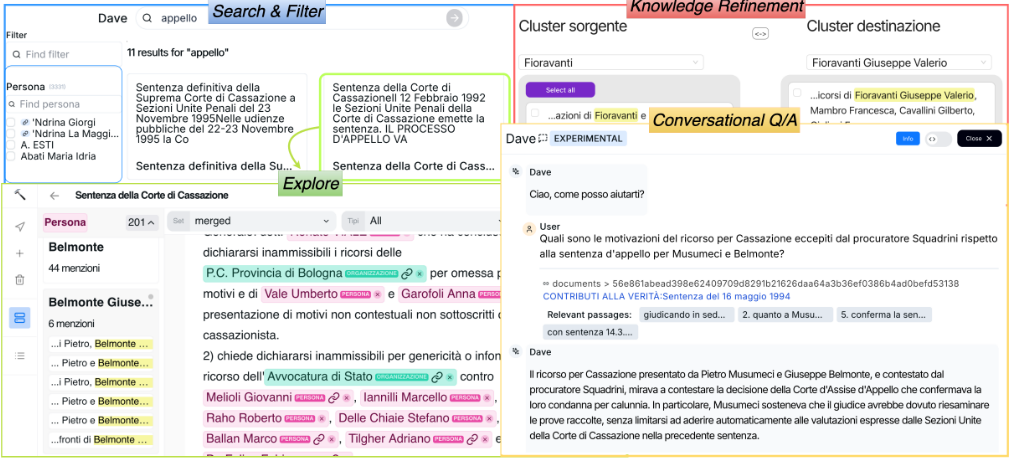
DAVE provides users with a number of functionalities to address the outlined requirements, which are discussed with examples in legal documents exploration (Figure 1):
- Search & Filter: Users can retrieve documents by entering keywords, which is ideal when they have a clear idea of what they are looking for. Additionally, they can refine their search results by applying multiple filters. For instance, users can filter the corpus based on specific individuals and locations. Figure illustrates the Search & Filter functionalities (the blue section), which allow users to retrieve documents by keyword and refine results through entity-based filters. For example, a user reviewing documents from a trial might search for the keyword "appeal". To narrow the focus, they could use the filtering panel on the left, which organizes filters by entity type (e.g., person, location). By selecting "Licio
1 https://github.com/unimib-datAI/DAVE
Gelli" from the list of identified entities, the user can dynamically refine the results, isolating only those documents where his name appears, with both the result set and available filters updating accordingly.
- Explore: Users can browse the full list of entities identified in each document and navigate directly to sections where they are referenced. In the figure, after selecting a document in the Search & Filter interface, it can be explored in detail via the Explore interface (green section). The entire document is shown with highlighted entity mentions based on type, and a list of entities grouped by mention appears on the left. For example, in the figure, the entity "Valerio Fioravanti" is mentioned 4 times. Clicking any mention takes the user directly to the corresponding text span.
- Conversational Question Answering (QA): Natural language queries are supported, allowing users to ask questions about entities and factual information across multiple documents. In the example (yellow section), the user asks the chatbot about the appeal grounds raised by Prosecutor Squadrini in the Musumeci and Belmonte case, and the DAVE chatbot responds with relevant document passages.
- Knowledge Refinement: Users can refine entity clusters, ensuring that corrections are reflected across all system functionalities. In the figure (red section), the user has identified that the entities "Corte d'Assise di Bologna" and "Corte di Assise di Bologna" with their respective mentions are actually equivalent, therefore is collapsing the two entity clusters into one.
DAVE also supports search composability, enabling users to combine Search, Filter, and Conversational Question Answering. By filtering results before querying the RAG-LLM
system, the chatbot works with a more focused document set, improving answer precision and relevance. Additionally, DAVE ensures data privacy through on-premise servers and access controls, crucial for sensitive domains.
By offering this suite of functionalities, DAVE enables precise control and in-depth understanding of large corpora, providing diverse exploration and search capabilities tailored to knowledge-intensive domains and specialized users. To this aim we implemented these functionalities by mixing the following techniques and technologies:
- Entity-centric management. Entity-level annotations are represented in the GATE format [Cunningham, 2002] and stored in a MongoDB database; the DB stores information about the annotations for every entity mentions, entity identifiers, and links between annotations and entity identifiers. The current prototype considers annotations resulting from pipelines that apply algorithms for NER, Named Entity Linking (with links to Wikipedia), NIL Prediction (to identify entities not represented in Wikipedia), and NIL Clustering (to cluster NIL entities and create identifiers for each cluster)[Pozzi et al., 2023a; Pozzi et al., 2023b; Bellandi et al., 2024]. As a result, each entity mention can be linked to an entity identifier, either external (e.g. a Wikipedia URI), or internal (identifying a local cluster). Each cluster is associated with a default surface form used to display the entities in the interface.
- Keyword and Faceted Search: The Search engine uses keyword matching to efficiently retrieve relevant documents and serves as the foundation for several other functionalities. To support the Search & Filter and Explore functionalities, DAVE employs the wellestablished faceted search paradigm. This technique provides filtering facets based on entities, allowing users to refine their search results. By providing a structured way to narrow down results, faceted search enhances the user's ability to explore large corpora. Users can apply filters either across the entire corpus or within a subset of documents for a more granular exploration.
- Human-in-the-Loop (HITL): The Knowledge Consolidation feature follows the HITL paradigm, ensuring continuous user involvement in refining the system. Users can correct and refine annotations and entity clusters, and these corrections are reflected across all system functionalities. This active participation helps the system improve over time, ensuring a pay-as-you-go consolidation of the background data as proposed for similar tasks [De Castilho et al., 2024; De Paoli et al., 2019; Cutrona et al., 2019; Cruz et al., 2016].
- Retrieval Augmented generation (RAG): The Conversational QA functionality is powered by an LLMbased chatbot, implemented through the RAG paradigm. This enables users to ask fact-based queries about entities across multiple documents. While LLMs excel in natural language understanding and zero-shot learning, RAG ensures responses are grounded in retrieved documents, addressing concerns about hallucinations and limited knowledge, which is crucial in certain domains.
3 Applications, Main Contributions and Demonstration
DAVE has been used in prototypes for Italian projects in the legal domain [Batini et al., 2024] with the goal of showing stakeholders AI-powered search functionalities, we have experimented DAVE in i) search on court decision in civil trials [Bellandi et al., 2024], ii) criminal investigations and chat analysis [Pozzi et al., 2025], and iii) analysis of the documentation about the Bologna massacre of August 2, 1980.
In relation with related work, we discuss below the three main novelties that we believe DAVE presents as a system:
- Mixing entity-driven faceted search and conversational assistant. Entity-driven faceted search is a mainstream technology in many knowledge-driven scenarios where documents are analyzed using entity extraction (EE) methods [Guo et al., 2023; Hirsch et al., 2021]. On the other hand, RAG systems on pre-filtered data have been studied, with approaches like agent-based filtering [Poliakov and Shvai, 2024], metadata-based filtering [Chang et al., 2024], and natural language inference [Yoran et al., 2023]. Our work combines faceted search with a RAG system, enabling dynamic, entitydriven document filtering.
- Integrating interactive entity-driven knowledge consolidation in an information exploration interface. Several platforms support text annotations, with Doccano [Nakayama et al., 2018] being widely used; Very recent work has surveyed interactive approaches to improve annotations, minimize user effort, manage annotation teams, support pre-annotated data, and enable customizable task design [De Castilho et al., 2024]. While we haven't fully integrated the advanced annotation quality methods from [Klie et al., 2020], our application is the first to integrate incorporate interactive methods editing into an exploratory search interface, focusing on improving entity clustering, a key challenge in end-to-end EE pipelines.
- Entity-centric RAG prototyping and grounding. Frameworks like LangChain [Chase, 2022] facilitate rapid prototyping and configuration of RAG systems, while tools such as RAGAS [Es et al., 2024] and RAGChecker [Ru et al., 2024] allow for detailed evaluation through a wide range of metrics. However, existing applications do not support the prototyping of highly entity-centric LLM-RAG systems that enable direct analysis of the corpus and its entities to verify factual accuracy, making effective debugging more challenging.
These innovations arise from the need for domain experts to thoroughly analyze and explore documents annotated by entity extraction pipelines, using established, user-friendly search paradigms and allowing experts to improve the system by refining annotations. A first quantitative evaluation where DAVE outputs are compared to outputs of top-tier models is ongoing in the context of a Civil Appeal Proceedings use case [Agazzi et al., 2024].
During the demonstration session, users are guided in exploring a document collection using DAVE's features.
Acknowledgments
The work has received funding from the European Union's Horizon Europe research and innovation programme under grant agreements No. 101189771 (DataPACT) and No. 101070284 (enRichMyData), and the European Community - Next Generation EU under the Italian Ministry of Justice, and the Italian PRIN project Discount Quality for Responsible Data Science (202248FWFS). We also thank "Associazione 2 Agosto 1980" for the useful discussions and their support for using their data in our demo.
@inproceedings{ijcai2025p1246,
  title     = {DAVE: A Framework for Assisted Analysis of Document Collections in Knowledge-Intensive Domains},
  author    = {Agazzi, Ruben and Alva Principe, Renzo and Pozzi, Riccardo and Ripamonti, Marco and Palmonari, Matteo},
  booktitle = {Proceedings of the Thirty-Fourth International Joint Conference on
               Artificial Intelligence, {IJCAI-25}},
  publisher = {International Joint Conferences on Artificial Intelligence Organization},
  editor    = {James Kwok},
  pages     = {10984--10988},
  year      = {2025},
  month     = {8},
  note      = {Demo Track},
  doi       = {10.24963/ijcai.2025/1246},
  url       = {https://doi.org/10.24963/ijcai.2025/1246},
}
TY - CPAPER TI - DAVE: A Framework for Assisted Analysis of Document Collections in Knowledge-Intensive Domains AU - Agazzi, Ruben AU - Alva Principe, Renzo AU - Pozzi, Riccardo AU - Ripamonti, Marco AU - Palmonari, Matteo T2 - Proceedings of the Thirty-Fourth International Joint Conference on Artificial Intelligence, IJCAI-25 PB - International Joint Conferences on Artificial Intelligence Organization PY - 2025 SP - 10984 EP - 10988 DO - 10.24963/ijcai.2025/1246 UR - https://doi.org/10.24963/ijcai.2025/1246 ER -Copied
Machine-readable versions of this paper, for tools and AI agents:





