
Machine Learning Driven Optimization of Fe-Based TMCs for Photodynamic Therapy
Proceedings of the Thirty-Fourth International Joint Conference on Artificial Intelligence. Demo Track. Pages 11091-11094.
https://doi.org/10.24963/ijcai.2025/1269
Keywords
- Multidisciplinary Topics and Applications: MTA: Physical sciences
- Machine Learning: ML: Generative models
- Machine Learning: ML: Reinforcement learning
- Multidisciplinary Topics and Applications: MTA: Energy, environment and sustainability
Abstract
Noble metal-based photoactive complexes have applications in photodynamic therapy (PDT), but their toxicity and high cost drive interest in sustainable and cheaper alternatives like iron-based compounds. In this paper, quantum chemistry and classical molecular dynamics were employed to characterize the photophysical properties and non-covalent interactions with DNA of two Fe(III) complexes. We explained the absorption of IR wavelength by bright ligand-to-metal transitions and showed that the complexes exhibit persistent, albeit modest, interaction with DNA. Building on these traditional simulation methods, we propose a conceptual ML-driven optimization module designed to refine the structure of iron complexes and enhance their photophysical features. While the framework is not yet implemented, we demonstrate that key properties relevant for PDT can be computationally evaluated, providing a foundation for future iterative optimization. The ML module integrates 3D molecular structures, simulation results, and quantum chemical insights to suggest modifications aimed at shifting the absorption spectrum more favorably into the visible range, improving their suitability for phototherapies.
- [Arcos, 2023] Ulises Alonso Carrillo Arcos. Iron-based pho- toactive complexes: control of geometry and electronic properties. PhD thesis, Université de Lorraine, 2023.
- [Balzani et al., 2007] Vincenzo Balzani, Giacomo Bergamini, Sebastiano Campagna, and Fausto Pun- toriero. Photochemistry and photophysics of coordination compounds: overview and general concepts. Springer, 2007.
- [Bouché et al., 2020] Mathilde Bouché, Cécilia Hognon, Stéphanie Grandemange, Antonio Monari, and Philippe C Gros. Recent advances in iron-complexes as drug can- didates for cancer therapy: Reactivity, mechanism of ac- tion and metabolites. Dalton Transactions, 49(33):11451- 11466, 2020.
- [Case et al., 2023] David A Case, Hasan Metin Aktulga, Kellon Belfon, David S Cerutti, G Andrés Cisneros, Vinícius Wilian D Cruzeiro, Negin Forouzesh, Timothy J Giese, Andreas W Götz, Holger Gohlke, et al. Amber- tools. Journal of chemical information and modeling, 63(20):6183-6191, 2023.
- [Francés-Monerris et al., 2019] Antonio Francés-Monerris, Philippe C Gros, Xavier Assfeld, Antonio Monari, and Mariachiara Pastore. Toward luminescent iron complexes: unravelling the photophysics by computing potential en- ergy surfaces. ChemPhotoChem, 3(9):666-683, 2019.
- [Frisch et al., 2016] MJ Frisch, GW Trucks, HB Schlegel, GE Scuseria, MA Robb, JR Cheeseman, G Scalmani, V Barone, GA Petersson, H Nakatsuji, et al. Gaussian16; gaussian, inc. Wallingford, CT, 2016.
- [Jin and Merz Jr, 2024] Hongni Jin and Kenneth M Merz Jr. Liganddiff: de novo ligand design for 3d transition metal complexes with diffusion models. Journal of Chemical Theory and Computation, 2024.
- [Kashyap and Ghasemi, 2020] Varun Kashyap and Hadi Ghasemi. Solar heat localization: concept and emerg- ing applications. Journal of materials chemistry A, 8(15):7035-7065, 2020.
- [Kjær et al., 2019] Kasper Skov Kjær, Nidhi Kaul, Om Prakash, Pavel Chábera, Nils W Rosemann, Alireza Honarfar, Olga Gordivska, Lisa A Fredin, Karl-Erik Bergquist, Lennart Häggström, et al. Luminescence and reactivity of a charge-transfer excited iron complex with nanosecond lifetime. Science, 363(6424):249-253, 2019.
- [Lawson Daku et al., 2005] Latévi Max Lawson Daku, Al- fredo Vargas, Andreas Hauser, Antony Fouqueau, and Mark Earl Casida. Assessment of density functionals for the high-spin/low-spin energy difference in the low-spin iron (ii) tris (2, 2'-bipyridine) complex. ChemPhysChem, 6(7):1393-1410, 2005.
- [Monro et al., 2018] Susan Monro, Katsuya L Colon, Huimin Yin, John Roque III, Prathyusha Konda, Shashi Gujar, Randolph P Thummel, Lothar Lilge, Colin G Cameron, and Sherri A McFarland. Transition metal com- plexes and photodynamic therapy from a tumor-centered approach: challenges, opportunities, and highlights from the development of tld1433. Chemical reviews, 119(2):797-828, 2018.
- [Nazeeruddin et al., 2001] Mohammad K Nazeeruddin, Pe- ter Pechy, Thierry Renouard, Shaik M Zakeeruddin, Robin Humphry-Baker, Pascal Comte, Paul Liska, Le Cevey, Emiliana Costa, Valery Shklover, et al. Engineering of efficient panchromatic sensitizers for nanocrystalline tio2- based solar cells. Journal of the American Chemical Soci- ety, 123(8):1613-1624, 2001.
- [Plasser, 2020] Felix Plasser. Theodore: A toolbox for a de- tailed and automated analysis of electronic excited state computations. The Journal of chemical physics, 152(8), 2020.
- [Reiher et al., 2001] Markus Reiher, Oliver Salomon, and Bernd Artur Hess. Reparameterization of hybrid func- tionals based on energy differences of states of different multiplicity. Theoretical Chemistry Accounts, 107:48-55, 2001.
- [Reiher, 2002] Markus Reiher. Theoretical study of the fe (phen) 2 (ncs) 2 spin-crossover complex with reparametrized density functionals. Inorganic chemistry, 41(25):6928-6935, 2002.
- [Wenger, 2019] Oliver S Wenger. Is iron the new ruthenium? Chemistry-A European Journal, 25(24):6043-6052, 2019.
- [Xia and Yang, 2017] Younan Xia and Xuan Yang. Toward cost-effective and sustainable use of precious metals in heterogeneous catalysts. Accounts of Chemical Research, 50(3):450-454, 2017.
- [Xu et al., 2023] Pengcheng Xu, Tao Feng, Tianfan Fu, Sid- dhartha Laghuvarapu, and Jimeng Sun. Molecular de novo design through transformer-based reinforcement learning. arXiv preprint arXiv:2310.05365, 2023.
- [Zheng et al., 2016] Suqing Zheng, Qing Tang, Jian He, Shiyu Du, Shaofang Xu, Chaojie Wang, Yong Xu, and Fu Lin. Vffdt: a new software for preparing amber force field parameters for metal-containing molecular sys- tems. Journal of chemical information and modeling, 56(4):811-818, 2016.
References were extracted automatically from the PDF and may contain errors.
Full text extracted automatically from the PDF; figures, tables and equations may differ. The PDF is the version of record.
1 Introduction
Solar energy is a promising alternative to fossil fuels due to its abundance and renewable nature [Kashyap and Ghasemi, 2020], and with the help of photovoltaics it can be converted to electricity [Nazeeruddin et al., 2001] and chemical energy. Transition metal complexes (TMSc), especially those based on nobel metals, are widely used for solar cells, artificial photosynthesis, bioimaging, and photodynamic therapy due to their remarkable photophysical properties [Balzani et al., 2007]. These precious metals, however, are very rare [Xia and Yang, 2017], which stimulates the search for alternative solutions, such as iron. Despite its abundance and lower toxicity, iron is inferior in photophysical properties, because ironbased complexes have lower ligand field and unstable excited states [Wenger, 2019]. Nonetheless, recent progress in prolonging excited state lifetimes in iron-based TMCs opens avenues for efficient photoactive complexes [Kjær et al., 2019].
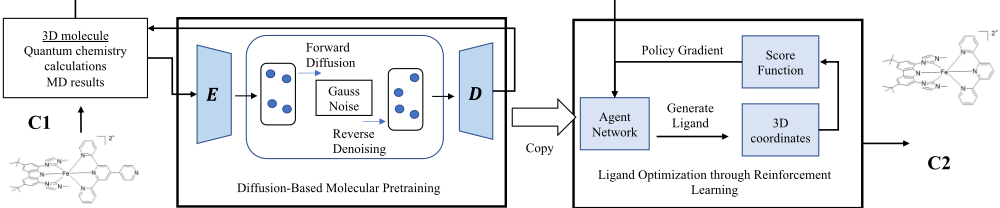
The photophysics of transition metal complexes plays a key role in their applications. Metal-organic complexes containing π -conjugated ligands have 4 main electronic excited states: ligand-centered (LC), metal-centered (MC), charge transfers from ligand to metal (LMCT), and from metal to ligand (MLCT) [Franc´es-Monerris et al., 2019]. A strong ligand field in Ru complexes results in the destabilization of triplet and quintet MC states, which results in long-lived MLCT states. In the case of iron-containing complexes, the situation is different: due to the weak ligand field, the MC states are lower in energy, which leads to rapid (subpicosecond) deactivation of MLCT and the impossibility of effective use of such compounds in photoactive processes. Recent advances in ligand design, such as the use of strong σ -donor and π -acceptor properties, have extended MLCT lifetimes, making Fe-based complexes viable for photoactive applications. On the other hand, highly symmetric coordination spheres (close to the ideal octahedral disposition) achieved with proper chelating ligands could also destabilize excitedstate deactivation through MC states. We rely on the latter strategy and consider two heteroleptic iron complexes (C1 and C2) (Figure 1) synthetized and characterized by Carrillo and colleagues [Arcos, 2023].
One of the applications of photoactive molecules is PDT, a targeted cancer treatment, which is based on the combined action of a drug and molecular oxygen [Monro et al., 2018]. Upon light irradiation, the excited state can be deactivated through electron or energy transfer to molecular oxygen, which results in reactive oxygen species (ROS). The highly active molecules are reactive towards DNA and cause cell apoptosis. TMCs are very suitable photosensitizers because of their stability, biocompatibility, high absorption within the relative rate of tissue transparency (700-1100 nm) and high triplet state quantum yield [Monro et al., 2018].
Finding the optimal Fe-based photosensitizer for PDT [Bouch´e et al., 2020] can be challenging due to the multiple objectives of the optimization problem and the need for experimental validation. We propose a conceptual ML-driven optimization method to iteratively adjust the molecule. The goal is to achieve a shift in the absorption spectrum toward visible range, thereby enhancing performance in photodynamic therapy, while maintaining key attributes, such as DNA affinity.
2 Proposed Framework
In this section, we present our conceptual ML-driven framework for the iterative optimization of iron-based TMCs, aimed at shifting the absorption spectrum toward the visible range while preserving DNA affinity. While the diffusionmodel-based agent has not yet been implemented, we outline a framework that leverages computationally accessible properties. The framework comprises two core modules: an agent module based on a conditioned diffusion model, and a scoring module, inspired by REINVENT-Transformer [Xu et al., 2023]. The process begins with an initial Fe-based complex (e.g., C1), whose absorption wavelength and DNA binding properties are evaluated using established methods (TDDFT, MD). At the heart of the framework is an agent built on a pretrained diffusion model, adapted from LigandDiff [Jin and Merz Jr, 2024]. The candidate structures are evaluated using TDDFT and MD, and a score is computed as the difference between the desired and the calculated properties. This score guides the agent in generating further modifications. To illustrate the framework, we present results from two ironbased complexes, C1 and C2. C2 is featuring a refined ligand and exhibits a shifted absorption wavelength consistent with our optimization targets, while retaining stable DNA affinity, serving as an example of a model output.
3 Results
3.1 QuantumChemistry
A starting complex is iteratively optimized to shift the absorption wavelength while keeping key PDT features stable. We briefly describe results for complexes C1 and C2.
One of the challenges computational chemists face when studying Fe-based TMCs is the correct determination of the ground state (GS) [Lawson Daku et al., 2005]. For these 100-atom complexes, DFT is suitable, although functionals inconsistently predict the GS. To alleviate these deficiencies, Reiher and coworkers introduced a reparameterization of the B3LYP functional specifically for Fe complexes - B3LYP* functional with reduced (from 20 % to 15%) admixture of the Hartree-Fock exchange [Reiher, 2002; Reiher et al., 2001]. B3LYP and B3LYP* functionals in combination with different basis sets reveal S0 and D1 as the GS for both C1 and C2 systems, respectively. The GAUSSIAN 16 [Frisch et al., 2016] software package has been used in all quantummechanical calculations.
| Functional | VAE (eV) | λ (nm) | f | ⟨ ˆ S2 ⟩ |
|---|---|---|---|---|
| BLYP | 1.6848 | 735.89 | 0.1808 | 0.891 |
| HCTH | 1.6784 | 738.70 | 0.1194 | 1.509 |
| M06 | 1.6899 | 733.66 | 0.1480 | 0.934 |
| M06-2X | 2.7039 | 458.53 | 0.0911 | 1.483 |
| PBE0 | 1.8645 | 664.96 | 0.1341 | 1.145 |
| B3LYP | 1.7062 | 726.68 | 0.1515 | 1.031 |
| B3LYP* | 1.6634 | 745.37 | 0.1484 | 1.140 |
| CAM-B3LYP | 2.152 | 576.22 | 0.1294 | 0.919 |
We benchmarked various exchange-correlation functionals and basis sets for C1's key spectroscopic characteristics against B3LYP*. We have studied the following functionals in the benchmark: BLYP, HCTH, M06, M06-2X, PBE0, B3LYP, and CAM-B3LYP, and compiled vertical absorption energies (VAEs), oscillator strengths (f ) and the expectation value of the total spin operator. In the case of the C2 complex, the brightest state D5 lies in the infra-red region, f = 0.1484 and λ = 745 nm (Table 1). The expectation value for the total spin operator is 1.14, which is comparable with an ideal value of 0.75 for a doublet. The results for the C1 complex are similar: the brightest state is again D5, f =0.1614 and λ = 757 nm. The total spin operator is 1.325, indicative of a slightly larger mixing with higher spin states as compared to the bright state of C2.
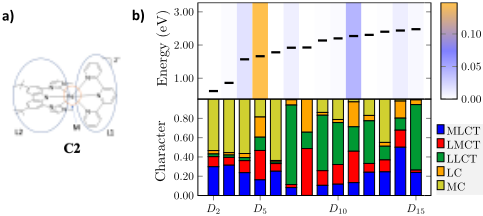
To understand the nature of the involved excited states, their density matrices obtained with the TD-B3LYP*/631G* method were analyzed utilizing the TheoDORE package [Plasser, 2020]. Results for C2 are presented in Figure 2. The excitation energies and oscillator strengths are given as colored shading. The representation shows that the brightest state is D5, which has a strongly pronounced LMCT character Energy (eV)
Character
3.00
2.00
1.00
0.80
0.60
0.40
0.20
0.00
D2 D5
3.00
3.00
0.00
State D2 D5
D10
State D15
D20
D25
D20
D2 D5 D10 D15 Figure 2: Fragment-based analysis of excited-states in C2 using TheoDORE reveals key LMCT contributions in C2. Molec-
State
State
ular structure (a) of the C2 molecule and its decomposition into
three fragments; (b) excitation energies and oscillator strengths and
excited-state character, automatically assigned using the CT num-
bers
and mixing with LC and LLCT, as shown by the CT numbers. The impact of the pyridine substitution from C2 to C1 on the absorption properties is small.
3.2 Molecular Dynamics
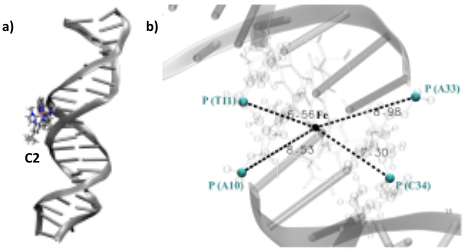
MD simulations rely on a force field to compute forces and equations of motion to describe particle dynamics. The force field must be parametrized, typically against experimental or high-level computational data. We assigned standard AMBER atom types to all ligands and unique atom types to each Fe-ligating atom, and generated the corresponding parameters with VFFDT [Zheng et al., 2016]. All-atom classical MD simulations of complex C2 with a DNA oligonucleotide were conducted to investigate non-covalent interactions by using Amber software [Case et al., 2023]. We visually inspected equilibrium dynamics and used Umbrella Sampling to determine the free binding energy. A 0.5 microsecond equilibruim dynamics simulation showed that C2 interacts with the DNA minor groove for 451.2 ns and remains unbound for 48.8 ns. Figure 3a shows the tert-butyl ligand in the minor groove, with a methyl group oriented toward the DNA. Figure 3b displays the Fe-P distances. Electrostatic forces dominate, as C2's di-cation interacts with the negatively charged phosphate backbone. Small Fe-P fluctuations indicate a stable interaction.
Binding free energy (∆G) was calculated by comparing D20
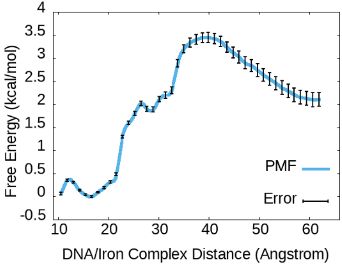
the free energies of the bound state (15-20 ˚A, where free energy is minimal) and the unbound state (50 ˚A, with no contact). The frequency diagram for 42 windows showed excellent sample overlap, validating the simulation (bias: 1 kcal ·mol-1 · ˚A-2 ). Figure 4's PMF indicates a favorable interaction with an estimated (∆G) of 2 kcal/mol, corresponding to 96 % binding at 310.15 K
The unbound-to-bound transition has a ∼ 1.5kcal/mol barrier (peaking at ∼ 40 ˚A), while the reverse path has a ∼ 3.5 kcal/mol barrier; both are accessible at 310.15 K.
Despite modest binding affinity, C2 remains close to DNA, suggesting that efficiently generated short-lived ROS could reach DNA for PDT.
4 Conclusion
In summary, this study presents an conceptual computational framework that combines quantum chemical calculations, molecular dynamics simulations, and a machine learningdriven optimization module to design and refine Fe-based transition metal complexes for PDT. Our analysis reveals that the near-IR absorption is primarily governed by the LMCT states. Furthermore, the molecular dynamics simulations indicate that while the complexes exhibit modest binding affinities to the DNA, they remain in close proximity, a key feature for effective ROS mediated damage in PDT.
The proposed ML-driven framework, though not yet implemented, demonstrates a feasible approach to iteratively tailor ligand structures by leveraging rich simulation data. Our work establishes a foundation for future optimization, showing that key PDT-relevant properties can be computationally evaluated and used to guide molecular design.
Overall, our work not only advances the fundamental understanding of the photophysical and binding properties of Fe-based complexes but also lays the foundation for future studies aimed at optimizing these compounds for practical PDT applications.
Acknowledgements
The work of Ilya Makarov on Section 1 was supported by the Ministry of Economic Development of the RF (code 25-13966879-1-0003).
0.00
@inproceedings{ijcai2025p1269,
  title     = {Machine Learning Driven Optimization of Fe-Based TMCs for Photodynamic Therapy},
  author    = {Manuilov, Vladimir and Francés-Monerris, Antonio and Abdelgawwad, Abdelazim M.A. and Escudero, Daniel and Makarov, Ilya},
  booktitle = {Proceedings of the Thirty-Fourth International Joint Conference on
               Artificial Intelligence, {IJCAI-25}},
  publisher = {International Joint Conferences on Artificial Intelligence Organization},
  editor    = {James Kwok},
  pages     = {11091--11094},
  year      = {2025},
  month     = {8},
  note      = {Demo Track},
  doi       = {10.24963/ijcai.2025/1269},
  url       = {https://doi.org/10.24963/ijcai.2025/1269},
}
TY - CPAPER TI - Machine Learning Driven Optimization of Fe-Based TMCs for Photodynamic Therapy AU - Manuilov, Vladimir AU - Francés-Monerris, Antonio AU - Abdelgawwad, Abdelazim M.A. AU - Escudero, Daniel AU - Makarov, Ilya T2 - Proceedings of the Thirty-Fourth International Joint Conference on Artificial Intelligence, IJCAI-25 PB - International Joint Conferences on Artificial Intelligence Organization PY - 2025 SP - 11091 EP - 11094 DO - 10.24963/ijcai.2025/1269 UR - https://doi.org/10.24963/ijcai.2025/1269 ER -Copied
Machine-readable versions of this paper, for tools and AI agents:





