
PyTorch-Lifestream: Learning Embeddings on Discrete Event Sequences
Proceedings of the Thirty-Fourth International Joint Conference on Artificial Intelligence. Demo Track. Pages 11104-11108.
https://doi.org/10.24963/ijcai.2025/1272
Keywords
- Machine Learning: ML: Self-supervised Learning
- Machine Learning: ML: Benchmarks
- Machine Learning: ML: Sequence and graph learning
- Machine Learning: ML: Unsupervised learning
Abstract
The domain of event sequences is widely applied in various industrial tasks in banking, healthcare, etc., where temporal tabular data processing is required. This paper introduces PyTorch-Lifestream, the first open-source library specially designed to handle event sequences. It supports scenarios with multimodal data and offers a variety of techniques for learning embeddings of event sequences and end-to-end model training. Furthermore, PyTorch-Lifestream efficiently implements state-of-the-art methods for event sequence analysis and adapts approaches from similar domains, thus enhancing the versatility and performance of sequence-based models for a wide range of applications, including financial risk scoring, campaigning, user ID matching, churn prediction, fraud detection, medical diagnostics, and recommender systems.
- [Alexandrov et al., 2020] Alexander Alexandrov, Kon- stantinos Benidis, Michael Bohlke-Schneider, Valentin Flunkert, Jan Gasthaus, Tim Januschowski, Danielle C. Maddix, Syama Rangapuram, David Salinas, Jasper Schulz, Lorenzo Stella, Ali Caner Türkmen, and Yuyang Wang. GluonTS: Probabilistic and Neural Time Series Modeling in Python. Journal of Machine Learning Research, 21(116):1-6, 2020.
- [Apache Arrow, 2016] Apache Software Foundation Apache Arrow. Apache arrow, 2016.
- [Babaev et al., 2022] Dmitrii Babaev, Nikita Ovsov, Ivan Kireev, Maria Ivanova, Gleb Gusev, Ivan Nazarov, and Alexander Tuzhilin. CoLES: Contrastive learning for event sequences with self-supervision. In Proceedings of the 2022 International Conference on Management of Data, SIGMOD/PODS '22. ACM, June 2022.
- [Bacry et al., 2017] E. Bacry, M. Bompaire, S. Gaïffas, and S. Poulsen. tick: a Python library for statistical learning, with a particular emphasis on time-dependent modeling. ArXiv e-prints, July 2017.
- [Baevski et al., 2020] Alexei Baevski, Henry Zhou, Abdel- rahman Mohamed, and Michael Auli. wav2vec 2.0: a framework for self-supervised learning of speech repre- sentations. In Proceedings of the 34th International Con- ference on Neural Information Processing Systems, NIPS '20, Red Hook, NY, USA, 2020.
- Curran Associates Inc. [Bardes et al., 2021]
- Adrien Bardes, Jean Ponce, and Yann LeCun. Vicreg: Variance-invariance-covariance regu- larization for self-supervised learning. arXiv preprint arXiv:2105.04906, 2021.
- [Bazarova et al., 2025] Alexandra Bazarova, Maria Koval- eva, Ilya Kuleshov, Evgenia Romanenkova, Alexander Stepikin, Aleksandr Yugay, Dzhambulat Mollaev, Ivan Kireev, Andrey Savchenko, and Alexey Zaytsev. Learning transactions representations for information management in banks: Mastering local, global, and external knowl- edge. International Journal of Information Management Data Insights, 5(1):100323, 2025.
- [Boosters, 2025a] Boosters. Alfa Battle 2 Overview, 2025. [Online; accessed 11-February-2025].
- [Boosters, 2025b] Boosters. Rosbank Challenge 1 Overview, 2025. [Online; accessed 11-February-2025].
- [Bromley et al., 1993] Jane Bromley, Isabelle Guyon, Yann LeCun, Eduard Säckinger, and Roopak Shah. Signature verification using a "Siamese" time delay neural network. Advances in neural information processing systems, 6, 1993.
- [Chen et al., 2020] Ting Chen, Simon Kornblith, Moham- mad Norouzi, and Geoffrey E. Hinton. A simple frame- work for contrastive learning of visual representations. ArXiv, abs/2002.05709, 2020.
- [Clark, 2020] K Clark. Electra: Pre-training text encoders as discriminators rather than generators. arXiv preprint arXiv:2003.10555, 2020.
- [Devlin et al., 2019] Jacob Devlin, Ming-Wei Chang, Ken- ton Lee, and Kristina Toutanova. BERT: Pre-training of deep bidirectional transformers for language understand- ing. In Jill Burstein, Christy Doran, and Thamar Solorio, editors, Proceedings of the 2019 Conference of the North American Chapter of the Association for Computational Linguistics: Human Language Technologies, Volume 1 (Long and Short Papers), pages 4171-4186, Minneapo- lis, Minnesota, June 2019. Association for Computational Linguistics.
- [Gorishniy et al., 2022] Yury Gorishniy, Ivan Rubachev, and Artem Babenko. On embeddings for numerical features in tabular deep learning. Advances in Neural Information Processing Systems, 35:24991-25004, 2022.
- [Hoffer and Ailon, 2015] Elad Hoffer and Nir Ailon. Deep metric learning using triplet network. In Similarity-based pattern recognition: third international workshop, SIM- BAD 2015, Copenhagen, Denmark, October 12-14, 2015. Proceedings 3, pages 84-92. Springer, 2015.
- [Karpukhin et al., 2024] Ivan Karpukhin, Foma Shipilov, and Andrey Savchenko. Hotpp benchmark: Are we good at the long horizon events forecasting?, 2024.
- [Liu et al., 2019] Yinhan Liu, Myle Ott, Naman Goyal, Jingfei Du, Mandar Joshi, Danqi Chen, Omer Levy, Mike Lewis, Luke Zettlemoyer, and Veselin Stoyanov. Roberta: A robustly optimized bert pretraining approach, 2019. [Mollaev et al., 2024] Dzhambulat Mollaev, Alexander Kostin, Maria Postnova, Ivan Karpukhin, Ivan A Kireev, Gleb Gusev, and Andrey Savchenko. Multimodal bank- ing dataset: Understanding client needs through event sequences, 2024.
- [Musgrave et al., 2020] Kevin Musgrave, Serge J. Belongie, and Ser-Nam Lim. Pytorch metric learning. ArXiv, abs/2008.09164, 2020.
- [ODS.AI, 2025] ODS.AI. Sberbank Sirius Lesson Competi- tion, 2025. [Online; accessed 11-February-2025].
- [Oord et al., 2018] Aaron van den Oord, Yazhe Li, and Oriol Vinyals. Representation learning with contrastive predic- tive coding. arXiv preprint arXiv:1807.03748, 2018.
- [Padhi et al., 2021] Inkit Padhi, Yair Schiff, Igor Melnyk, Mattia Rigotti, Youssef Mroueh, Pierre Dognin, Jerret Ross, Ravi Nair, and Erik Altman. Tabular transformers for modeling multivariate time series. In Proceedings of International Conference on Acoustics, Speech and Signal Processing (ICASSP), pages 3565-3569. IEEE, 2021.
- [Pedregosa et al., 2011] Fabian Pedregosa, Gaël Varoquaux, Alexandre Gramfort, Vincent Michel, Bertrand Thirion, Olivier Grisel, Mathieu Blondel, Peter Prettenhofer, Ron Weiss, Vincent Dubourg, et al. Scikit-learn: Machine learning in python. Journal of machine learning research, 12(Oct):2825-2830, 2011.
- [Radford et al., 2019] Alec Radford, Jeffrey Wu, Rewon Child, David Luan, Dario Amodei, Ilya Sutskever, et al. Language models are unsupervised multitask learners. OpenAI blog, 1(8):9, 2019.
- [Tavenard et al., 2020] Romain Tavenard, Johann Faouzi, Gilles Vandewiele, Felix Divo, Guillaume Androz, Chester Holtz, Marie Payne, Roman Yurchak, Marc Rußwurm, Kushal Kolar, and Eli Woods. Tslearn, a ma- chine learning toolkit for time series data. Journal of Ma- chine Learning Research, 21(118):1-6, 2020.
- [Vasilev et al., 2024] Alexey Vasilev, Anna Volodkevich, Denis Kulandin, Tatiana Bysheva, and Anton Klenitskiy. Replay: a recommendation framework for experimenta- tion and production use. In 18th ACM Conference on Rec- ommender Systems, RecSys '24, page 1191-1194. ACM, October 2024.
- [Wang, 2020] Phil Wang. x-transformers: A flexible trans- former implementation in pytorch, 2020. GitHub reposi- tory.
- [Wolf, 2019] T Wolf. Huggingface's transformers: State- of-the-art natural language processing. arXiv preprint arXiv:1910.03771, 2019.
- [Yugay and Zaytsev, 2024] Aleksandr Yugay and Alexey Za- ytsev. Uniting contrastive and generative learning for event sequences models. ArXiv, abs/2408.09995, 2024.
- [Zbontar et al., 2021] Jure Zbontar, Li Jing, Ishan Misra, Yann LeCun, and Stéphane Deny. Barlow twins: Self- supervised learning via redundancy reduction. In Inter- national conference on machine learning, pages 12310- 12320. PMLR, 2021.
- [Zhao et al., 2022] Wayne Xin Zhao, Yupeng Hou, Xingyu Pan, Chen Yang, Zeyu Zhang, Zihan Lin, Jingsen Zhang, Shuqing Bian, Jiakai Tang, Wenqi Sun, Yushuo Chen, Lanling Xu, Gaowei Zhang, Zhen Tian, Changxin Tian, Shanlei Mu, Xinyan Fan, Xu Chen, and Ji-Rong Wen. Recbole 2.0: Towards a more up-to-date recommendation library. In CIKM, pages 4722-4726. ACM, 2022.
- [Zong et al., 2024] Yongshuo Zong, Oisin Mac Aodha, and Timothy Hospedales. Self-supervised multimodal learn- ing: A survey. IEEE Transactions on Pattern Analysis and Machine Intelligence, 2024.
References were extracted automatically from the PDF and may contain errors.
Full text extracted automatically from the PDF; figures, tables and equations may differ. The PDF is the version of record.
1 Introduction
In a broad range of real-world applications, including finance, healthcare, risk assessment, e-commerce, and telecommunications, information is processed in the form of tabular time series [Padhi et al., 2021], i.e., event sequences [Babaev et al., 2022], where each event is characterized by its timestamp and attributes. Such events include financial transactions (with attributes like MCC code, amount, etc.), medical visits (attributes: diagnosis, ICD code, analysis results), customer interactions, and online actions like clicks or purchases.
There exist many frameworks for working with such data, such as recommender systems [Zhao et al., 2022; Vasilev et al., 2024] and temporal point processes [Bacry et al., 2017; Karpukhin et al., 2024]. Both are designed to predict the next event type, user action, or item interaction. However, many applications of sequential data go beyond next-event prediction. Some tasks focus on individual events, such as fraud detection in transactions. In contrast, others require modeling entire event sequences, such as classifying full event streams, refining customer segmentation, or scoring user behavior. Frameworks designed exclusively for next-event prediction are often insufficient for these broader challenges, limiting their applicability in domains that require a more comprehensive approach to event sequence modeling.
Frameworks for other similar domains, multivariate time series [Tavenard et al., 2020; Alexandrov et al., 2020] or text processing [Wolf, 2019], though provide exceptional performance in sequence modeling, cannot be directly applied to event sequence processing. Indeed, they rely on regularly spaced data, where observations or text tokens occur at fixed intervals. In contrast, event sequences are inherently irregular, with varying time between events. Moreover, events in sequence may contain a mix of numerical and categorical fea-
Large organizations typically have vast amounts of event data, enabling unsupervised/self-supervised learning (SSL) techniques to learn meaningful embeddings. Since only a small fraction is labeled, the typical pipeline involves training embeddings of event sequences, which are then utilized for downstream classification and regression tasks [Bazarova et al., 2025]. However, frameworks specifically designed for this purpose, such as SimCLR [Chen et al., 2020], often focus on narrow methodological aspects and do not provide a general framework for learning event representations.
As a result, practitioners working with event sequences often rely on general-purpose libraries like pandas or PySpark for feature engineering and preprocessing, followed by training models using deep learning frameworks such as PyTorch or TensorFlow. However, this approach requires significant adaptation, as these tools offer highly general-purpose functionality, whereas handling event sequences necessitates specialized solutions. This increases development time and model complexity and results in inefficiencies during both model creation and inference processes.
To bridge this gap, we introduce PyTorch-Lifestream (PTLS) 1 , an open-source library 2 explicitly designed for learning embeddings of event sequences. Unlike existing solutions that primarily focus on explicit predictive tasks, our library is optimized for learning informative sequence embeddings that can be used across various downstream applications, such as customer segmentation, anomaly detection, and forecasting. The library supports multimodal event sequences, including transactions, clickstreams, and geolocation data [Mollaev et al., 2024], offering a unified and efficient approach to representation learning.
1 Lifestream is a concept for processing sequential events that represent a subject's "stream of life"
2 https://github.com/pytorch-lifestream/pytorch-lifestream
A key advantage of PyTorch-Lifestream is its flexible and modular design, allowing users to adapt the framework to diverse tasks and model architectures swiftly. The library offers a configurable pipeline that supports various sequence encoders, training objectives, and inference strategies. A video demonstrating its usage is available at 3 .
2 PyTorch-LifestreamOverview
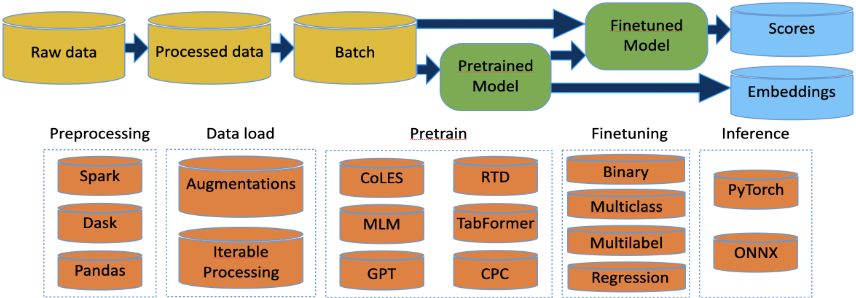
PyTorch-Lifestream offers a complete model development pipeline, enabling them to derive embeddings or scores for downstream tasks directly from raw data. Built on top of PyTorch Lightning, it is designed to be modular and easily extendable. This foundation simplifies distributed training, experiment reproducibility, and integration of custom components, such as additional checkpoints, evaluation metrics, and training logic. The library implements three core stages in the modeling process: preprocessing, training using SSL followed by fine-tuning, and inference (Figure 1).
PyTorch-Lifestream is a highly flexible framework that has been successfully deployed in real-world industrial scenarios involving millions of users. Its modular architecture and scalable data pipeline support make it well-suited for large-scale applications such as financial scoring, churn prediction, and user modeling. Details about our framework are provided in the following Subsections.
2.1 Preprocessing and Data Loading
In most business systems, data is stored in a "event-per-row" format, with several categorical and numerical features accompanying each action. However, this format makes it challenging to leverage such data in machine learning, as it lacks an explicit sequence structure.
In PyTorch-Lifestream, this shortcoming is addressed by various preprocessors that transform raw data into sequencefriendly formats and provide functions for handling categorical, numerical, and temporal features. These preprocessors support the fit-transform interface, similar to scikit-learn[Pedregosa et al., 2011], ensuring seamless integration into machine learning pipelines. For instance, PTLS includes a FrequencyEncoder component to efficiently convert the original categories into a training-ready format through frequencybased encoding. The library provides three preprocessors, each employing different toolsets for working with tabular data: pandas, Dask, and PySpark. After all transformations, a table is generated in the "sequence-per-row" format.
To improve computational efficiency, PTLS enables structured storage of preprocessed data in the Parquet format, which provides efficient compression and rapid retrieval into memory [Apache Arrow, 2016].
The framework offers an extensible Dataset interface that supports map-style and iterable-style datasets, facilitating flexible data handling strategies. This dual-mode support allows seamless adaptation to large-scale datasets that exceed memory constraints. Various options are available to transform raw data during loading. Users can limit the number of events, select a random data slice, shuffle the sequence of events, etc.
3 https://youtu.be/C1opqDCIfhI
2.2 Model Architecture
Our framework employs two key architectural components: the event encoder (TrxEncoder) and the sequence encoder (SeqEncoder). TrxEncoder consists of an embedding layer for categorical features and normalization for numerical features. The embeddings of categorical and numerical features are concatenated and passed through a linear layer. Custom numerical feature processing can be implemented. For example, to apply a custom piecewise linear encoding for numerical features [Gorishniy et al., 2022], it is sufficient to pass it as a scaler argument to TrxEncoder, allowing seamless integration of advanced feature engineering techniques.
Two main architectures are implemented for SeqEncoder: RNN (Recurrent Neural Network) and Transformer. The library supports modular replacement of standard sequence encoders with more advanced architectures. For instance, the SeqEncoder can use state-of-the-art transformers from Hugging Face [Wolf, 2019] or the x-transformers [Wang, 2020] library. This ensures seamless integration with popular Transformer-based architectures.
As some tasks require an embedding for each token in the input sequence, while others require a single embedding for the entire sequence, a parameter (is reduce sequence) controls this behavior. When set to true, the model outputs a single embedding suitable for predicting a single label. Otherwise, the model produces an embedding for each input token, enabling sequence-level processing.
PTLS also provides functionality for working with multimodal data, including a built-in method for early fusion [Zong et al., 2024], which enables combining different modalities by using separate TrxEncoders for each modality and a shared SeqEncoder. Multimodality in sequential data allows the model to integrate information from clickstream, transactions, and other contextual interactions, leading to a more comprehensive understanding of user activity.
2.3 ImplementedMethods
PyTorch-Lifestream implements various state-of-the-art pretraining methods for event sequences, for example:
- CoLES [Babaev et al., 2022] and its modifications: the library provides a wide range of samplers and loss functions for contrastive learning, including conventional contrastive loss [Bromley et al., 1993], triplet loss [Hoffer and Ailon, 2015], and InfoNCE [Oord et al., 2018]. Additionally, regularization techniques such as VicReg [Bardes et al., 2021] and Barlow Twins [Zbontar et al., 2021] are supported, allowing for training embeddings without negative examples.
- GPT-2 [Radford et al., 2019]: prediction of all categorical features of the next event.
- MLM (Masked Language Modeling) [Devlin et al., 2019; Liu et al., 2019]: the event embedding is masked at the event encoder output, as implemented in [Baevski et al., 2020; Yugay and Zaytsev, 2024]. The neural network is trained to reconstruct the masked embedding us-
ing a contrastive loss function. Additionally, the loss of NSP (next sentence prediction) can be used.
- RTD (Replace Token Detection): the library employs a simplified version of the architecture proposed in [Clark, 2020]. TrxEncoder is used as the encoder in our implementation, and the replaced token is randomly selected from the batch.
- TabFormer [Padhi et al., 2021]: a portion of event features is masked and subsequently reconstructed during model training.
- CPC (Contrastive Predictive Coding) [Oord et al., 2018]: during training, the next n embeddings produced by the event encoder are predicted.
Moreover, we support flexible loss functions. Users are not restricted to built-in loss functions. They can leverage specialized metric learning libraries such as PyTorch Metric Learning [Musgrave et al., 2020] or SSL libraries to incorporate modern loss functions.
A dedicated class, SequenceToTarget, fine-tunes the model, enabling further training for classification, regression, and other tasks. This class supports both training models from scratch and fine-tuning pre-trained models, allowing users to leverage prior knowledge encoded in embeddings while adapting to specific downstream tasks. This class allows training for supervised tasks for a given target at the sequence and individual transaction levels.
3 Our Benchmark
Together with our library, we introduce a benchmark for event sequence modeling. In this paper, we present its part for three datasets: Default Scoring [Boosters, 2025a], Churn prediction [Boosters, 2025b], and Age prediction [ODS.AI, 2025]. These tasks are widely applied in the banking sector and other business areas. Each dataset represents user transactional activity data. However, the datasets differ in scale: the Scoring dataset contains more than 1,400,000 users, the Age dataset has 50,000 users, and the Churn dataset includes less than 11,000 users.
Table 1 presents the results obtained using the methods implemented in PyTorch-Lifestream. Since some of these methods, such as GPT, MLM, and Tabformer, generate multiple embeddings, pooling across all transactions was applied for their use in downstream tasks. The library also includes a model that implements manually engineered features by aggregating various statistics along the sequence. The results show that the implemented methods frequently outperform approaches relying on manually engineered features. Moreover, blending or concatenating embeddings from different models often improves quality.
| Method | Scoring AUROC | Age Accuracy | Churn AUROC |
|---|---|---|---|
| Hand made features | 0.7792 | 0.629 | 0.827 |
| Barlow Twins | 0.7878 | 0.643 | 0.839 |
| VicReg | 0.7886 | 0.598 | 0.829 |
| CPC | 0.7919 | 0.602 | 0.792 |
| CoLES | 0.7921 | 0.640 | 0.841 |
| MLM | 0.7791 | 0.621 | 0.817 |
| RTD | 0.7910 | 0.631 | 0.771 |
| Tabformer | 0.7862 | 0.601 | 0.827 |
| GPT | 0.7737 | 0.589 | 0.824 |
4 Conclusion
This paper introduced PyTorch-Lifestream, the first publicly available unified framework for representing and modeling discrete event sequences. The integration of robust preprocessing and diverse model architectures, which can be adapted to various tasks and models thanks to the modular structure and code flexibility, allows researchers and practitioners to integrate the framework into their work quickly.
Beyond its strong performance, PyTorch-Lifestream offers practical advantages, including flexible data-loading options, efficient inference, and a modular codebase that facilitates customization. By providing a user-friendly interface for unimodal and multimodal sequence processing, our library lowers the barrier to adopting advanced sequence-based techniques while remaining extensible for evolving research and industry needs.
Acknowledgments
The work of A. Savchenko on Section 2 was supported by the Ministry of Economic Development of the RF (code 25-13966879-1-0003).
@inproceedings{ijcai2025p1272,
  title     = {PyTorch-Lifestream: Learning Embeddings on Discrete Event Sequences},
  author    = {Sakhno, Artem and Kireev, Ivan and Babaev, Dmitrii and Savchenko, Maxim and Gusev, Gleb and Savchenko, Andrey},
  booktitle = {Proceedings of the Thirty-Fourth International Joint Conference on
               Artificial Intelligence, {IJCAI-25}},
  publisher = {International Joint Conferences on Artificial Intelligence Organization},
  editor    = {James Kwok},
  pages     = {11104--11108},
  year      = {2025},
  month     = {8},
  note      = {Demo Track},
  doi       = {10.24963/ijcai.2025/1272},
  url       = {https://doi.org/10.24963/ijcai.2025/1272},
}
TY - CPAPER TI - PyTorch-Lifestream: Learning Embeddings on Discrete Event Sequences AU - Sakhno, Artem AU - Kireev, Ivan AU - Babaev, Dmitrii AU - Savchenko, Maxim AU - Gusev, Gleb AU - Savchenko, Andrey T2 - Proceedings of the Thirty-Fourth International Joint Conference on Artificial Intelligence, IJCAI-25 PB - International Joint Conferences on Artificial Intelligence Organization PY - 2025 SP - 11104 EP - 11108 DO - 10.24963/ijcai.2025/1272 UR - https://doi.org/10.24963/ijcai.2025/1272 ER -Copied
Machine-readable versions of this paper, for tools and AI agents:





