
SAFE: Structured Argumentation for Fact-checking with Explanations
Proceedings of the Thirty-Fourth International Joint Conference on Artificial Intelligence. Demo Track. Pages 11114-11118.
https://doi.org/10.24963/ijcai.2025/1274
Keywords
- Natural Language Processing: NLP: Sentiment analysis, stylistic analysis, and argument mining
- Natural Language Processing: NLP: Applications
Abstract
Explainable fact-checking plays a vital role in the fight against disinformation in today’s digital landscape. With the increasing volume of unverified content online, providing justifications for fact-checking has become essential to help users make informed decisions. While recent studies provide user-friendly explanations through abstractive or extractive summarization, they often assume the availability of human-written fact-checking articles, which is not always the case. This demo introduces SAFE, an argument-based framework designed to enhance both fact-checking and its justification. Specifically, SAFE offers three key features: i) producing argument-structured summaries of human-written fact-checking articles, ii) in the absence of human-written articles, generating structured summaries based on evidence retrieved from a corpus through a jointly trained summarization and evidence retrieval system, and iii) assessing the truthfulness of a claim by analyzing the structured summary.
- [Alhindi et al., 2018] Tariq Alhindi, Savvas Petridis, and Smaranda Muresan. Where is Your Evidence: Improving Fact-checking by Justification Modeling. In Proceedings of the First Workshop on Fact Extraction and VERifica- tion (FEVER), pages 85-90, Brussels, Belgium, Novem- ber 2018. Association for Computational Linguistics.
- [Amazeen, 2015] Michelle A. Amazeen. Revisiting the Epistemology of Fact-Checking. Critical Review, 27(1):1- 22, January 2015.
- [Chernyavskiy et al., 2021] Anton Chernyavskiy, Dmitry Il- vovsky, and Preslav Nakov. Whatthewikifact: Fact- checking claims against wikipedia. In Proceedings of the 30th ACM International Conference on Information & Knowledge Management, pages 4690-4695, 2021.
- [Da San Martino et al., 2020] Giovanni Da San Martino, Shaden Shaar, Yifan Zhang, Seunghak Yu, Alberto Barrón-Cedeño, and Preslav Nakov. Prta: A system to support the analysis of propaganda techniques in the news. In Asli Celikyilmaz and Tsung-Hsien Wen, editors, Pro- ceedings of the 58th Annual Meeting of the Association for Computational Linguistics: System Demonstrations, pages 287-293, Online, July 2020. Association for Com- putational Linguistics.
- [Guo et al., 2022] Zhijiang Guo, Michael Schlichtkrull, and Andreas Vlachos. A Survey on Automated Fact-Checking. Transactions of the Association for Computational Lin- guistics, 10:178-206, February 2022.
- [Hanselowski et al., 2018] Andreas Hanselowski, Avinesh PVS, Benjamin Schiller, Felix Caspelherr, Debanjan Chaudhuri, Christian M. Meyer, and Iryna Gurevych. A retrospective analysis of the fake news challenge stance- detection task. In Emily M. Bender, Leon Derczynski, and Pierre Isabelle, editors, Proceedings of the 27th Inter- national Conference on Computational Linguistics, pages 1859-1874, Santa Fe, New Mexico, USA, August 2018. Association for Computational Linguistics.
- [Huber, 1992] Peter J. Huber. Robust Estimation of a Lo- cation Parameter. In Samuel Kotz and Norman L. John- son, editors, Breakthroughs in Statistics, pages 492-518. Springer New York, New York, NY, 1992.
- [Izacard et al., 2022] Gautier Izacard, Mathilde Caron, Lu- cas Hosseini, Sebastian Riedel, Piotr Bojanowski, Armand Joulin, and Edouard Grave. Unsupervised Dense Informa- tion Retrieval with Contrastive Learning, August 2022.
- [Jiang et al., 2023] Albert Q. Jiang, Alexandre Sablayrolles, Arthur Mensch, Chris Bamford, Devendra Singh Chaplot, Diego de las Casas, Florian Bressand, Gianna Lengyel, Guillaume Lample, Lucile Saulnier, Lélio Renard Lavaud, Marie-Anne Lachaux, Pierre Stock, Teven Le Scao, Thibaut Lavril, Thomas Wang, Timothée Lacroix, and William El Sayed. Mistral 7B, October 2023.
- [Kotonya and Toni, 2020] Neema Kotonya and Francesca Toni. Explainable Automated Fact-Checking for Public Health Claims, October 2020.
- [Lewandowsky et al., 2012] Stephan Lewandowsky, Ullrich K. H. Ecker, Colleen M. Seifert, Norbert Schwarz, and John Cook. Misinformation and Its Correction: Contin- ued Influence and Successful Debiasing. Psychological Science in the Public Interest, 13(3):106-131, December 2012.
- [Ma et al., 2019] Jing Ma, Wei Gao, Shafiq Joty, and Kam- Fai Wong. Sentence-level evidence embedding for claim verification with hierarchical attention networks. In Pro- ceedings of the 57th Annual Meeting of the Association for Computational Linguistics. Association for Computa- tional Linguistics, 2019.
- [Ma et al., 2023] Jing Ma, Chen Chen, Chunyan Hou, and Xiaojie Yuan. KAPALM: Knowledge grAPh enhAnced Language Models for Fake News Detection. In Houda Bouamor, Juan Pino, and Kalika Bali, editors, Findings of the Association for Computational Linguistics: EMNLP 2023, pages 3999-4009, Singapore, December 2023. As- sociation for Computational Linguistics.
- [O'neil, 2017] Cathy O'neil. Weapons of Math Destruction: How Big Data Increases Inequality and Threatens Democ- racy. Crown, 2017.
- [Ouyang et al., 2022] Long Ouyang, Jeffrey Wu, Xu Jiang, Diogo Almeida, Carroll Wainwright, Pamela Mishkin, Chong Zhang, Sandhini Agarwal, Katarina Slama, Alex Ray, et al. Training language models to follow instruc- tions with human feedback. Advances in neural informa- tion processing systems, 35:27730-27744, 2022.
- [Pan et al., 2023] Liangming Pan, Xinyuan Lu, Min-Yen Kan, and Preslav Nakov. Qacheck: A demonstration sys- tem for question-guided multi-hop fact-checking. In Pro- ceedings of the 2023 Conference on Empirical Methods in Natural Language Processing: System Demonstrations, pages 264-273, 2023.
- [Russo et al., 2023] Daniel Russo, Serra Sinem Tekiroglu, and Marco Guerini. Benchmarking the Generation of Fact Checking Explanations. Transactions of the Associa- tion for Computational Linguistics, 11:1250-1264, Octo- ber 2023.
- [Samarinas et al., 2021] Chris Samarinas, Wynne Hsu, and Mong Li Lee. Improving evidence retrieval for automated explainable fact-checking. In Proceedings of the 2021 Conference of the North American Chapter of the Asso- ciation for Computational Linguistics: Human Language Technologies: Demonstrations, pages 84-91, 2021.
- [Thorne and Vlachos, 2018] James Thorne and Andreas Vlachos. Automated Fact Checking: Task formulations, methods and future directions, September 2018.
- [Thorne et al., 2018] James Thorne, Andreas Vlachos, Christos Christodoulopoulos, and Arpit Mittal. FEVER: A Large-scale Dataset for Fact Extraction and VERifica- tion. In Proceedings of the 2018 Conference of the North American Chapter of the Association for Computational Linguistics: Human Language Technologies, Volume 1 (Long Papers), pages 809-819, New Orleans, Louisiana, 2018. Association for Computational Linguistics.
- [Vedula and Parthasarathy, 2021] Nikhita Vedula and Srini- vasan Parthasarathy. FACE-KEG: Fact Checking Ex- plained using KnowledgE Graphs. In Proceedings of the 14th ACM International Conference on Web Search and Data Mining, pages 526-534, Virtual Event Israel, March 2021. ACM.
- [Veličković et al., 2018] Petar Veličković, Guillem Cucurull, Arantxa Casanova, Adriana Romero, Pietro Liò, and Yoshua Bengio. Graph Attention Networks, February 2018.
- [Walton et al., 2008] Douglas Walton, Christopher Reed, and Fabrizio Macagno. Argumentation Schemes. Cam- bridge University Press, 2008.
- [Wang et al., 2023] Gengyu Wang, Kate Harwood, Lawrence Chillrud, Amith Ananthram, Melanie Subbiah, and Kathleen McKeown. Check-COVID: Fact-Checking COVID-19 News Claims with Scientific Evidence, May 2023.
- [Wang et al., 2024] Xiaoou Wang, Elena Cabrio, and Serena Villata. Argument-structured justification generation for explainable fact-checking. In The 23rd IEEE/WIC Inter- national Conference on Web Intelligence and Intelligent Agent Technology, 2024.
- [Zeng and Gao, 2024] Fengzhu Zeng and Wei Gao. JustiLM: Few-shot Justification Generation for Explainable Fact- Checking of Real-world Claims. Transactions of the Asso- ciation for Computational Linguistics, 12:334-354, April 2024.
- [Zhang et al., 2019] Yifan Zhang, Giovanni Da San Mar- tino, Alberto Barrón-Cedeño, Salvatore Romeo, Jisun An, Haewoon Kwak, Todor Staykovski, Israa Jaradat, Georgi Karadzhov, Ramy Baly, Kareem Darwish, James Glass, and Preslav Nakov. Tanbih: Get to know what you are reading. In Sebastian Padó and Ruihong Huang, editors, Proceedings of the 2019 Conference on Empirical Meth- ods in Natural Language Processing and the 9th Interna- tional Joint Conference on Natural Language Processing (EMNLP-IJCNLP): System Demonstrations, pages 223- 228, Hong Kong, China, November 2019. Association for Computational Linguistics.
References were extracted automatically from the PDF and may contain errors.
Full text extracted automatically from the PDF; figures, tables and equations may differ. The PDF is the version of record.
1 Introduction
Justification production is an important task in journalistic and automated fact-checking [Thorne and Vlachos, 2018] for multiple reasons: readers need to be convinced on the interpretation of the evidence [Amazeen, 2015], justification allows a feedback loop which corrects judgment errors [O'neil, 2017], and finally, using black-box models without explanations can induce a "backfire effect" which leads to an increased conviction in the incorrect claim [Lewandowsky et al., 2012]. Early studies highlight key parts of a text [Ma et al., 2019] or adopt logic-based rules [Vedula and Parthasarathy, 2021] to produce explanations, failing to provide user-friendly outputs. Recent approaches [Kotonya and Toni, 2020; Russo et al., 2023] employ abstractive or extractive summarization to improve these aspects. However, most of them assume the availability of a pre-existing humanwritten fact-checking article as the basis for justification generation, thereby overlooking the critical step of evidence retrieval [Guo et al., 2022]. This is unrealistic in practice, as fact-checking articles are rarely available for all new claims.
To address these open challenges, we introduce SAFE (Structured Argumentation for Fact-checking with Explanations) 1 , a web tool designed to enhance both fact-checking and the generation of its justification. SAFE produces argument-structured natural language summaries of human-written fact-checking articles. These summaries mirror the work of fact-checkers who analyze claims and premises in news evidence to support or attack the news claim. Our argument-based model also outperforms stateof-the-art methods in the automated fact-checking task. To tackle the most realistic case where human-written factchecking articles are not available, SAFE's second function provides a retrieval-summarization module which generates argument-structured summaries based on retrieved evidence from a corpus. SAFE's last function allows to assess the truthfulness of a claim by analyzing a news claim along with a structured summary. All modules are accessible via a REST API for integration with external systems.
To our knowledge, SAFE is the only automated tool that supports argument-structured summarization of factchecking articles, integrates joint evidence retrieval and summarization, and provides automatic claim assessment along with a structured summary. Existing systems such as Tanbih [Zhang et al., 2019] only attribute a label to news claims. WhatTheWikiFact [Chernyavskiy et al., 2021] and Quin+ [Samarinas et al., 2021] rely on Wikipedia and FEVER [Thorne et al., 2018] to retrieve evidence and classify claims without providing structured explanations. Prta [Da San Martino et al., 2020] enables fake news analysis through propaganda identification without assigning a truthfulness label. The most similar system to SAFE is QACHECK [Pan et al., 2023], which retrieves evidence from Wikipedia and generates questions about the news claim, assigning a label based on the answers and an automatic rationale. However, this rationale is unstructured, and its comprehensibility depends on the outputs of models like InstructGPT [Ouyang et al., 2022]. Most summarization methods [Kotonya and Toni, 2020; Russo et al., 2023], except JustiLM [Zeng and Gao, 2024] which we will compare to SAFE, omit the evidence retrieval process. SAFE fills this gap by providing structured explanations even in the absence of human-written articles.
1 The demo is available at https://3ia-demos.inria.fr/safe/.
2 SAFEMain Functionalities
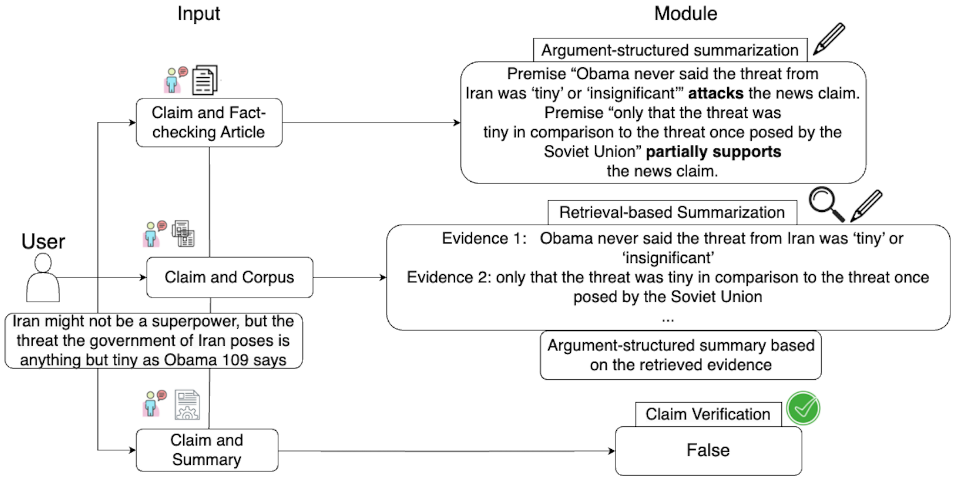
SAFE provides the following modules (Figure 1), whose outputs are also accessible as JSON files via the REST API.
Argument-Structured Summarization. By fine-tuning Mixtral-8x22B [Jiang et al., 2023] on the LIARArg dataset [Wang et al., 2024], SAFE generates argument-structured summaries from a news claim and a fact-checking article provided as input. This mimics the professional fact-checkers' review process and provides a structured analysis of whether each piece of evidence contained in the article supports, partially supports, attacks, or partially attacks the claim. Users can also input directly a list of evidence instead of a full factchecking article. An example of output is provided below for the claim: "Iran might not be a superpower, but the threat the government of Iran poses is anything but tiny as Obama says". An argument graph is also provided to visualize the relations between the claim and the evidence.
Example 1. Premise "Obama never said the threat from Iran was 'tiny' or 'insignificant'" attacks the news claim. Premise "only that the threat was tiny in comparison to the threat once posed by the Soviet Union" partially supports the news claim.
Retrieval-based Summarization. SAFE allows the retrieval of 5, 10, 15, or 20 pieces of evidence for a given news claim. While ExClaim [Zeng and Gao, 2024] serves as the default corpus in the tool, users can also provide a custom one. This module, trained on ExClaim, jointly optimizes the summarization and evidence retrieval tasks by integrating methods described in [Wang et al., 2024]. Atlas [Izacard et al., 2022] has been used as backbone for retrievalaugmented generation. We implement two losses in the training: one based on the similarity between a fact-checking article and the retrieved documents, and another one based on the Cauchy loss [Huber, 1992] between the attackability score distribution between the generated summaries and the mean attackability of retrieved documents for each summary. The module does not need fact-checking articles during inference. Its output consists of the retrieved evidence list, the generated summary and the resulting argument graph.
| Summarizer | R1 | R2 | RL |
|---|---|---|---|
| CDAE | 0.348 | 0.159 | 0.272 |
| SAFE | 0.268 | 0.128 | 0.143 |
Claim Verification or Fake News Classification. SAFE assesses the truthfulness of a claim by analyzing it along with a structured summary. We adopt the state-of-the-art method [Ma et al., 2023] for Fake News Classification to train our models. First, we concatenate claim and summary by inserting [SEP] between the two. Token [CLS] is then added to the beginning of each sentence pair, from which the final embedding of the input is extracted. We construct the entity graph of each concatenated text based on Wikidata and extract the graph embedding using graph attention networks [Veliˇckovi´c et al., 2018]. A softmax layer is applied to the concatenation of graph and textual embeddings to get the logits for each label. Consequently, the number of labels can differ according to the dataset on which the model is trained. Besides a specific model tailored to each dataset used for training (Section 3), we also provide a general classifier by merging all the labels of the datasets to True, False and Unknown.
| Input | LIAR-PLUS | FNC-1 | Check-Covid |
|---|---|---|---|
| Ground | 0.51 | 0.90 | 0.76 |
| CDAE | 0.41 | 0.76 | 0.62 |
| SAFE | 0.54 | 0.92 | 0.74 |
3 Models and Results
Argument-structured Summarization. At the time of writing, the claim-driven abstractive-extractive method (CDAE) [Russo et al., 2023] achieves the best results based on ROUGE scores. However, since our summaries are intended to support automated fact-checking, we also report the F1 scores of the claim verification module on three benchmarks for this task: LIAR-PLUS [Alhindi et al., 2018], FNC1 [Hanselowski et al., 2018], and Check-COVID [Wang et al., 2023], using 10-fold cross-validation. LIAR-PLUS is considered as in-domain data since the summarizer is trained on LIARArg [Wang et al., 2024], a subset of LIAR-PLUS which has been excluded from in the test set. Table 1 reports the ROUGE scores only for LIAR-PLUS since the other datasets lack ground truth summaries. Table 2 reports mean F1 scores, where Input denotes the outputs of different summarizers, with "Ground" referring to the original humanwritten fact-checking articles. Statistically significant differences are highlighted in bold.
Our results demonstrate that SAFE argument-structured summaries significantly improve the performance of the claim verification module compared to the CDAE stateof-the-art summarization method for fact-checking, both on in-domain and out-domain data. This shows that the CDAE summarization approach is not fully tailored for factchecking while SAFE produces structured summaries that are more effective in automated fact-checking. Although CDAE achieves higher ROUGE scores, F1 scores of the claim verification module are more relevant in this context. Higher ROUGE scores indicate greater linguistic overlap but do not necessarily imply that the generated summaries are better inputs for automated fact-checking models. As pointed out in [Wang et al., 2024], overlap-based metrics like ROUGE are insufficient for evaluating summarization in automated factchecking tasks. The comparison between Ground and SAFE in Table 2 shows that SAFE's argument-structured summaries could yield even better results on LIAR-PLUS and FNC-1 than original human-written texts. This result indicates that the performance of claim verification methods can be further enhanced through argument-enhanced summaries instead of human-written ones. Possible explanations are the more comprehensive coverage of evidence in the generated summaries and the explicit support-attack relations contained in these summaries which are especially useful for claim verification.
Retrieval-based Summarization. We compare SAFE on the major benchmark dataset ExClaim with JustiLM [Zeng and Gao, 2024], the state-of-the-art retrieval-summarization method evaluated against strong baselines such as GPT-4 with Retrieval Augmented Generation (RAG). We performed 10fold cross-validation. In terms of retrieval precision, we use top-k recall rate for k = 5, 10, 15, 20 as metrics. As shown in Table 3, SAFE outperforms JustiLM in all cases. Table 4 reports the mean F1 scores of the claim verification module on ExClaim by using summaries generated by JustiLM and SAFE (15 pieces of evidence retrieved for each claim). ROUGE scores compared with ground summaries are also reported. When compared on ExClaim, SAFE achieves an F1 score of 0.74, significantly higher than 0.67 of JustiLM [Zeng and Gao, 2024]. It is worth noting that using humanwritten fact-checking articles as input produces an F1 score of 0.72, indicating that our method achieves comparable precision to hand-written summaries even when evidence is automatically retrieved. ROUGE scores confirm the insufficiency of overlap-based metrics for evaluating fact-checkingoriented summarization.
| Top-k Recall | JustiLM | SAFE |
| Top-5 | 15% | 20% |
| Top-10 | 18% | 27% |
| Top-15 | 25% | 31% |
| Top-20 | 30% | 40% |
| Pipeline | F1 | R1 | R2 | RL |
| JustiLM | 0.67 | 0.387 | 0.195 | 0.354 |
| SAFE | 0.74 | 0.287 | 0.143 | 0.221 |
Claim Verification. SAFE leverages the state-of-the-art method of [Ma et al., 2023] in Fake News Classification. The goal is to provide a comprehensive fact-checking pipeline and demonstrate the effectiveness of SAFE's argument-structured summaries for automated fact-checking.
4 Concluding Remarks
SAFE offers argument-structured summaries of humanwritten fact-checking articles, generates summaries based on retrieved evidence in a news corpus, and assesses the truthfulness of a claim along with a summary. Our experiments demonstrate that SAFE's argument-structured summaries significantly improve the performance of the claim verification module compared to state-of-the-art summarization methods for fact-checking. SAFE also outperforms state-of-theart retrieval-summarization methods in fact-checking on reference benchmark for the task. As future work, we plan to (i) incorporate argument schemes [Walton et al., 2008] to provide in-depth explanations, (ii) enhance the retrievalsummarization module by leveraging external knowledge bases, (iii) investigate the factual consistency of the explanations, and finally, diversify the training corpora so that the model generalizes better to a wider range of domains.
Acknowledgements
This work has been partially supported by the ANR project ATTENTION (ANR21-CE23-0037) and the French government through the 3IA Cˆote d'Azur Investments in the Future project managed by the National Research Agency (ANR) with the reference number ANR-23-IACL-0001.
@inproceedings{ijcai2025p1274,
  title     = {SAFE: Structured Argumentation for Fact-checking with Explanations},
  author    = {Wang, Xiaoou and Cabrio, Elena and Villata, Serena},
  booktitle = {Proceedings of the Thirty-Fourth International Joint Conference on
               Artificial Intelligence, {IJCAI-25}},
  publisher = {International Joint Conferences on Artificial Intelligence Organization},
  editor    = {James Kwok},
  pages     = {11114--11118},
  year      = {2025},
  month     = {8},
  note      = {Demo Track},
  doi       = {10.24963/ijcai.2025/1274},
  url       = {https://doi.org/10.24963/ijcai.2025/1274},
}
TY - CPAPER TI - SAFE: Structured Argumentation for Fact-checking with Explanations AU - Wang, Xiaoou AU - Cabrio, Elena AU - Villata, Serena T2 - Proceedings of the Thirty-Fourth International Joint Conference on Artificial Intelligence, IJCAI-25 PB - International Joint Conferences on Artificial Intelligence Organization PY - 2025 SP - 11114 EP - 11118 DO - 10.24963/ijcai.2025/1274 UR - https://doi.org/10.24963/ijcai.2025/1274 ER -Copied
Machine-readable versions of this paper, for tools and AI agents:





