
MIRROR: Multi-agent Intra- and Inter-Reflection for Optimized Reasoning in Tool Learning
Proceedings of the Thirty-Fourth International Joint Conference on Artificial Intelligence. Main Track. Pages 117-125.
https://doi.org/10.24963/ijcai.2025/14
Keywords
- Agent-based and Multi-agent Systems: MAS: Multi-agent planning
- Agent-based and Multi-agent Systems: MAS: Applications
- Agent-based and Multi-agent Systems: MAS: Coordination and cooperation
Abstract
Complex tasks involving tool integration pose significant challenges for Large Language Models (LLMs), leading to the emergence of multi-agent workflows as a promising solution. Reflection has emerged as an effective strategy for correcting erroneous trajectories in agentic workflows. However, existing approaches only exploit such capability in the post-action stage, where the agent observes the execution outcomes. We argue that, like humans, LLMs can also engage in reflection before action execution: the agent can anticipate undesirable outcomes from its own decisions, which not only provides a necessarily complementary perspective to evaluate the decision but also prevents the propagation of errors throughout the trajectory. In this paper, we propose MIRROR, a framework that consists of both intra-reflection, which critically assesses intended actions before execution, and inter-reflection, which further adjusts the trajectory based on observations. This design systematically leverages LLM reflection capabilities to eliminate and rectify erroneous actions on a more comprehensive scope. Evaluations on both the StableToolBench and TravelPlanner benchmarks demonstrate MIRROR's superior performance, achieving state-of-the-art results compared to existing approaches.
- LLM Core Method G1-Inst. G1-Cat. G1-Tool. G2-Inst. G2-Cat. G3-Inst. Avg. Pass. Win. Pass. Win. Pass. Win. Pass. Win. Pass. Win. Pass. Win. Pass. Win.
- [Achiam et al., 2023] Josh Achiam, Steven Adler, Sandhini Agarwal, Lama Ahmad, Ilge Akkaya, Florencia Leoni Aleman, Diogo Almeida, Janko Altenschmidt, Sam Alt- man, Shyamal Anadkat, et al. Gpt-4 technical report. arXiv preprint arXiv:2303.08774, 2023. [Anthropic, 2024] Anthropic. Claude 3 family, 2024. Ac- cessed: 2024-10-14.
- [Besta et al., 2024] Maciej Besta, Nils Blach, Ales Ku- bicek, Robert Gerstenberger, Michal Podstawski, Lukas Gianinazzi, Joanna Gajda, Tomasz Lehmann, Hubert Niewiadomski, Piotr Nyczyk, et al. Graph of thoughts: Solving elaborate problems with large language models. In Proceedings of the AAAI Conference on Artificial Intel- ligence, volume 38, pages 17682-17690, 2024.
- [Brown, 2020] Tom B Brown. Language models are few- shot learners. arXiv preprint arXiv:2005.14165, 2020.
- [Chen et al., 2022] Wenhu Chen, Xueguang Ma, Xinyi Wang, and William W Cohen. Program of thoughts prompting: Disentangling computation from reason- ing for numerical reasoning tasks. arXiv preprint arXiv:2211.12588, 2022.
- [Chen et al., 2024] Junzhi Chen, Juhao Liang, and Benyou Wang. Smurfs: Leveraging multiple proficiency agents with context-efficiency for tool planning. arXiv preprint arXiv:2405.05955, 2024.
- [Dubey et al., 2024] Abhimanyu Dubey, Abhinav Jauhri, Abhinav Pandey, Abhishek Kadian, Ahmad Al-Dahle, Aiesha Letman, Akhil Mathur, Alan Schelten, Amy Yang, Angela Fan, et al. The llama 3 herd of models. arXiv preprint arXiv:2407.21783, 2024.
- [Gou et al., 2023] Zhibin Gou, Zhihong Shao, Yeyun Gong, Yelong Shen, Yujiu Yang, Nan Duan, and Weizhu Chen. Critic: Large language models can self-correct with tool- interactive critiquing. arXiv preprint arXiv:2305.11738, 2023.
- [Guo et al., 2024] Zhicheng Guo, Sijie Cheng, Hao Wang, Shihao Liang, Yujia Qin, Peng Li, Zhiyuan Liu, Maosong Sun, and Yang Liu. Stabletoolbench: Towards stable large- scale benchmarking on tool learning of large language models, 2024.
- [Hong et al., 2024] Sirui Hong, Mingchen Zhuge, Jonathan Chen, Xiawu Zheng, Yuheng Cheng, Jinlin Wang, Ceyao Zhang, Zili Wang, Steven Ka Shing Yau, Zijuan Lin, Liyang Zhou, Chenyu Ran, Lingfeng Xiao, Chenglin Wu, and Jürgen Schmidhuber. MetaGPT: Meta programming for a multi-agent collaborative framework. In The Twelfth International Conference on Learning Representations, 2024. Huang et al., 2024]
- Xu Huang, Weiwen Liu, Xiaolong Chen, Xingmei Wang, Hao Wang, Defu Lian, Yasheng Wang, Ruiming Tang, and Enhong Chen. Understand- ing the planning of llm agents: A survey. arXiv preprint arXiv:2402.02716, 2024.
- [Komeili, 2021] M Komeili. Internet-augmented dialogue generation. arXiv preprint arXiv:2107.07566, 2021.
- [Lewis et al., 2020] Patrick Lewis, Ethan Perez, Aleksan- dra Piktus, Fabio Petroni, Vladimir Karpukhin, Naman Goyal, Heinrich Küttler, Mike Lewis, Wen-tau Yih, Tim Rocktäschel, et al. Retrieval-augmented generation for knowledge-intensive nlp tasks. Advances in Neural Infor- mation Processing Systems, 33:9459-9474, 2020.
- [Madaan et al., 2024] Aman Madaan, Niket Tandon, Prakhar Gupta, Skyler Hallinan, Luyu Gao, Sarah Wiegreffe, Uri Alon, Nouha Dziri, Shrimai Prabhumoye, Yiming Yang, et al. Self-refine: Iterative refinement with self-feedback. Advances in Neural Information Processing Systems, 36, 2024.
- [Ouyang et al., 2022] Long Ouyang, Jeffrey Wu, Xu Jiang, Diogo Almeida, Carroll Wainwright, Pamela Mishkin, Chong Zhang, Sandhini Agarwal, Katarina Slama, Alex Ray, et al. Training language models to follow instruc- tions with human feedback. Advances in neural informa- tion processing systems, 35:27730-27744, 2022.
- [Petroni et al., 2020] Fabio Petroni, Aleksandra Piktus, An- gela Fan, Patrick Lewis, Majid Yazdani, Nicola De Cao, James Thorne, Yacine Jernite, Vladimir Karpukhin, Jean Maillard, et al. Kilt: a benchmark for knowledge intensive language tasks. arXiv preprint arXiv:2009.02252, 2020.
- [Qin et al., 2023] Yujia Qin, Shihao Liang, Yining Ye, Kun- lun Zhu, Lan Yan, Yaxi Lu, Yankai Lin, Xin Cong, Xian- gru Tang, Bill Qian, Sihan Zhao, Runchu Tian, Ruobing Xie, Jie Zhou, Mark Gerstein, Dahai Li, Zhiyuan Liu, and Maosong Sun. Toolllm: Facilitating large language mod- els to master 16000+ real-world apis, 2023.
- [Shinn et al., 2024] Noah Shinn, Federico Cassano, Ashwin Gopinath, Karthik Narasimhan, and Shunyu Yao. Reflex- ion: Language agents with verbal reinforcement learning. Advances in Neural Information Processing Systems, 36, 2024.
- [Sun et al., 2023] Jiankai Sun, Chuanyang Zheng, Enze Xie, Zhengying Liu, Ruihang Chu, Jianing Qiu, Jiaqi Xu, Mingyu Ding, Hongyang Li, Mengzhe Geng, et al. A sur- vey of reasoning with foundation models. arXiv preprint arXiv:2312.11562, 2023.
- [Team et al., 2023] Gemini Team, Rohan Anil, Sebastian Borgeaud, Yonghui Wu, Jean-Baptiste Alayrac, Jiahui Yu, Radu Soricut, Johan Schalkwyk, Andrew M Dai, Anja Hauth, et al. Gemini: a family of highly capable multi- modal models. arXiv preprint arXiv:2312.11805, 2023.
- [Team, 2024] Qwen Team. Qwen2.5: A party of foundation models, September 2024.
- [Touvron et al., 2023] Hugo Touvron, Louis Martin, Kevin Stone, Peter Albert, Amjad Almahairi, Yasmine Babaei, Nikolay Bashlykov, Soumya Batra, Prajjwal Bhargava, Shruti Bhosale, et al. Llama 2: Open foundation and fine-tuned chat models. arXiv preprint arXiv:2307.09288, 2023.
- [Wang et al., 2022] Xuezhi Wang, Jason Wei, Dale Schu- urmans, Quoc Le, Ed Chi, Sharan Narang, Aakanksha Chowdhery, and Denny Zhou. Self-consistency improves chain of thought reasoning in language models. arXiv preprint arXiv:2203.11171, 2022.
- [Wang et al., 2024a] Renxi Wang, Xudong Han, Lei Ji, Shu Wang, Timothy Baldwin, and Haonan Li. Toolgen: Uni- fied tool retrieval and calling via generation. arXiv preprint arXiv:2410.03439, 2024.
- [Wang et al., 2024b] Xingyao Wang, Boxuan Li, Yufan Song, Frank F. Xu, Xiangru Tang, Mingchen Zhuge, Ji- ayi Pan, Yueqi Song, Bowen Li, Jaskirat Singh, Hoang H. Tran, Fuqiang Li, Ren Ma, Mingzhang Zheng, Bill Qian, Yanjun Shao, Niklas Muennighoff, Yizhe Zhang, Binyuan Hui, Junyang Lin, Robert Brennan, Hao Peng, Heng Ji, and Graham Neubig. OpenDevin: An Open Platform for AI Software Developers as Generalist Agents, 2024.
- [Wei et al., 2022] Jason Wei, Xuezhi Wang, Dale Schuur- mans, Maarten Bosma, Fei Xia, Ed Chi, Quoc V Le, Denny Zhou, et al. Chain-of-thought prompting elicits reasoning in large language models. Advances in neural information processing systems, 35:24824-24837, 2022.
- [Wu et al., 2024] Qingyun Wu, Gagan Bansal, Jieyu Zhang, Yiran Wu, Beibin Li, Erkang Zhu, Li Jiang, Xiaoyun Zhang, Shaokun Zhang, Jiale Liu, Ahmed Hassan Awadal- lah, Ryen W White, Doug Burger, and Chi Wang. Auto- gen: Enabling next-gen llm applications via multi-agent conversation framework. In COLM, 2024.
- [Xie et al., 2024] Jian Xie, Kai Zhang, Jiangjie Chen, Tinghui Zhu, Renze Lou, Yuandong Tian, Yanghua Xiao, and Yu Su. Travelplanner: A benchmark for real- world planning with language agents. arXiv preprint arXiv:2402.01622, 2024.
- [Yan et al., 2024] Fanjia Yan, Huanzhi Mao, Charlie Cheng- Jie Ji, Tianjun Zhang, Shishir G. Patil, Ion Stoica, and Joseph E. Gonzalez. Berkeley function calling leader- board. 2024.
- [Yang et al., 2023] Sherry Yang, Ofir Nachum, Yilun Du, Ja- son Wei, Pieter Abbeel, and Dale Schuurmans. Foundation models for decision making: Problems, methods, and op- portunities. arXiv preprint arXiv:2303.04129, 2023.
- [Yao et al., 2022] Shunyu Yao, Jeffrey Zhao, Dian Yu, Nan Du, Izhak Shafran, Karthik Narasimhan, and Yuan Cao. React: Synergizing reasoning and acting in language mod- els. arXiv preprint arXiv:2210.03629, 2022.
- [Yao et al., 2024] Shunyu Yao, Dian Yu, Jeffrey Zhao, Izhak Shafran, Tom Griffiths, Yuan Cao, and Karthik Narasimhan. Tree of thoughts: Deliberate problem solving with large language models. Advances in Neural Informa- tion Processing Systems, 36, 2024.
- [Zhang et al., 2022] Susan Zhang, Stephen Roller, Naman Goyal, Mikel Artetxe, Moya Chen, Shuohui Chen, Christopher Dewan, Mona Diab, Xian Li, Xi Victoria Lin, et al. Opt: Open pre-trained transformer language models. arXiv preprint arXiv:2205.01068, 2022.
- [Zhuge et al., 2023] Mingchen Zhuge, Haozhe Liu, Francesco Faccio, Dylan R Ashley, Róbert Csordás, Anand Gopalakrishnan, Abdullah Hamdi, Hasan Abed Al Kader Hammoud, Vincent Herrmann, Kazuki Irie, et al. Mindstorms in natural language-based societies of mind. arXiv preprint arXiv:2305.17066, 2023.
References were extracted automatically from the PDF and may contain errors.
Full text extracted automatically from the PDF; figures, tables and equations may differ. The PDF is the version of record.
1 Introduction
Large Language Models (LLMs) have demonstrated remarkable capabilities in natural language processing, showcasing unprecedented performance in planning, reasoning, and complex task completion [Brown, 2020; Chen et al., 2022; Sun et al., 2023; Yang et al., 2023; Touvron et al., 2023]. However, these models face fundamental limitations in accessing real-time information, processing novel data patterns, and executing precise system controls [Petroni et al., 2020; Lewis et al., 2020; Komeili, 2021; Zhang et al., 2022]. These constraints become particularly challenging when tackling real-world tasks that require dynamic adaptation and accurate tool manipulation.
∗Work done during the internship at Metastone.
†Corresponding author: Zhendong Mao.
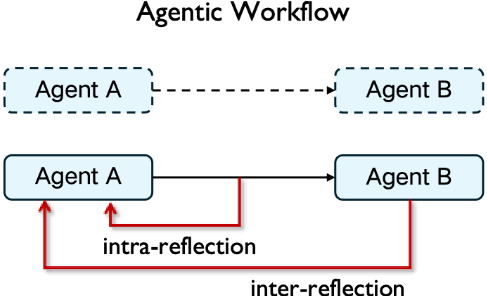
The tool learning paradigm emerged as a natural solution to extend LLMs' capabilities beyond their inherent limitations [Qin et al., 2023]. By enabling LLMs to interact with external tools and APIs, this approach significantly expands their practical applications. Recent advances in foundation models have further enhanced their ability to handle basic tool interactions [Achiam et al., 2023; Team et al., 2023; Dubey et al., 2024; Team, 2024]. However, when confronted with sophisticated multi-step tasks requiring intricate tool coordination, even these advanced models struggle to maintain consistent performance.
This challenge has given rise to multi-agent workflows, where complex tasks are distributed across specialized agents [Wu et al., 2024; Hong et al., 2024; Wang et al., 2024b]. In these systems, reflection mechanisms play a crucial role in optimizing agent behavior. Current approaches, exemplified by Reflexion [Shinn et al., 2024], implement reflection as a post-execution analysis tool, where agents learn from completed actions. While this retrospective approach enables iterative improvement, it suffers from fundamental limitations: it cannot prevent initial errors, risks irreversible system changes, and incurs significant learning costs through trial and error.
To address these limitations, we propose intra-reflection: a proactive evaluation mechanism that occurs before action execution. This approach mirrors human cognitive processes, where we often mentally simulate outcomes before taking action. By combining this preventive strategy with traditional post-execution reflection, we create a more comprehensive framework for multi-agent learning and adaptation.
Our paper introduces MIRROR (Multi-agent Intra- and Inter-Reflection for Optimized Reasoning), a novel framework that seamlessly integrates both reflection phases. This dual-phase approach systematically prevents errors while optimizing learning from necessary failures, creating a more robust and efficient multi-agent system. Unlike existing solutions that rely solely on learning from mistakes, MIRROR enables agents to anticipate and avoid potential errors while maintaining the ability to learn from unavoidable failures.
The primary contributions of this paper are summarized as follows:
- We introduce the concept of intra-reflection in multiagent tool learning, a pre-action evaluation mechanism that allows agents to critically assess their intended outputs before execution.
- We propose MIRROR, a novel framework for multiagent systems in tool learning tasks. MIRROR employs both intra-reflection and inter-reflection mechanisms to enhance decision-making, prevent error propagation, and improve collaboration efficiency.
- We provide a comprehensive evaluation of our framework using both StableToolBench and TravelPlanner benchmarks, demonstrating its superior performance across evaluation metrics, significantly outperforming existing state-of-the-art approaches.
2 RelatedWork
LLM-BasedTaskPlanning. LLMs have been increasingly leveraged for task planning. Initial approaches like Chainof-Thought (CoT) [Wei et al., 2022] generate intermediate reasoning steps, while Self-Consistency [Wang et al., 2022] improves robustness by generating multiple reasoning paths and selecting the most consistent solution. ReAct [Yao et al., 2022] integrates reasoning with action-taking capabilities. More advanced methods explore complex reasoning structures: Tree-of-Thought (ToT) [Yao et al., 2024] enables simultaneous exploration and evaluation of multiple reasoning paths, and Graph of Thoughts (GoT) [Besta et al., 2024] provides even greater flexibility with graph-structured, multidirectional thought connections. Our method builds on these by incorporating intra-reflection, allowing LLMs to critically assess and refine reasoning during task execution for enhanced adaptability.
Reflection in LLMs. LLM frameworks increasingly integrate reflection mechanisms to enhance performance and adaptability. For example, Self-refine [Madaan et al., 2024]
employs iterative self-critique and refinement, while Reflexion [Shinn et al., 2024] incorporates self-monitoring and feedback loops within the ReAct framework. DFSDT [Qin et al., 2023] advances reflection by enabling models to reevaluate and re-plan based on their complete history of previous error paths and information, thereby broadening the explored solution space. CRITIC [Gou et al., 2023] leverages external tools for output validation and subsequent improvement. While these approaches predominantly emphasize inter-reflection or post-hoc refinement, MIRROR innovates by stressing continuous intra-reflection during all reasoning phases, facilitating more dynamic and context-aware adaptations in real time.
LLM-Powered Multi-Agent Systems. Single-agent LLM systems face limitations such as hallucinations, restricted context, and lack of collaboration in real-world applications [Huang et al., 2024]. LLM-powered multi-agent systems (MAS) offer a promising solution, where multiple autonomous agents with unique strategies collaborate to manage complex, dynamic tasks beyond single-agent capabilities [Zhuge et al., 2023]. This collaborative approach leverages distinct agent strengths through communication. Notable examples include AutoGen [Wu et al., 2024], MetaGPT [Hong et al., 2024], and OpenHands [Wang et al., 2024b], which utilize Agent-Computer Interfaces for enhanced problemsolving. Our approach extends these MAS frameworks by integrating both intra-reflection and inter-reflection mechanisms, aiming to better address real-world complexities through maximized collaborative potential and adaptive reasoning.
3 Methodology
The MIRROR framework presents a structured approach to enhance LLM capabilities in tool learning. It leverages a specialized multi-agent system synergistically combined with unique intra-reflection and inter-reflection mechanisms. The overarching goal is to optimize the decomposition of complex tasks, the selection and parameterization of tools, and the final generation of answers, while proactively minimizing errors and enabling continuous learning.
3.1 Task Definition
Tool learning tasks involve an LLM interacting with external tools/APIs. Given a task description (Q) and a tool library (T = {n, d, p}, where n is name, d is description, p is parameters), the system must autonomously select the optimal tool (t ∈ T) and its parameters (pt). These are passed to an Executor, and the resulting output is synthesized into a comprehensive answer.
3.2 Framework Overview
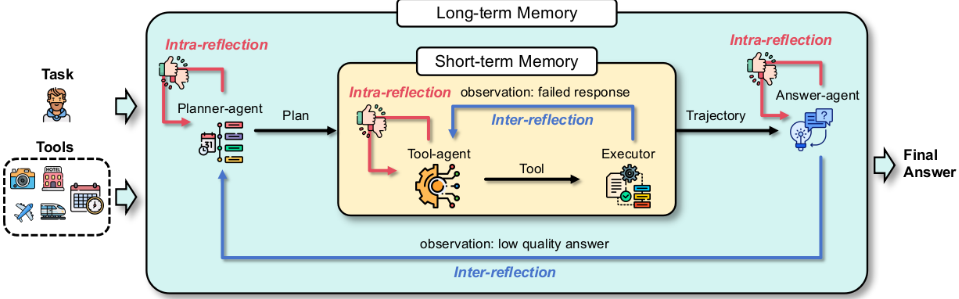
MIRROR's core innovation is intra-reflection, a distinct contribution enabling meaningful self-evaluation within a single agent during its generation phase and before action execution or handoff to another agent. This contrasts with methods relying on external agent feedback or post-execution reflection. Intra-reflection functions as a formalized prompting technique, universally applicable across tasks and models, embedding evaluation criteria directly into the agent's prompt to guide its reasoning and output generation. This systematic approach facilitates proactive error prevention. This overall framework, which deeply embeds intra-reflection within each agent and also integrates inter-reflection for comprehensive learning, is visually outlined in Figure 2.
3.3 Multi-Agent System
MIRROR integrates three distinct, specialized agents:
Planner Agent: Decomposes complex tasks into a topologically structured sequence of manageable subtasks, considering dependencies and execution order. It utilizes LongTerm Memory to refine decomposition strategies based on outcomes from previous attempts within the current task.
Tool Agent: Selects appropriate tools and parameters for each subtask. Its decision-making is guided by Short-Term Memory, which includes execution failure information and the agent's own intra-reflection outputs from prior attempts on the current subtask, helping to avoid repeated errors. Successful subtask results are stored for subsequent use.
Answer Agent: Synthesizes individual results from all completed subtasks, considering the entire execution trajectory, to produce a coherent and comprehensive final answer to the original task.
These agents engage in collaborative interactions, where the validated output of one agent becomes the input for the next. This structured collaboration, augmented by reflection, aims to achieve solutions that surpass the capabilities of any single agent operating in isolation.
3.4 Intra-Reflection
A cornerstone of the MIRROR framework, the intrareflection process is implemented by each agent before its output is passed to the next agent or the Executor. This ensures a thorough self-evaluation, minimizing errors and optimizing the quality of inter-agent information flow. Each agent performs a self-assessment based on its specific role and predefined quality thresholds (θp, θt, θa). This mechanism does not depend on additional LLMs or external evaluation agents, functioning as an inherent part of the agent's generation cycle.
Planner Agent Intra-Reflection: After generating an initial task decomposition, the Planner Agent critically evaluates this plan. The assessment focuses on its completeness, efficiency, and coherence. It also considers if subtasks can be further optimized. The agent integrates lessons from prior experiences within the current task to enhance decomposition quality. If the internal evaluation score surpasses the threshold θp, the plan is deemed sufficiently robust and proceeds to the Tool Agent. Otherwise, the plan is iteratively revised until it meets the required quality standard. This iterative refinement ensures that only well-optimized and coherent plans advance, significantly improving the framework's overall effectiveness and resource utilization.
Tool Agent Intra-Reflection: Upon receiving a subtask and selecting a tool and parameters, the Tool Agent performs intra-reflection. It evaluates these choices based on how well they meet the specific subtask requirements, whether they incorporate lessons from past attempts (within the current task, leveraging STM), and their alignment with the subtask's objectives. The agent assigns a score reflecting the expected effectiveness of its choices. Selections scoring above threshold θt are passed to the Executor for execution. Those scoring below are revised (the agent may choose a different tool or adjust parameters) to better align with subtask goals. This process optimizes tool and strategy selection at a granular level, enhancing the framework's operational efficiency and increasing the probability of successful subtask completion.
AnswerAgent Intra-Reflection: After synthesizing the results from all subtasks into a comprehensive solution, the Answer Agent conducts a final intra-reflection. This evaluation focuses on the completeness of the answer, its integration of key actions and observations from the entire trajectory, and the clarity of its presentation. The agent assigns a score to its output. If this score meets or exceeds the threshold θa, the task is considered successfully completed. If the score falls below θa, indicating a suboptimal answer, the entire task trajectory (including the plan, tool uses, reflections, and the deficient answer) is stored in long-termmemory. This stored information is then utilized by the Planner Agent to refine its strategy for the current task, facilitating an improved attempt at successful completion and promoting continuous, task-specific adaptation.
3.5 Inter-Reflection
MIRROR employs a dual-memory architecture to facilitate inter-reflection:
Short-TermMemory (STM): Utilized by the Tool Agent for subtask tool/parameter selection. It records execution failures and the agent's intra-reflection outputs, prompting adjustments. STM is reset upon successful subtask completion to maintain relevance for new selections.
Long-Term Memory (LTM): This memory is taskspecific. It stores the entire trajectory for the current task (decomposition plan, tool selections, execution results, solution quality). LTM is updated if execution fails or if the Answer Agent's final output is below θa. It resets upon overall task completion, enabling the system to learn from successes and failures within the current task for progressive strategy refinement.
This dual-memory architecture allows MIRROR to continually adapt and refine its performance through structured experiential learning.
3.6 Agent Collaboration
Agent collaboration critically relies on intra-reflection for high-quality inter-agent handoffs. The Planner Agent passes decompositions, validated for coherence and feasibility by its intra-reflection, to the Tool Agent. The Tool Agent, after its own reflection-refined tool and parameter selection aimed at optimal subtask execution, then directs the process. Results subsequently flow to the Answer Agent for careful synthesis and final quality assurance, also guided by its intra-reflection.
This reflection-gated workflow minimizes error propagation via early self-correction and optimizes inter-agent communication with reliable information exchange. Interreflection, through dual memory, further enhances collaboration: STM aids Tool Agent's immediate adaptation to execution challenges, while LTM enables the Planner Agent to refine strategies from current task trajectories.
Integrating both reflection types creates a self-optimizing system. This enhances individual agent efficiency and overall framework performance, robustness, and adaptability for complex tasks. Thus, MIRROR continuously learns and evolves. While dual-reflection increases token processing, this is justified by significant, experimentally validated performance gains, making it a worthwhile trade-off.
4 Experiment
To evaluate our proposed framework, we conducted comprehensive experiments as detailed below.
4.1 Setup
Benchmarks We utilized two benchmarks:
- StableToolBench [Guo et al., 2024]: An extension of ToolBench [Qin et al., 2023], this benchmark assesses LLM function invocation capabilities through executable tests.
- TravelPlanner [Xie et al., 2024]: This benchmark evaluates agent proficiency in real-world planning and tool interactions. Due to computational constraints, we used its validation set in a two-stage mode to assess tool utilization and planning capabilities.
Metrics
- StableToolBench: Metrics include Pass Rate (percentage of tasks successfully completed) and Win Rate (comparison against GPT-3.5+ReAct via LLM evaluation).
- TravelPlanner: Metrics include Delivery Rate (plan completion), Commonsense and Hard Constraint Pass Rates (rule adherence), and Final Pass Rate (overall plan feasibility).
Model Our experiments used the following foundational LLMs: GPT-3.5 Turbo [Ouyang et al., 2022] (gpt-35-turbo0125), GPT-4o Mini [Achiam et al., 2023] (gpt-4o-mini2024-07-18), GPT-4o [Achiam et al., 2023] (gpt-4o-202405-13), Claude 3 Haiku [Anthropic, 2024], and Qwen2.572B [Team, 2024]. For evaluation consistency on StableToolBench, we employed GPT-4 Turbo [Achiam et al., 2023] (gpt-4-turbo-2024-04-09). GPT-4o served as the parsing model for TravelPlanner.
Baselines We compared our method against six baselines:
- ReAct [Yao et al., 2022]: Alternates reasoning and acting within an LLM for interpretable trace generation and task-specific action execution.
- DFSDT [Qin et al., 2023]: Constructs and traverses decision trees for systematic re-evaluation and re-planning based on previous error paths.
- Reflexion [Shinn et al., 2024]: Employs self-reflection on environmental interactions to improve decisionmaking.
- Smurfs [Chen et al., 2024]: A multi-agent framework assigning distinct roles to agents via prompting for collaborative problem-solving.
- ToolLlama-2 [Qin et al., 2023]: A model fine-tuned on the ToolBench dataset.
- ToolGen [Wang et al., 2024a]: Represents tools as unique vocabulary tokens for direct tool call generation via a three-stage training process, bypassing separate retrieval steps.
4.2 Main Results
Experimental results demonstrate MIRROR's consistent performance advantages across both benchmarks. Across both benchmarks, MIRROR surpasses existing baselines. On StableToolBench, it demonstrates superiority with diverse LLMs (open-source and proprietary), notably outperforming supervised fine-tuning (SFT) methods like ToolLlama-2 and ToolGen (both with Pass Rates around 46%), underscoring SFT's limitations in complex tool use. This superior performance extends to TravelPlanner, where MIRROR consistently leads ReAct in Delivery Rate, Commonsense Pass Rate, and Hard Constraint Pass Rate. The efficacy of MIRROR is attributed to its dual-reflection architecture, which incorporates intra-reflection for immediate error detection and inter-reflection for strategic optimization. This approach shows clear advantages over Reflexion's single inter-reflection mechanism. Despite these gains, achieving a high Final Pass Rate on TravelPlanner remains challenging due to the inherent complexity of managing information and constraints in multifaceted planning.
| LLMCore | Method | G1-Inst. | G1-Cat. | G1-Tool. | G2-Inst. | G2-Cat. | G3-Inst. | Avg. | |||||||
|---|---|---|---|---|---|---|---|---|---|---|---|---|---|---|---|
| Pass. | Win. | Pass. | Win. | Pass. | Win. | Pass. | Win. | Pass. | Win. | Pass. | Win. | Pass. | Win. | ||
| GPT-3.5 Turbo | ReAct DFSDT Reflexion Smurfs MIRROR | 47.2±0.5 64.5±0.4 75.8±1.0 75.9±1.1 82.5±0.5 | / 66.9 65.6 74.2 76.1 | 42.9±0.8 61.2±0.8 73.0±1.5 82.6±0.4 86.3±1.3 | / 64.7 76.5 81.7 87.6 | 41.8±0.5 64.7±0.7 75.3±1.2 72.2±0.9 84.9±0.6 | / 68.4 70.3 71.5 79.7 | 46.1±0.2 59.3±0.2 72.5±2.8 76.6±1.4 78.8±1.0 | / 60.4 72.6 73.6 87.7 | 43.1±0.3 61.6±1.2 73.0±0.6 79.6±0.2 82.4±1.0 | / 64.5 72.6 79.8 83.1 | 42.1±1.5 57.4±1.3 58.5±0.8 73.0±2.0 87.4±1.5 | / 59.0 49.2 68.9 80.3 | 43.9±0.5 61.5±0.8 71.4±1.3 76.7±1.0 83.7±1.0 | / 64.0 67.8 75.0 82.4 |
| Claude 3 Haiku | ReAct DFSDT Reflexion Smurfs MIRROR | 54.9±0.0 67.9±0.8 75.8±0.7 68.4±0.5 78.3±0.8 | 49.1 55.2 68.7 65.0 74.8 | 46.1±0.0 68.8±0.9 76.9±0.4 81.2±1.2 81.9±0.6 | 47.7 65.4 85.0 81.0 86.9 | 54.0±0.6 76.8±0.6 80.6±0.4 80.6±1.3 85.2±0.8 | 55.1 68.4 77.2 76.6 79.7 | 55.3±1.1 65.9±1.6 73.4±1.1 72.5±1.2 80.2±1.7 | 52.8 67.9 77.4 71.7 81.1 | 52.2±1.0 69.8±0.9 73.8±1.3 75.4±0.3 78.1±1.4 | 50.8 57.3 76.6 69.4 81.5 | 65.8±0.8 69.4±0.8 73.0±1.2 74.3±0.8 81.4±0.4 | 55.7 57.4 70.5 60.7 75.4 | 54.7±0.6 69.8±0.9 75.6±0.9 75.4±0.9 80.9±1.0 | 51.9 61.9 75.9 70.7 79.9 |
| Qwen2.5-72B | ReAct DFSDT Reflexion Smurfs MIRROR | 53.0±1.0 62.9±0.4 76.4±0.3 77.8±0.9 83.2±0.8 | 52.8 60.7 70.6 73.6 75.5 | 63.6±0.4 66.3±0.7 75.7±0.6 81.9±0.2 85.3±0.3 | 69.3 72.5 81.0 88.9 90.8 | 60.8±0.8 62.4±0.1 75.9±0.9 78.0±0.1 81.8±0.3 | 62.0 62.7 77.2 78.5 80.4 | 60.8±0.7 64.0±1.2 72.3±0.2 76.7±0.6 77.2±0.3 | 67.9 66.0 83.0 84.0 86.8 | 57.5±0.7 65.3±0.9 77.2±0.7 79.6±0.7 80.9±1.1 | 60.5 64.5 81.5 77.4 83.9 | 54.9±2.7 58.5±1.4 79.0±0.8 88.3±0.4 89.1±0.8 | 52.5 52.5 68.9 68.9 85.2 | 58.4±1.1 63.2±0.8 76.1±0.6 80.4±0.5 82.9±0.6 | 60.8 63.2 77.0 78.6 83.8 |
| GPT-4o | ReAct DFSDT Reflexion Smurfs MIRROR | 58.6±1.1 68.7±1.9 76.4±0.3 75.1±1.3 82.5±0.3 | 63.8 66.3 74.8 73.6 77.3 | 61.5±0.7 66.1±0.7 76.7±0.9 79.5±1.1 83.3±0.5 | 64.1 67.3 87.6 80.4 91.5 | 62.2±0.3 73.9±0.5 74.4±0.4 81.6±1.2 86.2±0.7 | 59.5 72.8 78.5 76.6 86.1 | 61.5±1.6 67.0±1.0 71.5±0.8 77.0±0.4 77.2±0.2 | 67.0 69.8 78.3 83.0 84.9 | 54.7±1.9 65.9±0.7 73.5±1.1 76.9±1.0 80.8±1.0 | 62.9 74.2 79.0 78.2 85.5 | 52.5±0.7 67.5±1.0 72.7±0.8 84.4±0.7 88.3±1.5 | 50.8 72.1 70.5 78.7 86.9 | 58.5±1.1 68.2±1.0 74.2±0.7 79.1±1.0 83.1±0.7 | 61.4 70.4 78.1 78.4 85.4 |
| ToolLlama-2 | SFT | 50.3 | 46.1±2.1 | 49.4 | 37.9±1.5 | 46.2 | 43.1±0.7 | 46.8 | 41.3±0.8 | 37.7 | 46.1±1.1 | ||||
| 54.0±0.9 | 48.5 | 54.1±0.4 | 46.5 | ||||||||||||
| ToolGen | SFT | 51.2±0.9 | 47.9 | 47.8±0.6 | 45.1 | 52.4±0.3 | 43.7 | 48.7±2.0 | 52.8 | 42.3±0.3 | 45.2 | 35.5±1.0 | 29.5 | 46.3±0.9 | 44.0 |
| LLMCore | Method | Delivery Rate | Commonsense | Hard Constraint | Final Pass | ||
|---|---|---|---|---|---|---|---|
| Micro | Macro | Micro | Macro | Rate | |||
| GPT-4o Mini | ReAct MIRROR | 75.0 96.1 | 54.7 69.0 | 0 3.3 | 0 5.2 | 0 2.2 | 0 0 |
| Qwen2.5-72B | ReAct MIRROR | 79.4 95.6 | 56.0 64.9 | 0.6 6.7 | 3.3 12.9 | 2.2 9.4 | 0 1.7 |
| GPT-4o | ReAct MIRROR | 85.6 100 | 61.4 73.2 | 5.0 13.9 | 15.2 27.6 | 7.8 13.3 | 2.2 2.2 |
Performance across different LLMcores. MIRROR's effectiveness varies with the LLM core and benchmark. Across both StableToolBench (Table 1) and TravelPlanner (Table 2), MIRROR consistently enhanced performance over baselines across all evaluated LLMs. On StableToolBench, this led to average Pass Rate gains (over the next best method) from 2.5% (Qwen2.5-72B) to 7.0% (GPT-3.5 Turbo), and Win Rate gains (vs. GPT-3.5+ReAct) from 5.2% (Qwen2.572B) to 9.2% (Claude 3 Haiku). On TravelPlanner, which tests complex multi-step planning, MIRROR increased Delivery Rates by amounts ranging from 14.4% (with GPT-4o) to 21.1% (with GPT-4o Mini). Further, it yielded absolute improvements in macro Pass Rates for Commonsense (from 3.3% with GPT-4o Mini to 8.9% with GPT-4o) and Hard Constraints (from 2.2% with GPT-4o Mini to 7.2% with Qwen2.5-72B).
4.3 Ablation Study
For the ablation studies, we utilized GPT-4o Mini as the LLM core, with evaluations conducted on StableToolBench using Pass Rate metric.
Effectiveness of Intra-reflection. Intra-reflection mechanisms are critical for MIRROR's performance, as shown in Table 3. The full MIRROR configuration (average Pass Rate: 85.7%) significantly outperforms variants lacking these components. Removing Planner, Tool, or Answer Agent intrareflection drops the average Pass Rate to 82.1%, 81.3%, and 79.4%, respectively. Ablating all intra-reflection mechanisms causes the largest decline (to 78.7%, a 7.0% drop), particularly impacting complex instruction-heavy tasks like G3-Inst. (a 9.9% decrease in this category). These findings underscore the meaningful contribution of each agent's intrareflection and their combined role in enhancing task decomposition, tool selection, and output generation.
| Configuration | G1-Inst. | G1-Cat. | G1-Tool. | G2-Inst. | G2-Cat. | G3-Inst. | Avg. |
|---|---|---|---|---|---|---|---|
| MIRROR FC | 84.9±1.2 78.6±0.4 | 87.9±0.5 83.7±0.5 | 89.5±0.8 79.3±0.3 | 82.7±0.6 80.2±0.7 | 83.1±0.7 85.6±2.2 | 86.1±0.7 91.8±0.7 | 85.7±0.8 83.2±0.8 |
| w/o Planner Intra. w/o Tool Intra. w/o Answer Intra. w/o Intra. | 83.2±0.5 80.4±0.0 81.7±0.6 78.0±1.1 | 83.3±0.3 84.6±0.5 80.8±0.6 79.0±0.3 | 87.0±0.7 83.3±0.8 83.1±0.9 81.3±1.2 | 76.7±1.1 79.7±0.4 74.8±0.8 76.7±0.4 | 81.5±0.9 80.8±0.5 78.6±1.0 80.8±0.8 | 80.9±1.4 79.0±0.4 77.6±1.7 76.2±1.3 | 82.1±0.8 81.3±0.4 79.4±0.9 78.7±0.9 |
| w/o Long-termMemory w/o Short-termMemory w/o Inter. | 83.5±0.1 81.1±0.6 80.4±0.9 | 86.2±0.9 81.3±0.6 80.2±0.4 | 85.7±1.3 84.7±1.9 84.5±0.9 | 79.4±1.0 78.3±2.0 75.9±1.5 | 81.0±0.3 81.9±0.0 | 83.9±1.4 79.0±1.4 82.5±0.8 | 83.3±0.8 81.1±1.1 |
| w/o Reflection | 78.6±0.4 | 80.3±1.1 | 77.4±0.3 | 77.8±0.9 | |||
| 82.4±1.7 | |||||||
| 79.7±2.2 | |||||||
| 80.5±1.1 | |||||||
| 75.4±1.3 | |||||||
| 72.6±0.4 |
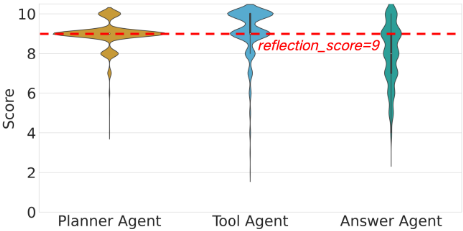
Intra-reflection score distribution. Figure 3 reveals distinct intra-reflection score distributions for the three agents. Scores for the Answer Agent are more uniformly distributed, with a notable proportion below the threshold, contrasting with the higher-clustering scores of the Planner and Tool Agents. This unique distribution for the Answer Agent aligns with findings from our ablation study (Table 3), where removing its intra-reflection mechanism most significantly impacts system performance. Such a significant impact underscores its critical role in filtering substandard outputs to preserve overall system quality.
Score threshold selection. Preliminary experiments indicated that threshold scores (e.g., Planner Agent at the 90th percentile) yield strong, generalizable results. Thresholds in the 80-90th percentile range effectively balance efficiency and quality. For the Planner Agent, specific threshold values of 7, 8, and 9 yielded Pass Rates of 82.3%, 83.3%, and 85.7%, respectively.
Impact of Inter-reflection. Disabling inter-reflection, as per Table 3, reduces MIRROR's average Pass Rate from 85.7% to 80.5%. This mechanism comprises long-term and short-termmemory. Ablating long-termmemory (83.3%) affects consistent planning and strategic decision-making. Removing short-term memory causes a larger drop (81.1%), underscoring its critical role in immediate action selection, local decision sequences, and maintaining coherence within task episodes. Thus, inter-reflection is a key architectural component for coordinating tactical and strategic decisions across diverse tasks.
Rounds of Inter-reflection. The number of inter-reflection rounds significantly influences both efficacy and token consumption. Optimal performance is achieved with 5 rounds, yielding an 85.7% Pass Rate at a cost of 13.6k tokens per query. Fewer rounds, such as 3, result in a lower Pass Rate of 83.4% although with marginally fewer tokens (12.8k per query). Conversely, increasing to 7 rounds not only elevates token usage substantially to 17.2k per query but also leads to a decline in effectiveness, with the Pass Rate dropping to 82.3%. This performance degradation with excessive reflection is likely attributable to induced redundancy and potential reasoning errors.
Prompt vs. Function Calling. In this analysis, we replace the Tool Agent's prompt-based approach with the LLM's function calling (FC) mode to evaluate its impact on performance. Table 3 shows that the prompt-based strategy achieves a higher average Pass Rate of 85.7% compared to
83.2% for FC. This demonstrates that the function calling capability of existing LLMs still requires further improvement.
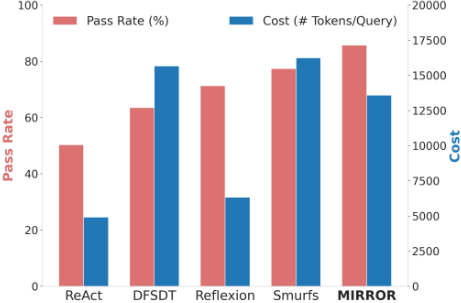
Token efficiency analysis. Figure 4 shows MIRROR achieving the highest Pass Rate while using fewer tokens per query than DFSDT and Smurfs. While ReAct and Reflexion are more token-efficient, they yield lower Pass Rates. MIRROR's efficiency is attributed to its dual-reflection architecture: intra-reflection provides early error detection and quality control, and inter-reflection optimizes decision paths. This integrated design enables high performance with minimized computational overhead.
Discussion on LLM core capabilities. We utilized GPT4o-2024-05-13 and GPT-4o-mini-07-18. Given their differences in both size and training datasets, tool-learning capability is not dictated by model size alone. This is evident on StableToolBench, where MIRROR with GPT-4o-mini-0718 achieved an average Pass Rate of 85.7% (Table 3), outperforming GPT-4o-2024-05-13 with MIRROR (83.1% average Pass Rate, Table 1). Similarly, on the external BFCL-v1 benchmark [Yan et al., 2024] (updated 08/11/2024), GPT-4omini-07-18 (87.35 accuracy) also surpassed GPT-4o-202405-13 (84.12 accuracy).
4.4 Case Study
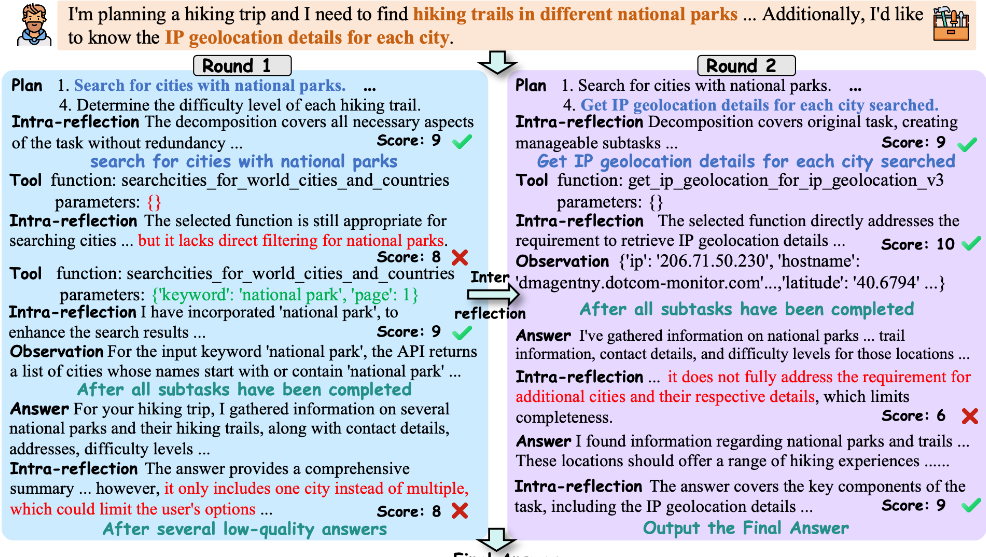
Figure 5 illustrates MIRROR's dual-reflection orchestrating complex task execution. In Round 1, after the Planner Agent decomposes the task, the Tool Agent's initial parameter selection for subtask 1 is flawed. MIRROR's tool-level intrareflection swiftly intervenes; operating without specific expected results for the subtask, it employs standard, generalizable criteria (e.g., function alignment, experiential learning) for an objective, pre-execution correction of the parameters. Despite this successful local fix and completion of all planned subtasks, the final answer remains suboptimal due to the Planner Agent's inadequate initial task decomposition.
Through inter-reflection on the complete execution trajectory, MIRROR identifies this planning limitation, prompting the Planner Agent to revise its task decomposition strategy. In the second round, the Planner Agent adds the crucial subtask 4, which was overlooked initially. This more comprehensive task decomposition, combined with accurate function selection, leads to a high-quality solution, demonstrating how MIRROR's reflection mechanisms effectively address errors at both planning and execution levels.
5 Conclusion
We present MIRROR, an innovative framework that advances tool use capabilities through the systematic integration of preexecution assessment (intra-reflection) and post-execution learning (inter-reflection) in a collaborative multi-agent environment. Rigorous evaluations conducted on both StableToolBench and TravelPlanner benchmarks demonstrate that our dual-reflection approach substantially enhances tool interaction reliability and task execution capabilities. These findings not only validate MIRROR's effectiveness but also underscore the fundamental role of reflection mechanisms in advancing agents' capability to interact with external environments through tools.
Acknowledgements
We thank the reviewers for their helpful feedback and suggestions, which improved this paper. This research is supported by Artificial Intelligence-National Science and Technology Major Project 2023ZD0121200 and National Natural Science Foundation of China under Grant 62222212.
@inproceedings{ijcai2025p14,
  title     = {MIRROR: Multi-agent Intra- and Inter-Reflection for Optimized Reasoning in Tool Learning},
  author    = {Guo, Zikang and Xu, Benfeng and Wang, Xiaorui and Mao, Zhendong},
  booktitle = {Proceedings of the Thirty-Fourth International Joint Conference on
               Artificial Intelligence, {IJCAI-25}},
  publisher = {International Joint Conferences on Artificial Intelligence Organization},
  editor    = {James Kwok},
  pages     = {117--125},
  year      = {2025},
  month     = {8},
  note      = {Main Track},
  doi       = {10.24963/ijcai.2025/14},
  url       = {https://doi.org/10.24963/ijcai.2025/14},
}
TY - CPAPER TI - MIRROR: Multi-agent Intra- and Inter-Reflection for Optimized Reasoning in Tool Learning AU - Guo, Zikang AU - Xu, Benfeng AU - Wang, Xiaorui AU - Mao, Zhendong T2 - Proceedings of the Thirty-Fourth International Joint Conference on Artificial Intelligence, IJCAI-25 PB - International Joint Conferences on Artificial Intelligence Organization PY - 2025 SP - 117 EP - 125 DO - 10.24963/ijcai.2025/14 UR - https://doi.org/10.24963/ijcai.2025/14 ER -Copied
Machine-readable versions of this paper, for tools and AI agents:





