
Stabilizing Holistic Semantics in Diffusion Bridge for Image Inpainting
Proceedings of the Thirty-Fourth International Joint Conference on Artificial Intelligence. Main Track. Pages 1756-1764.
https://doi.org/10.24963/ijcai.2025/196
Keywords
- Computer Vision: CV: Multimodal learning
- Computer Vision: CV: Representation learning
Abstract
Image inpainting aims to restore the original image from a damaged version. Recently, a special type of diffusion bridge model has achieved promising performance by directly mapping the degradation process and restoring corrupted images through the corresponding reverse process. However, due to the lack of explicit semantic priors during the denoising process, the inpainted results typically exhibit inferior context-stability and semantic consistency. To this end, this paper proposes a novel Global Structure-Guided Diffusion Bridge framework (GSGDiff), which incorporates an additional structure restorer to stabilize the generation of holistic semantics. Specifically, to acquire richer semantic structure priors, this paper proposes a posterior sampling approach that captures semantically global and consistent structures at each timestep, efficiently integrating them into the texture generation through the corresponding guidance module. Additionally, considering the characteristics of diffusion models with low denoising levels at larger timesteps, this paper proposes a semantic fusion schedule to avoid noise interference by reducing the weight of ineffective guided semantics in the early stages. By applying the proposed posterior sampling to the texture denoising process, GSGDiff can achieve more stable and superior inpainting results over competitive baselines. Experiments on Places2, Paris Street View and CelebA-HQ datasets validate the efficacy of the proposed method.
- [Barnes et al., 2009] Connelly Barnes, Eli Shechtman, Adam Finkelstein, and Dan B Goldman. Patchmatch: A randomized correspondence algorithm for structural image editing. ACM Trans. Graph., 28(3):24, 2009.
- [Criminisi et al., 2004] Antonio Criminisi, Patrick Pérez, and Kentaro Toyama. Region filling and object removal by exemplar-based image inpainting. IEEE Transactions on image processing, 13(9):1200-1212, 2004.
- [Doersch et al., 2012] Carl Doersch, Saurabh Singh, Abhi- nav Gupta, Josef Sivic, and Alexei A Efros. What makes paris look like paris? ACM Transactions on graphics, 31(4), 2012.
- [Dong et al., 2022] Qiaole Dong, Chenjie Cao, and Yanwei Fu. Incremental transformer structure enhanced image in- painting with masking positional encoding. In Proceed- ings of the IEEE/CVF Conference on Computer Vision and Pattern Recognition, pages 11358-11368, 2022.
- [Elfwing et al., 2018] Stefan Elfwing, Eiji Uchibe, and Kenji Doya. Sigmoid-weighted linear units for neural network function approximation in reinforcement learning. Neural networks, 107:3-11, 2018.
- [Goodfellow et al., 2014] Ian Goodfellow, Jean Pouget- Abadie, Mehdi Mirza, Bing Xu, David Warde-Farley, Sherjil Ozair, Aaron Courville, and Yoshua Bengio. Gen- erative adversarial nets. Advances in neural information processing systems, 27, 2014.
- [Guo et al., 2021] Xiefan Guo, Hongyu Yang, and Di Huang. Image inpainting via conditional texture and structure dual generation. In Proceedings of the IEEE/CVF international conference on computer vision, pages 14134-14143, 2021.
- [Han et al., 2025] Zihao Han, Baoquan Zhang, Lisai Zhang, Shanshan Feng, Kenghong Lin, Guotao Liang, Yun- ming Ye, Xiaochen Qi, and Guangming Ye. Asyncdsb: Schedule-asynchronous diffusion schrödinger bridge for image inpainting. In Proceedings of the AAAI Conference on Artificial Intelligence, 2025.
- [Heusel et al., 2017] Martin Heusel, Hubert Ramsauer, Thomas Unterthiner, Bernhard Nessler, and Sepp Hochre- iter. Gans trained by a two time-scale update rule converge to a local nash equilibrium. Advances in neural information processing systems, 30, 2017.
- [Ho et al., 2020] Jonathan Ho, Ajay Jain, and Pieter Abbeel. Denoising diffusion probabilistic models. Advances in neural information processing systems, 33:6840-6851, 2020.
- [Karras et al., 2018] Tero Karras, Timo Aila, Samuli Laine, and Jaakko Lehtinen. Progressive growing of gans for im- proved quality, stability, and variation. In International Conference on Learning Representations, 2018.
- [Ko and Kim, 2023] Keunsoo Ko and Chang-Su Kim. Con- tinuously masked transformer for image inpainting. In Proceedings of the IEEE/CVF International Conference on Computer Vision, pages 13169-13178, 2023.
- [Komodakis and Tziritas, 2007] Nikos Komodakis and Georgios Tziritas. Image completion using efficient belief propagation via priority scheduling and dynamic pruning. IEEE Transactions on Image Processing, 16(11):2649-2661, 2007.
- [Krizhevsky et al., 2012] Alex Krizhevsky, Ilya Sutskever, and Geoffrey E Hinton. Imagenet classification with deep convolutional neural networks. Advances in neural infor- mation processing systems, 25, 2012.
- [Li et al., 2021] Honglei Li, Wenmin Wang, Cheng Yu, and Shixiong Zhang. Swapinpaint: Identity-specific face in- painting with identity swapping. IEEE Transactions on Circuits and Systems for Video Technology, 32(7):4271- 4281, 2021.
- [Li et al., 2022] Wenbo Li, Zhe Lin, Kun Zhou, Lu Qi, Yi Wang, and Jiaya Jia. Mat: Mask-aware transformer for large hole image inpainting. In Proceedings of the IEEE/CVF conference on computer vision and pattern recognition, pages 10758-10768, 2022.
- [Liu et al., 2021] Yi Liu, Dingwen Zhang, Qiang Zhang, and Jungong Han. Part-object relational visual saliency. IEEE transactions on pattern analysis and machine intelligence, 44(7):3688-3704, 2021.
- [Liu et al., 2022] Haipeng Liu, Yang Wang, Meng Wang, and Yong Rui. Delving globally into texture and structure for image inpainting. In Proceedings of the 30th ACM In- ternational Conference on Multimedia, pages 1270-1278, 2022.
- [Liu et al., 2023] Guan-Horng Liu, Arash Vahdat, De-An Huang, Evangelos A Theodorou, Weili Nie, and Anima Anandkumar. I2sb: image-to-image schrödinger bridge. In Proceedings of the 40th International Conference on Machine Learning, pages 22042-22062, 2023.
- [Liu et al., 2024a] Haipeng Liu, Yang Wang, Biao Qian, Meng Wang, and Yong Rui. Structure matters: Tackling the semantic discrepancy in diffusion models for image inpainting. In Proceedings of the IEEE/CVF Conference on Computer Vision and Pattern Recognition, pages 8038- 8047, 2024.
- [Liu et al., 2024b] Yi Liu, De Cheng, Dingwen Zhang, Shoukun Xu, and Jungong Han. Capsule networks with residual pose routing. IEEE Transactions on Neural Net- works and Learning Systems, 2024.
- [Lugmayr et al., 2022] Andreas Lugmayr, Martin Danell- jan, Andres Romero, Fisher Yu, Radu Timofte, and Luc Van Gool. Repaint: Inpainting using denoising diffusion probabilistic models. In Proceedings of the IEEE/CVF conference on computer vision and pattern recognition, pages 11461-11471, 2022.
- [Luo et al., 2023] Ziwei Luo, Fredrik K Gustafsson, Zheng Zhao, Jens Sjölund, and Thomas B Schön. Image restora- tion with mean-reverting stochastic differential equations. In Proceedings of the 40st International Conference on Machine Learning, pages 23045-23066, 2023.
- [Luo et al., 2024] Ziwei Luo, Fredrik K Gustafsson, Zheng Zhao, Jens Sjölund, and Thomas B Schön. Photo- realistic image restoration in the wild with controlled vision-language models. In Proceedings of the IEEE/CVF Conference on Computer Vision and Pattern Recognition, pages 6641-6651, 2024.
- [Nazeri et al., 2019] Kamyar Nazeri, Eric Ng, Tony Joseph, Faisal Qureshi, and Mehran Ebrahimi. Edgeconnect: Structure guided image inpainting using edge prediction. In Proceedings of the IEEE/CVF international conference on computer vision workshops, 2019.
- [Peng et al., 2023] Jinjia Peng, Guangqi Jiang, and Huibing Wang. Adaptive memorization with group labels for un- supervised person re-identification. IEEE Transactions on Circuits and Systems for Video Technology, 33(10):5802- 5813, 2023.
- [Quan et al., 2024] Weize Quan, Jiaxi Chen, Yanli Liu, Dong-Ming Yan, and Peter Wonka. Deep learning-based image and video inpainting: A survey. International Jour- nal of Computer Vision, pages 1-34, 2024.
- [Shi et al., 2024] Yuyang Shi, Valentin De Bortoli, Andrew Campbell, and Arnaud Doucet. Diffusion schrödinger bridge matching. Advances in Neural Information Pro- cessing Systems, 36, 2024.
- [Song et al., 2021] Yang Song, Jascha Sohl-Dickstein, Diederik P Kingma, Abhishek Kumar, Stefano Ermon, and Ben Poole. Score-based generative modeling through stochastic differential equations. In International Conference on Learning Representations, 2021.
- [Suvorov et al., 2022] Roman Suvorov, Elizaveta Lo- gacheva, Anton Mashikhin, Anastasia Remizova, Arsenii Ashukha, Aleksei Silvestrov, Naejin Kong, Harshith Goka, Kiwoong Park, and Victor Lempitsky. Resolution- robust large mask inpainting with fourier convolutions. In Proceedings of the IEEE/CVF winter conference on applications of computer vision, pages 2149-2159, 2022.
- [Wang et al., 2004] Zhou Wang, Alan C Bovik, Hamid R Sheikh, and Eero P Simoncelli. Image quality assessment: from error visibility to structural similarity. IEEE transac- tions on image processing, 13(4):600-612, 2004.
- [Wang et al., 2022] Huibing Wang, Guangqi Jiang, Jinjia Peng, Ruoxi Deng, and Xianping Fu. Towards adaptive consensus graph: multi-view clustering via graph collabo- ration. IEEE Transactions on Multimedia, 25:6629-6641, 2022.
- [Wang et al., 2023] Huibing Wang, Mingze Yao, Guangqi Jiang, Zetian Mi, and Xianping Fu. Graph-collaborated auto-encoder hashing for multiview binary clustering. IEEE Transactions on Neural Networks and Learning Sys- tems, 2023.
- [Yao et al., 2024] Mingze Yao, Huibing Wang, Yawei Chen, and Xianping Fu. Between/within view information com- pleting for tensorial incomplete multi-view clustering. IEEE Transactions on Multimedia, 2024.
- [Yu et al., 2018] Jiahui Yu, Zhe Lin, Jimei Yang, Xiaohui Shen, Xin Lu, and Thomas S Huang. Generative image inpainting with contextual attention. In Proceedings of the IEEE conference on computer vision and pattern recogni- tion, pages 5505-5514, 2018.
- [Yue et al., 2024] Conghan Yue, Zhengwei Peng, Junlong Ma, Shiyan Du, Pengxu Wei, and Dongyu Zhang. Im- age restoration through generalized ornstein-uhlenbeck bridge. In Proceedings of the 41st International Confer- ence on Machine Learning, 2024.
- [Zeng et al., 2022] Yanhong Zeng, Jianlong Fu, Hongyang Chao, and Baining Guo. Aggregated contextual transfor- mations for high-resolution image inpainting. IEEE Trans- actions on Visualization and Computer Graphics, 2022.
- [Zhang et al., 2018] Richard Zhang, Phillip Isola, Alexei A Efros, Eli Shechtman, and Oliver Wang. The unreasonable effectiveness of deep features as a perceptual metric. In Proceedings of the IEEE conference on computer vision and pattern recognition, pages 586-595, 2018.
- [Zhang et al., 2023] Lvmin Zhang, Anyi Rao, and Maneesh Agrawala. Adding conditional control to text-to-image dif- fusion models. In Proceedings of the IEEE/CVF Interna- tional Conference on Computer Vision, pages 3836-3847, 2023.
- [Zhang et al., 2024] Ruoqi Zhang, Ziwei Luo, Jens Sjölund, Thomas B Schön, and Per Mattsson. Entropy-regularized diffusion policy with q-ensembles for offline reinforce- ment learning. Advances in neural information processing systems, 2024.
- [Zhou et al., 2017] Bolei Zhou, Agata Lapedriza, Aditya Khosla, Aude Oliva, and Antonio Torralba. Places: A 10 million image database for scene recognition. IEEE transactions on pattern analysis and machine intelligence, 40(6):1452-1464, 2017.
- [Zhou et al., 2024] Linqi Zhou, Aaron Lou, Samar Khanna, and Stefano Ermon. Denoising diffusion bridge models. In The Twelfth International Conference on Learning Rep- resentations, 2024.
References were extracted automatically from the PDF and may contain errors.
Full text extracted automatically from the PDF; figures, tables and equations may differ. The PDF is the version of record.
1 Introduction
Image inpainting refers to reconstructing a high-quality image from an incomplete one, and it has a wide range of applications in many fields such as image editing [Li et al., 2021], artifact restoration [Quan et al., 2024], and object removal. It is an inverse problem with an ill-posed nature. To resolve this challenging issue, conventional algorithms [Criminisi et al., 2004; Komodakis and Tziritas, 2007;
∗Corresponding author.
Barnes et al., 2009] mainly utilize low-level visual assumptions to heuristically reconstruct the damaged regions or search and copy similar image patches from of the undamaged source image to fill the target region. However, due to limited feature representation, these methods typically struggle to generate accurate semantics within the hole. To this end, later works [Krizhevsky et al., 2012; Liu et al., 2021; Liu et al., 2024b; Suvorov et al., 2022; Zeng et al., 2022; Yu et al., 2018; Ko and Kim, 2023; Li et al., 2022; Yao et al., 2024; Peng et al., 2023] have attempted to design advanced components to enhance feature representations or introduce self-attention mechanisms into GAN-based [Goodfellow et al., 2014] conditional generative models, achieving better performance. Nonetheless, such strategies often lead to weak semantics correlation among various patches within the masked regions. To address this, some approaches [Nazeri et al., 2019; Dong et al., 2022; Liu et al., 2022; Wang et al., 2023] explore the utilization of additional sparse structure priors as a means to strengthen the correlations between the inpainted and masked regions. However, due to their limited semantic generation capabilities and heavy reliance on the semantic consistency between structure priors and texture, these methods inevitably suffer from meaningless artifacts.
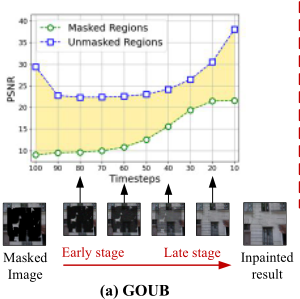
Recently, diffusion models [Ho et al., 2020; Song et al., 2021] have shown state-of-the-art performance in generative tasks, exhibiting excellent semantic generation capability and pattern convergence, thus effectively addressing poor semantic generation in image inpainting [Lugmayr et al., 2022; Luo et al., 2023; Liu et al., 2024a; Yue et al., 2024; Wang et al., 2022]. Within these models, a notable development is the diffusion bridges [Liu et al., 2023; Shi et al., 2024; Zhou et al., 2024; Han et al., 2025], which skillfully integrate the end-to-end training paradigm of CNN-based models with the denoising concept of diffusion models, creating a point-to-point diffusion process between original and damaged images. Among these developments, GOUB [Yue et al., 2024] proposes applying Doob's h-transform to the Generalized Ornstein-Uhlenbeck (GOU) process, achieving superiority over other diffusion bridge models. However, due to the absence of richer contextual semantics in the denoising process, all of the above diffusion-based methods tend to either exhibit poor semantics consistency or fill the masked area with inferior context-stability (see Figures 1 (a) and (b)).
Early stage Late stage
(b) StrDiff Early stage Late stage
(c) GSGDiff (Ours)
Figure 1: Illustration of the denoised results for existing arts on PSV [Doersch et al., 2012], e.g., GOUB [Yue et al., 2024] (a) fails to generate consistent semantics between the masked and unmasked regions due to missing structure guidance; equipped with the guidance of sparse consistent structure, StrDiff [Liu et al., 2024a] (b) tackles the semantic discrepancy with consistent structure guidance but introduces blurring and artifacts. Our GSGDiff (c) achieves coherent denoised results via auxiliary global and consistent structure guidance.
This, in practice, limits their performance capabilities, especially in complex degradation scenarios.
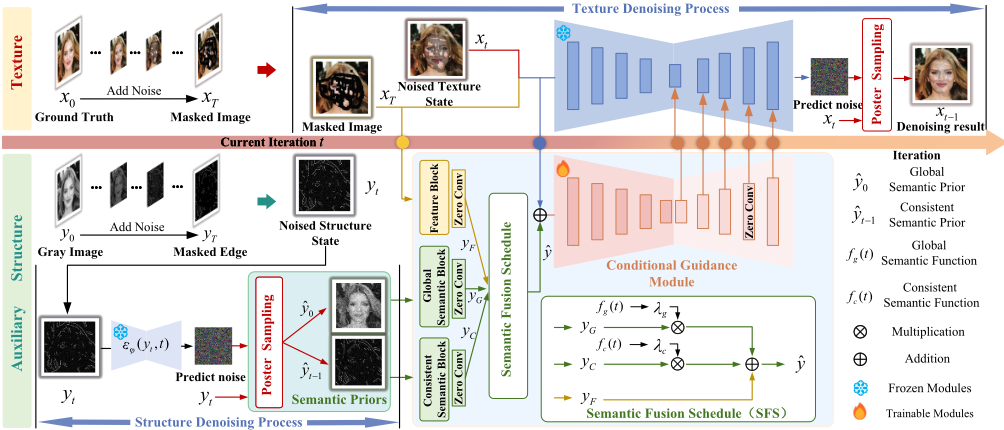
In this paper, we are committed to stabilizing the holistic semantics by exploiting additional semantic priors in texture denoising and propose an intuitive and effective inpainting architecture named the Global Structure-Guided Diffusion Bridge framework (GSGDiff). Specifically, we employ a guidance scheme that diffuses from grayscale images to masked edge maps within the structure denoising network to produce auxiliary structural information. To obtain global semantic prior over time, we propose a posterior sampling approach for the generalized ornstein-uhlenbeck bridge model. This approach enables the structure denoising network to capture global and consistent semantics at each timestep. Moreover, given the unique characteristics of the diffusion models, where higher values of timesteps correspond to lower levels of denoising, the guidance semantics often contain more irrelevant noise. To mitigate this issue, we propose a semantic fusion schedule that reduces the weight of ineffective semantics in the early stages to improve the effectiveness of guided information. With the assistance of structures in the texture denoise process, GSGDiff can generate meaningful results.
The main contributions of the paper are as follows:
- This paper proposes a novel Global Structure-Guided Diffusion Bridge framework that leverages a pre-trained auxiliary network to acquire structure semantics and efficiently injects them into texture generation, achieving superior restoration in texture and structure.
- To obtain time-dependent global semantics guidance, this paper proposes a posterior sampling approach tailored to the generalized ornstein-uhlenbeck bridge model, allowing the structure denoising network to capture global and consistent semantics at each timestep.
- Considering the lower denoising capability in the initial stages of denoising, this paper proposes a semantic fusion schedule to improve guided semantics more effectively while reducing the impact of irrelevant noise on texture generation.
2 Methodology
2.1 Preliminaries: Generalize Ornstein-Uhlenbeck Bridge for Image inapinting
Given a ground-truth image Igt ∈ R3×H×W and a binary mask M ∈ R1×H×W that indicates the region to be inpainted, the goal of image inpainting is to reconstruct the masked image Im = Igt ⊙M into a fully inpainted image. Typical diffusion bridge models for inpainting consist of two main processes: the forward texture diffusion process and the reverse texture denoising process.
For the forward diffusion process, given an initial texture state x0 representing the ground truth image Igt and a final state xT representing the corresponding masked image Im, with both ends of the bridge (i.e., x0 and xT ) known, the diffusion process {xt}Tt=0 for any time t ∈ [0, T] can be expressed as:
where θt and gt refer to the drift and diffusion coefficients, respectively. They are positive time-dependent parameters that satisfy 2λ2 = g2 t /θt. λ2 is a given constant scalar and wt is a standard Brownian motion that introduces randomness to the differential equation. The stochastic differential equation (SDE) defined above will necessarily pass through the final state xT when t = T , creating a bridge connecting the points x0 and xT , hence this type of model is referred to as a diffusion bridge model. The forward process at any given moment t can be defined as follows:
Masked
Image Inpainted result Masked Image Inpainted result For the reverse texture denoising process, we can reverse the diffusion SDE from Eq. (1) to denoise starting from the final state xT and obtain the restored image x0, this process can be defined as:
Since the conditional score function is unknown, we can train a conditional time-dependent neural network by parameterizing the noise as ϵθ(xt, xT , t) to estimate the score. Thus, the ultimate training objective can be expressed as:
where a and b is positive weight and the conditional score ∇xt log p(xt | xT ) ≈ ∇xt log pθ(xt | xT ) = -ϵθ(xt, xT , t)/¯σ′t . Therefore, starting from masked image xT , we can recover x0 by utilizing Eq. (3) to perform reverse iteration.
2.2 How to obtain Time-dependent Global Semantics for Texture Denoising?
Recent work [Liu et al., 2024a] indicates that progressively incorporating the semantically sparse structure into texture generation over time can encourage consistent semantics in the inpainted regions. However, in more complex degradation scenarios, merely relying on consistent semantics established at an early stage often fails to align the generated content with the global semantics well.
As shown in Figure 1, both GOUB [Yue et al., 2024] (a), which lacks additional semantic prior, and StrDiff [Liu et al., 2024a] (b), which relies on consistency-based semantics structure guidance, fail to achieve optimal inpainted result. To this end, an intuitive idea is to introduce global semantics, building upon the consistent sparse structure guidance provided in the early stage.
To achieve this, this paper proposes a posterior sampling approach for GOUB to generate richer global semantic prior from the posterior distribution p (xt-1 | xt, xT ) conditioned on x0. Specifically, given an initial state x0 and a finite random diffusion state xt at time t ∈ [0, T ], we can prove that the posterior of GOUB is tractable, and this posterior distribution is given by:
From Bayes' formula, we can infer that:
Since p(xt-1 | x0, xT ) and p(xt | x0, xT ) are Gaussian distributions (2), by employing the reparameterization technique, we can obtain p(xt | xt-1, xT ) = N(axt-1 + bxT , ( ¯σ′2 t -a2 ¯σ′2 t-1 ) I). Thus, this posterior distribution with mean and variance is given by:
2.3 Structure-Guided Denoising Process and Semantic Fusion Schedule
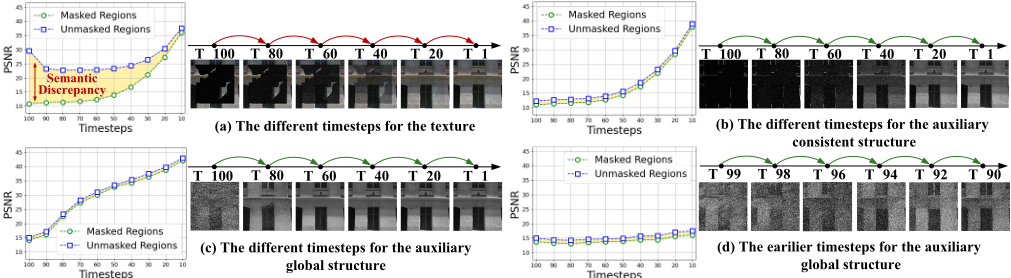
Considering that the semantic discrepancy between the masked and unmasked regions gradually increases as the timestep increases (see Figure 3 (a)), our aim is to alleviate this discrepancy in the early denoising through the aid of structures. This led to the introduction of the following:
How does the Structure Guide the Texture Denoising Process?
For the choice of guidance approaches, previous works [Liu et al., 2024a; Dong et al., 2022] used designed feature fusion strategies or modules to incorporate guidance information. However, these approaches typically require retraining the entire model, resulting in both limited flexibility and high computational costs. To address this, we introduce some new guidance modules inspired by ControlNet [Zhang et al., 2023], which guide the model's generation without modifying the original pre-trained diffusion model, thus fully leveraging its capabilities.
Specifically, as illustrated in Figure 2, the global and consistent semantics ˆy0 and ˆyt-1 are first encoded by their corresponding semantic blocks. These extracted features, combined with features of available regions, serve as inputs to the Conditional Guidance Module (CGM). The CGM is specifically designed to process and integrate the guidance information. Its left side aligns with and is initialized from the downsampling module of the pre-trained texture denoising U-Net, while its right side comprises zero-initialized convolutional layers. Due to the zero initialization, the initial influence of the conditional guidance on the denoising process is zero, which allows the model to maintain stability during the early stages of training. As the model learns, it gradually incorporates the guidance information, enabling it to approach optimal parameters more stably.
How to avoid noise interference within the obtained structure priors?
Due to the limited denoising capabilities in the early stages, the obtained structure semantics usually lack effective information. As depicted in Figure 3 (b), as t decreases from
where,
Moreover, thanks to the reparameterization technique (xt = ¯m′t + ¯σ′t ϵt), we can combine it with the noise prediction network ˜ ϵϕ(xt, xT , t) to estimate the variable x0 at time t:
where ¯m′t and ¯σ′t are the forward mean and variance in Eq. (2). Then we can iteratively sample reverse states by combining Eq. (9) with Eq. (5) to construct the sampling process.
By applying this sampling strategy to the structure denoising U-Net ϵφ(yt, t), as depicted in Figure 2, we can obtain the global semantics ˆy0 and the consistent semantics ˆyt-1 at any time t to assist the texture generation.
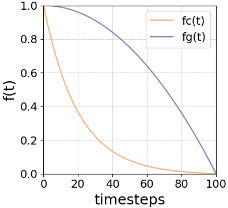
100 to 60, the masked regions within the auxiliary consistent structure predominantly contain invalid noise, thus it is difficult to perform any guidance function. To minimize the influence of invalid information during training, we propose a specific Semantic Fusion Schedule for the extracted global and consistent structure features, aiming to assign appropriate weights to incorporate them into the fusion process. Specifically, for the weight function of the consistent features, we desire it to smoothly approximate zero in the early stages and eventually converge to one. Given the natural properties of the exponential function, it can be set as follows:
where the parameter a is set to 5 for all experiments. Compared to the sparse consistent structure, the global structure contains richer semantics (see Figure 3 (b) and (c)). Noisy and ineffective information primarily appears in the earlier stages (e.g., when t decreases from 100 to 90), as illustrated in Figure 3 (d). Therefore, our idea is to initially assign higher weights to the global features, ensuring robust guidance from global semantics throughout training. The weight function for global features is given by:
The function curves of the two weight functions are shown in Figure 4. Thus, the final fusion strategy is defined as follows:
As a result, each semantic block is updated only when the guidance features become more distinctive, effectively avoiding the impact of irrelevant information.
2.4 Sampling Strategy for Texture Denoising Process
Generally, we can utilize the trained network to generate high-quality images by sampling a state xT and then iteratively solving the Eq. (3) with a numerical scheme. However, recent studies [Zhang et al., 2024; Luo et al., 2024] have shown that iterative sampling using the posterior sampling method during the reverse process can accelerate the convergence of the generative process and improve sample efficiency. Therefore, this paper applies the proposed posterior sampling strategy to texture denoising networks as well, aiming to achieve more excellent inpainting results. However, as the denoising proceeds, the correlation between the semantics generated by the auxiliary structure branch (ˆy0 and ˆyt-1) and the texture (ˆxt-1) gradually weakens. Continually injecting the guidance semantics throughout the entire texture denoising process may result in color distortion and blurring in the masked regions [Liu et al., 2024a].
To address this, we adopt a simple yet effective stage-wise semantic injection strategy, utilizing the stage point α to control the guided timesteps. Specifically, during the early denoising stages (i.e., when t ∈ [T, α]), we leverage sparse consistent and global structures to generate coherent contents align well with the overall semantics. In the later stage (i.e., when t ∈ (α, 0]), we rely solely on dense textures to generate meaningful semantic details. By doing so, we avoid semantic discrepancy between the generated textures and structures in the later stage, ultimately eliminating color distortion and achieving excellent results.
2.5 Overall Architecture
The pipeline of proposed GSGDiff is illustrated in Figure 2. Specifically, we first employ a pre-trained structure denoising U-Net ϵφ(yt, t), which models the transformation from gray image to masked edge image, to acquire structural semantic priors at each timestep. Then, these structural priors, combined with the masked image, are encoded by their respective feature extract blocks. Each block consists of four convolutional layers followed by a zero-initialized convolution layer and utilizes the SiLU [Elfwing et al., 2018] activation function. Afterward, the guidance module takes these encoded features to guide the texture generation. We initialize the texture denoising network with a pre-trained model and freeze its parameters, preserving its base denoising capability while enabling guidance learning and reducing training overhead.
3 Experiments
3.1 Experimental Settings
We validate our method and various baselines on three typical datasets, including Paris Street View (PSV) [Doersch et al., 2012], which consists of street photos taken in Paris and contains 14,900 training images and 100 validation images; CelebA-HQ [Karras et al., 2018] is a dataset containing 30,000 high-quality human face images, divided into 28k training images and 2k validation images; Places2 [Zhou et al., 2017] is a collection of more than 1.8 million natural images in multiple scenes. Following previous research, we use PSNR (Peak Signal-to-Noise Ratio) and SSIM (Structural Similarity Index) [Wang et al., 2004] to measure pixel and structural similarity. FID (Fr´echet Inception Distance) [Heusel et al., 2017] and LPIPS (Learned Perceptual Image Patch Similarity) [Zhang et al., 2018] are used to measure perceptual disparity and visual effect.
3.2 Comparison with the State of the Arts
To validate GSGDiff's effectiveness, various typical inpainting models are compared, including LaMa [Suvorov et al., 2022] which employs Fourier convolution to enlarge the receptive field; MAT [Li et al., 2022], CMT [Ko and Kim, 2023] which uses a self-attention mechanism to model the long-distance dependencies between masked and unmasked regions; CTSDG [Guo et al., 2021], DGTS [Liu et al., 2022], ZITS [Dong et al., 2022] which focuses on using the structure to assist texture generation; Repaint [Lugmayr et al., 2022] and IR-SDE [Luo et al., 2023], which benefit from DDPM but overlook the semantic consistency; StrDiff [Liu et al., 2024a], which recently exploits consistent structure to assist texture generation, and GOUB [Yue et al., 2024], which performs well as a diffusion bridge model in inpainting.
| Places2 Method | 0.01%-20% | 20%-40% | 40%-60% | ||||||||||||
|---|---|---|---|---|---|---|---|---|---|---|---|---|---|---|---|
| Venue | PSNR↑ | SSIM↑ | FID↓ | LPIPS↓ | PSNR↑ | SSIM↑ | FID↓ | LPIPS↓ | PSNR↑ | SSIM↑ | FID↓ | LPIPS↓ | |||
| LaMa [Suvorov et al., 2022] | WACV'22 | 31.7873 | 0.9576 | 9.5640 | 0.0399 | 25.9291 | 0.8740 | 26.0854 | 0.1060 | 22.1447 | 0.7706 | 55.5161 | 0.1849 | ||
| MAT [Li et al., 2022] CMT [Ko and Kim, 2023] | ECCV'22 ICCV'23 | 30.1129 32.2212 | 0.9243 0.9568 | 19.5104 9.7308 | 0.0790 0.0388 | 25.7473 25.7010 | 0.8575 0.8706 | 32.3014 29.3242 | 0.1278 0.1099 | 21.9842 22.2333 | 0.7571 0.7634 | 59.8215 58.9052 | 0.2022 0.1959 | ||
| CTSDG [Guo et al., 2021] DGTS [Liu et al., 2022] ZITS [Dong et al., 2022] | ICCV'21 MM'22 CVPR'22 | 30.8392 32.1521 32.0579 | 0.9520 0.9577 0.9575 | 16.0018 7.6521 8.6984 | 0.0523 0.0338 0.0384 | 24.7299 25.6256 26.2415 | 0.8544 0.8732 0.8758 | 53.6743 26.7281 23.5181 | 0.1492 0.1007 0.1026 | 21.2436 21.2612 22.1872 | 0.7362 0.7552 0.7700 | 102.6408 69.9825 50.2054 | 0.2500 0.2042 0.1825 | ||
| Repaint [Lugmayr et al., 2022] IR-SDE [Luo et al., 2023] StrDiff [Liu et al., 2024a] GOUB [Yue et al., 2024] | CVPR'22 ICML'23 CVPR'24 ICML'24 | 32.8635 33.3146 33.3335 33.5159 | 0.9611 0.9632 0.9625 0.9637 | 7.2329 6.6301 8.2728 6.5709 | 0.0347 0.0320 0.0330 0.0305 | 25.2324 25.6727 26.3314 25.9980 | 0.8781 0.8830 0.8770 0.8832 | 25.4316 24.0067 29.0277 22.9658 | 0.1001 0.0915 0.1050 0.0906 | 20.6880 20.9667 21.6504 21.2422 | 0.7550 0.7656 0.7581 0.7670 | 64.4779 59.0665 64.4334 56.6660 | 0.2053 0.1821 0.2028 0.1802 | ||
| GSGDiff (Ours) | - | 34.0562 | 0.9688 | 5.7582 | 0.0237 | 26.6631 | 0.8946 | 21.6388 | 0.0814 | 22.2646 | 0.7882 | 49.5415 | 0.1669 | ||
| Paris Street View (PSV) Method | Venue | PSNR↑ | 0.01%-20% SSIM↑ | FID↓ | LPIPS↓ | PSNR↑ | 20%-40% SSIM↑ | FID↓ | LPIPS↓ | PSNR↑ | 40%-60% SSIM↑ | FID↓ | LPIPS↓ | ||
| CTSDG [Guo et al., 2021] DGTS [Liu et al., 2022] | ICCV'21 MM'22 | 32.6122 27.3439 | 0.9605 0.8972 | 14.4908 37.2752 | 0.0496 0.1315 | 26.4840 23.5567 | 0.8831 0.8295 | 39.0581 47.7383 | 0.1369 0.1873 | 22.3543 20.4743 | 0.7812 0.7299 | 74.5036 71.8430 | 0.2323 0.2666 | ||
| IR-SDE [Luo et al., 2023] StrDiff [Liu et al., 2024a] GOUB [Yue et al., 2024] | ICML'23 CVPR'24 ICML'24 | 33.2511 32.9251 32.8552 | 0.9586 0.9552 0.9582 | 13.2687 15.5061 13.6456 | 0.0466 0.0503 0.0461 | 26.8808 26.7581 26.4787 | 0.8836 0.8704 0.8814 | 35.3289 39.6069 33.4046 | 0.1216 0.1389 0.1231 | 22.9834 23.2642 23.1824 | 0.7811 0.7630 0.7820 | 64.3514 76.8962 66.3349 | 0.2135 0.2387 0.2125 | ||
| GSGDiff (Ours) | - | 33.2808 | 0.9622 | 12.2068 | 0.0421 | 27.0950 | 0.8913 | 32.4010 | 0.1186 | 23.7311 | 0.7981 | 63.8277 | 0.2082 | ||
| CelebA-HQ Method | Venue | PSNR↑ SSIM↑ | 0.01%-20% FID↓ | LPIPS↓ | PSNR↑ | 20%-40% SSIM↑ FID↓ | LPIPS↓ | PSNR↑ | 40%-60% SSIM↑ FID↓ | LPIPS↓ | |||||
| LaMa [Suvorov et al., 2022] | WACV'22 | 36.7654 | 0.9728 | 6.5111 | 0.0322 | 29.2867 | 0.9088 | 15.2416 | 0.0821 | 24.6776 | 0.8340 | 22.3708 | 0.1378 | ||
| DGTS [Liu et al., 2022] CMT [Ko and Kim, 2023] | MM'22 ICCV'23 | 35.2689 37.2173 | 0.9694 0.9753 | 4.9180 5.1643 | 0.0271 0.0271 | 27.8547 29.2500 | 0.9032 0.9113 | 14.4271 14.3871 | 0.0793 0.0779 | 22.8301 24.4221 | 0.8085 0.8309 | 31.7918 22.8132 | 0.1651 0.1391 | ||
| Repaint [Lugmayr et al., 2022] IR-SDE [Luo et al., 2023] StrDiff [Liu et al., 2024a] GOUB [Yue et al., 2024] | CVPR'22 ICML'23 CVPR'24 ICML'24 | 36.2290 37.4388 38.2595 37.4265 | 0.9730 0.9753 0.9737 0.9755 | 5.2734 4.8706 4.7226 4.5224 | 0.0291 0.0303 0.0237 0.0284 | 27.8263 28.7787 29.4721 28.5941 | 0.9035 0.9082 0.9087 0.9076 | 13.9523 13.1708 14.5869 13.7277 | 0.0832 0.0804 0.0789 0.0796 | 22.7000 23.6836 24.3714 24.0265 | 0.8111 0.8146 0.8149 0.8158 | 23.7413 22.3751 25.5039 21.2560 | 0.1524 0.1475 0.1549 0.1461 | ||
| GSGDiff (Ours) | - | 38.6694 | 0.9807 | 3.8291 | 0.0188 | 29.1570 | 0.9181 | 12.1898 | 0.0677 | 24.3745 | 0.8344 | 20.0816 | 0.1305 | ||
Quantitative Results Table 1 shows that GSGDiff achieves near-optimal performance across all three benchmark datasets as masking ratios increase. On the Places2 dataset, we achieve PSNR improvements of 1.6%, 2.6%, and 4.8% for three different masking ratios compared to GOUB. Additionally, for street-view and natural image scenarios, our method outperforms StrDiff in all metrics. This superiority is attributed to StrDiff's lack of holistic semantics in its denoising process, suggesting that our method is capable of generating more stable and semantically consistent contexts. For texture-rich face inpainting, GSGDiff demonstrates superiority over other methods in terms of perceptual performance, as evidenced by lower FID and LPIPS indices.
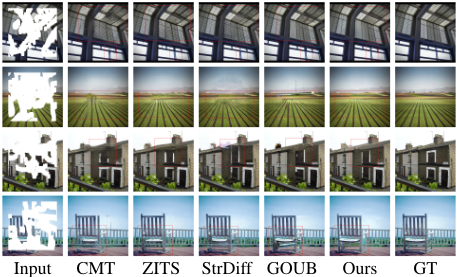
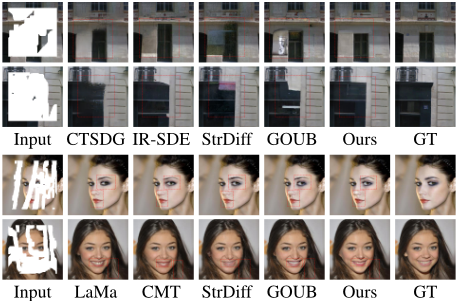
Qualitative Results In Figures 5 and 6, some visualization results are presented for our method and some representative methods. For complex structural degradation, our method avoids structural inconsistencies and blurring, yielding sharper results. Examples include the wall texture in the first row of Figure 5 and the second row of Figure 6. In addition, our method excels in restoring natural scenery, such as the wheat field and the chair depicted in Figure 5, demonstrating that our method can obtain more contextually semantic restoration results. For face restoration, GSGDiff also shows excellent texture generation ability, and compared with other methods, our method generates more natural face features with more realistic expressions.
3.3 Ablation and analysis
In this section, several ablated methods are conducted to assess the efficacy of the proposed algorithm and its components. We also analyze the selection of stage points α in texture denoising. Experiments use the PSV [Doersch et al., 2012] dataset with mix mask ratios of 20%-60%, and the baseline model is obtained by removing the proposed prior guidance and the semantic fusion schedule from our model.
| Semantic Prior | Fusion Schedule | Mix mask (20%-60%) | ||||||
|---|---|---|---|---|---|---|---|---|
| Setup | ˆ yt-1 | ˆ y0 | fc(t) | fg(t) | PSNR↑ | SSIM↑ | FID↓ | LPIPS↓ |
| Baseline A B C D E F Ours | ✓ ✓ ✓ ✓ ✓ ✓ | ✓ ✓ ✓ ✓ ✓ ✓ | ✓ fusion ✓ | ✓ w concat ✓ | 23.8064 24.4789 24.5202 24.5131 24.6488 24.6257 24.6143 24.7712 | 0.8057 0.8081 0.8091 0.8098 0.8106 0.8104 0.8091 0.8121 | 54.0858 53.2989 53.1829 52.5058 51.6009 52.6605 51.8449 51.1518 | 0.1896 0.1865 0.1864 0.1870 0.1857 0.1861 0.1874 0.1853 |
Semantic prior guidance Table 2 shows that both semantic priors yield improvements over the baseline model. The global prior notably enhances the performance, with model B achieving a gain of 0.7 dB in PSNR over the baseline. Notably, by combining consistent and global semantics, model C exhibits better FID and SSIM, but performs slightly worse on the other metrics. The reason for this is that the consistent semantics are too sparse in the early denoising stage and provide limited effective guidance to the texture denoising network. Hence, the performance improvement of the model C is not as significant as that of the model B.
Semantic fusion schedule Table 2 shows that both model D and model E show better performance than model C when the respective weighting functions are applied to the semantic priors. At the beginning of the denoising process, the consistent semantics are sparse compared to the global semantics. Thus, after adjusting the weights to reduce the interference of invalid noise, the model D exhibits higher performance metrics than the model E. Ultimately, our GSGDiff exhibits optimal performance when equipped with a corresponding fusion schedule for each semantic prior. In contrast, model F, which utilizes a direct concatenation of semantic priors, is shown to be inferior to our proposed semantic fusion schedule.
The analysis of sampling strategies in texture denoising To explore the practical performance of the proposed posterior sampling in texture denoising, we compare sampling strategies across models. The results, shown in Table 3, demonstrate that using our posterior sampling during inference significantly improves the model's performance, yielding better PSNR, SSIM, and LPIPS metrics.
| Mix Mask (20%-60%) | ||||
|---|---|---|---|---|
| Methods | PSNR↑ | SSIM↑ | FID↓ | LPIPS↓ |
| GSGDiff | 24.7712 | 0.8121 | 51.1518 | 0.1853 |
| GSGDiff-posterior | 24.8301 | 0.8230 | 53.9333 | 0.1839 |
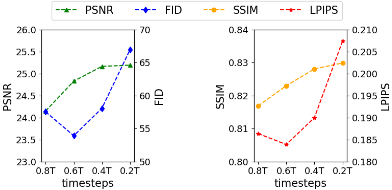
The choices for stage point α In Figure 7, we set α to take values at [0.2T, 0.4T, 0.6T, 0.8T] to evaluate its effect on the final inpainted results. From the figure, it can be seen that the values of distortion metrics (PSNR and SSIM) tend to increase as the value of α decreases. Notably, the FID and LPIPS metrics show a significant advantage at α = 0.6T; however, as the guided timestep is prolonged, the perceptual performance (FID and LPIPS) deteriorates. This is due to the correlation between the semantics generated by the auxiliary structure branch and the texture gradually weakens. Continually injecting the guidance semantics throughout the entire texture denoising process may result in color distortion and blurring. Considering the limitations of the traditional metrics (i.e., PSNR, SSIM) which tend to assign higher values to smoothed results and do not reflect human perception well [Zhang et al., 2018], we finally choose α = 0.6T , as the stage point for phased injection of guidance information.
4 Conclusion
We propose a novel diffusion bridge for inpainting, which aims to stabilize the inpainted result by integrating timedependent holistic semantics in texture denoising. A posterior sampling approach is tailored to the Generalized OrnsteinUhlenbeck bridge, which acquires semantically global and consistent structure priors. Considering the limited guidance caused by noise in the early denoising, a semantic fusion schedule is designed to reduce the weight of ineffective guided semantics. Experimental results demonstrate that our method achieves superior performance compared to previous methods.
Acknowledgments
This work was jointly supported by the National Key Research and Development Program of China Grant 2024YFB4710800; Liaoning Provincial Natural Science Foundation Grant 2024-MS-012; Dalian Science and Technology Talent Innovation Support Plan, Grant 2024RY010; Basic Research Project of Shijiazhuang Municipal Universities in Hebei Province (241791387A); Interdisciplinary Research Program of Hebei University (DXK202404).
@inproceedings{ijcai2025p196,
  title     = {Stabilizing Holistic Semantics in Diffusion Bridge for Image Inpainting},
  author    = {Peng, Jinjia and Li, Mengkai and Wang, Huibing},
  booktitle = {Proceedings of the Thirty-Fourth International Joint Conference on
               Artificial Intelligence, {IJCAI-25}},
  publisher = {International Joint Conferences on Artificial Intelligence Organization},
  editor    = {James Kwok},
  pages     = {1756--1764},
  year      = {2025},
  month     = {8},
  note      = {Main Track},
  doi       = {10.24963/ijcai.2025/196},
  url       = {https://doi.org/10.24963/ijcai.2025/196},
}
TY - CPAPER TI - Stabilizing Holistic Semantics in Diffusion Bridge for Image Inpainting AU - Peng, Jinjia AU - Li, Mengkai AU - Wang, Huibing T2 - Proceedings of the Thirty-Fourth International Joint Conference on Artificial Intelligence, IJCAI-25 PB - International Joint Conferences on Artificial Intelligence Organization PY - 2025 SP - 1756 EP - 1764 DO - 10.24963/ijcai.2025/196 UR - https://doi.org/10.24963/ijcai.2025/196 ER -Copied
Machine-readable versions of this paper, for tools and AI agents:





