
Distributed Cascaded Manifold Hashing Network for Compact Image Set Representation
Proceedings of the Thirty-Fourth International Joint Conference on Artificial Intelligence. Main Track. Pages 1991-1999.
https://doi.org/10.24963/ijcai.2025/222
Keywords
- Computer Vision: CV: Image and video retrieval
Abstract
Conventional image set methods typically learn from image sets stored in a single location. However, in real-world applications, image sets are often distributed across different locations. Learning from such distributed sets using deep neural networks poses challenges for efficient image set classification and retrieval. To address this, we propose Distributed Cascade Manifold Hashing Network (DCMHN) for compact image set representation. DCMHN represents each image set using an SPD manifold and utilizes a manifold hashing network to generate hash codes, enabling efficient classification and retrieval. The network is trained in a cascaded manner, where the bilinear mapping in the BiMap layer is learned first, followed by joint learning of the hash function and classifier in the hash layer. DCMHN enforces local consistency on global variables across neighboring nodes, allowing parallel optimization. Extensive experiments on three benchmark image set datasets demonstrate that the proposed DCMHN achieves competitive accuracies in distributed settings, and outperforms state-of-the-arts in terms of computation and storage efficiency.
- [Cao et al., 2022] Yuan Cao, Junwei Liu, Heng Qi, Jie Gui, Keqiu Li, Jieping Ye, and Chao Liu. Scalable distributed hashing for approximate nearest neighbor search. IEEE Transactions on Image Processing, 31:472-484, 2022.
- [Cevikalp and Triggs, 2010] Hakan Cevikalp and Bill Triggs. Face recognition based on image sets. In Proceed- ings of IEEE Computer Society Conference on Computer Vision and Pattern Recognition, pages 2567-2573, 2010.
- [Chakraborty et al., 2020] Rudrasis Chakraborty, Jose Bouza, Jonathan H Manton, and Baba C Vemuri. Mani- foldnet: A deep neural network for manifold-valued data with applications. IEEE Transactions on Pattern Analysis and Machine Intelligence, 44(2):799-810, 2020.
- [Datar et al., 2004] Mayur Datar, Nicole Immorlica, Piotr Indyk, and Vahab S Mirrokni. Locality-sensitive hashing scheme based on p-stable distributions. In Proceedings of Symposium on Computational Geometry, pages 253-262, 2004.
- [Garcia-Hernando et al., 2018] Guillermo Garcia-Hernando, Shanxin Yuan, Seungryul Baek, and Tae-Kyun Kim. First- person hand action benchmark with rgb-d videos and 3d hand pose annotations. In Proceedings of IEEE Confer- ence on Computer Vision and Pattern Recognition, pages 409-419, 2018.
- [Gionis et al., 1999] Aristides Gionis, Piotr Indyk, Rajeev Motwani, et al. Similarity search in high dimensions via hashing. In Proceedings of International Conference on Very Large Data Bases, pages 518-529, 1999.
- [Gong et al., 2012] Yunchao Gong, Svetlana Lazebnik, Al- bert Gordo, and Florent Perronnin. Iterative quantization: A procrustean approach to learning binary codes for large- scale image retrieval. IEEE Transactions on Pattern Anal- ysis and Machine Intelligence, 35(12):2916-2929, 2012.
- [Hamm and Lee, 2008] Jihun Hamm and Daniel D Lee. Grassmann discriminant analysis: a unifying view on subspace-based learning. In Proceedings of International Conference on Machine Learning, pages 376-383, 2008.
- [Han et al., 2025] Yuyang Han, Xiuxing Li, Qixin Wang, Tianyuan Jia, and Xia Wu. A brain-inspired dis- tributed long-term memory guided online continual learn- ing method. In Human Brain and Artificial Intelligence, pages 331-343, 2025.
- [Huang and Van Gool, 2017] Zhiwu Huang and Luc Van Gool. A riemannian network for spd matrix learn- ing. In Proceedings of AAAI Conference on Artificial Intelligence, pages 2036-2042, 2017.
- [Huang et al., 2015a] Zhiwu Huang, Ruiping Wang, Shiguang Shan, and Xilin Chen. Projection metric learning on grassmann manifold with application to video based face recognition. In Proceedings of IEEE Conference on Computer Vision and Pattern Recognition, pages 140-149, 2015.
- [Huang et al., 2015b] Zhiwu Huang, Ruiping Wang, Shiguang Shan, Xianqiu Li, and Xilin Chen. Log- euclidean metric learning on symmetric positive definite manifold with application to image set classification. In Proceedings of International Conference on Machine Learning, pages 720-729, 2015.
- [Huang et al., 2017] Zhiwu Huang, Ruiping Wang, Shiguang Shan, Luc Van Gool, and Xilin Chen. Cross euclidean-to-riemannian metric learning with application to face recognition from video. IEEE Transactions on Pattern Analysis and Machine Intelligence, 40(12):2827- 2840, 2017.
- [Huang et al., 2018] Zhiwu Huang, Jiqing Wu, and Luc Van Gool. Building deep networks on grassmann man- ifolds. In Proceedings of AAAI Conference on Artificial Intelligence, pages 3279-3286, 2018.
- [Jia et al., 2025] Tianyuan Jia, Chaoqiong Fan, Qing Li, Ziyu Li, Li Yao, and Xia Wu. A brain-inspired harmonized learning with concurrent arbitration for enhancing motion planning in fuzzy environments. IEEE Transactions on Fuzzy Systems, 33(2):631-643, 2025.
- [Kim et al., 2007] Tae-Kyun Kim, Josef Kittler, and Roberto Cipolla. Discriminative learning and recognition of im- age set classes using canonical correlations. IEEE Trans- actions on Pattern Analysis and Machine Intelligence, 29(6):1005-1018, 2007.
- [Li et al., 2015] Yan Li, Ruiping Wang, Shiguang Shan, and Xilin Chen. Hierarchical hybrid statistic based video bi- nary code and its application to face retrieval in tv-series. In Proceedings of IEEE International Conference and Workshops on Automatic Face and Gesture Recognition, volume 1, pages 1-8, 2015.
- [Liu et al., 2011] Wei Liu, Jun Wang, Sanjiv Kumar, and Shih-Fu Chang. Hashing with graphs. In Proceedings of International Conference on Machine Learning, pages 1- 8, 2011.
- [Liu et al., 2012] Wei Liu, Jun Wang, Rongrong Ji, Yu-Gang Jiang, and Shih-Fu Chang. Supervised hashing with ker- nels. In Proceedings of IEEE Conference on Computer Vision and Pattern Recognition, pages 2074-2081, 2012.
- [Lu et al., 2015] Jiwen Lu, Gang Wang, Weihong Deng, Pierre Moulin, and Jie Zhou. Multi-manifold deep met- ric learning for image set classification. In Proceedings of IEEE Conference on Computer Vision and Pattern Recog- nition, pages 1137-1145, 2015.
- [Norouzi and Fleet, 2011] Mohammad Norouzi and David J Fleet. Minimal loss hashing for compact binary codes. In Proceedings of International Conference on Machine Learning, pages 353-360, 2011.
- [Pigou et al., 2018] Lionel Pigou, Aäron Van Den Oord, Sander Dieleman, Mieke Van Herreweghe, and Joni Dambre. Beyond temporal pooling: Recurrence and tem- poral convolutions for gesture recognition in video. Inter- national Journal of Computer Vision, 126:430-439, 2018.
- [Schroff et al., 2015] Florian Schroff, Dmitry Kalenichenko, and James Philbin. Facenet: A unified embedding for face recognition and clustering. In Proceedings of IEEE Conference on Computer Vision and Pattern Recognition, pages 815-823, 2015.
- [Shen et al., 2015] Fumin Shen, Chunhua Shen, Wei Liu, and Heng Tao Shen. Supervised discrete hashing. In Pro- ceedings of IEEE Conference on Computer Vision and Pat- tern Recognition, pages 37-45, 2015.
- [Shen et al., 2024] Xiaobo Shen, Wei Wu, Xiaxin Wang, and Yuhui Zheng. Multiple riemannian kernel hashing for large-scale image set classification and retrieval. IEEE Transactions on Image Processing, 33:4261-4273, 2024.
- [Wang et al., 2012a] Jun Wang, Sanjiv Kumar, and Shih-Fu Chang. Semi-supervised hashing for large-scale search. IEEE Transactions on Pattern Analysis and Machine In- telligence, 34(12):2393-2406, 2012.
- [Wang et al., 2012b] Ruiping Wang, Huimin Guo, Larry S Davis, and Qionghai Dai. Covariance discriminative learn- ing: A natural and efficient approach to image set classifi- cation. In Proceedings of IEEE Conference on Computer Vision and Pattern Recognition, pages 2496-2503, 2012.
- [Wang et al., 2018a] Jingdong Wang, Ting Zhang, Jingkuan Song, Nicu Sebe, and Heng Tao Shen. A survey on learn- ing to hash. IEEE Transactions on Pattern Analysis and Machine Intelligence, 40(4):769-790, 2018.
- [Wang et al., 2018b] Rui Wang, Xiao-Jun Wu, Kai-Xuan Chen, and Josef Kittler. Multiple manifolds metric learn- ing with application to image set classification. In Pro- ceedings of International Conference on Pattern Recogni- tion, pages 627-632, 2018.
- [Wang et al., 2021] Rui Wang, Xiao-Jun Wu, and Josef Kit- tler. Symnet: A simple symmetric positive definite man- ifold deep learning method for image set classification. IEEE Transactions on Neural Networks and Learning Sys- tems, 33(5):2208-2222, 2021.
- [Wang et al., 2022] Rui Wang, Xiao-Jun Wu, Ziheng Chen, Tianyang Xu, and Josef Kittler. Learning a discriminative spd manifold neural network for image set classification. Neural networks, 151:94-110, 2022.
- [Wang et al., 2024a] Qixin Wang, Chaoqiong Fan, Tianyuan Jia, Yuyang Han, and Xia Wu. ND-MRM: neuronal diversity inspired multisensory recognition model. In Michael J. Wooldridge, Jennifer G. Dy, and Sriraam Natarajan, editors, Proceedings of AAAI Conference on Artificial Intelligence, pages 15589-15597, 2024.
- [Wang et al., 2024b] Rui Wang, Xiaojun Wu, Ziheng Chen, Cong Hu, and Josef Kittler. SPD manifold deep metric learning for image set classification. IEEE Transactions on Neural Networks and Learning Systems, 35(7):8924- 8938, 2024.
- [Wen et al., 2018] Xiaotong Wen, Hailing Wang, Zhenghao Liu, Chenghua Liu, Kang Li, Mingzhou Ding, and Xia Wu. Dynamic top-down configuration by the core control system during working memory. Neuroscience, 391:13- 24, 2018.
- [Yang et al., 2013] Meng Yang, Pengfei Zhu, Luc Van Gool, and Lei Zhang. Face recognition based on regularized nearest points between image sets. In Proceedings of IEEE International Conference and Workshops on Auto- matic Face and Gesture Recognition, pages 1-7, 2013.
- [Zhai et al., 2017] Deming Zhai, Xianming Liu, Xiangyang Ji, Debin Zhao, Shin'ichi Satoh, and Wen Gao. Super- vised distributed hashing for large-scale multimedia re- trieval. IEEE Transactions on Multimedia, 20(3):675-686, 2017.
- [Zhu et al., 2014] Pengfei Zhu, Wangmeng Zuo, Lei Zhang, Simon Chi-Keung Shiu, and David Zhang. Image set- based collaborative representation for face recognition. IEEE Transactions on Information Forensics and Security, 9(7):1120-1132, 2014.
- [Zhu et al., 2016] Han Zhu, Mingsheng Long, Jianmin Wang, and Yue Cao. Deep hashing network for efficient similarity retrieval. In Proceedings of AAAI Conference on Artificial Intelligence, pages 2415-2421, 2016.
- [Zhu et al., 2018] Pengfei Zhu, Hao Cheng, Qinghua Hu, Qilong Wang, and Changqing Zhang. Towards general- ized and efficient metric learning on riemannian manifold. In Proceedings of International Joint Conference on Arti- ficial Intelligence, pages 3235-3241, 2018. IJCAI
References were extracted automatically from the PDF and may contain errors.
Full text extracted automatically from the PDF; figures, tables and equations may differ. The PDF is the version of record.
1 Introduction
In recent years, the rapid development of multimedia technology has led to an explosion in the number of images captured by cameras and surveillance videos. As a result, many classification and retrieval tasks now focus on image sets, which consist of multiple images of a specific object [Zhu et al., 2014; Huang et al., 2015a; Huang et al., 2017; Pigou et al., 2018]. Image sets provide richer variability than single images, but due to factors like lighting, angle, posture, and background, the image sets from the same object often exhibit large intra-class variations, making image set classification a challenging task.
Image set modeling is crucial for image set tasks, and various effective methods have been proposed. Affine/convex hull [Cevikalp and Triggs, 2010] and linear subspace methods [Yang et al., 2013; Kim et al., 2007] model image sets but struggle to capture nonlinear structures. Manifold-based methods have gained attention for their strong nonlinear modeling capabilities. These methods can be categorized into three types: Riemannian kernel methods [Wang et al., 2012b; Hamm and Lee, 2008; Wang et al., 2018b; Shen et al., 2024], Riemannian metric learning methods [Huang et al., 2015b; Huang et al., 2015a; Zhu et al., 2018; Lu et al., 2015], and deep manifold networks [Huang and Van Gool, 2017; Huang et al., 2018; Chakraborty et al., 2020; Wang et al., 2021]. Riemannian kernel methods use kernel functions to embed manifolds into a Reproducing Kernel Hilbert Space (RKHS), but they ignore Riemannian geometry. Riemannian metric learning addresses this by using manifold similarity as the Riemannian metric. To enhance modeling, deep manifold networks construct neural networks directly on manifolds. However, these methods learn in continuous space, leading to high computational and storage costs on large-scale datasets, making learning of compact image set representations a continuing challenge.
∗Corresponding author.
Conventional image set methods primarily learn from image sets collected at a single location. However, in realworld applications, such as person re-identification [Cao et al., 2022], image sets are often collected across multiple locations. One approach is to centralize the image sets before applying a centralized learning method. However, this incurs high communication costs and may exceed the computational capacity of a single machine [Zhai et al., 2017].
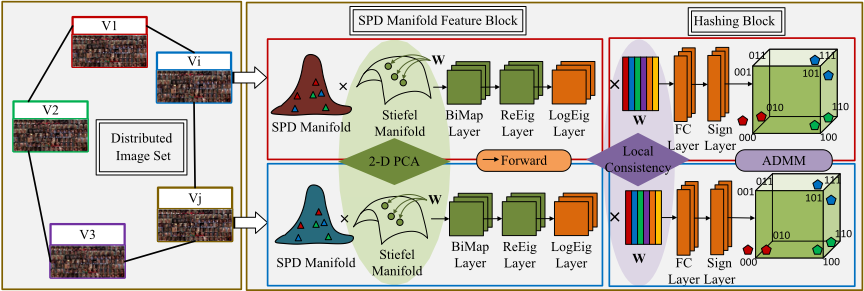
Hashing [Wang et al., 2018a] has attracted extensive interest in large-scale image retrieval due to its advantage of computation and storage. Hashing maps high-dimensional data into low-dimensional hash codes while preserving similarity structure among data. The advantage of hashing motivates us to extend to the application of image retrieval to more challenging image set classification and retrieval, and thus proposes Distributed Cascaded Manifold Hashing Network (DCMHN) to significantly reduce computation and storage costs. The illustration of the proposed DCMHN is shown in Figure 1. The main contributions of this work can be summarized as follows:
- We propose the Distributed Cascaded Manifold Hashing Network (DCMHN) to learn compact image set representations using hash codes, enabling efficient classifi-
cation and retrieval. DCMHN is the first deep neural network approach designed for compact representation learning on distributed image sets.
- The manifold hashing network is used to encode the manifold and is trained in a cascaded manner to reduce training time. DCMHN enforces local consistency across neighboring nodes, enabling parallel optimization.
- We evaluate DCMHN on three benchmark image set datasets, demonstrating competitive accuracy in distributed settings and superior performance in terms of computation and storage efficiency compared to stateof-the-art methods.
2 RelatedWork
Image Set Classification Conventional image set methods can be mainly divided into five types: affine/convex hull methods, linear subspace methods, Riemannian kernel methods, Riemannian metric learning methods, and deep manifold networks.
Affine/Convex hull methods, e.g., Affine/Convex Hull Based Image Set Distance (AHISD/CHISD) [Cevikalp and Triggs, 2010] characterize an image set by the convex geometric region, i.e., affine or convex hull, and measure the distance between two image sets by geometric distance, i.e., distance of closest approach between convex models. Linear subspace methods, e.g., Mutual Subspace Method (MSM) [Yang et al., 2013] and Discriminant Canonical Correlations (DCC) [Kim et al., 2007] represent an image set as a linear subspace. MSM uses the cosine of the minimum angle between two subspaces as the distance measurement, and DCC aims to seek the projection metric such that canonical correlations in the learned subspace are maximized. Riemannian kernel methods, e.g., Covariance Discriminative Learning (CDL) [Wang et al., 2012b] and Grassmann Discriminant Analysis (GDA) [Hamm and Lee, 2008] map the manifold into a reproducing kernel Hilbert space(RKHS), and then employ the kernel discriminant analysis for discriminant learning. Riemannian metric learning methods, e.g., LogEuclidean Metric Learning (LEML) [Huang et al., 2015b]
and Projection Metric Learning (PML) [Huang et al., 2015a] map the manifold to lower-dimensional discriminative manifold through metric learning. Deep manifold networks, e.g., Symmetric Positive Definite Network (SPDNet) [Huang and Van Gool, 2017] and Grassmann Network (GrNet) [Huang et al., 2018] generalize Euclidean network paradigm to manifold space and perform end-to-end training through matrix backpropagation. Later, [Wang et al., 2022] propose two Riemannian operation modules, i.e., Riemannian batch regularization layer, Riemannian pooling layer to improve performance. In addition, SymNet [Wang et al., 2021] proposes a simple SPD manifold deep learning network that learns multilevel connection matrices and reduces computational complexity.
Hashing Hashing [Liu et al., 2011; Gionis et al., 1999; Wang et al., 2012a; Liu et al., 2012; Norouzi and Fleet, 2011] projects the original high-dimensional data into a compact Hamming space while preserving the similarity structure. Locality Sensitive Hashing (LSH) [Datar et al., 2004] generates hash functions in a random manner. Iterative Quantization (ITQ) [Gong et al., 2012] uses Principal Component Analysis (PCA) to reduce dimension, and then employs orthogonal rotation to reduce quantization error. Supervised Discrete Hashing (SDH) [Shen et al., 2015] assumes that high-quality hash codes are ideal for classification, and then are learned jointly by minimizing quantization losses under a linear classifier framework. Deep Hashing Network (DHN) [Zhu et al., 2016] captures the image representation by a convolutional layer and a pooling layer, and uses cross-entropy loss and quantization loss supervision to generate a compact binary code, which addresses the quantization error issue.
3 Distributed CascadedManifold Hashing Network
3.1 Problem Setup
Suppose that we are given a distributed image set dataset {Si,Yi}Pi=1 that has N samples distributed in P nodes of a network, as shown in Figure 1. In the i-th node, image set features and labels are denoted as Si = {Sij ∈ Rl×nij }Ni j=1
and Yi ∈ RC×Ni respectively, where Sij and nij denote feature and number of images of the j-th image set in the i-th node respectively, l is the dimension of image feature, C is the number of classes, Ni denotes the number of image sets in the i-th node, and we have N = ∑Pi=1 Ni. The goal is to learn distributed hashing network and hash code B = {Bi ∈ Rd×Ni }Pi=1 from such distributed image set to perform efficient image set classification and retrieval, where d is the dimension of hash code.
3.2 Network Structure
SPDmanifold Given an image set S, its covariance matrix is defined as:
where m, si, and n denote the mean, the i-th image, and the number of images in S respectively. To ensure positive, we add a small regularization matrix Tr(X) α I, where I denotes the identity matrix, and parameter α is empirically set to 103 .
SPD Manifold and Hash Layer As shown in Figure 1, the proposed DCMHN constructs a manifold hashing network to encode manifold to generate hash code. Specifically, DCMHN first employs three SPD manifold layers [Huang and Van Gool, 2017], i.e., BiMap, ReEig, and LogEig layers to encode manifold, and further employs a hash layer to transform the continuous feature into hash code. We assume Xki ∈ Rdk×dk denotes the input of the k-th layer of the i-th node, and define the layers [Huang and Van Gool, 2017]:
BiMap Layer projects each input SPD matrix into a new one through a bilinear mapping Xk+1 i = Wk⊤ i Xki Wk i , where Wk i ∈ Rdk×dk+1 denotes transformation matrix, and we have dk+1 < dk.
ReEig Layer injects nonlinearity by tuning-up the small positive eigenvalues of each input SPD matrix via Xk+1 i = Umax(ϵI,Σ)U⊤, where U and Σ are eigenvectors and eigenvalues of Xki respectively, ϵ is a predefined small activation threshold.
LogEig Layer embeds each input SPD matrix into a flat space via Xk+1 i =Ulog(Σ)U⊤.
Hash Layer transforms the input using a linear mapping matrix and a nonlinear sign function via Xk+1 i = sign(Wk⊤ i Xki ), where sign denotes the sign function.
3.3 Formulation
As illustrated in Figure 1, the proposed DCMHN uses BiMap, ReEig, and LogEig layers for manifold encoding, with a Hash layer to generate hash codes. The ReEig and LogEig layers are parameter-free, while the BiMap and Hash layers contain learnable parameters. This section details the parameter learning process, as summarized in Algorithm 1.
Distributed Bilinear Mapping Learning
Conventional deep network often uses stochastic gradient descent, and further employs chain rule as backpropagation (BP). However, compared to calculating Euclidean gradient, calculating Riemannian gradients in deep manifold network is challenging. As such, a variant of SGD on Stiefel manifold [Huang and Van Gool, 2017] has been developed to train such network, however it leads to very high computational cost, and usually requires hundreds or even thousands iterations to converge. In this work, instead of using BP, we propose to learn bilinear mapping in BiMap layer from the perspective of effective preservation of SPD structure [Wang et al., 2024b].
We consider the i-th node, and denote Xn,k i ∈ Rdk×dk as the input SPD matrix of the k-level BiMap layer of the n-th image set, where dk denotes feature dimension. As defined earlier, BiMap layer transforms the input SPD matrix into a new SPD matrix via the following function via a projection matrix Wk i ∈ Rdk×dk+1 , and it is defined as follows:
We have the following theorem related to property of Wk.
Theorem 1. Given the input SPD matrix Xn,k i , the output matrix Xn,k+1 i is a SPD matrix if Wk i is required to be a row full-rank matrix, i.e.,Wk⊤ i Wk i = I.
Proof. It is easy to prove the output matrix is satisfied with the definition of SPD matrix if transformation matrix is fullrank using simple matrix computation.
Motivated by the popular idea of Principle Component Analysis (PCA), we propose a simple yet effective solution to learnWk i . Specifically, we aim to preserve SPD structure across BiMap layer [Wang et al., 2024b], and employ the following reconstruction loss:
where Xn,k i is first required to be centralized. The above problem can be equivalently transformed to the eigenvalue problem, andWk i is formed by the eigenvectors corresponding to the largest dk+1 eigenvalues of sample covariance matrix Cki = ∑Ni n=1 Xn,k⊤ i Xn,k i .
Note that we are given a distributed task, and we need to consider all the P nodes. To make full of all the distributed manifolds on the P nodes, we propose to calculate the global sample covariance matrix Ck = ∑Pi=1 Cki , and perform its eigenvalue decomposition. To achieve this, we introduce a parameter server to first receive the local covariance matrices on the P nodes, calculate the global covariance matrix by averaging the local ones. The parameter server finally returns the learned bilinear mapping matrices to the P nodes.
Distributed Hash Code Learning
On the i-th node, each SPD manifold is processed through BiMap, ReEig, and LogEig layers, and we have vectorized Euclidian features Xi ∈ Rm×Ni , where m denotes the feature dimension. The feature is then feed into hash layer to obtain hash code. Existing researches [Shen et al., 2015] show that optimal hash codes are expected to have good classification performance. In addition, quantization errors between continuous features and hash codes affect quality of hash codes. Therefore, we consider all the P nodes, and propose to learn hash codes by jointly minimizing the following simple yet linear classification loss and quantization loss:
where U ∈ Rd×C denotes the weighted matrix related to the linear classifier, V ∈ Rm×d denotes transformation matrix in hash layer, λ and µ denote regularization parameters. The first term is least square classification loss to improve discrimination of hash code, the second term is regularization term, and the third term is quantization loss between continuous feature and hash code. The binary constraint enforces the continuous feature to approximate hash code, which can handle large-scale applications efficiently.
Inspired by the brain's distributed memory processing [Wen et al., 2018] and brain-inspired coordination strategies [Han et al., 2025; Jia et al., 2025; Wang et al., 2024a], we formulate a distributed optimization framework. The local variable Bi can be optimized independently in each node, while the global variables U and V are shared among all the nodes, making them difficult to optimize. Motivated by block splitting strategy, we introduce a new set of local auxiliary variable in each node, i.e., Ui, Vi, and optimize these new local variables in parallel. To the end, (4) can be rewritten as the following distributed objective function:
where N(i) represents the neighbors of the i-th node. In (5), we impose consistency constraint on global variables in neighbor nodes rather than all the nodes by utilizing transitivity property of a connected graph. This optimization problem is non-convex with respect to the variables Bi, Ui, and Vi. Therefore, we divide it into multiple sub-problems and optimize the variables in one node while fixing the variables in other nodes. We use alternating direction multiplier method (ADMM) to solve (5). To the end, the augmented Lagrangian function of (5) can be defined as follows:
where Λi,j and Γi,j are Lagrangian multipliers for the constraints Vi = Vj and Ui = Uj respectively, α and β are penalty parameters corresponding to augmented Lagrangian.
Update Vi By fixing the other variables and removing irrelevant terms, the subproblem related to Vi is reduced as follows:
ADMM is applied to solve (7) by repeating the following two steps:
where t and t - 1 represent the t and t - 1 iterations respectively. We provide the following theorem to simplify the Lagrangian multipliers.
Lemma 1. The augmented Lagrangian function on Vi, i.e., (7) is equivalent to the following form:
where Λi = ∑j∈N(i) (Λi,j - Λj,i) is the new Lagrangian multiplier.
Proof. The lemma can be proven with straightforward matrix computations.
As can be seen, (9) has fewer Lagrange multipliers than (7), and computational complexity of ADMM can be greatly reduced. Based on Lemma 1, we have the following theorem to update Vi:
Theorem 2. For the new augmented Lagrangian, i.e., (9), we can update Vi using the following rule:
Proof. The theorem can be proven with straightforward matrix computations.
Update Bi By fixing other variables, the subproblem with respect to Bi is defined as:
It is challenging to directly optimize Bi as discrete constraint is NP hard. Following the widely-used coordinate descent in optimization, discrete cyclic coordinate descent (DCC) [Shen et al., 2015] is employed to optimize Bi bit by bit, and each bit admits a closed-form solution.
Algorithm 1 Distributed Cascade Manifold Hashing Network (DCMHN)
Input: Image sets S = {S1,S2, . . . ,SP , }; Labels Y = {Y1, Y2, . . . , YP }; Hash code length d; parameter α, β; Output: Hash code B = {B1, B2, . . . , BP };
- 1: Obtain SPD manifold of each image set via (1);
- 2: Calculate global covariance matrices of all the nodes and perform eigenvalue decomposition, and return the learned bilinear mapping matrix in BiMap layer on each node;
- 3: Perform eigenvalue correction to introduce non-linearity in ReEig layer;
- 4: PerformRiemannian computation in LogEig layer;
- 5: Randomly initialize Lagrangian multipliers {Λi}Pi=1 , {Γi}Pi=1 , {Ui}Pi=1 , {Vi}Pi=1 , and penalty parameters α, β;
- 6: for All nodes simultaneously do
- 7: Update {Bi}Pi=1 using DCC algorithm;
- 8: Update {Vi}Pi=1 , {Γi}Pi=1 using (10);
- 9: Update {Ui}Pi=1 , {Λ}Pi=1 using (13);
- 10: end for
Update Ui By fixing the other variables and removing irrelevant terms, the subproblem related to Ui is reduced as follows:
Similar to optimizing Vi, we repeat the following steps to optimize Ui:
4 Experiments
4.1 Experiment Setting
Datasets Three benchmark image set datasets, i.e., FPHA [Garcia-Hernando et al., 2018], AFEW [Wang et al., 2012b], BBT [Li et al., 2015] are used for experiment. The statistics of the three datasets are summarized in Table 1. For FPHA, a 63-dimensional image feature is extracted for each sequence [Wang et al., 2021]. For AFEW, a 400-dimensional feature is extracted for each frame [Wang et al., 2012b]. For BBT, a 512-dimensional deep feature for each frame is extracted by CNN [Schroff et al., 2015]. The training set of each image set benchmark is equally distributed across all the nodes in the network to construct distributed data. The network includes 3 nodes for FPHA and AFEW, and 4 nodes for BBT.
| Datasets | Type | #Samples | #Training | #Testing | #Dim |
|---|---|---|---|---|---|
| FPHA | sequence | 1150 | 600 | 550 | 63×63 |
| AFEW | video | 2118 | 1747 | 371 | 400×400 |
| BBT | video | 4667 | 3268 | 1399 | 512×512 |
| Method | Type | Accuracy | mAP | ||||||
|---|---|---|---|---|---|---|---|---|---|
| FPHA | AFEW | BBT | Avg | FPHA | AFEW | BBT | Avg | ||
| DCC | [L,C,E] | - | 0.258 | 0.939 | 0.399 | - | - | - | - |
| AHISD | [A,C,E] | - | - | - | - | - | - | - | - |
| CHISD | [A,C,E] | 0.642 | - | - | 0.214 | 0.226 | - | - | 0.075 |
| CDL | [M,C,E] | 0.250 | 0.297 | 0.876 | 0.474 | 0.091 | 0.200 | 0.885 | 0.392 |
| LEML | [M,C,E] | 0.762 | - | - | 0.254 | 0.368 | - | - | 0.123 |
| RMML-SPD | [M,C,E] | 0.732 | 0.159 | - | 0.297 | 0.026 | 0.171 | - | 0.066 |
| SPDNet | [M,C,E] | 0.807 | 0.253 | 0.972 | 0.677 | 0.512 | 0.251 | 0.935 | 0.566 |
| SymNet | [M,C,E] | 0.810 | 0.288 | 0.950 | 0.682 | 0.797 | 0.347 | 0.793 | 0.646 |
| ITQ-SPD | [M,H,E] | 0.299 | 0.191 | 0.923 | 0.471 | 0.259 | 0.253 | 0.923 | 0.478 |
| SDH-SPD | [M,H,E] | 0.769 | 0.159 | 0.953 | 0.627 | 0.616 | 0.159 | 0.953 | 0.576 |
| DCMHN | [M,H,D] | 0.812 | 0.315 | 0.966 | 0.697 | 0.787 | 0.415 | 0.946 | 0.716 |
Comparison Methods We compare the proposed method with various advanced image set classification methods, which can be divided into the following four categories: Affine/Convex hull methods including AHISD/CHISD [Cevikalp and Triggs, 2010], Linear subspace methods including DCC [Kim et al., 2007], Nonlinear manifold methods including CDL [Wang et al., 2012b], LEML [Huang et al., 2015b], RMML [Zhu et al., 2018], SPDNet [Huang and Van Gool, 2017], SymNet [Wang et al., 2021], Hashing methods including ITQ [Gong et al., 2012], SDH [Shen et al., 2015]. Specifically, ITQ-SPD and SDH-SPD apply ITQ and SDH to the SPD manifold respectively. The implementations of the baseline methods are kindly provided by the authors. The manifold network in the proposed DCMHN is constructed as fb, fr, fb, fr, fl, fh, where fb, fr, fl, fh denote BiMap, ReEig, LogEig, Hash layers respectively. The dimensions of the two BiMap layers are set to [20, 10], [70, 35], [80, 40] for FPHA, AFEW, and BBT respectively.
Evaluation Metrics Accuracy (Acc) is used as evaluation metric for classification, and mean Average Precision (mAP) and Precision-Recall (PR) curves are used as evaluation metrics for retrieval.
4.2 Performance Evaluation
Acc and mAP The classification and retrieval performances of all the methods on the three datasets are summarized in Table 2. From Table 2, we have the following observations:
- The proposed DCMHN generally achieves the best performance among all the cases, and improves the best
| Methods | SPD Manifold | Kernel Matrix | Continuous Feature | Hash Code | |||
|---|---|---|---|---|---|---|---|
| Mem | Red | Mem | Red | Mem | Red | Mem | |
| FPHA | 35.71 MB | 922× | 5.38 MB | 750× | 4.49 MB | 64× | 71.88 KB |
| AFEW | 2.53 GB | 40000× | 28.23 MB | 750× | 8.27 MB | 64× | 132.38 KB |
| BBT | 9.11 GB | 65536× | 116.36 MB | 750× | 18.23 MB | 64× | 291.69 KB |
| Methods | FPHA | AFEW | BBT |
|---|---|---|---|
| CDL | 0.14 | 0.25 | 1.85 |
| RMML | 39.24 | 4847.73 | 14364.62 |
| SPDNet/SymNet | 0.15 | 0.28 | 1.97 |
| Hashing | 0.01 | 0.01 | 0.01 |
baseline averagely by 2% and 7% in terms of Acc and mAP respectively. The empirical results demonstrate the effectiveness of the proposed method on image set modeling.
- Among two deep Riemannian manifold baselines, SymNet outperforms SPDNet. The deep Riemannian manifold baselines outperform the shallow baselines, due to superior capability of the deep architecture. Among hashing baselines, SDH-SPD outperforms ITQ-SPD, as SDH-SPD is supervised.
- Some baselines, e.g., AHISD, CHISHandLEML cannot be well scaled to large-scale datasets due to high computational complexity.
Storage The storage usages for SPD manifold, kernel matrix, continuous feature, and hash code of three datasets are reported in Table 3. As can be observed, the hash code only requires less than 300 KB of storage for the three datasets, while manifold feature requires significantly expensive storage, thus manifold methods cannot be applied to large-scale image set datasets. Particularly, the storage required using hash code is 64 times less than that required for continuous feature, and considerably less compared to other features. The empirical studies demonstrate the significant advantage of hashing in terms of efficient storage usage.
Time The running time associated with distance calculation of different methods on three benchmarks is reported in Table 4, and time of embedding generation is not included. We can find that the running time of hashing is significantly lower than that of the other methods. Specifically, on the AFEW dataset, hashing methods are nearly 280 times faster than those of continuous feature, and significantly faster than manifold methods. Hashing methods, including the proposed DCMHN, which calculate Hamming distance, are theoretically faster than conventional image set methods that calculate Euclidean distance. The empirical studies verify the superiority of the proposed method in terms of efficient distance calculation.
| Metric | Method | FPHA | AFEW | BBT |
|---|---|---|---|---|
| Acc | DCMHN-C DCMHN | 0.768 0.812 | 0.285 0.315 | 0.937 0.966 |
| mAP | DCMHN-C DCMHN | 0.564 0.787 | 0.298 0.410 | 0.828 0.946 |
4.3 Further Analysis
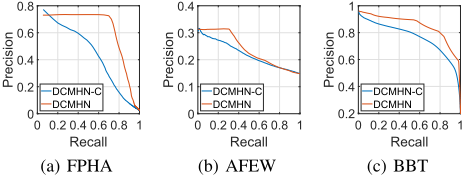
Discrete versus Continuous This section compares the performance of the proposed method with its continuous variant that removes binary constraint. The variant is denoted by adding the suffix '-C'. The Acc and mAP of the two methods on the three datasets are shown in Table 5, and the PR curves are shown in Figure 2. We can clearly see that even with binary constraint, the proposed DCMHN outperforms its continuous variant in all the cases, indicating that binary constraint does not degrade performance image set tasks. The empirical studies demonstrate superiority of hash code on modeling image set, and verify the effectiveness of the proposed optimization strategy.
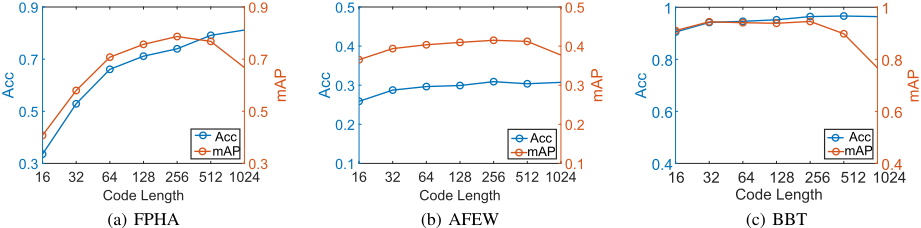
Code Length Analysis This section analyzes the impact of hash code length on the performance of the proposed method. Specifically, the Acc and mAP of the proposed method with respect to different code lengths varying from 16 to 1024 are illustrated in Figure 3. As can be seen, the performance of the proposed method improves as code length increases, and the best performance is generally achieved when code length is set to 256. The above empirical results suggest the optimal hash code length that can achieve good performance.
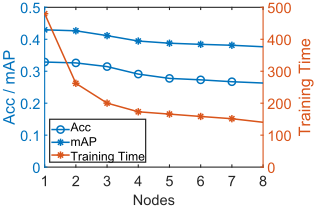
Node Number Analysis This section analyzes the impact of number of nodes in the network on the performance of the proposed method. The Acc, mAP, and running time of the proposed method with 32 bits on AFEW varying from 2 to 8 nodes are illustrated in Figure 4. As observed, increasing the number of nodes significantly reduces training time, with only a slight decline in accuracy and mAP. Using approximately 3 nodes strikes a balance between performance and training time. The empirical studies confirm that parallel optimization can improve training efficiency.
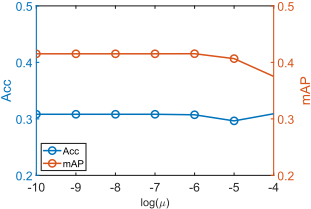
Trade-off Parameter Analysis This section empirically analyzes the sensitivity of a trade-off parameter, i.e., µ in the proposed DCMHN, where µ is used to balance the relative importance of quantization loss compared to classification loss. The Acc and mAP of the proposed method on AFEWwith respect to varying from [10-10 , 10-4 ] are shown in Figure 5. It can be observed that with the decrease of µ, the performance remains stable. The good performance can be achieved when µ is suggested to be less than 10-6 .
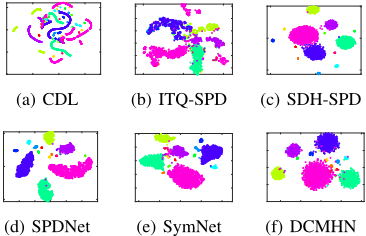
Visualization This section conducts qualitative empirical study and performs visualization. The visualization results of six representative methods on BBT are shown in Figure 6, and The widely-used t-SNE is applied to the learned representations. It can be observed that SDH-SPD, SPDNet, and the proposed DCMHN can separate multiple clusters better than the other methods. These qualitative results are consistent with previous quantitative results, intuitively reinforcing the effectiveness of the proposed DCMHN.
5 Conclusion
This paper introduces, for the first time, a Distributed Cascade Manifold Hashing Network (DCMHN) designed to construct a manifold-based network for learning hash codes in a distributed manner. The core idea is to model distributed image sets as a connected graph and build a distributed deep manifold hashing network on this graph, with the network trained in a cascaded fashion. Compared to existing image set methods, the proposed approach offers significant advantages in handling distributed image sets while enhancing computational and storage efficiency. The empirical studies validate our theoretical findings.
Acknowledgments
This work was supported by the National Science Fund for Distinguished Young Scholars of China under Grant No. 62325601, the National Natural Science Foundation of China under Grant No. 62472226, 62176126, the Natural Science Foundation of Jiangsu Province, China under Grant No. BK20230095.
@inproceedings{ijcai2025p222,
  title     = {Distributed Cascaded Manifold Hashing Network for Compact Image Set Representation},
  author    = {Wang, Xiaxin and Cai, Haoyu and Shen, Xiaobo and Wu, Xia},
  booktitle = {Proceedings of the Thirty-Fourth International Joint Conference on
               Artificial Intelligence, {IJCAI-25}},
  publisher = {International Joint Conferences on Artificial Intelligence Organization},
  editor    = {James Kwok},
  pages     = {1991--1999},
  year      = {2025},
  month     = {8},
  note      = {Main Track},
  doi       = {10.24963/ijcai.2025/222},
  url       = {https://doi.org/10.24963/ijcai.2025/222},
}
TY - CPAPER TI - Distributed Cascaded Manifold Hashing Network for Compact Image Set Representation AU - Wang, Xiaxin AU - Cai, Haoyu AU - Shen, Xiaobo AU - Wu, Xia T2 - Proceedings of the Thirty-Fourth International Joint Conference on Artificial Intelligence, IJCAI-25 PB - International Joint Conferences on Artificial Intelligence Organization PY - 2025 SP - 1991 EP - 1999 DO - 10.24963/ijcai.2025/222 UR - https://doi.org/10.24963/ijcai.2025/222 ER -Copied
Machine-readable versions of this paper, for tools and AI agents:





