
Decision-Aware Preference Modeling for Multi-Behavior Recommendation
Proceedings of the Thirty-Fourth International Joint Conference on Artificial Intelligence. Main Track. Pages 3063-3071.
https://doi.org/10.24963/ijcai.2025/341
Keywords
- Data Mining: DM: Recommender systems
- Data Mining: DM: Mining heterogenous data
- Data Mining: DM: Mining graphs
- Data Mining: DM: Collaborative filtering
Abstract
In recommender systems, multi-behavior methods have demonstrated significant effectiveness in addressing issues such as data sparsity—challenges commonly encountered by traditional single-behavior recommendation methods. These methods typically infer user preferences from various auxiliary behaviors and apply them to recommendations for the target behavior. However, existing methods face challenges in uncovering the interaction patterns for different behaviors from multi-behavior implicit feedback, as users exhibit varying preference strengths for different items across behaviors. To address this issue, this paper introduces a novel approach, Decision-Aware Preference Modeling (DAPM), for multi-behavior recommendation. We first construct a behavior-agnostic graph to learn comprehensive representations that are not affected by behavior factors, complementing the behavior-specific representations. Subsequently, we introduce an innovative contrastive learning paradigm that emphasizes inter-behavior consistency and intra-behavior uniformity to alleviate the “false repulsion” problem in traditional contrastive learning. Furthermore, we propose a multi-behavior hinge loss with boundary constraints to explicitly model users' decision boundaries across different behaviors, thereby enhancing the model’s ability to accurately capture users' inconsistent preference intensities. Extensive experiments on three real-world datasets demonstrate the consistent improvements achieved by DAPM over thirteen state-of-the-art baselines. We release our code at https://github.com/Breeze-del/DAPM.
- [Chen et al., 2020a] Chong Chen, Min Zhang, Yongfeng Zhang, Weizhi Ma, Yiqun Liu, and Shaoping Ma. Ef- ficient heterogeneous collaborative filtering without neg- ative sampling for recommendation. In Proceedings of the AAAI conference on artificial intelligence, volume 34, pages 19-26, 2020.
- [Chen et al., 2020b] Lei Chen, Le Wu, Richang Hong, Kun Zhang, and Meng Wang. Revisiting graph based collabo- rative filtering: A linear residual graph convolutional net- work approach. In Proceedings of the AAAI conference on artificial intelligence, volume 34, pages 27-34, 2020.
- [Chen et al., 2021] Chong Chen, Weizhi Ma, Min Zhang, Zhaowei Wang, Xiuqiang He, Chenyang Wang, Yiqun Liu, and Shaoping Ma. Graph heterogeneous multi-relational recommendation. In Proceedings of the AAAI conference on artificial intelligence, volume 35, pages 3958-3966, 2021.
- [Cheng et al., 2016] Heng-Tze Cheng, Levent Koc, Jeremiah Harmsen, Tal Shaked, Tushar Chandra, et al. Wide & deep learning for recommender systems. In Proceedings of the 1st workshop on deep learning for recommender systems, pages 7-10, 2016.
- [Cheng et al., 2023] Zhiyong Cheng, Sai Han, Fan Liu, Lei Zhu, Zan Gao, and Yuxin Peng. Multi-behavior recom- mendation with cascading graph convolution networks. In Proceedings of the ACM Web Conference 2023, pages 1181-1189, 2023.
- [Ding et al., 2018] Jingtao Ding, Guanghui Yu, Xiangnan He, Yuhan Quan, Yong Li, Tat-Seng Chua, Depeng Jin, and Jiajie Yu. Improving implicit recommender systems with view data. In Proceedings of the 27th International Joint Conference on Artificial Intelligence, pages 3343- 3349, 2018. IJCAI
- [Gao et al., 2019] Chen Gao, Xiangnan He, Dahua Gan, Xi- angning Chen, Fuli Feng, Yong Li, Tat-Seng Chua, and Depeng Jin. Neural multi-task recommendation from multi-behavior data. In 2019 IEEE 35th international con- ference on data engineering (ICDE), pages 1554-1557, 2019.
- [Gu et al., 2022] Shuyun Gu, Xiao Wang, Chuan Shi, and Ding Xiao. Self-supervised graph neural networks for multi-behavior recommendation. In Proceedings of the 31st International Joint Conference on Artificial Intelli- gence, pages 2052-2058, 2022. IJCAI
- [Guo et al., 2019] Long Guo, Lifeng Hua, Rongfei Jia, Bin- qiang Zhao, Xiaobo Wang, and Bin Cui. Buying or browsing?: Predicting real-time purchasing intent using attention-based deep network with multiple behavior. In Proceedings of the 25th ACM SIGKDD international con- ference on knowledge discovery & data mining, pages 1984-1992, 2019.
- [He et al., 2020] Xiangnan He, Kuan Deng, Xiang Wang, Yan Li, Yongdong Zhang, and Meng Wang. Lightgcn: Simplifying and powering graph convolution network for recommendation. In Proceedings of the 43rd International ACM SIGIR conference on research and development in Information Retrieval, pages 639-648, 2020.
- [Hsieh et al., 2017] Cheng-Kang Hsieh, Longqi Yang, Yin Cui, Tsung-Yi Lin, Serge Belongie, and Deborah Estrin. Collaborative metric learning. In Proceedings of the 26th international conference on world wide web, pages 193- 201, 2017.
- [Jin et al., 2020] Bowen Jin, Chen Gao, Xiangnan He, De- peng Jin, and Yong Li. Multi-behavior recommendation with graph convolutional networks. In Proceedings of the 43rd international ACM SIGIR conference on research and development in information retrieval, pages 659-668, 2020.
- [Li et al., 2023] Qingfeng Li, Huifang Ma, Ruoyi Zhang, Wangyu Jin, and Zhixin Li. Intra-and inter-behavior contrastive learning for multi-behavior recommendation. In Proceedings of the 28th International Conference on Database Systems for Advanced Applications, pages 147- 162, 2023.
- [Li et al., 2024] Qingfeng Li, Huifang Ma, Wangyu Jin, Yu- gang Ji, and Zhixin Li. Multi-interest network with simple diffusion for multi-behavior sequential recommendation. In Proceedings of the SIAM International Conference on Data Mining, pages 734-742, 2024.
- [Liang et al., 2023] Ke Liang, Yue Liu, Sihang Zhou, Wenx- uan Tu, Yi Wen, Xihong Yang, Xiangjun Dong, and Xin- wang Liu. Knowledge graph contrastive learning based on relation-symmetrical structure. IEEE Transactions on Knowledge and Data Engineering, 36(1):226-238, 2023.
- [Loni et al., 2016] Babak Loni, Roberto Pagano, Martha Larson, and Alan Hanjalic. Bayesian personalized rank- ing with multi-channel user feedback. In Proceedings of the 10th ACM conference on recommender systems, pages 361-364, 2016.
- [Luo et al., 2023] Xiao Luo, Daqing Wu, Yiyang Gu, Chong Chen, Luchen Liu, Jinwen Ma, Ming Zhang, Minghua Deng, Jianqiang Huang, and Xian-Sheng Hua. Criterion- based heterogeneous collaborative filtering for multi- behavior implicit recommendation. ACM Transactions on Knowledge Discovery from Data, 18(1):1-26, 2023.
- [Meng et al., 2023a] Chang Meng, Chenhao Zhai, Yu Yang, Hengyu Zhang, and Xiu Li. Parallel knowledge enhance- ment based framework for multi-behavior recommenda- tion. In Proceedings of the 32nd ACM International Conference on Information and Knowledge Management, pages 1797-1806, 2023.
- [Meng et al., 2023b] Chang Meng, Hengyu Zhang, Wei Guo, Huifeng Guo, Haotian Liu, Yingxue Zhang, Hongkun Zheng, Ruiming Tang, Xiu Li, and Rui Zhang. Hierarchical projection enhanced multi-behavior recom- mendation. In Proceedings of the 29th ACM SIGKDD Conference on Knowledge Discovery and Data Mining, pages 4649-4660, 2023.
- [Oord et al., 2018] Aaron van den Oord, Yazhe Li, and Oriol Vinyals. Representation learning with contrastive predic- tive coding. arXiv preprint arXiv:1807.03748, 2018.
- [Qi et al., 2021] Tao Qi, Fangzhao Wu, Chuhan Wu, and Yongfeng Huang. Personalized news recommendation with knowledge-aware interactive matching. In Proceed- ings of the 44th International ACM SIGIR Conference on Research and Development in Information Retrieval, pages 61-70, 2021.
- [Rendle et al., 2012] Steffen Rendle, Christoph Freuden- thaler, Zeno Gantner, and Lars Schmidt-Thieme. Bpr: Bayesian personalized ranking from implicit feedback. In Proceedings of the 25th International Conference on Un- certainty in Artificial Intelligence, page 452-461, 2012.
- [Schlichtkrull et al., 2018] Michael Schlichtkrull, Thomas N Kipf, Peter Bloem, Rianne Van Den Berg, Ivan Titov, and Max Welling. Modeling relational data with graph con- volutional networks. In The semantic web: 15th interna- tional conference, pages 593-607, 2018.
- [Singh and Gordon, 2008] Ajit P Singh and Geoffrey J Gor- don. Relational learning via collective matrix factoriza- tion. In Proceedings of the 14th ACM SIGKDD interna- tional conference on Knowledge discovery and data min- ing, pages 650-658, 2008.
- [Tang et al., 2016] Liang Tang, Bo Long, Bee-Chung Chen, and Deepak Agarwal. An empirical study on recommenda- tion with multiple types of feedback. In Proceedings of the 22nd ACM SIGKDD international conference on knowl- edge discovery and data mining, pages 283-292, 2016.
- [Tanjim et al., 2020] Md Mehrab Tanjim, Congzhe Su, Ethan Benjamin, Diane Hu, Liangjie Hong, and Julian McAuley. Attentive sequential models of latent intent for next item recommendation. In Proceedings of The Web Conference 2020, pages 2528-2534, 2020.
- [Wei et al., 2020] Yinwei Wei, Xiang Wang, Liqiang Nie, Xiangnan He, and Tat-Seng Chua. Graph-refined convo- lutional network for multimedia recommendation with im- plicit feedback. In Proceedings of the 28th ACM interna- tional conference on multimedia, pages 3541-3549, 2020.
- [Wei et al., 2022] Wei Wei, Chao Huang, Lianghao Xia, Yong Xu, Jiashu Zhao, and Dawei Yin. Contrastive meta learning with behavior multiplicity for recommendation. In Proceedings of the fifteenth ACM international confer- ence on web search and data mining, pages 1120-1128, 2022.
- [Wu et al., 2021] Jiancan Wu, Xiang Wang, Fuli Feng, Xi- angnan He, Liang Chen, Jianxun Lian, and Xing Xie. Self-supervised graph learning for recommendation. In Proceedings of the 44th international ACM SIGIR con- ference on research and development in information re- trieval, pages 726-735, 2021.
- [Xia et al., 2020] Lianghao Xia, Chao Huang, Yong Xu, Peng Dai, Bo Zhang, and Liefeng Bo. Multiplex be- havioral relation learning for recommendation via mem- ory augmented transformer network. In Proceedings of the 43rd international ACM SIGIR conference on research and development in information retrieval, pages 2397- 2406, 2020.
- [Xu et al., 2023] Jingcao Xu, Chaokun Wang, Cheng Wu, Yang Song, Kai Zheng, Xiaowei Wang, Changping Wang, Guorui Zhou, and Kun Gai. Multi-behavior self- supervised learning for recommendation. In Proceedings of the 46th International ACM SIGIR Conference on Re- search and Development in Information Retrieval, pages 496-505, 2023.
- [Yan et al., 2023] Mingshi Yan, Zhiyong Cheng, Chen Gao, Jing Sun, Fan Liu, Fuming Sun, and Haojie Li. Cascading residual graph convolutional network for multi-behavior recommendation. ACM Transactions on Information Sys- tems, 42(1):1-26, 2023.
- [Yan et al., 2024] Mingshi Yan, Fan Liu, Jing Sun, Fum- ing Sun, Zhiyong Cheng, and Yahong Han. Behavior- contextualized item preference modeling for multi- behavior recommendation. In Proceedings of the 47th In- ternational ACM SIGIR Conference on Research and De- velopment in Information Retrieval, pages 946-955, 2024.
- [Yu et al., 2022] Junliang Yu, Hongzhi Yin, Xin Xia, Tong Chen, Lizhen Cui, and Quoc Viet Hung Nguyen. Are graph augmentations necessary? simple graph contrastive learning for recommendation. In Proceedings of the 45th international ACM SIGIR conference on research and development in information retrieval, pages 1294-1303, 2022.
- [Zhao et al., 2015a] Zhe Zhao, Zhiyuan Cheng, Lichan Hong, and Ed H Chi. Improving user topic interest profiles by behavior factorization. In Proceedings of the 24th In- ternational Conference on World Wide Web, pages 1406- 1416, 2015.
- [Zhao et al., 2015b] Zhe Zhao, Zhiyuan Cheng, Lichan Hong, and Ed H Chi. Improving user topic interest profiles by behavior factorization. In Proceedings of the 24th In- ternational Conference on World Wide Web, pages 1406- 1416, 2015.
- [Zhu et al., 2024] Xi Zhu, Fake Lin, Ziwei Zhao, Tong Xu, Xiangyu Zhao, Zikai Yin, Xueying Li, and Enhong Chen. Multi-behavior recommendation with personalized directed acyclic behavior graphs. ACM Transactions on Information Systems, 2024.
References were extracted automatically from the PDF and may contain errors.
Full text extracted automatically from the PDF; figures, tables and equations may differ. The PDF is the version of record.
1 Introduction
Recommender systems are information filtering technologies designed to provide personalized services based on user preferences [He et al., 2020]. They are widely used in areas like e-commerce [Wu et al., 2021], social media [Qi et al.,
* Corresponding author.
2021], and online video platforms [Wei et al., 2020]. Traditional collaborative filtering methods [Cheng et al., 2016; He et al., 2020] typically focus on a single behavior like purchase and often encounter challenges with data sparsity, resulting in significant performance degradation.
In real-world scenarios, users can interact with items in multiple ways, including viewing, adding to the cart and purchasing. Different types of behaviors may characterize user preference from various intention dimensions and complement each other for better user preference learning [Tanjim et al., 2020]. To overcome the challenges posed by data sparsity, researchers have introduced Multi-Behavior Recommendation (MBR) methods [Wei et al., 2022; Chen et al., 2020a; Meng et al., 2023b; Li et al., 2024], which draw on data from multiple user behaviors to provide rich insights into user preferences. MBR methods primarily focus on the target behavior (i.e., purchase) while treating other behaviors as auxiliary behaviors, thereby enhancing the robustness and accuracy of the recommendation system by utilizing a broader spectrum of user data.
Early studies [Singh and Gordon, 2008; Zhao et al., 2015a] employed matrix factorization using shared embeddings for MBR. With the rise of deep learning, neural network-based methods [Gao et al., 2019; Guo et al., 2019; Xia et al., 2020] have gained traction for their ability to model complex relationships between users and items, capturing nuanced user interests and item characteristics. Among these, graph neural networks [Chen et al., 2020b; Schlichtkrull et al., 2018; Meng et al., 2023b; Zhu et al., 2024] have been widely applied in MBR due to their effectiveness in utilizing high-order connectivity between users and items. For example, MBGCN [Jin et al., 2020] and S-MBRec [Gu et al., 2022] implement behavior-aware embedding propagation layers to learn behavior diversity by aggregating multi-behavior interactions from high-order neighbors. However, these methods do not consider using dependencies between behaviors to assist model learning. To bridge this gap, recent works have introduced a behavior hierarchical order to support recommendations. CRGCN [Yan et al., 2023] and MB-CGCN [Cheng et al., 2023] incorporate cascade dependencies between behaviors into graph convolutional networks, improving the representation learning of users and items. BCIPM [Yan et al., 2024] further develops a behavior-contextualized item preference network to enhance item-aware preferences. Despite the technical difference, these methods share the common goal of integrating insights from auxiliary behaviors to guide recommendations for target behaviors.
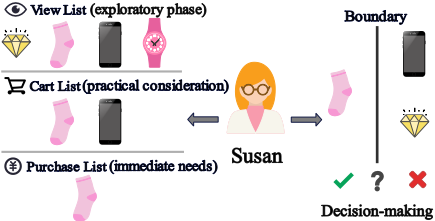
Despite the effectiveness of existing methods, they face a significant challenge: accurately inferring users' interaction patterns from complex multi-behavior signals. This challenge is exemplified in real-world scenarios. As depicted in Figure 1, Susan views four items-diamond, socks, phone and watch, and adds socks and phone to her cart but ultimately only purchases the socks. This diversity in her view list indicates an exploratory phase, where curiosity and informationseeking drive engagement with various items, including luxury and electronic items. During the cart list, practical considerations such as usability and price become more prominent, narrowing her focus to the phone and socks. By the time she makes a purchase, her decision is guided by immediate needs and budget constraints, leading her to choose the socks. Each behavior-view for information, cart for tentative choices, and purchase for final decisions-serves distinct objectives that influence the user's focus and selection criteria, leading to varying preference intensities for different items across different behavioral contexts. Therefore, understanding users' comprehensive preferences and decision-making boundaries is essential for capturing their interaction patterns, yet most existing MBR methods overlook these nuanced factors. Our approach aims to address this gap by emphasizing comprehensive preferences learning and explicitly modeling users' personalized decision boundaries, thereby enhancing recommendation effectiveness.
In addressing the challenges identified within MBR, we propose a novel approach named Decision-Aware Preference Modeling (DAPM). In DAPM, we construct a behavioragnostic user-item interaction graph that leverages multibehavior interaction data to capture a broader range of collaborative information, complementing preference learning on type-specific behavior subgraphs and leading to a more comprehensive understanding of user preferences. In addition, to avoid the "false repulsion" problem in traditional contrastive learning-where users with highly similar interactions are overlooked and incorrectly treated as negative samples-we eliminate the global contrastive loss for negative samples across all users. Instead, we focus on measuring the cross-behavior embedding consistency and embedding uniformity within behavior for individual users. This enables our developed DAPM to effectively extract additional supervision signals from different types of user behaviors, thereby enhancing the model optimization process with sparse supervision labels. Inspired by Bayesian personalized ranking loss, we introduce a multi-behavior hinge loss that enlarges the gap between positive and negative interactions by modeling the user's acceptance and rejection boundaries. Specifically, DAPM increases the likelihood of items that have interacted in a specific behavior, pushing it above the acceptance boundary, while decreasing the likelihood of the remaining uninteracted items, bringing them closer to the rejection boundary, thereby effectively exploring users' decision boundaries. Furthermore, we introduce a boundary constraint to prevent the learnable acceptance boundary from continually approaching the rejection boundary, thereby enhancing the model's ability to capture users' personalized decision boundaries.
In summary, our major contributions are summarized as follows. (1) We develop a new multi-behavior learning paradigm DAPM for recommendation by emphasizing the importance of comprehensive preferences and personalized decision boundaries. (2) We propose a multi-behavior hinge loss that explicitly models users' varying preference intensities by introducing acceptance and rejection boundaries, enabling the model to make accurate recommendations from the user's perspective. (3) Comprehensive experiments on three real-world datasets demonstrate that our DAPM outperforms the state-of-the-art approaches in multi-behavior scenarios. Further experimental results verify the rationality and effectiveness of the designed sub-modules.
2 RelatedWorks
Recently, MBR methods [Meng et al., 2023b; Li et al., 2024] have attracted considerable attention for their effectiveness in addressing data sparsity challenges. With advancements in technology, MBR methods can be broadly categorized into four main types: traditional machine learning methods, deep neural network (DNN) methods, graph convolutional network (GCN) methods, and self-supervised learning methods.
Traditional machine learning-based methods to MBR often tackle multi-behavior data through multiple matrix factorization techniques [Singh and Gordon, 2008; Tang et al., 2016; Zhao et al., 2015b] or innovative sampling strategies [Loni et al., 2016; Ding et al., 2018]. The former extends traditional matrix factorization by using multiple matrices with shared embeddings, such as CMF [Zhao et al., 2015b]. The latter leverages various user behaviors as auxiliary data, designing sampling strategies that enhance the training process. For example, MF-BPR [Loni et al., 2016] and VALS [Ding et al., 2018], introduce and refine negative sampling strategies to improve recommendation performance.
As deep learning technologies advance, researchers are increasingly investigating MBR methods that leverage DNNs and GCNs. DNN-based methods [Liang et al., 2023; Guo et al., 2019; Xia et al., 2020] typically design complex mechanisms to learn embeddings from different behaviors, integrating them into predictions for the target behavior. For instance, DIPN [Guo et al., 2019] and MATN [Xia et al., 2020] utilize various attention mechanisms to understand relationships between behaviors for effective embedding learning and aggregation. In contrast, NMTR [Gao et al., 2019] employs a multi-task learning strategy, treating all user behaviors as prediction objectives and using the prediction score of the previous behavior to inform the next.
GCN-based methods [Li et al., 2023; Schlichtkrull et al., 2018; Zhu et al., 2024] focus on learning embeddings by constructing a unified user-item graph and performing graph convolution operations. For example, MBGCN [Jin et al., 2020] emphasizes behavior semantics, leveraging an itemitem propagation layer alongside user-item propagation to enhance score predictions. CRGCN [Yan et al., 2023] and MB-CGCN [Cheng et al., 2023] further refine these methods by incorporating hierarchical relationships between behaviors, utilizing cascading graph convolutional networks to effectively capture user preferences and achieve notable performance improvements. The recently proposed PKEF [Meng et al., 2023a] builds on MB-CGCN by incorporating a parallel knowledge fusion module and a projected disentangled multi-expert network to address the issue of data distribution imbalance in multiple behaviors. In addition, BCIPM [Yan et al., 2024] develops a behavior-contextualized item preference network to learn item-aware preferences, enhancing the highorder neighbor preferences of users captured by the GCNs.
Inspired by the success of self-supervised learning (SSL), some studies [Wei et al., 2022; Liang et al., 2023] have attempted to leverage contrastive learning to enhance representation learning. The fundamental principle of contrastive learning is to learn high-quality, discriminative representations by maximizing the similarity among positive samples while minimizing it among negative samples. For example, CML [Wei et al., 2022] employs contrastive meta-learning to capture transferable user-item knowledge across various behaviors while maintaining users' personalized multi-behavior patterns. MBSSL [Xu et al., 2023] performs node selfidentification at both inter-behavior and intra-behavior levels in contrastive learning to obtain refined node representations.
Despite the technical diversity among these MBR methods, they commonly depend on collaborative information from auxiliary behaviors to improve the understanding of user preferences. Traditional machine learning-based methods directly extract information from user-item interactions in auxiliary behaviors. In contrast, other methods model overall auxiliary behaviors. However, these methods often overlook the inconsistency in users' preference intensities for different items across behaviors. Our proposed method stands in sharp contrast by focusing on finely modeling users' diverse item preference strengths across behaviors through the introduction of acceptance and rejection boundaries.
3 ProblemFormulation
We define U (𝑢 ∈ U) and V (𝑣 ∈ V) as the sets of users and items, respectively. In our multi-behavior recommendation scenario, we define the B (𝑏 ∈ B) as the set of behaviors, where the |B|-th behavior is the target behavior and other behaviors are auxiliary behaviors. The e𝑏 represents the 𝑏-th behavior type embedding. The multi-behavior interaction matrices can be represented as a set, i.e., M = {M1,M2, . . . ,M|B| }, where M𝑏 = [𝑚(𝑏)𝑢𝑣] |U|×|V| ∈ {0, 1}
indicates whether user 𝑢 interacted with item 𝑣 under behavior 𝑏. The task we aim to address is formally described as follows: Input: observed user-item interactions with multiplex |B| types of behaviors M among users U and items V. Output: a predictive function which estimates the likelihood of user 𝑢 will interact with item 𝑣 under the target type (|B|) of behaviors.
4 Methodology
The motivation behind this work stems from the observation that users exhibit varying levels of preference for different items across different behaviors. Based on this observation, we propose a decision-aware modeling module that explicitly explores personalized decision boundaries, focusing on learning the varying preference intensities for each item within specific behaviors. To complement the behaviorspecific preferences, we first construct a behavior-agnostic graph to capture more comprehensive user preferences. This graph is created from interaction data encompassing all behaviors, allowing us to utilize a broader and more nuanced spectrum of user-item interaction data. We then introduce a multi-behavior contrastive learning paradigm and a gated fusion mechanism to refine and enhance the behavior-specific preference using these comprehensive preferences. The architecture of DAPM is depicted in Figure 2, and the key components are explained in detail in the following subsections.
4.1 Behavior-specific Embedding Learning
To incorporate high-order connectivity into multiplex relation learning across users and items, we first establish a graph-based message passing framework that considers typespecific behavior context. Following the findings in the stateof-the-art model LightGCN [He et al., 2020], our behavioraware message passing scheme can be represented:
where E 𝑏, (𝑙) represents the 𝑙-th layer node embedding under 𝑏-th behavior, initialized as E 𝑏, (0) = E (0) + E𝑏𝑒ℎ, E (0) is the initialization of the user and item embeddings and E𝑏𝑒ℎ is composed of stacked behavior type embeddings e𝑏. A 𝑏 is adjacency matrix under 𝑏-th behavior, whose upper right block matrix is M𝑏 and lower left block matrix is M 𝑇 𝑏 . D denotes the diagonal identity matrix of A 𝑏 . The embeddings obtained from different layers emphasize the information passed from different hops. Thus, we further combine them to get the final embeddings: E 𝑏 = 1 𝐿+1 � 𝐿 𝑙=0 E 𝑏, (𝑙 ) . Finally, we obtain the embeddings under 𝑏-th behavior of a specific user 𝑢 and item 𝑣 from the E 𝑏 as e 𝑏 𝑢 and e 𝑏 𝑣 .
4.2 Behavior-agnostic Embedding Learning
In real-world recommendation scenarios, users' attention to items varies across different behaviors. For instance, as shown in Figure 1, compared to the more focused cart and purchase behaviors, Susan explores a wider range of items during viewing-ranging from luxury goods to electronics and daily necessities. This indicates that behavior-specific interactions capture only partial aspects of user preferences.
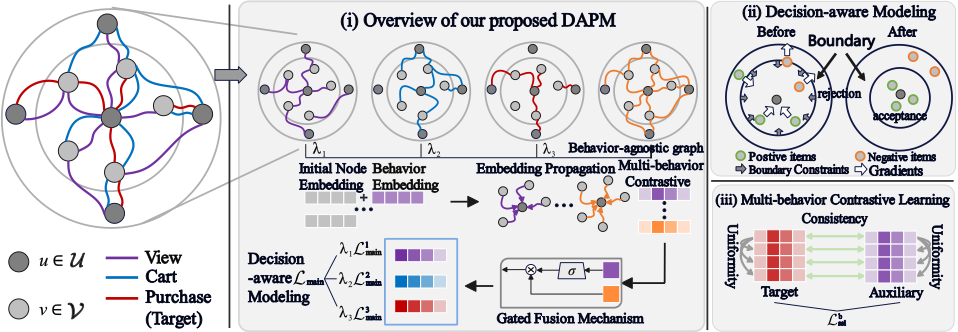
Furthermore, the inconsistent sparsity across behaviors may compromise the quality of behavior-specific embeddings.
To address these limitations, we first construct a behavioragnostic interaction graph by aggregating multi-behavior data, enabling the model to capture broader collaborative signals and enrich the learned representations. However, treating all behaviors equally may obscure users' personalized behavioral tendencies, as repeated interactions with the same item across behaviors can imply stronger interest, and different behaviors inherently reflect varying preference intensities. To better model this heterogeneity, we introduce behaviorspecific weighting coefficients 𝜆 to reweight the interaction matrices, thereby enhancing the expressiveness of user preferences across diverse behavioral signals. The behavioragnostic interaction matrix M| B|+1 is formalized as follows:
Then, we apply the same message-passing mechanism as in Section 4.1 on the interaction matrix M| B|+1 to learn embeddings e |B|+1 𝑢 , e |B|+1 𝑣 , treating it as an additional auxiliary behavior |B| + 1 to provide more comprehensive preferences. Note that, in order to maintain behavior agnosticism during the message-passing procedure, we use the initial embeddings E (0) directly, rather than E 𝑏, (0) .
4.3 Cross-behavior Aggregation
In the prediction layer of the DAPM framework, we propose using the more comprehensive embeddings learned from the behavior-agnostic graph to supplement and enhance the behavior-specific embeddings. To adaptively achieve this cross-behavior aggregation, we develop a gating network that learns the explicit importance of behavior-specific embeddings. Formally, the aggregation process is as follows:
where g 𝑏 𝑢 denotes the importance of the behavior-specific embeddings e 𝑏 𝑢 during the aggregation procedure, W 𝑏 𝑢 ∈ R 𝑑×𝑑 , b 𝑏 𝑢 ∈ R 𝑑 are trainable parameters. ⊙ represents the elementwise product of vectors. Similar aggregation is applied for the item side. To sum up, by integrating user interactions across all behaviors, we can learn more comprehensive embeddings and then apply a gated fusion mechanism to adaptively enhance and refine the behavior-specific embeddings.
4.4 Decision-aware Modeling
Existing multi-behavior methods have made progress in modeling user preferences, but they often overlook the complexity of interaction patterns-specifically, the varying preference intensities users exhibit across different behavioral contexts. Inferring fine-grained preferences from implicit feedback remains challenging, as observed interactions may not accurately reflect true preference intensity. For example, 𝑚(𝑏)𝑢𝑣 = 1 denotes that user 𝑢 interacted with item 𝑣 under the 𝑏-th behavior, but this does not necessarily indicate that 𝑢 favors 𝑣. Moreover, for the same item, users may apply different decision criteria across behaviors such as viewing or purchasing, resulting in different levels of preference.
To model these nuanced signals, we introduce behaviorspecific decision boundaries that represent each user's interaction criteria under different behavioral contexts. Unlike prior works [Hsieh et al., 2017; Luo et al., 2023] that assume shared thresholds across behaviors, we argue that each behavior reflects a distinct aspect of preference and thus requires separate decision boundaries. Our DAPM enhances expressiveness by learning a personalized acceptance boundary 𝑡 𝑏 𝑢𝑣 for each user-item-behavior combination, providing an explicit interpretation of what it means to "accept" or "reject" an item. This enables us to move beyond binary interaction modeling and capture varying degrees of preference among observed interactions. Specifically, we estimate behaviorspecific preference scores by projecting user and item behavior embeddings through a behavior-specific prediction layer:
where 𝜶𝑏 ∈ R 𝑑 denotes the predict layer under 𝑏-th behavior. To reduce computational cost, the acceptance boundary 𝑡 𝑏 𝑢𝑣 is parameterized via matrix factorization, and we fix the rejection boundary at 0. We then design a decision-aware hinge loss with asymmetric constraints: (1) preference scores for positive interactions should exceed the acceptance boundary 𝑡 𝑏 𝑢𝑣, indicating strong interest; and (2) those for negative interactions should remain close to zero, reflecting weak or no preference. As illustrated in Figure 2(ii), this design allows behavior- and instance-specific supervision. The main loss for 𝑏-th behavior can be formalized as follows:
where V (𝑏)+ 𝑢 ,V (𝑏)- 𝑢 denotes the corresponding observed and unobserved interacted items of user 𝑢 under 𝑏-th behavior, 𝑐 denotes the weight of negative entry, 𝑓 (·) denotes max(·, 0). At inference time, the predicted score �𝑦 |B| 𝑢𝑣 for target behavior |B| is adjusted by its corresponding acceptance boundary 𝑡 |B| 𝑢𝑣 , yielding a final score �𝑦 |B| 𝑢𝑣 /𝑡 |B| 𝑢𝑣 that reflects the user's preference relative to their personal behavioral threshold and guides recommendation more effectively.
However, this design may introduce an optimization issue where the acceptance boundary 𝑡 𝑏 𝑢𝑣 gradually decreases and approaches the rejection boundary. Since these boundaries play a crucial role in modeling the intensity and subtlety of user preferences, a vanishing gap between them undermines the model's capacity to distinguish fine-grained preference signals. To mitigate this, we introduce a boundary constraint loss to prevent collapse of the acceptance boundary: L 𝑏 𝑐𝑜𝑛𝑠 = � 𝑢∈U � 𝑣∈V -log(𝑡 𝑏 𝑢𝑣). This regularization term penalizes excessively small acceptance boundaries, effectively maintaining a meaningful separation from the rejection threshold and preserving the expressiveness of user preference modeling.
4.5 Multi-behavior Contrastive Learning
Compared to other types of user-item interactions, interactions observed under the target behavior are often sparse. The sparse supervision signals of the target behavior may lead to severe bias of learned representations compared with those of auxiliary behaviors. In view of the fact that supervision signals in auxiliary behaviors are much richer than that in the target behavior, we perform selective contrastive learning between auxiliary behaviors and the target behavior to enable knowledge transfer, thereby alleviating the sparsity of target behavior data. Specifically, we treat each behavior type as a distinct view, considering different behaviors of the same user as positive pairs and those of different users as negative pairs. Given the target behavior embedding e |B| 𝑢 , we construct positive pairs {e |B| 𝑢 , e 𝑏 𝑢 |𝑢 ∈ U} and negative pairs {e |B| 𝑢 , e 𝑏 𝑢 ′ |𝑢, 𝑢 ′ ∈ U, 𝑢 ≠ 𝑢 ′ }. This auxiliary supervision helps the model identify user-specific patterns across behaviors and capture the latent relations between target and auxiliary signals. Following [Wei et al., 2022], we adopt the InfoNCE loss [Oord et al., 2018] within this cross-behavior contrastive learning framework, computed as follows:
| Dataset | #User | #Item | #Interaction | #Target Interaction | #Interactive Behavior Type |
|---|---|---|---|---|---|
| Beibei | 21,716 | 7,977 | 3.3 × 10 6 | 282,860 | {View,Cart,purchase} |
| Taobao | 48,749 | 39,493 | 2.0 × 10 6 | 146,247 | {View,Cart,purchase} |
| Tmall | 41,738 | 11,953 | 2.3 × 10 6 | 255,586 | {View,Collect,Cart,purchase} |
where 𝜙(·) denotes the inner product between two embeddings, 𝜏 represents the temperature hyperparameter for the softmax function. However, forcing all user embeddings to be repelled may lead to the "false repulsion" phenomenon, where users with highly similar interactions are overlooked and incorrectly treated as negative samples, thereby interfering with the model's ability to accurately capture user preferences. To address this issue, we remove the global contrastive of negative samples across all users, instead focusing on measuring the similarity of embeddings for individual users across behaviors while enhancing uniformity to have more uniformly distributed user representations within their hyperspheres. Therefore, we conduct efficient self-supervised contrastive learning of user representation from the perspective of inter-behavior consistency and intra-behavior uniformity, formalized as follows:
These improvements allow the model to avoid forcibly increasing the distance between all negative user embeddings, thereby alleviating the "false repulsion" caused by behavioral similarities. Moreover, we constrain the Euclidean distance between different user embeddings to prevent excessive expansion and maintain the stability of the embedding space. These modifications simplify the computation, improve efficiency and stability, and enable the model to capture more label-irrelevant data structures and patterns, leading to more generalized consistency and uniformity, while also enhancing recommendation performance. Finally, we combine the above objective functions for joint optimization:
where the normalized 𝜆𝑖 adjusts the effect of the 𝑖-th behavioral tasks, 𝛽 controls the impact of contrastive learning.
5 Experiments
5.1 Experimental Setting
Dataset Description. To evaluate the effectiveness of the proposed DAPM, we conduct extensive experiments on three public multi-behavior datasets, including Beibei, Taobao and Tmall. For the three datasets, to eliminate duplicate data, we follow the previous works [Cheng et al., 2023; Yan et al., 2023; Meng et al., 2023a] to retain only the earliest occurrence of each interaction. The specific statistical information of the three datasets is presented in Table 1.
| Model | Beibei | Taobao | Tmall | |||||||||
|---|---|---|---|---|---|---|---|---|---|---|---|---|
| H@10 | N@10 | H@20 | N@20 | H@10 | N@10 | H@20 | N@20 | H@10 | N@10 | H@20 | N@20 | |
| MF-BPR | 0.0191 | 0.0049 | 0.0237 | 0.0053 | 0.0178 | 0.0101 | 0.0221 | 0.0113 | 0.0230 | 0.0124 | 0.0278 | 0.0135 |
| LightGCN | 0.0351 | 0.0190 | 0.0473 | 0.0211 | 0.0254 | 0.0138 | 0.0328 | 0.0153 | 0.0393 | 0.0169 | 0.0499 | 0.0182 |
| SGL | 0.0422 | 0.0201 | 0.0561 | 0.0223 | 0.0426 | 0.0257 | 0.0537 | 0.0285 | 0.0456 | 0.0185 | 0.0575 | 0.0202 |
| SimGCL | 0.0466 | 0.0231 | 0.0615 | 0.0245 | 0.0415 | 0.0226 | 0.0531 | 0.0249 | 0.0444 | 0.0195 | 0.0546 | 0.0215 |
| SGL all | 0.0599 | 0.0310 | 0.0767 | 0.0332 | 0.0466 | 0.0278 | 0.0592 | 0.0311 | 0.0577 | 0.0266 | 0.0698 | 0.0316 |
| SimGCL all | 0.0613 | 0.0311 | 0.0736 | 0.0333 | 0.0458 | 0.0274 | 0.0563 | 0.0288 | 0.0592 | 0.0296 | 0.0711 | 0.0321 |
| NMTR | 0.0429 | 0.0198 | 0.0558 | 0.0224 | 0.0409 | 0.0212 | 0.0515 | 0.0242 | 0.0517 | 0.0250 | 0.0651 | 0.0280 |
| MBGCN | 0.0470 | 0.0259 | 0.0635 | 0.0282 | 0.0434 | 0.0259 | 0.0564 | 0.0282 | 0.0549 | 0.0285 | 0.0686 | 0.0314 |
| GHCF | 0.1722 | 0.0912 | 0.1964 | 0.0903 | 0.0807 | 0.0442 | 0.0993 | 0.0499 | 0.0433 | 0.0175 | 0.0528 | 0.0186 |
| CML | 0.0507 | 0.0292 | 0.0649 | 0.0310 | 0.0298 | 0.0150 | 0.0378 | 0.0171 | 0.0388 | 0.0127 | 0.0493 | 0.0138 |
| MBSSL | 0.2114 | 0.1271 | 0.2706 | 0.1436 | 0.1031 | 0.0583 | 0.1299 | 0.0659 | 0.0858 | 0.0436 | 0.1082 | 0.0477 |
| CRGCN | 0.0459 | 0.0324 | 0.0560 | 0.0356 | 0.1152 | 0.0629 | 0.1463 | 0.0717 | 0.0840 | 0.0442 | 0.1092 | 0.0482 |
| MB-CGCN | 0.0579 | 0.0381 | 0.0724 | 0.0400 | 0.0989 | 0.0470 | 0.1197 | 0.0512 | 0.1073 | 0.0416 | 0.1352 | 0.0474 |
| PKEF | 0.1130 | 0.0582 | 0.1503 | 0.0663 | 0.1097 | 0.0627 | 0.1382 | 0.0683 | 0.1118 | 0.0630 | 0.1487 | 0.0693 |
| BCIPM | 0.1822 | 0.0985 | 0.2024 | 0.1105 | 0.1292 | 0.0716 | 0.1594 | 0.0843 | 0.1414 | 0.0741 | 0.1833 | 0.0855 |
| DAPM | 0.2603* | 0.1534* | 0.3140* | 0.1670* | 0.1666* | 0.1106* | 0.1832* | 0.1149* | 0.1558* | 0.0820* | 0.2072* | 0.0951* |
| #Improve | 23.13% | 20.69% | 16.04% | 16.28% | 28.95% | 54.47% | 14.93% | 36.30% | 10.18% | 10.66% | 13.04% | 11.23% |
Evaluation Protocols. In all our experiments, we assess the performance of our proposed DAPM model and baseline methods based on the top-𝑘 recommended items, using two evaluation metrics: Hit Ratio (H@k) and Normalized Discounted Cumulative Gain (N@k). For more experimental analysis, please refer to the supplementary materials.
Baseline Methods. To demonstrate the effectiveness of DAPM, we compare it with several state-of-the-art methods, which can be divided into three categories: (1) Singlebehavior methods: MF-BPR [Rendle et al., 2012] and LightGCN [He et al., 2020], (2) Self-supervised learning methods: SGL [Wu et al., 2021] and SimGCL [Yu et al., 2022], (3) Multi-behavior methods: NMTR [Gao et al., 2019], MBGCN [Jin et al., 2020], GHCF [Chen et al., 2021], CML [Wei et al., 2022], MBSSL [Xu et al., 2023], CRGCN [Yan et al., 2023], MB-CGCN [Cheng et al., 2023], PKEF [Meng et al., 2023a] and BCIPM [Yan et al., 2024].
Parameter Settings. For all methods, we uniformly set the batch size to 1024 and the embedding size to 64 during the training phase. The parameters are optimized by Adam, while the learning rate is set to 1𝑒 -3 . We adjust the behavior coefficients for each behavior in [0, 1/6, 2/6, 3/6, 4/6, 5/6, 1]. To determine the optimal values for the hyperparameters, including 𝑐 and 𝛽, we perform a grid search on the set [1𝑒 -2 , 1𝑒 -1 , 3𝑒 -1 , 5𝑒 -1 , 7𝑒 -1 , 1, 10, 100]. To ensure fairness, we also set parameters for the baselines according to the descriptions in their papers and perform a grid search to find the optimal values.
5.2 Performance Evaluation
Table 2 showcases the comparative experimental results of our proposed model alongside thirteen benchmark baseline models, evaluated across three distinct datasets.
LightGCN consistently outperforms MF-BPR across all three datasets, leveraging the strong representation learning capabilities of Graph Convolutional Networks. Moreover, SSL-based methods surpass single-behavior methods, demonstrating that SSL enhances representation learning and improves the generalization ability of recommender models.
Most multi-behavior recommendation methods outperform single-behavior methods, highlighting the benefits of incorporating multi-behavioral information into user preference modeling. Among various multi-behavior recommendation models, BCIPM is the best baseline in most cases. This suggests that capturing users' comprehensive preferences better guides model optimization.
Our DAPM outperforms all baselines across all datasets. Specifically, DAPM achieves average performance improvements of 19.16%, 33.66%, and 11.28% over the best baseline on the Beibei, Taobao, and Tmall datasets, respectively. This success is attributed to DAPM's ability to effectively capture the varying preference intensities of users across different behavioral contexts at a fine-grained level, while the behavioragnostic graph aids in understanding users' overall preferences. Additionally, we introduce a novel contrastive learning paradigm that improves embedding quality through interbehavior consistency and intra-behavior uniformity. The significant boost in recommendation accuracy underscores the effectiveness of our approach.
5.3 Ablation Studies
To evaluate the effectiveness of the individual design components in the DAPM framework, we consider five model variants: (1) removing the behavior-agnostic graph and learning embeddings only from type-specific behavior graph (w/o. BAG.), (2) removing the multi-behavior contrastive learning module (w/o. MBC.), (3) adopting the traditional InfoNCEbased contrastive loss (w/o. INC.), (4) replacing our hinge loss with a BPR loss (w/o. MHL.), and (5) removing the boundary constraint component (w/o. BDL.).
The experimental results are presented in Table 3. From the results, we observe that the w/o. BAG. variant shows a performance drop across all datasets, highlighting the importance of learning more comprehensive preferences to complement behavior-specific preferences. A similar trend is observed with the w/o. MCL. variant, indicating the effectiveness of inter-behavior consistency and intra-behavior uniformity in improving embedding quality. Furthermore, the performance degradation of the w/o. INC. variant validates the "false repulsion" mentioned before, where potential incorrect negative samples interfere with the learning of representations. The performance of the w/o. MHL. variant significantly drops, demonstrating that our multi-behavior hinge loss captures varying inherent preference intensities, which notably improves performance. Finally, DAPM outperforms the w/o. BDL. variant, confirming that continuously pushing the acceptance boundary toward the rejection boundary harms the model's ability to accurately model preference strength.
| Model Variants | Beibei | Taobao | Tmall | |||
|---|---|---|---|---|---|---|
| H@10 | N@10 | H@10 | N@10 | H@10 | N@10 | |
| DAPM | 0.2603 | 0.1534 | 0.1666 | 0.1106 | 0.1558 | 0.0820 |
| w/o. BAG. | 0.2185 | 0.1308 | 0.1132 | 0.0672 | 0.1311 | 0.0705 |
| w/o. MBC. | 0.2215 | 0.1331 | 0.1459 | 0.0969 | 0.1371 | 0.0720 |
| w/o. INC. | 0.2385 | 0.1428 | 0.1518 | 0.1018 | 0.1415 | 0.0731 |
| w/o. MHL. | 0.2082 | 0.1242 | 0.1361 | 0.0913 | 0.1268 | 0.0687 |
| w/o. BDL. | 0.2504 | 0.1469 | 0.1511 | 0.0993 | 0.1504 | 0.0774 |
| Model | Beibei | Taobao | Tmall | |||
|---|---|---|---|---|---|---|
| E | T | E | T | E | T | |
| DAPM | 16 (±1)s | 86m | 20 (±1)s | 111m | 21 (±1)s | 126m |
| NMTR | 165(±5)s | 550m | 180(±5)s | 600m | 196(±5)s | 670m |
| GHCF | 13(±1)s | 45m | 34(±1)s | 115m | 44(±1)s | 140m |
| BCIPM | 402(±10)s | 890m | 903(±10)s | 2211m | 1597(±10)s | 1822m |
5.4 Efficiency Analysis of DAPM
In this section, we evaluate the computational time of our proposed DAPM and compare it with three state-of-the-art multibehavior methods: NMTR, GHCF, and BCIPM. All methods are trained on a single NVIDIA GeForce GTX 3090 GPU with the same hidden state dimensionality setting to ensure a fair comparison of efficiency. Table 4 presents the runtime for each method during each epoch and the total training time. DAPM outperforms NMTR by effectively integrating users' diverse preferences into decision boundary modeling, thereby enhancing preference learning efficiency. GHCF improves performance by integrating edge relationships into the graph message-passing mechanism to learn better representations of users and items, with the cost of low efficiency. BCIPM achieves near-optimal performance across the three datasets, benefiting from its accurate learning of item preferences and high-order neighbor preferences. However, this two-pronged design and the additional embedding pre-training module considerably increase training time and reduce model efficiency. In contrast, we improve efficiency by removing the computation of negative samples in multibehavior contrastive learning and simplifying the decision boundary modeling. In a nutshell, our DAPM shows a competitive model scalability because of the comparable compu-
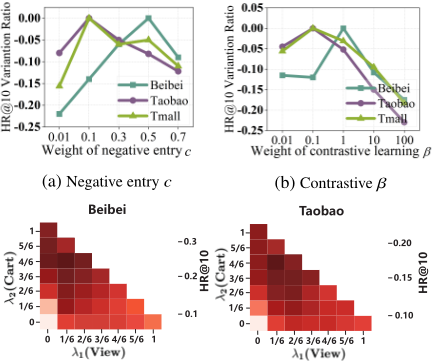
(c) Impact of the Behavioral Coefficients
Figure 3: Hyperparameter study of DAPM.
tational complexity and great performance.
5.5 Parameter Analysis
We conduct extensive experiments to examine the impact of several key hyperparameters, including the weight for negative entry 𝑐, the weight for contrastive learning 𝛽, and behavior coefficients 𝜆. Figure 3 illustrates the percentage decrease in performance relative to the best performance achieved. From Figures 3(a)(b), we observe a similar performance trend across different settings, i.e., performance initially improves significantly as the weight increases, but then quickly declines. For the behavior coefficient, both the Beibei and Taobao datasets consist of three behavior types-view, cart, and purchase-which correspond to the three loss coefficients 𝜆1, 𝜆2, and 𝜆3. The HR@10 results are shown in Figure 3(c), in which darker blocks mean better performance. It can be found that a relatively large coefficient for the cart behavior performs best on Beibei and Taobao. The potential reason is that purchase interaction is too sparse to offer much information and view interaction is relatively far from the target behavior. For both datasets, DAPM achieves optimal performance when the coefficients are set to [1/6, 4/6, 1/6], which not only effectively utilizes all three behavior types but also places more emphasis on cart behavior.
6 Conclusion
In this paper, we revisit the use of multi-behavior data in recommendation and propose a novel method, DAPM. Our approach constructs a behavior-agnostic graph for comprehensive representation learning, incorporates multi-behavior contrastive learning and a gating mechanism to adaptively refine behavior-specific embeddings, and explicitly models users' varying preference strengths via personalized decision boundaries. Extensive experiments on three real-world datasets demonstrate the effectiveness of DAPM.
Acknowledgments
This work is supported by the National Natural Science Foundation of China (U22B2060, 62276279), KeyArea Research and Development Program of Guangdong Province (2024B0101050005), Research Foundation of Science and Technology Plan Project of Guangzhou City(2023B01J0001, 2024B01W0004), Guangdong Basic and Applied Basic Research Foundation (2024A151501024, 2024B1515020032), Technology Innovation Center for Collaborative Applications of Natural Resources Data in GBA, MNR(No.2025NRDZ02), Zhuhai City IndustryUniversity-Research Project (2320004002797), 2024 Guangdong Province Science and Technology Innovation Strategic Special Fund (College Student Science and Technology Innovation Cultivation, pdjh2024b015).
@inproceedings{ijcai2025p341,
  title     = {Decision-Aware Preference Modeling for Multi-Behavior Recommendation},
  author    = {Li, Qingfeng and Liu, Wei and Meng, Zaiqiao and Yin, Jian},
  booktitle = {Proceedings of the Thirty-Fourth International Joint Conference on
               Artificial Intelligence, {IJCAI-25}},
  publisher = {International Joint Conferences on Artificial Intelligence Organization},
  editor    = {James Kwok},
  pages     = {3063--3071},
  year      = {2025},
  month     = {8},
  note      = {Main Track},
  doi       = {10.24963/ijcai.2025/341},
  url       = {https://doi.org/10.24963/ijcai.2025/341},
}
TY - CPAPER TI - Decision-Aware Preference Modeling for Multi-Behavior Recommendation AU - Li, Qingfeng AU - Liu, Wei AU - Meng, Zaiqiao AU - Yin, Jian T2 - Proceedings of the Thirty-Fourth International Joint Conference on Artificial Intelligence, IJCAI-25 PB - International Joint Conferences on Artificial Intelligence Organization PY - 2025 SP - 3063 EP - 3071 DO - 10.24963/ijcai.2025/341 UR - https://doi.org/10.24963/ijcai.2025/341 ER -Copied
Machine-readable versions of this paper, for tools and AI agents:





