
PALA: Class-imbalanced Graph Domain Adaptation via Prototype-anchored Learning and Alignment
Proceedings of the Thirty-Fourth International Joint Conference on Artificial Intelligence. Main Track. Pages 3198-3207.
https://doi.org/10.24963/ijcai.2025/356
Keywords
- Data Mining: DM: Class imbalance and unequal cost
- Data Mining: DM: Mining graphs
Abstract
Graph domain adaptation is a key subfield of graph transfer learning that aims to bridge domain gaps by transferring knowledge from a label-rich source graph to an unlabeled target graph. However, most existing methods assume balanced labels in the source graph, which often fails in practice and leads to biased knowledge transfer. To address this, in this paper, we propose a prototype-anchored learning and alignment framework for class-imbalanced graph domain adaptation. Specifically, we incorporate pointwise node mutual information into the graph encoder to capture high-order topological proximity and learn generalized node representations. Leveraging this, we then introduce categorical prototypes with adversarial proto-instances for prototype-anchored learning and recalibration to represent the source graph under an imbalanced class distribution. Finally, we introduce a weighted prototype contrastive adaptation strategy that aligns target pseudo-labels with source prototypes to handle class imbalance during adaptation. Extensive experiments show that our PALA outperforms the state-of-the-art methods. Our code is available at https://github.com/maxin88scu/PALA.
- [Arpit et al., 2017] Devansh Arpit, Stanisław Jastrzębski, Nicolas Ballas, David Krueger, Emmanuel Bengio, Maxinder S Kanwal, Tegan Maharaj, Asja Fischer, Aaron Courville, Yoshua Bengio, et al. A closer look at memo- rization in deep networks. In Proceedings of the Interna- tional Conference on Machine Learning, pages 233-242, 2017.
- [Cai et al., 2024] Ruichu Cai, Fengzhu Wu, Zijian Li, Pengfei Wei, Lingling Yi, and Kun Zhang. Graph do- main adaptation: A generative view. ACM Transactions on Knowledge Discovery from Data, 18(3):1-24, 2024.
- [Chen et al., 2019] Chaoqi Chen, Weiping Xie, Wenbing Huang, Yu Rong, Xinghao Ding, Yue Huang, Tingyang Xu, and Junzhou Huang. Progressive feature alignment for unsupervised domain adaptation. In Proceedings of the IEEE/CVF Conference on Computer Vision and Pat- tern Recognition, pages 627-636, 2019.
- [Cui et al., 2019] Yin Cui, Menglin Jia, Tsung-Yi Lin, Yang Song, and Serge Belongie. Class-balanced loss based on effective number of samples. In Proceedings of the IEEE/CVF Conference on Computer Vision and Pattern Recognition, pages 9268-9277, 2019.
- [Dai et al., 2022] Quanyu Dai, Xiao-Ming Wu, Jiaren Xiao, Xiao Shen, and Dan Wang. Graph transfer learning via adversarial domain adaptation with graph convolution. IEEE Transactions on Knowledge and Data Engineering, 35(5):4908-4922, 2022.
- [Graf et al., 2021] Florian Graf, Christoph Hofer, Marc Ni- ethammer, and Roland Kwitt. Dissecting supervised con- trastive learning. In Proceedings of the International Con- ference on Machine Learning, pages 3821-3830, 2021.
- [Gretton et al., 2012] Arthur Gretton, Karsten M Borgwardt, Malte J Rasch, Bernhard Schölkopf, and Alexander Smola. A kernel two-sample test. The Journal of Machine Learning Research, 13(1):723-773, 2012.
- [Guo et al., 2024] Xinyu Guo, Kai Wu, Xiaoyu Zhang, and Jing Liu. Automated loss function search for class- imbalanced node classification. In Forty-first International Conference on Machine Learning, 2024.
- [Hong et al., 2021] Youngkyu Hong, Seungju Han, Kwanghee Choi, Seokjun Seo, Beomsu Kim, and Buru Chang. Disentangling label distribution for long- tailed visual recognition. In Proceedings of the IEEE/CVF Conference on Computer Vision and Pattern Recognition, pages 6626-6636, 2021.
- [Huang et al., 2016] Chen Huang, Yining Li, Chen Change Loy, and Xiaoou Tang. Learning deep representation for imbalanced classification. In Proceedings of the IEEE/CVF Conference on Computer Vision and Pattern Recognition, pages 5375-5384, 2016.
- [Huang et al., 2023] Zhan Ao Huang, Yongsheng Sang, Yanan Sun, and Jiancheng Lv. Neural network with absent minority class samples and boundary shifting for imbal- anced data classification. Neural Computing and Applica- tions, 35(12):8937-8953, 2023.
- [Ju et al., 2024a] Wei Ju, Zhengyang Mao, Siyu Yi, Yi- fang Qin, Yiyang Gu, Zhiping Xiao, Yifan Wang, Xiao Luo, and Ming Zhang. Hypergraph-enhanced dual semi- supervised graph classification. In Proceedings of the In- ternational Conference on Machine Learning, 2024.
- [Ju et al., 2024b] Wei Ju, Siyu Yi, Yifan Wang, Qingqing Long, Junyu Luo, Zhiping Xiao, and Ming Zhang. A sur- vey of data-efficient graph learning. In Proceedings of the AAAI Conference on Artificial Intelligence, 2024. IJCAI
- [Ju et al., 2024c] Wei Ju, Siyu Yi, Yifan Wang, Zhiping Xiao, Zhengyang Mao, Hourun Li, Yiyang Gu, Yifang Qin, Nan Yin, Senzhang Wang, et al. A survey of graph neural networks in real world: Imbalance, noise, privacy and ood challenges. arXiv preprint arXiv:2403.04468, 2024.
- [Ju et al., 2025] Wei Ju, Zhengyang Mao, Siyu Yi, Yifang Qin, Yiyang Gu, Zhiping Xiao, Jianhao Shen, Ziyue Qiao, and Ming Zhang. Cluster-guided contrastive class- imbalanced graph classification. In Proceedings of the AAAI Conference on Artificial Intelligence, 2025.
- [Kang et al., 2020] Bingyi Kang, Saining Xie, Marcus Rohrbach, Zhicheng Yan, Albert Gordo, Jiashi Feng, and Yannis Kalantidis. Decoupling representation and classi- fier for long-tailed recognition. In International Confer- ence on Learning Representations, 2020.
- [Kipf and Welling, 2017] Thomas N Kipf and Max Welling. Semi-supervised classification with graph convolutional networks. In International Conference on Learning Rep- resentations, 2017.
- [Li et al., 2023] Wen-Zhi Li, Chang-Dong Wang, Hui Xiong, and Jian-Huang Lai. Graphsha: Synthesizing harder samples for class-imbalanced node classification. In Proceedings of the 29th ACM SIGKDD Conference on Knowledge Discovery and Data Mining, pages 1328- 1340, 2023.
- [Li et al., 2025] Hourun Li, Yifan Wang, Zhiping Xiao, Jia Yang, Changling Zhou, Ming Zhang, and Wei Ju. Disco: graph-based disentangled contrastive learning for cold- start cross-domain recommendation. In Proceedings of the AAAI Conference on Artificial Intelligence, volume 39, pages 12049-12057, 2025.
- [Liang et al., 2020] Jian Liang, Dapeng Hu, and Jiashi Feng. Do we really need to access the source data? source hy- pothesis transfer for unsupervised domain adaptation. In Proceedings of the International Conference on Machine Learning, pages 6028-6039, 2020.
- [Liu et al., 2020] Sheng Liu, Jonathan Niles-Weed, Narges Razavian, and Carlos Fernandez-Granda. Early-learning regularization prevents memorization of noisy labels. In Proceedings of the Conference on Neural Information Pro- cessing Systems, pages 20331-20342, 2020.
- [Liu et al., 2024a] Meihan Liu, Zeyu Fang, Zhen Zhang, Ming Gu, Sheng Zhou, Xin Wang, and Jiajun Bu. Re- thinking propagation for unsupervised graph domain adap- tation. In Proceedings of the AAAI Conference on Artificial Intelligence, volume 38, pages 13963-13971, 2024.
- [Liu et al., 2024b] Shikun Liu, Deyu Zou, Han Zhao, and Pan Li. Pairwise alignment improves graph domain adap- tation. In Forty-first International Conference on Machine Learning, 2024.
- [Liu et al., 2024c] Zhining Liu, Ruizhong Qiu, Zhichen Zeng, Hyunsik Yoo, David Zhou, Zhe Xu, Yada Zhu, Kommy Weldemariam, Jingrui He, and Hanghang Tong. Class-imbalanced graph learning without class rebalanc- ing. In Forty-first International Conference on Machine Learning, 2024.
- [Luo et al., 2023] Xiao Luo, Yusheng Zhao, Zhengyang Mao, Yifang Qin, Wei Ju, Ming Zhang, and Yizhou Sun. Rignn: A rationale perspective for semi-supervised open-world graph classification. Transactions on Machine Learning Research, 2023.
- [Luo et al., 2024a] Junyu Luo, Yiyang Gu, Xiao Luo, Wei Ju, Zhiping Xiao, Yusheng Zhao, Jingyang Yuan, and Ming Zhang. Gala: Graph diffusion-based alignment with jigsaw for source-free domain adaptation. IEEE Transac- tions on Pattern Analysis and Machine Intelligence, 2024.
- [Luo et al., 2024b] Junyu Luo, Zhiping Xiao, Yifan Wang, Xiao Luo, Jingyang Yuan, Wei Ju, Langechuan Liu, and Ming Zhang. Rank and align: Towards effective source- free graph domain adaptation. In Proceedings of the Inter- national Joint Conference on Artificial Intelligence, 2024.
- [Mao et al., 2023] Zhengyang Mao, Wei Ju, Yifang Qin, Xiao Luo, and Ming Zhang. Rahnet: Retrieval augmented hybrid network for long-tailed graph classification. In Pro- ceedings of the 31st ACM international conference on mul- timedia, pages 3817-3826, 2023.
- [Mao et al., 2025] Zhengyang Mao, Wei Ju, Siyu Yi, Yifan Wang, Zhiping Xiao, Qingqing Long, Nan Yin, Xinwang Liu, and Ming Zhang. Learning knowledge-diverse ex- perts for long-tailed graph classification. ACM Trans- actions on Knowledge Discovery from Data, 19(2):1-24, 2025.
- [Menon et al., 2021] Aditya Krishna Menon, Sadeep Jaya- sumana, Ankit Singh Rawat, Himanshu Jain, Andreas Veit, and Sanjiv Kumar. Long-tail learning via logit ad- justment. In Proceedings of the International Conference on Learning Representations, 2021.
- [Park et al., 2021] Joonhyung Park, Jaeyun Song, and Eunho Yang. Graphens: Neighbor-aware ego network synthesis for class-imbalanced node classification. In International Conference on Learning Representations, 2021.
- [Qiao et al., 2023] Ziyue Qiao, Xiao Luo, Meng Xiao, Hao Dong, Yuanchun Zhou, and Hui Xiong. Semi-supervised domain adaptation in graph transfer learning. In Proceed- ings of the International Joint Conference on Artificial In- telligence, pages 2279-2287, 2023. IJCAI
- [Qiu et al., 2021] Zhen Qiu, Yifan Zhang, Hongbin Lin, Shuaicheng Niu, Yanxia Liu, Qing Du, and Mingkui Tan. Source-free domain adaptation via avatar prototype gener- ation and adaptation. In Proceedings of the International Joint Conference on Artificial Intelligence, 2021. IJCAI
- [Qu et al., 2021] Liang Qu, Huaisheng Zhu, Ruiqi Zheng, Yuhui Shi, and Hongzhi Yin. Imgagn: Imbalanced net- work embedding via generative adversarial graph net- works. In Proceedings of the 27th ACM SIGKDD Con- ference on Knowledge Discovery & Data mining, pages 1390-1398, 2021.
- [Song et al., 2022] Jaeyun Song, Joonhyung Park, and Eunho Yang. Tam: topology-aware margin loss for class- imbalanced node classification. In International Confer- ence on Machine Learning, pages 20369-20383. PMLR, 2022.
- [Tan et al., 2020] Jingru Tan, Changbao Wang, Buyu Li, Quanquan Li, Wanli Ouyang, Changqing Yin, and Jun- jie Yan. Equalization loss for long-tailed object recog- nition. In Proceedings of the IEEE/CVF Conference on Computer Vision and Pattern Recognition, pages 11662- 11671, 2020.
- [Tang et al., 2008] Jie Tang, Jing Zhang, Limin Yao, Juanzi Li, Li Zhang, and Zhong Su. Arnetminer: extraction and mining of academic social networks. In Proceedings of the 14th ACM SIGKDD International Conference on Knowl- edge Discovery and Data Mining, pages 990-998, 2008.
- [Tzeng et al., 2017] Eric Tzeng, Judy Hoffman, Kate Saenko, and Trevor Darrell. Adversarial discriminative domain adaptation. In Proceedings of the IEEE Confer- ence on Computer Vision and Pattern Recognition, pages 7167-7176, 2017.
- [Veličković et al., 2018] Petar Veličković, Guillem Cucurull, Arantxa Casanova, Adriana Romero, Pietro Liò, and Yoshua Bengio. Graph attention networks. In Interna- tional Conference on Learning Representations, 2018.
- [Wang and Deng, 2018] Mei Wang and Weihong Deng. Deep visual domain adaptation: A survey. Neurocomput- ing, 312:135-153, 2018.
- [Wang et al., 2021] Jianfeng Wang, Thomas Lukasiewicz, Xiaolin Hu, Jianfei Cai, and Zhenghua Xu. Rsg: A sim- ple but effective module for learning imbalanced datasets. In Proceedings of the IEEE/CVF Conference on Computer Vision and Pattern Recognition, pages 3784-3793, 2021.
- [Wang et al., 2024] Yifan Wang, Xiao Luo, Chong Chen, Xian-Sheng Hua, Ming Zhang, and Wei Ju. Disensemi: Semi-supervised graph classification via disentangled rep- resentation learning. IEEE Transactions on Neural Net- works and Learning Systems, 2024.
- [Wu et al., 2023] Jun Wu, Jingrui He, and Elizabeth Ainsworth. Non-iid transfer learning on graphs. In Pro- ceedings of the AAAI Conference on Artificial Intelligence, pages 10342-10350, 2023.
- [Xu et al., 2018] Keyulu Xu, Weihua Hu, Jure Leskovec, and Stefanie Jegelka. How powerful are graph neural net- works? In International Conference on Learning Rep- resentations, 2018.
- [Yi et al., 2023] Si-Yu Yi, Zhengyang Mao, Wei Ju, Yong- Dao Zhou, Luchen Liu, Xiao Luo, and Ming Zhang. To- wards long-tailed recognition for graph classification via collaborative experts. IEEE Transactions on Big Data, 9(6):1683-1696, 2023.
- [You et al., 2023] Yuning You, Tianlong Chen, Zhangyang Wang, and Yang Shen. Graph domain adaptation via theory-grounded spectral regularization. In The eleventh International Conference on Learning Representations, 2023.
- [Yuan et al., 2023] Jingyang Yuan, Xiao Luo, Yifang Qin, Zhengyang Mao, Wei Ju, and Ming Zhang. Alex: To- wards effective graph transfer learning with noisy labels. In Proceedings of the ACM International Conference on Multimedia, pages 3647-3656, 2023.
- [Zeng et al., 2023] Liang Zeng, Lanqing Li, Ziqi Gao, Peilin Zhao, and Jian Li. Imgcl: Revisiting graph contrastive learning on imbalanced node classification. In Proceed- ings of the AAAI Conference on Artificial Intelligence, vol- ume 37, pages 11138-11146, 2023.
- [Zhao et al., 2021] Tianxiang Zhao, Xiang Zhang, and Suhang Wang. Graphsmote: Imbalanced node classifica- tion on graphs with graph neural networks. In Proceedings of the 14th ACM International Conference on Web Search and Data Mining, pages 833-841, 2021.
- [Zhuang and Ma, 2018] Chenyi Zhuang and Qiang Ma. Dual graph convolutional networks for graph-based semi- supervised classification. In Proceedings of the Web Con- ference, pages 499-508, 2018.
References were extracted automatically from the PDF and may contain errors.
Full text extracted automatically from the PDF; figures, tables and equations may differ. The PDF is the version of record.
1 Introduction
Graphs serve as an effective tool for representing intricate relationships across diverse domains. As a critical task in graphs [Kipf and Welling, 2017; Ju et al., 2024a], node classification aims to predict the labels of individual nodes, playing a key role in areas such as community detection and molecular property prediction. Despite its importance, node classification heavily depends on labeled data, which is often scarce and costly. Graph transfer learning [Yuan et al., 2023; Qiao et al., 2023; Li et al., 2025], which leverages learned knowledge from a labeled source domain graph an unlabeled target domain graph, has become a promising solution.
⇤Corresponding authors.
In recent years, many efforts have been made for graph transfer learning. One typical type of method is the graph domain adaptation (GDA) for node classification, where the primary task is to estimate the label distribution of the target domain graph based on the labeled source graph [Cai et al., 2024]. Thanks to the expressive modeling capabilities of graph neural networks (GNNs) [Ju et al., 2024b; Luo et al., 2023; Wang et al., 2024], the recent focus has shifted toward aligning distributions of the source and target domain graphs within the representation space learned by GNNs [Luo et al., 2024a; Liu et al., 2024a]. Distance-based methods explicitly minimize the distance between two domains via the proposed domain discrepancy metrics [Liu et al., 2024b; Wu et al., 2023]. In contrast, adversarial methods use a discriminator to distinguish between domains and learn invariant features [Luo et al., 2024b; Dai et al., 2022].
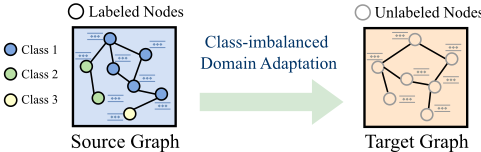
Despite the notable performance made by these methods, they often assume a balanced label distribution in the source graph. We argue that this assumption often fails in many real-world scenarios [Ju et al., 2024c], where a large portion of classes has few labeled nodes (tail classes), while a small number of classes have a disproportionately large share of labeled nodes (head classes) [Huang et al., 2016; Ju et al., 2025], resulting in highly imbalanced class distributions. For example, in a large-scale citation network, the number of papers on artificial intelligence greatly exceeds those on cryptography [Li et al., 2023]. As a result, the model trained on an imbalanced source graph would be severely biased and subsequently impact the graph domain adaptation process. Therefore, as shown in Figure 1, in this paper, we focus on a more practical scenario, which is referred to as class-imbalanced graph domain adaptation on graphs.
However, developing such an effective class-imbalanced domain adaptation framework is challenging due to the following two key obstacles: (i) How to effectively mitigate the impact of class imbalance to extract meaningful knowledge from the source graph? The imbalance often causes the model to focus primarily on the majority class, resulting in degraded performance on tail classes. And this ultimately leads to biased learning and poor generalization. (ii) How to overcome domain shifts across graphs to make accurate and domain-invariant predictions on the target graph? Existing works typically emphasize aligning the overall distributions between the source and target domain graphs, but they often overlook the fact that the class-level distributions may not be well-aligned, especially for the skewed tail classes.
To handle these challenges, our motivation is to investigate categorical prototypes, where each category has a single prototype to capture the semantic information of the source graph for adaptation. Toward this end, we propose a novel Prototype-Anchored Learning and Alignment method (term as PALA) for class-imbalanced graph domain adaptation, which leverages the categorical prototype instead source features to avoid the aforementioned problem. Specifically, we incorporate pointwise node mutual information into the graph encoder, allowing the model to explore high-order topological proximity and learn more generalized node representations. Based on this, we then introduce a set of categorical prototypes with corresponding adversarial proto-instances for prototype-anchored learning and recalibration to mitigate the class imbalance. Finally, we introduce a prototype-anchored contrastive adaptation strategy for class-imbalanced GDA, which generates pseudo-labels for the target domain graph and aligns them with the corresponding source prototypes to mitigate the class-imbalance issue during adaptation. To summarize, we make the following contributions:
- New Perspective: We focus on the class-imbalance issue in the source graph for graph domain adaptation tasks. To the best of our knowledge, this is the first work aimed at solving class-imbalanced graph domain adaptation.
- Novel Methodology: We propose a prototype-anchored learning and recalibration strategy to eliminate the prototype bias in the source graph and employ a novel contrastive prototype for alignment.
- Extensive Experiments: We conduct extensive experiments on various public datasets to evaluate our PALA. The results further show the superiority of our method in handling class-imbalanced graph domain adaptation.
2 Notations &ProblemDefinition
Source & Target Domain Graph. Let the source domain graph denoted as G s = ¶V s ↪ E s ↪Xs ↪ Y s ♦, where V s and E s represent the labeled nodes and edge set. The node feature matrix is given by Xs 2 R♣V s ♣⇥F , where each row xv 2 RF corresponds to the F-dimensional feature vector of a node v. The graph structure is captured by the adjacency matrix As 2 R♣V s ♣⇥♣V s ♣ , where Asij = 1 if there exists edge (vi↪ vj) 2 E s , otherwise, Asij = 0. In the source domain graph, each node is assigned a corresponding label. The labels are imbalanced, and the label matrix is denoted as Y s 2 R♣V s ♣⇥C , where C is the number of node classes. Similarly, we represent the target domain graph as G t = ¶V t ↪ E t ↪Xt ♦, where V t is the set of unlabeled nodes and E t is the edge set.
Class-imbalanced Graph Domain Adaptation. Given a labeled source graph G s = ¶V s ↪ E s ↪Xs ↪ Y s ♦ and an unlabeled target graph G t = ¶V t ↪ E t ↪Xt ♦, let Nc denote the number of nodes in G s that belong to the c-th class, satisfying N1 ≥ N2 ≥ · · · ≥ NC. The source graph is classimbalanced and quantified by the imbalance factor (IF) defined as N1◁NC. The goal of class-imbalanced graph domain adaptation is to mitigate the effects of this imbalance and generate accurate predictions for the unlabeled nodes in G t .
3 ProposedMethod
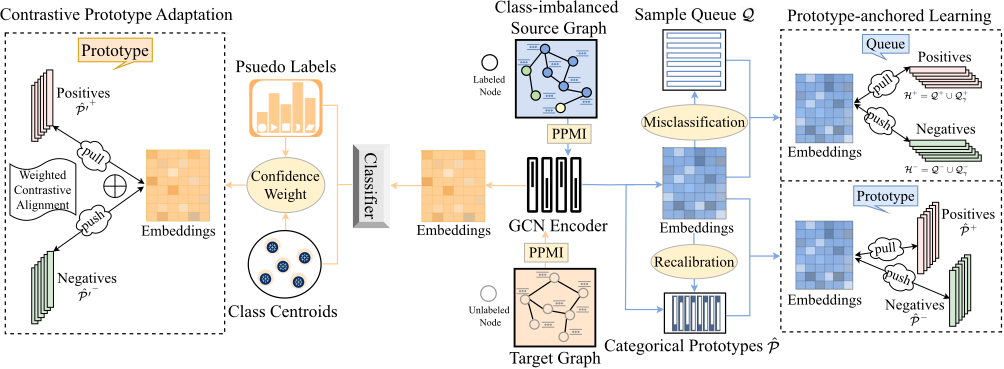
As shown in Figure 2, our proposed PALA consists of three modules: (1) Graph Consistency Encoder, designed to capture high-order structural information of the graph for learning more generalized node representations; (2) PrototypeAnchored Learning and Recalibration, which generates categorical prototypes by reducing contrastive negative pair redundancy, mining distinguishable positive pairs, and recalibrating prototypes to eliminate bias; (3) Contrastive Prototype Adaptation, which aligns pseudo-labeled target features with source prototypes to facilitate graph domain adaptation.
3.1 Graph Consistency Encoder
To effectively capture the high-order structural dependencies in the graph, we consider the global consistency relationships between nodes and calculate positive pointwise mutual information (PPMI) [Zhuang and Ma, 2018] to learn an informative representation of the node. Specifically, for a given graph G ⇤ ↪ ⇤ 2 ¶s↪ t♦, we employ random walk on A⇤ to sample a set of paths and calculate the frequency matrix F ⇤ between nodes to count their co-occurrence. Then, the PPMI between nodes can be computed as:
where Pij represent the probabilities that vj in the vi's context with a predefined window. P ⇤ ij captures the high-order topological proximity between nodes. A higher value of P ⇤ ij indicates that the two nodes have a higher co-occurrence frequency compared to when they are independent. Then, we can reformulate P ⇤ as the new adjacency matrix and the global consistency knowledge can be extracted as:
where ˜ P ⇤ = ˜ P + I, D⇤ i = Pj ˜ P ⇤ ij and W ⇤(l) is the filter weight of l-th layer. By stacking L layers, the global consistency knowledge can be extracted as Z⇤ = Z(L) ⇤ 2 Rd .
3.2 Prototype-anchored Recalibration &Learning
Since the categorical prototypes have a generalization ability for class-imbalanced data where each class corresponds to only one prototype, we leverage the categorical prototype to extract unbiased knowledge from the source domain graph.
Prototype-anchored Construction. To generate the prototype, we randomly initialize a set of parameters P = ¶pc 2 Rd ♣1 c C♦ and learn them in a contrastive manner. Given that head classes disproportionately dominate negative pairs in conventional contrastive methods, hindering tail class learning, we address this by reducing redundant negative pairs and identifying meaningful positive pairs. In practice, we maintain an instance queue that contains misclassified instance Q for prototype learning. For each node vi in G s , Q is divided into Q+ = ¶vj♣vj 2 Q↪ yj = yi♦ and Q- = ¶vj♣vj 2 Q↪ yj 6= yi♦. Similarly, we also divide prototype set into P + = ¶p+c ♣c = yi♦ and P - = ¶p-c ♣c 6= yi♦. Then, we synthesize the adversarial proto-instances to rectify the decision boundaries of tail classes during prototype learning. For the negative proto-instances, we rank the distance between node vi and nodes in Q- in ascending order and construct the adversarial negative proto-instance set Q-γ :
where d(·↪ ·) denote the distance between nodes based on their representation in Zs , zsγ is embedding of the γ-th node in Q-. For harder negative instances under imbalance class distribution, we randomly perturb each element in Q-γ with the positive prototype p+c , defined as:
where ✏i denotes the interpolation coefficient. Similarly, for the positive proto-instances, we select all the samples in Q+ and combine them with incorrectly assigned prototype p-c .
Prototype Recalibration. To further alleviate prototype bias during the learning process, where proto-instances tend to favor head classes and undermine performance on tail classes, we propose a prototype recalibration strategy, evaluating the importance of each categorical prototype and emphasizing the contribution of the tail class. Given the similarity between the node feature and prototype, we introduce a rectified sigmoid function for prototype recalibration. The calibration factor for each prototype can be defined as:
To ensure stability, we progressively updated the calibration factor via the exponential moving average (EMA):
where β denotes the smoothing coefficient. A larger recalibration factor indicates a higher representativeness of the prototype in guiding the model's learning process. Eventually, we impose all prototypes by the recalibration factor:
Prototype-anchored Learning. Inspired by the success of supervised contrastive learning (SCL) in delivering stable performance [Graf et al., 2021]. To address class imbalance more effectively, we extend SCL by incorporating prototypes and both positive and negative adversarial proto-instances into the training process. The prototype-anchored learning loss in the source domain graph can be formulated as:
3.3 Contrastive Prototype Adaptation
Given the prototype set of the source domain graph, directly aligning to the target domain graph is nontrivial due to the lack of target annotations. In this part, we generate pseudolabels for the target domain and introduce the weighted contrastive prototype alignment for adaptation.
Target Pseudo-Labeling. Given the unlabeled target domain graph G t , we aim to conduct domain alignment based on the generated prototype in source domain graph G s . Since the target node annotations are unavailable, we apply a selfsupervised labeling strategy to generate the target pseudo labels. Specifically, based on the encoded target domain graph embedding Zt, we predict the probability ˆ yk i = g(zt i ) for each class k with an MLP-based classifier g(·). Then, we attain the centroid for each class in G t as:
These centroids provide a robust and reliable representation of the category distributions within the target domain [Liang et al., 2020; Qiu et al., 2021], and we obtain the pseudo label via the nearest centroid as:
where φ(·↪ ·) denote the cosine similarity. Note that we can compute the new target centroid based on the new pseudo labels for the iteration process.
Weighted Contrastive Alignment. Based on the generated pseudo labels of the target domain graph, we align them to the source prototype ˆ P. Since the target pseudo labels may be noisy, we assume more reliable samples are generally closer to the class centroid [Chen et al., 2019] and employ a weighted contrastive alignment for adaptation. The confidence of node vi in G t can be compute as:
where ⌧ denotes the temperature parameter. We take each node vi in G t as an anchor, and the prototype adaptation can be conducted via the weighted contrastive alignment:
Algorithm 1 The overall training process of PALA
Input: Labeled source graph Gs = ¶V s ↪ E s ↪Xs ↪ Y s ♦ with C imbalanced classes, unlabeled target graph Gt = ¶V t ↪ E t ↪Xt ♦. Output: Parameters of graph consistency encoder, prototype set.
- 1: Consider global consistency relationships and calculate PPMI between nodes P ⇤ ↪ ⇤¶s↪ t♦ for Gs and Gt ; // Eq. 1
- 2: while not convergence do
- 3: Encode high-order structure information of the graph based on P ⇤ to get Z ⇤ ↪ ⇤ 2 ¶s↪ t♦ ; // Eq. 2 /* Prototype Recalibration & Learning */
- 4: Construct adversarial proto-instances ˆQ⇤γ↪ ⇤ 2 ¶+↪-♦ to rectify the boundaries of tail classes in Gs ; // Eqs. 3-4
- 6: Prototype-anchored learning with ˆQ⇤γ and ˆ P ; // Eq. 8 /* Contrastive Prototype Adaptation */
- 5: Initialize categorical prototypes P and recalibrate them to get ˆ P to alleviate prototype bias ; // Eqs. 5-7
- 7: Attain class centroid ¶θk♦↪ k 2 ¶1↪ ▷ ▷ ▷ ↪C♦ and pseudo labels for the target graph Gt ; // Eq. 10
- 8: Weighted prototype contrastive alignment based on ˆ P from source and target pseudo labels ; // Eqs. 11-12
- 9: Early learning regularization for class-imbalanced contrastive alignment process ; // Eqs. 13-14
- 10: end while
- 11: Obtain graph consistency encoder, prototype set for adaptation.
where p+i denotes the prototype with the same class to vi, where the label are attained from target pseudo-labeling.
Adaptation Regularization. Since learning from classimbalanced data always first memorizes the unbiased samples and then the biased knowledge [Arpit et al., 2017], we further regularize the adaptation process by leveraging the early predictions of each sample. Formally, we maintain a memory bank H = ¶¯h1↪ ▷ ▷ ▷ ↪ ¯hVt ♦ to record the prediction of node vi and update the bank via EMA:
where hi↪k is the alignment probability of C prototypes computed as in Eq. 12. We further regularize the model via an early learning loss [Liu et al., 2020]:
This regularization ensures that the current prediction aligns closely with the average prediction.
3.4 Overall Optimization
For the class-imbalance of nodes in the source domain graph, we apply the logit compensation to eliminate the bias and learn the rectification of the consistency knowledge [Menon et al., 2021], denoted as:
where '(·) represents the classification function output the logit of labels, λy is the importance weight of class ys i and δc is the compensation value of class c. In our paper, we set λc = 1 and δc = logNc as in the work [Menon et al., 2021]. Finally, the overall objective of our framework is defined as:
The detailed algorithm framework is provided in Algorithm 1.
| Methods | IF (⇢) | A)C | A)D | C)A | C)D | D)A | D)C | ||||||
|---|---|---|---|---|---|---|---|---|---|---|---|---|---|
| Micro | Macro | Micro | Macro | Micro | Macro | Micro | Macro | Micro | Macro | Micro | Macro | ||
| GCN | 10 20 50 | 66.01◦1▷15 60.90◦2▷14 62.28◦1▷17 55.48◦1▷79 42.41◦3▷32 | 61.21◦0▷57 60.75◦0▷69 56.26◦2▷21 | 53.20◦0▷71 51.60◦1▷48 43.35◦3▷53 | 58.25◦1▷22 51.17◦0▷58 44.38◦1▷12 | 56.52◦2▷87 43.78◦1▷54 32.20◦2▷51 | 63.39◦0▷32 59.00◦0▷88 53.06◦0▷55 | 58.38◦1▷27 48.22◦1▷57 37.09◦1▷18 | 55.47◦0▷39 50.93◦2▷70 41.86◦1▷31 | 52.80◦0▷86 45.12◦4▷44 31.11◦1▷50 | 61.68◦0▷38 54.02◦0▷27 42.28◦3▷28 | 58.35◦0▷68 46.18◦0▷55 32.05◦3▷30 | |
| GAT | 10 20 50 | 53.07◦3▷39 66.48◦0▷72 61.63◦3▷34 53.21◦7▷62 | 58.37◦2▷74 50.54◦3▷72 42.07◦7▷64 | 61.58◦0▷75 61.04◦1▷87 53.67◦4▷00 | 51.44◦1▷02 50.10◦1▷46 40.36◦5▷33 | 55.10◦2▷47 47.18◦1▷04 41.02◦0▷99 | 51.54◦4▷12 37.30◦1▷61 26.41◦1▷18 | 60.87◦1▷00 55.95◦1▷26 49.76◦0▷63 | 52.99◦1▷34 43.32◦2▷17 32.29◦1▷15 | 56.18◦0▷31 49.18◦1▷59 40.14◦1▷46 | 53.11◦0▷80 42.20◦2▷78 28.89◦1▷85 | 61.64◦0▷23 53.05◦3▷25 45.38◦7▷90 | 58.22◦0▷53 45.29◦2▷63 34.77◦8▷31 |
| GIN | 10 20 50 | 62.12◦0▷69 60.03◦1▷03 54.39◦1▷62 | 55.03◦0▷84 50.98◦0▷94 44.28◦1▷69 | 60.91◦0▷79 59.12◦1▷05 54.43◦1▷60 | 54.39◦1▷48 48.27◦0▷92 41.90◦2▷09 | 54.35◦1▷75 50.38◦2▷75 41.26◦0▷37 | 49.21◦1▷31 42.80◦3▷88 29.45◦0▷51 | 60.14◦1▷00 55.87◦2▷47 47.05◦0▷60 | 54.51◦2▷16 46.42◦4▷71 31.57◦1▷13 | 52.59◦0▷67 47.79◦1▷49 43.38◦1▷26 | 49.43◦2▷42 41.02◦2▷77 34.41◦2▷05 | 59.89◦1▷42 53.47◦2▷49 48.59◦2▷15 | 54.68◦2▷28 44.83◦2▷61 39.22◦2▷29 |
| GDA-SpecReg | 10 20 50 | 51.27◦1▷86 49.68◦1▷42 49.80◦6▷48 | 39.29◦2▷43 36.44◦1▷70 36.09◦7▷63 | 53.69◦3▷02 51.34◦3▷70 47.44◦4▷58 | 40.87◦5▷56 35.82◦3▷00 29.36◦6▷49 | 49.69◦4▷93 48.11◦4▷07 47.64◦4▷97 | 39.08◦7▷51 38.20◦6▷83 33.87◦7▷90 | 57.41◦3▷15 51.64◦1▷96 52.63◦2▷53 | 45.54◦4▷35 35.15◦3▷49 38.46◦6▷93 | 52.73◦3▷20 43.84◦3▷79 41.95◦3▷49 | 47.07◦7▷86 31.89◦3▷72 28.28◦7▷97 | 56.37◦1▷40 44.53◦6▷48 45.63◦5▷22 | 45.04◦3▷46 31.21◦6▷80 30.81◦8▷85 |
| A2GNN | 10 20 50 | 61.23◦0▷93 35.95◦0▷99 32.48◦1▷62 | 54.72◦2▷23 25.28◦1▷45 17.61◦1▷75 | 59.00◦0▷64 49.06◦1▷28 35.22◦0▷12 | 46.61◦1▷16 35.11◦1▷11 15.10◦0▷24 | 51.29◦0▷51 46.09◦0▷19 40.26◦0▷08 | 41.70◦0▷77 33.40◦0▷39 24.09◦0▷07 | 61.07◦0▷32 56.91◦0▷24 50.33◦0▷19 | 50.09◦0▷68 42.06◦0▷38 31.03◦0▷17 | 59.54◦0▷83 41.31◦0▷79 31.27◦0▷22 | 55.41◦1▷74 31.44◦1▷20 14.29◦0▷48 | 60.32◦1▷82 41.00◦0▷70 27.79◦0▷35 | 60.11◦2▷30 31.44◦1▷04 13.19◦0▷72 |
| GraphENS | 10 20 50 | 70.49◦0▷63 68.12◦1▷26 62.74◦0▷81 | 64.53◦1▷33 57.59◦1▷13 51.76◦0▷79 | 66.43◦1▷40 64.41◦0▷70 61.01◦1▷66 | 58.40◦3▷69 53.09◦1▷11 47.74◦4▷14 | 63.25◦1▷11 59.61◦1▷30 54.09◦1▷51 | 62.41◦2▷29 51.96◦1▷31 45.51◦1▷74 | 67.47◦0▷37 65.58◦1▷02 60.40◦0▷90 | 63.87◦1▷23 57.31◦3▷39 47.81◦2▷29 | 58.95◦0▷64 54.72◦0▷46 50.67◦0▷43 | 58.34◦1▷07 49.54◦1▷89 42.18◦0▷44 | 65.50◦0▷53 61.11◦0▷49 56.26◦0▷85 | 63.52◦0▷65 52.47◦1▷99 47.81◦2▷43 |
| TAM | 10 20 50 | 72.36◦0▷50 68.90◦1▷49 64.93◦3▷74 | 67.27◦0▷56 60.01◦1▷23 55.77◦4▷74 | 67.12◦0▷69 66.11◦0▷99 61.63◦0▷99 | 61.52◦1▷05 56.88◦1▷83 50.23◦1▷48 | 64.49◦0▷41 61.36◦0▷70 58.95◦1▷64 | 63.40◦1▷34 57.64◦2▷19 50.99◦2▷06 | 70.10◦0▷85 68.11◦0▷69 64.66◦1▷19 | 66.20◦1▷02 62.57◦1▷98 54.71◦2▷03 | 59.17◦0▷68 53.81◦1▷05 53.39◦1▷61 | 55.36◦1▷29 46.92◦1▷65 44.93◦2▷14 | 66.65◦0▷39 61.23◦1▷22 57.88◦1▷67 | 63.16◦0▷77 53.28◦1▷42 47.52◦2▷02 |
| GraphSHA | 10 20 50 | 73.20◦0▷73 71.00◦1▷58 64.97◦2▷30 | 70.43◦1▷14 64.33◦2▷56 53.99◦2▷49 | 61.79◦0▷09 57.95◦2▷55 65.96◦1▷44 | 56.09◦1▷47 47.37◦3▷16 54.07◦1▷91 | 66.07◦1▷26 62.87◦1▷74 56.55◦2▷73 | 66.24◦1▷34 60.41◦2▷91 49.19◦1▷58 | 63.05◦0▷93 62.72◦3▷73 56.10◦5▷25 | 56.69◦4▷64 53.91◦4▷00 44.72◦6▷29 | 63.28◦0▷55 57.56◦1▷71 50.08◦0▷95 | 64.06◦0▷54 53.22◦4▷22 41.72◦3▷42 | 71.11◦0▷64 66.93◦1▷40 57.89◦1▷59 | 69.03◦0▷64 62.03◦1▷82 50.52◦2▷26 |
| PALA (Ours) | 10 20 50 | 77.40◦0▷78 76.18◦1▷28 76.82◦0▷26 | 67.73◦2▷30 66.91◦2▷90 63.79◦0▷32 | 73.59◦0▷29 72.13◦1▷94 72.63◦0▷79 | 66.70◦2▷57 60.59◦3▷02 59.45◦0▷71 | 69.76◦0▷32 64.45◦2▷85 61.58◦2▷11 | 70.30◦0▷73 53.68◦2▷85 50.66◦2▷76 | 73.50◦1▷17 71.30◦1▷27 66.42◦2▷50 | 66.67◦0▷66 58.38◦1▷84 56.14◦1▷28 | 67.69◦0▷94 63.73◦1▷50 59.79◦1▷65 | 67.80◦1▷33 62.90◦1▷61 53.00◦2▷89 | 77.09◦0▷92 70.12◦2▷45 67.74◦0▷76 | 74.40◦2▷08 66.26◦2▷86 58.22◦0▷32 |
4 Experiments
4.1 Experimental Settings
Datasets. We conduct extensive experiments on three realworld graph datasets: ACMv9 (A), Citationv1 (C) and DBLPv7 (D) from ArnetMiner [Tang et al., 2008], constructed from distinct datasets over different periods: ACM (post-2010), Microsoft Academic Graph (pre-2008), and DBLP (2004-2008), leading to varied domain distributions. In each graph, nodes represent papers, with edges indicating undirected citation relationships. In order to simulate the real-world imbalance scenario more effectively, we adopt the same approach as [Park et al., 2021] to handle the source domain data. Specifically, we iteratively process the classes with fewer nodes in the source domain to meet the imbalance factor (IF), defined as ⇢ = N1◁NC, where N1 ≥ N2 ≥ · · · ≥ NC, and Nc represents the number of nodes belonging to the c-th class in the source graph.
Baselines. For our class-imbalanced graph domain adaptation, we select three classical GNN models: GCN [Kipf and Welling, 2017], GAT [Veliˇckovi´c et al., 2018] and GIN [Xu et al., 2018] as basic baselines. Additionally, we choose two models specifically designed for domain adaptation tasks: GDA-SpecReg [You et al., 2023] and A2GNN [Liu et al., 2024a], and three models known for handling imbalanced data effectively: GraphENS [Park et al., 2021], TAM [Song et al., 2022] and GraphSHA [Li et al., 2023].
Implementation Details. For the datasets mentioned above, we sequentially select one as the source domain and the other two as target domains for experiments. The imbalance factor ⇢ for the source domain is set to 10/20/50, covering scenarios from slightly imbalanced to severely imbalanced, to simulate real-world data imbalance scenarios. For our PALA, we use GCN [Kipf and Welling, 2017] as the backbone encoder, with the feature dimension of 512. We set our hyperparameters γ as 5, β as 0.9, and ✏ as 0.2, which are discussed in detail in Section 4.4, and the number of training epochs is set to 200. For a fair comparison, we use the same encoder to the baselines and tuned them to optimal performance. We evaluate model performance based on two F1 scores on the target domain: macro average and micro average. We record the average of five training runs for performance evaluation.
4.2 Performance Comparison
Table 1 presents the performance of different approaches on three datasets. In the domain adaptation across all six data pairs, our PALA highlights the best-performing results. As the imbalance factor increases-i.e., the head-class nodes grow and the tail-class nodes decrease-the performance of all methods declines. This is expected, as the abundance of head-class nodes leads the model to focus more on them, neglecting the tail-class nodes. Classic GNNs lack the capability to handle domain adaptation and imbalanced data, resulting in subpar performance, especially with high imbalance facotrs. Interestingly, some baseline models designed for domain adaptation perform worse than classical GNNs. In contrast, models designed to handle imbalanced data generally perform better. This suggests that addressing data imbalance in the source domain outweighs domain discrepancy. Our method PALA performs the best in domain adaptation across most data pairs, maintaining robust performance as imbalance factors increase. When using DBLPv7 as the source domain, its smaller number of nodes typically results in worse performance compared to ACMv9 or Citationv1. However, our method effectively alleviates this issue, enhancing robustness and generalization in data-scarce environments.
4.3 Ablation Study
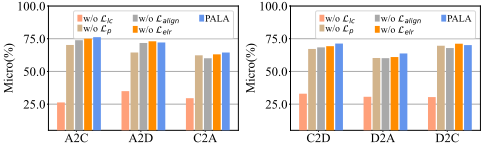
In this subsection, we design an ablation study to verify the contribution of each component in our method. We sequentially remove four losses while keeping the other losses unchanged and conduct experiments in an environment with ⇢ = 20. The results are shown in Figure 3. It can be observed that removing the logit compensation loss (w/o Llc) significantly drops performance, as the model loses valuable label information from the source domain. Similarly, removing the prototype-anchored learning loss (w/o Lp) can address data imbalance and promote generalization, but it leads to a significant performance drop and worsens as the imbalance factor increases. Additionally, removing the weighted contrastive alignment loss (w/o Lalign), which aligns the feature spaces between the source and target domains, causes some degradation, but the impact is smaller than removing the source domain contrastive learning loss. This indicates that data imbalance in the source domain has a greater effect than domain shift. Finally, removing the early learning loss (w/o Lelr) results in a smaller performance drop compared to other losses, but increases the variance in the domain adaptation process across most data pairs. This suggests that the early learning loss helps mitigate the noise impact and enhances robustness.
4.4 Sensitivity Analysis
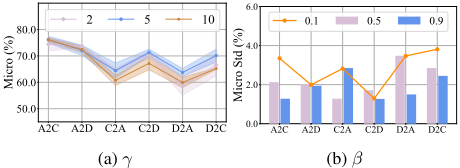
Here, we conduct a sensitivity analysis on three key hyperparameters at ⇢ = 20 to verify their impact on performance. Effect of γ. We test γ in ¶2↪ 5↪ 10♦. The results are shown in Figure 4a. It is observed that both too small and too large γ values harm performance-small values of γ limit the positive and negative samples, reducing the model's ability to capture key features, while larger values of γ amplify data imbalance by favoring head-class samples over tail-class samples. Also, larger γ values also increase computational cost.
| A)C | A)D | C)A | ||||
|---|---|---|---|---|---|---|
| ✏ | Micro | Macro | Micro | Macro | Micro | Macro |
| 0.2 | 76.18◦1▷28 | 66.91◦2▷90 | 72.13◦1▷94 | 60.59◦3▷02 | 64.45◦2▷85 | 53.68◦2▷85 |
| 0.4 | 75.20◦1▷80 | 63.16◦2▷51 | 72.02◦1▷07 | 60.91◦1▷74 | 62.76◦3▷27 | 51.86◦3▷33 |
| 0.8 | 73.32◦2▷01 | 61.93◦2▷22 | 71.94◦2▷12 | 59.71◦0▷90 | 63.98◦0▷80 | 53.56◦0▷78 |
Effect of β. We select β from ¶0▷1↪ 0▷5↪ 0▷9♦ and conduct experiments. The results are shown in Figure 4b. As β increases, the model's performance becomes more stable, and the standard deviation decreases accordingly. β controls the update speed of the memory bank when calculating Lelr. As β increases, the memory bank updates more slowly, encouraging the model to achieve greater stability in performance. Effect of ✏. We test ✏ values of ¶0▷2↪ 0▷4↪ 0▷8♦ and Table 2 shows the impact of different ✏ values. As ✏ increases, the model's performance declines because ✏ affects the linear interpolation of positive and negative samples in contrastive learning on the source domain. As ✏ increases, the prototype's weight increases, while the queue Q weight decreases, since Q is composed of misclassified samples, which are more likely to lead to errors. Prioritizing Q can improve the model more quickly. When ✏ is large, the model ignores misclassified points, thereby limiting the improvement in performance.
4.5 The Ability to Alleviate Imbalance Problem
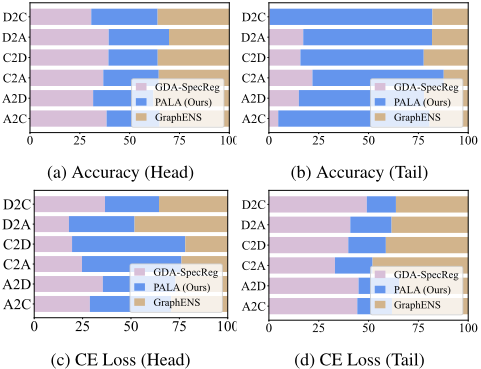
To evaluate the effectiveness of our PALA in alleviating data imbalance, we record and analyze the accuracy and crossentropy loss for head and tail classes across different data pairs with ⇢ = 20. Specifically, we normalize the accuracy and cross-entropy loss for each method to provide a clearer visualization. The results are shown in Figure 5. For the head class, the accuracy and corresponding cross-entropy loss ratios are similar across all three methods, indicating that their performance is comparable when data is sufficient. However, for the tail class, the performance of the other two methods
(a) GDA-SpecReg
(b) Our proposed PALA
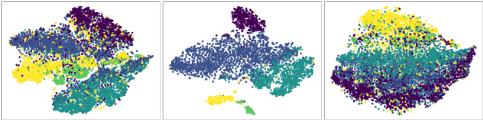
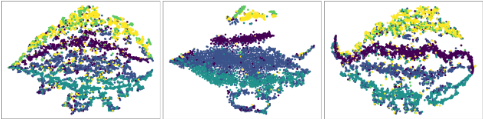
Figure 6: Visualization of node embeddings learned by GDASpecReg and PALA via t-SNE. From left to right is balanced source graph, imbalanced source graph, and target graph, respectively.
significantly declines, highlighting their inadequate domain adaptation ability when handling data imbalance. Notably, GraphENS consistently outperforms GDA-SpecReg, likely due to its inherent capability to handle imbalanced data. In contrast, our method demonstrates stable performance for both head and tail classes, indicating its effectiveness in mitigating data imbalance and its strong generalization capability.
4.6 Visualization
To evaluate the domain adaptation ability of our PALA, we compare it with the competitive baseline GDA-SpecReg via visualization. With ⇢ = 20, we reduce node features encoded by the encoder to 2D using t-SNE, as shown in Figure 6. For each method, we present results for three scenarios: balanced source graph, imbalanced source graph, and target graph. In GDA-SpecReg, class boundaries in both source domains are unclear, and the target visualization differs significantly, suggesting poor transfer of domain-invariant features. In contrast, our PALA shows clear class boundaries, even though the imbalanced source differs slightly from the balanced one. The visualization of the target domain is similar to that of the balanced source domain, with clearer class boundaries, demonstrating that our method, by learning from the imbalanced source domain data, captures domain-invariant interclass features and performs well in inter-class classification.
5 RelatedWork
5.1 Unsupervised Domain Adaption
Unsupervised Domain Adaption (UDA) aims at transferring knowledge from a labeled source domain to an unlabeled target domain, requiring domain adaptation methods to learn domain-invariant representations [Wang and Deng, 2018]. While successful in computer vision [Tzeng et al., 2017], existing methods for i.i.d. data (e.g., image) are unsuitable for non-i.i.d. graph data. Recently, approaches for graph domain adaptation include adversarial learning and methods that minimize domain discrepancy based on a certain metric (e.g., MMD [Gretton et al., 2012], subtree discrepancy [Wu et al., 2023]. For the first group, ImGAGN [Qu et al., 2021] balances class distribution by generating synthetic minority nodes and leveraging a GCN discriminator to address imbalanced graph classification. For the second group, GDASpecReg [You et al., 2023] facilitates GNNs in capturing more cross-domain representations via spectral regularization. Similarly, A2GNN [Liu et al., 2024a] adjusts propagation layers based on GNN Lipschitz bounds to enhance the ability of GNNs for cross-domain transfer. However, our proposed PALA further considers a more practical scenario-when the source graph is imbalanced-and proposes a novel prototype-anchored learning to eliminate prototype bias in the source graph, utilizing the learned prototypes for class-imbalanced graph domain adaptation.
5.2 Class-Imbalanced Learning on Graphs.
This line of work aims to address performance degradation caused by imbalanced data, primarily through three approaches: (i) Modifying the loss function to focus on underrepresented class [Cui et al., 2019; Tan et al., 2020; Menon et al., 2021; Mao et al., 2025], recent method like AutoLINC [Guo et al., 2024] introduces an automated framework for optimizing loss functions to address class imbalance based on node distributions and graph topology. (ii) Post-hoc correction to adjust logits for tail class [Kang et al., 2020; Hong et al., 2021; Yi et al., 2023]. (iii) Re-sampling to augment or generate tail class data [Wang et al., 2021; Park et al., 2021; Zhao et al., 2021; Mao et al., 2023; Huang et al., 2023], among them, GraphSHA [Li et al., 2023] enlarges decision boundaries for tail class by synthesizing harder samples. Additionally, BAT [Liu et al., 2024c] mitigates bias in class-imbalanced node classification using a topological augmentation without rebalancing classes, while ImGCL [Zeng et al., 2023] balances representations in graph contrastive learning with progressively balanced sampling and node centrality methods. However, distribution shifts in graphs are common in real-world scenarios, and addressing the class-imbalanced graph domain adaptation problem is a more challenging task. To this end, our proposed PALA learns recalibrated prototypes for each class to alleviate class imbalance bias, using the learned prototypes to guide pseudolabel assignment to target graph nodes and perform domain adaptation through weighted contrastive alignment.
6 Conclusion
In this paper, we highlight the class-imbalanced nature of the graph and propose a prototype-anchored learning and alignment framework termed PALA for the class-imbalanced graph domain adaption. Specifically, based on the encoded high-order structure information, we generate a set of categorical prototypes with corresponding proto-instances for recalibration and learning under imbalanced class distribution. Then, during the adaption phase, we introduce a robust contrastive prototype adaption strategy based on the generated pseudo label in the target graph domain. Experiments verify the effectiveness and superiority of our proposed PALA. In the future, we aim to integrate large language models into our prototype-anchored framework to further improve its adaptability and scalability, especially in handling more diverse and complex class-imbalanced graph data.
Contribution Statement
Xin Ma and Yifan Wang contributed equally to this work.
Acknowledgments
This paper is supported in part by the National Major Scientific Instruments and Equipments Development Project of National Natural Science Foundation of China under Grant 62427820, the Fundamental Research Funds for the Central Universities under Grant 1082204112364 and 1082204112K97, the National Natural Science Foundation of China under Grant 62306014, the Postdoctoral Fellowship Program (Grade A) of CPSF under Grant BX20250376 and BX20240239, the China Postdoctoral Science Foundation under Grant No. 2024M762201, the Sichuan Science and Technology Program under Grant 2025ZNSFSC1506 and 2025ZNSFSC0808, and the Sichuan University Interdisciplinary Innovation Fund 1082204112J74.
@inproceedings{ijcai2025p356,
  title     = {PALA: Class-imbalanced Graph Domain Adaptation via Prototype-anchored Learning and Alignment},
  author    = {Ma, Xin and Wang, Yifan and Yi, Siyu and Ju, Wei and Wu, Bei and Qiao, Ziyue and Tang, Chenwei and Lv, Jiancheng},
  booktitle = {Proceedings of the Thirty-Fourth International Joint Conference on
               Artificial Intelligence, {IJCAI-25}},
  publisher = {International Joint Conferences on Artificial Intelligence Organization},
  editor    = {James Kwok},
  pages     = {3198--3207},
  year      = {2025},
  month     = {8},
  note      = {Main Track},
  doi       = {10.24963/ijcai.2025/356},
  url       = {https://doi.org/10.24963/ijcai.2025/356},
}
TY - CPAPER TI - PALA: Class-imbalanced Graph Domain Adaptation via Prototype-anchored Learning and Alignment AU - Ma, Xin AU - Wang, Yifan AU - Yi, Siyu AU - Ju, Wei AU - Wu, Bei AU - Qiao, Ziyue AU - Tang, Chenwei AU - Lv, Jiancheng T2 - Proceedings of the Thirty-Fourth International Joint Conference on Artificial Intelligence, IJCAI-25 PB - International Joint Conferences on Artificial Intelligence Organization PY - 2025 SP - 3198 EP - 3207 DO - 10.24963/ijcai.2025/356 UR - https://doi.org/10.24963/ijcai.2025/356 ER -Copied
Machine-readable versions of this paper, for tools and AI agents:





