
Attribute Association Driven Multi-Task Learning for Session-based Recommendation
Proceedings of the Thirty-Fourth International Joint Conference on Artificial Intelligence. Main Track. Pages 3417-3425.
https://doi.org/10.24963/ijcai.2025/380
Keywords
- Data Mining: DM: Recommender systems
Abstract
Session-based Recommendation (SBR) aims to predict users’ next interaction based on their current session without relying on long-term profiles. Despite its effectiveness in privacy-preserving and real-time scenarios, SBR remains challenging due to limited behavioral signals. Prior methods often overfit co-occurrence patterns, neglecting semantic priors like item attributes. Recent studies have attempted to incorporate item attributes (e.g., category) by assigning fixed embeddings shared across all sessions. However, such approaches suffer from two key limitations: 1) Static attribute encoding fails to reflect semantic shifts under different session contexts. 2) Semantic misalignment between attribute and item ID embeddings. To address these issues, we propose attribute association driven multi-task learning for SBR, dubbed A²D-MTL. It explicitly models item categories using cross-session context to capture user potential interests and designs an adaptive sparse attention mechanism to suppress noise. Experimental results on three public datasets demonstrate the superiority of our method in recommendation accuracy (P@20) and ranking quality (MRR@20), validating the model’s effectiveness.
- [Chen and Wong, 2020] Tianwen Chen and Raymond Chi- Wing Wong. Handling information loss of graph neural networks for session-based recommendation. In Proceed- ings of the 26th ACM SIGKDD Conference on Knowledge Discovery and Data Mining, pages 1172-1180, 2020.
- [Chen et al., 2023] Qian Chen, Jianjun Li, Zhiqiang Guo, Guohui Li, and Zhiying Deng. Attribute-enhanced dual channel representation learning for session-based recom- mendation. In Proceedings of the 32nd ACM International Conference on Information and Knowledge Management, pages 3793-3797, 2023.
- [Cho et al., 2014] Kyunghyun Cho, Bart Van Merriënboer, Caglar Gulcehre, Dzmitry Bahdanau, Fethi Bougares, Holger Schwenk, and Yoshua Bengio. Learning phrase representations using rnn encoder-decoder for statistical machine translation. In Proceedings of the 2014 Confer- ence on Empirical Methods in Natural Language Process- ing, pages 1724-1734, 2014.
- [Choi et al., 2024] Minjin Choi, Hye-young Kim, Hyunsouk Cho, and Jongwuk Lee. Multi-intent-aware session-based recommendation. In Proceedings of the 47th International ACM SIGIR Conference on Research and Development in Information Retrieval, pages 2532-2536, 2024.
- [Guo et al., 2022] Jiayan Guo, Yaming Yang, Xiangchen Song, Yuan Zhang, Yujing Wang, Jing Bai, and Yan Zhang. Learning multi-granularity consecutive user intent unit for session-based recommendation. In Proceedings of the 15th ACM International Conference on Web Search and Data Mining, pages 343-352, 2022.
- [Han et al., 2022] Qilong Han, Chi Zhang, Rui Chen, Riwei Lai, Hongtao Song, and Li Li. Multi-faceted global item relation learning for session-based recommendation. In Proceedings of the 45th International ACM SIGIR Con- ference on Research and Development in Information Re- trieval, pages 1705-1715, 2022.
- [Hidasi et al., 2016] Balázs Hidasi, Alexandros Karat- zoglou, Linas Baltrunas, and Domonkos Tikk. Session- based recommendations with recurrent neural networks. In Proceedings of the 4th International Conference on Learning Representations, 2016.
- [Hou et al., 2022] Yupeng Hou, Binbin Hu, Zhiqiang Zhang, and Wayne Xin Zhao. CORE: simple and effective session-based recommendation within consistent repre- sentation space. In Proceedings of the 45th International ACM SIGIR Conference on Research and Development in Information Retrieval, pages 1796-1801, 2022.
- [Huang et al., 2021] Chao Huang, Jiahui Chen, Lianghao Xia, Yong Xu, Peng Dai, Yanqing Chen, Liefeng Bo, Ji- ashu Zhao, and Jimmy Xiangji Huang. Graph-enhanced multi-task learning of multi-level transition dynamics for session-based recommendation. In Proceedings of the AAAI Conference on Artificial Intelligence, pages 4123- 4130, 2021.
- [Lai et al., 2022] Siqi Lai, Erli Meng, Fan Zhang, Chenliang Li, Bin Wang, and Aixin Sun. An attribute-driven mirror graph network for session-based recommendation. In Pro- ceedings of the 45th International ACM SIGIR Conference on Research and Development in Information Retrieval, pages 1674-1683, 2022.
- [Li et al., 2016] Yujia Li, Daniel Tarlow, Marc Brockschmidt, and Richard S. Zemel. Gated graph sequence neural networks. In Proceedings of the 4th International Conference on Learning Representations, 2016.
- [Li et al., 2017] Jing Li, Pengjie Ren, Zhumin Chen, Zhaochun Ren, Tao Lian, and Jun Ma. Neural atten- tive session-based recommendation. In Proceedings of the 2017 ACM on Conference on Information and Knowledge Management, pages 1419-1428, 2017.
- [Liu et al., 2018] Qiao Liu, Yifu Zeng, Refuoe Mokhosi, and Haibin Zhang. STAMP: short-term attention/memory pri- ority model for session-based recommendation. In Pro- ceedings of the 24th ACM SIGKDD International Con- ference on Knowledge Discovery and Data Mining, pages 1831-1839, 2018.
- [Luo et al., 2020] Anjing Luo, Pengpeng Zhao, Yanchi Liu, Fuzhen Zhuang, Deqing Wang, Jiajie Xu, Junhua Fang, and Victor S. Sheng. Collaborative self-attention network for session-based recommendation. In Proceedings of the Twenty-Ninth International Joint Conference on Artificial Intelligence, pages 2591-2597, 2020. IJCAI
- [Ma et al., 2023] Yutao Ma, Zesheng Wang, Liwei Huang, and Jian Wang. Clhhn: Category-aware lossless hetero- geneous hypergraph neural network for session-based rec- ommendation. ACM Transactions on the Web, 18(1):1-37, 2023.
- [Ma et al., 2024] Yutao Ma, Zesheng Wang, Liwei Huang, and Jian Wang. CLHHN: category-aware lossless hetero- geneous hypergraph neural network for session-based rec- ommendation. ACM Trans. Web, 18(1):12:1-12:37, 2024.
- [Pan et al., 2020] Zhiqiang Pan, Fei Cai, Wanyu Chen, Honghui Chen, and Maarten de Rijke. Star graph neural networks for session-based recommendation. In Proceed- ings of the 29th ACM International Conference on Infor- mation and Knowledge Management, pages 1195-1204, 2020.
- [Qiao et al., 2023] Shutong Qiao, Wei Zhou, Junhao Wen, Hongyu Zhang, and Min Gao. Bi-channel multiple sparse graph attention networks for session-based recommenda- tion. In Proceedings of the 32nd ACM International Conference on Information and Knowledge Management, pages 2075-2084, 2023.
- [Song et al., 2021] Jiayu Song, Jiajie Xu, Rui Zhou, Lu Chen, Jianxin Li, and Chengfei Liu. Cbml: A cluster- based meta-learning model for session-based recommen- dation. In Proceedings of the 30th ACM International Conference on Information and Knowledge Management, pages 1713-1722, 2021.
- [Tan et al., 2016] Yong Kiam Tan, Xinxing Xu, and Yong Liu. Improved recurrent neural networks for session-based recommendations. In Proceedings of the 1st Workshop on Deep Learning for Recommender Systems, pages 17-22, 2016.
- [Tuan and Phuong, 2017] Trinh Xuan Tuan and Tu Minh Phuong. 3d convolutional networks for session-based rec- ommendation with content features. In Proceedings of the Eleventh ACM Conference on Recommender Systems, pages 138-146, 2017.
- [Veličković et al., 2018] Petar Veličković, Guillem Cucurull, Arantxa Casanova, Adriana Romero, Pietro Lio, and Yoshua Bengio. Graph attention networks. In Proceed- ings of the 6th International Conference on Learning Rep- resentations, 2018.
- [Wang et al., 2020] Ziyang Wang, Wei Wei, Gao Cong, Xiao-Li Li, Xianling Mao, and Minghui Qiu. Global context enhanced graph neural networks for session-based recommendation. In Proceedings of the 43rd International ACM SIGIR conference on research and development in Information Retrieval, pages 169-178, 2020.
- [Wang et al., 2024a] Xiao Wang, Tingting Dai, Qiao Liu, and Shuang Liang. Spatial-temporal perceiving: decipher- ing user hierarchical intent in session-based recommenda- tion. In Proceedings of the 33rd International Joint Con- ference on Artificial Intelligence, pages 2415-2423, 2024. IJCAI
- [Wang et al., 2024b] Yu Wang, Amin Javari, Janani Balaji, Walid Shalaby, Tyler Derr, and Xiquan Cui. Knowl- edge graph-based session recommendation with session- adaptive propagation. In Proceedings of the ACM on Web Conference, pages 264-273, 2024.
- [Wu et al., 2019] Shu Wu, Yuyuan Tang, Yanqiao Zhu, Liang Wang, Xing Xie, and Tieniu Tan. Session-based rec- ommendation with graph neural networks. In Proceedings of the 33rd AAAI Conference on Artificial Intelligence, pages 346-353, 2019.
- [Xia et al., 2021] Xin Xia, Hongzhi Yin, Junliang Yu, Yingxia Shao, and Lizhen Cui. Self-supervised graph co- training for session-based recommendation. In Proceed- ings of the 30th ACM International Conference on Infor- mation and Knowledge Management, pages 2180-2190, 2021.
- [Yuan et al., 2021] Jiahao Yuan, Zihan Song, Mingyou Sun, Xiaoling Wang, and Wayne Xin Zhao. Dual sparse atten- tion network for session-based recommendation. In Pro- ceedings of the 35th AAAI Conference on Artificial Intelli- gence, pages 4635-4643, 2021.
- [Zhang et al., 2023a] Peiyan Zhang, Jiayan Guo, Chaozhuo Li, Yueqi Xie, Jaeboum Kim, Yan Zhang, Xing Xie, Hao- han Wang, and Sunghun Kim. Efficiently leveraging multi-level user intent for session-based recommendation via atten-mixer network. In Proceedings of the 16th ACM International Conference on Web Search and Data Min- ing, pages 168-176, 2023.
- [Zhang et al., 2023b] Zhihui Zhang, Jianxiang Yu, and Xi- ang Li. Context-aware session-based recommendation with graph neural networks. In Proceedings of the IEEE International Conference on Knowledge Graph, pages 35- 44, 2023.
References were extracted automatically from the PDF and may contain errors.
Full text extracted automatically from the PDF; figures, tables and equations may differ. The PDF is the version of record.
1 Introduction
Session-based Recommendation (SBR) has become a critical task in recommendation systems. A session refers to a sequence of consecutive user interactions [Tan et al., 2016; Tuan and Phuong, 2017], which typically completes within a short time frame and independent of broader context, reflecting the user's preferences or needs in a specific situation. Unlike traditional recommendation systems that rely on longterm user profiles, SBR focuses on leveraging the information within a single session to predict the user's next behavior or preference. This approach is particularly valuable in scenarios where user information cannot be obtained due to privacy constraints or in real-time recommendation contexts, such as overseas e-commerce websites or video-streaming platforms.
∗Corresponding authors.
The primary challenges faced by session-based recommendation systems stem from information scarcity caused by short sequences and the interference of noise in the data. First, sessions typically focus only on the ongoing interaction, without considering long-term interaction history. As a result, the sequences are short, and explicit user signals (such as clicks, inputs, or feedback) are limited, leading to data sparsity. Moreover, users may click on items that are irrelevant to their current interests out of curiosity, exploration, or random clicks without clear purchase intent. These behaviors may not reflect the user's true needs and introduce noise, making it difficult to accurately infer user intentions. Consequently, the model must effectively capture potential user intentions even with limited sequence data while maintaining robustness to noise to prevent performance degradation.
Earlier works in session-based recommendation primarily rely on the temporal characteristics of sessions, focusing on single-session modeling. For instance, Recurrent Neural Network (RNN)-based methods [Hidasi et al., 2016; Tan et al., 2016; Tuan and Phuong, 2017; Li et al., 2017], such as GRU4Rec [Hidasi et al., 2016] and its variants using Gated Recurrent Units (GRUs), encode the sequential information of items within sessions. These methods predict the next item the user may interact with based on the temporal dependencies between items in the session data. Selfattention-based methods, such as NARM [Li et al., 2017], overcome the limitations of RNNs by capturing dependencies not just between adjacent items, but across all items in the sequence, improving the model's ability to recognize longrange relationships. However, these methods typically rely solely on session-level context and treat each session independently, neglecting cross-session context. This limits their ability to effectively utilize complex transfer relationships between items, thus reducing recommendation performance. Not only that, self-attention mechanisms often focus excessively on certain parts of the sequence, ignoring the global relevance of user behaviors and making it harder to capture diverse user intentions.
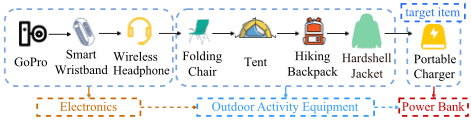
In recent years, some approaches have sought to incorporate both within-session and cross-session context information to improve session-based recommendations. Graph Neural Network (GNN)-based methods [Chen and Wong, 2020; Pan et al., 2020; Xia et al., 2021], such as GCE-GNN [Wang et al., 2020] and MTD [Huang et al., 2021], model the data of all historical sessions as a session graph, capturing item correlations within the same session and across different sessions. This dual modeling approach creates a complex correlation network between items, facilitating a more comprehensive understanding of user behavior patterns and improving the accuracy of recommendations through message passing on the session graph. Each node (representing an item) aggregates information from its neighboring nodes, enhancing the model's ability to capture complex dependencies. However, these methods often focus solely on item co-occurrence patterns and overlook other valuable information, such as item attributes like categories, resulting in biased recommendations that overemphasize frequently co-purchased items. For instance, as shown in Figure 1, a promotional campaign associates hiking backpacks with children's schoolbags, artificially elevating the latter in the ranking list. Yet this outcome deviates from the user's genuine interests. Based on categorylevel semantics, the user exhibits preferences for both outdoor and electronic items-implying a stronger interest in items like power banks, which bridge these two scenarios. Such recommendations align more closely with the user's underlying intent than those shaped by incidental promotional associations, highlighting the importance of leveraging attribute information to improve recommendation relevance.
To alleviate the bias introduced by relying solely on item co-occurrence patterns, some studies have explored incorporating item attribute information to provide additional semantic signals for user preference modeling. Existing methods [Chen et al., 2023; Song et al., 2021] typically assign a fixed embedding to each item attribute before training, which is shared across all sessions. These attribute embeddings are then directly combined with item ID embeddings to construct the overall item representation. However, it suffers from two major limitations: 1) Static encoding neglects how attribute semantics vary with session contexts: As shown in Figure 1, the functional and aesthetic attributes emphasized for a hardshell jacket differ significantly between casual wear and outdoor sports scenarios. These context-insensitive embeddings make it difficult to accurately capture user intent across sessions and track evolving interests within a session. 2) Semantic misalignment between attribute and ID embeddings: Attribute embeddings encode global, time-invariant semantics, while item ID embeddings emphasize sequential dependencies and local transition patterns. This semantic inconsistency may lead to conflicts when the two are naively fused, introducing noise that ultimately hinders the model's ability to identify fine-grained user preferences and degrades recommendation quality.
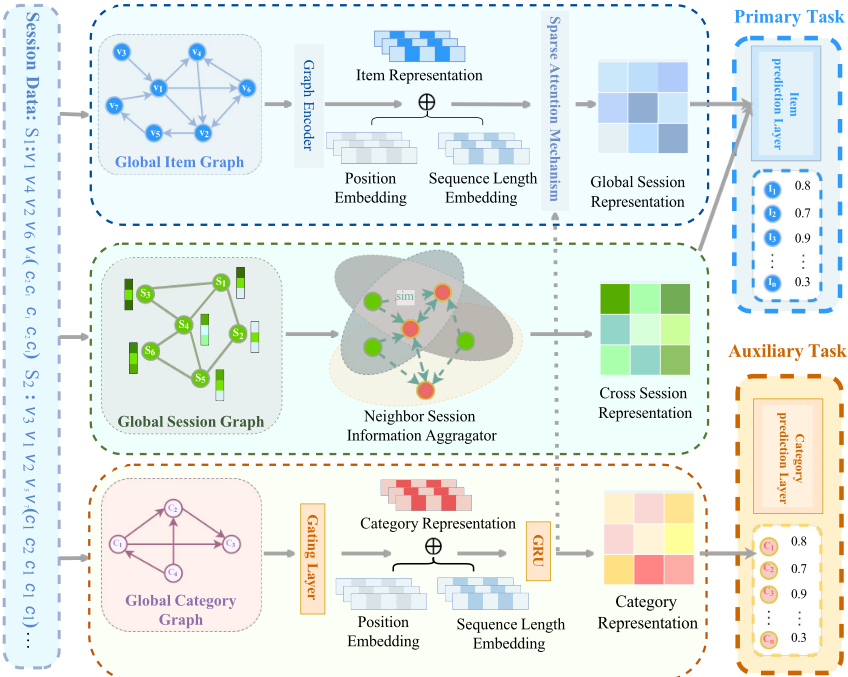
To address the aforementioned challenges, we propose Attribute Association Driven Multi-Task Learning for session-based recommendation, termed A2D-MTL. Specifically, we first construct a global category graph based on inter-session information to capture the structural correlations among item categories. On top of this, each item dynamically attends to multiple semantically related categories and adaptively fuses them with the current session context. This design overcomes the limitations of static attribute modeling and enhances the model's ability to generalize user interest transitions and expand recommendation coverage. Then, we introduce an adaptive sparse attention mechanism guided by dynamic category representations. By incorporating item position and contextual state within the session, the attention distribution is adjusted in a data-driven manner to explicitly focus on attribute signals that are most relevant to the user's current intent. This mechanism effectively suppresses irrelevant noise and facilitates accurate modeling of true user preferences. Experimental results on three public datasets demonstrate that our method significantly outperforms existing methods in recommendation accuracy (P@20) and ranking quality (MRR@20), with the rationality and effectiveness of the model design being verified.
2 Preliminaries
Notations. Let V = {v1, v2, . . . , vN} denote the set of all items, where N is the total number of items. A session is represented as S = {v1, v2, . . . , vT}, where T is the length of the session. Additionally, items are often associated with auxiliary information such as categories. Let C = {c1, c2, . . . , cM} represent the set of categories, where M is the total number of categories. Each item v ∈ V corresponds to a category c ∈ C. For a session S, the category sequence can be derived as Sc = {cv1 , cv2 , . . . , cvT }, where cvt ∈ C denotes the category of item vt.
Problem Definition. The goal of Session-based Recommendation (SBR) is to predict the next item a user will interact with based on their anonymous historical behavior in a session. Specifically, the task of SBR is to recommend the most likely next item vT+1 based on the current session S.
3 Method
We begin with a brief overview of the proposed method, followed by a detailed description of each component.
3.1 Overview
To address the limitations of static category encoding and the semantic misalignment between attributes and item sequences, we propose attribute association driven multi-task learning (A2D-MTL) for SBR, which jointly captures itemlevel interactions and category-level associations. Dynamic category embeddings guide an adaptive sparse attention mechanism for fine-grained intent modeling. The framework includes two key modules: category relation modeling via a global category graph, and item interaction modeling across and within sessions. A multi-task objective combining category prediction and item recommendation further enhances the semantic guidance and improves model adaptability and generalization.
3.2 Graph Construction
To effectively model the sequential dependencies and category-level relationships in session-based recommendation, we construct two global co-occurrence graphs: Item Graph and Category Graph. These directed graphs are built from the historical session sequences in the dataset. Similar to MSGAT [Qiao et al., 2023], normalized edge weights are used to ensure that the constructed graphs are not dominated by frequent transitions involving popular nodes, maintaining fairness in the graph construction.
Item Graph Construction. The item graph Gi captures the co-occurrence relationships between items across all sessions. For each session sequence S = {v1, v2, . . . , vT}, directed edges are created between consecutive items in the order they appear. The edge weight between items vi and vj, denoted as wij, represents the normalized co-occurrence frequency:
where count(vi → vj) denotes the number of times vi is followed by vj in the session sequences, and Nout(vi) is the set of items that vi points to in the graph. It is worth noting that the directed edge vi → vj indicates the order in which items appear, preserving the sequential nature of user interactions. Category Graph Construction. The category graph Gc models the relationships between item categories. For a given session S = {v1, v2, . . . , vT } and its corresponding category sequence Sc = {cv1 , cv2 , . . . , cvT }, directed edges are created between consecutive categories cvi and cvj . Formally, the edge weight wcij between categories ci and cj can be defined as:
where count(ci → cj) is the number of times ci is followed by cj in the category sequences, and Nout(ci) is the set of categories that ci points to in the graph.
3.3 Category-Level Representation Learning
After constructing the Category Graph, we aim to learn global representations of each category to capture the sequential and dependency relationships between categories. To achieve this, we employ a graph-based approach that first learns the global representations of each category through a Graph Attention Network (GAT) [Veliˇckovi´c et al., 2018].
Given a category sequence Sc = {c1, c2, . . . , cT }, the goal is to learn the representation of each category ct. To model the global dependencies between categories, we introduce neighborhood aggregation to update the representation hkct of each category ct at the k-th layer, which is formulated as:
where αct,cj is the attention score between categories ct and cj, representing the importance of category ct with respect to its neighboring category cj. The attention score αct,cj is computed as follows:
where ∥ denotes the concatenation operation, ect,cj is the edge weight between categories ct and cj , a and W1 are learnable parameters, and σ is the activation function.
Then, we apply a gating mechanism to adaptively fuse the initial and graph-based category representations as follows:
where ˜hct denotes the final fused embedding of category ct, h(0) ct is the initial category embedding, and hglobal ct is the global representation obtained via the graph attention network. The fusion weight βct ∈ [0, 1] is computed through a gating function as:
where ∥ denotes concatenation, W2 and b2 are learnable parameters, and σ(·) is the sigmoid activation function that ensures the fusion weight lies within [0, 1]. This gating mechanism adaptively balances semantic priors and structure-aware representations.
To enhance temporal modeling, the fused category representation is combined with positional and session-length embeddings and encoded by a GRU [Cho et al., 2014]:
where ˜hct is the fused category embedding at time step t, pt and lt denote the positional and length embeddings, respectively. In this way, the latent dependencies among categories can be effectively modeled by integrating global structureaware semantics with sequence-aware positional and contextual signals, thus improving both the expressiveness and predictive performance of the category sequence encoder.
3.4 ItemRelationModeling
Intra-Session Representation Learning. We apply a GAT the previously constructed item graph Gi to obtain global item representations Hglobal item = {hv1 , hv2 , ..., hvN }. To further encode the current session, we extract multiple types of session-level features, including the embedding of the last interacted item hvT , which reflects the user's most recent interest; the full item embedding sequence Hitem ∈ RT×D , where T denotes the session length and D is the embedding dimension; the average-pooled item embedding Havg item ; and the average-pooled category embedding Havg cate.
To unify feature dimensions, we apply separate linear transformations to each input as follows:
where Wi ∈ Rd×D and bi ∈ Rd (for i = 1, 2, 3, 4) are learnable parameters. Here, qvT , qitem, and qcate ∈ R1×d denote global session-level features, while Qseq ∈ RT×d encodes local item-level representations.
Global features are broadcast-added to local representations, followed by a sigmoid activation to obtain the enhanced session representation Sseq ∈ RT×d :
Then, we apply an Adaptive Sparse Attention Mechanism (ASAM) to model contextual dependencies. The enhanced session representation Sseq is first transformed via a multilayer perceptron (MLP):
where WMLP ∈ Rd′×d and bMLP ∈ Rd′ are the weight and bias parameters, and d′ denotes the output dimension.
The transformed representation Strans serves as the query, while the original sequence Sseq is used as both key and value in the attention computation:
where dk is the key dimensionality, and αatt ∈ RT×d′ denotes the context-aware representation weighted by similarity between queries and keys.
To further enhance model expressiveness, we refine the attention output using residual connections and layer normalization. The residual path preserves original information and mitigates gradient vanishing, while the normalization stabilizes the output distribution:
We apply the Entmax activation function [Yuan et al., 2021] to normalize the attention weights, promoting sparsity and encouraging the model to focus on the most relevant items in the session:α = Entmax(α, αent), (14)
where αent is a hyperparameter controlling the degree of sparsity. Finally, the session-level representation is computed as a weighted sum over context features:
where v is a matrix containing external features (e.g., item or category embeddings), and Sintra item ∈ Rd serves as the final session representation for downstream prediction.
Inter-Session Representation Learning. To enhance the model's generalization ability, we incorporate inter-session representation learning based on session-level interaction similarity. For a given session n, we first compute the average-pooled representation of all items within the session:
where Nn denotes the number of items in session n, and hv(n) i is the embedding of the i-th item in that session.
Then, we compute the cosine similarity between session n and all other sessions:
We select the top-R most similar sessions to form an auxiliary session set R(n). The inter-session representation is then obtained by aggregating the reference sessions with similarity-based weights:
where the attention weights γn,m are computed via a softmax function:
By leveraging contextual information from similar sessions, the model captures broader behavioral patterns, thereby enhancing the robustness of item prediction.
Final Item Representation Learning. After obtaining the intra-session representation Sintra item and the inter-session representation Sinter item , we compute the final item-level representation via weighted summation:
The resulting representation Sitem is then used for item prediction in the session-based recommendation task.
3.5 Prediction
For item prediction, we compute the dot product of the final item representation Sitem with the embeddings Hv i of the item i to obtain the predicted scores ˆ yi:
where ˆ yi represents the likelihood of item vi being the next item in the session. We use the cross-entropy loss function to measure the discrepancy between the predicted and true item labels, where yi denotes the one-hot encoding vector of the ground truth value:
where M is the total number of items in the session.
For category prediction, we follow a similar process. The predicted category score ˆ yc is computed by taking the dot product of the final session representation Sitem with all category embeddings Hci in the category set C:
We also use the cross-entropy loss for category prediction, where yc denotes the one-hot encoding vector of the true category:
where N is the number of categories.
The total loss function is then a combination of both item and category loss:
where λ is a hyperparameter that balances the two loss terms.
4 Experiment
In our study, we conduct an extensive set of experiments on three real-world datasets to investigate three key research questions:
- RQ1: Can our proposed A2D-MTL outperform the baselines for session-based recommendation?
- RQ2: What is the role of each component in driving the recommendation performance of A2D-MTL?
- RQ3: How is the performance of A2D-MTL affected by different parameter settings?
| Dataset | Diginetica | Tmall | Yoochoose1 64 |
|---|---|---|---|
| #Training Sessions | 719,470 | 351,268 | 369,859 |
| #Test Sessions | 60,858 | 25,898 | 55,898 |
| #Items | 43,097 | 40,728 | 16,766 |
| #Categories | 995 | 711 | 341 |
| Average Length | 5.12 | 6.69 | 6.16 |
4.1 Experimental Settings
Datasets. Following recent studies on session-based recommendation systems [Hou et al., 2022; Zhang et al., 2023b; Wang et al., 2024b], three widely-used public benchmark datasets are adopted in our work: Diginetica, Tmall, and
Yoochoose1 64.
- Diginetica 1 : A dataset of anonymous user transaction records from an e-commerce search engine's logs over five months, provided by the CIKM Cup 2016.
- Tmall 2 : A dataset of anonymized shopping logs from the Tmall platform, released for the IJCAI15 competition.
1 http://cikm2016.cs.iupui.edu/cikm-cup
2 https://tianchi.aliyun.com/dataset/42
| Datasets | Diginetica | Tmall | Yoochoose1 64 | |||
|---|---|---|---|---|---|---|
| Metrics | P@20 | MRR@20 | P@20 | MRR@20 | P@20 | MRR@20 |
| GRU4Rec | 29.49 | 8.22 | 10.93 | 5.89 | 60.64 | 22.89 |
| STAMP | 46.62 | 15.13 | 26.47 | 13.36 | 68.76 | 29.47 |
| SR-GNN | 50.73 | 17.59 | 27.57 | 13.72 | 70.54 | 30.97 |
| GCE-GNN | 54.22 | 19.04 | 33.42 | 15.42 | 70.91 | 30.62 |
| MTD | 51.82 | 17.26 | 29.12 | 13.73 | 71.88 | 31.32 |
| MSGIFSR | 56.08 | 19.13 | 36.54 | 16.09 | 72.44 | 32.03 |
| AttenMixer | 54.56 | 19.06 | 32.49 | 15.21 | 65.09 | 30.92 |
| MiaSRec | 54.85 | 18.93 | 40.12 | 16.45 | 72.93 | 32.02 |
| MGS | 54.85 | 19.23 | 40.27 | 16.62 | 73.94 | 31.33 |
| CLHHN | 55.67 | 19.58 | 41.20 | 16.39 | 72.57 | 30.90 |
| A2D-MTL | 61.94 | 23.25 | 41.38 | 17.43 | 76.06 | 33.94 |
- Yoochoose1 64 3 : A dataset of user click events on an e-commerce platform, created for the RecSys Challenge 2015, using the latest 1/64 portion of training sessions .
Following the approach in [Wu et al., 2019; Wang et al., 2020], we preprocess the three datasets. Specifically, the most recent week's historical sessions are used as the test set, while the remaining sessions are used as the training set. Additionally, items that did not appear in the training set are filtered out from the test set to avoid the influence of cold-start factors for new items. Finally, sessions with a length of 1 and items that appeared fewer than five times are removed. The details of the datasets after preprocessing are summarized in Table 1. Baselines. We categorize the baselines into two types: those that do not use side information (e.g., GRU4Rec [Hidasi et al., 2016], STAMP [Liu et al., 2018], SR-GNN [Wu et al., 2019], GCE-GNN [Wang et al., 2020], MTD [Huang et al., 2021], MSGIFSR [Guo et al., 2022], Atten-Mixer [Zhang et al., 2023a], and MiaSRec [Choi et al., 2024]), and those that use side information (e.g., MGS [Lai et al., 2022] and CLHHN [Ma et al., 2024]). MGS uses side information through a mirror graph, while CLHHN incorporates it via a heterogeneous hypergraph to improve item representations.
Metrics. We adopt two widely used evaluation metrics in information retrieval: Precision (P@20) and Mean Reciprocal Rank (MRR@20) for evaluating the performance.
Hyper-parameter Setup. Following [Wu et al., 2019; Wang et al., 2020], the dimension of the latent vectors is fixed to 256, and the batch size is set to 100. We use the Adam optimizer with the initial learning rate of 0.001, which decays by 0.8 after every 3 epochs. The l2 penalty is set to 10-5 .
4.2 Performance Comparison
To evaluate the effectiveness of A2D-MTL, we report the comparison results with the state-of-the-art baselines. From Table 2, we draw the following observations:
- A2D-MTL outperforms all RNN-based methods on all datasets. Unlike GRU4Rec, which uses GRU to model sequential data without focusing on key time points,
3 http://2015.recsyschallenge.com/challege
- A2D-MTL employs an attention mechanism to dynamically highlight important items at each time step. Overall, GNN-based models, including A2D-MTL, outperform traditional sequential models by capturing more complex item transitions. Additionally, models like GCE-GNN and MTD perform better than SR-GNN, suggesting that integrating item transitions from other sessions improves interest prediction.
- Methods leveraging attribute information as side information consistently outperform GNN-based and multilevel models, highlighting its effectiveness in handling sparse interactions in short sequences.
- Our model outperforms all baseline models across all metrics on three datasets, demonstrating its superiority. The performance improvement over methods like MGS, which directly integrates category information into item embeddings, or CLHHN, which links items and categories through hyperedges, further highlights that constructing a global graph with categories as independent nodes better preserves the independence and flexibility of category information, enhances global information modeling, and avoids excessive coupling between items and categories.
4.3 Ablation Study
To investigate the necessity of each component of A2D-MTL, we design four variants and conduct ablation experiments across three datasets. Specifically, we use the A2D-MTL variant without side information (category information) (A2DMTL w/o CATE) for modeling; the variant that directly integrates category into item embeddings (A2D-MTL w/o EXP); the variant without sparse attention (A2D-MTL w/o SPA), which only uses GAT as an encoder; and the variant without adaptive adjustment of sparse attention coefficients (A2DMTL w/o AdaSPA).
Table 3 presents the comparison results, from which we make the following observations: 1) Compared to A2D-MTL w/o CATE, A2D-MTL w/o EXP performs better, highlighting the importance of side information. However, A2D-MTL w/o EXP underperforms A2D-MTL, indicating that constructing a graph with categories as independent nodes yields more accurate recommendations than directly integrating category information into item embeddings. 2) When compared to the variant without the sparse attention mechanism (A2DMTL w/o SPA), the variant without adaptive adjustment of sparse attention coefficients (A2D-MTL w/o AdaSPA) performs better, demonstrating the effectiveness of the sparse attention mechanism. However, its MRR value is lower than that of A2D-MTL, suggesting that the adaptive sparse attention mechanism helps more accurately identify noise and rank target items higher. 3) A2D-MTL achieves the best performance, demonstrating that the integration of commodity category association guidance and the adaptive sparse attention mechanism enhances recommendation relevance.
| Datasets | Diginetica | Tmall | Yoochoose1 64 | |||
|---|---|---|---|---|---|---|
| Metrics | P@20 | MRR@20 | P@20 | MRR@20 | P@20 | MRR@20 |
| A2D-MTL w/o CATE | 52.92 | 16.65 | 35.25 | 13.34 | 70.18 | 30.24 |
| A2D-MTL w/o EXP | 54.56 | 21.13 | 36.54 | 16.29 | 73.03 | 32.44 |
| A2D-MTL w/o SPA | 56.85 | 19.22 | 39.57 | 15.19 | 73.94 | 31.02 |
| A2D-MTL w/o AdaSPA | 59.21 | 20.67 | 40.09 | 15.78 | 74.98 | 31.90 |
| A2D-MTL | 61.94 | 23.25 | 41.38 | 17.43 | 76.06 | 33.94 |
4.4 Parameter Sensitivity
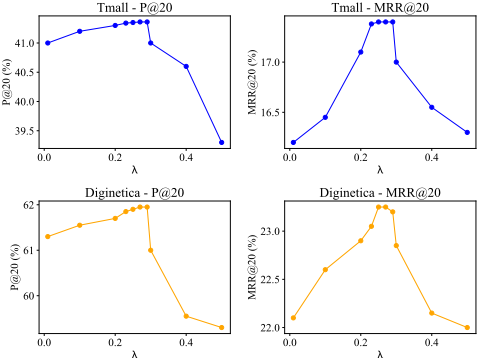
The regularization parameter λ in Eq.(25) balances the item prediction loss and category prediction loss in A2D-MTL. We evaluate the performance of A2D-MTL under different λ values {0.01, 0.1, 0.2, 0.23, 0.25, 0.27, 0.29, 0.3, 0.4, 0.5}. As shown in Figure 3, A2D-MTL achieve good results on both datasets. Specifically, increasing the value of λ within the range of 0.01 to 0.25 gradually improved performance metrics. When λ is between 0.25 and 0.29, performance metrics stabilize. However, when λ exceeds 0.3, the performance metrics decline significantly. These observations indicate that selecting an appropriate value of λ can enhance recommendation performance.
5 RelatedWork
Early RNN-based session-based recommendation (SBR) methods, such as GRU4Rec [Hidasi et al., 2016], predict user interest by modeling the temporal dependencies in the item sequence. Later, NARM [Li et al., 2017] introduces the attention mechanism to enhance the modeling of item importance, but it still lacked sufficient exploration of category information. As research progressed, attention mechanisms derived from Transformer models were widely applied to SBR. For example, CoSAN [Luo et al., 2020] generates richer item representations by combining neighborhood information with attention mechanisms. Graph Neural Networks (GNNs) have also been extensively used in SBR. SR-GNN [Wu et al., 2019] is the first to apply Gated Graph Neural Networks (GGNN) [Li et al., 2016] to SBR, learning transfer relationships between items by propagating information on the session graph. GCE-GNN [Wang et al., 2020] enhances understanding of complex session structures by learning session representations across multiple graph layers. MGIR [Han et al., 2022] strengthens session representations by learning global item relationships.
Recent studies highlight the importance of item category information in improving recommendation performance, as it is both effective and easy to obtain in practice. Integrating such information into SBR models has become an effective approach to enhancing recommendation performance. For example, CLHHN [Ma et al., 2023] introduces category hyperedges and constructs hypergraphs to capture high-order interactions among categories, thereby revealing more complex item similarities. Additionally, HearInt [Wang et al., 2024a] integrates category information into its intent recognition module to achieve finer-grained semantic partitioning when parsing dynamic user interests, thus accurately capturing users' ever-changing demands.
6 Conclusion
This paper proposes A2D-MTL, a novel session-based recommendation method that leverages item and category graphs to capture sequential and categorical relationships. By utilizing a Graph Attention Network (GAT) for global item and category representation learning, and employing a multi-head sparse attention mechanism to capture session context, A2DMTL significantly improves performance, surpassing existing baselines. Our approach enhances global information modeling while preserving the independence of category information, demonstrating its effectiveness in addressing sparse interaction issues and improving recommendation accuracy.
Acknowledgments
This work is supported by the National Natural Science Foundation of China (No. 62402337, No. 92370111, No. 62422210, No. 62272340, and No. 62276187), the Postdoctoral Fellowship Program of CPSF under Grant No. GZC20241207, the China Postdoctoral Science Foundation under Grant No. 2024M752367, and the Hebei Natural Science Foundation under Grant No. F2024202047.
@inproceedings{ijcai2025p380,
  title     = {Attribute Association Driven Multi-Task Learning for Session-based Recommendation},
  author    = {Wang, Xinyao and Yu, Zhizhi and He, Dongxiao and Yang, Liang and Wei, Jianguo and Jin, Di},
  booktitle = {Proceedings of the Thirty-Fourth International Joint Conference on
               Artificial Intelligence, {IJCAI-25}},
  publisher = {International Joint Conferences on Artificial Intelligence Organization},
  editor    = {James Kwok},
  pages     = {3417--3425},
  year      = {2025},
  month     = {8},
  note      = {Main Track},
  doi       = {10.24963/ijcai.2025/380},
  url       = {https://doi.org/10.24963/ijcai.2025/380},
}
TY - CPAPER TI - Attribute Association Driven Multi-Task Learning for Session-based Recommendation AU - Wang, Xinyao AU - Yu, Zhizhi AU - He, Dongxiao AU - Yang, Liang AU - Wei, Jianguo AU - Jin, Di T2 - Proceedings of the Thirty-Fourth International Joint Conference on Artificial Intelligence, IJCAI-25 PB - International Joint Conferences on Artificial Intelligence Organization PY - 2025 SP - 3417 EP - 3425 DO - 10.24963/ijcai.2025/380 UR - https://doi.org/10.24963/ijcai.2025/380 ER -Copied
Machine-readable versions of this paper, for tools and AI agents:





