
Adaptive Gradient Learning for Spiking Neural Networks by Exploiting Membrane Potential Dynamics
Proceedings of the Thirty-Fourth International Joint Conference on Artificial Intelligence. Main Track. Pages 4164-4172.
https://doi.org/10.24963/ijcai.2025/464
Keywords
- Humans and AI: HAI: Cognitive modeling
- Humans and AI: HAI: Cognitive systems
Abstract
Recent advancements have focused on directly training high-performance spiking neural networks (SNNs) by estimating the approximate gradients of spiking activity through a continuous function with constant sharpness, known as surrogate gradient (SG) learning. However, as spikes propagate within neurons and among layers, the distribution of membrane potential dynamics (MPD) will deviate from the gradient-available interval of fixed SG, hindering SNNs from searching the optimal solution space. To maintain the stability of gradient flows, SG needs to align with evolving MPD. Here, we propose a novel adaptive gradient learning for SNNs by exploiting MPD, namely MPD-AGL. It fully accounts for the underlying factors contributing to membrane potential shifts and establishes a dynamic association between SG and MPD at different timesteps to relax gradient estimation, which provides a new degree of freedom for SG learning. Experimental results demonstrate that our method achieves excellent performance at low latency. Moreover, it increases the proportion of neurons that fall into the gradient-available interval compared to fixed SG, effectively mitigating the gradient vanishing problem. Code is available at https://github.com/jqjiang1999/MPD-AGL.
- [Bellec et al., 2018] Guillaume Bellec, Darjan Salaj, Anand Subramoney, Robert Legenstein, and Wolfgang Maass. Long short-term memory and learning-to-learn in net- works of spiking neurons. Advances in neural information processing systems, 31, 2018.
- [Che et al., 2022] Kaiwei Che, Luziwei Leng, Kaixuan Zhang, Jianguo Zhang, Qinghu Meng, Jie Cheng, Qing- hai Guo, and Jianxing Liao. Differentiable hierarchi- cal and surrogate gradient search for spiking neural net- works. Advances in Neural Information Processing Sys- tems, 35:24975-24990, 2022.
- [Dampfhoffer et al., 2024] Manon Dampfhoffer, Thomas Mesquida, Alexandre Valentian, and Lorena Anghel. Backpropagation-based learning techniques for deep spik- ing neural networks: A survey. IEEE Transactions on Neu- ral Networks and Learning Systems, 35(9):11906-11921, 2024.
- [Deng et al., 2022] Shikuang Deng, Yuhang Li, Shanghang Zhang, and Shi Gu. Temporal efficient training of spiking neural network via gradient re-weighting. In International Conference on Learning Representations, 2022.
- [Fang et al., 2021a] Wei Fang, Zhaofei Yu, Yanqi Chen, Tiejun Huang, Timothée Masquelier, and Yonghong Tian. Deep residual learning in spiking neural net- works. Advances in Neural Information Processing Sys- tems, 34:21056-21069, 2021.
- [Fang et al., 2021b] Wei Fang, Zhaofei Yu, Yanqi Chen, Timothée Masquelier, Tiejun Huang, and Yonghong Tian. Incorporating learnable membrane time constant to en- hance learning of spiking neural networks. In Proceedings of the IEEE/CVF international conference on computer vi- sion, pages 2661-2671, 2021.
- [Guo et al., 2022a] Yufei Guo, Yuanpei Chen, Liwen Zhang, Xiaode Liu, Yinglei Wang, Xuhui Huang, and Zhe Ma. IM-Loss: Information maximization loss for spiking neu- ral networks. Advances in Neural Information Processing Systems, 35:156-166, 2022.
- [Guo et al., 2022b] Yufei Guo, Yuanpei Chen, Liwen Zhang, YingLei Wang, Xiaode Liu, Xinyi Tong, Yuanyuan Ou, Xuhui Huang, and Zhe Ma. Reducing information loss for spiking neural networks. In European Conference on Computer Vision, pages 36-52. Springer, 2022.
- [Guo et al., 2022c] Yufei Guo, Xinyi Tong, Yuanpei Chen, Liwen Zhang, Xiaode Liu, Zhe Ma, and Xuhui Huang. RecDis-SNN: Rectifying membrane potential distribution for directly training spiking neural networks. In Proceed- ings of the IEEE/CVF Conference on Computer Vision and Pattern Recognition, pages 326-335, 2022.
- [Guo et al., 2024] Yufei Guo, Yuanpei Chen, Zecheng Hao, Weihang Peng, Zhou Jie, Yuhan Zhang, Xiaode Liu, and Zhe Ma. Take A Shortcut Back: Mitigating the gradient vanishing for training spiking neural networks. Advances in Neural Information Processing Systems, 37:24849- 24867, 2024.
- [Hu et al., 2025] Yifan Hu, Lei Deng, Yujie Wu, Man Yao, and Guoqi Li. Advancing spiking neural networks toward deep residual learning. IEEE Transactions on Neural Net- works and Learning Systems, 36(2):2353-2367, 2025.
- [Huh and Sejnowski, 2018] Dongsung Huh and Terrence J Sejnowski. Gradient descent for spiking neural networks. Advances in neural information processing systems, 31, 2018.
- [Jiang et al., 2024] Haiyan Jiang, Vincent Zoonekynd, Giu- lia De Masi, Bin Gu, and Huan Xiong. TAB: Temporal ac- cumulated batch normalization in spiking neural networks. In The Twelfth International Conference on Learning Rep- resentations, 2024.
- [Jiang et al., 2025] Jiaqiang Jiang, Haohui Ding, Haixia Wang, and Rui Yan. Deep spiking neural networks driven by adaptive interval membrane potential for tem- poral credit assignment problem. IEEE Transactions on Emerging Topics in Computational Intelligence, 9(1):717- 728, 2025.
- [Lee et al., 2025] Donghyun Lee, Yuhang Li, Youngeun Kim, Shiting Xiao, and Priyadarshini Panda. Spiking transformer with spatial-temporal attention. In Proceed- ings of the IEEE/CVF Conference on Computer Vision and Pattern Recognition, 2025.
- [Lian et al., 2023] Shuang Lian, Jiangrong Shen, Qianhui Liu, Ziming Wang, Rui Yan, and Huajin Tang. Learn- able surrogate gradient for direct training spiking neural networks. In Proceedings of the Thirty-Second Interna- tional Joint Conference on Artificial Intelligence, IJCAI- 23, pages 3002-3010, 2023. IJCAI
- [Lian et al., 2024] Shuang Lian, Jiangrong Shen, Ziming Wang, and Huajin Tang. IM-LIF: Improved neuronal dy- namics with attention mechanism for direct training deep spiking neural network. IEEE Transactions on Emerging Topics in Computational Intelligence, 8(2):2075-2085, 2024.
- [Liang et al., 2024] Limei Liang, Runhao Jiang, Huajin Tang, and Rui Yan. An event-based feature representation method for event stream classification using deep spiking neural networks. In 2024 International Joint Conference on Neural Networks (IJCNN), pages 1-8. IEEE, 2024.
- [Liu et al., 2025] Wei Liu, Li Yang, Mingxuan Zhao, Shuxun Wang, Jin Gao, Wenjuan Li, Bing Li, and Weiming Hu. DeepTAGE: Deep temporal-aligned gradient enhancement for optimizing spiking neural networks. In The Thir- teenth International Conference on Learning Representa- tions, 2025.
- [Ma et al., 2024] De Ma, Xiaofei Jin, Shichun Sun, Yitao Li, Xundong Wu, Youneng Hu, Fangchao Yang, Huajin Tang, Xiaolei Zhu, Peng Lin, et al. Darwin3: a large-scale neu- romorphic chip with a novel isa and on-chip learning. Na- tional Science Review, 11(5):nwae102, 2024.
- [Ozdenizci and Legenstein, 2024] Ozan Ozdenizci and Robert Legenstein. Adversarially robust spiking neural networks through conversion. Transactions on Machine Learning Research, pages 2835-8856, 2024.
- [Pei et al., 2019] Jing Pei, Lei Deng, Sen Song, Mingguo Zhao, Youhui Zhang, Shuang Wu, Guanrui Wang, Zhe Zou, Zhenzhi Wu, Wei He, et al. Towards artificial general intelligence with hybrid tianjic chip architecture. Nature, 572(7767):106-111, 2019.
- [Qin et al., 2023] Lang Qin, Rui Yan, and Huajin Tang. A low latency adaptive coding spike framework for deep re- inforcement learning. In Proceedings of the Thirty-Second International Joint Conference on Artificial Intelligence, pages 3049-3057, 2023. IJCAI
- [Qin et al., 2025] Lang Qin, Ziming Wang, Runhao Jiang, Rui Yan, and Huajin Tang. GRSN: Gated recurrent spik- ing neurons for pomdps and marl. Proceedings of the AAAI Conference on Artificial Intelligence, 39(2):1483- 1491, 2025.
- [Rathi and Roy, 2023] Nitin Rathi and Kaushik Roy. DIET- SNN: A low-latency spiking neural network with direct input encoding and leakage and threshold optimization. IEEE Transactions on Neural Networks and Learning Sys- tems, 34(6):3174-3182, 2023.
- [Suetake et al., 2023] Kazuma Suetake, Shin-ichi Ikegawa, Ryuji Saiin, and Yoshihide Sawada. S3NN: Time step re- duction of spiking surrogate gradients for training energy efficient single-step spiking neural networks. Neural Net- works, 159:208-219, 2023.
- [Wang et al., 2023] Ziming Wang, Runhao Jiang, Shuang Lian, Rui Yan, and Huajin Tang. Adaptive smoothing gradient learning for spiking neural networks. In Inter- national Conference on Machine Learning, pages 35798- 35816. PMLR, 2023.
- [Wang et al., 2025a] Siqi Wang, Tee Hiang Cheng, and Meng-Hiot Lim. Potential distribution adjustment and parametric surrogate gradient in spiking neural networks. Neurocomputing, 620:129189, 2025.
- [Wang et al., 2025b] Ziling Wang, Ziming Wang, Shuang Lian, Rui Yan, and Huajin Tang. Adaptive gradient-based timesurface for event-based detection. In ICASSP 2025- 2025 IEEE International Conference on Acoustics, Speech and Signal Processing (ICASSP), pages 1-5. IEEE, 2025.
- [Wang et al., 2025c] Ziming Wang, Ziling Wang, Huaning Li, Lang Qin, Runhao Jiang, De Ma, and Huajin Tang. EAS-SNN: End-to-end adaptive sampling and representa- tion for event-based detection with recurrent spiking neu- ral networks. In European Conference on Computer Vi- sion, pages 310-328. Springer, 2025.
- [Wu et al., 2018] Yujie Wu, Lei Deng, Guoqi Li, Jun Zhu, and Luping Shi. Spatio-temporal backpropagation for training high-performance spiking neural networks. Fron- tiers in neuroscience, 12:331, 2018.
- [Wu et al., 2019] Yujie Wu, Lei Deng, Guoqi Li, Jun Zhu, Yuan Xie, and Luping Shi. Direct training for spiking neural networks: Faster, larger, better. Proceedings of the AAAI conference on artificial intelligence, 33(01):1311- 1318, 2019.
- [Yang et al., 2022] Qu Yang, Jibin Wu, Malu Zhang, Yan- song Chua, Xinchao Wang, and Haizhou Li. Training spik- ing neural networks with local tandem learning. Advances in Neural Information Processing Systems, 35:12662- 12676, 2022.
- [Yang et al., 2024] Panpan Yang, Ziming Wang, Huajin Tang, and Rui Yan. Multi-scale harmonic mean time sur- faces for event-based object classification. In 2024 Inter- national Joint Conference on Neural Networks (IJCNN), pages 1-8. IEEE, 2024.
- [Yao et al., 2022] Xingting Yao, Fanrong Li, Zitao Mo, and Jian Cheng. GLIF: A unified gated leaky integrate-and-fire neuron for spiking neural networks. Advances in Neural Information Processing Systems, 35:32160-32171, 2022.
- [Yao et al., 2023] Man Yao, Guangshe Zhao, Hengyu Zhang, Yifan Hu, Lei Deng, Yonghong Tian, Bo Xu, and Guoqi Li. Attention spiking neural networks. IEEE transactions on pattern analysis and machine intelligence, 45(8):9393- 9410, 2023.
- [Zenke and Vogels, 2021] Friedemann Zenke and Tim P Vo- gels. The remarkable robustness of surrogate gradient learning for instilling complex function in spiking neural networks. Neural computation, 33(4):899-925, 2021.
- [Zhang and Li, 2020] Wenrui Zhang and Peng Li. Tempo- ral spike sequence learning via backpropagation for deep spiking neural networks. Advances in neural information processing systems, 33:12022-12033, 2020.
- [Zheng et al., 2021] Hanle Zheng, Yujie Wu, Lei Deng, Yi- fan Hu, and Guoqi Li. Going deeper with directly-trained larger spiking neural networks. Proceedings of the AAAI conference on artificial intelligence, 35(12):11062-11070, 2021.
- [Zhou et al., 2023] Zhaokun Zhou, Yuesheng Zhu, Chao He, Yaowei Wang, Shuicheng Yan, Yonghong Tian, and Li Yuan. Spikformer: When spiking neural network meets transformer. In The Eleventh International Conference on Learning Representations, 2023.
- [Zhu et al., 2025] Rui-Jie Zhu, Malu Zhang, Qihang Zhao, Haoyu Deng, Yule Duan, and Liang-Jian Deng. TCJA- SNN: Temporal-channel joint attention for spiking neural networks. IEEE Transactions on Neural Networks and Learning Systems, 36(3):5112-5125, 2025.
References were extracted automatically from the PDF and may contain errors.
Full text extracted automatically from the PDF; figures, tables and equations may differ. The PDF is the version of record.
1 Introduction
As a new paradigm with biological plausibility and computational efficiency, spiking neural networks (SNNs) achieve unique sparse coding and asynchronous information processing by modeling the spike firing and temporal dynamics of biological neurons. Instead of artificial neural networks (ANNs) that work with continuous activation and multiply-and-accumulate (MAC) operations, SNNs operate with threshold firing and accumulate (AC) operations, which allow low-latency inference and low-power computation on neuromorphic hardware [Pei et al., 2019; Ma et al., 2024]. Nowadays, with the development of SNNs, it has exhibited high potential in many applications, such as event-based image classification [Yang et al., 2024; Liang et al., 2024], object detection [Wang et al., 2025c; Wang et al., 2025b], reinforcement learning [Qin et al., 2023; Qin et al., 2025], etc. Backpropagation-based learning is a favorable methodology for training high-performance SNNs [Huh and Sejnowski, 2018; Dampfhoffer et al., 2024]. Nevertheless, the discontinuous nature of spiking neurons hinders the direct application of gradient descent in SNNs. To tackle the non-differentiability of spike activity, surrogate gradient (SG) methods employ a smooth curve to distribute the gradient of output signals into a group of analog items in temporal neighbors [Zhang and Li, 2020]. Unfortunately, as spikes propagate in the spatio-temporal domain (STD), the distribution of membrane potential will shift and may not align with the gradient-available interval of fixed SG, leading to gradient vanishing or mismatch problems [Guo et al., 2022c].
∗Corresponding author
In Fig. 1, the main reason for gradient vanishing or mismatch problems is that the overlap area between the evolving membrane potential dynamics (MPD) and the gradientavailable interval of fixed SG becomes too narrow or too wide. On the one hand, the limited overlap area causes many membrane potentials to fall into the area with zero approximate derivatives, leading to gradient propagation blockage. On the other hand, when the overlap area saturates, neurons contribute many inaccurate approximate gradients, enlarging the error with true gradients. To match SG and MPD, two groups of methods have been developed: (1) membrane potential regulation and (2) SG optimization. Membrane potential regulation methods redistribute the membrane potential before firing [Guo et al., 2022b] or define a distribution loss to rectify it [Guo et al., 2022c; Wang et al., 2025a], aiming to balance the distribution to minimize the undesired shifts, but this increases the inference burden or requires more parameters and computations. By contrast, SG optimization methods update the SG by capturing the direction of accurate gradients that can automatically calibrate the SG sharpness in response to MPD for better gradient estimation [Guo et al., 2022a; Wang et al., 2023; Wang et al., 2025a]. However, most of these methods either focus only on regulating membrane potentials or only on optimizing SG, ignoring their correlation, which cannot effectively control their alignment across the entire timestep. Moreover, the lack of comprehensive analysis regarding the causes of membrane potential shifts leaves room for improvement in these methods.
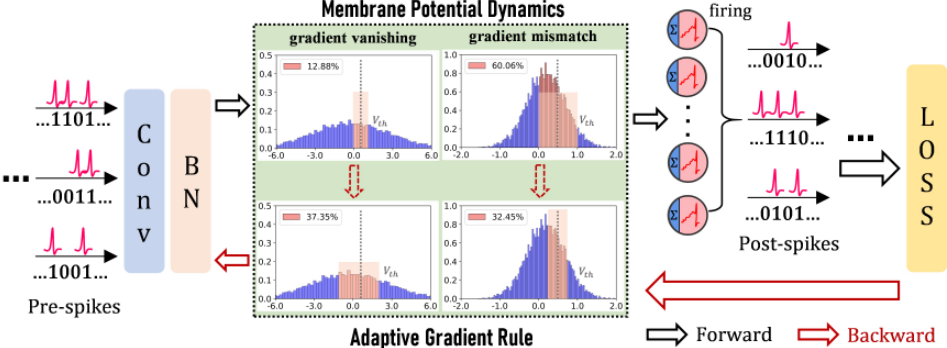
The reason for the membrane potential shifts and how to optimize SG to align with the evolving MPD in SNN learning are our main concerns. In this work, we propose an adaptive gradient learning algorithm for SNNs by exploiting MPD. Specifically, we realized that the affine transformation in normalization layers would force the pre-synaptic input to deviate from the desired distribution, affecting the distribution of MPD, which is the main cause of membrane potential shifts. Considering the influence of affine transformation, we derive the specific distribution of MPD at different timesteps during forward propagation and accordingly design a correlation function between SG and MPD to dynamically optimize SG, capturing the evolving MPD. The overall framework of our method is illustrated in Fig. 1. In summary, the main contributions of this work can be summarized as follows:
- We provide a new perspective for understanding the membrane potential shifts in SNN forward propagation by analyzing the effect of learnable affine transformation in the normalization layers on the distribution of MPD.
- We propose an adaptive gradient rule that synchronously adjusts the gradient-available interval of SG in response to the distribution of membrane potentials at different timesteps, aligning with the evolving MPD.
- Extensive experiments on four datasets CIFAR10, CIFAR100, CIFAR10-DVS, and Tiny-ImageNet show that our method overwhelmingly outperforms existing advanced SG optimization methods. Moreover, MPDAGL consumes only 5.2% energy of ANN for a single inference at ultra-low latency T = 2.
2 RelatedWork
2.1 Direct Training of SNNs
With the introduction of spatio-temporal backpropagation and approximate derivatives of spike activity [Wu et al., 2018; Wu et al., 2019], direct training of SNNs has ushered in a new opportunity. [Fang et al., 2021a; Hu et al., 2025] modified the basic spiking ResNet to achieve identity mapping, effectively mitigating the degradation problem of directly training SNNs and achieving very deep SNNs. [Yao et al., 2023; Lee et al., 2025] incorporated the attention mechanism to estimate the saliency of different domains, helping SNNs focus on important features. [Fang et al., 2021b; Yao et al., 2022] developed neuronal variants to learn membrane parameters, expanding the expressiveness of SNNs. [Deng et al., 2022; Guo et al., 2022a] designed loss functions to regulate the distribution of spikes and membrane potentials along the temporal dimension to more accurately align the learning gradients.
2.2 Gradient Alignment
An essential component of SG learning is the suitable gradient flow [Zenke and Vogels, 2021]. To alleviate the problem of fixed SG not aligned with evolving MPD, [Guo et al., 2022b] designed a membrane potential rectifier to redistribute potentials closer to the spikes. [Guo et al., 2022c] introduced three regularization losses to penalize three undesired shifts of MPD. [Wang et al., 2025a] quantified the inconsistency between actual distributions and targets, which was integrated into the overall network loss for joint optimization. Optimizing SG is another appealing approach. [Guo et al., 2022a] approximated the gradient of spike activity by a differentiable asymptotic function evolving continuously, bridging the gap between pseudo and natural derivatives. [Che et al., 2022] proposed a differentiable gradient search for parallel optimization of local SG. [Lian et al., 2023] proposed a learnable SG to unlock the width limitation of SG. [Wang et al., 2023] learned the accurate gradients of loss landscapes adaptively by fusing the learnable relaxation degree into a prototype network with random spike noise. [Wang et al., 2025a] proposed a parametric SG strategy that can be iteratively updated. Considering the lack of synergy between these methods in matching SG and MPD, this motivates us to explore their correlations to maximize matching optimization.
3 Preliminary
3.1 Spiking Neural Model
Based on the essential electrophysiological properties of biological neurons, the leaky integrate-and-fire (LIF) model simulates the electrical activity of neurons in a simplified mathematical form, widely used in SNNs as the basis unit. For computational tractability, [Wu et al., 2019] used the Euler formula to translate LIF into an iterative expression, the membrane potential evolves according to
where the superscript n, subscripts i and t denote the n-th layer, the i-th neuron and the t-th timestep, respectively. l(n1) denotes the number of neurons in the (n - 1)-th layer. wn ij denotes the synapse weight from the j-th neuron in the (n-1)-th layer to the i-th neuron in the n-th layer. I, V , and S denote the pre-synaptic input, the membrane potential, and the binary spiking output of neurons, respectively. τ is the decay factor. Vth is the firing threshold.
3.2 Surrogate Gradient of SNNs
In Eq. 3, the activation function Θ(·) of SNNs is a Heaviside step function. The derivative of output signals ∂S ∂V tends to infinity at the firing threshold Vth and zeros otherwise, i.e. Dirac function. SG learning allows gradient information to be backpropagated layer-wise along STD, which lays the foundation for developing general SNNs. In this work, we employ the rectangular SG [Wu et al., 2018], which is defined as
where hyperparameter κ controls the width of h(·) to ensure it integrates to 1, normally set to 1 [Wu et al., 2018; Wu et al., 2019]. The gradient 1κ is available when the membrane potential V n i (t) falls within the interval [Vth - κ2 , Vth + κ2 ].
3.3 Threshold-dependent Batch Normalization
There are some drawbacks to directly applying BN techniques in SNNs due to the inherent temporal dynamics of spiking neurons [Wu et al., 2019]. To retain the advantages of BN in the channel dimension and capture the temporal dimension of SNN, [Zheng et al., 2021] proposed thresholddependent BN (tdBN), which normalized the pre-synaptic input I to the distribution of N(0, (αVth)2 ) instead of N(0, 1). Let I t c represent the c-th channel feature maps of I(t), then Ic = (I 1 c , I 2 c , ..., I T c ) will be normalized as
where E[Ic] and VAR[Ic] denote the expectation and variance of Ic, which are computed over the Mini-Batch. ϵ is a tiny constant. The hyperparameter α is to prevent overfire or underfire, normally set to 1 [Zheng et al., 2021]. The pair of learnable parameters γc and βc are initial to 1 and 0, for scaling and shifting the normalized ˆ Ic.
4 Method
In this section, we introduce the MPD-AGL algorithm in detail and the overall training procedure.
4.1 Rethinking Pre-synaptic Input Distribution
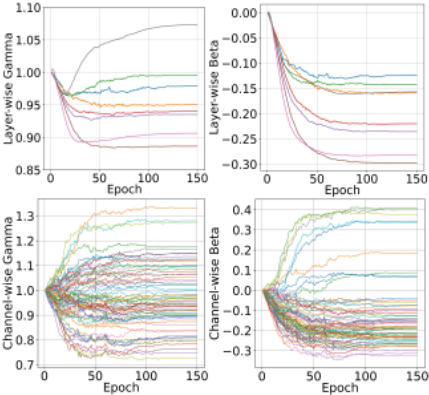
To maintain the representation capacity of the layer, BN layers will normally perform a learnable affine transformation of the normalized pre-activations (Eq. 6). As shown in Fig. 2, the learnable parameters γc and βc will evolve, and their discrepancy grows more pronounced during training. Thus, the pre-synaptic input normalized by tdBN [Zheng et al., 2021] may not satisfy I ≁ N(0, (Vth)2 ), which has not been considered in many previous studies. When SG uses the fixed gradient-available interval, unpredictable shifts in the membrane potential will naturally deviate from the optimal areas for gradient matching, resulting in performance limitations. As the membrane potential is directly computed from the presynaptic input, clarifying the distribution of pre-synaptic input helps to analyze the membrane potential shifts. For this respect, we propose Theorem 1 to rethink the specific distribution of pre-synaptic input.
Theorem 1. With the iterative LIF model and tdBN method, assuming normalized pre-synaptic input I ∼ N(0, (Vth)2 ), we have ¯ I ∼ N(¯ β, (¯ γVth)2 ) after affine transformation, where ¯ β = 1C ∑Cc=1 βc and ¯ γ = 1C ∑Cc=1 γc, C is the channel size of tdBN layer.
Proof. The proof of Theorem 1 is presented in Supplementary A of the Extended version 1 .
Theorem 1 proves that the distribution of pre-synaptic input normalized by tdBN is not only governed by threshold Vth, but also by the parameters γc and βc of affine transformations. As the foundation of our work, it provides a new insight into the distribution of pre-synaptic input.
4.2 Adaptive Gradient Rule
To optimize SNN learning, we need to synchronously modify the gradient-available interval of SG to better align with the evolving MPD. Thus, it is essential to analyze the detailed dynamics of membrane potentials. [Zheng et al., 2021] derived a high degree of similarity between the distribution of pre-synaptic input and membrane potential in neurons. [Lian et al., 2023] extended this reasoning that for a given presynaptic input I ∼ N(0, (Vth)2 ), then the distribution of membrane potential is only determined by decay factor τ and satisfies V ∼ N(0, (1 + τ 2 )(Vth)2 ). Based on the analysis in Section 4.1, it is known that the pre-synaptic input will deviate from the desired distribution after tdBN normalization. To this end, we further propose Theorem 2 to express the relation between the pre-synaptic input, the decay factor, and the membrane potential at different timesteps.
Theorem 2. Consider an SNN with T timesteps, the presynaptic input of neurons injected into the tdBN layer with affine transformation is normalized to satisfy ¯ I ∼ N( ¯ β, (¯ γVth)2 ), we have the membrane potential ¯ V ∼ N( ¯ β, (¯ γVth)2 ) when t = 1, and ¯ V ∼ N((1 + τ)¯ β, (1 + τ 2 )(¯ γVth)2 ) when t > 1, where t ∈ T .
Proof. The proof of Theorem 2 is also presented in Supplementary A of the Extended version 1 .
Theorem 2 describes the dynamic distribution of membrane potential at different timesteps. [Lian et al., 2023] observed a correlation between SG width κ and neuron decay factor τ and manually designed a proportional function (e.g. κ = f(τ)) to describe it. As the decay factor also affects the membrane potential (Eq. 2), the proportional function can link SG width to MPD. From that view, we can avoid gradient information loss or redundancy by dynamically adjusting the SG width to control the alignment between the gradientavailable interval and the evolving MPD. Then, we will concentrate on how to design the correlation function.
For a well-formed f(·), the key is to control the proportion of MPD in SG within a reasonable level. The variance reflects the dispersion of a distribution. An increase in variance indicates a more dispersed MPD, so the width needs to be enlarged to increase the proportion of neurons in SG to avoid gradient information loss. Conversely, a decrease in variance requires narrowing the width to reduce the proportion. Thus, a positive correlation arises between SG width and MPD. Here, we empirically set κ as 2 times the square root of VAR when Vth = 0.5 in our work, which ensures the initial width satisfies the standard rectangular SG setting (i.e. k ≈ 1). Moreover, as PLIF neurons [Fang et al., 2021b] can hierarchically learn the decay factor in SNNs, we also employ them to cooperate with the learnable affine transformation to control the evolving MPD together. It does not destroy the correlation function for scaling the SG width in response to MPD, but also enhances the expressiveness of SNNs. Finally, the correlation function f(·) can be formulated as
1 Extended version: https://arxiv.org/abs/2505.11863
where learnable ρn is a layer-wise factor to ensure τ n ∈ (0, 1). τ n is initialized to 0.2 for all layers, which is adjusted when ρn is updated based on gradients (Eq. 11). In this way, SG can accurately capture the membrane potential shift and promptly update the gradient-available interval, effectively optimizing the loss landscape of SNNs.
4.3 The Overall Training Procedure
Employing the iterative LIF neurons in SNN has temporal dynamics in the spatial domain, which can well apply the spatio-temporal backpropagation algorithm (STBP) [Wu et al., 2018] to update synapse weights. In the readout layer, we also only accumulate the membrane potential of output neurons without leakage and firing, as did in recent works [Rathi and Roy, 2023; Deng et al., 2022], which can be described by
where N and T denote the number of layers and timesteps, respectively. Then, the gradient of synaptic weights wn ij and learnable ρn can be derived by the chain rule:
As V n i (t) not only contributes to the Sn i (t) but also governs the V n i (t +1), it can be derived by
Moreover, the pseudocode of the overall training procedure is briefed in Algorithm 1.
Algorithm 1 The overall training procedure of SNNs with MPD-AGL algorithm in one iteration
Input: Timestep: T; Threshold: Vth; Initial layer-wise decay: τ n ; input: S(t), t ∈ T; true-label vector: Y .
Output: updated the weight wn ij and learnable ρn of SNNs.
Forward: 1: for n = 1 to N do 2: if n < N then 3: Compute I n = wnSn-1 // (1) 4: ¯ I n ← tdBN(I n ) // (4) and (5) 5: for t = 1 to T do 6: Compute ¯ V n (t), Sn (t) // (2) and (3) 7: Compute the width of SG κ // (7) and (8) 8: end for 9: else 10: oN = 1 T ∑Tt=1 (wN SN-1 (t)) // (9) 11: end if 12: end for 13: L←CrossEntropy(oN , Y ) Backward: 14: for n = 1 to N do 15: for t = 1 to T do 16: ∂L ∂V n (t) ←Grad( ∂L ∂Sn (t) , ∂L ∂V n (t+1) ) // (12) 17: ∂L ∂Sn (t) ←Grad( ∂L ∂V n+1 (t) , ∂L ∂V n (t+1) ) // (13) 18: end for 19: end for 20: Update the parameters wn ij and ρn . // (10) and (11)5 Experiment
In this section, we evaluate SNN with MPD-AGL for classification tasks on static CIFAR10/100, Tiny-ImageNet datasets, and the neuromorphic CIFAR10-DVS dataset.
5.1 Comparisons with Other Methods
As listed in Table 1, we compare the classification accuracy of the proposed method with other advanced methods. For CIFAR10 dataset, MPD-AGL with ResNet-19 achieves 96.54% accuracy in 6 timesteps, significantly outperforming other methods. Notably, at ultra-low latency (T = 2), our method even slightly improves over all compared methods. For CIFAR100 dataset, MPD-AGL still performs well and achieves the best accuracy of 80.49% in only 6 timesteps. Furthermore, our method outperforms LSG by an overwhelming margin of 2.52%, 2.87%, and 3.36%, respectively. The main reason is that LSG neglects the effect of affine transformation on the pre-synaptic input and membrane potential. As a result, the LSG-designed learnable SG cannot accurately capture the evolving MPD. For CIFAR10-DVS dataset, MPDAGL with VGGSNN in 10 timesteps can reach an accuracy of 84.10% by using the TET loss [Deng et al., 2022]. It even achieves the 82.50% accuracy w/o it, which is a greater improvement over other methods. For Tiny-ImageNet dataset, MPD-AGL with VGG-13 achieves the accuracy of 58.14% in 4 timesteps, outperforming ASGL by 1.57%.
5.2 Proportion of Gradient Available
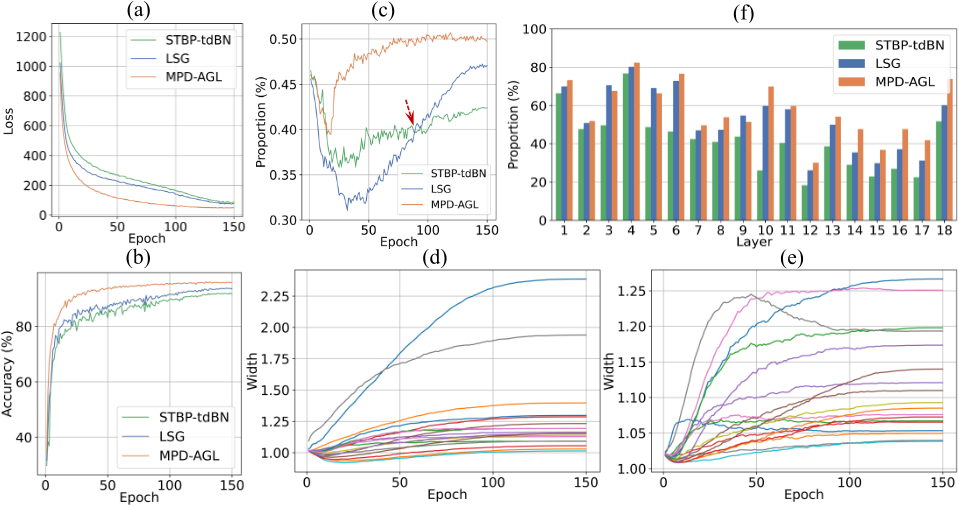
To investigate whether the proposed method can effectively alleviate the gradient vanishing problem, we conducted experiments using ResNet-19 on the CIFAR10 dataset with 2 timesteps. MPD-AGL rethinks the distribution of presynaptic input in the tdBN method [Zheng et al., 2021] and, inspired by LSG [Lian et al., 2023], designs the correlation function to dynamically adjust SG. Therefore, we take STBPtdBN and LSG as the benchmark algorithms. In Fig. 5(a) and Fig. 5(b), we compare the training loss and test accuracy of these three methods, where MPD-AGL can optimize the training loss to lower smooth values that have better generalization ability. Then we visualize the gradient-available proportion curve for layer 7 (Fig. 5(c)). The fixed width of SG in STBP-tdBN cannot effectively match the evolving MPD, which causes many neurons to fall outside the gradient-available interval and slow weight updates. Compared with STBP-tdBN, LSG can slightly alleviate this situation, but cannot respond to MPD timely. Specifically, LSG takes more epochs to make the proportion of neurons fall into the gradient-available interval to an appropriate level. Obviously, MPD-AGL can quickly capture the shifts in membrane potential and respond promptly. To reveal how our method helps SNNs for gradient propagation, we display the width of SG and the proportion of neurons that fall into the gradientavailable interval in each layer. As illustrated in Fig. 5(d-e), the SG width in MPD-AGL is distributed mostly around 1.26, whereas LSG is 1.12. It means that MPD-AGL makes more neurons in deep layers have gradients, alleviating the gradient vanishing. Consequently, active neurons in all layers of MPD-AGL are higher than STBN-tdBN and LSG (Fig. 5(f)).
5.3 Effectiveness on SG Functions
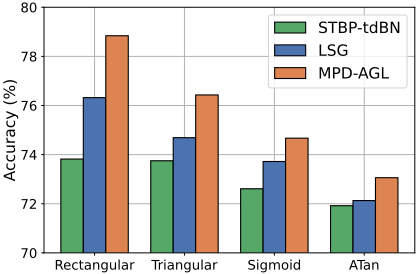
To clarify the effectiveness of our method on other SG functions, we conducted experiments using ResNet-19 on the CIFAR100 dataset with 2 timesteps. Here, we choose three other widely used SG functions, i.e., triangular [Bellec et al., 2018], sigmoid [Zenke and Vogels, 2021], and aTan [Fang et al., 2021b]. Considering that optimal sharpness varies among different SGs, we scaled κ proportionally. As shown in Fig. 3, MPD-AGL achieves 76.43% accuracy with triangular SG, outperforming STBP-tdBN and LSG by 2.68% and 1.74%, respectively. While MPD-AGL still performs better than STBP-tdBN and LSG on sigmoid and aTan SG functions, it does not perform as well as rectangular and triangular SG. This may be due to simply adjusting the sharpness of these asymptotic SG functions based on the evolving MPD, which leads to large oscillations in the gradient information. Instead, linear SG functions have a relatively smooth gradient estimation characteristic and thus exhibit stronger robustness.
| Dataset | Method | SG optimization | Architecture | Timestep | Accuarcy(%) |
|---|---|---|---|---|---|
| CIFAR10 | TAB [Jiang et al., 2024] ShortcutBP [Guo et al., 2024] STAtten + [Lee et al., 2025] TCJA [Zhu et al., 2025] PSG [Wang et al., 2025a] LSG [Lian et al., 2023] DeepTAGE [Liu et al., 2025] Ours | ResNet-19 ResNet-19 SpikingReformer-6-384 MS-ResNet-18 ResNet-19 ResNet-19 ResNet-18 ResNet-19 | 6 / 4 / 2 2 4 4 6 / 4 6 / 4 / 2 4 6 / 4 / 2 | 94.81 / 94.76 / 94.73 95.19 95.26 95.60 95.00 / 95.12 95.52 / 95.17 / 94.41 95.86 96.54 / 96.35 / 96.18 | |
| CIFAR100 | TAB [Jiang et al., 2024] IM-LIF [Lian et al., 2024] TCJA [Zhu et al., 2025] STAtten + [Lee et al., 2025] PSG [Wang et al., 2025a] LSG [Lian et al., 2023] ASGL [Wang et al., 2023] Ours | ResNet-19 ResNet-19 MS-ResNet-18 SpikingReformer-6-384 ResNet-19 ResNet-19 ResNet-18 ResNet-19 | 6 / 4 / 2 6 / 3 4 4 4 6 / 4 / 2 4 / 2 6 / 4 / 2 | 76.82 / 76.81 / 76.31 77.42 / 77.21 77.72 77.90 75.72 77.13 / 76.85 / 76.32 77.74 / 76.59 80.49 / 79.72 / 78.84 | |
| CIFAR10-DVS | IM-LIF [Lian et al., 2024] IMPD-AGL [Jiang et al., 2025] TET [Deng et al., 2022] STAtten + [Lee et al., 2025] PSG [Wang et al., 2025a] LSG [Lian et al., 2023] DeepTAGE[Liu et al., 2025] Ours Offline LTL [Yang et al., 2022] | VGGSNN VGGSNN VGGSNN SpikingReformer-4-384 ResNet-19 VGGSNN VGG-11 VGGSNN VGG-13 ResNet-18 ResNet-19 | 10 10 10 16 7 10 10 10 16 1 6 / 3 | 80.50 77.20 77.33 / 83.17∗ 80.60 76.00 77.90 81.23 82.50 / 84.10∗ 55.37 55.49 | |
| Tiny-ImageNet | S3NN [Suetake et al., 2023] IM-LIF [Lian et al., 2024] AT [Ozdenizci and Legenstein, 2024] ASGL [Wang et al., 2023] Ours | VGG-11 VGG-13 VGG-13 | 8 8 / 4 4 | 55.37 / 54.82 57.21 56.81 / 56.57 58.14 |
5.4 Energy Efficiency
To validate the efficiency of SNNs in energy consumption, we conducted experiments using ResNet-19 on the CIFAR10 dataset. The theoretical energy consumption of SNNs can be estimated from the synaptic operations (SOPs) [Zhou et al., 2023]. Due to the binarized and sparse nature of spikes, SNNs operate low-power AC operations only when neurons fire, and its required SOP varies with spike sparsity. In our model, real-valued images are directly fed into SNNs for encoding, and membrane potentials in the readout layer are used for prediction, so the SOPs contain AC operations and a few MAC operations. For the number of addition operations, we calculate it by rn ×T×N n AC , where r is the average firing rate of n-th layer and N n AC is the number of addition operations in n-th layer of an iso-architecture ANN. For the number of multiplication operations, it equals the number of multiplication operations at encoding and readout layers and scales by T [Yao et al., 2023]. [Rathi and Roy, 2023] measured in 45 nm CMOS technology that an addition operation costs 0.9pJ and a MAC operation costs 4.6pJ.
| Method | T #Add. | #Multi. | Energy |
|---|---|---|---|
| ANN | - 2285.35M | 2285.35M | 10.51mJ |
| STBP-tdBN | 2 890.20M | 7.08M | 0.83mJ |
| LSG | 2 677.72M | 7.08M | 0.64mJ |
| 2 579.33M | 7.08M | 0.55mJ | |
| MPD-AGL | 4 1004.70M | 14.16M | 0.96mJ |
| 6 1303.21M | 21.25M | 1.25mJ |
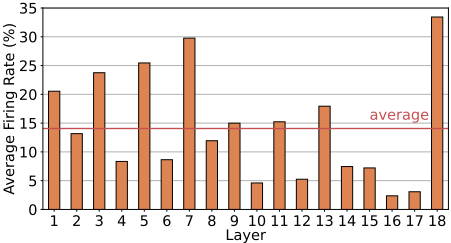
As shown in Fig. 4, the average firing rate of each layer in spiking ResNet-19 does not exceed 34% (14% on average) when T = 2. In Table 2, we estimate the energy consumption during inference in different timesteps, and the proposed MPD-AGL is 19× lower compared to ANN in 2 timesteps.
| Method | Accuracy (%) | |
|---|---|---|
| CIFAR10 | CIFAR100 | |
| Vanilla | 92.38 | 73.87 |
| w/ trainable decay | 93.15 | 74.12 |
| w/ LSG [Lian et al., 2023] | 94.41 | 76.32 |
| w/ AGR | 95.93 | 78.47 |
| w/ MPD-AGL | 96.18 | 78.84 |
5.5 Ablation Study
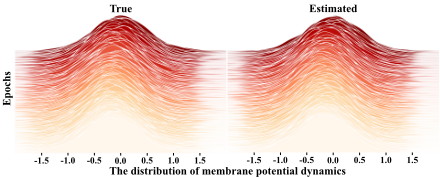
As shown in Fig. 6, the true mean and variance of presynaptic input are close to the estimated values reasoned from Theorem 1 during training, proving the correctness of Theorem 1. It also indicates that the affine transformation of normalization layers is the reason for the membrane potential shifts, limiting the performance of SG learning. As for Theorem 2, which follows [Zheng et al., 2021; Lian et al., 2023]
by employing the factors of affine transformation, please refer to Supplementary A of the Extended version for detailed proofs. To evaluate the effectiveness of MPD-AGL algorithm, we also conducted experiments using ResNet-19 on the CIFAR10/100 datasets with 2 timesteps. In Table 3, applying the proposed adaptive gradient rule (AGR) achieves an accuracy of 95.93%/78.47% on the CIFAR10/100 datasets, surpassing the vanilla and LSG methods by 3.55%/4.60% and 1.52%/2.15%, respectively. When combined with AGR and PLIF neurons, it even reaches 96.18%/78.84%, which means that the trainable decay can indeed combine with the adaptive gradient rule to enhance SNN learning.
6 Conclusion
In this work, we present a new perspective on understanding the gradient vanishing or mismatch problems in directly training SNNs with SG learning. We identify that these issues primarily arise as the failure of fixed SG and evolving MPD to align, which is caused by the affine transformation in normalization layers. Here, we propose the MPD-AGL algorithm, which adaptively relaxes SG in a temporal-aligned manner to more accurately capture the evolving MPD at different timesteps. Experimental results and theoretical analysis on four datasets demonstrate the effectiveness and superiority of our approach. MPD-AGL unlocks the limitation of SG width and provides more flexible gradient estimation for SNNs. Importantly, it can naturally integrate into existing SNN architectures to further enhance performance without additional inference costs, hopefully promoting the application of SNNs in more complex tasks and wider scenarios.
Acknowledgements
This work was supported by the National Key Research and Development Program of China (Grant No.: 2024YDLN0005) and the National Natural Science Foundation of China (Grant No.: 62276235)
@inproceedings{ijcai2025p464,
  title     = {Adaptive Gradient Learning for Spiking Neural Networks by Exploiting Membrane Potential Dynamics},
  author    = {Jiang, Jiaqiang and Wang, Lei and Jiang, Runhao and Fan, Jing and Yan, Rui},
  booktitle = {Proceedings of the Thirty-Fourth International Joint Conference on
               Artificial Intelligence, {IJCAI-25}},
  publisher = {International Joint Conferences on Artificial Intelligence Organization},
  editor    = {James Kwok},
  pages     = {4164--4172},
  year      = {2025},
  month     = {8},
  note      = {Main Track},
  doi       = {10.24963/ijcai.2025/464},
  url       = {https://doi.org/10.24963/ijcai.2025/464},
}
TY - CPAPER TI - Adaptive Gradient Learning for Spiking Neural Networks by Exploiting Membrane Potential Dynamics AU - Jiang, Jiaqiang AU - Wang, Lei AU - Jiang, Runhao AU - Fan, Jing AU - Yan, Rui T2 - Proceedings of the Thirty-Fourth International Joint Conference on Artificial Intelligence, IJCAI-25 PB - International Joint Conferences on Artificial Intelligence Organization PY - 2025 SP - 4164 EP - 4172 DO - 10.24963/ijcai.2025/464 UR - https://doi.org/10.24963/ijcai.2025/464 ER -Copied
Machine-readable versions of this paper, for tools and AI agents:





