
A General Framework for Representing Controlled Natural Language Sentences and Translation to KR Formalisms
Proceedings of the Thirty-Fourth International Joint Conference on Artificial Intelligence. Main Track. Pages 4401-4409.
https://doi.org/10.24963/ijcai.2025/490
Keywords
- Knowledge Representation and Reasoning: KRR: Knowledge representation languages
- Knowledge Representation and Reasoning: KRR: Logic programming
- Knowledge Representation and Reasoning: KRR: Other
- Knowledge Representation and Reasoning: KRR: Non-monotonic reasoning
Abstract
Languages for Knowledge Representation and Reasoning, such as ASP, CP, and SMT, excel at solving some complex problems, but encoding them into a higher-level language may be more profitable, leaving these formalisms as targets for solving. Recent studies aim to convert controlled natural languages into formal representations, yet these solutions are often tailored to specific languages and require significant effort.
This paper introduces a general framework that generates grammars for target representation languages, enabling the translation of problems stated in CNL into formal representations. The related system, CNLWizard, offers a flexible, high-level approach to defining desired grammars, significantly reducing the time and effort needed to create custom grammars. Finally, we demonstrate the system's effectiveness through an experimental analysis.
- [Alviano and Grillo, 2024] Mario Alviano and Lorenzo Grillo. Answer set programming and large language mod- els interaction with YAML: preliminary report. In Proc. of CILC, volume 3733 of CEUR Workshop Proceedings. CEUR-WS.org, 2024.
- [Baral and Dzifcak, 2012] Chitta Baral and Juraj Dzifcak. Solving puzzles described in english by automated trans- lation to answer set programming and learning how to do that translation. In Proc. of KR. AAAI Press, 2012.
- [Barrett et al., 2021] Clark W. Barrett, Roberto Sebastiani, Sanjit A. Seshia, and Cesare Tinelli. Satisfiability modulo theories. In Handbook of Satisfiability -Second Edition, volume 336 of FAIA, pages 1267-1329. IOS Press, 2021.
- [Borroto Santana et al., 2024] Manuel Borroto Santana, Ir- fan Kareem, and Francesco Ricca. Towards automatic composition of asp programs from natural language spec- ifications. In Proc. of IJCAI, 2024. IJCAI
- [Caruso et al., 2024] Simone Caruso, Carmine Dodaro, Marco Maratea, Marco Mochi, and Francesco Riccio. CNL2ASP: converting controlled natural language sen- tences into ASP. Theory Pract. Log. Program., 24(2):196- 226, 2024.
- [Caruso et al., 2025] Simone Caruso, Carmine Dodaro, Marco Maratea, and Alice Tarzariol. Github repository of CNLWizard. MIT Licence, available at https://github. com/dodaro/CNLWizard, 2025. Link
- [Chomsky, 1959] Noam Chomsky. On certain formal prop- erties of grammars. Inf. Control., 2(2):137-167, 1959.
- [Clark et al., 2005] Peter Clark, Philip Harrison, Thomas Jenkins, John A. Thompson, and Richard H. Wojcik. Ac- quiring and using world knowledge using a restricted sub- set of english. In Proc. of FLAIRS, pages 506-511. AAAI Press, 2005.
- [Coppolillo et al., 2024] Erica Coppolillo, Francesco Cal- imeri, Giuseppe Manco, Simona Perri, and Francesco Ricca. LLASP: fine-tuning large language models for an- swer set programming. In Proc. of KR, 2024.
- [de Moura and Bjørner, 2008] Leonardo Mendonc ¸a de Moura and Nikolaj S. Bjørner. Z3: an efficient SMT solver. In Proc. of TACAS, volume 4963 of LNCS, pages 337-340. Springer, 2008.
- [de Moura and Bjørner, 2011] Leonardo Mendonc ¸a de Moura and Nikolaj S. Bjørner. Satisfiability modulo theories: introduction and applications. Commun. ACM, 54(9):69-77, 2011.
- [Erdem and Yeniterzi, 2009] Esra Erdem and Reyyan Yen- iterzi. Transforming controlled natural language biomed- ical queries into answer set programs. In Proc. of the BioNLP Workshop, pages 117-124. Association for Com- putational Linguistics, 2009.
- [Erdem et al., 2016] Esra Erdem, Michael Gelfond, and Nicola Leone. Applications of answer set programming. AI Mag., 37(3):53-68, 2016.
- [Filipovikj et al., 2017] Predrag Filipovikj, Guillermo Rodríguez-Navas, Mattias Nyberg, and Cristina Sece- leanu. Smt-based consistency analysis of industrial systems requirements. In Proc. of SAC, pages 1272-1279. ACM, 2017.
- [Fuchs and Schwitter, 1995] Norbert E. Fuchs and Rolf Schwitter. Specifying logic programs in controlled natural language. CoRR, abs/cmp-lg/9507009, 1995.
- [Fuchs, 2005] Norbert E. Fuchs. Knowledge representation and reasoning in (controlled) natural language. In Proc. of ICCS, volume 3596 of LNCS, pages 51-51. Springer, 2005.
- [Gebser et al., 2016] Martin Gebser, Roland Kaminski, Ben- jamin Kaufmann, Max Ostrowski, Torsten Schaub, and Philipp Wanko. Theory solving made easy with clingo 5. In Proc. of ICLP TCs, volume 52 of OASIcs, pages 2:1- 2:15. Schloss Dagstuhl -Leibniz-Zentrum für Informatik, 2016.
- [Hooker and van Hoeve, 2018] John N. Hooker and Willem Jan van Hoeve. Constraint programming and op- erations research. Constraints An Int. J., 23(2):172-195, 2018.
- [Hopcroft and Ullman, 1979] John E. Hopcroft and Jef- frey D. Ullman. Introduction to Automata Theory, Lan- guages and Computation. Addison-Wesley, 1979.
- [Konrad and Cheng, 2005] Sascha Konrad and Betty H. C. Cheng. Real-time specification patterns. In Proc. of (ICSE), pages 372-381. ACM, 2005.
- Lark, ] Lark repository. URL: https://github.com/ lark-parser/lark. Link
- [Lifschitz, 2019] Vladimir Lifschitz. Answer Set Program- ming. Springer, 2019.
- [Lifschitz, 2022] Vladimir Lifschitz. Translating definitions into the language of logic programming: A case study. In Proc. of the ICLP Workshops, volume 3193 of CEUR Workshop Proceedings. CEUR-WS.org, 2022.
- [Mahmud et al., 2016] Nesredin Mahmud, Cristina Sece- leanu, and Oscar Ljungkrantz. Resa tool: Structured requirements specification and sat-based consistency- checking. In Proc. of FedCSIS, volume 8 of Annals of Computer Science and Information Systems, pages 1737- 1746. IEEE, 2016.
- [Narizzano et al., 2018] Massimo Narizzano, Luca Pulina, Armando Tacchella, and Simone Vuotto. Consistency of property specification patterns with boolean and con- strained numerical signals. In Proc. of NFM, volume 10811 of LNCS, pages 383-398. Springer, 2018.
- [Nguyen et al., 2007] Vu Nguyen, Sophia Deeds-Rubin, Thomas Tan, and Barry Boehm. A sloc counting standard. In Cocomo ii forum, volume 2007, pages 1-16. Citeseer, 2007.
- [Öztok and Erdem, 2011] Umut Öztok and Esra Erdem. Generating explanations for complex biomedical queries. In Proc. of AAAI. AAAI Press, 2011.
- [Perron et al., 2023] Laurent Perron, Frédéric Didier, and Steven Gay. The CP-SAT-LP solver (invited talk). In Proc. of CP, volume 280 of LIPIcs, pages 3:1-3:2. Schloss Dagstuhl -Leibniz-Zentrum für Informatik, 2023.
- [Post et al., 2011] Amalinda Post, Igor Menzel, and Andreas Podelski. Applying restricted english grammar on automo- tive requirements -does it work? A case study. In Proc. of REFSQ, volume 6606 of LNCS, pages 166-180. Springer, 2011.
- [Rossi et al., 2006] Francesca Rossi, Peter van Beek, and Toby Walsh, editors. Handbook of Constraint Program- ming, volume 2 of Foundations of Artificial Intelligence. Elsevier, 2006.
- [Schwitter et al., 1995] Rolf Schwitter, Bernhard Ham- burger, and Norbert E. Fuchs. Attempto: Specifications in controlled natural language. In Proc. of the Workshop on Logische Programmierung, pages 151-160, 1995.
- [Schwitter, 2018] Rolf Schwitter. Specifying and verbalising answer set programs in controlled natural language. The- ory Pract. Log. Program., 18(3-4):691-705, 2018.
- [Vuotto et al., 2019] Simone Vuotto, Massimo Narizzano, Luca Pulina, and Armando Tacchella. Poster: Automatic consistency checking of requirements with reqv. In Proc. of IEEE ICST, pages 363-366. IEEE, 2019.
- [Wallace, 1996] Mark Wallace. Practical applications of constraint programming. Constraints An Int. J., 1(1/2):139-168, 1996.
- [Wang et al., 2024] Zhongsheng Wang, Jiamou Liu, Qiming Bao, Hongfei Rong, and Jingfeng Zhang. Chatlogic: Inte- grating logic programming with large language models for multi-step reasoning. In Proc. of IJCNN, pages 1-8. IEEE, 2024.
- [Yang et al., 2024] Xiaocheng Yang, Bingsen Chen, and Yik-Cheung Tam. Arithmetic reasoning with LLM: prolog generation & permutation. CoRR, abs/2405.17893, 2024.
References were extracted automatically from the PDF and may contain errors.
Full text extracted automatically from the PDF; figures, tables and equations may differ. The PDF is the version of record.
1 Introduction
Answer Set Programming (ASP) [Lifschitz, 2019], Constraint Programming (CP) [Rossi et al., 2006], and Satisfiability Modulo Theories (SMT) [Barrett et al., 2021] are three powerful computational paradigms widely used for addressing complex combinatorial problems, each offering distinct approaches to problem modelling and solving. ASP is a form of declarative programming rooted in logic programming and non-monotonic reasoning. ASP solvers generate solutions, known as answer sets, that satisfy a given logic program. ASP is capable of dealing with problems requiring reasoning with incomplete or evolving information, such as knowledge representation, reasoning, and AI applications [Erdem et al., 2016]. CP focuses on representing a problem through variables, domains, and constraints. The goal is to find assignments to variables that satisfy all constraints, making CP particularly effective for problems with intricate combinatorial structures, such as scheduling, planning, and resource allocation [Wallace, 1996; Hooker and van Hoeve, 2018]. SMT builds upon the foundation of Boolean Satisfiability (SAT) by extending it to more expressive theories like arithmetic, bit-vectors, and arrays [de Moura and Bjørner, 2011]. SMT solvers determine the satisfiability of logical formulas within these theories, enabling efficient handling of problems in verification, model checking, and software synthesis, where mathematical precision is crucial. They can be seen as complementary formalisms within the same broader framework of declarative problem-solving, where each formalism excels in different problem domains, yet they can be integrated or used in tandem to leverage their respective strengths.
These formalisms can benefit from the use of a controlled natural language (CNL), a subset of natural language with a restricted grammar and vocabulary designed to reduce ambiguity and complexity. Indeed, CNLs provide a bridge between formal methods and human-readable specifications, allowing domain experts to describe complex problems in a more intuitive and accessible manner without requiring deep expertise in the underlying formalism. As argued by Clark et al. [2005], and by Caruso et al. [2024], the benefits of using CNLs include (i) enhanced accessibility, as CNLs make it easier for non-experts to participate in problem formulation, as they can express constraints, rules, and requirements in a language close to the natural one; (ii) reduced errors by minimizing ambiguity, since CNLs help to prevent misinterpretations and errors in problem specifications, leading to more accurate solutions; (iii) improved collaboration, as CNLs facilitate communication between diverse teams, including domain experts and developers; and (iv) improved performance of natural language processing tools, as recently shown by Borroto Santana et al. [2024]. Integrating CNLs with ASP, CP, and SMT allows for a more natural and efficient approach to complex problem-solving, combining the precision of formal methods with the accessibility of natural language, broadening the applicability and impact of these powerful computational paradigms. Nevertheless, implementing custom CNLs is a time-consuming and challenging process. Indeed, from a technical perspective, creating a custom CNL involves writing the grammar, processing the Abstract Syntax Tree (AST), and generating code that translates the natural language input into the specific formalism. The first step requires defining a set of syntactic rules capable of capturing the nuances of the language while maintaining precision and clarity. The grammar must be comprehensive enough to cover the wide variety of constructs that users may wish to express, yet restricted enough to avoid ambiguity. Once the CNL input is parsed according to the grammar, it must be converted into an AST. This stage is complex because it involves resolving ambiguities, managing scope, and ensuring compliance with all semantic rules of the CNL. The final step involves translating the AST into code that conforms to the specific formalism, whether it be ASP, CP, or SMT. This translation process is intricate, as it requires mapping highlevel CNL constructs to the lower-level constructs of the formal language. In this paper, we present a novel framework that (i) enables the user to specify a grammar for multiple target languages abstractly, (ii) automatically suggests a possible default implementation for some elements involved in the pipeline, and (iii) provides auxiliary data structures that make the construction of the CNL language more flexible and guided. We implemented the framework, obtaining a system called CNLWizard, designed to reduce the effort involved in developing a custom CNL. CNLWizard processes inputs described in a simple YAML-based language and automatically generates the grammar for the CNL, along with a set of preimplemented imperative functions that minimise boilerplate code. This allows developers to focus primarily on writing the specific code required to convert sentences into the target formalism, streamlining the process and making custom CNL development more accessible and efficient. Indeed, as a practical evaluation, we compared the lines of code required by CNLWizard with those required by CNL2ASP [Caruso et al., 2024] to define and convert CNL sentences into ASP rules, demonstrating that CNLWizard consistently requires significantly fewer lines of code than CNL2ASP.
2 Framework
We recall that a grammar [Chomsky, 1959] is a tuple (N, T, S, P ), where N and T are disjoint sets of non-terminal and terminal symbols, respectively, S ∈ N is the starting symbol, and P is a finite binary relation defined on (N ∪ T)∗ ◦ N ◦ (N ∪ T)∗ × (N ∪ T)∗ , called production rules, where ∗ is the Kleene star operator [Hopcroft and Ullman, 1979]. According to the Chomsky Hierarchy, four types of grammar can be classified depending on the expressiveness allowed by P . For the purpose addressed in this work, we use type 2 or context-free grammars, where P is restricted to relations defined on N × (N ∪ T)∗ . Let F be a set containing KR formalisms. We represent with fn : P, F ↦→ I the function that maps a production rule p ∈ P and a KR formalism k ∈ F into an imperative function invoked when applying p in the Abstract Syntax Tree (AST), where an element in I is a triple (name, ⃗ args, code) containing, respectively, the function's name, arguments and implementation. In other words, the imperative function defined through fn specifies how CNL's text matching a production rule is "processed" to obtain statement(s) in a target KR formalism or to define the structure of the entities described.
Let FTar ⊂ F represent a set of target KR formalisms for which a programmer aims to define a CNL grammar (and the corresponding fn). Our framework provides a high-level language to compactly define the CNL grammar Gt = (Nt, Tt, St, Pt) for each formalism t ∈ FTar, together with an initialization of fn(p, t) for each production rule p ∈ Pt. For the sake of simplicity, we will define how each set of production rule Pt is built and assume that Nt and Tt are implicitly derived by projecting all the non-terminal and terminal symbols occurring in Pt. Without loss of generality, the starting symbol of each grammar, St, can be defined as a default nonterminal symbol, S.
Our framework consists of a function ϕ : C ↦→ 2(P,I,F) that maps a command c ∈ C into a set of triples defining a production rule and corresponding imperative function for a formalism. Given a set of commands ˆ C ⊆ C, we define every Pt for t ∈ FTar as Pt = ⋃c∈ ˆ C {p | (p, I, t) ∈ ϕ(c)}. Then, for each c ∈ ˆ C and each (p, I, t) ∈ ϕ(c), we initialize fn(p, t) = I. A command is a pair where the first argument is a keyword (such as syntax, concat, etc.) or a non-terminal symbol N and the second argument can be any element of a grammar, formalisms or a set of commands. In the following, we are going to define the set of accepted command C, together with the definition of ϕ for each of them.
A possible command is (n, Par), where n ∈ N and Par is a set of commands with exactly one occurrence of:
- (syntax, ST), where ST ⊆ (N ∪ T)∗ ; and
- (target, TG), where TG ⊆ FTar;
and at most one occurrence of the command:
- (concat,CN), where CN ∈ (N ∪ T).
Then, the function ϕ((n, Par)) returns:
This command is used to define a production rule for each target formalism and automatically bind it with the corresponding imperative function, as shown in (1). Notice that the code part is left empty, since the implementation depends on the specific application. The optional command (concat, CN) specifies an additional production rule for n, where its righthand side consists of multiple applications of ST, concatenated by the symbol CN. The corresponding imperative function is named n concat and has a single argument consisting of the list of non-terminal symbols that appeared in the rule, while its implementation is already provided by the framework and called code con, as shown in (2).
A mandatory command is (start, Par), where Par is a set of commands defined as in the previous item. This command is used to specify the production rule of the starting symbol for each target formalism. Indeed, ϕ((start, Par)) returns the sets in (1) and (2), where n is replaced by the default starting symbol S.
Another possible command is (operation, Par), where Par is a set of commands with exactly one occurrence of:
- (name,Op), where Op ∈ N;
- (syntax, ST), where ST ⊆ (N∪T)∗ andOp oper ∈ ST ;
- (target, TG), where TG ⊆ FTar; and
- (operators, (s, fs)), where s ∈ T represents an operator for the operation Op, and fs defines how to translate s when encountering its node in the AST;
and at most one occurrence of the command:
- (concat,CN), where CN ∈ (N ∪ T).
Then, the function ϕ(operation, Par) returns:
The command (operation, Par) simplifies the definition of operations (e.g., mathematical, comparison, etc.), where the symbol Op occurring with the keyword name represents a class of operations that includes all the operator's symbols defined after the keyword operators. The right-hand side of the production rule for Op, namely ST, must contain a special keyword, called Op oper, that indicates the position in the sentence of the string describing an operator. The framework then defines ϕ to return: a tuple for each t ∈ TG containing the production rule of Op, where the implementation of the corresponding function is already provided by the framework and called code op, as shown in (3); a tuple containing a production rule that maps Op oper to each operation s, where the implementation of the corresponding function is defined by fs , as shown in (4); and, lastly, the tuples obtained from the concatenation, as shown in (5).
Similarly to library usage for programming languages, our framework imports common patterns occurring for standard KR formalisms. Let FAux ⊂ F represent a set of KR formalisms. For each s ∈ FAux we assume the presence of an auxiliary context-free production rules P sAux , where for each auxiliary rule p ∈ P sAux the function fn(p, s) is pre-defined.
Another command is (import, Par), where Par is a set of commands with exactly one occurrence of:
- (source, s), where s ∈ FAux; and
- (target, t), where t ∈ FTar;
and one or more occurrences of the command:
- (rules, name(p)), where name(p) is a label identifying a production rule p.
This command can be used to import auxiliary production rules and pre-defined imperative functions. Namely, ϕ((import, Par)) = {(p, fn(p, s), t) | (source, s) ∈ Par, (target, t) ∈ Par, (rules, name(p)) ∈ Par, p ∈ P sAux }.
Lastly, to extend the flexibility of the grammars, our framework provides a set of data structures characterizing elements that frequently occur in KR formalisms. By activating them, the user can access auxiliary production rules. In particular, we consider: (i) Signatures that provide a template to define concepts, which intuitively can be traced back to types in imperative programming languages; for example, they can be used to define the structure of an atom in ASP, a variable in CP, and a literal/variable in SAT and SMT. A signature σ is composed of an entity, which includes a name and attributes; (ii) Variables that provide a template to define a variable that can range over different values. For example, one can state a variable X is between 0 and 10, and then our framework is able to recognise that X can range over the values and substitute it with its possible values in all of its occurrences.
2.1 Instantiation of the Framework
This section shows how the framework is instantiated for defining grammars that can parse CNLs tailored to the most common KR formalisms. FAux is the set {ASP, CP, SMT} and PAux is a set containing the following elements (for brevity, we show only the most important production rules), where non-terminal symbols are highlighted in bold and ∨ represents an or between elements, elements followed by ? are optional, string is a placeholder for a production rule matching any non-empty string containing letters, numbers and symbol , and number is a placeholder for a production rule matching any number:
- (signature, (A ∨ An) string has (a ∨ an) string ((, ∨ and) (a ∨ an) string)*);
- (variable, where string is between number and number);
- (there is clause, (there ∨ There) is entity);
- (positive constraint, It is required that positive constraint body);
- (negative constraint, It is prohibited that negative constraint body);
- (math, (The ∨ the) math operator between math first and math second);
- (comparison, comparison first is? comparison operator comparison second);
- (formula, formula first formula operator formula second);
- (entity, (a ∨ an)? string attribute?);
- (verb, (a ∨ an)? string attribute? string);
- (attribute, with string equal to (string ∨ number));
- (simple prop, entity (have ∨ has ∨ are ∨ is) verb entity);
- (neg simple prop, entity (do not have ∨ does not have ∨ are not ∨ is not) verb entity);
- (consequence, If (simple prop ∨ neg simple prop) then (simple prop ∨ neg simple prop)).
These elements are provided by the framework and can be imported by users who want to extend the framework with new elements. In the example below, we demonstrate a simple extension of the framework.
Example 1. In the following, we assume the user wants to create a CNL that contains only sentences of the form:
- An entity has an attribute and a attribute.
- There is a entity with attribute equal to value, and with attribute equal to value.
- When there is a entity with attribute equal to value and attribute equal to value, then there is a entity with attribute equal to value and attribute equal to value.
where entity is an element in the signature, attribute is part of the entity, and value is either a string or a number.
To this end, the user has to define the following set of commands, with ASP as a target:
(import, { (source, asp), (target, asp), (rules, signature); (rules, there_is_clause)}); (start, { (syntax, signature), (target, {asp}), (concat, .)}); (start, { (syntax, there_is_clause), (target, {asp}), (concat, .)}); (start, { (syntax, rule), (target, {asp}), (concat, .)}); (rule, { (syntax, When there_is_clause, then there_is_clause), (target, {asp})}).The following CNL sentences are thus parsed by the resulting grammar:
A user has an id and a name. An admin has an id and a name. There is a user with id equal to 1, and with name equal to john. There is a user with id equal to 2, and with name equal to susan. When there is a user with id equal to 2, and
with name equal to susan, then there is an admin with id equal to 2, and with name equal to susan.
3 CNLWizard
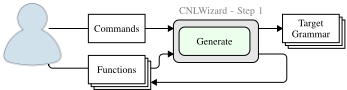
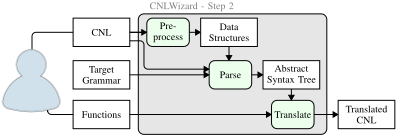
The framework described in the previous section has been implemented as part of a practical tool called CNLWizard, which operates through two main computational steps. The former corresponds to the framework, while the latter is responsible for the actual translation of a CNL file into a target language representation. For the first step, our system expects a YAML file (see https://yaml.org/ for the syntax of YAML) specifying the set of commands ˆ C, where terminal symbols are identified as double-quoted strings and non-quoted strings are either non-terminal symbols or keywords; then, CNLWizard generates a grammar and a Python file containing the corresponding imperative functions, for each target language t specified in ˆ C through the keyword target. In the second step, CNLWizard applies the generated grammar to parse a CNL file, automatically producing an AST, and then it obtains the translated CNL by evaluating each node of the tree with the corresponding function generated in the previous step.
3.1 Step 1) Generate Target Grammar and Functions
Figure 1 depicts the first step of CNLWizard. The dotted arrow states that the user can optionally provide in input a file containing some of the auxiliary functions. If this is the case, instead of producing a new file containing all the function templates, the system just appends the missing functions.
In the following, we describe the YAML file expressing the set of commands ˆ C, where keywords are highlighted in bold, optional elements are enclosed in square brackets, and round brackets followed by the symbol plus indicate that multiple elements can be listed. The structure of the commands follows the template defined in the framework but relies on syntactic sugar that group commands with the same keywords, in order to further reduce the size of the file. The YAML file accepts commands of the form:
import: rules: (rule_name)+source: (source_lang)+ target: (target_lang)+where each rule name is a reserved word identifying an auxiliary production rule provided by CNLWizard, for each formalism listed in source (at the moment, ASP, CP, and SMT). The imported rule is added to the grammar of the languages specified by target. The lists in source and target must have the same length to have a pair-wise match that reduces the length of the specification for homonymous rules. For each non-terminal symbol defined by the user, non term sym, the following entry is expected:
non_term_sym: syntax: (regex)+ [target: (target_lang)+] [concat: conc_symbol]where regex is a regular expression of terminal and nonterminal symbols, target lang is the name of a KR formalism for which CNLWizard will generate the grammar and imperative functions, and conc symbol is either a terminal or non-terminal symbol. If target is absent, then this rule is produced for every language specified with the starting symbol. Let us note that after syntax it is allowed to have a list of regular expressions. This is CNLWizard's syntactic sugar that compactly expresses groups of commands for the same non-terminal symbol. Additionally, CNLWizard allows unifying the definition of multiple rules, while being able to recall each of them in other regular expressions through the identifier rule name specified after the keyword name:
non_term_sym: ( name: rule_name syntax: (regex)+ [target: (target_lang)+] [concat: conc_symbol] )+Then, we can have commands defining the starting symbol:
start:
syntax: regex target: (target_lang)+ [concat: conc_symbol]where its structure matches the one used in the framework. The specification of the language operators is obtained with:
operation: ( name: op_name operators: (sym : op_repr)+ syntax: (regex)+ [target: (target_lang)+] [concat: conc_symbol] )+This command is similar to the one for non-terminal symbols but additionally requires the presence of the non-terminal symbol op name operator in regex. After the keyword operators, it is expected a list of mappings from the operation name used in the CNL file, sym, to its representation in the target language, op repr. In op repr, it is possible to have either a terminal symbol or a function defined as:
fun: name: function_name args: (argument)+allowing for distinguishing the function name and list of arguments and making them easily accessible in the function implementation.
Lastly, together with the formalism for ASP, CP and SMT, CNLWizard provides further auxiliary grammar elements and relative implementation. Indeed, it provides the definition of the most common regular expressions, such as string and number, that can be used in the entries of syntax. Moreover, through the following statements:
non_term_aux: ( syntax: regex [target: (lang)+] [concat: token] )+the system allows overwriting the syntax of the auxiliary nonterminal symbols appearing in the imported rules.
3.2 Example of YAML and Python Functions
In this section, we describe a use case to demonstrate the usefulness of CNLWizard. Specifically, let us assume that the user wants to solve the following (simplified) scheduling problem: Given three natural numbers (namely, p1, p2, and b), a set of teams, and a set of employees, where each employee has a salary, the goal is to assign employees to teams such that the following conditions are met: (i) each employee is assigned to exactly one team; (ii) each team has at least p1 employees and at most p2 employees; (iii) the total salaries of the employees on each team must not exceed the given budget b. Moreover, let us assume (s)he wants to use the following CNL to describe an instance of the problem with 3 employees, 2 teams, p1, p2, and b set to 1, 2, and 5000, respectively:
An employee has a name and a salary. A team has an id. Assigned has an employee_name and a team_id. There is an employee with name equal to 1, with salary equal to 2000. There is an employee with name equal to 2, with salary equal to 3000.There is an employee with name equal to 3, with salary equal to 2000. There is a team with id equal to X, where X is between 1 and 2. Employee with name equal to X is assigned to a team with id equal to 1 or with id equal to 2, where X is between 1 and 3. The number of employees assigned to a team with id equal to X is greater than or equal to 1, where X is between 1 and 2. The number of employees assigned to a team with id equal to X is less than 3, where X is between 1 and 2. The sum between the salary of the employees that are assigned to a team with id equal to X is less than 5000, where X is between 1 and 2.where sentences in lines 1-3 defines the concepts of employee, team, and assigned, respectively. Then, sentences in lines 4-6 define the employees and their salaries, and sentence at line 7 defines the two teams. Finally, sentences in lines 8-11 ensure that all conditions are met.
In this case, the YAML file reported in Listing 2 defines a set of commands for generating the grammar and the code needed by the aforementioned CNL, where we consider all the three different formalisms (ASP, CP, and SMT) as target.
import:
rules: [attribute, there_is_clause, math, comparison, simple_proposition, negated_simple_proposition, entity, verb, variable, signature] source: [asp, cp, smt] target: [asp, cp, smt] start: syntax: (proposition ".")* target: [asp, cp, smt] proposition: - name: disjunction syntax: simple_clause "or" attribute concat: ", and" - name: there_is_clause - name: comparison simple_clause: syntax: [ simple_proposition, negated_simple_proposition] comparison_first: syntax: [math, aggregate] aggregate: syntax: '"The number of" entity verb entity' comparison_second: syntax: number math_first: syntax: '"the" string "of the" entity "that are" verb entity'The specification begins with the keyword import, which adds to the grammar the auxiliary production rules identified by attribute, there is clause, math, comparison, simple proposition, negated simple proposition, entity, verb, variable, and signature. Then, the start keyword represents the root node of the AST, and its syntax is made of the concatenation of proposition. Here, the list of target formalisms, namely asp, cp, and smt, is also defined. Following, we define the syntax of proposition, which can be a there is clause, a comparison, or a disjunction (which also presents the syntax and the concat keywords). In the following, other rules are defined using the same format, nevertheless, notice that some non-terminal symbols, e.g. comparison first, comparison second and math first, must be defined because of the imported rules, comparison and math.
Once the specification is defined, the tool generates the two files for each target language: the grammar, and the functions. An example of an unimplemented function generated by the tool is shown in Listing 3, where the function start raises a NotImplementedError meaning that it must be implemented by the user.
def start(propositions): raise NotImplementedErrorOther rules, instead, as for example the operation rule, have a default implementation as shown in Listing 4. In this, case the math function returns the joined string of the operator with the operands.
def math(*args): operator_index = 0 operator = args[operator_index] args = list(args) args.pop(operator_index) return operator.join(map(str, args))After the generation step, the user should implement the functions with empty code, allowing CNLWizard to invoke them during the translation step. By providing the structure for each function, we facilitate the user's task of implementing how each parsed element is mapped into the corresponding expression in the target representation language. As the functions are defined in an imperative language, it is possible to rely on external libraries for the implementation and evaluation of each expression.
Moreover, a user can define a proposition that is valid only for one target formalism, e.g. ASP. This can be done by adding the following line under proposition:
- name: weak_constraint syntax: '"It is preferred as much as possible, that" comparison' target: [asp]which adds an optimization statement only for the target asp.
3.3 Step 2) Translate CNL into Target Representation
Once the target grammar(s) and corresponding functions have been generated and implemented by the user, we can proceed with the translation step, illustrated in Figure 2. First, CNLWizard pre-processes the input CNL. In this phase, it initializes the auxiliary data structures, i.e. signatures, if imported, and substitutes the variables. The signatures support the writing of the grammar and translation into the target formalism. As mentioned above, they define the concepts of the problem and their structure, and then one can easily recall them with their defined structure in the propositions. On the other hand, variable substitution allows the straightforward application of the same statement with different values. After the pre-processing, CNLWizard applies the generated grammar to parse the processed CNL and obtains an AST, which is evaluated according to the corresponding function, obtaining the corresponding CNL translated in the target representation. As an example, consider the sentence There is an employee with name equal to 1, with salary equal to 2000. reported in Section 3.2 and consider the ASP target. This sentence is automatically parsed by the generated grammar and the following Python function is automatically created:
def there_is_clause(entity): return Fact(entity)where Fact is the name of a Python class implemented in CNLWizard which translates the entity in the ASP fact employee(1, 2000). Note that entity is also a data structure that is automatically created by CNLWizard and can be modified by accessing its internal fields, as follows:
def there_is_clause(entity): if 'salary' in entity.fields: entity.fields['salary'] += 'USD' return Fact(entity)In this case, CNLWizard creates the ASP fact employee (1, "2000USD"). All the examples and data for the target formalisms are available at https://github.com/dodaro/ CNLWizard/tree/main/examples.
4 Implementation and Experiments
CNLWizard has been implemented in Python and released under an open-source licence [Caruso et al., 2025]. The target grammar is obtained and expressed using the library lark [Lark, ], while the file containing the templates for the functions is expressed in Python. For each target language, CNLWizard uses state-of-the-art tools, such as clingo [Gebser et al., 2016] for ASP, OR-tools [Perron et al., 2023] for CP, and Z3 [de Moura and Bjørner, 2008] for SMT. Moreover, it includes several error messages designed to identify misspelled text, and common user errors. As for the evaluation of the performance, as CNLWizard is a tool to define novel CNLs, we measured how it can help developers reduce their development time. This is often measured in Software Engineering as the number of lines of code needed to solve a problem (see, e.g. [Nguyen et al., 2007] for a discussion about pros and cons). In our case, the problem is the generation of a grammar for a CNL and its translation to a KR formalism. Specifically, we compared the required lines of code (both grammar and python code) to implement the translations from a CNL into ASP using CNLWizard with the ones required by CNL2ASP, which is an open-source tool recently proposed by Caruso et al. [2024]. Concerning the problem specifications, we used the domains available from the CNL2ASP repository (available at https://github.com/dodaro/ cnl2asp/tree/main/examples), namely Chemotherapy Treatment Scheduling (CTS), Graph Coloring (GC), Manipulation of Articulated Objects (MAO), and Nurse Scheduling (NSP). We also mention that CNL2ASP is a versatile tool with many constructs and functions and a total of about 6 thousand lines of code. As an example, it supports temporal operators and other constructs that are out of the scope of this paper. Therefore, for a fair evaluation of the lines of codes, for CNL2ASP we only considered the lines needed for parsing and translating the specific problem. The results are presented in Table 1, where the column labeled "All" indicates the total lines of code required to support the CNL sentences across all the considered domains. The main advantages of CNLWizard consist of a compact way of describing the grammar of the CNLs, a quick and easy way to import parts of grammar, and import/generate Python functions, and internal management of features such as signature, concatenation, and variable templates. As a result, CNLWizard consistently generated a corresponding CNL with significantly fewer lines of code, up to 10 times less than CNL2ASP.
| CTS | GC | MAO | NSP | All | |
|---|---|---|---|---|---|
| CNLWizard | 266 | 130 | 287 | 415 | 514 |
| CNL2ASP | 2620 | 2162 | 2422 | 2566 | 2936 |
5 RelatedWork
Many CNLs have been proposed for different tasks. Konrad and Cheng [2005] introduced a CNL which can be translated into various formalisms: linear time logic (LTL), computational tree logic, graphical interval logic, metric temporal logic, timed computational tree logic, and real-time graphical interval logic. This CNL was used in different practical applications in many domains. For example, Post et al. [2011]
tested the applicability of this CNL in the automotive domain, while Filipovikj et al. [2017] used it to check industrial system requirements with SMT translations. Vuotto et al. [2019] and Narizzano et al. [2018] converted CNL constraints into LTL formulae and Mahmud et al. [2016] employed a controlled language to structure automotive embedded systems specifications in a natural language, which is then translated into Boolean expressions to check their consistency using Z3.
In logic programming, the first approaches were proposed by Fuchs and Schwitter [1995] and Schwitter et al. [1995], resulting in Attempto CNL [Fuchs, 2005], whose idea was to convert sentences expressed in a CNL as Prolog clauses. Clark et al. [2005] presented a computer-processable language designed to be more accessible for computers than for human users. Erdem and Yeniterzi [2009] proposed BIOQUERYCNL, a CNL for biomedical queries, and developed an algorithm designed to automatically encode a biomedical query expressed in this language as an ASP program. BIOQUERYCNL is a subset of Attempto CNL that can represent queries, and it was also used as a basis to generate explanations of complex queries [ ¨Oztok and Erdem, 2011]. Baral and Dzifcak [2012] proposed a CNL specific for solving logic puzzles, whose sentences are then converted into ASP. Lifschitz [2022] showed the process of translating one English sentence into ASP code. Caruso et al. [2024] proposed a CNL (similar to the one proposed by [Schwitter, 2018]) which is then converted into ASP by the tool CNL2ASP.
Another line of related work concerns LLMs, even if they differ fundamentally from CNLs. Indeed, while LLMs show generally good performance, they are currently unreliable in producing correct ASP, CP, or SMT code due to their probabilistic nature. CNLs, instead, ensure precision through grammar-based determinism. Nevertheless, CNLs can be used for improving the performance of LLMs, as shown by Borroto Santana et al. [2024], where CNLs were used as an intermediate layer to map NL to ASP. Our tool could be used to define new CNLs, which in turn can serve as targets for converting NL sentences using their method. Other recent works on LLMs and KR formalisms address different goals: Alviano and Grillo [2024] focuses on using LLMs to generate ASP facts; Coppolillo et al. [2024] convert simple patterns in ASP code, but they do not generalize on complex encodings; while Wang et al. [2024] and Yang et al. [2024] use KR formalisms to improve LLMs performance.
6 Conclusions
In this paper, we introduced a novel framework and its implementation, CNLWizard, which simplifies the creation of CNLs for KR formalisms such as ASP, CP, and SMT. The framework also facilitates the development of CNLs for other languages by automating much of the CNL creation process. Using a YAML-based input language, CNLWizard streamlines grammar generation and the creation of imperative functions, reducing the need for extensive boilerplate code.
For future work, the framework could be extended to natively support additional languages and enable users to share their custom CNLs with the broader community. Moreover, CNLWizard can be extended to prevent misspelled CNL text.
Acknowledgments
Carmine Dodaro and Marco Maratea were supported by the European Union - NextGenerationEU and by Italian Ministry of Research (MUR) under PNRR project FAIR "Future AI Research", CUP H23C22000860006 and by the European Union - NextGenerationEU and by the Ministry of University and Research (MUR), National Recovery and Resilience Plan (NRRP), Mission 4, Component 2, Investment 1.5, project "RAISE - Robotics and AI for Socio-economic Empowerment" (ECS00000035) under the project "Gestione e Ottimizzazione di Risorse Ospedaliere attraverso Analisi Dati, Logic Programming e Digital Twin (GOLD)", CUP H53C24000400006. Carmine Dodaro was supported by the European Union - NextGenerationEU and by Italian Ministry of Research (MUR) under PNRR project Tech4You "Technologies for climate change adaptation and quality of life improvement", CUP H23C22000370006. This research was funded in part by the Austrian Science Fund (FWF) 10.55776/COE12.
@inproceedings{ijcai2025p490,
  title     = {A General Framework for Representing Controlled Natural Language Sentences and Translation to KR Formalisms},
  author    = {Caruso, Simone and Dodaro, Carmine and Maratea, Marco and Tarzariol, Alice},
  booktitle = {Proceedings of the Thirty-Fourth International Joint Conference on
               Artificial Intelligence, {IJCAI-25}},
  publisher = {International Joint Conferences on Artificial Intelligence Organization},
  editor    = {James Kwok},
  pages     = {4401--4409},
  year      = {2025},
  month     = {8},
  note      = {Main Track},
  doi       = {10.24963/ijcai.2025/490},
  url       = {https://doi.org/10.24963/ijcai.2025/490},
}
TY - CPAPER TI - A General Framework for Representing Controlled Natural Language Sentences and Translation to KR Formalisms AU - Caruso, Simone AU - Dodaro, Carmine AU - Maratea, Marco AU - Tarzariol, Alice T2 - Proceedings of the Thirty-Fourth International Joint Conference on Artificial Intelligence, IJCAI-25 PB - International Joint Conferences on Artificial Intelligence Organization PY - 2025 SP - 4401 EP - 4409 DO - 10.24963/ijcai.2025/490 UR - https://doi.org/10.24963/ijcai.2025/490 ER -Copied
Machine-readable versions of this paper, for tools and AI agents:





