
Relational Decomposition for Program Synthesis
Proceedings of the Thirty-Fourth International Joint Conference on Artificial Intelligence. Main Track. Pages 4526-4534.
https://doi.org/10.24963/ijcai.2025/504
Keywords
- Knowledge Representation and Reasoning: KRR: Learning and reasoning
- Knowledge Representation and Reasoning: KRR: Logic programming
Abstract
We introduce a relational approach to program synthesis. The key idea is to decompose synthesis tasks into simpler relational synthesis subtasks. Specifically, our representation decomposes a training input-output example into sets of input and output facts respectively. We then learn relations between the input and output facts. We demonstrate our approach using an off-the-shelf inductive logic programming (ILP) system on four challenging synthesis datasets. Our results show that (i) our representation can outperform a standard one, and (ii) an off-the-shelf ILP system with our representation can outperform domain-specific approaches.
- [Aleixo and Lelis, 2023] David S. Aleixo and Levi H. S. Lelis. Show me the way! bilevel search for synthesizing programmatic strategies. In AAAI 2023, pages 4991-4998, 2023.
- [Ameen and Lelis, 2023] Saqib Ameen and Levi H. S. Lelis. Program synthesis with best-first bottom-up search. J. Artif. Intell. Res., 77:1275-1310, 2023.
- [Blumer et al., 1987] Anselm Blumer, Andrzej Ehrenfeucht, David Haussler, and Manfred K. Warmuth. Occam's razor. Inf. Process. Lett., (6):377-380, 1987.
- [Bundy, 2013] Alan Bundy. The interaction of represen- tation and reasoning. Proceedings of the Royal Soci- ety A: Mathematical, Physical and Engineering Sciences, 469(2157):20130194, 2013.
- [Chen et al., 2021] Mark Chen, Jerry Tworek, Heewoo Jun, Qiming Yuan, et al. Evaluating large language models trained on code. CoRR, abs/2107.03374, 2021.
- [Chollet, 2019] Franc ¸ois Chollet. On the measure of intelli- gence. CoRR, abs/1911.01547, 2019.
- [Cohen, 1990] William W. Cohen. An analysis of representa- tion shift in concept learning. In Machine Learning, Pro- ceedings of the Seventh International Conference on Ma- chine Learning, Austin, Texas, USA, June 21-23, 1990, pages 104-112.
- Morgan Kaufmann, 1990.
- [Cropper and Dumančić, 2020] Andrew Cropper and Sebasti- jan Dumančić. Learning large logic programs by going be- yond entailment. In IJCAI 2020, pages 2073-2079, 2020. IJCAI
- [Cropper and Dumančić, 2022] Andrew Cropper and Sebasti- jan Dumančić. Inductive logic programming at 30: A new introduction. J. Artif. Intell. Res., 74:765-850, 2022.
- [Cropper and Hocquette, 2023] Andrew Cropper and Céline Hocquette. Learning logic programs by combining pro- grams. In ECAI 2023, pages 501-508, 2023.
- [Cropper and Morel, 2021] Andrew Cropper and Rolf Morel. Learning programs by learning from failures. Mach. Learn., 110(4):801-856, 2021.
- [Curtis et al., 2022] Aidan Curtis, Tom Silver, Joshua B. Tenenbaum, Tomás Lozano-Pérez, and Leslie Pack Kael- bling. Discovering state and action abstractions for gen- eralized task and motion planning. In AAAI 2022, pages 5377-5384, 2022.
- [Devlin et al., 2017] Jacob Devlin, Jonathan Uesato, Surya Bhupatiraju, Rishabh Singh, Abdel-rahman Mohamed, and Pushmeet Kohli. Robustfill: Neural program learning under noisy I/O. In ICML 2017, volume 70, pages 990-998, 2017.
- [Ellis et al., 2018] Kevin Ellis, Lucas Morales, Mathias Sablé-Meyer, Armando Solar-Lezama, and Josh Tenen- baum. Learning libraries of subroutines for neurally-guided bayesian program induction. In NeurIPS 2018, pages 7816- 7826, 2018.
- [Ellis et al., 2019] Kevin Ellis, Maxwell I. Nye, Yewen Pu, Felix Sosa, Josh Tenenbaum, and Armando Solar-Lezama. Write, execute, assess: Program synthesis with a REPL. In NeurIPS 2019, pages 9165-9174, 2019.
- [Evans et al., 2021] Richard Evans, José Hernández-Orallo, Johannes Welbl, Pushmeet Kohli, and Marek J. Sergot. Making sense of sensory input. Artif. Intell., 293:103438, 2021.
- [Franzen et al., 2024] Daniel Franzen, Jan Disselhoff, and David Hartmann. The llm architect: Solving arc-agi is a matter of perspective. 2024.
- [Gulwani et al., 2017] Sumit Gulwani, Oleksandr Polozov, Rishabh Singh, et al. Program synthesis. Foundations and Trends® in Programming Languages, 4(1-2):1-119, 2017.
- [Gulwani, 2011] Sumit Gulwani. Automating string process- ing in spreadsheets using input-output examples. In POPL 2011, pages 317-330, 2011.
- [Hodel, 2024] Michael Hodel. RE-ARC: Reverse- engineering the abstraction and reasoning corpus, 2024.
- [Katayama, 2008] Susumu Katayama. Efficient exhaustive generation of functional programs using monte-carlo search with iterative deepening. In PRICAI 2008, pages 199-210, 2008.
- [Kim et al., 2022] Subin Kim, Prin Phunyaphibarn, Donghyun Ahn, and Sundong Kim. Playgrounds for abstraction and reasoning. In NeurIPS 2022 Workshop on Neuro Causal and Symbolic AI (nCSI), 2022.
- [Lei et al., 2024] Chao Lei, Nir Lipovetzky, and Krista A. Ehinger. Generalized planning for the abstraction and rea- soning corpus. In AAAI 2024, pages 20168-20175, 2024.
- [Li et al., 2024] Wen-Ding Li, Keya Hu, Carter Larsen, Yuqing Wu, Simon Alford, Caleb Woo, Spencer M Dunn, Hao Tang, Michelangelo Naim, Dat Nguyen, et al. Com- bining induction and transduction for abstract reasoning. arXiv preprint arXiv:2411.02272, 2024.
- [Lin et al., 2014] Dianhuan Lin, Eyal Dechter, Kevin Ellis, Joshua B. Tenenbaum, and Stephen Muggleton. Bias refor- mulation for one-shot function induction. In ECAI 2014, pages 525-530, 2014.
- [Lloyd, 2012] John W Lloyd. Foundations of logic program- ming. Springer Science & Business Media, 2012.
- [Manna and Waldinger, 1980] Zohar Manna and Richard J. Waldinger. A deductive approach to program synthesis. ACM Trans. Program. Lang. Syst., 2(1):90-121, 1980. IJCAI
- [Muggleton et al., 2015] Stephen H. Muggleton, Dianhuan Lin, and Alireza Tamaddoni-Nezhad. Meta-interpretive learning of higher-order dyadic Datalog: predicate inven- tion revisited. Mach. Learn., (1):49-73, 2015.
- [Muggleton, 1991] Stephen H. Muggleton. Inductive logic programming. New Gener. Comput., 8(4):295-318, 1991.
- [Raedt, 2008] Luc De Raedt. Logical and relational learning. Cognitive Technologies. Springer, 2008.
- [Reiter, 1977] Raymond Reiter. On closed world data bases. In Logic and Data Bases, Symposium on Logic and Data Bases, Centre d'études et de recherches de Toulouse, France, 1977, pages 55-76, New York, 1977.
- [Rule et al., 2024] Joshua S. Rule, Steven T. Piantadosi, An- drew Cropper, Kevin Ellis, Maxwell Nye, and Joshua B. Tenenbaum. Symbolic metaprogram search improves learn- ing efficiency and explains rule learning in humans. Nature Communications, 15(1):6847, 2024.
- [Rule, 2020] Joshua Stewart Rule. The child as hacker: build- ing more human-like models of learning. PhD thesis, MIT, 2020.
- [Shapiro, 1983] Ehud Y. Shapiro. Algorithmic Program De- Bugging. Cambridge, MA, USA, 1983.
- [Shi et al., 2022] Kensen Shi, Hanjun Dai, Kevin Ellis, and Charles Sutton. Crossbeam: Learning to search in bottom- up program synthesis. In International Conference on Learning Representations, 2022.
- [Silver et al., 2020] Tom Silver, Kelsey R. Allen, Alex K. Lew, Leslie Pack Kaelbling, and Josh Tenenbaum. Few- shot bayesian imitation learning with logical program poli- cies. In AAAI 2020, pages 10251-10258, 2020.
- [Summers, 1977] Phillip D. Summers. A methodology for LISP program construction from examples. J. ACM, 24(1):161-175, 1977.
- [Tian et al., 2019] Yonglong Tian, Andrew Luo, Xingyuan Sun, Kevin Ellis, William T. Freeman, Joshua B. Tenen- baum, and Jiajun Wu. Learning to infer and execute 3d shape programs. In ICLR 2019, 2019.
- [Wang et al., 2024] Ruocheng Wang, Eric Zelikman, Gabriel Poesia, Yewen Pu, Nick Haber, and Noah Goodman. Hy- pothesis search: Inductive reasoning with language models. In ICLR 2024, 2024.
- [Wind, 2022] J. S. Wind. 1st place solution. https:// www.kaggle.com/c/abstraction-and-reasoning-challenge/ discussion/154597, 2022. Kaggle Forums, accessed 21 May 2025. Link
- [Witt et al., 2025] Jonas Witt, Sebastijan Dumancic, Tias Guns, and Claus-Christian Carbon. A divide, align and conquer strategy for program synthesis. J. Artif. Intell. Res., 82:1961-1997, 2025.
- [Xu et al., 2023] Yudong Xu, Elias B. Khalil, and Scott San- ner. Graphs, constraints, and search for the abstraction and reasoning corpus. In AAAI 2023, pages 4115-4122, 2023.
- [Xu et al., 2024] Yudong Xu, Wenhao Li, Pashootan Vaezipoor, Scott Sanner, and Elias Boutros Khalil. LLMs and the abstraction and reasoning corpus: Successes, fail- ures, and the importance of object-based representations. Transactions on Machine Learning Research, 2024.
- [Yang and Piantadosi, 2022] Yuan Yang and Steven T. Pianta- dosi. One model for the learning of language. Proceedings of the National Academy of Sciences, 119(5):e2021865119, 2022.
References were extracted automatically from the PDF and may contain errors.
Full text extracted automatically from the PDF; figures, tables and equations may differ. The PDF is the version of record.
1 Introduction
The goal of program synthesis is to automatically generate a computer program from a set of input-output examples [Shapiro, 1983; Gulwani et al., 2017], such as a LISP [Summers, 1977], Prolog [Shapiro, 1983], or Haskell [Katayama, 2008] program. For instance, consider the examples shown in Table 1. Given these examples, we want to learn a program that inserts the letter a at position 2 in the input list to produce the corresponding output list.
| Input | Output |
|---|---|
| [l, i, o, n] [t, i, g, e, r] | [l, a, i, o, n] [t, a, i, g, e, r] |
The standard approach to program synthesis is to search for a sequence of actions [Cropper and Dumanˇci´c, 2020; Curtis et al., 2022; Aleixo and Lelis, 2023; Lei et al., 2024] or functions [Lin et al., 2014; Ellis et al., 2018; Kim et al., 2022; Ameen and Lelis, 2023; Witt et al., 2025; Rule et al., 2024] to map entire inputs to their corresponding entire outputs. For instance, given the examples in Table 1 and the functions head, tail, and cons, a system could learn the following program where x is an input:
def f(x): return cons(head(x),cons('a',tail(x))
Whilst the standard approach is effective for simple programs, it can struggle when learning programs that require long sequences of actions/functions. For instance, to insert the letter a at position 3, a system could synthesise the program:
def f(x):return cons(head(x),cons(head(tail(x)), cons('a' ,tail(tail(x)))))This program is long and difficult to learn because the search complexity in program synthesis is exponential with the search depth [Gulwani et al., 2017; Witt et al., 2025]. Therefore, most existing approaches struggle to learn long sequences of actions/functions.
Rather than learn a sequence of actions/functions to map an entire input to an entire output, our key contribution is to introduce a representation that decomposes synthesis tasks into simpler relational synthesis subtasks. Specifically, our representation decomposes a training input-output example into sets of input and output facts. We then learn relations between the input and output facts.
To illustrate this idea, consider the first input-output example in Table 1. Rather than represent the example as a pair of lists, [l,i,o,n] ↦→ [l,a,i,o,n], we represent the input as a set of facts of the form in(I,V) 1 , where each fact states that the input value at index I is V:
in(1,l). in(2,i). in(3,o). in(4,n).Similarly, rather than represent the output as a list, we represent the output as a set of facts of the form out(I,V) 1 , where each fact states that the output value at index I is V:
out(1,l). out(2,a). out(3,i). out(4,o). out(5,n).We then try to generalise the out facts given the in facts and additional background knowledge, which encodes additional information about the examples. For instance, by decomposing the examples in Table 1, our approach learns the following rules as a solution:
out(I,V):- I<2, in(I,V). out(2,a). out(I,V):- I>2, in(I-1,V).The first rule says that the output value at index I is the input value at index I for indices strictly smaller than 2. The second rule says that the output value at index 2 is a. The third rule says that the output value at index I is the input value at index I -1 for indices I strictly greater than 2. We can learn similar rules for insert at position k by learning different indices.
1 We also prefix each fact with an example identifier but omit it for brevity.
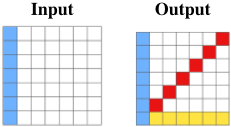
As a second illustrative scenario, consider the task shown in Figure 1, which is from the Abstraction and Reasoning Corpus (ARC) [Chollet, 2019]. The goal is to learn a function to map the input image to the output image. Rather than treat the input and output as entire images, we reason about individual pixels. Specifically, we represent the input image as a set of facts of the form in(X,Y,C), where each fact states that the input pixel at row X and column Y has colour C:
in(1,1,blue). in(2,1,blue). in(3,1,blue). in(4,1,blue). in(5,1,blue). in(6,1,blue).We use a set of facts of the form empty(X,Y) to indicate that the input pixel at row X and column Y is empty/uncoloured:
empty(1,2). empty(1,3). empty(1,4). empty(2,2). empty(2,3). empty(2,4).Similarly, we represent the output image as a set of facts of the form out(X,Y,C), where each fact states that the output pixel at row X and column Y has colour C:
out(1,1,blue). out(7,2,yellow). out(1,7,red). out(2,1,blue). out(7,3,yellow). out(2,6,red).We then try to generalise the out facts given the in and empty facts and additional background knowledge. For instance, we can learn the rules:
out(X,Y,C):- in(X,Y,C). out(X,Y,yellow):- empty(X,Y), height(X). out(X,Y,red):- empty(X,Y), height(X+Y-1).The first rule says that any coloured pixel in the input image is the same colour in the output image. The second rule says that any uncoloured pixel in the bottom row of the input image is yellow in the output image. The last rule states that any uncoloured pixel in the input image is red in the output image if its coordinates X and Y sum to H + 1, where H is the height (number of rows) of the image, i.e. if it is located on the diagonal. In other words, our representation concisely expresses the concept of a line without being given the definition.
Our representation offers several benefits. Foremost, it decomposes a task into smaller ones by decomposing each training example into multiple examples. Therefore, instead of learning a program to map an entire input list or image at once, we learn a set of rules, each generalising some list elements or image pixels. The key benefit is that we can learn each rule independently and then combine them [Cropper and Hocquette, 2023]. For instance, solving the list function task insert at position 3 with a program that processes entire examples requires at least 8 sequential actions. In contrast, our approach only needs 3 rules, each with at most 3 literals. Since each rule is smaller, the search space is reduced, making the overall program easier to learn. The Blumer bound [Blumer et al., 1987] explains why searching smaller spaces leads to better generalisation. This result says that given two search spaces, searching the smaller one is more likely to produce higher accuracy, assuming that a good program is in both.
To demonstrate our idea, we use inductive logic programming (ILP) [Muggleton, 1991; Cropper and Dumanˇci´c, 2022]. Given background knowledge and examples, the goal of ILP is to find a program that generalises the examples with respect to the background knowledge. ILP represents data and learned programs as logic programs and is therefore a relational approach to program synthesis.
Contributions. Our main contribution is to show that program synthesis tasks can be solved more easily if decomposed into relational learning tasks. The second contribution is to show that an off-the-shelf ILP system with our representation and a domain-independent bias can achieve high performance compared to domain-specific approaches on four varied and challenging datasets.
Overall, we make the following contributions:
- We introduce a relational representation that decomposes a synthesis task into multiple relational subtasks.
- We evaluate our representation using an off-the-shelf ILP system on four challenging datasets, including image reasoning, string transformations, and list functions. Our empirical results show that (i) our relational representation can drastically improve learning performance compared to a standard state/functional representation, and (ii) an off-the-shelf ILP system with our representation can outperform domain-specific approaches.
2 RelatedWork
Program synthesis. Deductive program synthesis approaches [Manna and Waldinger, 1980] deduce programs that exactly satisfy a complete specification. By contrast, we focus on inductive program synthesis, which uses partial specifications, typically input-output examples [Shapiro, 1983; Gulwani et al., 2017]. Hereafter, program synthesis refers to the inductive approach. While most approaches learn functional programs [Ellis et al., 2019; Shi et al., 2022; Witt et al., 2025; Rule et al., 2024], we learn relational (logic) programs.
Domain specific. There are many domain-specific approaches to program synthesis, including for strings [Gulwani, 2011], 3D shapes [Tian et al., 2019], list functions [Rule, 2020], and visual reasoning [Wind, 2022; Xu et al., 2023; Lei et al., 2024]. For instance, ICECUBER [Wind, 2022] is a symbolic synthesis approach for ARC. It uses 142 handcrafted functions designed by manually solving the first 100 tasks, achieving a performance of 47%. By contrast, our approach is versatile, generalises to multiple domains, and uses an off-the-shelf general-purpose ILP system.
State-based synthesis. Most synthesis approaches learn a sequence of actions or functions to transform an input state to an output state. Some approaches evaluate the distance to the desired output [Ellis et al., 2019; Cropper and Dumanˇci´c, 2020; Ameen and Lelis, 2023]. By contrast, we decompose examples and reason about elements or pixels.
LLMs. Directly comparing symbolic program synthesis to large language models (LLMs) is difficult. As Wang et al. [2024] state, LLMs need large pretraining datasets, which may include test data. For instance, LLMs approaches for ARC use datasets such as ARC-Heavy (200k tasks) or ARC-Potpourri (400k tasks) [Li et al., 2024], additional training examples [Hodel, 2024], or data augmentations [Franzen et al., 2024]. The ARChitects [Franzen et al., 2024], winners of the ARCAGI challenge, pretrained their solution on 531,318 examples. By contrast, our approach requires no pretraining and uses only the 2-10 training examples provided for each task.
Lists and images. Our experiments focus on synthesis tasks over lists and images. Lists are a simple yet expressive domain, well-suited to representing observations in many domains such as computational biology, where proteins, genes, and DNA are typically represented as strings [Raedt, 2008]. As Rule [2020] explains, lists use numbers in multiple roles (symbols, ordinals, and cardinals) and support recursive structures. Lists naturally align with familiar psychological concepts, encompass classic concept learning domains, and are formally tractable. Similarly, image tasks, like those in the ARC [Chollet, 2019], capture a wide range of abstract concepts, including shapes, patterns, and spatial relationships. They offer high task diversity and align well with human core knowledge priors.
ILP. Many ILP approaches use state representations [Lin et al., 2014; Cropper and Dumanˇci´c, 2020]. Related approaches with decomposed representations include Silver et al. [2020] and Evans et al. [2021]. These approaches are specifically designed for learning game policies from demonstrations and dynamics from temporal sequences, respectively. By contrast, we use a general-purpose off-the-shelf ILP system and consider program synthesis tasks.
Decomposition. Some approaches partition the training examples into subsets, learn programs for each subset, and combine them into a global solution [Cropper and Hocquette, 2023]. By contrast, we decompose each training example into multiple examples. BEN [Witt et al., 2025] decomposes examples into objects, aligns them through analogical reasoning, and synthesises programs for the resulting subtasks. We differ in many ways. First, while BEN uses domain-specific rules to decompose an example into objects, we simply decompose lists and images into individual elements. Second, BEN relies on hand-engineered functions, such as border(s), which draws a border of size s and denoise(s), which denoises an object in the ARC domain, whereas we use only basic arithmetic operations like addition. Finally, BEN synthesises functional programs that manipulate object-based states, whereas we learn relational rules between input and output elements.
Representation change. Representation change refers to changing the language used to represent knowledge, including the examples [Cohen, 1990]. Bundy [2013] argues that finding the right representation is the key to successful reasoning. We contribute to this view by showing that simply looking at a problem differently can greatly improve learning performance.
3 Problem Setting
We formulate the synthesis problem as an ILP problem. We assume familiarity with logic programming [Lloyd, 2012] but provide a summary in the appendix. We use the term rule synonymously with definite clause. A definite program is a set of definite clauses with the least Herbrand model semantics. We refer to a definite program as a logic program. A hypothesis space is a set of hypotheses (logic programs) defined by a language bias, which restricts the syntactic form of hypotheses [Cropper and Dumanˇci´c, 2022].
We use the learning from entailment setting of ILP [Raedt, 2008]. We define an ILP task:
Definition 1 (ILP task). An ILP task is a tuple (E+, E-, B, H, costB,E+,E-), where E+ and E- are sets of ground atoms denoting positive and negative examples respectively, B is a logic program denoting the background knowledge, H is a hypothesis space, and costB,E+,E- : H ↦→ N is a function that measures the cost of a hypothesis.
We define an optimal hypothesis:
Definition 2 (Optimal hypothesis). For an ILP task (E+,E-,B,H, costB,E+,E-), a hypothesis h ∈ H is optimal when ∀h′ ∈ H, costB,E+,E-(h) ≤ costB,E+,E-(h′ ).
In this paper, we assume a noiseless setting. We search for a hypothesis h which entails all examples in E+ (∀e ∈ E+, h ∪ B |= e) and no example in E- (∀e ∈ E-, h ∪ B ̸|= e). A hypothesis has an infinite cost if it does not entail all positive examples or if it entails any negative examples. Otherwise, its cost is equal to its size (number of literals in the hypothesis).
4 Decomposing Examples
Rather than learn a sequence of actions/functions to map an entire input to an entire output, we introduce a representation that decomposes synthesis tasks into simpler relational subtasks. Specifically, our representation decomposes a training input-output example into input and output facts.
Algorithm 1 shows our algorithm for decomposing examples. It takes as input a set of examples E and a domain D of element values. E is a set of input-output examples of the form i ↦→ o, where i is an n-dimensional array and o is an m-dimensional array. Algorithm 1 returns a tuple (E+, E-, B). We consider each example i ↦→ o in turn, and define an identifier id for the current example (line 5). For each element x in i, we generate the fact in(id,I1,...,In,V ), where (I1,...,In) is the position of x in i and V its value. We add this fact to the background knowledge B (line 9). For each element y in o, we generate the fact out(id,I1,...,Im,V ), where (I1,...,Im) is the position of y in o and V its value. We add this fact to the positive examples E+ (line 13). We reason under the closed-world assumption [Reiter, 1977] to generate negative examples. For each element y in o and for each value W in the domain of V , where W ̸= V , we generate the negative example out(id,I1,...,Im,W), where (I1,...,Im) is the position of y in o and V its value. We add this fact to the negative examples E- (line 16).
In the next section, we empirically show that using a decomposed representation can substantially improve learning performance.
Algorithm 1 Example Decomposition
1 def decompose(E, D): 2 E+, E-, B = {}, {}, {} 3 id = 0 4 for i ↦→ o in E: 5 id += 1 6 for x in i : 7 let (I1, . . . , In) be the position of x in i 8 let V be the value of x in i 9 B += in(id,I1,...,In,V ) 10 for y in o: 11 let (I1, . . . , Im) be the position of y in o 12 let V be the value of y in o 13 E+ += out(id,I1,...,Im,V ) 14 for W in D: 15 if W ̸= V : 16 E- += out(id,I1,...,Im,W) 17 return E+, E-, B5 Evaluation
To test our claim that decomposing a synthesis task can improve learning performance, our evaluation aims to answer the question:
Q1 Can our decomposed representation outperform a standard state/functional representation?
To answer Q1, we compare the learning performance of an ILP system with a decomposed representation (Algorithm 1) against a state/functional representation. We use the same ILP system so the only difference is the representation.
To test our claim that our decomposed representation is competitive with domain-specific approaches, our evaluation aims to answer the question:
- Q2 Can a general-purpose ILP system with a decomposed representation outperform domain-specific approaches?
To answer Q2, we compare the learning performance of a general-purpose ILP system with a decomposed representation against domain-specific approaches.
5.1 Datasets
We use the following diverse and challenging datasets.
1D-ARC. The 1D-ARC dataset [Xu et al., 2024] is a onedimensional adaptation of ARC.
ARC. The ARC dataset [Chollet, 2019] evaluates to perform abstract reasoning and problem-solving from a small number of examples. The goal of each task is to transform two-dimensional input images into their corresponding output images. The tasks are widely varied, including pattern recognition, geometric transformations, colour manipulation, and counting. We use the training subset and report top-1 accuracy, following related work [Witt et al., 2025; Xu et al., 2023; Xu et al., 2024; Wang et al., 2024].
Strings. The goal is to learn string transformation programs [Lin et al., 2014]. This real-world dataset gathers userprovided examples from online forums and is inspired by a dataset of user-provided examples in Microsoft Excel [Gulwani, 2011].
List functions. This dataset [Rule, 2020; Rule et al., 2024] evaluates human and machine learning ability. The goal of each task is to identify a function that maps input lists to output lists, where list elements are natural numbers. The tasks range from basic list functions, such as duplication and removal, to more complex functions involving conditional logic, arithmetic, and pattern-based reasoning.
5.2 Decomposed Representation
We use a purposely simple bias formed of the decomposed training examples and basic relations for arithmetic addition and value comparison. We describe our bias for each domain.
1D-ARC. We decompose a one-dimensional image into a set of pixel facts. The fact empty(I) holds if the pixel at index I is a background pixel (an uncoloured pixel). We allow integers between 0 and 9, representing the 10 different colours, as constant symbols.
ARC. We decompose a two-dimensional image into a set of pixel facts. The fact empty(X,Y) holds if the pixel at row X and column Y is a background pixel. We allow integers between 0 and 9 as constant symbols. We use the relations height and width to identify the dimensions of the image, midrow and midcol to locate the middle row and column, respectively, and different to determine colour inequality.
Strings. We decompose a string into a set of character facts. The fact end(I) denotes the end position of an input string. We use the relation changecase to convert a lowercase letter to uppercase or vice versa.
List functions. We decompose a list into a set of element facts. The fact end(I) denotes the end position of an input list. Following Rule [2020], we allow integers between 0 and 9 for the first 80 problems and integers between 0 and 99 for the remaining ones.
5.3 Existing Representations
We compare our approach against three standard (undecomoposed) representations from the literature.
Undecomposed list (UD-List). We use a functional representation designed for list functions tasks [Rule, 2020] which contains the relations head, tail, empty, and cons.
Undecomposed element (UD-Elem). We extend the UDList representation with the relations element at and empty at to extract elements/pixels in lists/images.
Undecomposed string (UD-Str). We use a functional representation designed for string transformation tasks [Lin et al., 2014] which recursively parses strings left to right .
We also use the same arithmetic relations and constant symbols as in the decomposed representation for each domain. Although we aim to provide similar relations for all representations, the biases in these undecomposed representations differ from those in the decomposed representation.
5.4 Systems
We use the following systems.
POPPER. We use the ILP system POPPER [Cropper and Morel, 2021] because it can learn large programs, especially programs with many independent rules [Cropper and Hocquette, 2023].
ARGA. ARGA [Xu et al., 2023] is an object-centric approach designed for ARC. ARGA abstracts images into graphs and then searches for a program using a domain-specific language. ARGA uses 15 operators, such as to rotate, mirror, fill, or hollow objects.
METABIAS (MB). The ILP systemMETABIAS [Lin et al., 2014] uses a functional representation specifically designed for the string transformations dataset that we consider in our experiments. It uses 11 operators, such as to copy a word and convert a word to uppercase or lowercase.
BEN. BEN [Witt et al., 2025] decomposes images into objects and learns a functional program. It uses 15 object features and 11 relations for ARC, and 14 features and 11 relations for strings 2 . See Section 2 for more details on BEN.
HL. Hacker-Like (HL) [Rule, 2020; Rule et al., 2024] is an inductive learning system designed for the list functions dataset and using Monte Carlo tree search. HL aims to reproduce human learning, rather than outperform it. However, it outperforms other program synthesis approaches on the list functions dataset such as METAGOL [Muggleton et al., 2015], ROBUSTFILL 3 [Devlin et al., 2017], CODEX [Chen et al., 2021], and FLEET [Yang and Piantadosi, 2022]. Among these, only HL and FLEET achieve human-level performance, while the others greatly struggle.
5.5 Experimental Setup
We measure predictive accuracy (the proportion of correct predictions on test data). For our decomposed representation, a prediction is correct only if all output elements/characters/pixels are correct. For the strings and list functions datasets, we perform leave-one-out cross-validation. For tasks 81 to 250 in the list functions dataset, due to the large number of constant values, we sample 10,000 negative examples per task. We repeat each learning task 3 times and calculate the mean and standard error. The error values in the tables represent the standard error. We use an Intel compute node with dual 2.0 GHz Intel Xeon Gold 6138 processors, 40 CPU cores, and 192 GB of DDR4 memory. Each system uses a single CPU. We describe our experimental setup for each research question.
- Q1. We compare POPPER with our decomposed representation against POPPER with undecomposed representations.
- Q2. We compare POPPER with our decomposed representation against domain-specific approaches (ARGA, METABIAS, BEN, and HL).
5.6 Results
Q1: Can our decomposed representation outperform a standard state/functional representation?
Table 2 shows the results. It shows that our decomposed representation outperforms all undecomposed ones on all four domains and for all maximum learning times except UD-Str on the strings dataset. AMcNeymar's test confirms the statistical significance (p < 0.01) of the difference. For instance, POPPER with our decomposed representation achieves 71% accuracy on strings compared to 21% for UD-List.
2 The code of BEN is not publicly available, and the authors were unable to share it with us. As a result, we show the results reported in their paper. Since the evaluation was performed on different hardware, the comparison should be viewed as indicative only.
3 ROBUSTFILL required 3 days of training which highlights the search efficiency of our approach.
| Dataset | Time | UD-List | UD-Elem | UD-Str | Decom |
|---|---|---|---|---|---|
| 1 | 0 ± 0 | 0 ± 0 | 0 ± 0 | 59 ± 7 | |
| 1DARC | 10 | 0 ± 0 | 0 ± 0 | 0 ± 0 | 63 ± 7 |
| 60 | 0 ± 0 | 0 ± 0 | 0 ± 0 | 69 ± 6 | |
| 1 | 0 ± 0 | 0 ± 0 | 0 ± 0 | 15 ± 1 | |
| ARC | 10 | 0 ± 0 | 0 ± 0 | 0 ± 0 | 20 ± 1 |
| 60 | 0 ± 0 | 0 ± 0 | 0 ± 0 | 22 ± 1 | |
| 1 | 15 ± 2 | 11 ± 2 | 55 ± 3 | 54 ± 3 | |
| Strings | 10 | 17 ± 2 | 16 ± 2 | 77 ± 2 | 68 ± 2 |
| 60 | 21 ± 2 | 19 ± 2 | 79 ± 2 | 71 ± 2 | |
| 1 | 10 ± 1 | 8 ± 1 | 2 ± 1 | 27 ± 2 | |
| Lists | 10 | 12 ± 1 | 11 ± 1 | 2 ± 1 | 46 ± 2 |
| 60 | 14 ± 1 | 13 ± 1 | 2 ± 1 | 52 ± 2 |
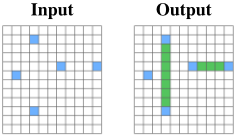
One reason for the performance improvement is that our representation decomposes a task into multiple subtasks. For instance, consider the ARC task 253bf280 shown in Figure 2. The goal is to colour in green pixels in between two blue pixels in the input image. Our approach learns the rules:
out(X,Y,blue):- in(X,Y,blue). out(X,Y,green):- in(X,Y1,blue), in(X,Y2,blue), Y1<Y<Y2. out(X,Y,green):- in(X1,Y,blue), in(X2,Y,blue), X1<X<X2.The first rule says that an out pixel is blue if it is blue in the input. The second rule says that an out pixel is green if it is between two blue pixels in the same row in the input. The third rule says that an out pixel is green if it is between two blue pixels in the same column in the input. In other words, our approach learns one rule for the permanence of blue pixels, one for horizontal lines, and one for vertical lines. Moreover, our approach learns this perfect solution without being given the definition of a line. By contrast, POPPER cannot solve this task with any of the undecomposed representations tested.
Similarly, consider the string task 117 shown in Table 3. The goal is to capitalise the first letter of both the first and last names. For this task, our approach learns the rules:
out(1,C):- in(1,C1), changecase(C1,C). out(I,C):- in(I,C1), changecase(C1,C), in(I-1, ' '). out(I,C):- in(I,C), in(I-1,C1), changecase(C1,C2).The first rule says that the out character at index 1 is the in character at index 1 uppercased. The second rule says that the out character at index I is the in character at index I uppercased if the in character at index I-1 is a space. The last rule says that the out character at index I is the in character at index I if the in character at index I - 1 is a lowercase letter. In other words, our approach learns three rules: one for uppercasing the first letter of the first name, one for the last name, and one for copying the remaining lowercase letters. It learns this program without being given the definition of a word. By contrast, POPPER cannot solve this task with any of the undecomposed representations tested.
| Input | Output |
|---|---|
| joanie faas oma cornelison | Joanie Faas Oma Cornelison |
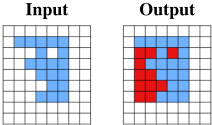
Another reason for the performance improvement is that our decomposed representation allows programs to be expressed more compactly. In program synthesis, the search space grows exponentially with the size of the target program. By using a more compact representation, we reduce the size of the search space. The Blumer bound [Blumer et al., 1987] theoretically explains why searching smaller spaces leads to better generalisation. This result says that given two search spaces, searching the smaller one is more likely to produce higher accuracy, assuming that a good program is in both. For instance, the goal of the ARC task 6d75e8bb (Figure 3) is to colour in red empty pixels within the rectangle delimited by blue pixels. Our approach learns the rules:
The first rule says that an out pixel has colour C if it has colour C in the input. The second rule says that an out pixel is red if it is empty in the input and if there are a pixel in the same row (X) and a pixel in the same column (Y) with the same colour (C) in the input. In other words, our approach compactly captures the concept of a rectangle without being given the definition in the background knowledge.
POPPER struggles with our decomposed representation to solve some tasks due to our purposely simple bias. For instance, the goal of the ARC task 5582e5ca is to learn a program that colours the output image with the majority colour from the input image. However, we do not include a counting mechanism in our bias and POPPER struggles to learn how to count, as it requires reasoning over all pixels.
Overall, these results suggest that the answer to Q1 is yes: our decomposed representation can outperform an undecomposed one.
Q2: Can a general-purpose ILP system with a decomposed representation outperform domain-specific approaches?
Table 4 shows the results. It shows that the general-purpose ILP system POPPER with our decomposed representation is competitive with, and can outperform, domain-specific approaches. Notably, it outperforms ARGA on ARC, METABIAS on strings and HL on lists. AMcNeymar's test confirms the significance (p < 0.01) of these differences. We discuss the results for each dataset in turn.
| Dataset | Time | ARGA | BEN | MB | HL | Decom |
|---|---|---|---|---|---|---|
| 1 | 93±6 | na | 0±0 | 0±0 | 59±7 | |
| 1DARC | 10 | 94±6 | na | 0±0 | 0±0 | 63±7 |
| 60 | 94±6 | na | 0±0 | 0±0 | 69±6 | |
| 1 | 8±1 | 6±na | 0±0 | 0±0 | 15 ±1 | |
| ARC | 10 | 11±2 | 25±na | 0±0 | 0±0 | 20±1 |
| 60 | 12±2 | na | 0±0 | 0±0 | 22±1 | |
| 1 | 0±0 | 85±na | 25±2 | 0±0 | 54±3 | |
| Strings | 10 | 0±0 | na | 25±2 | 0±0 | 68±2 |
| 60 | 0±0 | na | 26±2 | 0±0 | 71±2 | |
| 1 | 0±0 | na | 0±0 | 31±2 | 27±2 | |
| Lists | 10 | 0±0 | na | 7±1 | 33±2 | 46±2 |
| 60 | 0±0 | na | 8±1 | 35±3 | 52±2 |
1D-ARC ARGA outperforms our decomposed representation on the 1D-ARC dataset (94% vs 69% predictive accuracy with a maximum learning time of 1h). This result is unsurprising because ARGA is designed for image reasoning tasks and uses domain-specific operators, such as the ability to fill, mirror, and hollow objects. This background knowledge is particularly useful for tasks such as fill, mirror, and hollow. By contrast, our decomposed representation is not designed for these tasks and does not include domain-specific relations.
Our decomposed representation significantly outperforms HL on the 1D-ARC dataset (69% vs 0% predictive accuracy with a maximum learning time of 1h). Although these tasks involve identifying list functions, HL struggles on them. We asked the authors of HL for potential explanations and they explained that HL does not perform as well on problems requiring a recursive solution as it does on non-recursive problems. For instance, the task denoise (Figure 4) requires learning a recursive solution with an undecomposed representation, which is difficult for HL. By contrast, our approach learns the non-recursive rule:
This rule says that an out pixel at index I has colour C if there are two adjacent pixels with colour C in the input image (at indices I1 and I1 + 1), where one of these pixels is at index I (if I2 = 0, then I1 = I, and if I2 = 1, then I1 + 1 = I), i.e. the pixel at index I has an adjacent pixel with the same colour. This rule generalises perfectly to the test data. Notably, unlike ARGA and BEN, which both use a denoise operator, our approach learns this rule without domain-specific operators.
4 We report results for 1 and 10 minutes for ARC and 1 min for strings for BEN, as they are the only ones provided in the paper.

ARC POPPER with our decomposed representation outperforms ARGA on the ARC (22% vs 12% accuracy with a maximum learning time of 1h). ARGA struggles, partly because it assumes input and output images have identical sizes, preventing it from solving 138/400 tasks with different sizes.
HL assumes inputs and outputs are one-dimensional lists, so it struggles on ARC. METABIAS uses a bias for string manipulation, such as skipping words or converting them to uppercase, so struggles on both 1D-ARC and ARC, where values are all digits.
BEN achieves 25% accuracy given a 10 mins search timeout. BEN uses a hand-designed domain-specific function to decompose images into objects. Without this function, the accuracy of BEN drops to 6%. Moreover, BEN uses hand-designed ARC-specific functions, such as mirror, inner, and denoise. By contrast, we only use general background knowledge, such as how to add two numbers.
Strings ARGA achieves default performance (0%) because it cannot identify any object. Similarly, HL achieves only default performance, as it assumes constants are numbers and cannot handle characters.
POPPER with our decomposed representation significantly outperforms METABIAS on the string dataset and achieves 71% vs 26% with a maximum learning time of 1h. The reason is that POPPER outperforms METAGOL on which METABIAS is based [Cropper and Hocquette, 2023].
BEN outperforms POPPER with our representation (85% versus 54% in 1min). BEN uses domain-specific background functions, such as capitalising the first character, dropping the first n characters, and adding a white space, as well as features, such as the number of digits, uppercase and lowercase letters. By contrast, we only use general background knowledge.
List functions POPPER with our decomposed representation significantly outperforms ARGA on the list functions dataset (52% vs 0% in 1h). ARGA struggles because it requires inputs and outputs of identical size, which prevents it from solving 188/250 tasks. Additionally, ARGA is designed for object-centric tasks so struggles when it cannot identify meaningful objects. Finally, ARGA uses operators designed for image reasoning, which do not generalise well to list functions. By contrast, our approach generalises to a broader range of problems, partly because we use a domain-independent bias.
POPPER with our decomposed representation significantly outperforms HL (52% vs 35% in 1h). Since HL is designed to reproduce human learning, it is understandable that our approach performs better. For instance, the goal of the list function task 194 (Table 5) is to reverse the input list and add its length at the start and end. Humans achieve less than 25% accuracy on this task [Rule, 2020] and HL achieves 0%. By contrast, we achieve 100% accuracy with the rules:
out(1,E-1):- end(E). out(I,V):- end(E), add(I,I1,E+1), in(I1,V). out(E+1,E-1):- end(E).The first rule says that the out element at index 1 is E - 1, where E is the index of the first empty position in the input list. The last rule says that the out element at index E + 1 is E - 1, where E is the index of the first empty position in the input list. The second rule says that the out element at index I is the in element at index I1, where I + I1 = E + 1. In other words, this second rule compactly expresses the concept of reverse and move by one position.
| Input | Output |
|---|---|
| [81, 43] | [2, 43, 81, 2] |
| [1, 63, 21, 16] | [4, 16, 21, 63, 1, 4] |
Overall, the results suggest that the answer to Q2 is yes: a general-purpose ILP system with a decomposed representation can outperform domain-specific approaches.
6 Conclusions and Limitations
We have introduced a representation that decomposes synthesis tasks into smaller relational subtasks. Our empirical results on four domains show that our decomposed representation substantially outperforms an undecomposed one. Moreover, we show that an off-the-shelf ILP system using our decomposed representation with little domain-specific bias is competitive with, and in some cases outperforms, highly engineered domain-specific approaches. More broadly, our results show that simply representing a problem differently can greatly improve learning performance.
6.1 Limitations
Bias. In our evaluation, we use a purposely simple bias formed of raw input (elements or pixels) and basic arithmetic relations. While this simple bias achieves good performance, it is limiting for some tasks. For instance, by adding relations describing the ordinality of some characters in the strings domain, we improve the predictive accuracy by 9% and 4% with maximum learning times of 1 minute and 60 minutes, respectively. Future work should explore adding general-purpose concepts, such as counting, to further improve performance.
ILP system. We have shown that an off-the-shelf ILP system is competitive with domain-specific approaches. However, this system struggles on some tasks, where a good solution exists in the search space but the system cannot find it within the time limit. This limitation is due to the system we use and not our representation. However, our decomposed representation is system-agnostic, so we could use alternative ILP systems. Moreover, because we use an off-the-shelf ILP system, our approach naturally benefits from any developments in ILP.
7 Appendices, Code, and Data
A longer version of this paper with the appendices is available at https://arxiv.org/pdf/2408.12212. The experimental code and data are available at https://github.com/celinehocquette/ ijcai25-relational-decomposition.
Acknowledgements
The authors acknowledge the use of the IRIDIS High Performance Computing Facility at the University of Southampton in completing this work.
@inproceedings{ijcai2025p504,
  title     = {Relational Decomposition for Program Synthesis},
  author    = {Hocquette, Céline and Cropper, Andrew},
  booktitle = {Proceedings of the Thirty-Fourth International Joint Conference on
               Artificial Intelligence, {IJCAI-25}},
  publisher = {International Joint Conferences on Artificial Intelligence Organization},
  editor    = {James Kwok},
  pages     = {4526--4534},
  year      = {2025},
  month     = {8},
  note      = {Main Track},
  doi       = {10.24963/ijcai.2025/504},
  url       = {https://doi.org/10.24963/ijcai.2025/504},
}
TY - CPAPER TI - Relational Decomposition for Program Synthesis AU - Hocquette, Céline AU - Cropper, Andrew T2 - Proceedings of the Thirty-Fourth International Joint Conference on Artificial Intelligence, IJCAI-25 PB - International Joint Conferences on Artificial Intelligence Organization PY - 2025 SP - 4526 EP - 4534 DO - 10.24963/ijcai.2025/504 UR - https://doi.org/10.24963/ijcai.2025/504 ER -Copied
Machine-readable versions of this paper, for tools and AI agents:





