
FS-KEN: Few-shot Knowledge Graph Reasoning by Adversarial Negative Enhancing
Proceedings of the Thirty-Fourth International Joint Conference on Artificial Intelligence. Main Track. Pages 4597-4605.
https://doi.org/10.24963/ijcai.2025/512
Keywords
- Computer Vision: CV: Structural and model-based approaches, knowledge representation and reasoning
- Knowledge Representation and Reasoning: KRR: Learning and reasoning
- Machine Learning: ML: Few-shot learning
Abstract
Few-shot knowledge graph reasoning (FS-KGR) try to infer missing facts in a knowledge graphs using limited data (such as only 3/5 samples).Existing strategies have shown good performance by mining more supervised information for few-shot learning through meta-learning and self-supervised learning. However, the problem of insufficient samples has not been fundamentally solved. In this paper, we propose a novel algorithm based on adversarial learning for Enhancing Negative samples in few-shot scenarios of FS-KGR, termed FS-KEN. Specifically, we are the first to use GAN to conduct data augmentation on FS-KGR scenario. FS-KEN uses policy gradient GANs for negative sample augmentation, solving the gradient back-propagation issue in traditional GANs. The generator aims to produce high-quality negative entities. while the objective of the discriminator is to distinguish between generated entities and real entities. Comprehensive experiments conducted on two few-shot knowledge graph completion datasets reveal that FS-KEN surpasses other baseline models, achieving state-of-the-art results.
- [Bollacker et al., 2008] Kurt Bollacker, Colin Evans, Praveen Paritosh, Tim Sturge, and Jamie Taylor. Freebase: a collaboratively created graph database for structuring human knowledge. In Proceedings of the 2008 ACM SIGMOD international conference on Management of data, pages 1247-1250, 2008.
- [Bordes et al., 2013] Antoine Bordes, Nicolas Usunier, Alberto Garcia-Duran, Jason Weston, and Oksana Yakhnenko. Translating embeddings for modeling multi-relational data. Advances in neural information processing systems, 26, 2013.
- [Brown et al., 2020] Tom Brown, Benjamin Mann, Nick Ry- der, Melanie Subbiah, Jared D Kaplan, Prafulla Dhari- wal, Arvind Neelakantan, Pranav Shyam, Girish Sastry, Amanda Askell, et al. Language models are few-shot learners. Advances in neural information processing sys- tems, 33:1877-1901, 2020.
- [Chao and Zhang, 2023] Xuewei Chao and Lixin Zhang. Few-shot imbalanced classification based on data augmen- tation. Multimedia Systems, 29(5):2843-2851, 2023.
- [Chen et al., 2019] Mingyang Chen, Wen Zhang, Wei Zhang, Qiang Chen, and Huajun Chen. Meta relational learning for few-shot link prediction in knowledge graphs. arXiv preprint arXiv:1909.01515, 2019.
- [Chen et al., 2021] Shiming Chen, Wenjie Wang, Beihao Xia, Xinge You, Qinmu Peng, Zehong Cao, and Weiping Ding. Cde-gan: Cooperative dual evolution-based genera- tive adversarial network. IEEE Transactions on Evolution- ary Computation, 25(5):986-1000, 2021.
- [Chen et al., 2023] Man-Sheng Chen, Chang-Dong Wang, and Jian-Huang Lai. Low-rank tensor based proximity learning for multi-view clustering. IEEE Trans. Knowl. Data Eng., 35(5):5076-5090, 2023.
- [Chen et al., 2024] Man-Sheng Chen, Xi-Ran Zhu, Jia-Qi Lin, and Chang-Dong Wang. Contrastive multiview at- tribute graph clustering with adaptive encoders. IEEE Transactions on Neural Networks and Learning Systems, pages 1-12, 2024.
- [Chen et al., 2025] Man-Sheng Chen, Jia-Qi Lin, Chang- Dong Wang, Dong Huang, and Jian-Huang Lai. Con- trastive ensemble clustering. IEEE Transactions on Neural Networks and Learning Systems, 2025.
- [Dosovitskiy et al., 2020] Alexey Dosovitskiy, Lucas Beyer, Alexander Kolesnikov, Dirk Weissenborn, Xiaohua Zhai, Thomas Unterthiner, Mostafa Dehghani, Matthias Min- derer, Georg Heigold, Sylvain Gelly, et al. An image is worth 16x16 words: Transformers for image recognition at scale. arXiv preprint arXiv:2010.11929, 2020.
- [Huang et al., 2022] Qian Huang, Hongyu Ren, and Jure Leskovec. Few-shot relational reasoning via connection subgraph pretraining. arXiv preprint arXiv:2210.06722, 2022.
- [Ji et al., 2015] Guoliang Ji, Shizhu He, Liheng Xu, Kang Liu, and Jun Zhao. Knowledge graph embedding via dy- namic mapping matrix. In Proceedings of the 53rd an- nual meeting of the association for computational linguis- tics and the 7th international joint conference on natural language processing (volume 1: Long papers), pages 687- 696, 2015.
- [Jiang et al., 2023] Pengcheng Jiang, Cao Xiao, Adam Cross, and Jimeng Sun. Graphcare: Enhancing healthcare predictions with personalized knowledge graphs. arXiv preprint arXiv:2305.12788, 2023.
- [Kim and Hwang, 2022] Jun-Hyung Kim and Youngbae Hwang. Gan-based synthetic data augmentation for in- frared small target detection. IEEE Transactions on Geo- science and Remote Sensing, 60:1-12, 2022.
- [Kim et al., 2022] Hazel H Kim, Daecheol Woo, Seong Joon Oh, Jeong-Won Cha, and Yo-Sub Han. Alp: Data augmen- tation using lexicalized pcfgs for few-shot text classifica- tion. In Proceedings of the aaai conference on artificial intelligence, volume 36, pages 10894-10902, 2022.
- [Li et al., 2023] Qian Li, Shu Guo, Jia Wu, Jianxin Li, Jiawei Sheng, Hao Peng, and Lihong Wang. Event extraction by associating event types and argument roles. IEEE Trans- actions on Big Data, 9(6):1549-1560, 2023.
- [Li et al., 2024] Qian Li, Jianxin Li, Jia Wu, Xutan Peng, Cheng Ji, Hao Peng, Lihong Wang, and Philip S Yu. Triplet-aware graph neural networks for factorized multi- modal knowledge graph entity alignment. Neural Net- works, 179:106479, 2024.
- [Li et al., 2025] Yuhan Li, Xinni Zhang, Linhao Luo, Heng Chang, Yuxiang Ren, Irwin King, and Jia Li. G-refer: Graph retrieval-augmented large language model for ex- plainable recommendation. In Proceedings of the ACM on Web Conference 2025, pages 240-251, 2025.
- [Liang et al., 2024] Ke Liang, Lingyuan Meng, Meng Liu, Yue Liu, Wenxuan Tu, Siwei Wang, Sihang Zhou, Xin- wang Liu, Fuchun Sun, and Kunlun He. A survey of knowledge graph reasoning on graph types: Static, dy- namic, and multi-modal. IEEE Transactions on Pattern Analysis and Machine Intelligence, 46(12):9456-9478, 2024.
- [Liao et al., 2022] Wentong Liao, Kai Hu, Michael Ying Yang, and Bodo Rosenhahn. Text to image generation with semantic-spatial aware gan. In Proceedings of the IEEE/CVF conference on computer vision and pattern recognition, pages 18187-18196, 2022.
- [Liu et al., 2024] Meng Liu, Ke Liang, Yawei Zhao, Wenx- uan Tu, Sihang Zhou, Xinbiao Gan, Xinwang Liu, and He Kunlun. Self-supervised temporal graph learning with temporal and structural intensity alignment. IEEE Trans- actions on Neural Networks and Learning Systems, 2024.
- [Luo et al., 2025] Linhao Luo, Zicheng Zhao, Chen Gong, Gholamreza Haffari, and Shirui Pan. Graph-constrained reasoning: Faithful reasoning on knowledge graphs with large language models. In Forty-second International Conference on Machine Learning, 2025.
- [Meng et al., 2024a] Lingyuan Meng, Ke Liang, Bin Xiao, Sihang Zhou, Yue Liu, Meng Liu, Xihong Yang, Xinwang Liu, and Jinyan Li. Sarf: Aliasing relation-assisted self- supervised learning for few-shot relation reasoning. IEEE Transactions on Neural Networks and Learning Systems, 2024.
- [Meng et al., 2024b] Lingyuan Meng, Ke Liang, Hao Yu, Yue Liu, Sihang Zhou, Meng Liu, and Xinwang Liu. Fedean: Entity-aware adversarial negative sampling for federated knowledge graph reasoning. IEEE Transactions on Knowledge and Data Engineering, 2024.
- [Mitchell et al., 2018] T. Mitchell, W. Cohen, E. Hruschka, P. Talukdar, B. Yang, J. Betteridge, A. Carlson, B. Dalvi, M. Gardner, B. Kisiel, J. Krishnamurthy, N. Lao, K. Mazaitis, T. Mohamed, N. Nakashole, E. Platan- ios, A. Ritter, M. Samadi, B. Settles, R. Wang, D. Wi- jaya, A. Gupta, X. Chen, A. Saparov, M. Greaves, and J. Welling. Never-ending learning. Commun. ACM, 61(5):103-115, apr 2018.
- [Paszke et al., 2019] Adam Paszke, Sam Gross, Francisco Massa, Adam Lerer, James Bradbury, Gregory Chanan, Trevor Killeen, Zeming Lin, Natalia Gimelshein, Luca Antiga, et al. Pytorch: An imperative style, high- performance deep learning library. Advances in neural in- formation processing systems, 32, 2019.
- [Saxena et al., 2020] Apoorv Saxena, Aditay Tripathi, and Partha Talukdar. Improving multi-hop question answer- ing over knowledge graphs using knowledge base embed- dings. In Proceedings of the 58th annual meeting of the as- sociation for computational linguistics, pages 4498-4507, 2020.
- [Sheng et al., 2020] Jiawei Sheng, Shu Guo, Zhenyu Chen, Juwei Yue, Lihong Wang, Tingwen Liu, and Hongbo Xu. Adaptive attentional network for few-shot knowl- edge graph completion. arXiv preprint arXiv:2010.09638, 2020.
- [Sun et al., 2021] Jian Sun, Yu Zhou, and Chengqing Zong. One-shot relation learning for knowledge graphs via neighborhood aggregation and paths encoding. Transac- tions on Asian and Low-Resource Language Information Processing, 21(3):1-19, 2021.
- [Sutton et al., 1999] Richard S Sutton, David McAllester, Satinder Singh, and Yishay Mansour. Policy gradient methods for reinforcement learning with function approx- imation. Advances in neural information processing sys- tems, 12, 1999.
- [Teru et al., 2020] Komal Teru, Etienne Denis, and Will Hamilton. Inductive relation prediction by subgraph rea- soning. In International Conference on Machine Learning, pages 9448-9457. PMLR, 2020.
- [Viswanathan and Singh, 2023] Shyam Balagurumurthy Viswanathan and Gaurav Singh. Advancing financial operations: leveraging knowledge graph for innova- tion. International Journal of Computer Trends and Technology, 71(10):51-60, 2023.
- [Wang et al., 2021] Hongwei Wang, Hongyu Ren, and Jure Leskovec. Relational message passing for knowledge graph completion. In Proceedings of the 27th ACM SIGKDD Conference on Knowledge Discovery & Data Mining, pages 1697-1707, 2021.
- [Wu et al., 2023] Likang Wu, Zhi Li, Hongke Zhao, Zhefeng Wang, Qi Liu, Baoxing Huai, Nicholas Jing Yuan, and En- hong Chen. Recognizing unseen objects via multimodal intensive knowledge graph propagation. In Proceedings of the 29th ACM SIGKDD Conference on Knowledge Dis- covery and Data Mining, pages 2618-2628, 2023.
- [Wu et al., 2024a] Likang Wu, Zhi Li, Hongke Zhao, Zhenya Huang, Yongqiang Han, Junji Jiang, and Enhong Chen. Supporting your idea reasonably: A knowledge-aware topic reasoning strategy for citation recommendation. IEEE Transactions on Knowledge and Data Engineering, 2024.
- [Wu et al., 2024b] Likang Wu, Zhaopeng Qiu, Zhi Zheng, Hengshu Zhu, and Enhong Chen. Exploring large lan- guage model for graph data understanding in online job recommendations. In Proceedings of the AAAI Conference on Artificial Intelligence, volume 38, pages 9178-9186, 2024.
- [Xiong et al., 2018] Wenhan Xiong, Mo Yu, Shiyu Chang, Xiaoxiao Guo, and William Yang Wang. One-shot re- lational learning for knowledge graphs. arXiv preprint arXiv:1808.09040, 2018.
- [Yang et al., 2014] Bishan Yang, Wen-tau Yih, Xiaodong He, Jianfeng Gao, and Li Deng. Embedding entities and relations for learning and inference in knowledge bases. arXiv preprint arXiv:1412.6575, 2014.
- [Yu et al., 2024] Hao Yu, Ke Liang, Dayu Hu, Wenxuan Tu, Chuan Ma, Sihang Zhou, and Xinwang Liu. Gzoo: Black- box node injection attack on graph neural networks via zeroth-order optimization. IEEE Transactions on Knowl- edge and Data Engineering, 2024.
- [Zhang et al., 2020] Chuxu Zhang, Huaxiu Yao, Chao Huang, Meng Jiang, Zhenhui Li, and Nitesh V Chawla. Few-shot knowledge graph completion. In Proceedings of the AAAI conference on artificial intelligence, volume 34, pages 3041-3048, 2020.
- [Zhang et al., 2023] Lei Zhang, Wuji Zhang, Likang Wu, Ming He, and Hongke Zhao. Shgcn: Socially en- hanced heterogeneous graph convolutional network for multi-behavior prediction. ACM Transactions on the Web, 18(1):1-27, 2023.
References were extracted automatically from the PDF and may contain errors.
Full text extracted automatically from the PDF; figures, tables and equations may differ. The PDF is the version of record.
1 Introduction
Knowledge graphs (KGs) structure extensive, multirelational real-world human knowledge using heterogeneous graph formats [Liang et al., 2024; Zhang et al., 2023; Chen et al., 2024]. Such information is stored as triplets (head entity, relation, tail entity), where relation signifies relations. KGs are instrumental in numerous applications, including recommendation systems [Wu et al., 2024b; Wu et al., 2024a], medical recognition [Jiang et al., 2023], financial analysis [Viswanathan and Singh, 2023], and question answering [Saxena et al., 2020].
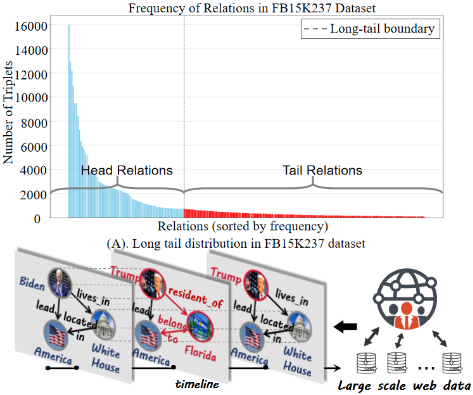
However, due to the complexity and diversity of relationships in the human world, KGs have the inherent property of being incomplete [Wu et al., 2023; Chen et al., 2023; Chen et al., 2025]. To improve the quality and usability of KGs, it is necessary to complete the missing facts based on existing data. This task is termed knowledge graph reasoning (KGR) [Luo et al., 2025; Li et al., 2025]. Although various methods have achieved good performance in solving KGR tasks, the performance of these methods is heavily dependent on sufficient labeled data. However, real-world knowledge graph data often has a long-tail distribution, that is, a few relations contain sufficient triples, while most relations contain too few triples. As shown in Figure 1.A, in the FB15K237 dataset, the number of triples corresponding to more than 60% of the relations only accounts for 10% of the total number of triples. In addition, the knowledge graph is dynamically changing and constantly updated. As shown in Figure 1.b, new entities and relations may be continuously added to the knowledge graph over time, and the sample size is small. When the data distribution is imbalanced, traditional methods will produce performance deviation, overfitting the head class data and ignoring the learning of the tail class, which will hinder performance improvement. Therefore, investigating the application of few-shot learning techniques in knowledge graph reasoning holds substantial practical value and relevance in contemporary research.
† Corresponding Authors.
Current approaches of FS-KGR are predominantly divided into two main groups, i.e., techniques based on meta-learning and those utilizing self-supervised learning. Specifically, meta-learning-based approaches like GMatching [Xiong et al., 2018] and FSRL [Zhang et al., 2020] seek to develop differentiable metrics that expand the distance between support sets and negative query triplets while reducing the proximity from positive query triplets. Furthermore, Att-FMetric [Sun et al., 2021] incorporates attention-based neighborhood aggregation and path encoding to predict long-tail relationships, while MetaR [Chen et al., 2019] trains a meta-learner with limited instances to optimize the task-specific learner. However, these approaches rely heavily on manually crafted metatraining tasks, incurring significant human labor costs. As a more effective learning paradigm, self-supervised pretraining has demonstrated powerful learning with few-shot samples in other domains [Li et al., 2024; Li et al., 2023] but has been less applied in FS-KGR tasks. The most representative method is CSR [Huang et al., 2022], which learns structural information through subgraph mining, achieving satisfactory performance. Although both types of methods have achieved satisfactory performance, they essentially mine richer supervised information from a small amount of labeled data, and do not fundamentally solve the class imbalance problem caused by a long-tailed distribution. In addition, although the selfsupervised-based paradigm does not require the construction of meta-training tasks, it still requires the manual construction of meta-testing tasks, which is time-consuming and laborious in real-world application scenarios.
To address these challenges of insufficient sample data, various data augmentation strategies have been proposed in other fields such as computer vision [Kim and Hwang, 2022] and natural language processing [Liao et al., 2022], among which the Generative Adversarial Network (GAN) has been proven to be an effective method. However, to our best knowledge, GAN has not been extended to FS-KGR tasks. To fill this gap, we introduce GAN to increase the number of samples in FS-KGR tasks. However, triplets reflect realworld facts in KGs, thus augmenting data for a specific relation involves fabricating entities and facts, which rules out direct positive sample enhancement within the knowledge graph. To tackle this challenge, we focus on the negative augmentation, which is crucial to the hinge loss in most KGR models. Therefore, we proposes a FS-KGR method based on adversarial learning for negative sampling. Specifically, the generator and discriminator aims to generate high-quality negative entities jointly. Furthermore, to address the discrete sampling issue, we combine policy gradient theory with GAN. Finally, we integrated FS-KEN into the latest baselines to verify its effectiveness on two datasets. Specifically, the main contributions of our paper include three aspects:
- We propose a novel FS-KGR method, termed FS-KNE, which leverages adversarial learning for negative augmentation. To the best of our knowledge, we are the first to address the class imbalance issue arising from longtail distributions through data augmentation within the FS-KGR scenario.
- To overcome the limitation of traditional GANs that cannot backpropagate gradients to the generator during dis-
- crete sampling, we introduce a reinforcement learning mechanism, designing a policy gradient GAN for discrete data production, ensuring the creation of highquality negative entities.
- Extensive experiments on two FS-KGR datasets demonstrate the superior performance of FS-KEN in the task of FS-KGR task.
2 RelatedWork
2.1 Few-shot Knowledge Graph Reasoning
Meta-learning Based Knowledge Graph Reasoning
As an efficient learning paradigm, the meta-learning paradigm achieve knowledge transfer to new tasks through carefully designed meta-tasks. To tackle the issue of limited data availability in few-shot learning scenarios, a significant number of FS-KGR approaches have embraced the metalearning framework as their primary methodology. As the first model of FS-KGR, GMatching [Xiong et al., 2018]based on metric learning, which obtains embedding representations through neighborhood structures and uses an LSTM to match the embeddings with the target, subsequently producing similarity metrics that quantify the resemblance between the query triplet and the reference dataset. FSRL [Zhang et al., 2020] demonstrates proficiency in extracting insights from diverse graph configurations and synthesizing the feature representations of few-shot instances, assigning different weights to neighborhood information through a heterogeneous neighbor decoder. FAAN [Sheng et al., 2020] incorporates an advanced approach to analyze the evolving characteristics of both entities and relations. By employing an attention-based framework, it effectively identifies and adapts to the shifting attributes that vary with distinct operational contexts. Furthermore, MetaR [Chen et al., 2019] enhances entity embeddings using neighborhood information by adopting a meta-learning framework, which includes gradient meta-learning and relation meta-learning, to perform FKGR tasks, effectively improving the performance. However, the performance of meta-learning-based methods relies heavily on hand-designed meta-tasks. The construction process of meta-tasks is time-consuming and laborious, which hinders further generalization of the model.
Self-supervised Based Knowledge Graph Reasoning
In recent years, self-supervised learning has attracted significant attention in various fields such as computer vision [Dosovitskiy et al., 2020], natural language processing [Brown et al., 2020], graph learning [Yu et al., 2024; Liu et al., 2024], and knowledge graph representation learning [Meng et al., 2024b]. Inspired by their success, some FSKGR methods have been designed powerful self-supervised pre-training objectives without the need to construct metatasks, significantly improving the performance of FS-KGR tasks. Concretely, CSR [Huang et al., 2022] is based on the theory of hypothetical induction, which represents the few-shot relations through the maximal common subgraph, and ultimately transforms the few-sample learning reasoning into an inductive relational reasoning task. SARF [Meng et al., 2024a] proposed an aliasing relation-assisted mechanism, which mines aliasing relations from head relations that are semantically similar to the target long-tail relations. Although these approaches have achieved satisfactory performance due to the mining of more supervision information, the class imbalance problem caused by the long-tail distribution has not been fully solved.
2.2 Few-shot Data Augmentation Strategy
The few-shot data augmentation strategy aims to solve the class imbalance challenge caused by the long-tail distribution and provide sufficient and high-quality samples for training. A large number of methods have been proposed recently. Specifically, H-SMOTE [Chao and Zhang, 2023] proposed a new paradigm based on the reasonable and stable data augmentation. ALP [Kim et al., 2022] proposes a novel text augmentation method that increases the diversity of sentence structure and word choice in sentences while preserving semantic content. CDE-GAN [Chen et al., 2021] utilized generative adversarial networks to try to generate high-quality negative samples for novelty detection. Although these strategies are considered effective, It is difficult to perform data augmentation for the KGs since the data in the KGs is factual.
3 Methodology
3.1 Preliminaries
A knowledge graph can be conceptualized as a directed network structure consisting of three fundamental components: a collection of entities denoted as E = {e1, e2, ..., en}, a set of relationships represented by R = {r1, r2, ..., rm}, and a series of triplets T. Each triplet within this framework is structured as an ordered tuple (h, r, t), where h and t are elements of E, and r belongs to R, signifying the head entity, tail entity, and their relations, respectively. For a incompleteness triplet ti ∈ T ′ , where ti = (h, r, ?) or ti = (?, r, t) or ti = (h, ?, t), which has a missing entity/relation, knowledge graph reasoning aims to infer the missing entity/relation based on existing facts T .
Compared with the conventional knowledge graph reasoning, few-shot knowledge graph reasoning refers to the task of reasoning over a knowledge graph where the number of labeled triplets associated with a particular relation is limited. In such scenarios, the goal is to leverage the limited number of labeled examples to generalize to other unseen triplets involving the same or similar relations. Formally, let S = {(hk, tk) | (hk, r, tk) ∈ T, r ∈ R} denote a set of entity pairs (hk, tk) associated with a specific relation r within the triplet set T, the goal of the few-shot knowledge graph completion is to predict triplets for the under-sampled relation r.
3.2 FS-KGR Framework
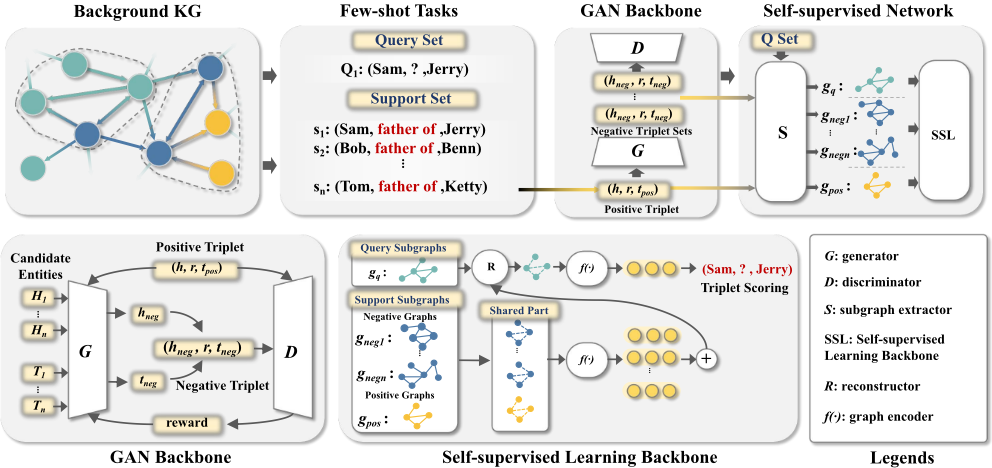
The FS-KGR based on adversarial learning for negative sampling is shown in Figure 2. Specifically, the FS-KEN algorithm consists of two modules, i.e., a GAN backbone network and a self-supervised learning network. The GAN backbone network aims to generate high quality negative samples for the training process. Specifically, it takes instances in the support set as positive samples and generates high-quality negative samples through a policy gradient GAN. The selfsupervised learning network try to learn the representation of few-shot relations. Concretely, it inputs positive and negative samples to extract subgraphs and then reconstructs the maximum common subgraph in these subgraphs using a generative self-supervised method. The detailed process of each module of FS-KEN is introduced below.
GAN Backbone Network
In our FS-KEN framework, both the generator and discriminator are built upon knowledge graph embedding (KGE) models, utilizing softmax probabilities to represent the likelihood of each entity. Specifically, the generator is designed to produce high-quality negative entities by leveraging feedback from the discriminator. These rewards guide the generator in generating negative samples that align more closely with the underlying structure of the knowledge graph. Conversely, the discriminator is tasked with encoding the graph, integrating both true and generated negative entities, and evaluating the quality of the generated samples.
The generator aims to minimize the discrepancy between the negative entities it generates and the true entities in the knowledge graph to ensure that the generated negative samples resemble realistic entities, rather than easily distinguishable false ones. Meanwhile, the goal of the discriminator is to minimize the hinge loss between the target triplets and the generated negative triplets, which can ensure the discriminator can effectively differentiate between true and negative samples, thereby motivating the generator to produce negative samples that are increasingly difficult to distinguish from true ones. During the training process, the generator and discriminator undergo alternating training.
For a positive triplet Tp ∈ T, we first define the probability distribution of the generator to produce a negative triplet as pG(Tn|Tp), where Tn denotes the negative triplet. After that, a set of negative triplets {Tn} will be generated by sampling. Furthermore, the scoring function for the discriminator is denoted by fD(T). We employ the knowledge graph embedding model as fD(T) to learn embeddings from few-shot data. Finally, the discriminator tries to minimize the marginbased loss function, which is defined below:
where [·]+ denotes the hinge loss function, while γ is a hyperparameter representing a fixed margin. The triplet Tn represents a negative triplet, generated by replacing one of the head or tail entities of a positive triplet with an entity randomly selected from the KG. Formally, Tn ∈ {(h′ , r, t)|h′ ∈ E} ∪ {(h, r, t′ )|t′ ∈ E}.
The goal of the generator is to optimize the anticipated value of the negative distance below:
However, this process involves discrete sampling steps, making it difficult to compute gradients through direct differentiation. Drawing inspiration from reinforcement learning, which selects optimal actions from a discrete action space according to a policy, we conceptualize the Generative Adversarial Network (GAN) as an agent. In this framework, the entity sampling process is modeled as the agent's behavior of sampling from the discrete action space, effectively addressing the challenges associated with gradient computation.
Specifically, a policy gradient [Sutton et al., 1999] generative adversarial network (PG-GAN) is employed to derive the gradient of LG with respect to the generator parameters:
Where the approximate sign indicates that the expectation has been feasibly approximated through sampling. Therefore, the gradient of LG can be calculated, and optimization can be performed using gradient-based methods.
For the PG-GAN framework, we further explain the connotation by analogy with RL. In the context of RL terminology, the generator is analogous to the agent, while the discriminator corresponds to the environment. The set of positive triples Tp defines the state space, and the sampling probability πG(Tn|Tp) represents the policy. The set of negative triples Tn constitutes the action space, and the final score assigned to the negative sample serves as the reward. In our model, the generator interacts with the environment, taking actions and evolving to maximize the cumulative reward. Note that in contrast to the conventional RL framework where an agent may take multiple actions within a single episode, our agent takes only one action in each episode. This distinction arises because the agent's action does not influence the state, thereby limiting the interaction to a single action at each step.
Self-Supervised Learning Network
The self-supervised learning framework is designed to identify the subgraph connection patterns associated with specific few-shot relations for the purpose of few-shot relation reasoning. Note that the subgraph connection pattern refers to the largest common subgraph within a set of neighborhoodclosed subgraphs, which are sampled based on triplets containing the same relation. Specifically, the self-supervised learning framework consists of two main components, i.e., the enclosing subgraph construction module and the selfsupervised backbone network.
Enclosing Subgraph Construction Module: Following the existing work [Teru et al., 2020], we hypothesize that crucial evidence for the target relation is located in the connections between the two target entities. Numerous prior studies have extracted closed subgraphs around triplets to facilitate relational reasoning [Wang et al., 2021]. In our paper, we adopt the GraIL-based model [Teru et al., 2020] to sample the enclosing subgraphs. Concretely, entities of each triplet within the support and query sets are denoted as Nh and Nt. Subsequently, a closed subgraph is formed by intersecting these neighbor sets, after which any isolated nodes that are more than k hops away from either target entity are removed.
Self-Supervised Backbone Network: The self-supervised backbone network learns the maximal common subgraph features for few-shot relations within the framework of a generative self-supervised paradigm, which comprises three distinct stages. Firstly, the module applies a soft edge mask in order to extract the maximal common subgraph from all subgraphs in the support set as the representative subgraph of the target few-shot relation. After that, the representative subgraph is encoded into the vector space over the graph encoder fe(·). Finally, the features of the representative subgraph are decoded and reconstructed by integrating them with the query subgraph. Consequently, the overarching objective of the network is to train a reconstructor RG that ensures the reconstructed representative subgraph closely resembles the original subgraph before encoding. The objective function for this process is formalized as follows:
| Dataset | #E | #R | #T | Tasks |
|---|---|---|---|---|
| NELL-One | 68544 | 291 | 181109 | 11 |
| FB15K-237 | 14543 | 200 | 268039 | 30 |
where M : [0, 1]R represents the mask matrix of the inductive hypothesis subgraph, CR represents the graph reconstructor, which has the same form as the graph encoder fe(·), G represents the target subgraph. We expects the distance between the mask matrix of the hypothesis subgraph before and after reconstruction to be minimized in the vector space.
To enable collaborative training with fe, we introduce a contrastive loss function, denoted as Le:
Here, ej = fe(G,M) represents the embedding of the graph G masked by M, while ep and en correspond to the embeddings of the positive and negative graphs, respectively.
Therefore, combining the discriminator loss from Section 3.2.1, the overall optimization objective of FS-KEN is:
where λ1 and λ2 are hyper-parameters. Note that in our target function, two hyper-parameters are utilized due to the different dimensions of the loss terms on different datasets. Furthermore, the proposed generative adversarial negative sample enhancement strategy is a plug-and-play module, and the choice of the self-supervised backbone network is robust.
4 Experiments and Discussion
This chapter elaborates on the experimental framework through three critical dimensions: datasets, assessment criteria, implementation details. Subsequently, an extensive sequence of empirical investigations is undertaken to substantiate the efficacy of the newly developed FS-KEN framework by addressing the following research questions.
- Q1: Superiority. Does FS-KEN demonstrate superior performance when integrated with existing few-shot knowledge graph reasoning models?
- Q2: Effectiveness. Does the proposed model exhibit acceptable training efficiency? Is FS-KEN robust to variations in its components? How do these individual modules contribute to the overall performance?
- Q3: Sensitivity. How sensitive is the performance of FS-KEN to hyper-parameters, especially the graph encoder loss weight (λ1) and the reconstructor weight (λ2)?
- Q4: Case Study. Does the proposed FS-KEN generate high-quality negative triplets during the experimental evaluation?
In addressing the aforementioned questions, we conduct a range of comprehensive experiments. Specifically, answers of Q1 to Q4 are provided in Section 4.2 to Section 4.4.
4.1 Experiment Settings
Datasets and Evaluation Metrics
In order to show the effectiveness of the proposed FS-KEN, we assessed the FS-KEN on two real-world few-shot datasets, i.e., NELL-One [Mitchell et al., 2018] and FB15K-237 [Bollacker et al., 2008]. For the NELL-One, the meta-evaluation and meta-test splits provided in the dataset were used for evaluating and testing few-shot tasks. We also focused on relations containing between 50 and 500 triplets as few-shot tasks. In the case of FB15K-237 [Bollacker et al., 2008], a minority ratio of 7:30 was selected for the target few-shot evaluation and test tasks. Table 1 presents the statistical details of all three datasets.
The performance of the models is evaluated using traditional ranking metrics, namely mean reciprocal rank (MRR) and Hits@h. In this paper, the value of h are set to 1, 5, and 10. Moreover, each test triplet is compared with 50 possible negative triplets.
Implementation Details
The FS-KEN experiments were primarily executed using the PyTorch [Paszke et al., 2019] library and were performed on a single NVIDIA GeForce 3090Ti. Furthermore, the few-shot instance count K was configured to 3. In practice, the methods presented in we can be generalized to any K. For the step of generating closed subgraphs, we generate 2-hop subgraphs in NELL-One and 1-hop subgraphs in FB15K-237. We employed AdamW with a learning rate of 1 × 10⁻⁵ . Moreover, the training epochs of model were set to 5000, and the training batch size was set to 8. Various knowledge graph embedding models were employed for the generator to validate its robustness (refer to Table 3).
4.2 Performance Comparison (RQ1)
To highlight the effectiveness of the model in the FS-KGR task, this chapter compares the proposed model with 13 baseline models on two datasets. These include 7 traditional KGR models, 3 meta-learning-based FS-KGR models, and 3 generative self-supervised FS-KGR methods. As shown in Table 2, FS-KEN outperforms all other models across all metrics. For instance, compared to the state-of-the-art baseline model SARF [Meng et al., 2024a], FS-KEN improves the testing MRR by 0.7% and Hits@5 by 1.8% on the NELLONE dataset. On the FB15K-237 dataset, FS-KEN further enhances Hits@5 and Hits@10 by 5.16% and 3.5%, respectively. The experimental results indicate that FS-KGR provides high-quality negative samples for model training, effectively enhancing the model's reasoning ability. Specifically, the model achieves greater performance improvement on the FB15K-237 dataset compared to NELL-ONE. This is because FB15K-237 contains a larger set of entities, providing a broader sampling space. Additionally, the entities in the FB15K-237 exhibit higher homogeneity, i.e., the direct neighboring entities of an entity are closely related, making it easier to sample high-quality negative entity samples.
| Methods | NELL-One | FB15K-237 | ||||||
|---|---|---|---|---|---|---|---|---|
| MRR | Hits@1 | Hits@5 | Hits@10 | MRR | Hits@1 | Hits@5 | Hits@10 | |
| Tranditional KGR Models | ||||||||
| TransE | 0.118 | 0.061 | 0.132 | 0.223 | 0.120 | 0.570 | 0.137 | 0.238 |
| DistMult | 0.134 | 0.083 | 0.143 | 0.233 | 0.094 | 0.053 | 0.101 | 0.172 |
| ComplEx | 0.124 | 0.077 | 0.134 | 0.213 | 0.104 | 0.058 | 0.114 | 0.188 |
| RotatE | 0.112 | 0.060 | 0.131 | 0.209 | 0.115 | 0.069 | 0.131 | 0.200 |
| R-GCN | 0.199 | 0.141 | 0.219 | 0.307 | 0.140 | 0.082 | 0.154 | 0.255 |
| MEAN | 0.180 | 0.124 | 0.189 | 0.296 | 0.114 | 0.058 | 0.119 | 0.217 |
| LAN | 0.172 | 0.116 | 0.181 | 0.286 | 0.112 | 0.055 | 0.119 | 0.218 |
| Meta learning-based FS-KGR Models | ||||||||
| GMatching | 0.322 | 0.225 | 0.432 | 0.510 | - | - | - | - |
| FIRE | 0.273 | 0.225 | 0.364 | 0.497 | 0.478 | 0.413 | 0.502 | 0.577 |
| FSRL | 0.490 | 0.327 | 0.695 | 0.853 | 0.684 | 0.573 | 0.817 | 0.902 |
| MetaR | 0.471 | 0.322 | 0.647 | 0.763 | 0.805 | 0.740 | 0.881 | 0.937 |
| Self Supervised-based FS-KGR Models | ||||||||
| CSR-OPT | 0.463 | 0.321 | 0.629 | 0.760 | 0.619 | 0.512 | 0.747 | 0.824 |
| CSR-GNN | 0.560 | 0.435 | 0.703 | 0.821 | 0.678 | 0.612 | 0.746 | 0.792 |
| SARF | 0.626 | 0.493 | 0.797 | 0.875 | 0.753 | 0.688 | 0.814 | 0.884 |
| FS-KEN | 0.631↑ | 0.490 | 0.812↑ | 0.887↑ | 0.773 | 0.699 | 0.856 | 0.915 |
| Datasets | Methods | MRR | Hit@1 | Hit@5 | Hit@10 |
|---|---|---|---|---|---|
| FB15K-237 | FS-KEN | 0.773 | 0.699 | 0.856 | 0.915 |
| FS-KEN w.o. GAN | 0.678 | 0.612 | 0.746 | 0.792 | |
| FS-KENw.o. SSL | 0.635 | 0.571 | 0.657 | 0.693 | |
| FS-KENw.o. GAN+SSL | 0.478 | 0.413 | 0.502 | 0.577 | |
| NELL-One | FS-KEN | 0.631 | 0.490 | 0.812 | 0.887 |
| FS-KEN w.o. GAN | 0.560 | 0.435 | 0.703 | 0.821 | |
| FS-KENw.o. SSL | 0.528 | 0.419 | 0.657 | 0.788 | |
| FS-KENw.o. GAN+SSL | 0.273 | 0.225 | 0.367 | 0.497 |
4.3 Ablation Study (RQ2)
To demonstrate the robustness of the model to different generators in the GAN backbone, we verified and analyzed the performance using three different KGE models as generators on the NELL-ONE dataset, namely: TransE [Bordes et al., 2013], TransD [Ji et al., 2015], and DistMult [Yang et al., 2014]. For the discriminator, we selected TransE. The ablation study results are shown in Table 5.
The results demonstrate that, on both the NELL-ONE and FB15K-237 datasets, all three generators achieved outstanding performance, showing the robustness of the FS-KEN model in selecting GAN generators. Specifically, on the NELL-ONE dataset, the Hit@1 metric for FS-KEN under the three generators was 62.9%, 62.4%, and 63.1%, with a performance variance of only 1.12%. On the FB15K-237 dataset, the Hit@1 metric for FS-KEN under the three generators was 76.2%, 77.3%, and 76.5%, with a performance variance of 1.44%. Our future research will explore the application of a broader range of knowledge graph embedding models.
Furthermore, we conducted further ablation experiments to demonstrate the effectiveness of the two main modules of FS-KEN on two datasets, i.e., GAN backbone and the selfsupervised learning module. Note that in order to demonstrate the effectiveness of self-supervised learning, we replaced it with the meta-learning method FIRE. The results in Table 3 show that both of the GAN backbone and the selfsupervised network are effective in our model.
4.4 Efficiency Study (RQ2)
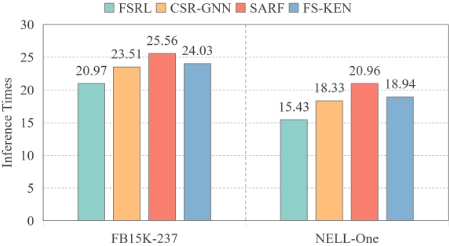
Considering that the introduction of GANs provides additional negative samples during training, which may increase computational cost, we further measure the inference time of our method compared to three other FS-KGR baselines, i.e., FSRL, CSR-GNN, and SARF. As shown in Figure 4, we observe that the inference runtime of our FS-KEN is reduced compared to the state-of-the-art model SARF. Additionally, compared to CSR-GNN, the inference time of FS-KEN on the FB15K-237 dataset is only 0.5 seconds longer per epoch, which remains acceptable. Since the GAN backbone is not involved in the inference process, the introduction of GANs does not significantly affect the model's inference time. Overall, FS-KEN demonstrates both acceptable time consumption and significant performance improvements.
| Target Triplet | Low-quality Entities | Similarity Score | High-quality Entities | Similarity Score |
|---|---|---|---|---|
| (person:Brandon, plays sport, sport:baseball) | disease:diabetes artery:vessels | 0.17 0.21 | sport:golf sport:football | 0.44 0.78 |
| clothing:pants | 0.15 | sport:basketball | 0.93 | |
| (person:Mario, person born in, city:york) | clothing:white | 0.07 | city:petoskey city:riyadh | 0.47 0.52 |
| river:chena | 0.24 | |||
| city:number | 0.35 | county:york city | 0.63 |
| Methods | MRR | Hit@1 | Hit@5 | Hit@10 | |
|---|---|---|---|---|---|
| FB15K-237 | TransE | 0.762 | 0.706 | 0.831 | 0.898 |
| TransD | 0.773 | 0.699 | 0.856 | 0.915 | |
| DistMult | 0.765 | 0.695 | 0.823 | 0.887 | |
| NELL-One | TransE | 0.629 | 0.495 | 0.81 | 0.877 |
| TransD | 0.624 | 0.481 | 0.804 | 0.883 | |
| DistMult | 0.631 | 0.490 | 0.812 | 0.887 |
4.5 Sensitivity Analysis (RQ3)
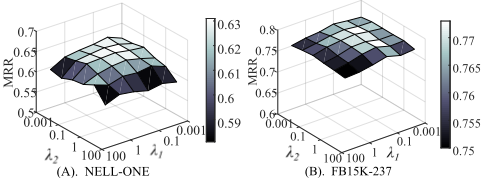
We analyze the sensitivity of the reconstruction loss weight λ1 and the discriminator loss weight λ2 in the FS-KEN algorithm on the MRR metric for both datasets. Specifically, We perform a grid search on both hyper-parameters and report the optimal hyperparameter combination. Both values of the two parameters are chosen from {0.01, 0.1, 1, 10, 100}, which as depicted in Figure 3. The experimental results show that when λ1 and λ2 both take the value of 0.1, the model achieves the best performance on NELL-One dataset. For the FB15k-237 dataset, our model achieves best performance when λ1 = 1 and λ2 = 0.1. Furthermore, the experiment results demonstrated that our proposed FS-KEN is robust to the hyper-parameters.
4.6 Case Study (RQ4)
In this section, we show several cases from NELL-One dataset in order to qualitatively show the effectiveness of the proposed negative augmentation strategy, which is shown in Table 4. Specifically, for the target triplet, we sample negative tail entities over the traditional random sampling mechanism and the proposed method as low-quality entities and highquality entities, respectively. Finally, we calculate the cosine similarity score of sampled negative entities and the tail entity of the target triplet. Table 4 shows that FS-KEN can generate high-quality negative samples that are closer to the target triples in the implicit vector space. Taking the target triple (person:Brandon, plays sport, sport:baseball) as an example, the negative entities generated by the random sampling strategy may be disease, artery, and clothing, which have much smaller semantic similarity with the tail entities of the target triple than those generated by FS-KEN.
5 Conclusion
In this paper, we proposed a novel adversarial learning strategy for few-shot knowledge graph reasoning, termed FSKEN. Specifically, FS-KEN uses policy gradient GAN for negative sample enhancement on the data in the support set, solving the problem of traditional GANs in preventing gradient back-propagation to the generator during discrete sampling to obtain high-quality and high-quantity negative samples. The generator aims to generate high-quality negative entities, while the discriminator aims to distinguish between generated entities and real entities. To show the superiority of our FS-KEN, various experiments on two few-shot benchmark datasets are conducted. The results indicate that FSKEN generally outperformed other methods.
Acknowledgments
This work is supported by the National Natural Science Foundation of China (no. 62325604, 62441618, 62276271).
@inproceedings{ijcai2025p512,
  title     = {FS-KEN: Few-shot Knowledge Graph Reasoning by Adversarial Negative Enhancing},
  author    = {Meng, Lingyuan and Liang, Ke and Zhu, Zeyu and Liu, Xinwang and Lu, Wenpeng},
  booktitle = {Proceedings of the Thirty-Fourth International Joint Conference on
               Artificial Intelligence, {IJCAI-25}},
  publisher = {International Joint Conferences on Artificial Intelligence Organization},
  editor    = {James Kwok},
  pages     = {4597--4605},
  year      = {2025},
  month     = {8},
  note      = {Main Track},
  doi       = {10.24963/ijcai.2025/512},
  url       = {https://doi.org/10.24963/ijcai.2025/512},
}
TY - CPAPER TI - FS-KEN: Few-shot Knowledge Graph Reasoning by Adversarial Negative Enhancing AU - Meng, Lingyuan AU - Liang, Ke AU - Zhu, Zeyu AU - Liu, Xinwang AU - Lu, Wenpeng T2 - Proceedings of the Thirty-Fourth International Joint Conference on Artificial Intelligence, IJCAI-25 PB - International Joint Conferences on Artificial Intelligence Organization PY - 2025 SP - 4597 EP - 4605 DO - 10.24963/ijcai.2025/512 UR - https://doi.org/10.24963/ijcai.2025/512 ER -Copied
Machine-readable versions of this paper, for tools and AI agents:





