
Decomposing Inconsistencies: Marginal Contributions and Pooling Techniques
Proceedings of the Thirty-Fourth International Joint Conference on Artificial Intelligence. Main Track. Pages 4687-4695.
https://doi.org/10.24963/ijcai.2025/522
Keywords
- Knowledge Representation and Reasoning: KRR: Other
- Knowledge Representation and Reasoning: KRR: Reasoning about knowledge and belief
Abstract
Inconsistency measures quantify the degree of conflict within a set of propositions. They can be broadly categorized into global measures, which assess the overall inconsistency of a set, and local measures, which evaluate the contribution of single formulas to the overall inconsistency. This paper investigates the relationship between these two classes of measures through the lens of marginal contributions and pooling mechanisms. We propose a systematic framework for deriving local inconsistency measures from global ones by employing notions of marginal contributions inspired by cooperative game theory, including Shapley and Banzhaf values. Conversely, we explore methods for constructing global inconsistency measures by
aggregating local contributions using various pooling techniques. A key research question arises: which combinations of marginal contribution notions (maC) and pooling mechanisms (P) are compatible? Compatibility is defined such that, given a global measure I, applying (P) to the marginal contributions derived from I yields the same result as directly applying I, and vice versa. We analyze this compatibility condition and identify specific pairs of methods, (maC) and (P), that satisfy it across various inconsistency frameworks. Our findings provide a deeper understanding of the interplay between global and local inconsistency measures, providing a foundation for designing principled and interpretable inconsistency evaluation methods in logic-based systems.
- [Agussurja et al., 2022] Lucas Agussurja, Xinyi Xu, and Bryan Kian Hsiang Low. On the convergence of the Shap- ley value in parametric bayesian learning games. In ICML, pages 180-196, 2022.
- [Amgoud and Ben-Naim, 2015] Leila Amgoud and Jonathan Ben-Naim. Argumentation-based ranking logics. In AAMAS, pages 1511-1519, 2015.
- [Amgoud and Ben-Naim, 2017] Leila Amgoud and Jonathan Ben-Naim. Measuring Disagreement in Argumentation Graphs, pages 208-222. Springer International Publishing, 2017.
- [Amgoud et al., 2017] Leila Amgoud, Jonathan Ben-Naim, and Srdjan Vesic. Measuring the intensity of attacks in argumentation graphs with shapley value. In IJCAI, pages 63-69, 2017. IJCAI
- [Arieli et al., 2024] Ofer Arieli, Kees van Berkel, Badran Raddaoui, and Christian Straßer. Deontic reasoning based on inconsistency measures. In KR, 2024.
- [Banzhaf, 1965] J.F. Banzhaf. Weighted voting doesn't work: A mathematical analysis. Rutgers Law Review, 19(2):317-343, 1965.
- [Besnard, 2014] Philippe Besnard. Revisiting postulates for inconsistency measures. In JELIA, pages 383-396, 2014.
- [Bian et al., 2022] Yatao Bian, Yu Rong, Tingyang Xu, Jiax- iang Wu, Andreas Krause, and Junzhou Huang. Energy- based learning for cooperative games, with applications to valuation problems in machine learning. In ICLR, 2022.
- [Chalkiadakis et al., 2011] Georgios Chalkiadakis, Edith Elkind, and Michael J. Wooldridge. Computational As- pects of Cooperative Game Theory. Synthesis Lectures on Artificial Intelligence and Machine Learning. 2011.
- [Condotta et al., 2016] Jean-Franc ¸ois Condotta, Badran Raddaoui, and Yakoub Salhi. Quantifying conflicts for spatial and temporal information. In KR, pages 443-452, 2016.
- [Corea et al., 2022] Carl Corea, John Grant, and Matthias Thimm. Measuring inconsistency in declarative process specifications. In BPM, pages 289-306, 2022.
- [Fatima et al., 2008] S. Shaheen Fatima, Michael J. Wooldridge, and Nicholas R. Jennings. A linear ap- proximation method for the shapley value. Artif. Intell., 172(14):1673-1699, 2008.
- [Ghorbani et al., 2020] Amirata Ghorbani, Michael P. Kim, and James Zou. A distributional framework for data valu- ation. In ICML, pages 3535-3544, 2020.
- [Grant et al., 2021] John Grant, Maria Vanina Martinez, Cristian Molinaro, and Francesco Parisi. Dimensional inconsistency measures and postulates in spatio-temporal databases. J. Artif. Intell. Res., 71:733-780, 2021.
- [Heyninck et al., 2023] Jesse Heyninck, Badran Raddaoui, and Christian Straßer. Ranking-based argumentation se- mantics applied to logical argumentation. In IJCAI, pages 3268-3276, 2023. IJCAI
- [Hunter and Konieczny, 2010] Anthony Hunter and Sébastien Konieczny. On the measure of conflicts: Shapley inconsistency values. Artif. Intell., 174(14):1007- 1026, 2010.
- [Karczmarz et al., 2022] Adam Karczmarz, Tomasz Micha- lak, Anish Mukherjee, Piotr Sankowski, and Piotr Wygocki. Improved feature importance computation for tree models based on the banzhaf value. In UAI, pages 969-979, 2022.
- [Kuhlmann and Corea, 2024] Isabelle Kuhlmann and Carl Corea. Inconsistency measurement in LTL f based on minimal inconsistent sets and minimal correction sets. In SUM, pages 217-232, 2024.
- [Livshits et al., 2021] Ester Livshits, Rina Kochirgan, Segev Tsur, Ihab F. Ilyas, Benny Kimelfeld, and Sudeepa Roy. Properties of inconsistency measures for databases. In SIGMOD, pages 1182-1194, 2021.
- [Lundberg and Lee, 2017] Scott M. Lundberg and Su-In Lee. A unified approach to interpreting model predictions. In NIPS, pages 4765-4774, 2017.
- [Ma et al., 2007] Yue Ma, Guilin Qi, Pascal Hitzler, and Zuoquan Lin. Measuring inconsistency for description logics based on paraconsistent semantics. In ECSQARU, pages 30-41, 2007.
- [Maniquet, 2003] Franc ¸ois Maniquet. A characterization of the shapley value in queueing problems. Journal of Eco- nomic Theory, 109(1):90-103, 2003.
- [McAreavey et al., 2011] Kevin McAreavey, Weiru Liu, Paul Miller, and Kedian Mu. Measuring inconsistency in a network intrusion detection rule set based on snort. Int. J. Semantic Comput., 5(3):281-322, 2011.
- [Mu et al., 2012] Kedian Mu, Weiru Liu, and Zhi Jin. A blame-based approach to generating proposals for han- dling inconsistency in software requirements. Int. J. Knowl. Syst. Sci., 3(1):1-17, 2012.
- [Mu, 2015] Kedian Mu. Responsibility for inconsistency. Int. J. Approx. Reason., 61:43-60, 2015.
- [Narayanam and Narahari, 2011] Ramasuri Narayanam and Yadati Narahari. A shapley value-based approach to dis- cover influential nodes in social networks. IEEE Trans Autom. Sci. Eng., 8(1):130-147, 2011.
- [Parisi and Grant, 2023] Francesco Parisi and John Grant. On measuring inconsistency in definite and indefi- nite databases with denial constraints. Artif. Intell., 318:103884, 2023.
- [Picado-Muiño, 2011] David Picado-Muiño. Measuring and repairing inconsistency in probabilistic knowledge bases. International Journal of Approximate Reasoning, 52(6):828-840, 2011.
- [Raddaoui et al., 2024] Badran Raddaoui, Christian Straßer, and Saïd Jabbour. Towards a principle-based framework for assessing the contribution of formulas on the conflicts of knowledge bases. In IJCAI, pages 3541-3548, 2024. IJCAI
- [Ribeiro and Thimm, 2021] Jandson S. Ribeiro and Matthias Thimm. Consolidation via tacit culpability measures: Be- tween explicit and implicit degrees of culpability. In KR, pages 529-538, 2021.
- [Shapley, 1953] Lloyd S Shapley. A value for n-person games. In Contributions to the Theory of Games II, pages 307-317. Princeton University Press, 1953.
- [Sundararajan and Najmi, 2020] Mukund Sundararajan and Amir Najmi. The many shapley values for model expla- nation. In ICML, pages 9269-9278. PMLR, 2020.
- [Thimm and Wallner, 2019] Matthias Thimm and Jo- hannes Peter Wallner. On the complexity of inconsistency measurement. Artif. Intell., 275:411-456, 2019.
- [Ulbricht et al., 2020] Markus Ulbricht, Matthias Thimm, and Gerhard Brewka. Handling and measuring inconsis- tency in non-monotonic logics. Artif. Intell., 286:103344, 2020.
References were extracted automatically from the PDF and may contain errors.
Full text extracted automatically from the PDF; figures, tables and equations may differ. The PDF is the version of record.
1 Introduction
Both human and artificial agents have to deal with inconsistent information. Reasoning with inconsistency is therefore a central topic both in philosophical logic as well as in Artificial Intelligence (AI). One particular question of interest is to both understand and determine how inconsistent a set of formulas (or knowledge base) is. It is sensible to consider some knowledge bases more inconsistent than others. This is clearly so when comparing a consistent with an inconsistent knowledge base. But, even among inconsistent knowledge bases differences can be made. Suppose that we are given two bases K1 = {p, q, ¬(p ∧ q)} and K2 = K1 ∪ {¬p}. When comparing K1 with K2, many would consider K2 more inconsistent than K1. In recent years, the underlying intuitions have been made precise in terms of a variety of inconsistency measures that allow for determining how inconsistent a knowledge base is (see [Thimm and Wallner, 2019] for an overview). 1
Similarly, one may ask how much a given formula contributes to the inconsistency of a knowledge base. E.g., it would seem intuitive to take the formula p to contribute more to the inconsistency of the knowledge base K2 than q. Less research effort has been devoted to this question, i.e., to measures that quantify the responsability of a formula to the overall inconsistency ([Hunter and Konieczny, 2010; Mu, 2015; Ribeiro and Thimm, 2021; Raddaoui et al., 2024]). Let us call such measures local inconsistency measures and distinguish them from global inconsistency measures that assess the inconsistency of knowledge bases as a whole. In what follows, when the context is clear we will refer to global (resp. local) inconsistency measures simply as global (resp. local) measures.
As far as we know and apart of the work by [Hunter and Konieczny, 2010] (discussed in Section 4), these two classes of measures have been studied independently, leaving the relationship between them unexplored. However, local and global measures can be related by two intuitive methods:
Method g2l viaMarginal Contributions. A simple and natural method to obtain a local measure based on a global measure Ig is to determine the marginal contribution a formula has to a given knowledge base relative to Ig. For this, game-theoretic concepts can and have been employed, such as Shapley value or Banzhaf value (more on that below).
1 Applications of such measures are diverse, including network intrusion detection [McAreavey et al., 2011], conflicts management in ontologies [Ma et al., 2007] and rule-based expert systems in internal medicine [Picado-Mui˜no, 2011], reasoning with temporal and spatial information [Condotta et al., 2016; Kuhlmann and Corea, 2024], software requirements engineering and business processes [Mu et al., 2012; Corea et al., 2022], answer set programming [Ulbricht et al., 2020], nonmonotonic reasoning [Arieli et al., 2024], belief revision [Ribeiro and Thimm, 2021], and databases [Livshits et al., 2021; Grant et al., 2021; Parisi and Grant, 2023].
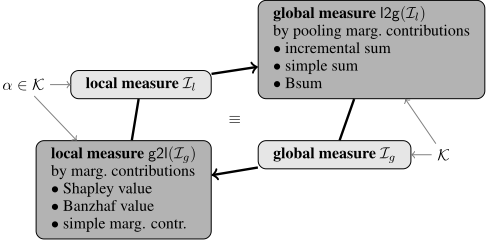
Method l2g via Pooling. Similarly, given a local measure, a simple and natural method to obtain a global measure is to pool the individual contributions of the formulas in the knowledge base (for instance by summing up).
We now state a basic desideratum for these methods:
Good fit. Suppose a local measure Il = g2l(Ig) that is obtained by determining marginal contributions relative to a global measure Ig. When applying the pooling method to Il, resulting in l2g(Il), we expect Ig(K) = l2g(Il)(K) for any knowledge base K, since pooling the marginal contributions of the formulas in K should make up the inconsistency of K, in toto (see Fig. 1). Similarly, where Ig is obtained by a pooling method on the basis of a local measure Il (so, Ig = l2g(Il)), we expect that Il = g2l(Ig) for an adequate way of obtaining marginal contributions of formulas in K.
This motivates the central research question in this paper, namely to identify retracting pairs 2 of methods g2l and l2g, i.e., Il = g2l(l2g(Il)) and Ig = l2g(g2l(Ig)), that provide a good fit by satisfying the two desiderata:
- Given a global measure Ig, Ig = l2g(g2l(Ig)). In this case, we say that Ig retracts under ⟨g2l, l2g⟩.
- Given a local measure Il, Il = g2l(l2g(Il)). In this case, we say that Il retracts under ⟨l2g, g2l⟩.
Another way of looking at this research question underlying item 1 is to ask (similarly for item 2): for a given method of generating a local measure from global one by means of marginal contribution (such as using Shapley or Banzhaf values), what is the adequate pooling method that gives rise to the same global measure when applied to the induced local measure?
Let us describe the two methods g2l and l2g in more detail. From global to local measures (g2l). Local measures are inspired by the game-theoretic notion of marginal contribution which is a measure of how much a player contributes to the utility generated by a collaborative group of agents.
For our setting, we are interested in the marginal contribution of a formula α to the inconsistency of a knowledge base K as measured by a global measure Ig . Let K⊖α = K \ {α} and K ⊕ α = K ∪ {α}. A straightforward way would be to define the local measure as follows:
2 In category theory, a morphism f : X → X′ is a retraction of a morphism g : X′ → X in category theory, in case f ◦ g = 1X.
(simple marginal contribution)
Other approaches take inspiration from cooperative game theory 3 (for an introduction to this theory, see [Chalkiadakis et al., 2011]). Two well-known solution concepts that make use of the notion of marginal contribution are the Shapley value, and the Banzhaf value. The local measures derived from these indices can be defined as follows:
(Shapley value, [Shapley, 1953]) Shapley(I)(α,K) =
(Banzhaf value, [Banzhaf, 1965])
Actually, the marginal contribution of a player in a cooperative game measures the difference a player makes to the payoff of a given coalition by joining it. In our context, players are the formulas that constitute the knowledge base K, subsets of K take the role of coalitions, and the notion of payoff generated by a coalition is replaced by the inconsistency degree of a given subset S of K.
From local to global measures by pooling (l2g). Given a local measure Il, we may obtain a global measure by aggregating the inconsistency contributions of each formula in a given knowledge base. For instance, we can sum up the individual contributions of the formulas in K measured by Il. Again, there are various options how to sum up, e.g., where K = {α1, . . . , αn}:
where K[i] = {α1, . . . , αi}. Of course, this list is by no means exhaustive. E.g., one may want to average over sums or use entirely different approaches such as considering max(I)(K) = maxα∈K I(α, K).
3 Collaborative game theory has a wide spectrum of application domains, including cooperative scheduling and task allocation, queuing problems [Maniquet, 2003], handling inconsistent information [Hunter and Konieczny, 2010; Amgoud et al., 2017], explainable AI [Lundberg and Lee, 2017; Sundararajan and Najmi, 2020; Karczmarz et al., 2022], influence maximization in social networks [Narayanam and Narahari, 2011], and machine learning literature [Ghorbani et al., 2020; Agussurja et al., 2022; Bian et al., 2022], among others.
Central Result. The main result of our study is that for each of the three g2l-approaches to obtain local measures via marginal contributions from global measures, a l2g-pooling method can be identified, under which we obtain retracting pairs of measures, and vice versa. For instance, a global measure I retracts under simple marginal contributions and incremental sums. Moreover, we identify properties global measures have to satisfy in order to be a good fit with their local measures induced by Shapley values and with sums. A similar result is obtained for Banzhaf values for a specific type of sum (which we dub Bsum, see Def. 9).
From a more general perspective, this paper shows that game-theoretic techniques can be successfully imported to the study of inconsistency in logic-based systems, as first indicated in [Hunter and Konieczny, 2010]. In particular, they can give rise to local measures that are a good fit with their global counterparts. Table 1 summarizes the main results presented in the paper.
| simple sum | incr. sum | Bsum | |
|---|---|---|---|
| simple marginal contrib. | Il rob. under perm. (Cor.1) all Ig (Thm.2) | ||
| Shapley | Iλ, λ mon. & rel. (Cor.7) all Ig (Cor.5) | ||
| Banzhaf | all Il (Thm.5) all Ig (Cor.8) |
The paper has the following structure. In Section 2, we introduce basic terminology. Section 3 discusses simple marginal contributions and their retraction under incremental sums, while Section 4 presents a similar retraction result of Shapley values with sums. Section 5 shows how local and global inconsistency measures retract under Banzhaf values and Bsum. We summarize our findings in Section 6 and discuss some future work.
2 Formal Setup
In this paper, we assume that there is a Boolean language L(V ) built on a finite set of propositional variables V and the standard connectives (¬, ∨, ∧, →). Greek letters α, β, etc. will be used to denote well-formed formulas from the language L(V ). From now on, we shall denote by ⊢ the classical consequence relation. A knowledge base is a finite set of propositional formulas. We write K for the class of all knowledge bases defined over the language L(V ). A knowledge base K ∈ K is said to be inconsistent if there is a formula α such that K ⊢ α and K ⊢ ¬α. Otherwise, K is consistent.
Let us now present some key concepts that are essential for reasoning with inconsistent information. Given K ∈ K, a subset of formulas M ⊆ K is a minimal inconsistent set of K iff M is inconsistent and ∀α ∈ M, M ⊖ α is consistent. Similarly, M is a maximal consistent set of K iff M is consistent and ∀α ∈ K \ M, M ⊕ α is inconsistent. Moreover, the subset M ⊆ K is a minimal correction set of K iff K \ M is consistent, and ∀α ∈ M, (K \ M) ⊕ α is inconsistent. For convenience, we shall simply write mi(K), ms(K) and mc(K) as an abbreviation for the set of minimal inconsistent sets, maximal consistent sets and minimal correction sets of K, respectively. We also define mi(α,K) = {M ∈ mi(K) | α ∈ M}, ms(α, K) = {M ∈ ms(K) | α ∈ M}, and mc(α,K) = {M ∈ mc(K) | α ∈ M} = {K \ M | M ∈ ms(K), α ∈ M}. The formulas in K that are individually inconsistent are called self contradictory or simply paradoxical formulas and denoted as ⊥(K) = {α ∈ K | α ⊢ ⊥}. Let us also define prob(K) to be the set of problematic formulas, i.e., those that appear in at least one conflict. Formally, prob(K) = ⋃ mi(K). Any self contradictory formula is, by definition, problematic.
2.1 ACloser Look at InconsistencyMeasures
We now take a closer look at global and local inconsistency measures. In this work, we restrict our attention to Tarskian propositional logic.
Definition 1. A global inconsistency measure is a function Ig on K that maps each knowledge base K to a real value, i.e., Ig : K→R+0 ∪ {∞}.
Intuitively, the greater the inconsistency in K, the higher the value returned by Ig. In the literature, some basic requirements have been studied to characterize desirable global measures. Below are two of these properties:
- Consistency: Ig(K) = 0 iff prob(K) = ∅.
- Monotonicity: Ig(K ∪ K′ ) ≥ Ig(K).
Example 1. Table 2 presents some well-studied global measures from literature. For further discussions on these measures and their properties, we refer to, e.g., [Hunter and Konieczny, 2010; Besnard, 2014].
| Id(K) | = | {0 |mi(K)| = 0 1 else |
| I#(K) | = | |mi(K)| |
| Imi(K) | = | ∑ M∈mi(K) 1 |M| |
| Iprob(K) | = | |prob(K)| |
| Ims(K) | = | (|ms(K)| + |⊥(K)|) - 1 |
We now define local measures in knowledge bases. Let for this K = {(α, K) | K ∈ K, α ∈ K}.
Definition 2. A local inconsistency measure is a function Il on K that associates a real value to each formula α in a knowledge base K, i.e., Il : K→R+0 ∪ {∞}.
Similar to global measures, the two following basic properties are required to characterize reasonable local measures [Ribeiro and Thimm, 2021; Raddaoui et al., 2024]:
- Consistency: Il(α,K) = 0, if prob(K) = ∅.
- Blame: Il(α,K) > 0, iff α ∈ prob(K).
Example 2. In Table 3, we list some examples of local measures that have been investigated in several proposals. We refer to, e.g., [Raddaoui et al., 2024] and the references therein for further discussions on these measures.
Table 3: Some examples of local measures
Numerous global and local inconsistency measures have been proposed; yet the relationships between them remain unexplored, apart of the work by [Hunter and Konieczny, 2010] (see Section 4). In what follows, we will provide links in terms of identifying retracting pairs of measures.
3 Simple Marginal Contributions and Incremental Sums
Global measures may give rise to local measures by assessing the so-called marginal contribution of a formula to the overall inconsistency, that is, the difference between the inconsistency value when the formula is in the knowledge base and what can be the degree of inconsistency without its contribution to the conflict. In the same way, local measures can be utilized to evaluate the overall inconsistency of the knowledge base. Let us first formally introduce the notion of marginal contribution measure.
Definition 3. Let Il be a local measure. Then, Il is called a marginal contribution measure if there exists a global measure Ig such that Il(α,K) = Ig(K) - Ig(K ⊖ α), for all knowledge bases K ∈ K and all α ∈ K.
Obviously, given a global measure Ig, we can induce the marginal contribution measure maC(Ig) defined as maC(Ig)(α, K) = Ig(K) - Ig(K ⊖ α). That is, global measures can seamlessly be applied to determine the contribution of single formulas to the inconsistency of the knowledge base.
However, one can also go the other way around. As we will see in the rest of this section, marginal contribution measures give naturally rise to global measures, if they fulfill the following requirement (Def. 4).
Where K = {α1, . . . , αn} is a knowledge base and π is a permutation on the set {1, . . . , n}, we define the ordered sets K[i] = {α1, . . . , αi} and K[π(i)] = {απ(1), . . . , απ(i)}.
Definition 4. A local measure Il is robust under permutation iff for any knowledge base K = {α1, . . . , αn} and any permutation π over {1, . . . , n},
Local measures that are robust under permutation induce global measures in terms of their incremental sums.
Definition 5. Let K = {α1, . . . , αn} be a knowledge base, and Il a local measure robust under permutation. Then, the global measure Ig induced by Il is defined as:
The requirement for robustness under permutation ensures that the induced global measure Ig is well-defined.
Theorem 1 shows that any local measure Il that is robust under permutation is identical to the marginal contribution measure relative to the induced global measure obtained by pooling Il under incremental sum.
Theorem 1. Let Il be a local measure that is robust under permutation. For any knowledge base K ∈ K and any α ∈ K, we have Il(α, K) = maC(incsum(Il))(α, K).
Corollary 1. Every local measure that is robust under permutation retracts under ⟨incsum, maC⟩.
We now present the following property for local measures, which we show to be sufficient to ensure the robustness under permutation:
Switching Where α, β /∈ K,
Proposition 1. Every marginal contribution measure satisfies switching.
Proof. Let Il be a marginal contribution measure for the global measure Ig. We have:
Notably, with the exception of the measure Id all of the local measures in Table 3 satisfy the property of switching.
Proposition 2. The local measures I#, Imi and Iprob satisfy switching.
The following example shows that the local measure Id violates the property of switching.
Example 3. Consider the knowledge base K = {¬q}, α = p and β = ¬p∧q. We have that Id(α, K⊕α)+Id(β, K⊕α⊕ β) = 0 + 1 ̸= 1 + 1 = Id(β, K ⊕ β) + Id(α, K ⊕ α ⊕ β).
Lemma 1. A local measure is robust under permutation iff it satisfies switching.
From the previous results (Proposition 1 and Lemma 1), it follows directly that:
Corollary 2. Every marginal contribution measure is robust under permutation.
Corollary 3 is an immediate consequence of the above claim.
Corollary 3. The local measures I#, Imi, and Iprob are robust under permutation.
The following result shows that given a global measure Ig, applying the incremental sum to the marginal contribution derived from Ig yields the same result as directly applying Ig.
Theorem 2. Every global measure Ig retracts under ⟨maC, incsum⟩. That is, Ig(K) = incsum(maC(Ig))(K), for any knowledge base K ∈ K.
4 Shapley Values and Simple Sums
Since a single formula can interact with other formulas to produce inconsistency within a knowledge base, it may be desirable to assess its marginal contribution to the overall inconsistency by averaging across all possible subsets where it plays a role in causing conflicts. This can be effectively quantified using the Shapley value, a standard solution concept in cooperative game theory. 4
The Shapley value is axiomatized by (adjusted to the context of global inconsistency measures I and I ′ ) the following properties. Let for this S be a game-theoretic power index.
Dummy. S(I)(α,K) = 0, if ∀C ⊆ K, I(C) = I(C ⊕α).
Theorem 3 ([Shapley, 1953]). The Shapley value is the unique function that satisfies efficiency, symmetry, dummy and additivity.
We now examine the retracting pairs of inconsistency measures using the Shapley value. One direction follows immediately with the Efficiency property and Theorem 3.
Corollary 4. Let Ig be a global measure. Then, for all knowledge bases K, Ig(K) = sum(Shapley(Ig))(K).
4 Let us briefly recall the notion of Shapley values from cooperative game theory. Let N = {1, . . . , n} be a set of players and v : ℘(N) → R be a function that assigns a numerical value to every coalition S ⊆ N (with v(∅) = 0), representing its performance. The Shapley value is defined by Shapley(i, v) = ∑S⊆N\{i} η(|S|, |N|) · (v(S ∪ {i}) - v(S)) where η(k, n) = k!·(n-k-1)!
n! . It represents a fair way of distributing the total payoff to the collaborating players.
Corollary 5. Every global measure Ig retracts under ⟨Shapley, sum⟩.
The following discrete global measure will help us compartmentalize inconsistency measures (see Cor. 6 and Lemma 8). Where M is a set of formulas, let
We note that, in general, the I ⊆M measure does not satisfy the Consistency property.
Lemma 2. Given K ∈ K, we have the following properties for the global measure I ⊆M :
Lemma 3. Let S be a game-theoretic power index satisfying efficiency, dummy and symmetry. Let K ∈ K and α ∈ K. Where M is a set of formulas, 5
Proof. Let C ⊆ K. Suppose α /∈ M. If I ⊆M (C) = 0, then I ⊆M (C ⊕ α) = 0 by M-monotonicity. If I ⊆M (C) = 1, then I ⊆M (C ⊕ α) = 1 by 1-monotonicity. By Dummy, we have, (1), S(I ⊆M , K)(α) = 0.
Building on Lemma 3, the following corollary provides an expression for the Shapley value of the global measure I ⊆M .
Corollary 6. Let K be a knowledge base and α ∈ K. Then,
In the following, we work with functions that assign to each knowledge base a set of its subsets, for instance, its minimal inconsistent sets (i.e., λ : K ↦→mi(K)).
Definition 6. Let λ : K → ℘℘(L(V )) be a function that maps sets of formulas to sets of sets of formulas in such a way that λ(K) ∈ ℘℘(K). Then,
- λ is monotonic if λ(K) ⊆ λ(K⊕α),
- λ is relevant if for all M ∈ λ(K ⊕ α) \ λ(K), α ∈ M.
5 This lemma can also be found in [Hunter and Konieczny, 2010, Lemma 1]. There the authors observe that the local measure Il(α, K) = ∑M∈mi(K),α∈M 1 |M| retracts for ⟨sum, Shapley⟩. We here generalize this result.
We let λα(K) = {M ∈ λ(K) | α ∈ M}.
Lemma 4. If λ : K→℘℘(L(V )) is monotonic and relevant, so is λα.
Example 4. The functions λmi : K ↦→ mi(K) and λprob : K ↦→ {{α} | α ∈ prob(K)} are monotonic and relevant, unlike λ : K ↦→ ms(K) which is not monotonic.
Lemma 5. Let λ : K → ℘℘(L(V )) be monotonic and relevant. Where C ⊆ K ∈ K and α /∈ C, we have:
Definition 7. Let λ : K → ℘℘(L(V )) be as in Def. 6. We call a global measure Ig λ-additive iff Ig(K) = |λ(K)|.
Example 5. Examples of λ-additive global measures are I#(K) = |mi(K)| and Iprob(K) = |prob(K)|.
Definition 8. Where λ : K → ℘℘(L(V ) as in Def. 6, let Iλ be the local measure that maps (α,K) ∈ K to ∑M∈λα(K) 1 |M| .
Lemma 6. Where λ : K → ℘℘(L(V ) as in Def. 6, sum(Iλ) is λ-additive.
The next result presents the formulation of λ-additive global measures as follows.
Lemma 7. Let K be a knowledge base. If a global measure Ig is λ-additive, then Ig(K) = sum(Iλ)(K).
Based on Lemma 7, we can characterize the λ-additive global measures as follows.
Lemma 8. Let Kbe a knowledge base and Ig be a λ-additive global measure. Then, Ig(K) = ∑M∈λ(K) I ⊆M (K).
We now give a characterization of the local measures induced by λ-additive global measures using the Shapley value.
Theorem 4. Let K be a knowledge base, α ∈ K and let λ : K → ℘℘(L(V )) be monotonic and relevant. Then, 6
Proof. By the additivity of the Shapley value,
6 We let ⊕{I1, . . . , In} = I1 ⊕ . . . ⊕ In.
By Corollary 6, Shapley(⊕M∈λα(K) I ⊆M )(α,K) = ∑M∈λα(K) 1 |M| . So, we need to show that Shapley(sum(Iλ))(α,K) = ∑ M∈λα(K) Shapley(I ⊆M )(α, K). We have, where (†) by Lemma 5 and (⋆) by Lemmas 6 and 8 and ηK C = η(|C|, |K|),
Shapley(sum(Iλ))(α, K) =
The next result shows, under certain conditions, the retraction of local measures for the pair ⟨sum, Shapley⟩.
Corollary 7. Every local measure Iλ for which λ is monotonic and relevant, retracts under ⟨sum, Shapley⟩. That is, Iλ(α,K) = Shapley(sum(Iλ))(α,K), for any knowledge base K ∈ K and α ∈ K.
Example 7. For instance, Iλmi = Shapley(sum(Iλmi )) = Shapley(Imi) and Iλprob = Id = Shapley(sum(Iλprob )) = Shapley(Iprob).
5 Banzhaf Values and Bsums
Another approach of assessing the marginal contribution of single formulas to the inconsistency of the knowledge base is by using the Banzhaf value. This index, introduced by [Banzhaf, 1965], is a standard technique in game theory that addresses the issue of double counting associated with the Shapley value (Narukawa, Modeling Decisions, 1998, p.202).
The Banzhaf index measures the average marginal contribution across all subsets of a given knowledge base. In Corollary 8 and Theorem 5, we show that both global and local measures retract for Banzhaf values relative to a specific pooling method, named Bsum, which is defined below.
Definition 9 (Bsum). Let Il be a local measure, K = {α1, . . . , αn} ∈ K and α ∈ K. 7 We define inductively:
We let Bsum(Il)(K) = ∑ni=1 I ⋆ l (αi,K[i]).
The next result shows that the measure Bzf(Ig)⋆ is a marginal contribution measure.
7 For the moment, we consider this an ordered set, but as we will see this is inconsequential (Prop. 3).
Lemma 9. Let Ig be a global measure, K be a knowledge base, and α ∈ K. Then, Bzf(Ig)⋆ (α, K) = maC(Ig)(α, K).
Proof. We show this via induction on the size |K|.
Assume the case |K| = 1. Then, K = {α} and Bzf(Ig)⋆ (α, K) = Bzf(Ig)(α, K) = Ig({α}) - Ig(∅).
For the inductive step, assume |K| = n + 1. We have, Bzf(Ig)⋆ (α,K) = Bzf(Ig)(α,K) · 2|K|-1 - ∑S⊊K α∈S Bzf(Ig)⋆ (α, S). By the inductive hypothesis, for ev-
Proposition 3. Let Ig be a global measure, K = {α1, . . . , αn} ∈ K, and π a permutation over {1, . . . , n}. Then, we have:
The following result shows that global measures are a good fit with their corresponding local measures induced by the Banzhaf value and Bsum.
Corollary 8. Every global measure Ig retracts under ⟨Bzf, Bsum⟩. That is, Ig(K) = Bsum(Bzf(Ig))(K), for any knowledge base K ∈ K.
The last theorem shows the retraction of local measures for the pair ⟨Bsum, Bzf⟩: for any local measure Il, applying the marginal contribution measure Bzf to the global measure induced by Il yields the same result as applying Il directly.
Theorem 5. Every local measure Il retracts under ⟨Bsum, Bzf⟩. That is, Il(α,K) = Bzf(Bsum(Il))(α,K) for all knowledge bases K ∈ K and all α ∈ K.
Proof. We have: Bzf(Bsum(Il))(α,K) =
Note that for every S = {α1, . . . , αn} ⊆ K with α ∈ S, Bsum(Il)(S⊕α)-Bsum(Il)(S) = ∑ni=1 I ⋆ l (αi, S⊕α[i])-
6 Summary and FutureWork
A number of different approaches to measuring inconsistency have been proposed in the AI literature. In this paper, we have provided a systematic study of global and local measures, where the former measure the degree to which knowledge bases are inconsistent, while the latter evaluate the degree to which a given formula contributes to the overall inconsistency. We have identified different ways in which global measures induce local ones by following the idea of marginal contributions, inspired by notions from game theory (such as the Shapley and Banzhaf values). We did not stop there, but also considered the opposite direction: by summing up marginal contributions of the formulas of a knowledge base one can obtain global measures. Finally, some combinations of approaches to marginal contributions and approaches to summing up turned out to be good fits in the sense that they retract.
Our work can be seen as a systematic way of continuing the research of ideas introduced in [Hunter and Konieczny, 2010], where the Shapley value has been studied. In future research, we will investigate several threads opened by this paper. First, many formal properties have been studied for global (e.g., [Hunter and Konieczny, 2010; Besnard, 2014]) and local measures (e.g., [Ribeiro and Thimm, 2021; Raddaoui et al., 2024]), but it is not understood which properties warrant which other properties for induced local or global measures. Second, the topic of computational complexity remains an open question. It is worth noting that, despite the computational hardness of Shapley and Banzhaf values, various methods exist that make them feasible in practice ([Fatima et al., 2008]), which is why they have been found useful in other areas of AI, such as XAI (e.g., [Lundberg and Lee, 2017; Karczmarz et al., 2022]). Third, recently connections have been made between inconsistency measures and formal argumentation (e.g., [Amgoud and Ben-Naim, 2015; Heyninck et al., 2023]). Indeed, local measures may be useful to determine how much a given argument contributes to disagreements (see [Amgoud and Ben-Naim, 2017]).
Acknowledgments
This work was funded, in part, by the ANR under grant EXPIDA: ANR-22-CE23-0017, by the Deutsche Forschungsgesellschaft (DFG) under the grant LoDeX: 511915728, and by the European Union's Horizon research and innovation programme under the MSCA-SE grant STARWARS: 10108625.
@inproceedings{ijcai2025p522,
  title     = {Decomposing Inconsistencies: Marginal Contributions and Pooling Techniques},
  author    = {Straßer, Christian and Raddaoui, Badran and Jabbour, Said},
  booktitle = {Proceedings of the Thirty-Fourth International Joint Conference on
               Artificial Intelligence, {IJCAI-25}},
  publisher = {International Joint Conferences on Artificial Intelligence Organization},
  editor    = {James Kwok},
  pages     = {4687--4695},
  year      = {2025},
  month     = {8},
  note      = {Main Track},
  doi       = {10.24963/ijcai.2025/522},
  url       = {https://doi.org/10.24963/ijcai.2025/522},
}
TY - CPAPER TI - Decomposing Inconsistencies: Marginal Contributions and Pooling Techniques AU - Straßer, Christian AU - Raddaoui, Badran AU - Jabbour, Said T2 - Proceedings of the Thirty-Fourth International Joint Conference on Artificial Intelligence, IJCAI-25 PB - International Joint Conferences on Artificial Intelligence Organization PY - 2025 SP - 4687 EP - 4695 DO - 10.24963/ijcai.2025/522 UR - https://doi.org/10.24963/ijcai.2025/522 ER -Copied
Machine-readable versions of this paper, for tools and AI agents:





