
Multimodal Inference with Incremental Tabular Attributes
Proceedings of the Thirty-Fourth International Joint Conference on Artificial Intelligence. Main Track. Pages 4878-4886.
https://doi.org/10.24963/ijcai.2025/543
Keywords
- Machine Learning: ML: Multi-modal learning
- Machine Learning: ML: Incremental learning
- Computer Vision: CV: Multimodal learning
Abstract
Multimodal Learning with visual and tabular modalities has become more and more popular nowadays, especially in the healthcare area. Due to the adaptation of new equipment or new factors being introduced, the tabular modality keeps changing. However, the standard process of training multimodal AI models requires tables to have fixed columns in training and inference; thus, it is not suitable for handling dynamically changed tables. Therefore, new methods are needed for efficiently handling such tables in multimodal learning. In this paper, we introduce a new task, multimodal inference with incremental tabular attributes, which aims to enable trained multimodal models to leverage incremental attributes in tabular modality during the inference stage efficiently. We implement a specialized encoder to disentangle the latent representation of incremental tabular attributes inside itself and with the old attributes to reduce information redundancy and further align the incremental attributes with the visual modality with consistency loss to improve information richness. Experimental results across five public datasets show that our method effectively utilizes incremental tabular attributes, achieving state-of-the-art performance in general scenarios. Beyond the inference, we also find that our method achieved better performance in fully supervised settings, evoking a new training style for multimodal learning with tables.
- [Arik and Pfister, 2020] Sercan O. Arik and Tomas Pfister. Tabnet: Attentive interpretable tabular learning, 2020.
- [Bahri et al., 2021] Dara Bahri, Heinrich Jiang, Yi Tay, and Donald Metzler. Scarf: Self-supervised contrastive learn- ing using random feature corruption. arXiv preprint arXiv:2106.15147, 2021.
- [Bahri et al., 2022] Dara Bahri, Heinrich Jiang, Yi Tay, and Donald Metzler. Scarf: Self-supervised contrastive learn- ing using random feature corruption, 2022.
- [Carballo et al., 2023] Kimberly Villalobos Carballo, Liangyuan Na, Yu Ma, Léonard Boussioux, Cynthia Zeng, Luis R. Soenksen, and Dimitris Bertsimas. Tab- text: A flexible and contextual approach to tabular data representation, 2023.
- [Chen and Guestrin, 2016] Tianqi Chen and Carlos Guestrin. Xgboost: A scalable tree boosting system. In Proceedings of the 22nd ACM SIGKDD International Conference on Knowledge Discovery and Data Mining, KDD '16. ACM, August 2016.
- [Chen et al., 2020] Ting Chen, Simon Kornblith, Moham- mad Norouzi, and Geoffrey Hinton. A simple framework for contrastive learning of visual representations, 2020.
- [Dosovitskiy et al., 2021] Alexey Dosovitskiy, Lucas Beyer, Alexander Kolesnikov, Dirk Weissenborn, Xiaohua Zhai, Thomas Unterthiner, Mostafa Dehghani, Matthias Min- derer, Georg Heigold, Sylvain Gelly, Jakob Uszkoreit, and Neil Houlsby. An image is worth 16x16 words: Trans- formers for image recognition at scale, 2021.
- [Du et al., 2024] Siyi Du, Shaoming Zheng, Yinsong Wang, Wenjia Bai, Declan P. O'Regan, and Chen Qin. Tip: Tabular-image pre-training for multimodal classification with incomplete data, 2024.
- [Gorishniy et al., 2021] Yury Gorishniy, Ivan Rubachev, Valentin Khrulkov, and Artem Babenko. Revisiting deep learning models for tabular data. CoRR, abs/2106.11959, 2021.
- [Gorishniy et al., 2023] Yury Gorishniy, Ivan Rubachev, Valentin Khrulkov, and Artem Babenko. Revisiting deep learning models for tabular data, 2023.
- [Guo et al., 2024] Y. Guo, S.D. Chen, J. You, et al. Multi- plex cerebrospinal fluid proteomics identifies biomarkers for diagnosis and prediction of alzheimer's disease. Na- ture Human Behaviour, 8:2047-2066, 2024.
- [Hager et al., 2023] Paul Hager, Martin J. Menten, and Daniel Rueckert. Best of both worlds: Multimodal con- trastive learning with tabular and imaging data, 2023.
- [Hegselmann et al., 2023a] Stefan Hegselmann, Alejandro Buendia, Hunter Lang, Monica Agrawal, Xiaoyi Jiang, and David Sontag. Tabllm: Few-shot classification of tab- ular data with large language models, 2023.
- [Hegselmann et al., 2023b] Stefan Hegselmann, Alejandro Buendia, Hunter Lang, Monica Agrawal, Xiaoyi Jiang, and David Sontag. Tabllm: Few-shot classification of tab- ular data with large language models. In International Conference on Artificial Intelligence and Statistics, pages 5549-5581. PMLR, 2023.
- [Higgins et al., 2017] Irina Higgins, Loic Matthey, Arka Pal, Christopher Burgess, Xavier Glorot, Matthew Botvinick, Shakir Mohamed, and Alexander Lerchner. beta-VAE: Learning basic visual concepts with a constrained varia- tional framework. In International Conference on Learn- ing Representations, 2017.
- [Hollmann et al., 2025] N. Hollmann, S. Müller, L. Pu- rucker, et al. Accurate predictions on small data with a tabular foundation model. Nature, 637:319-326, 2025.
- [Huang et al., 2023] Jingmin Huang, Bowei Chen, Lan Luo, Shigang Yue, and Iadh Ounis. Dvm-car: A large-scale automotive dataset for visual marketing research and ap- plications, 2023.
- [Huang, 2023] Weichen Huang. Multimodal contrastive learning and tabular attention for automated alzheimer's disease prediction, 2023.
- [Jack et al., 2024] C.R. Jack, S.J. Andrews, T.G. Beach, et al. Revised criteria for the diagnosis and staging of alzheimer's disease. Nature Medicine, 30:2121-2124, 2024.
- [Jia et al., 2021] Chao Jia, Yinfei Yang, Ye Xia, Yi-Ting Chen, Zarana Parekh, Hieu Pham, Quoc V. Le, Yunhsuan Sung, Zhen Li, and Tom Duerig. Scaling up visual and vision-language representation learning with noisy text su- pervision, 2021.
- [Jr et al., 2008] Clifford R. Jack Jr, Matt A. Bernstein, Nick C. Fox, Paul Thompson, Gene Alexander, Danielle Harvey, Bret Borowski, Paula J. Britson, Jennifer L. Whitwell, Chadwick Ward, et al. The alzheimer's dis- ease neuroimaging initiative (adni): Mri methods. Jour- nal of Magnetic Resonance Imaging: An Official Jour- nal of the International Society for Magnetic Resonance in Medicine, 27(4):685-691, 2008.
- [Kim and Mnih, 2019] Hyunjik Kim and Andriy Mnih. Dis- entangling by factorising, 2019.
- [Kumar et al., 2018] Abhishek Kumar, Prasanna Sattigeri, and Avinash Balakrishnan. Variational inference of disen- tangled latent concepts from unlabeled observations, 2018.
- [Lu et al., 2023] Jiaying Lu, Yongchen Qian, Shifan Zhao, Yuanzhe Xi, and Carl Yang. Mug: A multimodal classifi- cation benchmark on game data with tabular, textual, and visual fields. In Findings of the Association for Computa- tional Linguistics: EMNLP 2023, page 5332-5346. Asso- ciation for Computational Linguistics, 2023.
- [Mao et al., 2023] Anqi Mao, Mehryar Mohri, and Yutao Zhong. Cross-entropy loss functions: Theoretical analy- sis and applications, 2023.
- [Nam et al., 2023] Jaehyun Nam, Jihoon Tack, Kyungmin Lee, Hankook Lee, and Jinwoo Shin. Stunt: Few-shot tabular learning with self-generated tasks from unlabeled tables, 2023.
- [O'Shea and Nash, 2015] Keiron O'Shea and Ryan Nash. An introduction to convolutional neural networks, 2015.
- [Potdar et al., 2017] Kedar Potdar, Taher Pardawala, and Chinmay Pai. A comparative study of categorical variable encoding techniques for neural network classifiers. Inter- national Journal of Computer Applications, 175:7-9, 10 2017.
- [Radford et al., 2021] Alec Radford, Jong Wook Kim, Chris Hallacy, Aditya Ramesh, Gabriel Goh, Sandhini Agar- wal, Girish Sastry, Amanda Askell, Pamela Mishkin, Jack Clark, Gretchen Krueger, and Ilya Sutskever. Learning transferable visual models from natural language supervi- sion, 2021.
- [Shi et al., 2021] Xingjian Shi, Jonas Mueller, Nick Erick- son, Mu Li, and Alex Smola. Multimodal autoML on structured tables with text fields. In 8th ICML Workshop on Automated Machine Learning (AutoML), 2021.
- [Soenksen et al., 2022] Luis R. Soenksen, Yu Ma, Cynthia Zeng, Leonard Boussioux, Kimberly Villalobos Carballo, Liangyuan Na, Holly M. Wiberg, Michael L. Li, Igna- cio Fuentes, and Dimitris Bertsimas. Integrated multi- modal artificial intelligence framework for healthcare ap- plications. npj Digital Medicine, 5(1), September 2022.
- [Somepalli et al., 2021] Gowthami Somepalli, Micah Gold- blum, Avi Schwarzschild, C. Bayan Bruss, and Tom Gold- stein. Saint: Improved neural networks for tabular data via row attention and contrastive pre-training, 2021.
- [Su et al., 2024] Aofeng Su, Aowen Wang, Chao Ye, Chen Zhou, Ga Zhang, Gang Chen, Guangcheng Zhu, Haobo Wang, Haokai Xu, Hao Chen, Haoze Li, Haoxuan Lan, Ji- aming Tian, Jing Yuan, Junbo Zhao, Junlin Zhou, Kaizhe Shou, Liangyu Zha, Lin Long, Liyao Li, Pengzuo Wu, Qi Zhang, Qingyi Huang, Saisai Yang, Tao Zhang, Wen- tao Ye, Wufang Zhu, Xiaomeng Hu, Xijun Gu, Xinjie Sun, Xiang Li, Yuhang Yang, and Zhiqing Xiao. Tablegpt2: A large multimodal model with tabular data integration, 2024.
- [Sudlow et al., 2015] Cathie Sudlow, John Gallacher, Naomi Allen, Valerie Beral, Paul Burton, John Danesh, and et al. Uk biobank: An open access resource for identifying the causes of a wide range of complex diseases of middle and old age. PLOS Medicine, 12(3):e1001779, 2015.
- [van den Oord et al., 2019] Aaron van den Oord, Yazhe Li, and Oriol Vinyals. Representation learning with con- trastive predictive coding, 2019.
- [Wang and Sun, 2022] Zifeng Wang and Jimeng Sun. Transtab: Learning transferable tabular transformers across tables, 2022.
- [Wang et al., 2024a] Laijun Wang, Zhiwei Cui, Shi Dong, and Ning Wang. Airport visibility classification based on multimodal fusion of image-tabular data. IEEE Access, 12:155082-155097, 2024.
- [Wang et al., 2024b] Zifeng Wang, Chufan Gao, Cao Xiao, and Jimeng Sun. Meditab: Scaling medical tabular data predictors via data consolidation, enrichment, and refine- ment, 2024. IJCAI
- [Wu et al., 2021] Chuhan Wu, Fangzhao Wu, and Yongfeng Huang. Rethinking infonce: How many negative samples do you need?, 2021. IJCAI
- [Yi et al., 2023] F. Yi, H. Yang, D. Chen, et al. Xgboost- shap-based interpretable diagnostic framework for alzheimer's disease. BMC Medical Informatics and Decision Making, 23(1):137, 2023.
- [Zhang et al., 2024] Han Zhang, Xumeng Wen, Shun Zheng, Wei Xu, and Jiang Bian. Towards foundation models for learning on tabular data, 2024.
References were extracted automatically from the PDF and may contain errors.
Full text extracted automatically from the PDF; figures, tables and equations may differ. The PDF is the version of record.
1 Introduction
Modern datasets often include multiple modalities, with visual and tabular modalities being particularly prevalent in the medical field [Sudlow et al., 2015]. The visual modality is typically derived from imaging techniques such as CT scans, containing rich spatial and anatomical information. In contrast, the tabular modality often records structured patient data, such as medical history, laboratory results, and demographic information, which encapsulates a different set of critical features compared to images [Soenksen et al., 2022;
∗Weimin Tan and Bo Yan are the corresponding authors.
Yi et al., 2023]. Numerous studies have demonstrated the efficacy of integrating visual and tabular modalities, showing that such multimodal approaches often outperform singlemodality models [Huang, 2023; Hager et al., 2023]. However, existing methods generally assume a static tabular modality, requiring the attributes of tabular data at inference time to align with those present during training [Somepalli et al., 2021]. In practical applications, tabular data is frequently updated. For instance, in Alzheimer's disease prediction, existing models have been trained on MRI images with demographic information and clinical indicators. Recently, significant biomarkers such as the YWHAG protein [Guo et al., 2024] and inflammation/immune-related markers [Jack et al., 2024] have been discovered. Leveraging these new biomarkers alongside existing models for retraining poses a challenge, as recalling patients from previous databases for re-evaluation is impractical. Such dynamic nature of tabular modalities underscores the need for models capable of handling incremental tabular attributes in a multimodal context, enabling more robust and adaptable inference in real-world scenarios.
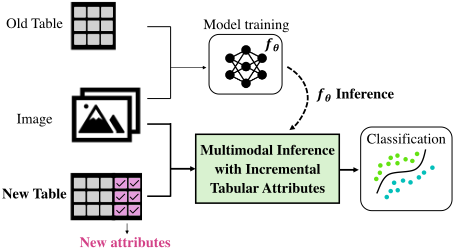
To address this challenge, we introduce a novel task termed multimodal inference with incremental tabular attributes. As shown in Figure 1, we consider a scenario in which a multimodal model has been trained using any deep learning algorithm on visual and tabular modalities. During the inference stage, new attribute columns are introduced to the tabular modality. Our objective is to propose a method that fine-tunes the trained model to leverage the relationships among the incremental tabular attributes, the old tabular attributes, and the visual modality. In doing so, the model learns task-relevant information more effectively in an unsupervised manner. This approach aims to outperform models that discard the new attributes and rely solely on the old ones, while simultaneously reducing the data preparation overhead and improving convergence speed compared to fully supervised re-training.
Designing such a method is challenging, with the main difficulty being the inability to dynamically adapt due to the heterogeneity of the tabular modality. Each column in a table represents a distinct attribute with varying scales, semantics, and statistical distributions [Nam et al., 2023]. Directly applying encoding patterns from old attributes to new ones may not only fail to improve performance but could also degrade it. Furthermore, effectively leveraging the visual and tabular modalities to compress redundant information in incremental attributes and extract novel, task-relevant knowledge is essential. This ensures the new attributes contribute meaningfully to the model. However, research on multimodal tasks involving visual and tabular modalities, particularly when incremental tabular attributes are introduced, remains limited.
To address the aforementioned challenges, we propose a novel framework named Multimodal Inference with Incremental Tabular Attributes (MIITA). Specifically, we design a dedicated encoder for the incremental tabular attributes based on a Variational Autoencoder (VAE). This encoder not only extracts implicit features but also decouples them, ensuring that the learned latent representations are as independent as possible across dimensions. This disentanglement enhances interpretability and makes the latent features more amenable to constraints imposed by the old tabular attributes and the visual modality. Besides classification loss and CLIP loss-encouraging the representations of the two modalities to be close for the same sample and distant for different-we introduce two new loss functions. The first is a disentangled loss designed to further improve the disentanglement of the latent representations with the old representation. The second is a consistency loss, aimed at strengthening the alignment between the incremental tabular attributes and the visual modality. Both losses have demonstrated their effectiveness in ablation, showing significant contributions to overall performance. In summary, the contributions of this paper are:
- This paper introduces a new task, Multimodal Inference with Incremental Tabular Attributes, aiming to enable multimodal models to incorporate incremental tabular columns during the inference stage, enhancing the practicality of AI models in dynamically changed tables.
- To dynamically and unsupervisedly leverage incremental tabular attributes, we propose the MIITA framework, which disentangles the incremental representation from the old ones and adds the modality consistency constraint for better alignment. Our approach achieves state-of-the-art performance across five public datasets.
- Despite the new task, we show that MIITA evokes a new training procedure for general supervised multimodal learning with tabular and vision modalities.
2 RelatedWork
2.1 Multimodal Contrastive Learning
Multimodal contrastive learning has emerged as a powerful framework for learning representations across different modalities. Methods such as CLIP [Radford et al., 2021] and ALIGN [Jia et al., 2021] leverage large-scale paired datasets to align representations of text and images through contrastive objectives. These approaches ensure that similar samples across modalities are brought closer in the shared representation space, while dissimilar samples are pushed apart [Wu et al., 2021]. Recent works have extended this paradigm to other modality pairs, especially visual-tabular data [Hager et al., 2023; Wang et al., 2024a], demonstrating its versatility in fusing visual and tabular information.
However, existing multimodal contrastive learning methods are generally designed for static multimodal datasets and assume fixed input dimensions for each modality. When new attributes are introduced to the tabular modality, these models fail to adapt without retraining on the updated dataset. This limitation hinders their applicability to real-world scenarios.
2.2 Tabular Deep Learning
Tabular deep learning has become an important area of research, focusing on adapting neural networks to structured tabular data. Architectures such as TabNet [Arik and Pfister, 2020], FT-Transformer [Gorishniy et al., 2023] and SCARF [Bahri et al., 2022] have shown promise in feature selection, representation learning, and interpretability for tabular data. These models leverage advanced attention mechanisms or feature gating to capture meaningful relationships between attributes and outperform traditional machine learning approaches in various tasks. Recently, Large Language Models (LLMs) have also been explored for tabular data tasks. Methods like TabLLM [Hegselmann et al., 2023a] and TableGPT2 [Su et al., 2024] convert tabular attributes into natural language formats, enabling LLMs to incorporate prior knowledge and perform reasoning directly on structured data.
Despite these advancements, traditional tabular deep learning models typically assume a fixed tabular input. Current efforts, such as TransTab [Wang and Sun, 2022] and TabPFN [Hollmann et al., 2025], have introduced methods for handling dynamic attributes in tabular data. However, these approaches are predominantly focused on single-modality settings and lack the capability to effectively utilize visual modality information. On the other hand, LLM-assisted approaches excel in zero-shot or few-shot scenarios by leveraging pre-trained knowledge but often fall short in scenarios requiring incremental learning of incremental attributes [Zhang et al., 2024; Carballo et al., 2023]. Consequently, both traditional and LLM-assisted methods face significant challenges in addressing dynamic tabular attributes and fully leveraging cross-modal relationships, leaving a gap in solving incremental multimodal inference tasks.
3 Method
In this section, we formally define the task of Multimodal Inference with Incremental Tabular Attributes (MIITA). We then present the proposed framework, also named MIITA, detailing its architecture and the mechanisms it employs to handle incremental updates in tabular attributes during inference.
3.1 ProblemFormulation
Consider a multimodal dataset D = {(xvis i , xold i , yi)}Ni=1 , where xvis i ∈ X vis represents a visual input (e.g., medical images), xold i ∈ X old denotes tabular data comprising M old attributes, and yi ∈ Y is the target label. Amultimodal model f is trained on D to predict yi by jointly utilizing xvis i and xold i :
where Θ denotes the model parameters learned in training.
In the MIITA setting, during the inference phase, incremental attributes are added to the tabular modality, resulting in an incremental tabular input xinf i ∈ X inf , where X inf ⊃ X old and the incremental attributes are denoted as X inc = X inf \ X old . The goal is to adapt the trained model f to utilize the augmented tabular input xinf i along with xvis i to predict yi:
where f ′ and Θ′ represent the adapted model and updated parameters, respectively.
The MIITA task involves three key challenges:
- Dynamic Adaptation: The model must incorporate X inc without requiring retraining on the entire dataset.
- Preserving Knowledge: The model should retain its ability to utilize the old attributes X old and X vis .
- Unsupervised Adaptation: The adaptation should not rely on labels for the incremental attributes, instead leveraging unsupervised learning to extract task-relevant information.
By addressing these challenges, MIITA enables robust multimodal inference in dynamic real-world scenarios where tabular data evolves over time.
3.2 MIITA Framework
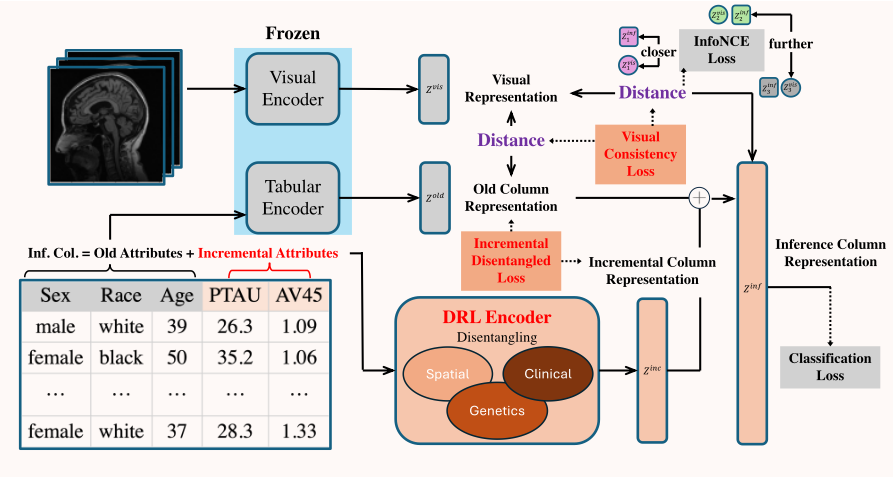
As shown in Figure 2, our framework is based on a trained multimodal model, from which we extract the tabular encoder and the visual encoder, freezing their parameters to ensure that MIITA does not perform worse than the old model. During inference, the image and the old tabular attributes of a given sample are passed through the visual encoder and tabular encoder, respectively, producing the visual representation and old tabular representation.
To handle incremental tabular attributes, we use a dedicated Disentangled Representation Learning (DRL) encoder. This encoder disentangles the entangled representations of the incremental attributes into interpretable dimensions, such as spatial or temporal factors. This disentanglement not only enhances the interpretability of the model but also strengthens the effectiveness of subsequent multimodal learning procedures. After passing through the DRL encoder, we obtain the incremental tabular representation.
Our framework leverages the relationships among the three representations: visual, old tabular representation, and incremental tabular representation, using a combination of novel loss functions. Beyond the foundational InfoNCE loss and a task-specific classification loss with pseudo-labels, we will introduce novel Incremental Disentangled Loss and Visual Consistency Loss in detail. By integrating the DRL encoder with these four loss functions, we finally use the improved inference tabular representation for downstream tasks. Our framework can effectively utilize the information from the incremental tabular attributes, improving model performance in an unsupervised manner while achieving faster convergence.
DRL Encoder
The DRL encoder is pivotal for disentangling incremental tabular attributes, enabling effective utilization of new information in the MIITA framework. Specifically, it employs a β-Variational Autoencoder (β-VAE) to encode the incremental attributes xinc into a disentangled latent space zinc , ensuring independence among dimensions [Higgins et al., 2017]. Other DRL encoder variants, like FactorVAE [Kim and Mnih, 2019] and DIP-VAE [Kumar et al., 2018], are also compatible with our framework. The β-VAE's objective is defined by a combination of reconstruction and regularization losses.
The reconstruction loss ensures that the encoder effectively captures the information contained in xinc :
where ˆxinc is the reconstruction of the input. To promote disentanglement, a regularization term enforces the independence of latent dimensions by introducing a KL divergence between the posterior qϕ(zinc |xinc ) and a factorized unit Gaussian prior p(zinc ):
The overall loss for the DRL encoder is expressed as:
where β is a hyperparameter that controls the trade-off between reconstruction accuracy and disentanglement strength.
Incremental Disentangled Loss
In addition to disentangling the incremental attributes themselves, we aim to ensure that zinc encodes meaningful, complementary information while avoiding redundancy with zold . To achieve this, we introduce a disentangled loss with two distinct focuses:
The redundancy mitigation loss focuses on maximizing the KL divergence between qϕ(zinc |xinc ) and q(zold ), ensuring zinc captures novel, nonlinear information not present in zold :
The covariance regularization loss, on the other hand, penalizes linear cross-correlations between the dimensions of zinc and zold , further promoting disentanglement by encouraging independence:
where C cross ij is the cross-covariance matrix in zinc and zold .
The overall disentangled loss is then defined as:
where λ1 and λ2 are hyperparameters controlling the tradeoff between nonlinear redundancy mitigation and linear covariance regularization.
InfoNCE Loss
The InfoNCE loss [van den Oord et al., 2019] facilitates alignment between the visual and tabular modalities by encouraging the inference tabular representation zinf , formed by concatenating zold and zinc , to be close to the visual representation zvis of the same sample while being far from those of other samples in the batch.
The inference tabular representation is defined as:
The InfoNCE loss is expressed as:
where sim(a, b) denotes cosine similarity, τ is a temperature hyperparameter, and B is the batch size. This loss ensures that zinf aligns closely with zvis for the same sample while preserving inter-sample separability.
Visual Consistency Loss
To better align the tabular and visual modalities, we further ensure that the inference tabular representation zinf is closer to the visual representation zvis than the old tabular representation zold alone. This encourages incremental tabular attributes to complement the old tabular representation effectively.
To enforce the desired alignment, we propose an InfoNCEinspired loss that compares the relative similarities between the representations:
By minimizing LVis-Cons, the model explicitly enforces the inference tabular representation zinf to capture richer and more complementary information from the incremental attributes, improving its alignment with the visual modality. This approach leverages the additional information from incremental tabular attributes to enhance multimodal inference while maintaining consistency with the visual modality.
Classification with Pseudo Labels
To enhance the framework's classification capabilities, pseudo-labels generated by old models are employed to provide supervision in an unsupervised setting. To ensure reliability, only pseudo-labels with a confidence score higher than a specific threshold (e.g., 0.7) are retained for supervision. The classification loss is defined using the standard cross-entropy loss as [Mao et al., 2023]:
where ˆ yi represents the highest pseudo-label probability of sample i, yi is the predicted probability for the corresponding class.The purpose of LCls is to ensure that the learned features are strongly related to downstream tasks by aligning them with task-relevant information. This process helps to discard task-irrelevant features, thereby improving the effectiveness of MIITA for specific applications.
Overall Objective
The overall objective integrates all components to optimize the MIITA framework holistically:
where each term contributes to specific aspects of representation learning, alignment, and classification. By balancing these losses, the model effectively captures and integrates multimodal information, achieving robust and interpretable performance.
4 Experiment
4.1 Experiment Setup
Datasets and Comparative Methods
We use five public datasets that are commonly used in multimodal learning areas using tabular and visual modalities: ADNI (AD) [Jr et al., 2008], Data Visual Marketing (DV) [Huang et al., 2023], Pokemon Primary Type (PK), HearthStone Card's category (HS), CS:GO skin quality (CG) [Lu et al., 2023]. In each, we remove specific columns from the train and validation sets while keeping them in the inference set to simulate real-world incremental tabular inference. The deleted columns were chosen logically, reflecting their historical appearance. Details are in the appendix.
For baselines, we use single tabular modality classifiers: XGBoost [Chen and Guestrin, 2016], SCARF [Bahri et al., 2021] and FT-Transformer [Gorishniy et al., 2021]. Since these tabular methods can't utilize incremental columns, we only use the same columns as the train set for inference. Single visual modality classifiers like CNN [O'Shea and Nash, 2015] and ViT [Dosovitskiy et al., 2021] are also used. Then, we compare our method to recent tabular-visual multimodal models: AutoMM [Shi et al., 2021], SimCLR [Chen et al., 2020], MMCL [Huang, 2023] and TIP [Du et al., 2024]. Also, we compare our method to FT-Trans* and TransTab [Wang and Sun, 2022], which can utilize all columns in the inference set. Note that in our experiments, we modified FTTransformer by replacing the embedding layer with a linear embedding (1 × encoder size) to handle any input dimensions, noted as FT-Trans*. Finally, we compare performance with LLM-assisted models, including TabLLM [Hegselmann et al., 2023b] and MediTab [Wang et al., 2024b].
Implementation Details
We encode categorical features using a backward difference encoder [Potdar et al., 2017]. Key setting of MIITA are: β (VAE) ∈ {2, 5, 10}, λ1 (KL) / λ2 (cov-cross) ∈ {0.5, 1.0, 2.0}, and pseudo-label threshold = 0.7. The loss weights in Eq.13 were adjusted based on early gradient magnitudes. The default setting is {1, 0.5, 0.8, 0.4, 1}.
| Modality Input | Model | Predicted Result | Target | ||
|---|---|---|---|---|---|
| Old tabular attributes | Year Color … | 2018 White … | XGBoost | BMW 1 series | Car Brand |
| Image | ViT | Volkswagen Golf | |||
| Incremental tabular | 27000 | MMCL | Volkswagen Golf | ||
| attributes | Price Speed … | 136 mph … | MIITA | Audi A3 | |
| Old tabular attributes | HP Attack … | 100 134 … | XGBoost | Dark | Primary Type |
| Image | ViT | Dragon | |||
| Incremental tabular attributes | Weight 202 kg | MMCL | Dark | ||
| Ability … | Sand Stream … | MIITA | Rock | ||
4.2 Results on Public Datasets
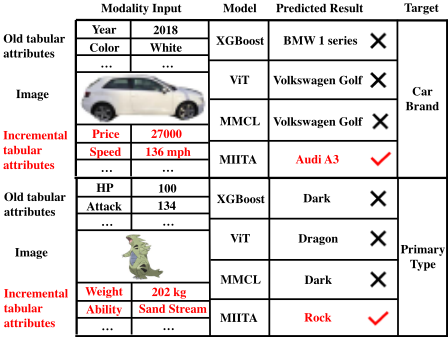
We evaluated the MIITA framework for six tasks in five widely used datasets that span entirely different domains, each containing both tabular and visual modalities. As shown in Table 1, MIITA consistently outperformed state-of-the-art (SOTA) single-modal and multimodal methods, representing MIITA is a general framework applicable for all scenarios including medical, advertisement and game. The visualization result of two difficult samples is shown in Figure 3. All results were averaged over four runs to mitigate randomness, with the corresponding variances provided in the appendix.
Single-Modal Baselines
We first conducted experiments using single-modal models for both tabular and visual data. Since traditional tabular learning methods cannot handle dynamic attributes, our tabular experiments only used the static, old attributes matching the training setup. The results demonstrate significant performance limitations in both modalities: the visual data proved unstable and informationally limited, while the tabular modality was severely constrained by its inability to utilize incremental columns.
Multimodal Methods
Three multimodal learning models designed for tabular and visual modalities were evaluated. These models achieved superior performance compared to single-modal baselines, highlighting the effectiveness of multimodal learning in leveraging complementary information from both modalities. We used SimCLR as a baseline for further experiments, replacing its tabular feature extractor with methods capable of handling dynamic attributes.
Experiments with Incremental Tabular Attributes
To explore handling dynamic tabular attributes, we first tested FT-Trans*, which directly maps tabular data with incremental attributes using the old encoder without adaptation. The results were poor, demonstrating the necessity for tailored adjustments in encoding schemes. Both the traditional selfsupervised pretraining approach (TransTab, TIP) and large language model (LLM)-assisted tabular learning also failed to achieve satisfactory results. Their performance was often worse than multimodal models using only the old tabular attributes because they cannot put trained tabular encoders into fully usage. In contrast, MIITA consistently achieved leading performance across all tasks. This demonstrates the superiority and generalizability of the MIITA framework in addressing the challenges posed by incremental tabular attributes in multimodal learning.
| Dataset size | 1250 | 1250 | 176414 | 897 | 10710 | 956 | |
|---|---|---|---|---|---|---|---|
| Train tabular attribute size | 30 | 30 | 5 | 7 | 5 | 2 | |
| Incremental tabular attribute size | 85 | 85 | 11 | 10 | 7 | 3 | |
| Method/Dataset | AD3 | AD2 | DV | PK | HS | CG | Rank(Std) |
| Tabular classifiers | |||||||
| XGBoost | 0.758 | 0.866 | 0.890 | 0.616 | 0.600 | 0.546 | 9.8 (1.47) |
| SCARF | 0.742 | 0.852 | 0.887 | 0.589 | 0.600 | 0.521 | 11.2 (1.51) |
| FT-Trans | 0.746 | 0.868 | 0.891 | 0.607 | 0.610 | 0.533 | 9.2 (2.27) |
| Visual classifiers | |||||||
| CNN | 0.761 | 0.883 | 0.880 | 0.322 | 0.550 | 0.682 | 8.8 (4.54) |
| ViT | 0.768 | 0.885 | 0.880 | 0.308 | 0.568 | 0.674 | 8.6 (4.59) |
| Multimodal classifiers | |||||||
| AutoMM | 0.760 | 0.902 | 0.887 | 0.620 | 0.460 | 0.600 | 8.0 (2.85) |
| SimCLR | 0.760 | 0.908 | 0.896 | 0.634 | 0.702 | 0.604 | 4.3 (1.86) |
| MMCL | 0.773 | 0.908 | 0.898 | 0.646 | 0.689 | 0.610 | 3.2 (0.98) |
| Multimodal classifiers with traditional dynamic tabular encoder | |||||||
| SimCLR w. FT-Trans* | 0.628 | 0.830 | 0.847 | 0.561 | 0.432 | 0.519 | 13.7 (0.82) |
| SimCLR w. TransTab | 0.730 | 0.882 | 0.892 | 0.634 | 0.647 | 0.590 | 7.4 (3.32) |
| TIP | 0.788 | 0.908 | 0.906 | 0.634 | 0.653 | 0.624 | 3.2 (0.98) |
| Multimodal classifiers with LLM-assisted tabular encoder | |||||||
| SimCLR w. TabLLM | 0.742 | 0.868 | 0.885 | 0.617 | 0.602 | 0.586 | 9.7 (1.54) |
| SimCLR w. MediTab | 0.760 | 0.896 | 0.892 | 0.620 | 0.605 | 0.580 | 7.0 (1.58) |
| MIITA | 0.814 | 0.930 | 0.924 | 0.692 | 0.714 | 0.742 | 1.0 (0.00) |
4.3 Generalizability Across Different Scenarios
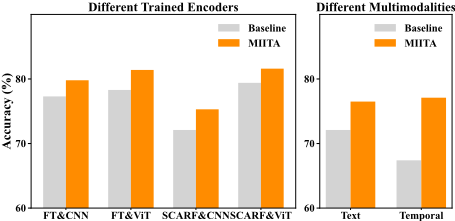
As discussed in the methodology section, MIITA is designed to be a model-agnostic framework, capable of integrating with various architectures seamlessly. As illustrated in Figure 4, MIITA demonstrates consistent performance improvements when applied to models employing different tabular and visual feature extractors in AD3 dataset. This showcases the flexibility of MIITA in adapting to diverse base architectures without requiring significant structural modifications.
The generalizability of MIITA extends beyond tabularvisual multimodal tasks to scenarios involving other modalities. We conducted experiments on additional multimodal learning tasks: tabular-text in a game dataset[Lu et al., 2023] and tabular-temporal data in a stock dataset. Across these tasks, MIITA achieved a consistent performance improvement, highlighting its effectiveness in leveraging incremental tabular attributes with other modalities, reinforcing its potential as a universal approach for dynamic multimodal learning.
4.4 General Improvement on Supervised Learning
Beyond excelling in the proposed MIITA task, our framework also demonstrated significant advantages in fully supervised multimodal scenarios. The experiments showed that MIITA consistently outperformed traditional training approaches when labeled data was available.
| Settings/Dataset | AD3 | PK | DV |
|---|---|---|---|
| Fully supervised | 0.838 | 0.774 | 0.930 |
| Disentangled rate | 0.343 | 0.457 | 0.678 |
| MIITA | 0.870 | 0.796 | 0.938 |
| Disentangled rate | 0.689 | 0.824 | 0.749 |
| Attributes/Dataset | AD3 | DV | PK |
|---|---|---|---|
| High Visual-Corr | 0.783 | 0.900 | 0.646 |
| MediumVisual-Corr | 0.794 | 0.900 | 0.660 |
| Low Visual-Corr | 0.814 | 0.920 | 0.689 |
| Few | 0.788 | 0.900 | 0.668 |
| Moderate | 0.820 | 0.908 | 0.683 |
| Many | 0.814 | 0.924 | 0.692 |
In the supervised setting, the MIITA framework was applied by first disentangling the complete tabular data using the DRL encoder. The disentangled features were then treated as original inputs and progressively grouped in batches to train the MIITA framework with the proposed loss constraints. For this scenario, the DRL encoder utilized a Transformerbased architecture. As presented in Table 2, this incremental training approach achieved superior performance across three datasets compared to state-of-the-art multimodal learning models [Hager et al., 2023]. Furthermore, we evaluated the disentanglement level using the metric introduced in [Higgins et al., 2017], demonstrating that MIITA achieves a higher disentanglement rate compared to traditional multimodal methods, which is beneficial for the integration of multimodal learning. These findings highlight the broader applicability of the MIITA framework and its potential to inspire novel strategies for progressive training and disentangling in general tabular-visual multimodal learning tasks, moving beyond the limitations of holistic learning approaches.
4.5 Incremental Tabular Attributes Settings
As shown in Table 3, we explored the impact of different incremental attribute settings in the tabular modality on the performance of MIITA. Based on human cognitive perception, we categorized the tabular attributes into three groups: those highly related to the image (i.e., the table attributes are fully reflected in the image), moderately related, and weakly related. Experimental results demonstrate that weakly related tabular attributes provide more information for multimodal tasks and play a more significant role in incremental inference. We also tested different numbers of incremental attributes, categorized as few, moderate, and many. Results indicate that as more attributes are added, MIITA's performance generally will improve. Even with a small incremental column size, MIITA shows performance gains, meaning MIITA treats incremental attributes as valuable rather than noise.
| Components/Dataset | AD3 | DV | PK |
|---|---|---|---|
| w/o. VCL &DRL & IDL | 0.788 | 0.900 | 0.651 |
| w/o. VCL | 0.796 | 0.906 | 0.662 |
| w/o. DRL & IDL | 0.790 | 0.906 | 0.679 |
| w/o. IDL | 0.773 | 0.904 | 0.608 |
| ALL | 0.814 | 0.924 | 0.692 |
4.6 Ablation Studies
To validate the effectiveness of the MIITA framework and the proposed loss functions, we conducted ablation studies by removing or replacing key components, as summarized in Table 4. Removing the visual consistency loss caused a notable performance drop, emphasizing its role in aligning the tabular representation with the visual modality. Replacing the disentangled encoder and incremental disentangled loss with a standard transformer also led to reduced performance, highlighting the benefits of disentangling incremental tabular attributes into interpretable dimensions. Additionally, using the disentangled encoder without the incremental disentangled loss caused a significant performance decline, showing that isolating incremental attributes leads to redundancy and inefficiency. The full MIITA framework, with all modules included, achieved the best results, demonstrating the effectiveness of each component in addressing the challenges of incremental tabular attributes in multimodal learning.
5 Discussion and Conclusion
In this work, we introduced MIITA, a novel framework designed to address the challenge of multimodal inference with incremental tabular attributes. Our extensive experiments demonstrated that MIITA outperforms state-of-the-art singlemodal and multimodal methods across a variety of datasets. The key strength of MIITA lies in its ability to effectively integrate incremental tabular attributes, leveraging disentangled representation learning and innovative loss functions to maintain alignment with existing modalities. We believe that MIITA offers broad applicability to multimodal learning tasks involving tabular data, and its design principles can be extended to other domains like audio and video. MIITA represents a significant step forward in integrating dynamic tabular data with other modalities and opens new opportunities for future research in flexible, interpretable multimodal learning.
Acknowledgements
This work is supported by NSFC (grant nos. 62472102 to B.Y. and 62372117 to W.T.) and by the Natural Science Foundation of Shanghai (24ZR1490400 to W.T.). The computations in this research were performed using the CFFF platform of Fudan University.
@inproceedings{ijcai2025p543,
  title     = {Multimodal Inference with Incremental Tabular Attributes},
  author    = {Chen, Xinda and Xing, Zhen and Zhang, Zixian and Tan, Weimin and Yan, Bo},
  booktitle = {Proceedings of the Thirty-Fourth International Joint Conference on
               Artificial Intelligence, {IJCAI-25}},
  publisher = {International Joint Conferences on Artificial Intelligence Organization},
  editor    = {James Kwok},
  pages     = {4878--4886},
  year      = {2025},
  month     = {8},
  note      = {Main Track},
  doi       = {10.24963/ijcai.2025/543},
  url       = {https://doi.org/10.24963/ijcai.2025/543},
}
TY - CPAPER TI - Multimodal Inference with Incremental Tabular Attributes AU - Chen, Xinda AU - Xing, Zhen AU - Zhang, Zixian AU - Tan, Weimin AU - Yan, Bo T2 - Proceedings of the Thirty-Fourth International Joint Conference on Artificial Intelligence, IJCAI-25 PB - International Joint Conferences on Artificial Intelligence Organization PY - 2025 SP - 4878 EP - 4886 DO - 10.24963/ijcai.2025/543 UR - https://doi.org/10.24963/ijcai.2025/543 ER -Copied
Machine-readable versions of this paper, for tools and AI agents:





