
Flexible Generalized Low-Rank Regularizer for Tensor RPCA
Proceedings of the Thirty-Fourth International Joint Conference on Artificial Intelligence. Main Track. Pages 5235-5243.
https://doi.org/10.24963/ijcai.2025/583
Keywords
- Machine Learning: ML: Robustness
- Machine Learning: ML: Matrix/tensor methods
Abstract
Tensor Robust Principal Component Analysis (TRPCA) has emerged as a powerful technique for low-rank tensor recovery. To achieve better recovery performance, a variety of TNN (Tensor Nuclear Norm) based low-rank regularizers have been proposed case by case, lacking a general and flexible framework. In this paper, we design a novel tensor low-rank regularization framework coined FGTNN (Flexible Generalized Tensor Nuclear Norm). Equipped with FGTNN, we develop the FGTRPCA (Flexible Generalized TRPCA) framework, which has two desirable properties. 1) Generalizability: Many existing TRPCA methods can be viewed as special cases of our framework; 2) Flexibility: Using FGTRPCA as a general platform, we derive a series of new TRPCA methods by tuning a continuous parameter to improve performance. In addition, we develop another novel smooth and low-rank regularizer coined t-FGJP and the resulting SFGTRPCA (Smooth FGTRPCA) method by leveraging the low-rankness and smoothness priors simultaneously. Experimental results on various tensor denoising and recovery tasks demonstrate the superiority of our methods.
- [Barron et al., 2023] Jonathan T Barron, Ben Mildenhall, Dor Verbin, Pratul P Srinivasan, and Peter Hedman. Zip- nerf: Anti-aliased grid-based neural radiance fields. In Proceedings of the IEEE/CVF International Conference on Computer Vision, pages 19697-19705, 2023.
- [Boyd et al., 2011] Stephen Boyd, Neal Parikh, Eric Chu, Borja Peleato, Jonathan Eckstein, et al. Distributed op- timization and statistical learning via the alternating direc- tion method of multipliers. Foundations and Trends® in Machine learning, 3(1):1-122, 2011.
- [Chen et al., 2021] Lin Chen, Xue Jiang, Xingzhao Liu, and Zhixin Zhou. Logarithmic norm regularized low-rank fac- torization for matrix and tensor completion. IEEE Trans- actions on Image Processing, 30:3434-3449, 2021.
- [Gao et al., 2020] Quanxue Gao, Pu Zhang, Wei Xia, Deyan Xie, Xinbo Gao, and Dacheng Tao. Enhanced tensor rpca and its application. IEEE Transactions on Pattern Analysis and Machine Intelligence, 43(6):2133-2140, 2020.
- [Hou et al., 2024] Jingyao Hou, Xinling Liu, Hailin Wang, and Ke Guo. Tensor recovery from binary measurements fused low-rankness and smoothness. Signal Processing, 221:109480, 2024.
- [Hu et al., 2012] Yao Hu, Debing Zhang, Jieping Ye, Xue- long Li, and Xiaofei He. Fast and accurate matrix com- pletion via truncated nuclear norm regularization. IEEE Transactions on Pattern Analysis and Machine Intelli- gence, 35(9):2117-2130, 2012.
- [Huang et al., 2015] Bo Huang, Cun Mu, Donald Goldfarb, and John Wright. Provable models for robust low- rank tensor completion. Pacific Journal of Optimization, 11(2):339-364, 2015.
- [Huang et al., 2024] Kai Huang, Weichao Kong, Min Zhou, Wenjin Qin, Feng Zhang, and Jianjun Wang. Enhanced low-rank tensor recovery fusing reweighted tensor corre- lated total variation regularization for image denoising. Journal of Scientific Computing, 99(3):69, 2024.
- [Ji and Feng, 2023] Jintian Ji and Songhe Feng. Anchor structure regularization induced multi-view subspace clus- tering via enhanced tensor rank minimization. In Proceed- ings of the IEEE/CVF International Conference on Com- puter Vision, pages 19343-19352, 2023.
- [Jiang et al., 2020] Tai-Xiang Jiang, Ting-Zhu Huang, Xi-Le Zhao, and Liang-Jian Deng. Multi-dimensional imaging data recovery via minimizing the partial sum of tubal nu- clear norm. Journal of Computational and Applied Math- ematics, 372:112680, 2020.
- [Kilmer and Martin, 2011] M. Kilmer and C. Martin. Factor- ization strategies for third-order tensors. Linear Algebra Appl., 435(3):641-658, 2011.
- [Kilmer et al., 2013] Misha E Kilmer, Karen Braman, Ning Hao, and Randy C Hoover. Third-order tensors as opera- tors on matrices: A theoretical and computational frame- work with applications in imaging. SIAM Journal on Ma- trix Analysis and Applications, 34(1):148-172, 2013.
- [Kilmer et al., 2021] Misha E Kilmer, Lior Horesh, Haim Avron, and Elizabeth Newman. Tensor-tensor algebra for optimal representation and compression of multiway data. Proceedings of the National Academy of Sciences, 118(28):e2015851118, 2021.
- [Ko et al., 2020] Ching-Yun Ko, Kim Batselier, Lucas Daniel, Wenjian Yu, and Ngai Wong. Fast and accurate tensor completion with total variation regularized tensor trains. IEEE Transactions on Image Processing, 29:6918- 6931, 2020.
- [Kodak, 1993] Eastman Kodak. Kodak lossless true color image suite (photocd pcd0992). URL http://r0k. us/graph- ics/kodak, 6:2, 1993. Link
- [Liu et al., 2024a] Youfa Liu, Bo Du, Yongyong Chen, Lefei Zhang, Mingming Gong, and Dacheng Tao. Convex- concave tensor robust principal component analysis. Inter- national Journal of Computer Vision, 132(5):1721-1747, 2024.
- [Liu et al., 2024b] Youheng Liu, Yulong Wang, Longlong Chen, Libin Wang, and Yutao Hu. Tihn: Tensor improved huber norm for low-rank tensor recovery. International Journal of Wavelets, Multiresolution and Information Pro- cessing, 22(05):2450023, 2024.
- [Liu et al., 2024c] Zhiyu Liu, Zhi Han, Yandong Tang, Xi- Le Zhao, and Yao Wang. Low-tubal-rank tensor re- covery via factorized gradient descent. arXiv preprint arXiv:2401.11940, 2024.
- [Lu et al., 2020] C. Lu, J. Feng, Y. Chen, W. Liu, Z. Lin, and S. Yan. Tensor robust principal component analysis with a new tensor nuclear norm. IEEE Transactions on Pattern Analysis and Machine Intelligence, 42(4):925-938, Apr. 2020.
- [Martin et al., 2001] David Martin, Charless Fowlkes, Doron Tal, and Jitendra Malik. A database of human segmented natural images and its application to evaluat- ing segmentation algorithms and measuring ecological statistics. In Proceedings eighth IEEE international conference on computer vision. ICCV 2001, volume 2, pages 416-423. IEEE, 2001.
- [Peng et al., 2020] Jiangjun Peng, Qi Xie, Qian Zhao, Yao Wang, Leung Yee, and Deyu Meng. Enhanced 3dtv reg- ularization and its applications on hsi denoising and com- pressed sensing. IEEE Transactions on Image Processing, 29:7889-7903, 2020.
- [Peng et al., 2022a] Jiangjun Peng, Hailin Wang, Xiangyong Cao, Xinling Liu, Xiangyu Rui, and Deyu Meng. Fast noise removal in hyperspectral images via representative coefficient total variation. IEEE Transactions on Geo- science and Remote Sensing, 60:1-17, 2022.
- [Peng et al., 2022b] Jiangjun Peng, Yao Wang, Hongying Zhang, Jianjun Wang, and Deyu Meng. Exact decomposi- tion of joint low rankness and local smoothness plus sparse matrices. IEEE Transactions on Pattern Analysis and Ma- chine Intelligence, 45(5):5766-5781, 2022.
- [Phothilimthana et al., 2024] Mangpo Phothilimthana, Sami Abu-El-Haija, Kaidi Cao, Bahare Fatemi, Michael Bur- rows, Charith Mendis, and Bryan Perozzi. Tpugraphs: A performance prediction dataset on large tensor computa- tional graphs. Advances in Neural Information Processing Systems, 36, 2024.
- [Qin et al., 2024] Wenjin Qin, Hailin Wang, Feng Zhang, Weijun Ma, Jianjun Wang, and Tingwen Huang. Non- convex robust high-order tensor completion using random- ized low-rank approximation. IEEE Transactions on Im- age Processing, 33:2835-2850, 2024.
- [Qiu et al., 2021] Duo Qiu, Minru Bai, Michael K Ng, and Xiongjun Zhang. Robust low-rank tensor completion via transformed tensor nuclear norm with total variation regu- larization. Neurocomputing, 435:197-215, 2021.
- [Wang et al., 2023a] Hailin Wang, Jiangjun Peng, Wenjin Qin, Jianjun Wang, and Deyu Meng. Guaranteed ten- sor recovery fused low-rankness and smoothness. IEEE Transactions on Pattern Analysis and Machine Intelli- gence, 45(9):10990-11007, 2023.
- [Wang et al., 2023b] Yulong Wang, Kit Ian Kou, Hong Chen, Yuan Yan Tang, and Luoqing Li. Double auto- weighted tensor robust principal component analysis. IEEE Transactions on Image Processing, 32:5114-5125, 2023.
- [Wen et al., 2024] Tao Wen, Elynn Chen, and Yuzhou Chen. Tensor-view topological graph neural network. In Interna- tional Conference on Artificial Intelligence and Statistics, pages 4330-4338. PMLR, 2024.
- [Yan and Guo, 2024] Tinghe Yan and Qiang Guo. Tensor ro- bust principal component analysis via dual lp quasi-norm sparse constraints. Digital Signal Processing, 150:104520, 2024.
- [Yasuma et al., 2008] Fumihito Yasuma, Tomoo Mitsunaga, Daisuke Iso, and Shree K Nayar. Generalized assorted pixel camera: Post-capture control of. Tech. rep., Depart- ment of Computer Science, Columbia University CUCS- 061-08, 2008.
- [Zhang et al., 2023a] Chao Zhang, Huaxiong Li, Wei Lv, Zizheng Huang, Yang Gao, and Chunlin Chen. Enhanced tensor low-rank and sparse representation recovery for in- complete multi-view clustering. In Proceedings of the AAAI conference on artificial intelligence, volume 37, pages 11174-11182, 2023.
- [Zhang et al., 2023b] Feng Zhang, Hailin Wang, Wenjin Qin, Xile Zhao, and Jianjun Wang. Generalized non- convex regularization for tensor rpca and its applications in visual inpainting. Applied Intelligence, 53(20):23124- 23146, 2023.
- [Zhao et al., 2024] Linqing Zhao, Xiuwei Xu, Ziwei Wang, Yunpeng Zhang, Borui Zhang, Wenzhao Zheng, Dalong Du, Jie Zhou, and Jiwen Lu. Lowrankocc: Tensor decom- position and low-rank recovery for vision-based 3d seman- tic occupancy prediction. In Proceedings of the IEEE/CVF Conference on Computer Vision and Pattern Recognition, pages 9806-9815, 2024.
References were extracted automatically from the PDF and may contain errors.
Full text extracted automatically from the PDF; figures, tables and equations may differ. The PDF is the version of record.
1 Introduction
Tensor data are ubiquitous, many real-world data are usually inherently multidimensional, with information stored in multi-way arrays known as tensors, e.g., images, videos, network flow data, etc. In recent years, significant advancements across various interdisciplinary domains have been made in tensor analysis, such as machine learning [Wen et al., 2024; Phothilimthana et al., 2024], data mining [Zhang et al., 2023a; Huang et al., 2024], and computer vision [Zhao et al., 2024; Liu et al., 2024a]. However, due to the inherent limitations of signal acquisition equipment, including sensor sensitivity, photon effects, and calibration errors, tensor data gathered from real-world environments frequently suffer from substantial corruption [Wang et al., 2023a]. Consequently, tensor recovery has become a crucial task in tensor analysis.
† Corresponding author: Yulong Wang
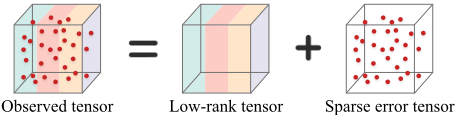
This paper concentrates on the problem of Tensor Robust Principal Component Analysis (TRPCA) [Huang et al., 2015], which seeks to recover the underlying low-rank tensor L and sparse tensor E from their sumM(see Figure 1 for a visual representation) and solves the following problem
where λ > 0 is a regularization parameter, rank(L) denotes the rank of clean tensor L and ∥E∥1 is ℓ1-norm (sum of the absolute values of all the entries) to measure the sparsity of the noise tensor E. A key challenge is the definition of tensor rank, which is inherently more complex than matrix rank. Various conventional methods for defining tensor rank originate from distinct tensor decompositions. For instance, inspired by the tensor singular value decomposition (t-SVD), [Kilmer et al., 2013] proposed the tensor tubal rank that can be efficiently computed using the fast Fourier Transform (FFT). Since the non-convexity and discontinuity of the rank function, solving the problem (1) is usually NP-hard. Consequently, [Lu et al., 2020] proposed a novel tensor nuclear norm as a convex approximation to the tensor tubal rank and proposed a new TRPCA method defined as follows
where ∥ · ∥∗ represents the tensor nuclear norm (TNN). Furthermore, recent research by [Kilmer et al., 2021] has demonstrated the optimal representation and compression capabilities of t-SVD, further highlighting the significance of model (2) in capturing the intrinsic low-rank structures of tensors. As a result, the model (2) under t-SVD has garnered considerable interests recently [Hou et al., 2024; Liu et al., 2024c; Qin et al., 2024].
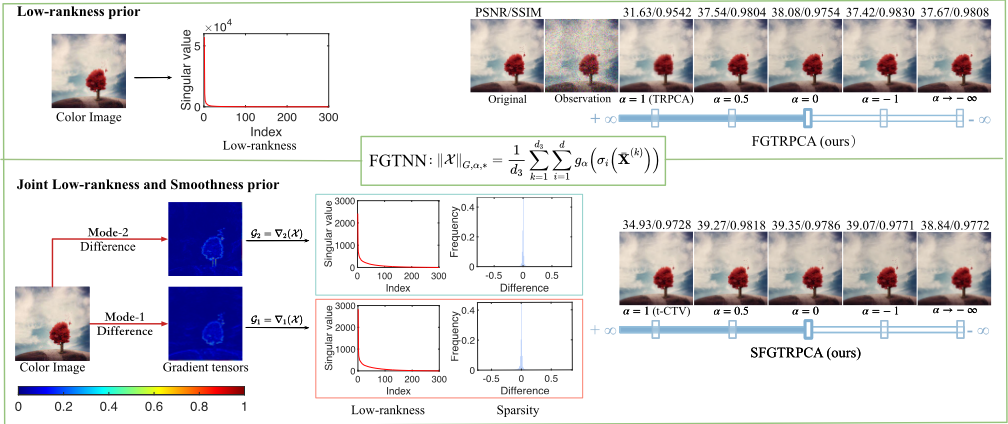
Despite the impressive performance of TRPCA, it still exhibits several limitations. Specifically, when minimizing the TNN, TRPCA employs tensor singular value thresholding to uniformly diminish all singular values. In real-world applications, singular values often carry distinct physical meanings, supported by prior knowledge indicating that larger singular values are generally associated with more significant information. The uniform shrinkage approach of TRPCA fails to account for these differences among singular values, potentially leading to suboptimal results.
While many existing advanced methodologies [Gao et al., 2020; Jiang et al., 2020; Wang et al., 2023b; Zhang et al., 2023b; Yan and Guo, 2024; Liu et al., 2024b] develop various TNN-based low-rank regularizers that penalize large singular values less and small singular values more, thereby efficiently preserving essential information and filtering out irrelevant details. However, their discrete and fixed models lack flexibility for diverse scenarios. To address this problem, we design a novel Flexible Generalized low-rank regularizer (FGTNN) to adaptively assign different penalties to distinct singular values and impose the constraint on the sparse component. We have shown that several existing TRPCA models can be reformulated as special cases of FGTRPCA. Apart from that, we can also derive a wider family of new TRPCA models by tuning a continuous parameter to improve performance. Through this, our model significantly improves flexibility and efficiency in complex situations.
Note that the low-rankness prior and the smoothness prior modeled by total variation (TV) are widely utilized in tensor recovery applications [Ko et al., 2020; Qiu et al., 2021]. This prior states how similar objects/scenes (with shapes) are adjacently distributed [Peng et al., 2022b]. Most previous works encoded the two priors with two independent regularizers and incorporated them into a unified model, which achieved better performance [Peng et al., 2020; Peng et al., 2022a]. However, they have two drawbacks: (1) it is challenging to fine-tune the regularization parameter between the two terms; (2) the theoretical guarantee for exact recovery remains unproven for the related methods.
Given the circumstances above, [Wang et al., 2023a] proposed the tensor Correlated Total Variation (t-CTV) norm which integrates the two priors into a single regularization term, eliminating the need for tuning separate parameters. Moreover, this work offered theoretical guarantees for the precise recovery of analogous tensor methods that concurrently model both priors. Analogously, the integration regularization term was also based on TNN in the gradient domain. Consequently, [Huang et al., 2024] proposed a reweighted regularizer based on ℓp norm as a surrogate for t-CTV term. In this paper, we employ FGTNN to explore the inherent structural properties of gradient tensors and introduce a new tensor-correlated Flexible Generalized Joint Prior (t-FGJP) regularizer.
Our principal contributions are outlined as follows:
- We propose a flexible generalized low-rank regularizer (FGTNN) that accounts for the varying importance of different singular values in low-rank tensors and develop a novel FGTRPCA framework. The FGTRPCA, not only regards many existing TRPCA methods as special cases, but also opens a door to design a broad new family of TRPCA methods by tuning a continuous parameter. This enhances the flexibility of our model to counter more intricate scenarios.
- Considering the low-rankness and smoothness priors simultaneously, we propose a novel tensor-correlated Flexible Generalized Joint Prior (t-FGJP) regularizer based on FGTNN. It maintains the flexibility of discriminatively controlling different singular values of the gradient tensors and can derive a new smooth FGTRPCA
model, termed SFGTRPCA.
- We design ADMM-based [Boyd et al., 2011] optimization algorithmic frameworks tailored for our FGTRPCA and SFGTRPCA models. Extensive experiments on various tensor denoising and recovery tasks demonstrate the advantages of our models.
2 Notations and Preliminaries
First, we present some key notations and definitions used throughout the paper. We represent scalars, vectors, and matrices using lowercase letters, boldface lowercase letters, and boldface uppercase letters, e.g., x, x, X, respectively. Tensors are presented by bold calligraphic letters, e.g., X. 1d1×d2 and 1d1×d2×d3 represent a matrix of size d1 ×d2 and a tensor of size d1 ×d2 ×d3 with all entries as ones. For a 3-order tensor X ∈ Rd1×d2×d3 , we denote Xijk as its (i, j, k)-th entry, X(i, :, :) as its horizontal slice, X(:, j, :) as its lateral slice, X(:, :, k) as its frontal slice, respectively. For convenience, the frontal slice X(:, :, k) is often denoted as X(k) . The tensor nuclear norm (TNN), tensor ℓ1 norm (TL1N), tensor Frobenius norm and tensor infinity norm of X are defined by ∥X∥∗ , ∥X∥1 = ∑ijk |Xijk| , ∥X∥F = √∑ijk |Xijk|2 and ∥X∥∞ = maxijk|Xijk|, respectively. The transpose of X is defined as X T ∈ Rd2×d1×d3 [Lu et al., 2020].
Definition 1. (T-SVD) [Kilmer and Martin, 2011] For a tensor X ∈ Rd1×d2×d3 , it can be factorized by t-SVD as
where U ∈ Rd1×d1×d3 , V ∈ Rd2×d2×d3 are orthogonal tensors, i.e., U ∗ U T = U T ∗ U = V ∗ V T = V T ∗ V = I, and S ∈ Rd1×d2×d3 is an f-diagonal tensor, i.e., each frontal slices are the diagonal matrices, and "∗" is the t-product.
Definition 2. (Tensor Nuclear Norm, TNN) [Lu et al., 2020] For a tensor X ∈ Rd1×d2×d3 , d = min(d1, d2), the Tensor Nuclear Norm of X is defined as
where ¯ X is the result by applying FFT on X along the third dimension, i.e., ¯ X = fft(X, [], 3). ¯X(k) is the k-th frontal slice of ¯ X, σi ( ¯X(k) ) is the i-th singular value of ¯X(k) .
3 ProposedMethods
We begin by detailing the motivation for FGTNN and its characteristics, then propose the FGTRPCA framework and implement it using an efficient optimization algorithm. Furthermore, by simultaneously considering low-rankness and smoothness priors, we develop a novel t-FGJP regularizer and apply it to solve TRPCA problem, termed SFGTRPCA.
3.1 Flexible Generalized TNN
According to Definition 2, the original TNN uniformly shrinks each singular value of the low-rank tensor L when minimizing the tensor nuclear norm, which may lead to suboptimal solution. Indeed, larger singular values are associated with more critical information within the tensor. Inspired by the common purposes of enhancing TRPCA methods, we introduce a flexible generalized tensor nuclear norm (FGTNN) as a unified framework, which is defined below.
Definition 3. (FGTNN) For a tensor X ∈ Rd1×d2×d3 , d = min(d1, d2), the Flexible Generalized Tensor Nuclear Norm (FGTNN) is defined as follows
where gα(x) follows [Barron et al., 2023]:
where α ∈ R is a continuous parameter that controls the shape of gα(x) and c > 0 is a scale parameter.
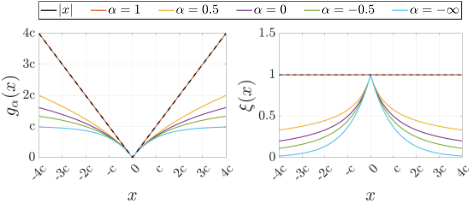
Remark 1. Our proposed FGTNN mainly exhibits two desirable properties. 1) Generalizability: By introducing a continuous parameter α, low-rank regularizers in many existing popular methods such as TRPCA, LRTF, ETR, and DATRPCA can be viewed as special cases of FGTNN with different values of α.(see Table 1 for more details); 2) Flexibility: We can develop plenty of new low-rank regularizers by tuning α and achieve better performance. Compared to the method with fixed-form low-rank regularizer, our model gains flexibility and can adapt to more complex scenarios. Apart from that, gα(x) in FGTNN controls the penalty strength to singular values. Figure 3(a) intuitively presents the characteristics of gα(x). We observe that gα(x) increases slower than |x| for various α, which means less shrunk to large singular values, preserving the critical information within the tensor to a greater extent. More importantly, α is related to the shape of gα(x). When α → -∞, gα(x) follows an approximately exponential form; When α = 0, gα(x) takes a logarithmic form; When α = 1, gα(x) turns to |x|; And in the other case of α, gα(x) is represented in a approximate power form.
Specifically, we can extend FGTNN to the sparse component and define the flexible generalized tensor ℓ1 norm (FGTL1N).
Definition 4. (FGTL1N) For a tensor X ∈ Rd1×d2×d3 , the Flexible Generalized Tensor ℓ1 Norm (FGTL1N) is defined as follows:
| Author and year | Method | Value of α | gα(x) | Low-rank Regularizer |
|---|---|---|---|---|
| [Lu et al., 2020] | TRPCA | α = 1 | |x| | ∥X ∥G,1,∗ |
| [Chen et al., 2021] | LRTF | α = 0 | c ln (|x|/c + 1) | ∥X ∥G,0,∗ |
| [Ji and Feng, 2023] | ETR | α = -1 | 2|x| |x|/c+2 | ∥X ∥G,-1,∗ |
| [Wang et al., 2023b] | DATRPCA | α→-∞ | c (1- exp (-|x|/c)) | ∥X ∥G,-∞,∗ |
3.2 Flexible Generalized TRPCA
By integrating FGTNN and FGTL1N into the TRPCA framework, we formulate the following Flexible Generalized TRPCA (FGTRPCA) model.
Remark 2. It is worth pointing out that FGTRPCA serves as a versatile framework for addressing TRPCA problems. By adjusting the parameter α, it can be tailored to develop new TRPCA methods. Specifically, in this paper, we introduce a variant of FGTRPCA with α = 0.5, a choice that has not been explored before.
Note that FGTNN includes a series of specific functions that are nonlinear and complex, thus making it hard to obtain the optimal solution of the FGTRPCA model. In this paper, we design an efficient algorithm optimization framework based on the ADMM framework [Boyd et al., 2011] to implement the FGTRPCAmodel.
Proposition 1. For gα(x), there exists a convex conjugate function ϕ : R → R which satisfies
and for fixed x, the minimum is reached at w = ξ(x; c)(c is a positive constant), which is defined as
Remark 3. According to Proposition 1, gα(x) in Eq. (6) can be optimized by an adaptive alternating weighted minimization scheme. From the perspective of weights, smaller weights represent smaller shrinkages to singular values. As shown in Figure 3(b), TNN assigns equal weight to each singular value, i.e., TNN treats each singular value equally. For our proposed FGTNN, larger singular values will adaptively receive smaller weights, resulting in less shrinkage.
According to Proposition 1, FGTNN can be transformed into
where the Wki is the k, i-th element of matrix W ∈ Rd3×d . The minimum is reached at Wki = ξ(σi(¯L(k) ); c). Similarly, as for FGTL1N, we have
where the Wijk is the i, j, k-th element of tensor W ∈ Rd1×d2×d3 . The minimum is reached at Wijk = ξ(|Eijk|; c).
Notably, problem (8) can be reformulated as the weighted tensor nuclear norm minimization problem (11) and the weighted tensor ℓ1 norm minimization problem (12). The following defines two key concepts: Weighted tensor nuclear norm (WTNN) and weighted tensor ℓ1 norm (WTL1N).
Definition 5. (Weighted Tensor Nuclear Norm, WTNN)[Wang et al., 2023b] For a tensor X ∈ Rd1×d2×d3 and a weight matrix W ∈ Rd3×d , d = min(d1, d2), the WTNN of X is defined as
Definition 6. (Weighted Tensor ℓ1 Norm, WTL1N)[Wang et al., 2023b] For a tensor X ∈ Rd1×d2×d3 and a weight tensor W ∈ Rd1×d2×d3 , the WTL1N of X is defined as
By incorporating Eq. (11) and Eq. (12) into model (8), and according to the definition of WTNN and WTL1N, we have
where ΦM(W) and ΦT (W) are defined such that ΦM(W) = ∑d1 k=1 ∑d2 i=1 ψ(Wki) and ΦT (W) = ∑d1 i=1 ∑d2 j=1 ∑d3 k=1 ψ(Wijk). In the next part, we will present the optimization for implementing FGTRPCA.
3.3 Optimization for FGTRPCA
The Lagrangian function of the FGTRPCA model is L(L, E, W, W, Z, µ) = ∥L∥W,∗ + λ∥E∥W,1 + ΦM (W)
where Z ∈ Rd1×d2×d3 denotes the Lagrangian multiplier and µ is a positive parameter. Each variable can be updated alternately in the scheme of the ADMM framework.
Step1: Update L by fixing the other variables:
The closed-form solution of (17) can be easily obtained with the following proximity operator.
Lemma 1. Given X ∈ Rd1×d2×d3 with t-SVD X = U ∗ S ∗ V ∗ and a weight matrix W ∈ Rd×d3 , where wk is the k-th column of W and d = min{d1, d2}. Considering the following Weighted Tensor Nuclear Norm minimization (WTNNM) problem
where ∥ · ∥W,∗ denotes the WTNN, and Prox∥·∥W,∗ is defined as a proximal operator. For non-descending weights 0 ≤ Wk1 ≤ Wk2 ≤ · · · ≤ Wkd(k = 1, . . . , d3), the problem (18) has the global solution which is defined as
where ifft denotes the inverse fast Fourier transform applied along the third dimension, PW(¯S) is a tensor to meet the conditions of its k-th frontal slice is Pwk (¯S(k) ) for k = 1, . . . , d3. ¯S(k) is the k-th frontal slice of ¯S, and Pwk (¯S(k) ) denotes a diagonal matrix which can be computed as (Pwk (¯S(k) ))ii = (¯S(k) ii -wki)+, where (x)+ = x if x > 0 and (x)+ = 0 otherwise. wki is the i-th element of the wk.
By recalling the definition of WTNN in Definition 5, we have 1 µt ∥L∥W,∗ = ∥L∥ 1 µt W,∗ . Based on Lemma 1, the solution of the subproblem (17) can be described as
Step2: Update E by fixing other variables:
To get the closed-form solution of the above problem, we utilize the tensor soft-thresholding operator (TST) defined below to update Et+1.
where the ijk-th entry of TST is defined by
Step3: Update the elements of W and W by an adaptive way according to Proposition 1
Step4: Update the Lagrangian multiplier tensor Z and the parameter µ by
Algorithm 1 FGTRPCA algorithm
Input: Observation tensor data M ∈ Rd1×d2×d3 , and the parameter λ.
- 1: Initialize L0 = E0 = Z0 = 0, W0 = 1d3×d, W0 = 1d1×d2×d3 , µ0 = 10-2 , ρ = 1.1, ϵ = 10-6 , and t = 0.
- 2: while not converge do
- 3: Update the low-rank tensor L by Eq. (17).
- 4: Update the sparse tensor E by Eq. (21).
- 5: Update the weightsWandW by Eq. (24).
- 6: Update the Lagrangian multiplier Z by Eq. (25).
- 7: Update the parameter µ by Eq. (26).
- 8: Check the convergence condition in Eq. (27).
- 9: end while
Output: L = Lt+1, E = Et+1
where ρ = 1.1. The convergence conditions are defined as
The whole optimization procedure is summarized in Algorithm 1.
3.4 Smooth FGTRPCA
Considering a structured tensor that exhibits both lowrankness and smoothness, we devise a novel regularizer that aims to represent both two properties simultaneously on the gradient tensors, instead of employing a combination of two distinct regularizers for encoding the two properties. We first introduce the definition of the gradient tensor and present our proposed tensor-correlated Flexible Generalized Joint Prior (t-FGJP) regularizer.
Definition 7. (Gradient tensor)[Wang et al., 2023a] For a tensor X ∈ Rd1×d2×d3 , its gradient tensor along the k-th mode is defined as
where Ddk is a row circulant matrix of (-1, 1, 0, ..., 0).
Definition 8. (t-FGJP) For a tensor X ∈ Rd1×d2×d3 , the proposed t-FGJP norm is defined as
where Γ represents a priori set of directions along which X equips both low-rankness and smoothness priors and γ := #{Γ} denotes the cardinality of Γ. By incorporating both tFGJP and FGTL1N into the TRPCA framework, we propose a smooth FGTRPCA (SFGTRPCA) model defined as
The SFGTRPCA optimization problem is similar to the FGTRPCA problem. Details of the optimization algorithm and the entire procedure are presented in the supplementary material due to space limitations.
4 Experiments
In this section, we present several real-world experiments to substantiate the effectiveness of our models. Additional results are provided in the supplementary material.
4.1 Settings
Datasets. For comprehensive comparison, we use 4 widely used tensor data types including color images, grayscale videos, hyperspectral images (HSIs), and multispectral images (MSIs). For color images, we choose 3 widely used datasets including Berkeley Segmentation Dataset 1 (BSD) [Martin et al., 2001], Kodak [Kodak, 1993] dataset 2 , and ZheJiang University (ZJU) [Hu et al., 2012] dataset 3 . For grayscale videos, we use 14 grayscale video sequences from the YUV dataset 4 and select the first 100 frames for each sequence. For HSIs, we utilize Cuprite 5 , DCMall 5 , Urban 5 , Indian Pines 5 , and Pavia University 5 (PaviaU) with their first 50 bands from each HSI dataset for experiments. For MSIs, we randomly select 4 MSIs from the CAVE dataset [Yasuma et al., 2008].
1 https://www2.eecs.berkeley.edu/Research/Projects/CS/vision/ bsds/
2 http://r0k.us/graphics/kodak/
3 https://sites.google.com/site/zjuyaohu/
4 http://trace.eas.asu.edu/yuv/
5 https://lesun.weebly.com/hyperspectral-data-set.html
Baselines. Our baselines are divided into two categories based on different priors. (1) Low-rankness: TRPCA [Lu et al., 2020], ETRPCA [Gao et al., 2020], and PTRPCA [Yan and Guo, 2024]; (2) Joint Low-rankness & Smoothness: tCTV [Wang et al., 2023a] and RTCTV [Huang et al., 2024]. We utilize the parameters recommended by the authors. For the key parameter α in our models, we search from a candidate set and employ α = 0.5. More detailed parameter settings are described in the supplementary material.
Evaluation metrics. The peak signal-to-noise ratio (PSNR) and structural similarity (SSIM) are used to evaluate the recovery performance.
Noising Data Construction. For each color channel of the color image, each frame of the grayscale video, and each band of HSI and MSI, we add random salt and pepper noise at varying noise ratios of 10%, 20%, and 30%.
| Noise Ratio | 10% | 20% | ||
|---|---|---|---|---|
| Methods | PSNR | SSIM | PSNR | SSIM |
| TRPCA | 31.20 | 0.9464 | 29.55 | 0.9115 |
| ETRPCA | 33.26 | 0.9580 | 31.23 | 0.9233 |
| images PTRPCA | 33.37 | 0.9622 | 31.43 | 0.9350 |
| FGTRPCA | 37.26 | 0.9796 | 33.26 | 0.9415 |
| Color t-CTV | 32.84 | 0.9525 | 31.71 | 0.9348 |
| RTCTV | 34.96 | 0.9689 | 33.46 | 0.9529 |
| SFGTRPCA | 40.96 | 0.9907 | 36.93 | 0.9782 |
| TRPCA | 35.19 | 0.9636 | 34.16 | 0.9538 |
| videos ETRPCA | 38.29 | 0.9772 | 36.13 | 0.9433 |
| PTRPCA | 38.95 | 0.9807 | 37.31 | 0.9669 |
| FGTRPCA | 41.85 | 0.9858 | 39.07 | 0.9743 |
| Grayscale t-CTV | 37.37 | 0.9721 | 36.52 | 0.9665 |
| RTCTV | 41.11 | 0.9843 | 38.62 | 0.9482 |
| SFGTRPCA | 44.51 | 0.9911 | 41.91 | 0.9846 |
| TRPCA | 44.18 | 0.9754 | 42.48 | 0.9718 |
| ETRPCA | 44.54 | 0.9747 | 43.20 | 0.9720 |
| PTRPCA | 47.38 | 0.9815 | 45.48 | 0.9772 |
| HSIs FGTRPCA | 47.30 | 0.9858 | 44.90 | 0.9787 |
| t-CTV | 45.72 | 0.9779 | 44.39 | 0.9759 |
| RTCTV | 48.29 | 0.9812 | 46.76 | 0.9789 |
| SFGTRPCA | 52.38 | 0.9888 | 50.16 | 0.9856 |
| TRPCA | 42.07 | 0.9898 | 40.41 | 0.9867 |
| ETRPCA | 45.95 | 0.9931 | 44.00 | 0.9906 |
| PTRPCA | 46.87 | 0.9939 | 44.84 | 0.9920 |
| MSIs FGTRPCA | 49.73 | 0.9960 | 46.05 | 0.9921 |
| t-CTV | 46.62 | 0.9938 | 45.21 | 0.9925 |
| RTCTV | 50.19 | 0.9952 | 48.69 | 0.9941 |
| SFGTRPCA | 57.37 | 0.9977 | 53.35 | 0.9955 |
4.2 Experimental Results
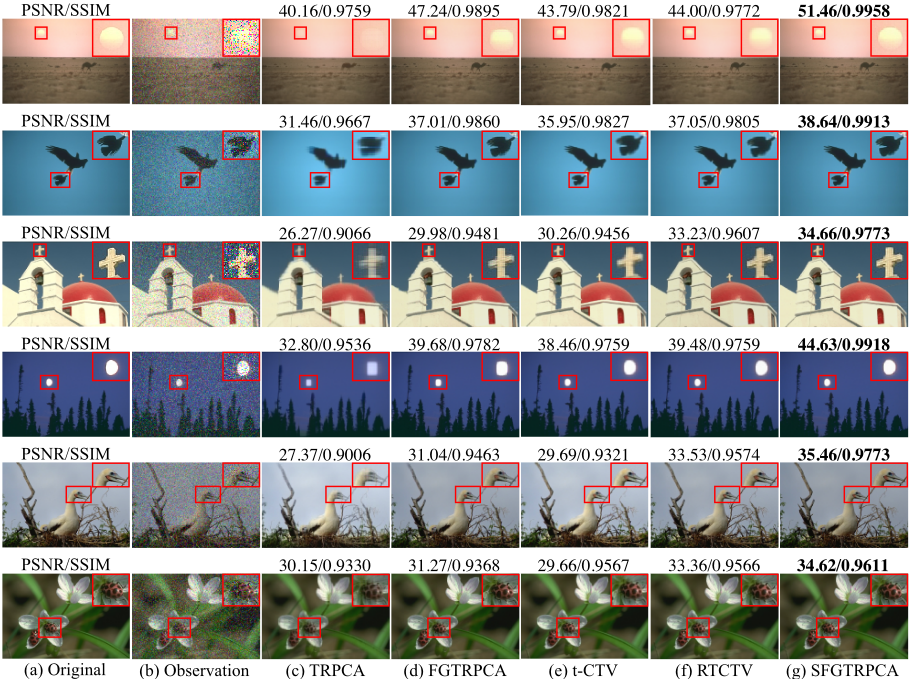
Visual Quality. To clearly illustrate the advantages of our methods on color image recovery, Figure 4 presents 6 sample images from the BSD dataset, along with the recovery results under 20% salt and pepper noise. The PSNR and SSIM values are listed above the recovered images to enhance the credibility of the results. The results show that SFGTRPCA constructs more image details and color information (Especially the contour and color of the moon in the 4-th image). Additionally, we have observed that the proposed FGTRPCA and SFGTRPCA methods significantly outperform the baseline methods under corresponding priors.
Quantitative Quality. Table 2 displays the results of all the competitors on the 4 tensor types with 10% and 20% noise. From the results, we draw the following conclusions:
- Firstly, SFGTRPCA outperforms all comparison methods, achieving an average PSNR improvement of over 4.4 dB compared to the second-best baseline. Specifically, it attains PSNR gains of 17.16% and 14.31% for
color images and MSIs with 10% noise, respectively. This is because our model can adaptively learn appropriate weights for the frontal slices of the tensor through a weighting function.
- Secondly, compared to the baselines that only consider the low-rankness prior (TRPCA, ETRPCA, and PTRPCA), our FGTRPCA demonstrates the best performance in most situations, and achieves an average improvement of over 1.7 dB in PSNR compared to the second-best baseline. Notably, our FGTRPCA always leads in SSIM values, which indicates that our FGTRPCA can recover more structural information.
- Thirdly, our methods consistently achieve competitive evaluation scores across diverse tensor data types under varying noise levels, demonstrating their ability to effectively leverage low-rank and sparse structures for robust recovery.
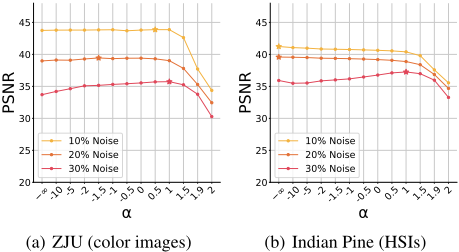
Parameter Analysis. It should be noticed that the parameter α plays a crucial role in our models, which can adjust the flexibility and generalizability to adapt to various scenarios. To explore its impact on different cases, we examine some recovery tasks with different values of α under various noise ratios on ZJU (color images) and Indian Pines (HSIs) datasets in Figure 5. As seen, by tuning α, our SFGTRPCA model gains significant improvements in various situations. This improvement highlights the advantage of incorporating α as a hyperparameter instead of a fixed formula and validates the flexibility of our framework.
5 Conclusion
In this article, we propose a flexible generalized low-rank regularizer termed FGTNN, and develop a novel FGTRPCA framework. Many existing TRPCA methods can fall into our special cases, which reveals connections between existing and new TRPCA approaches through a continuous parameter. Additionally, by integrating low-rankness and smoothness priors, we design a novel regularizer based on FGTNN and propose a smooth FGTRPCA (SFGTRPCA) model. Compared to existing works, our models process with flexibility and generalizability, demonstrating superior performance.
Ethical Statement
There are no ethical issues.
Acknowledgments
We are grateful to the anonymous IJCAI reviewers for their constructive comments. This work was supported by the National Natural Science Foundation of China (under Grant Nos. 62276111, 62076041, 61806027, 61702057, and 62202009), the Fundamental Research Funds for the Central Universities of China (under Grant Nos. 2662023XXPY002 and 2662023LXPY005), the HZAU-AGIS Cooperation Fund (under Grant No. SZYJY2023010), and the IndustryUniversity-Research Cooperation Project of Zhuhai, Guangdong, China, under Grant GP/026/2020 and Grant HF-0102021.
Contribution Statement
Zhiyang Gong and Jie Yu are co-first authors, and Yulong Wang is the corresponding author.
@inproceedings{ijcai2025p583,
  title     = {Flexible Generalized Low-Rank Regularizer for Tensor RPCA},
  author    = {Gong, Zhiyang and Yu, Jie and Hu, Yutao and Wang, Yulong},
  booktitle = {Proceedings of the Thirty-Fourth International Joint Conference on
               Artificial Intelligence, {IJCAI-25}},
  publisher = {International Joint Conferences on Artificial Intelligence Organization},
  editor    = {James Kwok},
  pages     = {5235--5243},
  year      = {2025},
  month     = {8},
  note      = {Main Track},
  doi       = {10.24963/ijcai.2025/583},
  url       = {https://doi.org/10.24963/ijcai.2025/583},
}
TY - CPAPER TI - Flexible Generalized Low-Rank Regularizer for Tensor RPCA AU - Gong, Zhiyang AU - Yu, Jie AU - Hu, Yutao AU - Wang, Yulong T2 - Proceedings of the Thirty-Fourth International Joint Conference on Artificial Intelligence, IJCAI-25 PB - International Joint Conferences on Artificial Intelligence Organization PY - 2025 SP - 5235 EP - 5243 DO - 10.24963/ijcai.2025/583 UR - https://doi.org/10.24963/ijcai.2025/583 ER -Copied
Machine-readable versions of this paper, for tools and AI agents:





