
A Simple yet Effective Hypergraph Clustering Network
Proceedings of the Thirty-Fourth International Joint Conference on Artificial Intelligence. Main Track. Pages 6352-6360.
https://doi.org/10.24963/ijcai.2025/707
Keywords
- Machine Learning: ML: Deep learning architectures
- Machine Learning: ML: Clustering
- Machine Learning: ML: Representation learning
- Machine Learning: ML: Unsupervised learning
Abstract
Hypergraph Clustering has gained significant attention due to its capability of capturing high order structural information. Among different approaches, contrastive learning-based methods leverage self-supervised learning and data augmentation, exhibiting impressive performance. However, most of them come with the following limitations: 1) Augmentation strategies like feature dropout can potentially disrupt the intrinsic clustering structure of hypergraphs. 2) High computational demands hinder their real-world application. To address the above issues, we propose a simple yet effective Hypergraph Clustering Network framework (HCN). Specifically, HCN replaces the hypergraph convolution operation with smoothing preprocessing, which avoids high computational complexity. Besides, to retain intrinsic structure, it develops two key modules: the self-diagonal consistency module and the structure alignment mod ule. They respectively align the similarity matrix with the identity matrix and the structural affinity matrix, which ensures intra-cluster compact ness and inter-cluster separability. Extensive experiments on five benchmark datasets demonstrate HCN’s superiority over state-of-the-art methods.
- [Antelmi et al., 2023] Alessia Antelmi, Gennaro Cordasco, Mirko Polato, Vittorio Scarano, Carmine Spagnuolo, and Dingqi Yang. A survey on hypergraph representation learning. ACM Computing Surveys, 56(1):1-38, 2023.
- [Bretto, 2013] Alain Bretto. Hypergraph theory. An intro- duction. Mathematical Engineering. Cham: Springer, 1, 2013.
- [Cai et al., 2022] Derun Cai, Moxian Song, Chenxi Sun, Baofeng Zhang, Shenda Hong, and Hongyan Li. Hyper- graph structure learning for hypergraph neural networks. In IJCAI, pages 1923-1929, 2022. IJCAI
- [Chen et al., 2024a] Man-Sheng Chen, Xi-Ran Zhu, Jia-Qi Lin, and Chang-Dong Wang. Contrastive multiview at- tribute graph clustering with adaptive encoders. IEEE Transactions on Neural Networks and Learning Systems, 2024.
- [Chen et al., 2024b] Mulin Chen, Bocheng Wang, and Xue- long Li. Deep contrastive graph learning with clustering- oriented guidance. In Proceedings of the AAAI Conference on Artificial Intelligence, volume 38, pages 11364-11372, 2024.
- [Chen et al., 2025] Jianpeng Chen, Yawen Ling, Jie Xu, Yazhou Ren, Shudong Huang, Xiaorong Pu, Zhifeng Hao, Philip S Yu, and Lifang He. Variational graph generator for multiview graph clustering. IEEE Transactions on Neural Networks and Learning Systems, 2025.
- [Chien et al., 2021] Eli Chien, Chao Pan, Jianhao Peng, and Olgica Milenkovic. You are allset: A multiset function framework for hypergraph neural networks. arXiv preprint arXiv:2106.13264, 2021.
- [Dai and Gao, 2023] Qionghai Dai and Yue Gao. Hyper- graph computation for medical and biological applica- tions. In Hypergraph Computation, pages 191-221. Springer, 2023.
- [Dua and Graff, 2017] Dheeru Dua and Casey Graff. UCI machine learning repository, 2017.
- [Feng et al., 2019] Yifan Feng, Haoxuan You, Zizhao Zhang, Rongrong Ji, and Yue Gao. Hypergraph neural net- works. In Proceedings of the AAAI conference on artificial intelligence, volume 33, pages 3558-3565, 2019.
- [Feng et al., 2021] Song Feng, Emily Heath, Brett Jefferson, Cliff Joslyn, Henry Kvinge, Hugh D Mitchell, Brenda Praggastis, Amie J Eisfeld, Amy C Sims, Larissa B Thack- ray, et al. Hypergraph models of biological networks to identify genes critical to pathogenic viral response. BMC bioinformatics, 22(1):287, 2021.
- [Gao et al., 2022] Yue Gao, Yifan Feng, Shuyi Ji, and Ron- grong Ji. Hgnn+: General hypergraph neural networks. IEEE Transactions on Pattern Analysis and Machine In- telligence, 45(3):3181-3199, 2022.
- [Huang and Yang, 2021] Jing Huang and Jie Yang. Unignn: a unified framework for graph and hypergraph neural net- works. arXiv preprint arXiv:2105.00956, 2021. IJCAI
- [Kim et al., 2024] Sunwoo Kim, Soo Yong Lee, Yue Gao, Alessia Antelmi, Mirko Polato, and Kijung Shin. A survey on hypergraph neural networks: An in-depth and step-by- step guide. In Proceedings of the ACM SIGKDD Con- ference on Knowledge Discovery and Data Mining, pages 6534-6544, 2024.
- [Kingma, 2014] Diederik P Kingma. Adam: A method for stochastic optimization. arXiv preprint arXiv:1412.6980, 2014.
- [Lee and Chae, 2024] Jongsoo Lee and Dong-Kyu Chae. Multi-view mixed attention for contrastive learning on hy- pergraphs. In Proceedings of the International ACM SIGIR Conference on Research and Development in Information Retrieval, pages 2543-2547, 2024.
- [Lee and Shin, 2023] Dongjin Lee and Kijung Shin. I'm me, we're us, and i'm us: Tri-directional contrastive learning on hypergraphs. In Proceedings of the AAAI Conference on Artificial Intelligence, volume 37, pages 8456-8464, 2023.
- [Li et al., 2013] Dong Li, Zhiming Xu, Sheng Li, and Xin Sun. Link prediction in social networks based on hyper- graph. In Proceedings of the international conference on world wide web, pages 41-42, 2013.
- [Liu et al., 2023] Yue Liu, Xihong Yang, Sihang Zhou, Xin- wang Liu, Zhen Wang, Ke Liang, Wenxuan Tu, Liang Li, Jingcan Duan, and Cancan Chen. Hard sample aware net- work for contrastive deep graph clustering. In Proceed- ings of the AAAI conference on artificial intelligence, vol- ume 37, pages 8914-8922, 2023.
- [Liu et al., 2024] Yunhui Liu, Xinyi Gao, Tieke He, Tao Zheng, Jianhua Zhao, and Hongzhi Yin. Reliable node similarity matrix guided contrastive graph clustering. IEEE Transactions on Knowledge and Data Engineering, 2024.
- [Qian et al., 2024] Yiyue Qian, Tianyi Ma, Chuxu Zhang, and Yanfang Ye. Dual-level hypergraph contrastive learn- ing with adaptive temperature enhancement. In Compan- ion Proceedings of the ACM on Web Conference, pages 859-862, 2024.
- [Rossi and Ahmed, 2015] Ryan Rossi and Nesreen Ahmed. The network data repository with interactive graph analyt- ics and visualization. In Proceedings of the AAAI confer- ence on artificial intelligence, volume 29, 2015.
- [Sen et al., 2008] Prithviraj Sen, Galileo Namata, Mustafa Bilgic, Lise Getoor, Brian Galligher, and Tina Eliassi-Rad. Collective classification in network data. AI magazine, 29(3):93-93, 2008.
- [Song et al., 2024] Yumeng Song, Yu Gu, Tianyi Li, Jianzhong Qi, Zhenghao Liu, Christian S Jensen, and Ge Yu. Chgnn: a semi-supervised contrastive hypergraph learning network. IEEE Transactions on Knowledge and Data Engineering, 2024.
- [Tang et al., 2024] Bohan Tang, Zexi Liu, Keyue Jiang, Si- heng Chen, and Xiaowen Dong. Training-free message passing for learning on hypergraphs, 2024.
- [Van der Maaten and Hinton, 2008] Laurens Van der Maaten and Geoffrey Hinton. Visualizing data using t-sne. Journal of machine learning research, 9(11), 2008.
- [Wang et al., 2023] Yuxin Wang, Quan Gan, Xipeng Qiu, Xuanjing Huang, and David Wipf. From hypergraph en- ergy functions to hypergraph neural networks. In Inter- national Conference on Machine Learning, pages 35605- 35623. PMLR, 2023.
- [Wei et al., 2022] Tianxin Wei, Yuning You, Tianlong Chen, Yang Shen, Jingrui He, and Zhangyang Wang. Augmenta- tions in hypergraph contrastive learning: Fabricated and generative. Advances in neural information processing systems, 35:1909-1922, 2022.
- [Wu et al., 2024] Hanrui Wu, Nuosi Li, Jia Zhang, Sentao Chen, Michael K Ng, and Jinyi Long. Collaborative con- trastive learning for hypergraph node classification. Pat- tern Recognition, 146:109995, 2024.
- [Xia et al., 2021] Xin Xia, Hongzhi Yin, Junliang Yu, Qinyong Wang, Lizhen Cui, and Xiangliang Zhang. Self-supervised hypergraph convolutional networks for session-based recommendation. In Proceedings of the AAAI conference on artificial intelligence, volume 35, pages 4503-4511, 2021.
- [Xia et al., 2022] Lianghao Xia, Chao Huang, Yong Xu, Ji- ashu Zhao, Dawei Yin, and Jimmy Huang. Hypergraph contrastive collaborative filtering. In Proceedings of the International ACM SIGIR conference on research and de- velopment in information retrieval, pages 70-79, 2022.
- [Yang et al., 2021] Yiyang Yang, Sucheng Deng, Juan Lu, Yuhong Li, Zhiguo Gong, Zhifeng Hao, et al. Graphlshc: towards large scale spectral hypergraph clustering. Infor- mation Sciences, 544:117-134, 2021.
- [Yang et al., 2023a] Xihong Yang, Yue Liu, Sihang Zhou, Siwei Wang, Wenxuan Tu, Qun Zheng, Xinwang Liu, Liming Fang, and En Zhu. Cluster-guided contrastive graph clustering network. In Proceedings of the AAAI con- ference on artificial intelligence, volume 37, pages 10834- 10842, 2023.
- [Yang et al., 2023b] Xihong Yang, Cheng Tan, Yue Liu, Ke Liang, Siwei Wang, Sihang Zhou, Jun Xia, Stan Z Li, Xinwang Liu, and En Zhu. Convert: Contrastive graph clustering with reliable augmentation. In Proceedings of the ACM International Conference on Multimedia, pages 319-327, 2023.
- [Yu et al., 2021] Junliang Yu, Hongzhi Yin, Jundong Li, Qinyong Wang, Nguyen Quoc Viet Hung, and Xiangliang Zhang. Self-supervised multi-channel hypergraph convo- lutional network for social recommendation. In Proceed- ings of the web conference, pages 413-424, 2021.
- [Zhou et al., 2006] Dengyong Zhou, Jiayuan Huang, and Bernhard Schölkopf. Learning with hypergraphs: Clus- tering, classification, and embedding. Advances in neural information processing systems, 19, 2006.
- [Zhu et al., 2018] Jianming Zhu, Junlei Zhu, Smita Ghosh, Weili Wu, and Jing Yuan. Social influence maximization in hypergraph in social networks. IEEE Transactions on Network Science and Engineering, 6(4):801-811, 2018.
References were extracted automatically from the PDF and may contain errors.
Full text extracted automatically from the PDF; figures, tables and equations may differ. The PDF is the version of record.
1 Introduction
Hypergraphs have emerged as a compelling extension of traditional graphs that can effectively capture high-order relationships among entities [Bretto, 2013; Antelmi et al., 2023; Kim et al., 2024]. Unlike traditional graphs, which model pairwise relationships through edges, hypergraphs extend this concept by introducing hyperedges that simultaneously connect multiple nodes. This unique property makes hypergraphs highly effective in modeling complex data structures, such as social networks [Li et al., 2013; Zhu et al., 2018], biological systems [Feng et al., 2021; Dai and Gao, 2023], and recommendation systems [Xia et al., 2021; Yu et al., 2021], where interactions often go beyond simple pairwise relationships.
∗Corresponding Author
Inspired by the remarkable success of graph neural networks (GNNs) [Chen et al., 2024b; Chen et al., 2024a; Chen et al., 2025], recent research has increasingly focused on the development of hypergraph neural networks (HNNs) [Feng et al., 2019; Cai et al., 2022; Wang et al., 2023], aiming to leverage hypergraphs to characterize complex relationships. HNNs iteratively aggregate node features into their incident hyperedges and then propagate the hyperedge features back to their incident nodes. Although these methods demonstrate promising results, they primarily focus on (semi-)supervised node classification tasks. However, in realworld scenarios, there exist massive unlabeled data due to the high expense and complexity of hypergraph data annotation. These methods depend on label guidance and confront difficulties when processing the unlabeled data. Therefore, several unsupervised hypergraph learning methods were developed to mitigate this problem, among which, hypergraph clustering is the most representative approach.
Hypergraph clustering aims to partition the nodes of a hypergraph into several disjoint groups in an unsupervised manner. Existing hypergraph clustering methods can be broadly categorized into traditional and deep learning-based methods. For instance, traditional hypergraph clustering methods include applying spectral clustering to hypergraphs [Zhou et al., 2006; Yang et al., 2021]. Nevertheless, these methods are inadequate for capturing complex and high-order structural information, while deep approaches can effectively mitigate this issue. Especially, contrastive learning-based hypergraph clustering [Wei et al., 2022; Xia et al., 2022; Wu et al., 2024; Qian et al., 2024] significantly improves representation capabilities as a self-supervised method. Most of them typically employ various data augmentation strategies, such as simple feature dropout or structural perturbation, to generate distinct views of the hypergraph. Subsequently, they utilize HNNs to learn representations for each view and employ contrastive learning to maximize the similarity between positive pairs while minimizing the similarity between negative pairs.
Although hypergraph contrastive clustering has achieved promising results, they have the following drawbacks: 1) The data augmentation strategies can inadvertently distort the semantic information of the hypergraph, which risks altering the intrinsic clustering structure of the hypergraph and undermining its ability to accurately capture high-order dependencies. 2) HNNs typically require iterative updates of node representations during training process, which results in high computational complexity. Therefore, a simple yet effective hypergraph clustering network is highly expected.
In this paper, we propose a Hypergraph Clustering Network (HCN) to address the aforementioned issues. Specifically, it first implements a hypergraph smoothing preprocessing step instead of the hypergraph convolution operation, effectively reducing the computational complexity. Then, we feed the preprocessed hypergraph data into unshared Multilayer Perceptron (MLP) encoders to generate distinct views. Additionally, HCN incorporates a self-diagonal consistency module to enhance consistency by aligning the similarity matrices across different views with the identity matrix, thereby preserving shared semantic information. In parallel, it introduces the structure alignment module to capture the intrinsic structural patterns by aligning the similarity matrices with the hypergraph's structural affinity matrix, which ensures intracluster compactness and inter-cluster separability. Finally, we fuse the representations from different views for clustering. The major contributions are summarized as follows:
- We propose a simple yet effective hypergraph clustering network, which explores hypergraph learning in clustering tasks.
- We utilize hypergraph smoothing preprocessing instead of hypergraph convolution for structural information representation with better computational efficiency.
- We introduce the self-diagonal consistency module and structure alignment module to maintain consistency and simultaneously capture the intrinsic hypergraph structural patterns.
2 RelatedWork
In recent years, advancements in HNNs have demonstrated significantly improved performance by effectively exploring high-order information inherent in complex data structures. HGNN [Feng et al., 2019] is the first work to propose hypergraph neural networks, extending GCNs to a more general form. Unignn [Huang and Yang, 2021] is a unified framework that extends GNNs to hypergraphs, enabling seamless adaptation of advanced GNN architectures for effective hypergraph representation learning. HSL [Cai et al., 2022] refines hypergraph structures and trains HNNs end-to-end using sampling and contrastive learning to enhance performance. AllSet [Chien et al., 2021] introduces a highly flexible and expressive hypergraph neural network framework by leveraging multiset functions. However, these methods primarily focus on node classification guided by label information, making them unsuitable for unsupervised scenarios.
Given the powerful representation learning capabilities of contrastive learning, researchers have leveraged it for hypergraph representation learning. HyperGCL [Wei et al., 2022] improves hypergraph neural networks in low-label settings by combining domain-driven and generative augmentation strategies to construct effective contrastive views. MMACL [Lee and Chae, 2024] integrates high-order and pairwise relationships through mixed-attention mechanisms and leverages multi-view contrastive learning for more expressive node representations. TriCL [Lee and Shin, 2023] introduces tridirectional contrastive learning on hypergraphs, capturing both node- and group-level structural information through three complementary contrastive objectives. CHGNN [Song et al., 2024] combines adaptive view generation, enhanced hypergraph encoding, and contrastive learning to achieve superior classification accuracy on hypergraphs. CCL [Wu et al., 2024] alternates contrastive learning between standard graphs and hypergraphs to collaboratively enhance node representations. However, on the one hand, inappropriate data augmentation strategies may alter the semantic information of hypergraphs, thereby disrupting the intrinsic clustering structure of hypergraphs. On the other hand, these approaches often involve substantial computational overhead, which hinders their practicality in real-world scenarios.
3 The ProposedMethod
In this section, we introduce a novel framework for a Hypergraph Clustering Network (HCN). As illustrated in Figure 1, the framework is built upon three pivotal modules: hypergraph data preprocessing, self-diagonal consistency module, and structure alignment module. The subsequent sections will provide an in-depth exploration of each module, outlining its mechanisms and contributions to the overall approach.
3.1 Notations and ProblemDefinition
Notations: Consider a hypergraph data H = {X,H, E}, let V = {v1, v2, ..., vn} represents a set of n nodes belonging to k distinct classes, and E = {e1, e2, ..., em} denotes a set of hyperedges. The attribute matrix of all nodes is given by X ∈ Rn×d , where d indicates the dimension of the node attributes. The incidence matrix H ∈ {0, 1}n×m encodes the relationship between nodes and hyperedges, where Hij = 1 if node vi is contained in hyperedge ej, and Hij = 0 otherwise. We define Dv ∈ Rn×n as the diagonal degree matrix of nodes and DE ∈ Rm×m as the diagonal degree matrix of hyperedges. For node vi and hyperedge ek, Div represents the number of hyperedges connected to vi, while DkE denotes the number of nodes contained in ek.
Problem Statement: The objective of deep hypergraph clustering is to encode nodes using a neural network in an unsupervised manner and then partition them into several disjoint groups. In general, the hypergraph neural network F embeds the node attribute X and structural information H of the hypergraph into low-dimensional representations Z. Subsequently, clustering algorithms such as k-means or spectral clustering are employed to partition these low-dimensional representations into k disjoint groups.
3.2 Hypergraph Data Preprocessing
Existing hypergraph methods employ hypergraph neural networks to capture meaningful node features by iteratively updating hyperedge representations via their incident nodes and node representations via their incident hyperedges [Feng et al., 2019; Gao et al., 2022; Lee and Shin, 2023; Kim et al., 2024]. However, these methods often require substantial computational resources, which restricts their practical applicability.
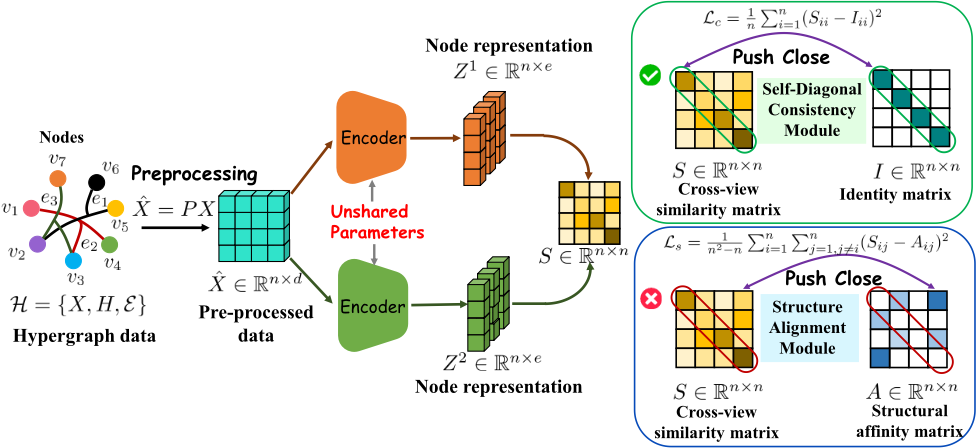
Inspired by [Tang et al., 2024], we utilize hypergraph smoothing preprocessing instead of hypergraph convolution for structural information representation, thereby reducing the computational burden. Specifically, we first define the hyperedge weight matrix, which is calculated as:
That is, the numerator equals 1 if ek contains both vi and vj simultaneously; otherwise, it equals 0. Then, we generate the hypergraph propagation matrix P as follows:
where ˆM = M+ In, and ˆD ∈ Rn×n denotes the diagonal degree matrix corresponding to ˆM. t represents the number of propagation layers. Specifically, each propagation step extends the spread of node information to more distant neighbors. When t = 1, the propagation is limited to direct neighbors, while t > 1 indicates that the information is propagated to nodes at greater distances. Additionally, a high value of α places greater emphasis on preserving the intrinsic information of each node, whereas a lower α amplifies the contribution of information from neighboring nodes. Then, we obtain the preprocessed hypergraph data, which can be represented as follows:
where ˆX denotes the preprocessed hypergraph data. Through the preprocessing process, we can train the processed hypergraph data using a simple network, significantly reducing the training time.
3.3 Self-Diagonal ConsistencyModule
The preprocessed hypergraph data is input into MLP encoders to generate node representations, which can be formulated as follows:
where MLP1 and MLP2 represent two unshared MLP encoders, while Z1 and Z2 correspond to the first and second views of node representations, respectively. By mapping ˆX into different subspaces, this approach captures diverse semantic information. Unlike other data augmentation techniques (e.g., feature dropout), this method preserves the hypergraph's structural and attribute integrity, thereby avoiding alterations to its semantic information.
To ensure consistency among node representations across different views, we introduce the self-diagonal consistency module. Specifically, the similarity between the two node representations, Z1 and Z2 , is formally defined as follows:
where S ∈ Rn×n is a cross-view similarity matrix. To keep the consistency of individual nodes across different views, we align the similarity matrix with the identity matrix. This can be expressed as:
where I ∈ Rn×n is an identity matrix. By minimizing this loss, the alignment of corresponding node representations across views is effectively promoted. This ensures that each node's representation remains consistent and invariant across different views, preserving the shared semantic information while mitigating the influence of view-specific noise.
3.4 Structure Alignment Module
Considering the structural information inherent in hypergraphs, nodes within the same hyperedge are more likely to exhibit similar semantic characteristics. To effectively capture and reinforce this property, we propose the structure alignment module. This module aims to align the relationships between nodes within the hypergraph structure, ensuring the consistency of their representations. Specifically, to quantify the relationships between nodes, we compute the product of the incidence matrix H and its transpose. Formally, it is defined as follows:
where A ∈ Rn×n represents the structural affinity matrix. Here, Aij encodes the strength of the relationship between nodes vi and vj based on their shared membership in hyperedges.
To ensure structural consistency, we align the off-diagonal elements of the cross-view similarity matrix S with the corresponding elements of A. The structure alignment loss is thus defined as:
By minimizing Ls, the structure alignment module encourages the learned representations to align with the hypergraph structure, promoting semantic coherence among nodes that share hyperedges. This ensures that the hypergraph's intrinsic connectivity patterns are preserved, ultimately enhancing the quality and reliability of the node representations across different views.
3.5 The Objective Function
The objective function of the proposed HCN framework integrates the self-diagonal consistency loss Lc and the structure alignment loss Ls. In summary, the objective function is defined as follows:
where β is a trade-off parameter that balances the contributions of Lc and Ls.
To obtain the final clustering results, we first fuse node representations Z1 and Z2 as follows:
| CORA | CITESEER | PUBMED | CORA-CA | 20NEWS | |
|---|---|---|---|---|---|
| Nodes | 1,434 | 1,458 | 3,840 | 2,388 | 16,242 |
| Hyperedges | 1,579 | 1,079 | 7,963 | 1,072 | 100 |
| Memberships | 4,786 | 3,453 | 34,629 | 4,585 | 65,451 |
| Features | 1,433 | 3,703 | 500 | 1,433 | 100 |
| Classes | 7 | 6 | 3 | 7 | 4 |
The fused representation Z is then utilized as input to the kmeans clustering to partition the nodes into multiple disjoint groups.
4 Experiments
4.1 Experimental Settings
Benchmark Datasets. The experiments are conducted on five benchmark hypergraph datasets, including CORA [Sen et al., 2008], CITESEER [Sen et al., 2008], PUBMED [Sen et al., 2008], CORA-CA [Rossi and Ahmed, 2015], and 20NEWS [Dua and Graff, 2017]. Among these datasets, CORA, CITESEER, and PUBMED are co-citation datasets, while CORA-CA is a co-authorship dataset. The 20NEWS dataset is sourced from the UCI Categorical Machine Learning Repository. The detailed characteristics and statistics of datasets are provided in Table 1.
Comparison Methods. To validate the effectiveness of the proposed HCN, we perform a comparative analysis against state-of-the-art baseline methods, encompassing four deep graph clustering methods and four deep hypergraph methods. Deep graph clustering methods include CCGC [Yang et al., 2023a], HSAN [Liu et al., 2023], CONVERT [Yang et al., 2023b], NS4GC [Liu et al., 2024], while deep hypergraph methods encompass HyperGCL [Wei et al., 2022], MMACL [Lee and Chae, 2024], TriCL [Lee and Shin, 2023], CHGNN [Song et al., 2024].
Evaluation Metrics. We assess clustering performance using four standard metrics: Accuracy (ACC), Normalized Mutual Information (NMI), Adjusted Rand Index (ARI), and Macro F1-score (F1), where higher values indicate superior performance. To avoid the influence of randomness, the mean and standard deviation of these metrics are calculated over 10 independent runs for each method.
Implementation Details. The experiments are conducted on a system equipped with an Intel Core i9-13900K CPU, an NVIDIA GeForce RTX 4090 GPU, and 64GB of RAM. All experiments are implemented using the Pytorch framework, with a maximum training epoch limit of 400. The Adam optimizer [Kingma, 2014] is used to minimize the total loss, and the k-means algorithm is applied to the fused embeddings to obtain the final clustering results. For deep graph clustering methods, since these methods cannot be directly applied to hypergraphs, we transform the hypergraphs into graphs using clique expansion before applying them.
4.2 Comparison Results
In Table 2, we comprehensively compare our proposed method with the other eight state-of-the-art methods on four evaluation metrics, where the best and the sub-optimal performance are denoted in red and blue, respectively. From the results, we have the following observations:
| Dataset | Metric | Graph Methods | Hypergraph Methods | ||||||
|---|---|---|---|---|---|---|---|---|---|
| CCGC HSAN | CONVERT | NS4GC | HyperGCL | MMACL | TriCL | CHGNN | HCN | ||
| ACC NMI ARI F1 | 69.75±2.58 50.59±3.55 44.94±4.28 64.97±2.72 | 71.95±0.73 53.32±0.74 47.83±0.90 67.99±1.35 | 71.46±1.26 52.61±1.18 46.89±1.48 67.12±1.97 | 73.11±2.12 54.46±2.99 48.64±3.68 69.81±1.87 | 57.29±3.78 38.51±3.09 31.08±3.93 55.99±3.74 | 73.50±0.61 56.16±0.93 49.63±0.71 69.37±2.33 | 75.46±1.42 57.20±0.98 55.60±1.76 72.69±2.76 | 52.63±3.58 41.21±2.35 30.15±3.41 46.33±5.04 | CORA 75.95±0.41 58.52±0.59 56.65±0.69 73.54±0.48 |
| ACC NMI ARI F1 | 67.97±2.30 42.64±2.49 41.93±3.07 61.05±2.40 | 69.72±0.62 44.61±0.68 45.24±1.28 63.43±1.78 | 65.84±1.02 40.04±1.40 40.27±1.67 60.84±1.45 | 69.47±0.92 43.28±1.26 44.68±1.75 61.70±2.03 | 49.11±2.54 24.81±3.28 22.85±3.43 45.07±2.56 | 68.78±0.78 44.93±1.06 45.13±0.99 62.25±1.05 | 69.73±0.79 44.27±0.91 45.95±1.34 63.74±1.25 | 50.96±2.26 30.78±2.04 28.36±3.03 44.02±1.66 | CITESEER 71.67±0.86 46.85±0.63 47.75±1.26 64.55±1.70 |
| ACC NMI ARI F1 | 64.84±0.78 28.55±0.54 25.71±0.74 63.85±0.76 | 65.96±1.00 28.34±0.65 26.67±1.10 65.09±1.00 | 70.17±2.08 29.25±2.13 31.62±3.47 68.33±2.26 | 68.08±0.58 27.98±0.35 28.97±0.57 67.37±0.61 | 60.96±5.39 20.32±4.75 19.94±5.65 60.35±5.74 | 68.42±0.31 31.69±1.07 29.87±0.48 67.97±0.30 | 68.46±1.39 33.34±0.83 30.43±1.44 67.82±1.34 | 62.37±3.58 23.99±4.34 21.57±4.53 62.32±3.73 | PUBMED 72.45±0.38 33.07±0.79 36.72±0.79 71.01±0.28 |
| ACC NMI ARI F1 | 62.45±2.30 42.12±1.98 37.24±2.65 56.57±3.84 | 64.02±1.39 44.86±0.92 37.83±1.81 60.32±4.31 | 64.70±2.31 42.09±2.25 37.10±2.95 63.51±2.28 | 67.45±0.87 46.05±2.10 41.65±1.75 64.18±2.94 | 47.42±4.93 28.66±4.32 21.75±4.83 44.44±4.71 | 71.27±0.94 51.60±1.36 46.43±0.91 67.80±2.00 | 72.04±1.51 51.87±2.44 47.96±2.07 69.28±1.41 | 42.50±0.90 29.44±1.02 16.78±4.04 41.74±1.70 | CORA-CA 73.59±0.74 53.66±1.20 51.04±1.68 71.68±0.69 |
| ACC NMI ARI F1 | 56.93±0.79 20.76±1.64 24.75±1.05 48.82±0.85 | OOM | 58.46±1.27 22.77±1.54 27.31±1.70 52.81±1.07 | 65.83±1.08 31.49±1.12 33.22±1.02 57.33±1.48 | 65.24±3.47 30.17±3.30 34.48±4.51 61.40±3.51 | OOT | 71.62±0.81 40.71±2.05 44.04±2.71 66.66±1.99 | 69.35±3.12 39.22±2.48 40.29±4.64 64.70±4.61 | 20NEWS 74.85±1.14 41.83±1.57 49.90±1.89 70.57±1.51 |
| Dataset | Modules | Metrics | |||||
|---|---|---|---|---|---|---|---|
| HDP | SDC | SAM | ACC | NMI | ARI | F1 | |
| CORA | ✔ ✔ ✗ ✔ | ✔ ✗ ✔ ✔ | ✗ ✔ ✔ ✔ | 74.24±0.81 72.75±1.18 66.03±1.71 75.95±0.41 | 57.17±1.15 56.12±0.72 45.62±1.61 58.52±0.59 | 51.08±1.34 49.34±1.11 39.62±1.79 56.65±0.69 | 70.52±0.86 68.47±1.82 64.32±1.83 73.54±0.48 |
| CITESEER | ✔ ✔ ✗ ✔ | ✔ ✗ ✔ ✔ | ✗ ✔ ✔ ✔ | 71.42±0.85 67.01±1.92 67.52±1.19 71.67±0.86 | 46.33±0.58 41.90±1.92 41.34±0.75 46.85±0.63 | 47.26±1.17 41.19±2.58 41.09±1.30 47.75±1.26 | 63.89±1.77 61.98±1.56 61.54±1.18 64.55±1.70 |
| PUBMED | ✔ ✔ ✗ ✔ | ✔ ✗ ✔ ✔ | ✗ ✔ ✔ ✔ | 71.22±1.76 68.17±0.96 65.62±0.41 72.45±0.38 | 33.16±1.57 31.14±1.83 26.10±0.47 33.07±0.79 | 33.71±2.44 29.26±1.63 25.55±0.48 36.72±0.79 | 70.11±1.59 66.96±1.37 65.63±0.43 71.01±0.28 |
| CORA-CA | ✔ ✔ ✗ ✔ | ✔ ✗ ✔ ✔ | ✗ ✔ ✔ ✔ | 69.18±1.55 64.15±1.91 64.64±2.22 73.39±0.74 | 49.50±1.71 47.24±1.15 43.66±1.41 53.66±1.20 | 43.63±1.56 37.84±1.82 36.47±3.70 51.04±1.68 | 66.44±2.14 59.75±3.39 60.97±3.24 71.68±0.69 |
| 20NEWS | ✔ ✔ ✗ ✔ | ✔ ✗ ✔ ✔ | ✗ ✔ ✔ ✔ | 69.16±0.71 69.47±0.52 67.39±0.95 74.85±1.14 | 40.16±1.43 40.78±1.67 36.29±3.23 41.83±1.57 | 42.14±1.37 42.47±0.49 37.95±1.28 47.90±1.89 | 65.15±1.26 66.63±0.21 63.70±2.03 70.57±1.51 |
- Our method consistently outperforms all compared approaches across most datasets, demonstrating its robustness and effectiveness. Notably, on the 20NEWS dataset, our approach achieves substantial improvements over the second-best method, TriCL, with performance gains of 3.23% in ACC, 1.12% in NMI, 5.86% in ARI, and 3.91% in F1. These significant improvements underscore the effectiveness of our model in leveraging
hypergraph structure information to capture meaningful and complex relationships among nodes, leading to more precise clustering results.
- Compared with four other state-of-the-art contrastive learning-based hypergraph methods, our method shows significant advantages. These methods employ various
α
α
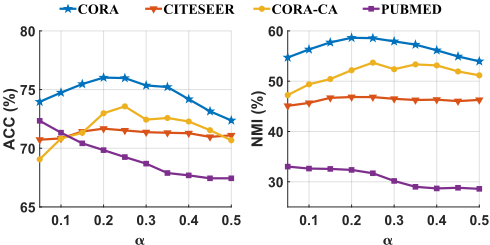
Figure 4: The sensitivity analysis of hyper-parameter α across two evaluation metrics on four datasets.
data augmentation strategies to generate different views, treating the same node across views as positive samples and different nodes as negative samples. In contrast, our method makes full use of the inherent structure of the hypergraph to define positive and negative pairs in a more effective manner. Nodes that share similar structural properties are regarded as positive samples, while those with distinct structural characteristics are treated as negative samples. Another critical distinction is that many contrastive learning-based methods rely on simple feature dropout or structural perturbation augmentations to construct different views, which can inadvertently alter the semantic information of the hypergraph. Our method, however, avoids any modification to the hypergraph itself. Instead, we employ unshared encoders to map the hypergraph into different subspaces. This approach allows for richer and more discriminative representations without the risk of information loss caused by augmentation techniques.
4.3 Ablation Studies
In this subsection, we conduct ablation experiments to verify the effectiveness of each module.
Ablation on Model Modules. We start by examining the contributions of key modules in our proposed framework. For simplicity, we denote hypergraph data preprocessing, selfdiagonal consistency module, and structure alignment module as 'HDP', 'SDC', and 'SAM', respectively. From the results in Table 3, the best performance can be achieved when
t
t
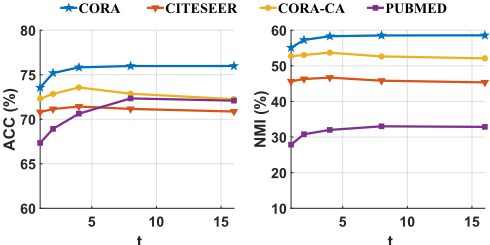
Figure 5: The sensitivity analysis of hyper-parameter t across two evaluation metrics on four datasets.
all modules are considered. Omitting any single module results in a noticeable decline in clustering accuracy, emphasizing the critical role each plays in enhancing the method's overall performance.
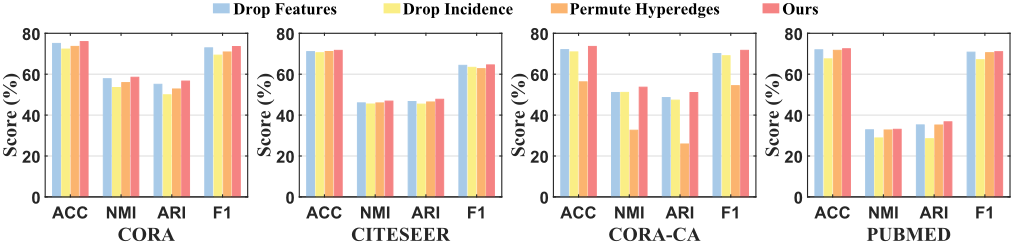
Ablation on Data Augmentation Strategies. We also conduct an in-depth analysis of the impact of different data augmentation strategies on the results. Specifically, three strategies are evaluated: drop features, drop incidence, and permute hyperedges. The detailed experimental results are illustrated in Figure 3, which clearly demonstrate that our strategies achieves superior performance compared to other strategies. Unlike the other three augmentation strategies, our method does not alter the hypergraph itself. Instead, we use unshared encoders to project the hypergraph into distinct subspaces, thereby preserving its semantic information.
4.4 Parameter Sensitivity Analysis
In this subsection, we study the sensitivity of hyperparameters: the trade-off hyper-parameter β, the number of layers t, and hyper-parameter α on four datasets.
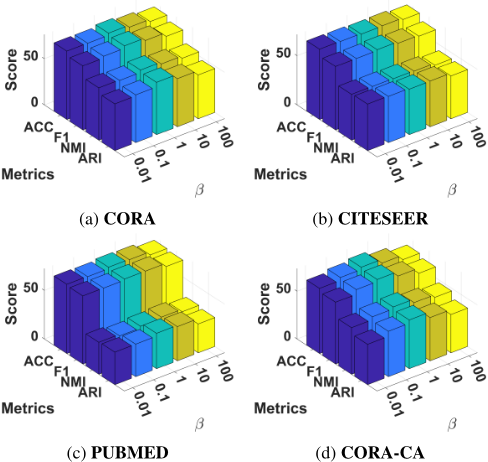
Effect of hyper-parameter β. To evaluate the impact of hyper-parameter β, we conduct sensitivity analysis across four benchmark datasets: CORA, CITESEER, PUBMED, and CORA-CA. The results, presented in Figure 2, illustrate the performance variations under different values of β, which are chosen from the set {0.01, 0.1, 1, 10, 100}. From the results, we observe that the clustering performance remains relatively stable with minor fluctuations as β increases. Notably, the best overall performance is achieved when β = 1, and we set β = 1 as the default value for subsequent experiments.
| Dataset | Graph Methods | Hypergraph Methods | |||||||
|---|---|---|---|---|---|---|---|---|---|
| CCGC | HSAN | CONVERT | NS4GC | HyperGCL | MMACL | TriCL | CHGNN | Ours | |
| CORA | 7.90 | 5.07 | 10.13 | 5.41 | 34.25 | 658.67 | 36.56 | 16.39 | 3.36 |
| CITESEER | 6.25 | 5.71 | 11.58 | 4.75 | 29.18 | 540.10 | 27.72 | 12.73 | 2.56 |
| PUBMED | 13.86 | 21.03 | 9.31 | 8.39 | 160.99 | 9792.04 | 218.17 | 734.85 | 2.83 |
| CORA-CA | 11.50 | 10.78 | 19.03 | 8.47 | 38.18 | 1048.05 | 34.10 | 17.12 | 3.71 |
| 20NEWS | 52.78 | OOM | 53.83 | 429.53 | 181.38 | OOT | 139.60 | 23.02 | 22.50 |
| Avg. | 18.46 | - | 20.78 | 91.31 | 88.80 | - | 91.23 | 160.82 | 6.99 |
Effect of hyper-parameter α and t. In addition, we further investigate how the hyper-parameter α and t in the hypergraph data preprocessing module influence clustering performance. Following by [Tang et al., 2024], α is selected from the set {0.05, 0.1, 0.15, 0.2, 0.25, 0.3, 0.35, 0.4, 0.45, 0.5}, while t is chosen from {1, 2, 4, 8, 16}. Figure 4 and 5 illustrate the variations in ACC and NMI of our approach as α and t change. From Figure 4, we observe that for the PUBMED dataset, clustering performance decreases as α increases. In contrast, for the CORA and CORA-CA datasets, clustering performance improves with increasing α until it reaches a peak, after which it gradually declines. A larger α value places greater emphasis on preserving the intrinsic information of the node, whereas a smaller α value amplifies the impact of information derived from neighboring nodes. From Figure 5, we can see that as t increases, clustering performance gradually improves before leveling off. Based on these observations, selecting appropriate values of α and t is critical for achieving optimal clustering performance.
4.5 Efficiency Comparison
We evaluate the training efficiency of HCN by comparing it with eight baselines on five datasets under identical 400epoch settings. As shown in Table 4, HCN achieves the fastest training speed across all datasets, outperforming recent contrastive hypergraph methods by at least 12× on average. This efficiency stems from two key designs: (1) Unlike the hypergraph neural networks used in hypergraph methods, our architecture consists of unshared MLPs, significantly reducing the number of network parameters. (2) The hypergraph data preprocessing module employs smoothing preprocessing instead of hypergraph convolution, significantly simplifying the training process.
4.6 Visualization Analysis
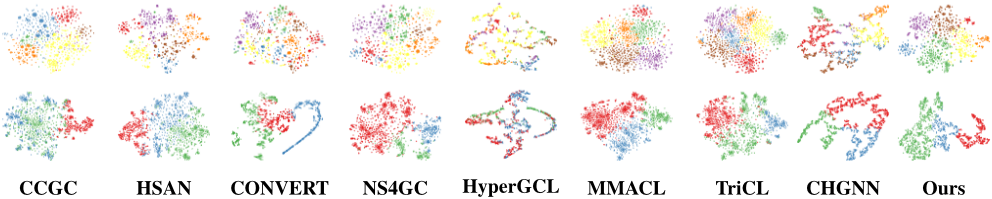
In this subsection, we employ t-SNE [Van der Maaten and Hinton, 2008] for visualizing the clustering results, providing an intuitive perspective on the effectiveness of HCN in addressing the CORA and PUBMED datasets. As illustrated in Figure 6, the consensus representation derived from our approach demonstrates a significantly more compact and welldefined cluster structure. This enhanced compactness highlights HCN's superior capability to capture the intrinsic relationships and latent patterns within the data, setting it apart from the other baseline methods.
5 Conclusion
In this work, we propose a simple yet effective hypergraph clustering network, named HCN, aiming at addressing the limitations of hypergraph learning in clustering tasks. Specifically, we first employ hypergraph smoothing preprocessing to simplify the process and enhance training efficiency. Then, the preprocessed hypergraph data is passed through unshared encoders to generate different views, thereby preserving the original semantic information. Next, the self-diagonal consistency module enhances the intrinsic coherence of node representations by increasing the self-correlation of each node. Finally, to reveal the structural relationships between nodes, we adopt the structure alignment module, which employs the structural information of the hypergraph to enhance the representation learning capability. Extensive experiments on five benchmark datasets demonstrate the effectiveness of our proposed method.
Acknowledgments
This work is supported by the National Natural Science Foundation of China under Grant 62176203, the Fundamental Research Funds for the Central Universities (ZYTS25267, QTZX25004), and the Science and Technology Project of Xi'an (Grant 2022JH-JSYF-0009), Open Project of Anhui Provincial Key Laboratory of Multimodal Cognitive Computation, Anhui University (No. MMC202416), Selected Support Project for Scientific and Technological Activities of Returned Overseas Chinese Scholars in Shaanxi Province 202302, and the Xidian Innovation Fund (Project NoYJSJ25007).
@inproceedings{ijcai2025p707,
  title     = {A Simple yet Effective Hypergraph Clustering Network},
  author    = {Wang, Qianqian and Zhao, Bowen and Ding, Zhengming and Zhang, Xiangdong and Gao, Quanxue},
  booktitle = {Proceedings of the Thirty-Fourth International Joint Conference on
               Artificial Intelligence, {IJCAI-25}},
  publisher = {International Joint Conferences on Artificial Intelligence Organization},
  editor    = {James Kwok},
  pages     = {6352--6360},
  year      = {2025},
  month     = {8},
  note      = {Main Track},
  doi       = {10.24963/ijcai.2025/707},
  url       = {https://doi.org/10.24963/ijcai.2025/707},
}
TY - CPAPER TI - A Simple yet Effective Hypergraph Clustering Network AU - Wang, Qianqian AU - Zhao, Bowen AU - Ding, Zhengming AU - Zhang, Xiangdong AU - Gao, Quanxue T2 - Proceedings of the Thirty-Fourth International Joint Conference on Artificial Intelligence, IJCAI-25 PB - International Joint Conferences on Artificial Intelligence Organization PY - 2025 SP - 6352 EP - 6360 DO - 10.24963/ijcai.2025/707 UR - https://doi.org/10.24963/ijcai.2025/707 ER -Copied
Machine-readable versions of this paper, for tools and AI agents:





