
Fair Incomplete Multi-View Clustering via Distribution Alignment
Proceedings of the Thirty-Fourth International Joint Conference on Artificial Intelligence. Main Track. Pages 6379-6387.
https://doi.org/10.24963/ijcai.2025/710
Keywords
- Machine Learning: ML: Clustering
- AI Ethics, Trust, Fairness: ETF: Fairness and diversity
- Machine Learning: ML: Multi-view learning
Abstract
Incomplete multi-view clustering (IMVC) extracts consistent and complementary information from multi-source/modality data with missing views, aiming to partition the data into different clusters. It can effectively address the problem of unsupervised multi-source data analysis in complex environments and has gained considerable attention. However, the fairness of IMVC remains underexplored, particularly when data contains sensitive features ({e.g.}, gender, marital status, and age). To tackle the problem, this work presents a novel Fair Incomplete Multi-View Clustering (FIMVC) method. The proposed FIMVC introduces fairness constraints to ensure clustering results are independent of sensitive features. Additionally, it learns consensus representations to enhance clustering performance by maximizing mutual information and aligning the distributions of different views. Experimental results on three datasets containing sensitive features demonstrate that our method improves the fairness of clustering results while outperforming state-of-the-art IMVC methods in clustering performance.
- [Chao et al., 2021] Guoqing Chao, Shiliang Sun, and Jinbo Bi. A survey on multiview clustering. IEEE Transactions on Artificial Intelligence, 2(2):146-168, 2021.
- [Chen et al., 2022] Man-Sheng Chen, Tuo Liu, Chang-Dong Wang, Dong Huang, and Jian-Huang Lai. Adaptively- weighted integral space for fast multiview clustering. In Proceedings of the 30th ACM International Conference on Multimedia, MM '22, page 3774-3782, New York, NY, USA, 2022. Association for Computing Machinery.
- [Chierichetti et al., 2018] Flavio Chierichetti, Ravi Kumar, Silvio Lattanzi, and Sergei Vassilvitskii. Fair clustering through fairlets, 2018.
- [Cohen et al., 2021] Maxime C. Cohen, Adam N. Elmach- toub, and Xiao Lei. Price discrimination with fairness con- straints. In Proceedings of the 2021 ACM Conference on Fairness, Accountability, and Transparency, FAccT '21, page 2, New York, NY, USA, 2021. Association for Com- puting Machinery.
- [Ding and Fu, 2018] Zhengming Ding and Yun Fu. Robust multiview data analysis through collective low-rank sub- space. IEEE Transactions on Neural Networks and Learn- ing Systems, 29(5):1986-1997, 2018.
- [Guo and Ye, 2019] Jun Guo and Jiahui Ye. Anchors bring ease: An embarrassingly simple approach to partial multi- view clustering. In Proceedings of the AAAI conference on artificial intelligence, volume 33, pages 118-125, 2019.
- [Hardt et al., 2016] Moritz Hardt, Eric Price, and Nathan Srebro. Equality of opportunity in supervised learning. In NeurIPS, page 3323-3331, 2016.
- [Hjelm et al., 2019] R Devon Hjelm, Alex Fedorov, Samuel Lavoie-Marchildon, Karan Grewal, Phil Bachman, Adam Trischler, and Yoshua Bengio. Learning deep representa- tions by mutual information estimation and maximization, 2019.
- [Hu and Chen, 2019] Menglei Hu and Songcan Chen. One- pass incomplete multi-view clustering. In Proceedings of the AAAI conference on artificial intelligence, volume 33, pages 3838-3845, 2019.
- [Kenfack et al., 2023] Patrik Joslin Kenfack, Adín Ramírez Rivera, Adil Mehmood Khan, and Manuel Mazzara. Learning fair representations through uniformly dis- tributed sensitive attributes. In 2023 IEEE Conference on Secure and Trustworthy Machine Learning (SaTML), pages 58-67, 2023.
- [Kleindessner et al., 2019a] Matthäus Kleindessner, Samira Samadi, Pranjal Awasthi, and Jamie Morgenstern. Guaran- tees for spectral clustering with fairness constraints. In In- ternational conference on machine learning, pages 3458- 3467. PMLR, 2019.
- [Kleindessner et al., 2019b] Matthäus Kleindessner, Samira Samadi, Pranjal Awasthi, and Jamie Morgenstern. Guar- antees for spectral clustering with fairness constraints. In ICML, pages 3458-3467, 09-15 Jun 2019.
- [Lee et al., 2021] Woojin Lee, Hyungjin Ko, Junyoung Byun, Taeho Yoon, and Jaewook Lee. Fair clustering with fair correspondence distribution. Information Sciences, 581:155-178, 2021.
- [Li et al., 2014a] Shao-Yuan Li, Yuan Jiang, and Zhi-Hua Zhou. Partial multi-view clustering. In AAAI, AAAI'14, page 1968-1974. AAAI Press, 2014.
- [Li et al., 2014b] Shao-Yuan Li, Yuan Jiang, and Zhi-Hua Zhou. Partial multi-view clustering. In Proceedings of the AAAI conference on artificial intelligence, volume 28, 2014.
- [Li et al., 2020a] Peizhao Li, Han Zhao, and Hongfu Liu. Deep fair clustering for visual learning. In Proceedings of the IEEE/CVF Conference on Computer Vision and Pat- tern Recognition, pages 9070-9079, 2020.
- [Li et al., 2020b] Yunfan Li, Peng Hu, Zitao Liu, Dezhong Peng, Joey Tianyi Zhou, and Xi Peng. Contrastive cluster- ing, 2020.
- [Li et al., 2022] Xingfeng Li, Quansen Sun, Zhenwen Ren, and Yinghui Sun. Dynamic incomplete multi-view im- puting and clustering. In Proceedings of the 30th ACM International Conference on Multimedia, MM '22, page 3412-3420, New York, NY, USA, 2022. Association for Computing Machinery.
- [Li et al., 2023] Xingfeng Li, Yinghui Sun, Quansen Sun, Jia Dai, and Zhenwen Ren. Distribution consistency based fast anchor imputation for incomplete multi-view cluster- ing. In Proceedings of the 31st ACM International Confer- ence on Multimedia, MM '23, page 368-376, New York, NY, USA, 2023. Association for Computing Machinery.
- [Lin et al., 2021] Yijie Lin, Yuanbiao Gou, Zitao Liu, Boyun Li, Jiancheng Lv, and Xi Peng. Completer: Incomplete multi-view clustering via contrastive prediction. In Pro- ceedings of the IEEE/CVF conference on computer vision and pattern recognition, pages 11174-11183, 2021.
- [Lin et al., 2023] Yijie Lin, Yuanbiao Gou, Xiaotian Liu, Jinfeng Bai, Jiancheng Lv, and Xi Peng. Dual contrastive prediction for incomplete multi-view representation learn- ing. IEEE TPAMI, 45(4):4447-4461, 2023.
- [Liu et al., 2020] Xinwang Liu, Miaomiao Li, Chang Tang, Jingyuan Xia, Jian Xiong, Li Liu, Marius Kloft, and En Zhu. Efficient and effective regularized incomplete multi-view clustering. IEEE transactions on pattern anal- ysis and machine intelligence, 43(8):2634-2646, 2020.
- [Macqueen, 1967] J. Macqueen. Some methods for classi- fication and analysis of multivariate observations. Proc. Symp. Math. Statist. and Probability, 5th, 1, 1967.
- [Mcculloch and Pitts, 1943] Warren S. Mcculloch and Wal- ter Pitts. A logical calculus of the ideas immanent in ner- vous activity. biol math biophys, 1943.
- [Tao et al., 2019] Zhiqiang Tao, Hongfu Liu, Huazhu Fu, and Yun Fu. Multi-view saliency-guided clustering for image cosegmentation. IEEE Transactions on Image Pro- cessing, 28(9):4634-4645, 2019.
- [Tao et al., 2020] Zhiqiang Tao, Hongfu Liu, Sheng Li, Zhengming Ding, and Yun Fu. Marginalized multiview ensemble clustering. IEEE Transactions on Neural Net- works and Learning Systems, 31(2):600-611, 2020.
- [Wang et al., 2018] Qianqian Wang, Zhengming Ding, Zhiqiang Tao, Quanxue Gao, and Yun Fu. Partial multi- view clustering via consistent gan. In IEEE ICDM, pages 1290-1295, 2018.
- [Wang et al., 2021] Qianqian Wang, Zhengming Ding, Zhiqiang Tao, Quanxue Gao, and Yun Fu. Generative partial multi-view clustering with adaptive fusion and cy- cle consistency. IEEE Transactions on Image Processing, 30:1771-1783, 2021.
- [Wang et al., 2022] Qianqian Wang, Zhiqiang Tao, Quanxue Gao, and Licheng Jiao. Multi-view subspace clustering via structured multi-pathway network. IEEE TNNLS, pages 1- 7, 2022.
- [Wen et al., 2020] Jie Wen, Zheng Zhang, Zhao Zhang, Zhi- hao Wu, Lunke Fei, Yong Xu, and Bob Zhang. Dimc- net: Deep incomplete multi-view clustering network. In Proceedings of the 28th ACM international conference on multimedia, pages 3753-3761, 2020.
- [Wen et al., 2023] Jie Wen, Gehui Xu, Chengliang Liu, Lunke Fei, Chao Huang, Wei Wang, and Yong Xu. Local- ized and balanced efficient incomplete multi-view cluster- ing. In Proceedings of the 31st ACM International Con- ference on Multimedia, MM '23, page 2927-2935, New York, NY, USA, 2023. Association for Computing Ma- chinery. Xia et al., 2022]
- Wei Xia, Quanxue Gao, Qianqian Wang, and Xinbo Gao. Tensor completion-based incomplete multiview clustering. IEEE Transactions on Cybernetics, 52(12):13635-13644, 2022.
- [Xie et al., 2016] Junyuan Xie, Ross Girshick, and Ali Farhadi. Unsupervised deep embedding for clustering analysis, 2016.
- [Xu et al., 2013] Chang Xu, Dacheng Tao, and Chao Xu. A survey on multi-view learning, 2013.
- [Xu et al., 2019] Cai Xu, Ziyu Guan, Wei Zhao, Hongchang Wu, Yunfei Niu, and Beilei Ling. Adversarial incomplete multi-view clustering. In IJCAI, volume 7, pages 3933- 3939, 2019. IJCAI
- [Xu et al., 2023] Jie Xu, Chao Li, Liang Peng, Yazhou Ren, Xiaoshuang Shi, Heng Tao Shen, and Xiaofeng Zhu. Adaptive feature projection with distribution alignment for deep incomplete multi-view clustering. IEEE TIP, 32:1354-1366, 2023.
- [Yin and Sun, 2022] Jun Yin and Shiliang Sun. Incom- plete multi-view clustering with cosine similarity. Pattern Recognition, 123:108371, 2022.
- [Yin et al., 2015] Qiyue Yin, Shu Wu, and Liang Wang. Incomplete multi-view clustering via subspace learning. CIKM, 2015.
- [Zafar et al., 2017] Muhammad Bilal Zafar, Isabel Valera, Manuel Gomez Rodriguez, and Krishna P. Gummadi. Fair- ness constraints: Mechanisms for fair classification, 2017.
- [Zhan et al., 2019] Kun Zhan, Chaoxi Niu, Changlu Chen, Feiping Nie, Changqing Zhang, and Yi Yang. Graph struc- ture fusion for multiview clustering. IEEE Transactions on Knowledge and Data Engineering, 31(10):1984-1993, 2019.
- [Zhang et al., 2023] Chao Zhang, Jingwen Wei, Bo Wang, Zechao Li, Chunlin Chen, and Huaxiong Li. Robust spec- tral embedding completion based incomplete multi-view clustering. In Proceedings of the 31st ACM International Conference on Multimedia, MM '23, page 300-308, New York, NY, USA, 2023. Association for Computing Ma- chinery. Zhao et al., 2024]
- Bowen Zhao, Qianqian Wang, Zhiqiang Tao, Wei Feng, and Quanxue Gao. Dfmvc: Deep fair multi-view clustering. In Proceedings of the 32nd ACM In- ternational Conference on Multimedia, pages 8090-8099, 2024.
- [Zheng et al., 2023a] Lecheng Zheng, Yada Zhu, and Jingrui He. Fairness-aware multi-view clustering. In Proceedings of the 2023 SIAM International Conference on Data Min- ing (SDM), pages 856-864. SIAM, 2023.
- [Zheng et al., 2023b] Lecheng Zheng, Yada Zhu, and Jingrui He. Fairness-aware multi-view clustering, 2023.
References were extracted automatically from the PDF and may contain errors.
Full text extracted automatically from the PDF; figures, tables and equations may differ. The PDF is the version of record.
1 Introduction
Multi-view data has become increasingly prevalent, which incorporates multiple perspectives or viewpoints on a particular object [Xu et al., 2013]. Compared with single-view data, multi-view data provides more details that help enhance the effectiveness of clustering tasks [Tao et al., 2019; Ding and Fu, 2018]. Extensive research has been conducted on multi-view clustering (MVC) [Zhan et al., 2019; Chao et al., 2021; Tao et al., 2020], which has been proven as an effective tool for analyzing unlabeled data [Chen et al., 2022]. However, the effectiveness of existing MVC approaches relies on the completeness of the data. In the presence of missing multi-view data, the performance of most MVC methods decreases drastically with an increasing missing rate [Wen et al., 2023]. Consequently, it motivates the investigation of the incomplete multi-view clustering (IMVC)
∗ correspinding autor
Samples that have been incorrectly clustered

problem[Li et al., 2023].
Incomplete multi-view data [Li et al., 2014a] is ubiquitous due to environmental noise, sensor failure, transmission interference, etc. The simplest IMVC technique involves excluding samples with missing views or imputing the missing view with zeros or the mean, followed by applying an MVC method [Li et al., 2023]. However, the exclusion of samples can lead to the loss of important information [Zhang et al., 2023], and imputing missing values with zeros or means may result in poor clustering results due to the deviation from genuine samples [Xia et al., 2022]. To overcome the difficulty, researchers have extensively investigated the IMVC problem, yielding three main types of IMVC methods: 1) Non-negative matrix factorization (NMF) based methods [Li et al., 2014a]: These methods decompose the data matrix to learn a complement low-dimensional representation. However, their application is limited to non-negative matrices [Li et al., 2022]. 2) Subspace learning based methods [Yin et al., 2015]: They solve the IMVC problem by learning the completed subspace for clustering; 3) Generation-based methods. Wang et al. [2018] utilized the powerful generative capabilities of generative adversarial networks (GANs) to impute missing data, thereby ensuring that the imputed data are closer to the distribution of the original data.
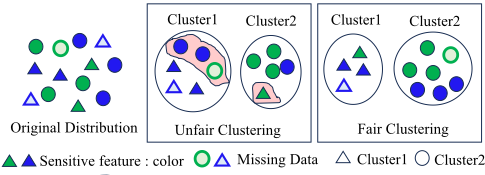
Although the aforementioned methods improve IMVC performance, they treat sensitive features as sample differences, resulting in unfair clustering results [Kenfack et al., 2023]. That is, samples with sensitive features from the same class are always divided into different clusters, as shown in Figure 1. For example, when clustering results are used for targeted advertising or job recommendations, discriminated groups may not receive equal opportunities compared to other groups if the clustering results are not fair. To tackle this problem, several fair MVC have been proposed [Hardt et al., 2016; Lee et al., 2021]. Chierichetti et al. [2018] computed the clusters with a fair distribution of sensitive features first and also established evaluation metrics of fairness. The method proposed by Kleindessner et al. [2019a] forces groups of different sensitive attributes to have similar similarity distributions in feature space by modifying the spectral clustering objective function, which centers on incorporating fairness constraints into the Laplace matrix construction process, but faces the problem of computational complexity growing with the square of the number of views. The deep fair clustering algorithm proposed by Li et al.[2020a] uses a combination of deep representation learning and adversarial training to generate sensitive attribute-independent embeddings via a viewsharing encoder, but the adversarial training model may lead to clustering center drift.
Despite the growing attention towards fairness in MVC, few works consider fairness in IMVC tasks. Nevertheless, the unfairness problem becomes more serious when encountering IMVC problem because IMVC may lose crucial discriminative features, leading to a situation where sensitive features dominate the clustering process. As illustrated in Figure 1, the missing data leads to unfair clustering for cluster 1. Moreover, these sensitive features may be misinterpreted as categorical information, contributing to unfair clustering outcomes for cluster 2.
To address this issue, this paper proposes a novel fair IMVC method that takes into account the fairness of IMVC and reduces the impact of sensitive features on the clustering results. It first maximizes the mutual information to eliminate redundant information from the complete view and extract the minimally sufficient common representation. Then, it aligns the feature distribution between the incomplete view and the complete view, improving the consistency of the common representation. Additionally, the model imposes fairness constraints on the soft clustering allocation, ensuring that the distribution of sensitive features in each cluster closely matches the true distribution. Specifically, our contribution can be summarized as follows:
- We develop a novel fair IMVC method that makes clustering results independent of sensitive features, alleviating the unfairness problem in IMVC. The fairness of clustering is maintained by ensuring that the distribution of sensitive features within each cluster closely aligns with the true distribution.
- We maximize mutual information to mine common features and align complete and incomplete view data distributions to learn the optimal clustering structure.
- Extensive experiments on several datasets demonstrate that the proposed method guarantees the fairness of the
clustering results, and its clustering performance is superior to existing IMVC methods.
2 RelatedWork
2.1 Incomplete Multi-viewClustering
Incomplete multi-view clustering (IMVC) tackles the challenge of missing views, which impedes effective extraction of cross-view information. Existing IMVC strategies focus on imputing low-dimensional subspace representations or missing views. For instance, matrix factorization methods [Li et al., 2014b; Hu and Chen, 2019] recover nonnegative representations from available views, with the work [Yin and Sun, 2022] preserving manifold structures through cosine similarity. Kernel-based techniques similarly impute incomplete matrices using consensus information, including anchor-based strategies [Guo and Ye, 2019] and multiple kernel fusion approaches [Liu et al., 2020]. Generative approaches utilize GANs [Wang et al., 2021; Xu et al., 2019] to synthesize missing views. DIMC-net [Wen et al., 2020] employs graph-guided imputation, while Completer [Lin et al., 2021] leverages dual prediction mechanisms for accurate reconstruction. Despite these advances, two fundamental limitations persist: imputation methods might significantly degrade clustering performance at high missing rates, and the distribution gap between representations of complete and incomplete data negatively influences the imputation validity.
2.2 Fair Incomplete Multi-viewClustering
The integration of fairness and IMVC is an emerging research direction that aims to develop algorithms capable of handling both missing views and clustering bias. Balancing incompleteness and fairness introduces significant technical challenges. DFMVC [2024] uses contrast constraints to align sensitive attribute distributions with the target cluster distribution, but it does not handle the missing-view problem. In contrast, Fair-MVC [2023a] integrates group fairness constraints into IMVC, ensuring that protected groups with sensitive attributes are evenly distributed in each cluster. However, Fair-MVC overlooks the real distribution of sensitive attributes, Besides, a key limitation of both methods is that they do not well model the interaction between missing patterns and sensitive attributes, potentially exacerbating bias. To address these issues, we propose a novel framework based on information bottleneck theory and mutual information maximization that aligns distributions between complete and incomplete views while enforcing fairness constraints, enabling fair clustering on incomplete data without sacrificing clustering performance.
3 Fair Incomplete Multi-ViewClustering via Distribution Alignment
Problem setting & Notations: Given a multi-view data matrix X = {X1 , X2 , · · · ,Xv , · · · ,XV }, where Xv ∈ RN×dv (v = 1, 2, · · · , V ), V is the number of views, N is the number of samples, dv is the dimension of Xv . Since our model is designed for incomplete multi-view clustering, we divide the data with multiple views X into two parts: 1)
| Notation | Description |
|---|---|
| Xv ̂Xv Xvp Xvu Zv Zvp Zvu Zvp+u Zp Z dvj sj α, β, γ | Input data for the v-th view Reconstructed data for the v-th view Paired data for the v-th view Unpaired data for the v-th view Subspace feature of the filled v-th view Subspace feature of paired data Subspace feature of unpaired data Subspace feature of the v-th view Common feature of paired data Shared representation Distance from the cluster center. The sensitive features in the j-th cluster. Hyperparameters. |
paired data of which all the views are complete, denoted as Xvp ; 2) unpaired data of which some data is missing Xvu . We denote ̂Xv as the reconstructed data of v-th view.
Definition 1. Fair clustering: It is assumed that there are m cases where the sensitive features R ∈ RN×m take values, i.e., there are m sensitive groups (based on sensitive features such as gender, race, etc.), and the data is to be clustered into k categories. Let Ps denote the proportion of samples in the entire dataset belonging to sensitive group s ∈ {1, 2...m}. Let Ps,j denote the proportion of samples in cluster j ∈ {1, 2...k} that belong to sensitive group s. We define the fairness ratio P ′s,j = Ps,j/Ps, which measures how the representation of sensitive group s in cluster j compares to its representation in the overall dataset. A clustering result is considered fair if the proportion of each sensitive group within each cluster closely matches the proportion of that sensitive group in the entire dataset, which occurs when P ′s,j approaches 1 for all clusters and sensitive groups.
When P ′s,j equals 1, it signifies that the proportion of sensitive groups within each cluster matches the proportion of that sensitive group in the entire dataset, ensuring maximum fairness in clustering. For instance, if the ratio of men to women in a given category is 1:1, clustering should maintain the same ratio within that category.
3.1 Network Architecture
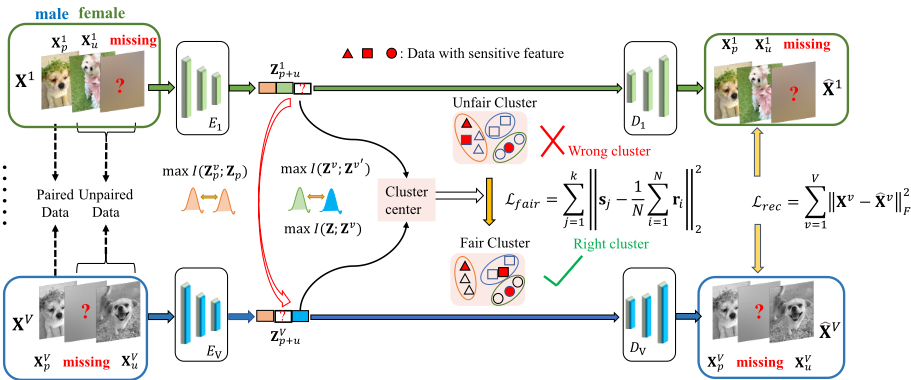
Figure 2 illustrates the overall architecture of FIMVC-DA, which is composed of V encoders/decoders E/D, a common representation learning module, an unpaired data distribution alignment module, and a fairness-aware clustering module. We first send partial multi-view data [Xvp ,Xvu ] to the encoder corresponding to each view and obtain latent subspace features Zvp+u = [Zvp , Zvu ], and the decoders map the latent features to reconstructed samples ̂Xv . Then, the common representation learning module removes the redundant information in the latent subspace feature Zip and retains the consistent latent representation. Subsequently, we use the unpaired data distribution alignment module to complete the latent representation Z of data with missing views and guarantee the consistent distribution of complete view data and incomplete view data. Finally, the fairness-aware clustering module achieves the fairness of clustering results.
Encoder/Decoder Module:
The encoder transforms each view's input data into hidden layer features, which are better suitable for clustering. The subsequent clustering tasks are performed on the feature Zvp+u extracted by the encoder. The decoder attempts to reconstruct the original data from the extracted features Zvp+u , thereby enforcing the extracted features not to deviate from the original data. Generally, the function of the encoder/decoder module is achieved via a Reconstruction Loss as defined below:
(2)
where Xv is the v-th view; Ev represents the encoder of the v-th view; Dv represents the decoder of the v-th view; ̂Xv represents the reconstructed data of Xv after undergoing encoding and decoding. A proficiently trained encoder/decoder module should minimize the disparity between Xv and ̂Xv .
Common Representation Learning Module:
To learn common representations with better clustering structures, we use common features Zp as anchors, increasing the common information in paired data from multiple views while removing redundant information from the original data, which is implemented by the following loss:
where I(·; ·) denotes the mutual information between two random variables, which measures the amount of shared information. R(·, ·) is a regularization term whose purpose is to prevent the model from reaching a trivial clustering assignment result, which is formulated as
When the features from multiple views are projected into a shared common feature space, each sample can be represented by features from any view. Building upon these observations, we suggest feature weighting to derive common features for each sample. We denote Zp as the learned common feature of the paired data, calculated from the weighted sum of the complete features of all views as
where wv is the weight of the v-th view, which is designed to help Zp have more information about the clustering structure.
Sensitive information:
It is calculated by the following formula:
where σ denotes the variance, which is used to measure the degree of dispersion of Zvp . The intuition is that a welldefined discrete structure is beneficial for clustering. Therefore, assigning a higher weight to view features with larger variances ensures a better clustering structure for the learned common features Zp.
Unpaired Data Distribution Alignment Module:
We aim to learn a comprehensive shared representation from both unpaired and paired data and eliminate differences in Zp and Zvu distributions to promote objective Eq. (8). To achieve this goal, we first complete the shared latent representation Z with unpaired representations provided by other views. This process is conceptually achieved by concatenating the representations from all available data (both paired and unpaired) to form a unified information source. This ensures that the final shared representation Z for all samples is formed by fusing both the paired and unpaired latent features, i.e., Z = Zp ⊕Zvu (v = 1, ..., V ), where the unpaired features Zvu are implicitly completed by aligning their distributions with the anchor Zp. Then, we align the probability distribution of unpaired data with paired data by maximizing the mutual information between two representations of incomplete view data after filling them with each other [Hjelm et al., 2019]. The Alignment Loss is as follows:
where v′ denotes a view different from v and H denotes entropy. The first mutual information term I(Zv ;Zv′ ) aims to align the distribution of unpaired data, the latter mutual information terms I(Z; Zv ) aims to align the distribution between the shared representation Z (which is informed by all data) and each individual view's representation, and the last term H(Zv ) is a regularization term to avoid the objective function degenerating into a trivial solution that simply aligns samples into one category, which is calculated as:
where p(zvi ) represents the probability distribution of i-th feature zvi in Zv of view v. The entropy term H(Zv ) serves as a regularization term that maximizes the uncertainty of feature distribution, encouraging the model to explore more diverse feature representations, preventing all samples from being mapped to the same category, and ensuring the diversity and effectiveness of clustering results.
By optimizing this objective function, it aligns effectively unpaired data and avoids trivial solutions. Additionally, it ensures the consistent distribution of complete view data and incomplete view data.
Fairness-aware Clustering Module:
A reasonable strategy for fairness is to ensure that the proportion of sensitive features acquired by clustering is consistent with the original data [Kleindessner et al., 2019b; Cohen et al., 2021]. We first calculate the distance of a sample from each view to each cluster center as:
where zvi ∈ Zv denotes the feature vector of the i-th sample from the v-th view; cj is the center of the j-th cluster; sim(·, ·) is the similarity function. dvij represents the distance
Algorithm 1 FIMVC-DA
Input: Incomplete multi-view data {Xv }, v ∈ {1, 2...V },
Epoch T
Initialize: Extract initial features for all samples from each view.
Parameter: Objective function weights α, β, γ
Output: Clustering results on Z
- 1: while not reach T do
- 2: For each viewv, extract features for paired samples Zvp and unpaired samples Zvu .
- 3: Calculate the weight of v-th viewwv by Eq. (5).
- 4: Fuse paired features to obtain common representation: Zp = ∑Vv=1 wvZvp .
- 5: Concatenate Zp and all Zvu to form the unified feature matrix Z.
- 6: Calculate the distance dvij between each sample and each cluster center by Eq. (8).
- 7: Update the distribution of sensitive features sj by Eq. (9).
- 8: Adapt the distribution of sensitive features in clustering results by Eq. (10).
- 9: Optimize the total loss by Eq. (11).
- 10: end while
- 11: Perform k-means clustering on Z.
between the i-th sample from the v-th view and the center of the j-th cluster. Suppose ri is the sensitive feature of the ith sample, we calculate the weighted mean of each sensitive feature in j-th cluster as:
Finally, the Fairness Constraint Loss can be defined as:
where k is the number of clusters; 1N N∑ i=1 ri is the average value of sensitive features in the entire dataset.
Optimizing this loss ensures that the proportion of sensitive features in each cluster is close to the overall dataset distribution. Thus, this objective function can fix the model's bias problem on sensitive features.
3.2 Objective Function
In summary, the objective loss function of our model is as follows:
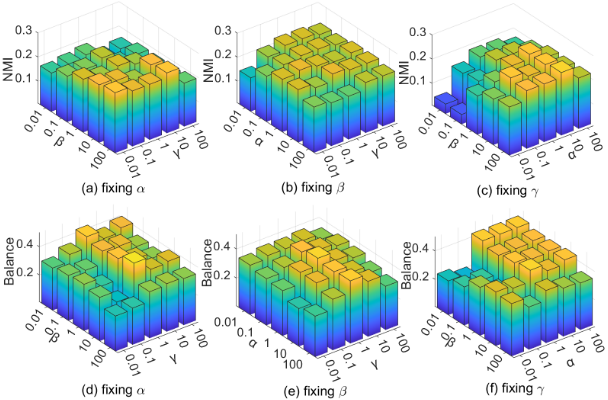
where Lrec is the reconstruction loss of encoder and decoder. Lcom is a common representation learning loss used to discover common representations across views. Lalign is the alignment loss to align the feature distribution between incomplete and complete view data, which makes unpaired data nearer to its cluster in the feature subspace. Lfair is the fairness-aware clustering loss. α, β, and γ are employed to control Lcom, Lalign, and Lfair. An excessive β can negatively impact the feature resolution, potentially reducing the clustering to a single class. Conversely, a small β can cause incomplete view data to deviate from the cluster it belongs to. Lfair is the fair constraint loss that ensures that the distribution of sensitive features in each cluster is close to the genuine distribution. We summarize the optimization algorithm in Algorithm 1.
| Dataset | Number | Sensitive feature | Cluster |
|---|---|---|---|
| Credit Card | 5000 | Gender | 5 |
| Zafar | 10000 | Binary value | 2 |
| Bank | 5000 | Marital status | 2 |
4 Experiments
4.1 Experimental Setup
Our experiments were all run on Windows 10 systems with Python 3.7 and Cuda 11.5. The hidden layer dimension for all codec-related algorithms is set to 200 and every random seed has been set to 8. In all experiments, we set the learning rate to 0.0001. We chose Adam as the underlying optimizer. For the Credit Card, and Bank Marketing data set, we use two non-linear functions[Mcculloch and Pitts, 1943] (e.g., Sigmoid and Relu) to generate two views.
Datasets We evaluated our model on three fairness datasets: Credit Card, Zafar, and Bank [Zafar et al., 2017]. The Credit Card dataset contains 30,000 samples with gender as the sensitive attribute; Zafar is a widely used synthetic dataset with a binary sensitive attribute; and the Bank dataset includes 40,000 samples with marital status as the sensitive attribute. All datasets were preprocessed to ensure balanced class and sensitive attribute distributions. Table 2 summarizes the main characteristics and sensitive attributes of each dataset.
ComparisonAlgorithms We compare our methodwith the following state-of-the-art approaches: Single-view clustering: k-means [Macqueen, 1967], DEC [Xie et al., 2016], CC [Li et al., 2020b], Multi-view clustering: MvDSCN [Wang et al., 2022], Incomplete multi-view clustering: DCP [Lin et al., 2023], APADC [Xu et al., 2023], Fair multi-view clustering: Fair-MVC [Zheng et al., 2023b].
Evaluation Criteria We demonstrated two indicators of the model in clustering tasks: (1) Normalized Mutual Information(NMI); (2) Balance Score ∈ [0, 1] [Chierichetti et al., 2018]. The tightness of clustering is evaluated using NMI. The fairness of clustering is assessed by the balance score, which is defined as follows:
where Cj ∈ [0, 1] represents the the j-th cluster, sm represents m-th protected subgroup. The distribution of sensitive traits typically determines the upper limit of balance, and the higher the balance value, the fairer the outcome.
| Datasets | Missing Rate | 0 | 0.25 | 0.5 | 0.75 | ||||
|---|---|---|---|---|---|---|---|---|---|
| Metrics(%) | NMI | Balance | NMI | Balance | NMI | Balance | NMI | Balance | |
| k-means[Macqueen, 1967] | 20.94 ± 1.14 | 35.53 ± 0.37 | 15.67 ± 1.48 | 36.02 ± 0.60 | 13.56 ± 0.63 | 36.32 ± 0.38 | 9.24 ± 0.72 | 36.54 ± 0.28 | |
| DEC[Xie et al., 2016] | 21.03 ± 2.09 | 35.96 ± 0.60 | 20.05 ± 0.79 | 36.40 ± 0.78 | 15.67 ± 1.21 | 36.26 ± 0.40 | 10.43 ± 1.53 | 36.42 ± 0.62 | |
| MvDSCN[Wang et al., 2022] | 21.92 ± 1.53 | 35.82 ± 0.41 | 20.34 ± 1.59 | 35.94 ± 0.48 | 16.34 ± 1.83 | 36.63 ± 0.69 | 11.56 ± 1.62 | 36.72 ± 0.70 | |
| CC[Li et al., 2020b] | 23.87 ± 1.28 | 35.74 ± 0.47 | 20.95 ± 0.68 | 36.16 ± 0.71 | 17.62 ± 1.01 | 36.80 ± 0.97 | 11.74 ± 0.96 | 37.18 ± 0.76 | |
| Credit Card DCP[Lin et al., 2023] | 26.73 ± 0.26 | 24.19 ± 1.05 | 23.18 ± 0.34 | 30.42 ± 2.23 | 20.04 ± 1.49 | 34.97 ± 0.47 | 16.12 ± 1.32 | 39.18 ± 0.58 | |
| APADC[Xu et al., 2023] | 23.07 ± 0.45 | 26.32 ± 0.22 | 23.15 ± 0.24 | 32.27 ± 0.72 | 16.30 ± 1.52 | 32.27 ± 0.71 | 11.17 ± 1.62 | 33.29 ± 0.41 | |
| Fair-MVC[Zheng et al., 2023b] | 24.95 ± 0.41 | 41.98 ± 0.32 | 22.09 ± 0.75 | 38.20 ± 0.46 | 18.71 ± 0.79 | 39.07 ± 0.76 | 14.28 ± 0.59 | 39.82 ± 0.92 | |
| FIMVC-DA | 26.89 ± 0.53 | 45.23 ± 1.54 | 23.26 ± 0.62 | 43.84 ± 1.53 | 20.36 ± 0.54 | 42.31 ± 1.56 | 17.16 ± 0.56 | 43.62 ± 1.48 | |
| k-means[Macqueen, 1967] | 70.32 ± 0.78 | 17.06 ± 0.76 | 64.83 ± 1.21 | 16.35 ± 0.44 | 60.24 ± 0.90 | 16.23 ± 1.11 | 55.65 ± 1.02 | 16.32 ± 0.86 | |
| DEC[Xie et al., 2016] | 72.55 ± 1.92 | 16.85 ± 0.73 | 70.89 ± 1.33 | 17.11 ± 0.84 | 64.93 ± 1.28 | 16.96 ± 0.93 | 58.96 ± 1.16 | 17.04 ± 0.86 | |
| MvDSCN[Wang et al., 2022] | 76.91 ± 0.42 | 17.13 ± 0.65 | 74.98 ± 1.01 | 18.32 ± 0.88 | 69.58 ± 1.66 | 16.87 ± 0.99 | 64.26 ± 1.34 | 17.08 ± 1.17 | |
| CC[Li et al., 2020b] | 78.95 ± 0.68 | 17.01 ± 0.71 | 75.22 ± 0.87 | 18.41 ± 0.67 | 72.13 ± 0.74 | 17.96 ± 0.83 | 68.05 ± 0.72 | 17.87 ± 1.06 | |
| Zafar DCP[Lin et al., 2023] | 81.57 ± 1.57 | 21.65 ± 1.23 | 73.79 ± 2.44 | 22.54 ± 1.85 | 65.54 ± 1.91 | 19.89 ± 2.45 | 57.15 ± 2.18 | 21.27 ± 2.28 | |
| APADC[Xu et al., 2023] | 72.38 ± 0.80 | 21.21 ± 0.57 | 66.37 ± 0.11 | 21.70 ± 0.31 | 61.28 ± 0.94 | 22.02 ± 1.28 | 55.29 ± 0.82 | 21.47 ± 0.96 | |
| Fair-MVC[Zheng et al., 2023b] | 81.61 ± 0.57 | 28.96 ± 0.59 | 79.89 ± 0.55 | 30.64 ± 0.89 | 76.97 ± 0.79 | 29.33 ± 0.80 | 73.16 ± 0.92 | 29.58 ± 0.86 | |
| FIMVC-DA | 83.23 ± 0.81 | 30.32 ± 1.67 | 80.94 ± 0.66 | 32.32 ± 0.91 | 78.22 ± 0.73 | 30.34 ± 0.85 | 75.84 ± 0.85 | 30.28 ± 0.92 | |
| k-means[Macqueen, 1967] | 28.67 ± 1.44 | 37.65 ± 0.66 | 24.77 ± 1.71 | 36.66 ± 0.45 | 21.08 ± 1.17 | 36.32 ± 0.89 | 16.83 ± 1.46 | 36.25 ± 0.92 | |
| DEC[Xie et al., 2016] | 30.93 ± 1.15 | 37.60 ± 0.96 | 28.97 ± 1.80 | 36.42 ± 0.69 | 24.37 ± 1.02 | 37.09 ± 0.78 | 19.43 ± 1.22 | 36.68 ± 0.85 | |
| MvDSCN[Wang et al., 2022] | 36.24 ± 0.55 | 37.59 ± 0.67 | 35.02 ± 1.21 | 36.11 ± 0.57 | 31.33 ± 1.76 | 36.96 ± 0.77 | 27.15 ± 1.54 | 37.24 ± 0.86 | |
| CC[Li et al., 2020b] | 36.23 ± 1.01 | 37.46 ± 0.97 | 34.88 ± 1.33 | 37.69 ± 0.95 | 31.13 ± 1.63 | 37.80 ± 0.85 | 27.12 ± 1.54 | 37.62 ± 0.94 | |
| Bank DCP[Lin et al., 2023] | 39.93 ± 1.84 | 26.75 ± 2.06 | 34.20 ± 2.87 | 20.49 ± 1.54 | 28.12 ± 2.31 | 27.29 ± 1.24 | 21.54 ± 2.46 | 26.58 ± 1.36 | |
| APADC[Xu et al., 2023] | 40.62 ± 0.25 | 27.79 ± 2.59 | 32.21 ± 2.79 | 28.41 ± 2.11 | 33.14 ± 2.77 | 27.82 ± 2.28 | 26.32 ± 2.56 | 27.92 ± 2.12 | |
| Fair-MVC[Zheng et al., 2023b] | 38.99 ± 0.91 | 42.40 ± 0.75 | 36.66 ± 1.01 | 41.76 ± 0.83 | 32.90 ± 1.03 | 41.61 ± 0.67 | 28.34 ± 0.98 | 41.82 ± 0.78 | |
| FIMVC-DA | 41.12 ± 0.80 | 44.35 ± 0.67 | 38.89 ± 1.05 | 43.30 ± 0.93 | 34.43 ± 0.91 | 43.29 ± 0.76 | 30.25 ± 0.87 | 43.58 ± 0.89 | |
| L1 | L2 | L3 | L4 | Credit Card | Bank | Zafar | |||
|---|---|---|---|---|---|---|---|---|---|
| NMI | Balance | NMI | Balance | NMI | Balance | ||||
| ✓ | 14.76 | 14.47 | 15.53 | 13.21 | 22.03 | 17.71 | |||
| ✓ | ✓ | 17.31 | 23.22 | 20.00 | 16.52 | 39.87 | 17.12 | ||
| ✓ | ✓ | ✓ | 20.12 | 26.17 | 32.15 | 20.32 | 72.24 | 21.47 | |
| ✓ | ✓ | ✓ | ✓ | 20.36 | 42.31 | 34.43 | 43.29 | 78.22 | 30.34 |
4.2 Experimental Results
Definition 2 Missing Rate If X comprises N samples across V views, the total number of samples is N ∗ V . If some views of certain data are missing, let the total number of missing samples be Nmiss. The missing rate is then calculated as Nmiss/(N ∗ V ).
Clustering Results and Balance Scores on Three Datasets Table 3 shows that our method outperforms existing clustering methods on the three datasets, including the most recent clustering algorithm. Despite a certain constraint between the balance score and clustering accuracy, the results show that our algorithm achieves higher clustering accuracy. This is consistent with our alignment loss, which aligns the distribution of partial and complete view data, allowing the learned features to be more beneficial for clustering tasks. Our model exceeds the second-best result in clustering NMI by 2% on average in the three datasets, and the fairness score of clustering clusters is 3% higher on average. This result shows that our model achieves better feature extraction and fusion capabilities, which helps to improve the degree of balance while maintaining clustering accuracy.
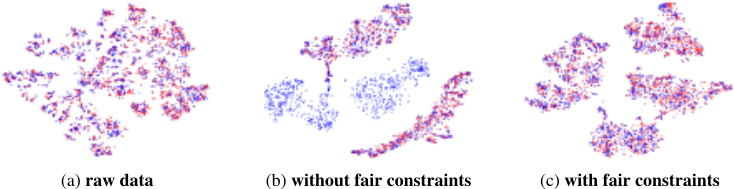
Sensitive Features Visualization Figure 4 presents t-SNE visualizations of the Credit Card dataset, illustrating the effect of fairness constraints on clustering results. In the raw data (a), male (blue) and female (red) samples are evenly distributed, reflecting the balanced gender ratio in the original dataset. Without fairness constraints (b), some clusters are dominated by a single gender, indicating the presence of bias in the clustering results. In contrast, with fairness constraints applied (c), the gender distribution within each cluster closely matches that of the original data. These results demonstrate that our method effectively mitigates bias and achieves fair clustering outcomes that are independent of sensitive attributes.
Ablation Study In this part, we conduct an ablation study to analyze the influence of the reconstruction loss Lrec (L1), the common representation learning loss Lcom (L2), the alignment loss Lalign (L3), and the fairness-aware clustering loss Lfair (L4). We report experimental results on the three datasets in Table 4. An obvious finding is that the fairness constraint loss significantly improves the fairness of the clustering results. The incomplete view alignment scheme based on information theory effectively improves the clustering performance. As can be seen from the results in the last two rows, the fairness constraint also helps to promote correct clustering to some extent. In summary, the ablation study demonstrates that each component of the proposed FIMVCDA effectively improves clustering performance and fairness.
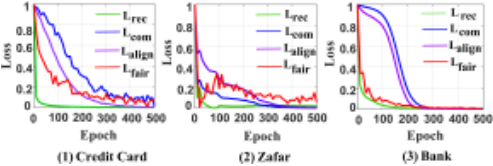
Convergence Analysis Figure 3 depicts the convergence curves of the model's objective functions on three datasets. We normalize the loss function values of the four parts because they differ in magnitude. After training 500 batches, each portion of the loss function on the four data sets is reduced to a constant. This suggests that our model exhibits an elevated level of convergence.
Parametric Analysis From Figure 5, it can be seen that when fixing α to be 1, the other two hyperparameters do not have much effect on NMI. However, it is seen that the fairness score is higher when the hyperparameter γ is larger. When fixing β to 10, the other two hyperparameters have little effect on the NMI results as well as on the fairness score. When fixing γ to 1, the other two parameters controlling the consistency representation of the learning view do not differ much in the NMI values when taking values between 1 and 10. The clustering fairness is also the best.
5 Conclusion
This study addresses fair clustering in the context of missing multi-view data, presenting a novel approach named Fair Incomplete Multi-View Clustering via Distribution Alignment
(FIMVC-DA). Initially, we tackle the challenge of integrating incomplete view data and refining common features by maximizing mutual information from complete views. Additionally, we align the distribution of incomplete views to enhance coordination between the data. Fairness constraints are then employed to ensure proximity between sensitive feature distributions in clusters and those in real categories, thereby mitigating model bias risks. Empirical evaluations on three datasets confirm the superior clustering performance of our method, with experiments on sensitive feature visualization highlighting its effectiveness in ensuring clustering fairness.
Acknowledgments
This work is supported by the National Natural Science Foundation of China under Grant 62176203, the Fundamental Research Funds for the Central Universities (ZYTS25267, QTZX25004), and the Science and Technology Project of Xi'an (Grant 2022JH-JSYF-0009), Open Project of Anhui Provincial Key Laboratory of Multimodal Cognitive Computation, Anhui University (No. MMC202416), Selected Support Project for Scientific and Technological Activities of Returned Overseas Chinese Scholars in Shaanxi Province 202302, and the Xidian Innovation Fund (Project NoYJSJ25007).
@inproceedings{ijcai2025p710,
  title     = {Fair Incomplete Multi-View Clustering via Distribution Alignment},
  author    = {Wang, Qianqian and Xu, Haiming and Liu, Meiling and Feng, Wei and Zhang, Xiangdong},
  booktitle = {Proceedings of the Thirty-Fourth International Joint Conference on
               Artificial Intelligence, {IJCAI-25}},
  publisher = {International Joint Conferences on Artificial Intelligence Organization},
  editor    = {James Kwok},
  pages     = {6379--6387},
  year      = {2025},
  month     = {8},
  note      = {Main Track},
  doi       = {10.24963/ijcai.2025/710},
  url       = {https://doi.org/10.24963/ijcai.2025/710},
}
TY - CPAPER TI - Fair Incomplete Multi-View Clustering via Distribution Alignment AU - Wang, Qianqian AU - Xu, Haiming AU - Liu, Meiling AU - Feng, Wei AU - Zhang, Xiangdong T2 - Proceedings of the Thirty-Fourth International Joint Conference on Artificial Intelligence, IJCAI-25 PB - International Joint Conferences on Artificial Intelligence Organization PY - 2025 SP - 6379 EP - 6387 DO - 10.24963/ijcai.2025/710 UR - https://doi.org/10.24963/ijcai.2025/710 ER -Copied
Machine-readable versions of this paper, for tools and AI agents:





