
BILE: An Effective Behavior-based Latent Exploration Scheme for Deep Reinforcement Learning
Proceedings of the Thirty-Fourth International Joint Conference on Artificial Intelligence. Main Track. Pages 6497-6505.
https://doi.org/10.24963/ijcai.2025/723
Keywords
- Machine Learning: ML: Reinforcement learning
Abstract
Efficient exploration of state spaces is critical for the success of deep reinforcement learning (RL). While many methods leverage exploration bonuses to encourage exploration instead of relying solely on extrinsic rewards, these bonus-based approaches often face challenges with learning efficiency and scalability, especially in environments with high-dimensional state spaces.
To address these issues, we propose BehavIoral metric-based Latent Exploration (BILE). The core idea is to learn a compact representation within the behavioral metric space that preserves value differences between states. By introducing additional rewards to encourage exploration in this latent space, BILE drives the agent to visit states with higher value diversity and exhibit more behaviorally distinct actions, leading to more effective exploration of the state space. Additionally, we present a novel behavioral metric for efficient and robust training of the state encoder, backed by theoretical guarantees. Extensive experiments on high-dimensional environments, including realistic indoor scenarios in Habitat, robotic tasks in Robosuite, and challenging discrete Minigrid benchmarks, demonstrate the superiority and scalability of our method over other approaches.
- [Badia et al., 2020a] Adrià Puigdomènech Badia, Bilal Piot, Steven Kapturowski, Pablo Sprechmann, Alex Vitvitskyi, Zhaohan Daniel Guo, and Charles Blundell. Agent57: Outperforming the atari human benchmark. In Interna- tional conference on machine learning, pages 507-517.
- PMLR, 2020.
- [Badia et al., 2020b] Adrià Puigdomènech Badia, Pablo Sprechmann, Alex Vitvitskyi, Daniel Guo, Bilal Piot, Steven Kapturowski, Olivier Tieleman, Martín Arjovsky, Alexander Pritzel, Andew Bolt, et al. Never give up: Learning directed exploration strategies. arXiv preprint arXiv:2002.06038, 2020.
- [Bai et al., 2021] Chenjia Bai, Peng Liu, Kaiyu Liu, Lingx- iao Wang, Yingnan Zhao, Lei Han, and Zhaoran Wang. Variational dynamic for self-supervised exploration in deep reinforcement learning. IEEE Transactions on neural networks and learning systems, 34(8):4776-4790, 2021.
- [Bellemare et al., 2016a] Marc Bellemare, Sriram Srini- vasan, Georg Ostrovski, Tom Schaul, David Saxton, and Remi Munos. Unifying count-based exploration and in- trinsic motivation. Advances in neural information pro- cessing systems, 29, 2016.
- [Bellemare et al., 2016b] Marc Bellemare, Sriram Srini- vasan, Georg Ostrovski, Tom Schaul, David Saxton, and Remi Munos. Unifying count-based exploration and in- trinsic motivation. Advances in neural information pro- cessing systems, 29, 2016.
- [Burda et al., 2018a] Yuri Burda, Harri Edwards, Deepak Pathak, Amos Storkey, Trevor Darrell, and Alexei A Efros. Large-scale study of curiosity-driven learning. arXiv preprint arXiv:1808.04355, 2018.
- [Burda et al., 2018b] Yuri Burda, Harrison Edwards, Amos Storkey, and Oleg Klimov. Exploration by random net- work distillation. arXiv preprint arXiv:1810.12894, 2018.
- [Castro, 2020] Pablo Samuel Castro. Scalable methods for computing state similarity in deterministic markov deci- sion processes. In Proceedings of the AAAI Conference on Artificial Intelligence, volume 34, pages 10069-10076, 2020.
- [Chevalier-Boisvert et al., 2024] Maxime Chevalier- Boisvert, Bolun Dai, Mark Towers, Rodrigo Perez- Vicente, Lucas Willems, Salem Lahlou, Suman Pal, Pablo Samuel Castro, and Jordan Terry. Minigrid & miniworld: Modular & customizable reinforcement learning environments for goal-oriented tasks. Advances in Neural Information Processing Systems, 36, 2024.
- [Eysenbach et al., 2018] Benjamin Eysenbach, Abhishek Gupta, Julian Ibarz, and Sergey Levine. Diversity is all you need: Learning skills without a reward function. arXiv preprint arXiv:1802.06070, 2018.
- [Ferns et al., 2011] Norm Ferns, Prakash Panangaden, and Doina Precup. Bisimulation metrics for continuous markov decision processes. SIAM Journal on Computing, 40(6):1662-1714, 2011.
- [Hafner et al., 2019] Danijar Hafner, Timothy Lillicrap, Jimmy Ba, and Mohammad Norouzi. Dream to control: Learning behaviors by latent imagination. arXiv preprint arXiv:1912.01603, 2019.
- [Henaff et al., 2022] Mikael Henaff, Roberta Raileanu, Minqi Jiang, and Tim Rocktäschel. Exploration via ellip- tical episodic bonuses. Advances in Neural Information Processing Systems, 35:37631-37646, 2022.
- [Houthooft et al., 2016] Rein Houthooft, Xi Chen, Yan Duan, John Schulman, Filip De Turck, and Pieter Abbeel. Vime: Variational information maximizing exploration. Advances in neural information processing systems, 29, 2016.
- [Mahankali et al., 2024] Srinath Mahankali, Zhang-Wei Hong, Ayush Sekhari, Alexander Rakhlin, and Pulkit Agrawal. Random latent exploration for deep rein- forcement learning. arXiv preprint arXiv:2407.13755, 2024.
- [Mnih et al., 2015] Volodymyr Mnih, Koray Kavukcuoglu, David Silver, Andrei A Rusu, Joel Veness, Marc G Belle- mare, Alex Graves, Martin Riedmiller, Andreas K Fidje- land, Georg Ostrovski, et al. Human-level control through deep reinforcement learning. nature, 518(7540):529-533, 2015.
- [Ostrovski et al., 2017a] Georg Ostrovski, Marc G Belle- mare, Aäron Oord, and Rémi Munos. Count-based explo- ration with neural density models. In International con- ference on machine learning, pages 2721-2730. PMLR, 2017.
- [Ostrovski et al., 2017b] Georg Ostrovski, Marc G Belle- mare, Aäron Oord, and Rémi Munos. Count-based explo- ration with neural density models. In International con- ference on machine learning, pages 2721-2730. PMLR, 2017.
- [Park et al., 2022] Seohong Park, Jongwook Choi, Jaekyeom Kim, Honglak Lee, and Gunhee Kim. Lipschitz- constrained unsupervised skill discovery. In International Conference on Learning Representations, 2022.
- [Park et al., 2023] Seohong Park, Oleh Rybkin, and Sergey Levine. Metra: Scalable unsupervised rl with metric- aware abstraction. arXiv preprint arXiv:2310.08887, 2023.
- [Pathak et al., 2017] Deepak Pathak, Pulkit Agrawal, Alexei A Efros, and Trevor Darrell. Curiosity-driven exploration by self-supervised prediction. In International conference on machine learning, pages 2778-2787.
- PMLR, 2017.
- [Pathak et al., 2019] Deepak Pathak, Dhiraj Gandhi, and Ab- hinav Gupta. Self-supervised exploration via disagree- ment. In International conference on machine learning, pages 5062-5071. PMLR, 2019.
- [Plappert et al., 2017] Matthias Plappert, Rein Houthooft, Prafulla Dhariwal, Szymon Sidor, Richard Y Chen, Xi Chen, Tamim Asfour, Pieter Abbeel, and Marcin Andrychowicz. Parameter space noise for exploration. arXiv preprint arXiv:1706.01905, 2017.
- [Raileanu et al., 2020] Roberta Raileanu, Tim Rocktäschel, et al. Ride: Rewarding impact-driven exploration for procedurally-generated environments. arXiv preprint arXiv:2002.12292, 2020.
- [Ratzlaff et al., 2020] Neale Ratzlaff, Qinxun Bai, Li Fuxin, and Wei Xu. Implicit generative modeling for efficient ex- ploration. In International Conference on Machine Learn- ing, pages 7985-7995. PMLR, 2020.
- [Schulman et al., 2017] John Schulman, Filip Wolski, Pra- fulla Dhariwal, Alec Radford, and Oleg Klimov. Proximal policy optimization algorithms. ArXiv, abs/1707.06347, 2017.
- [Seo et al., 2021] Younggyo Seo, Lili Chen, Jinwoo Shin, Honglak Lee, Pieter Abbeel, and Kimin Lee. State entropy maximization with random encoders for efficient explo- ration. In International Conference on Machine Learning, pages 9443-9454. PMLR, 2021.
- [Shyam et al., 2019] Pranav Shyam, Wojciech Jaśkowski, and Faustino Gomez. Model-based active exploration. In International conference on machine learning, pages 5779-5788. PMLR, 2019.
- [Stanton and Clune, 2016] Christopher Stanton and Jeff Clune. Curiosity search: producing generalists by en- couraging individuals to continually explore and acquire skills throughout their lifetime. PloS one, 11(9):e0162235, 2016.
- [Stanton and Clune, 2018] Christopher Stanton and Jeff Clune. Deep curiosity search: Intra-life exploration im- proves performance on challenging deep reinforcement learning problems. arXiv preprint arXiv:1806.00553, 2018.
- [Sutton and Barto, 2018] Richard S Sutton and Andrew G Barto. Reinforcement learning: An introduction. MIT press, 2018.
- [Tang et al., 2017] Haoran Tang, Rein Houthooft, Davis Foote, Adam Stooke, OpenAI Xi Chen, Yan Duan, John Schulman, Filip DeTurck, and Pieter Abbeel. # explo- ration: A study of count-based exploration for deep rein- forcement learning. Advances in neural information pro- cessing systems, 30, 2017.
- [Tao et al., 2020] Ruo Yu Tao, Vincent Franc ¸ois-Lavet, and Joelle Pineau. Novelty search in representational space for sample efficient exploration. Advances in Neural Informa- tion Processing Systems, 33:8114-8126, 2020.
- [Wang et al., 2023] Yiming Wang, Ming Yang, Renzhi Dong, Binbin Sun, Furui Liu, et al. Efficient potential- based exploration in reinforcement learning using inverse dynamic bisimulation metric. Advances in Neural Infor- mation Processing Systems, 36:38786-38797, 2023.
- [Wang et al., 2024] Yiming Wang, Kaiyan Zhao, Furui Liu, et al. Rethinking exploration in reinforcement learning with effective metric-based exploration bonus. In The Thirty-eighth Annual Conference on Neural Information Processing Systems, 2024.
- [Yang et al., 2023a] Ming Yang, Renzhi Dong, Yiming Wang, Furui Liu, Yali Du, Mingliang Zhou, and Leong Hou U. Tiecomm: Learning a hierarchical communica- tion topology based on tie theory. In International Con- ference on Database Systems for Advanced Applications, pages 604-613. Springer, 2023.
- [Yang et al., 2023b] Ming Yang, Yiming Wang, Yang Yu, Mingliang Zhou, et al. Mixlight: Mixed-agent coopera- tive reinforcement learning for traffic light control. IEEE Transactions on Industrial Informatics, 20(2):2653-2661, 2023.
- [Yang et al., 2024] Ming Yang, Kaiyan Zhao, Yiming Wang, Renzhi Dong, Yali Du, Furui Liu, Mingliang Zhou, and Leong Hou U. Team-wise effective communication in multi-agent reinforcement learning. Autonomous Agents and Multi-Agent Systems, 38(2):36, 2024.
- [Yarats et al., 2021] Denis Yarats, Rob Fergus, Alessandro Lazaric, and Lerrel Pinto. Reinforcement learning with prototypical representations. In International Conference on Machine Learning, pages 11920-11931. PMLR, 2021.
- [Zang et al., 2023] Hongyu Zang, Xin Li, Leiji Zhang, Yang Liu, Baigui Sun, Riashat Islam, Remi Tachet des Combes, and Romain Laroche. Understanding and addressing the pitfalls of bisimulation-based representations in offline re- inforcement learning. Advances in Neural Information Processing Systems, 36:28311-28340, 2023.
- [Zhang et al., 2020] Amy Zhang, Rowan Thomas McAllis- ter, Roberto Calandra, Yarin Gal, and Sergey Levine. Learning invariant representations for reinforcement learn- ing without reconstruction. ArXiv, abs/2006.10742, 2020.
- [Zhang et al., 2021] Tianjun Zhang, Huazhe Xu, Xiaolong Wang, Yi Wu, Kurt Keutzer, Joseph E Gonzalez, and Yuandong Tian. Noveld: A simple yet effective explo- ration criterion. Advances in Neural Information Process- ing Systems, 34:25217-25230, 2021.
- [Zhao et al., 2024] Kaiyan Zhao, Yiming Wang, Yuyang Chen, Yan Li, Xiaoguang Niu, et al. Efficient diversity- based experience replay for deep reinforcement learning. arXiv preprint arXiv:2410.20487, 2024.
- [Zhu et al., 2020] Yuke Zhu, Josiah Wong, Ajay Mandlekar, Roberto Martín-Martín, Abhishek Joshi, Soroush Nasiri- any, and Yifeng Zhu. robosuite: A modular simula- tion framework and benchmark for robot learning. arXiv preprint arXiv:2009.12293, 2020.
References were extracted automatically from the PDF and may contain errors.
Full text extracted automatically from the PDF; figures, tables and equations may differ. The PDF is the version of record.
1 Introduction
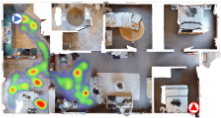
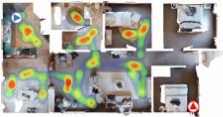
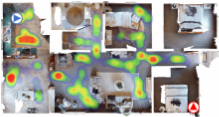
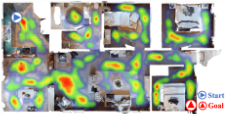
Striking an appropriate balance between exploration and exploitation remains a long-standing challenge in reinforcement learning (RL) [Sutton and Barto, 2018]. To address this problem, classical exploration strategies such as ϵ-greedy or Boltzmann exploration randomly choose from all possible actions with a non-zero probability [Mnih et al., 2015]. However, these methods alone cannot perform deep exploration, which requires the agent to discover rewards far from the initial states. Recent approaches leverage exploration bonus to encourage deep exploration. These exploration bonuses estimate the novelty of states and incentivize the policy to visit new states. For instance, [Bellemare et al., 2016a] models the bonus as inversely proportional to the pseudo-count of visited states, encouraging the agent to visit infrequently-seen states. Other curiosity-driven approaches [Burda et al., 2018b; Pathak et al., 2017] aim to learn the dynamics of the environment and use prediction error as the intrinsic reward. Another line of research [Wang et al., 2023; Raileanu et al., 2020; Zhang et al., 2021; Wang et al., 2024] utilizes state differences as exploration bonuses. Despite the excellent performance of exploration bonus on some tasks, the scalability is a significant limitation especially in high-dimensional spaces where state differences is subtle. Furthermore, existing work [Burda et al., 2018a; Badia et al., 2020b; Henaff et al., 2022] reports that the performance of bonuses varies significantly across different tasks and learning stages, especially in environments with highdimensional state spaces where the novelty between states is rooted in the stochasticity in the environment's dynamics and have little to do with the agent's exploration capabilities (e.g., the "noisy TV" problem [Pathak et al., 2017]), which significantly limits the widespread adoption of exploration bonuses as a default exploration strategy in the realm of deep RL. For example, as shown in Figure 1, in a navigation task within a realistic indoor environment, recent advanced bonus-based exploration methods, such as those curiosity-driven [Burda et al., 2018b], latent-based [Raileanu et al., 2020], and statedifference approaches [Wang et al., 2023], struggle to achieve comprehensive exploration, with the agent typically exploring only up to four rooms. The limitation arises because these methods encourage repetitive actions aimed at maximizing the exploration bonus, often disregarding the extrinsic goal, leading to what can be described as meaningless exploration. In contrast, our method encourages more diverse behavior, enabling the agent to fully explore all the rooms.
∗Corresponding author.
(d) BILE (ours)
Figure 1: Visualization of heatmap of trajectories from policies trained with different exploration algorithms in the indoor environment with high-dimensional state spaces. The agent needs to navigate from the start position to reach the goal position. Other methods fails to reach the goal due to insufficient exploration, since the bonus can distract the agent, leading it to take repetitive actions and accumulate numerous rewards without reaching the goal. Our method BILE explores the whole room space including the goal position by encouraging the agent to produce diverse behavior while maintaining sufficient exploration over the high-dimensional state space.
In this paper, we aim to address the aforementioned challenges by providing an exploration strategy that is both efficient and effective across various domains. To achieve this, we train a state encoder by projecting the high-dimensional states into the behavioral metric space, where the value difference between states is upper-bounded by the distance in the latent space. By learning to span the metric space, the agent is encouraged to explore states with higher value diversity, which leads to taking more diverse behavior and, in turn, promotes more effective exploration. Moreover, by exploring a more compact latent space through the proposed behavioral metric, the agent becomes better suited to handle complex, high-dimensional state spaces (e.g., images), which ensures that the agent can effectively navigate and learn in environments with high-dimensional state representations.
Our main contribution can be summarized as follows. Firstly, we propose a novel exploration strategy that captures diverse behaviors by maximally exploring the compact latent behavioral metric space. Secondly, we introduce a novel behavioral metric that enables efficient and robust training of the state encoder, supported by theoretical guarantees. Thirdly, we introduce a plug-in exploration bonus that promotes more effective exploration and is scalable across various environments. Lastly, we conduct extensive experiments on challenging tasks within different environments. We also evaluate our algorithm in the real-life indoor environment Habitat. The results demonstrate that our algorithm significantly enhances exploration while maintaining broad scalability.
2 Preliminaries
Reinforcement Learning. We assume the underlying environment is a Markov Decision Process (MDP), defined by the tuple M = (S,A, P, r, γ), where S is the state space, A is the action space, P (s′ | s, a) is state transition function from state s ∈ S to state s′ ∈ S, r is the reward function, and γ ∈ [0, 1) is the discount factor. Generally, the policy of an agent in an MDP is a mapping π : S × A → [0, 1]. An agent chooses actions a ∈ A according to a policy function a ∼ π(s), which updates the system state s′ ∼ P (s, a) yielding a reward r(s, a). The goal of the agent is to learn a policy π that maximizes expected return Eπ [∑∞t=0 γ t r(st, at)] in a trajectory (s0, a0, s1, . . . , ) by learning a value function (or value network) Vπ from the interaction that approximates
Behavioral Metric. Behavioral metrics are designed to quantify the dissimilarity between states by considering differences in immediate reward signals and the divergence of their next-state distributions. These methods establish approximate metrics within the representation space, ensuring that behavioral similarities among states are preserved. Furthermore, behavioral metrics have been shown to provide an upper bound on state-value discrepancies between corresponding states. A widely used behavioral metric is the bisimulation metric [Ferns et al., 2011], which defines a pseudometric space (S, d), where a distance function d : S × S ↦→ R≥0 measures the behavioral similarity between two states. Recently, the π-bisimulation metric [Castro, 2020] has been introduced to address scalability challenges, making it applicable to continuous tasks. The metric consists of two key components: Reward Difference term and Distribution Divergence term:
Definition 1 (π-bisimulation metric). Given a fixed policy π, the following π-bisimulation metric exists and is unique:
Exploration Bonus. Addressing the sparse reward challenge prevalent in many environments necessitates augmenting the original external reward function, r, with an intrinsic reward bonus, b, resulting in a combined reward: r′ = r+b. As such, the agent is encouraged to visit novel states with the guidance of the extra exploration bonus. A number of bonuses have been proposed, based on pseudo-counts [Bellemare et al., 2016a], prediction errors between dynamic models [Burda et al., 2018b], and state differences in the latent space [Wang et al., 2023], among others. Table 1 highlights the key differences between our approach and recent baselines. Notably, our method is the first to exhibit both the state-value difference bound and robust representation properties, while demonstrating effectiveness in sparse reward tasks and highdimensional environments. A detailed discussion of these results is provided in the following section.
3 Methodology
Our goal is to develop an effective exploration scheme that enhances deep exploration across various environments.
Challenge of High-dimensional Exploration. A key challenge for exploration bonus-based methods is scaling to realistic environments with high-dimensional state spaces. While recent bonus-based methods, such as curiosity-driven exploration [Burda et al., 2018b], performwell in toy environments like grid games, they often struggle in high-dimensional spaces. These methods typically prioritize maximizing the intrinsic bonus without considering the extrinsic task or goal, which leads to repetitive actions or meaningless exploration. For instance, as shown in Figure 1(a), the RND agent explores solely based on the intrinsic bonus, neglecting the extrinsic goal, which impairs both exploration and task performance. Recent state-difference-based methods [Wang et al., 2023; Wang et al., 2024] have shown strong performance across a variety of environments. However, subtle state differences complicate the evaluation of state novelty in highdimensional environments. Additionally, we prove that these methods exhibit representation collapse (c.f. Theorem 1) in sparse reward scenarios. For example, LIBERTY [Wang et al., 2023], as shown in Figure 1(c), struggles to reach the goal in realistic indoor environments. More recent approaches attempt to model novelty in low-dimensional latent spaces, but they still face difficulties in complex and high-dimensional settings. As illustrated in Figure 1(b), the latent-based exploration method RIDE [Raileanu et al., 2020] fails to adequately explore the goal space, with only a limited portion of the environment explored, which highlights the reduced exploration capability of latent exploration methods in highdimensional spaces.
| Algorithms | Value Diff. Bound Robust Representation | Learn Dyn. | |
|---|---|---|---|
| ICM [Pathak et al., 2017] | � | � � | |
| RND [Burda et al., 2018b] | � | � � | |
| RIDE [Raileanu et al., 2020] | � | � � | |
| EME [Wang et al., 2024] | � | � � | |
| RLE [Mahankali et al., 2024] | � | � � | |
| LIBERTY [Wang et al., 2023] | � | � � | |
| BILE (ours) | � | � � | |
Solution: Ensuring Behavioral Diversity of Bonuses. The key to improve the overall performance and scalability of bonus-based methods lies in their ability to generate diverse behaviors in environments with high-dimensional state spaces. Previous methods fail to promote the diversity of action behaviors in large state spaces, which can lead to repetitive or meaningless actions. Specifically, exploration bonuses can misguide the agent into repeating actions without progressing toward the task. Inspired by the behavioral mericbased representation learning methods [Zhang et al., 2020; Castro, 2020], we integrate behavioral differences into the exploration bonus by training a behavioral metric-based state encoder. This approach not only improves learning efficiency in high-dimensional environments but also enhances the diversity of actions and behaviors. By connecting the value of states with the extrinsic reward, which is tied to task completion, our method encourages the agent to take actions that are both diverse and goal-directed. The remaining questions are:
Q1: What behavioral metric should we choose to construct the state encoder (latent space)?
Q2: How can we integrate behavioral diversity with bonus in an easy-to-plug and computationally efficient way?
3.1 Behavioral Metric-based State Encoder
We propose BILE (BehavIoral metric-based Latent Exploration), a data-efficient approach to promote effective exploration from unstructured high-dimensional states across different environments. We begin by training a representation function dϕ : S → Z. Regarding the aforementioned Q1 and Q2, our representation function ϕ has two key desiderata. First, dϕ should map behaviorally equivalent, highdimensional states into a compact low-dimensional representation. Second, ϕ should encode the distance between states in terms of their value differences to ensure state-value diversity in novel states.
Limitation of Previous Methods. Previous approaches, such as LIBERTY [Wang et al., 2023] and DBC [Zhang et al., 2020], set bisimulation-based metric as the behavioral metric (1) for the training of state encoders. These methods can be generalized by minimize the following objective:
where dπϕ (si, sj) = ||ϕ(si) - ϕ(sj)||2, 2-Wasserstein metric W2 is used instead of W1 to estimate the distribution divergence term due to its convenient closed form for Gaussian distributions, and the inverse dynamic output introduced in [Wang et al., 2023] can be scalarized into a constant.
Theorem 1 (Representation Collapse under Spare Rewards). Let ξ denote the distribution over pairs of states (si, sj) sampled from ξ. Assume deterministic transitions and the existence of a stationary distribution over states. Given a bisimulation metric dπ of the form (1), we have:
Under sparse rewards, the right-hand side (RHS) of Equation (3), i.e., E(si,sj)∼ξ[|rπ si - rπ sj |] ≈ 0 for most cases. Consequently, the learned embedding collapses to a constant value: ˆ dϕ(si) = dϕc .
Proof in Appendix A. Based on Theorem 1, in environments with sparse rewards, the leaned embedding under the loss (2) collapses to a constant value, effectively discarding all state information. Such a collapse significantly impairs exploration performance, as the embedding fails to distinguish between states. The issue is still prevalent even in the latest bisimulation-based approaches [Wang et al., 2024; Zang et al., 2023], which highlights a fundamental limitation in their ability to handle sparse reward scenarios.
Behavioral Metric of BILE. Our goal is to learn a robust representations Z using the behavioral metric-based encoder dϕ, even in sparse reward environments and then use these representations to improve exploration. To address the representation collapse issue highlighted in Theorem 1, we introduce the BILE operator for the behavioral metric:
Definition 2. Given a policy π, the probabilistic transition dynamics model Pη(·|s) = N(µη, ση), BILE operator is updated as :F(dBILE
where rπ PE (s) = || ˆ Pη(s, a) - s′ ||2, ˆ Pη(s, a) represents the predicted next state from the learned probabilistic transition dynamics model, and α is a scaling hyperparameter.
For the Reward Difference term, to address the sparse reward issue faced by previous methods, we incorporate the prediction error of the probabilistic transition dynamics model, rπ PE (s), as an extra reward into the state encoder learning objective. This ensures the reward signal remains informative during encoder training, preventing it from vanishing. Since the transition dynamics model is already trained for the encoder loss, the additional computational cost of this approach is negligible. Over time, as the agent explores and becomes better at predicting its environment, the prediction error diminishes, naturally reducing its impact on the metric learning process.
Furthermore, for the Distribution Divergence term, unlike previous bisimulation-based approaches that rely on the Wasserstein distance which is computationally intractable and requires relaxation, we replace it with a samplebased next-state distribution divergence. Our approach requires only sampling, making it significantly more computationally efficient without loss of theoretical integrity.
Theoretical Guarantee. The BILE metric operator preserves the following theoretical properties as a behavioral metric:
Theorem 2 (Convergence Guarantee). Given a policy π, with the convergence of the latent transition dynamic model, the BILE operator F(dBILE ϕ , π) has a fixed-point.
Theorem 3 (State-Value Difference Upper-bound). For any two states si and sj, a given policy π and the BILE metric encoder dBILE ϕ , we have:
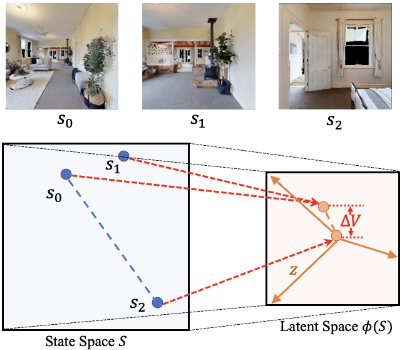
Proof in Appendix A. Theorem 2 establishes the convergence guarantee for the BILE metric-based encoder. Meanwhile, Theorem 3 shows that the value difference between states is upper-bounded by their distance in the BILE behavioral metric space, similar to bisimulation-based approaches. As depicted in Figure 2, states with higher novelty retain greater value diversity, encouraging the agent to explore novel states with larger value differences, which drives the agent to exhibit more diverse behaviors and facilitates more effective exploration. Additionally, as the bonus increases, it results in larger temporal difference (TD) errors for adjacent state pairs during learning, which will significantly enhance learning efficiency, as the BILE metric promotes the prioritization of states that improve both novelty and learning efficacy.
3.2 Latent Exploration via BILE
Improvements over Previous Approaches. Previous latent exploration methods define the exploration bonus using prediction error [Pathak et al., 2017], randomized rewards [Mahankali et al., 2024], and state differences [Wang et al., 2023]. However, these methods often struggle in environments with high-dimensional state spaces. As the state differences become subtle and the exploration space grows exponentially, their performance degrades significantly in realistic environments with high-dimensional observation spaces. A detailed comparison is provided in Table 1. To address these limitations and build upon the conclusions of prior work, we identify key principles to ensure behavioral diversity and improve exploration performance:
- P1: First, the exploration bonus require correlating with states; otherwise, they would appear as white noises, which does not help exploration as shown by [Plappert et al., 2017].
- P2: Second, to ensure the bonus is fully observable and actionable by the policy, the bonus function must allow the policy to condition on it (see Figure 10).
- P3: Last, the exploration bonus should incorporate value diversity between states to encourage diverse and purposeful behavior even in sparse reward setting.
To fulfill these principles, as illustrated in Figure 2, we assert that encouraging the agent to effectively traverse the compact latent space will facilitate exploration of the true state space. We implement the bonus function (denoted as b) as
where f(s, s′ ) = dBILE ϕ (s, s′ ) =< ϕ(s)-ϕ(s′ ) > and z ∈ Z is a random sampled vector from the latent space (the analysis on z will be elaborated in Section 4 and Appendix B.
As Equation (6) satisfies P1, we address P2 by augmenting the input to the policy with the latent vector z, enabling the latent-conditioned policy π(s, z) to be aware of both the state and the random latent variable that factorizes the exploration bonus function. For P3, recalling Theorem 3, we set dBILE ϕ (s) as the state encoder, which encodes the value difference between states, encouraging the agent to visit novel states with higher value diversity even in sparse reward setting.
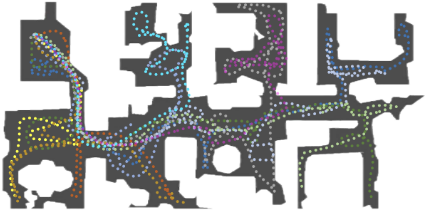
As shown in Figure 3 , changing the latent vector z in BILE leads to diverse trajectories across all rooms. Since the latent-conditioned policy π(s, z) must maximize the reward in Equation (6) for all randomly sampled vectors z, the agent is able to explore the entire latent space. Consequently, the agent is encouraged to produce diverse behavior while maintaining sufficient exploration over the state space.
Based on Equation (4), we denote the state encoder by dBILE ϕ : S → Rn , the probability transition dynamic model is parameterized by η, and draw batches of state pairs, and minimize the mean square error:
where ˆ ϕ is a copy of parameters for the target network. We outline the full training procedure in Algorithm 1.
4 Experiment
To evaluate the performance of BILE, we conduct comprehensive experiments on various settings of different environments to assess the effectiveness of our algorithm. The project site is https://sites.google.com/view/ijcai25bile.
Baselines. We compare BILE with the following baselines: (1) ICM [Pathak et al., 2017]: The widely adopted curiositydriven exploration method. (2) RND [Burda et al., 2018b]: A representative baseline from the family of bonus-based exploration methods. (3) RIDE [Raileanu et al., 2020]: An exploration method that constructs the exploration bonus in the latent space, modeled as the state difference within inverse and forward dynamics representation spaces. (5) EME [Wang et al., 2024]: A competitive dynamic bonus-based method de-
Algorithm 1 BILE
- 1: Initialize policy πθ, probability transition dynamicmodel Pη(·|s) and behavioral metric-based encoder dBILE ϕ
- 2: while not converged do
- 3: Sample the latent vector z from distribution P(Z)
- 4: for t = 1 to MAX STEP PER EPISODE do
- 5: Sample action at ∼ πθ(· | st, z) and reach st+1
- 6: Record transition in the buffer D
- 7: Compute bonus: r′t = rt + bt(s, z)
- 8: Train policy πθ(s, z) via policy gradient
- 9: Sample and permute mini batch B from the buffer
- 10: Update metric encoder EB[L(ϕ)] ▷Equation (7)
- 11: Update dynamic models by minimizing the prediction error rπ PE (s)
- 12: end for
- 13: end while
signed for high-dimensional environments, excelling in challenging exploration tasks. (6) RLE [Mahankali et al., 2024]: A recent exploration method that leverages randomized rewards in the latent space. (7) LIBERTY [Wang et al., 2023]: An approach utilizing a bonus based on state differences evaluated via the bisimulation metric. (8) PPO [Schulman et al., 2017]: the standard RL benchmark algorithm.

4.1 Real Indoor Habitat Environment
Habitat is a platform for embodied AI research which provides an interface for agents to navigate and act in photorealistic simulations of real indoor environments. As shown in Figure 4, at each episode, the agent finds itself in a different indoor space. Full details can be found in Appendix C.
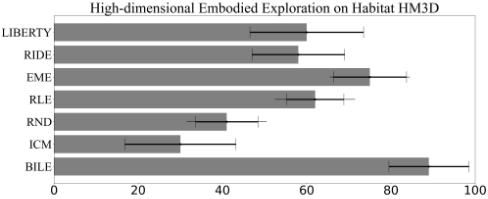
High-dimensional Exploration. We assess the exploration capability of different algorithms by measuring how much of the environment is revealed by the agent's line of sight over the course of an episode. Quantitative results are presented in Figure 5, where BILE reveals significantly more of the maps than any other method. The heatmaps of trajectories for all these methods can be found in Appendix B, which clearly demonstrates that BILE explores a larger portion of the space compared to other methods. These results provide strong evidence of BILE's scalability to high-dimensional observations and reinforce its practical applicability.

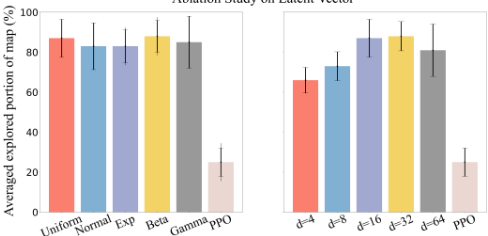
The Impact of Latent Vector. To evaluate the impact of z on the induced policy's behaviors. we sample different latent vector z and rollout trajectories with the policy conditioning on those latent vectors, plotting each trajectory in a different color in Figure 3, indicating that altering the latent vector z can produce diverse trajectories. We also investigate the impact of different latent vector distributions on BILE's performance and how sensitive BILE is to the dimension of the latent vector. Our study involves training BILE with various distributions, including Uniform, Normal, Exp (Exponential), Beta, and Gamma distributions. The dimension of the representation, or the latent vector, is an important hyperparameter. We test BILE with d ∈ 4, 8, 16, 32, 64, where d = 16 is the default setting in Habitat environments. As shown in Figure 7, BILE outperforms the baseline PPO across different latent vector distributions, suggesting that BILE's performance is robust to the choice of distributions. However, the performance of d = 4 and d = 8 lags behind, while d = 16 and d = 32 yield comparable results. When the dimension increases further, performance declines. Overall, BILE's performance with different dimensions remains superior to the baseline method PPO, indicating that BILE's performance is not highly sensitive to the choice of dimension.

4.2 Robotic Continuous Control
Overall Performance of Continuous Control. In our continuous control experiments conducted on the realistic robotic platform [Zhu et al., 2020], we evaluate agents across a variety of challenging tasks, including Nut Assembly, Door Opening, Table Wiping, and Pick-and-Place, as illustrated in Figure 8. The overall results, shown in Figure 6, demonstrate that our method consistently outperforms the baselines, highlighting its superiority in handling continuous control tasks. Among the baselines, EME achieves the second-best performance across all four tasks, underscoring the advantages of using a dynamic bonus. In contrast, episodic count-based methods such as RIDE and randomized bonus methods like RLE perform less effectively, as episodic counts and randomized bonuses lose their effectiveness in high-dimensional environments. Similarly, for the bisimulation metric-based method LIBERTY, performance declines in high-dimensional environments due to the increasingly subtle state differences. Curiosity-driven approaches such as ICM and RND struggle with insufficient exploration, leading to bad performance.
The Importance of Latent Vector Conditioning. As stated in P2 of Section 3.1, we emphasized the necessity for the policy to be conditioned on the latent vector. In order to verify the statement, we compare BILE with and without latentconditioned policy network. As depicted in Figure 10, the performance of BILE exhibits a decline in the Pick-and-Place task (full results in Appendix B). The absence of latent vector conditioning results in limited behavioral variability in the policy network, which leads to failures in more challenging exploration tasks that necessitate a diverse behavior.
4.3 Sparse RewardMinigrid Environment
To evaluate BILE in scenarios with sparse rewards and discrete actions, we test our method on hard exploration tasks in the MiniGrid [Chevalier-Boisvert et al., 2024] benchmark.

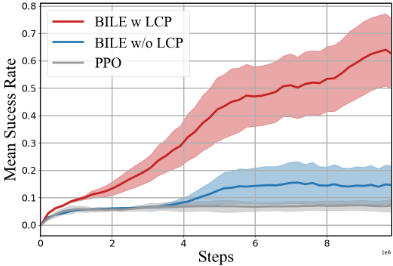
This benchmark includes grid-world exploration games with varying room layouts, interactive objects, and goals. In these environments, the agent must learn a specific sequence of actions to reach the final goal while operating within a limited view size. Valid actions include picking up a key, unlocking a door, unpacking a box, and moving objects, with no extrinsic reward provided until the goal is reached. We select four representative settings fromMiniGrid: FourRooms, MultiRoomN7, DoorKey-16x16, and KeyCorridorS6R3. Details on the specific environmental settings are provided in Appendix C. BILE successfully solves all hard-level exploration environments, achieving the best performance across all settings.
Noisy TV Problem. In addition to the standard tasks, we assess the model's robustness to environmental stochasticity by incorporating a manually-created Noisy TV setting introduced in [Raileanu et al., 2020]. We also test the performance of our method as the room size and number of rooms increase. Results are detailed in Appendix B, showing that BILE consistently outperforms other baselines, further demonstrating the effectiveness and scalability of our approach.
5 RelatedWork
Exploration remains a long-standing problem in RL. Common approaches include ϵ-greedy [Sutton and Barto, 2018], count-based exploration [Bellemare et al., 2016b; Ostrovski et al., 2017a; Zhao et al., 2024], and curiosity-based exploration [Stanton and Clune, 2016; Stanton and Clune, 2018; Burda et al., 2018a]. Several exploration strategies use a dynamics model to provide intrinsic rewards [Pathak et al.,
2017; Burda et al., 2018b; Houthooft et al., 2016; Pathak et al., 2019]. Latent variable dynamics have also been studied for exploration [Bai et al., 2021; Tao et al., 2020; Seo et al., 2021; Raileanu et al., 2020; Yang et al., 2024]. Maximum entropy in the state representation has been used for exploration, through random encoders, in RE3 [Seo et al., 2021], and prototypical representations [Yarats et al., 2021]. Attentionbased intrinsic reward is used to improve communication in traffic flow control [Yang et al., 2023b; Yang et al., 2023a]. Alternative approaches to modelling the environment's dynamics are based on pseudo-counts [Bellemare et al., 2016a; Ostrovski et al., 2017b; Tang et al., 2017], which use density estimations techniques to explore less seen areas of the environment. Some methods combine model-based intrinsic motivation with pseudo-counts, such as RIDE [Raileanu et al., 2020], which rewards the agent with for transitions that have an impact on the state representation, and NGU [Badia et al., 2020b] and agent57 [Badia et al., 2020a], which modulates a pseudo-count bonus with the intrinsic rewards provided by RND. Another line of research try to model the difference between states as bonuses to incentive exploration [Wang et al., 2023; Zhang et al., 2021; Henaff et al., 2022]. Other unsupervised learning approaches [Eysenbach et al., 2018; Park et al., 2023; Park et al., 2022] propose unsupervised frameworks to induce diverse skills or long-horizon behaviors. Recent breakthroughs concerning exploration in RL have also focused on using the learned environment dynamics to plan to explore [Shyam et al., 2019; Ratzlaff et al., 2020; Hafner et al., 2019], where they use imaginary rollouts from their dynamics models to plan exploratory behaviors.
6 Conclusion
In this work, we identify the limitations of previous exploration methods, particularly in environments with highdimensional state spaces. To address these challenges, we propose a novel exploration strategy that captures diverse behaviors by maximally exploring the compact latent behavioral metric space. We introduce a new behavioral metric that facilitates efficient and robust training of the state encoder, supported by theoretical guarantees. Additionally, we encourage agents to explore the latent space by providing exploration bonuses based on randomized latent vectors. Extensive experiments across various challenging tasks, including continuous control, minigrid games, and realistic environments, demonstrate the effectiveness and scalability of our method.
Acknowledgments
This work was supported by the Science and Technology Development Fund Macau SAR (0003/2023/RIC, 0052/2023/RIA1, 0031/2022/A, 001/2024/SKL for SKLIOTSC) , Shenzhen-Hong Kong-Macau Science and Technology Program Category C (SGDX20230821095159012), NSF of China 62402325 and the Research Foundation of Shenzhen Polytechnic University under Grant 6022310014K and 6022312054K. This work was performed in part at SICC which is supported by SKL-IOTSC, University of Macau.
@inproceedings{ijcai2025p723,
  title     = {BILE: An Effective Behavior-based Latent Exploration Scheme for Deep Reinforcement Learning},
  author    = {Wang, Yiming and Zhao, Kaiyan and Li, Yan and U, Leong Hou},
  booktitle = {Proceedings of the Thirty-Fourth International Joint Conference on
               Artificial Intelligence, {IJCAI-25}},
  publisher = {International Joint Conferences on Artificial Intelligence Organization},
  editor    = {James Kwok},
  pages     = {6497--6505},
  year      = {2025},
  month     = {8},
  note      = {Main Track},
  doi       = {10.24963/ijcai.2025/723},
  url       = {https://doi.org/10.24963/ijcai.2025/723},
}
TY - CPAPER TI - BILE: An Effective Behavior-based Latent Exploration Scheme for Deep Reinforcement Learning AU - Wang, Yiming AU - Zhao, Kaiyan AU - Li, Yan AU - U, Leong Hou T2 - Proceedings of the Thirty-Fourth International Joint Conference on Artificial Intelligence, IJCAI-25 PB - International Joint Conferences on Artificial Intelligence Organization PY - 2025 SP - 6497 EP - 6505 DO - 10.24963/ijcai.2025/723 UR - https://doi.org/10.24963/ijcai.2025/723 ER -Copied
Machine-readable versions of this paper, for tools and AI agents:





