
POLO: An LLM-Powered Project-Level Code Performance Optimization Framework
Proceedings of the Thirty-Fourth International Joint Conference on Artificial Intelligence. Main Track. Pages 7319-7328.
https://doi.org/10.24963/ijcai.2025/814
Keywords
- Multidisciplinary Topics and Applications: MTA: Software engineering
- Agent-based and Multi-agent Systems: MAS: Engineering methods, platforms, languages and tools
Abstract
Program performance optimization is essential for achieving high execution efficiency, yet it remains a challenging task that requires expertise in both software and hardware.
Large Language Models (LLMs), trained on high-quality code from platforms like GitHub and other open-source sources, have shown promise in generating optimized code for simple snippets. However, current LLM-based solutions often fall short when tackling project-level programs due to the complexity of call graphs and the intricate interactions among functions. In this paper, we emulate the process a human expert might follow when optimizing project-level programs and introduce a three-phase framework POLO (PrOject-Level Optimizer) to address this limitation.
First, we profile the program to identify performance bottlenecks using an iterative weighting algorithm.
Next, we conduct structural analysis by scanning the project and generating a graph that represents the program's structure.
Finally, two LLM agents collaborate in iterative cycles to rewrite and optimize the code at these hotspots, gradually improving performance.
We conduct experiments on open-source and proprietary projects. The results demonstrate that POLO accurately identifies performance bottlenecks and successfully applies optimizations. Under the O3 compilation flag, the optimized programs achieved speedups ranging from 1.34x to 21.5x.
- [Achiam et al., 2023] Josh Achiam, Steven Adler, Sandhini Agarwal, Lama Ahmad, Ilge Akkaya, Florencia Leoni Ale- man, Diogo Almeida, Janko Altenschmidt, Sam Altman, Shyamal Anadkat, et al. Gpt-4 technical report. arXiv preprint arXiv:2303.08774, 2023.
- [Bairi et al., 2024] Ramakrishna Bairi, Atharv Sonwane, Aditya Kanade, Vageesh D. C., Arun Iyer, Suresh Parthasarathy, Sriram Rajamani, B. Ashok, and Shashank Shet. Codeplan: Repository-level coding using llms and planning. Proc. ACM Softw. Eng., 1(FSE), July 2024.
- [Bell et al., 1990] Timothy Bell, John Cleary, and Ian Wit- ten. Calgary corpus. https://www.data-compression.info/ Corpora/CalgaryCorpus/, 1990. Accessed: October 20, 2024. Link
- [Chen et al., 2024] Zimin Chen, Sen Fang, and Martin Mon- perrus. Supersonic: Learning to generate source code opti- mizations in c/c++. IEEE Transactions on Software Engi- neering, 2024.
- [Conte, 2015] Brad Conte. Basic implementations of stan- dard cryptography algorithms, like aes and sha-1. https: //github.com/B-Con/crypto-algorithms/tree/master, 2015. Accessed: October 20, 2024. Link
- [DBAIWangGroup, 2021] DBAIWangGroup. Benchmark of nearest neighbor search on high dimensional data. https: //github.com/DBAIWangGroup/nns benchmark, 2021. Ac- cessed: October 20, 2024. Link
- [Della Toffola et al., 2015] Luca Della Toffola, Michael Pradel, and Thomas R Gross. Performance problems you can fix: A dynamic analysis of memoization opportunities. ACM SIGPLAN Notices, 50(10):607-622, 2015.
- [Du et al., 2024] Xueying Du, Mingwei Liu, Kaixin Wang, Hanlin Wang, Junwei Liu, Yixuan Chen, Jiayi Feng, Chaofeng Sha, Xin Peng, and Yiling Lou. Evaluating large language models in class-level code generation. In Pro- ceedings of the IEEE/ACM 46th International Conference on Software Engineering, pages 1-13, 2024.
- [Feng et al., 2020] Zhangyin Feng, Daya Guo, Duyu Tang, Nan Duan, Xiaocheng Feng, Ming Gong, Linjun Shou, Bing Qin, Ting Liu, Daxin Jiang, et al. Codebert: A pre-trained model for programming and natural languages. arXiv preprint arXiv:2002.08155, 2020.
- [Gao et al., 2024] Shuzheng Gao, Cuiyun Gao, Wenchao Gu, and Michael Lyu. Search-based llms for code optimization. arXiv preprint arXiv:2408.12159, 2024.
- [Garg et al., 2022] Spandan Garg, Roshanak Zilouchian Moghaddam, Colin B Clement, Neel Sundaresan, and Chen Wu. Deepperf: A deep learning-based approach for improving software performance. arXiv preprint arXiv:2206.13619, 2022.
- [Garg et al., 2023] Spandan Garg, Roshanak Zilouchian Moghaddam, and Neel Sundaresan. Rapgen: An approach for fixing code inefficiencies in zero-shot. arXiv preprint arXiv:2306.17077, 2023.
- [Gregg, 2016] Brendan Gregg. The flame graph. Communi- cations of the ACM, 59(6):48-57, 2016.
- [Group, 2006] Princeton CASS Group. Audio datasets. https: //www.cs.princeton.edu/cass/demos.htm, 2006. Accessed: October 20, 2024. Link
- [Huang et al., 2023] Dong Huang, Qingwen Bu, Jie M Zhang, Michael Luck, and Heming Cui. Agentcoder: Multi-agent- based code generation with iterative testing and optimisa- tion. arXiv preprint arXiv:2312.13010, 2023.
- [Jegou et al., 2010] Herve Jegou, Matthijs Douze, and Cordelia Schmid. Product quantization for nearest neighbor search. IEEE transactions on pattern analysis and machine intelligence, 33(1):117-128, 2010.
- [Liu et al., 2024a] Jiawei Liu, Chunqiu Steven Xia, Yuyao Wang, and Lingming Zhang. Is your code generated by chatgpt really correct? rigorous evaluation of large lan- guage models for code generation. Advances in Neural Information Processing Systems, 36, 2024.
- [Liu et al., 2024b] Zhijie Liu, Yutian Tang, Xiapu Luo, Yum- ing Zhou, and Liang Feng Zhang. No need to lift a finger anymore? assessing the quality of code generation by chat- gpt. IEEE Transactions on Software Engineering, 2024.
- [Luo et al., 2024] Qinyu Luo, Yining Ye, Shihao Liang, Zhong Zhang, Yujia Qin, Yaxi Lu, Yesai Wu, Xin Cong, Yankai Lin, Yingli Zhang, Xiaoyin Che, Zhiyuan Liu, and Maosong Sun. RepoAgent: An LLM-powered open-source framework for repository-level code documentation genera- tion. In Proceedings of the 2024 Conference on Empirical Methods in Natural Language Processing: System Demon- strations, pages 436-464, Miami, Florida, USA, November 2024. Association for Computational Linguistics.
- [Nethercote and Seward, 2007] Nicholas Nethercote and Ju- lian Seward. Valgrind: a framework for heavyweight dynamic binary instrumentation. ACM Sigplan notices, 42(6):89-100, 2007.
- [Ni et al., 2023] Ansong Ni, Srini Iyer, Dragomir Radev, Veselin Stoyanov, Wen-tau Yih, Sida Wang, and Xi Victoria Lin. Lever: Learning to verify language-to-code generation with execution. In International Conference on Machine Learning, pages 26106-26128. PMLR, 2023.
- [Nistor et al., 2013] Adrian Nistor, Tian Jiang, and Lin Tan. Discovering, reporting, and fixing performance bugs. In 2013 10th working conference on mining software reposito- ries (MSR), pages 237-246. IEEE, 2013. [OpenAI, 2024] OpenAI. Hello gpt-4o. https://openai.com/index/hello-gpt-4o/, 2024. Accessed: October 20, 2024. Link
- [Page et al., 1999] Lawrence Page, Sergey Brin, Rajeev Mot- wani, and Terry Winograd. The pagerank citation ranking: Bringing order to the web. Technical report, Stanford info- lab, 1999.
- [Roziere et al., 2023] Baptiste Roziere, Jonas Gehring, Fabian Gloeckle, Sten Sootla, Itai Gat, Xiaoqing Ellen Tan, Yossi Adi, Jingyu Liu, Tal Remez, Jérémy Rapin, et al. Code llama: Open foundation models for code. arXiv preprint arXiv:2308.12950, 2023.
- [Shypula et al., 2023] Alexander Shypula, Aman Madaan, Yi- meng Zeng, Uri Alon, Jacob Gardner, Milad Hashemi, Gra- ham Neubig, Parthasarathy Ranganathan, Osbert Bastani, and Amir Yazdanbakhsh. Learning performance-improving code edits. arXiv preprint arXiv:2302.07867, 2023.
- [Smidt, 2012] Joseph Smidt. quant++: A c++ quantitative trading framework. https://github.com/jsmidt/quantpp/tree/ master, 2012. Accessed: October 20, 2024. Link
- [Song and Lu, 2017] Linhai Song and Shan Lu. Performance diagnosis for inefficient loops. In 2017 IEEE/ACM 39th International Conference on Software Engineering (ICSE), pages 370-380. IEEE, 2017.
- [Sturtevant, 2012] N. Sturtevant. Benchmarks for grid-based pathfinding. Transactions on Computational Intelligence and AI in Games, 4(2):144 -148, 2012.
- [Team, 2007] The Clang Team. Libtooling. https://clang.llvm.org/docs/LibTooling.html, 2007. Accessed: October 20, 2024. Link
- [Wang et al., 2024] Yi Wang, Qidong Zhao, Dongkuan Xu, and Xu Liu. Purpose enhanced reasoning through iterative prompting: uncover latent robustness of chatgpt on code comprehension. In Proceedings of the Thirty-Third Inter- national Joint Conference on Artificial Intelligence, pages 6513-6521, 2024. IJCAI
- [Weidendorfer, 2012] Josef Weidendorfer. Cache perfor- mance analysis with callgrind and kcachegrind. In 8 VI- HPS Tuning Workshop, 2012.
- [Xiao et al., 2013] Xusheng Xiao, Shi Han, Dongmei Zhang, and Tao Xie. Context-sensitive delta inference for iden- tifying workload-dependent performance bottlenecks. In Proceedings of the 2013 International Symposium on Soft- ware Testing and Analysis, pages 90-100, 2013.
- [Xu et al., 2010] Guoqing Xu, Nick Mitchell, Matthew Arnold, Atanas Rountev, Edith Schonberg, and Gary Sevit- sky. Finding low-utility data structures. In Proceedings of the 31st ACM SIGPLAN Conference on Programming Lan- guage Design and Implementation, pages 174-186, 2010.
- [Yang et al., 2023] Guang Yang, Yu Zhou, Xiang Chen, Xi- angyu Zhang, Tingting Han, and Taolue Chen. Exploit- gen: Template-augmented exploit code generation based on codebert. Journal of Systems and Software, 197:111577, 2023.
- [Yu et al., 2024] Hao Yu, Bo Shen, Dezhi Ran, Jiaxin Zhang, Qi Zhang, Yuchi Ma, Guangtai Liang, Ying Li, Qianxiang Wang, and Tao Xie. Codereval: A benchmark of pragmatic code generation with generative pre-trained models. In Pro- ceedings of the 46th IEEE/ACM International Conference on Software Engineering, pages 1-12, 2024.
- [Zan et al., 2022] Daoguang Zan, Bei Chen, Dejian Yang, Zeqi Lin, Minsu Kim, Bei Guan, Yongji Wang, Weizhu Chen, and Jian-Guang Lou. CERT: Continual pre-training on sketches for library-oriented code generation. In The 2022 International Joint Conference on Artificial Intelli- gence, 2022. IJCAI
- [Zhang et al., 2023] Fengji Zhang, Bei Chen, Yue Zhang, Jacky Keung, Jin Liu, Daoguang Zan, Yi Mao, Jian-Guang Lou, and Weizhu Chen. RepoCoder: Repository-level code completion through iterative retrieval and generation. In Houda Bouamor, Juan Pino, and Kalika Bali, editors, Pro- ceedings of the 2023 Conference on Empirical Methods in Natural Language Processing, pages 2471-2484, Sin- gapore, December 2023. Association for Computational Linguistics.
- [Zheng et al., 2023a] Lin Zheng, Jianbo Yuan, Zhi Zhang, Hongxia Yang, and Lingpeng Kong. Self-infilling code generation. In Forty-first International Conference on Ma- chine Learning, 2023.
- [Zheng et al., 2023b] Wenqing Zheng, SP Sharan, Ajay Ku- mar Jaiswal, Kevin Wang, Yihan Xi, Dejia Xu, and Zhangyang Wang. Outline, then details: Syntactically guided coarse-to-fine code generation. In International Conference on Machine Learning, pages 42403-42419.
- PMLR, 2023.
- [Zhu et al., 2024] Yuqi Zhu, Jia Li, Ge Li, YunFei Zhao, Zhi Jin, and Hong Mei. Hot or cold? adaptive temperature sampling for code generation with large language mod- els. In Proceedings of the AAAI Conference on Artificial Intelligence, volume 38, pages 437-445, 2024.
References were extracted automatically from the PDF and may contain errors.
Full text extracted automatically from the PDF; figures, tables and equations may differ. The PDF is the version of record.
1 Introduction
Program performance issues, often referred to as performance bugs, are defects that arise from inefficient programming practices, such as the use of suboptimal data structures. These defects lead to excessive processing overhead and unnecessary resource allocation. Even worse, performance bugs typically do not cause program malfunctions, making them difficult to detect and particularly elusive [Nistor et al., 2013]. While tools like FlameGraph [Gregg, 2016] and Valgrind [Nethercote and Seward, 2007] are available for performance analysis, fixing performance bugs requires more advanced expertise than simply writing the code, making it a highly challenging task. Sometimes, performance issues may arise from workload variability or deployment environment. In this paper, we focus on performance problems caused by inefficient implementations at the source code level. Bottlenecks due to other factors are beyond the scope of this paper.
∗Corresponding author.
Traditional methods typically focus on specific types of defects, such as inefficient loops [Song and Lu, 2017; Xiao et al., 2013], redundant computations [Della Toffola et al., 2015], etc. With recent advances in generative language models, researchers [Chen et al., 2024; Shypula et al., 2023] have started collecting pre- and post-optimization code to fine-tune LLMs for addressing a wider range of performance issues. However, these efforts generally focus on optimizing individual functions (e.g., LeetCode problems) or even specific lines, making them insufficient to meet the project-level optimization demands in real-world scenarios.
Recently, some works have shifted their focus to functionlevel optimization. For example, DeepPerf [Garg et al., 2022] collects code snippets of the same function before and after optimization in C# projects to fine-tune code models. Its follow-up, RAPGen [Garg et al., 2023], retrieves knowledge from pre-built databases and leverages large models to perform optimizations based on historical examples. However, RAPGen's reliance on code matching limits it to handling additions, deletions, and modifications related to the misuse of common C# API. This approach requires a knowledge base constructed from before-and-after optimization changes in code snippets of specific functions, which incurs significant costs for collection and maintenance. Besides, it is challenging to adapt it to other types of bugs and programming languages.
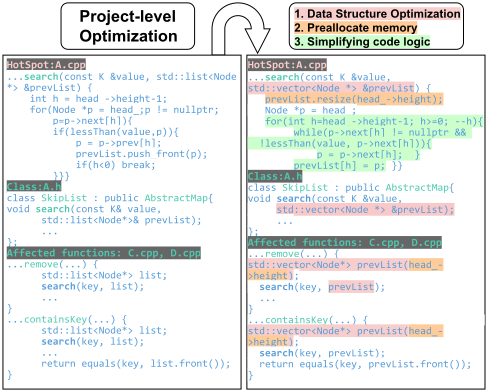
In the absence of a dedicated knowledge base for the project, we must rely on common sense and practical experience for code optimization. Fortunately, LLMs, having been trained on vast repositories of projects written in various languages, possess a general understanding of what well-optimized code looks like. If we can effectively guide LLMs during program optimization, we can establish a zero-shot method for performance debugging. As illustrated in Fig. 1, we begin by reviewing how a human expert approaches project-level code optimizations and identify the challenges:
- Profiling and Hotspot Identification: In Fig. 1, the optimization is centered around the hotspot search. The key to effective optimization is profiling the program to identify the hotspot that most impacts performance. It is crucial as execution paths and bottlenecks vary across programs. In complex programs, the call graph can be intricate, making it challenging to pinpoint the hotspot.
- Project-Level Correlation Detection: For project-level performance optimization, it is essential to understand the context of a hotspot function, including its position in the program and relationships with other modules. In Fig. 1, the hotspot search calls the lessThan. It is invoked by containsKey and remove, and is a member of the SkipList class. These insights provide a comprehensive understanding of the program's structure, enabling more effective optimization by the expert.
- Code Rewrite: After identifying the chain of bottlenecks, we attempt to rewrite the code to improve performance. However, this is a non-trivial task. The program shown in Fig. 1 can be optimized in various aspects, including data structures, memory allocation, and code logic. The diverse nature of performance issues across different
projects requires a human expert to possess a broad range of skills and knowledge across multiple domains. This is the most challenging aspect of optimization, as it demands expertise in multiple areas to effectively address and resolve these varied performance issues.
In this paper, we propose the POLO (PrOject-Level Optimizer) to tackle the challenge of project-level code optimization by simulating the optimization process of a human expert. POLO is organized into the following three modules:
Runtime Local Hotspot Detection: Program hotspots can only be identified after actual execution, necessitating the use of runtime analysis to detect local hotspots, as discussed in Sec. 3.1. By running the program under real workloads and using instrumentation tools, POLO can capture the program's runtime behavior, ensuring the detection of genuine performance bottlenecks. To model the program's runtime states, we employ a meticulously designed finite state machine to automatically parse profiling results and construct a directed graph, the Program Call Graph (PCG), in which nodes represent functions and edges denote function call relationships. To precisely identify hotspot, we apply a PageRank-like method, Func Rank, on the PCG to rank the functions, considering both their execution time and impact within the call stack.
Global Correlation Detection: Runtime analysis alone cannot reveal the complete structure of the program. For example, if there are numerous "if-else" branches and some are not executed during runtime, critical information will be missing. A comprehensive understanding of the program's structure is essential for grasping its functionality and semantics. As discussed in Sec. 3.2, we perform a static analysis of the entire project, constructing a Program Structure Graph (PSG) that represents the structural information of the program, where nodes denote key elements and edges represent their relationships. The nodes and edges sufficiently encapsulate program information to facilitate subsequent optimization.
Code Rewrite with LLM Agents: LLMs, as programming experts, have already achieved significant success in code generation [Zhu et al., 2024; Zheng et al., 2023b; Zheng et al., 2023a; Ni et al., 2023]. We leverage multiple agents in an interactive and iterative manner to perform optimization. The Generator Agent extracts neighboring nodes of the hotspot from PSG and PCG, crafts prompts, and interacts with the LLM to generate optimized code. The Decision Agent executes the modified program, evaluates performance changes, and decides on further optimization or improvement directions. This iterative loop ensures optimizations are guided by real-time performance impact for targeted improvements. Overall, the contributions of this paper are as follows:
| Elements | Relations (Edges) | |||
|---|---|---|---|---|
| Type | (Nodes) Attribute | Type | Attribute | |
| Correlation analysis | Class/Struct Function Global/Static variable | name, body, template, file name, parameter, return type, body, template, file name, value, file | Static refer Inheritance Ownership | referer, referee superclassOf, subclassOf hasmember, ismember |
| Runtime analysis | Function | custom, library, time, file | Dynamic call | caller, callee, frequency |
- To the best of our knowledge, POLO is the first endto-end project-level program optimization framework, encompassing global program analysis, local hotspot detection, and the code rewriting capabilities of large models, enabling us to make a exploration into the relatively underexplored field of performance optimization.
- We propose using the Program Structure Graph (PSG) to model project architecture, incorporating richly attributed nodes and edges to facilitate a comprehensive understanding of the program's semantic context. We advocate for an automated system to manage information during the runtime, constructing a Program Call Graph (PCG). By applying a PageRank-like algorithm to this graph, our profiling process can effectively identify hotspot.
- We propose a collaborative, iterative method involving two LLM agents to optimize programs based on hotspots and program context. In each optimization cycle, the agent continuously senses performance changes from the environment, deciding whether to accept the current optimization and guiding subsequent optimizations.
- We conduct experiments on six open-source and private projects. The results indicate that POLO successfully identifies and optimizes hotspot, achieving speedups ranging from 1.34x to 21.5x under the O3 compilation flag.
2 RelatedWork
2.1 LLMs for Code Generation
Generative language models have achieved remarkable accomplishments [Yu et al., 2024; Yang et al., 2023; Du et al., 2024; Huang et al., 2023; Liu et al., 2024b; Liu et al., 2024a; Wang et al., 2024; Zan et al., 2022] in the automated code generation field. They are capable of generating code based on user instructions or the context of the program. Currently, there are many generative models specifically tailored for code generation, like CodeBert [Feng et al., 2020] and CodeLlama [Roziere et al., 2023]. The large language models (LLMs), represented by GPT 4 [Achiam et al., 2023], have further propelled research to its peak. LLMs have been proven to effectively understand and generate code. They have achieved notable results on code benchmarks. However, it is worth noting that these benchmarks focus on the ability to generate a single code file. Considering that real-world codes typically exist at the project-level, initiatives like CodePlan [Bairi et al., 2024] have begun to leverage LLMs for project-level code migration tasks. RepoAgent [Luo et al., 2024] explores the documentation generation task. Nevertheless, such tasks remain relatively unexplored.
2.2 Performance Optimization
Performance optimization, also referred to performance bug repair, involves correcting code that causes poor performance due to inefficient data structures or unnecessary operations. Early methods aim to address specific types of performance deficiencies, such as inefficient loops [Song and Lu, 2017; Xiao et al., 2013], suboptimal data structures [Xu et al., 2010], and redundant computations [Della Toffola et al., 2015]. Generative models have brought new directions for performance optimization. PIE4Perf [Shypula et al., 2023] and Supersonic [Chen et al., 2024] collect pre- and post-optimization versions of numerous C++ programming solutions and finetune existing generative models to perform optimization. SBLLM [Gao et al., 2024] iterates the optimization process from the perspective of search. However, their optimizations are mainly within single files (On the algorithm competition platform, e.g., AtCoder and Codeforces), which cannot meet the requirements of project-level performance repair in realworld scenarios. Recently, DeepPERF [Garg et al., 2022] and Rapgen [Garg et al., 2023] have begun attempting program optimizations for C# language. DeepPERF collects pre- and post-optimization code pairs and fine-tunes the code language models. Similarly, RAPGen utilizes the same code pairs to build an optimization knowledge base to generate prompts for LLMs to perform optimizations. However, it focuses primarily on fixing misuse of common C# API and lacks the capability to optimize other types of bugs. Overall, project-level optimization remains a relatively unexplored area.
3 Method
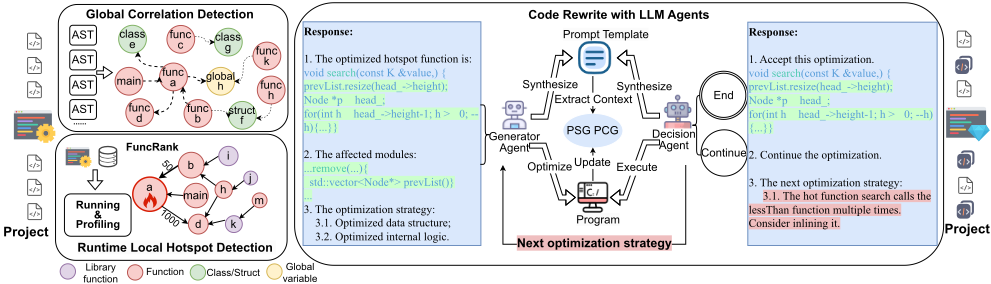
The architecture of POLO is shown in Fig. 2, consisting of Runtime Local Hotspot Detection, Global Correlation Detection, and Code Rewrite with LLM Agents.
3.1 Runtime Local Hotspot Detection
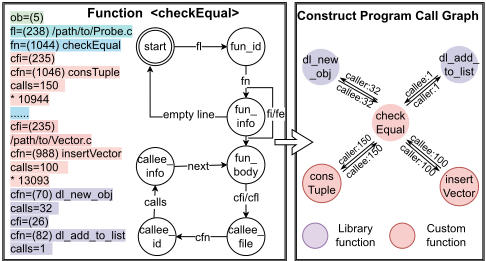
We use the Callgrind profiling tool [Weidendorfer, 2012] for dynamic analysis. Unfortunately, the profiling results generated by Callgrind are not human readable. To enable further analysis of runtime critical information, we thoroughly analyze Callgrind's output and develop a Finite State Machine (FSM) for automated parsing. As shown in Fig. 3, the left side displays the highly simplified version of Callgrind output. We employ the FSM on the right side to parse each file, function, and call information involved at runtime line by line. Despite the highly varied output of Callgrind due to its built-in compression methods, our FSM can extract the execution cost and call relationships for each function, including those from numerous standard and third-party libraries.
Based on the parsed call information, we define the directed graph, referred to as the Program Call Graph (PCG), to represent the intricate call relationships within the program. Formally, PCG = (V c ,Ec ), where V c is the set of functions executed during the program's running (including library functions), and Ec represents the dependencies between these functions. Both nodes and edges contain rich attributes. For example, the node checkEqual in Fig. 3 is characterized by Aci = {name : "checkEqual", type : "custom", time : 25%}, which indicates that i ∈ V c is a custom function, and its execution time contributes 25% of the total cost (excluding its calling relationships). The Acij = {type : "caller", count : 100, time : 20%} describes an edge (i, j) ∈ Ec , where function i (the caller) invokes function j (the callee) 100 times, and the call from i to j contributes 20% of the total execution cost.
Considering cases where time-consuming function is caused by errors in their callers/callees or where non-optimizable library functions become performance bottlenecks, it is evident that relying solely on function execution time is insufficient for hotspot identification. A thorough analysis of the lengthy call stack and execution duration is necessary to pinpoint hotspots effectively. To address this, we propose a PageRanklike ranking method: Func Rank. We draw inspiration from the PageRank [Page et al., 1999] algorithm. Func Rank simultaneously considers both the time-consuming nature of functions and their influence within the PCG. Specifically, we analogize functions to web pages, with function calls viewed as links between them, and the execution cost of the function representing its inherent influence. The called functions propagate time cost to their callers. Formally, we first compute the weights for edges of the callee type. The weight is shown as:
where Acju is the set of edges from node j to node u, and Acju [time] denotes the time cost for this invocation. Here, caller(j) represents the set of nodes that call j.
We use Ii to represent the final score of the function i, which is derived from the function's real execution cost and its influence within the call graph. This value is used to rank and identify hotspot functions.
where j is a callee of node i. α is the dumping factor, which balances the functions' execution time and the influence propagated from other nodes, with a default value of 0.5. We apply the above equation iteratively until the values converge.
3.2 Global Correlation Detection
Conducting a global static analysis of the project is necessary. It not only aids in understanding the context of functions but also ensures proper adaptation of functions in the call stack impacted by optimizations involving changes to function signatures. Languages like C++ are among the most challenging due to their support for multiple programming paradigms, template and other advanced features. Its status as the primary choice for performance-critical algorithm motivates us to select it as the example for program analysis in this work.
We use Clang's LibTooling [Team, 2007] to construct an Abstract Syntax Tree (AST) for each source file. The nodes of the ASTs are analyzed through recursive traversal, extracting both node attributes and relationships. The analysis process is detailed in the Algorithm 1 in Appendix A. As shown in Table 1, we extract Classes, Functions, Global variables, and their attributes. Class is used to define a custom data type. Function, being the basic building block of a program, is a key targets for optimization. Global variable is used to store essential information shared across various modules.
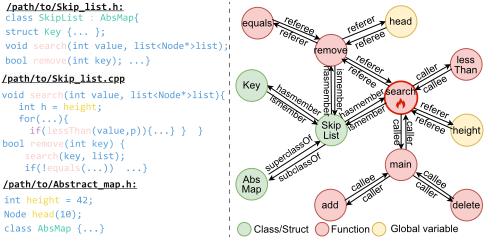
We define a directed graph, referred to as the Program Structure Graph (PSG), to represent the structural relationships within the program, as illustrated in Fig. 4. Formally, the graph is denoted as PSG = (V s , Es ), where V s represents the set of vertices, each corresponding to a function, class, or global variable identified through program analysis. The edges, Es , capture the relationships between these vertices. Each vertex u ∈ V s is associated with a set of attributes Asu , which describe its properties. For instance, Asu = {type : "function", name : "Search", ...} indicates that the vertex u represents a function named "Search". To handle potential naming conflicts, each vertex also includes a namespace attribute, ensuring uniqueness among functions with identical names. Similarly, edges (u, v) ∈ Es are annotated with attributes Asuv , which describe the attribute of the relationship between vertices u and v. For instance, an edge Asuv = {type : "ismember"} implies that there is an edge (u, v) ∈ Es between nodes u and v, where the relationship u → v indicating u is member of v; conversely, v → u is the "hasmember", indicating v is parent of u. This information facilitates the extraction and assembly of each element in subsequent steps, such as constructing a function's signature from its template, name, return type, and parameter list.
3.3 Code Rewrite with LLMAgents
As shown in Fig. 2, we adopt two LLM agents for iterative optimization: Generator Agent and Decision Agent. Human programmers are sometimes limited by their own knowledge domains and may inadvertently write inefficient code. Leveraging Generator Agent as a code generator can mitigate these issues by unleashing their comprehensive and advanced programming capabilities. Decision Agent incorporates performance changes as feedback. It can effectively guide the LLM to optimize while avoiding negatively impact code.
Generator Agent
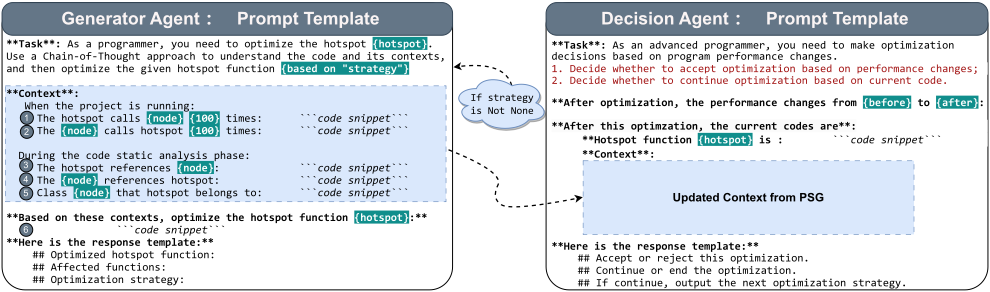
An important fact is that the context of function aids LLM in better understanding its functionality, thereby facilitating optimization. Additionally, the context helps the LLM comprehend the call stack of hotspot and their connections with other modules, enabling broader optimization rather than focusing solely on isolated code segments. Hence, we extract the neighboring nodes of the hotspot function as program context.
Prompt Synthesis. For the hotspot node u, its set of neighboring nodes and associated edges from PSG and PCG are denoted as N node (u) = {v ∈ V s ∪ V c | (u, v) ∈ Es ∪ Ec } and N edge (u) = {e = (u, v) | e ∈ Es ∪ Ec }. We obtain the neighboring nodes and their attributes as: {(v,Av) | v ∈ N node (u)}. Taking the search node in the Fig. 4 as an example, we can derive its context lessThan, remove, and SkipList from N node (u). Based on the edge attributes in N edge (u), we can derive that search has a call relationship with lessThan and is a member of SkipList. We synthesize neighboring nodes into different prompts based on the types of edges. The detailed template is shown in Fig. 5.
As shown in Fig. 5, the dynamic relationships are included in parts 1⃝ 2⃝ of the prompt, while the static relationships are covered in parts 3⃝ 4⃝ 5⃝. Finally, the hotspot function itself 6⃝and the return format follow, completing the template synthesis. Since each node has attributes, we can concatenate the attributes (return type, name, parameters, body) to form the code snippet in the template.
Optimize with LLM. We send the assembled prompt to the LLM to optimize the hotspot. We intentionally inject the node ID of each node into the synthesized prompt and require the LLM's output to include the ID, which is given in the PSG. By parsing the response, we can automatically write the modified code back into the source files. It facilitates cross-file and cross-function modifications, making the optimization process process more seamless and efficient.
Decision Agent
The code generated by the Generator can impact performance both positively and negatively. Unnecessary optimizations may degrade performance. Therefore, tracking performance changes is crucial to retain only beneficial optimizations.
Program Execution and PSG Update. The program needs to be re-executed to assess the performance. We record both the pre- and post-optimization performances. Meanwhile, since the function bodies, and other modules may have changed, the PSG needs to be updated to reflect the newest version of program. This ensures that the PSG synchronizes the modified program, maintaining consistency for future steps.
Make Decision. As shown in Fig. 5, we track prompt changes and retrieve the current hotspot context based on the updated PSG. The LLM decides whether to accept or reject these changes, and whether to continue or terminate the optimization. If it continues, it provides additional strategies, which are passed to the Generator Agent for program optimization. This iterative process persists, with the Decision Agent evaluating each cycle, until further optimization is deemed unnecessary, at which point the process terminates.
4 Experiments
In real world, the compile level O0 is used during development, and O3 enables aggressive optimizations, aiming to produce highly optimized code for production needs. We consider both the O0 and O3 flags. The goal is to verify whether the optimizations produced by POLO surpass what the compiler can accomplish. We focus on the following questions:
| Level | Project | Language | File | Class | Functions | Lines | Type |
|---|---|---|---|---|---|---|---|
| Easy | Quant [Smidt, 2012] | C++ | 5 | 1 | 9 | 315 | Quantitative Trade Framework |
| AStar (Private) | C++ | 10 | 9 | 18 | 484 | A* search Algorithm | |
| Medium | SkipList (Private) | C++ | 6 | 7 | 44 | 886 | SkipList Implementation |
| AES [Conte, 2015] | C | 3 | 0 | 31 | 1409 | Crypto Algorithm | |
| Hard | KGraph [DBAIWangGroup, 2021] | C++ | 8 | 22 | 109 | 3937 | Nearest Neighbor Search |
| MiniSQL (Private) | C++ | 129 | 130 | 772 | 15915 | Small Database System |
| Project | Data | Correctness | Speed Test | Coverage |
|---|---|---|---|---|
| Quant | provided | ✓ | ✓ | 85.71% |
| AStar | [Sturtevant, 2012] | ✓ | ✓ | 83.17% |
| SkipList | provided | ✓ | ✓ | 91.36% |
| AES | [Bell et al., 1990] | ✓ | ✓ | 93.69% |
| KGraph | Audio [Group, 2006], Sift1M [Jegou et al., 2010] | ✓ | ✓ | - |
| MiniSQL | provided | ✓ | ✓ | 83.73% |
RQ1: Overall Effectiveness. Is POLO capable of optimizing real projects, especially with the O3 flag enabled?
- RQ2: Baseline Compare. How does POLO compare to the existing state-of-the-art C++ program optimization methods?
- RQ3: Ablation Study. How does the POLO perform without context or multiple rounds of agents' interactions?
RQ4: Case Study. What specific optimization techniques does POLO employ to optimize different programs?
4.1 Experiment Settings
Projects. The six C/C++ projects, summarized in Table 2, focus on algorithmic domains like SkipList and A* search, where performance is critical. They are classified into three levels based on lines of code: easy (≤ 500), medium (> 500,≤ 2000), and hard (> 2000), to assess the effectiveness in handling projects of varying scales. Notably, no existing dataset in project-level optimization. Related tasks-project-level code migration [Bairi et al., 2024], code generation [Zhang et al., 2023], and document generation [Luo et al., 2024]-have used 6, 6, and 9 projects, respectively. Thus, we believe the number of projects in our study is reasonable, given the effort required for performance testing and correctness validation.
Correctness and Performance testing. Functional verification is a crucial step. The performance gains are meaningful only if it passes the functional tests of the origin version. Furthermore, it is necessary to provide domain-specific performance tests for each project. Table 3 presents the tests for each project. We also measured the code coverage of the correctness test program, which is above 80% in most cases.
Evaluation metrics. Real-world projects have no absolute ground truth code. Therefore, we use the actual execution time of the program as the evaluation metric. Additionally, we also adopt the metric from the [Chen et al., 2024], where the performance improvement (PI) is denoted as the ratio of the execution times of the origin (origin) and optimized version (optimized), defined as PI= origin optimized . Each project is executed five times, and the average execute time is reported. Implementation details. To balance effectiveness and cost, we use GPT-4o [OpenAI, 2024] as the default LLM agent. We set the (temperature: 0.2) to ensure the results are as deterministic and reproducible as possible. We use separate instances of the LLM as the Generator Agent and the Decision Agent to ensure role separation and avoid context entanglement. For each code optimization, we adopt a Top-N selection criteria, i.e., generating N results and selecting the best one among them. In our experiments, N=5. Occasionally, the LLMmay generate compilation bugs, at which point we re-query the LLM to correct it. Our results show that the LLM does not produce a significant number of errors in optimization tasks. Because it refines the initial version of the code, rather than writing code from scratch. In the worst case, it generates code identical to the origin version, with no improvements.
4.2 RQ1: Overall Effectiveness
The object of RQ1 is to validate the effectiveness of POLO in real-world projects. For all projects, we conduct tests using both O0 and O3 flags. The goal is to assess whether the optimizations generated by POLO outperform those achieved by the compiler. The results in Table 4 demonstrate that POLO can significantly enhance project-level performance, achieving speedups ranging from several times to tens of times. Some optimizations even span across functions and files. We will further elaborate on the optimization through detailed case study. (Sec. 4.5). Notably, for data structures and algorithms projects (e.g., SkipList and AStar), the optimization effects are especially pronounced. For data processing and query-based projects (e.g., Minisql and KGraph), the optimized program demonstrates substantial performance gains across different data loads, including Audio and Sift1M datasets. In the Quant project, performance bottlenecks due to improper use of thirdparty libraries are addressed, leading to a significant improvement. For the AES project, POLO still achieves substantial improvements across various encryption modes.
4.3 RQ2: Baseline Compare
Unfortunately, we are unable to find an end-to-end system similar to POLO that spans from hotspot detection to optimization. Therefore, we manually inject the hotspot into baselines.
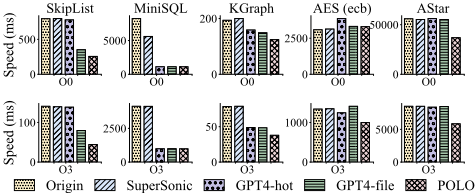
Supersonic [Chen et al., 2024]: It uses a Seq2Seq model trained on pre- and post-optimization C/C++ code. Its training data is crawled from platforms like Codeforces, AIZU, and AtCoder. GPT4-hot: we use the more advanced GPT-4 Turbo [Achiam et al., 2023], and send only the hotspot to the model as the prompt. GPT4-file: We provide the entire C++ file without explicitly marking the hotspot function to the GPT-4 Turbo. Notably, sending the hotspot for optimization to GPT-4 is a widely adopted baseline in this field, as seen in [Chen et al., 2024; Garg et al., 2023].
| O0 | O3 | ||||||
|---|---|---|---|---|---|---|---|
| Projects | Origin (ms) | Optimized (ms) | PI (%) | Origin (ms) | Optimized (ms) | PI (%) | |
| SkipList | 794.6 | 255.5 | 3.11× | 140.7 | 44.1 | 3.19× | |
| Quant | 671.9 | 30.9 | 21.7× | 178.7 | 8.3 | 21.5× | |
| AStar | 55925.2 | 36853 | 1.52× | 8527.6 | 5844.6 | 1.46× | |
| MiniSQL | 8260 | 1107.8 | 7.45× | 4133.8 | 977.6 | 4.23× | |
| KGraph | Audio | 193.6 | 124.3 | 1.56× | 78.5 | 37.8 | 2.08× |
| Sift1M | 38671.8 | 28422.2 | 1.36× | 14222.5 | 9096.5 | 1.56× | |
| ECB | 3083.3 | 3298.1 | 0.93× | 1336.6 | 996.9 | 1.34× | |
| AES | CBC | 3136.7 | 3330.0 | 0.94× | 1323.7 | 989.0 | 1.34× |
| CTR | 3141.1 | 3340.1 | 0.94× | 1326.1 | 989.8 | 1.34× | |
The results are shown in Fig. 6. Due to the simplicity of Quant's changes (Appendix B.1), the baseline's optimized code matches POLO's and is omitted from the figure. Our method consistently outperforms all baselines. Notably, Supersonic demonstrates minimal optimization across most projects, with only minor changes (e.g., adding #pragma GCC optimize("unroll-loops")) and no substantial function-level modifications. This limitation may stem from its training data, which is from Online Judge platforms, making it less suited for project-level optimizations. GPT4-hot can optimize function-level logic, but it becomes ineffective for project like SkipList, which require cross-function modifications. GPT4-file shows improvements in specific cases, especially when the hotspot and its context are within the same file, but it is limited for project like AStar, which require cross-file modifications.
4.4 RQ3: Ablation Study
Effect of multi-agent: Our framework relies on multi-round interactions between two agents to optimize the program. As shown in Table 5, we break down each individual optimization step and provide a detailed discussion of the changes. In the Quant project, significant optimization is achieved in the first round, and the optimized code is already highly efficient. Consequently, the Decision Agent opts to terminate the optimization process early. The MiniSQL project also achieved substantial optimization results in the first round, with only marginal improvements in the second round compared to the first. For all other projects, multiple rounds of optimization yield further improvements. In the second round of interactions, substantial gains are observed for SkipList and AES. During the third round, although execution times improve under O0, performance under O3 declines. This is due to optimizations in these projects, such as inlining caller functions, which underperform compared to the compiler's native inlining strategies. The Decision Agent identifies this slowdown and rejects the optimization attempt. For AStar and KGraph, optimal results are achieved after the third round of interaction. Throughout multi-round optimization, an interesting pattern emerges: during the initial rounds, the LLM focuses on optimizing the internal logic of the hotspot. Afterwards, it gradually adopts a more global perspective, performing crossfunction changes or utilizing more advanced instruction sets.
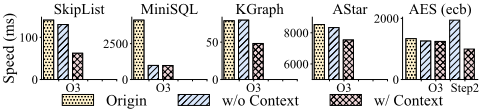
Effect of context: In Sec. 3.3, we synthesize neighboring nodes of the hotspot in the PSG to create a prompt. To evaluate the impact of context nodes, we compare two methods: one with ("w/ context") and one without the context ("w/o context") information. For a controlled comparison, we apply a single round of optimization, omitting the multi-round agent interactions. As shown in Fig. 7, "w/ context" performs similarly or better than the "w/o context" method. For intrafunction optimizations like Quant and AES, the context-aware advantage is minimal, while for cross-function optimizations like SkipList and AStar, it significantly outperforms the "w/o context" method. In the AES project, both the "w/ context" and "w/o context" versions produce nearly identical optimized code after the initial optimization. To further refine both versions, we apply the multi-round agent strategy. The results are indicated by the Step 2 marker. Following this additional optimization, analysis reveals that the context-aware method achieves improvement by utilizing external function.
Our framework offers three key benefits: (1) Multi-agent and multi-round interactions enable more advanced optimization strategies, and (2) Decision Agent-environment interaction evaluates optimization effectiveness based on program feedback. (3) Context information is crucial for LLMs to
| O0 (ms) | O3 (ms) | ||||||||
|---|---|---|---|---|---|---|---|---|---|
| Projects | Step 0 | Step 1 | Step 2 | Step 3 | Step 0 | Step 1 | Step 2 | Step 3 | |
| SkipList | 794.63 | 508.73 | 255.54 | 226.13 | 140.67 | 62.23 | 44.13 | 50.69 | |
| Quant | 671.90 | 30.97 | - | - | 178.70 | 8.31 | - | - | |
| AStar | 55925.2 | 49189 | 43573.4 | 36853 | 8527.6 | 7536 | 7203.4 | 5844.6 | |
| MiniSQL | 8260 | 1112.8 | 1107.8 | 1115 | 4133.8 | 989.8 | 977.6 | 985.4 | |
| KGraph | Audio | 193.6 | 174.02 | 125.36 | 124.25 | 78.5 | 48.2 | 38.79 | 37.80 |
| Sift1M | 38671.8 | 34622.4 | 28540.92 | 28422.2 | 14222.5 | 9835.45 | 9352.83 | 9096.51 | |
| ECB | 3083.29 | 3813.72 | 3298.06 | 2759.26 | 1336.59 | 1245.92 | 996.87 | 1110.29 | |
| AES | CBC | 3136.65 | 3859.24 | 3330.01 | 2758.77 | 1323.74 | 1229.13 | 989.04 | 1092.31 |
| CTR | 3141.04 | 3870.70 | 3340.12 | 2782.09 | 1326.12 | 1236.10 | 989.81 | 1091.39 | |
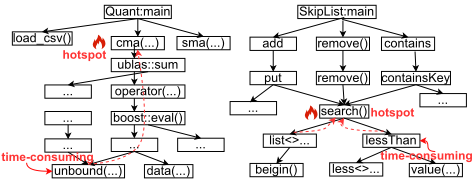
void SkipList<>::searchſconst K &value, std::list<Node *> &prevListƀ { int h = head _ ->height-1; forſNode *p=head _;p!=nullptr;p=p->next[h]ƀ{ ifſlessThanſvalue,pƀƀ{ p = p->prev[h]; prevList.push _ frontſpƀ; h--; ifſh<0ƀ break; } } } std::optional<V> SkipList<>::putſ...ƀ { std::list<Node*> list; searchſkey, listƀ; ... // Details omitted }void SkipList<>::searchſconst K &value, std::vector<Node *> &prevListƀ { int h = head _ ->height - 1; Node *p = head _; prevList.resizeſhead _ ->height, nullptrƀ; while ſh >= 0ƀ { while ſp->next[h] != nullptr && !lessThanſvalue, p->next[h] ƀƀ { p = p->next[h]; } prevList[h] = p; h--; } } std::optional<V> SkipList<>::putſ...ƀ { std::vector<Node*> list; ... // Remains the same }devise comprehensive project-level optimization strategies. Effect of hotspot detection: We use Quant and SkipList as case studies to demonstrate the effectiveness of Func Rank in identifying true hotspot functions. The key question we address is whether Func Rank outperforms a naive baseline that simply selects the most time-consuming function as the hotspot. As shown in Fig. 8, the function with the longest execution time often lies on the call path to the actual hotspot, but is not the hotspot itself. In contrast, our approach analyzes the full call chain to accurately localize the true bottleneck.
4.5 RQ4: Case Study
This section illustrates how POLO optimizes projects step by step, complementing quantitative results with processlevel insights. For additional case studies, please see the Appendix B.1.
SkipList: Fig. 9 shows the optimization in SkipList. In Step 1, we replace std::list with std::vector, as the latter's contiguous memory allocation improves cache locality, reducing cache misses. Modern processors' prefetching mechanisms further enhance cache hit rates. The internal loop logic is also optimized. In Step 2, due to the high frequency of calls to put and get, the cumulative cost of repeatedly allocating and deallocating memory for the temporary std::vector<Node*> becomes a performance bottleneck. By declaring the vector as static thread local, memory is allocated only once and reused across function calls, effectively eliminating unnecessary allocation overhead.
AStar: Fig. 14 (see Appendix B.1) shows that the initial code frequently allocates and deallocates memory with each call to getNeighbors, as it creates a new std::vector to retrieve neighboring nodes for movement cost calculations. In Step 1, the function is modified to use a fixed-size array, returning only the count of valid neighbors, thus eliminating dynamic memory overhead and improving performance. Further optimizations include preallocating space in the unordered map using reserve to reduce resizing costs, encapsulating priority queue operations in lambda functions for modularity, and inlining getNeighbors to decrease function call overhead. We use objdump disassembly tool to confirm that the previous code does not inline this function even under O3 optimization, demonstrating the effectiveness of the manual inlining.
5 Conclusion
We present POLO, a novel framework for project-level program optimization. It identifies performance bottlenecks through dynamic analysis and a finite state machine that constructs the program call graph, followed by a function ranking algorithm to locate hotspots. Comprehensive static analysis extracts contextual information around these key elements. Subsequently, we propose a collaborative multi-agent method, where specialized agents interact over multiple rounds to iteratively improve performance based on feedback. Experiments on real-world projects demonstrate that POLO achieves significant speedups, even on top of the -O3 optimization level.
void SkipList<>::searchſconst K &value, std::vector<Node *> &prevListƀ { ... // Remains the same } std::optional<V> SkipList<>::putſ...ƀ { static thread _ local std::vector<Node*> list; ... // Remains the same } std::optional<V> SkipList<>::getſ...ƀ { static thread _ local std::vector<Node*> list; ... // Remains the same } bool SkipList<>::removeſ...ƀ { static thread _ local std::vector<Node*> list; ... // Remains the same }Acknowledgments
This work has been supported by Zhejiang Province "Jianbing" Key R&D Project of China (No.2025C01010).
@inproceedings{ijcai2025p814,
  title     = {POLO: An LLM-Powered Project-Level Code Performance Optimization Framework},
  author    = {Bai, Jiameng and Xu, Ruoyi and Wu, Sai and Yang, Dingyu and Zhao, Junbo and Chen, Gang},
  booktitle = {Proceedings of the Thirty-Fourth International Joint Conference on
               Artificial Intelligence, {IJCAI-25}},
  publisher = {International Joint Conferences on Artificial Intelligence Organization},
  editor    = {James Kwok},
  pages     = {7319--7328},
  year      = {2025},
  month     = {8},
  note      = {Main Track},
  doi       = {10.24963/ijcai.2025/814},
  url       = {https://doi.org/10.24963/ijcai.2025/814},
}
TY - CPAPER TI - POLO: An LLM-Powered Project-Level Code Performance Optimization Framework AU - Bai, Jiameng AU - Xu, Ruoyi AU - Wu, Sai AU - Yang, Dingyu AU - Zhao, Junbo AU - Chen, Gang T2 - Proceedings of the Thirty-Fourth International Joint Conference on Artificial Intelligence, IJCAI-25 PB - International Joint Conferences on Artificial Intelligence Organization PY - 2025 SP - 7319 EP - 7328 DO - 10.24963/ijcai.2025/814 UR - https://doi.org/10.24963/ijcai.2025/814 ER -Copied
Machine-readable versions of this paper, for tools and AI agents:





