
Multi-View Learning with Context-Guided Receptance for Image Denoising
Proceedings of the Thirty-Fourth International Joint Conference on Artificial Intelligence. Main Track. Pages 765-773.
https://doi.org/10.24963/ijcai.2025/86
Keywords
- Computer Vision: CV: Structural and model-based approaches, knowledge representation and reasoning
- Computer Vision: CV: Machine learning for vision
- Computer Vision: CV: Low-level Vision
- Computer Vision: CV: Representation learning
Abstract
Image denoising is essential in low-level vision applications such as photography and automated driving. Existing methods struggle with distinguishing complex noise patterns in real-world scenes and consume significant computational resources due to reliance on Transformer-based models. In this work, the Context-guided Receptance Weighted Key-Value (CRWKV) model is proposed, combining enhanced multi-view feature integration with efficient sequence modeling. The Context-guided Token Shift (CTS) mechanism is introduced to effectively capture local spatial dependencies and enhance the model's ability to model real-world noise distributions. Also, the Frequency Mix (FMix) module extracting frequency-domain features is designed to isolate noise in high-frequency spectra, and is integrated with spatial representations through a multi-view learning process. To improve computational efficiency, the Bidirectional WKV (BiWKV) mechanism is adopted, enabling full pixel-sequence interaction with linear complexity while overcoming the causal selection constraints. The model is validated on multiple real-world image denoising datasets, outperforming the state-of-the-art methods quantitatively and reducing inference time up to 40%. Qualitative results further demonstrate the ability of our model to restore fine details in various scenes. The code is publicly available at https://github.com/Seeker98/CRWKV.
- [Abdelhamed et al., 2018] Abdelrahman Abdelhamed, Stephen Lin, and Michael S Brown. A high-quality denoising dataset for smartphone cameras. In Proceedings of the IEEE conference on computer vision and pattern recognition, pages 1692-1700, 2018.
- [Cai et al., 2023] Han Cai, Junyan Li, Muyan Hu, Chuang Gan, and Song Han. Efficientvit: Lightweight multi-scale attention for high-resolution dense prediction. In Proceed- ings of the IEEE/CVF international conference on com- puter vision, pages 17302-17313, 2023.
- [Chen et al., 2021] Hanting Chen, Yunhe Wang, Tianyu Guo, Chang Xu, Yiping Deng, Zhenhua Liu, Siwei Ma, Chunjing Xu, Chao Xu, and Wen Gao. Pre-trained image processing transformer. In 2021 IEEE/CVF Conference on Computer Vision and Pattern Recognition (CVPR), pages 12294-12305. IEEE Computer Society, 2021.
- [Dabov et al., 2007] Kostadin Dabov, Alessandro Foi, Vladimir Katkovnik, and Karen Egiazarian. Image denoising by sparse 3-d transform-domain collaborative filtering. IEEE Transactions on image processing, 16(8):2080-2095, 2007.
- [Dao and Gu, 2024] Tri Dao and Albert Gu. Transformers are ssms: Generalized models and efficient algorithms through structured state space duality. arXiv preprint arXiv:2405.21060, 2024.
- [Ding et al., 2022] Xiaohan Ding, Xiangyu Zhang, Jungong Han, and Guiguang Ding. Scaling up your kernels to 31x31: Revisiting large kernel design in cnns. In Pro- ceedings of the IEEE/CVF conference on computer vision and pattern recognition, pages 11963-11975, 2022.
- [Dosovitskiy et al., 2020] Alexey Dosovitskiy, Lucas Beyer, Alexander Kolesnikov, Dirk Weissenborn, Xiaohua Zhai, Thomas Unterthiner, Mostafa Dehghani, Matthias Min- derer, Georg Heigold, Sylvain Gelly, et al. An image is worth 16x16 words: Transformers for image recognition at scale. arXiv preprint arXiv:2010.11929, 2020.
- [Duan et al., 2024] Yuchen Duan, Weiyun Wang, Zhe Chen, Xizhou Zhu, Lewei Lu, Tong Lu, Yu Qiao, Hongsheng Li, Jifeng Dai, and Wenhai Wang. Vision-rwkv: Effi- cient and scalable visual perception with rwkv-like archi- tectures. arXiv preprint arXiv:2403.02308, 2024.
- [Fei et al., 2024] Zhengcong Fei, Mingyuan Fan, Changqian Yu, Debang Li, and Junshi Huang. Diffusion-rwkv: Scal- ing rwkv-like architectures for diffusion models. arXiv preprint arXiv:2404.04478, 2024.
- [Guo et al., 2019] Shi Guo, Zifei Yan, Kai Zhang, Wang- meng Zuo, and Lei Zhang. Toward convolutional blind denoising of real photographs. In Proceedings of the IEEE/CVF conference on computer vision and pattern recognition, pages 1712-1722, 2019.
- [Guo et al., 2025] Hang Guo, Jinmin Li, Tao Dai, Zhihao Ouyang, Xudong Ren, and Shu-Tao Xia. Mambair: A sim- ple baseline for image restoration with state-space model. In European conference on computer vision, pages 222- 241. Springer, 2025.
- [He et al., 2010] Kaiming He, Jian Sun, and Xiaoou Tang. Single image haze removal using dark channel prior. IEEE transactions on pattern analysis and machine intelligence, 33(12):2341-2353, 2010.
- [Huang et al., 2015] Jia-Bin Huang, Abhishek Singh, and Narendra Ahuja. Single image super-resolution from transformed self-exemplars. In Proceedings of the IEEE conference on computer vision and pattern recognition, pages 5197-5206, 2015.
- [Jin et al., 2024] Yanliang Jin, Yifan Wu, Yuan Gao, Shun- qing Zhang, Shugong Xu, and Cheng-Xiang Wang. Lin- former: A linear-based lightweight transformer archi- tecture for time-aware mimo channel prediction. arXiv preprint arXiv:2410.21351, 2024.
- [Krull et al., 2019] Alexander Krull, Tim-Oliver Buchholz, and Florian Jug. Noise2void-learning denoising from sin- gle noisy images. In Proceedings of the IEEE/CVF con- ference on computer vision and pattern recognition, pages 2129-2137, 2019.
- [Laghrib and Afraites, 2024] Amine Laghrib and Lekbir Afraites. Image denoising based on a variable spatially ex- ponent pde. Applied and Computational Harmonic Anal- ysis, 68:101608, 2024.
- [Lee et al., 2022] Wooseok Lee, Sanghyun Son, and Ky- oung Mu Lee. Ap-bsn: Self-supervised denoising for real-world images via asymmetric pd and blind-spot net- work. In Proceedings of the IEEE/CVF Conference on Computer Vision and Pattern Recognition, pages 17725- 17734, 2022.
- [Liang et al., 2021] Jingyun Liang, Jiezhang Cao, Guolei Sun, Kai Zhang, Luc Van Gool, and Radu Timofte. Swinir: Image restoration using swin transformer. In Proceedings of the IEEE/CVF international conference on computer vi- sion, pages 1833-1844, 2021.
- [Liu et al., 2024] Yue Liu, Yunjie Tian, Yuzhong Zhao, Hongtian Yu, Lingxi Xie, Yaowei Wang, Qixiang Ye, and Yunfan Liu. Vmamba: Visual state space model. arXiv preprint arXiv:2401.10166, 2024.
- [Nam et al., 2016] Seonghyeon Nam, Youngbae Hwang, Ya- suyuki Matsushita, and Seon Joo Kim. A holistic approach to cross-channel image noise modeling and its application to image denoising. In Proceedings of the IEEE confer- ence on computer vision and pattern recognition, pages 1683-1691, 2016.
- [Peng et al., 2023] Bo Peng, Eric Alcaide, Quentin An- thony, Alon Albalak, Samuel Arcadinho, Stella Biderman, Huanqi Cao, Xin Cheng, Michael Chung, Matteo Grella, et al. Rwkv: Reinventing rnns for the transformer era. arXiv preprint arXiv:2305.13048, 2023.
- [Ronneberger et al., 2015] Olaf Ronneberger, Philipp Fis- cher, and Thomas Brox. U-net: Convolutional networks for biomedical image segmentation. In Medical Image Computing and Computer-Assisted Intervention-MICCAI 2015: 18th International Conference, Munich, Germany, October 5-9, 2015, Proceedings, Part III 18, pages 234- 241. Springer, 2015.
- [Wang et al., 2018] Xiaolong Wang, Ross Girshick, Abhinav Gupta, and Kaiming He. Non-local neural networks. In Proceedings of the IEEE conference on computer vision and pattern recognition, pages 7794-7803, 2018.
- [Wang et al., 2022a] Zejin Wang, Jiazheng Liu, Guoqing Li, and Hua Han. Blind2unblind: Self-supervised image de- noising with visible blind spots. In Proceedings of the IEEE/CVF conference on computer vision and pattern recognition, pages 2027-2036, 2022.
- [Wang et al., 2022b] Zhendong Wang, Xiaodong Cun, Jian- min Bao, Wengang Zhou, Jianzhuang Liu, and Houqiang Li. Uformer: A general u-shaped transformer for image restoration. In Proceedings of the IEEE/CVF conference on computer vision and pattern recognition, pages 17683- 17693, 2022.
- [Wang et al., 2023] Zichun Wang, Ying Fu, Ji Liu, and Yu- lun Zhang. Lg-bpn: Local and global blind-patch network for self-supervised real-world denoising. In Proceedings of the IEEE/CVF Conference on Computer Vision and Pat- tern Recognition, pages 18156-18165, 2023.
- [Xiao et al., 2023] Jie Xiao, Xueyang Fu, Man Zhou, Hongjian Liu, and Zheng-Jun Zha. Random shuffle trans- former for image restoration. In International Conference on Machine Learning, pages 38039-38058. PMLR, 2023.
- [Xu et al., 2018] Jun Xu, Hui Li, Zhetong Liang, David Zhang, and Lei Zhang. Real-world noisy image denois- ing: A new benchmark. arXiv preprint arXiv:1804.02603, 2018.
- [Yang et al., 2024] Zhiwen Yang, Hui Zhang, Dan Zhao, Bingzheng Wei, and Yan Xu. Restore-rwkv: Efficient and effective medical image restoration with rwkv. arXiv preprint arXiv:2407.11087, 2024.
- [Zamir et al., 2022] Syed Waqas Zamir, Aditya Arora, Salman Khan, Munawar Hayat, Fahad Shahbaz Khan, and Ming-Hsuan Yang. Restormer: Efficient transformer for high-resolution image restoration. In Proceedings of the IEEE/CVF conference on computer vision and pattern recognition, pages 5728-5739, 2022.
- [Zhai et al., 2021] Shuangfei Zhai, Walter Talbott, Nitish Srivastava, Chen Huang, Hanlin Goh, Ruixiang Zhang, and Josh Susskind. An attention free transformer. arXiv preprint arXiv:2105.14103, 2021.
- [Zhang et al., 2017] Kai Zhang, Wangmeng Zuo, Yunjin Chen, Deyu Meng, and Lei Zhang. Beyond a gaussian de- noiser: Residual learning of deep cnn for image denoising. IEEE transactions on image processing, 26(7):3142-3155, 2017.
- [Zhang et al., 2023] Kai Zhang, Yawei Li, Jingyun Liang, Jiezhang Cao, Yulun Zhang, Hao Tang, Deng-Ping Fan, Radu Timofte, and Luc Van Gool. Practical blind image denoising via swin-conv-unet and data synthesis. Machine Intelligence Research, 20(6):822-836, 2023.
- [Zheng et al., 2019] Yu-Bang Zheng, Ting-Zhu Huang, Xi- Le Zhao, Tai-Xiang Jiang, Tian-Hui Ma, and Teng-Yu Ji. Mixed noise removal in hyperspectral image via low- fibered-rank regularization. IEEE Transactions on Geo- science and Remote Sensing, 58(1):734-749, 2019.
- [Zhou and Chen, 2024] Xudong Zhou and Tianxiang Chen. Bsbp-rwkv: Background suppression with boundary preservation for efficient medical image segmentation. In Proceedings of the 32nd ACM International Conference on Multimedia, pages 4938-4946, 2024.
- [Zhou et al., 2020] Yuqian Zhou, Jianbo Jiao, Haibin Huang, Yang Wang, Jue Wang, Honghui Shi, and Thomas Huang. When awgn-based denoiser meets real noises. In Proceed- ings of the AAAI Conference on Artificial Intelligence, vol- ume 34, pages 13074-13081, 2020.
- [Zhu et al., 2024] Lianghui Zhu, Bencheng Liao, Qian Zhang, Xinlong Wang, Wenyu Liu, and Xinggang Wang. Vision mamba: Efficient visual representation learning with bidirectional state space model. arXiv preprint arXiv:2401.09417, 2024.
References were extracted automatically from the PDF and may contain errors.
Full text extracted automatically from the PDF; figures, tables and equations may differ. The PDF is the version of record.
1 Introduction
Images captured in real-world scenes are commonly influenced by noise from a mixture of sources, including optical sensing limitations and electronic functional failures, making image denoising an essential topic in low-level computer vision. Failing to effectively remove noise can significantly reduce the performance of subsequent high-level tasks or scenes. For instance, this may affect content extracted from a low-light, noisy document capture or identification of pedestrians in adverse weather conditions for vision-based
∗Corresponding author.
(a) Selected visual result
(b) Model complexity comparison
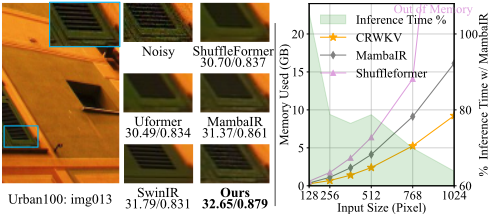
Figure 1: Comparison of existing image denoising methods. (a) Visual results on Urban100 dataset: our method preserves fine details under complex noise pattern, while others suffer from information losses or artifacts. (b) Computational complexity across input scales for Transformer- and state space-based models.
autonomous driving systems. Furthermore, recent advancements in computational resources and specialized hardware such as image signal processors (ISPs), combined with the inherent limitations of optical systems, create a timely opportunity to advance denoising methods further.
Various foundational architectures have emerged, combining classical image processing principles with recent deep learning advances, which include convolutional neural networks (CNNs) [Zhang et al., 2017], Transformers [Chen et al., 2021], Mambas [Zhu et al., 2024], and Receptance Weighted Key Values (RWKVs) [Peng et al., 2023]. CNNs, often considered as an evolution of classical methods utilizing hand-crafted priors [Zheng et al., 2019; Laghrib and Afraites, 2024; He et al., 2010], remain their core idea of local window filtering. Despite advanced techniques such as non-local operations [Wang et al., 2018], large kernels [Ding et al., 2022], and architectures like U-Net [Ronneberger et al., 2015], CNNs struggle with oversmoothing in complex scenes and fail to handle distant information. Transformers and Mambas introduce global modeling through self-attention (SA) mechanisms [Dosovitskiy et al., 2020] and state space models [Zhu et al., 2024; Liu et al., 2024], respectively. While these approaches achieve the state-of-the-art (SOTA) performance, they encounter challenges such as quadratic computational complexity in Transformers and causal-style dependencies in Mambas. Alternative approaches [Jin et al., 2024] tried to tackle these problems, but still lead to inconsistent modeling in local regions.
Reviewing prior work reveals two main issues: featurelevel design and effective model architecture development. Consider a scenario where a single convolution layer efficiently reduces noise in detailed regions but struggles in flat areas, leaving residual noise. In such cases, the highfrequency components, often dominated by noise in flat regions, require attenuation rather than selective enhancement. In addition, image information is spatially distributed across all directions. However, causal-style token mixing, where information is derived only from past tokens, introduces asymmetry in both weighting and positioning. While this lack of symmetry may have minimal impact in natural language processing (NLP), it poses a significant challenge in image feature representation, where spatial symmetry is essential for accurate reconstruction and effective denoising.
In this study, we propose Context-guided Receptance Weighted Key-Value (CRWKV), a novel model that addresses challenges in noise modeling and computational efficiency mentioned above. Our model provides superior realworld image denoising performance within limited resources, and the main contributions are as follows:
- We propose CRWKV, a novel model for image denoising that integrates a multi-view learning approach. Our design enhances the RWKV model by introducing the BiWKV mechanism, enabling full pixel-sequence computation superior to causal-style selection with linear complexity relative to sequence length.
- We introduce CTS mechanism to effectively model local noise correlations in image. Besides, we propose FMix module to selectively process frequency-domain information and attenuate noise. They together significantly improve denoising performance.
- Comprehensive experiments on real-world image denoising datasets demonstrate that CRWKV consistently outperforms SOTA methods. Its strong generalization ability is validated through testing on multiple unseen datasets, showcasing its efficiency and effectiveness for practical denoising applications.
2 RelatedWorks
2.1 Real-world Image Denoising
Image denoising is a fundamental problem in image processing, with applications ranging from photography to medical imaging. Classical methods, such as BM3D [Dabov et al., 2007], rely on hand-crafted priors and assumptions about noise characteristics, achieving good results in controlled scenarios but struggle with complex noise patterns. With advancements in deep learning, modern approaches like DnCNN [Zhang et al., 2017] have emerged, focusing primarily on removing Additive White Gaussian Noise (AWGN). While effective for synthetic noise, these methods face significant challenges when applied to real-world noise, which is far more complex than AWGN due to spatial correlation, intensity variation, and limited paired data.
To address these issues, various methods have been proposed. Some rethink the imaging and noise generation processes, as seen in CBDNet and SCUNet [Guo et al., 2019; Zhang et al., 2023], while others adopt self-supervised pixel reconstruction techniques using blind-spot networks [Krull et al., 2019; Lee et al., 2022]. Additionally, Gaussian denoisers have been adapted for real-world denoising by performing noise pattern corruption with shuffling techniques in advance [Zhou et al., 2020; Xiao et al., 2023]. Recent works have also explored novel image restoration architectures. For instance, MambaIR [Guo et al., 2025] leverages state space modeling, while Restormer [Zamir et al., 2022] incorporates windowed self-attention, both demonstrating notable improvements in real-world image denoising. Despite these advancements, limited attention has been given to integrating noise-specific priors into modern architectures while achieving a balance between computational efficiency and restoration quality.
2.2 RWKVModels
RWKV [Peng et al., 2023] was proposed as an efficient alternative to Transformers for NLP, particularly in Large Language Models (LLMs). RWKV introduces two main innovations: token shifting and WKV computation. By incorporating token shifts in the preceding direction and concatenating shifted and non-shifted channels, the model can separate two tasks-predicting the next token, and accumulating and passing information from previous tokens. The WKV computation improves upon the Attention-Free Transformer [Zhai et al., 2021] by employing trainable distance factors and enhanced integration of the current token to model token weights more precisely. Additionally, it adopts an equivalent recurrent form for efficient inference. These features position RWKV as a strong competitor to CNNs and Transformers.
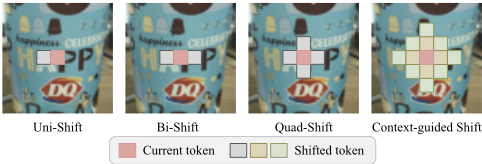
Recent studies, such as Vision-RWKV [Duan et al., 2024], have showed the potential of RWKV-based models as vision backbones [Fei et al., 2024; Zhou and Chen, 2024]. Two major improvements have been developed to adapt RWKV for vision tasks: quad-shift, a token-shifting strategy on 2D planes, and Bi-WKV, an attention mechanism with absolute positional bias to align with the symmetric nature of images. While promising efforts like Restore-RWKV [Yang et al., 2024] have emerged, targeting all-in-one medical image restoration with Re-WKV and omni-shift, there remains limited exploration of how RWKV-based models can enhance performance in low-level vision tasks, such as real-world image denoising.
3 Methodology
In this section, the details of our proposed model CRWKV will be introduced. We will start with the model overview and gradually analyze the structure of CRB and FMix designed specifically for real-world noise modeling.
3.1 Overall Architecture
As illustrated in Figure 2, the proposed CRWKV model adopts a U-shaped hierarchical structure with long-skip connections to effectively capture both local and global features. For a noisy input image x ∈ RH×W×3 , a 3 × 3 convolution is first applied to extract low-level features. The resulting feature map is then processed through four distinct stages of encoders and decoders following the U-shaped structure. After this process, the refined features are passed through a final projection layer to reconstruct the denoised output image.
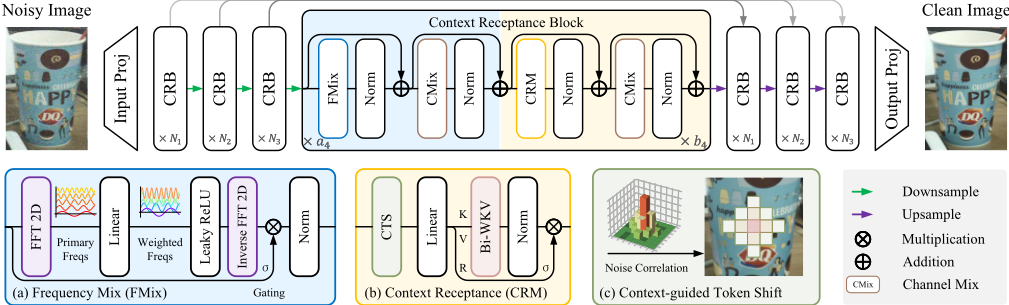
Each encoder and decoder stage contains Nk Context Receptance Blocks (CRBs). Each CRB consists of two types of modules for multi-view learning: ak Frequency Mix (FMix) Modules and bk Context Receptance Modules (CRMs), such that ak + bk = Nk for k = 1, 2, 3, 4. The computation in a single CRB can be expressed as:
and
where x and y denote the input and output features, respectively. The Channel Mix (CMix) module is computed as follows:
where CTS(·) represents the Context-guided Token Shift mechanism, further detailed in Section 3.2.
3.2 Context Receptance Module
Algorithm 1 Context-guided Token Shift
Input: input x, offset dictionary D, learnable weight ω
Parameter: channel C
Output: shifted output CTS(x)
- 1: Let psum = 0, c = 0, o = zeros(x.shape)
- 2: for offset p in D do
- 3: calculate p's Manhattan distance dp = dm(p, 0)
- 4: calculate offset p's weight wp = 1/dp
- 5: psum += wp
- 6: end for
- 7: calculate channel expansion factor k = C/psum
- 8: for offset p in D do
- 9: fill o w/ shifted x: o[c : c+k ·wp] = xp[c : c+k ·wp]
- 10: c = c +k · wp
- 11: end for
- 12: return CTS(x) = ω · o + (1 -ω) · x
Context-guided Token Shift. The shifting operations in the mixing processes enable selective accumulation of information from previous tokens to the current token. Unlike NLP problems, pixels in an image often exhibit correlations with their neighbors in a centrosymmetric manner. Realworld noise, in particular, correlate with a specific neighborhood structure. Therefore, it is essential to identify this neighborhood shape to ensure that all significant pixels are fully considered while avoiding shifts over excessively large areas, which may introduce extra complexity in the implementation and reduce efficiency.
To address this issue, we propose a CTS mechanism, which assigns predefined weights to the most correlated pixels, as illustrated in Figure 2(c), and a visual comparison with existing token shift methods is provided in Figure 3. The colored masks in the figure depict individual pixels rather than image patches. Starting with the red central pixel, a context-guided region is defined as the equivalent reception field. This region aligns with the specific neighborhood identified in [Wang et al., 2023] through Pearson's correlation analysis, which highlights the most correlated pixels with the central noise. The detailed algorithm of CTS is presented in Algorithm 1.
| Characteristics | Vanilla Attention | WindowAttention | Linear Attention | State Space Model | BiWKV |
|---|---|---|---|---|---|
| Operator Type Inductive Bias Token Mixer Token Type Local Interaction Global Interaction Complexity | SA - Dense Patch (typ.) - Direct Quadratic | SA Locality Blockwise sense Patch (typ.) Shifting window Arch-specific Quadratic to win size | Linearized SA Low-rank (LR) approx. Lower-triangle (LT) Patch (typ.) - Kernel-dependent Linear | Selective scan Causality LT, blockwise LR Pixel (typ.) Scan strategy Hidden state Linear | Attention-free Spatial symmetry Almost dense Pixel (typ.) Token shifting Recurrent state Linear |
Bidirectional WKV operation. Unlike the self-attention mechanism, BiWKV operation employs a token-shift operation to achieve a weighted fusion of the feature map with its context-guided shifted version, generated using the CTS operation. The fused feature map, denoted as CTS(x), is then used to produce r1, k1, and v1 through three linear projection layers:
where Wr, Wk, and Wv are the weight matrices of the respective linear projection layers. Among these, k1 and v1 are utilized for the BiWKV computation, while r1 serves as a gating mechanism after passing through a sigmoid activation function. The output of a single CRM block is computed as:
where σ represents the sigmoid function and ⊙ is the Hadamard element-wise product. Denote the relative position bias between the t-th and i-th token as:
the computation of the BiWKV operation is given as follows:
where T represents the length of the processed sequence, k1,i and v1,i correspond to the i-th token of k1 and v1, respectively, and u is a learnable parameter representing bonus of the current token. The absolute valued design in bt,i ensures that tokens equidistant from the current token in both forward and backward directions are weighted equally, preserving the spatial symmetry of image planes. Overall, the BiWKV operation computes a weighted sum of all tokens in v1 along the token dimension. The weights are determined by a combination of symmetric relative position bias, the vector k1, and the current token bonus controlled by the parameter u.
To justify the BiWKV operation for real-world image denoising, we compare it to several attention mechanisms and sequence models relevant to low-level vision. These include the vanilla attention [Dosovitskiy et al., 2020], window attention [Liang et al., 2021], linear attention [Cai et al., 2023], state space model [Guo et al., 2025], and BiWKV. Table 1 summarizes a detailed comparison of these operations, focusing on key characteristics. Specifically, the 'Token Mixer' row in the table reflects the shape of L in the following equation, based on the structured masked attention framework [Dao and Gu, 2024]:
3.3 FrequencyMixModule
Real-world images often contain spatially correlated noise, which complicates detail-rich areas. This noise spreads information across all frequencies, causing overlap in highfrequency components and resulting in either over-smoothing or incomplete noise removal.
To address this issue, we propose the FMix module, illustrated in Figure 2(a), designed to extract detailed frequency representations from high-level features using FFT. Given a feature map x ∈ Rh×w×c , a 2D FFT is applied:
The extracted frequencies are linearly weighted, followed by activation with Leaky ReLU. The weighted frequencies are then passed through an inverse FFT (iFFT) to return to the spatial domain. The resulting feature map is combined with the input via an element-wise product and normalized to produce the filtered feature map:
3.4 Loss Function
The proposed CRWKV model is trained by minimizing the L1 loss, which can be written as follows:
where x∗ is the ground truth and y is the model output. The L1 loss is capable of retaining fine details such as edges and textures with its linear penalty that other losses such as L2 may smooth out, ensuring robustness to outliers and accurate reconstruction of the denoised image.
4 Experiments
4.1 Experiment Setup
Datasets and metrics. We use the SIDD dataset [Abdelhamed et al., 2018], consisting of 320 real-world images, as the primary training set. From each high-resolution image (256 × 256), we crop 300 non-overlapping slices, generating a total of 96,000 training samples. For testing, we evaluate on the SIDD, ccnoise [Nam et al., 2016], and PolyU [Xu et al., 2018] datasets, all containing realistic noise. Additionally, we create a synthetic dataset, Urban100GP, by introducing mixed Additive White Gaussian Noise (AWGN) with σ = 10 and Poisson noise to Urban100 [Huang et al., 2015] to simulate real-world noise. To quantify model performance, we use Peak Signal-to-Noise Ratio (PSNR) and Structural Similarity Index Measure (SSIM) as evaluation metrics.
| Methods | Params (M) | SIDD | ccnoise | PolyU | Urban100GP | ||||
|---|---|---|---|---|---|---|---|---|---|
| ↑PSNR | ↑SSIM | ↑PSNR | ↑SSIM | ↑PSNR | ↑SSIM | ↑PSNR | ↑SSIM | ||
| BM3D [Dabov et al., 2007] | - | 29.97 | 0.679 | 36.15 | 0.947 | 37.40 | 0.957 | 25.02 | 0.813 |
| AP-BSN [Lee et al., 2022] | 3.10 | 36.74 | 0.889 | 33.30 | 0.918 | 36.46 | 0.947 | 24.25 | 0.716 |
| B2U [Wang et al., 2022a] | 1.96 | 32.37 | 0.727 | 35.72 | 0.938 | 35.71 | 0.947 | 27.39 | 0.847 |
| DnCNN [Zhang et al., 2017] | 0.56 | 26.21 | 0.604 | 33.88 | 0.959 | 36.11 | 0.960 | 24.20 | 0.866 |
| SwinIR [Liang et al., 2021] | 11.75 | 33.70 | 0.864 | 35.26 | 0.978 | 37.14 | 0.977 | 28.21 | 0.896 |
| Uformer [Wang et al., 2022b] | 50.88 | 39.68 | 0.958 | 36.02 | 0.979 | 37.48 | 0.979 | 26.88 | 0.885 |
| ShuffleFormer [Xiao et al., 2023] | 50.53 | 39.60 | 0.958 | 35.88 | 0.978 | 37.50 | 0.979 | 27.89 | 0.900 |
| Restormer [Zamir et al., 2022] | 26.10 | 40.01 | 0.960 | 36.33 | 0.981 | 37.56 | 0.979 | 28.18 | 0.904 |
| MambaIR [Guo et al., 2025] | 26.78 | 39.88 | 0.960 | 36.20 | 0.981 | 37.58 | 0.980 | 27.42 | 0.898 |
| CRWKV (Ours) | 20.19 | 39.87 | 0.960 | 36.69 | 0.983 | 37.60 | 0.980 | 28.30 | 0.908 |
Implementation details. During training, images are cropped to 128×128, and data augmentation techniques such as rotations (90◦ , 180◦ , 270◦ ) and random flipping are applied to enhance model robustness. The training process is carried out with a batch size of 4 for a total of 288, 000 iterations. We use the AdamW optimizer with β1 = 0.9 and β2 = 0.999. The learning rate starts at 3 × 10⁻⁴ and is gradually reduced to 1×10⁻⁶ after the 192, 000-th iteration. For model-specific configurations, the output channel size of the input projection is set to 48. The depths of the four stages are empirically chosen as L1 = 3, L2 = L3 = 4, and L4 = 6. All experiments are conducted on a single NVIDIA RTX 4090 GPU, running Ubuntu 22.04 with PyTorch 2.5 as the software environment.
4.2 Comparison on Real-world Image Denoising
The proposed FRWKV method was evaluated on real-world image denoising tasks against several SOTAmethods, including BM3D [Dabov et al., 2007], AP-BSN [Lee et al., 2022], B2U [Wang et al., 2022a], DnCNN [Zhang et al., 2017], Uformer [Wang et al., 2022b], SwinIR [Liang et al., 2021], ShuffleFormer [Xiao et al., 2023], Restormer [Zamir et al., 2022], and MambaIR [Guo et al., 2025]. The compared methods cover backbones including CNNs, Transformers and Mambas, functioning paradigms including supervised, selfsupervised, and non-learning based.
Quantitative comparison. Quantitative results on four datasets-SIDD, ccnoise, PolyU, and Urban100GP-are summarized in Table 2, along with the parameter count for each model. Our model achieves superior performance across nearly all datasets and metrics. The only exception is the PSNR metric on the SIDD dataset, where Restormer slightly surpasses our model by a margin of 0.1 dB. However, this minor advantage comes at the cost of a significantly larger model size, with Restormer requiring 30% more parameters than CRWKV. On the ccnoise and PolyU datasets, the differences between the models' metrics are less significant compared to the SIDD dataset. This can be attributed to the complex noise pattern in SIDD images, including noise introduced from multiple stages of the image processing pipeline.
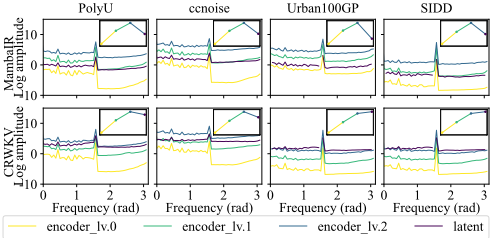
Figure 7 compares the power spectrum of feature maps between MambaIR and CRWKV. A significant amplitude drop is observed in MambaIR between encoder layer.2 and latent, which is essential in semantic-level feature reconstruction. In contrast, CRWKV exhibits a much smaller amplitude reduction on PolyU and ccnoise while maintaining superior performance on Urban100GP and SIDD. This indicates that CRWKV is able to retain amplitude stably across layers, preserving and leveraging high-frequency information throughout the denoising process effectively.
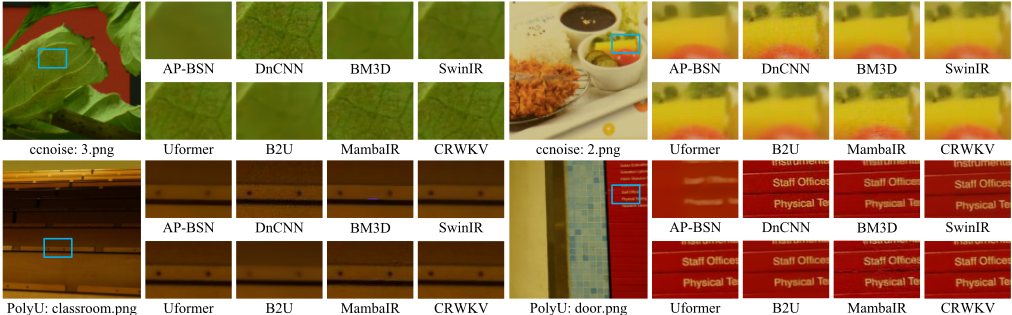
Qualitative comparison. On ccnoise and PolyU datasets (Figure 4), our model excels in preserving both fine details (leaf veins in ccnoise 3.png) and flat regions (ccnoise 2.png), and maintaining high-quality text fidelity (PolyU door.png). Other methods, such as B2U, struggle with edge preservation
| Methods | Params | FLOPs (G) | Time (ms) | SIDD | |
|---|---|---|---|---|---|
| (M) | PSNR | SSIM | |||
| SwinIR [Liang et al., 2021] | 11.75 | 253.46 | 170.33 | 33.70 | 0.864 |
| ShuffleFormer [Xiao et al., 2023] | 50.53 | 120.67 | 98.96 | 39.60 | 0.958 |
| Uformer [Wang et al., 2022b] | 50.88 | 41.44 | 62.50 | 39.68 | 0.958 |
| Restormer [Zamir et al., 2022] | 26.10 | 35.24 | 47.40 | 40.01 | 0.960 |
| MambaIR [Guo et al., 2025] | 26.78 | 34.39 | 79.61 | 39.88 | 0.960 |
| CRWKV (Ours) | 20.19 | 28.78 | 62.74 | 39.87 | 0.960 |
(PolyU classroom.png), while models like MambaIR leave visible noise residuals in flat regions (ccnoise 2.png).
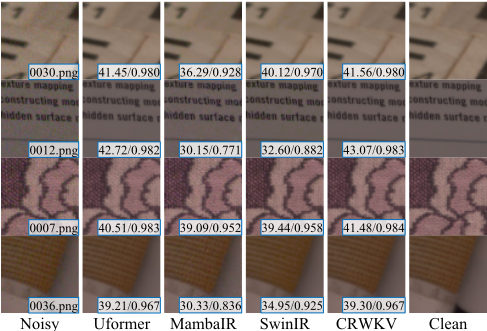
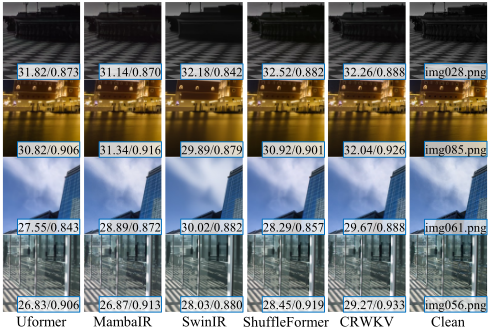
For SIDD dataset (Figure 5), visual comparisons showcase CRWKV's superior ability to restore text and textures. In the first two examples, our model successfully reconstructs text at varying scales, while competing methods struggle. In the latter two examples, CRWKV recovers intricate textures such as those in the 0036.png, where other models like SwinIR fail to reproduce fine details. The PSNR and SSIM values displayed in the lower-right corners further confirm the model's effectiveness. For the Urban100GP dataset (Figure 6), CRWKV produces denoised images that strike a superior balance between preserving structural details and reducing noise artifacts. For instance, the grid pattern and fine features in img056.png can be jointly restored with CRWKV, outperforming other models. Additionally, CRWKV produces the most realistic reconstruction of the reflective water surface, showcasing its ability to handle challenging scenarios.
Compared to other methods, CRWKV demonstrates significant improvements in restoring both flat regions and fine details, achieving smoother textures and sharper edges. Furthermore, evaluations on unseen datasets, such as ccnoise, PolyU, and Urban100GP, suggest strong generalizability of CRWKV, as they were excluded from the training process.
Computational complexity. Themodel efficiency comparison results are summarized in Table 3. On the ccnoise dataset, CRWKV outperforms Restormer by over 0.3 dB PSNR and achieves competitive performance with MambaIR, while utilizing only 83% of the FLOPs. Figure 1(b) illustrates GPU memory usage during inference for varying input image sizes, comparing CRWKV with state-space and full-attention architectures. Notably, the Transformer-based Shuffleformer encounters memory limitations when the input size reaches 1024, whereas CRWKV requires only 40% of the GPU memory. Even with a comparable parameter count, CRWKV uses approximately 60% of the memory consumed by state-spacebased MambaIR. This demonstrates that CRWKV strikes an optimal balance between denoising performance and computational efficiency, offering a practical solution for highresolution and resource-constrained applications.
4.3 Ablation Study
Effectiveness of CRBmodule designs. To evaluate the effectiveness of the FMix module and CTS mechanism, we perform experiments on different configurations within the CRB. In the first configuration, we remove FMix and replace it with a basic spatial-mix while omitting the CTS in the CRM and CMix modules. In the second configuration, FMix is retained, but CTS is excluded. Finally, we evaluate the model's performance with partial (CRM-only or CMix-only) and full insertion of CTS. The results suggest that removing FMix leads to a substantial performance degradation, with a PSNR drop of at least 0.40 dB on the SIDD dataset compared to the second configuration. Similarly, omitting CTS from CRM and CMix results in suboptimal performance. Introducing CTS yields consistent improvements, increasing PSNR by at least 0.15 dB on the ccnoise dataset and further boosting results on the SIDD dataset. These findings validate the importance of FMix and CTS in enhancing denoising performance.
Effectiveness of shifting mechanisms. As a guidance to the model's vast search space, shifting mechanisms include Uni-shift, Bi-shift, and Quad-shift are adopted previously. To further evaluate the effectiveness of shifting window in CTS, we implement CTS(+), an extended version including pixels at a Manhattan distance of 3 from the central pixel additionally, covering a total of 16 neighboring pixels. Table 5 shows CTS outperforms CTS(+), suggesting the additional context introduces complexity without significant benefits. Although learning a dynamic offset dictionary with deformable convolution is feasible, we choose a fixed offset dictionary to avoid overfitting to noise patterns in the training set and to reduce computational costs. While the results show that a fixed offset dictionary achieves comparable performance, the need for learnable offsets for optimal results remains an open question.
Effectiveness of parameter settings. To evaluate the roles of FMix and CRM in the model, we analyze the impact of parameters ak , bk (where each CRB contains a FMix modules and b CRM modules), as shown in Table 6. The findings can be summarized as follows: (1) A small number of FMix modules is optimal for low-level feature extraction and excessive usage disrupts early-stage modeling. (2) Applying frequency domain analysis at the middle layers negatively impacts performance. This may be attributed to the limited ability of FMix to model mid-level features, which are less semantically structured. (3) Incorporating frequency selection at deeper network layers significantly enhances performance. Deeper layers deal with semantically rich features that benefit more from frequency-domain processing. Based on these findings, the optimal configuration for the CRB is b1 = 3 , b2 = b3 = 4 and a4 = 6.
Effectiveness of loss functions. Table 7 presents a comparison of different loss functions on SIDD and ccnoise datasets. L1 loss achieves the best performance, offering a strong balance between pixel-level fidelity and perceptual quality. In contrast, MSE loss, while converging faster, suffers from over-smoothing, leading to unsatisfied results. Charbonnier loss achieves comparable but slightly weaker results, likely due to its more complex convergence dynamics. PSNR loss, however, shows a significant performance drop on the ccnoise dataset, suggesting its limitations in generalizability.
5 Conclusion
This work introduces the CRWKV model, a novel approach designed to tackle the challenges of noise modeling and computational inefficiency in real-world image denoising tasks.
| FMix | CTS | SIDD | ccnoise | |||
|---|---|---|---|---|---|---|
| CRM | CMix | PSNR | SSIM | PSNR | SSIM | |
| ✘ | 39.28 | 0.954 | 36.45 | 0.981 | ||
| ✔ | 39.70 | 0.957 | 36.50 | 0.982 | ||
| ✔ | ✔ | 39.75 | 0.957 | 36.64 | 0.983 | |
| ✔ | ✔ | 39.74 | 0.957 | 36.62 | 0.982 | |
| ✔ | ✔ | ✔ | 39.87 | 0.960 | 36.69 | 0.983 |
| Shifting | SIDD | ccnoise | ||
|---|---|---|---|---|
| PSNR | SSIM | PSNR | SSIM | |
| Uni-Shift | 39.57 | 0.957 | 36.46 | 0.982 |
| Bi-Shift | 39.58 | 0.958 | 36.54 | 0.982 |
| Quad-Shift | 39.74 | 0.958 | 36.50 | 0.982 |
| CTS(+) | 39.79 | 0.958 | 36.60 | 0.982 |
| CTS | 39.87 | 0.960 | 36.69 | 0.983 |
| k | SIDD | ccnoise | ||||
|---|---|---|---|---|---|---|
| Lk | (ak, bk) | PSNR | SSIM | PSNR | SSIM | |
| (3, 0) | 39.72 | 0.957 | 36.13 | 0.935 | ||
| 1 | 3 | (2, 1) | 39.82 | 0.958 | 36.60 | 0.980 |
| (1, 2) | 39.83 | 0.958 | 36.57 | 0.925 | ||
| (0, 3) | 39.87 | 0.960 | 36.69 | 0.983 | ||
| (4, 0) | 32.77 | 0.779 | 22.91 | 0.727 | ||
| 2, 3 | 4 | (2, 1) | 34.63 | 0.789 | 30.71 | 0.824 |
| (1, 2) | 38.56 | 0.908 | 34.90 | 0.884 | ||
| (0, 4) | 39.87 | 0.960 | 36.69 | 0.983 | ||
| (6, 0) | 39.87 | 0.960 | 36.69 | 0.983 | ||
| 4 | 6 | (3, 3) | 39.84 | 0.958 | 36.63 | 0.982 |
| (2, 4) | 39.85 | 0.957 | 36.59 | 0.982 | ||
| (0, 6) | 39.84 | 0.957 | 36.65 | 0.983 | ||
| Loss function | SIDD | ccnoise | ||
|---|---|---|---|---|
| PSNR | SSIM | PSNR | SSIM | |
| Charbonnier Loss | 39.86 | 0.959 | 36.67 | 0.983 |
| MSE Loss | 39.66 | 0.957 | 36.53 | 0.983 |
| PSNR Loss | 39.82 | 0.958 | 36.31 | 0.982 |
| L1 Loss | 39.87 | 0.960 | 36.69 | 0.983 |
Key contributions include the CTS mechanism, which effectively captures local spatial contexts affected by noise, and the FMix module, which integrates semantic-level frequencydomain information through a multi-view learning process. By incorporating the BiWKV mechanism into the RWKV backbone, CRWKV achieves efficient pixel-sequence computation with linear complexity, overcoming the limitations of causal-style computation. These advancements enable CRWKV to effectively differentiate noise from complex scenes and separate high-frequency noise from structural details. Extensive experimental results demonstrate CRWKV's superior performance, both quantitatively and qualitatively, highlighting its robustness and practicality for real-world image denoising applications.
Ethical Statement
There are no ethical issues.
Acknowledgments
This work is supported by Shandong Provincial Natural Science Foundation (Grant No. ZR2023QF030).
@inproceedings{ijcai2025p86,
  title     = {Multi-View Learning with Context-Guided Receptance for Image Denoising},
  author    = {Chen, Binghong and Chai, Tingting and Jiang, Wei and Xu, Yuanrong and Zhou, Guanglu and Wu, Xiangqian},
  booktitle = {Proceedings of the Thirty-Fourth International Joint Conference on
               Artificial Intelligence, {IJCAI-25}},
  publisher = {International Joint Conferences on Artificial Intelligence Organization},
  editor    = {James Kwok},
  pages     = {765--773},
  year      = {2025},
  month     = {8},
  note      = {Main Track},
  doi       = {10.24963/ijcai.2025/86},
  url       = {https://doi.org/10.24963/ijcai.2025/86},
}
TY - CPAPER TI - Multi-View Learning with Context-Guided Receptance for Image Denoising AU - Chen, Binghong AU - Chai, Tingting AU - Jiang, Wei AU - Xu, Yuanrong AU - Zhou, Guanglu AU - Wu, Xiangqian T2 - Proceedings of the Thirty-Fourth International Joint Conference on Artificial Intelligence, IJCAI-25 PB - International Joint Conferences on Artificial Intelligence Organization PY - 2025 SP - 765 EP - 773 DO - 10.24963/ijcai.2025/86 UR - https://doi.org/10.24963/ijcai.2025/86 ER -Copied
Machine-readable versions of this paper, for tools and AI agents:





