
Attention-based Conditional Random Field for Financial Fraud Detection
Proceedings of the Thirty-Fourth International Joint Conference on Artificial Intelligence. Main Track. Pages 7822-7830.
https://doi.org/10.24963/ijcai.2025/870
Keywords
- Knowledge Representation and Reasoning: KRR: Applications
- Data Mining: DM: Anomaly/outlier detection
- Multidisciplinary Topics and Applications: MTA: Finance
- Machine Learning: ML: Attention models
Abstract
Financial fraud detection is critical for market transparency and regulatory compliance. Existing methods often ignore the temporal patterns in financial data, which are essential for understanding dynamic financial behaviors and detecting fraud. Moreover, they also treat companies as independent entities, overlooking the valuable interrelationships. To address these issues, we propose ACRF-RNN, a Recurrent Neural Network (RNN) with Attention-based Conditional Random Field (CRF) for fraud detection. Specifically, we use an RNN with a sliding window to capture temporal dependencies from historical data, and an attention-based CRF feature transformer to model inter-company relationships. This transforms raw financial data into optimized features, fed into a multi-layer perceptron for classification. Besides, we also use the focal loss to alleviate the class imbalance problem caused by rare fraudulent cases. This work presents a novel real-world dataset to evaluate the performance of ACRF-RNN. Extensive experiments show that ACRF-RNN outperforms the state-of-the-art methods by 15.28% in KS and 4.04% in Recall.
Data and code are available at: https://github.com/XNetLab/ACRF-RNN.git.
- [Aftabi et al., 2023] Seyyede Zahra Aftabi, Ali Ahmadi, and Saeed Farzi. Fraud detection in financial statements using data mining and gan models. Expert Systems with Appli- cations, 227:120144, 2023.
- [Bao et al., 2020] Yang Bao, Bin Ke, Bin Li, Y Julia Yu, and Jie Zhang. Detecting accounting fraud in publicly traded us firms using a machine learning approach. Journal of Accounting Research, 58(1):199-235, 2020.
- [Chen and Guestrin, 2016] Tianqi Chen and Carlos Guestrin. XGBoost: A Scalable Tree Boosting System. In Proceed- ings of the 22nd ACM SIGKDD International Conference on Knowledge Discovery and Data Mining, pages 785- 794, San Francisco California USA, August 2016. ACM.
- [Chen et al., 2018a] Dapeng Chen, Dan Xu, Hongsheng Li, Nicu Sebe, and Xiaogang Wang. Group Consistent Simi- larity Learning via Deep CRF for Person Re-identification. In 2018 IEEE/CVF Conference on Computer Vision and Pattern Recognition, pages 8649-8658, June 2018.
- [Chen et al., 2018b] Liang-Chieh Chen, George Papan- dreou, Iasonas Kokkinos, Kevin Murphy, and Alan L. Yuille. DeepLab: Semantic Image Segmentation with Deep Convolutional Nets, Atrous Convolution, and Fully Connected CRFs. IEEE Transactions on Pattern Analysis and Machine Intelligence, 40(4):834-848, April 2018.
- [Cheng and Li, 2021] Rui Cheng and Qing Li. Modeling the Momentum Spillover Effect for Stock Prediction via Attribute-Driven Graph Attention Networks. Proceed- ings of the AAAI Conference on Artificial Intelligence, 35(1):55-62, May 2021.
- [Cheng et al., 2020] Dawei Cheng, Xiaoyang Wang, Ying Zhang, and Liqing Zhang. Risk Guarantee Prediction in Networked-Loans. In IJCAI International Joint Confer- ence on Artificial Intelligence, page 7, 2020. IJCAI
- [Cho et al., 2014] Kyunghyun Cho, Bart van Merrienboer, Caglar Gulcehre, Dzmitry Bahdanau, Fethi Bougares, Holger Schwenk, and Yoshua Bengio. Learning Phrase Representations using RNN Encoder-Decoder for Statisti- cal Machine Translation, September 2014.
- [Craja et al., 2020] Patricia Craja, Alisa Kim, and Stefan Lessmann. Deep learning for detecting financial statement fraud. Decision Support Systems, 139:113421, 2020.
- [Cucchiara, 2012] Andrew Cucchiara. Applied Logistic Re- gression. Technometrics, 34:358-359, March 2012.
- [Gao et al., 2019] Hongchang Gao, Jian Pei, and Heng Huang. Conditional Random Field Enhanced Graph Con- volutional Neural Networks. In Proceedings of the 25th ACM SIGKDD International Conference on Knowledge Discovery & Data Mining, pages 276-284, Anchorage AK USA, July 2019. ACM.
- [Grandini et al., 2020] Margherita Grandini, Enrico Bagli, and Giorgio Visani. Metrics for Multi-Class Classifica- tion: An Overview, August 2020.
- [Hajek and Henriques, 2017] Petr Hajek and Roberto Hen- riques. Mining corporate annual reports for intelligent de- tection of financial statement fraud-a comparative study of machine learning methods. Knowledge-Based Systems, 128:139-152, 2017.
- [Hamilton et al., 2017] Will Hamilton, Zhitao Ying, and Jure Leskovec. Inductive Representation Learning on Large Graphs. In Advances in Neural Information Processing Systems, volume 30.
- Curran Associates, Inc., 2017.
- [Ke et al., 2017] Guolin Ke, Qi Meng, Thomas Finley, Taifeng Wang, Wei Chen, Weidong Ma, Qiwei Ye, and Tie-Yan Liu. LightGBM: A Highly Efficient Gradient Boosting Decision Tree. In Advances in Neural Informa- tion Processing Systems, volume 30.
- Curran Associates, Inc., 2017.
- [Kipf and Welling, 2017] Thomas N. Kipf and Max Welling. Semi-Supervised Classification with Graph Convolutional Networks, February 2017.
- [Krähenbühl and Koltun, 2011] Philipp Krähenbühl and Vladlen Koltun. Efficient Inference in Fully Connected CRFs with Gaussian Edge Potentials. In Advances in Neural Information Processing Systems, volume 24.
- Curran Associates, Inc., 2011.
- [Lin et al., 2015] Chi-Chen Lin, An-An Chiu, Shaio Yan Huang, and David C Yen. Detecting the financial state- ment fraud: The analysis of the differences between data mining techniques and experts' judgments. Knowledge- Based Systems, 89:459-470, 2015.
- [Lin et al., 2017] Tsung-Yi Lin, Priya Goyal, Ross Girshick, Kaiming He, and Piotr Dollar. Focal Loss for Dense Ob- ject Detection. In Proceedings of the IEEE international conference on computer vision, pages 2980-2988, 2017.
- [Liu et al., 2023] Yajing Liu, Zhengya Sun, and Wensheng Zhang. Improving fraud detection via hierarchical attention-based graph neural network. Journal of Infor- mation Security and Applications, 72:103399, 2023.
- [Lv et al., 2025] Xiangwei Lv, Jingyuan Chen, Mengze Li, Yongduo Sui, Zemin Liu, and Beishui Liao. Grasp the key takeaways from source domain for few shot graph domain adaptation. In Proceedings of the ACM on Web Conference 2025, pages 2330-2340, 2025.
- [Maas et al., 2013] Andrew L Maas, Awni Y Hannun, and Andrew Y Ng. Rectiper Nonlinearities Improve Neural Network Acoustic Models. In Proceedings of the 30 Th International Conference on Machine Learning, Atlanta, Georgia, USA, 2013.
- [Mao et al., 2022a] Xuting Mao, Mingxi Liu, and Yinghui Wang. Using gnn to detect financial fraud based on the re- lated party transactions network. Procedia Computer Sci- ence, 214:351-358, 2022.
- [Mao et al., 2022b] Xuting Mao, Hao Sun, Xiaoqian Zhu, and Jianping Li. Financial fraud detection using the related-party transaction knowledge graph. Procedia Com- puter Science, 199:733-740, 2022.
- [Mao et al., 2022c] Xuting Mao, Hao Sun, Xiaoqian Zhu, and Jianping Li. Financial fraud detection using the related-party transaction knowledge graph. Procedia Com- puter Science, 199:733-740, 2022.
- [Massey and Frank, 1951] J Massey and J Frank. The Kolmogorov-Smirnov test for goodness of fit. Journal of the American statistical Association, 46(253):68-78, 1951.
- [Papík and Papíková, 2022] Mário Papík and Lenka Papíková. Detecting accounting fraud in companies re- porting under us gaap through data mining. International Journal of Accounting Information Systems, 45:100559, 2022.
- [Rauber et al., 2016] Paulo E Rauber, Alexandre X Falcão, and Alexandru C Telea. Visualizing time-dependent data using dynamic t-sne. In Proceedings of the Eurograph- ics/IEEE VGTC Conference on Visualization: Short Pa- pers, pages 73-77, 2016.
- [Ribeiro et al., 2016] Marco Tulio Ribeiro, Sameer Singh, and Carlos Guestrin. "Why Should I Trust You?": Ex- plaining the Predictions of Any Classifier. In Proceed- ings of the 22nd ACM SIGKDD International Conference on Knowledge Discovery and Data Mining, pages 1135- 1144, 2016.
- [Skousen et al., 2009] Christopher J. Skousen, Kevin R. Smith, and Charlotte J. Wright. Detecting and predicting financial statement fraud: The effectiveness of the fraud triangle and SAS No. 99. In Mark Hirschey, Kose John, and Anil K. Makhija, editors, Advances in Financial Eco- nomics, volume 13, pages 53-81. Emerald Group Publish- ing Limited, January 2009.
- [SONG and LU, 2015] Yan-yan SONG and Ying LU. Deci- sion tree methods: Applications for classification and pre- diction. Shanghai Archives of Psychiatry, 27(2):130-135, April 2015.
- [Sun et al., 2006] Yanmin Sun, Mohamed S. Kamel, and Yang Wang. Boosting for Learning Multiple Classes with Imbalanced Class Distribution. In Sixth international con- ference on data mining (ICDM'06), pages 592-602. IEEE, 2006.
- [Veličković et al., 2018] Petar Veličković, Guillem Cucurull, Arantxa Casanova, Adriana Romero, Pietro Liò, and Yoshua Bengio. Graph Attention Networks, February 2018.
- [Wang et al., 2021] Yurou Wang, Ruixue Li, and Yanfang Niu. A deep neural network based financial statement fraud detection model: Evidence from china. In Proceed- ings of the 2021 4th Artificial Intelligence and Cloud Com- puting Conference, pages 145-149, 2021.
- [Wang et al., 2024] Chenxu Wang, Mengqin Wang, Xi- aoguang Wang, Luyue Zhang, and Yi Long. Multi- relational graph representation learning for financial state- ment fraud detection. Big Data Mining and Analytics, 7(3):920-941, 2024.
- [Wang et al., 2025] Xiaoguang Wang, Chenxu Wang, Huan- long Liu, Mengqin Wang, Tao Qin, and Pinghui Wang. Figraph: A dynamic heterogeneous graph dataset for fi- nancial anomaly detection. In Companion Proceedings of the ACM on Web Conference 2025, pages 813-816, 2025.
- [Xu et al., 2021] Bingbing Xu, Huawei Shen, Bingjie Sun, Rong An, Qi Cao, and Xueqi Cheng. Towards consumer loan fraud detection: Graph neural networks with role- constrained conditional random field. In Proceedings of the AAAI Conference on Artificial Intelligence, volume 35, pages 4537-4545, 2021.
- [Yao et al., 2018] Jianrong Yao, Jie Zhang, and Lu Wang. A financial statement fraud detection model based on hybrid data mining methods. In 2018 international conference on artificial intelligence and big data (ICAIBD), pages 57-61. IEEE, 2018.
- [Zhang et al., 2021] Yanci Zhang, Tianming Du, Yujie Sun, Lawrence Donohue, and Rui Dai. Form 10-Q Itemization. In Proceedings of the 30th ACM International Conference on Information & Knowledge Management, pages 4817- 4822, Virtual Event Queensland Australia, October 2021. ACM.
- [Zhu et al., 2021] Xiaoqian Zhu, Xiang Ao, Zidi Qin, Yan- peng Chang, Yang Liu, Qing He, and Jianping Li. Intel- ligent financial fraud detection practices in post-pandemic era. The Innovation, 2(4):100176, November 2021.
References were extracted automatically from the PDF and may contain errors.
Full text extracted automatically from the PDF; figures, tables and equations may differ. The PDF is the version of record.
1 Introduction
Deceptions in financial statements such as inflating profits and understating liabilities can misguide investors and cause severe losses [Zhu et al., 2021]. Thus, regulators mandate audits and public disclosure of annual financial statements. Financial statements comprise numerous accounting items that can be viewed as high-dimensional features. In such data, detecting financial statement fraud year by year is challenging because of the concealed nature of such fraud and the lack of labeled data. Recently, financial statement fraud detection has attracted much attention from both academics and industries. However, existing methods still face two drawbacks.
∗Corresponding author.
Drawback 1: Temporal correlations in financial data have long been neglected for fraud detection. Most existing methods rely on the financial statements in a single year to detect potential fraud. They overlook the strong temporal correlation inherent in financial data. The financial condition of a company tends to exhibit continuity and correlation in short periods, and many fraud cases have shown that ongoing financial distress often leads to financial fraud behaviors spanning multiple consecutive years [Bao et al., 2020]. For instance, LeEco [Mao et al., 2022a] committed consecutive fraud from 2016 to 2017, Luckin Coffee [Mao et al., 2022b] from 2019 to 2020, and Enron [Bao et al., 2020] from 1997 to 2001. Therefore, capturing temporal correlations in financial data aids in improving fraud detection.
Drawback 2: There is a lack of effective methods to capture behavioral homogeneity of fraudulent companies.
Most existing methods treat companies as independent entities. Although a few studies have demonstrated that explicit relationships (e.g., related-party transactions and investments) can aid in financial fraud detection [Wang et al., 2024; Wang et al., 2025], the effect of implicit relationships on fraud detection remains under-explored. In practice, companies often exhibit behavioral homogeneity. For instance, fraudulent activities frequently involve similar deceptive tactics, resulting in similar behaviors. LeEco, Kangmei Pharmaceutical, and Luckin Coffee committed financial fraud by fabricating profits recorded in financial statements, while Hunan Chinasun Pharmaceutical Machinery, Hirisun and Xintai Electric artificially diminished their accounts receivable [Mao et al., 2022a]. Implicit relationships can effectively model such behavioral homogeneity for fraud detection enhancement. Unfortunately, accurately and automatically capturing implicit relationships among companies presents a significant challenge. Furthermore, these real-world fraud cases also reveal diverse strategies, indicating that behavioral homogeneity varies across patterns. Consequently, relying on a single implicit relationship may fail to capture homogeneity under diverse patterns, underscoring the necessity of modeling multiple implicit relationships among companies.
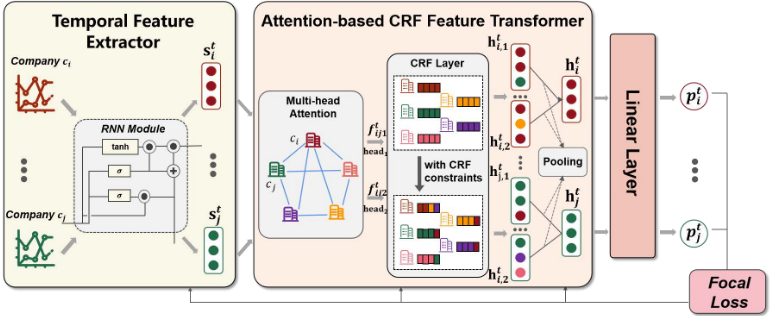
To address these issues, this paper presents ACRF-RNN, a Recurrent Neural Network with Attention-based Conditional Random Field for financial fraud detection. To capture temporal patterns, ACRF-RNN treats a company's annual financial statements as multivariate time series data, and uses a recurrent neural network (RNN) to learn temporal correlations across years. It utilizes a sliding time window to extract short sub-sequences. The representation learned from each sub-sequence is then used as the temporal embedding for the most recent year within the window. Our model well captures the temporal correlations of financial statements.
To address the second drawback, we propose a novel multi-head attention-based Conditional Random Field (CRF) to capture complex implicit relationships among companies within a single year. Our method takes temporal embeddings from different years as input and employs the multi-head attention mechanism to capture implicit relationships under different patterns. The obtained similarity coefficients quantify the strength of these relationships. Subsequently, the CRF model recursively updates the company representations based on the learned similarity coefficients to ensure that companies with similar behaviors are embedded closer in the latent space. Finally, the company representations learned from all attention heads are aggregated through a pooling operation to produce the final representation, which is then fed into a multi-layer perceptron for classification.
Since fraudulent companies are far fewer than benign ones in practice, the model tends to predict test samples as benign, making it difficult to accurately identify fraud samples [Liu et al., 2023]. To address this issue, we use the Focal Loss [Lin et al., 2017] to optimize the model by assigning higher weights to fraudulent samples. The main contributions are as follows:
- We propose a novel Recurrent Neural Network with Attention-based Conditional Random Field to capture both temporal information and implicit relationships among companies for financial fraud detection.
- We propose a multi-head attention-based Conditional Random Field to model implicit relationships among companies, which captures various common patterns of fraudulent behaviors.
- We conduct extensive experiments based on a real-world financial statement dataset to verify the effectiveness of the proposed method. Experimental results demonstrate that our model outperforms state-of-the-art methods by more than 15.28% in KS.
2 RelatedWork
2.1 Financial Fraud Detection
Existing studies often adopt classic machine learning algorithms, such as Logistic Regression [Lin et al., 2015], Support Vector Machine [Pap´ık and Pap´ıkov´a, 2022], Random Forest [Yao et al., 2018], Decision Tree [Hajek and Henriques, 2017], XGBoost [Aftabi et al., 2023], and MultiLayer Perceptron [Wang et al., 2021], to detect fraud behaviors. Craja et al. [Craja et al., 2020] utilized a hierarchical attention network to extract text features from the Management Discussion and Analysis section of annual reports. Besides, companies' true financial conditions often show continuity, with many fraud cases revealing that ongoing financial distress can lead to fraud spanning multiple consecutive years [Bao et al., 2020]. Chen et al. [Zhang et al., 2021] detected corporate financial fraud through a two-stage mapping process within the combined temporal and financial feature domains. Besides, there are rich explicit relationships between companies, such as related-party transactions and investment relationships, which can aid in detecting financial fraud. Mao et al. [Mao et al., 2022c] construct a related-party transaction knowledge graph and extract topological features to improve fraud detection performance. Unlike previous methods, we use an RNN model to effectively capture temporal correlations in financial statements. Moreover, our model captures richer implicit relationships among listed companies through a attention-based CRF.
2.2 Conditional RandomField
Traditional CRF models are often used as offline postprocessing layers for label refinement, capturing dependency relationships between a reference sample and its context. They are widely utilized in image segmentation [Chen et al., 2018b] and named entity recognition [Chen et al., 2018a]. In recent years, researchers have combined CRF models with graph convolutional networks to ensure that similar nodes have similar representations [Gao et al., 2019; Xu et al., 2021]. Such similarity constraints are often established using similarity calculated using Gaussian functions [Gao et al., 2019] or shared labels [Xu et al., 2021]. Unlike previous works, this paper proposes a novel multi-head attention-based CRF to capture implicit relationships among companies under various fraudulent patterns.
3 Preliminaries
This paper formulates the financial fraud detection as a binary classification task. Consider a set of N companies. For a given company ci, its multivariate time series financial data are denoted as xi = [x1i , x2i , · · · , xTi ], where xti ∈ Rd is a d-dimensional feature vector extracted from its financial statement for the t-th year, and T is the length of the time series. Moreover, yi = [l1 i , l2 i , · · · , lT i ] is the label sequence of xi, where lt i is the label of xti . lt i = 1 if company ci engages in fraud at time t, and lt i = 0 if otherwise. To effectively capture temporal correlations from xi, we set a sliding window with a fixed width w and slide it in xi to extract T-w+1 sub-sequences, i.e., {x1→w i , x2→w+1 i , · · · , xT-w+1→T i }, where xt-w+1→t i = [xt-w+1 i , · · · , xti ] and w ≤ t ≤ T. For simplicity, we denote xt-w+1→t i as xti . And then the sub-sequence embedding sti is learned from xti . Through learning the implicit relationships across the N companies from St = {st1 , · · · , stN }, the final embeddings Ht = {ht1 , · · · , htN } are produced for classification. A classifier C is trained on {H1 , · · · ,Ht-1 } to predict the labels of Ht .
4 Methodology
4.1 Overview
Figure 1 shows the framework of ACRF-RNN. It consists of three components: a Temporal Feature Extractor (TFE), an Attention-based CRF Feature Transformer (ACRF), and a Classifier. TFE takes the multivariate time series xti as input and produces a sub-sequence embedding sti by learning temporal information from financial statements. Next, ACRF takes the sub-sequence embedding sti as input and produces the final embedding hti for company ci by learning implicit relationships among behavior-similar companies. Finally, the final embedding hti is fed into the Classifier for classification.
4.2 Temporal Feature Extractor
Financial condition of a company often exhibits continuity and correlation in a short period. Capturing such correlations is vital for fraud detection. Various enhanced RNN-based networks, such as LSTM and GRU, have been used to capture temporal information [Cheng and Li, 2021; Cheng et al., 2020]. This paper utilizes a two-layer GRU model [Cho et al., 2014] to capture temporal information due to the advantages of fewer parameters, faster convergence, and less overfitting. The GRU model takes the sub-sequence xti = [xt-w+1 i , · · · , xti ] of company ci as input to learn the sub-sequence embedding sti = GRU(xti ) as follows:
where W = {Wxr,Wxz,Wxn} and b = {br, bn, bz} are learnable weights and biases, respectively, ⊙ is the Hadamard product, rt , zt , nt are the reset gate, update gate and candidate hidden state, respectively. The reset gate determines whether the network ignores the previous hidden state information, while the update gate determines whether the network remembers the previous hidden state information. The GRU produces sti ∈ Rd by aggregating temporal information from the sub-sequence xti , where d is the dimension. st-1 i is derived from the sub-sequence xt-1 i , and so on.
4.3 Attention-based CRF Feature Transformer
This module comprises two sub-modules: a Multi-head Attention component and a Conditional Random Field (CRF)
model. The former aims to effectively learn inter-company implicit relationships, and the corresponding similarity coefficients indicate the strength of these relationships. The multiple attention heads are used to capture various behavioral patterns. The learned similarity coefficients are fed into the CRF model to optimize the sub-sequence embeddings under each attention head. The optimized sub-sequence embeddings are aggregated to produce the final embedding for each company.
Multi-head Attention Mechanism
In practice, fraudulent companies often exhibit various fraud patterns, such as inflating profits or understating liabilities. A notable example is LeEco [Mao et al., 2022a]. Besides, the implicit relationships may vary under different patterns. Therefore, we introduce a multi-head attention mechanism to capture implicit relationships under different patterns, enabling more nuanced fraud detection. Specifically, the multihead attention mechanism consists of a shared feed-forward network with m LeakyReLU gates [Maas et al., 2013]. First, we define Rt i,j,m to measure the m-th implicit relationship between company ci and cj as follows:
where LeakyReLUm(·) is the m-th gate to prevent information loss, ⊕ denotes concatenating operation, Wa ∈ Rd′×2d is the trainable weight matrix of the feed-forward network, shared with all attention heads, and sti and stj are subsequence embeddings of company ci and cj, respectively. To ensure all Rt i,j,m's are in the same magnitude and comparable, we perform the softmax normalization operation to Rt i,j,m to obtain the similarity coefficient fi,j,m:
The larger the value of f t i,j,m, the stronger the implicit relationship between company ci and company cj under the m-th pattern.
Conditional Random Field Model
Based on the learned similarity coefficients, the CRF model further optimizes the sub-sequence embeddings by perceiving the homogeneity among companies [Kr¨ahenb¨uhl and Koltun, 2011]:
where Z(·) denotes the normalization operation, hti denotes the optimized sub-sequence embedding, and P (hti |sti ) denotes the conditional probability of producing hti given sti . For simplicity, the subscript m of the similarity coefficients is temporarily omitted. The goal is to maximize the conditional probability P (hti |sti ), which is equivalent to minimizing the energy function E (hti |sti ) [Gao et al., 2019]:
where ∥hti -sti ∥2 , named the unary potential, measures the transformation loss from sti to hti , ∑j∈N fi,j ∥∥hti -htj ∥∥22 , named the binary potential, perceives the homogeneity between company ci and those measured by their weighted distances, α and β are learnable parameters adjusting their importance, respectively. The sub-sequence embedding maintains a certain degree of similarity before and after optimization by minimizing ∥hti - sti ∥2 . Moreover, when f t i,j is large, htj and hti are highly similar, and fi,j ∥∥hti - htj ∥∥22 approaches 0. Conversely, when f t i,j is small, htj and hti are discriminative and fi,j ∥∥hti -htj ∥∥22 also approaches 0. That is, f t i,j is a supervisory signal promoting the optimized sub-sequence embeddings of companies sharing similar fraud patterns to be more similar. Equation (8) aims to achieve a balance between unary and binary potentials, striving to enhance the discriminative power of the optimized sub-sequence embeddings while preserving the information from the original subsequence embeddings.
The prerequisite for learning the optimized sub-sequence embedding hti is to determine the true distribution of the conditional probability P (hti |sti ). Thus, we first formulate P (hti |sti ) ∼ P(Ht |St ), denoting the distribution function of the conditional probability. However, the time complexity of computing exact P(Ht |St ) will cause the whole model to barely work. Therefore, we learn the sample distribution Q(Ht ) and make it approximate the true distribution P(Ht |St ), based on the mean-field approximation method [Gao et al., 2019]. This sample distribution Q(Ht ) can be represented as a product of independent marginal distributions through variational inference, expressed as Q(Ht ) = ∏Ni hti . We minimize the KL divergence distance between Q(Ht ) and P(Ht |St ) to obtain the optimal sample distribution Q∗ (Ht ). For company ci, according to Equations (7), it can be deduced that:
where Q∗i (hti ) is a multi-dimensional Gaussian function with the kernel E (hti |sti ). Therefore, hti can be updated by calculating the expectation of Q∗i (hti ):
where K is a hyper-parameter indicating the epochs of iterations, initially, (hti )0 = sti . Based on the learned similarity coefficient f t i,j , the optimized sub-sequence embedding hti can be learned recursively. It should be emphasized that there are m learned similarity coefficients with m attention heads. Therefore, we learn the m-th optimized sub-sequence embedding hti,m under m-th attention heads through Equation (10) for company ci. And then we use a SUM pooling operation to obtain the final embedding:
where M is the total number of attention heads. Experimental results verify that summation pooling is the best aggregation in our fraud detection task.
4.4 Model Training
The optimized sub-sequence embedding hti is then fed into a multi-layer perceptron (MLP) for classification:
where pti denotes the probability that company ci is predicted to be fraudulent at time t, σ(·) denotes the activation function. We employ the Focal Loss [Lin et al., 2017] to optimize the model, which can alleviate the class imbalance problem by assigning higher weights to fraud companies:
where abalance is a hyperparameter balancing the weight of benign and fraud companies.
5 Experiments
5.1 Datasets
We collect a real-world dataset containing multivariate time series financial data from 491 Chinese listed companies from 2010-2020. In each year, each listed company has 208dimensional features derived from its financial statement. To extract more comprehensive features for accurate fraud detection, we refer to the fraud triangle theory to select the following three types of features: i) 91-dimensional financial features such as profits, ownership interest and cash flow, ii) 7-dimensional basic features such as industry and listed time, and iii) 110-dimensional fraud features aligned with Skousen's framework [Skousen et al., 2009]. Companies penalized by China Securities Regulatory Commission due to the violation of the accounting standards are labeled as fraud companies, and others are defined benign ones. All data are collected from the China Securities Regulatory Commission 1 .
5.2 Baseline Methods
We compare eight baseline methods with our method, including two classical machine learning methods (Logistic Regression (LR) [Cucchiara, 2012] and Decision Tree (DT) [SONG and LU, 2015]), two ensemble learning methods (LightGBM [Ke et al., 2017] and XGBoost [Chen and Guestrin, 2016]), three GNN-based methods (GCN [Kipf and Welling, 2017], GAT [Veliˇckovi´c et al., 2018] and GraphSAGE [Hamilton et al., 2017]), and one state-of-the-art fraud detection model ADGAT [Cheng and Li, 2021]. For a fair comparison between ACRF-RNN and GNN-based methods, we construct a static audit-sharing graph, where the nodes represent the company-year pair, and the edges connect nodes audited by the same audit institution.
1 http://www.csrc.gov.cn/
| Partitions | Training set (# Fraud / # Benign) | Testing set (# Fraud / # Benign) |
|---|---|---|
| Validation | 2010-2016 (874/2653) | 2017 (122/369) |
| Test 1 | 2010-2017 (996/2932) | 2018 (127/364) |
| Test 2 | 2010-2018 (1123/3296) | 2019 (110/381) |
| Test 3 | 2010-2019 (1233/3677) | 2020 (86/405) |
5.3 EvaluationMetrics
Four widely adopted metrics are used to measure the performance of different methods. Accuracy calculates the percentage of all correctly classified samples to assess classification performance. Recallm [Grandini et al., 2020] averages recall across all classes. G-mean [Sun et al., 2006] is defined as the geometric mean of the recalls over all classes. A low Gmean indicates poor identification ability of a model for at least one class. As a popular metric to assess the discrimination ability between fraud and benign samples, KS [Massey and Frank, 1951] measures the maximal difference between True Positive Rate and False Positive Rate as the classification threshold shifts from 0 to 1.
5.4 Experimental Settings
In real business scenarios, financial fraud detection is conducted once a year, using models trained on historical data to detect fraud companies for the current year. Therefore, we split the real-world dataset by year. Specifically, we use the data from 2010 to 2016 for training and use the data from 2017 as validation to adjust hyperparameters. Next, with fixed hyperparameters, we train the model on data from 2010 to T, and test it on data at the (T+1)-th year, where T ∈ {2017, 2018, 2019}. Table 1 details the partitions.
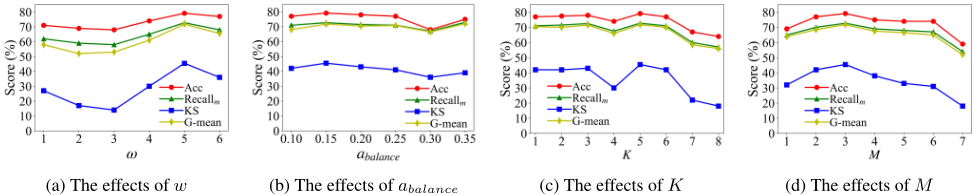
We implement ACRF-RNN based on PyTorch 1.12.1 with Python 3.8, and all the experiments are run on a Ubuntu 16.04 LTS server. Grid search is employed to select the optimal hyper-parameters based on the validation set. All parameters are initialized using the Kaiming initialization and are trained using the Adam optimizer with an initial learning rate of 0.01. The optimal time window size w is 5, the iteration of CRF K is set to 5, the sub-sequence embedding dimension d is set to 64. The attention layer consists of M = 3 attention heads and its hidden size d′ is set to 32. And the penalty coefficient of fraud sample abalance is set to 0.15.
5.5 Results and Analysis
Table 2 shows the experimental results. ACRF-RNN significantly outperforms all baselines in all experimental settings. Among all the test results, ACRF-RNN achieves the highest accuracy score, indicating the best overall classification performance. Compared to all baselines, the improvement in KS is 15.28-25.34%, indicating that ACRF-RNN excels more in distinguishing between fraud and benign samples. Besides, KS exceed 40% over three consecutive testing years, demonstrating its powerful generalization and robustness. The improvement of ACRF-RNN in Recallm scores is 4.04-6.58%, indicating the best identification ability. However, such higher Recallm scores may also be due to excessive focus on fraud samples, which can lead to more benign samples being misclassified. Therefore, we use G-mean for auxiliary evaluation. ACRF-RNN achieves a high G-mean score of around 70% in all test results and outperforms all baselines. This finding indicates that our model steadily achieves high performance at different years.
Machine learning methods demonstrate suboptimal performance, indicating that the extracted rich raw features are effective in detecting financial fraud. Ensemble learning methods perform better than machine learning methods because of their stronger robustness and generalization ability. However, these methods have lower performance than ACRF-RNN because they fail to capture temporal information and implicit relationships.
GCN, GAT, and GraphSAGE have relatively poor performance, indicating that explicit relationships, such as auditsharing, may not be suitable for the financial fraud detection task. This finding also demonstrates the importance of selecting proper explicit relationships, which are labor-intensive. On the contrary, our method can automatically explore various implicit relationships among companies for latent feature optimization and achieves optimal performance.
ADGAT achieves the second-best performance, trailing only ACRF-RNN. The key difference lies in how it model inter-company implicit correlations. ADGAT concatenates high-attention neighbor node vectors, whereas ACRF-RNN optimizes feature vectors by minimizing energy loss. Besides, ACRF-RNN employs an inductive feature transformation, enhancing generalization without relying on specific prior knowledge.
5.6 Ablation Study
We design three variants of ACRF-RNN to validate the effectiveness of three key components. ACRF-RNN (w/o TFE) removes TFE, utilizes a linear layer to transform the raw features of a single annual financial statement instead of subsequences, and feeds the output of the linear layer into ACRF. ACRF-RNN (w/o FT) excludes ACRF, feeding TFE outputs directly to the classifier. ACRF-RNN (w/o FL) replaces Focal Loss with cross-entropy to assess class imbalance handling. Table 3 shows the average experimental results of all variants on three test sets. The full ACRF-RNN outperforms all variants, demonstrating the effectiveness of all components. ACRF-RNN (w/o TFE) shows the worst performance on all metrics scores, demonstrating the effectiveness of learning temporal information. Compared to ACRF-RNN (w/o FL), the full model significantly boosts Recallm, G-mean, and KS scores. This finding indicates that Focal Loss effectively enhances the model's ability to identify fraud samples but may misclassify benign samples.
| Test 1 (2018) | Test 2 (2019) | Test 3 (2020) | ||||||||||
|---|---|---|---|---|---|---|---|---|---|---|---|---|
| Methods | Acc | Recallm | KS | G-mean | Acc | Recallm | KS | G-mean | Acc | Recallm | KS | G-mean |
| LR | 61.71 | 60.33 | 20.67 | 60.27 | 55.40 | 60.27 | 20.53 | 59.62 | 53.16 | 57.87 | 15.73 | 57.41 |
| DT | 57.43 | 60.01 | 20.02 | 59.77 | 55.19 | 56.90 | 13.81 | 56.82 | 60.08 | 58.40 | 16.80 | 58.34 |
| LightGBM | 63.14 | 65.65 | 31.31 | 65.45 | 62.32 | 64.08 | 28.17 | 64.00 | 63.54 | 65.99 | 31.99 | 65.89 |
| XGBoost | 61.71 | 61.87 | 23.74 | 61.87 | 62.12 | 61.36 | 22.73 | 61.35 | 66.40 | 66.35 | 32.70 | 66.35 |
| GCN | 54.18 | 57.56 | 15.12 | 57.13 | 56.42 | 55.75 | 11.50 | 55.74 | 52.55 | 57.50 | 14.99 | 56.99 |
| GAT | 61.91 | 57.39 | 14.79 | 56.63 | 49.69 | 56.92 | 13.83 | 55.39 | 65.38 | 56.57 | 13.15 | 54.93 |
| GraphSAGE | 47.05 | 47.37 | 5.27 | 47.36 | 63.34 | 50.51 | 1.03 | 44.85 | 68.02 | 53.14 | 6.28 | 47.95 |
| ADGAT | 76.17 | 68.04 | 36.07 | 65.91 | 79.23 | 72.07 | 44.13 | 70.89 | 77.39 | 67.52 | 35.04 | 65.79 |
| ACRF-RNN | 77.60 | 70.79 | 41.58 | 69.37 | 80.45 | 75.44 | 50.88 | 74.89 | 79.43 | 71.96 | 43.92 | 71.04 |
| Impr. | 1.88% | 4.04% | 15.28% | 5.25% | 1.54% | 4.68% | 15.30% | 5.64% | 2.64% | 6.58% | 25.34% | 7.07% |
| Methods | Acc | Recallm | KS | G-mean |
|---|---|---|---|---|
| ACRF-RNN (w/o TFE) ACRF-RNN (w/o FT) | 56.75 | 48.65 | 4.37 | 46.42 |
| 78.95 | 70.28 | 41.35 | 69.05 | |
| ACRF-RNN (w/o FL) | 79.63 | 70.95 | 41.91 | 69.25 |
| ACRF-RNN | 79.16 | 72.73 | 45.46 | 71.77 |
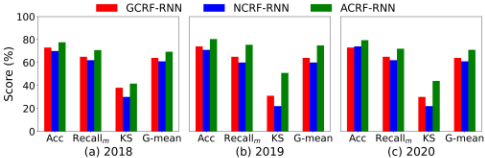
To further verify the effectiveness of the multi-head attention mechanism in capturing implicit relationships, we implement the CRF-Gaussian and CRF-NN layers proposed by [Gao et al., 2019] in our model, creating two variants named GCRF-RNN and NCRF-RNN. Specifically, GCRFRNN computes f t i,j by a Gaussian function, and NCRF-RNN computes f t i,j by a flexible neural network. Figure 2 shows their performance on three test sets. ACRF-RNN outperforms NCRF and GCRF on all metrics, indicating the effectiveness of the multi-head attention mechanism in learning similarity coefficients for capturing multiple similar behaviors among companies. The Gaussian function is highly sensitive to outliers, resulting in imprecise similarity assessments. Neural networks, albeit more adaptable than Gaussian functions, capture only a general sense of similarity. The multihead attention mechanism is adept at discerning implicit relationships in different subspaces and thus achieves higher performance.
5.7 Sensitivity Analysis
Figure 3(a) illustrates the effect of the width of the time window w. As w increases, all metrics first decrease and then increase. A small w makes the model only observe a small part of the whole sequence, leading to insufficient understanding of the overall temporal correlation. The optimal performance is achieved when w = 5. However, further increasing w leads to a decline in performance because longterm correlation may harm the learning of recent characteristics. Figure 3(b) shows the effect of abalance. KS initially rises and then decrease as abalance increases, reaching a peak at abalance = 0.15. A larger value of abalance directs the model's attention towards fraud samples, aiding in improving the recognition capability for the fraud class. However, as abalance continues to increase, the model might overly emphasize fraud samples, neglecting crucial information from benign samples. This could lead to a decrease in overall performance. Figure 3(c) demonstrates the model's performance as the number of iterations K varies. As K gradually increases, the model's effectiveness experiences slight fluctuations. As K continues to rise, the model's performance begins to deteriorate, potentially due to the overfitting caused by excessive iterations. Figure 3(d) demonstrates the effect of the number of attention heads. When M is small, the model may fail to fully capture the complexity of various patterns, leading to insufficient representational capability. Conversely, too many heads might cause overfitting.
5.8 Further Research
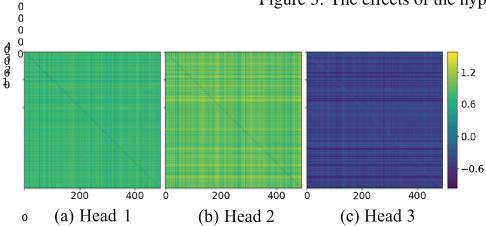
To further explore the role of the multi-head attention mechanism in capturing fraud pattern diversity, we visualize the learned similarity coefficients from different attention heads in experiment Test 2 (2019), as shown in Figure 4. The heatmaps illustrate the attention coefficients from three distinct attention heads. The lightness of color in these heatmaps corresponds to the attention weights, with lighter hues indicating stronger connections between companies. Each heatmap reveals unique attention patterns, signifying that each head specializes in a distinct feature subspace to infer similarity relationships among companies. Such diversity enables the model to capture broader information from the training data.
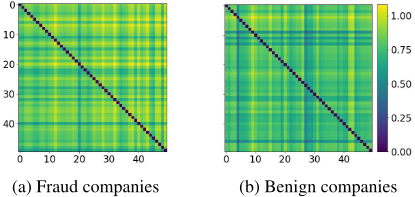
Additionally, within the same attention head, we randomly select 50 benign companies and 50 fraud companies to visualize their similarity coefficients, as shown in Figure 5. Fraudulent companies tend to have relatively higher similarity, suggesting that they share more common behavioral characteristics, such as overstatement of revenue, cost manipulation, and inflation of reported financial outcomes. A comparison of Figure 5(a) and 5(b) reveals that benign companies exhibit more diverse behavioral patterns than fraudulent ones.
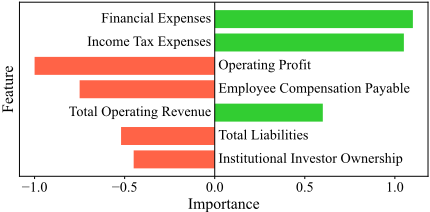
Moreover, we conduct experiments using the LIME [Ribeiro et al., 2016] interpretability framework to identify key features aiding in detecting fraud companies. Figure 6 shows results for a randomly selected fraudulent case. "Financial Expenses" and "Income Tax Expenses" are identified as the top two features contributing to the classification of this sample as fraudulent. Both of them directly impact a company's cash flow. Fraudulent activities might aim to misrepresent the company's cash flow situation by manipulating these expenses. For instance, understating income tax expenses can temporarily inflate earnings, presenting an unrealistically positive financial performance.
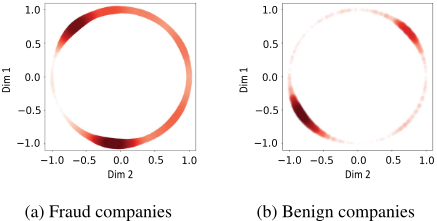
In order to verify the performance of ACRF-RNN, the raw features and the learned final embeddings of companies are visualized by t-SNE [Rauber et al., 2016; Lv et al., 2025] in Figure 7. The shade of the color and the change in the size of the points together represent the density distribution of the data points, with darker and larger points having higher density. The distribution of raw features is more uniform, while the learned final embeddings are more discriminative and exhibit obvious cluster characteristics. It indicates that ACRF-RNN learns critical information during the training, improving the distinction between fraud and benign samples.
6 Conclusion
This paper presents ACRF-RNN, a novel recurrent neural network (RNN) with an attention-based conditional random field (CRF) for financial fraud detection. The RNN captures critical temporal patterns in multivariate financial time series for each company, producing the sub-sequence embeddings. Besides, the attention-based CRF models intercompany implicit relationships to refine these sub-sequence embeddings for improved classification. Experiments on real-world datasets show that ACRF-RNN outperforms stateof-the-art methods, achieving average gains of 2.02% in accuracy, 5.1% in Recallm and 18.64% in KS. Future work will focus on the effect of implicit relationships between different companies across adjacent years on financial fraud detection.
Acknowledgements
The research presented in this paper is supported in part by the National Natural Science Foundation of China (No. 62272379, T2341003, 62102310), the Shaanxi Science Fund for Outstanding Young Scientists (2025JC-JCQN-081), the Key R&D in Shaanxi Province (2023-YBGY-269), and the Fundamental Research Funds for the Central Universities (xzy012023068).
@inproceedings{ijcai2025p870,
  title     = {Attention-based Conditional Random Field for Financial Fraud Detection},
  author    = {Wang, Xiaoguang and Wang, Chenxu and Zhang, Luyue and Wang, Xiaole and Wang, Mengqin and Liu, Huanlong and Qin, Tao},
  booktitle = {Proceedings of the Thirty-Fourth International Joint Conference on
               Artificial Intelligence, {IJCAI-25}},
  publisher = {International Joint Conferences on Artificial Intelligence Organization},
  editor    = {James Kwok},
  pages     = {7822--7830},
  year      = {2025},
  month     = {8},
  note      = {Main Track},
  doi       = {10.24963/ijcai.2025/870},
  url       = {https://doi.org/10.24963/ijcai.2025/870},
}
TY - CPAPER TI - Attention-based Conditional Random Field for Financial Fraud Detection AU - Wang, Xiaoguang AU - Wang, Chenxu AU - Zhang, Luyue AU - Wang, Xiaole AU - Wang, Mengqin AU - Liu, Huanlong AU - Qin, Tao T2 - Proceedings of the Thirty-Fourth International Joint Conference on Artificial Intelligence, IJCAI-25 PB - International Joint Conferences on Artificial Intelligence Organization PY - 2025 SP - 7822 EP - 7830 DO - 10.24963/ijcai.2025/870 UR - https://doi.org/10.24963/ijcai.2025/870 ER -Copied
Machine-readable versions of this paper, for tools and AI agents:





