
Beyond Fixed Length: Bucket Pre-training is All You Need
Proceedings of the Thirty-Fourth International Joint Conference on Artificial Intelligence. Main Track. Pages 8331-8338.
https://doi.org/10.24963/ijcai.2025/926
Keywords
- Natural Language Processing: NLP: Language models
- Data Mining: DM: Big data and scalability
- Data Mining: DM: Mining text, web, social media
- Natural Language Processing: NLP: Language generation
Abstract
Large Language Models (LLMs) have demonstrated exceptional performance across various tasks, with pre-training stage serving as the cornerstone of their capabilities. However, the conventional fixed-length data composition strategy for pre-training presents several practical challenges. When using shorter sequences, documents are often truncated, potentially leading to information loss and affecting the model's ability to capture long-range dependencies. Conversely, longer sequences require concatenation of multiple documents, which can introduce noise and affect the natural document boundaries and semantic coherence as well as require substantial computational overhead. To address these challenges, we first establish three quantitative metrics for evaluating data composition quality: padding ratio, truncation ratio, and concatenation ratio. Building upon these metrics, we propose a novel multi-bucket data composition method that transcends the fixed-length paradigm. Our approach adaptively organizes training data to achieve optimal composition quality as measured by the proposed metrics, offering a more flexible and efficient approach for pre-training. We conduct extensive experiments and the results demonstrate that our proposed method significantly enhances both the efficiency and effectiveness of LLM pre-training. Our proposed method has been adopted in the Du Xiaoman–XuanYuan series of financial large language models at https://github.com/Duxiaoman-DI/XuanYuan.
- [Bisk et al., 2020] Yonatan Bisk, Rowan Zellers, Jianfeng Gao, Yejin Choi, et al. Piqa: Reasoning about physical commonsense in natural language. In Proceedings of the AAAI conference on artificial intelligence, volume 34, pages 7432-7439, 2020.
- [Brown et al., 2020] Tom Brown, Benjamin Mann, Nick Ry- der, Melanie Subbiah, Jared D Kaplan, Prafulla Dhariwal, Arvind Neelakantan, Pranav Shyam, Girish Sastry, Amanda Askell, et al. Language models are few-shot learners. Ad- vances in neural information processing systems, 33:1877- 1901, 2020.
- [Clark et al., 2018] Peter Clark, Isaac Cowhey, Oren Etzioni, Tushar Khot, Ashish Sabharwal, Carissa Schoenick, and Oyvind Tafjord. Think you have solved question answer- ing? try arc, the ai2 reasoning challenge. arXiv preprint arXiv:1803.05457, 2018.
- [DeepSeek-AI, 2024] DeepSeek-AI. Deepseek-v3 technical report. arXiv preprint arXiv:2412.19437, 2024.
- [Ding et al., 2024] Hantian Ding, Zijian Wang, Giovanni Paolini, Varun Kumar, Anoop Deoras, Dan Roth, and Ste- fano Soatto. Fewer truncations improve language modeling. arXiv preprint arXiv:2404.10830, 2024.
- [Dubey et al., 2024] Abhimanyu Dubey, Abhinav Jauhri, Ab- hinav Pandey, Abhishek Kadian, Ahmad Al-Dahle, Aiesha Letman, Akhil Mathur, Alan Schelten, Amy Yang, Angela Fan, et al. The llama 3 herd of models. arXiv preprint arXiv:2407.21783, 2024.
- [Hendrycks et al., 2020] Dan Hendrycks, Collin Burns, Steven Basart, Andy Zou, Mantas Mazeika, Dawn Song, and Jacob Steinhardt. Measuring massive multitask lan- guage understanding. In International Conference on Learning Representations, 2020.
- [Le Scao et al., 2023] Teven Le Scao, Angela Fan, Christo- pher Akiki, Ellie Pavlick, Suzana Ilić, Daniel Hesslow, Ro- man Castagné, Alexandra Sasha Luccioni, François Yvon, Matthias Gallé, et al. Bloom: A 176b-parameter open- access multilingual language model. 2023.
- [Mihaylov et al., 2018] Todor Mihaylov, Peter Clark, Tushar Khot, and Ashish Sabharwal. Can a suit of armor conduct electricity? a new dataset for open book question answering. In Proceedings of the 2018 Conference on Empirical Meth- ods in Natural Language Processing, pages 2381-2391, 2018.
- [Ouyang et al., 2022] Long Ouyang, Jeffrey Wu, Xu Jiang, Diogo Almeida, Carroll Wainwright, Pamela Mishkin, Chong Zhang, Sandhini Agarwal, Katarina Slama, Alex Ray, et al. Training language models to follow instructions with human feedback. Advances in neural information processing systems, 35:27730-27744, 2022.
- [Penedo et al., 2024] Guilherme Penedo, Hynek Kydlíček, Anton Lozhkov, Margaret Mitchell, Colin Raffel, Lean- dro Von Werra, Thomas Wolf, et al. The fineweb datasets: Decanting the web for the finest text data at scale. arXiv preprint arXiv:2406.17557, 2024.
- [Pouransari et al., 2024] Hadi Pouransari, Chun-Liang Li, Jen-Hao Rick Chang, Pavan Kumar Anasosalu Vasu, Cem Koc, Vaishaal Shankar, and Oncel Tuzel. Dataset decom- position: Faster llm training with variable sequence length curriculum. In Proceedings of the Annual Conference on Neural Information Processing Systems, 2024.
- [Rae et al., 2021] Jack W Rae, Sebastian Borgeaud, Trevor Cai, Katie Millican, Jordan Hoffmann, Francis Song, John Aslanides, Sarah Henderson, Roman Ring, Susan- nah Young, et al. Scaling language models: Methods, analysis & insights from training gopher. arXiv preprint arXiv:2112.11446, 2021.
- [Talmor et al., 2019] Alon Talmor, Jonathan Herzig, Nicholas Lourie, and Jonathan Berant. Commonsenseqa: A question answering challenge targeting commonsense knowledge. In Proceedings of the 2019 Conference of the North, page 4149. Association for Computational Linguistics, 2019.
- [Touvron et al., 2023] Hugo Touvron, Louis Martin, Kevin Stone, Peter Albert, Amjad Almahairi, Yasmine Babaei, Nikolay Bashlykov, Soumya Batra, Prajjwal Bhargava, Shruti Bhosale, et al. Llama 2: Open foundation and fine- tuned chat models. arXiv preprint arXiv:2307.09288, 2023.
- [Yang et al., 2024] An Yang, Baosong Yang, Beichen Zhang, Binyuan Hui, Bo Zheng, Bowen Yu, Chengyuan Li, Dayi- heng Liu, Fei Huang, Haoran Wei, et al. Qwen2. 5 technical report. arXiv preprint arXiv:2412.15115, 2024.
- [Zellers et al., 2019] Rowan Zellers, Ari Holtzman, Yonatan Bisk, Ali Farhadi, and Yejin Choi. Hellaswag: Can a machine really finish your sentence? In Proceedings of the 57th Annual Meeting of the Association for Computational Linguistics, pages 4791-4800, 2019.
- [Zhang et al., 2022] Susan Zhang, Stephen Roller, Naman Goyal, Mikel Artetxe, Moya Chen, Shuohui Chen, Christo- pher Dewan, Mona Diab, Xian Li, Xi Victoria Lin, et al. Opt: Open pre-trained transformer language models. arXiv preprint arXiv:2205.01068, 2022.
References were extracted automatically from the PDF and may contain errors.
Full text extracted automatically from the PDF; figures, tables and equations may differ. The PDF is the version of record.
1 Introduction
Large Language Models (LLMs) have demonstrated unprecedented capabilities across diverse domains, including natural language processing, coding, and mathematical reasoning [Brown et al., 2020; Ouyang et al., 2022]. The extraordinary performance of these models stems from their extensive pre-training on vast corpora of unlabeled text data. Given the immense scale of pre-training datasets, efficient and effective organization of input data during training becomes important.
∗Corresponding author
While ideally, each document would be processed as an independent training instance to preserve semantic integrity and eliminate noise, practical constraints such as computational efficiency, maximum context length, and batch processing requirements make this approach unfeasible.
In current LLM pre-training, the dominant approach for organizing massive document collections is fixed-length method, which randomly concatenates documents and segments them into fixed-length sequences, typically 4096 or 8192 tokens, with special tokens marking document boundaries [Rae et al., 2021; Zhang et al., 2022; Touvron et al., 2023; Pouransari et al., 2024; Yang et al., 2024; DeepSeek-AI, 2024]. While this method has been widely adopted for its computational efficiency and batch processing compatibility, the arbitrary segmentation at fixed intervals introduces potential drawbacks. It often disrupts natural document boundaries and semantic coherence, potentially compromising the model's ability to learn long-range dependencies.
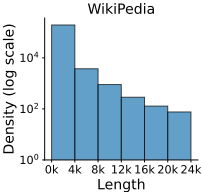
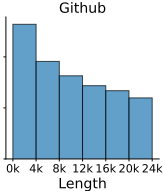
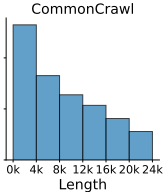
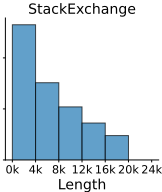
We analyze the length distributions across four representative pre-training corpora: WikiPedia, Github, CommonCrawl, StackExchange. Figure 1 reveals that the majority of documents in these datasets are relatively short, predominantly within the 2k token range. This heterogeneous distribution exposes fundamental limitations of fixed-length training approaches. Using shorter sequence lengths (e.g., 2k) severely restricts the model's ability to capture long-range dependencies and understand broader context, which is crucial for complex reasoning and document-level comprehension. Furthermore, longer documents must be truncated into fixed-length segments, breaking the coherent flow of information and semantic relationships. Conversely, longer lengths (e.g., 8k) not only necessitate extensive document concatenation, introducing artificial boundaries and potential noise, but also significantly increase computational overhead and slow down training speed. These issues collectively highlight the inherent inflexibility of fixed-length approaches in handling the diverse nature of real-world text data.
Recent works have attempted to address the challenges arising from document concatenation and splitting. Ding et al. [Ding et al., 2024] proposed Best-fit Packing, a lengthaware combinatorial optimization approach to minimize unnecessary truncation. Similarly, Hadi et al. [Pouransari et al., 2024] developed a length-based bucketing method with curriculum sampling, utilizing binomial decomposition to create flexible training sequences.
While these methods show promising results, they lack a systematic framework for evaluating data composition quality in LLM pre-training. To bridge this gap, we propose three quantitative metrics:
- Padding ratio: The proportion of padding tokens in training sequences.
Figure 1: Data Length Distribution.
Initially, most large-scale models [Zhang et al., 2022; Touvron et al., 2023; Le Scao et al., 2023; Dubey et al., 2024; Yang et al., 2024], adopted a straightforward fixed-length approach: concatenating documents and segmenting them into sequences matching the model's context window. While computationally efficient, this approach often compromises document integrity and semantic coherence, potentially limiting the model's ability to learn long-range dependencies.
- Truncation ratio: The percentage of truncated documents.
- Concatenation ratio: The average number of documents combined in each training sample.
These metrics provide a comprehensive assessment of data composition quality, with lower values indicating better composition for pre-training. A detailed discussion of these metrics is provided in Section 3.
Based on these observations and challenges, we propose to transcend the fixed-length training paradigm with a novel multi-bucket data composition method for LLM pre-training. Our approach adaptively organizes training data into lengthspecific buckets, significantly optimizing the aforementioned metrics to achieve higher quality data composition while maintaining training efficiency. The main contributions of this work are:
- Data Composition Quality Metrics: We design a comprehensive framework of quantitative metrics for evaluating data composition quality in LLM pre-training, providing a systematic approach to measure and optimize training data composition.
- Multi-Bucket Method: We introduce a novel multibucket data composition strategy that moves beyond the fixed-length paradigm, demonstrating superior trade-off performance across proposed quality metrics while maintaining computational efficiency.
- Empirical Validation: Through extensive experiments, we demonstrate that our method not only optimizes data composition efficiency, but also leads to improved the performance of LLM across various standard benchmarks.
2 RelatedWork
In traditional pre-training, individual documents were treated as independent training instances, padded with [PAD] tokens to enable batch processing. While effective for smaller models, this approach becomes impractical for modern LLMs with terabyte-scale datasets due to excessive padding overhead.
Recent works have attempted to address these limitations, albeit with their own constraints. Ding et al. [Ding et al., 2024] proposed a Best-Fit-Decreasing algorithm that reduces unnecessary truncation, but inherits other limitations of fixedlength approaches such as forced document concatenation and the inability to handle varying sequence lengths efficiently. Hadi et al. [Pouransari et al., 2024] introduced a more flexible length-based bucketing approach with binomial decomposition. While this method avoids fixed-length constraints and eliminates padding and concatenation issues, it introduces extensive document fragmentation, as most documents undergo truncation through the decomposition process.
3 Preliminary
To systematically evaluate and compare different data composition strategies, we propose a quantitative framework for assessing training data quality. Our framework is guided by three key objectives:
- Information Preservation: Minimizing document truncation to retain the original semantic content and preserve long-range dependencies in the training data.
- Semantic Coherence: Limiting document concatenation within individual training samples to reduce the noise introduced by artificial boundaries during auto-regressive training.
- Computational Efficiency: Optimizing the use of padding tokens to maximize computational resources and training throughput.
Below, we formally define these objectives as quantitative metrics and analyze their implications for LLM pre-training performance.
We introduce in detail the calculation of the proposed metrics, including: padding ratio, truncation ratio, and concatenate ratio.
- Padding Ratio: indicates the proportion of the padding
token in the processed training data, which is defined as:
where N represents the total number of input data, count(i) represents the number of [PAD] in the i-th data, and len(i) refers to the length of the i-th data. The lower the rpad, the more effective training.
(2) Truncation Ratio: the ratio of the original training data to be split, which is defined as:
where M represents the total number of original documents, and J(i) represents that if i-th original documents is split, J(i) is 1. The lower the rtru, the more data is fully trained, and less information is lost.
(3) Concatenate Ratio: the ratio of original data contained in a piece of processed training data.
where M represents the total number of original documents, and C represents the number of the training samples. The lower the rcat, the less the number of original data concatenated in the training data and the less noise during training.
4 Bucketing AlgorithmDesign
Optimizing all three metrics (rpad, rtrunc, and rcat) simultaneously presents inherent challenges, as these metrics often compete with each other. A longer fixed sequence length typically increases concatenation ratio while reducing truncation, and vice versa. To address this trade-off, we explore a multi-bucket approach for organizing pre-training data.
Naive Bucketing Method We first consider a straightforward approach that organizes documents into pre-defined bucket sizes (2048, 4096, 8192, 16384 tokens):
- Documents ≤ 2048 tokens go to the 2048-token fixed bucket.
- Documents of 2049-4096 tokens go to the 4096-token fixed bucket.
- Similarly for 4097-8192 and 8193-16384 token ranges.
- Documents in each bucket are concatenated and split into fixed-length segments.
However, this naive approach suffers from a critical flaw: excessive truncation. Most documents, except those perfectly matching bucket sizes or ideal concatenation scenarios, lose information during the fixed-length segmentation process. This substantial information loss motivates the need for a more sophisticated data organization strategy that better preserves document integrity while maintaining training efficiency.
Algorithm 1 BucketLLM
Require: All Documents DS, preset bucket set B with capacities, padding threshold P , Pool Size S
Ensure: All Training buckets T B
- 1: initialize a empty document pool D
- 2: for each di in DS do
- 3: Add di to D
- 4: if len(D) >= S then
- 5: T , D ← Generate_a_Bucket(D, B, P )
- 6: add T to T B
- 7: end if
- 8: end for
- 9: return T B
BucketLLM-v0: Improved Bucketing Algorithm To address the limitations of the naive approach, we propose an improved bucketing method that adaptively organizes documents using a greedy strategy. The key innovation is allowing flexible bucket allocation: instead of strict length-based assignments, documents can be placed in larger buckets when beneficial for minimizing truncation and maximizing space utilization. The algorithm processes documents in batches as a document pool from a globally shuffled dataset:
- Initial Organization: Documents in the current pool are sorted in descending order by length to prioritize placing larger documents.
- Bucket Assignment: For each document, we select the smallest viable bucket that can accommodate it completely.
- Space Optimization:
- Long documents exceeding the maximum bucket size are split, with the remainder returning to the pool.
- When a bucket cannot fit more complete documents, if remaining space exceeds a padding threshold, it is filled with a chunk from the shortest available document.
- Small remaining spaces below the threshold are filled with padding tokens.
This method demonstrates several improvements over the naive approach. It significantly reduces the truncation ratio (rtrunc) through flexible document placement, while maintaining a low concatenation ratio (rcat). The padding ratio (rpad) is effectively managed through the padding threshold parameter, enabling a tunable balance between space utilization and computational efficiency.
However, BucketLLM-v0's greedy strategy reveals certain limitations. By prioritizing the longest fitting document for each bucket, it can create suboptimal space allocation scenarios. Specifically, after placing a long document, the remaining space may be too small for any complete document, yet too large to justify padding. Moreover, this strategy tends to favor larger buckets, as they offer more flexibility in document placement, potentially leading to an imbalanced distribution of training sequences across different length buckets. This bias towards longer sequences not only affects training efficiency
Algorithm 2 Generate_a_Bucket
Require: A Documents Pool D, preset bucket set B with capacities, padding threshold P Ensure: A Training bucket T , updated Documents Pool D 1: Sort D in descending order by length 2: s ← select bucket size from B to fit D1, initialized the empty bucket T 3: for each di in D do 4: if len(di) ≤ s then 5: r ← s - len(di) 6: if mind∈D len(d) > r > P · bucket capacity then 7: Find a, b ∈ D where len(a) + len(b) ≤ r and len(a) + len(b) > len(di) 8: if a, b found then 9: Add a, b to bucket T 10: s ← s - (len(a) + len(b)) 11: a, b ← ∅ 12: else 13: Add di to bucket T 14: s ← r 15: end if 16: else 17: Add di to bucket T 18: s ← r 19: end if 20: τ ← ∅ 21: else if bucket is empty then 22: Add di[0 : b] to bucket T 23: di ← di[b :] {Update document} 24: end if 25: end for 26: Shuffle the bucket T 27: if r/bucket capacity > P then 28: Add D[-1][0 : r] to bucket T {Chunk from shortest document} 29: D[-1] ←D[-1][r :] 30: else 31: Add [pad_id] × r to bucket T 32: end if 33: return T, Dbut may also impact the model's ability to handle inputs of varying lengths effectively. These observations motivate the need for a more sophisticated document selection strategy that can better balance bucket utilization across different sequence lengths.
BucketLLM: Final Optimized Bucketing Algorithm Building upon the greedy approach described earlier, we propose a further optimized algorithm that incorporates heuristic strategies to address the limitations of the previous method. This final algorithm aims to minimize padding and truncation while maximizing the utilization of bucket space. The key improvement lies in its handling of scenarios where the remaining space is too small for the next largest document but too large to be efficiently padded.
Compared with the workflow in the above BucketLLM-v0, this algorithm has a more detailed solution in Space Optimization step: when a document τ is added and the remaining space r is smaller than the shortest document but larger than the padding threshold, apply the following heuristic:
- Search for two shorter documents a and b such that len(a) + len(b) ≤ r and len(a) + len(b) > len(τ ).
- If such a pair is found, add a and b to the bucket instead of τ .
- If no such pair is found, proceed with adding τ.
This heuristic approach provides several advantages: (1) Reduced Padding: By finding pairs of shorter documents to fill larger gaps, we significantly reduce the amount of padding required, thus decreasing rpad. (2) Improved Space Utilization: The algorithm makes more efficient use of the available bucket space, potentially increasing the amount of useful data in each training sample.
Mathematically, we can express the condition for applying the heuristic as:
min d∈D len(d) > r > P · bucket_capacity ,where D is the set of remaining documents, r is the remaining space in the current bucket, and P is the padding threshold.
The optimization goal for selecting documents a and b can be expressed as:
max a,b∈D(len(a) + len(b)) subject to len(a) + len(b) ≤ r , and len(a) + len(b) > len(τ ) (4)The detailed pseudocode in Algorithm 1 and Algorithm 2 illustrates the step-by-step process of our method to optimized bucket creation.
Our algorithm is designed to work with a preset bucket set B (e.g., 1024, 2048, 4096, ...), which allows for flexibility in defining bucket capacities based on specific model or hardware requirements. The padding threshold P provides a tunable parameter to balance between space utilization and computational efficiency.
Overall, the key features and improvements of our method are as follows:
- Document Pool Management: We introduce a document pool of size S, allowing for more flexible and efficient handling of very large datasets. This approach ensures a consistent flow of data processing and memory efficiency.
- Adaptive Bucket Size Selection: The algorithm dynamically selects the appropriate bucket size based on the current longest document in the pool, ensuring efficient use of different bucket capacities.
- Optimized Bucket Filling: Our method implements an improved greedy strategy with heuristic optimization. It aims to maximize bucket utilization while minimizing padding and truncation.
This method effectively balances the three key metrics we introduced earlier, and could achieve a more efficient and flexible data composition process for LLM pre-training. This approach not only improves the quality of training data by preserving document integrity where possible but also enhances computational efficiency by optimizing bucket utilization and minimizing unnecessary padding and concatenation.
5 Experiments
To comprehensively evaluate our proposed multi-bucket data composition method, we conduct experiments to address the following research questions:
RQ1: How does our multi-bucket method improve data composition quality? To answer this question, we evaluate our method against conventional fixed length and SOTA data composition strategies using the proposed metrics: padding ratio, truncation ratio and concatenation ratio.
RQ2: Does our proposed method lead to better model performance in LLM pre-training? To validate the effectiveness of our approach, we pre-train language models using our multi-bucket data composition method and evaluate them on widely used benchmarks. Meanwhile, we particularly focus on examining the model's capability in capturing long-range dependencies and processing longer sequences.
5.1 Experimental Setup
Datasets We utilize FineWebEdu [Penedo et al., 2024], a high-quality pre-training dataset derived from CommonCrawl. We conduct our experiments on a representative subset consisting of 100B tokens (approximately 98M documents), and this subset maintains the original dataset's quality characteristics and diversity, making it suitable for evaluating the data composition method.
Baselines We compare our method with the following baselines.
- Fixed Length: The standard approach of concatenating all documents and then splitting them into fixed-length samples for training such as Fixed-1024, Fixed-2048, Fixed-4096, Fixed-8192, and Fixed-16384.
- DD [Pouransari et al., 2024]: A state-of-the-art data composition method that groups sequences by length into document-specific buckets and employs curriculumbased sampling during training.
In our method, we pre-define five buckets with commonly used sequence lengths: 1024, 2048, 4096, 8192, and 16384.
5.2 RQ1: Data Composition Quality
To evaluate the effectiveness of our proposed multi-bucket data composition strategy, we conduct a comprehensive analysis of data organization quality across different methods. Specifically, we compare our approach against five fixed-length baselines (Fixed-1024, Fixed-2048, Fixed-4096, Fixed-8192, and Fixed-16384) and the DD method measuring their performance in terms of three proposed key metrics: padding ratio, truncation ratio, and concatenation ratio.
Table 1 presents the comparison of different methods across three data composition quality metrics. For fixed-length methods, we observe clear trade-offs: shorter sequence lengths (e.g., Fixed-1024) lead to lower padding ratios but higher truncation ratios, while longer sequences (e.g., Fixed-16384) reduce truncation at the cost of increased concatenation meanwhile significantly slower training speed due to long context attention complexity. The DD method achieves minimal padding and concatenation but at the expense of extremely high truncation (99.9%), which could potentially harm model performance by breaking the natural document boundaries and coherent semantic units. Our proposed BucketLLM accepts a slightly higher padding ratio (0.12%) compared to fixed-length methods and DD, but this small overhead brings substantial benefits: it dramatically reduces the truncation ratio to 0.28%while maintaining a relatively low concatenation ratio (2.81). This represents a well-balanced trade-off, as the minimal increase in padding has negligible computational cost, while the reduced truncation better preserves document integrity and the controlled concatenation better preserve the natural document boundaries and semantic coherence.
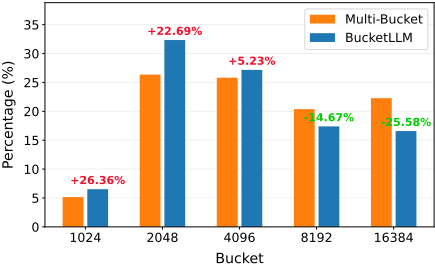
In addition, we compare our preliminary version BucketLLM-v0, which could help demonstrate the effectiveness and insights of the evolution of our approach. Figure 2 shows the sequence length distribution between our two methods. BucketLLM demonstrates a more balanced distribution with a notable shift towards shorter sequences compared to BucketLLM-v0. Specifically, BucketLLM increases the proportion of sequences in shorter buckets (1024-4096 tokens) while reducing the percentage in longer buckets (8192-16384 tokens). Combined with the metrics in Table 1, this distribution shift demonstrates that BucketLLM achieves a better balance between quality and efficiency: while both methods achieve low padding and truncation ratios, BucketLLM's better utilization of shorter sequences leads to a reduced concatenation ratio (2.81 vs 3.78). Importantly, its preference for shorter sequences leads to substantially improved training efficiency.
5.3 RQ2: Pre-training LLMPerformance
Experimental Settings To evaluate the effectiveness of different data composition methods on model performance, we conduct extensive pre-training experiments using a 1B parameter model based on the Llama3.1 architecture [Dubey et al., 2024]. For comparison, we select three widely used fixed-length baselines (Fixed-2048, Fixed-4096, and Fixed-
| Fixed-1024 | Fixed-2048 | Fixed-4096 | Fixed-8192 | Fixed-16384 | DD | BucketLLM-v0 | BucketLLM | |
|---|---|---|---|---|---|---|---|---|
| rpad ↓ | 0.01% | 0.01% | 0.02% | 0.04% | 0.08% | 0.0% | 0.37% | 0.12% |
| rtru ↓ | 61.26% | 38.39% | 21.45% | 11.51% | 5.96% | 99.9% | 0.19% | 0.28% |
| rcat ↓ | 1.03 | 2.05 | 4.11 | 8.20 | 16.40 | 1.0 | 3.78 | 2.81 |
| DD | Fixed-2048 | Fixed-4096 | Fixed-8192 | BucketLLM | |
|---|---|---|---|---|---|
| Arc-challenge | 0.2920 | 0.3000 | 0.2920 | 0.2760 | 0.3140 (+4.67%) |
| Arc-easy | 0.6570 | 0.6590 | 0.6480 | 0.6420 | 0.6640 (+0.76%) |
| Commonsense-qa | 0.3790 | 0.3610 | 0.3530 | 0.3730 | 0.3870 (+2.11%) |
| Hellaswag | 0.3860 | 0.4030 | 0.3960 | 0.3810 | 0.4060 (+0.74%) |
| Mmlu-average | 0.3118 | 0.3098 | 0.3077 | 0.2993 | 0.3165 (+1.51%) |
| Openbookqa | 0.2420 | 0.2420 | 0.2580 | 0.2480 | 0.2620 (+1.55%) |
| Piqa | 0.6880 | 0.6970 | 0.6880 | 0.6680 | 0.7020 (+0.72%) |
| Average | 0.4223 | 0.4245 | 0.4204 | 0.4125 | 0.4359 (+2.69%) |
8192) and the DD method. All models are trained using the DeepSpeed framework on 8 nodes, each equipped with 8 NVIDIA A800 GPUs (64 GPUs in total). We maintain consistent training configurations across all methods, including an initial learning rate of 2e-4. Notably, we implement a bucket sampling algorithm where buckets are sampled proportionally to their token counts at each training step, and the sampling algorithm could ensure that data across all GPUs of the same step consistently reside within the same bucket, facilitating efficient training.
Training Efficiency Table 3 presents the distribution of training data across different bucket sizes and their corresponding training throughput. Our multi-bucket approach shows two key advantages in terms of training efficiency. First, we achieve a favorable data distribution where 55.44% of the training data falls into buckets of 4,096 tokens or shorter. And these shorter sequences demonstrate substantially higher training throughput: compared to the 8,192 sequence length (which has become a common choice in recent LLM training). While longer sequences (16,384) show reduced throughput (-18.74%), they only account for 17.39% of the training data. This distribution-aware training strategy effectively balances the trade-off between sequence length and computational efficiency, leading to improved overall training throughput compared to fixed-length approaches.
Benchmark Evaluation We evaluate each model on a comprehensive set of standard benchmarks under Lighteval framework 1 , including arc-challenge [Clark et al., 2018], arc-easy [Clark et al., 2018], commonsense-qa [Talmor et al., 2019], hellaswag [Zellers et al., 2019], mmluaverage [Hendrycks et al., 2020], openbook-qa [Mihaylov et al., 2018], and piqa [Bisk et al., 2020]. We report accuracies for each category.
1 https://github.com/huggingface/lighteval
| bucket | data ratio | batch size | speed (tokens/s) |
|---|---|---|---|
| 1,024 | 6.52% | 48 | 16,793 (+22.62%) |
| 2,048 | 16.58% | 24 | 16,263 (+18.74%) |
| 4,096 | 32.34% | 12 | 15,505 (+13.21%) |
| 8,192 | 27.17% | 6 | 13,696 (+0.00%) |
| 16,384 | 17.39% | 3 | 11,129 (-18.74%) |
Table 2 presents the evaluation results across seven standard NLP benchmarks. Our BucketLLM consistently outperforms all baseline methods across all tasks, achieving an average improvement of 2.69% over the best baseline (Fixed2048). Notably, we observe substantial improvements on more challenging tasks, such as Arc-challenge (+4.67%) and Commonsense-qa (+2.11%). Since these benchmarks primarily involve short-text understanding and reasoning, it is unsurprising that Fixed-2048 emerges as the strongest baseline among fixed-length approaches, as it better matches the natural length distribution of these tasks. In contrast, Fixed-8192 shows the worst performance, likely due to excessive concatenation introducing cross-document noise during training. Our multi-bucket approach effectively addresses this challenge by adaptively handling sequences of different lengths, leading to more robust performance across the full benchmark suite while maintaining training efficiency.
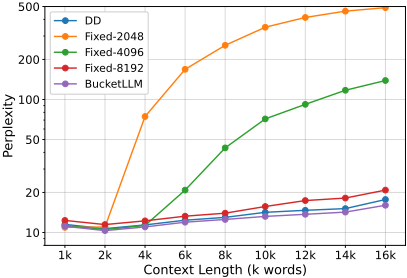
Long Context Modeling Evaluation We evaluate models' capability in handling texts of varying lengths by measuring perplexity across different context windows, from 1k to 16k, as shown in Figure 3. Our BucketLLM and the other bucket method DD demonstrates superior performance across the entire length spectrum, maintaining the lowest perplexity for both short and long contexts. This consistent performance can be attributed to the adaptive bucket strategy, which exposes the model to an appropriate mix of sequence lengths during training. Notably, while Fixed-2048 showed strong performance in previous short-text benchmarks, it struggles significantly with longer contexts, showing rapidly degrading perplexity beyond its training length.
The experimental results demonstrate that our adaptive multi-bucket strategy effectively balances the trade-offs in LLM training: by intelligently distributing sequences across different length buckets, BucketLLM not only accelerates training through efficient processing of shorter sequences, but also maintains robust modeling capabilities across both short and long contexts, leading to superior performance in both standard benchmarks and long-text understanding tasks.
5.4 Further Scaling Analysis
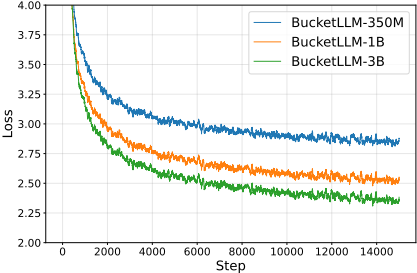
Figures 4 and 5 present comprehensive analyses of our method's scaling behavior across different model sizes (350M, 1B, and 3B parameters) and training data scales. First, the loss curves (Figure 4) demonstrate consistent and stable training dynamics across all model sizes, with the larger models (3B) achieving lower loss values as expected. The convergence tendency suggests that our multi-bucket approach effectively supports stable training regardless of model scale.
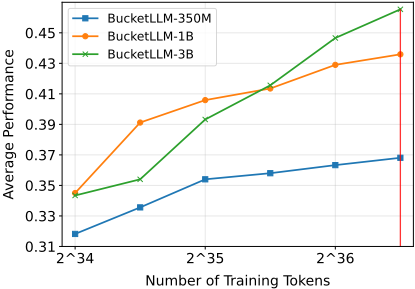
More importantly, Figure 5 reveals the interaction between model size and data scaling. When increasing the number of training tokens from 234 to 236 , we observe distinct scaling patterns: the 350Mmodel shows limited improvement with more data, suggesting it reaches its capacity limit earlier. In contrast, both 1B and 3B models demonstrate stronger scaling behavior, with the 3B model showing the most substantial performance gains as training data increases. This indicates that our bucket-based training strategy effectively supports both data and model scaling, allowing larger models to better utilize increased training data for improved performance.
These findings suggest that BucketLLM's adaptive sequence length strategy is particularly beneficial for scaling up model training, as it maintains efficient training while enabling models to effectively leverage both increased model capacity and training data.
6 Conclusion
In this paper, we study the data composition problem in LLM pre-training by introducing a systematic approach to evaluate and optimize training data composition. Our key contributions include establishing three quantitative metrics - padding ratio, truncation ratio, and concatenation ratio - providing a comprehensive framework for measuring data composition quality. We further propose BucketLLM, an adaptive multibucket data composition method that transcends the traditional fixed-length paradigm, which demonstrates superior performance in both data composition quality and model training. Our method shows substantial improvements in training efficiency and model performance across different scales and benchmarks. Our work provides valuable insights into efficient LLM training through better data organization strategies.
@inproceedings{ijcai2025p926,
  title     = {Beyond Fixed Length: Bucket Pre-training is All You Need},
  author    = {Yang, Qing and Peng, Qiyao and Liu, Hongtao and Liu, Kai and Qin, Bing and Liu, Ting},
  booktitle = {Proceedings of the Thirty-Fourth International Joint Conference on
               Artificial Intelligence, {IJCAI-25}},
  publisher = {International Joint Conferences on Artificial Intelligence Organization},
  editor    = {James Kwok},
  pages     = {8331--8338},
  year      = {2025},
  month     = {8},
  note      = {Main Track},
  doi       = {10.24963/ijcai.2025/926},
  url       = {https://doi.org/10.24963/ijcai.2025/926},
}
TY - CPAPER TI - Beyond Fixed Length: Bucket Pre-training is All You Need AU - Yang, Qing AU - Peng, Qiyao AU - Liu, Hongtao AU - Liu, Kai AU - Qin, Bing AU - Liu, Ting T2 - Proceedings of the Thirty-Fourth International Joint Conference on Artificial Intelligence, IJCAI-25 PB - International Joint Conferences on Artificial Intelligence Organization PY - 2025 SP - 8331 EP - 8338 DO - 10.24963/ijcai.2025/926 UR - https://doi.org/10.24963/ijcai.2025/926 ER -Copied
Machine-readable versions of this paper, for tools and AI agents:





