
A Goal-Oriented Meaning-based Statistical Multi-Step Math Word Problem Solver with Understanding, Reasoning and Explanation
Proceedings of the Twenty-Sixth International Joint Conference on Artificial Intelligence. Demos. Pages 5235-5237.
https://doi.org/10.24963/ijcai.2017/775
Keywords
- Machine Learning: Machine Learning
- Natural Language Processing: Natural Language Processing
Abstract
A goal-oriented meaning-based statistical framework is presented in this paper to solve the math word problem that requires multiple arithmetic operations with understanding, reasoning and explanation. It first analyzes and transforms sentences into their meaning-based logical forms, which represent the associated context of each quantity with role-tags (e.g., nsubj, verb, etc.). Logic forms with role-tags provide a flexible and simple way to specify the physical meaning of a quantity. Afterwards, the main-goal of the problem is decomposed recursively into its associated sub-goals. For each given sub-goal, the associated operator and operands are selected with statistical models. Lastly, it performs inference on logic expressions to get the answer and explains how the answer is obtained in a human comprehensible way. This process thus resembles the human cognitive understanding of the problem and produces a more meaningful problem solving interpretation.
- [Bakman, 2007] Yefim Bakman. Robust understanding of word problems with extraneous information. http://lanl.arxiv.org/abs/math.GM/0701393., 2007. Link
- [Chang and Lin, 2011] Chih-Chung Chang and Chih-Jen Lin. 2011. LIB-SVM: a library for support vector machines. ACM Transactions on Intelligent Systems and Technology, 2(3):27:1-27:27. http://www.csie.ntu.edu.tw/cjlin/libsvm, 2011. Link
- [Hosseini et al., 2014] Mohammad Javad Hosseini, Han- naneh Hajishirzi, Oren Etzioni, and Nate Kushman. 2014. Learning to solve arithmetic word problems with verb categorization. Proceedings of the 2014 Conference on Empirical Methods in Natural Language Processing, EMNLP 2014, Doha, Qatar, A meeting of SIGDAT, a Spe- cial Interest Group of the ACL, pages 523-533, October 25-29, 2014.
- [Huang et al., 2015] Chien-Tsung Huang, Yi-Chung Lin, and Keh-Yih Su. Explanation generation for a math word problem solver. International Journal of computational Linguistics and Chinese Language processing (IJ- CLCLP), 20(2):27-44, 2015.
- [Koncel-Kedziorski et al., 2015] Rik Koncel-Kedziorski, Hannaneh Hajishirzi, Ashish Sabharwal, Oren Etzioni, and Siena Dumas Ang. Parsing algebraic word problems into equations. Transactions of the Association for Com- putational Linguistics, 3:585-597, 2015.
- [Kushman et al., 2014] Nate Kushman, Yoav Artzi, Luke Zettlemoyer, and Regina Barzilay. Learning to automati- cally solve algebra word problems, page 271-281, Bal- timore, Maryland, June. Association for Computational Linguistics, 2014.
- [Liang et al., 2016] Chao-Chun Liang, Shih-Hong Tsai, Ting-Yun Chang, Yi-Chung Lin and Keh-Yih Su. A Meaning-based English Math Word Problem Solver with Understanding, Reasoning and Explanation. Proceedings of COLING 2016, 2016.
- [Lin et al., 2015] Yi-Chung Lin, Chao-Chun Liang, Kuang-Yi Hsu, Chien-Tsung Huang, Shen-Yun Miao, Wei-Yun Ma, Lun-Wei Ku, Churn-Jung Liau, and Keh-Yih Su. Designing a tag-based statistical math word problem solver with reasoning and explanation. International Journal of computational Linguistics and Chinese Lan- guage processing (IJCLCLP), 20(2):1-26, 2015.
- [Ma et al., 2010] Yuhui Ma, Ying Zhou, Guangzuo Cui, Yun Ren, and Ronghuai Huang. Frame-based calculus of sol- ing arithmetic multi-step addition and subtraction word problems. Education Technology and Computer Science, International Workshop on, 2:476-479, 2010.
- [Manning et al., 2014] Christopher D Manning, Mihai Surdeanu, John Bauer, Jenny Finkel, Steven J Bethard, and David McClosky. The Stanford CoreNLP natural language processing toolkit. In ACL Demonstrations, 2014.
- [Mayer, 1987] Richard E. Mayer. Educational psychology: A cognitive approach. Boston: Little, Brown, 1987.
- [Mayer, 1992] Richard E. Mayer. Thinking, Problem solving, Cognition. 2nd Edition. New York: Freeman, 1992.
- [Mitra and Baral, 2016] Arindam Mitra and Chitta Baral. Learning to use formulas to solve simple arithmetic problems. In Proceedings of the 54th Annual Meeting of the Association for Computational Linguistics, pages 2144-2153, 2016.
- [Mukherjee and Garain, 2008] Anirban Mukherjee and Utpal Garain. A review of methods for automatic understanding of natural language mathematical problems. Artif. Intell. Rev., 29(2):93-122, 2008
- [Pape, 2004] Stephen J. Pape. Middle school children's problem-solving behavior: A cognitive analysis from a reading comprehension perspective. Journal for Research in Mathematics Education, 35(3):187-219, 2004.
- [Roy and Roth, 2015] Subhro Roy and Dan Roth. Solving general arithmetic word problems. EMNLP-2015, pages 1743-1752, 2015.
- [Roy et al., 2015] Subhro Roy, Tim Vieira, and Dan Roth. Reasoning about quantities in natural language. TACL, 3:1-13, 2015.
- [Russell and Norvig, 2009] Stuart Russell and Peter Norvig. Artificial Intelligence: A Modern Approach. Prentice Hall Press, Upper Saddle River, NJ, USA, 3rd edition, 2009.
- [Slagle, 1965] James. R. Slagle. Experiments with a deduc- tive question-answering program. J-CACM, 8(12):792-798, 1965.
References were extracted automatically from the PDF and may contain errors.
Full text extracted automatically from the PDF; figures, tables and equations may differ. The PDF is the version of record.
1 Introduction
The math word problem (MWP) was frequently chosen to study the task of natural language understanding and simulate human problem solving procedure [Bakman, 2007; Kushman et al., 2014; Liang et al., 2016]. However, many previous approaches either only handled MWPs that involve one arithmetic operation [Mukherjee and Garain, 2008; Roy et al., 2015] or solved multi-step arithmetic operations with various limitations (e.g., only handling Addition and Subtraction sequence [Ma et al., 2010; Hosseini et al., 2014; Mitra and Baral, 2016]). Only [Roy and Roth, 2015] and [Koncel-Kedziorski et al., 2015] proposed bottom-up tree construction approaches to handle general multi-step arithmetic MWPs. But both of them lacked intermediate understanding and explanation. It thus belongs to the worse direct translation approach [Pape, 2004]. In contrary, previous goal-oriented approaches [Slagle, 1965; Ma et al., 2010] largely aligned with the human comprehension process, though they could not handle general cases and suffered from the difficulty of constructing a wide coverage rule-set.
A goal-oriented meaning-based statistical approach is thus proposed in this paper to avoid the problems mentioned above via combining the goal-oriented approach with a statistical framework. Except the ultimate goal, all the desired operations and operands (including sub-goals) will be identified by statistical classifiers. Moreover, each quantity is associated with various role-tags (e.g., nsubj, verb, modifier, time, place, etc.) for denoting its contextual relationship. Since the physical meaning (represented by role-tags) of each quantity is explicitly used in selecting both operations and operands, it allows us to examine the problem in an incremental and intuitive manner. In each step of the process, we know the meaning of the associated sub-goals/operands, and are thus able to explain the procedure in a human-comprehensible way [Mayer, 1987; 1992].
2 System Architecture
The block diagram of the proposed MWP solver is shown in Figure 1. The sentences in an MWP are first analyzed by the Language Analyzer (LA) (i.e., Stanford CoreNLP suite [Manning et al., 2014]) to obtain corresponding linguistic representation (i.e., dependency trees and co-reference chains). The Logic Form Converter (LFC) then transforms the linguistic representation into logic forms and constructs the final operation tree. Besides, the LFC also calls the Solution Type Classifier (STC) to determine the solution type and calls the Inference Engine (IE) [Liang et al., 2016] to evaluate the given operation tree and generate the answer for the question. Lastly, the Explanation Generator (EG) [Huang et al., 2015] generates the explanation text to explain how the answer is obtained according to the given reasoning chain.
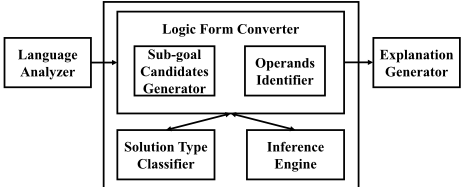
We adopt the same STC, IE and EG modules used in [Liang et al., 2016], and only describe new modules below.
2.1 Logical Form Converter
The LFC transforms each quantity into its first-order logic form [Lin et al., 2015; Russell and Norvig, 2009]. All quantities and the main-goal are first identified by rules and explicitly associated with their role-tags, which carries context information and specifies the physical meaning of that quantity. For example, "quan(q1,#,apple)=3 & verb(q1, eat) & nsub(q1, Mary)" is generated to state 'Mary ate 3 apples'. In contrast with the bottom up approach adopted in [Roy and Roth, 2015; Koncel-Kedziorski et al., 2015], the LFC constructs the operation tree [Roy and Roth, 2015] in a top-down manner. It initializes a recursive procedure by first pushing the main-goal into a stack. Afterwards, it pops the current working goal from the stack, and then asks the STC to decide the desired solution type (i.e., the operator) associated with the goal. It then generates all possible candidates of sub-goals (via the rule-based Sub-goal Candidates Generator sub-module), and selects associated operands (via the statistical Operands Identifier sub-module) among all available known quantities and those sub-goal candidates just generated. Afterwards, it spawns a new level of recursion if the selected operand is an unknown quantity (i.e., a sub-goal candidate generated above), which will be regarded as a new sub-goal and pushed into the stack. The above procedure will keep going until the stack is empty. Lastly, the LFC identifies the corresponding IE utility (associated with the solution type), and calls the IE to get the answer.
2.2 Operands Identifier
The Operand Identifier selects the appropriate operands from the Operand-Candidate-Set, which is a set formed by newly generated sub-goals and currently available known quantities. An SVM classifier with linear kernel [Chang and Lin, 2011] is used. We adopt three different kinds of features: (1) Math fact pattern features (e.g., "if the operand is a known quantity", etc.); (2) NP-matching features (e.g., "if the noun-phrases of the operand-candidate and the goal are in entailment relationship", etc.); (3) Role-tag-matching features (e.g. "if the role-tags of operand-candidate and that of goal are matched", etc.).
3 Experimental Results
We evaluate our system on two publicly available datasets: IL-562 and CC-600. IL-562 is a collection of 562 MWPs (with single arithmetic operation) released by [Roy et al., 2015]. CC-600 is a dataset of 600 MWPs released by [Roy and Roth, 2015] to cover multi-step MWPs with four different arithmetic operations. We compare our system with the KAZB [Kushman et al., 2014] and the system proposed by [Roy and Roth, 2015]. Since exactly the same n-fold cross-validation evaluation setting is adopted, the performances can be directly compared. Table 1 shows that our system significantly outperforms theirs in overall performance. We believe the improvement is mainly due to
| IL-562 | CC-600 | |
|---|---|---|
| Our System | 80.1 | 53.5 |
| Roy and Roth, 2015 | 73.9 | 45.2 |
| Kushman et al., 2014 | 73.7 | 2.3 |
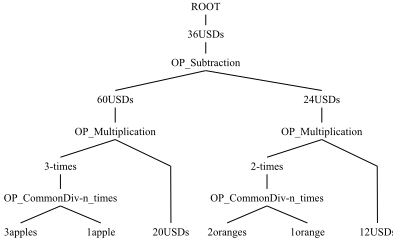
Answer and Explanation:
3 apples vs. 1 apple is: 3 ÷ 1 = 3-times
3-times and 20 USDs is: 3 * 20 = 60 USDs
2 oranges vs. 1 orange is: 2 ÷ 1 = 2-times
2-times and 12 USDs is: 2 * 12 = 24 USDs
60 USDs - 24 USDs = 36 USDs
- ∴ 3 apples cost 36 USDs more expensive than 2 oranges.
Figure 2: The reasoning chain and explanation text
that the system explicitly checks the physical meaning of the selected quantities against the meaning of the given sub-goal.
4 Demonstration Outline
The MWP solver comprises a web user interface and a processing server. The web interface is used to input the problem and display various outputs generated from the submitted MWP. The server will process the submitted problem to get the answer. After an MWP is submitted, various processing modules will be invoked in a recursion manner to solve the problem. Once the process is finished, the user can browse the outputs generated from each module: (1) Dependency relations, co-reference chains and linguistic representations generated from the LA. (2) Logic forms transformed from the linguistic representation and the specified solution type. (3) Reasoning chain and explanation text (Figure 2), which explains how the problem is solved. An online demo is available via the following web address: http://nlul.iis.sinica.edu.tw/EnglishMathSolver/mathDemo MS.py.
5 Conclusion
A goal-oriented meaning-based statistical framework is proposed to solve multi-step MWPs in a top-down, recursive manner. The approach resembles the human cognitive understanding of math word problems, and thus allows us to provide an intuitive human-comprehensible explanation to the problem-solving process.
@inproceedings{ijcai2017p775,
  title     = {A Goal-Oriented Meaning-based Statistical Multi-Step Math Word Problem Solver with Understanding, Reasoning and Explanation},
  author    = {Liang, Chao-Chun and Wong, Yu-Shiang and Lin, Yi-Chung and Su, Keh-Yih},
  booktitle = {Proceedings of the Twenty-Sixth International Joint Conference on
               Artificial Intelligence, {IJCAI-17}},
  publisher = {International Joint Conferences on Artificial Intelligence Organization},
  editor    = {Carles Sierra},
  pages     = {5235--5237},
  year      = {2017},
  month     = {8},
  note      = {Demos},
  doi       = {10.24963/ijcai.2017/775},
  url       = {https://doi.org/10.24963/ijcai.2017/775},
}
TY - CPAPER TI - A Goal-Oriented Meaning-based Statistical Multi-Step Math Word Problem Solver with Understanding, Reasoning and Explanation AU - Liang, Chao-Chun AU - Wong, Yu-Shiang AU - Lin, Yi-Chung AU - Su, Keh-Yih T2 - Proceedings of the Twenty-Sixth International Joint Conference on Artificial Intelligence, IJCAI-17 PB - International Joint Conferences on Artificial Intelligence Organization PY - 2017 SP - 5235 EP - 5237 DO - 10.24963/ijcai.2017/775 UR - https://doi.org/10.24963/ijcai.2017/775 ER -Copied
Machine-readable versions of this paper, for tools and AI agents:





