
Multi-scale Spatial Representation Learning via Recursive Hermite Polynomial Networks
Proceedings of the Thirty-First International Joint Conference on Artificial Intelligence. Main Track. Pages 1465-1473.
https://doi.org/10.24963/ijcai.2022/204
Keywords
- Computer Vision: Representation Learning
Abstract
Multi-scale representation learning aims to leverage diverse features from different layers of Convolutional Neural Networks (CNNs) for boosting the feature robustness to scale variance. For dense prediction tasks, two key properties should be satisfied: the high spatial variance across convolutional layers, and the sub-scale granularity inside a convolutional layer for fine-grained features. To pursue the two properties, this paper proposes Recursive Hermite Polynomial Networks (RHP-Nets for short). The proposed RHP-Nets consist of two major components: 1) a dilated convolution to maintain the spatial resolution across layers, and 2) a family of Hermite polynomials over a subset of dilated grids, which recursively constructs sub-scale representations to avoid the artifacts caused by naively applying the dilation convolution. The resultant sub-scale granular features are fused via trainable Hermite coefficients to form the multi-resolution representations that can be fed into the next deeper layer, and thus allowing feature interchanging at all levels. Extensive experiments are conducted to demonstrate the efficacy of our design, and reveal its superiority over state-of-the-art alternatives on a variety of image recognition tasks. Besides, introspective studies are provided to further understand the properties of our method.
- [Chen et al., 2018a] Kai Chen, Jiangmiao Pang, Jiaqi Wang, Yu Xiong, Xiaoxiao Li, Shuyang Sun, Wansen Feng, Ziwei Liu, Jianping Shi, Wanli Ouyang, Chen Change Loy, and Dahua Lin. mmdetection. In https://github.com/open-mmlab/mmdetection, pages -, 2018. Link
- [Chen et al., 2018b] L.-C. Chen, G. Papandreou, I. Kokkinos, K. Murphy, and A. L. Yuille. Deeplab: Semantic image segmen- tation with deep convolutional nets, atrous convolution, and fully connected crfs. IEEE Trans. Patt. Anal. Mach. Intel., 40(4):834- 848, April 2018.
- [Chiu et al., 2013] C. Chiu, M. A. Digman, and E. Gratton. Cell matrix remodeling ability shown by image spatial correlation. Journal of Biophysics, 2013(doi: 10.1155/2013/532030):1-8, July 2013. DOI
- [Choe and Shim, 2019] J. Choe and H. Shim. Attention-based dropout layer for weakly supervised object localization. In CVPR, pages 2219-2228, 2019.
- [Choe et al., 2020] J. Choe, S. J. Oh, S. Lee, S. Chun, Z. Akata, and H. Shim. Evaluating weakly supervised object localization methods right. In CVPR, pages 3133-3142, 2020.
- [Cordts et al., 2016] M. Cordts, M. Omran, S. Ramos, T. Rehfeld, M. Enzweiler, R. Benenson, U. Franke, S. Roth, and B. Schiele. The cityscapes dataset for semantic urban scene understanding. In CVPR, 2016.
- [Fan et al., 2020] B. Fan, L. Wang, R. Zhang, Z. Guo, Y. Zhao, R. Li, and W. Gong. Contextual multi-scale feature learning for person re-identification. In ACM Multimedia, 2020.
- [Fuchs et al., 2019] A. Fuchs, R. Priewald, and F. Pernkopf. Recur- rent dilated densenets for a time-series segmentation task. In In- ternational Conference on Machine Learning and Applications, pages 75-80, 2019.
- [Ge et al., 2018] R. Ge, J. D. Lee, and T. Ma. Learning one-hidden- layer neural networks with landscape design. In ICLR, pages -, 2018.
- [Glorot et al., 2011] X. Glorot, A. Bordes, and Y. Bengio. Deep sparse rectifier neural networks. In International conference on artificial intelligence and statistics, pages 315-323, 2011.
- [Gong and Poellabauer, 2018] Y. Gong and C. Poellabauer. Impact of aliasing on deep cnn-based end-to-end acoustic models. In International Speech, 2018.
- [He et al., 2016] K. He, X. Zhang, S. Ren, and J. Sun. Deep resid- ual learning for image recognition. In CVPR, 2016.
- [He et al., 2017] Kaiming He, Georgia Gkioxari, Piotr Dollár, and Ross Girshick. Mask r-cnn. In ICCV, pages -, 2017.
- [Huang et al., 2017] G. Huang, Z. Liu, L. van der Maaten, and K. Q. Weinberger. Densely connected convolutional networks. In CVPR, pages 4700-4708, 2017.
- [Lan et al., 2018] X. Lan, X. Zhu, and S. Gong. Person search by multi-scale matching. In ECCV, pages -, 2018.
- [Li et al., 2018] Y. Li, X. Zhang, and D. Chen. Csrnet: Dilated convolutional neural networks for understanding the highly con- gested scenes. In CVPR, 2018.
- [Li et al., 2019] Y. Li, Z. Kuang, Y. Chen, and W. Zhang. Data- driven neuron allocation for scale aggregation networks. In CVPR, pages 11526-11534, 2019.
- [Lin et al., 2014] Tsung-Yi Lin, Michael Maire, Serge Belongie, James Hays, Pietro Perona, Deva Ramanan, Piotr Dollar, and Larry Zitnick. Microsoft coco: Common objects in context. In ECCV, pages -, 2014.
- [Lin et al., 2017a] T.-Y. Lin, P. Dollár, R. Girshick, K. He, B. Har- iharan, and S. Belongie. Feature pyramid networks for object detection. In CVPR, pages 2117-2125, 2017.
- [Lin et al., 2017b] Tsung-Yi Lin, Priya Goyal, Ross Girshick, Kaiming He, and Piotr Dollár. Focal loss for dense object de- tection. In ICCV, pages -, 2017.
- [Liu et al., 2010] T. Liu, Z. Yuan, J. Sun, J. Wang, N. Zheng, X. Tang, and H.-Y. Shum. Learning to detect a salient object. IEEE Trans. Pat. Anal. Mach. Intel., 33(2):353-367, April 2010.
- [Liu et al., 2017] H. Liu, J. Feng, Z. Jie, K. Jayashree, B. Zhao, M. Qi, J. Jiang, and S. Yan. Neural person search machines. In ICCV, pages 493-501, 2017.
- [Lokhande et al., 2020] V. Suresh Lokhande, S. Tasneeyapant, A. Venkatesh, S. N. Ravi, and V. Singh. Generating accurate pseudo-labels in semi-supervised learning and avoiding overcon- fident predictions via hermite polynomial activations. In CVPR, pages 11435-11443, 2020.
- [Long et al., 2015] J. Long, E. Shelhamer, and T. Darrell. Fully convolutional networks for semantic segmentation. In CVPR, 2015.
- [Lu et al., 2019] Xin Lu, Buyu Li, Yuxin Yue, Quanquan Li, and Junjie Yan. Grid r-cnn. In CVPR, pages -, 2019.
- [Martens, 2006] J.-B. Martens. The hermite transform: A survey. EURASIP Journal on Advances in Signal Processing, 2006:1-20, 2006.
- [Newell et al., 2016] A. Newell, K. Yang, and J. Deng. Stacked hourglass network for human pose estimation. In ECCV, 2016.
- [Pang et al., 2019] Jiangmiao Pang, Kai Chen, Jianping Shi, Hua- jun Feng, Wanli Ouyang, and Dahua Lin. Libra r-cnn: Towards balanced learning for object detection. In CVPR, pages -, 2019.
- [Pauwels et al., 1995] E. J. Pauwels, L. J. Van Gool, P. Fiddelaers, and T. Moons. An extended class of scale-invariant and recur- sive scale space filters. IEEE Trans. Patt. Anal. Mach. Intel., 17(4):691-701, 1995.
- [Qian et al., 2017] X. Qian, Y. Fu, Y. Jiang, T. Xiang, and X. Xue. Multi-scale deep learning architectures for person re- identification. pages 5399-5408, 2017.
- [Rasiah et al., 1997] A.I. Rasiah, R. Togneri, and Y. Attikiouzel. Modelling 1-d signals using hermite basis functions. IEEE proceedings-Vision, Image and Signal Processing, 144(6):345- 354, 1997.
- [Ren et al., 2015] S. Ren, K. He, R. Girshick, and J. Sun. Faster r-cnn: Towards real-time object detection with region proposal networks. In NIPS, pages -, 2015.
- [Schuster et al., 2019] R. Schuster, O. Wasenmuller, C. Unger, and D. Stricker. Sdc-stacked dilated convolution: A unified descrip- tor network for dense matching tasks. In CVPR, pages 2556- 2565, 2019.
- [Shen et al., 2019] Y. Shen, R. Ji, X. Hong, F. Zheng, X. Guo, Y. Wu, and F. Huang. A part power set model for scale-free per- son retrieval. In IJCAI, pages 3397-3403, 2019. IJCAI
- [Singh and Lee, 2017] K. K. Singh and Y. J. Lee. Hide-and-seek: Forcing a network to be meticulous for weakly-supervised object and action localization. In ICCV, 2017.
- [Sun et al., 2019] K. Sun, B. Xiao, D. Liu, and J. Wang. Deep high- resolution representation learning for human pose estimation. In CVPR, 2019.
- [Szegedy et al., 2016] C. Szegedy, S. Ioffe, V. Vanhouck, and A. A. Alemi. Inception-4v, inception-resnet and the impact of residual connections on learning. In AAAI, 2016.
- [Takahashi and Mitsufuji, 2021] N. Takahashi and Y. Mitsufuji. Densely connected multidilated convolutional networks for dense prediction tasks. In CVPR, pages 993-1002, 2021.
- [Wah et al., 2010] C. Wah, S. Branson, P. Welinder, P. Perona, and S. Belongie. Caltech-ucsd birds 200. In Technical report CNS- TR-2010-001, California Insititute of TEchnology, 2010.
- [Wang et al., 2018] P. Wang, P. Chen, Y. Yuan, D. Liu, Z. Huang, X. Hou, and G. Cottrell. Understanding convolution for semantic segmentation. In WACV, 2018.
- [Wang et al., 2020] X. Wang, S. Zhang, Z. Yu, L. Feng, and W. Zhang. Scale-equalizing pyramid convolutions for object de- tection. In CVPR, pages 13359-13368, 2020.
- [Xiao et al., 2017] T. Xiao, S. Li, B. Wang, L. Lin, and X. Wang. Joint detection and identification feature learning for person search. In CVPR, pages 3376-3385, 2017.
- [Yu et al., 2017] F. Yu, V. Koltun, and T. Funkhouser. Dilated resid- ual networks. In CVPR, pages 472-480, 2017.
- [Yun et al., 2019] S. Yun, D. Han, S. J. Oh, S. Chun, J. Choe, and Y. Yoo. Cutmix: regularization strategy to train strong classifiers with localizable features. In ICCV, 2019.
- [Zhang et al., 2018a] X. Zhang, Y. Wei, J. Feng, Y. Yang, and T. Huang. Adversarial complementary learning for weakly su- pervised object localization. In CVPR, pages 1325-1334, 2018.
- [Zhang et al., 2018b] X. Zhang, Y. Wei, G. Kang, Y. Yang, and T. Huang. Self-produced guidance for weakly-supervised object localization. In ECCV, 2018.
- [Zheng et al., 2017] L. Zheng, H. Zhang, S. Sun, M. Chandraker, Y. Yang, and Q. Tian. Person re-identification in the wild. In CVPR, pages 1367-1376, 2017.
- [Zhou et al., 2016] B. Zhou, A. Khosla, A. Lapedriza, A. Oliva, and A. Torralba. Learning deep features for discriminative localiza- tion. In CVPR, pages 2921-2929, 2016.
References were extracted automatically from the PDF and may contain errors.
Full text extracted automatically from the PDF; figures, tables and equations may differ. The PDF is the version of record.
1 Introduction
Dense prediction tasks, such as object localization [Wang et al., 2020; Yu et al., 2017] and semantic segmentation, typically require to describe scale-varied objects with high spatial variances and fine-grained details. To account for objects that may appear with different sizes, multi-resolution representations through CNNs form the basis of a standard solution, due to the capability of CNNs in representing robust and expressive features in hierarchy. Technically, previous methods in this direction mainly resort to skip connections [Lin et al., 2017a; Huang et al., 2017], where features with multi-sized receptive fields are fused at different depths, and/or multibranch feature fusion [Li et al., 2019; Wang et al., 2020; Szegedy et al., 2016], where the input and output channels are alternated by dynamic sampling rates, for alleviating scale variations. However, CNNs are limited in preserving spatial precision, since a series of pooling or striding layers would produce coarse, high-level features for deeper layers of the feature network. Such an architecture can reduce the spatial resolution of the resulting feature maps, which is hardly regained and non-invertible. This regret poses an obstacle to dense prediction tasks from achieving higher performance in complex image understanding. For example, matching two scenic person shots needs to simultaneously consider multiscale matching (due to camera distances), and fine-grained matching with accurate spatial dimensions (e.g., the hairstyle, shoes, and jacket patterns).
As a representative solution, dilated convolution is shown to be effective for tasks that require high-resolution predictions [Wang et al., 2020; Takahashi and Mitsufuji, 2021]. The dilation factors are set to grow exponentially as deep layers are stacked, and thereby the network can cover a larger receptive field. However, applying the dilation convolution incurs the prominent aliasing problem [Gong and Poellabauer, 2018; Wang et al., 2018], where the signal over the Nyquist frequency becomes indistinguishable with lower frequency after sampling. The dilation convolution with sub-sampling can give rise to such artifacts in feature maps whose receptive field is smaller than the dilation factor [Gong and Poellabauer, 2018]. This is especially obvious for the fine-grained features with much higher frequency. Thus, an appropriate lowpass filter for anti-artifacts (e.g., a standard convolution filter [Wang et al., 2018; Fuchs et al., 2019]) is needed to boost the accuracy of dense prediction tasks.
In this paper, we develop a novel multi-scale spatial representation learning approach to seek accurate and highly expressive features for dense prediction tasks. We present a network based on dilated convolution coupled with Recursive Hermite Polynomials (called RHP-Nets) to incorporate the spatial variance and sub-scale feature granularity. The family of Hermite polynomials possesses the recursive property [Pauwels et al., 1995] of producing sub-scale features without losing the spatial resolution. Specifically, by increasing the dilation factor at deeper layers, the proposed RHP-Nets receive larger receptive fields to maintain the spatial resolution across convolutional layers. To explicit mitigate the artifacts caused by the dilated convolution, we apply a set of Hermite polynomials attending to the subset of dilated grids, and recursively generate sub-scale features with granularity. This operation resembles the low-passing filter on the finegrained features, and also allows the information interchange amongst representations at all layers. By doing so, the aliasing problem is greatly alleviated, and the proposed paradigm not only preserves the recognizable details but also fuses information from different scales into the same representation in an end-to-end manner.
The contributions of this paper are summarized as follows: 1) We introduce Recursive Hermite Polynomial Networks (RHP-Nets) to learn multi-scale spatial representations, which are demonstrated to be beneficial to dense prediction tasks that require robust and expressive features with high spatial accuracy; 2) Multi-scale networks are designed by respecting the spatial variance across layers and exploring the sub-scale feature granularity within a convolutional layer to address the undesirable artifacts.
2 RelatedWork
2.1 Multi-Scale Representation Learning
Existing works in this direction can be roughly categorized into skip connection based [Lin et al., 2017a; Huang et al., 2017] and multi-branch feature fusion based [Li et al., 2019; Wang et al., 2020; Szegedy et al., 2016] methods. The skip connection structure exploits the inherent design of CNNs to create short paths between different layers. However, a simple connectivity of multiple convolutional layers might not be the optimal way to increase the expressiveness of representations, as too many layers are required to cover a sufficiently large input, and training the network is difficult. Multi-branch fusion is to explicitly model the inter-channel dependencies between convolutional features. For instance, ScaleNets [Li et al., 2019] generate multi-scale representations by downsampling the input feature maps at different factors while up-scaling the low-resolution representations to recover the lost resolution. Nonetheless, these methods commonly capture multi-scale features in either channel-wise or weighted summation manners, laying intensive emphasis on architecture engineering. Also, by using a medium sized receptive field, the above methods reduce the spatial resolution of the resulting feature maps.
Dilated convolution has been shown effective in many dense predictions tasks that require high resolutions [Wang et al., 2020; Chen et al., 2018b; Takahashi and Mitsufuji, 2021]. It is able to generalize the regular convolution through expanding the kernels with zero insertion. This operation effectively increases the receptive field, so as to perceive a larger spatial context without introducing additional parameters. For instance, PConv [Wang et al., 2020] exploits multiscale features by manipulating a group of dilated rates to extract diverse features corresponding to different receptive fields. Atrous Spatial Pyramid Pooling (ASPP) [Chen et al., 2018b] sums parallel spatial results for semantic context pooling. The concept of stacking multiple dilated convolutions (SDC) in parallel and combining each output by concatenation is proposed in [Schuster et al., 2019]. However, we remark that these methods [Wang et al., 2020; Schuster et al., 2019; Takahashi and Mitsufuji, 2021] simply use convolution with different dilation rates to compute the multiscale feature descriptor, while the fine-grained features could be over-smoothed and become indistinguishable after subsampling. This prominent problem is also known as aliasing [Gong and Poellabauer, 2018], which degrades the performance of CNN-based recognition tasks [Wang et al., 2018; Fuchs et al., 2019]. Inspired by an interesting property of recursivity principle in scale-space [Pauwels et al., 1995], this paper presents recursive Hermite polynomials to prevent the occurrence of aliasing in fine-grained features. It implies that the increasingly blurrier version of an image can be generated from the intermediate levels of its scaled variant with less frequency reduced. Hence, we formulate a family of Hermite polynomials to recursively produce sub-scale features within a convolutional layer.
2.2 Multi-ResolutionModeling
Fusing feature maps in different resolutions from early layers are important to dense prediction tasks [Long et al., 2015; Newell et al., 2016]. For example, in Hourglass [Newell et al., 2016], early down-sampled features are first up-sampled and combined via skip connections. Another method for combining feature maps [Sun et al., 2019] attempts to use stage-wise aggregation, i.e., in each stage, feature maps in different resolutions are processed by CNNs individually and then aggregated by a cross-resolution matching with up/down-sampling at the end of each stage. However, this stage-wise aggregation only fuses feature maps globally without local feature fusion. In stark contrast, we produce subscale features of different resolutions within a convolutional layer, which are aggregated via trainable Hermite coefficients. This allows us to fuse feature maps with multiple resolutions at all layers. The multi-dilated convolution [Takahashi and Mitsufuji, 2021] can be considered as a multi-resolution modelling where the dense-connected convolutions operate different resolutions using dilated factors depending on skip connections [Huang et al., 2017]. However, such a method can generate undesirable artifacts in feature maps.
3 Method
In this section, we detail how the proposed Recursive Hermite Polynomial Networks (RHP-Nets) learn multi-scale spatial representations. To preserve spatial resolution across deep layers of CNNs, we use a set of dilated filters with larger receptive fields to be applied on input features. To enhance fine-grained features for dense prediction, we address the artifacts caused by dilated convolutions through a sequence of Hermite polynomials to recursively produce sub-scale feature maps. These feature maps are aggregated via trainable Hermite coefficients to interchange local representations at all levels. In what follows, we describe the dilated convolution to preserve spatial resolution during the course of convolutions. Then, we describe how the Hermite polynomials are utilized to generate sub-scaled granular features without artifacts.
3.1 Dilated Convolution
The alternatives to obtain a larger receptive field could be larger kernels and dilated convolutions [Yu et al., 2017; Li et al., 2018]. The drawback of using a larger kernel is the high computational cost in terms of the increased number of parameters. To circumvent this problem, dilated convolution advises an enlarged sampling interval with sparsity. In this spirit, we can create the network with dilated convolutional layers, each of which suggests an increased dilated rate to enlarge the receptive field in deeper layers.
To be self-contained, we first define the feature block at a convolutional layer l by denoting F l ∈ RC×H×W , where C is the number of channels, H and W are the height and width. Further denote the convolutional filter as G ∈ RCot×Cin×K×K , where a set of Cot filters with size K ×K convolve with the input feature, and each filter applies Cin kernels to match those input channels. The convolutional operation takes the form:
where m = K-1 2 . F l+1 c,x,y ∈ RCot×H×W is the output feature in layer l + 1, c = 1, . . . ,Cot indexes the output channel, x and y are indices of spatial positions in a feature map.
It is argued that convolution with a dilation rate d and stride d amounts to convolving the sub-sampled input by a factor d without dilation [Chen et al., 2018b; Schuster et al., 2019; Li et al., 2018]. Thus, dilated convolution with striding-free produces a d-downsampled response at full spatial coverage. This critical observation is heavily used by our network design where we employ the output of convolutions with different dilation rates to produce a multi-scale response with spatial resolution preserved. Specifically, given a dilated rate d, the dilated convolution becomes
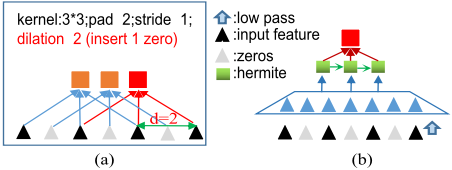
Apparently, if we define the receptive field of one element in layer F l+1 as a subset elements in the preceding layer F l , then it drives the receptive field of each element in F l+1 with (2l+2 -1)×(2l+2 -1). However, the standard dilation convolution may introduce the artifacts caused by the aliasing effect (i.e., insert zeros into input features. Fig.2 (a)). This would hinder the learning of fine-grained features in dense prediction. For this, we propose to apply Hermite polynomials to address the artifacts, and enable dense interchange amongst local representations in each convolution (see Fig.2 (b)).
3.2 LearningMulti-Scale Spatial Features via Recursive Hermite Polynomials
In dense prediction tasks, many methods preserve the spatial resolution across convolutional layers by cascading dilated convolutional layers with different dilation factors. However, the standard dilated convolution can cause the artifacts which impedes the fine-grained features for boosting the prediction accuracy. To alleviate the artifacts, we apply a sequence of recursive Hermite polynomials to low-pass the high frequency and generate the sub-scale granularity.
Hermite Polynomials Hermite polynomials define a class of orthogonal polynomials that can be applied in signal processing [Rasiah et al., 1997], local image matching [Martens, 2006] and polynomial activations in neural networks [Lokhande et al., 2020; Ge et al., 2018]. Mathematically, the normalized Hermite polynomials can be expressed as
An important property regarding Hermite transformation is the recursive relationship that can be derived from Eq.(3) as
We take advantage of this recursive property to resemble the low-passing filter on fine-grained features so as to produce sub-scale granularity without artifacts.
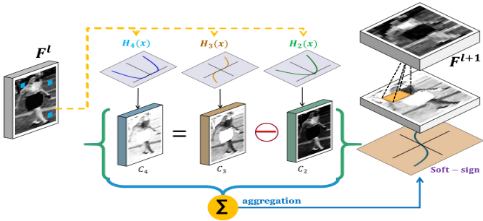
Recursive Hermite Polynomial Networks: RHP-Nets As shown in Fig.1, the core of RHP-Nets is a Hermite polynomial block (HPB). In a single convolutional layer, HPB attends to dilated features, and forwards to polynomial activations to low-pass these features. The nature of recursivity in Hermite polynomials guarantees the reduction on spatial frequency over fine-grained details to combat the aliasing caused by cross-layer dilation convolutions. Then, a combination of resultant sub-scale granular features are fused via a set of trainable Hermite coefficients. Each coefficient corresponds to one order of Hermite polynomials. Mathematically, the proposed HPB operation is expressed as
where Hn(·) is computed using Eq. (3). Cn stands for the Hermite coefficient corresponding to the order-n polynomial Hn, (n = 0, . . . ,N). σ(a) = a 1+|a| represents the soft-sign function, which plays the role of suppressing the unbounded activations associated with higher-order polynomials [Glorot et al., 2011]. Intuitively, a set of Hermite polynomial transformations amounts to steerable filters for extracting finegrained features and low-pass them during the scaling. The recursive relationship between Hermite polynomials can reduce the high spatial frequency as the order of polynomials increases. After the removal of high frequent features, we propose an aggregation scheme to fuse these sub-scale representations. We cast Cn to be trainable parameters such that features at different orders are pooled for multi-scale representations. It also ensures that a set of Hermite polynomials are recursive on spatial dimensions without losing the spatial accuracy. Finally, the entire sub-scale features with granularity are aggregated and fed into the next layer .
3.3 Relationship to ExistingMethods
At first glance, our method looks similar to PConv [Wang et al., 2020] and SDC [Schuster et al., 2019] in the sense of using dilation to preserve the spatial resolution. However, our method shows clear distinctions in two folds. First, PConv [Wang et al., 2020] and SDC [Schuster et al., 2019] utilize a sequence of dilated convolutions to produce a multi-scale response, which can incur the artifacts caused by the aliasing problem [Gong and Poellabauer, 2018]. Unfortunately, both PConv [Wang et al., 2020] and SDC [Schuster et al., 2019] cannot solve this issue. To circumvent this, in this paper we employ the Hermite polynomials to recursively produce subscale features within each convolution, during which the same spatially contextual features are sub-sampled to produce the sub-scale output without artifacts. Second, they stack convolutional outputs from each branch, which has limitation in fusing local features. Instead, we aggregate the sub-scale granular features via trainable Hermite coefficients, which allows every local information interchange at all layers.
3.4 Instantiation
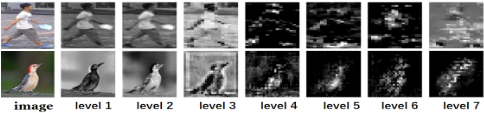
The proposed RHP-Nets have 7 computational levels in total, denoted as Ll, l = 1, . . . , 7. The network has residual connection analogous to ResNet [He et al., 2016] as the basic module of Conv-BN-ReLU. Each image is resized to be 224×224×3, and the output is 112×112×32 after level 1. We remove the max-pooling by replacing it by convolutional filters. The max-pooling operation leads to high-frequency activations that can be propagated to higher layers [Yu et al., 2017]. The max-pooling is only applied in the last level to produce the output of size 14×14. To improve computational efficiency, we adopt a transition layer between the last convolution and the fully-connected layer. The transition layer is composed of a 1×1 convolution followed by a 2×2 average pooling. Finally, a fully-connected layer is added, followed by a classification task using the soft-max function. The HPB is plugged into the network, e.g., ResNet [He et al., 2016] from level 4 to level 7 nested into the 3×3 convolution, where the dilation rates are set d = {2, 4, 2, 1}, from L4 to L7, respectively. In this way, we achieve the spatial accuracy across convolutions to benefit dense prediction.
To produce sub-scale granular features without artifacts, we realize the spatial frequency inside each layer by compositing Hermite polynomials into the dilated grids. This leads to the proposed RHP-Nets by simultaneously achieving the multi-scale representations with high spatial variance and the sub-scale features for boosting dense prediction. The activations on each level are shown in Fig.3. Note that batch normalization is applied before the Hermite polynomial transformation. We tune the choice of the number of Hermite polynomials N by N ∈ {0, 2, 4, 6, 8} in our ablation study. In all experiments, we set N = 4 as default.
4 Experiments
4.1 Object Localization
Dataset and Evaluation Metrics We use the CaltechUCSD Birds-200-2011 (CUB) [Wah et al., 2010] as the benchmark dataset. CUB consists of 200 classes with 5,994 training and 5,794 testing images. We adopt the MaxBoxAcc as the evaluation metric to measure the accuracy between the predicted box and the ground-truth box [Choe et al., 2020]. Given the ground truth box B, the box accuracy at score map threshold τ and IoU threshold δ, BoxAcc(τ, δ) is defined as: BoxAcc(τ, δ) = 1M ∑m 1IoU(box(s(X(m) ),τ),B(m) )≥δ , where box(s(X(m) ), τ)) is the tightest box around the connected component of the mask {(i, j)|s(X(m) ij ) ≥ τ}, s(·) is a scoring function thresholding it at τ, and X(m) ij denotes a pixel in an image X ∈ RH×W . Then, the maximal box accuracy is MaxBoxAcc(δ) := maxτ BoxAcc(τ, δ). We also adopt the top-1 classification/localization as evaluation metrics.
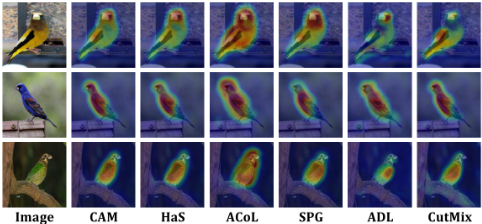
Implementation Details We train our method in fullysupervised setting where each image has full supervision either in a bounding box or binary mask. We consider a foreground saliency mask predictor [Liu et al., 2010], where each pixel is trained with the binary cross-entropy loss against the target mask. The mask is built by labeling pixels inside the ground truth boxes as foreground. To demonstrate the compatibility of our method to different score functions, we set our network as an architecture for classification, and combine with different localization methods: CAM [Zhou et al., 2016], SPG [Zhang et al., 2018b], HaS [Singh and Lee, 2017], ACoL [Zhang et al., 2018a], ADL [Choe and Shim, 2019] and CutMix [Yun et al., 2019]. MaxBoxAcc measures the performance at a fixed IoU threshold δ = 0.5.
Experimental Results Our localization results are shown in Fig. 4. We compare our approach with two recent multiresolution based methods for dense prediction tasks, i.e., Inception-4v [Szegedy et al., 2016] and SDC [Schuster et al., 2019]. The results in Table 1 show that our method achieves consistently performance gain on three measures in the combination with six object localization methods. Though the multi-branch method SDC [Schuster et al., 2019] shows its effectiveness in combining with HaS [Singh and Lee, 2017] and ACoL [Zhang et al., 2018a], it has ignorance to finegrained features which should be explored to boost the pixelwise dense prediction on objects.
4.2 Semantic Segmentation
Dataset and Evaluation Metric We use the Cityscapes dataset [Cordts et al., 2016], which contains 5,000 images recorded from street scenes in 50 different cities. Each image has high quality pixel-level annotations. The dataset is annotated with 30 categories, and 19 categories are used for training and evaluation. The training, validation and test set contains 2975, 500, and 1525 images, respectively. In our experiment, the mean of class-wise intersection over union (mIoU) is reported.
Implementation Details The proposed HPB can be integrated with a CNN by simply injecting the polynomial block into the series of convolutional layers. To highlight the effect of Hermite orders, we combine the DenseNet [Huang et al., 2017] with HPB (called D-HPB), i.e., each resolution recursively passes the Hermite polynomials. Data augmentation is performed with random horizontal flipping, cropping and scaling.
| Network | Score function | MBA | Top-1 loc | Top-1 cls |
|---|---|---|---|---|
| Inception | CAM | 56.7 | 40.4 | 61.8 |
| HaS | 53.4 | 55.6 | 70.9 | |
| ACoL | 56.2 | 44.8 | 56.1 | |
| SPG | 55.9 | 44.9 | 58.8 | |
| ADL | 58.8 | 39.2 | 33.1 | |
| CutMix | 57.5 | 48.3 | 70.2 | |
| CAM | 63.0 | 56.1 | 58.4 | |
| SDC | HaS | 64.6 | 60.7 | 74.5 |
| ACoL | 66.4 | 57.8 | 64.0 | |
| SPG | 60.4 | 51.5 | 37.8 | |
| ADL | 58.3 | 41.1 | 32.7 | |
| CutMix | 62.8 | 54.5 | 32.7 | |
| CAM | 67.1 | 57.2 | 69.8 | |
| HaS | 66.2 | 60.5 | 76.1 | |
| ACoL | 65.1 | 57.9 | 78.0 | |
| RHP-Nets | SPG | 63.0 | 60.4 | 78.8 |
| ADL | 60.1 | 44.0 | 67.0 | |
| CutMix | 67.0 | 60.7 | 74.2 |
| Backbone | #param. | mIoU |
|---|---|---|
| D-ResNet-50 | 49.5M | 59.7 |
| D-ResNet-101 | 68.5M | 62.4 |
| D3Net-S | 9.7M | 65.1 |
| D3Net-L | 38.7M | 68.1 |
| D-HPB (Ours) | 37.2M | 70.2 |
| D-HPB-Light (Ours) | 9.2M | 72.3 |
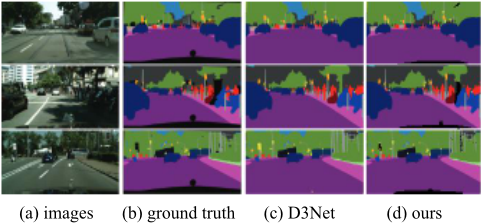
Experimental Results Results in Fig. 5 show that our method achieves superior segmentation performance. Learning to produce sub-scale features as the multi-resolution representations is beneficial to semantic segmentation by leveraging both global and fine-grained information. To thoroughly study the effect of Hermite orders, we consider a variant model that is different in using dilation convolution. The backbones include Dilated-ResNet-50(-101) [Yu et al., 2017] and D3Net-S(-L) [Takahashi and Mitsufuji, 2021]. Experimental results are reported in Table 2. D-HPB-Light is a light version by using the channel-reduction mechanism [Huang et al., 2017] to improve the efficiency. Although D3Net [Takahashi and Mitsufuji, 2021] can address the aliasing problem by adjusting the dilation factors, the receptive fields are enlarged repeatedly, leading to an exponentially growing receptive field in almost all layers. In contrast, we design the pluggable polynomial activation as the low-passing filter which is computational efficient.
4.3 Object Detection onMS COCO
The MS COCO dataset [Lin et al., 2014] has 80 categories, which contains 115k images for training (train2017), 5k images for validation (val2017), and 20k images for testing (test-dev). We train the model on train2017, and report the results on test-dev. All reported results follow standard COCOstyle Average Precision (AP) metrics.
Implementation Details All experiments are implemented based on mmdetecton [Chen et al., 2018a]. Following [Lin et al., 2017a], the shorter sizes of input images are resized to 800 pixels. For a fair comparison, we re-implement the following detectors equipped with the backbone ResNet-101FPN [Lin et al., 2017a]: RetinaNet [Lin et al., 2017b], FasterR-CNN [Ren et al., 2015], Libra-R-CNN [Pang et al., 2019], Grid-R-CNN [Lu et al., 2019], and Mask-R-CNN [He et al., 2017]. Another two backbones with dilation convolution are D-ResNet-50(-101) [Yu et al., 2017] and D3Net-S(-L) [Takahashi and Mitsufuji, 2021]. We also consider a SOTA object detection method, i.e., DeepLabV3 [Chen et al., 2018b] backboned on D-ResNet-50(-101).
Experimental Results Comparison results on MS COCO are shown in Table 3. We have the following observations: 1) Using the proposed RHP-Nets as the backbone, contemporary detectors can achieve superior performance. For example, by replacing FPN with RHP, Mask-R-CNN using ResNet-101 as backbone (denoted as ResNet-101-RHP) achieves 46.1 AP, which is 7.5 point higher than MaskR-CNN based on ResNet-101-FPN. This clearly shows the importance of the proposed RHP in object detection. 2) Comparing with the detectors that are backboned on dilated CNNs, i.e., D-ResNet-50(-101) and D3Net-S(-L), our method can still improves the performance. For example, when using Faster-R-CNN based on DenseNet+RHP, our performance is 46.3 AP, whilst Faster-R-CNN with D3Net-S achieves 45.3. 3) Comparing with DeepLabV3 [Chen et al., 2018b] based on D-ResNet-101 [Yu et al., 2017], our method can effectively address the aliasing problem caused by the atrous convolution, thus improves the object detection performance. For example, Faster-R-CNN [Ren et al., 2015] (backboned on ResNet-101+RHP) improves AP by 0.7 in comparing with DeepLabV3 [Chen et al., 2018b].
4.4 Multi-scale PersonMatching
Dataset and Evaluation Metrics PRW [Zheng et al., 2017] is a person search benchmark. The dataset contains a total of 11,816 video frames and 43,100 person bounding boxes. The training set has 482 different identities from 5,704 raw video frames and the testing set has 2,057 probe IDs along with a gallery repository of 6,122 images. The resolutions of PRW range from 58 × 21 to 777 × 574, which is a challenging multi-scale matching problem. Hence, this dataset presents the intrinsic multi-scale challenge. These detected person bounding boxes are determined by employing the Faster-R-CNN [Ren et al., 2015], due to its excellence in detecting varying sized objects in unconstrained scenes. Thereby, it is only necessary to evaluate the performance of our method and state-of-the-arts (SOTAs) on this task. We adopt the widely used protocols: Cumulative Matching Characteristic (CMC) and mean Average Precision (mAP).
ImplementationDetails All person bounding boxes are resized to 256×128 pixels. To have fair comparison with existing methods ([Lan et al., 2018; Zheng et al., 2017]), we use both annotated and detected boxes to train the identity matching loss. The learning rate is initialized to be 0.001, and the warming up skill is applied by reducing the learning rate as more epochs. Each image is randomly erased with a region to reduce the over-fitting effect.
Experimental Results We compared our method with several SOTA methods in person search: OIM [Xiao et al., 2017], NPSM [Liu et al., 2017], CWS [Zheng et al., 2017], Cross-Level Semantic Alignment (CLSA) [Lan et al., 2018], MuDeep [Qian et al., 2017], PPS [Shen et al., 2019] and CMSNet [Fan et al., 2020]. Besides, we compare with recent multi-scale learning methods that can be applied into person search: FPN [Lin et al., 2017a] and PConv [Wang et al., 2020]. We use the code released by the authors. Comparison results on rank-1, -5, -10 and mAP values are reported in Table 4. It can be seen that our method achieves consistent improvement over STOAs in CMC values and mAP. It also shows that most of skip connection methods align the features to leverage coarse-to-fine details so as to improve the person matching. Though these methods help, they lack explicit mechanisms to fuse diverse information from different scales into the same representation. The family of multibranch methods, i.e., PConv [Wang et al., 2020] and CMSNet [Fan et al., 2020], can combat this problem by aggregating scale characteristics into one convolutional layer. In stark contrast, our approach constructs spatial polynomials to encode the fine-grained structure. Therefore, multi-scale spatial representations are helpful in multi-scale person search, which requires fine-grained details.
| Method | Backbone | AP | AP50 | AP75 | APS | APM | APL |
|---|---|---|---|---|---|---|---|
| RetinaNet | ResNet-101-FPN | 39.1 | 59.1 | 42.3 | 21.8 | 42.7 | 50.2 |
| Faster-R-CNN | ResNet-101-FPN | 36.3 | 59.1 | 42.3 | 21.8 | 42.7 | 50.2 |
| Libra-R-CNN | ResNet-101-FPN | 40.3 | 61.3 | 43.9 | 22.9 | 43.1 | 51.0 |
| Grid-R-CNN | ResNet-101-FPN | 41.5 | 60.9 | 44.5 | 23.3 | 44.9 | 53.1 |
| Mask-R-CNN | ResNet-101-FPN | 38.2 | 60.3 | 41.7 | 20.1 | 41.1 | 50.2 |
| DeepLabV3 | D-ResNet-50 | 45.2 | 63.7 | 47.7 | 25.4 | 46.9 | 55.8 |
| DeepLabV3 | D-ResNet-101 | 45.4 | 63.8 | 48.1 | 26.0 | 47.0 | 55.9 |
| Faster-R-CNN | D3Net-S | 45.3 | 65.0 | 49.8 | 28.7 | 49.2 | 57.4 |
| Faster-R-CNN | D3Net-L | 45.6 | 65.1 | 49.8 | 29.1 | 49.6 | 57.3 |
| Faster-R-CNN | ResNet-101+RHP | 46.1 | 66.0 | 51.4 | 31.7 | 50.8 | 58.4 |
| Mask-R-CNN | ResNet-101+RHP | 45.7 | 65.2 | 51.0 | 31.4 | 50.6 | 58.2 |
| Faster-R-CNN | DenseNet+RHP | 46.3 | 66.7 | 51.5 | 31.4 | 50.0 | 57.4 |
| Mask-R-CNN | DenseNet+RHP | 46.1 | 65.4 | 51.4 | 31.2 | 50.1 | 57.3 |
| Method | Rank-1 | Rank-5 | Rank-10 | mAP |
|---|---|---|---|---|
| OIM | 49.9 | 85.1 | 89.6 | 21.3 |
| NPSM | 53.1 | 85.2 | 87.7 | 24.2 |
| IDE + CWS | 45.5 | 84.1 | 89.6 | 18.3 |
| Skip-Connection FPN | 53.4 | 86.4 | 90.8 | 31.9 |
| MuDeep | 55.7 | 84.2 | 87.9 | 37.9 |
| CLSA | 65.0 | 88.7 | 88.1 | 38.7 |
| PPS | 72.8 | 84.6 | 89.8 | 48.7 |
| PConv | 68.2 | 82.5 | 85.0 | 41.1 |
| Dilation CMSNet | 70.6 | 86.7 | 89.7 | 42.7 |
| SDC | 73.1 | 86.7 | 90.4 | 46.8 |
| RHP-Nets | 80.7 | 91.2 | 92.7 | 57.5 |
4.5 Ablation Study
In this section, we examine the impact of Hermite polynomial orders and the quality of the learned spatial representations.
The Orders of Hermite Polynomials for Scaling
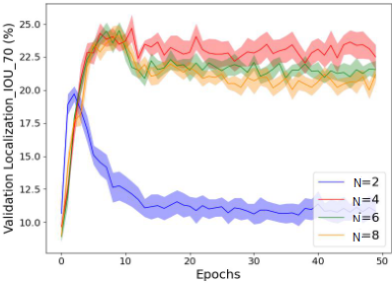
In this experiment, we empirically determine the number of Hermite polynomials. To observe the effects of using varied orders, we use the measure of IoU on localization validation set of CUB dataset. In Fig. 6, we evaluate the IoU with 70%, 50%, 30% of validation set and calculate the average of the above values. We observe that setting the polynomial order to be N = 4 is enough to achieve higher accuracy on localization. Thus, we set N = 4 as default in all our experiments.
How Goodness of Learned Spatial Representations?
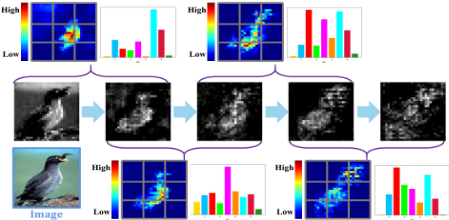
In this experiment, we validate the quality of spatial representations empirically. To show this quantitatively, we use the spatial relevance to qualify the degree of spatial variance across levels. The spatial relevance [Chiu et al., 2013] is defined as S(ϵx, ϵy) = <I(x,y),I(x+ϵx,y+ϵy)> <I(x,y),I(x,y)> , where we set the offsets ϵx and ϵy along the x and y axis, respectively. As shown in Fig. 7, the spatial statistics in 9 bins across levels of our RHP-Nets show that we preserve the high spatial resolution entire the network.
5 Conclusion
In this paper, we show the importance of multi-scale spatial representations with granularity in dense prediction tasks and propose a novel architecture called RHP-Nets. We present a network that considers a large context region with high spatial variance across layers, and yet fine-grained feature with granularity within a convolution to aggregate the multiple resolutions. These properties are achieved by applying dilated convolutions across deep layers of CNNs and a family of Hermite polynomials inside a layer to address the artifacts caused by the standard dilation. Extensive experiments in a variety of image recognition tasks confirm the effectiveness of the proposed method.
Acknowledgements
This project was partially funded by NSFC U19A2073, 62002096 and the Co-operative Innovation Project of Colleges in Anhui (GXXT-2019-025).
@inproceedings{ijcai2022p204,
  title     = {Multi-scale Spatial Representation Learning via Recursive Hermite Polynomial Networks},
  author    = {Wu, Lin (Yuanbo) and Liu, Deyin and Guo, Xiaojie and Hong, Richang and Liu, Liangchen and Zhang, Rui},
  booktitle = {Proceedings of the Thirty-First International Joint Conference on
               Artificial Intelligence, {IJCAI-22}},
  publisher = {International Joint Conferences on Artificial Intelligence Organization},
  editor    = {Luc De Raedt},
  pages     = {1465--1473},
  year      = {2022},
  month     = {7},
  note      = {Main Track},
  doi       = {10.24963/ijcai.2022/204},
  url       = {https://doi.org/10.24963/ijcai.2022/204},
}
TY - CPAPER TI - Multi-scale Spatial Representation Learning via Recursive Hermite Polynomial Networks AU - Wu, Lin (Yuanbo) AU - Liu, Deyin AU - Guo, Xiaojie AU - Hong, Richang AU - Liu, Liangchen AU - Zhang, Rui T2 - Proceedings of the Thirty-First International Joint Conference on Artificial Intelligence, IJCAI-22 PB - International Joint Conferences on Artificial Intelligence Organization PY - 2022 SP - 1465 EP - 1473 DO - 10.24963/ijcai.2022/204 UR - https://doi.org/10.24963/ijcai.2022/204 ER -Copied
Machine-readable versions of this paper, for tools and AI agents:





