
Eliminating Backdoor Triggers for Deep Neural Networks Using Attention Relation Graph Distillation
Proceedings of the Thirty-First International Joint Conference on Artificial Intelligence. Main Track. Pages 1481-1487.
https://doi.org/10.24963/ijcai.2022/206
Keywords
- Machine Learning: Adversarial Machine Learning
- Multidisciplinary Topics and Applications: Security and Privacy
- Computer Vision: Adversarial learning, adversarial attack and defense methods
Abstract
Due to the prosperity of Artificial Intelligence (AI) techniques, more and more backdoors are designed by adversaries to attack Deep Neural Networks (DNNs). Although the state-of-the-art method Neural Attention Distillation (NAD) can effectively erase backdoor triggers from DNNs, it still suffers from non-negligible Attack Success Rate (ASR) together with lowered classification ACCuracy (ACC), since NAD focuses on backdoor defense using attention features (i.e., attention maps) of the same order. In this paper, we introduce a novel backdoor defense framework named Attention Relation Graph Distillation (ARGD), which fully explores the correlation among attention features with different orders using our proposed Attention Relation Graphs (ARGs). Based on the alignment of ARGs between teacher and student models during knowledge distillation, ARGD can more effectively eradicate backdoors than NAD. Comprehensive experimental results show that, against six latest backdoor attacks, ARGD outperforms NAD by up to 94.85% reduction in ASR, while ACC can be improved by up to 3.23%.
- [Adi et al., 2018] Yossi Adi, Carsten Baum, Moustapha Cissé, Benny Pinkas, and Joseph Keshet. Turning your weakness into a strength: Watermarking deep neural net- works by backdooring. In USENIX Security Symposium, 2018.
- [Bryant et al., 2019] Chen Bryant, Carvalho Wilka, Bara- caldo Nathalie, Ludwig Heiko, Edwards Benjamin, Lee Taesung, Molloy Ian, and Srivastava Biplav. Detecting backdoor attacks on deep neural networks by activation clustering. In AAAI, pages 39-57, 2019.
- [Carlini and Wagner, 2017] Nicholas Carlini and David Wagner. Towards evaluating the robustness of neural networks. In IEEE S&P, pages 39-57, 2017.
- [Chen et al., 2017] Xinyun Chen, Chang Liu, Bo Li, Kim- berly Lu, and Dawn Song. Targeted backdoor attacks on deep learning systems using data poisoning. arXiv preprint arXiv:1712.05526, 2017.
- [Chou et al., 2020] Edward Chou, Florian Tramèr, and Gi- ancarlo Pellegrino. Sentinet: Detecting localized universal attacks against deep learning systems. In IEEE S&P Work- shops, pages 48-54, 2020.
- [Gu et al., 2019] Tianyu Gu, Kang Liu, Brendan Dolan- Gavitt, and Siddharth Garg. Badnets: Evaluating back- dooring attacks on deep neural networks. IEEE Access, 7:47230-47244, 2019.
- [He et al., 2016] Kaiming He, Xiangyu Zhang, Shaoqing Ren, and Jian Sun. Deep residual learning for image recog- nition. In CVPR, pages 770-778, 2016.
- [Komodakis and Zagoruyko, 2017] Nikos Komodakis and Sergey Zagoruyko. Paying more attention to attention: im- proving the performance of convolutional neural networks via attention transfer. In ICLR, 2017.
- [Li et al., 2020a] Yige Li, Xixiang Lyu, Nodens Koren, Lingjuan Lyu, Bo Li, and Xingjun Ma. Neural attention distillation: Erasing backdoor triggers from deep neural networks. In ICLR, 2020.
- [Li et al., 2020b] Yiming Li, Tongqing Zhai, Baoyuan Wu, Yong Jiang, Zhifeng Li, and Shutao Xia. Rethink- ing the trigger of backdoor attack. arXiv preprint arXiv:2004.04692, 2020.
- [Liu et al., 2017] Yingqi Liu, Shiqing Ma, Yousra Aafer, Wen-Chuan Lee, Juan Zhai, Weihang Wang, and Xiangyu Zhang. Trojaning attack on neural networks. In NDSS, 2017.
- [Liu et al., 2019] Yufan Liu, Jiajiong Cao, Bing Li, Chun- feng Yuan, Weiming Hu, Yangxi Li, and Yunqiang Duan. Knowledge distillation via instance relationship graph. In CVPR, pages 7096-7104, 2019.
- [Liu et al., 2020] Yunfei Liu, Xingjun Ma, James Bailey, and Feng Lu. Reflection backdoor: A natural backdoor attack on deep neural networks. In ECCV, pages 182-199, 2020.
- [Papernot et al., 2016] Nicolas Papernot, Patrick McDaniel, Xi Wu, Somesh Jha, and Ananthram Swami. Distillation as a defense to adversarial perturbations against deep neu- ral networks. In IEEE S&P, pages 582-597, 2016.
- [Pau et al., 2020] Rodríguez Pau, Dorta Diego, Velazquez, Cucurull Guillem, M. Gonfaus Josep, Roca F. Xavier, and Gonzàlez Jordi. Pay attention to the activations: A mod- ular attention mechanism for fine-grained image recogni- tion. IEEE TM, 22(2):502-514, 2020.
- [Pei et al., 2021] Yulong Pei, Yanyun Qu, and Junping Zhang. Self-boosting for feature distillation. In IJCAI, 2021. IJCAI
- [Pirsiavash et al., 2009] Hamed Pirsiavash, Deva Ramanan, and Charless C Fowlkes. Bilinear classifiers for visual recognition. In NIPS, 2009.
- [Ren et al., 2021] Jie Ren, Mingjie Li, Zexu Liu, and Quan- shi Zhang. Interpreting and disentangling feature compo- nents of various complexity from DNNs. In ICML, 2021.
- [Song et al., 2021] Yunfei Song, Tian Liu, Tongquan Wei, Xiangfeng Wang, Zhe Tao, and Mingsong Chen. FDA 3 : Federated defense against adversarial attacks for cloud- based iiot applications. IEEE TII, 17:7830-7838, 2021.
- [Tran et al., 2018] Brandon Tran, Jerry Li, and Aleksander Madry. Spectral signatures in backdoor attacks. In NeurIPS, 2018.
- [Turner et al., 2018] Alexander Turner, Dimitris Tsipras, and Aleksander Madry. Clean-label backdoor attacks. https: //people.csail.mit.edu/madry/lab/, 2018. Accessed: 2018- 09-27. Link
- [Wang et al., 2019] Bolun Wang, Yuanshun Yao, Shawn Shan, Huiying Li, Bimal Viswanath, Haitao Zheng, and Ben Y Zhao. Neural cleanse: Identifying and mitigating backdoor attacks in neural networks. In IEEE S&P, pages 707-723, 2019.
- [Wenger et al., 2021] Emily Wenger, Josephine Passananti, Arjun Nitin Bhagoji, Yuanshun Yao, Haitao Zheng, and Ben Y. Zhao. Backdoor attacks against deep learning sys- tems in the physical world. In CVPR, pages 6206-6215, 2021.
- [Zhao et al., 2020] Pu Zhao, Pin-Yu Chen, Payel Das, Karthikeyan Natesan Ramamurthy, and Xue Lin. Bridg- ing mode connectivity in loss landscapes and adversarial robustness. In ICLR, 2020.
- [Zhong et al., 2020] Haoti Zhong, Cong Liao, Cinzia Squic- ciarini, Anna, Sencun Zhu, and Miller David. Backdoor embedding in convolutional neural network models via in- visible perturbation. In CODASPY, pages 97-108, 2020.
References were extracted automatically from the PDF and may contain errors.
Full text extracted automatically from the PDF; figures, tables and equations may differ. The PDF is the version of record.
1 Introduction
Along with the proliferation of Artificial Intelligence (AI) techniques, Deep Neural Networks (DNNs) are increasingly deployed in various safety-critical domains, e.g., autonomous driving, commercial surveillance, and medical monitoring. Although DNNs enable both intelligent sensing and control, more and more of them are becoming the main target of adversaries. It is reported that DNNs are prone to be attacked by potential threats in different phases of their life cycles [Song et al., 2021]. For example, due to biased training data or overfitting/underfitting models, at test time a tiny input perturbation made by some adversarial attack can fool a given DNN and result in incorrect or unexpected behaviors [Carlini and Wagner, 2017], which may cause disastrous consequences. As another type of notoriously perilous adversaries, backdoor attacks can inject Trojan in DNNs on numerous occasions, e.g., collecting training data from unreliable sources, and downloading pre-trained DNNs from untrusted parties.
Typically, by poisoning a small portion of training data, backdoor attacks aim to trick DNNs into learning the correlation between trigger patterns and target labels. Rather than affecting the performance of models on clean data, backdoor attacks may cause incorrect prediction at test time when some trigger pattern appears [Wenger et al., 2021].
Compared with traditional adversarial attacks, backdoor attacks have gained more attentions, since they can be easily implemented in real scenarios [Chen et al., 2017; Gu et al., 2019]. Currently, there are two major kinds of mainstream backdoor defense methods. The first one is the detectionbased methods that can identify whether there exists a backdoor attack during the training process. Although these approaches are promising in preventing DNNs from backdoor attacks, they cannot fix models implanted with backdoor triggers. The second one is the erasing-based methods, which aims to eliminate backdoors by purifying the malicious impacts of backdoored models. In this paper, we focus on the latter case. Note that, due to the concealment and imperceptibility of backdoors, it is hard to fully purify backdoored DNNs. Therefore, our goal is to further lower Attack Success Ratio (ASR) on backdoored data without sacrificing the classification ACCuracy (ACC) on clean data.
Neural Attention Distillation (NAD) [Li et al., 2020a] has been recognized as the most effective backdoor erasing method so far, which is implemented based on finetuning and distillation operations. Inspired by the concept of attention transfer [Komodakis and Zagoruyko, 2017], NAD utilizes a teacher model to guide the finetuning of a backdoored student model using a small set of clean data. Note that the teacher model is obtained by finetuning the student model using the same set of clean data. By aligning intermediate-layer attention features of the student model with their counterparts in the teacher model, backdoors can be effectively erased from DNNs. In NAD, an attention feature represents the activation information of all neurons in one layer. Therefore, the conjunction of all the feature attentions within a DNN can reflect the most discriminative regions in the model's topology [Pau et al., 2020].
Although the attention mechanism can be used as an indicator to evaluate the performance of backdoor erasing methods, the implementation of NAD strongly limits the expressive power of attention features, since it only compares the feature attentions of the same order during the finetuning. Unfortunately, the correlation among attention features of different orders [Liu et al., 2019; Ren et al., 2021] is totally ignored. The omission of such salient features in finetuning may result in a "cliff-like" decline in defending backdoor attacks [Komodakis and Zagoruyko, 2017]. In this paper, we propose a novel backdoor erasing framework named Attention Relation Graph Distillation (ARGD), which fully considers the correlation of attention features of different orders. This paper makes the following three major contributions:
- We propose Attention Relation Graphs (ARGs) to fully reflect the correlations among attention features of different orders, which can be combined with distillation to erase more impacts of backdoor triggers from DNNs.
- We define three loss functions for ARGD, which enable effective alignment of the intermediate-layer ARG of a student model with that of its teacher model.
- We conduct comprehensive experiments on various well-known backdoor attacks to show the effectiveness and efficiency of our proposed defense method.
2 RelatedWork
2.1 Backdoor Attacks
We are witnessing more and more DNN-based backdoor attacks in real environment [Adi et al., 2018]. Typically, a backdoor attack refers to designing a trigger pattern injected into partial training data with (poisoned-label attack [Gu et al., 2019]) or without (clean-label attack [Liu et al., 2020]) a target label. At test time, such backdoor patterns can be triggered to control the prediction results, which may result in incorrect or unexpected behaviors. Aiming at increasing ASR without affecting ACC, extensive studies [Li et al., 2020b] have been investigated to design specific backdoor triggers. Existing backdoor attacks can be classified into two categories, i.e., observable backdoor attacks, and imperceptible backdoor attacks [Turner et al., 2018]. Although the observable backdoor attacks have a profound impact on DNNs, the training data with changes by such attacks can be easily identified. As an alternative, the imperceptible backdoor attacks (e.g., natural reflection [Liu et al., 2020] and human imperceptible noises [Zhong et al., 2020]) are more commonly used in practice.
2.2 Backdoor Defense
The mainstream backdoor defense approaches can be classified into two major types. The first one is the detection-based methods, which can identify backdoors from DNNs during the training [Bryant et al., 2019] or filter backdoored training data to eliminate the influence of backdoor attacks [Chou et al., 2020]. Note that few of existing detection-based methods can be used to purify backdoored DNNs. The second one is the elimination-based approaches [Wang et al., 2019; Pei et al., 2021]. Based on a limited number of clean data, such methods can erase backdoors by finetuning the backdoored DNNs. Although various elimination-based approaches [Li et al., 2020a; Zhao et al., 2020] have been extensively investigated, so far there is no method that can fully purify the backdoored DNNs. Most of them are still striving to improve ASR and ACC from different perspectives. For example, the Neural Attention Distillation (NAD) method adopts attention features of the same order to improve backdoor elimination performance based on finetuning and distillation operations. However, NAD suffers from non-negligible ASR. This is because NAD focuses on the alignment of feature attentions of the same order, thus the expressive power of attention features is inevitably limited.
To the best of our knowledge, ARGD is the first attempt that takes the correlation of attention features into account for the purpose of eliminating backdoor from DNNs. Based on our proposed ARGs and corresponding loss functions, ARGD can not only reduce the ASR significantly, but also improve the ACC on clean data.
3 Our ARGDApproach
As the state-of-the-art elimination-based backdoor defense method, NAD tries to suppress the impacts of backdoor attacks based on model retraining (finetuning) and knowledge distillation of backdoored models. Based on clean retraining data, NAD can effectively erase backdoor by aligning the intermediate-layer attention features between teacher and student models. However, due to the privacy issues or various access restrictions, in practice such clean data for finetuning only accounts for a very small proportion of the data required for model training. This strongly limits the defense performance of NAD, since NAD focuses on the alignment of attention features of the same orders, while the relation of transforms between attention features is totally ignored. As a result of limited retraining data, it is hard to guarantee the ASR and ACC performance for NAD.
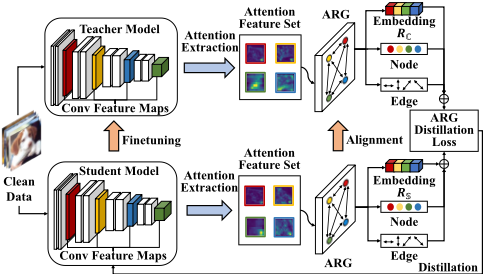
To address the ASR and ACC issues posed by NAD, we introduce a novel knowledge distillation method named ARGD as shown in Figure 1, which fully considers the correlations between attention features using our proposed ARGs for backdoor defense. This figure has two parts, where the upper part denotes both the teacher model and its extracted ARG information. The teacher model is trained by the finetuning of the backdoored student model using the provided clean data. The lower part of the figure presents the student model, which needs to be finetuned by aligning its ARG to the one of the teacher model. We use the ARG distillation loss for knowledge distillation, which takes the combination of node, edge and embedding correlations into account. The following subsections will introduce the key components of our approach in detail.
3.1 Attention Relation Graph
Inspired by the instance relation graph introduced in [Liu et al., 2019], we propose ARGs to enable the modeling of knowledge transformation relation between attention features and facilitate the alignment of defense structures against backdoor from student models to teacher models. Unlike instance relation graphs that are established based on the regression accuracy of image instances, for a given input data, an ARG of is built on top of the model's attention features within different orders. In our approach, we assume that the finetuned teacher model by clean data has a benign knowledge structure represented by its ARGs, which fully reflects the correlations between its attention features of different orders. Therefore, we use ARGs to guide the finetuning of backdoored student model during the knowledge distillation by aligning the ARGs of the backdoored student model to its counterparts of the teacher model. Given an input data, the ARG of a model can be modeled as a complete graph formalized by a 2-tuple G = (N, ε), where N represents the node set and ε denotes the edge set. Here, each node in N represents an attention feature with a specific order, and each edge in ε indicates the similarity between two nodes.
ARG Nodes
Given a DNN model M and an input data X, we define the pth convolutional feature map of M as F p = M p (X), which is an activation map having the three dimensions of channel index, width and height. By taking the 3-dimensional F p as an input, the attention extraction operation A outputs a flattened 2-dimensional tensor T pM representing the extracted attention feature. Let C, H, W denote the number of channels, height, and width of input tensors, respectively. Essentially, the attention extraction operation can be formulated as a function AM : RC×H×W → RH×W defined as follows:
where C is the number of channels of F p , and F p i indicates the ith channel of F p . By applying AM on F p , we can obtain the attention feature of F p , which is denoted as an ARG node with an order of p. Assuming that the model M has k convolutional feature maps, based on AM we can construct a node set N = {T 1M , T 2M , ..., T pM , ..., T kM }. Note that in practice we only use a subset of N to construct ARGs.
ARG Edges
After figuring out the node set to construct an ARG, we need to construct a complete graph, where the edge set (i.e., ε = ⋃ki=1 ⋃kj=1 {eij }) indicates the correlations between attention features of different orders in M, where eij indicates the edge between T iM and T jM . Let EM be an weight function of edges in the form of EM : ε → R, where EijM = EM(eij ) denotes the Euclidean distance between two attention features T iM and T jM . Assume that the maximum size of T iM and T jM is h × w. Let Γij(Y ) be a function that converts the attention feature Y into a 2-dimensional feature Y ′ with a size of h ×w. EM indicates the correlations between attention features, where the edge weight EijM can be calculated as
3.2 ARGEmbedding
To facilitate the alignment from a student ARG to its teacher counterpart, we consider the graph embedding for ARGs, where an ARG embedding can be constructed by all the involved attention features within a model. Since the embedding reflects high-dimensional semantic features of all the nodes in an ARG, they can be used to figure out the knowledge dependencies between ARGs of both the teacher and student models. Let C and S be the teacher model and student model, respectively. We construct ARG embedding vectors (i.e., RpC and Rp S ) from the pth attention features of C and S, respectively, based on the following two formulas:
where ψ(·) is the adaptive average pooling function, and σ(·) is the activation function to generate the embedding vectors. Here, W p C and W p S are two linear transformation parameters constructed in the distillation process for the pth attentions feature of the teacher and student models.
By comparing the embedding vectors between the teacher model and the student model, we can figure out the correlation between a student node and all the teacher nodes. In our approach, we use the relation vector βp S to denote the correlations between the pth student node and all the teacher nodes, which is defined as
where wb is the bilinear weight used to convert the underlying relation between different order attention features in distillation [Pirsiavash et al., 2009].
3.3 ARGDistillation Loss
The ARG distillation loss LG is defined as the difference between ARGs. It involves three kinds of differences from different perspectives between the teacher ARG GC and student ARG GS: i) node difference that indicates the sum of distances between node pairs in terms of attention features; ii) edge difference that specifies the sum of distances between edge pairs; and iii) embedding difference that denotes the weighted sum of distances between student-teacher node pairs in terms of embedding vectors. To reflect such differences from different structural perspectives, we define three kinds of losses, i.e., ARG node loss LN, ARG edge loss Lε and ARG embedding loss LEm. Since the weight of an ARG edge indicates the similarity between two nodes with different orders, the ARG edge loss can further enhance the alignment of ARGs between the teacher model and student model. The ARG node loss function is defined as
The ARG node loss LN is essentially a kind of imitation loss, which enables the pixel-level alignment of attention features at same layers from a backdoored student model to its teacher counterpart. The ARG edge loss denotes the difference between two edge sets, which is calculated using
where C 2 k is the combination formula. During the alignment of ARGs, an attention feature of the student model needs to learn knowledge from different attention features of the teacher model. However, the combination of ARG node loss and edge loss cannot fully explore the knowledge structure dependence among attention features between the teacher model and student model. To enable such kind of learning, we propose the ARG embedding loss based on the relation vector, which is defined as
Based on the above three losses, we define the ARG distillation loss LG to support accurate ARG alignment during the knowledge distillation, which is defined as
3.4 Overall Loss for Distillation
Our ARGD method is based on knowledge distillation. To enable the alignment of ARGs during the distillation process, we define the overall loss function of the backdoored DNN as
where LCE is the cross entropy loss between predictions of the backdoored DNN and corresponding target values.
4 Experimental Results
To evaluate the effectiveness of our approach, we implemented our ARGD framework 1 on top of Pytorch (version 1.4.0). All the experiments were conducted on a workstation with Ubuntu operating system, Intel i9-9700K CPU, 16GB memory, and NVIDIA GeForce GTX2080Ti GPU. In this section, we designed comprehensive experiments to answer the following three research questions.
- Q1 (Superiority of ARGD): What are the advantages of ARGD compared with state-of-the-art methods?
- Q2 (Applicability of ARGD): What are the impacts of different settings (e.g., clean data rates, teacher model architectures) on the performance of ARGD?
- Q3 (Benefits of ARGs): Why can our proposed ARGs substantially improve purifying backdoored DNNs?
4.1 Experimental Settings
Backdoor Attacks and Configurations: We conducted experiments using the following six latest backdoor attacks: i) BadNets [Gu et al., 2019], ii) Trojan attack [Liu et al., 2017], iii) Blend attack [Chen et al., 2017], iv) Sinusoidal signal attack (SIG) [Tran et al., 2018], v) Clean Label [Turner et al., 2018], and vi) Reflection attack (Refool) [Liu et al.,
1 Available at https://github.com/BililiCode/ARGD.
2020]. To make a fair comparison against these methods, we adopted the same configurations (e.g., backdoor trigger patterns, backdoor trigger sizes, and target labels for restoring) as presented in their original papers. Based on WideResNet (WRN-16-1) [He et al., 2016] and its variants, we trained DNN models based on the CIFAR-10 dataset using our approach and its six opponents, respectively. Note that here each DNN training for backdoor attacks involves 100 epochs.
Defense Method Settings and Evaluation: We compared our ARGD with three state-of-the-art backdoor defense methods, i.e., traditional finetuning [Papernot et al., 2016], Mode Connectivity Repair (MCR) [Zhao et al., 2020], and NAD [Li et al., 2020a]. Since it is difficult to achieve clean data for the purpose of finetuning in practice, similar to the work presented in [Li et al., 2020a], in our experiments we assumed that all the defense methods can access only 5% of training dataset as the clean dataset by default. We conducted the image preprocessing using the same training configuration of NAD adopted in [Li et al., 2020a]. We set the mini-batch size of all the defense methods to 64, and the initial learning rate to 0.1. For each backdoor defense method, we trained each DNN for 10 epochs for the purpose of erasing backdoor. We adopted the Stochastic Gradient Descent (SGD) optimizer with a momentum of 0.9. Similar to the setting of attack model training, by default we use WideResNet (WRN-16-1) as the teacher model of ARGD for finetuning. However, it does not mean that the structures of both student and teacher models should be the same. In fact, teacher models with different structures can also be applied on ARGD (see Table 3 for more details). During the finetuning, based on the attention extraction operation, our approach can extract attention features of each group of the WideResNet model and form an ARG for the given DNN. We use two indicators to evaluate the performance of backdoor defensemethods: i) Attack Success Rate (ASR) denoting the ratio of succeeded attacks over all the attacks on backdoored data; and ii) the classification ACCuracy (ACC) indicating the ratio of correctly predicted data over all the clean data. Generally, lower ASRs mean better defense capabilities.
4.2 Comparison with State-of-the-Arts
To show the superiority of ARGD, we compared our approach with the three backdoor defense methods against six latest backdoor attacks. Table 1 presents the comparison results. Column 1 presents the name of six backdoor attack methods. Column 2 shows the results for backdoored student models without any defense. Column 3 gives the results for the finetuning methods. Note that here the finetuning method was conducted based on the counterpart teacher model with extra 10 epoch training on the same collected clean data. Columns 4-6 denote the experimental results for MCR, NAD and ARGD, respectively. Column 7 shows the improvements of ARGD over NAD for the six backdoor attacks.
From this table, we can find that ARGD can not only purify the backdoored DNNs effectively, but also have the minimum side effect on clean data. We can observe that, among all the four defense methods, ARGD outperforms the other three defense methods significantly. Especially, ARGD greatly outperforms the state-of-the-art approach NAD from the perspectives of both ASR and ACC. As shown in the last column, compared with NAD, ARGD can reduce the ASR by up to 94.85% and increase the ACC by up to 3.23%. The reason of such improvement is mainly because ARGD takes the alignment of ARGs into account during the finetuning between teacher and student models, while NAD only considers the attention features of the same order during the finetuning. Without considering the structural information of ARGs, the finetuning using attention features can be easily biased, which limits the backdoor erasing capacities of attention features as well as degrades the ACC on clean data.
| Backdoor Attack | Backdoored | Finetuning | MCR (t=0.3) | NAD | ARGD (Ours) | Improvement | ||||||
|---|---|---|---|---|---|---|---|---|---|---|---|---|
| ASR(%) | ACC(%) | ASR(%) | ACC(%) | ASR(%) | ACC(%) | ASR(%) | ACC(%) | ASR(%) | ACC(%) | ASR(%) | ACC(%) | |
| BadNets | 100.00 | 80.08 | 4.56 | 77.16 | 3.12 | 78.99 | 3.62 | 77.98 | 2.10 | 79.81 | 41.99 | 2.35 |
| Trojan | 99.81 | 80.04 | 3.57 | 78.06 | 2.56 | 77.76 | 2.91 | 77.03 | 1.97 | 79.60 | 32.30 | 3.23 |
| Blend | 79.42 | 82.76 | 3.08 | 80.08 | 70.06 | 77.10 | 2.33 | 79.09 | 0.12 | 80.47 | 94.85 | 1.74 |
| SIG | 99.98 | 82.43 | 9.12 | 79.08 | 3.69 | 81.52 | 11.78 | 79.63 | 1.83 | 80.56 | 84.47 | 1.17 |
| Clean Label | 45.94 | 82.43 | 11.42 | 81.24 | 16.56 | 79.25 | 9.56 | 79.66 | 5.32 | 80.18 | 45.14 | 2.98 |
| Refool | 100.00 | 82.22 | 5.96 | 80.23 | 8.94 | 79.99 | 4.02 | 80.87 | 3.12 | 81.67 | 22.39 | 0.99 |
| Average | 87.53 | 81.66 | 6.29 | 79.31 | 17.49 | 79.10 | 5.70 | 79.04 | 2.41 | 80.38 | +53.52 | +2.08 |
| Deviation | - | - | -81.24 | -2.35 | -70.04 | -2.56 | -81.82 | -2.62 | -85.12 | -1.38 | - | - |
4.3 Impact of Clean Data Sizes
Since the finetuning is mainly based on the learning on clean data, the clean data sizes play an important role in determining the quality of backdoor defense. Intuitively, the more clean data we can access for finetuning, the better ASR and ACC we can achieve. Table 2 presents the performance of the four defense methods against the six backdoor attack approaches under different clean data sizes. Due to space limitation, this table only shows the averaged ASR and ACC values of the six backdoor attack methods. In this table, column 1 presents the clean data size information in terms of clean data ratio. Here, we investigated different ratios from 1% to 20% of the total training data. For example, 5% means that we use 5% of the original clean training data for the finetuning between teacher and student models. Column 2 presents the averaged ASR and ACC values for all the backdoored DNNs using the testing data, and columns 3-6 show the ASR and ACC for the four defense methods, respectively. The last column denotes the improvement of ARGD over NAD.
From this table, we can find that ARGD has the best performance in eliminating backdoor. Compared with Backdoored, ARGD can reduce ASR by up to 2.41% from 87.53%, while the finetuning method and NAD reduce ASR by up to 4.38% and 3.91%, respectively. Among all the four cases, our approach can achieve the highest ACC in three out of four cases. Especially, ARGD outperforms both the finetuning method and NAD in all the cases from the perspectives of both ASR and ACC. For example, when the ratio of clean data is 1%, ARGD outperforms NAD by 43.89% and 19.53% for ASR and ACC, respectively. Note that, when the clean data ratio is 1%, ARGD can achieve an ASR of 3.58%, which is much smaller than all the cases of the other three defense methods with different clean data ratios. It means that the backdoor erasing effect of ARGD with only 1% clean data can achieve much better ASR than the other three methods with
20% clean data each. For the case with 1% clean data ratio, although MCR can have a slightly higher ACC than ARGD, its ASR is much higher than the other three defense methods. This implies that MCR has a higher dependence on clean data and is more prone to attacks when there are little clean data for finetuning.
4.4 Impact of Teacher Model Architectures
In knowledge distillation, the performance of student models is mainly determined by the knowledge level of teacher models. However, due to the uncertainty and unpredictability of training processes, it is hard to figure out an ideal teacher model for specific student models for the purpose of backdoor defense. Rather than exploring optimal teacher models, in this experiment we investigated the impact of teacher model architectures on the backdoor defense performance.
Table 3 presents the results of defense performance comparison between NAD and ARGD. The first column presents the differences between pairs of teacher and student models. Column 2 shows the architecture settings for both teacher and student models. Based on the teacher models trained using the 5% clean training data, column 3 gives the prediction results on all the provided testing data in CIFAR-10. From this table, we can find that model architectures with larger depths or channel widths can lead to better accuracy as shown in column 3. This is also true for the ACC results of both NAD and ARGD methods. Since ASR and ACC are two conflicting targets for backdoor defense, we can observe that larger teacher models will result in the reverse trends for ASR. Note that, no matter what the teacher model architecture is, ARGD always outperforms NAD for both ASR and ACC. For example, when we adopt a teacher model with architecture WRN-10-1, ARGD can improve the ASR and ACC of NAD by 23.66% and 17.07%, respectively.
4.5 Understanding Attention Relation Graphs
To understand how ARGs help eliminating the impact of backdoor triggers, Figure 2 presents a comparison of ARGs generated by different defense methods for a BadNets backdoored image. Since both teacher and student models used by the involved defense methods are based on model WRN16-1 that has three residual groups, each ARG here has three nodes representing attention features, where the lighter color indicates higher attention values. In this figure, the student models of NAD and ARGD are learnt based on the knowledge distillation using the backdoored student model and finetuning teacher model with the 5% clean training data. In the finetuning model, we used circles with specific colors to highlight the most noticeable areas in different ARG nodes, respectively. Similarly, to enable similarity analysis of student models, we also labeled the circles with the same sizes, colors and locations on the ARG nodes of NAD and ARGD.
| Clean Data Ratio(%) | Backdoored | Finetuning | MCR (t=0.3) | NAD | ARGD (Ours) | Improvement | ||||||
|---|---|---|---|---|---|---|---|---|---|---|---|---|
| ASR(%) | ACC(%) | ASR(%) | ACC(%) | ASR(%) | ACC(%) | ASR(%) | ACC(%) | ASR(%) | ACC(%) | ASR(%) | ACC(%) | |
| 1 | 87.53 | 81.66 | 7.78 | 76.04 | 41.34 | 79.88 | 6.38 | 64.06 | 3.58 | 76.57 | 43.89 | 19.53 |
| 5 | 87.53 | 81.66 | 6.29 | 79.31 | 17.49 | 79.10 | 5.70 | 79.04 | 2.41 | 80.38 | 57.72 | 1.70 |
| 10 | 87.53 | 81.66 | 6.66 | 80.75 | 14.21 | 80.62 | 5.18 | 80.69 | 3.01 | 81.21 | 41.89 | 0.64 |
| 20 | 87.53 | 81.66 | 4.38 | 82.17 | 7.01 | 82.06 | 3.91 | 82.31 | 2.64 | 82.52 | 32.48 | 0.26 |
| Model | Teacher | Student | Teacher | Backdoored | NAD | ARGD (Ours) | Improvement | ||||
|---|---|---|---|---|---|---|---|---|---|---|---|
| Difference | Structure | Structure | ACC(%) | ASR(%) | ACC(%) | ASR(%) | ACC(%) | ASR(%) | ACC(%) | ASR(%) | ACC(%) |
| Same Model | WRN-16-1 | WRN-16-1 | 67.51 | 45.94 | 82.43 | 6.16 | 64.76 | 4.84 | 74.02 | 21.43 | 14.30 |
| Depth | WRN-10-1 | WRN-16-1 | 62.31 | 45.94 | 82.43 | 5.96 | 60.46 | 4.55 | 70.78 | 23.66 | 17.07 |
| Channel | WRN-16-2 | WRN-16-1 | 68.93 | 45.94 | 82.43 | 7.98 | 66.63 | 5.46 | 76.11 | 31.58 | 14.28 |
| Depth &Channel | WRN-40-2 | WRN-16-1 | 69.01 | 45.94 | 82.43 | 8.08 | 67.15 | 4.92 | 76.45 | 39.11 | 13.85 |
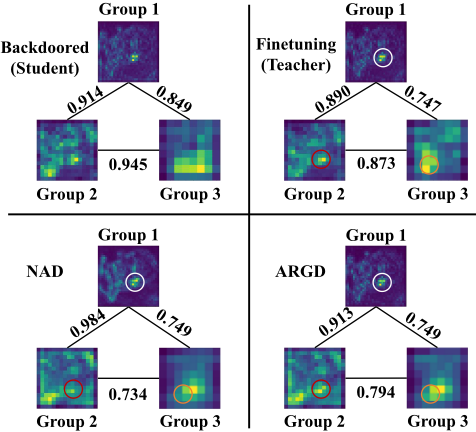
From this figure, we can observe that, benefiting from the imitative learning of ARGs, our proposed ARGD method can achieve better ARG alignment between the teacher model and student model than the one of NAD. Compared with NAD, ARGD can not only generate closer attention features with different orders (especially the part inside the circle of group 2) for its student model, but also have closer correlation between attention features. For example, the correlations between the attention feature pairs of (group1, group2) and (group2, group3) are 0.913 and 0.794, while the corresponding correlations for the ARG generated by NAD are 0.984 and 0.734, respectively. Since the edge weights of the finetuning teacher model are 0.890 and 0.873, respectively, ARDG has better alignment than NAD for these two ARG edges. In other words, by using ARG-based knowledge transfer, the effects of backdoor triggers can be effectively suppressed, while the benign knowledge structure is minimally affected.
| Finetuning | Node | Edge | Embedding | ACC (%) | ASR (%) |
|---|---|---|---|---|---|
| ✓ ✓ ✓ ✓ | ✓ ✓ ✓ | ✓ ✓ | ✓ | 79.31 79.04 79.88 80.38 | 6.29 5.70 3.03 2.41 |
| Backdoored DNN | 81.66 | 87.53 | |||
Table 4 evaluates the contributions of key ARG components in ARGD based on a series of ablation studies. Column 1 denotes the case without adopting knowledge distillation or incorporating any of our proposed loss functions. Columns 5-6 indicate the average ACC and ASR of the six backdoor attacks under 5% clean training data, respectively. Note that NAD can be considered as ARGD with only the node loss. Compared with the finetuning method, the ASR of NAD can be improved from 6.29% to 5.70%. However, in this case the ACC slightly drops from 79.31% to 79.04%. Unlike NAD, the full-fledged ARGD takes the synergy of three losses into account. Compared with NAD, it can reduce the ASR from 5.70% to 2.41%, while the ACC can be improved from 79.04% to 80.38%.
5 Conclusion
This paper proposed a novel backdoor defense method named Attention Relation Graph Distillation (ARGD). Unlike the state-of-the-art method NAD that considers attention features of the same order in finetuning and distillation, ARGD takes the correlations of attention features with different orders into account. By using our proposed Attention Relation Graphs (ARGs) and corresponding loss functions, ARGD enables quick alignment of ARGs between both teacher and student models, thus the impacts of backdoor triggers can be effectively suppressed. Comprehensive experimental results show the effectiveness of our proposed method.
Acknowledgments
This work was supported by Natural Science Foundation of China 61872147, National Key Research and Development Program of China 2018YFB2101300, Fundamental Research Funds for the Central Universities YBNLTS2022-008, Shanghai Gaofeng & Gaoyuan Project for University Academic Program Development and Shanghai Trusted Industry Internet Software Collaborative Innovation Center. Mingsong Chen is the corresponding author.
@inproceedings{ijcai2022p206,
  title     = {Eliminating Backdoor Triggers for Deep Neural Networks Using Attention Relation Graph Distillation},
  author    = {Xia, Jun and Wang, Ting and Ding, Jiepin and Wei, Xian and Chen, Mingsong},
  booktitle = {Proceedings of the Thirty-First International Joint Conference on
               Artificial Intelligence, {IJCAI-22}},
  publisher = {International Joint Conferences on Artificial Intelligence Organization},
  editor    = {Luc De Raedt},
  pages     = {1481--1487},
  year      = {2022},
  month     = {7},
  note      = {Main Track},
  doi       = {10.24963/ijcai.2022/206},
  url       = {https://doi.org/10.24963/ijcai.2022/206},
}
TY - CPAPER TI - Eliminating Backdoor Triggers for Deep Neural Networks Using Attention Relation Graph Distillation AU - Xia, Jun AU - Wang, Ting AU - Ding, Jiepin AU - Wei, Xian AU - Chen, Mingsong T2 - Proceedings of the Thirty-First International Joint Conference on Artificial Intelligence, IJCAI-22 PB - International Joint Conferences on Artificial Intelligence Organization PY - 2022 SP - 1481 EP - 1487 DO - 10.24963/ijcai.2022/206 UR - https://doi.org/10.24963/ijcai.2022/206 ER -Copied
Machine-readable versions of this paper, for tools and AI agents:





