
On the Complexity of Enumerating Prime Implicants from Decision-DNNF Circuits
Proceedings of the Thirty-First International Joint Conference on Artificial Intelligence. Main Track. Pages 2583-2590.
https://doi.org/10.24963/ijcai.2022/358
Keywords
- Knowledge Representation and Reasoning: Knowledge Compilation and Tractable Languages
Abstract
We consider the problem Enum·IP of enumerating prime implicants of Boolean functions represented by decision decomposable negation normal form (dec-DNNF) circuits. We study Enum·IP from dec-DNNF within the framework of enumeration complexity and prove that it is in OutputP, the class of output polynomial enumeration problems, and more precisely in IncP, the class of polynomial incremental time enumeration problems. We then focus on two closely related, but seemingly harder, enumeration problems where further restrictions are put on the prime implicants to be generated. In the first problem, one is only interested in prime implicants representing subset-minimal abductive explanations, a notion much investigated in AI for more than thirty years. In the second problem, the target is prime implicants representing sufficient reasons, a recent yet important notion in the emerging field of eXplainable AI, since they aim to explain predictions achieved by machine learning classifiers. We provide evidence showing that enumerating specific prime implicants corresponding to subset-minimal abductive explanations or to sufficient reasons is not in OutputP.
- [Audemard et al., 2021] Gilles Audemard, Steve Bellart, Louenas Bounia, Frédéric Koriche, Jean-Marie Lagniez, and Pierre Marquis. On the explanatory power of decision trees. CoRR, abs/2108.05266, 2021.
- [Bryant, 1986] Randal E. Bryant. Graph-based algorithms for Boolean function manipulation. IEEE Transactions on Computers, C-35(8):677-692, 1986.
- [Chandra and Markowsky, 1978] Ashok K. Chandra and George Markowsky. On the number of prime implicants. Discrete Mathematics, 24:7-11, 1978.
- [Darwiche and Hirth, 2020] Adnan Darwiche and Auguste Hirth. On the reasons behind decisions. In Proc. of ECAI'20, pages 712-720, 2020.
- [Darwiche and Marquis, 2002] Adnan Darwiche and Pierre Marquis. A knowledge compilation map. J. Artif. Intell. Res., 17:229-264, 2002.
- [Darwiche and Marquis, 2021] Adnan Darwiche and Pierre Marquis. On quantifying literals in Boolean logic and its applications to explainable AI. J. Artif. Intell. Res., 72:285-328, 2021.
- [Darwiche, 2001] Adnan Darwiche. Decomposable negation normal form. Journal of the Association for Computing Machinery, 48(4):608-647, 2001.
- [de Kleer, 1986] Johan de Kleer. An assumption-based TMS. Artificial Intelligence, 28:127-167, 1986.
- [Dunham and Fridshal, 1959] Bradford Dunham and Richard Fridshal. The problem of simplifying logical expressions. Journal of Symbolic Logic, 1959.
- [Eiter and Gottlob, 1995] Thomas Eiter and Georg Gottlob. The complexity of logic-based abduction. Journal of the ACM, 42(1):3-42, 1995.
- [Eiter et al., 2008] Thomas Eiter, Kazuhisa Makino, and Georg Gottlob. Computational aspects of monotone dualization: A brief survey. Discret. Appl. Math., 156(11):2035-2049, 2008.
- [Gergov and Meinel, 1994] Jordan Gergov and Christoph Meinel. Efficient analysis and manipulation of OBDDs can be extended to FBDDs. IEEE Transactions on Com- puters, 43(10):1197-1209, 1994.
- [Gurvich and Khachiyan, 1999] Vladimir Gurvich and Leonid Khachiyan. On generating the irredundant conjunctive and disjunctive normal forms of monotone Boolean functions. Discret. Appl. Math., 96-97:363-373, 1999.
- [Ignatiev et al., 2019] Alexey Ignatiev, Nina Narodytska, and João Marques-Silva. Abduction-based explanations for machine learning models. In Proc. of AAAI'19, pages 1511-1519, 2019.
- [Ignatiev et al., 2020] Alexey Ignatiev, Nina Narodytska, Nicholas Asher, and João Marques-Silva. On relat- ing 'why?' and 'why not?' explanations. CoRR, abs/2012.11067, 2020.
- [Koriche et al., 2013] Frédéric Koriche, Jean-Marie Lagniez, Pierre Marquis, and Samuel Thomas. Knowl- edge compilation for model counting: Affine decision trees. In Proc. of IJCAI'13, pages 947-953, 2013. IJCAI
- [Madre and Coudert, 1991] Jean Christophe Madre and Olivier Coudert. A logically complete reasoning main- tenance system based on a logical constraint solver. In Proc. of IJCAI'91, pages 294-299, 1991. IJCAI
- [Marques-Silva et al., 2021] João Marques-Silva, Thomas Gerspacher, Martin C. Cooper, Alexey Ignatiev, and Nina Narodytska. Explanations for monotonic classifiers. In Proc. of ICML'21, pages 7469-7479, 2021.
- [Marquis, 2000] Pierre Marquis. Consequence finding algo- rithms, volume 5 of Handbook on Defeasible Reasoning and Uncertainty Management Systems, chapter 2, pages 41-145. Kluwer Academic Publisher, 2000.
- [Miller, 2019] Tim Miller. Explanation in artificial intelli- gence: Insights from the social sciences. Artificial Intelli- gence, 267:1-38, 2019.
- [Molnar, 2019] Christoph Molnar. Interpretable Machine Learning -A Guide for Making Black Box Models Explain- able. Leanpub, 2019.
- [Narodytska et al., 2018] Nina Narodytska, Shiva Prasad Kasiviswanathan, Leonid Ryzhyk, Mooly Sagiv, and Toby Walsh. Verifying properties of binarized deep neural net- works. In Proc. of AAAI'18, pages 6615-6624, 2018.
- [Oztok and Darwiche, 2014] Umut Oztok and Adnan Dar- wiche. On compiling CNF into Decision-DNNF. In Proc. of CP'14, pages 42-57, 2014.
- [Quine, 1952] Willard Van Orman Quine. The problem of simplifying truth functions. American Mathematical Monthly, 59:521-531, 1952.
- [Reiter and de Kleer, 1987] Raymond Reiter and Johan de Kleer. Foundations of assumption-based truth mainte- nance systems: preliminary report. In Proc. of AAAI'87, pages 183-188, 1987.
- [Selman and Levesque, 1990] Bart Selman and Hector J. Levesque. Abductive and default reasoning: a computa- tional core. In Proc. of AAAI'90, pages 343-348, 1990.
- [Shih et al., 2018a] Andy Shih, Arthur Choi, and Adnan Darwiche. Formal verification of Bayesian network clas- sifiers. In Proc. of PGM'18, pages 427-438, 2018.
- [Shih et al., 2018b] Andy Shih, Arthur Choi, and Adnan Darwiche. A symbolic approach to explaining Bayesian network classifiers. In Proc. of IJCAI'18, pages 5103- 5111, 2018. IJCAI
- [Shih et al., 2019] Andy Shih, Arthur Choi, and Adnan Dar- wiche. Compiling Bayesian networks into decision graphs. In Proc. of AAAI'19, pages 7966-7974, 2019.
- [Strozecki, 2019] Yann Strozecki. Enumeration complexity. Bull. EATCS, 129, 2019.
- [Wegener, 2000] Ingo Wegener. Branching Programs and Binary Decision Diagrams. SIAM, 2000.
References were extracted automatically from the PDF and may contain errors.
Full text extracted automatically from the PDF; figures, tables and equations may differ. The PDF is the version of record.
1 Introduction
Prime implicants are a key concept when dealing with Boolean functions since the notion has been introduced seven decades ago [Quine, 1952]. Within AI, prime implicants (or the dual concept of prime implicates) have been considered for modeling and solving a number of problems, including compiling knowledge [Reiter and de Kleer, 1987] and generating explanations of various kinds. This is the case in logic-based abductive reasoning (see e.g., [Selman and Levesque, 1990; Eiter and Gottlob, 1995]), a form of inference required in many applications when the available knowledge base is incomplete (e.g., in medicine) and because of such an incompleteness, it cannot alone explain the observations that are made about the state of the world. Abduction gave rise to much research in AI for the past thirty years, especially because it is closely connected to other reasoning settings, including truth maintenance [de Kleer,
1986], assumption-based reasoning and closed-world reasoning (see e.g., [Marquis, 2000] for a survey). Formally, the explanations one looks for are terms over a preset alphabet (composed of the so-called abducible variables, e.g., representing diseases) such that the manifestations that are reported (e.g., some symptoms) are logical consequences of the background knowledge when completed by such a term. In order to avoid trivial explanations, one also asks those terms to be consistent with the knowledge base. Explanations that are the less demanding ones from a logical standpoint (i.e., subset-minimal ones) can be characterized as specific prime implicants. More recently, deriving explanations justifying why certain predictions have been made has appeared as essential for ensuring trustworthy Machine Learning (ML) technologies [Miller, 2019; Molnar, 2019]. In the research area of eXplainable AI (XAI), recent work has shown how ML classifiers of various types (including black boxes) can be associated with Boolean circuits (alias transparent or "white" boxes), exhibiting the same input-output behaviours [Narodytska et al., 2018; Shih et al., 2018a; Shih et al., 2019]. Thanks to such mappings, XAI queries about classifiers can be delegated to the corresponding circuits. The notion of sufficient reason for an instance given a Boolean function f modeling a binary classifier has been introduced in [Darwiche and Hirth, 2020]. Given an instance a (a simply is an assignment, i.e., a vector of truth values given to each of the n variables) such that f(a) = 1 (resp. f(a) = 0), a sufficient reason for a is a subset-minimal partial assignment a′ which is coherent with a (i.e., a and a′ give the same values to the variables that are assigned in a′ ) and which satisfies the property that for every extension a′′ of a′ we have f(a′′ ) = 1 (resp. f(a′′ ) = 0). The features assigned in a′ (and the way they are assigned) can be viewed as explaining why a has been classified by f as a positive (or as a negative) instance.
Whatever the way prime implicants are used, generating them is in general a computationally demanding task, for at least two reasons. On the one hand, deriving a single prime implicant of a Boolean function represented by a propositional formula (or circuit) is NP-hard since such a formula is satisfiable when it has a prime implicant, and it is valid precisely when this prime implicant is the empty term. On the other hand, a source of complexity is the number of prime implicants that may prevent from computing them all. Indeed, it is well-known that the number of prime implicants of a Boolean function can be exponential in the number of variables of the function, and, for many representations of the function, also exponential in the size of the representation (just consider the parity function as a matter of example). In more detail, the number of prime implicants of a Boolean function can be larger than the number of assignments satisfying the function [Dunham and Fridshal, 1959]; there also exist families of Boolean functions over n variables having Ω( 3n n ) prime implicants [Chandra and Markowsky, 1978].
In this paper, we focus on the issue of enumerating prime implicants of a Boolean function represented by a decision decomposable negation normal form circuit (alias a Decision-DNNF circuit - dec-DNNF circuit for short). The question is to determine whether such prime implicants can be enumerated "efficiently", which is obviously not the case when the circuit considered is unconstrained (as explained above, in such a case, computing a single prime implicant is already hard). This question is important for all the problems listed previously, when prime implicants represent explanations: since they are typically too numerous to be computed as a whole, it makes sense to derive them in an incremental way, with some performance guarantees in the generation; this lets the user who asked for an explanation deciding what to do after each derivation, namely to stop the enumeration process since he/she is satisfied by the explanation that has been provided, or alternatively to ask for a further explanation.
The dec-DNNF language [Oztok and Darwiche, 2014; Darwiche, 2001] and its subsets FBDD (free binary decision diagrams) [Gergov and Meinel, 1994], OBDD (ordered binary decision diagrams) [Bryant, 1986] and even DT (the set of all binary decision trees over Boolean variables, see e.g., [Wegener, 2000, Chapter 2]) appear at first sight as good candidates for representing the function in the perspective of enumerating "efficiently" its prime implicants. Indeed, they are known as tractable representation languages (they support in polynomial time many queries and transformations from the so-called knowledge compilation map [Darwiche and Marquis, 2002; Koriche et al., 2013]).
The main contribution of the paper is as follows. We give a polynomial incremental time algorithm for enumerating the prime implicants of a Boolean function f represented by a dec-DNNF circuit Σ. Given Σ and a positive integer k, this algorithm returns k prime implicants of Σ in O(poly(k + |Σ|)) time, or returns all prime implicants of Σ if there are fewer than k. This shows that enumerating prime implicants from dec-DNNF is in the enumeration complexity class IncP [Strozecki, 2019]. We also provide evidence showing that enumerating specific prime implicants corresponding to subset-minimal abductive explanations or to sufficient reasons is not in OutputP: on the one hand, computing a single subset-minimal abductive explanation from an OBDD circuit or a decision tree is NP-hard; on the other hand, the existence of an output polynomial time algorithm for enumerating sufficient reasons given an OBDD circuit or a decision tree would lead to an output polynomial time algorithm for enumerating the minimal transversals of a hypergraph, thus answering a long-standing question related to monotone dualization [Eiter et al., 2008].
The rest of the paper is organized as follows. We start with some preliminaries (Section 2) where the language of decDNNF circuits and the framework used to study enumeration problems are presented. We formally define the problem Enum·IP of enumerating prime implicants. Then in Section 3 we show that generating the set of all prime implicants from a dec-DNNF circuit is feasible in output polynomial time. From there, we show in Section 4 that Enum·IP from dec-DNNF is in fact in IncP and point out a polynomial incremental time enumeration algorithm. Finally, in Section 5 we focus on subset-minimal abductive explanations and sufficient reasons and show that for each of the two cases, the enumeration issue is seemingly harder than in the case when all prime implicants are considered. A full-proof version of the paper is available at www.cril.univ-artois.fr/expekctation/ papers.html.
2 Preliminaries
A Boolean function over n variables x1, . . . , xn is a mapping f from {0, 1}n to {0, 1}. The set of variables of f is denoted by var(f). The assignments to var(f) mapped to 1 by f are called satisfying assignments of f. A literal upon variable x is either x or its negation x and a term is a conjunction of literals. We often omit the conjunction symbols when writing terms, for instance we may shorten a ∧ c into a c. We define the empty term t∅ as the term over zero literal. The empty term verifies t∧t∅ = t for every term t. Given ℓ ∈ {x, x}, we denote by f |ℓ the Boolean function over var(f ) \ {x} whose satisfying assignments coincide with that of f ∧ℓ. We use the usual symbols ∧, ∨, ¬, |= to denote conjunction, disjunction, negation, and entailment. Given a set S of terms, max(S, |=) denotes the subset of terms of S that do not entail another term in S. An implicant of a Boolean function f is a term t whose satisfying assignments also satisfy f, i.e., t |= f. An implicant t is prime when no term t-ℓ obtained by removing a literal ℓ from t is an implicant of f.
2.1 Compilation Languages
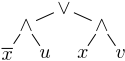
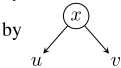
Compilation languages are often seen as classes of circuits. Let PS be a countable set of propositional variables. A circuit in negation normal form (NNF) is a directed acyclic graph (DAG) whose leaves are labelled with 0 (false), 1 (true), or a literal built upon x ∈ PS, and whose internal nodes are labelled with ∧ or ∨ connectives; we call them ∧-nodes and ∨-nodes. An NNF circuit computes a Boolean function over the variables appearing in it. For v a node of an NNF circuit Σ, var(v) denotes the set of variables labelling leaves under v in Σ and Σv denotes the subcircuit of Σ rooted at v. The language of decomposable NNF circuits (DNNF) contains the NNF circuits where ∧-nodes are decomposable, that is, the children v1, . . . , vm of every ∧- node v are such that var(vi) ∩ var(vj) = ∅ for all i ̸= j. The language of deterministic, decomposable NNF circuits (d-DNNF) contains the DNNF circuits Σ where ∨-nodes are deterministic, that is, the children v1, . . . , vm of every ∨-node v are such that Σvi ∧Σvj is inconsistent for all i ̸= j. Finally, the language of Decision-DNNF circuits (dec-DNNF) is that of circuits whose leaves are labelled with 0, 1, or a literal built upon x ∈ PS, and whose internal nodes are decision nodes and ∧-nodes. Whenever n is a decision node labelled by variable x in a dec-DNNF circuit Σ, the circuit Σn given is viewed as a compact representation of the
ure 2 in [Darwiche and Marquis, 2002]).
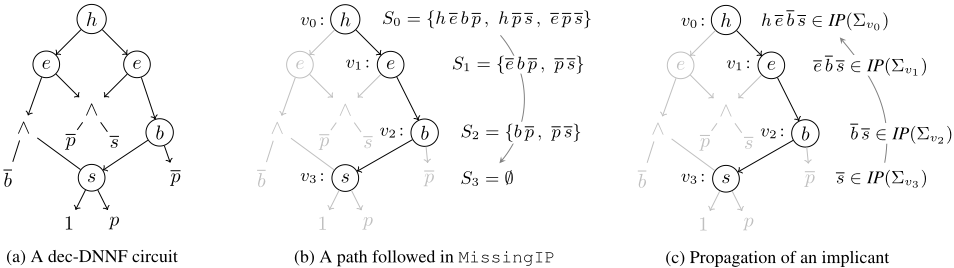
Thus, a decision node n is labelled by a variable and has two children: the 0-child (node u on the previous picture) and the 1-child (node v on the previous picture). If n is labelled by x and Σu (resp. Σv) represents the function f0 (resp. f1), then Σn represents the function (x ∧ f0) ∨ (x ∧ f1). For instance, Figure 1a gives a dec-DNNF circuit whose deepest decision node computes (s ∧ 1) ∨ (s ∧ p). It is worth mentioning that all Boolean functions on finitely many variables can be represented in dec-DNNF, or indeed in any of its subsets like FBDD, OBDD, and DT.
Let Σ be a dec-DNNF circuit. The size of Σ, denoted by |Σ| is its number of edges. From a dec-DNNF circuit Σ, one can easily derive in polynomial time a dec-DNNF circuit equivalent to Σ where every ∧-node has exactly two children. Since it is computationally harmless, for the sake of simplicity, our enumeration algorithms suppose that the dec-DNNF circuits satisfy this condition, so that their size is at most twice their number of nodes. In the same vein, we suppose that our dec-DNNF circuits have been reduced, i.e., every node v in Σ such that Σv computes the 0 function reduces to a leaf labelled by 0. Testing the satisfiability of a dec-DNNF circuit is feasible in linear time [Darwiche and Marquis, 2002], so reducing a dec-DNNF circuit also is a polynomial-time operation.
2.2 Enumeration Complexity
We now recall some enumeration complexity classes as described in [Strozecki, 2019]. Let V be an alphabet and let A be a binary predicate in V ∗ × V ∗ . Given an instance x ∈ V ∗ (the input), A(x) (the set of solutions) denotes the set of all y ∈ V ∗ such that A(x, y). The enumeration problem Enum·A is the function mapping x to A(x). Enum·A is in the class EnumP if for every y ∈ A(x), |y| is polynomial in |x|, and if deciding whether y is in A(x) is in P. EnumP does not capture the complexity of computing the set of solutions A(x), it serves more as a counterpart of NP for enumeration problems.
The model used for the enumeration of solutions is the random access machine (RAM) model. See [Strozecki, 2019] for details on why RAM have been chosen for this task. A RAM solves Enum·A if, for all x, it returns a sequence y1, . . . , ym of pairwise distinct elements such that {y1, . . . , ym} = A(x). Enum·A is in OutputP if there is a RAM solving Enum·A in time O(poly(|x| + |A(x)|)) on every input x. OutputP is a relevant enumeration class when the whole set of solutions is explicitly asked for. For instance, the dualization of a monotone CNF formula φ is the task of generating a DNF formula equivalent to φ. Because of the monotony condition on φ, the terms used in any smallest DNF formula equivalent to φ are precisely its prime implicants. Thus, the dualization problem boils down to enumerating all the prime implicants of φ.
For other applications, computing only a fixed number of solutions may be enough. A RAM solves Enum·A in incremental time f(t)g(n) if on every x, it runs in time O(f(t)g(|x|)) and returns a sequence y1, . . . , yt of t pairwise distinct elements of A(x) when t ≤ |A(x)|, and the whole set A(x) when t > |A(x)|. Enum·A is in IncP if there is a RAM that solves A in incremental time O(tanb ) for some constants a and b. IncP has a characterization that uses the function problem AnotherSol·A which, given x and S ⊆ A(x), returns y ∈ A(x) \ S when S ̸= A(x), and false otherwise.
Proposition 1 ([Strozecki, 2019]). A problem Enum·A in EnumP is in IncP if and only if AnotherSol·A is in FP.
Note that OutputP is thought to be distinct from IncP [Strozecki, 2019].
3 Enum·IP fromDec-DNNF is in OutputP
Let us first consider the problem of enumerating the prime implicants of a Boolean function f given as a dec-DNNF circuit Σ, for short the prime implicants of Σ. Let IP(Σ, t) be the binary predicate representing the relation that t is a prime implicant of Σ. Then IP(Σ) denotes the set of prime implicants of Σ. We extend the notation IP(·) to any Boolean function f . To be able to speak of prime implicants enumeration from circuits other than dec-DNNF ones we write "Enum.IP from L" with L the language Σ belongs to.
We start with a couple of easy results. First of all, since there is a linear-time procedure to verify that a term is an implicant of a dec-DNNF circuit, there is a polynomial-time algorithm to decide whether a given a term is a prime implicant of a dec-DNNF circuits, thus:
Proposition 2. Enum·IP from dec-DNNF is in EnumP.
In addition, it is known that Enum·IP from OBDD is in OutputP [Madre and Coudert, 1991], and it is almost straightforward to extend this result to dec-DNNF. To make it precise, let us briefly describe the output polynomial construction of IP(Σ) for Σ, a dec-DNNF circuit. The construction is based on the three following, folklore propositions (for the sake of completeness, a proof for each of them is nonetheless reported in the full-proof version of the paper).
Proposition 3. Let f and g be Boolean functions, then IP(f∧ g) =max({t ∧ t′ | t ∈ IP(f), t′ ∈ IP(g)}, |=). Furthermore if var(f) ∩ var(g) = ∅, then IP(f ∧ g) = {t ∧ t′ | t ∈ IP(f), t′ ∈ IP(g)}.
Proposition 4. Let f a Boolean function, let x be a variable, and let ℓ ∈ {x, x}. Consider t ∈ IP(f|ℓ). If t |= f|ℓ, then t ∈ IP(f), otherwise t ∧ ℓ ∈ IP(f).
Proposition 5. Let f be a Boolean function and let x be a variable.
Note that t ∈ IP(f|x) (resp. IP(f|x)) entails f|x (resp. f|x) if and only if t is subsumed by some term in IP(f |x∧f |x). As a consequence, from IP(f|x) and IP(f|x), one can construct IP(f|x∧f|x) in polynomial time thanks to Proposition 3 and we use it to derive IP(f) thanks to Proposition 5.
We also have that (see the algorithm for conditioning a prime implicant representation provided in [Darwiche and Marquis, 2002]):
Proposition 6. Let f a Boolean function and let x be a variable, then |IP(f)| ≥max(|IP(f|x)|, |IP(f|x)|).
Consider now a dec-DNNF circuit Σ and an internal node v with two children u and w. If the sets IP(Σu) and IP(Σw) are provided, then IP(Σv) is obtained in polynomial time using Proposition 3 if v is a decomposable ∧-gate, and using Proposition 5 if v is a decision node. Furthermore, in both cases, we have |IP(Σv)| ≥ max(|IP(Σu)|, |IP(Σw)|). These observations lead to a simple algorithm that generates IP(Σ) by computing the sets IP(Σv) for every node v of Σ considered in a bottom-up way. Since constructing the set of prime implicants for any node given that of its children is tractable, since this set is smaller than |IP(Σ)|, and since it is computed only once, the algorithm runs in time O(poly(|Σ|+|IP(Σ)|)). Thus, we get:
Proposition 7. Enum·IP from dec-DNNF is in OutputP.
Example 1. We give the construction of the sets of prime implicants for the nodes v1, v2, v3 in the dec-DNNF circuit Σ represented on Figure 1b.
v3: the sets of prime implicants of the children are IP(1) = {t∅} and IP(p) = {p}. Using Proposition 5 we have that s ∧ t∅ = s and Σv3 |s = p, so s ∧ t∅ ̸|= Σv3 |s showing that s ∈ IP(Σv3 ). We also have that Σv3 |s = 1, so sp |= Σv3 |s showing that sp ̸∈ IP(Σv3 ). Finally, we have that IP(Σv3 |s ∧ Σv3 |s) = {p} by Proposition 3, so IP(Σv3 ) = {s, p}.
v2: the sets of prime implicants of the children are IP(p) = {p} and IP(Σv3 ) so we compute IP(Σv2 ) = {b p, b s, b p, p s}
v1: the sets of prime implicants of the children are IP(p ∧ s) = {ps} and IP(Σv2 ) so we compute IP(Σv1 ) = {e b p, e b p, e b s, p s}
4 Enum·IP fromDec-DNNF is in IncP
We now investigate Enum·IP from dec-DNNF from the incremental enumeration perspective. Based on Proposition 1, we design a tractable algorithm AnotherIP for solving the problem AnotherSol·IP, thus showing that Enum·IP from dec-DNNF is in IncP.
4.1 Solving the Decision Variant of AnotherSol·IP
We first consider the decision variant of AnotherSol·IP from dec-DNNF: given a dec-DNNF circuit Σ and a set S ⊆ IP(Σ), return false if and only if S ̸= IP(Σ). Recall from the discussion preceding Proposition 7 that there is a bottom-up procedure for generating all prime implicants of the dec-DNNF circuit Σ. To address the decision variant of AnotherSol·IP on inputs Σ and S, a reverse, top-down search is performed, assuming that S is IP(Σ) until finding a contradiction.
Before defining what a contradiction means in this setting, a few notations are useful. For t a term and X a set of variables, tX denotes the restriction of t to variables in X. Note that if X and var(t) are disjoint, then tX is the empty term t∅.
Proposition 8. Let Σ be a dec-DNNF circuit and let S ⊆ IP(Σ). If the root of Σ is an ∧-node, let u and w be its children and let Su = {tvar(Σu) | t ∈ S} and Sw = {tvar(Σw) | t ∈ S}. Then Su ⊆ IP(Σu) and Sw ⊆ IP(Σw) hold, and
Proposition 9. Let Σ be a dec-DNNF circuit whose root is a decision node labelled by x. Let u be its 0-child and w be its 1-child. Given S ⊆ IP(Σ), let Su = {t | t ∧ x ∈ S} ∪ (S ∩ IP(Σu)), Sw = {t | t ∧ x ∈ S} ∪ (S ∩ IP(Σw)) and S′ = {t | t ∈ S, x ̸∈ var(t)}. Then Su ⊆ IP(Σu) and Sw ⊆ IP(Σw) hold, and
Let v be the root of the dec-DNNF circuit Σ and let S ⊆ IP(Σ). We say that we have a contradiction at node v when
- (c1) S = ∅ while Σ is satisfiable, or
Algorithm 1: MissingIP(Σ, S, P ) Promises: Σ is reduced, S ⊆ IP(Σ) 1 Let v be the root of Σ and let P ′ ← P ∪ (v) 2 if λ(v) = |S| then return false 3 if S = ∅ then 4 if v is labelled by 0 then set λ(v) to 0, return false 5 else return (GenerateIP(Σ), P ′ ) 6 end 7 if v is a ∧-node with children u and w then 8 Build Su and Sw as in Proposition 8 9 r ← MissingIP(Σu, Su, P ′ ) 10 if r ̸= false then return r 11 r ← MissingIP(Σw, Sw, P ′ ) 12 if r ̸= false then return r 13 else if v is a decision node with children u and w then 14 Build Su, Sw, S′ as in Proposition 9 15 r ← MissingIP(Σu, Su, P ′ ) 16 if r ̸= false then return r 17 r ← MissingIP(Σw, Sw, P ′ ) 18 if r ̸= false then return r 19 S∗ ←max({tu ∧ tw | tu ∈ Su, tw ∈ Sw}, |=) 20 if S∗ ̸= S′ then for any t ∈ S∗ \ S′ return (t, P ′ ) 21 end 22 Set λ(v) to |S| and return falseA contradiction guarantees that S ̸= IP(Σ). The contradiction (c1) is easy to check. Contradiction (c2) on the other hand requires to show that Su = IP(Σu) and Sw = IP(Σw). When v is an internal node, with children u and w, if there is no contradiction (c1) at v, we use Propositions 8 and 9 to build from S two sets Su and Sw that we recursively compare to IP(Σu) and IP(Σw). Either the recursion ends under u or w on a contradiction, in which case S ̸= IP(Σ), or it stops by itself (i.e., when reaching the leaves of the circuit), which shows that Su = IP(Σu) and Sw = IP(Σw), and then we can check whether there is contradiction (c2) at node v. If there is none, then S = IP(Σ).
The procedure is given by Algorithm MissingIP. The inputs are a dec-DNNF circuit Σ, a set S ⊆ IP(Σ) and a path P in Σ (which will be useful later). A function λ mapping the nodes of Σ to integers is used for memoization purposes. Initially λ(v) = -1 for every node v, but λ(v) may be assigned a non-negative value at some point. More precisely, the first time a call MissingIP(Σv, S, P) returns false, we learn that S = IP(Σv) and set λ(v) to |S|. Then for each later call MissingIP(Σv, S′ , P ′ ) with S′ ⊆ IP(Σv), we check whether S′ = IP(Σv) by verifying that λ(v) = |S′ |.
Proposition 10. Given a reduced dec-DNNF circuit Σ and S ⊆ IP(Σ), MissingIP(Σ, S, ∅) runs in time O(poly(|S|+ |Σ|)), and it returns false if and only if S = IP(Σ).
4.2 Augmenting an Incomplete Subset of IP(Σ)
We build upon MissingIP so that, when S ̸= IP(Σ), we also return a prime implicant in IP(Σ) \ S. The idea is to use the path P to keep track of the ancestor nodes that were visited before reaching a contradiction and to use P to con-
- Algorithm 2: GenerateIP(Σ) Promise: Σ is satisfiable 1 Find a satisfying assignment a of Σ 2 Let t = ∧a(x)=1 x ∧ ∧a(x)=0 x 3 while there is ℓ ∈ t such that t - ℓ |= Σ do 4 Remove ℓ from t 5 end 6 Return t
struct a prime implicant in IP(Σ) \ S. As an example, consider calling MissingIP(Σ, S0, ∅) with Σ the dec-DNNF circuit of Figure 1a and S0 = {he b p, hps, eps} a set of prime implicants of Σ. Figure 1b shows a scenario when MissingIP(Σ, S0, ∅) calls MissingIP(Σv1 , S1, (v0)), which calls in turnMissingIP(Σv2 , S2, (v0, v1)), which finally calls MissingIP(Σv3 , S3, (v0, v1, v2)). Since S3 = ∅ and Σv3 is reduced and different from 0, the algorithm has reached a contradiction (c1) at node v3 and has not returned false, thus indicating that S0 ̸= IP(Σ). MissingIP has followed the path P = (v0, v1, v2, v3) to reach that contradiction and has kept it in memory. This path P can then be used to generate a prime implicant in IP(Σ) \ S0. First MissingIP returns the path P to v3 as well as a prime implicant of Σv3 , say it is s. Then we construct a prime implicant of Σv2 upon s, here since v3 is the 0-child of v2 and since s does not entail the 1-child of v2 we obtain b s ∈ IP(Σv2 ). Then we construct a prime implicant of Σv1 upon b s, here since v2 is the 0-child of v1 and since b s does not entail the 1-child of v1 we obtain e b s ∈ IP(Σv1 ). Repeating the step one more time leads to he b s ∈ IP(Σv0 ) = IP(Σ). The procedure is illustrated in Figure 1c. In this example, for generating a new prime implicant of Σ, we have created t ∈ Σv3 \ S3 and augmented it using Proposition 4 as we travelled backwards along P. We say that we have propagated t along the path P .
Accordingly, the algorithm AnotherIP to generate a new prime implicant breaks into two steps. First MissingIP(Σ, S, P) searches for a contradiction. It returns false if S = IP(Σ) or a pair (t, P) with P the path followed to reach a node v where a contradiction has been found (like v3 in the example), and t a prime implicant of Σv that could not be derived from S. The procedure GenerateIP is used to generate t. GenerateIP runs in polynomial time thanks to linear-time implicant check on dec-DNNF circuits. Finally PropagateIP is called to propagate t along the path P .
The next proposition shows the correctness of AnotherIP:
Proposition 11. Let Σbe a reduced dec-DNNF circuit and let S ⊆ IP(Σ). AnotherIP(Σ, S) runs in time O(poly(|S| + |Σ|)). It returns false if S = IP(Σ), otherwise it returns a prime implicant of Σ that does not belong to in S.
On this basis, the existence of a polynomial incremental time enumeration of prime implicants for dec-DNNF circuits can be easily established:
Proposition 12. Enum·IP from dec-DNNF is in IncP.
Algorithm 3: Propagate(Σ, t, P = (v0, . . . , vi)) Promise: Σ is reduced, its root is v0, P is a path in Σ 1 if |P| = 1 then return t 2 if vi-1 is a ∧-node with children u and w then 3 if vi = u then t′ ← GenerateIP(Σw) 4 if vi = w then t′ ← GenerateIP(Σu) 5 else if vi-1 is a decision node for variable x with 0-child u and 1-child w then 6 if vi = u then 7 if t |= Σw then t′ ← t∅ else t′ ← x 8 else 9 if t |= Σu then t′ ← t∅ else t′ ← x 10 end 11 Propagate(Σ, t ∧ t′ , (v0, . . . , vi-1))- Algorithm 4: AnotherIP(Σ, S) Promise: Σ is reduced, S ⊆ IP(Σ) 1 r ←MissingIP∗ (Σ, S, ∅) 2 if r = false then return false 3 else if r = (t, P) then return Propagate(Σ, t, P)
5 Enumerating Specific Prime Implicants
For some applications, enumerating all prime implicants of f makes sense, even though there can be exponentially many. We have already mentioned the dualization of monotone CNF formulae as an example. In this section, we describe two problems that ask for generating only specific prime implicants, representing respectively subset-minimal abductive explanations and sufficient reasons.
To illustrate the two notions we use the function f computed by the dec-DNNF circuit of Figure 1a as a toy example. f encodes a very incomplete characterization of human-like creatures in Tolkien's Middle Earth based on four physical attributes: presence of beard and facial hair (b), small size (s), human-like skin (h), pointy ears (p), plus the indication of whether the creature is enrolled in the armies of evil (e). We imagine that there are only seven possible creatures: hobbits (h b p s e), elves (h b p s e), dwarfs (h b p s e), men and women (h∗p s ∗), 1 ents (h∗p s e), orcs (h b p∗e) and trolls (h b p s e). The satisfying assignments of f describe these creatures. Its prime implicants are the smallest combinations of attributes which guarantee the existence of a creature in our Middle Earth.
5.1 Abductive Explanations
Abductive explanations (see e.g., [Selman and Levesque, 1990; Eiter and Gottlob, 1995]) can be defined as follows:
Definition 1 (Abductive explanation). Given a Boolean function f over variables X, a subset H ⊆ X, and a term m on X \ H, an abductive explanation is a term t on H such that f ∧ t is satisfiable and f ∧ t |= m.
1 ∗ denotes that both choices are possible for the variable, typically here humans may fight for evil, humans and ents may or may not have beards, and orcs have a wide range of size.
The abduction problem asks whether an abductive explanation t exists for the input (f,H,m).
Example 2. Consider our toy example. We look for combinations of physical attributes that guarantee that the creature is evil. This is an abduction problem with H = {h, b, p, s} and m = e. For instance the term h ∧ p is an abductive explanation because there exist creatures with pointy ears and a skin that are not human-like, and all of them are evil (in this case only the orcs fit the description).
It is easy to see that an abductive explanation t is in fact an implicant of ¬f∨mwith the conditions that f∧t is satisfiable and that t is restricted to variables in H (the abducibles). Furthermore, since abduction is not a truth-preserving form of inference, one is often interested in generating subset-minimal abductive explanations only (i.e., the logically weakest abductive explanations); they correspond to the prime implicants of ¬f ∨m such that f ∧t is satisfiable and t is restricted to variables in H.
Obviously enough, the abduction problem we focus on (the existence of an abductive explanation) is the same, would we consider subset-minimal abductive explanations or not. Indeed, deciding whether an abductive explanation exists is equivalent to deciding whether a subset-minimal abductive explanation exists. Unfortunately, the condition that only variables in H are allowed in abductive explanations is already too demanding from an enumeration perspective.
Proposition 13. Unless P = NP, there is no polynomial-time algorithm which, given an OBDD circuit or a decision tree computing a function f over X and a set Y ⊆ X, decides whether f has an implicant t with var(t) ⊆ Y .
5.2 Sufficient Reasons
The notion of sufficient reason 2 [Darwiche and Hirth, 2020] (aka prime implicant explanation [Shih et al., 2018b]) is defined as follows:
Definition 2 (Sufficient reason). Given a Boolean function f, let a be any assignment to a superset of var(f). A sufficient reason for a is a prime implicant t of f (resp. ¬f) such that a satisfies t, provided that a satisfies f (resp. ¬f). The set of all sufficient reasons for a given f is denoted by SR(f, a) (resp. SR(¬f, a)) when a satisfies f (resp. ¬f).
Example 3. Consider again our toy example. There is no creature which is small, has human-like skin, pointy ears, no facial hair, and is evil. Finding the reasons of why such a creature cannot exist means finding sufficient reasons for the assignment a defined by a(h) = a(p) = a(s) = a(e) = 1 and a(b) = 0 given ¬f. In this case hpe ∈ SR(¬f, a) explains why such a creature cannot exist: there are no creatures that are evil and have both human-like skin and pointy ears, but there are such creatures that are non-evil (hobbits and elves), and there are evil creatures that have pointy ears (orcs) or human-like skin (men). There are other sufficient reasons for a given ¬f , for instance h s e ∈ SR(¬f, a).
2 This concept is also referred to as "abductive explanations" [Ignatiev et al., 2019; Ignatiev et al., 2020]; in the following, we stick to "sufficient reason" to avoid any confusion with the (distinct) concept of abductive explanations as discussed in the previous section.
We define the problem Enum·SR similarly to Enum·IP. A couple of results about the complexity of computing sufficient reasons have been pointed out for the past few years. Obviously enough, when no assumption is made on the representation of f, computing a single sufficient reason for an assignment a is already NP-hard (for pretty much the same reasons as for the prime implicant case, i.e., f is valid iff for any a, the unique sufficient reason for a given f is the empty term). Furthermore, the number of sufficient reasons for an assignment a given f can be exponential in the number of variables even when f is represented in DT [Audemard et al., 2021]. Contrary to abductive explanations, it is computationally easy to generate a single sufficient reason from SR(Σ, a) when Σ is an OBDD circuit or a decision tree representing f. A greedy algorithm can be used to this end: if a satisfies Σ (resp. ¬Σ), then start with the canonical term having a as its unique satisfying assignment and remove literals from this term while ensuring that it still is an implicant of Σ (resp. ¬Σ), until no more literal can be removed. In addition, when Σ is in DT, we can generate in polynomial time a monotone CNF formula Ψ such that IP(Ψ) = SR(Σ, a) (see [Darwiche and Marquis, 2021] for details), and then take advantage of a quasi-polynomial time algorithm for enumerating the elements of IP(Ψ) [Gurvich and Khachiyan, 1999]. Contrastingly, deciding whether a preset number of sufficient reasons for a given a exists is intractable (NP-hard), even when the Boolean function f is monotone (see Theorem 3 in [MarquesSilva et al., 2021]).
In the following, we complete those results by providing evidence that Enum·SR from any language among decDNNF, OBDD, or DT is a difficult problem, despite the fact that those languages are quite convenient for many reasoning tasks [Darwiche and Marquis, 2002; Koriche et al., 2013].
Let us first give an inductive computation of SR(Σ, a) similar to that of IP(Σ).
Proposition 14. Let f and g be Boolean functions with var(f) ∩ var(g) = ∅ and let a be a truth assignment to a superset of var(f) ∪ var(g), then SR(f ∧ g, a) = {t ∧ t′ | t ∈ SR(f, a), t′ ∈ SR(g, a)}.
Proposition 15. Let f be a Boolean function, let a be a truth assignment to a superset of var(f) and let x ∈ var(f). If a satisfies the literal ℓ on variable x then
By Proposition 6, |IP(f)| ≥ max(|IP(f|x)|, |IP(f|x)|). In a sense this means that using IP(f|x) and IP(f|x) to generate IP(f) is not a waste of resources since all these implicants are kept in some form through IP(f). This led to our output polynomial procedure to generate IP(f) for OBDD and more generally for dec-DNNF circuits. On the other hand, it is not guaranteed that SR(f, a) is larger than SR(f|x, a) and SR(f|x, a) so there is no straightforward adaptation of this procedure from Enum·IP to Enum·SR.
Example 4. Let Σ be the dec-DNNF circuit of Figure 1a. Consider the dec-DNNF circuit Σv1 rooted at node v1, as spotted in Figure 1b. The assignment a to {b, e, p, s} defined by a(b) = a(e) = 1 and a(p) = a(s) = 0 satisfies Σv1 . Recall that the set IP(Σv1 ) has been constructed in Example 1 and observe that SR(Σv1 , a) = {ps}. Now the 0-child of v1 is v2 and looking at the set IP(Σv2 ) constructed in Example 1, we see that SR(Σv2 , a) = {ps, b p}. Since Σv2 = Σv1 |e, we have that |SR(Σv1 , a)| < max(|SR(Σv1 |e, a)|, |SR(Σv1 |e, a)|).
Actually, we give evidence that enumerating sufficient reasons from dec-DNNF, and even from OBDD or DT, is not in OutputP by reducing to it the problem of enumerating the minimal transversals of a hypergraph, a well-known problem whose membership to OutputP is a long-standing question. Formally:
Proposition 16. If Enum·SR from OBDD is in OutputP or Enum·SR from DT is in OutputP, then enumerating the minimal transversals of a hypergraph is in OutputP.
6 Conclusion
Most applications of prime implicants for Boolean function analysis use only a fraction of the many prime implicants a Boolean function may have. Especially, in the context of logic-based abduction, subset-minimal assumptions to be added to the available background knowledge in order to be able to derive some given manifestations are looked for; in the propositional case, they correspond to specific prime implicants. Furthermore, in an eXplainable AI perspective, specific prime implicants known as sufficient reasons are used to explain the predictions of machine learning algorithms.
In our work, we have studied the enumeration of general and specific prime implicants of Boolean functions represented as dec-DNNF circuits. It was known that these circuits enable efficient reasoning on Boolean functions. Our results show that when it comes to prime implicants enumeration, dec-DNNF circuits have benefits as well as limitations. Our take-home message is that, while dec-DNNF circuits enable enumerating general prime implicants in incremental polynomial time, there are strong pieces of evidence against the existence of any output-polynomial time procedure for enumerating specific prime implicants from dec-DNNF circuits. More precisely, if a procedure for enumerating subset-minimal abductive explanations were to exist, then P = NP would follow. Similarly, if there were an output-polynomial time algorithm for enumerating sufficient reasons from dec-DNNF circuits, then the enumeration of the minimal transversals of a hypergraph would be in OutputP. Though this is considered unlikely in enumeration complexity, we think that proving a stronger statement would be a valuable contribution. We let this task open for future research.
Acknowledgments
Many thanks to the anonymous reviewers for their comments and insights. This work has benefited from the supports of the PING/ACK project (ANR-18-CE40-0011) and of the AI Chair EXPEKCTATION (ANR-19-CHIA-0005-01) of the French National Research Agency. It was also partially supported by TAILOR, a project funded by EU Horizon 2020 research and innovation programme under GA No 952215.
@inproceedings{ijcai2022p358,
  title     = {On the Complexity of Enumerating Prime Implicants from Decision-DNNF Circuits},
  author    = {de Colnet, Alexis and Marquis, Pierre},
  booktitle = {Proceedings of the Thirty-First International Joint Conference on
               Artificial Intelligence, {IJCAI-22}},
  publisher = {International Joint Conferences on Artificial Intelligence Organization},
  editor    = {Luc De Raedt},
  pages     = {2583--2590},
  year      = {2022},
  month     = {7},
  note      = {Main Track},
  doi       = {10.24963/ijcai.2022/358},
  url       = {https://doi.org/10.24963/ijcai.2022/358},
}
TY - CPAPER TI - On the Complexity of Enumerating Prime Implicants from Decision-DNNF Circuits AU - de Colnet, Alexis AU - Marquis, Pierre T2 - Proceedings of the Thirty-First International Joint Conference on Artificial Intelligence, IJCAI-22 PB - International Joint Conferences on Artificial Intelligence Organization PY - 2022 SP - 2583 EP - 2590 DO - 10.24963/ijcai.2022/358 UR - https://doi.org/10.24963/ijcai.2022/358 ER -Copied
Machine-readable versions of this paper, for tools and AI agents:





