
Robust Fine-tuning via Perturbation and Interpolation from In-batch Instances
Proceedings of the Thirty-First International Joint Conference on Artificial Intelligence. Main Track. Pages 4397-4403.
https://doi.org/10.24963/ijcai.2022/610
Keywords
- Natural Language Processing: Text Classification
- Machine Learning: Classification
Abstract
Fine-tuning pretrained language models (PLMs) on downstream tasks has become common practice in natural language processing. However, most of the PLMs are vulnerable, e.g., they are brittle under adversarial attacks or imbalanced data, which hinders the application of the PLMs on some downstream tasks, especially in safe-critical scenarios. In this paper, we propose a simple yet effective fine-tuning method called Match-Tuning to force the PLMs to be more robust. For each instance in a batch, we involve other instances in the same batch to interact with it. To be specific, regarding the instances with other labels as a perturbation, Match-Tuning makes the model more robust to noise at the beginning of training. While nearing the end, Match-Tuning focuses more on performing an interpolation among the instances with the same label for better generalization. Extensive experiments on various tasks in GLUE benchmark show that Match-Tuning consistently outperforms the vanilla fine-tuning by 1.64 scores. Moreover, Match-Tuning exhibits remarkable robustness to adversarial attacks and data imbalance.
- [Aghajanyan et al., 2021] Armen Aghajanyan, Akshat Shri- vastava, Anchit Gupta, Naman Goyal, Luke Zettlemoyer, and Sonal Gupta. Better fine-tuning by reducing represen- tational collapse. In International Conference on Learning Representations (ICLR), 2021.
- [Branco et al., 2021] Ruben Branco, António Branco, João Rodrigues, and João Silva. Shortcutted commonsense: Data spuriousness in deep learning of commonsense rea- soning. In Proceedings of the 2021 Conference on Em- pirical Methods in Natural Language Processing, pages 1504-1521, 2021.
- [Chen et al., 2020] Sanyuan Chen, Yutai Hou, Yiming Cui, Wanxiang Che, Ting Liu, and Xiangzhan Yu. Recall and learn: Fine-tuning deep pretrained language models with less forgetting. In Bonnie Webber, Trevor Cohn, Yulan He, and Yang Liu, editors, EMNLP, 2020.
- [Clark et al., 2019] Christopher Clark, Mark Yatskar, and Luke Zettlemoyer. Don't Take the Easy Way Out: Ensem- ble Based Methods for Avoiding Known Dataset Biases. arXiv, 2019.
- [Daumé III, 2007] Hal Daumé III. Frustratingly easy domain adaptation. In Proceedings of the 45th Annual Meeting of the Association of Computational Linguistics (ACL), June 2007.
- [Devlin et al., 2019] Jacob Devlin, Ming-Wei Chang, Ken- ton Lee, and Kristina Toutanova. BERT: Pre-training of deep bidirectional transformers for language understand- ing. In Proceedings of the 2019 Conference of the North American Chapter of the Association for Computational Linguistics: Human Language Technologies (NAACL- HLT), June 2019.
- [Dinh et al., 2017] Laurent Dinh, Razvan Pascanu, Samy Bengio, and Yoshua Bengio. Sharp minima can general- ize for deep nets. In International Conference on Machine Learning, pages 1019-1028. PMLR, 2017.
- [Fan et al., 2021] Lijie Fan, Sijia Liu, Pin-Yu Chen, Gaoyuan Zhang, and Chuang Gan. When does contrastive learning preserve adversarial robustness from pretraining to finetuning? Advances in Neural Information Process- ing Systems, 34, 2021.
- [Gao et al., 2021] Tianyu Gao, Xingcheng Yao, and Danqi Chen. Simcse: Simple contrastive learning of sentence embeddings. arXiv preprint arXiv:2104.08821, 2021.
- [Hochreiter and Schmidhuber, 1995] Sepp Hochreiter and Jürgen Schmidhuber. Simplifying neural nets by discov- ering flat minima. In Advances in neural information pro- cessing systems, pages 529-536, 1995.
- [Houlsby et al., 2019] Neil Houlsby, Andrei Giurgiu, Stanis- law Jastrzebski, Bruna Morrone, Quentin De Laroussilhe, Andrea Gesmundo, Mona Attariyan, and Sylvain Gelly. Parameter-efficient transfer learning for NLP. In ICML 2019, 2019.
- [Hovy and Søgaard, 2015] Dirk Hovy and Anders Søgaard. Tagging performance correlates with author age. In ACL, pages 483-488, 2015.
- [Jiang et al., 2020] Haoming Jiang, Pengcheng He, Weizhu Chen, Xiaodong Liu, Jianfeng Gao, and Tuo Zhao. SMART: Robust and efficient fine-tuning for pre-trained natural language models through principled regularized optimization. In Proceedings of the 58th Annual Meeting of the Association for Computational Linguistics (ACL), July 2020.
- [Lee et al., 2020] Cheolhyoung Lee, Kyunghyun Cho, and Wanmo Kang. Mixout: Effective regularization to finetune large-scale pretrained language models. In ICLR, 2020.
- [Liu et al., 2019a] Yinhan Liu, Myle Ott, Naman Goyal, Jingfei Du, Mandar Joshi, Danqi Chen, Omer Levy, Mike Lewis, Luke Zettlemoyer, and Veselin Stoyanov. Roberta: A robustly optimized BERT pretraining approach. arXiv preprint, arXiv:1907.11692, 2019.
- [Liu et al., 2019b] Yufan Liu, Jiajiong Cao, Bing Li, Chun- feng Yuan, Weiming Hu, Yangxi Li, and Yunqiang Duan. Knowledge distillation via instance relationship graph. In Proceedings of the IEEE/CVF Conference on Computer Vision and Pattern Recognition, pages 7096-7104, 2019.
- [Sagawa et al., 2019] Shiori Sagawa, Pang Wei Koh, Tat- sunori B Hashimoto, and Percy Liang. Distributionally robust neural networks for group shifts: On the importance of regularization for worst-case generalization. arXiv preprint arXiv:1911.08731, 2019.
- [Smith et al., 2018] Samuel L Smith, Pieter-Jan Kinder- mans, Chris Ying, and Quoc V Le. Don't decay the learn- ing rate, increase the batch size. In International Confer- ence on Learning Representations, 2018.
- [Wang et al., 2019] Alex Wang, Amanpreet Singh, Julian Michael, Felix Hill, Omer Levy, and Samuel R. Bowman. GLUE: A multi-task benchmark and analysis platform for natural language understanding. In ICLR, 2019.
- [Wang et al., 2021] Boxin Wang, Chejian Xu, Shuohang Wang, Zhe Gan, Yu Cheng, Jianfeng Gao, Ahmed Has- san Awadallah, and Bo Li. Adversarial glue: A multi-task benchmark for robustness evaluation of language models. arXiv preprint arXiv:2111.02840, 2021.
- [Xu et al., 2021] Runxin Xu, Fuli Luo, Zhiyuan Zhang, Chuanqi Tan, Baobao Chang, Songfang Huang, and Fei Huang. Raise a child in large language model: Towards effective and generalizable fine-tuning. In EMNLP, pages 9514-9528, 2021.
- [Yao et al., 2021] Yu Yao, Tongliang Liu, Mingming Gong, Bo Han, Gang Niu, and Kun Zhang. Instance-dependent label-noise learning under a structural causal model. Ad- vances in Neural Information Processing Systems, 34, 2021.
- [Zhu et al., 2019] Chen Zhu, Yu Cheng, Zhe Gan, Siqi Sun, Tom Goldstein, and Jingjing Liu. Freelb: Enhanced adver- sarial training for natural language understanding. arXiv preprint arXiv:1909.11764, 2019.
References were extracted automatically from the PDF and may contain errors.
Full text extracted automatically from the PDF; figures, tables and equations may differ. The PDF is the version of record.
1 Introduction
Pretrained language models (PLMs) have contributed to striking success in natural language processing (NLP). Simultaneously, fine-tuning has been a common practice to employ PLMs for downstream natural language understanding tasks. However, recent work shows that vanilla finetuning methods may lead to vulnerable models [Aghajanyan et al., 2021]. This long-standing problem hinders the model performance and makes fine-tuned PLMs vulnerable to adversarial attacks and spurious bias [Branco et al., 2021; Clark et al., 2019]. As a result, it limits the application of the PLMs on some downstream tasks, especially in some realworld scenarios where robustness is especially required.
To alleviate this problem, various fine-tuning approaches have been proposed. For instance, SMART [Jiang et al.,
* Equal contribution.
2020] and R3F [Aghajanyan et al., 2021] introduce regularizations to the noise applied to the original pretrained representations. ChildTuning [Xu et al., 2021] updates the child network during fine-tuning via strategically masking out the gradients of the non-child network. However, most of them focus on improving the generalizing robustness or the adaptive robustness, while the robustness to adversarial attacks and spurious correlations remains challenging.
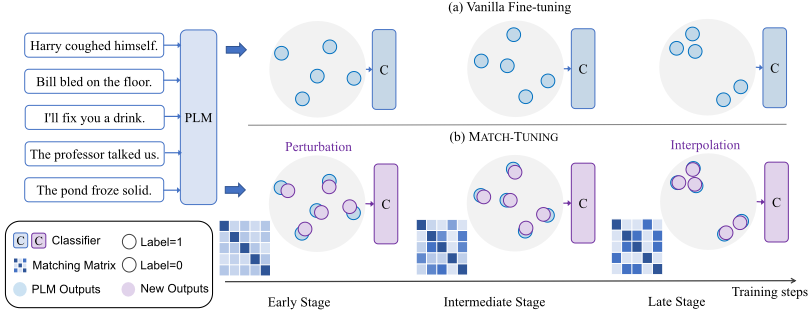
Inspired by contrastive learning with in-batch instances [Gao et al., 2021; Fan et al., 2021], we propose MATCH-TUNING that utilizes in-batch instances dynamically for robust fine-tuning. In MATCH-TUNING, we convert each instance representation in a batch by fusing the representations of other instances in the same batch. More concretely, MATCH-TUNING first calculates the similarities between the PLM outputs of instances in a batch to form a matching matrix. Then, we fuse the PLM representations according to the matching matrix to form new representations for this batch. Finally, we use the new representations for prediction.
MATCH-TUNING works by adaptively determining how to utilize the in-batch instances during the whole training procedure. As shown in Fig. 1, at the beginning of training, regarding the instances with other labels as a perturbation, MATCH-TUNING urges the PLM to converge to a more flat local minimum for better robustness. While nearing the end, MATCH-TUNING focuses more on performing an interpolation among the instances with the same label for better generalization. In this manner, MATCH-TUNING reduces the vulnerability of models and improves their general performance.
We conduct a comprehensive evaluation of MATCHTUNING on the GLUE benchmark. The results show that our method outperforms the vanilla fine-tuning by 1.64 scores on average. In addition, our method outperforms vanilla finetuning by 4.11 average scores on advGLUE, and yields a great improvement for label noise or data imbalance, which shows our overwhelming robustness over vanilla fine-tuning.
Our main contributions are summarized as follows:
- We propose an adaptive fine-tuning method called MATCH-TUNING to train robust models, where instances in the same batch will interact with each other. 1
- MATCH-TUNING reduces the vulnerability of models
1 Our code is available at https://github.com/tongshoujie/ MATCH-TUNING
and outperforms the vanilla fine-tuning by 1.64 scores on the GLUE benchmark.
- Our method manifests extraordinary robustness to various scenarios, including adversarial attacks, spurious biases, and data imbalance.
2 RelatedWork
The vanilla fine-tuning simply adapts PLMs to the taskspecific inputs and outputs, and fine-tunes all the parameters in an end-to-end manner [Devlin et al., 2019; Liu et al., 2019a]. The token representations or the representation of a special token (e.g., [CLS]) is directly fed into an output layer for tagging or classification, respectively. This manner has been shown to produce biased models that are vulnerable to adversarial attacks and noisy data [Aghajanyan et al., 2021; Clark et al., 2019].
In the past years, numerical variants like ChildTuning and R3F are proposed to conduct more trustworthy and effective fine-tuning [Lee et al., 2020; Xu et al., 2021; Aghajanyan et al., 2021]. FreeLB [Zhu et al., 2019] adds perturbations to continuous word embedding by using a gradient method and minimizes the resultant adversarial risk. Moreover, Jiang et al. [Jiang et al., 2020] introduce a regularization to encourage the model output not to change much when injecting a small perturbation to the input. Aghajanyan et al. [Aghajanyan et al., 2021] simply regularize the model against the parametric noise. The literature provides strong insights that proper perturbation on the PLM outputs has great potential in enforcing the model smoothness and robustness.
Recently, in-batch learning successes in many fields. Yao et al. [Liu et al., 2019b; Yao et al., 2021] suggest that the unsupervised instances are helpful to learning the classifier in computer vision tasks. For NLP, contrastive learning with in-batch instances also improves the task-specific representation [Gao et al., 2021] and adversarial robustness [Fan et al., 2021]. Inspired by this, we propose MATCH-TUNING to utilize in-batch instances dynamically for robust fine-tuning.
Different from previous work, MATCH-TUNING no longer needs label information or the specification of negative and positive instances in advance. It performs automatic instance interaction, which applies to most existing pretrained models.
3 Method
MATCH-TUNING derives a composite representation for each instance in a batch by fusing the representations of other instances in the same batch, which are deemed as adaptive noise. From experiments, we find that the adaptive noise functions as an in-batch perturbation in the initial stage of training, and then gradually transits to an in-batch interpolation among "positive" instances that share the same label. In addition, we show that MATCH-TUNING helps the model to escape the sharp local minima through qualitative analysis.
3.1 Overview of MATCH-TUNING
In the batched gradient descent, the data points in a batch are formulated as {(xi, yi)|i = 1, ..., n}, where n denotes the batch size. Throughout our paper, xi represents a textual input, e.g., a single sentence or a sentence pair, while yi denotes a discrete label or a continuous number for classification and regression tasks, respectively. We use h and θ to represent a PLM that extracts contextualized features from xi and its parameters. Similarly, the task-specific classifier and its parameters are denoted by f and ψ. Letting L denote the taskspecific loss function, we compute the mini-batch gradient g in the vanilla fine-tuning as follows:
To apply adaptive weights to the instances in a batch, we introduce the matching matrix M, where each element indicates the pair-level similarity between in-batch instance representations given by a PLM. The matrix M is given by
Note that the overhead to compute Mi,j is small since we can directly reuse h(x; θ), the outputs of the PLM. Then, to produce a robust representation for an instance, we derive a composite representation z(i) from h(x(i) ; θ):
Then, z(i) serves as a drop-in replacement for h(x(i) ; θ) in the vanilla fine-tuning and the mini-batch gradient g′ in MATCHTUNING is computed as follows:
3.2 Qualitative Understanding of MATCH-TUNING
We provide a qualitative viewpoint to understand how MATCH-TUNING works stemming from the notions of perturbation and interpolation.
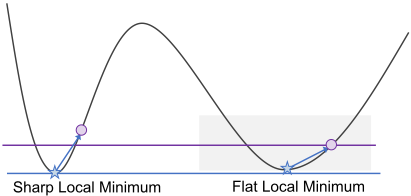
We first introduce the shape of local minima. The loss surface of deep neural networks tends to have various local minima as illustrated in Fig. 2. Sharp local minima are where the loss in a small neighborhood increase rapidly while flat local minima are where the loss varies slowly in a relatively large neighborhood. Sufficient literature has proved that flat local minima usually lead to better generalization [Hochreiter and Schmidhuber, 1995; Dinh et al., 2017]. In addition, under a Bayesian perspective, the noise in gradient could drive model away from sharp minima [Smith et al., 2018].
MATCH-TUNING follows this gradient noise addition routine, but in a different way. To better understand the mechanism of MATCH-TUNING, we visualize the the values of the "positive" instances (with the same label) and "negative" instances (with other labels) in the matching matrix. Fig. 3 depicts the change of matching matrix in MATCH-TUNING. We sum up the values of all instances with the same label and show the cumulative values for "positive" instances on Fig. 3. The "negative" instances share the same setting.
In-batch Perturbation In the initial stage, MATCHTUNING works by performing in-batch perturbation on the original outputs of PLM. As shown in Fig. 3, instances from the same class and that from other classes are similar in the matching matrix. Therefore, any other instance in the same batch is close to a tiny perturbation on the output of PLM. If the PLM provides vulnerable representations, the perturbed representations will break down easily. Therefore, the early stage in MATCH-TUNING encourages the PLM to generate a more robust representation for each instance and converge to a more flat local minimum.
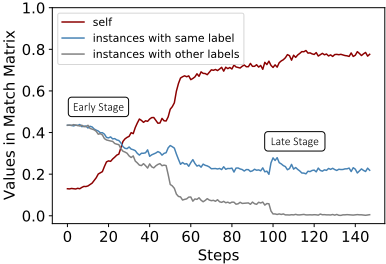
In-batch Interpolation During the whole training process, the model will gradually learn to distinguish the representations of the positive (same label) and negative (other labels) instances in a batch. Consequently, as training proceeds, the portion of negative instances is getting smaller in the match matrix and can hardly influence the composite representation in the late stage of training. In this moment, MATCHTUNING tends to interpolate the representations of the positive instances. We also observe more representative positive instances will contribute more to the final composite representation. As illustrated in Fig. 1, the late stage in MATCHTUNING encourages composite representations to be grouped into clusters according to their real labels.
4 Experiments
We conducted extensive experiments on various downstream tasks to evaluate the general performance and robustness of MATCH-TUNING. For simplicity, in the rest of the paper, we denote other instances in the same batch with the same label as the current instance by positive instances, and other instances with different labels by negative samples.
4.1 Datasets
Following previous work [Xu et al., 2021; Lee et al., 2020], we conduct experiments on four main datasets in GLUE [Wang et al., 2019] to evaluate the general performance. Among them, classification task like CoLA is for linguistic acceptability, RTE is for natural language inference, and MRPC is for paraphrase identification. STS-B is a regression task for semantic textual similarity. By systematically conducting 14 kinds of adversarial attacks on representative GLUE tasks, Wang et al. [Wang et al., 2021] proposed AdvGLUE, a multi-task benchmark to evaluate and analyze the robustness of language models and robust training methods.
| Method | CoLA | RTE | MRPC | STS-B | Avg | ∆ |
|---|---|---|---|---|---|---|
| Vanilla Fine-tuning | 63.16 (64.55) | 70.61 (74.37) | 90.70 (91.42) | 89.64 (90.99) | 78.53 | 0.00 |
| Weight Decay [Daum´e III, 2007] | 63.26 (64.76) | 72.10 (74.77) | 90.88 (91.62) | 89.66 (90.22) | 78.98 | +0.45 |
| Top-K Tuning [Houlsby et al., 2019] | 63.02 (63.88) | 70.92 (74.37) | 91.04 (92.23) | 89.64 (90.83) | 78.66 | +0.13 |
| Mixout [Lee et al., 2020] | 63.78 (65.55) | 72.32 (75.52) | 91.19 (92.01) | 89.89 (90.33) | 79.30 | +0.77 |
| RecAdam [Chen et al., 2020] | 63.99 (65.53) | 71.82 (73.30) | 90.84 (91.89) | 89.67 (90.42) | 79.08 | +0.55 |
| R3F [Aghajanyan et al., 2021] | 64.03 (66.24) | 72.42 (74.37) | 91.09 (91.32) | 89.64 (90.99)∗ | 79.30 | +0.77 |
| ChildTuningF [Xu et al., 2021] | 63.70 (66.12) | 72.02 (74.17) | 91.23 (92.01) | 90.16 (90.68) | 79.28 | +0.75 |
| ChildTuningD [Xu et al., 2021] | 64.84 (66.17) | 73.23 (76.17) | 91.42 (92.20) | 90.18 (90.88) | 79.92 | +1.39 |
| MATCH-TUNING | 64.39 (67.25) | 74.12 (76.17) | 91.70 (92.39) | 90.45 (90.89) | 80.17 | +1.64 |
| MATCH-TUNING + R3F | 65.21 (67.25) | 73.63 (76.17) | 92.34 (93.22) | 90.45 (90.89)∗ | 80.41 | +1.88 |
4.2 Experimental Setup
We report the averaged results over 10 random seeds. We conduct our experiments based on the HuggingFace transformers library 2 and follow the default hyper-parameters and settings unless noted otherwise.
4.3 General Performance
We compare MATCH-TUNING with the vanilla fine-tuning and related work on four tasks of the well-recognized benchmark, GLUE. And we focus on evaluating the performance of BERT-Large based models on the GLUE development set.
Baselines We compare MATCH-TUNING with the following methods. 1) Vanilla Fine-tuning [Devlin et al., 2019], the standard fine-tuning paradigm; 2) Weight Decay [Daum´e III, 2007], which adds a regularization term to the loss function; 3) Top-K Tuning [Houlsby et al., 2019], which fine-tunes only the top-K layers of the PLM; 4) Mixout [Lee et al., 2020], which stochastically replaces the parameters with their pretrained weights; 5) RecAdam [Chen et al., 2020], which introduces quadratic penalty and objective shifting mechanism; 6) R3F [Aghajanyan et al., 2021], which adds adversarial objectives with noise sampled from either a normal or uniform distribution; 7) ChildTuningF [Xu et al., 2021], which randomly masks a subset of parameters PLM during the backward process; 8) ChildTuningD [Xu et al., 2021], which detects the most important child network for the target task.
Results We show the mean (and max) scores on GLUE Benchmark in Tab. 1. MATCH-TUNING significantly outperforms vanilla fine-tuning by 1.88 average score. Moreover, compared with several strong tuning methods, MATCHTUNING achieves the best performance on three tasks, showing its effectiveness. Although ChildTuningD has performance on par with MATCH-TUNING on CoLA task (0.45 mean/-1.08 max), our method has a small computational overhead while ChildTuningD has to adopt Fisher information estimation to obtain the task-driven child network.
2 https://github.com/huggingface/transformers
Note that MATCH-TUNING can be integrated with other tuning methods to further boost the performance. We evaluate the combination of MATCH-TUNING and R3F, which achieves an additional improvement of 0.24 average score.
4.4 Robustness of MATCH-TUNING
Recent work reveals that vanilla fine-tuning is deceptive and vulnerable in many aspects. For instance, fool the models to output arbitrarily wrong answers by perturbing input sentences in a human-imperceptible way. Real-world systems built upon these vulnerable models can be misled in ways that would have profound security concerns. To examine the robustness of MATCH-TUNING, we design robustness evaluation tasks for three common scenarios respectively.
Robustness to Adversarial Attacks
As recent studies revealed, the robustness of fine-tuned PLMs can be challenged by carefully crafted textual adversarial examples. We systematically conduct various adversarial attack evaluations on the advGLUE benchmark.
Tab. 2 illustrates that fine-tuned models maintain vulnerabilities to adversarial attacks while our MATCH-TUNING approach alleviates this chronic problem by 4.11 accuracy promotion on average. Compared with vanilla fine-tuning, existing methods like R3F and ChildTuning encounter 8 ∼ 13 accuracy collapse on advSST-2, while MATCH-TUNING outperforms vanilla fine-tuning by 4.11 scores. On advMNLI, advRTE, and advQQP, MATCH-TUNING also holds a large improvement, as much as 10.79 higher accuracy than vanilla fine-tuning. In short, compared with prior fine-tuning methods, we find that MATCH-TUNING is more robust in adapting PLMs to various tasks.
Robustness to Label Noise
Nowadays, there is inevitably some noise in large-scale datasets. To explore the model robustness to noisy data, we conduct simple simulation experiments on RTE, MRPC, and CoLA. Specifically, we generate noisy training data by randomly changing a certain proportion of labels to incorrect ones. We test the robustness of different fine-tuning methods trained on the noisy data.
| Method | advSST-2 | advMNLI | advRTE | advQNLI | advQQP | Avg | ∆ |
|---|---|---|---|---|---|---|---|
| Vanilla Fine-tuning | 47.57 | 34.99/30.00 | 41.73 | 46.40 | 38.45/27.59 | 40.24 | 0.00 |
| R3F [Aghajanyan et al., 2021] | 38.51 | 35.81/30.26 | 50.12 | 47.52 | 40.59/35.23 | 41.42 | +1.18 |
| ChildTuningF [Xu et al., 2021] | 34.46 | 33.88/26.53 | 41.98 | 47.53 | 40.38/35.82 | 38.46 | -1.78 |
| ChildTuningD [Xu et al., 2021] | 39.19 | 34.06/27.84 | 46.17 | 49.55 | 40.66/39.80 | 41.22 | +0.98 |
| MATCH-TUNING | 51.35 | 35.54/31.07 | 52.52 | 47.52 | 41.45 /32.62 | 44.35 | +4.11 |
| Method | CoLA | MRPC | RTE | Avg |
|---|---|---|---|---|
| Noise Ratio | 5 % | |||
| Vanilla Fine-tuning | 61.14 | 90.38 | 69.68 | 73.73 (↓ 4.80) |
| R3F | 62.42 | 90.82 | 67.99 | 73.74 (↓ 5.56) |
| ChildTuningF | 61.13 | 90.46 | 71.59 | 74.39 (↓ 4.89) |
| ChildTuningD | 61.46 | 90.42 | 71.72 | 74.53 (↓ 5.39) |
| MATCH-TUNING | 62.33 | 91.19 | 72.96 | 75.49 (↓ 4.68) |
| Noise Ratio | 10 % | |||
| Vanilla Fine-tuning | 59.21 | 88.90 | 68.34 | 72.15 ( ↓ 6.38) |
| R3F | 61.76 | 90.36 | 66.75 | 72.96 (↓ 6.34) |
| ChildTuningF | 60.97 | 89.83 | 70.02 | 73.61 (↓ 5.67) |
| ChildTuningD | 61.35 | 89.92 | 69.06 | 73.44 (↓ 6.84) |
| MATCH-TUNING | 61.41 | 90.55 | 71.56 | 74.51 (↓ 5.66) |
| Noise Ratio | 15 % | |||
| Vanilla Fine-tuning | 59.01 | 87.84 | 68.12 | 71.66 (↓ 6.87) |
| R3F | 60.16 | 88.51 | 65.14 | 71.27 (↓ 8.03) |
| ChildTuningF | 59.66 | 88.08 | 69.10 | 72.28 (↓ 7.00) |
| ChildTuningD | 59.88 | 89.01 | 69.78 | 72.89 (↓ 7.03) |
| MATCH-TUNING | 59.65 | 89.51 | 70.04 | 73.07 (↓ 7.10) |
As shown in Tab. 3, MATCH-TUNING outperforms other fine-tuning methods on noised training data. To be exact, MATCH-TUNING surpasses vanilla fine-tuning by 1.76 average scores under 5% noise ratio, 2.36 under 10% noise ratio, and 1.41 under 15% noise ratio. Furthermore, we compare the degradation of model performance towards different noise ratios. Compared with Tab. 1, we calculated the degradation and display it in brackets (the last column of the Tab. 3 ). It shows that MATCH-TUNING has the smallest performance drop compared to other fine-tuning methods. All the above results show that MATCH-TUNING is more robust to label noise than existing methods.
Robustness to Data Imbalance
Minority Class Minority class refers to the class which owns insufficient instances in the training set. These kinds of classes are more challenging during fine-tuning than a normal class. To explore the performance of different tuning approaches on the minority class, we conduct experiments on synthetic RTE, MRPC, and CoLA datasets.
As Tab. 5 illustrated, under different data reduction ratios, MATCH-TUNING outperforms other fine-tuning methods by a large margin. MATCH-TUNING yields an improvement of up to 6.12 average score on 30% reduction ratio and 4.89 average scores on 40% reduction ratio. Besides, it can be seen that the smaller the reduction ratio, the better MATCHTUNING performs compared to other fine-tuning methods. In summary, we can conclude that MATCH-TUNING is more robust towards the minority class.
Atypical Groups Vanilla fine-tuned models can be highly accurate on average on an i.i.d. test set yet consistently fail on atypical groups of the data [Hovy and Søgaard, 2015; Sagawa et al., 2019] (e.g., by learning spurious correlations that hold on average but not in such groups). In contrast, MATCH-TUNING no longer aims at minimizing the original batch average loss and paying more attention to the comparison of instances. As demonstrated in Tab. 6, simply applying MATCH-TUNING improves the worst-group performance by 1.1 with traditional empirical risk minimization (ERM) and 1.5 with GroupDRO [Sagawa et al., 2019]. What's more, the results show that MATCH-TUNING is orthogonal to prior techniques for data imbalance, integrating MATCH-TUNING with them brings further improvement.
5 Analysis and Discussion
5.1 Exploration into Effects of In-batch Instances
As analyzed in Section 3.2, negative instances and positive instances in a batch function differently in the process of MATCH-TUNING. To further explore the role of negative instances and positive instances in MATCH-TUNING, we define a mask matrix A by:
Then we update M ← A ⊙ M so that merely positive instances are involved for MATCH-TUNING, while M ← (In - A) ⊙M so that only negative instances are observed. As is shown in Tab. 7, both negative instances and positive instances place an important role in MATCH-TUNING. When negative instances are masked for the matching matrix and only positive instances are responsible for MATCH-TUNING, the resulting score outperforms on RTE and MRPC, but drops on CoLA slightly. In the contrast, if we only preserve the influence of negative instances on the current instance, the performance surpasses the vanilla fine-tuning baseline steadily.
| Method | CoLA | RTE | MRPC | STS-B | advSST-2 | advMNLI | advRTE | advQNLI | advQQP | Avg |
|---|---|---|---|---|---|---|---|---|---|---|
| Vanilla Fine-tuning | 80 | 40 | 37 | 55 | 645 | 4090 | 40 | 1190 | 3540 | 1070 |
| R3F | 135 | 75 | 65 | - | 860 | 7020 | 75 | 2010 | 5490 | 1755∗ |
| ChildTuningF | 150 | 60 | 60 | 100 | 1200 | 6570 | 60 | 1950 | 6600 | 1861 |
| ChildTuning†D | 100 | 45 | 40 | 65 | 700 | 4310 | 45 | 1270 | 3720 | 1144 |
| MATCH-TUNING | 80 | 40 | 37 | 55 | 650 | 4280 | 40 | 1200 | 3540 | 1102 |
| MATCH-TUNING + R3F | 140 | 80 | 65 | - | 880 | 7100 | 80 | 2030 | 5500 | 1772∗ |
| Method | CoLA | MRPC | RTE | Avg |
|---|---|---|---|---|
| Reduction Ratio | 30 % | |||
| Vanilla Fine-tuning | 81.11 | 78.53 | 27.17 | 62.27 ( - ) |
| R3F | 80.50 | 80.17 | 20.61 | 60.42 (↓ 1.85) |
| ChildTuningF | 83.07 | 80.36 | 29.31 | 64.25 (↑ 1.98) |
| ChildTuningD | 83.18 | 78.75 | 29.62 | 63.85 (↑ 1.58) |
| MATCH-TUNING | 81.68 | 83.26 | 40.23 | 68.39 (↑ 6.12) |
| Reduction Ratio | 40 % | |||
| Vanilla Fine-tuning | 83.13 | 83.94 | 38.14 | 68.40 ( - ) |
| R3F | 83.01 | 85.14 | 22.43 | 63.53 (↓ 4.87) |
| ChildTuningF | 85.10 | 82.80 | 37.79 | 68.56 (↑ 0.16) |
| ChildTuningD | 85.76 | 84.41 | 38.78 | 69.65 (↑ 1.15) |
| MATCH-TUNING | 83.30 | 88.03 | 48.55 | 73.29 (↑ 4.89) |
| Reduction Ratio | 50 % | |||
| Vanilla Fine-tuning | 86.01 | 87.56 | 44.81 | 72.79 ( - ) |
| R3F | 86.27 | 89.21 | 30.53 | 68.67 (↓ 4.12) |
| ChildTuningF | 88.09 | 87.06 | 48.58 | 74.58 (↑ 1.79) |
| ChildTuningD | 87.89 | 87.63 | 49.41 | 74.98 (↑ 2.19) |
| MATCH-TUNING | 86.22 | 89.32 | 53.66 | 76.40 (↑ 3.61) |
This result indicates that both perturbation and interpolation contribute to the final improvements. MATCH-TUNING simply unify negative instances and positive instances by the matching matrix, and such unification brings further improvement (refer to the last row of Tab. 7).
5.2 Computational Efficiency
MATCH-TUNING improves the general performance and robustness of PLMs by introducing simple in-batch interactions. To demonstrate the computational efficiency of MATCH-TUNING, we report the training time of a single epoch for different fine-tuning methods. All the methods are based on BERTLARGE and tested on a single NVIDIA A40 GPU. As illustrated in Tab.4, while other methods all introduce heavy extra computational cost, MATCH-TUNING takes almost no overhead than vanilla fine-tuning. Besides, MATCH-TUNING + R3F improves the performance of R3F with slight overhead, which also shows the efficiency of MATCH-TUNING.
| Method | MNLI | |
|---|---|---|
| Avg Acc | Worst-group Acc | |
| ERM | 82.8 ( - | ) 65.1 ( - ) |
| GroupDRO | 81.2 ( - ) | 78.3 ( - ) |
| ERM + MATCH-TUNING | 82.9 (↑ 0.1) | 66.1 (↑ 1.0) |
| GroupDRO + MATCH-TUNING | 81.2 (↑ 0.0) | 79.6 (↑ 1.3) |
| Method | CoLA | RTE | MRPC |
|---|---|---|---|
| F.T.vanilla | 63.16 ( - ) | 70.61 ( - ) | 90.70 ( - ) |
| M.T.Positive | 62.88 (↓ 0.28) | 72.71 (↑ 2.10) | 90.77 (↑ 0.07) |
| M.T.Negative | 63.32 (↑ 0.16) | 72.82 (↑ 2.21) | 91.18 (↑ 0.48) |
| M.T.F ull | 64.39 (↑ 1.23) | 74.12 (↑ 3.51) | 91.70 (↑ 1.00) |
6 Conclusions
To improve the general performance and robustness for fine-tuning PLMs, we propose robust MATCH-TUNING via in-batch instance perturbation. Extensive experiments on downstream tasks demonstrate the general performance of MATCH-TUNING. In addition, MATCH-TUNING is shown to be a powerful tuning approach towards broad categories of robustness evaluation. We further analyze the functioning process of MATCH-TUNING and provide probation on its components.
Acknowledgements
This paper is supported by the National Key Research and Development Program of China 2020AAA0106700 and NSFC project U19A2065.
@inproceedings{ijcai2022p610,
  title     = {Robust Fine-tuning via Perturbation and Interpolation from In-batch Instances},
  author    = {Tong, Shoujie and Dong, Qingxiu and Dai, Damai and Song, Yifan and Liu, Tianyu and Chang, Baobao and Sui, Zhifang},
  booktitle = {Proceedings of the Thirty-First International Joint Conference on
               Artificial Intelligence, {IJCAI-22}},
  publisher = {International Joint Conferences on Artificial Intelligence Organization},
  editor    = {Luc De Raedt},
  pages     = {4397--4403},
  year      = {2022},
  month     = {7},
  note      = {Main Track},
  doi       = {10.24963/ijcai.2022/610},
  url       = {https://doi.org/10.24963/ijcai.2022/610},
}
TY - CPAPER TI - Robust Fine-tuning via Perturbation and Interpolation from In-batch Instances AU - Tong, Shoujie AU - Dong, Qingxiu AU - Dai, Damai AU - Song, Yifan AU - Liu, Tianyu AU - Chang, Baobao AU - Sui, Zhifang T2 - Proceedings of the Thirty-First International Joint Conference on Artificial Intelligence, IJCAI-22 PB - International Joint Conferences on Artificial Intelligence Organization PY - 2022 SP - 4397 EP - 4403 DO - 10.24963/ijcai.2022/610 UR - https://doi.org/10.24963/ijcai.2022/610 ER -Copied
Machine-readable versions of this paper, for tools and AI agents:





