
HEA-D: A Hybrid Evolutionary Algorithm for Diversified Top-k Weight Clique Search Problem
Proceedings of the Thirty-First International Joint Conference on Artificial Intelligence. Main Track. Pages 4821-4827.
https://doi.org/10.24963/ijcai.2022/668
Keywords
- Search: Heuristic Search
- Search: Local search
- Search: Evolutionary Computation
- Search: Combinatorial Search and Optimisation
Abstract
The diversified top-k weight clique (DTKWC) search problem is an important generalization of the diversified top-k clique (DTKC) search problem with extensive applications, which extends the DTKC search problem by taking into account the weight of vertices. In this paper, we formulate DTKWC search problem using mixed integer linear program constraints and propose an efficient hybrid evolutionary algorithm (HEA-D) that combines a clique-based crossover operator and an effective simulated annealing-based local optimization procedure to find high-quality local optima. The experimental results show that HEA-D performs much better than the existing methods on two representative real-world benchmarks.
- [Berry et al., 2004] Nina Berry, Teresa Ko, Tim Moy, Juli- enne Smrcka, Jessica Turnley, and Ben Wu. Emergent clique formation in terrorist recruitment. In The AAAI-04 Workshop on Agent Organizations: Theory and Practice, pages 1198-1208, 2004.
- [Carrasco et al., 2020] Jacinto Carrasco, Salvador García, María del Mar Rueda, S. Das, and Francisco Herrera. Re- cent trends in the use of statistical tests for comparing swarm and evolutionary computing algorithms: Practical guidelines and a critical review. Swarm Evol. Comput., 54:100665, 2020.
- [Chang, 2020] Lijun Chang. Efficient maximum clique com- putation and enumeration over large sparse graphs. VLDB J., 29(5):999-1022, 2020.
- [Derrac et al., 2011] Joaquín Derrac, Salvador García, Daniel Molina, and Francisco Herrera. A practical tutorial on the use of nonparametric statistical tests as a methodology for comparing evolutionary and swarm intelligence algorithms. Swarm Evol. Comput., 1(1):3-18, 2011.
- [Garey and Johnson, 1979] M. R. Garey and David S. John- son. Computers and Intractability: A Guide to the Theory of NP-Completeness. W. H. Freeman, 1979.
- [Jiang et al., 2017] Hua Jiang, Chu-Min Li, and Felip Manyà. An exact algorithm for the maximum weight clique problem in large graphs. In Satinder P. Singh and Shaul Markovitch, editors, Proceedings of the Thirty-First AAAI Conference on Artificial Intelligence, February 4- 9, 2017, San Francisco, California, USA, pages 830-838. AAAI Press, 2017.
- [Lee et al., 2010] Conrad Lee, Fergal Reid, Aaron McDaid, and Neil Hurley. Detecting highly overlapping commu- nity structure by greedy clique expansion. arXiv preprint arXiv:1002.1827, 2010.
- [López-Ibáñez et al., 2016] Manuel López-Ibáñez, Jérémie Dubois-Lacoste, Leslie Pérez Cáceres, Mauro Birattari, and Thomas Stützle. The irace package: Iterated racing for automatic algorithm configuration. Operations Research Perspectives, 3:43-58, 2016.
- [Porumbel et al., 2011] Daniel Cosmin Porumbel, Jin Kao Hao, and Pascale Kuntz. An efficient algorithm for com- puting the distance between close partitions. Discrete Ap- plied Mathematics, 159(1):53-59, 2011.
- [Wu and Yin, 2021] Jun Wu and Minghao Yin. A restart local search for solving diversified top-k weight clique search problem. Mathematics, 9(21), 2021.
- [Wu et al., 2020] Jun Wu, Chu-Min Li, Lu Jiang, Junping Zhou, and Minghao Yin. Local search for diversified top-k clique search problem. Comput. Oper. Res., 116:104867, 2020.
- [Yuan et al., 2015] Long Yuan, Lu Qin, Xuemin Lin, Li- jun Chang, and Wenjie Zhang. Diversified top-k clique search. In Johannes Gehrke, Wolfgang Lehner, Kyuseok Shim, Sang Kyun Cha, and Guy M. Lohman, editors, 31st IEEE International Conference on Data Engineering, ICDE 2015, Seoul, South Korea, April 13-17, 2015, pages 387-398. IEEE Computer Society, 2015.
- [Zheng et al., 2011] Xiaoqi Zheng, Taigang Liu, Zhongnan Yang, and Jun Wang. Large cliques in arabidopsis gene co- expression network and motif discovery. Journal of plant physiology, 168(6):611-618, 2011.
- [Zhou et al., 2020] Zhou Zhou, Zhuopeng Xiao, and Wei- hong Deng. Improved community structure discovery al- gorithm based on combined clique percolation method and k-means algorithm. Peer Peer Netw. Appl., 13(6):2224- 2233, 2020.
- [Zhou et al., 2021] Junping Zhou, Chumin Li, Yupeng Zhou, Mingyang Li, Lili Liang, and Jianan Wang. Solving diver- sified top-k weight clique search problem. Sci. China Inf. Sci., 64(5), 2021.
References were extracted automatically from the PDF and may contain errors.
Full text extracted automatically from the PDF; figures, tables and equations may differ. The PDF is the version of record.
1 Introduction
A clique is a subset of vertices from an unweighted graph, where any two distinct vertices in the subset are adjacent and if it is not covered by any other clique of the given graph, it is a maximal clique. The maximum clique problem (MCP) is to find a maximal clique with the largest cardinality in the graph. Moreover, the maximum weight clique problem (MWCP) is a generalization of MCP with a positive integer assigned to each vertex as its weight value. MWCP aims to find a maximal weight clique which is not a subset of any other maximal weight clique and the total weight of the clique is maximum. MCP andMWCP areNP-hard problems [Garey and Johnson, 1979] with a wide range of practical applications in different fields, including combinatorial auction [Zhou et al., 2020], community detection [Chang, 2020], and video object segmentation [Jiang et al., 2017].
Note that the MCP and MWCP only take into account the maximum one. In order to have larger and more informative solutions, the diversified top-k clique (DTKC) search problem is introduced to find k maximal cliques to cover as many vertices as possible which are not only individually large but also lowly overlapping with each other, and k is an integer parameter which requires to be provided. This problem is NPhard [Wu et al., 2020]. DTKC search problem is notable for its numerous applications, such as the community search in social networks [Lee et al., 2010], motif discovery in molecular biology [Zheng et al., 2011], and anomaly detection in complex networks [Berry et al., 2004]. The concept DTKC was first introduced by [Yuan et al., 2015].
∗Corresponding author
However, in many situations, the vertices of a graph do not have the same weight, so the DTKC model is not sufficient. So we focus on the DTKWC search problem, which attempts to find k maximal weight cliques of a graph, in the sense that they cover the most weight in the graph. Since the DTKC is just a particular case of DTKWC in which the weight of all vertices is the same, the DTKWC is also NP-hard. Unlike MCP and MWCP, which have been investigated by many researchers, only a few algorithms have been proposed for solving the DTKC and DTKWC search problems.
Several approximation algorithms based on clique enumeration methods were proposed to solve the DTKC search problem [Yuan et al., 2015], and [Wu et al., 2020] provide a local search algorithm (TOPKLS) with two novel heuristic strategies allowing to obtain high-quality solutions of the DTKC search problem. For the DTKWC search problem studied in this work, the exact and heuristic algorithms have been proposed by [Zhou et al., 2021], transforming the DTKWC search problem to the weighted partial MaxSAT (WPMS) problem with direct encoding (DE) and independent set partition based encoding (ISPE), which are then solved by the state-of-the-art WPMS solvers. However, due to the NPhardness of the DTKWC search problem, the above encoding methods failed to encode large or even medium-sized graphs to WPMS. Motivated by this, [Wu and Yin, 2021] proposed a heuristic algorithm (TOPKWCLQ) to solve the DTKWC search problem on large graphs, which repeats a local search procedure within a reasonable time.
We note that the existing approaches have difficulties to robustly and consistently produce high-quality solutions for large instances. Furthermore, to the best of our knowledge, the powerful population-based evolutionary approach for the DTKWC search problem has not been investigated. Therefore, in this work, we fill this gap by presenting an effective hybrid evolutionary algorithm called HEA-D (hybrid evolutionary algorithm for DTKWC). The main contributions of this work are summarized as follows.
First, from the algorithm perspective, this is the first time a hybrid evolutionary algorithm has been used to solve the DTKWC search problem with several powerful components. The clique-based crossover operator is carefully designed to generate better offspring solutions during the search period. And this operator requires a score function to evaluate the quality of the cliques in the current solution. Furthermore, the simulated annealing-based local optimization is used to find local optimal solutions by effectively exploring the candidate solutions which are the restricted neighborhood of the current solution. Meanwhile, the pool of the population always maintains different and feasible solutions. Second, from the computational perspective, the experimental results demonstrate that our algorithm obtains the best solutions on the 550 benchmark instances tested and is often more than 1 to 3 orders of magnitude faster than the competitors on many instances. In particular, the new record results for 334 out of 550 benchmark instances (for 334 large real-world instances, while for small instances, all algorithms find the optimal solutions) are reported. Finally, HEA-D starts its search with an initial population obtained with a greedy construction procedure, and this population size is no more than a given constant value. Therefore, this work shows the benefit of the population-based approach for solving the DTKWC search problem, and this method can clearly also be used to solve other diversified top-k cohesive subgraph problems.
2 Diversified Top-k Weight Clique Search Problem
2.1 Preliminaries
A weighted graph G = (V, E, w) is a graph with |V | vertices, |E| edges, and a weight function w that assigns to each vertex vi of V a non-negative integer w(vi) representing its weight. A weight clique c in G is a set of vertices such that for any u, v ∈ c, (u ̸= v), we have (u, v) ∈ E and the weight of c is ω(c) = ∑vi∈c w(vi). A weight clique c in G is a maximal weight clique if and only if there exists no clique c′ in G such that c ⊂ c′ and ω(c) < ω(c′ ). Given a set of maximal weighted cliques C = {c1, c2, . . . }, the coverage of a weight clique set C is defined as cov(C) = ⋃ci∈C ci, while the weight of C is the total weight of the vertices in G covered by the maximal weight cliques in C, denoted by W(C) and calculated by the formula W(C) = ∑v∈(⋃c∈C c) w(v). The private vertices of a maximal weight clique c in C, denoted by priv(c,C), are a subset of vertices of c not contained in any other clique in C, i.e., priv(c, C) = c \ cov(C \ c).
Definition 1 (Diversified top-k weight clique, DTKWC). Given a weighted graph G(V,E,w) and a fixed integer k, the diversified top-k weight clique search problem is to compute a set C, so that each c ∈ C is a maximal weight clique, |C| ≤ k, and W(C) is maximized. C is called diversified top-k weight cliques.
Let G(V,E,w) be a given graph and C is the current solution. Suppose that S = {C1,C2, . . . } is the search space including all feasible solutions of the given problem, i.e., the DTKWC search problem in this paper. Thus, each item in S contains at most k maximal weight cliques of G.
Definition 2 (Distance). The distance between Ci and Cj, denoted by Dist(Ci, Cj), is the minimum number of vertices that need to be changed in Ci such that the resulting solution becomes the same as Cj. If Dist(Ci,Cj) > 0, then Ci and Cj are not identical solutions. Otherwise, they have the same coverage.
This distance Dist(Ci,Cj) can be calculated in polynomial time [Porumbel et al., 2011].
2.2 Constraint Model for DTKWC Search Problem
Given a graph G = (V, E, w), the DTKWC search problem involves finding at most k maximal weight cliques that cover maximum weight of vertices in a given graph. Let xih be the binary variable such that xih = 1 if the vertex vi is allocated to the hth maximal weight clique, and xih = 0 otherwise. Likewise, let yi be a binary variable associated with vertex vi such that yi = 1 if vi in a maximal weight clique, yi = 0 otherwise. wi denotes the weight of the vertex vi. ¯E is a set of edges in the complement graph ¯G = (V, ¯E,w). The DTKWC search problem can be expressed by the following MILP constraint formulation.
In the above formulation, the objective function (1) is to maximize the function f(G), i.e. maximize the total weight of the selected maximal weight cliques. The intuitions of other formulas are given below. 1) Constraint (2) guarantees that there is an edge between every two vertices in a clique; 2) Constraint (3) means that the value of yi = 1 if there exists at least one xih = 1 (vi ∈ V and 1 ≤ h ≤ k); otherwise, the value of yi = 0; 3) Constraint (4) indicates that xih (vi ∈ V and 1 ≤ h ≤ k) can only be assigned a value of 0 or 1.
3 HEA-D: the Top-Level Algorithm
This section describes a hybrid evolutionary algorithm, called HEA-D, for the DTKWC search problem on top level. Details of important components will be presented in the following.
As shown in Algorithm 1, HEA-D starts with an initial population Pop of at most p (p is a parameter and p ≥ 2) individuals or solutions (line 1). After that, HEA-D performs a number of generations to evolve the population until the given stopping condition is met (lines 3-8). In this work, the condition is a cutoff time limit. During each generation, HEA-D picks out two parent solutions C1 and C2 from Pop. A clique-based crossover operator (Crossover) is used to recombine C1 and C2 to generate an offspring solution (line 5). Generally, the quality of this offspring solution is not good enough. Thus, a simulated annealing-based local optimization (SALO) procedure is performed to improve its quality (line 6). Finally, the improved offspring solution is used to update the population according to the updating rules (line 8).
Algorithm 1: The main framework of the HEA-D
Input: a weighted graph G(V, E, w), one integer k, population size p and other parameters of the algorithm Output: a set C ∗ containing at most k maximal weight cliques 1 Pop ←PopInitialize(p); 2 C ∗ ← argmaxC∈PopW(C); 3 while stopping condition is not met do 4 Randomly select two solutions C1, C2 from Pop; 5 C0 ←Crossover(C1,C2); /* Section 4 */ 6 C0 ←SALO(C0); /* Section 5 */ 7 if W(C0) >W(C ∗ ) then C ∗ ←C0 ; 8 Pop ←UpdatePool(Pop,C0); 9 return C ∗ ;Below, we describe the procedures of population initialization and updating.
3.1 Population Initialization
The initial population Pop consists of no more than p feasible solutions, and each solution includes at most k maximal weight cliques. Pop is built using the population initialization procedure. Let C0 denote a candidate solution initialized as an empty set. The initialization procedure creates at most k maximal weight cliques. If one clique is not empty, add it into C0 directly; otherwise, the inner loop is ended. After the trivial solution C0 is created, the SALO procedure is invoked to improve C0, and then add C0 into Pop. Note that the constructing and optimization procedures of a new solution are repeated p times to fill Pop with p improved feasible solutions. However, all improved solutions in Pop may be different from each other, or some of them are identical solutions. In addition, it is time-consuming and unnecessary to have repeated elements in the population. Consequently, we use the distance measure (Definition 2) to calculate the pairwise distances of the p solutions and eliminate duplicates. If all solutions in Pop are identical, i.e. |Pop| = 1, we try to create another different solution in the sense of the distance and apply again the SALO procedure to improve it. Therefore, this initialization procedure can always create an initial population with 2 to p high-quality and diverse solutions.
3.2 Population Updating
For keeping both high-quality and diversity of the population Pop, the population need to be updated when an offspring individual that is a feasible solution for the DTKWC search problem is generated and further improved by Crossover and SALO procedures, respectively. We first calculate the distance between the new offspring individual C0 and each one in Pop. Thus, there are three situations in which the population is tried to update with the new offspring individual: (1) If C0 is identical to an individual in the current population Pop, C0 is dropped without changing the population. (2) If C0 is different from all individuals in the population and the size of the current population is less than p, C0 will be included
Input: two selected parent solutions C1 and C2 Output: a offspring solution C0 1 C0 ←C1 ∪C2; 2 for i = 1 to k do 3 for c ∈ C0 do 4 Calculate the scoring value score(c) of c according to the score function. 5 cmin ← arg minc∈C0 score(c); 6 Remove the maximal weight clique cmin which is the one with the least score value from C0, breaking ties in favour of the new one; 7 return C0;directly into the population. (3) If neither of the above situations is satisfied. We compare C0 with the worst individual Cmin that has the least weight in the current population. If the new offspring C0 is better than the worst one Cmin, replace Cmin with this offspring; otherwise, drop C0 directly.
Additionally, as the current best solution is not improved in L steps, |Pop| × θreduce (θreduce is a parameter of HEA-D) individuals in Pop will be removed, allowing more opportunities for the diversity of individuals to be added to Pop.
4 Clique-based Crossover Operator
Generally, the memetic algorithm that integrates the evolutionary algorithm and the local search algorithm needs to design a suitable crossover operator such that this operator allows the offspring solutions to inherit the corresponding genetic information from the parent solutions. For the DTKWC search problem, the maximal weight cliques shared by parents are used to represent such information in HEA-D. Therefore, a well-designed crossover operator based on the cliques is presented.
Specifically, it is important to find a way to evaluate whether the cliques in the parent solutions can be inherited to the offspring solution. Consequently, we propose a score function based on the total weight of the private vertices, following the general principle presented above and described below.
Given a weighted graph G = (V, E, w), a maximal weight clique set C and a maximal weight clique c of G (c ∈ C), the score of c is defined as:
In Algorithm 2, let C0 denote a new offspring solution and C1, C2 be the selected parent solutions. The crossover operator generates a new offspring solution C0 by inheriting the cliques with better profit from C1 and C2 in order to maximize the total weight of the covered vertices included in C0. The criteria for deciding which clique can be inherited is relying on the score of each clique calculated by the Equation (5). For the above purpose, all cliques in C1 and C2 are contained in C0 which is initialized as an empty set (line 1). Then, the score values for all cliques in C0 will be calculated according to Equation (5) (line 4). Among them, the clique with the least score value is eliminated fromC0 (lines 5-6). These two sequential steps will be repeated k iteration steps to recombine a new offspring solution from the reference parents, so that C0 becomes a feasible solution again with the largest weight value. Note that the crossover operator aims to transfer as many cliques with the greatest score value in both reference parents to the new offspring as possible in each iteration.
5 Local Optimization
This section is dedicated to the simulated annealing-based local optimization (SALO), which can be used to improve the solutions created by population initialization and the offspring solution generated by crossover operator. As discussed in the literature, during the search process of memetic algorithms, a local optimization method can find higher-quality solutions than only evolutionary algorithms for constrained optimization problems. Therefore, following this, a SALO procedure is used to effectively explore the candidate solutions. We first introduce the neighborhood used by the SALO and then present the general algorithm.
5.1 Neighborhood
During the SALO procedure, the neighborhood of a feasible solution of the DTKWC search problem is one key ingredient and should be carefully designed. Therefore, in the following, we introduce a new definition of neighborhood for the DTKWC search problem, which is based on the maximal weight cliques. The distance between a feasible solution and its neighbor solution for the DTKWC search problem must be greater than zero, and there is one and only one clique between them that is different. The definition of a neighborhood follows the general principle presented above and is described as follows.
According to the definition of distance between two feasible solutions of the DTKWC search problem, a neighbor solution can be built by exchanging a random maximal weight clique from the current solution with another maximal weight clique. However, with no restriction on the cliques to be exchanged, there are numerous candidate solutions which needs to be checked, and many of them fail to improve the quality of the current solution. To improve the search efficiency, the SALO procedure will accept a restricted neighborhood that
Algorithm 3: SALO
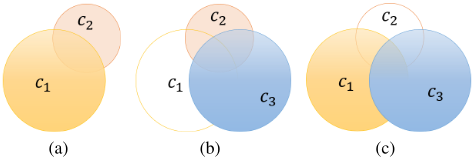
Input: a current solution C Output: a best solution C best found so far 1 T ← Tinit, C best ←C; 2 while True do 3 for iter = 1 to p × k × θsize do 4 c ← find a new maximal weight clique from the given graph G; 5 C ′ ← C ∪ {c}; 6 Compute the score for each clique in C ′ ; 7 cmin ← argminc∈C score(c), breaking ties in favor of the new one; 8 C ′ ←C ′ \ cmin; 9 With probability defined in Equation (6), accept solution C ′ as new current solution C; 10 if W(C) >W(C best ) then C best ←C ; 11 T ← T × θcool; /* Temperature cooling down */ 12 if C best is not updated for l rounds then break ; 13 return C best ;excludes non-promising candidate solutions to replace the old one. For example, in Figure 1, let C = {c1, c2} be the current solution and c3 be a new maximal weight clique which is different from the one in C. Suppose that the parameter k = 2 and we add c3 into C, in this case, one of the cliques in C must be removed such that C is also a feasible solution for the DTKWC search problem, which leads to C with the largest coverage of the objective value. Note that {c2, c3} and {c1, c3} are both the neighbor solutions of {c1, c2}, and it is easy to check that {c1, c3} is the best solution among all neighbors of C.
With this restricted neighborhood, the SALO procedure can transfer from the current solution to the best solution possible. It has the advantages of having a smaller size compared with the conventional neighborhood and being more focused on good enough neighbor solutions.
5.2 General Algorithm
The SALO procedure explores the candidate solutions according to the restricted neighborhood above to improve the solutions created by the initialization procedure and crossover operator following the general simulated annealing framework. As shown in Algorithm 3, the SALO procedure performs a number of search rounds (lines 2-12) with different temperature values T (initially set to Tinit). Let C best be the best solution found by the SALO procedure (initially set to the current solution C). In one round, the SALO procedure checks p × k × θsize candidate restricted neighbor solutions (lines 3-10). Neighbor solutions are generated by adding a new maximal weight clique in C and again removing the worst one, breaking ties in favor of the new one (lines 4-8).
Sometimes, the improved solutions are not always better than the current best solution and a decision must be made to decide whether an unimproved neighbor solution C ′ is accepted as the new current solution according to the following acceptance probability:
| Parameter | Range | Value |
|---|---|---|
| p | {10, 15, 20, 25, 30} | 20 |
| θsize | {2, 4, 8, 16, 32} | 8 |
| θcool | {0.90, 0.91, . . . , 0.99} | 0.96 |
| θreduce | {0.1,0.2,. . . ,0.9} | 0.5 |
| l | {1,2,. . . ,10} | 5 |
| L | {50,100,150,200} | 100 |
If the acceptance probability is satisfied, the current solution C is updated by an unimproved neighbor solution C ′ ; otherwise, the search process will continue (line 9). If the current solution can be improved by a neighbor solution, and it is better than C best in this iteration, the best solution C best is updated (line 10). At the end of each search round, as many simulated annealing algorithms, the temperature T will be decreased by a constant factor θcool which is a parameter of HEA-D (line 11).
Further, the current solution could not be improved from the neighborhood in numerous rounds. To reduce unnecessary search rounds, a new criterion is adopted such that the search process will be terminated and return the best solution found so far when C best is unchanged in l rounds (line 12).
Specifically, the SALO procedure is sensitive to the initial temperature Tinit which is set using a simple automated binary search. This method considers the frequency of reaching the best solution in one search round. And the initial temperature Tinit is set to 1000 first (the initial range is [1,2000]). If this frequency is equals to 50%, then set Tinit to this value; otherwise, according to the value of the frequency is less or greater than 50%, the frequency is set to the first or second half-sized range in the next search round.
6 Computational Experiments
We carry out extensive experiments to evaluate the performance of HEA-D on two representative real-world graphs used in the previous literatures: advertisement putting benchmark (8 graphs) [Zhou et al., 2021] and weighted real-world large graph benchmark (102 graphs) [Wu and Yin, 2021]. We compare HEA-D against the existing algorithms, including a heuristic algorithm TOPKWCLQ [Wu and Yin, 2021] and two exact algorithms DE and ISPE [Zhou et al., 2021].
6.1 Experimental Setup
HEA-D is implemented in C++ and compiled using g++ with "-O3". Detailed results and the sourced code is reported in github 1 . The default values of the parameters used in HEAD are shown in Table 1 tuned with the automatic configuration tool irace [L´opez-Ib´a˜nez et al., 2016]. All experiments were performed on CentOS with 2.00 GHz CPU and 32 GB
1 https://github.com/wujunzero/HEA-D
memory. The optimal solutions of the advertisement putting instances are known, whereas the weighted large real-world instances have unknown optimal solutions. Moreover, for the advertisement putting problem, the size of the instances is small, so that in some instances all vertices will be covered when k is set to 5 or more for some instances. For this reason, we set the parameter k to 1, 2, 3, 4, and 5, respectively, while for each large real-world graph in our experiments, the parameter k is set to 10, 20, 30, 40, and 50, respectively. Thus, we have (8 + 102) × 5 = 550 DTKWC search problem instances in total. For HEA-D and TOPKWCLQ, they are performed on 10 independent runs with a cutoff time (600 seconds) on each instance. For CPLEX solver and two exact algorithms DE and ISPE, a cutoff time of one hour is used. For advertisement putting instances, the results are not reported here, owing to they are so easy that HEA-D and its competitors find the optimal solutions quickly. For real-world large graphs, we compared HEA-D with the CPLEX solver (version 12.9), which uses the mathematical model presented in Section 2.2 and the heuristic algorithm for the DTKWC search problem called TOPKWCLQ.
6.2 Computational Results
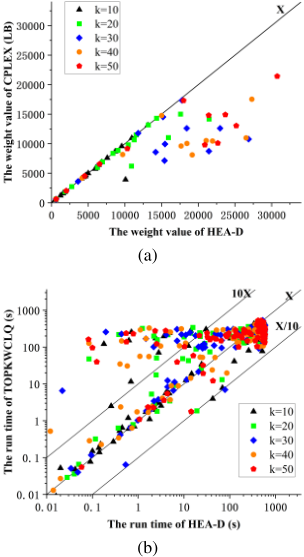
For large real-world instances, HEA-D significantly outperforms the competitors. HEA-D found the best solution on all instances, indicating that HEA-D dominated TOPKWCLQ, CPLEX, DE and ISPE. For 19 out of 510 real-world instances, CPLEX was able to prove the solution optimal, where the values of the lower bound and upper bound are equivalent in the results of CPLEX. For 45 out of 73 instances where CPLEX solver can reach a solution, HEA-D finds better objective values; HEA-D and CPLEX find the same objective values on the remaining 28 instances (Figure 2(a)). Furthermore, considering the average computing time of reaching the best solutions for large real-world instances, we observe that HEA-D requires less time than TOPKWCLQ on most instances and performs 1-3 orders of magnitude faster than TOPKWCLQ for most instances (Figure 2(b)). In addition, the best value and average value found by HEA-D are the same on many instances, indicating that the feasibility and robustness of HEA-D are better than TOPKWCLQ.
To verify whether there exists a statistically significant difference between HEA-D and its competitors in terms of the best (average) objective values, the p-values from the nonparametric Wilcoxon signed ranks test [Derrac et al., 2011; Carrasco et al., 2020] with a significance level of 0.05 are provided in Table 2. Column R+ best (R+ avg ) denotes the sum of ranks for the instances in which HEA-D outperforms the compared algorithms, in terms of the best (average) objective value, while Rbest (Ravg ) refers to the sum of ranks for the opposite. Therefore, the statistical tests in Table 2 confirm that HEA-D has a significance improvement over the two competitors (CPLEX and TOPKWCLQ) with a significance level of 0.05. Furthermore, the summary results are shown in Table 3. "#Better" and "#Equal" record the number of instances for which the associated algorithm yields a better and equal solution than the best solution produced by the other algorithms, respectively. HEA-D outperformed CPLEX and performed the same as TOPKWCLQ on 175 instances in terms of the best objective values. In particular, HEA-D established new lower bounds for 334 out of the 550 instances.
| Comparison | k | R+ best | R- best | p-value | R+ avg | R- avg | p-value |
|---|---|---|---|---|---|---|---|
| vs. CPLEX | 10 | 89 | 0 | 2.59e-16 | 89 | 0 | 2.59e-16 |
| 20 | 99 | 0 | 5.78e-18 | 99 | 0 | 5.78e-18 | |
| 30 | 98 | 0 | 8.46e-18 | 98 | 0 | 8.46e-18 | |
| 40 | 98 | 0 | 8.46e-18 | 98 | 0 | 8.46e-18 | |
| 50 | 98 | 0 | 8.46e-18 | 98 | 0 | 8.46e-18 | |
| vs. TOPKWCLQ | 10 | 55 | 0 | 1.14e-10 | 67 | 1 | 1.59e-12 |
| 20 | 63 | 0 | 5.29e-12 | 76 | 0 | 3.69e-14 | |
| 30 | 69 | 0 | 5.33e-13 | 82 | 0 | 3.73e-15 | |
| 40 | 74 | 0 | 7.89e-14 | 86 | 1 | 6.38e-16 | |
| 50 | 74 | 0 | 7.89e-14 | 92 | 0 | 8.28e-17 |
| Benchmark k | DE/ISPE | CPLEX | TOPKWCLQ #Better#Equal#Better#Equal#Better#Equal | HEA-D | ||||
|---|---|---|---|---|---|---|---|---|
| real-world graphs (102) | 10 | N/A | 0 | 13 | 0 | 49 | 53 | 49 |
| 20 | N/A | 0 | 3 | 0 | 39 | 63 | 39 | |
| 30 | N/A | 0 | 4 | 0 | 32 | 69 | 33 | |
| 40 | N/A | 0 | 4 | 0 | 28 | 74 | 28 | |
| 50 | N/A | 0 | 4 | 0 | 28 | 74 | 28 | |
| Total | 0 | 0 | 28 | 0 | 175 | 334 | 176 | |
6.3 Analysis
In this section, we perform additional experiments to analyze two key ingredients of HEA-D: the population-based memetic search framework and the SALO procedure. The experiments were conducted on all large real-world graphs considered in this work and the parameter k = 10. To assess the effectiveness of the two key ingredients, we compared HEA-D with two HEA-D variants: HEA-D-Descent and SARestart, which replace SALO by a pure descent procedure and keep SALO procedure only, respectively. Consequently, we can verify the importance of SALO and the populationbased memetic framework by comparing HEA-D with HEAD-Descent and SA-Restart, respectively. From the results, we can make the following observations: (1) SA-Restart reports the worst results in terms of best and average objective values, which are significantly worse than the results of HEAD, indicating that removing the memetic framework (set the population size to 1) drastically degrades the performance of the HEA-D and the memetic framework is one key component that ensuring HEA-D's high performance; (2) HEA-DDescent reports better results than HDA-D-Restart, but its results are still significantly worse than the results of HEA-D, indicating that disabling the SALO procedure negatively impacts the performance of HEA-D, i.e., SALO procedure positively contributes to the high performance of the HEA-D.
In addition, the Wilcoxon signed ranks test results from Table 4 indicate that HEA-D performs better than HEA-DDescent and SA-Restart with a significance level of 0.05.
| Comparison | R+ best | R- best | p-value | R+ avg | R- avg | p-value |
|---|---|---|---|---|---|---|
| vs. HEA-D-Descent | 54 | 0 | 1.67e-10 | 64 | 0 | 3.61e-12 |
| vs. SA-Restart | 81 | 0 | 5.46e-15 | 94 | 1 | 6.42e-17 |
7 Conclusions
This paper proposed a hybrid evolutionary algorithm for the DTKWC search problem that is proved to be an NP-hard problem, called HEA-D. On the basis of the general memetic framework, HEA-D combines a clique-based crossover operator for solution recombination (offspring generation) and a SALO procedure for effective local optimization. Computational results on a wide range of real-world instances demonstrated the superiority of HEA-D over the reference methods. This work takes a first step towards the hybrid evolutionary algorithm for the DTKWC search problem and provides new insights into the memetic framework for diversified top-k cohesive subgraph problems as well as related clique problems.
Acknowledgements
This work is supported by the Fundamental Research Funds for the Central Universities 2412019ZD013, NSFC (under Grant No.61976050, 61972384). The authors also thank the Matrics Platform of the Universit´e de Picardie Jules Verne.
@inproceedings{ijcai2022p668,
  title     = {HEA-D: A Hybrid Evolutionary Algorithm for Diversified Top-k Weight Clique Search Problem},
  author    = {Wu, Jun and Li, Chu-Min and Zhou, Yupeng and Yin, Minghao and Xu, Xin and Niu, Dangdang},
  booktitle = {Proceedings of the Thirty-First International Joint Conference on
               Artificial Intelligence, {IJCAI-22}},
  publisher = {International Joint Conferences on Artificial Intelligence Organization},
  editor    = {Luc De Raedt},
  pages     = {4821--4827},
  year      = {2022},
  month     = {7},
  note      = {Main Track},
  doi       = {10.24963/ijcai.2022/668},
  url       = {https://doi.org/10.24963/ijcai.2022/668},
}
TY - CPAPER TI - HEA-D: A Hybrid Evolutionary Algorithm for Diversified Top-k Weight Clique Search Problem AU - Wu, Jun AU - Li, Chu-Min AU - Zhou, Yupeng AU - Yin, Minghao AU - Xu, Xin AU - Niu, Dangdang T2 - Proceedings of the Thirty-First International Joint Conference on Artificial Intelligence, IJCAI-22 PB - International Joint Conferences on Artificial Intelligence Organization PY - 2022 SP - 4821 EP - 4827 DO - 10.24963/ijcai.2022/668 UR - https://doi.org/10.24963/ijcai.2022/668 ER -Copied
Machine-readable versions of this paper, for tools and AI agents:





