
Am I No Good? Towards Detecting Perceived Burdensomeness and Thwarted Belongingness from Suicide Notes
Proceedings of the Thirty-First International Joint Conference on Artificial Intelligence. AI for Good. Pages 5073-5079.
https://doi.org/10.24963/ijcai.2022/704
Keywords
- Natural Language Processing: Sentiment Analysis and Text Mining
- Humans and AI: Computational Sustainability and Human Well-Being
- Natural Language Processing: Resources and Evaluation
- Machine Learning: Multi-task and Transfer Learning
- Machine Learning: Attention Models
Abstract
The World Health Organization (WHO) has emphasized the importance of significantly accelerating suicide prevention efforts to fulfill the United Nations' Sustainable Development Goal (SDG) objective of 2030. In this paper, we present an end-to-end multitask system to address a novel task of detection of two interpersonal risk factors of suicide, Perceived Burdensomeness (PB) and Thwarted Belongingness (TB) from suicide notes. We also introduce a manually translated code-mixed suicide notes corpus, CoMCEASE-v2.0, based on the benchmark CEASE-v2.0 dataset, annotated with temporal orientation, PB and TB labels. We exploit the temporal orientation and emotion information in the suicide notes to boost overall performance. For comprehensive evaluation of our proposed method, we compare it to several state-of-the-art approaches on the existing CEASE-v2.0 dataset and the newly announced CoMCEASE-v2.0 dataset. Empirical evaluation suggests that temporal and emotional information can substantially improve the detection of PB and TB.
- [Bahdanau et al., 2015] Dzmitry Bahdanau, Kyung Hyun Cho, and Yoshua Bengio. Neural machine translation by jointly learning to align and translate. In ICLR, 2015.
- [Devlin et al., 2019] Jacob Devlin, Ming-Wei Chang, Ken- ton Lee, and Kristina Toutanova. BERT: Pre-training of deep bidirectional transformers for language understand- ing. In Proceedings of NAACL-HLT, 2019.
- [Donker et al., 2014] Tara Donker, Philip J Batterham, Kim- berly A Van Orden, and Helen Christensen. Gender- differences in risk factors for suicidal behaviour identi- fied by perceived burdensomeness, thwarted belonging- ness and acquired capability: cross-sectional analysis from a longitudinal cohort study. BMC psychology, 2(1):1-10, 2014.
- [Ghosh et al., 2020] Soumitra Ghosh, Asif Ekbal, and Push- pak Bhattacharyya. Cease, a corpus of emotion annotated suicide notes in english. In LREC, 2020.
- [Ghosh et al., 2021] Soumitra Ghosh, Asif Ekbal, and Push- pak Bhattacharyya. A multitask framework to detect de- pression, sentiment and multi-label emotion from suicide notes. Cognitive Computation, pages 1-20, 2021.
- [Gunn III et al., 2012] John F Gunn III, David Lester, Janet Haines, and Christopher L Williams. Thwarted belonging- ness and perceived burdensomeness in suicide notes. Cri- sis: The Journal of Crisis Intervention and Suicide Pre- vention, 33(3):178, 2012.
- [Gupta et al., 2018] Deepak Gupta, Pabitra Lenka, Asif Ek- bal, and Pushpak Bhattacharyya. Uncovering code-mixed challenges: A framework for linguistically driven question generation and neural based question answering. In Pro- ceedings of the 22nd Conference on Computational Natu- ral Language Learning, 2018.
- [Handelman and Lester, 2007] Lori D Handelman and David Lester. The content of suicide notes from attempters and completers. Crisis, 28(2):102-104, 2007.
- [Joiner and others, 2005] Thomas E Joiner et al. Why people die by suicide. Harvard University Press, 2005.
- [Joshi, 1982] Aravind Joshi. Processing of sentences with intra-sentential code-switching. In Coling, 1982.
- [Kamila et al., 2018] Sabyasachi Kamila, Mohammed Hasanuzzaman, Asif Ekbal, Pushpak Bhattacharyya, and Andy Way. Fine-grained temporal orientation and its relationship with psycho-demographic correlates. In NAACL-HLT, 2018.
- [Kim, 2014] Yoon Kim. Convolutional neural networks for sentence classification. In EMNLP, 2014.
- [Laghi et al., 2009] Fiorenzo Laghi, Roberto Baiocco, Maria D'Alessio, and Grazia Gurrieri. Suicidal ideation and time perspective in high school students. European Psychiatry, 24(1):41-46, 2009.
- [Lefèvre et al., 2019] Héline Kaya Lefèvre, Christine Mirabel-Sarron, Aurélie Docteur, Virginie Leclerc, Alexandra Laszcz, Philip Gorwood, and Catherine Bun- gener. Time perspective differences between depressed patients and non-depressed participants, and their rela- tionships with depressive and anxiety symptoms. Journal of Affective Disorders, 246:320-326, 2019.
- [Pestian and Matykiewicz, 2008] John P Pestian and Pawel Matykiewicz. Classification of suicide notes using natural language processing. Proceedings of ACL Bio NLP, 967, 2008.
- [Pestian et al., 2012] John P Pestian, Pawel Matykiewicz, Michelle Linn-Gust, Brett South, Ozlem Uzuner, Jan Wiebe, K Bretonnel Cohen, John Hurdle, and Christopher Brew. Sentiment analysis of suicide notes: A shared task. Biomedical informatics insights, 5:BII-S9042, 2012.
- [Poria et al., 2017] Soujanya Poria, Erik Cambria, Deva- manyu Hazarika, Navonil Majumder, Amir Zadeh, and Louis-Philippe Morency. Context-dependent sentiment analysis in user-generated videos. In ACL, pages 873-883, 2017.
- [Shahnaz et al., 2019] Arezoo Shahnaz, Boaz Y Saffer, and E David Klonsky. Examining time perspective orientation in suicide ideation and suicide attempts. Journal of Social and Clinical Psychology, 38(8):627-646, 2019.
- [Spitzer et al., 1967] Robert L Spitzer, Jacob Cohen, Joseph L Fleiss, and Jean Endicott. Quantification of agreement in psychiatric diagnosis: A new approach. Archives of General Psychiatry, 17(1):83-87, 1967.
- [Srivastava and Singh, 2020] Vivek Srivastava and Mayank Singh. Phinc: A parallel hinglish social media code-mixed corpus for machine translation. In Proceedings of W-NUT, 2020.
- [Teixeira et al., 2021] Andreia Sofia Teixeira, Szymon Ta- laga, Trevor James Swanson, and Massimo Stella. Reveal- ing semantic and emotional structure of suicide notes with cognitive network science. Scientific reports, 11(1):1-15, 2021.
- [Vaswani et al., 2017] Ashish Vaswani, Noam Shazeer, Niki Parmar, Jakob Uszkoreit, Llion Jones, Aidan N Gomez, Łukasz Kaiser, and Illia Polosukhin. Attention is all you need. Advances in neural information processing systems, 30, 2017.
- [Wang et al., 2019] Bin Wang, Xiaobing Zhou, and Xuejie Zhang. Ynuwb at semeval-2019 task 6: K-max pooling cnn with average meta-embedding for identifying offen- sive language. In SEMEVAL, 2019.
References were extracted automatically from the PDF and may contain errors.
Full text extracted automatically from the PDF; figures, tables and equations may differ. The PDF is the version of record.
1 Introduction
According to the World Health Organization (WHO), more than 700,000 people, or one in every 100, committed suicide in 2019. In 2019, the global suicide rate per 100,000 people was 9.0, with 11.2 in the Africa region, 10.5 in Europe, and 10.2 in Southeast Asia. The Eastern Mediterranean area had the lowest rate (6.4). While global suicide rates fell by 36% between 2000 and 2019, the Americas region witnessed a 17% increase 1 . The worldwide catastrophe produced by the COVID-19 pandemic has amplified risk factors for suicidal behaviour, making suicide prevention even more vital now.
According to the interpersonal theory of suicide [Joiner and others, 2005], suicidal desire arises when individuals experience persistent emotions of perceived burdensomeness (PB) and thwarted belongingness (TB). The feeling of being a burden on friends, family, and/or society, as well as the potentially dangerous belief that one's death is worth more than one's life, is referred to as PB. TB, on the other hand, is also a risk factor for developing the impulse to commit suicide if someone feels isolated from friends, family, or other important social networks. Identifying latent vulnerability factors that raise the likelihood of suicide conduct might help determine preventive efforts.
1 https://news.un.org/en/story/2021/06/1094212
Suicidal behavior is a challenging problem to investigate, requiring huge samples because of the low baseline rates of suicide attempts and deaths in the general population. Most importantly, individuals dying by suicide hinder the employment of any methods for psychological assessments by researchers. In such a case, a suicide note might be a valuable asset in attempting to assess an individual's specific personality status and mind rationale [Pestian and Matykiewicz, 2008].
- Suicide note excerpt (Hinglish): agara maematraraiimatra gahalflata.iimatra thaiimatra bhaiimatra ta.omatra maematraraiimatra wife & daughter kaomatra saumatra saaamatraidda kyomatraanusvara karavaaamatraяaamatra gaяaamatra , torture karakaematra।
- English translation: Even if it was my fault then why was my wife & daughter made to commit suicide, by torture.
The usage of code-mixed forms of communication is common in multilingual and multicultural societies worldwide, notably in India, Bangladesh, Pakistan, Singapore, and even the United States of America, the United Kingdom, etc. The above excerpt is from a suicide note written in Hindi-English code-mixed language.
Specific time perspective orientations (TPOs), such as having an aversive attitude towards the past (Negative Past) and having a hopeless, nihilistic attitude towards life (Fatalistic Present), are associated with suicide ideation. [Shahnaz et al., 2019] found large and significant differences in TPOs between individuals with a history of suicide ideation and nonsuicidal participants. Emotion is also recognised to have an important influence in predicting the author's mental state in a suicide note. The association of various emotions of different polarities with varying time perspectives may help learn the underlying emotional feeling conveyed in the content of suicide notes (SNs). Recent advances in computational approaches may be used to better understand various ideas in psychology research, which might aid in the early detection, evaluation, management, and follow-up of those experiencing suicidal thoughts and behaviors.
Most existing automated systems need the availability of datasets for training prediction models, and relevant datasets are scarce. Despite the fact that many multilingual speakers in densely populated countries such as India, Pakistan, and Bangladesh use English-Hindi code-mixed language, just a few research [Gupta et al., 2018; Srivastava and Singh, 2020] have attempted to work on this issue. Furthermore, the existing resources [Ghosh et al., 2020; Ghosh et al., 2021] are in English only and annotated at the sentence level, limiting their value in developing automated systems on code-mixed languages and addressing tasks at the document level. During the peak of the COVID-19 epidemic, a large increase in telehealth usage was driven more by persons seeking mental health services than care for physical conditions 2 . Artificial Intelligence (AI)-based automated systems can be incorporated into digital interventions, particularly web and smartphone apps, to enhance user experience and optimise personalised mental health care, more so, in developing countries with high population and minimal healthcare facilities. This motivated us to devise an approach for utilizing the sentencelevel information inherent in existing datasets and addressing correlated tasks at the document level by leveraging the underlying connection between them. Also, such an approach can be built on top of current state-of-the-art transformerbased pre-trained models to account for the data scarcity problem and produce good results.
To this end, the current study presents an automated method to simultaneously detect the presence of two interpersonal states of individuals, PB and TB, from their SNs, given the temporal orientation information and the emotional states of the note content. We introduce, CoMCEASE-v2.0, a manually translated code-mixed suicide notes corpus based on the benchmark CEASE-v2.0 dataset and annotated with temporal orientation, PB, and TB labels. We compare our proposed technique to various state-of-the-art approaches using the existing CEASE-v2.0 dataset and the recently announced CoMCEASE-v2.0 dataset to provide a complete evaluation. The note-level personality annotations with reference noteids can be accessed from https://www.iitp.ac.in/∼ai-nlp-ml/ resources.html#CoMCEASE.
The main contributions are summarized below:
- This is the first study towards detection of perceived burdensomeness and thwarted belongingness from suicide notes using computational methods.
- We introduce a good quality manually translated codemixed corpus of SNs based on the benchmark CEASEv2.0 English dataset with manual annotations for TPO, PB and TB.
- We propose a Temporal and Emotion-assisted Multitask Framework (TEMF) to jointly detect PB and TB from SNs.
2 RelatedWork
Several studies have performed a content analysis of SNs and identified distinguishing features that differentiate SNs from other types of texts [Handelman and Lester, 2007; Pestian et al., 2012]. Suicidal thoughts has been linked to the concepts of PB and TB in various research. The frequency of occurrence of PB and TB in SNs was investigated in [Gunn III et al., 2012]. Gender differences in the determinants and correlates of PB, TB, and acquired suicidal capacity were investigated in [Donker et al., 2014].
2 https://www.frontiersin.org/research-topics/25568/ artificial-intelligence-in-mental-health
Temporal perspective was found to have a significant effect in predicting suicidal thoughts in teenagers [Laghi et al., 2009]. Notable changes were observed in the time perspective of depressed patients when compared to non-depressed people [Lef`evre et al., 2019]. Analyzing the emotional balance in SNs, [Teixeira et al., 2021] discovered links between the concepts and emotional states of persons who committed suicide by recreating the knowledge structure of such notes.
The bulk of suicide note research have concentrated on identifying suicide notes [Handelman and Lester, 2007], with a few focusing on related risk factors for suicide [Ghosh et al., 2021]. Furthermore, massive pre-trained transformer-based language models have taken NLP by storm in recent years, delivering state-of-the-art performance on many downstream tasks. To this end, our study introduces a manually translated code-mixed suicide notes corpus with reliable annotations for TPO, PB, and TB, and use computational techniques to detect two crucial interpersonal risk factors, PB and TB, using an effective multitask network.
3 Dataset
We consider the benchmark CEASE-v2.0 dataset [Ghosh et al., 2021] for this study. This is the only available emotion annotated corpus of suicide notes publicly available for research purposes to the best of our knowledge. The dataset consists of 4932 sentences from over 350 suicide notes annotated with 15 fine-grained emotions at the sentence level. We used the sentence-to-note reference identifiers (IDs) 3 to establish the order of sentences in the dataset, as the original resource was released at sentence-level, all shuffled to prevent reconstruction and preserve anonymity. We perform three main tasks on this existing dataset: (A). Manually annotate for PB and TB (at the note-level), (B). Manually annotate for TPO (at the sentence-level), and, (C). Produce Hindi-English (Hi-En) code-mixed translations for the CEASE-v2.0 English dataset (at the sentence level).
3.1 Annotator Details
Each task was performed by three annotators (A1, A2, and A3), two doctoral degree holders, and one graduate student, sufficiently acquainted with labeling tasks and well-versed with the concepts of PB, TB and TPO. The annotators are familiar with the nuances of Hindi-English code-mixed communication. All of them are native Hindi speakers, wellproficient in English, and also use Hi-En code-mixed language in daily communications.
3 provided by [Ghosh et al., 2021] on request to use it for research purpose solely
3.2 Annotations for PB and TB
Each suicide note is labeled PB/Not-PB and TB/Not-TB to indicate the existence of PB and TB. The final annotations were acquired by using a majority vote on the labels provided by the three annotators. We obtain a Fleiss-Kappa [Spitzer et al., 1967] agreement of 0.791 and 0.76 for the PB and TB tasks respectively, which indicates substantial agreement among the annotators.
3.3 Annotation for TPO
We perform the annotations for the temporal orientation at the sentence level as a single note often contains references to various time perspectives. Consider the suicide note excerpt below:
The rest of my life would only be a burden for others. I am unable to do anything because of poor health.
We can observe that the first sentence relates to a future event while the following sentence relates to a present event. We follow the connotations of past, present or future as described by [Kamila et al., 2018]. Any event(s) that has started and ended is labelled as past whereas an ongoing event is marked as present and event(s) that are yet to happen are labelled as future. We obtain a Fleiss-Kappa agreement of 0.745 which indicates that the annotations are of substantial quality.
3.4 Code-MixedManual Translation of Benchmark CEASE-v2.0 Dataset
We construct code-mixed (Hindi-English) translations of each English sentence in the CEASE-v2.0 dataset while preserving fluency (F) (syntax) and adequacy (A) (semantics). The resulting dataset is known as CoMCEASE-v2.0. We use the matrix language frame (MLF) theory [Joshi, 1982] to create the translations, which states that a code-mixed text has a dominant language or matrix language (here, Hindi) and an inserted language or embedded language (here, English). The insertions could be words or bigger elements that adhere to the matrix language's grammatical structure. Based on previous works [Gupta et al., 2018] on code-mixed text creation, we identified three key scopes where the words or components from the original English sentence can be maintained in the translated code-mixed text. These are: Named Entities (NEs) of types 'Person', 'Location' and 'Organization', noun phrases, and adjective words. However, we need not consider the NEs as the original CEASE-v2.0 dataset comes with anonymized forms of all NEs (as also mentioned in [Ghosh et al., 2021]).
Each annotator (say A1) was asked to mark every translated sentence of the next annotator (A2) for both F and A with an ordinal value from a scale of 1-5 4 . We obtain high average F and A scores of 4.31 and 4.65, respectively, which indicates that the translations are of good quality. A couple of sample translations from the CoMCEASE-v2.0 dataset are shown below:
4 Fluency - 5: Flawless, 4: Good, 3: Non-native, 2: Disfluent, 1: Incomprehensible; Adequacy - 5: All, 4: Most, 3: Much, 2: Little, 1: None
| HE | A1 | A2 | A3 | Average |
| F | 4.25 | 4.28 | 4.40 | 4.31 |
| A | 4.45 | 4.80 | 4.71 | 4.65 |
- Original (En): Do not feel sorry for me. Translation (Hi-En): maematrara ematra imatralae sorry feel mata. karaomatra।
- Original (En): I was immediately taken in a wheelchair to the psychiatrist's office.
- Translation (Hi-En): maumatra jhaematra ta.umatra raanusvarata. wheelchair saematra psychiatrist kaematra office laematra jaaamatraяaamatra gaяaamatra।
3.5 Dataset Statistics
Out of the 364 suicide notes in CEASE-v2.0 dataset which we annotated for PB and TB, 27% of the notes are marked as either PB (10.44%), TB (11.81%) or both (4.67%). Total of 55 notes are labelled as PB and 60 notes as TB. We consider 4885 sentences from the 4932 phrases in the CEASE-v2.0 dataset for the temporality annotations and our experiments. The remaining 47 sentences were not considered due to the following reasons: non-matching mapping IDs (as provided by the authors in [Ghosh et al., 2021]), confusion among all annotators (while annotating for TPO), single-word sentences. The dataset is distributed over the various temporal categories as follows: past - 1508 sentences (30.87%), present - 2035 sentences (41.66%) and future - 1342 sentences (27.47%). The average sentence length in the CoMCEASE-v2.0 dataset is 16.73, whereas it is 14.96 in the original dataset.
4 Methodology
We present a detailed discussion on the proposed TEMF system in the following sub-sections. We depict the overall architecture of the approach in Figure 1.
4.1 Task Definition
Given a suicide note (Si ) with sentences annotated with temporal orientation and emotion labels, the task objective is to detect the presence or absence (1 or 0) of PB and TB. Let D denotes the dataset consisting of the N suicide notes, then D = (S1 , S2 , ..., SN ). A note Si is a collection of sentences such that Si = (si1 , si2 , ..., sin ), where n denotes the number of sentences in the ith note. The emotion labels (Ei ) and temporality labels (T i ) corresponding to each sentence in Si is denoted as Ei = (ei1 , ei2 , ..., ein ) and T i = (ti1 , ti2 , ..., tin ), respectively. The proposed approach work towards maximising the value of the following function:
where y ϵ {1, 0} and θ denotes the model parameters to be optimized.
4.2 Temporal and Emotion-assistedMulti-task Framework (TEMF)
This section discusses our proposed system, which comprises the six main components: a). Input Embeddings, b). Document Encoder, c). Sentence Encoder, d). Attention Module e). High-level Document Abstraction, f). Task-specific Dense layers and Output Layers.
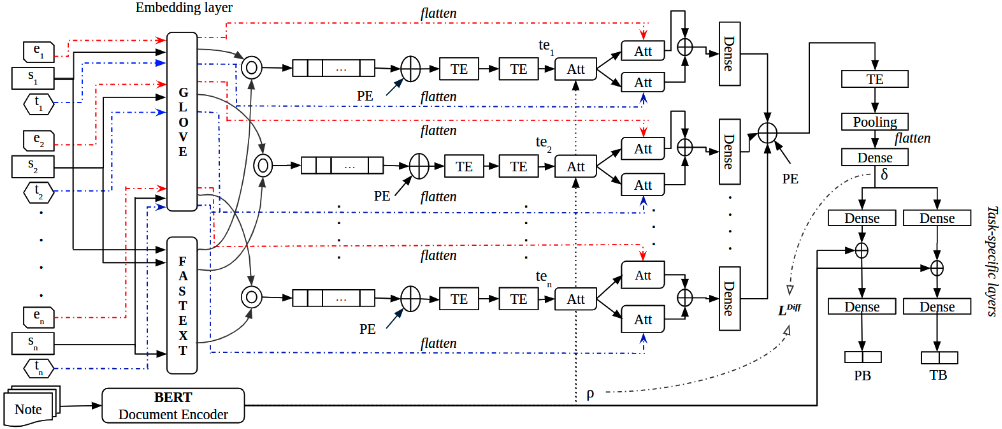
Input Embeddings
Since our focus is on working with the Hinglish dataset, we consider the pre-trained GloVe 5 (English) and fastText 6 (Hindi) word embeddings to capture the semantics of the words of the input sentences. We embed the emotion class and temporality class labels with the word vectors (R1×D ) from GloVe embeddings as all the class labels are in English. D is the dimension of the embedding (in our case, 300).
The sentence embedding representations from GloVe and fastText are projected to a single vector space by finding their mathematical mean, as inspired by the work in [Wang et al., 2019]. Each si is embedded as W i emb = {w1,w2, ...,wc}, W ϵ c × d, where c is the length of si .
Document Encoder
We use the BERT (base) [Devlin et al., 2019] pre-trained model to encode the information of a suicide note at the document level. The representation from the [CLS] token of the BERT encoder's last encoder layer encodes the whole document's contextual information.
Sentence Encoder
At the sentence level, we employ the transformer encoder (TE) [Vaswani et al., 2017] to capture the local semantic information as well as long-term dependencies. First, the positional encodings (PEi ) and the word embeddings (W i emb ) are added to generate the input embeddings (IEi =W i emb + PEi ). This allows the model to use word-order information, including relative and absolute positional data. Each transformer module performs a multi-head self-attention (MHA)
5 https://nlp.stanford.edu/data/glove.840B.300d.zip
6 https://fasttext.cc/docs/en/crawl-vectors.html
operation on the input, followed by a fully connected pointwise feed forward network (FFN) to produce knowledge representation, passing the embedding representation of each sentence IEi through two successive layers of transformer encoder.
where l is the number of layers in the network.
Attention Module
We infuse the document-level contextual information from BERT (ρ) to the sentence-level transformer outputs (tei) by performing additive-attention (Att) [Bahdanau et al., 2015] to make each sentence aware of the global context. The attention-mechanism can be realized by the following equations:
where W1, W2, W3 are the learnable weight matrices, tanh is a non-linear function.
We further apply two independent additive attention operations on each context-aware sentence output, one with the temporal embedding as the query vector and the other with the emotion class embedding as the query vector. These attention mechanisms enable to focus on the relevant words in the sentence concerning each sentence's temporal and emotional information. The temporal and emotion-aware representations of each sentence are concatenated and passed through a sentence-specific dense layer.
High-level Document Abstraction
The dense representations give an abstract representation of the input sentences, which are concatenated (⊕) together and passed through another TE to learn the temporal and emotionaware global context information. The sentence-level position embedding is also added with the input to the TE to use the sentence-order information. Hierarchical transformer encoders have shown promising output while capturing document-level contextual information. We apply a maxpooling operation on the transformer output (δ) to capture the essential latent semantic information across the input.
Task-specific Dense Layers and Output Layers
The max-pooled output (∆) is passed to two task-specific dense layers that capture the intermediate features particular to each task, followed by two task-specific fully connected layers with softmax activation function that acts as the output classification layers. The BERT document representation is added to the task-specific intermediate representations to enhance each feature set.
Calculation of loss: We train the model through a unified loss function as shown below:
Where LPB and LTB are the categorical cross-entropy losses, and α and β are the loss weights for the two tasks.
Alongside the cross-entropy losses (L T ), we calculate a differential loss to minimize the mean squared difference (LDiff ) between the output representations of BERT and TE to build an adequate shared feature space. The intuition is to reduce the vulnerability mainly due to two reasons: (1) the variation in different encoding methods and (2) handling two document representations (one generated from the whole document and one generated from constituent sentences.
where ti ϵ {0, 1} is the ground truth label of each task and T denotes the two tasks.
5 Experiments and Results
In this section, we discuss the experiments performed and the results and analysis.
5.1 Baselines
We evaluate the efficacy of our proposed method on the CEASE-v2.0 dataset considering the following state-of-theart systems as baselines: Convolutional Neural Network [Kim, 2014], Convolutional Neural Network+Context Long Short Term Memory (CNN+cLSTM) [Poria et al., 2017], BERT [Devlin et al., 2019] and CMSEKI [Ghosh et al., 2021]. In CNN+cLSTM system, CNN is used for feature extraction at utterance level followed by a cLSTM to learn context-aware utterance representations. The CMSEKI system was introduced in the work that presented CEASE-v2.0 dataset, addressing detection of depression, sentiment and emotion, using common-sense knowledge. We adapted the CMSEKI system to address our PB and TB tasks. For evaluation on the CoMCEASE-v2.0 dataset, we consider the following state-of-the-art systems as baselines: (1) K-Max Pooling CNN (k-max CNN) [Wang et al., 2019] that uses metaembeddings formed from GloVe and fastText, (2) multilingual BERT (mBERT) [Devlin et al., 2019] pre-trained model.
5.2 Implementation Details
We used 10-fold cross-validation on both datasets and the macro-F1 measure to evaluate all models, as the data is highly skewed over the various classes. For our experiments, we chose the average note length of 13 as the document length. The sequence lengths were set to the average sentence lengths of 15 and 17 for the CEASE-v2.0 and CoMCEASEv2.0 datasets, respectively. For each TE, we used 5 selfattention heads with an embedding dimension of 300 and a feed-forward dimension of 600. All models were trained using a batch size of 4 (to maximise GPU use) and 6 epochs. We chose a learning rate of 2e-5 for the TEMF MT system. The Grid Search approach was used to fine-tune parameters. The best model on the validation set for each fold were saved for testing. We used the BERTBase (English and multilingual) pre-trained models 7 . All the dense layers (except the output dense, which uses softmax activation) used ReLU activation. The task-specific fully-connected and output layers have 128 and 2 neurons each for each task. We trained all the models with Adam optimizer using backpropagation. The implementations were done on an NVIDIA GeForce RTX 2080 Ti GPU. To account for the non-determinism of different TensorFlow GPU operations, we report F1 scores averaged across the five 10-fold cross-validation runs.
5.3 Results and Analysis
We observe from Table 2 that the proposed TEMF MT system outperforms all the baselines commendably with improvements of 2.86% (on PB Task) and 3.08% (on TB task) from the next best performing models BERTBase ST and CMSEKI MT , respectively, on the CEASE-v2.0 dataset. The TEMF MT system also obtains highest F1-scores of 51.27% and 55.21% on the CoM-CEASE-v2.0 dataset, with improvements of 2.34% (on PB Task) and 4.12% (on TB task) from the next best performing model mBERTBase ST . The PB task yielded higher scores for all models than the TB task, which might be due to a slightly higher number of TB occurrences in the dataset than PB.
Varying Context Length
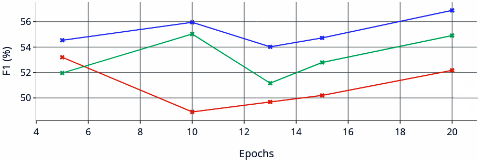
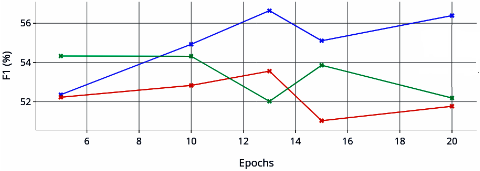
Figure 2 and 3 depicts the F1 results of our TEMF system with comparison to the best performing baselines on different context lengths (5, 10, 13, 15, 20). We observe an upward trend towards the improvement of PB and TB scores by our TEMF MT system, outperforming the CMSEKI MT and BERT MT systems, as contextual information is increased. Furthermore, on the TB task, unlike the BERT MT and CMSEKI MT systems where performance deteriorates with the increase in context length, the proposed TEMF MT model improves substantially.
7 https://github.com/google-research/bert
| Models | F1 PB (%) | F1 TB (%) |
|---|---|---|
| CNN ST [Kim, 2014] | 46.6 | 50.4 |
| CNN+cLSTM ST [Poria et al., 2017] | 45.4 | 45.8 |
| BERTBase ST [Devlin et al., 2019] | 51.16 | 52.02 |
| CMSEKI MT [Ghosh et al., 2021] | 49.68 | 53.56 |
| TEMF MT (proposed) | 54.02 | 56.64 |
| TMF MT (ablation 1) | 53.33 | 52.43 |
| EMF MT (ablation 2) | 51.63 | 48 |
| Models | F1 PB (%) | F1 TB (%) |
|---|---|---|
| k-max CNN [Wang et al., 2019] | 47.43 | 51.06 |
| mBERTBase ST [Devlin et al., 2019] | 48.93 | 51.09 |
| TEMF MT (proposed) | 51.27 | 55.21 |
| TMF MT (ablation 1) | 50.03 | 47.01 |
| EMF MT (ablation 2) | 49.37 | 47.02 |
Comparison with Prior Works
We observe from Tables 2 and 3 that our proposed TEMF MT system outperforms the considered state-of-the-art baselines on both the CEASE-v2.0 and CoM-CEASE-v.0 datasets. The best performing baselines on the PB and TB tasks are BERTBase ST and CMSEKI MT , respectively for the CEASEv2.0 dataset and mBERTBase ST for the CoMCEASE-v2.0 dataset. Moreover, the poor performance of the various baselines on both datasets show how critical it is for present context modelling approaches to perceive interpersonal content from texts.
Ablation Study
We modify TEMF MT by removing the temporal orientation labels and emotion labels in the input, one at a time, to develop EMF MT and TMF MT , respectively. Tables 2 and 3 show that eliminating either one of the time or emotional information from the input has a significant detrimental influence on the overall performance of the model for both the datasets. Furthermore, the results show that removing the temporal information from the input has a more significant impact than removing the emotion data.
Error Analysis
We identify some circumstances in which our proposed technique fails to accurately categorize PB and TB instances.
- Inconsistent grammar rules: Writing style in suicide notes is often informal and does not follow the standard rules of sentence structure. This makes it difficult for our model to recognize syntactic information correctly. For example, Kept me in a locked shower stall for 1 hour. Next sent me burnt food. Giant bugs crawling over my hands. NO FUN!!
- Insufficient context: Lack of knowledge of the context makes the task of detection for PB and TB challenging. For example, They tried to get me, I got them first!
- Sarcastic undertone: The proposed method finds it hard to capture sarcasm, and the problem becomes even critical with lack of sufficient context. For example, It's amazing to look at my grade sheet.
6 Conclusion
In this work, we proposed a Temporal and Emotion-aware Multitask Framework (TEMF) for joint detection of two interpersonal risk factors of suicide: perceived burdensomeness and thwarted belongingness, from suicide notes. We introduced a manually translated code-mixed Hindi-English corpus (CoMCEASE-v2.0) of suicide notes with manual annotations for TPO, PB and TB. We empirically observe that the infusion of temporal and emotion information has a positive impact on improving the performances of the PB and TB detection tasks from suicide notes. Also, the proposed method enables utilizing the existing sentence-level CEASEv2.0 dataset to address note-level tasks.
Future study into the potential pathways that increase the ability to commit suicide would be beneficial as well, such as duration, intensity, and frequency for PB, TB and acquired capability for self-injury.
Ethical Statement
Our resource creation utilizes publicly available CEASE-v2.0 [Ghosh et al., 2021] benchmark suicide notes dataset. We followed the data usage restrictions and did not violate any copyright issues. This study was also evaluated and approved by our Institutional Review Board (IRB). We shall make the code and data available for research purposes (on acceptance), through appropriate data agreement procedure.
Acknowledgments
Asif Ekbal acknowledges the Young Faculty Research Fellowship (YFRF), supported by Visvesvaraya PhD scheme for Electronics and IT, Ministry of Electronics and Information Technology (MeitY), Government of India, being implemented by Digital India Corporation (formerly Media Lab Asia).
@inproceedings{ijcai2022p704,
  title     = {Am I No Good? Towards Detecting Perceived Burdensomeness and Thwarted Belongingness from Suicide Notes},
  author    = {Ghosh, Soumitra and Ekbal, Asif and Bhattacharyya, Pushpak},
  booktitle = {Proceedings of the Thirty-First International Joint Conference on
               Artificial Intelligence, {IJCAI-22}},
  publisher = {International Joint Conferences on Artificial Intelligence Organization},
  editor    = {Luc De Raedt},
  pages     = {5073--5079},
  year      = {2022},
  month     = {7},
  note      = {AI for Good},
  doi       = {10.24963/ijcai.2022/704},
  url       = {https://doi.org/10.24963/ijcai.2022/704},
}
TY - CPAPER TI - Am I No Good? Towards Detecting Perceived Burdensomeness and Thwarted Belongingness from Suicide Notes AU - Ghosh, Soumitra AU - Ekbal, Asif AU - Bhattacharyya, Pushpak T2 - Proceedings of the Thirty-First International Joint Conference on Artificial Intelligence, IJCAI-22 PB - International Joint Conferences on Artificial Intelligence Organization PY - 2022 SP - 5073 EP - 5079 DO - 10.24963/ijcai.2022/704 UR - https://doi.org/10.24963/ijcai.2022/704 ER -Copied
Machine-readable versions of this paper, for tools and AI agents:





