
VMAgent: A Practical Virtual Machine Scheduling Platform
Proceedings of the Thirty-First International Joint Conference on Artificial Intelligence. Demo Track. Pages 5944-5947.
https://doi.org/10.24963/ijcai.2022/860
Keywords
- Planning and Scheduling: Scheduling
- Planning and Scheduling: Learning in Planning and Scheduling
- Machine Learning: Deep Reinforcement Learning
- Uncertainty in AI: Sequential Decision Making
Abstract
Virtual machine (VM) scheduling is one of the critical tasks in cloud computing. Many works have attempted to incorporate machine learning, especially reinforcement learning, to empower VM scheduling procedures. Although improved results are shown in several demo simulators, the performances in real-world scenarios are still underexploited. In this paper, we design a practical VM scheduling platform, i.e., VMAgent, to assist researchers in developing their methods on the VM scheduling problem. VMAgent consists of three components: simulator, scheduler, and visualizer. The simulator abstracts three general realistic scheduling scenarios (fading, recovering, and expansion) based on Huawei Cloud’s scheduling data, which is the core of our platform. Flexible configurations are further provided to make the simulator compatible with practical cloud computing architecture (i.e., Multi Non-Uniform Memory Access) and scenarios. Researchers then need to instantiate the scheduler to interact with the simulator, which is also pre-built in various types (e.g., heuristic, machine learning, and operations research) of scheduling algorithms to speed up the algorithm design. The visualizer, as an auxiliary component of the simulator and scheduler, facilitates researchers to conduct an in-depth analysis of the scheduling procedure and comprehensively compare different scheduling algorithms. We believe that VMAgent would shed light on the AI for the VM scheduling community, and the demo video is presented in https://bit.ly/vmagent-demo-video.
- [Bays, 1977] Carter Bays. A comparison of next-fit, first-fit, and best-fit. Communications of the ACM, 20(3):191-192, 1977.
- [Bello et al., 2016] Irwan Bello, Hieu Pham, Quoc V Le, Mohammad Norouzi, and Samy Bengio. Neural combina- torial optimization with reinforcement learning. In ICLR, 2016.
- [Brockman et al., 2016] Greg Brockman, Vicki Cheung, Ludwig Pettersson, Jonas Schneider, John Schulman, Jie Tang, and Wojciech Zaremba. Openai gym. arXiv preprint arXiv:1606.01540, 2016.
- [Deudon et al., 2018] Michel Deudon, Pierre Cournut, Alexandre Lacoste, Yossiri Adulyasak, and Louis-Martin Rousseau. Learning heuristics for the TSP by policy gradient. In CPAIOR, pages 170-181, 2018.
- [Duan et al., 2019] Lu Duan, Haoyuan Hu, Yu Qian, Yu Gong, Xiaodong Zhang, Yinghui Xu, and Jiangwen Wei. A multi-task selected learning approach for solving 3D flexible bin packing problem. In AAMAS, pages 1386- 1394, 2019.
- [Hadary et al., 2020] Ori Hadary, Luke Marshall, Ishai Men- ache, Abhisek Pan, Esaias E Greeff, David Dion, Star Dorminey, Shailesh Joshi, Yang Chen, Mark Russinovich, et al. Protean: VM allocation service at scale. In OSDI, pages 845-861, 2020.
- [Hu et al., 2017] Haoyuan Hu, Xiaodong Zhang, Xiaowei Yan, Longfei Wang, and Yinghui Xu. Solving a new 3D bin packing problem with deep reinforcement learning method. arXiv preprint arXiv:1708.05930, 2017.
- [Lameter, 2013] Christoph Lameter. NUMA (Non-Uniform Memory Access): An overview. Queue, 11(7):40-51, 2013.
- [Mnih et al., 2015] Volodymyr Mnih, Koray Kavukcuoglu, David Silver, Andrei Rusu, Joel Veness, Marc Bellemare, Alex Graves, Martin Riedmiller, Andreas Fidjeland, Georg Ostrovski, Stig Petersen, Charles Beattie, Amir Sadik, Ioannis Antonoglou, Helen King, Dharshan Kumaran, Daan Wierstra, Shane Legg, and Demis Hassabis. Human- level control through deep reinforcement learning. Nature, 518(7540):529-533, 2015.
- [Mnih et al., 2016] Volodymyr Mnih, Adria Puigdomenech Badia, Mehdi Mirza, Alex Graves, Timothy Lillicrap, Tim Harley, David Silver, and Koray Kavukcuoglu. Asyn- chronous methods for deep reinforcement learning. In ICML, pages 1928-1937, 2016.
- [Nair et al., 2020] Vinod Nair, Sergey Bartunov, Felix Gi- meno, Ingrid von Glehn, Pawel Lichocki, Ivan Lobov, Brendan O'Donoghue, Nicolas Sonnerat, Christian Tjan- draatmadja, Pengming Wang, Ravichandra Addanki, Tharindi Hapuarachchi, Thomas Keck, James Keeling, Pushmeet Kohli, Ira Ktena, Yujia Li, Oriol Vinyals, and Yori Zwols. Solving mixed integer programs using neural networks. arXiv:2012.13349, 2020.
- [Nazari et al., 2018] Mohammadreza Nazari, Afshin Oroo- jlooy, Lawrence V Snyder, and Martin Takac. Reinforce- ment learning for solving the vehicle routing problem. In NeurIPS, pages 9861-9871, 2018.
- [Sheng et al., 2022] Junjie Sheng, Yiqiu Hu, Wenli Zhou, Lei Zhu, Bo Jin, Jun Wang, and Xiangfeng Wang. Learn- ing to schedule multi-NUMA virtual machines via rein- forcement learning. Pattern Recognition, 121:108254, 2022.
- [Wolke et al., 2015] Andreas Wolke, Boldbaatar Tsend- Ayush, Carl Pfeiffer, and Martin Bichler. More than bin packing: Dynamic resource allocation strategies in cloud data centers. Information Systems, 52:83-95, 2015.
References were extracted automatically from the PDF and may contain errors.
Full text extracted automatically from the PDF; figures, tables and equations may differ. The PDF is the version of record.
1 Introduction
The main challenge for leading cloud computing providers, e.g., AWS, Azure, Alibaba Cloud, and Huawei Cloud, is to fulfill customers' dynamic resource requirements (CPU/GPU, memory, etc.) seamlessly by real-time scheduling the incoming requests to the physical machines (PMs)
∗Corresponding author
of the particular cluster. This status quo makes designing efficient VM scheduling algorithms one of the critical tasks in cloud computing. Many classical combinatorial optimization methods were used to solve offline VM scheduling problem [Wolke et al., 2015]. However, practical scheduling scenarios mainly rely on heuristic methods [Bays, 1977; Hadary et al., 2020] with low time complexity due to the urgent online requirement. Unfortunately, these methods heavily depend on expert knowledge and may get stuck in suboptimals.
Recently, deep reinforcement learning (DRL) has shown promising results on several combinatorial optimization problems [Nair et al., 2020]. [Bello et al., 2016; Nazari et al., 2018; Deudon et al., 2018] adapt DRL to solve routing problems or travelling salesman problems (TSP); [Duan et al., 2019; Hu et al., 2017] apply the DRL to solve the bin packing problem; And more relevantly, [Sheng et al., 2022] firstly propose a DRL algorithm for the VM scheduling, which shows that DRL can obtain better performance than heuristic methods in simple VM scheduling tasks. These all indicate that DRL has great potential for solving VM scheduling problems. However, different from the aforementioned practical combinatorial optimization problems, the lack of realistic benchmarks makes VM scheduling algorithms only evaluable in the laboratory environment (e.g., [Sheng et al., 2022]) and cannot substantially benefit industrial applications.
In this paper, we propose a practical and efficient VM scheduling platform called VMAgent to assist in developing machine learning, especially DRL methods for VM scheduling. It consists of three components: simulator, scheduler and visualizer, as shown in Figure 1. Specifically, the simulator, which is the core of the entire platform, needs to simulate the practical VM scheduling scenarios and provide efficient interaction interfaces for the scheduler. In order to construct a simulator which substantially benefit industrial applications, we collect realistic VM requests data from Huawei Cloud's actual operation scenarios and abstract three general realistic scheduling scenarios (i.e., fading, recovering, and expanding) from these real-world VM scheduling processes. Flexible configurations are further provided to make the simulator compatible with more physical cloud computing architectures and scenarios. For researchers in the DRL community to get started quickly, we introduce the gym-like [Brockman et al., 2016] interface style into the simulator implementation.
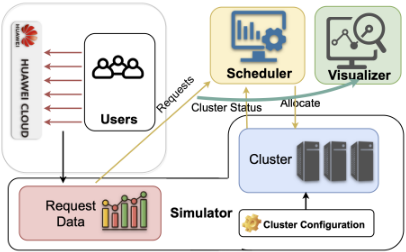
Researchers then need to instantiate the scheduler to interact with the simulator, which is also pre-built various types of scheduling baselines to speed up the algorithm design. These baselines range from widely-used heuristic methods to wellperformed DRL methods, and we benchmark the baselines in Table 1. Meanwhile, considering the data-hungry of the DRL algorithm, the scheduler is designed in a multi-processing scheme and can interact with multiple simulator instances in parallel. The visualizer, as an auxiliary component of the simulator and scheduler, facilitates researchers to conduct in-depth analysis of the scheduling procedure (in uni-policy mode) and comprehensively compare different scheduling algorithms (in multi-policies mode).
Besides benefiting the scheduling community, VMAgent is also a flexible playground for DRL. For example, more allocatable physical machines correspond to a larger state and action space; unpredictable requests for resources release (i.e., the recovering scenario) will make the DRL algorithm face a highly non-stationary environment; and an extensible physical machine pool (i.e., the expanding scenario) will guide the algorithm design to the field of life-long DRL. Coincidentally, these challenges are also three key issues of applying DRL to real-world problems. To sum up, VMAgent can provide a powerful platform to explore the law and scope of DRL for VM scheduling applications and investigates the challenges for applying RL to real-world problems.
2 The VMAgent Platform
The VMAgent project 1 is a VM scheduling platform for designing DRL-based VM scheduling algorithms. In this section, we will give a detailed introduction to the three components of the VMAgent platform, the simulator, the scheduler, and the visualizer. Before that, we will first illustrate how the VMAgent platform models the VM scheduling procedure. Although modeling this procedure belongs to the simulator and scheduler design, it is singled out for explanation considering that it is the cornerstone of the entire platform.
1 https://github.com/mail-ecnu/VMAgent.
2.1 Scheduling Fundamentals
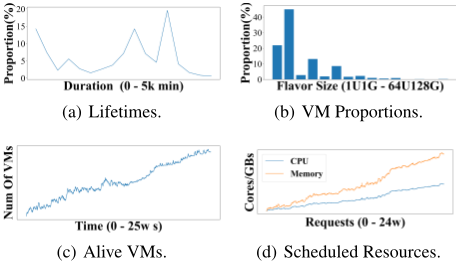
VMAgent models the practical VM scheduling based on physical system architectures and the open-source real-world VM scheduling dataset, Huawei-East-1 2 , from Huawei Cloud. The Huawei-East-1 dataset was collected in the east china region of Huawei Cloud for one month, which includes 241743 requests and 15 types requested virtual machines, and relevant statistical analyses are shown in Figure 2.
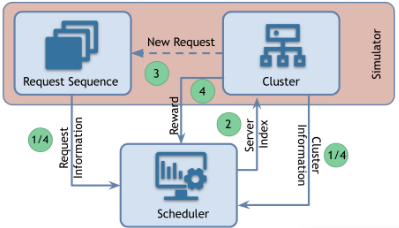
We model practical VM scheduling as a finite number of repetitions of the following four steps under DRL context, which is shown in Figure 3. In each loop, for the current request in the request sequence (constructed from the Huawei-East-1 dataset), 1 the simulator preprocesses request information to obtain observations; 2 the scheduler performs VM scheduling action accordingly; after the current request is processed, 3 the simulator turns to process the next request in the sequence; 4 the simulator calculates the reward according to the scheduling result and the next request's information. The above loop will continue until the stop condition is satisfied. Below we define some of the terms in the above procedure in detail.
The observations is the combination of sorted cluster status and the current request information. The cluster status includes the number of PMs within the cluster, the scheduled resources, and architectures (e.g., double NUMA [Lameter, 2013]) of each PM. We sort the cluster status based on the scheduled resources (CPU and memory) to make an efficient representation. The current request information can be categorized into two types: allocation, which includes the feature (e.g., the amount of CPU and memory) of resources, and release, which only includes the request ID in the sequence.
The action is the scheduled ID of PM (and NUMA in some tasks) and the reward is the cumulative number of successful scheduling. When an allocation can not be satisfied (i.e., no PMs can satisfy required resources), the cluster is denoted as not available, and we take it as the stop condition.
The goal of VM scheduling or the scheduler is to increase the cluster's availability and gain more income from the requests. The availability is measured by the number of scheduled requests, while the income is calculated based on scheduled VMs' prices and alive duration.
2 https://github.com/huaweicloud/VM-placement-dataset.
2.2 Simulator
To reflect pratical VM scheduling procedure, we abstract three scenarios, i.e., recovering, fading and expansion, from the Huawei-East-1 dataset in the simulator design.
Recovering. The recovering scenario considers both allocation and releasing requests, which is common in the public cloud when the PM pool will not be expanded. The scheduled resources are released from the cluster when a release request comes. Due to the dynamic, unpredictable release requests, the scheduler faces a high non-stationarity environment.
Fading. The fading scenario only allows allocation requests, which is common in the dedicated cloud. When the number of PMs is large, the curse of dimensionality raises.
Expansion. The expansion scenario considers that the PM pool will be expanded if the remaining resources are lower than a certain threshold, common in the public cloud. The cluster will replenish PMs before scheduling is terminated. This scenario leads to a life-long VM scheduling problem.
We utilize YAML to provide flexible configurations to make the simulator compatible with physical architecture. The configurations can be categorized into two types: cluster and scene. The following example shows the configuration of the expansion scenario.
cluster_args: env_args:
N: 100
allow_release: True
CPU: 40
growing_threshold: 0.8
MEM: 90
growing_nums: 20
double_numa: True
Besides the YAML configuration, the simulator follows the gym-like interface and provides an efficient multi-process sampling interface. This makes it an RL-friendly simulator.
2.3 Scheduler
Researchers need to instantiate the scheduler to interact with the simulator, which is also pre-built various types of VM scheduling baselines to speed up the algorithm design. It includes the popular heuristic online VM scheduling methods
| Metric/Algos | SchedQ | DQN | A2C | FF | BF | |
|---|---|---|---|---|---|---|
| Fading | Availability | 276.1±1.18 | 275.1±0.19 | 274.0±1.40 | 270.6 | 270.6 |
| Incomes | 103.11±0.83 | 102.43±0.11 | 101.69±0.98 | 99.2 | 99.2 | |
| Recovering | Availability | 393.4±2.63 | 392.5±1.59 | 392.1±0.96 | 371.0 | 384.4 |
| Incomes | 211.87±3.88 | 210.28±1.87 | 209.88±0.97 | 185.1 | 200.3 |
(i.e., first-fit and best-fit [Bays, 1977]) and many DRL methods (e.g., DQN [Mnih et al., 2015], A2C [Mnih et al., 2016], SchedQ [Sheng et al., 2022]). We benchmark some of the baselines in different scenarios with 5 PMs, and the results are shown in Table 1, which illustrates the advantage of DRL.
2.4 Visualizer
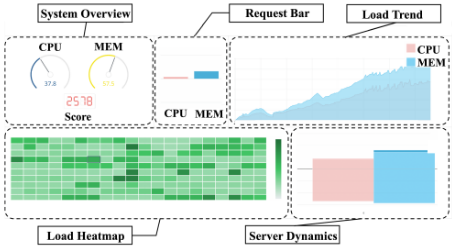
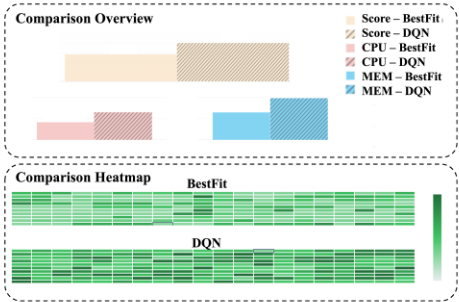
The visualizer, as an auxiliary component of the simulator and scheduler, facilitates researchers to conduct an in-depth analysis of the scheduling procedure and comprehensively compare different scheduling algorithms. Visualizer provides two modes: uni-policy mode (Figures 4) and multi-policies mode (Figure 5). Uni-policy mode visualizes the dynamic of cluster status and the scheduler's decisions when continually handling requests. The multi-policies mode makes visualization on comparisons among different schedulers.
We finally conclude that our paper proposes a practical and efficient VM scheduling platform, VMAgent. It well supports RL methods design in real-world VM scheduling scenarios.
Acknowledgements
This work was supported in part by the National Key Research and Development Program of China (No. 2020AAA0107400), STCSM (No. 20DZ1100304 and 19ZR141420) and Shenzhen Science and Technology Program (JCYJ20210324120011032).
@inproceedings{ijcai2022p860,
  title     = {VMAgent: A Practical Virtual Machine Scheduling Platform},
  author    = {Sheng, Junjie and Cai, Shengliang and Cui, Haochuan and Li, Wenhao and Hua, Yun and Jin, Bo and Zhou, Wenli and Hu, Yiqiu and Zhu, Lei and Peng, Qian and Zha, Hongyuan and Wang, Xiangfeng},
  booktitle = {Proceedings of the Thirty-First International Joint Conference on
               Artificial Intelligence, {IJCAI-22}},
  publisher = {International Joint Conferences on Artificial Intelligence Organization},
  editor    = {Luc De Raedt},
  pages     = {5944--5947},
  year      = {2022},
  month     = {7},
  note      = {Demo Track},
  doi       = {10.24963/ijcai.2022/860},
  url       = {https://doi.org/10.24963/ijcai.2022/860},
}
TY - CPAPER TI - VMAgent: A Practical Virtual Machine Scheduling Platform AU - Sheng, Junjie AU - Cai, Shengliang AU - Cui, Haochuan AU - Li, Wenhao AU - Hua, Yun AU - Jin, Bo AU - Zhou, Wenli AU - Hu, Yiqiu AU - Zhu, Lei AU - Peng, Qian AU - Zha, Hongyuan AU - Wang, Xiangfeng T2 - Proceedings of the Thirty-First International Joint Conference on Artificial Intelligence, IJCAI-22 PB - International Joint Conferences on Artificial Intelligence Organization PY - 2022 SP - 5944 EP - 5947 DO - 10.24963/ijcai.2022/860 UR - https://doi.org/10.24963/ijcai.2022/860 ER -Copied
Machine-readable versions of this paper, for tools and AI agents:





