
Learning Attention from Attention: Efficient Self-Refinement Transformer for Face Super-Resolution
Proceedings of the Thirty-Second International Joint Conference on Artificial Intelligence. Main Track. Pages 1035-1043.
https://doi.org/10.24963/ijcai.2023/115
Keywords
- Computer Vision: CV: Computational photography
- Computer Vision: CV: Biometrics, face, gesture and pose recognition
Abstract
Recently, Transformer-based architecture has been introduced into face super-resolution task due to its advantage in capturing long-range dependencies. However, these approaches tend to integrate global information in a large searching region, which neglect to focus on the most relevant information and induce blurry effect by the irrelevant textures. Some improved methods simply constrain self-attention in a local window to suppress the useless information. But it also limits the capability of recovering high-frequency details when flat areas dominate the local searching window. To improve the above issues, we propose a novel self-refinement mechanism which could adaptively achieve texture-aware reconstruction in a coarse-to-fine procedure. Generally, the primary self-attention is first conducted to reconstruct the coarse-grained textures and detect the fine-grained regions required further compensation. Then, region selection attention is performed to refine the textures on these key regions. Since self-attention considers the channel information on tokens equally, we employ a dual-branch feature integration module to privilege the important channels in feature extraction. Furthermore, we design the wavelet fusion module which integrate shallow-layer structure and deep-layer detailed feature to recover realistic face images in frequency domain. Extensive experiments demonstrate the effectiveness on a variety of datasets.
- [Bulat and Tzimiropoulos, 2018] Adrian Bulat and Georgios Tzimiropoulos. Super-fan: Integrated facial landmark lo- calization and super-resolution of real-world low resolu- tion faces in arbitrary poses with gans. In Proceedings of the IEEE Conference on Computer Vision and Pattern Recognition, pages 109-117, 2018.
- [Cao et al., 2017] Qingxing Cao, Liang Lin, Yukai Shi, Xi- aodan Liang, and Guanbin Li. Attention-aware face hallu- cination via deep reinforcement learning. In Proceedings of the IEEE conference on computer vision and pattern recognition, pages 690-698, 2017.
- [Cao et al., 2021] Jiezhang Cao, Yawei Li, Kai Zhang, and Luc Van Gool. Video super-resolution transformer. arXiv preprint arXiv:2106.06847, 2021.
- [Chen et al., 2018] Yu Chen, Ying Tai, Xiaoming Liu, Chun- hua Shen, and Jian Yang. Fsrnet: End-to-end learning face super-resolution with facial priors. In Proceedings of the IEEE Conference on Computer Vision and Pattern Recog- nition, pages 2492-2501, 2018.
- [Chen et al., 2020] Chaofeng Chen, Dihong Gong, Hao Wang, Zhifeng Li, and Kwan-Yee K Wong. Learning spa- tial attention for face super-resolution. IEEE Transactions on Image Processing, 30:1219-1231, 2020.
- [Chu et al., 2021] Xiangxiang Chu, Zhi Tian, Yuqing Wang, Bo Zhang, Haibing Ren, Xiaolin Wei, Huaxia Xia, and Chunhua Shen. Twins: Revisiting the design of spatial attention in vision transformers. Advances in Neural In- formation Processing Systems, 34, 2021.
- [Dosovitskiy et al., 2021] Alexey Dosovitskiy, Lucas Beyer, Alexander Kolesnikov, Dirk Weissenborn, Xiaohua Zhai, Thomas Unterthiner, Mostafa Dehghani, Matthias Min- derer, Georg Heigold, Sylvain Gelly, et al. An image is worth 16x16 words: Transformers for image recognition at scale. In International Conference on Learning Repre- sentations, 2021.
- [Huang et al., 2017] Huaibo Huang, Ran He, Zhenan Sun, and Tieniu Tan. Wavelet-srnet: A wavelet-based cnn for multi-scale face super resolution. In Proceedings of the IEEE International Conference on Computer Vision, pages 1689-1697, 2017.
- [Le et al., 2012] Vuong Le, Jonathan Brandt, Zhe Lin, Lubomir Bourdev, and Thomas S Huang. Interactive facial feature localization. In European conference on computer vision, pages 679-692. Springer, 2012.
- [Li et al., 2021] Zhuangzi Li, Ge Li, Thomas Li, Shan Liu, and Wei Gao. Information-growth attention network for image super-resolution. In Proceedings of the 29th ACM International Conference on Multimedia, pages 544-552, 2021.
- [Liang et al., 2021] Jingyun Liang, Jiezhang Cao, Guolei Sun, Kai Zhang, Luc Van Gool, and Radu Timofte. Swinir: Image restoration using swin transformer. In Proceedings of the IEEE/CVF International Conference on Computer Vision, pages 1833-1844, 2021.
- [Liu et al., 2015] Ziwei Liu, Ping Luo, Xiaogang Wang, and Xiaoou Tang. Deep learning face attributes in the wild. In Proceedings of the IEEE international conference on computer vision, pages 3730-3738, 2015.
- [Liu et al., 2021] Ze Liu, Yutong Lin, Yue Cao, Han Hu, Yixuan Wei, Zheng Zhang, Stephen Lin, and Baining Guo. Swin transformer: Hierarchical vision transformer using shifted windows. In Proceedings of the IEEE/CVF Inter- national Conference on Computer Vision, pages 10012- 10022, 2021.
- [Ma et al., 2020] Cheng Ma, Zhenyu Jiang, Yongming Rao, Jiwen Lu, and Jie Zhou. Deep face super-resolution with iterative collaboration between attentive recovery and landmark estimation. In Proceedings of the IEEE/CVF conference on computer vision and pattern recognition, pages 5569-5578, 2020.
- [Maeda, 2022] Shunta Maeda. Image super-resolution with deep dictionary. In European Conference on Computer Vision, pages 464-480. Springer, 2022.
- [Shi and Zhao, 2019] Jingang Shi and Guoying Zhao. Face hallucination via coarse-to-fine recursive kernel regression structure. IEEE Transactions on Multimedia, 21(9):2223- 2236, 2019.
- [Shi et al., 2022] Jingang Shi, Yusi Wang, Songlin Dong, Xi- aopeng Hong, Zitong Yu, Fei Wang, Changxin Wang, and Yihong Gong. IDPT: interconnected dual pyramid trans- former for face super-resolution. In Proceedings of the Thirty-First International Joint Conference on Artificial Intelligence (IJCAI), pages 1306-1312, 2022. IJCAI
- [Tian et al., 2022] Chunwei Tian, Yanning Zhang, Wang- meng Zuo, Chia-Wen Lin, David Zhang, and Yixuan Yuan. A heterogeneous group cnn for image super-resolution. IEEE Transactions on Neural Networks and Learning Sys- tems, 2022.
- [Tuzel et al., 2016] Oncel Tuzel, Yuichi Taguchi, and John R Hershey. Global-local face upsampling network. arXiv preprint arXiv:1603.07235, 2016.
- [Vaswani et al., 2017] Ashish Vaswani, Noam Shazeer, Niki Parmar, Jakob Uszkoreit, Llion Jones, Aidan N Gomez, Łukasz Kaiser, and Illia Polosukhin. Attention is all you need. Advances in neural information processing systems, 30, 2017.
- [Wang et al., 2004] Zhou Wang, Alan C Bovik, Hamid R Sheikh, and Eero P Simoncelli. Image quality assessment: from error visibility to structural similarity. IEEE transac- tions on image processing, 13(4):600-612, 2004.
- [Wang et al., 2021] Wenhai Wang, Enze Xie, Xiang Li, Deng-Ping Fan, Kaitao Song, Ding Liang, Tong Lu, Ping Luo, and Ling Shao. Pyramid vision transformer: A ver- satile backbone for dense prediction without convolutions. In Proceedings of the IEEE/CVF International Conference on Computer Vision, pages 568-578, 2021.
- [Wu et al., 2021] Yu-Huan Wu, Yun Liu, Xin Zhan, and Ming-Ming Cheng. P2t: Pyramid pooling transformer for scene understanding. arXiv preprint arXiv:2106.12011, 2021.
- [Yuan et al., 2021] Li Yuan, Yunpeng Chen, Tao Wang, Wei- hao Yu, Yujun Shi, Zi-Hang Jiang, Francis EH Tay, Jiashi Feng, and Shuicheng Yan. Tokens-to-token vit: Training vision transformers from scratch on imagenet. In Proceed- ings of the IEEE/CVF International Conference on Com- puter Vision, pages 558-567, 2021.
- [Zhang et al., 2016] Kaipeng Zhang, Zhanpeng Zhang, Zhifeng Li, and Yu Qiao. Joint face detection and align- ment using multitask cascaded convolutional networks. IEEE signal processing letters, 23(10):1499-1503, 2016.
- [Zhang et al., 2018a] Kaipeng Zhang, Zhanpeng Zhang, Chia-Wen Cheng, Winston H Hsu, Yu Qiao, Wei Liu, and Tong Zhang. Super-identity convolutional neural network for face hallucination. In Proceedings of the European conference on computer vision (ECCV), pages 183-198, 2018.
- [Zhang et al., 2018b] Richard Zhang, Phillip Isola, Alexei A Efros, Eli Shechtman, and Oliver Wang. The unreasonable effectiveness of deep features as a perceptual metric. In Proceedings of the IEEE conference on computer vision and pattern recognition, pages 586-595, 2018.
- [Zhang et al., 2018c] Yulun Zhang, Kunpeng Li, Kai Li, Lichen Wang, Bineng Zhong, and Yun Fu. Image super- resolution using very deep residual channel attention net- works. In Proceedings of the European conference on computer vision (ECCV), pages 286-301, 2018.
References were extracted automatically from the PDF and may contain errors.
Full text extracted automatically from the PDF; figures, tables and equations may differ. The PDF is the version of record.
1 Introduction
Face Super-resolution (FSR) is a specific super-resolution problem which needs to consider the unique textures on the face, such as eyes, mouth, nose, etc. The reconstruction of these structures are critical to distinguishing identity information. In recent years, FSR technology has been widely used and has attracted much attention. With the development of Convolutional Neural Networks (CNN), many researchers have designed various CNN networks [Huang et al., 2017; Zhang et al., 2018a; Zhang et al., 2018c; Shi and Zhao, 2019; Li et al., 2021] to improve FSR performance. Moreover, face priors, such as facial landmarks and heatmaps, were also incorporated into some methods [Chen et al., 2018; Bulat and Tzimiropoulos, 2018] in order to improve global face contour recovery.
∗Corresponding author
The CNN-based network has limited receptive field since convolution is a local operation. Due to the symmetry of the face, we also need to establish long-term dependencies in the FSR task in order to reconstruct the complex details on facial components. Different from CNN, Transformer [Vaswani et al., 2017] proposes a self-attention mechanism to establish global dependencies. In the field of computer vision, the pioneering work ViT [Dosovitskiy et al., 2021] separates the image into patches of equal size and then calculates the selfattention between the patches in the whole image, yielding better results compared to CNN in the classification task. Following this, various vision Transformers [Wang et al., 2021; Chu et al., 2021; Yuan et al., 2021; Liu et al., 2021] were proposed to address different visual tasks. Subsequently, Transformers were also introduced into the SR task. Generally, recent Transformers mainly conduct self-attention in the global searching region or pre-defined local window. However, it may encounter practical difficulties when deals with FSR. For the self-attention performed on global image region, the reconstructed texture details are calculated by the combination of all input tokens, which fails to focus the attention on the most relevant ones. The integration of irrelevant textures could cause blurry artifacts on the reconstructed results. For self-attention conducted on local window, it may fail to produce high-frequency details on complex facial components (e.g., eyes) if flat textures dominate the pre-defined rectangular window.
To solve these problems, we propose an efficient selfrefinement mechanism for Transformer, called Region Selection Attention (RSA), which first produces the coarse attention map for conducting self-attention and then learns finegrained attention map from the coarse one for further refinement. In the coarse-grained self-attention, the attention map is calculated on the down-sampled scale, which is effective for reconstructing flat facial regions and has the advantage of saving computational cost. To enhance the features of key patches in the coarse attention map, we adaptively divide several regions with the strongest attention as refined searching field to calculate fine-grained self-attention. In this way, we could further restore the detailed features to compensate the reconstructed coarse textures on the key regions. The advantages of the proposed RSA can be summarized in two aspects. First, it conducts a content-aware feature reconstruction that treats the coarse structure and detailed texture in different manners. Second, it could explore fine-grained self-attention in the receptive field with irregular shape, which is more robust compared to the traditional rectangular regions.
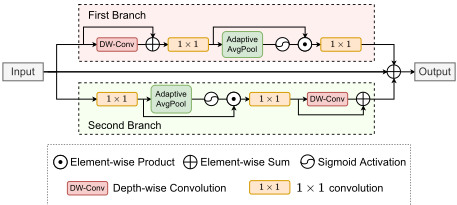
Another drawback in self-attention is that the operation takes the channel information of tokens equally without considering the importance. To privilege the important channels in feature extraction, we propose Feature Integration Module (FIM) which consists of alternating channel attention module and depth-wise convolution in dual-branch. It could promote a further step to achieve cross-spatial and cross-channel integration simultaneously in Transformer.
Furthermore, we design the Wavelet Fusion Module (WFM) which could modulate the global facial structure information and local detailed texture in frequency-domain. As we know, the shallow layer in the deep network contains the structural information (e.g., facial contour) while the deep layer has the advantage of extracting complex local details (e.g., eyelids). Different from previous methods which conduct simple concatenation or summation in the temporal domain, the proposed WFM achieves reconstruction by exploring the frequency property. We employ Wavelet Transformation (WT) to separate low-frequency and middle-frequency parts from shallow-layer features, while obtaining the highfrequency parts from deep-layer features. The modulation of frequency-specific feature maps is then conducted in WFM for better restoration.
Overall, our main contributions are summarized as follows:
- We propose an efficient self-refinement Transformerbased architecture for FSR task. It could adaptively conduct texture-aware reconstruction in a coarse-to-fine manner.
- The Feature Integration Module (FIM) is employed to consider cross-channel difference in Transformer, which promotes the integration of spatial-wise and channelwise information for feature extraction.
- We design the Wavelet Fusion Module (WFM) to achieve the modulation of shallow-layer and deep-layer features through frequency decomposition and recombination.
- Our method achieves state-of-the-art quantitative metrics and visualizations. It obtains the advantages of more than 0.32dB for PSNR values on the Helen datasets.
2 RelatedWorks
2.1 Face Super-Resolution
In recent years, deep learning has achieved great developments in the field of computer vision. The FSR task has attracted many researchers because of its wide application prospects. GLN [Tuzel et al., 2016] designs the Global Upsampling Network to reconstruct the overall face and the Local Refinement Network to enhance the local details of the face. Attention-FH [Cao et al., 2017] utilizes the context dependencies between facial components to recursively restore the details. RCAN [Zhang et al., 2018c] presents a very deep residual channel attention network, which significantly enhances the learning capacity of CNN. FSRNet [Chen et al., 2018] adds facial geometry priors such as facial landmarks, heatmaps and parsing maps to the network and achieves excellent results. SPARNet [Chen et al., 2020] proposes a network built from Face Attention Units that can efficiently capture key features in very low-resolution face images. DIC [Ma et al., 2020] adopts a novel iterative collaboration network to gradually obtain accurate facial landmarks and super-resolution images. IGAN [Li et al., 2021] considers SR as the information-growth process and recovers HR images by exploring information differences in images of different resolutions. SRDD [Maeda, 2022] proposes a high-resolution (HR) dictionary that can be learned explicitly, which reduces the information that the network needs to process in the HR space. HGSRCNN [Tian et al., 2022] adopts a heterogeneous structure to enhance the internal and external correlations of channels in parallel, which promotes the recovery of images.
2.2 Vision Transformer
The Transformer is originally used for sequence processing in natural language tasks. The proposal of ViT [Dosovitskiy et al., 2021] proves that Transformer can achieve state-of-theart performance in the image classification task. By recursively aggregating tokens of neighboring items, T2T [Yuan et al., 2021] greatly decreases tokens length for practical application. [Wu et al., 2021] builds a Pyramid Pooling Transformer to achieve better performance in various downstream vision tasks such as semantic segmentation and object detection. Swin Transformer [Liu et al., 2021] decomposes the image into non-overlapping windows, calculates multi-head self-attention (MHSA) within the window, and introduces a shifted window mechanism to establish the cross-window connection. Recently, various vision Transformers [Wang et al., 2021; Chu et al., 2021] are proposed to address different visual tasks. Meanwhile, Transformers are also applied in the field of super-resolution. [Liang et al., 2021] builds SwinIR based on Swin Transformer and achieves excellent results in SR tasks. VSR [Cao et al., 2021] turns MHSA into a spatialtemporal convolutional self-attention to achieve state-of-theart performance in video super-resolution tasks. [Shi et al., 2022] proposes a pyramid encoder/decoder Transformer architecture to extract and restore feature textures in different spaces through a hierarchical structure.
3 Method
3.1 Overview
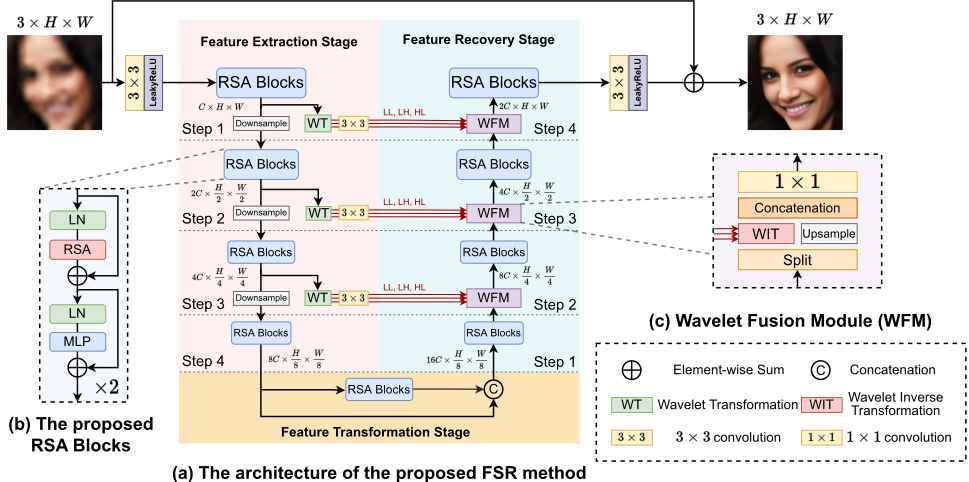
As shown in Figure 1(a), we describe three core stages of the proposed network: Feature Extraction Stage, Feature Transformation Stage, and Feature Recovery Stage. Let I L ∈
R3×H×W be an input low-resolution RGB image, where H and W represent the height and width, respectively. We first expand the channel of input image I L to C as:
where HEF (·) consists of a 3 × 3 convolution and a LeakyReLU activation. The convolutional layer expands the feature to a higher dimensional feature space, which is beneficial for recovering details in different feature channels.
Feature Extraction Stage. We extract features through a hierarchical feature pyramid structure containing 4 steps. Each step consists of 2 Region Selection Attention (RSA) Blocks, a down-sampling operation, a Wavelet Transformation (WT), and a 3×3 convolution. In particular, the 4-th step only contains 2 RSA Blocks. We get the output features F i es of i-th step as:
where HRB(·) denotes 2 consecutive RSA Blocks, and Down(·) is the down-sampling operation. For the downsampling operation, we apply a 4×4 convolutional layer with stride 2 to double the channel number and reduce the height and width to 1/2 of their original size, respectively. In each step, the features are also decomposed into frequency-domain features by Wavelet Transformation (WT). Our proposed WT is composed of a low-pass filter and a high-pass filter. The features sequentially pass through the combination of two filters, which can be converted into frequency-domain features:
LL, LH, HL, and HH (see Sec. 3.3 for details). In the ith step, for the output ˆ F i es of 2 RSA Blocks, we extract the low-frequency and middle-frequency features to present the global facial structure information:
where HWT (·) denotes WT and Conv3×3(·) is a 3 × 3 convolutional layer.
Feature Transformation Stage. At this stage, the output of the previous step F 4 es is fed into 2 RSA Blocks and concatenated with itself as:
where Concat[·] denotes concatenation operation.
Feature Recovery Stage. This stage also contains 4 steps to gradually restore high-resolution images. Each step consists of 2 RSA Blocks, and a Wavelet Fusion Module (WFM). The 1-st step doesn't contain the WFM. WFM can integrate the general facial features extracted from the Feature Extraction Stage and the corresponding high-frequency features in the Feature Recovery Stage through Wavelet Inverse Transformation (WIT).
We will describe the WFM in detail in Sec 3.4. More specifically, the output of j-th step can be formulated as:
where i = 5-j, and HWFM(·) represents the WFM. Finally, the features F 4 rs ∈ R2C×H×W are refined by a 3×3 convolution and a LeakyReLU activation to obtain the residual image I R ∈ R3×H×W . The final recovered image ˆ I can be obtained by ˆ I = I L + I R.
3.2 Efficient Region Search Attention (RSA) Block
As shown in Figure 1(b), we replace the traditional multihead self-attention (MHSA) with our proposed Region Selection Attention (RSA). Given the input as Fs, our proposed RSA Block can be formulated as:
where LN(·) is Layer Normalization and RSA(·) is RSA, which selects multiple regions with rich high-frequency information and computes their self-attention.
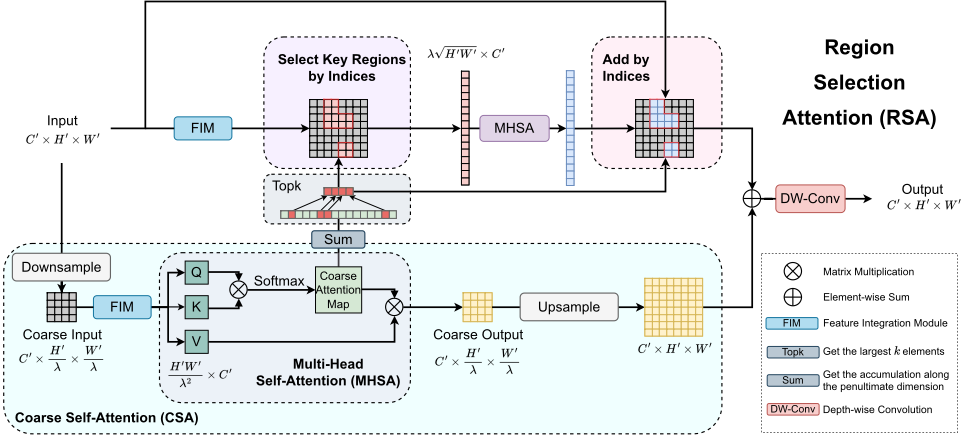
RSA is a data-driven approach to adaptively implement texture-aware reconstruction in a coarse-to-fine procedure. Specifically, we get a global coarse attention map via Coarse Self-Attention (CSA). This coarse attention map can reflect the high-frequency information density of each region of the image. Under the guidance of the coarse attention map, we can find the largest k attention values in this feature map, representing the most important k regions in the original features. These regions are extracted from the original features and calculated MHSA to refine the results. Key regions with rich high-frequency information are thus reconstructed by the refinement procedure.
As illustrated in Figure 2, given the input Finput ∈ RC′×H′×W ′ , Finput is first downsampled into a smaller feature map Fcoarse as:
where Downsample(·) uses a convolutional layer with kernel size of λ × λ and stride λ. Then the features are fed into the Feature Integration Module (FIM) to privilege the channel-wise importance. This can be formulated as:
Then we transpose the coarse feature ˆ Fcoarse ∈ RC′× H′ λ × W ′ λ into Fc ∈ Rnc×C′ , where nc = H′ λ × W ′ λ . We feed it into MHSA with M heads as:
where Wq, Wk, Wv, Wo are learnable parameters, and Dh = C ′ /M is the number of dimensions for one head. SA(h) , AM (h) , Q(h) c , K(h) c and V (h) c represent the output of selfattention, attention map, query embedding, key embedding, and value embedding from the h-th attention head, respectively. Then we select the key regions according to the coarse attention map. It is can be defined as:
where AM ∈ RM×nc×nc means coarse attention map and Sum(·) represents accumulation along the penultimate dimension of AM, which turns region-to-region attention into region-to-global attention. Topk(·) means to get the largest k elements and GetIndex(·) denotes getting the indices of elements in feature ˆ Finput. Here we let k = ⌊ √H′W ′ λ ⌋ to balance the computational cost and effect. Thus we get the indices of the key regions in ˆ Finput. Next, we extract these regions to calculate the MHSA and add them back to ˆ Finput by indices. The output of this process can be obtained by:
where SelectByIndex(·) means to select the regions in ˆ Finput according to Index and AddByIndex(·) denotes adding Fregions after MHSA to Finput according to Index. Finally, we upsample Outputc and add it to Outputf , which is then fed into a depth-wise convolutional layer. It could be formulated as:
where Upsample(·) denotes the up-sampling operation, which is a 4 × 4 transposed convolution with stride 2. DWConv(·) means 3 × 3 depth-wise convolution.
Feature Integration Module (FIM). As shown in Figure 3, our proposed FIM consists of depth-wise convolutions, channel attention module, and residual connection. Depth-wise convolution can effectively model the spatial information of features. The channel attention module allows the network to focus on channels which should be paid more attention. We change the combination of the depth-wise convolution and the channel attention for better interaction. Moreover, we utilize the residual connections to merge dual branches and the original input. This design complements the features with rich cross-spatial and cross-channel information.
In FIM, the kernel size of depth-wise convolution is 3 × 3, and Adaptive AvgPool means global average pooling operation.
3.3 Wavelet Transformation (WT) andWavelet Inverse Transformation (WIT)
Our proposed Wavelet Transformation (WT) and Wavelet Inverse Transformation (WIT) consist of a convolutional block and a transposed convolution block, respectively. To decompose features into several frequency components, we adopt a high-efficiency wavelet transformation, namely the Haar wavelet.
where L and H represent low-pass and high-pass filters, respectively. Low-pass filters can capture general information like global contour, and facial structure. In contrast, a highpass filter extracts local details such as texture, eyes, facial components, etc.
With the combination of two filters, we can achieve four kernels of Haar wavelet:
The above four kernels could be utilized to decompose the feature map into frequency-domain components: LL, LH, HL, and HH. Given an arbitrary feature map F , the WT can be defined as:
where ConvLLT (·), ConvLHT (·), ConvHLT (·), ConvHHT (·) represent group convolution with stride 2 and weights LLT , LHT , HLT and HHT , respectively.
We use WIT to integrate the general information (LL, LH, and HL) and the high-frequency details HH to reconstruct the face image. The WIT can be defined as:
where DeconvLLT (·), DeconvLHT (·), DeconvHLT (·), DeconvHHT (·) represent four separate transposed convolutions with the weights as Eq. 14.
The WT operation achieves the modulation of shallowlayer and deep-layer feature maps from the perspective of the frequency domain. We employ skip connections to perform WIT in the Feature Recovery Stage, which can stabilize the generation of detailed information.
3.4 Wavelet FusionModule (WFM)
In this section, we describe our proposed Wavelet Fusion Module (WFM). As shown in Figure 1(c), for the feature Frs, it is split evenly into two features Frs L and Frs R as:
Then, Frs L and Frs R are fed into a Wavelet Inverse Transformation (WIT) and an up-sampling block, respectively, which are defined as:
where HWIT (·) and Upsample(·) separately represents the WIT and a 4 × 4 transposed convolution with stride 2. Deeplayer feature Frs L and the corresponding shallow-layer features LL, LH, HL are modulated to refine the detail in the WIT.
Then we feed the combination of two features into a convolutional layer to get the output of this module, which can be formulated as:
where Concat[·] denotes concatenation operation. Conv1×1(·) is an 1 × 1 convolution, which reduces the channel number of the features to half.
4 Experiments
4.1 Datasets
The CelebA [Liu et al., 2015] and the Helen [Le et al., 2012] are two publicly available face image datasets. First, we use MTCNN [Zhang et al., 2016] to crop the face region. After excluding images with a resolution smaller than 128 × 128, the image is resized to 128×128. So we obtained about 178k images from CelebA, of which 177k images were used as HR training images. Using bicubic interpolation, the HR images are downsampled to 16 × 16 to generate LR images. In the testing phase, we extract the remaining 1000 images from the cropped CelebA dataset and randomly extract 100 images from the cropped Helen dataset. For evaluation, we employ the following metrics: Peak Signal-to-Noise Ratio (PSNR), Structural Similarity (SSIM) [Wang et al., 2004] computed on the Y channel of the image YCbCr space, and Learned Perceptual Image Patch Similarity (LPIPS) [Zhang et al., 2018b].
4.2 Implementation Details
Before the Feature Extraction Stage, we first extend the number of feature channels to 32. In the Feature Extraction Stage, the channel number of feature map is 2i-1 × 32 and the attention head number of RSA Block is 2i-1 in the i-th step. In the Feature Transformation Stage, the number of feature channels is set to 256. The number of attention heads is set to 16. In the Feature Recovery Stage at the j-th step, the channel number of feature map is 25-j ×32 and the attention head number of RSA Block is 24-j . When the height × width of the feature map is less than or equal to 32 × 32, we only employ CSA in the RSA with λ = 1. Otherwise, we apply the full RSA and λ = 4. The AdamW optimizer is used to train our model with β1 = 0.9, β2 = 0.99, and weight decay is set to 0.02. The learning rate is initially set to 4 × 10⁻⁴ and dropped by half every 20 epochs. Meanwhile, L1 loss is used for training. The batchsize is set to 32. Our model is implemented in PyTorch and trained for 100 epochs using 2 NVIDIA GeForce RTX 3090 GPUs.
| Method | Helen | CelebA | ||||
|---|---|---|---|---|---|---|
| PSNR | SSIM | LPIPS | PSNR | SSIM | LPIPS | |
| Bicubic | 24.25 | 0.6798 | 0.5236 | 24.10 | 0.6605 | 0.5267 |
| RCAN [Zhang et al., 2018c] | 27.94 | 0.8196 | 0.1927 | 28.08 | 0.8149 | 0.1825 |
| DIC [Ma et al., 2020] | 26.61 | 0.7755 | 0.2292 | 27.38 | 0.7911 | 0.1950 |
| SPARNet [Chen et al., 2020] | 27.62 | 0.8094 | 0.2012 | 27.83 | 0.8067 | 0.1874 |
| IGAN [Li et al., 2021] | 27.97 | 0.8213 | 0.1845 | 28.15 | 0.8171 | 0.1767 |
| SwinIR [Liang et al., 2021] | 28.04 | 0.8219 | 0.1905 | 28.27 | 0.8192 | 0.1808 |
| SRDD [Maeda, 2022] | 27.64 | 0.8093 | 0.2184 | 27.88 | 0.8071 | 0.2058 |
| HGSRCNN [Tian et al., 2022] | 27.93 | 0.8192 | 0.1885 | 28.20 | 0.8175 | 0.1793 |
| Ours | 28.36 | 0.8318 | 0.1626 | 28.58 | 0.8297 | 0.1542 |
4.3 Comparisons with State-of-the-Art Methods
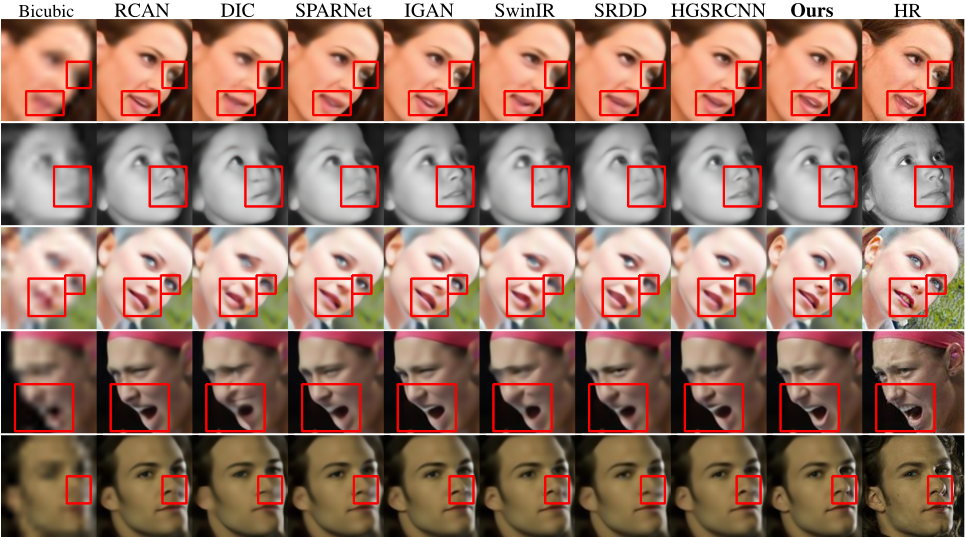
We compare the proposed FSR method with several state-ofthe-art methods: RCAN [Zhang et al., 2018c], DIC [Ma et al., 2020], SPARNet [Chen et al., 2020], IGAN [Li et al., 2021], SwinIR [Liang et al., 2021], SRDD [Maeda, 2022], and HGSRCNN [Tian et al., 2022]. Our quantitative results for Helen and CelebA dataset are shown in Table 1. The results demonstrate that our method achieves the best PSNR, SSIM, and LPIPS performance on both datasets, outperforming other state-of-the-art approaches by a significant margin. Specifically, for the PSNR value, our method outperforms the best other methods by 0.32dB and 0.31dB on the Helen and CelebA datasets, respectively. Qualitative results are shown in Figure 4. Our method can recover more realistic details in the blurry region, and the reconstructed result is closer to the real image. The pupils and nose of the face are restored more clearly. Other methods tend to produce blurring artifacts in regions with complex textures.
4.4 Ablation Study
Effectiveness of the Region Selection Attention (RSA). The core part of RSA is the region selection strategy. Relying on this design, our RSA can effectively focus on regions with long-range dependencies and rich high-frequency information. To demonstrate the effectiveness of this strategy, we remove the part that selects regions to compute key regions selfattention and only retain the Coarse Self-Attention (CSA). As shown in Table 2, our RSA improves the PSNR value by 0.12dB on the Helen test set. The above experiments demonstrate the effectiveness of the proposed RSA.
Effectiveness of the Feature Integration Module (FIM). Our proposed FIM is used to enhance cross-channel awareness and cross-spatial awareness of features. To verify the effectiveness of FIM, we use learnable position parameters, depth-wise convolution or single-branch FIM to replace full FIM. As can be seen from Table 3, compared to learnable position parameters and depth-wise convolution, our firstbranch-only FIM and second-branch-only FIM improve the PSNR values by 0.04dB and 0.03dB, respectively. The full FIM achieved a significant PSNR value improvement of 0.11dB, which illustrates the superiority of our proposed innovative FIM.
| Methods | RSA | CSA |
| PSNR | 28.36 | 28.24 |
| SSIM | 0.8318 | 0.8297 |
| Methods | PSNR | SSIM |
|---|---|---|
| learnable position parameters | 28.25 | 0.8296 |
| DW-Conv | 28.25 | 0.8300 |
| FIM only first branch | 28.29 | 0.8301 |
| FIM only second branch | 28.28 | 0.8293 |
| FIM | 28.36 | 0.8318 |
| Methods | PSNR | SSIM |
|---|---|---|
| concatenation | 28.31 | 0.8306 |
| WFMw/o splitting | 28.32 | 0.8310 |
| WFM | 28.36 | 0.8318 |
Effectiveness of the Wavelet Fusion Module (WFM). WFM is used in the Feature Recovery Stage to recombine the frequency-domain features. In WFM, we retain half of the features that do not participate in the WIT. Preserved features help stabilize feature recovery. Therefore, we designed two ablation experiments: In the first one, we simply replaced WFMwith a concatenation operation. In the second one, we let all the features in the WFM participate in the WIT without splitting. Table 4 demonstrates that our proposed WFM achieves 0.05dB and 0.04dB improvements, respectively. Experiments prove that the designed WFM is efficient.
5 Conclusion
In this paper, we propose a self-refinement Transformer for FSR. It could conduct the coarse-grained self-attention and further compensate for the details by fine-grained selfattention on key regions. To consider the importance of channel information in Transformer, we also employ the FIM to achieve cross-spatial and cross-channel integration simultaneously. Furthermore, WFM is designed to modulate the shallow and deep feature maps in frequency domain for restoration. Extensive experiments demonstrate the effectiveness of the proposed method.
Acknowledgments
This work was supported by the National Natural Science Foundation of China (Grant No. 62002283, 62311530046, U2003207, 61921004, U21B2048, 62102307, 61972016, 62071380), the Key Research and Development Program of Shaanxi (No.2021GXLH-Z-021) and the Fundamental Research Funds for the Central Universities.
@inproceedings{ijcai2023p115,
  title     = {Learning Attention from Attention: Efficient Self-Refinement Transformer for Face Super-Resolution},
  author    = {Li, Guanxin and Shi, Jingang and Zong, Yuan and Wang, Fei and Wang, Tian and Gong, Yihong},
  booktitle = {Proceedings of the Thirty-Second International Joint Conference on
               Artificial Intelligence, {IJCAI-23}},
  publisher = {International Joint Conferences on Artificial Intelligence Organization},
  editor    = {Edith Elkind},
  pages     = {1035--1043},
  year      = {2023},
  month     = {8},
  note      = {Main Track},
  doi       = {10.24963/ijcai.2023/115},
  url       = {https://doi.org/10.24963/ijcai.2023/115},
}
TY - CPAPER TI - Learning Attention from Attention: Efficient Self-Refinement Transformer for Face Super-Resolution AU - Li, Guanxin AU - Shi, Jingang AU - Zong, Yuan AU - Wang, Fei AU - Wang, Tian AU - Gong, Yihong T2 - Proceedings of the Thirty-Second International Joint Conference on Artificial Intelligence, IJCAI-23 PB - International Joint Conferences on Artificial Intelligence Organization PY - 2023 SP - 1035 EP - 1043 DO - 10.24963/ijcai.2023/115 UR - https://doi.org/10.24963/ijcai.2023/115 ER -Copied
Machine-readable versions of this paper, for tools and AI agents:





