
On Efficient Transformer-Based Image Pre-training for Low-Level Vision
Proceedings of the Thirty-Second International Joint Conference on Artificial Intelligence. Main Track. Pages 1089-1097.
https://doi.org/10.24963/ijcai.2023/121
Keywords
- Computer Vision: CV: Computational photography
- Computer Vision: CV: Applications
- Computer Vision: CV: Representation learning
Abstract
Pre-training has marked numerous state of the arts in high-level computer vision, while few attempts have ever been made to investigate how pre-training acts in image processing systems. In this paper, we tailor transformer-based pre-training regimes that boost various low-level tasks. To comprehensively diagnose the influence of pre-training, we design a whole set of principled evaluation tools that uncover its effects on internal representations. The observations demonstrate that pre-training plays strikingly different roles in low-level tasks. For example, pre-training introduces more local information to intermediate layers in super-resolution (SR), yielding significant performance gains, while pre-training hardly affects internal feature representations in denoising, resulting in limited gains. Further, we explore different methods of pre-training, revealing that multi-related-task pre-training is more effective and data-efficient than other alternatives. Finally, we extend our study to varying data scales and model sizes, as well as comparisons between transformers and CNNs. Based on the study, we successfully develop state-of-the-art models for multiple low-level tasks.
- [Agustsson and Timofte, 2017] Eirikur Agustsson and Radu Timofte. Ntire 2017 challenge on single image super- resolution: Dataset and study. In CVPRW, pages 126-135, 2017.
- [Brown et al., 2020] Tom B Brown, Benjamin Mann, Nick Ryder, Melanie Subbiah, Jared Kaplan, Prafulla Dhari- wal, Arvind Neelakantan, Pranav Shyam, Girish Sastry, Amanda Askell, et al. Language models are few-shot learners. arXiv preprint arXiv:2005.14165, 2020.
- [Chen et al., 2017] Liang-Chieh Chen, George Papandreou, Iasonas Kokkinos, Kevin Murphy, and Alan L Yuille. Deeplab: Semantic image segmentation with deep convo- lutional nets, atrous convolution, and fully connected crfs. PAMI, 40(4):834-848, 2017.
- [Chen et al., 2021] Hanting Chen, Yunhe Wang, Tianyu Guo, Chang Xu, Yiping Deng, Zhenhua Liu, Siwei Ma, Chunjing Xu, Chao Xu, and Wen Gao. Pre-trained image processing transformer. In CVPR, pages 12299-12310, 2021.
- [Chen et al., 2022] X Chen, X Wang, J Zhou, and C Dong. Activating more pixels in image super-resolution trans- former. arxiv 2022. arXiv preprint arXiv:2205.04437, 2022.
- [Cortes et al., 2012] Corinna Cortes, Mehryar Mohri, and Afshin Rostamizadeh. Algorithms for learning kernels based on centered alignment. The Journal of Machine Learning Research, 13(1):795-828, 2012.
- [Dabov et al., 2007] Kostadin Dabov, Alessandro Foi, Vladimir Katkovnik, and Karen Egiazarian. Image denoising by sparse 3-d transform-domain collaborative filtering. TIP, 16(8):2080-2095, 2007.
- [Dai et al., 2019] Tao Dai, Jianrui Cai, Yongbing Zhang, Shu-Tao Xia, and Lei Zhang. Second-order attention net- work for single image super-resolution. In CVPR, pages 11065-11074, 2019.
- [Deng et al., 2009] Jia Deng, Wei Dong, Richard Socher, Li- Jia Li, Kai Li, and Li Fei-Fei. Imagenet: A large-scale hierarchical image database. In CVPR, pages 248-255.
- [Devlin et al., 2018] Jacob Devlin, Ming-Wei Chang, Ken- ton Lee, and Kristina Toutanova. Bert: Pre-training of deep bidirectional transformers for language understand- ing. arXiv preprint arXiv:1810.04805, 2018.
- [Dosovitskiy et al., 2020] Alexey Dosovitskiy, Lucas Beyer, Alexander Kolesnikov, Dirk Weissenborn, Xiaohua Zhai, Thomas Unterthiner, Mostafa Dehghani, Matthias Min- derer, Georg Heigold, Sylvain Gelly, et al. An image is worth 16x16 words: Transformers for image recognition at scale. In ICLR, 2020.
- [Fu et al., 2017a] Xueyang Fu, Jiabin Huang, Xinghao Ding, Yinghao Liao, and John Paisley. Clearing the skies: A deep network architecture for single-image rain removal. TIP, 26(6):2944-2956, 2017.
- [Fu et al., 2017b] Xueyang Fu, Jiabin Huang, Delu Zeng, Yue Huang, Xinghao Ding, and John Paisley. Remov- ing rain from single images via a deep detail network. In CVPR, pages 3855-3863, 2017.
- [Girshick et al., 2014] Ross Girshick, Jeff Donahue, Trevor Darrell, and Jitendra Malik. Rich feature hierarchies for accurate object detection and semantic segmentation. In CVPR, pages 580-587, 2014.
- [Girshick, 2015] Ross Girshick. Fast r-cnn. In ICCV, pages 1440-1448, 2015.
- [Gretton et al., 2007] Arthur Gretton, Kenji Fukumizu, Choon Hui Teo, Le Song, Bernhard Schölkopf, Alexan- der J Smola, et al. A kernel statistical test of independence. In Nips, volume 20, pages 585-592.
- [Gu et al., 2017] Shuhang Gu, Deyu Meng, Wangmeng Zuo, and Lei Zhang. Joint convolutional analysis and synthesis sparse representation for single image layer separation. In ICCV, pages 1708-1716, 2017.
- [He et al., 2021] Kaiming He, Xinlei Chen, Saining Xie, Yanghao Li, Piotr Dollár, and Ross Girshick. Masked autoencoders are scalable vision learners. arXiv preprint arXiv:2111.06377, 2021.
- [Huang et al., 2015] Jia-Bin Huang, Abhishek Singh, and Narendra Ahuja. Single image super-resolution from transformed self-exemplars. In CVPR, pages 5197-5206, 2015.
- [Kolesnikov et al., 2020] Alexander Kolesnikov, Lucas Beyer, Xiaohua Zhai, Joan Puigcerver, Jessica Yung, Sylvain Gelly, and Neil Houlsby. Big transfer (bit): General visual representation learning. In ECCV, pages 491-507. Springer, 2020.
- [Kornblith et al., 2019] Simon Kornblith, Jonathon Shlens, and Quoc V Le. Do better imagenet models transfer bet- ter? In CVPR, pages 2661-2671, 2019.
- [LeCun et al., 1989] Yann LeCun, Bernhard Boser, John S Denker, Donnie Henderson, Richard E Howard, Wayne Hubbard, and Lawrence D Jackel. Backpropagation ap- plied to handwritten zip code recognition. Neural compu- tation, 1(4):541-551, 1989.
- [Li et al., 2016] Yu Li, Robby T Tan, Xiaojie Guo, Jiangbo Lu, and Michael S Brown. Rain streak removal using layer priors. In CVPR, pages 2736-2744, 2016.
- [Li et al., 2018] Xia Li, Jianlong Wu, Zhouchen Lin, Hong Liu, and Hongbin Zha. Recurrent squeeze-and-excitation context aggregation net for single image deraining. In ECCV, pages 254-269, 2018.
- [Liang et al., 2021] Jingyun Liang, Jiezhang Cao, Guolei Sun, Kai Zhang, Luc Van Gool, and Radu Timofte. Swinir: Image restoration using swin transformer. In ICCVW, pages 1833-1844, 2021.
- [Liu et al., 2021] Ze Liu, Yutong Lin, Yue Cao, Han Hu, Yixuan Wei, Zheng Zhang, Stephen Lin, and Baining Guo. Swin transformer: Hierarchical vision transformer using shifted windows. ICCV, 2021.
- [Liu et al., 2022] Lin Liu, Lingxi Xie, Xiaopeng Zhang, Shanxin Yuan, Xiangyu Chen, Wengang Zhou, Houqiang Li, and Qi Tian. Tape: Task-agnostic prior embedding for image restoration. In ECCV, pages 447-464. Springer, 2022.
- [Luo et al., 2015] Yu Luo, Yong Xu, and Hui Ji. Removing rain from a single image via discriminative sparse coding. In ICCV, pages 3397-3405, 2015.
- [Mahajan et al., 2018] Dhruv Mahajan, Ross Girshick, Vig- nesh Ramanathan, Kaiming He, Manohar Paluri, Yixuan Li, Ashwin Bharambe, and Laurens Van Der Maaten. Ex- ploring the limits of weakly supervised pretraining. In ECCV, pages 181-196, 2018.
- [Mei et al., 2021] Yiqun Mei, Yuchen Fan, and Yuqian Zhou. Image super-resolution with non-local sparse attention. In CVPR, pages 3517-3526, 2021.
- [Nguyen et al., 2020] Thao Nguyen, Maithra Raghu, and Si- mon Kornblith. Do wide and deep networks learn the same things? uncovering how neural network repre- sentations vary with width and depth. arXiv preprint arXiv:2010.15327, 2020.
- [Radford et al., 2018] Alec Radford, Karthik Narasimhan, Tim Salimans, and Ilya Sutskever. Improving language understanding by generative pre-training. 2018.
- [Radford et al., 2019] Alec Radford, Jeffrey Wu, Rewon Child, David Luan, Dario Amodei, Ilya Sutskever, et al. Language models are unsupervised multitask learners. OpenAI blog, 1(8):9, 2019.
- [Raghu et al., 2021] Maithra Raghu, Thomas Unterthiner, Simon Kornblith, Chiyuan Zhang, and Alexey Dosovit- skiy. Do vision transformers see like convolutional neural networks? arXiv preprint arXiv:2108.08810, 2021.
- [Ren et al., 2019] Dongwei Ren, Wangmeng Zuo, Qinghua Hu, Pengfei Zhu, and Deyu Meng. Progressive image de- raining networks: A better and simpler baseline. In CVPR, pages 3937-3946, 2019.
- [Sun et al., 2017] Chen Sun, Abhinav Shrivastava, Saurabh Singh, and Abhinav Gupta. Revisiting unreasonable ef- fectiveness of data in deep learning era. In ICCV, pages 843-852, 2017.
- [Tian et al., 2020] Chunwei Tian, Yong Xu, and Wangmeng Zuo. Image denoising using deep cnn with batch renor- malization. Neural Networks, 121:461-473, 2020.
- [Vaswani et al., 2017] Ashish Vaswani, Noam Shazeer, Niki Parmar, Jakob Uszkoreit, Llion Jones, Aidan N Gomez, Łukasz Kaiser, and Illia Polosukhin. Attention is all you need. In NIPS, pages 5998-6008, 2017.
- [Wang et al., 2018] Xintao Wang, Ke Yu, Shixiang Wu, Jin- jin Gu, Yihao Liu, Chao Dong, Yu Qiao, and Chen Change Loy. Esrgan: Enhanced super-resolution gener- ative adversarial networks. In ECCVW, pages 0-0, 2018.
- [Wang et al., 2019] Tianyu Wang, Xin Yang, Ke Xu, Shaozhe Chen, Qiang Zhang, and Rynson WH Lau. Spa- tial attentive single-image deraining with a high quality real rain dataset. In CVPR, pages 12270-12279, 2019.
- [Wang et al., 2020] Hong Wang, Qi Xie, Qian Zhao, and Deyu Meng. A model-driven deep neural network for sin- gle image rain removal. In CVPR, pages 3103-3112, 2020.
- [Wang et al., 2021a] Wenhai Wang, Enze Xie, Xiang Li, Deng-Ping Fan, Kaitao Song, Ding Liang, Tong Lu, Ping Luo, and Ling Shao. Pyramid vision transformer: A ver- satile backbone for dense prediction without convolutions. arXiv preprint arXiv:2102.12122, 2021.
- [Wang et al., 2021b] Zhendong Wang, Xiaodong Cun, Jian- min Bao, and Jianzhuang Liu. Uformer: A general u- shaped transformer for image restoration. arXiv preprint arXiv:2106.03106, 2021.
- [Wei et al., 2019] Wei Wei, Deyu Meng, Qian Zhao, Zong- ben Xu, and Ying Wu. Semi-supervised transfer learning for image rain removal. In CVPR, pages 3877-3886, 2019.
- [Xiao et al., 2021] Tete Xiao, Mannat Singh, Eric Mintun, Trevor Darrell, Piotr Dollár, and Ross Girshick. Early convolutions help transformers see better. arXiv preprint arXiv:2106.14881, 2021.
- [Yang et al., 2019] Wenhan Yang, Robby T Tan, Jiashi Feng, Zongming Guo, Shuicheng Yan, and Jiaying Liu. Joint rain detection and removal from a single image with con- textualized deep networks. PAMI, 42(6):1377-1393, 2019.
- [Zamir et al., 2022] Syed Waqas Zamir, Aditya Arora, Salman Khan, Munawar Hayat, Fahad Shahbaz Khan, and Ming-Hsuan Yang. Restormer: Efficient transformer for high-resolution image restoration. In CVPR, pages 5728- 5739, 2022.
- [Zhang et al., 2017] Kai Zhang, Wangmeng Zuo, Yunjin Chen, Deyu Meng, and Lei Zhang. Beyond a gaussian de- noiser: Residual learning of deep cnn for image denoising. TIP, 26(7):3142-3155, 2017.
- [Zhang et al., 2018a] Kai Zhang, Wangmeng Zuo, and Lei Zhang. Ffdnet: Toward a fast and flexible solution for cnn-based image denoising. TIP, 27(9):4608-4622, 2018.
- [Zhang et al., 2018b] Yulun Zhang, Kunpeng Li, Kai Li, Lichen Wang, Bineng Zhong, and Yun Fu. Image super- resolution using very deep residual channel attention net- works. In ECCV, pages 286-301, 2018.
- [Zhang et al., 2021] Kai Zhang, Yawei Li, Wangmeng Zuo, Lei Zhang, Luc Van Gool, and Radu Timofte. Plug-and- play image restoration with deep denoiser prior. PAMI, 2021.
References were extracted automatically from the PDF and may contain errors.
Full text extracted automatically from the PDF; figures, tables and equations may differ. The PDF is the version of record.
1 Introduction
Image pre-training has received great attention in computer vision, especially prevalent in object detection and segmentation [Girshick et al., 2014; Girshick, 2015; Chen et al., 2017]. When task-specific data is limited, pre-training helps models see large-scale data, thus vastly enhancing their capabilities. In the field of high-level vision, previous work [Kornblith et al., 2019; Sun et al., 2017; Mahajan et al., 2018; Kolesnikov et al., 2020] has shown that ConvNets pre-trained on ImageNet [Deng et al., 2009] classification yield significant improvements on a wide spectrum of downstream tasks. As for image processing tasks, e.g., super-resolution (SR) and deraining, the widely used datasets typically contain only a few thousand images, pointing out the potential of pretraining. However, its crucial role in low-level vision is commonly omitted. To the best of our knowledge, the sole pioneer exploring this point is IPT [Chen et al., 2021]. Hence, there still lacks principled analysis on understanding how pretraining acts and how to perform effective pre-training.
∗Equal contribution
Previous image processing systems majorly leverage convolutional neural networks (CNNs) [LeCun et al., 1989]. More recently, transformer architectures [Dosovitskiy et al., 2020; Liu et al., 2021; Wang et al., 2021a], initially proposed in NLP [Vaswani et al., 2017], have achieved promising results in vision tasks, demonstrating the potential of using transformers as a primary backbone for vision applications. Moreover, the stronger modeling capability of transformers allows for large-scale and sophisticated pre-training, which has shown great success in both NLP and computer vision [Radford et al., 2018; Radford et al., 2019; Brown et al., 2020; Devlin et al., 2018; He et al., 2021; Liu et al., 2022; Zamir et al., 2022; Chen et al., 2022]. However, it remains infeasible to directly exploit structure designs and data utilization on the full-attention transformers for low-level vision. For example, due to the massive amount of parameters (e.g., 116M for IPT [Chen et al., 2021]) and huge computational cost, it is prohibitively hard to explore various pre-training design choices based on IPT and further apply them in practice. Instead of following the full-attention pipeline, we explore the other window-based variants [Liang et al., 2021; Wang et al., 2021b], which are more computationally efficient while leading to impressive performance. Along this line, we develop an encoder-decoder-based transformer (EDT) that is powerful yet efficient in data exploitation and computation. We mainly adopt EDT as a representative for efficient computation, since our observations generalize well to other frameworks, as shown in Sec. 3.4.
In this paper, we systematically explore and evaluate how image pre-training performs in window-based transformers. Using centered kernel alignment [Kornblith et al., 2019; Cortes et al., 2012] as a network "diagnosing" measure, we have designed a set of pre-training strategies, and thoroughly tested them with different image processing tasks. As a result, we uncover their respective effects on internal network representations, and draw useful guidelines for applying pretraining to low-level vision. The key findings and contributions of this study can be summarized as follows,
- Internal representations of transformers. We find striking differences in low-level tasks, e.g., SR and de-
raining models show clear stages, containing more local information in early layers while more global information in higher layers. The denoising model presents a relatively uniform structure filled with local information.
- Effects of pre-training. We find that pre-training improves the model performance by introducing different degrees of local information, treated as a kind of inductive bias, to the intermediate layers.
- Pre-training guidelines. Examining different pretraining strategies, we suggest a favorable multi-relatedtask setup that brings more improvements and could be applied to multiple downstream tasks. Also, we find this performing strategy is more data-efficient than purely increasing the data scale. Besides, a larger model capacity usually gets more out of pre-training.
- Transformers v.s. CNNs. We observe that both transformers and CNNs benefit from pre-training, while transformers obtain greater improvements.
- SOTA models. Based on the comprehensive study of pre-training, we provide a series of pre-trained models with state-of-the-art performance for multiple tasks, including super-resolution, denoising and deraining.
2 Encoder-Decoder-Based Transformer
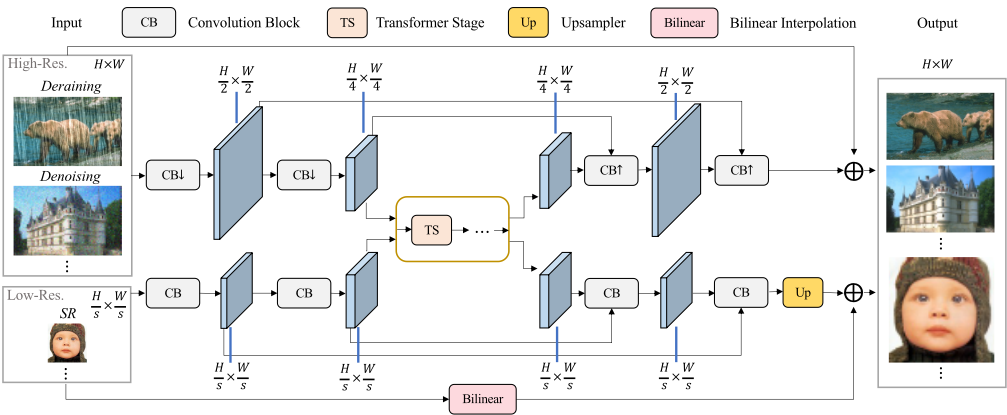
Several transformers [Chen et al., 2021; Liang et al., 2021; Wang et al., 2021b] are tailored to low-level tasks, among which window-based architectures [Liang et al., 2021; Wang et al., 2021b] show competitive performance under constrained parameters and computational complexity. Built upon the existing work, we make several modifications and present an efficient encoder-decoder-based transformer (EDT) in Fig. 1. It achieves state-of-the-art results on multiple low-level tasks (see Sec. 4), especially for those with heavy degradation. For example, EDT yields 0.49dB improvement in ×4 SR on the Urban100 [Huang et al., 2015]
benchmark compared to IPT, while our ×4 SR model size (11.6M) is only 10.0% of IPT (115.6M) and only requires 200K images (15.6% of IPT) for pre-training. Also, our denoising model obtains superior performance in level-50 Gaussian denoising, with 38 GFLOPs for 192 × 192 inputs, far less than SwinIR [Liang et al., 2021] (451 GFLOPs), accounting for only 8.4%. And the inference speed of EDT (51.9ms) is much faster than SwinIR (271.9ms). It should be pointed out that designing a novel framework is not our main purpose. Noticing similar pre-training effects on transformers in Sec. 3.4, we adopt EDT for fast pre-training in this paper.
2.1 Overall Architecture
As shown in Fig. 1, our EDT is composed of a lightweight convolutional encoder and decoder as well as a transformerbased body, for modeling long-range interactions.
To improve the encoding efficiency, images are first downsampled to 1/4 size with strided convolutions for tasks with high-resolution inputs (e.g., denoising or deraining), while being processed under the original size for those with lowresolution inputs (e.g., SR). The stack of early convolutions is also proven useful for stabling the optimization [Xiao et al., 2021]. Then, there follow multiple stages of transformer blocks, achieving a large receptive field at a low computational cost. It is noted that we improve the structure of transformer blocks through a series of ablations and provide more details in the supplementary file. During the decoding phase, we upsample the feature back to the input size using transposed convolutions for denoising or deraining while maintaining the size for SR. Besides, skip connections are introduced to enable fast convergence during training. In particular, there is an additional convolutional upsampler before the output for super-resolution.
2.2 Architecture Variants
We develop four variants of EDT with different model sizes, rendering our framework easily applied in various scenarios.
| Models | EDT-T | EDT-S | EDT-B | EDT-L |
|---|---|---|---|---|
| #Channels | 60 | 120 | 180 | 240 |
| #Stages | 4 | 5 | 6 | 12 |
| #Heads | 6 | 6 | 6 | 8 |
| #Param. (×106 , M) | 0.9 | 4.2 | 11.5 | 40.2 |
| FLOPs (×109 , G) | 2.8 | 12.4 | 37.6 | 136.4 |
As shown in Table 1, apart from the base model (EDT-B), we also provide EDT-T (Tiny), EDT-S (Small) and EDT-L (Large). The main differences lie in the channel number, stage number and head number in the transformer body. We uniformly set the block number in each transformer stage to 6, the expansion ratio of the feed-forward network (FFN) to 2 and the window size to (6, 24).
3 Study of Image Pre-training
3.1 Pre-training on ImageNet
Following [Chen et al., 2021], we adopt the ImageNet [Deng et al., 2009] dataset in the pre-training stage. Unless specified otherwise, we only use 200K images for fast pretraining. We choose three representative low-level tasks including super-resolution (SR), denoising and deraining. Referring to [Chen et al., 2021; Agustsson and Timofte, 2017; Gu et al., 2017], we simulate the degradation procedure to synthesize low quality images. In terms of SR, we utilize bicubic interpolation to obtain low-resolution images. As for denoising and deraining, Gaussian noises (on RGB space) and rain streaks are directly added to the clean images. In this work, we explore ×2/×3/×4 settings in SR, 15/25/50 noise levels in denoising and light/heavy rain streaks in deraining.
We explore three pre-training strategies: on a single task, on unrelated tasks and on related tasks. (1) Single-task pretraining refers to training a single model on a specific task (e.g., ×2 SR). (2) The second is to train a single model on multiple yet unrelated tasks (e.g., ×2 SR, level-15 denoising), while (3) the last contains highly related tasks (e.g., ×2, ×3 SR). Following [Chen et al., 2021], we adopt a multi-encoder, multi-decoder, shared-body architecture for the latter two setups. The fine-tuning is performed on a single task, where the model is initialized with the pre-trained task-specific encoder and decoder as well as the shared transformer body. Training details are provided in the supplementary file.
3.2 Centered Kernel Alignment
We introduce centered kernel alignment (CKA)[Kornblith et al., 2019; Cortes et al., 2012; Raghu et al., 2021] to study representation similarity of network hidden layers, supporting quantitative comparisons within and across networks. In detail, given m data points, we calculate the activations of two layers X ∈ Rm×p1 and Y ∈ Rm×p2 , having p1 and p2 neurons respectively. We use the Gram matrices K = XX⊤ and L = YY⊤ to compute CKA:
where HSIC is the Hilbert-Schmidt independence criterion [Gretton et al., 2007]. Given the centering matrix H = In - 1n 11⊤, K′ = HKH and L′ = HLH are centered Gram matrices, then we have HSIC(K,L) = vec(K′ ) · vec(L′ )/(m- 1)2 . Thanks to the properties of CKA, invariant to orthogonal transformation and isotropic scaling, we are able to conduct a meaningful analysis of neural network representations. However, naive computation of CKA requires maintaining the activations across the entire dataset in memory, causing much memory consumption. To avoid this, we use minibatch estimators of CKA[Nguyen et al., 2020], with a minibatch of 300 by iterating over the test dataset 10 times.
3.3 Representation Structure of EDT
We begin our investigation by studying the internal representation structure of our models. How are representations propagated within models in different low-level tasks? To answer this intriguing question, we compute CKA similarities between every pair of layers within a model. Apart from the convolutional head and tail, we include outputs of attention and FFN after residual connections in the transformer body.
We observe a block-diagonal structure in the CKA similarity maps in Fig. 2. As for the SR and deraining models in Fig. 2 (a)-(b), we find there are roughly four groups, among which a range of transformer layers are of high similarity. The first and last group structures (from left to right) correspond to the model head and tail, while the second and third group structures account for the transformer body. As for the denoising task (Fig. 2 (c)), there are only three obvious group structures, where the second one (transformer body) is dominated. Finally, from the cross-model comparison in Fig. 2 (d) and (h), we find higher similarity scores between denoising body layers and the second group SR layers, while showing significant differences compared to the third group SR layers.
We also explore the impact of single-task pre-training on the internal representations. As for SR and deraining in Fig. 2 (e)-(f), the representations of the model head and tail remain basically unchanged. Meanwhile, we observe obvious representation changes in the transition regions between the second and third groups. In terms of denoising in Fig. 2 (g), the internal representations do not change too much, consistent with the finding in Table 4 that denoising tasks obtain fewer improvements, compared to SR and deraining tasks.
Key Findings: (1) SR and deraining models show clear stages in the internal representations of the transformer body, while the denoising model presents a relatively uniform structure; (2) the denoising model layers show more similarity to the lower layers of SR models, containing more local information, as verified in Sec. 3.4; (3) single-task pre-training mainly affects the intermediate layers of SR and deraining models but has limited impact on the denoising model.
3.4 Single- andMulti-Task Pre-training
In the previous section, we observe that the transformer body of SR models is clearly composed of two group structures and pre-training mainly changes the representations of higher layers. What is the difference between these two partitions?
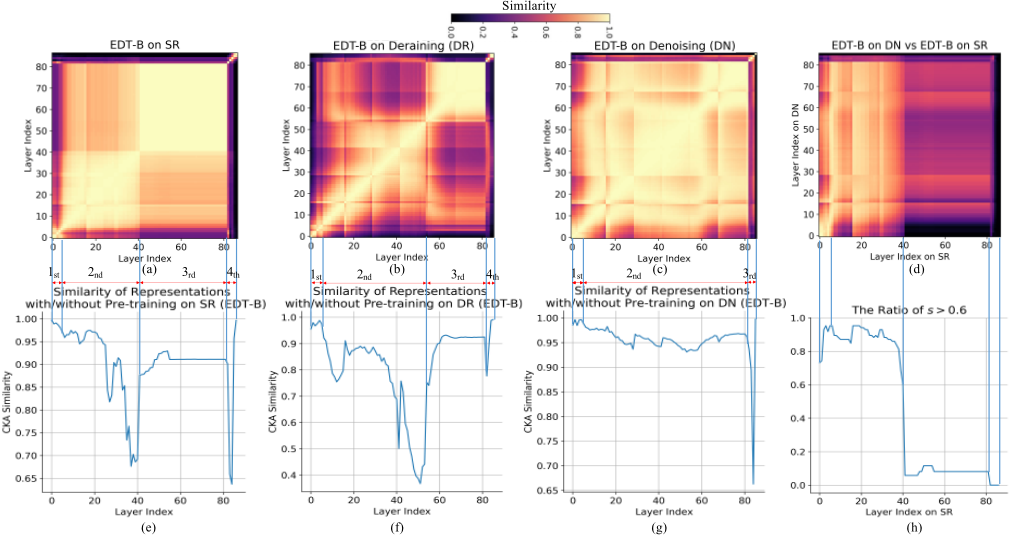
0.6 for input images, where "s" means the similarity between the current layer in SR and any layer in denoising.
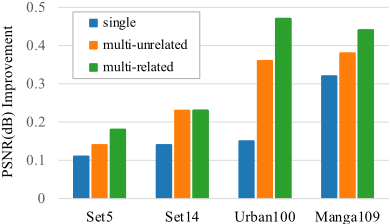
How does the pre-training, especially multi-task pre-training, affect the behaviors of models?
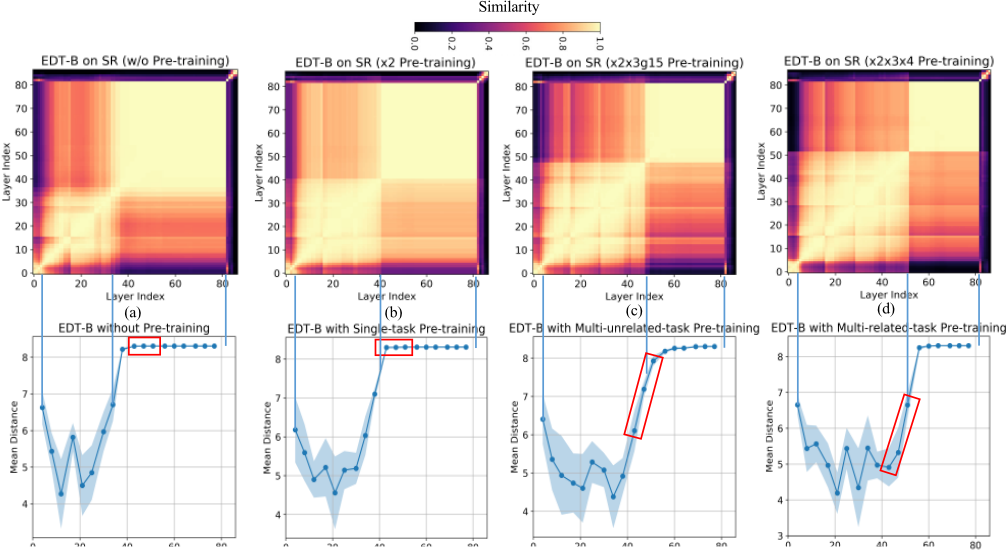
We conjecture that one possible reason causing the partition lies with the difference of ability to incorporate local or global information between different layers. We start by analyzing self-attention layers for their mechanism of dynamically aggregating information from other spatial locations, which is quite different from the fixed receptive field of the FFN layer. To represent the range of attentive fields, we average pixel distances between the queries and keys using attention weights for each head over 170,000 data points, where a larger distance usually refers to using more global information. We do not record attention distances of shifted local windows, because the shift operation narrows down boundary windows and hence can not reflect real distances.
As shown in Fig. 4 (e)-(h), for the second group structure
(counted from the head, same as Sec. 3.3), the standard deviation of attention distances (shown as the blue area) is large and the mean value is small, indicating the attention modules in this group structure area have a mix of local heads (relatively small distances) and global heads (relatively large distances). On the contrary, the third group structure only contains global heads, showing more global information are aggregated in this stage.
Compared to single-task pre-training (×2 SR, Fig. 4 (b) and (f)), multi-unrelated-task setup (×2, ×3 SR, g15 denoising, in Fig. 4 (c) and (g)) converts more global representations (in red box) of the third group to local ones, increasing the scope of the second group. In consequence, as shown in Fig. 3, we observe obvious PSNR improvements on all benchmarks. When replacing the g15 denoising with highly related ×4 SR (×2, ×3, ×4 SR, in Fig. 4 (d) and (h)), we observe more changes in global representations, along with further improvements in Fig. 3. The inferiority of multi-unrelatedtask setup is mainly due to the representation mismatch of unrelated tasks, as shown in Sec. 3.3. We also provide detailed quantitative comparisons for all tasks and different batch size settings in the supplementary material.
Key Findings: (1) the representations of SR models contain more local information in early layers while more global information in higher layers; (2) all three pre-training methods can greatly improve the performance by introducing different degrees of local information, treated as a kind of inductive bias, to the intermediate layers of the model, among which multi-related-task pre-training performs best.
(e)
(f)
(g)
(h)
Figure 4: Sub-figures (a)-(d) show CKA similarities of ×2 SR models, without pre-training as well as with pre-training on a single task (×2),
unrelated tasks (×2, ×3 SR, g15 denoising) and highly related tasks (×2, ×3, ×4 SR). Sub-figures (e)-(h) show the corresponding attention
head mean distances of transformer blocks. We do not plot shifted local windows in (e)-(h) so that the last blue dotted line ("---") has no
matching point. The red boxes indicate the same attention modules.
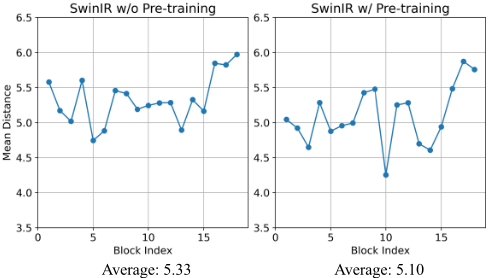
To validate whether the finding that pre-training brings more local information to the model also fit other windowbased frameworks, we show the attention head distances of SwinIR [Liang et al., 2021] in Fig. 5. Without pre-training, the first few blocks (1-15) tend to be local while the last ones (16-18) are more global. And pre-training brings more local representations, matching our observation before.
3.5 Effect of Data Scale on Pre-training
In this section, we investigate how pre-training data scale affects the super-resolution performance. As shown in Table 2, with regard to the EDT-B model, we obviously observe incremental PSNR improvements on multiple SR benchmarks by increasing the data scale from 50K to 400K during single-task pre-training. It is noted that we double the pre-training iterations for the data scale of 400K so that the data can be fully functional. However, a longer pre-training period largely increases the training burden.
| Model | Data | Set5 | Set14 | Urban100 | Manga109 |
|---|---|---|---|---|---|
| EDT-B | 0 | 38.45 | 34.57 | 33.80 | 39.93 |
| EDT-B† | 50K | 38.53 | 34.66 | 33.86 | 40.14 |
| EDT-B† | 100K | 38.55 | 34.68 | 33.90 | 40.18 |
| EDT-B† | 200K | 38.56 | 34.71 | 33.95 | 40.25 |
| EDT-B† | 400K | 38.61 | 34.75 | 34.05 | 40.37 |
| EDT-B⋆ | 200K | 38.63 | 34.80 | 34.27 | 40.37 |
On the contrary, as shown in Table 2, multi-related-task pre-training (with much fewer training iterations) successfully breaks through the limit. Our EDT-B model with multirelated-task pre-training on 200K images achieves new state of the arts on all benchmarks, though a smaller data scale is adopted, revealing that simply increasing the data scale may not be the optimal option. Thus, we suggest multi-relatedtask pre-training is more effective and data-efficient.
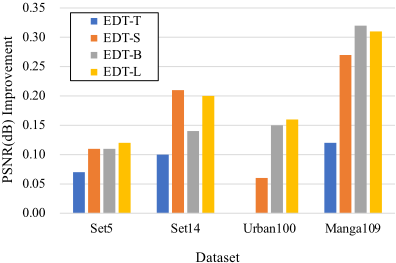
Urban100 is 0.00dB, thus we do not plot the bar.
3.6 Effect of Model Size on Pre-training
We conduct experiments to compare the performance of single-task pre-training for four model variants in the ×2 SR task. As shown in Fig. 6, we visualize PSNR improvements of models with pre-training over counterparts trained from scratch. It is observed that models with larger capacities generally obtain more improvements. Especially, we find pretraining can still improve a lot upon already strong EDT-L models, showing the potential of pre-training. The quantitative results are provided in the supplementary file.
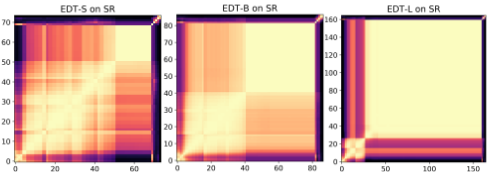
Here we visualize the CKA maps of the EDT-S, EDT-B and EDT-L models in Fig 7. As illustrated in Sec. 3.3, we already know there are roughly four group structures in the CKA maps of SR models, among which the second and third group structures account for the transformer body. The proportion of the third part is positively correlated with the model size. Especially, compared to the other two, the third group structure of EDT-L account for the vast majority and show high similarities, which reflects the redundancy of the model.
3.7 EDT v.s. ConvNets with Pre-training
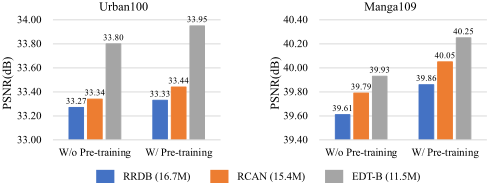
We further explore the pre-training performance of EDT and CNNs-based models (RRDB [Wang et al., 2018] and RCAN [Zhang et al., 2018b]). Fig. 8 demonstrates that our EDT-B obtains greater or comparable improvements from pre-training, giving higher baselines with fewer parameters. From the representation comparisons between EDT and CNNs-based models exhibited in the supplementary material, we argue that the superiority of transformers may come from the utilization of global information.
4 Experiments
Following the pre-training guidelines, we conduct experiments in super-resolution (SR), denoising and detraining. As aforementioned, we observe that multi-related-task pretraining is highly effective and data-efficient. Thus, we adopt this pre-training strategy in all the tests. The involved pretraining tasks of SR include ×2, ×3 and ×4, those of denoising include g15, g25 and g50, and those of deraining include light and heavy rain streaks. More experimental settings and visual comparisons are given in the supplementary file.
4.1 Super-Resolution Results
For the super-resolution (SR) task, we test our models on two settings, classical and lightweight SR, where the latter generally refers to models with < 1M parameters. The results of ×3 classical SR and lightweight SR are provided in the supplementary material due to the space limit.
We compare our EDT with state-of-the-art CNNs-based methods as well as transformer-based methods. As shown in Table 3, while the proposed EDT-B serves as a strong baseline, achieving nearly 0.1dB gains on multiple datasets over SwinIR [Liang et al., 2021], pre-training still brings significant improvements on ×2 and ×4 scales. For example, we observe up to 0.46dB and 0.45dB improvements on highresolution benchmark Urban100 and Manga109, manifesting the effectiveness of our pre-training strategy.
4.2 Denoising Results
In Table 4, we present our three models: (1) EDT-B without pre-training; (2) EDT-B with pre-training; (3) EDT-B without downsampling and pre-training.
It is worthwhile to note that, unlike SR models that benefit a lot from pre-training, denoising models only achieve 0.02-0.11dB gains. One possible reason is that we use a large training dataset in denoising tasks, which already provides sufficient data to make the capacity of our models into full play. On the other hand, pre-training hardly affects the internal feature representation of models, discussed in Sec. 3.3. Therefore, we suggest that the Gaussian denoising task may not need a large amount of training data.
Besides, we find our framework is well performed on high noise levels (e.g., σ = 50), while yielding slightly inferior performance on low noise levels (e.g., σ = 15). This could be caused by the downsampling operation in EDT. To verify this assumption, we train another EDT-B model without downsampling. As shown in Table 4, it does obtain better performance on the low level noises. Nonetheless, we suggest that the proposed EDT model is still a good choice for denoising tasks since it strikes a sweet point between performance and computational complexity. For example, the FLOPs of EDT-B (38G) is only 8.4% of SwinIR (451G).
| Scale | Method | #Param. (×106 ) | Set5 | Set14 | BSDS100 | Urban100 | Manga109 | |||||
|---|---|---|---|---|---|---|---|---|---|---|---|---|
| PSNR | SSIM | PSNR | SSIM | PSNR | SSIM | PSNR | SSIM | PSNR | SSIM | |||
| ×2 | RCAN [Zhang et al., 2018b] | 15.4 | 38.27 | 0.9614 | 34.12 | 0.9216 | 32.41 | 0.9027 | 33.34 | 0.9384 | 39.44 | 0.9786 |
| SAN [Dai et al., 2019] | 15.7 | 38.31 | 0.9620 | 34.07 | 0.9213 | 32.42 | 0.9028 | 33.10 | 0.9370 | 39.32 | 0.9792 | |
| NLSA [Mei et al., 2021] | 31.9 | 38.34 | 0.9618 | 34.08 | 0.9231 | 32.43 | 0.9027 | 33.42 | 0.9394 | 39.59 | 0.9789 | |
| IPT† [Chen et al., 2021] | 115.5 | 38.37 | - | 34.43 | - | 32.48 | - | 33.76 | - | - | - | |
| SwinIR [Liang et al., 2021] | 11.8 | 38.42 | 0.9622 | 34.48 | 0.9252 | 32.50 | 0.9038 | 33.70 | 0.9418 | 39.81 | 0.9796 | |
| SwinIR‡ [Liang et al., 2021] | 11.8 | 38.42 | 0.9623 | 34.46 | 0.9250 | 32.53 | 0.9041 | 33.81 | 0.9427 | 39.92 | 0.9797 | |
| EDT-B(Ours) | 11.5 | 38.45 | 0.9624 | 34.57 | 0.9258 | 32.52 | 0.9041 | 33.80 | 0.9425 | 39.93 | 0.9800 | |
| EDT-B† (Ours) | 11.5 | 38.63 | 0.9632 | 34.80 | 0.9273 | 32.62 | 0.9052 | 34.27 | 0.9456 | 40.37 | 0.9811 | |
| RCAN [Zhang et al., 2018b] | 15.6 | 32.63 | 0.9002 | 28.87 | 0.7889 | 27.77 | 0.7436 | 26.82 | 0.8087 | 31.22 | 0.9173 | |
| SAN [Dai et al., 2019] | 15.9 | 32.64 | 0.9003 | 28.92 | 0.7888 | 27.78 | 0.7436 | 26.79 | 0.8068 | 31.18 | 0.9169 | |
| NLSA [Mei et al., 2021] | 44.2 | 32.59 | 0.9000 | 28.87 | 0.7891 | 27.78 | 0.7444 | 26.96 | 0.8109 | 31.27 | 0.9184 | |
| IPT† [Chen et al., 2021] | 115.6 | 32.64 | - | 29.01 | - | 27.82 | - | 27.26 | - | - | - | |
| ×4 SwinIR [Liang et al., 2021] | 11.9 | 32.74 | 0.9020 | 29.06 | 0.7939 | 27.89 | 0.7479 | 27.37 | 0.8233 | 31.93 | 0.9246 | |
| SwinIR‡ [Liang et al., 2021] | 11.9 | 32.92 | 0.9044 | 29.09 | 0.7950 | 27.92 | 0.7489 | 27.45 | 0.8254 | 32.03 | 0.9260 | |
| EDT-B(Ours) | 11.6 | 32.82 | 0.9031 | 29.09 | 0.7939 | 27.91 | 0.7483 | 27.46 | 0.8246 | 32.05 | 0.9254 | |
| EDT-B† (Ours) | 11.6 | 33.06 | 0.9055 | 29.23 | 0.7971 | 27.99 | 0.7510 | 27.75 | 0.8317 | 32.39 | 0.9283 | |
| Dataset | σ | BM3D [Dabov et al., 2007] | DnCNN [Zhang et al., 2017] | FFDNet [Zhang et al., 2018a] | BRDNet [Tian et al., 2020] | IPT† [Chen et al., 2021] | DRUNet [Zhang et al., 2021] | SwinIR‡ [Liang et al., 2021] | EDT-B (Ours) | EDT-B† (Ours) | EDT-B∗ (Ours) |
|---|---|---|---|---|---|---|---|---|---|---|---|
| 15 | 33.52 | 33.90 | 33.87 | 34.10 | - | 34.30 | 34.42 | 34.33 | 34.38 | 34.39 | |
| CBSD68 | 25 | 30.71 | 31.24 | 31.21 | 31.43 | - | 31.69 | 31.78 | 31.73 | 31.76 | 31.76 |
| 50 | 27.38 | 27.95 | 27.96 | 28.16 | 28.39 | 28.51 | 28.56 | 28.55 | 28.57 | 28.56 | |
| 15 | 34.28 | 34.60 | 34.63 | 34.88 | - | 35.31 | 35.34 | 35.25 | 35.31 | 35.37 | |
| Kodak24 | 25 | 32.15 | 32.14 | 32.13 | 32.41 | - | 32.89 | 32.89 | 32.84 | 32.89 | 32.94 |
| 50 | 28.46 | 28.95 | 28.98 | 29.22 | 29.64 | 29.86 | 29.79 | 29.81 | 29.83 | 29.87 | |
| 15 | 34.06 | 33.45 | 34.66 | 35.08 | - | 35.40 | 35.61 | 35.43 | 35.51 | 35.61 | |
| McMaster | 25 | 31.66 | 31.52 | 32.35 | 32.75 | - | 33.14 | 33.20 | 33.20 | 33.26 | 33.34 |
| 50 | 28.51 | 28.62 | 29.18 | 29.52 | 29.98 | 30.08 | 30.22 | 30.21 | 30.25 | 30.25 | |
| 15 | 33.93 | 32.98 | 33.83 | 34.42 | - | 34.81 | 35.13 | 34.93 | 35.04 | 35.22 | |
| Urban100 | 25 | 31.36 | 30.81 | 31.40 | 31.99 | - | 32.60 | 32.90 | 32.78 | 32.86 | 33.07 |
| 50 | 27.93 | 27.59 | 28.05 | 28.56 | 29.71 | 29.61 | 29.82 | 29.93 | 29.98 | 30.16 |
4.3 Deraining Results
We evaluate the performance of our EDT on Rain100L [Yang et al., 2019] and Rain100H [Yang et al., 2019] two datasets, accounting for light and heavy rain streaks. As shown in Table 5, though the model size of our EDT-B (11.5M) for deraining is far smaller than IPT (116M), it still outperforms IPT by 0.52dB on the light rain setting. Meanwhile, our model reaches significantly superior results by 2.66dB gain on the heavy rain setting, compared to the second-best RCDNet [Wang et al., 2020], supporting that EDT performs well for restoration tasks with heavy degradation.
5 Conclusion
Based on the proposed framework, we perform an in-depth analysis of transformer-based image pre-training in low-level vision. We find pre-training plays the central role of developing stronger intermediate representations by incorporating more local information. Also, we find the effect of pretraining is task-specific, leading to significant improvements on SR and deraining while limited gains on denoising. Then, we suggest multi-related-task pre-training exhibits great potential in digging image priors, far more efficient than using larger pre-training datasets. Finally, we show how data scale and model size affect the performance of pre-training and present comparisons between transformers and ConvNets.
| Method | RAIN100L | RAIN100H | ||
|---|---|---|---|---|
| PSRN | SSIM | PSNR | SSIM | |
| DSC [Luo et al., 2015] | 27.34 | 0.8494 | 13.77 | 0.3199 |
| GMM [Li et al., 2016] | 29.05 | 0.8717 | 15.23 | 0.4498 |
| JCAS [Gu et al., 2017] | 28.54 | 0.8524 | 14.62 | 0.4510 |
| Clear [Fu et al., 2017a] | 30.24 | 0.9344 | 15.33 | 0.7421 |
| DDN [Fu et al., 2017b] | 32.38 | 0.9258 | 22.85 | 0.7250 |
| RESCAN [Li et al., 2018] | 38.52 | 0.9812 | 29.62 | 0.8720 |
| PReNet [Ren et al., 2019] | 37.45 | 0.9790 | 30.11 | 0.9053 |
| SPANet [Wang et al., 2019] | 35.33 | 0.9694 | 25.11 | 0.8332 |
| JORDER E [Yang et al., 2019] | 38.59 | 0.9834 | 30.50 | 0.8967 |
| SSIR [Wei et al., 2019] | 32.37 | 0.9258 | 22.47 | 0.7164 |
| RCDNet [Wang et al., 2020] | 40.00 | 0.9860 | 31.28 | 0.9093 |
| IPT† [Chen et al., 2021] | 41.62 | 0.9880 | - | - |
| EDT-B† (Ours) | 42.14 | 0.9903 | 34.02 | 0.9406 |
Acknowledgments
This work is partially supported by Shenzhen Science and Technology Program KQTD20210811090149095 and also the Pearl River Talent Recruitment Program 2019QN01X226.
@inproceedings{ijcai2023p121,
  title     = {On Efficient Transformer-Based Image Pre-training for Low-Level Vision},
  author    = {Li, Wenbo and Lu, Xin and Qian, Shengju and Lu, Jiangbo},
  booktitle = {Proceedings of the Thirty-Second International Joint Conference on
               Artificial Intelligence, {IJCAI-23}},
  publisher = {International Joint Conferences on Artificial Intelligence Organization},
  editor    = {Edith Elkind},
  pages     = {1089--1097},
  year      = {2023},
  month     = {8},
  note      = {Main Track},
  doi       = {10.24963/ijcai.2023/121},
  url       = {https://doi.org/10.24963/ijcai.2023/121},
}
TY - CPAPER TI - On Efficient Transformer-Based Image Pre-training for Low-Level Vision AU - Li, Wenbo AU - Lu, Xin AU - Qian, Shengju AU - Lu, Jiangbo T2 - Proceedings of the Thirty-Second International Joint Conference on Artificial Intelligence, IJCAI-23 PB - International Joint Conferences on Artificial Intelligence Organization PY - 2023 SP - 1089 EP - 1097 DO - 10.24963/ijcai.2023/121 UR - https://doi.org/10.24963/ijcai.2023/121 ER -Copied
Machine-readable versions of this paper, for tools and AI agents:





