
Image Composition with Depth Registration
Proceedings of the Thirty-Second International Joint Conference on Artificial Intelligence. Main Track. Pages 1134-1141.
https://doi.org/10.24963/ijcai.2023/126
Keywords
- Computer Vision: CV: Scene analysis and understanding
- Multidisciplinary Topics and Applications: MDA: Arts and creativity
Abstract
Handling occlusions is still a challenging problem for image composition. It always requires the source contents to be completely in front of the target contents or needs manual interventions to adjust occlusions, which is very tedious. Though several methods have suggested exploiting priors or learning techniques for promoting occlusion determination, their potentials are much limited. This paper addresses the challenge by presenting a depth registration method for merging the source contents seamlessly into the 3D space that the target image represents. Thus, the occlusions between the source contents and target contents can be conveniently handled through pixel-wise depth comparisons, allowing the user to more efficiently focus on the designs for image composition. Experimental results show that we can conveniently handle occlusions in image composition and improve efficiency by about 4 times compared to Photoshop.
- [Azadi et al., 2020] Samaneh Azadi, Deepak Pathak, Sayna Ebrahimi, and Trevor Darrell. Compositional gan: Learn- ing image-conditional binary composition. International Journal of Computer Vision, 128(10):2570-2585, 2020.
- [Bao et al., 2022] Zhongyun Bao, Chengjiang Long, Gang Fu, Daquan Liu, Yuanzhen Li, Jiaming Wu, and Chunxia Xiao. Deep image-based illumination harmonization. In Proceedings of the IEEE/CVF Conference on Computer Vision and Pattern Recognition, pages 18542-18551, 2022.
- [Chen et al., 2018] Liang-Chieh Chen, Yukun Zhu, George Papandreou, Florian Schroff, and Hartwig Adam. Encoder-decoder with atrous separable convolution for se- mantic image segmentation. In Proceedings of the Euro- pean conference on computer vision (ECCV), pages 801- 818, 2018.
- [Cong et al., 2021] Wenyan Cong, Li Niu, Jianfu Zhang, Jing Liang, and Liqing Zhang. Bargainnet: Background- guided domain translation for image harmonization. In 2021 IEEE International Conference on Multimedia and Expo (ICME), pages 1-6. IEEE, 2021.
- [Cong et al., 2022] Wenyan Cong, Xinhao Tao, Li Niu, Jing Liang, Xuesong Gao, Qihao Sun, and Liqing Zhang. High- resolution image harmonization via collaborative dual transformations. In Proceedings of the IEEE/CVF Confer- ence on Computer Vision and Pattern Recognition, pages 18470-18479, 2022.
- [Farbman et al., 2011] Zeev Farbman, Raanan Fattal, and Dani Lischinski. Convolution pyramids. ACM Trans. Graph., 30(6):175, 2011.
- [Fu et al., 2008] Xinyuan Fu, He Guo, Yuxin Wang, Tianyang Liu, and Han Li. Arbitrary image cloning. In Signal Processing for Image Enhancement and Multime- dia Processing, pages 289-300. Springer, 2008.
- [Guo and Sim, 2009] Dong Guo and Terence Sim. Color me right-seamless image compositing. In International Conference on Computer Analysis of Images and Patterns, pages 444-451. Springer, 2009.
- [Hang et al., 2022] Yucheng Hang, Bin Xia, Wenming Yang, and Qingmin Liao. Scs-co: Self-consistent style con- trastive learning for image harmonization. In Proceedings of the IEEE/CVF Conference on Computer Vision and Pat- tern Recognition, pages 19710-19719, 2022.
- [Huang et al., 2019] Han Huang, Yihui Liang, Xiaowei Yang, and Zhifeng Hao. Pixel-level discrete multiobjec- tive sampling for image matting. IEEE Transactions on Image Processing, 28(8):3739-3751, 2019.
- [Kornilov and Safonov, 2018] Anton S Kornilov and Ilia V Safonov. An overview of watershed algorithm imple- mentations in open source libraries. Journal of Imaging, 4(10):123, 2018.
- [Levin et al., 2007] Anat Levin, Dani Lischinski, and Yair Weiss. A closed-form solution to natural image matting. IEEE transactions on pattern analysis and machine intel- ligence, 30(2):228-242, 2007.
- [Niu et al., 2021] Li Niu, Wenyan Cong, Liu Liu, Yan Hong, Bo Zhang, Jing Liang, and Liqing Zhang. Making images real again: A comprehensive survey on deep image com- position. arXiv preprint arXiv:2106.14490, 2021.
- [Pérez et al., 2003] Patrick Pérez, Michel Gangnet, and An- drew Blake. Poisson image editing. In ACM SIGGRAPH 2003 Papers, pages 313-318. 2003.
- [Rother et al., 2004] Carsten Rother, Vladimir Kolmogorov, and Andrew Blake. "GrabCut" interactive foreground ex- traction using iterated graph cuts. ACM transactions on graphics (TOG), 23(3):309-314, 2004.
- [Tan et al., 2019] Xuehan Tan, Panpan Xu, Shihui Guo, and Wencheng Wang. Image composition of partially occluded objects. Computer Graphics Forum, 38(7):641-650, 2019.
- [Tang et al., 2019] Jingwei Tang, Yagiz Aksoy, Cengiz Oztireli, Markus Gross, and Tunc Ozan Aydin. Learning- based sampling for natural image matting. In Proceedings of the IEEE/CVF Conference on Computer Vision and Pat- tern Recognition, pages 3055-3063, 2019.
- [Wang et al., 2016] Wencheng Wang, Panpan Xu, Xiaohui Bie, and Miao Hua. Enhanced use of mattes for easy im- age composition. IEEE Transactions on Image Processing, 25(10):4608-4616, 2016.
- [Yu et al., 2021] Bing Yu, Youdong Ding, Zhifeng Xie, and Dongjin Huang. Stacked generative adversarial networks for image compositing. EURASIP Journal on Image and Video Processing, 2021(1):1-20, 2021.
- [Yuan et al., 2022] Weihao Yuan, Xiaodong Gu, Zuozhuo Dai, Siyu Zhu, and Ping Tan. Newcrfs: Neural window fully-connected crfs for monocular depth estimation. In Proceedings of the IEEE Conference on Computer Vision and Pattern Recognition, 2022.
- [Zhan et al., 2020] Fangneng Zhan, Shijian Lu, Changgong Zhang, Feiying Ma, and Xuansong Xie. Adversarial image composition with auxiliary illumination. In Proceedings of the Asian Conference on Computer Vision, 2020.
References were extracted automatically from the PDF and may contain errors.
Full text extracted automatically from the PDF; figures, tables and equations may differ. The PDF is the version of record.
1 Introduction
Image composition tries to merge selected contents from the source image (source contents) into the target image to produce a plausible image [P´erez et al., 2003; Guo and Sim, 2009]. Till now, existing methods pay much attention to color blending for a seamless composition [P´erez et al., 2003; Zhan et al., 2020; Levin et al., 2007; Yu et al., 2021; Bao et al., 2022], including a large quantity of matting methods [Levin et al., 2007; Tang et al., 2019; Huang et al., 2019] and cloning-based methods [Farbman et al., 2011; P´erez et al., 2003]. As for the correct occlusion relationships required between the source contents and the contents in the target image (target contents), corresponding studies are insufficient [Niu et al., 2021]. Existing methods always require the source contents to be completely in front of the target contents. For compositing the source contents that are partially occluded by the target contents, the user needs to remove the occluded parts of the source contents with careful manual interventions or use image editing software (e.g., Photoshop) to separate the contents into different layers and manually identify the orders of the layers to obtain the correct occlusions between the contents. These manual interventions are laborious, preventing image composition from applications.
∗Corresponding authors

To promote image composition of partially occluded objects, Tan et al. [Tan et al., 2019] proposed using two priors to infer occlusions. The first prior is that when a source content is completely inside the region of a target content, the source content must be in front of the target content. The second prior is that, when there is a common support plane for the source content and its overlapped target contents, the depth values of the sites for these contents to touch the support plane can be used to deduce the occlusions between them. Unfortunately, these priors cannot be applied in many cases; e.g., there is no common support plane for the source contents and their overlapped target contents. In particular, when the source content and the target content occlude each other, this method cannot be used, as illustrated in Fig. 1(c). In [Azadi et al., 2020], learning techniques are exploited for handling complicated interactions between different real-world objects for image composition, including the occlusions between source contents and target contents. Unfortunately, it can only learn occlusions from the training data, and therefore its generalization potentials are much limited; e.g., it cannot deal with the example in Fig. 1(d).
This paper addresses the challenge of handling occlusions efficiently by presenting a depth registration method for seamlessly merging source contents into the 3D space represented by the target image. Thus, occlusions between source contents and target contents can be easily determined, reducing the amount of manual intervention for occlusion determination. This method benefits from the learning techniques that perform well in segmenting objects in images and estimating their depths, and from the observation in [Tan et al., 2019] that image composition is always by mixing objects in an image, by which we can handle objects instead of pixels for image composition. Clearly, the estimated depths of objects in different images cannot be used directly for determining the occlusions between the objects in a composition image. Fortunately, the human visual system is very sensitive to the size of an object in the image with respect to its distance from the viewpoint. Thus, we can adjust the size of the source object to look as if it is standing at the same distance as a target object, by which the source object can be registered into the target image. For high-quality depth registration, in Section 3 we develop novel measures to construct a correspondence between the size of the source object and the depths of its pixels in the target image, so that complicated occlusions like those in Fig. 1 can be well handled with much fewer manual interventions than existing methods. As a result, without being distracted by occlusion determination in image composition, the user can more efficiently focus on design by adjusting the locations and sizes of source objects in the target image to achieve satisfactory results, as shown in experiments.
2 RelatedWork
Various methods have been proposed for image composition. Unfortunately, most of them are focused on color blending [Cong et al., 2021; Cong et al., 2022; Hang et al., 2022], and pay little attention to occlusion determination between the source contents and target contents, though correct occlusions are important for a plausible composition.
Color blending methods can be classified into two categories: matting-based methods [Levin et al., 2007; Tang et al., 2019; Huang et al., 2019] and cloning-based methods [Farbman et al., 2011; P´erez et al., 2003; Fu et al., 2008]. Matting-based methods try to produce an alpha matte to represent the source contents, whose alpha weights are used for pixel-wise linear color interpolation between the source and the target images. Cloning-based methods take the outlined source image patch containing interested contents as input and paste the input onto the target image for a composition. The color discrepancies between the source image and target image on the boundary of the input patch are propagated over the entire cloned area for a seamless color blending. In general, these methods require the source contents to be completely in front of the target contents in the composition. If some parts of the source contents are occluded by the target contents in the composition, the occluded parts of the source contents should be removed, and this generally requires substantial user interventions, such as drawing an excessive number of strokes or trimaps to generate suitable mattes [Levin et al., 2007; Tang et al., 2019] or laboriously drawing the boundary to exclude the occluded parts from the patch for cloning [Farbman et al., 2011]. Intensive manual interventions are very troublesome, preventing image composition from applications.
Though there are some learning based methods proposed for image composition [Tang et al., 2019; Huang et al., 2019], they still require the source contents over the target image, which means that partially occluded source contents cannot be composited into the target image.
For compositing partially occluded source contents, image editing software (e.g. Photoshop) tries to separate the image contents into different layers and identify the orders of the layers for occlusion determination. However, such a procedure is very time-consuming.
To our knowledge, two priors are used in [Tan et al., 2019] to facilitate occlusion determination to promote the composition of partially occluded objects. As discussed in Section 1, however, these two priors are not suitable in many cases and so this method is still prevented from compositing images with complicated occlusions. Learning techniques have also been exploited to determine the occlusions between objects and promoting image composition [Azadi et al., 2020]. However, as the technique is dependent on the training data for learning occlusions, its potentials are limited and its handling is inconvenient, especially when handling complicated occlusions, as illustrated in Fig. 1(d).
3 Depth Registration
The proposed depth registration method places the source object into the 3D space represented by the target image. To achieve this, we first perform semantic segmentation and depth estimation in the source image and the target image to obtain objects and their related depths, to which end many existing learning techniques can be used. As the source image and the target image represent different 3D spaces, the estimated depths for the source object cannot be used directly in the target image. Fortunately, the depth differences between pixels of the source object are concerned with the 3D existence of the source object, and so keeping unchanged in the source image and target image. As a result, these depth differences can be exploited for depth registration. Our process of depth registration consists of the following three operations:
- Registration initialization places the source object into the 3D space of the target image (Subsection 3.1).
- Adaptive depth adjustment computes pixelwise depths to determine occlusions between the source object and the target objects for a composition (Subsection 3.2).
- Registration refinement optimizes depths and object segmentation to correct unsuitable occlusions (Subsection 3.3).
The pipeline for depth registration is illustrated in Fig. 2. Here, we generate a structure called difference-template for representing the 3D existence of the source object. The image patch of the extracted source object in the source image is called the source image patch in Fig. 2(a). Its differencetemplate in Fig. 2(b) is constructed to record the depth differences between the pixels of the source image patch and an anchor point of the source object; e.g., the red point P in Fig. 2(a), to be discussed in Subsection 3.1. Adaptive depth adjustment is then performed according to the location of the source object for its composition in the target image in Fig. 2(c) and Fig. 2(d), In Fig. 2(c), in order to compute the depth for each pixel of the source image patch in the target image, a use-template is formed from the difference-template and the depth of the anchor point in the target image. By mapping the use-template to the target image, we can obtain the depths for the pixels of the image patch of the source object in the target image, called the target-source image patch, as illustrated in Fig. 2(d).
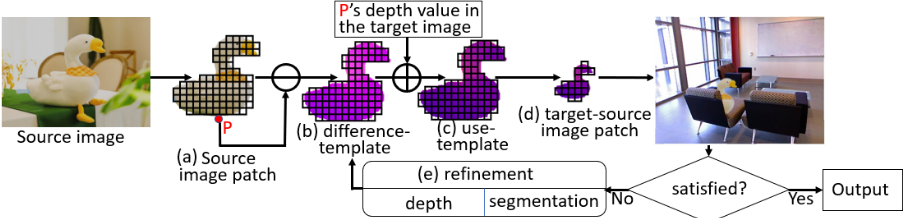
As the estimated depths and object segmentation are not very accurate, some occlusions by the registered depths are not correct. To remedy this, we refine the registration. We allow the user to manually correct unsuitable occlusions, so that the difference-template has its depth differences refined correspondingly. As a result, the subsequent depth registration for other designs of compositing the source object into the target image will be facilitated as refined depths and segmented objects would have fewer and fewer incorrect occlusions generated.
3.1 Registration Initialization
We initialize depth registration by resizing the target-source image patch of the source object against a target object in the target image until the two objects look as if they are standing at the same distance from the viewpoint, as illustrated in Fig. 3.
At this time, it is generally regarded that the lowest pixels of these two objects in the target image have the same distance from the viewpoint, meaning the same depth value. Thus, the lowest pixel of the target-source image patch for the source object has its depth value in the target image; i.e., the depth of the lowest pixel of the target object, as illustrated in Fig. 3(c). Clearly, this lowest pixel has a corresponding point in the source image patch, called the anchor point. If there are several pixels at the lowest sites in the target-source image patch, any one of them can be selected as the anchor point, without preventing image composition.
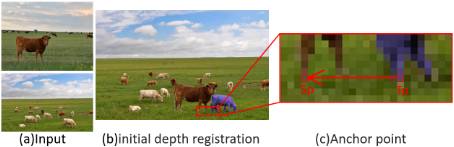
By depth interpolation of the neighboring pixels around the anchor point in the source image patch, the anchor point has its depth in the source image. Thus, the pixels of the source image patch compute their depth differences from the anchor point, forming the difference-template.
Clearly, having obtained the difference-template and the depth of the anchor point in the target image, we can now construct the use-template of the source object, and place it into the 3D space of the target image.
3.2 Depth Determination for Composition
After initializing depth registration, the user designs the composition by progressively adjusting the location and size of the source object until satisfactory results are produced. In this procedure, the depths of the overlapped pixels for the target objects and the source object are compared to determine the occlusion between them, where the pixels of the source object have their depths determined adaptively by investigating the size variation of the target-source image patch.
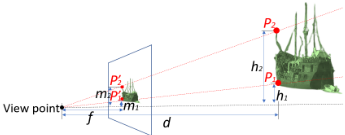
As Fig. 4 shows, for a 3D object projected onto the image plane, its two points P1 and P2 lie on a plane, which is parallel to the image plane, and their projection points on the image plane, P ′1 and P ′2 , have the following equations,
where h1 and h2 are the heights of P1 and P2 in the 3D space, m1 and m2 are the heights of P ′1 and P ′2 in the image plane, f is the focal distance from the viewpoint to the image plane and d is the distance from the plane of P1 and P2 to the viewpoint in the 3D space.
As we know, when the user places a source object into the target image for image composition, the user may shrink, enlarge, or rotate the source object. With these operations, the target-source image patch for the source object varies . Some variations are caused by the changes in the distance from the source object to the image plane, while some are not; e.g., making the 3D shape of the source object wider or shorter. Thus, we should distinguish whether the user's interventions are intended to resize the 3D shape of the source object or to change its depth. Fortunately, it seldom occurs that the user simultaneously resizes the source object and changes its depth. Thus, when the user's intention is to resize the source object, the user should add an intervention as an indication. Then, the other cases of size variation in the target-source image patch all stem from the user's interventions to change the depth of the source object. Under this assumption, the proposed measure of depth computation is as follows.
Depth Computation
In image composition, no matter what happens to cause size variations in the target-source image patch, we observe that for two points P1 and P2 on a plane parallel to the image plane, they still remain on a plane parallel to the image plane. In addition, when the source object has its corresponding 3D shape unchanged, (h2 - h1) remains unchanged for P1 and P2, as shown in Fig. 4. As f is also fixed, we have
when the source object is placed at another location with d′ for P1 and P2, and their m′1 and m′2 on the image plane. As we know, (m′2 -m′1 ) and (m2 -m1) can be easily detected on the target image, so that d′ for producing m′2 and m′1 can be easily determined, assuming that (m2 -m1) is the result for P1 and P2 in the initial registration.
As we know, a pixel is a rasterized point, which can be approximated by a small rectangle parallel to the image plane. For a pixel of the source image patch, its related rectangle varies in size in the target image when the distance from the source object to the image plane changes. Thus, according to the size variations of the rectangle, we can compute the depth of the pixel by Equation (4). On the other hand, with the changes in distance, all rectangles of the pixels for the source object vary in the same way, meaning these rectangles have their heights changed by the same rate drate. Thus, we can use the variations in the target-source image patch to compute the depth of the pixels of the source object respectively, using the following equations,
where dp is the depth of pixel p of the source object when the source object is placed at a new location in the target image, dini is the depth of pixel p when the source object is initially depth registered into the target image, drate is the variation rate, heightini is the height of the target-source image patch in the initial depth registration, and heightp is the height of the target-source image patch at the new location.
Note that when the 3D shape of the source object is not changed in composition, the size variations in its targetsource image patch are caused only by distance changes. Thus, the variation rate along any direction that is parallel to the image plane for the target-source image patch is the same, as it is only determined by f and d. Therefore, we compute drate by the height variation here, without loss of generality.
When the source object has its 3D shape changed in the composite, we compute drate by investigating the changes, as discussed in the following "Computation of drate".
With drate determined, each pixel can have its depth computed using Equation (5). As discussion in Subsection 3.1, the difference-template represents the 3D existence of the source object. Thus, after computing the depth for the anchor point for the source object at the new location, we can obtain the depths of the pixels of the use-template from the difference-template, where only one addition is required for each pixel. This can save a lot of time compared with using Equation (5) directly, which needs multiplications. As a result, we obtain the depths of the pixels of the target image patch by mapping the use-template.
Computation of drate
In Equation (6), the variation rate drate is computed by the variation in height of the target-source image patch. However, in adjusting the size of the target-source image patch for composition using a series of manual interventions, the variation rates along different directions may be different. To solve this, we need to investigate the variation rates along all directions and select the most suitable for depth computation.
Note that only depth change can cause size variations in the target-source image along all directions and at the same variation rate, whereas other changes have not such an effect; e.g., widening the target-source image. Therefore, we investigate the variation rates of the target-source image along all directions and select the one that is nearest to 1.0. In implementation, we investigate only the variation rates along the horizontal direction and the vertical direction, as the user generally manipulates the target-source image patch along the horizontal or the vertical.
3.3 Registration Refinement
In image composition, when the source objects are registered into the target image, the occlusions between the source object and the target objects can be determined by their pixelwise depths. Unfortunately, estimating pixelwise depths and object segmentation by learning techniques is not very accurate and may cause unsuitable occlusions, requiring the user to performmanual corrections. Therefore, the pixelwise depths and object segmentation are refined, which helps facilitate the subsequent composition attempts.
Considering that image composition actually combines some meaningful parts of objects rather than entire objects, we further segment the source objects and the target objects into semantic parts respectively, where many methods can be used for this purpose. We use the Watershed Algorithm [Kornilov and Safonov, 2018], and correct occlusions by parts instead of pixels. In this way, interventions are easy and more efficient. Fig. 5 shows the process of depth refinement for occlusion correction by subdividing an object into semantic parts.The wall of the cup is subdivided into the inner and the outer; therefore, the spoon can be compared with the subdivided parts for refining occlusion determination. As a result, when there is an incorrect occlusion, the user need only click the corresponding parts for occlusion correction.
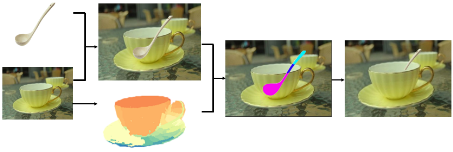
In our treatment, we first compute the overlapped regions between the source object and the target objects by parts. Thus, each overlapped region is related to only a part of a target object, and in general only an occlusion relationship is required in each overlapped region. The exceptional case is when the parts are concave, in which case such parts could be further decomposed into convex subparts for convenient implementation. Therefore, we expect all pixels in each overlapped region to satisfy depthp(t) >= depthp(s) or depthp(t) <= depthp(s), where depthp(t) and depthp(s) refer to the depths of pixel p for the target object t and the source object s respectively. Based on this, we correct unsuitable occlusions and refine depths and object segmentation correspondingly, as discussed below. The refinement result is then transferred to the difference-template of the source object for refining the representation of its 3D existence.
Refinement Measures
The refinement process updates the depths of the related objects or their segmentation. This is achieved by firstly refining the source object, as we expect the target image to remain unchanged if possible. When desired results cannot be obtained by refining the source object, we will further refine the related target objects that have unsuitable occlusions with the refined source object. By refining the source object and the related target objects iteratively, the desired results can be obtained as the estimated depths and object segmentation using learning techniques provide a good base for our implementation. In practical tests, refinement generally takes 1 or 2 iterations.
Using our method, overlapped regions are investigated respectively. For each overlapped region, we first deduce its occlusion relationship by investigating the pairs of (depthp(t), depthp(s)). If most pixels here have depthp(t) >= depthp(s), it means the source object occludes the overlapped target object; otherwise, the source object is occluded by the overlapped target object. For the unsuitable occlusions, we allow the user to manually click the corresponding regions. Thus, the expected occlusions in all the overlapped regions are obtained, for which the refinement process is as follows.
We first refine depths and then refine object segmentation. For depth refinement to reduce depth conflicts in occlusion determination, we deduce a depth offset β and a parameter α ∈[0, 1] to flatten the object. In general, the occlusions in the overlapped regions can be obtained correctly with depth refinement, but some pixels in the overlapped regions may still have unsuitable occlusions. For these pixels, we investigate whether they are outliers of the object and exclude such outliers for refining the object segmentation here. If there are still some pixels with unsuitable occlusions after object refinement, we resort to iterative refinement of the source object and the related target objects alternatively.
In sum, the refinement process involves the following steps:
- Occlusions in overlapped regions are deduced respectively.
- The user interactively clicks the regions with unsuitable occlusions.
- The pixelwise depths and object segmentation are refined iteratively by the following sequence of steps until expected occlusions in all the overlapped regions are achieved.
- 3.1) Refine depths for the source object;
- 3.2) Refine object segmentation for the source object;
- 3.3) Refine depths for the overlapped target objects;
- 3.4) Refine object segmentation for the overlapped target objects.
Without loss of generality, we now discuss the measures for depth refinement and object refinement.
- Depth refinement. Depth refinement is defined by the following formula:
where depth′i is the refined depth for pixel i from its previous depth depthi, and depthAcPoint is the depth of the anchor point. Clearly, β can be derived by investigating the depth differences between depthp(t) and depthp(s) for the pixels in the regions with wrong occlusions; e.g., β = max(|depthp(t) - depthp(s)|) if the source object is expected to be occluded, and β = -max(|depthp(t) - depthp(s)|) otherwise. As for α, it should be as close as possible to 1.0 for retaining the originally estimated 3D shape of the object. With all overlapped regions considered, α and β can be computed by dynamic programming. Two examples are illustrated in Fig. 6 and Fig. 7.
- Object refinement. Refining object segmentation is computed by finding and excluding the outliers of the object in an overlapped region. First, we check the colors and depths of the pixels of the object under investigation in an overlapped region; e.g., (colorp, depthp) for pixel p. In general, these pixels should be clustered very well by their (colorp, depthp). The pixels that are on the boundary of the object and have much different (colorp, depthp) from their neighboring pixels in this overlapped region are regarded as outliers. Here, for each pixel p, we compute its maximum depth difference and color difference with its neighboring pixels in the overlapped region; e.g., dep-diff(p) and clr-diff(p). We then obtain the average values for these depth differences and color differences; e.g., average-dep-diff and average-clr-diff. For each pixel p, if dep-diff(p) /∈ [average-dep-diff × (1.0 -



λ), average-dep-diff × (1.0 + λ)], or clr-diff(p) /∈ [average-clr-diff×(1.0-µ), average-clr-diff×(1.0+ µ)], the pixel is regarded as an outlier. Many tests show that setting λ=0.7 and µ=0.7 can always obtain good results.
4 Algorithm for Image Composition
Using the measures in Section 3, we present an image composition algorithm that can handle complicated occlusions conveniently and efficiently. The algorithm has the following steps:
- Semantic segmentation and depth estimation are executed in the source image and the target image using learning techniques.
- The user selects an interested source object and places it onto the target image to test designs. A satisfactory composite is achieved by the following steps:
- 2.1) The source object is initially depth registered into the 3D space of the target image.
- 2.2) The user tries a design by placing the source object with a suitable size onto the target image for a composition. Here, occlusions are determined by pixelwise depths, and color blending methods are then used for the visible pixels of the source object.
- 2.3) When there are incorrect occlusions in the composite obtained in 2.2), the user manually clicks the related regions for occlusion correction.
- 2.4) Step 2.2) and 2.3) are repeated until a satisfactory composite is obtained.
4.1 Implementation
In implementing our method, we use the following techniques for semantic segmentation, depth estimation, and color blending.
Semantic segmentation uses primarily the popular method DeepLabV3+ [Chen et al., 2018]. We also use GrabCut [Rother et al., 2004] to further optimize the extracted objects.
Depth estimation uses NeWCRFs [Yuan et al., 2022] to obtain a high-resolution depth map given a single RGB image.
Color blending uses the enhanced matting method of [Wang et al., 2016], which computes the color at pixel i by the following formulae,
where fi, ti, and gi are the colors of the pixel i in the composited image, the target image, and the source image respectively, and N is the set of pixels in the source object. The weight wi is set to 0.8 for the pixels on the boundary of the source object, and 0.9 for the pixels inside the source object, which has always produced very good composites in our tests, as detailed in Section 5. W is the normalized weight for distinguishing smoothing effects in different regions, computed as Wj = (1 - wj)/ ∑Nk=1 (1 - wk) for pixel j, and S(i, j) = exp(-||pi - pj||2 ) for pixels i and j, where pk denotes the pixel position.
5 Results and Discussion
The proposed method was implemented in Python 3.8.9. For comparison, we implemented the method in [Tan et al., 2019] in Visual C++ and downloaded the learned network (CompGAN) of [Azadi et al., 2020]. Comparisons with Adobe Photoshop 2020 were also performed. Experimental results were collected on a personal computer installed with an Intel(R) Core(TM) i7-6700 CPU, 16GB RAM, and Windows 10. Due to limit of the paper length, we list only a few results here for discussion. More results are provided in the supplementary materials.
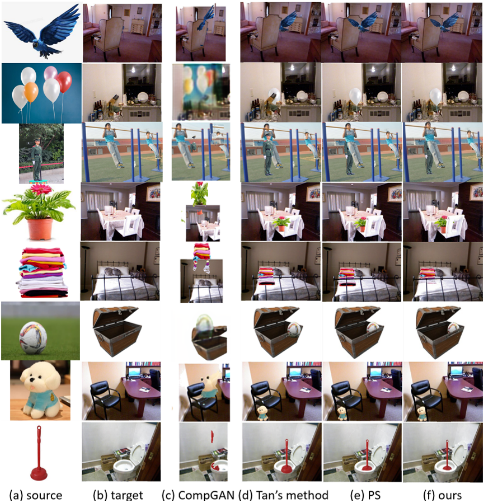
Quality. As shown in Fig. 8, it is clear that our method and Photoshop can well handle complicated occlusions to produce plausible composition images. However, the results produced by the [Tan et al., 2019] and compGAN[Azadi et al., 2020] methods are implausible as they cannot handle many occlusions, like the occlusions with off-ground objects in the 3rd row in Fig. 8 and the cyclic occlusions in the 6th row. This is attested by the quantitative results in Table 1, where accuracy refers to the percentage of pixels with correct occlusion labels in the source image patch, and the Photoshop compositions are used as the ground truth as they are manually produced. Though Photoshop can produce results as plausible as ours, it is inefficient and very troublesome to use.
Efficiency. In Table 2, we list the required interventions and times for composing the results shown in Fig. 8, comparing our method with Photoshop. These statistics show that we can considerably reduce the interventions and time costs, achieving an acceleration of 145.6/36.3=4.01 times over Photoshop on average.
Applications. In general, the user needs to try many designs to achieve a satisfactory composition result. As our method inserts the source object into the 3D space represented by the target image, the refined results for depths and object segmentation can be used repeatedly for facilitating occlusion determination. Thus, when the user tries designs, the required interventions for occlusion correction are reduced and image composition is more efficient. In comparison, Photoshop needs respective interventions to determine occlusions for each composition, which is inefficient. The example in Fig. 9 shows that the user needs four interventions to obtain a satisfactory composition using our method, whereas many more are required by Photoshop (Fig. 10).
Limitation. Our method relies on the experiences of human stereoscopy in the real 3D world. If the user lacks such experiences, a good result would not be produced. Fortunately, the user is always familiar with the objects selected for image composition in applications. Thus, our method can help promote corresponding applications.
| Accuracy | ||||
|---|---|---|---|---|
| compGAN | Tan's | ours | our* | |
| Row1 | 0.2100 | 0.7001 | 0.9826 | - |
| Row2 | 0.0000 | 0.7951 | 0.9896 | - |
| Row3 | 0.1674 | 0.8163 | 0.9799 | - |
| Row4 | 0.4322 | 0.6304 | 0.7846 | 0.9995 |
| Row5 | 0.4503 | 0.7913 | 0.9687 | - |
| Row6 | 0.5222 | 0.5786 | 0.9731 | - |
| Row7 | 0.0000 | 0.9178 | 0.9218 | 0.9887 |
| Row8 | 0.1998 | 0.8357 | 0.9809 | - |
| Average | 0.2477 | 0.7582 | 0.9477 | 0.9941 |
Note: "our*" refers to the results with some required refinements; "-" means no refinement required.
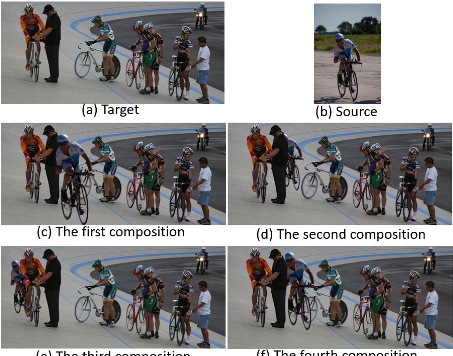
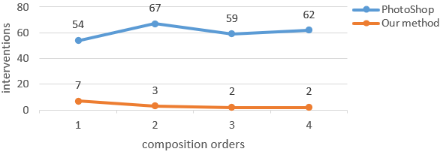
Figure 10: Interventions compared for the results in Fig. 9.
6 Summary
This paper has presented a novel method for depth registration of the source object into the 3D space that is represented by the target image. Thus, the occlusions between the source object and the target objects can be easily handled. As a result, we can handle the occlusion problem in image composition more conveniently compared to existing methods. Experimental results show that we can conveniently composite images with complicated occlusions and considerably reduce manual interventions, making efficiency improved by about 4 times compared to Photoshop.
| Photoshop | Ours | |||
|---|---|---|---|---|
| Time | Interventions | Time | Interventions | |
| Row1 | 142.0s | 71 | 33.0s | 4 |
| Row2 | 158.0s | 84 | 34.0s | 5 |
| Row3 | 139.0s | 87 | 32.0s | 4 |
| Row4 | 160.0s | 93 | 44.0s | 5 |
| Row5 | 144.0s | 77 | 45.0s | 5 |
| Row6 | 137.0s | 75 | 33.0s | 4 |
| Row7 | 133.0s | 82 | 35.0s | 4 |
| Row8 | 152.0s | 73 | 34.0s | 4 |
| Average | 145.6s | 80.3 | 36.3s | 4.4 |
Acknowledgements
This work is partially supported by the National Natural Science Foundation of China under Grant. 62072446 and 61872347. We highly appreciate the constructive suggestions of anonymous reviewers.
@inproceedings{ijcai2023p126,
  title     = {Image Composition with Depth Registration},
  author    = {Li, Zan and Wang, Wencheng and Hou, Fei},
  booktitle = {Proceedings of the Thirty-Second International Joint Conference on
               Artificial Intelligence, {IJCAI-23}},
  publisher = {International Joint Conferences on Artificial Intelligence Organization},
  editor    = {Edith Elkind},
  pages     = {1134--1141},
  year      = {2023},
  month     = {8},
  note      = {Main Track},
  doi       = {10.24963/ijcai.2023/126},
  url       = {https://doi.org/10.24963/ijcai.2023/126},
}
TY - CPAPER TI - Image Composition with Depth Registration AU - Li, Zan AU - Wang, Wencheng AU - Hou, Fei T2 - Proceedings of the Thirty-Second International Joint Conference on Artificial Intelligence, IJCAI-23 PB - International Joint Conferences on Artificial Intelligence Organization PY - 2023 SP - 1134 EP - 1141 DO - 10.24963/ijcai.2023/126 UR - https://doi.org/10.24963/ijcai.2023/126 ER -Copied
Machine-readable versions of this paper, for tools and AI agents:





