
Acoustic NLOS Imaging with Cross Modal Knowledge Distillation
Proceedings of the Thirty-Second International Joint Conference on Artificial Intelligence. Main Track. Pages 1405-1413.
https://doi.org/10.24963/ijcai.2023/156
Keywords
- Computer Vision: CV: Applications
- Machine Learning: ML: Multi-modal learning
- Computer Vision: CV: Neural generative models, auto encoders, GANs
Abstract
Acoustic non-line-of-sight (NLOS) imaging aims to reconstruct hidden scenes by analyzing reflections of acoustic waves. Despite recent developments in the field, existing methods still have limitations such as sensitivity to noise in a physical model and difficulty in reconstructing unseen objects in a deep learning model. To address these limitations, we propose a novel cross-modal knowledge distillation (CMKD) approach for acoustic NLOS imaging. Our method transfers knowledge from a well-trained image network to an audio network, effectively combining the strengths of both modalities. As a result, it is robust to noise and superior in reconstructing unseen objects. Additionally, we evaluate real-world datasets and demonstrate that the proposed method outperforms state-of-the-art methods in acoustic NLOS imaging. The experimental results indicate that CMKD is an effective solution for addressing the limitations of current acoustic NLOS imaging methods. Our code, model, and data are available at https://github.com/shineh96/Acoustic-NLOS-CMKD.
- [Albanie et al., 2018] Samuel Albanie, Arsha Nagrani, An- drea Vedaldi, and Andrew Zisserman. Emotion recogni- tion in speech using cross-modal transfer in the wild. In Proceedings of the 26th ACM international conference on Multimedia, pages 292-301, 2018.
- [Alhashim and Wonka, 2018] Ibraheem Alhashim and Peter Wonka. High quality monocular depth estimation via transfer learning. arXiv preprint arXiv:1812.11941, 2018.
- [Aytar et al., 2016] Yusuf Aytar, Carl Vondrick, and Antonio Torralba. Soundnet: Learning sound representations from unlabeled video. Advances in neural information process- ing systems, 29, 2016.
- [Chen et al., 2019] Wenzheng Chen, Simon Daneau, Fahim Mannan, and Felix Heide. Steady-state non-line-of-sight imaging. In Proceedings of the IEEE/CVF Conference on Computer Vision and Pattern Recognition, pages 6790- 6799, 2019.
- [Christensen et al., 2020] Jesper Haahr Christensen, Sascha Hornauer, and X Yu Stella. Batvision: Learning to see 3d spatial layout with two ears. In 2020 IEEE Interna- tional Conference on Robotics and Automation (ICRA), pages 1581-1587. IEEE, 2020.
- [Gan et al., 2019] Chuang Gan, Hang Zhao, Peihao Chen, David Cox, and Antonio Torralba. Self-supervised moving vehicle tracking with stereo sound. In Proceedings of the IEEE/CVF International Conference on Computer Vision, pages 7053-7062, 2019.
- [Gao et al., 2020] Ruohan Gao, Changan Chen, Ziad Al- Halah, Carl Schissler, and Kristen Grauman. Visuale- choes: Spatial image representation learning through echolocation. In European Conference on Computer Vi- sion, pages 658-676. Springer, 2020.
- [Geng et al., 2021] Ruixu Geng, Yang Hu, Yan Chen, et al. Recent advances on non-line-of-sight imaging: Conven- tional physical models, deep learning, and new scenes. APSIPA Transactions on Signal and Information Process- ing, 11(1), 2021.
- [Grau Chopite et al., 2020] Javier Grau Chopite, Matthias B Hullin, Michael Wand, and Julian Iseringhausen. Deep non-line-of-sight reconstruction. In Proceedings of the IEEE/CVF Conference on Computer Vision and Pattern Recognition, pages 960-969, 2020.
- [Heide et al., 2014] Felix Heide, Lei Xiao, Wolfgang Hei- drich, and Matthias B Hullin. Diffuse mirrors: 3d recon- struction from diffuse indirect illumination using inexpen- sive time-of-flight sensors. In Proceedings of the IEEE Conference on Computer Vision and Pattern Recognition, pages 3222-3229, 2014.
- [Henley et al., 2020] Connor Henley, Tomohiro Maeda, Tristan Swedish, and Ramesh Raskar. Imaging behind oc- cluders using two-bounce light. In European Conference on Computer Vision, pages 573-588. Springer, 2020.
- [Hinton et al., 2015] Geoffrey Hinton, Oriol Vinyals, Jeff Dean, et al. Distilling the knowledge in a neural network. arXiv preprint arXiv:1503.02531, 2015.
- [Isola et al., 2017] Phillip Isola, Jun-Yan Zhu, Tinghui Zhou, and Alexei A Efros. Image-to-image translation with con- ditional adversarial networks. In Proceedings of the IEEE conference on computer vision and pattern recognition, pages 1125-1134, 2017.
- [Jang et al., 2022] Seungwoo Jang, Ui-Hyeon Shin, and Kwangsu Kim. Deep non-line-of-sight imaging using echolocation. Sensors, 22(21):8477, 2022.
- [Kadambi et al., 2016] Achuta Kadambi, Hang Zhao, Boxin Shi, and Ramesh Raskar. Occluded imaging with time- of-flight sensors. ACM Transactions on Graphics (ToG), 35(2):1-12, 2016.
- [Kirmani et al., 2009] Ahmed Kirmani, Tyler Hutchison, James Davis, and Ramesh Raskar. Looking around the corner using transient imaging. In 2009 IEEE 12th Inter- national Conference on Computer Vision, pages 159-166. IEEE, 2009.
- [Lindell et al., 2019a] David B Lindell, Gordon Wetzstein, and Vladlen Koltun. Acoustic non-line-of-sight imaging. In Proceedings of the IEEE/CVF Conference on Computer Vision and Pattern Recognition, pages 6780-6789, 2019.
- [Lindell et al., 2019b] David B Lindell, Gordon Wetzstein, and Matthew O'Toole. Wave-based non-line-of-sight imaging using fast fk migration. ACM Transactions on Graphics (ToG), 38(4):1-13, 2019.
- [Liu et al., 2020] Xiaochun Liu, Sebastian Bauer, and An- dreas Velten. Phasor field diffraction based reconstruction for fast non-line-of-sight imaging systems. Nature com- munications, 11(1):1-13, 2020.
- [Maeda et al., 2019] Tomohiro Maeda, Guy Satat, Tristan Swedish, Lagnojita Sinha, and Ramesh Raskar. Re- cent advances in imaging around corners. arXiv preprint arXiv:1910.05613, 2019.
- [Mao et al., 2017] Xudong Mao, Qing Li, Haoran Xie, Ray- mond YK Lau, Zhen Wang, and Stephen Paul Smolley. Least squares generative adversarial networks. In Proceed- ings of the IEEE international conference on computer vi- sion, pages 2794-2802, 2017.
- [O'Toole et al., 2018] Matthew O'Toole, David B Lindell, and Gordon Wetzstein. Confocal non-line-of-sight imaging based on the light-cone transform. Nature, 555(7696):338-341, 2018.
- [Ronneberger et al., 2015] Olaf Ronneberger, Philipp Fis- cher, and Thomas Brox. U-net: Convolutional networks for biomedical image segmentation. In International Conference on Medical image computing and computer- assisted intervention, pages 234-241. Springer, 2015.
- [Sarfraz et al., 2021] Fahad Sarfraz, Elahe Arani, and Bahram Zonooz. Knowledge distillation beyond model compression. In 2020 25th International Conference on Pattern Recognition (ICPR), pages 6136-6143. IEEE, 2021.
- [Shen et al., 2021] Siyuan Shen, Zi Wang, Ping Liu, Zhengqing Pan, Ruiqian Li, Tian Gao, Shiying Li, and Jingyi Yu. Non-line-of-sight imaging via neural transient fields. IEEE Transactions on Pattern Analysis and Ma- chine Intelligence, 43(7):2257-2268, 2021.
- [Stanton et al., 2021] Samuel Stanton, Pavel Izmailov, Polina Kirichenko, Alexander A Alemi, and Andrew G Wilson. Does knowledge distillation really work? Advances in Neural Information Processing Systems, 34:6906-6919, 2021.
- [Tran et al., 2015] Du Tran, Lubomir Bourdev, Rob Fergus, Lorenzo Torresani, and Manohar Paluri. Learning spa- tiotemporal features with 3d convolutional networks. In Proceedings of the IEEE international conference on com- puter vision, pages 4489-4497, 2015.
- [Valverde et al., 2021] Francisco Rivera Valverde, Juana Va- leria Hurtado, and Abhinav Valada. There is more than meets the eye: Self-supervised multi-object detection and tracking with sound by distilling multimodal knowl- edge. In Proceedings of the IEEE/CVF Conference on Computer Vision and Pattern Recognition, pages 11612- 11621, 2021.
- [Velten et al., 2012] Andreas Velten, Thomas Willwacher, Otkrist Gupta, Ashok Veeraraghavan, Moungi G Bawendi, and Ramesh Raskar. Recovering three-dimensional shape around a corner using ultrafast time-of-flight imaging. Na- ture communications, 3(1):1-8, 2012.
- [Wu et al., 2021] Cheng Wu, Jianjiang Liu, Xin Huang, Zheng-Ping Li, Chao Yu, Jun-Tian Ye, Jun Zhang, Qiang Zhang, Xiankang Dou, Vivek K Goyal, et al. Non-line-of- sight imaging over 1.43 km. Proceedings of the National Academy of Sciences, 118(10):e2024468118, 2021.
- [Zhao et al., 2018] Mingmin Zhao, Tianhong Li, Moham- mad Abu Alsheikh, Yonglong Tian, Hang Zhao, Antonio Torralba, and Dina Katabi. Through-wall human pose es- timation using radio signals. In Proceedings of the IEEE Conference on Computer Vision and Pattern Recognition, pages 7356-7365, 2018.
- [Zhu and Cai, 2022] Dayu Zhu and Wenshan Cai. Fast non- line-of-sight imaging with two-step deep remapping. ACS Photonics, 9(6):2046-2055, 2022.
References were extracted automatically from the PDF and may contain errors.
Full text extracted automatically from the PDF; figures, tables and equations may differ. The PDF is the version of record.
1 Introduction
Non-line-of-sight (NLOS) imaging [Kirmani et al., 2009] is a method for reconstructing objects or scenes that are hidden from the line-of-sight of an observer. Conventional NLOS imaging methods [Velten et al., 2012; Heide et al., 2014; O'Toole et al., 2018] primarily utilize optical systems in order to infer the properties of hidden scenes. These are achieved by analyzing indirect measurements, such as reflections of optic waves. However, acoustic signals can also be used for NLOS imaging, providing an alternative approach to the analysis of optical signals. Acoustic signals are immune to interference or noise from external sources, such as light or radio frequency radiation. Furthermore, the audible frequency signal exhibits robustness to noise within a specific frequency band, owing to its wide frequency range of 20 Hz to 20 kHz. This makes acoustic NLOS systems more robust and reliable in noise environments, or in situations where the reflections of the optical waves may be distorted or attenuated. In contrast, optical NLOS systems may be affected by noise, which can reduce the quality of the reconstructed image.
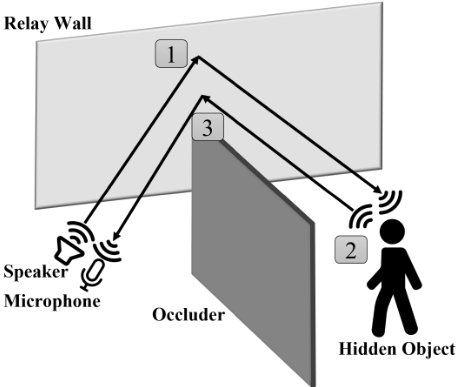
Recently, NLOS imaging methods that utilize acoustic characteristics have been proposed. [Lindell et al., 2019a] proposed a physical model for analyzing acoustic time-offlight, inspired by seismic imaging. However, NLOS systems typically measure three-bounce reflected signals, as shown in Fig. 1. These signals have low signal intensity, a long travel distance, and high levels of environmental noise. Furthermore, the measurements may be affected by ambient noise, interference, or multipath effects, which can degrade the accuracy and reliability of the time-of-flight estimates. As a result, this approach has only been verified with data collected in a space that is isolated with acoustic foam panels and does not reflect acoustic signals other than these of the relay wall.
To address the limitations of the physical model, [Jang et al., 2022] proposed an end-to-end deep learning model that reconstructs the depth map by extracting the features of hidden scenes from the relative intensity and the arrival time delay of the reflected signal. The model utilizes an encoder with a hierarchical structure to extract acoustic signals frommultichannel audio and the reconstruct hidden scenes in a space where no soundproofing system has been implemented. However, the model is limited in its ability to reconstruct unseen objects that are out of distribution with respect to the trained objects.
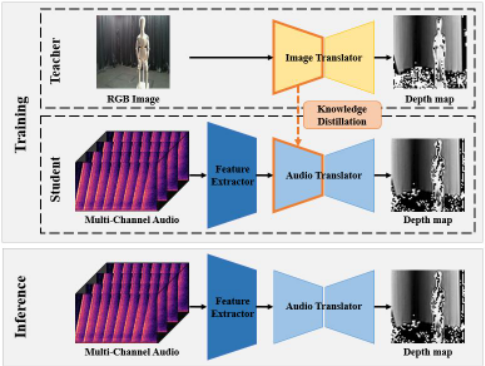
In general, knowledge distillation [Hinton et al., 2015] has been shown to improve the generalization performance of a target student model by transferring the knowledge of a verified teacher model [Stanton et al., 2021]. Additionally, several studies [Aytar et al., 2016; Albanie et al., 2018; Gan et al., 2019; Valverde et al., 2021] have demonstrated that knowledge distillation between different modalities, such as from image to audio, can further enhance the performance of the target model. Based on these findings, we design a model that is optimized for acoustic NLOS imaging that is intended to be robust to noise and capable of reconstructing unseen objects. To achieve this, we propose a cross-modal knowledge distillation (CMKD) approach that transfer the knowledge of a well-trained image network to an audio network.
The utilization of CMKD allows the strengths of each modality to be used optimally. Image data faithfully represent visual details and spatial information, whereas audio effectively capture dynamic information and potentially useful temporal information. By combining these strengths, the model could achieve better performance than by using either modality alone [Zhao et al., 2018; Gao et al., 2020]. Furthermore, this method enables the model to better generalize to unseen objects and makes the target network robust to noise [Sarfraz et al., 2021].
The CMKD framework consists of an image teacher network and an audio student network shown in Fig. 2. The image teacher network is initially trained to perform the transformation of an RGB image into a depth map. Subsequently, the audio student network is trained to convert multi-channel audio to a depth map, and to leverage the distilled knowledge from the frozen image teacher network. During inference, the audio student network is able to reconstruct the depth map of a hidden scene using only reflected acoustic signals as input, without any additional image information.
To facilitate this task, we collect a large dataset of 3,600 corresponding frames that consist of RGB images, depth maps, and multi-channel audio. We also construct an acoustic system with eight speaker and microphone arrays and collect 64 channels of reflected signals by transmitting and receiving audible signals (20 Hz to 20 kHz) in a space where no soundproofing system has been implemented. We use this self-collected experimental data to confirm the robustness of our model to noise generated in real-world scenarios.
We compare the performance of our approach with stateof-the-art methods using acquired data. We demonstrate superior performance in reconstructing both trained and unseen objects. We also present detailed ablation studies to highlight the significance of the proposed techniques. The main contributions of this work are as follows:
- To the best of our knowledge, this is the first instance where CMKD has been applied to NLOS imaging in general, not just in the acoustic domain.
- We collect a new acoustic NLOS dataset and make it available to the public. We hope that this dataset will contribute to the advancement of research in the field of acoustic NLOS.
- Our model demonstrates robustness to real-world noise and enhances the generalization performance on unseen objects, and it outperforms current state-of-the-art models.
2 RelatedWork
2.1 NLOS Imaging
NLOS imaging has numerous potential applications, including autonomous driving, medical imaging, and rescue operations [Maeda et al., 2019]. A variety of hardware systems, such as pulse lasers and high-resolution detectors [Velten et al., 2012; Liu et al., 2020; Wu et al., 2021], time-of-flight cameras [Heide et al., 2014; Kadambi et al., 2016], conventional cameras [Chen et al., 2019; Henley et al., 2020], LiDAR systems [Zhu and Cai, 2022], and speaker-microphone arrays [Lindell et al., 2019a; Jang et al., 2022], have been used for NLOS imaging. Additionally, several methods have been proposed, including time-of-flight-based models [Velten et al., 2012; Heide et al., 2014] that use directivity and wave-based models [Lindell et al., 2019b] that use diffraction. However, NLOS imaging is an ill-posed problem with a low signal-to-noise ratio, due to the fact that it relies on the analysis of three-bounce reflected signals [Geng et al., 2021]. This can make it challenging to achieve high-quality reconstruction of the hidden scene.
To address this problem, several NLOS imaging methods that use deep learning [Chen et al., 2019; Grau Chopite et al., 2020; Shen et al., 2021] have been proposed. These methods have been successful in reconstructing hidden scenes by distinguishing noise and extracting meaningful features. However, it is important to note that the performance of deep learning models heavily relies on the quantity and quality of the dataset. In particular, it is difficult to construct large datasets using optical equipment for NLOS imaging. This is primarily due to the directivity of light, which results in a long collection time of 1 - 5 minutes per sample using pointby-point scanning. As a result, most deep learning methods rely on synthesized data for training and evaluation, as it can be impractical to collect large amounts of real-world data. In contrast, we reduce the collection time to 25 seconds by using an acoustic system that can scan hidden spaces at once. This enables the collection of a larger and higher-quality dataset, which is crucial for the performance of deep learning models.
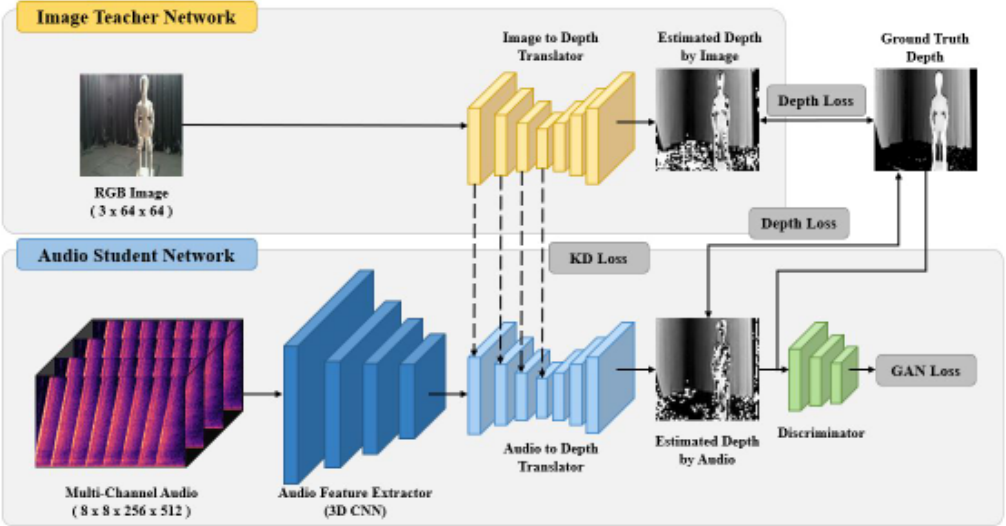
3 Methodology
In this section, we provide a detailed description of the overall framework and the role of each component, as well as the knowledge transfer method between the two modalities and the loss function used for network learning.
The goal of this framework is to reconstruct the depth map for the hidden scene by transferring knowledge from an image modality to an audio modality. To achieve this, we use an RGB image as the teacher modality and multi-channel audio as the student modality. We employ a two-phase approach, where the first phase involves training the teacher network to transform an RGB image to a depth map. Then, in the second phase, the weights of the well-trained teacher network are frozen, and a student network is trained to convert multichannel audio to a depth map using the distilled knowledge supplied by the teacher network.
3.1 Cross-Modal Knowledge Distillation
In our approach, we use this method to transfer the knowledge of a well-trained RGB image to depth network to the audio to depth network, with the goal of improving the reconstruction performance of the audio network. During training, we learn both the image and audio modalities, but during inference, we only use the audio modality. This approach allows us to effectively transfer the knowledge of the image network to the audio network, resulting in improved performance.
To facilitate CMKD, the translators of the two subnetworks are designed to have the same structure. We compare three cases of transferring knowledge from the image teacher network to the audio student network: encoder knowledge, decoder knowledge, and whole network knowledge. The results show that transferring only the knowledge of the encoders leads to the greatest improvement in the performance of the audio network. The detailed results of this experiment can be found in the supplementary material. Based on these findings, we present optimal conditions for CMKD in acoustic NLOS imaging.
3.2 Network Architecture
The network architecture consists of two main components: an image teacher network and an audio student network.
Image Teacher Network
The image teacher network is a translator that converts RGB images into depth maps. We adopt a U-Net [Ronneberger et al., 2015] structure auto-encoder as the translator network. The U-Net has been shown to perform well on the task of monocular depth estimation [Alhashim and Wonka, 2018], which involves converting each pixel of an RGB image to a depth value.
The U-Net translator consists of an encoder that extracts features from an RGB image and a decoder that reconstructs the latent vector as a depth map. The encoder and decoder are symmetrical, and the high-dimensional information from the encoder is transmitted to the decoder through skip connections. This image network learns the knowledge that is required to convert RGB images to depth maps.
Audio Student Network
The audio student network consists of three main components: a feature extractor optimized for multi-channel audio input, a translator that converts the extracted audio features to a depth map, and a discriminator that distinguishes whether the estimated depth map is real or fake. The feature extractor is responsible for extracting meaningful features from the multi-channel audio input, these features are then passed to the translator. The translator uses these features to reconstruct the depth map of the hidden space. The discriminator is used to evaluate the quality of the reconstructed depth map and distinguish between real and fake examples.
The audio network feature extractor is designed specifically to manage multi-channel audio data that are acquired from various locations. The audio data are acquired using an 8×8 grid of vertically arranged speaker-microphone pairs that move horizontally. To extract features from the 1D time series data, we apply a short-time Fourier transform to convert the data into a 2D spectrogram having dimensions of 256×512. The resulting 4D audio data (8×8×256×512) are input into the network and passed through eight encoding blocks that extract features using 3D convolution operations [Tran et al., 2015] and two fully connected layers that transform the latent vector to the input form for the next network. Each encoding block consists of a 3D convolutional layer, a 3D batch normalization layer, and a ReLU activation function. This network effectively extracts features from the 4D audio data while preserving the location information.
The translator in the audio network has the same structure as the image network, which allows for the transfer of knowledge from the image network to the audio network. This structure, which is based on the RGB image to depth map translator, helps to improve the reconstruction performance of the audio network. In addition, the student translator is initialized with the pre-trained weights of the teacher network in order to accelerate learning and further improve reconstruction performance.
We adopt the discriminator structure from Pix2Pix [Isola et al., 2017]. The discriminator serves the purpose of distinguishing whether the estimated depth map is real or fake. The discriminator aligns the distribution of the prediction depth map with the ground truth depth map.
3.3 Objective
Image Teacher Network
The image network is trained using only the depth Loss, which is the pointwise l1 error between the estimated depth map and the actual depth map. The objective of the image network is as follows:
where, Gt is a teacher network generator that translates the RGB image to the depth map.
Audio Student Network
The audio network employs knowledge distillation to enhance the performance of the conditional adversarial network for audio to depth map translation. Therefore, it is trained by integrating the loss for the conditional adversarial network with the loss for the knowledge distillation. We utilize a conditional adversarial network loss based on the Batvision [Christensen et al., 2020] and we measure the depth map reconstruction error using the pointwise L1 error. The GAN loss is determined by the least-squares loss [Mao et al., 2017]. In order to align the audio network with the image network, the distance between the feature map distributions of each translator encoding block should be minimized. Our network is designed to minimize this distance as measured by the Kullback-Leibler divergence (KL divergence) [Hinton et al., 2015]. The objective of the audio network is as follows:
where, Gs is the generator of the student network, and Ds is the discriminator of the student network. α and β are balancing weights. We set α to 100 and β to 0.01.
4 Experiment
In this section, we describe the data acquisition system for acoustic NLOS imaging and the details of the experimental setup using the acquired dataset. We then evaluate the performance of CMKD approach for NLOS imaging and compare it with state-of-the-art methods for both LOS and NLOS acoustic imaging. We demonstrate the superiority for unseen object reconstruction and present detailed ablation studies to highlight the contributions of techniques in our method.
4.1 Data
The data used in the experiments and evaluations were selfcollected and are representative of real-world scenarios. Using self-acquired data, rather than synthetic or simulated data, enhances the external validity of the results and makes it more likely that the results can be generalized to real-world scenarios. In this subsection, we describe the experimental setup, data acquisition equipment, and processes used in this study on acoustic NLOS imaging.
We conduct the experiments in a space without soundproofing. The experimental setup includes an occluder that separates the scanning space from the hidden space shown on the left side of Fig. 4. The right side of Fig. 4 illustrates the configuration of the acoustic system. The system consists of eight sets of speakers and microphones, an audio interface, and a power amplifier. A translation stage is positioned at a 45-degree angle to the relay wall, to move the speaker-microphone array horizontally.
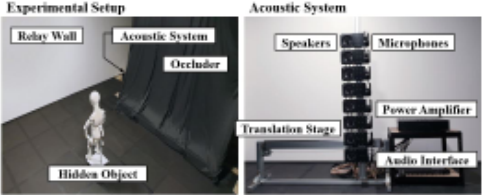
In the acoustic data acquisition process, we employ a sequential emission method. This method emits linear chirp signals by eight speakers in the audible frequency range (20 Hz to 20 kHz), each lasting for 0.1 seconds. To acquire the acoustical data, eight microphones were placed at intervals of 10 cm, with the speakers emitting linear chirp signals sequentially for a total of 0.8 seconds. The reflected signal is recorded simultaneously on all eight microphones for a duration of 0.9 seconds at a sampling rate of 48 kHz, where the time required for the last emitted signal to be reflected back is 0.1 seconds. The acoustic data were then collected at eight points, with the speaker-microphone array moving horizontally at intervals of 5 cm. Along with the acoustic data, we also acquired RGB images and depth maps as the ground truth for the hidden scene.
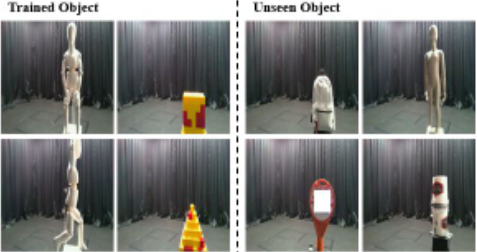
We acquired data using 30 different kinds of objects, including mannequins, plastic models, and other objects. The mannequins were posed differently for each class, and the plastic models were made to have various shapes such as hexahedrons and pyramids. Other objects included items such as paper boxes, backpacks, and plastic signs. Fig. 5 shows some examples of the target objects that were used for data acquisition. Each object is acquired 120 times at different angles and positions, resulting in a total of 3,600 time-synchronized RGB images, as well as depth maps and multi-channel audio.
4.2 Experimental Settings
Data Split
During the training process, we utilize only the mannequin and plastic model data. The data for the training objects are divided into 1920 samples for training, 240 samples for validation, and 240 samples for testing. The remaining objects, which are not used for training, are utilized to evaluate the model performance on unseen object reconstruction with a total of 1200 data samples
Evaluation Metric
To evaluate the performance of methods for the depth map reconstruction of hidden scenes, we utilize metrics commonly used in depth estimation tasks [Alhashim and Wonka, 2018].
It is important to note that all data were acquired with the same background, and the size of the object region is only about 10% of the background region on average. Therefore, if the entire depth map is evaluated, a network that performs well on estimating the depth of the background may appear superior to a network that accurately predicts the depth of the target object. To address this issue, we evaluate the depth map reconstruction error for the object region only, excluding the background.
4.3 Baselines
We compare the performance of CMKD method with both LOS and NLOS acoustic imaging approaches. A physical model [Lindell et al., 2019a] reconstructs a hidden scene based on the analysis of acoustic time-of-flight. A Batvision [Christensen et al., 2020] is a state-of-the-art deep learning method for LOS acoustic imaging, which consists of an audio feature extractor, an auto-encoder, and a discriminator. A hierarchical audio encoder (HAE) [Jang et al., 2022] is a deep learning method for NLOS acoustic imaging that extracts audio features through the HAE that considers the location characteristics of multi-channel audio.
4.4 Experimental Results
We conduct experiments on both trained and unseen objects from the acquired dataset. We compare the performance of our method with several state-of-the-art acoustic imaging baseline methods using both quantitative and qualitative evaluation.
Quantitative Evaluation
In order to perform a quantitative evaluation, we evaluate the reconstruction error for only the object region to use depth estimation metrics. The physical model has limited capability for high resolution depth map reconstruction, which makes it difficult to directly compare it with other models. Therefore, we compare quantitative evaluations of proposed model with those of other baseline models
In Tab. 1, CMKD shows the best performance in terms of quantitative evaluation on both trained and unseen objects. In particular, the threshold accuracy (δi), which represents accuracy within certain tolerances, of our method shows a 10 - 20% improvement over that of other methods. Although the RMSE of our model is slightly higher than that of other models, the difference is small, ranging from 1 - 5%. Other methods tend to blur areas where objects are expected to be, as Trained Objects Approach Rel(↓) RMSE(↓) δ1(↑) δ2(↑) δ3(↑) Approach Batvison
5.311
0.288 44.3 56.5 64.2 Batvison
HAE
3.539
0.288 49.4 60.4 67.8 HAE
CMKD (Ours) 2.994
0.293 57.2 65.9 71.7 CMKD (Ours) 7.094
| Unseen Objects | |||||
|---|---|---|---|---|---|
| Approach | Rel(↓) | RMSE(↓) | δ1(↑) | δ2(↑) | δ3(↑) |
| Batvison | 8.345 | 0.373 | 31.9 | 43.7 | 51.4 |
| HAE | 7.803 | 0.399 | 36.4 | 46.6 | 53.4 |
| CMKD (Ours) | 7.094 | 0.392 | 40.0 | 49.9 | 56.2 |
they focus on reducing pixel-wise loss. This is further demonstrated in the qualitative results.
Qualitative Evaluation
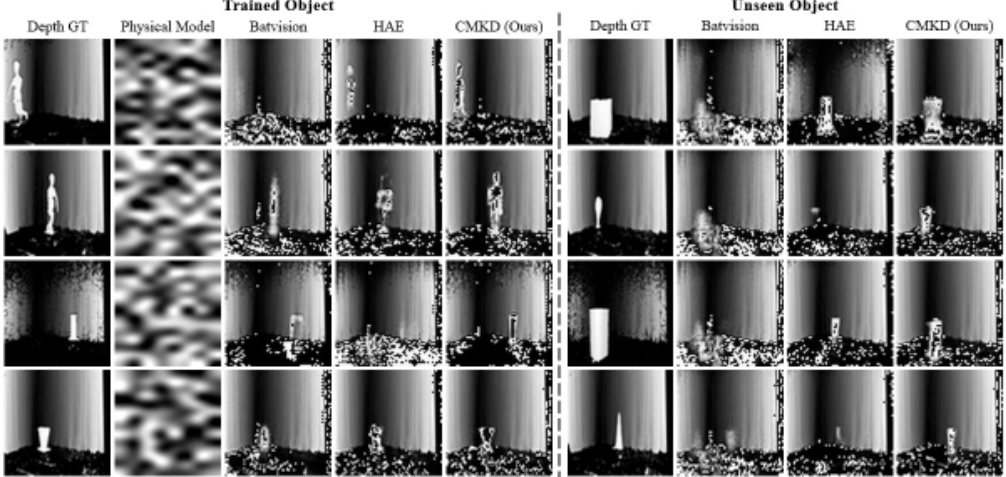
In this subsection, we qualitatively evaluate the performance of CMKD framework for acoustic NLOS imaging. Fig. 6 shows the visualized results for depth map reconstruction for trained and unseen objects, respectively.
Our experiments are conducted in a non-soundproofed environment with ambient noise and overlapping reflections, which can be challenging for the physical model. However, deep learning models, including our model, accurately reconstruct the background due to their ability to learn from data with the same background.
In the case of trained objects, both Batvision and HAE approximate the location of hidden objects and reconstruct their shapes. However, these baseline models sometimes fail to accurately detect object locations and the shapes of their reconstructions are not always clear. In contrast, CMKDmodel accurately estimates both the shape and distance of the hidden object, and it accurately detects the area where the object is located.
Additionally, we evaluate the generalization performance of these models through experiments on unseen objects. While most deep learning-based methods detect the areas where hidden objects are located, Batvision struggles to accurately estimate object shapes and tends to reconstruct blurry depth maps. HAE reconstructs box-shaped objects relatively well, but performs poorly on untrained objects of other shapes. In contrast, CMKD model accurately reconstructs both the position and shape of the object thanks to the transfer of knowledge from the image teacher network, which is not utilized by the other methods.
Other deep learning baselines rely on the pixel-wise loss. However, in some cases, using the pixel-wise loss function may lead to a blurry reconstruction because the model is unable to capture fine-grained details or sharp edges in the image. This can occur if the model does not have enough capacity or if the training data are not representative of the test data. In contrast, our model utilizes knowledge distillation loss, which focuses on predicting the shape of the hidden object by transferring knowledge from the image network and results in more distinct shapes in the reconstructed depth map.
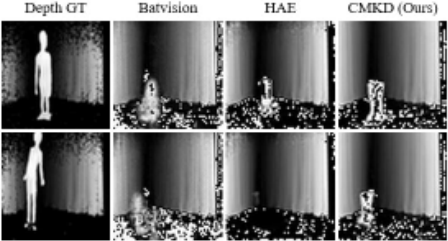
Fig. 7 shows the poor reconstruction results on unseen objects that differ in material from the trained objects. However, even in these cases, other models either fail to predict the position of the object or produce a blurry reconstruction, while our model still accurately estimates the position of the hidden object and relatively accurately reconstructs its size. There is a limitation in acoustic NLOS imaging as the reflected signal can vary significantly depending on the material or type of hidden objects. This issue can potentially be addressed by increasing the diversity of collected objects, as the types of trained data are limited and tend to have similar shapes, materials, and sizes. In our future research, we aim to address this issue by expanding our data acquisition to encompass a broader range of objects with varying shapes, materials, and sizes.
Ablation Study
| Extractor | KD | Rel(↓) | RMSE(↓) | δ1(↑) | δ2(↑) | δ3(↑) | |
|---|---|---|---|---|---|---|---|
| (a) | 3D CNN | X | 7.888 | 0.399 | 31.6 | 42.0 | 49.1 |
| (b) | 2D CNN | O | 8.027 | 0.397 | 36.8 | 46.9 | 53.7 |
| (c) | HAE | 7.479 | 0.396 | 36.8 | 46.8 | 53.4 | |
| (d) | 3D CNN | 7.094 | 0.392 | 40.0 | 49.9 | 56.2 |
In Tab. 2, we present the results of ablation studies which were conducted to evaluate the effectiveness of the techniques used in CMKD method. The results are presented in the form of a comparison between different configurations. The comparison of configurations (a) and (d) demonstrate the effect of knowledge distillation, whereas the comparison of configurations (b), (c) and (d) demonstrate the performance of each feature extractor. We can observe that using the 3D CNN
feature extractor and incorporating knowledge distilled from the image network significantly improves the reconstruction of hidden objects in acoustic NLOS imaging. These findings confirm the effectiveness of the techniques and structures implemented in the proposed model.
5 Conclusion
In this paper, we propose a method for improving the performance of acoustic NLOS imaging systems. While previous approaches to acoustic NLOS imaging have encountered limitations, such as vulnerability to noise and difficulty in reconstructing unseen objects, our method uses CMKD to transfer knowledge from a well-trained image network to an audio network. This enables the resulting model to be robust to noise and to enhance the generalization performance on unseen objects. Our experimental results show that CMKD method outperforms state-of-the-art methods in acoustic NLOS imaging and demonstrates superior performance in reconstructing unseen objects. Additionally, the results of the ablation studies demonstrate the suitability of the techniques and structures implemented in the proposed model for acoustic NLOS imaging. Overall, we provide a promising solution for acoustic NLOS imaging, and has potential for various practical applications in the future.
Acknowledgments
This work was partly supported by Institute of Information & communications Technology Planning & Evaluation (IITP) grant funded by the Korea government(MSIT) (No.2021-002068, Artificial Intelligence Innovation Hub) and Korea Internet & Security Agency (KISA) grant funded by the Korea government(MSIT) (No. RS-2023-00231200, Development of personal video information privacy protection technology capable of AI learning in an autonomous driving environment).
@inproceedings{ijcai2023p156,
  title     = {Acoustic NLOS Imaging with Cross Modal Knowledge Distillation},
  author    = {Shin, Ui-Hyeon and Jang, Seungwoo and Kim, Kwangsu},
  booktitle = {Proceedings of the Thirty-Second International Joint Conference on
               Artificial Intelligence, {IJCAI-23}},
  publisher = {International Joint Conferences on Artificial Intelligence Organization},
  editor    = {Edith Elkind},
  pages     = {1405--1413},
  year      = {2023},
  month     = {8},
  note      = {Main Track},
  doi       = {10.24963/ijcai.2023/156},
  url       = {https://doi.org/10.24963/ijcai.2023/156},
}
TY - CPAPER TI - Acoustic NLOS Imaging with Cross Modal Knowledge Distillation AU - Shin, Ui-Hyeon AU - Jang, Seungwoo AU - Kim, Kwangsu T2 - Proceedings of the Thirty-Second International Joint Conference on Artificial Intelligence, IJCAI-23 PB - International Joint Conferences on Artificial Intelligence Organization PY - 2023 SP - 1405 EP - 1413 DO - 10.24963/ijcai.2023/156 UR - https://doi.org/10.24963/ijcai.2023/156 ER -Copied
Machine-readable versions of this paper, for tools and AI agents:





