
Accurate MRI Reconstruction via Multi-Domain Recurrent Networks
Proceedings of the Thirty-Second International Joint Conference on Artificial Intelligence. Main Track. Pages 1524-1532.
https://doi.org/10.24963/ijcai.2023/169
Keywords
- Computer Vision: CV: Biomedical image analysis
- Computer Vision: CV: Applications
Abstract
In recent years, deep convolutional neural networks (CNNs) have become dominant in MRI reconstruction from undersampled k-space. However, most existing CNNs methods reconstruct the undersampled images either in the spatial domain or in the frequency domain, and neglecting the correlation between these two domains. This hinders the further reconstruction performance improvement. To tackle this issue, in this work, we propose a new multi-domain recurrent network (MDR-Net) with multi-domain learning (MDL) blocks as its basic units to reconstruct the undersampled MR image progressively. Specifically, the MDL block interactively processes the local spatial features and the global frequency information to facilitate complementary learning, leading to fine-grained features generation. Furthermore, we introduce an effective frequency-based loss to narrow the frequency spectrum gap, compensating for over-smoothness caused by the widely used spatial reconstruction loss. Extensive experiments on public fastMRI datasets demonstrate that our MDR-Net consistently outperforms other competitive methods and is able to provide more details.
- [Aggarwal et al., 2018] Hemant K Aggarwal, Merry P Mani, and Mathews Jacob. Modl: Model-based deep learning architecture for inverse problems. IEEE transactions on medical imaging, 38(2):394-405, 2018.
- [Eo et al., 2018] Taejoon Eo, Yohan Jun, Taeseong Kim, Jin- seong Jang, Ho-Joon Lee, and Dosik Hwang. Kiki-net: cross-domain convolutional neural networks for recon- structing undersampled magnetic resonance images. Mag- netic Resonance in Medicine, 80(5):2188-2201, 2018.
- [Fan et al., 2018] Zhiwen Fan, Liyan Sun, Xinghao Ding, Yue Huang, Congbo Cai, and John Paisley. A segmentation-aware deep fusion network for compressed sensing mri. In Proceedings of the European Conference on Computer Vision (ECCV), pages 55-70, 2018.
- [Feng et al., 2021] Chun-Mei Feng, Zhanyuan Yang, Geng Chen, Yong Xu, and Ling Shao. Dual-octave convolution for accelerated parallel mr image reconstruction. In Pro- ceedings of the AAAI Conference on Artificial Intelligence, volume 35, pages 116-124, 2021.
- [Fritsche et al., 2019] Manuel Fritsche, Shuhang Gu, and Radu Timofte. Frequency separation for real-world super- resolution. In 2019 IEEE/CVF International Conference on Computer Vision Workshop (ICCVW), pages 3599- 3608. IEEE, 2019.
- [Han et al., 2019] Yoseob Han, Leonard Sunwoo, and Jong Chul Ye. k-space deep learning for accelerated mri. IEEE transactions on medical imaging, 2019.
- [Huang et al., 2022] Jie Huang, Yajing Liu, Feng Zhao, Keyu Yan, Jinghao Zhang, Yukun Huang, Man Zhou, and Zhiwei Xiong. Deep fourier-based exposure correction network with spatial-frequency interaction. In European Conference on Computer Vision, pages 163-180. Springer, 2022.
- [Jiang et al., 2021] Liming Jiang, Bo Dai, Wayne Wu, and Chen Change Loy. Focal frequency loss for image reconstruction and synthesis. In Proceedings of the IEEE/CVF International Conference on Computer Vision, pages 13919-13929, 2021.
- [Katznelson, 2004] Yitzhak Katznelson. An introduction to harmonic analysis. Cambridge University Press, 2004.
- [Liang et al., 2020] Dong Liang, Jing Cheng, Ziwen Ke, and Leslie Ying. Deep magnetic resonance image reconstruc- tion: Inverse problems meet neural networks. IEEE Signal Processing Magazine, 37(1):141-151, 2020.
- [Liu, 2021] Risheng Liu. Optimization learning: perspec- tive, method, and applications. In Proceedings of the Twenty-Ninth International Conference on International Joint Conferences on Artificial Intelligence, pages 5146- 5168, 2021. IJCAI
- [Lustig et al., 2007] Michael Lustig, David Donoho, and John M Pauly. Sparse mri: The application of compressed sensing for rapid mr imaging. Magnetic Resonance in Medicine: An Official Journal of the International Society for Magnetic Resonance in Medicine, 58(6):1182-1195, 2007.
- [Mardani et al., 2018] Morteza Mardani, Enhao Gong, Joseph Y Cheng, Shreyas S Vasanawala, Greg Zaharchuk, Lei Xing, and John M Pauly. Deep generative adversarial neural networks for compressive sensing mri. IEEE transactions on medical imaging, 38(1):167-179, 2018.
- [Quan et al., 2018] Tran Minh Quan, Thanh Nguyen-Duc, and Won-Ki Jeong. Compressed sensing mri reconstruc- tion using a generative adversarial network with a cyclic loss. IEEE transactions on medical imaging, 37(6):1488- 1497, 2018.
- [Rahaman et al., 2019] Nasim Rahaman, Aristide Baratin, Devansh Arpit, Felix Draxler, Min Lin, Fred Hamprecht, Yoshua Bengio, and Aaron Courville. On the spectral bias of neural networks. In International Conference on Ma- chine Learning, pages 5301-5310. PMLR, 2019.
- [Ran et al., 2020] Maosong Ran, Wenjun Xia, Yongqiang Huang, Zexin Lu, Peng Bao, Yan Liu, Huaiqiang Sun, Jiliu Zhou, and Yi Zhang. Md-recon-net: A parallel dual-domain convolutional neural network for compressed sensing mri. IEEE Transactions on Radiation and Plasma Medical Sciences, 5(1):120-135, 2020.
- [Ravishankar and Bresler, 2010] Saiprasad Ravishankar and Yoram Bresler. Mr image reconstruction from highly un- dersampled k-space data by dictionary learning. IEEE transactions on medical imaging, 30(5):1028-1041, 2010.
- [Ronen et al., 2019] Basri Ronen, David Jacobs, Yoni Kas- ten, and Shira Kritchman. The convergence rate of neu- ral networks for learned functions of different frequencies. Advances in Neural Information Processing Systems, 32, 2019.
- [Ronneberger et al., 2015] Olaf Ronneberger, Philipp Fis- cher, and Thomas Brox. U-net: Convolutional networks for biomedical image segmentation. In International Conference on Medical image computing and computer- assisted intervention, pages 234-241. Springer, 2015.
- [Sandino et al., 2020] Christopher M Sandino, Joseph Y Cheng, Feiyu Chen, Morteza Mardani, John M Pauly, and Shreyas S Vasanawala. Compressed sensing: From research to clinical practice with deep neural networks: Shortening scan times for magnetic resonance imaging. IEEE signal processing magazine, 37(1):117-127, 2020.
- [Schlemper et al., 2017] Jo Schlemper, Jose Caballero, Joseph V Hajnal, Anthony N Price, and Daniel Rueckert. A deep cascade of convolutional neural networks for dynamic mr image reconstruction. IEEE transactions on Medical Imaging, 37(2):491-503, 2017.
- [Souza et al., 2018] Roberto Souza, Oeslle Lucena, Julia Garrafa, David Gobbi, Marina Saluzzi, Simone Ap- penzeller, Letícia Rittner, Richard Frayne, and Roberto Lotufo. An open, multi-vendor, multi-field-strength brain mr dataset and analysis of publicly available skull strip- ping methods agreement. NeuroImage, 170:482-494, 2018.
- [Souza et al., 2019] Roberto Souza, R Marc Lebel, and Richard Frayne. A hybrid, dual domain, cascade of con- volutional neural networks for magnetic resonance im- age reconstruction. In International Conference on Medi- cal Imaging with Deep Learning, pages 437-446. PMLR, 2019.
- [Sriram et al., 2020] Anuroop Sriram, Jure Zbontar, Tullie Murrell, Aaron Defazio, C Lawrence Zitnick, Nafissa Yakubova, Florian Knoll, and Patricia Johnson. End-to- end variational networks for accelerated mri reconstruc- tion. In International Conference on Medical Image Com- puting and Computer-Assisted Intervention, pages 64-73. Springer, 2020.
- [Tong et al., 2022] Chuan Tong, Yanwei Pang, and Yueze Wang. Hiwdnet: A hybrid image-wavelet domain network for fast magnetic resonance image reconstruction. Com- puters in Biology and Medicine, 151:105947, 2022.
- [Wang et al., 2016] Shanshan Wang, Zhenghang Su, Leslie Ying, Xi Peng, Shun Zhu, Feng Liang, Dagan Feng, and Dong Liang. Accelerating magnetic resonance imaging via deep learning. In 2016 IEEE 13th International Sym- posium on Biomedical Imaging (ISBI), pages 514-517. IEEE, 2016.
- [Wang et al., 2020a] Shanshan Wang, Huitao Cheng, Leslie Ying, Taohui Xiao, Ziwen Ke, Hairong Zheng, and Dong Liang. Deepcomplexmri: Exploiting deep residual net- work for fast parallel mr imaging with complex convolu- tion. Magnetic Resonance Imaging, 68:136-147, 2020.
- [Wang et al., 2020b] Sheng-Yu Wang, Oliver Wang, Richard Zhang, Andrew Owens, and Alexei A Efros. Cnn- generated images are surprisingly easy to spot... for now. In Proceedings of the IEEE/CVF conference on computer vision and pattern recognition, pages 8695-8704, 2020.
- [Wang et al., 2022] Yueze Wang, Yanwei Pang, and Chuan Tong. Dsmenet: Detail and structure mutually enhancing network for under-sampled mri reconstruction. Computers in Biology and Medicine, page 106204, 2022.
- [Wei et al., 2021] Yunxuan Wei, Shuhang Gu, Yawei Li, Radu Timofte, Longcun Jin, and Hengjie Song. Unsu- pervised real-world image super resolution via domain- distance aware training. In Proceedings of the IEEE/CVF Conference on Computer Vision and Pattern Recognition, pages 13385-13394, 2021.
- [Wu et al., 2019] Yan Wu, Yajun Ma, Jing Liu, Jiang Du, and Lei Xing. Self-attention convolutional neural network for improved mr image reconstruction. Information sciences, 490:317-328, 2019.
- [Xu et al., 2019] Zhi-Qin John Xu, Yaoyu Zhang, and Yanyang Xiao. Training behavior of deep neural net- work in frequency domain. In International Conference on Neural Information Processing, pages 264-274. Springer, 2019.
- [Yang et al., 2017] Guang Yang, Simiao Yu, Hao Dong, Greg Slabaugh, Pier Luigi Dragotti, Xujiong Ye, Fangde Liu, Simon Arridge, Jennifer Keegan, Yike Guo, et al. Da- gan: deep de-aliasing generative adversarial networks for fast compressed sensing mri reconstruction. IEEE trans- actions on medical imaging, 37(6):1310-1321, 2017.
- [Zamir et al., 2022] Syed Waqas Zamir, Aditya Arora, Salman Khan, Munawar Hayat, Fahad Shahbaz Khan, and Ming-Hsuan Yang. Restormer: Efficient transformer for high-resolution image restoration. In Proceedings of the IEEE/CVF Conference on Computer Vision and Pattern Recognition, pages 5728-5739, 2022.
- [Zbontar et al., 2018] Jure Zbontar, Florian Knoll, Anuroop Sriram, Tullie Murrell, Zhengnan Huang, Matthew J Muckley, Aaron Defazio, Ruben Stern, Patricia John- son, Mary Bruno, et al. fastmri: An open dataset and benchmarks for accelerated mri. arXiv preprint arXiv:1811.08839, 2018.
- [Zhan et al., 2015] Zhifang Zhan, Jian-Feng Cai, Di Guo, Yunsong Liu, Zhong Chen, and Xiaobo Qu. Fast multi- class dictionaries learning with geometrical directions in mri reconstruction. IEEE Transactions on biomedical en- gineering, 63(9):1850-1861, 2015.
- [Zhang et al., 2019] Xu Zhang, Svebor Karaman, and Shih- Fu Chang. Detecting and simulating artifacts in gan fake images. In 2019 IEEE international workshop on infor- mation forensics and security (WIFS), pages 1-6. IEEE, 2019.
- [Zhang et al., 2021] Yulun Zhang, Kai Li, Kunpeng Li, and Yun Fu. Mr image super-resolution with squeeze and ex- citation reasoning attention network. In Proceedings of the IEEE/CVF Conference on Computer Vision and Pat- tern Recognition, pages 13425-13434, 2021.
- [Zhao et al., 2019] Xiaole Zhao, Yulun Zhang, Tao Zhang, and Xueming Zou. Channel splitting network for single mr image super-resolution. IEEE transactions on image processing, 28(11):5649-5662, 2019.
- [Zheng et al., 2019] Hao Zheng, Faming Fang, and Guixu Zhang. Cascaded dilated dense network with two-step data consistency for mri reconstruction. Advances in Neural In- formation Processing Systems, 32, 2019.
- [Zhou and Zhou, 2020] Bo Zhou and S Kevin Zhou. Du- dornet: learning a dual-domain recurrent network for fast mri reconstruction with deep t1 prior. In Proceedings of the IEEE/CVF conference on computer vision and pattern recognition, pages 4273-4282, 2020.
- [Zhu et al., 2018] Bo Zhu, Jeremiah Z Liu, Stephen F Cauley, Bruce R Rosen, and Matthew S Rosen. Image re- construction by domain-transform manifold learning. Na- ture, 555(7697):487, 2018.
References were extracted automatically from the PDF and may contain errors.
Full text extracted automatically from the PDF; figures, tables and equations may differ. The PDF is the version of record.
1 Introduction
Magnetic Resonance Imaging (MRI) is one of the most powerful imaging modalities for diagnosis, and can provide superior soft tissue contrast. However, MRI requires a long acquisition time that may occur patient discomfort, leading to significant artifacts in the reconstructed image caused by patient or physiological motions during acquisitions. Furthermore, the availability of MR scanners is also limited by the long acquisition process [Wang et al., 2020a].
A common way to speed up the MRI acquisition process is to sample fewer k-space data instead [Aggarwal et al., 2018]. However, the undersampled k-space data obtained using lowfrequency results in aliasing artifacts in the reconstructed images. Therefore, various efforts have focused on developing advanced algorithms to reconstruct an artifact-free MR image from undersampled k-space data. The most widely used technology is compressed sensing (CS), which utilizes the sparsity of an MR image in a specific transform domain, to reconstruct the full image from undersampled k-space data [Lustig et al., 2007]. However, the sparsity regularized CSMRI methods are time-consuming due to the iterative nature of optimization solutions, which makes it challenging to deploy in real-time MRI scenarios, i.e., Cardiac-MRI.
∗Corresponding Author
Recently, deep learning-based methods have demonstrated superior performance over CS for MRI reconstruction [Sandino et al., 2020; Liang et al., 2020]. DL-based methods can be roughly categorized into two fashions, i.e., single-domain methods and dual-domain methods. On the one hand, the single-domain methods [Yang et al., 2017; Mardani et al., 2018; Quan et al., 2018; Wang et al., 2020a; Han et al., 2019] reconstruct MR images from undersampled data solely in the spatial or frequency domain. On the other hand, the dual-domain methods restore the undersampled image in dual-domain [Zhu et al., 2018; Eo et al., 2018; Souza et al., 2019; Zhou and Zhou, 2020]. In general, due to the limited domain knowledge, single-domain methods usually underperform the dual-domain techniques. Dual-domain methods process reconstruction in both domains to broaden domain information, where the features from different domains are serially delivered while ignoring the correlation between these two representations.
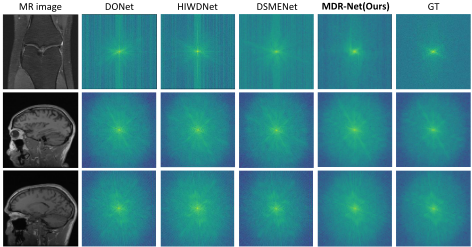
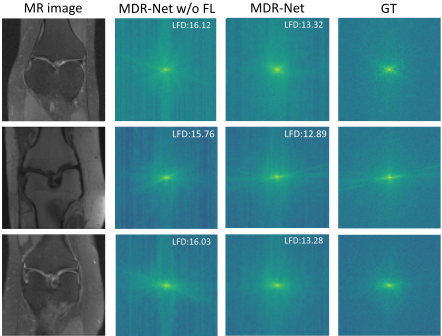
Besides, most DL-based MRI reconstruction methods mainly focus on designing the spatial-domain loss as it can directly provide perceptual improvement. However, single spatial-domain optimization tends to guide the model to generate over-smoothed images due to the lack of frequency information. Many studies [Ronen et al., 2019; Rahaman et al., 2019] show that models tend to fit lowfrequency components first that are easy to synthesize while losing high-frequency parts. We visualize the frequency spectra of reconstructed MR images in Figure 1, and previous methods based on spatial-domain optimization show an obvious frequency domain discrepancy between the reconstructed MR images and ground truth. Both HIWDNet and DSMENet fail to restore the high-frequency information. The focal frequency loss [Jiang et al., 2021] is proven effective in synthesizing fine frequency components, but its potential to narrow the frequency domain gap in MRI reconstruction remains under-explored. We find that each frequency in the spectra is the statistical sum across all pixels in the MRI so that frequency-level supervision can offer a new solution for global guidance.
In this paper, we propose a multi-domain recurrent network (MDR-Net) to restore the undersampled MR image. The motivation comes from the spectral convolutional theorem in [Katznelson, 2004] and the dual-domain learning strategy in [Huang et al., 2022]. Therefore, we designed a multi-domain learning (MDL) block in our MDR-Net to interactively learn the local spatial features and global frequency information to obtain complementary representations. Moreover, we introduce an effective frequency loss to make the model concentrate high frequencies that are difficult to synthesize. As a result, frequency spectra reconstructed by MDR-Net are closest to the ground truth in Figure 1, which shows the superiority of our method in narrowing the frequency difference. Furthermore, the feature-level learning in MDL and frequency-level refinement mutually promote common prosperity and ameliorate image quality. Lastly, our recurrent learning helps to avoid overfitting in directly optimizing networks in dual domains. Experiments show that our MDR-Net is able to accurately reconstruct MR images with sharp details.
The main contributions of this work are as follows:
- We propose a novel learning strategy, i.e., a multidomain learning strategy, which allows us to explore and exploit the properties of undersampled images across different domains.
- We design a newMDL block that incorporates both spatial and frequency information to effectively merge local and global representations, which can provide complementary information.
- To compensate for the excessive smoothing caused by the spatial-domain loss, we design an effective frequency loss to narrow the frequency domain discrepancy by forcing the model to restore high frequencies adaptively.
2 RelatedWork
2.1 MRI Reconstruction
Generally, there are two kinds of MRI reconstruction methods: model-driven and data-driven. The former aims to design different optimization algorithms for reconstructing MR images from undersampled k-space data. For example, [Lustig et al., 2007] proposed compressed sensing magnetic resonance imaging (CS-MRI) to accelerate the imaging speed from sparse MR signals. In [Ravishankar and Bresler, 2010], MR images are reconstructed from highly undersampled k-space data using dictionary learning. In addition, a new sparse reconstruction model with multi-class dictionaries is introduced in [Zhan et al., 2015] to accelerate the learning process. However, efficiency issues and poor adaptability limit the effectiveness of these methods.
Inspired by the great success of computer vision, [Wang et al., 2016] first proposed a deep learning model to reconstruct MR images in the spatial domain. With the development of deep learning, various networks [Fan et al., 2018; Zhao et al., 2019; Liu, 2021; Zhang et al., 2021] have been applied to MRI reconstruction. For example, [Schlemper et al., 2017] designed a data consistency layer in a deep cascade of CNNs to ensure the consistency between the reconstructed image and ground truth. [Wu et al., 2019] introduced the self-attention mechanism with deep residual CNNs, called (SAT-Net). [Zheng et al., 2019] proposed a cascaded dilated dense network with two-step data consistency to remove aliasing artifacts in the reconstructed MR image. However, the investigation of single-domain MRI reconstruction methods soon arrived at a serious bottleneck due to the limited domain knowledge. Therefore, [Eo et al., 2018] proposed a KIKI-Net to reconstruct the image and k-spaces sequentially, which can improve the reconstruction quality progressively. [Zhou and Zhou, 2020] designed a Dual-Domain Recurrent Network (DudoRNet) with deep T1 prior for reconstructing the k-space and image information. [Ran et al., 2020] proposed MR-Recon-Net employs parallel architecture to process the relationships between the spatial domain and frequency domain. However, MD-Recon-Net still does not consider the differences between the spatial domain and frequency domain as it adapts the same CNNs for restoring these two domains. [Feng et al., 2021] proposed double-frequency convolution to learn multi-scale spatial frequency features for parallel MRI. To explore the characteristics of time-frequency features in the wavelet domain, [Tong et al., 2022] propose a hybrid image-wavelet domain reconstruction network (HIWDNet) for accurate MRI reconstruction. In [Wang et al., 2022], detail and structure mutually enhancing network (DSMENet) is proposed to effectively learn the mapping from undersampled input to truth images. In contrast to the abovementioned data-driven methods, our approach leverages the correlations across different domains to improve the reconstruction performance.
2.2 Frequency SpectrumAnalysis
The key point of frequency spectrum analysis is signal frequency characteristics. [Xu et al., 2019] proved that DLbased networks attach more importance to low frequencies to fit the objective, which inevitably leads to the frequency domain gap. Many studies [Wang et al., 2020b; Zhang et al., 2019] proved that the periodic patterns shown in the frequency domain are consistent with the artifacts in the spatial domain. Therefore, recent methods tend to improve the visual difference in the spatial domain by narrowing the gap between reconstructed images and ground truth. [Fritsche et al., 2019] proposed the frequency separation method to treat low-frequency and high-frequency images differently. To solve the domain deviation in super-resolution, [Wei et al., 2021] used domain-gap aware training and domain-distance weighted supervision. [Jiang et al., 2021] indicated that focusing on hard frequencies can improve reconstruction performance. In MRI reconstruction, the over-fitting at low frequencies brings smooth textures and blurry structures. Therefore, exploring adaptive constraints at specific frequencies is essential for an accurate reconstruction.
3 Method
3.1 Overall Architecture
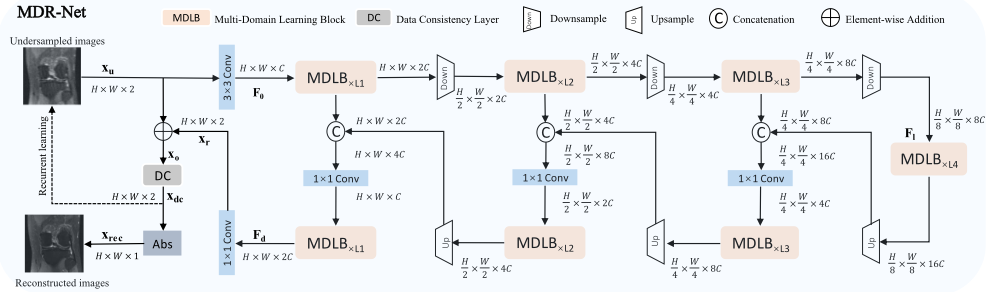
The overall network architecture and internal module of our MDR-Net are illustrated in Figure 2. We chose U-Net as the backbone to build our MDR-Net, which helps to show the superiority of the designed components.
In MR image reconstruction, our purpose is to reconstruct a desired image from measured k-space data. The binary masks M is used for simulating the fast acquisition process of MR signals, projecting the fully k-space data k ∈ RH×W×2 into ku ∈ RH×W×2 . Then we formulate the transformation process as follows:
where xu is the undersampled input image of MDR-Net; F2D and F -1 2D are 2D Fourier transform (FT), and inverse Fourier transform (IFT); ⊙ is element-wise multiplication.
Given an undersampled image xu ∈ RH×W×2 , MDRNet first applies a 3 × 3 convolution layer to extract shallow features F0 ∈ RH×W×C ; where H × W denotes the spatial dimension and C is the number of channels. Next, these low-level features F0 pass through a 4-level symmetric encoder-decoder and then transform into deep features Fd ∈ RH×W×2C . To prove the effectiveness and efficiency of the multi-domain learning block, each level of encoder-decoder only contains an MDL block, where the original U-Net has instead a sequence of two 3 × 3 convolution operations to learn features-maps. Starting from the high-resolution image, the encoder hierarchically reduces spatial size while expanding channel capacity. The decoder takes low-resolution latent features Fl ∈ R H8 × W8 ×8C as input and recovers the high-resolution representations progressively. To assist the recovery process, the encoder features with the same spatial dimension are concatenated with the decoder features via skip connections. Then the concatenation operation is followed by a 1×1 convolution to reduce channels at all levels except the top one. Finally, a 1 × 1 convolution layer is applied to the deep features Fd to generate a residual image xr ∈ RH×W×2 to which input image is added to obtain the restored image: xo = xu + xr.
Then the restored image xo passes through the data consistency (DC) layer to ensure the consistency between the reconstructed k-space and sampled k-space (ku) since the k-space is changed after inference through MDR-Net. Therefore, the purpose of the DC layer is to maintain the k-space fidelity at sampled locations z of M. Denoting the FT output of xo as ko, the corresponding output from DC layer [Sriram et al., 2020] can be thus formulated as:
where kdc denotes the corrected k-space altered by the DC layer, and λ is a trainable hyper-parameter that controls the level of linear combination between sampled k-space values and predicted values. When λ = 0, the sampled k-space directly substitutes the prediction at z in k-space. The corrected k-space is transformed into the spatial domain as xdc by IFT. The process mentioned above can be seen as the first iteration of our MDR-Net. The corrected restored image xdc will be adopted as the following input of MDR-Net according to the number of recurrent blocks (Nrec). Next, we will present the details of the MDL block.
3.2 Multi-domain Learning Block
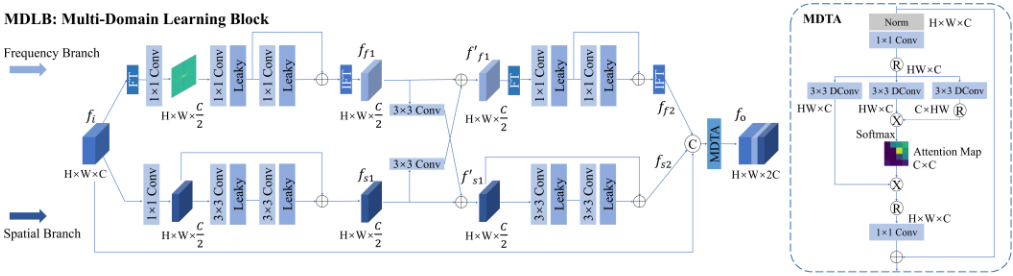
To further explore the difference and relationship between the spatial domain and frequency domain, we propose the MDL block in our model to learn feature-maps from different domains with customized convolution blocks. According to Fourier theory, processing information in Fourier space is capable of capturing the global frequency representation in the frequency domain. In contrast, normal convolution focuses on learning local representations in the spatial domain. In this way, we propose the interactive block to combine these two representations, which is beneficial for learning more representative features. As shown in Figure 3, the MDL block comprises a spatial branch and a frequency branch for processing spatial and frequency representations. Denoting fi as the input features of the MDL block, the spatial branch first applies a 1 × 1 convolution operation to reduce channels (by half) and then adopts a residual block with 3 × 3 convolution layers to process information in the spatial domain and obtain fs1. While the frequency branch uses Fourier transform to convert the feature-maps to the Fourier space and then adopts a 1 × 1 convolution to halve the frequency features. To process frequency-domain representation, we adopt a residual block with 1 × 1 convolution operation and then apply Inverse Fourier transform to convert it back to the image space that obtains ff1. Thus,ff1 is the processed result of the frequency-domain representation. Next, we interact the features from spatial branch fs1 and frequency branch ff1 as:
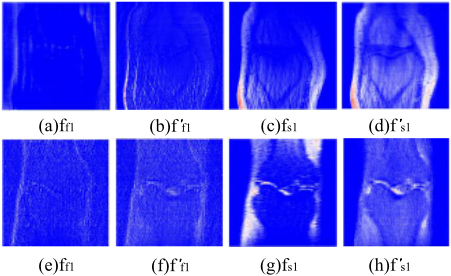
where P1 and P2 denotes the 3×3 convolution operation, f ′s1 and f ′f1 are the output of the interacted spatial and frequency branch. As illustrated in Figure 4, both f ′s1 and f ′f1 get the complementary representation, which is beneficial for these two branches to obtain more representational features. The following spatial and frequency branches are formulated in the same way as above and output the results fs2 and ff2, respectively. To efficiently aggregate local and non-local pixel interactions across different domains, we introduce a multiDconv head transposed attention(MDTA) [Zamir et al., 2022] to process the final concatenated results from fi, fs2 and ff2. Specifically, the MDTA implicitly models global context by applying self-attention across channels rather than the spatial dimension, which allows MDL block to prioritize the featuremaps learning from different domains. These design yield quality improvements were shown in the experiment section.
3.3 Loss Functions
The inherent bias of CNNs makes it challenging to synthesize high-frequency features in the MR image reconstruction, which leads to the frequency domain discrepancy in other methods in Figure 1. One way is to introduce some constraints to alleviate this. In this paper, we introduce a joint spatial and frequency loss to regularize the optimization of our model, which can improve the reconstruction results from both the spatial and frequency domains. The loss in the spatial domain is indispensable for the image reconstruction task. So, first of all, we use SSIM loss in the spatial domain. It can be formulated as follows:
| fastMRI 1D random mask | CC-359 2D random mask | CC-359 2D radial mask | ||||||||||||||||
|---|---|---|---|---|---|---|---|---|---|---|---|---|---|---|---|---|---|---|
| RF | = 4 | RF = 5 | RF = 10 | RF = 5 | ||||||||||||||
| Methods | SSIM | PSNR | NMSE | SSIM | RF = PSNR | NMSE | SSIM | PSNR | NMSE | SSIM | PSNR | NMSE | SSIM | PSNR | NMSE | SSIM | RF = 10 PSNR | NMSE |
| Zero-Filled | 0.6870 | 30.5 | 0.0438 | 0.5428 | 26.6 | 0.0839 | 0.6074 | 19.32 | 0.1951 | 0.5455 | 17.79 | 0.2778 | 0.6912 | 21.16 | 0.1289 | 0.5428 | 17.79 | 0.2778 |
| U-Net [Ronneberger et al., 2015] | 0.7587 | 32.4 | 0.0318 | 0.6006 | 26.8 | 0.0798 | 0.8500 | 27.78 | 0.0279 | 0.8133 | 26.75 | 0.0349 | 0.8859 | 29.47 | 0.0191 | 0.8154 | 26.23 | 0.0396 |
| DCCNN [Schlemper et al., 2017] | 0.7453 | 32.6 | 0.0315 | 0.6131 | 27.6 | 0.0677 | 0.8924 | 30.85 | 0.0140 | 0.8340 | 27.91 | 0.0272 | 0.8999 | 30.83 | 0.0138 | 0.8127 | 26.41 | 0.0383 |
| KIKI [Eo et al., 2018] | 0.7662 | 33.2 | 0.0286 | 0.6133 | 27.6 | 0.0684 | 0.9054 | 29.96 | 0.0180 | 0.8717 | 28.12 | 0.0269 | 0.9155 | 30.50 | 0.0158 | 0.8637 | 27.89 | 0.0278 |
| CDDN [Zheng et al., 2019] | 0.7578 | 33.0 | 0.0295 | 0.6251 | 27.8 | 0.0654 | 0.9267 | 32.96 | 0.0090 | 0.8967 | 30.26 | 0.0168 | 0.9321 | 32.92 | 0.0090 | 0.8798 | 29.32 | 0.0202 |
| MD-Recon-Net [Ran et al., 2020] | 0.7590 | 33.3 | 0.0272 | 0.6260 | 28.5 | 0.0567 | 0.8954 | 30.93 | 0.0173 | 0.8476 | 28.02 | 0.0288 | 0.9021 | 30.93 | 0.0145 | 0.8233 | 26.78 | 0.0389 |
| DudoRNet [Zhou and Zhou, 2020] | 0.7717 | 33.3 | 0.0285 | 0.6256 | 27.9 | 0.0641 | 0.9315 | 33.26 | 0.0084 | 0.8983 | 30.27 | 0.0162 | 0.9354 | 33.21 | 0.0085 | 0.8857 | 29.34 | 0.0199 |
| DONet [Feng et al., 2021] | 0.7645 | 33.0 | 0.0294 | 0.6193 | 27.6 | 0.0677 | 0.9313 | 33.35 | 0.0083 | 0.8949 | 30.41 | 0.0157 | 0.9087 | 30.68 | 0.0143 | 0.8863 | 29.71 | 0.0183 |
| HIWDNet [Tong et al., 2022] | 0.7762 | 33.5 | 0.0278 | 0.6344 | 28.0 | 0.0629 | 0.9345 | 33.40 | 0.0083 | 0.9031 | 30.83 | 0.0144 | 0.9368 | 33.33 | 0.0084 | 0.8953 | 29.83 | 0.0180 |
| DSMENet [Wang et al., 2022] | 0.7770 | 33.6 | 0.0271 | 0.6304 | 28.3 | 0.0605 | 0.9366 | 33.68 | 0.0079 | 0.9073 | 31.05 | 0.0140 | 0.9390 | 33.54 | 0.0081 | 0.8988 | 30.21 | 0.0167 |
| MDR-Net (Ours) | 0.7807 | 33.7 | 0.0271 | 0.6688 | 29.6 | 0.0474 | 0.9378 | 33.73 | 0.0067 | 0.9082 | 31.25 | 0.0132 | 0.9412 | 34.33 | 0.0065 | 0.8993 | 30.68 | 0.0153 |
where xrec, xgt are the reconstruction and ground truth images, respectively. Although the MDL block in our model includes frequency domain learning, the model is still not optimized for the frequency domain. Therefore, the reconstructed images provided by MDR-Net have an undesirable spectrum, as shown in Figure. 1, so we introduce the focal frequency loss [Jiang et al., 2021] to construct the frequency fidelity term. We define the reconstructed MR image and ground truth as xrec and xgt with the dimensions of RH×W×1 . Specifically,the focal frequency loss LFFL between the ground truth x and the reconstructed MR image xrec is formulated as:
where Fgt represents 2D discrete Fourier transform of ground truth image (represents xgt here), and Ff represents 2D discrete Fourier transform of reconstructed image (represents xrec here); α denotes a frequency distance coefficient to make the distance correlation adjustable, and the analysis of frequency-distance coefficients α is provided in Section 4.3. The matrix w(u, v) represents the dynamic weight for the spatial frequency at coordinate (u, v), which is defined as:
We introduce the weight factor λ to balance the spatial and frequency loss, and the total loss of our MDR-Net is:
The analysis of the weight factor λ is provided in Section 4.3.
4 Experiments
4.1 Datasets and Settings
fastMRI dataset. We conduct experiments on the singlecoil knee track of the fastMRI dataset [Zbontar et al., 2018]. The dataset consists of raw k-space data from 1372 knee MRI exams, which are obtained by four different MRI devices. Two types of commonly used MRI sequences are provided by the FastMRI dataset: a Proton Density (PD) weighted sequence and a Proton Density with Fat Saturation (PDFS). We used the same training, validation and testing split as in the original dataset. The training, validation, and testing sets consisted of 973, 199 and 108 volumes, respectively. The single-coil k-space data were retrospectively undersampled using 1D Cartesian random sampling masks, which are based on code released with the fastMRI dataset.
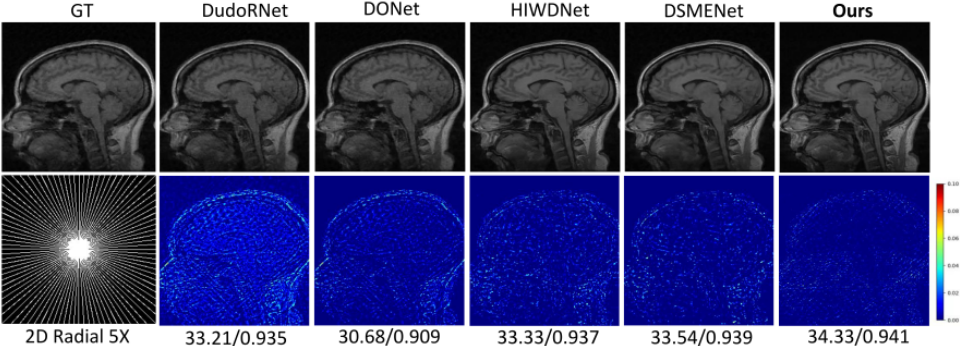
CC359 dataset. The CC-359 Brain dataset[Souza et al., 2018] consists of T1-weighted MR brain images with the size of 256 × 256, which were collected from various vendors using scanners at both 1.5T and 3T. It includes a total of 45 volumes, with 25 designated for training, 10 for validation, and 10 for testing. In the experiments, MDR-Net is trained on the full training volumes and evaluated on the full validation volumes for comparison.
Implementation Details. The hyper-parameter setting of the network is as follows: the entry channel number MDRNet is c = 32, and the number of recurrent blocks is N = 4. All experiments are implemented using the Pytorch platform on two NVIDIA GeForce GTX 3090 with 24GB GPU memory. Our network is trained with an RMSProp optimizer. The initial learning rate is 10-3 and reduce to 10-4 after 40 epochs. The batch size is set as 1, and the network is trained for 50 epochs to ensure convergence. NMSE, PSNR and SSIM are used for quantitative evaluation.
4.2 Comparisons with the State-of-the-art
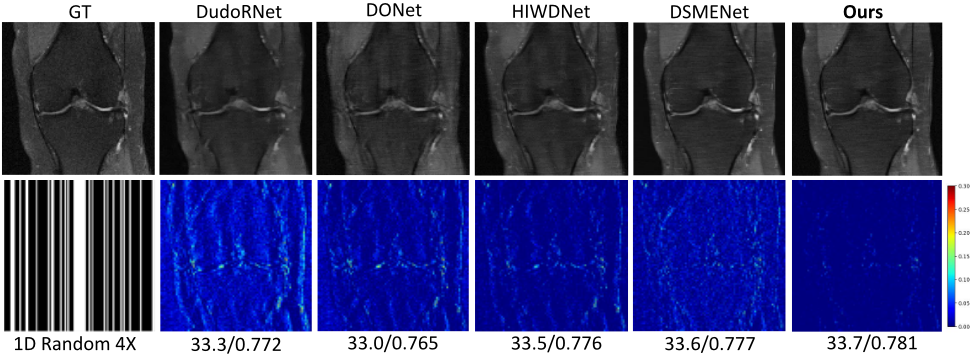
Quantitative Comparison. We compare our proposed MDR-Net with ten state-of-the-art methods, including one conventional method (Zero-Filled) and nine CNNs-based methods (U-Net [Ronneberger et al., 2015], DCCNN [Schlemper et al., 2017], KIKI-Net [Eo et al., 2018], CDDN [Zheng et al., 2019], MD-Recon-Net [Ran et al., 2020], DudoRNet [Zhou and Zhou, 2020], DONet[Feng et al., 2021], DSMENet [Wang et al., 2022] and HIWDNet [Tong et al., 2022]). To ensure a fair comparison, we conducted all experiments using the same train, validation, and test sets, as well as the same computing environment. Additionally, we used the released code of each competitor with the default settings. This allows us to compare the performance of each method under the same conditions. Quantitative results on FastMRI and CC359 datasets in terms of SSIM, PSNR and NMSE are reported in Table 1. We can see that our MDR-Net significantly outperforms other methods.
| Methods | SSIM↑ | PSNR↑ | NMSE↓ |
|---|---|---|---|
| (A) Net-baseline | 0.7678 | 32.8 | 0.0299 |
| (B) Net-MDLB | 0.7761 | 33.4 | 0.0278 |
| (C) Net-FL | 0.7705 | 33.0 | 0.0302 |
| (D) Net-Rec | 0.7738 | 33.0 | 0.0304 |
| (E) Net-MDLB-Rec | 0.7786 | 33.6 | 0.0279 |
| (F) Net-MDLB-FL | 0.7773 | 33.5 | 0.0278 |
| (G) Net-FL-Rec | 0.7768 | 33.5 | 0.0281 |
| (H) Net-MDLB-FL-Rec | 0.7807 | 33.7 | 0.0271 |
| Metric | w/o FT&IFT | 2-FB | 2-SB | w/o Interaction | w/o MDTA | MDL block |
| SSIM ↑ | 0.7651 | 0.7781 | 0.7788 | 0.7792 | 0.7797 | 0.7807 |
| PSNR ↑ | 33.0 | 32.6 | 33.2 | 33.4 | 33.6 | 33.7 |
Visual Comparison. As shown in Figures 5 and 6, these qualitative results show that our reconstructed MRI is the closest and highest correlation to the ground truth. Besides, we perform our MDR-Net on different sampling patterns and draw the corresponding error maps between reconstructed images and ground truth. As a result, our MDR-Net generates more visually pleasant results than previous methods, especially in the reconstruction of high-frequency structural content, which benefits from feature-level and frequency-level dual-domain learning.
4.3 Ablation Study
In this study, we evaluated three key components of MDRNet on the fastMRI dataset with a reduction factor RF=4, including multi-domain learning block (MDLB), frequency loss (FL) and recurrent learning (Rec). We used the MDRNet without these three components as a baseline, and set the value of Nrec in Rec to 5. The results of this component analysis are shown in Table 2. We found that the MDL block (B)
| Metric | Nrec=1 | Nrec=2 | Nrec=3 | Nrec=4 | Nrec=5 | Nrec=6 | Nrec=7 |
| SSIM ↑ | 0.7769 | 0.7783 | 0.7794 | 0.7804 | 0.7807 | 0.7805 | 0.7801 |
| PSNR ↑ | 32.9 | 33.3 | 33.5 | 33.6 | 33.7 | 33.6 | 33.5 |
| Metric | λ = 0 | λ = 0.2 | λ = 0.4 | λ = 0.6 | λ = 0.8 | λ = 1 |
| SSIM ↑ | 0.7781 | 0.7788 | 0.7792 | 0.7797 | 0.7807 | 0.7793 |
| PSNR ↑ | 33.2 | 33.3 | 33.5 | 33.6 | 33.7 | 33.6 |
| NMSE ↓ | 0.0283 | 0.0281 | 0.0277 | 0.0270 | 0.0271 | 0.0273 |
increased the PSNR value by 0.6 dB compared to the baseline (A), a more significant improvement than either frequency learning (C) or recurrent learning (D) alone. The combination of the MDL block and recurrent learning (E) produced the largest boost in performance, while all three components together (H) yielded the best reconstruction results overall. These findings demonstrate that all three components contribute to the enhanced performance of the MDR-Net. Next, we will separately provide the ablation studies of each component mentioned above.
Ablation Study of MDLB. We validate the effectiveness of the design of the MDL block in Table 3. As can be seen, the performance decreases significantly when removing both FT and IFT operations. Furthermore, both replacing the spatial branch with the frequency branch or replacing the frequency branch with the spatial branch results in a significant performance drop. While the interaction between these two branches can improve performance remarkably, demonstrating the effectiveness of integrating these two complementary representations. Moreover, the introduced MDTA provides a favorable gain of 0.2dB over the baseline.
The Number of Recurrent Learning. The Number of Recurrent Learning. An important factor of MDR-Net is the number of recurrent learning. We compare the results of different recurrent numbers in Table 4. We can observe that both SSIM and PSNR values tend to be saturated when N is four and reaches the highest when N is 5.
Loss Weight Factor. The parameter λ in Eq.(7) is used to balance the importance of spatial and frequency loss. We studied how the model's performance changes with different values of λ and present the results in Table 5. When λ = 0, the model only focuses on the spatial domain loss which is not optimal, showing that frequency-level supervision is crucial. As the frequency loss increases, the model's performance improves. The best results in terms of PSNR and SSIM are achieved when λ = 0.8.
Frequency Loss. Figure 7 illustrates the difference in frequency spectra reconstructed with and without the frequency loss. The corresponding log frequency distance(LFD) is also shown in the same figure. Without frequency supervision, the reconstructed spectra exhibit an aliasing artifact. However, when using our proposed frequency loss, the frequency spectra are reconstructed more accurately and with a lower LFD, resulting in a closer match to the true frequency statistics. Additionally, the fine-grained spectrum supervision in frequency loss helps to preserve high-frequency details that are difficult to synthesize.
| Metric | α = 0.1 | α = 0.3 | α = 0.5 | α = 1 | α = 2 | α = 3 |
| LFD ↓ | 14.8633 | 14.3792 | 13.9825 | 13.6571 | 13.3238 | 15.0863 |
| SSIM ↑ | 0.7739 | 0.7752 | 0.7782 | 0.7795 | 0.7807 | 0.7792 |
| PSNR ↑ | 33.1 | 33.2 | 33.5 | 33.8 | 33.7 | 33.5 |
Frequency Distance Coefficient. The frequency distance coefficient α in Eq.(5) is introduced to emphasize the frequency parts of the reconstructed MR image. The higher the value of α, the more the network will penalize underfitting frequencies. Table6 shows the model performance for different values of α. The highest PSNR is achieved when α = 1, while the best SSIM and LFD performance is obtained when α = 2. Lowering α results in weaker frequency penalty and lower performance, while increasing it leads to more stringent frequency domain supervision, which can distort the reconstructed MR image. Therefore, we set α = 2 as the default value to balance structural similarity and perceptual quality.
5 Conclusion
The investigation of CNNs for MR image reconstruction has arrived at a serious bottleneck as networks with better performance usually adopt a dual-domain learning strategy generally while could not recover the detailed structures in the reconstructed MR images. To solve this problem, we proposed a Multi-Domain Recurrent Network(MDR-Net) to restore both image and k-space signal simultaneously with multi-domain interactions. Experiments demonstrated that while previous MR image reconstruction methods on singledomain and dual-domain have limited capability of reducing aliasing artifacts in the image domain, our MDR-Net can effectively restore the reconstruction with complementary features. Future work includes exploring MDR-Net on multicoil MR data and the application to other image reconstruction tasks, such as Photoacoustic Tomography images reconstruction.
Acknowledgements
This work was supported in part by the CAS Project for Young Scientists in Basic Research under Grant YSBR-067, in part by the National Natural Science Foundation of China under Grant 32271431.
Contribution Statement
Jinbao Wei and Zhijie Wang contributed equally to this work.
@inproceedings{ijcai2023p169,
  title     = {Accurate MRI Reconstruction via Multi-Domain Recurrent Networks},
  author    = {Wei, Jinbao and Wang, Zhijie and Wang, Kongqiao and Guo, Li and Fu, Xueyang and Liu, Ji and Chen, Xun},
  booktitle = {Proceedings of the Thirty-Second International Joint Conference on
               Artificial Intelligence, {IJCAI-23}},
  publisher = {International Joint Conferences on Artificial Intelligence Organization},
  editor    = {Edith Elkind},
  pages     = {1524--1532},
  year      = {2023},
  month     = {8},
  note      = {Main Track},
  doi       = {10.24963/ijcai.2023/169},
  url       = {https://doi.org/10.24963/ijcai.2023/169},
}
TY - CPAPER TI - Accurate MRI Reconstruction via Multi-Domain Recurrent Networks AU - Wei, Jinbao AU - Wang, Zhijie AU - Wang, Kongqiao AU - Guo, Li AU - Fu, Xueyang AU - Liu, Ji AU - Chen, Xun T2 - Proceedings of the Thirty-Second International Joint Conference on Artificial Intelligence, IJCAI-23 PB - International Joint Conferences on Artificial Intelligence Organization PY - 2023 SP - 1524 EP - 1532 DO - 10.24963/ijcai.2023/169 UR - https://doi.org/10.24963/ijcai.2023/169 ER -Copied
Machine-readable versions of this paper, for tools and AI agents:





