
Prompt Learns Prompt: Exploring Knowledge-Aware Generative Prompt Collaboration For Video Captioning
Proceedings of the Thirty-Second International Joint Conference on Artificial Intelligence. Main Track. Pages 1622-1630.
https://doi.org/10.24963/ijcai.2023/180
Keywords
- Computer Vision: CV: Vision and language
- Computer Vision: CV: Video analysis and understanding
Abstract
Fine-tuning large vision-language models is a challenging task. Prompt tuning approaches have been introduced to learn fixed textual or visual prompts while freezing the pre-trained model in downstream tasks. Despite the effectiveness of prompt tuning, what do those learnable prompts learn remains unexplained. In this work, we explore whether prompts in the fine-tuning can learn knowledge-aware prompts from the pre-training, by designing two different sets of prompts in pre-training and fine-tuning phases respectively. Specifically, we present a Video-Language Prompt tuning (VL-Prompt) approach for video captioning, which first efficiently pre-train a video-language model to extract key information (e.g., actions and objects) with flexibly generated Knowledge-Aware Prompt (KAP). Then, we design a Video-Language Prompt (VLP) to transfer the knowledge from the knowledge-aware prompts and fine-tune the model to generate full captions. Experimental results show the superior performance of our approach over several state-of-the-art baselines. We further demonstrate that the video-language prompts are well learned from the knowledge-aware prompts.
- [Akbik et al., 2019] Alan Akbik, Tanja Bergmann, Duncan Blythe, Kashif Rasul, Stefan Schweter, and Roland Voll- graf. FLAIR: An easy-to-use framework for state-of-the- art NLP. In NAACL, pages 54-59, 2019.
- [Alec and Karthik, 2018] Radford Alec and Narasimhan Karthik. Improving language understanding by generative pre-training. OpenAI, 2018.
- [Arnab et al., 2021] Anurag Arnab, Mostafa Dehghani, Georg Heigold, Chen Sun, Mario Lučić, and Cordelia Schmid. Vivit: A video vision transformer. In ICCV, 2021.
- [Banerjee and Lavie, 2005] Satanjeev Banerjee and Alon Lavie. Meteor: An automatic metric for mt evaluation with improved correlation with human judgments. In ACL workshop, pages 65-72, 2005.
- [Beltagy et al., 2020] Iz Beltagy, Matthew E Peters, and Ar- man Cohan. Longformer: The long-document trans- former. arXiv preprint arXiv:2004.05150, 2020.
- [Bertasius et al., 2021] Gedas Bertasius, Heng Wang, and Lorenzo Torresani. Is space-time attention all you need for video understanding? In ICML, volume 2, page 4, 2021.
- [Chen et al., 2018] Yangyu Chen, Shuhui Wang, Weigang Zhang, and Qingming Huang. Less is more: Picking in- formative frames for video captioning. In ECCV, 2018.
- [Chen et al., 2020] Mark Chen, Alec Radford, Rewon Child, Jeffrey Wu, Heewoo Jun, David Luan, and Ilya Sutskever. Generative pretraining from pixels. In ICML, 2020.
- [Chen et al., 2022] Long Chen, Yuhang Zheng, and Jun Xiao. Rethinking data augmentation for robust visual question answering. In ECCV, pages 95-112, 2022.
- [Devlin et al., 2018] Jacob Devlin, Ming-Wei Chang, Ken- ton Lee, and Kristina Toutanova. Bert: Pre-training of deep bidirectional transformers for language understand- ing. arXiv preprint arXiv:1810.04805, 2018.
- [Dosovitskiy et al., 2021] Alexey Dosovitskiy, Lucas Beyer, Alexander Kolesnikov, Dirk Weissenborn, Xiaohua Zhai, Thomas Unterthiner, Mostafa Dehghani, Matthias Min- derer, Georg Heigold, Sylvain Gelly, Jakob Uszkoreit, and Neil Houlsby. An image is worth 16x16 words: Trans- formers for image recognition at scale. In ICLR, 2021.
- [Du et al., 2022] Yu Du, Fangyun Wei, Zihe Zhang, Miao- jing Shi, Yue Gao, and Guoqi Li. Learning to prompt for open-vocabulary object detection with vision-language model. In CVPR, pages 14084-14093, 2022.
- [He et al., 2016] Kaiming He, Xiangyu Zhang, Shaoqing Ren, and Jian Sun. Deep residual learning for image recog- nition. In CVPR, pages 770-778, 2016.
- [Huang et al., 2022] Siteng Huang, Biao Gong, Yulin Pan, Jianwen Jiang, Yiliang Lv, Yuyuan Li, and Donglin Wang. Vop: Text-video co-operative prompt tuning for cross- modal retrieval. arXiv preprint arXiv:2211.12764, 2022.
- [Jia et al., 2022] Menglin Jia, Luming Tang, Bor-Chun Chen, Claire Cardie, Serge J. Belongie, Bharath Hariha- ran, and Ser-Nam Lim. Visual prompt tuning. In ECCV, pages 709-727, 2022.
- [Ju et al., 2022] Chen Ju, Tengda Han, Kunhao Zheng, Ya Zhang, and Weidi Xie. Prompting visual-language models for efficient video understanding. In ECCV, 2022.
- [Lester et al., 2021] Brian Lester, Rami Al-Rfou, and Noah Constant. The power of scale for parameter-efficient prompt tuning. In EMNLP, pages 3045-3059, 2021.
- [Li and Liang, 2021] Xiang Lisa Li and Percy Liang. Prefix- tuning: Optimizing continuous prompts for generation. In ACL-IJCNLP, pages 4582-4597, 2021.
- [Li et al., 2021] Dongxu Li, Junnan Li, Hongdong Li, Juan Carlos Niebles, and Steven C. H. Hoi. Align and prompt: Video-and-language pre-training with entity prompts. CVPR, pages 4943-4953, 2021.
- [Lin and Och, 2004] Chin-Yew Lin and Franz Josef Och. Automatic evaluation of machine translation quality using longest common subsequence and skip-bigram statistics. In ACL, pages 605-612, 2004.
- [Lin et al., 2022] Kevin Lin, Linjie Li, Chung-Ching Lin, Faisal Ahmed, Zhe Gan, Zicheng Liu, Yumao Lu, and Lijuan Wang. Swinbert: End-to-end transformers with sparse attention for video captioning. In CVPR, 2022.
- [Liu et al., 2021a] Fenglin Liu, Xuancheng Ren, Xian Wu, Bang Yang, Shen Ge, and Xu Sun. O2NA: an object- oriented non-autoregressive approach for controllable video captioning. In ACL/IJCNLP, 2021.
- [Liu et al., 2021b] Pengfei Liu, Weizhe Yuan, Jinlan Fu, Zhengbao Jiang, Hiroaki Hayashi, and Graham Neubig. Pre-train, prompt, and predict: A systematic survey of prompting methods in natural language processing. ACM Computing Surveys, 2021.
- [Liu et al., 2021c] Xiao Liu, Yanan Zheng, Zhengxiao Du, Ming Ding, Yujie Qian, Zhilin Yang, and Jie Tang. Gpt understands, too. ArXiv, abs/2103.10385, 2021.
- [Liu et al., 2021d] Ze Liu, Yutong Lin, Yue Cao, Han Hu, Yixuan Wei, Zheng Zhang, Stephen Lin, and Baining Guo. Swin transformer: Hierarchical vision transformer using shifted windows. In ICCV, pages 10012-10022, 2021.
- [Liu et al., 2022] Ze Liu, Jia Ning, Yue Cao, Yixuan Wei, Zheng Zhang, Stephen Lin, and Han Hu. Video swin trans- former. In CVPR, pages 3202-3211, 2022.
- [Nag et al., 2022] Sauradip Nag, Xiatian Zhu, Yi-Zhe Song, and Tao Xiang. Zero-shot temporal action detection via vision-language prompting. In ECCV, 2022.
- [Pan et al., 2020] Boxiao Pan, Haoye Cai, De-An Huang, Kuan-Hui Lee, Adrien Gaidon, Ehsan Adeli, and Juan Car- los Niebles. Spatio-temporal graph for video captioning with knowledge distillation. In CVPR, 2020.
- [Papineni et al., 2002] Kishore Papineni, Salim Roukos, Todd Ward, and Wei-Jing Zhu. Bleu: a method for au- tomatic evaluation of machine translation. In ACL, 2002.
- [Qin et al., 2023] Zheyun Qin, Xiankai Lu, Xiushan Nie, Dongfang Liu, Yilong Yin, and Wenguan Wang. Coarse- to-fine video instance segmentation with factorized con- ditional appearance flows. Journal of Automatica Sinica, 10(5):1-17, 2023.
- [Radford et al., 2021] Alec Radford, Jong Wook Kim, Chris Hallacy, Aditya Ramesh, Gabriel Goh, Sandhini Agar- wal, Girish Sastry, Amanda Askell, Pamela Mishkin, Jack Clark, et al. Learning transferable visual models from nat- ural language supervision. In ICML, 2021.
- [Ryu et al., 2021] Hobin Ryu, Sunghun Kang, Haeyong Kang, and C. Yoo. Semantic grouping network for video captioning. In AAAI, 2021.
- [Shannon, 1948] Claude Elwood Shannon. A mathematical theory of communication. The Bell system technical jour- nal, 27(3):379-423, 1948.
- [Shen et al., 2022] Sheng Shen, Shijia Yang, Tianjun Zhang, Bohan Zhai, Joseph E Gonzalez, Kurt Keutzer, and Trevor Darrell. Multitask vision-language prompt tuning. arXiv preprint arXiv:2211.11720, 2022.
- [Shin et al., 2020] Taylor Shin, Yasaman Razeghi, Robert L Logan IV, Eric Wallace, and Sameer Singh. Autoprompt: Eliciting knowledge from language models with automat- ically generated prompts. In EMNLP, 2020.
- [Shu et al., 2022] Manli Shu, Weili Nie, De-An Huang, Zhiding Yu, Tom Goldstein, Anima Anandkumar, and Chaowei Xiao. Test-time prompt tuning for zero-shot gen- eralization in vision-language models. In NeurIPS, 2022.
- [Tay et al., 2020] Yi Tay, Mostafa Dehghani, Dara Bahri, and Donald Metzler. Efficient transformers: A survey. ACM Computing Surveys, 2020.
- [Thomas and Joy, 2006] MTCAJ Thomas and A Thomas Joy. Elements of information theory. Wiley-Interscience, 2006.
- [Uzair Khattak et al., 2022] Muhammad Uzair Khattak, Hanoona Rasheed, Muhammad Maaz, Salman Khan, and Fahad Shahbaz Khan. Maple: Multi-modal prompt learning. arXiv e-prints, pages arXiv-2210, 2022.
- [Vedantam et al., 2015] Ramakrishna Vedantam, C Lawrence Zitnick, and Devi Parikh. Cider: Consensus- based image description evaluation. In CVPR, 2015.
- [Venugopalan et al., 2015] Subhashini Venugopalan, Mar- cus Rohrbach, Jeffrey Donahue, Raymond Mooney, Trevor Darrell, and Kate Saenko. Sequence to sequence- video to text. In CVPR, pages 4534-4542, 2015.
- [Wang et al., 2018a] Bairui Wang, Lin Ma, Wei Zhang, and Wei Liu. Reconstruction network for video captioning. In CVPR, 2018.
- [Wang et al., 2018b] Xin Wang, Wenhu Chen, Jiawei Wu, Yuan-Fang Wang, and William Yang Wang. Video cap- tioning via hierarchical reinforcement learning. In CVPR, 2018.
- [Wang et al., 2019] Bairui Wang, L. Ma, W. Zhang, Wenhao Jiang, Junling Wang, and W. Liu. Controllable video cap- tioning with pos sequence guidance based on gated fusion network. In ICCV, 2019.
- [Wang et al., 2022a] Qifan Wang, Yi Fang, Anirudh Ravula, Fuli Feng, Xiaojun Quan, and Dongfang Liu. Webformer: The web-page transformer for structure information ex- traction. In ACM Web Conference, 2022.
- [Wang et al., 2022b] Wenguan Wang, James Liang, and Dongfang Liu. Learning equivariant segmentation with instance-unique querying. In NeurIPS, 2022.
- [Wang et al., 2023] Wenguan Wang, Cheng Han, Tianfei Zhou, and Dongfang Liu. Visual recognition with deep nearest centroids. In ICLR, 2023.
- [Xu et al., 2016] Jun Xu, Tao Mei, Ting Yao, and Yong Rui. Msr-vtt: A large video description dataset for bridging video and language. In CVPR, 2016.
- [Yan et al., 2022a] Liqi Yan, Siqi Ma, Qifan Wang, Yingjie Chen, Xiangyu Zhang, Andreas Savakis, and Dongfang Liu. Video captioning using global-local representation. TCSVT, 32(10):6642-6656, 2022.
- [Yan et al., 2022b] Liqi Yan, Qifan Wang, Yiming Cui, Fuli Feng, Xiaojun Quan, Xiangyu Zhang, and Dongfang Liu. Gl-rg: Global-local representation granularity for video captioning. In IJCAI, 2022. IJCAI
- [Ye et al., 2022] Hanhua Ye, Guorong Li, Yuankai Qi, Shuhui Wang, Qingming Huang, and Ming-Hsuan Yang. Hierarchical modular network for video captioning. In CVPR, pages 17939-17948, 2022.
- [Zaheer et al., 2020] Manzil Zaheer, Guru Guruganesh, Ku- mar Avinava Dubey, Joshua Ainslie, Chris Alberti, Santi- ago Ontanon, Philip Pham, Anirudh Ravula, Qifan Wang, Li Yang, et al. Big bird: Transformers for longer se- quences. NeurIPS, 33:17283-17297, 2020.
- [Zang et al., 2022] Yuhang Zang, Wei Li, Kaiyang Zhou, Chen Huang, and Chen Change Loy. Unified vi- sion and language prompt learning. arXiv preprint arXiv:2210.07225, 2022.
- [Zhang and Peng, 2019] Junchao Zhang and Yuxin Peng. Object-aware aggregation with bidirectional temporal graph for video captioning. In CVPR, 2019.
- [Zhang et al., 2020] Ziqi Zhang, Yaya Shi, Chunfeng Yuan, Bing Li, Peijin Wang, Weiming Hu, and Zheng-Jun Zha. Object relational graph with teacher-recommended learn- ing for video captioning. In CVPR, 2020.
- [Zhang et al., 2021] Ziqi Zhang, Zhongang Qi, Chunfeng Yuan, Ying Shan, Bing Li, Ying Deng, and Weiming Hu. Open-book video captioning with retrieve-copy-generate network. In CVPR, 2021.
- [Zheng et al., 2020] Qi Zheng, Chaoyue Wang, and D. Tao. Syntax-aware action targeting for video captioning. In CVPR, 2020.
- [Zhengbao et al., 2019] Jiang Zhengbao, Xu Frank, F., Araki J., and Neubig Graham. How can we know what language models know? TACL, 8:423-438, 2019.
- [Zhou et al., 2022a] Kaiyang Zhou, Jingkang Yang, Chen Change Loy, and Ziwei Liu. Conditional prompt learning for vision-language models. In CVPR, 2022.
- [Zhou et al., 2022b] Kaiyang Zhou, Jingkang Yang, Chen Change Loy, and Ziwei Liu. Learning to prompt for vision-language models. IJCV, 130(9):2337-2348, 2022.
References were extracted automatically from the PDF and may contain errors.
Full text extracted automatically from the PDF; figures, tables and equations may differ. The PDF is the version of record.
1 Introduction
In 1959, three computer science pioneers envisioned that AI is to create a computer program that simulated human problem-solving behavior. Humans can process novel tasks effortlessly by using existing knowledge and learning from new information. Artificial systems, however, need a heavily pre-trained base model (e.g., CNNs [He et al., 2016] and Transformers [Dosovitskiy et al., 2021; Wang et al., 2022a]) with extensive fine-tuning on curated data for each problem. This practice is common in deep learning. But adapting these large-scale models to downstream tasks is hard. Full finetuning requires storing and deploying a separate copy of the backbone parameters for every task, which is expensive and
∗Equal contributions.
†Corresponding author.
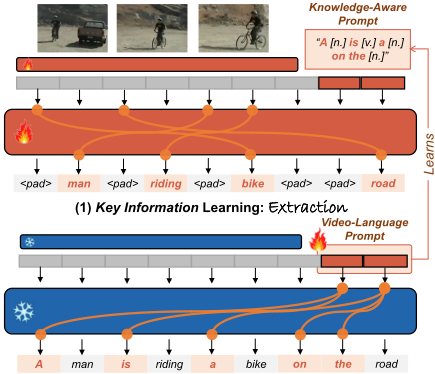
(2) Context Prompt Recovery: Diffusion
Figure 1: Our method includes two phases: 1) Key Information Learning: model pre-training to extract key information for each video with a knowledge-aware prompt. 2) Context Prompt Recovery: model fine-tuning to recover the pre-trained knowledge-aware prompt for each video and generate the full caption.
impractical, especially for modern Transformer-based architectures such as Swin-L [Liu et al., 2021d] (284M parameters), ViT-Huge [Dosovitskiy et al., 2021] (632M parameters), and iGPT-L [Chen et al., 2020] (1362M parameters). Inspired by human-like learning, a substantial amount of concurrent scientific efforts for intelligent systems have been devoted to the development of a novel training strategy in both natural language processing (NLP) and computer vision (CV) to efficiently transfer knowledge across domains.
This appetite for training has been successfully addressed in natural language processing (NLP) by prompt tuning. The solutions are based on generative language modeling in GPT [Alec and Karthik, 2018] and masked language pretraining in BERT [Devlin et al., 2018]. The idea is to reformulate downstream tasks to look more like those solved during the language model (LM) pre-training with the help of a textual prompt [Liu et al., 2021b]. For example, when recognizing the emotion of a social media post, we may continue with a prompt "I felt so ", and ask the LM to fill the blank with an emotion-bearing word. Creating and experimenting with these prompts takes time and experience, so methods have been proposed to automate the template design process. These methods can be separated into two broad types: a) discrete prompts, which automate search for templates described in a discrete space, usually corresponding to natural language phrases [Zhengbao et al., 2019; Shin et al., 2020], and b) continuous prompts, which are directly described in the embedding space [Li and Liang, 2021; Lester et al., 2021]. These emerging methods enable quick training of generalizable NLP models containing over one hundred billion parameters for novel tasks [Liu et al., 2021c].
Prompt tuning is a generic form of prefix virtual tokens construction that is natural and applicable in computer vision as well [Lester et al., 2021] [Li and Liang, 2021]. Visual Prompt Tuning (VPT) [Jia et al., 2022] introduces only a small amount of trainable parameters into the image feature input space while keeping the model backbone frozen. Several CLIP-based [Radford et al., 2021] methods adopt VPTlike architectures into their image encoders [Uzair Khattak et al., 2022; Huang et al., 2022], achieving impressive performance in terms of efficiency and accuracy. Researchers recently began to investigate how to jointly optimize prompts across vision and language. For example, UPT [Zang et al., 2022] trains a tiny neural network to generate the prompt for CLIP text and visual encoders, both of them are started with a shared initial prompt. MVLPT [Shen et al., 2022] finds that many target tasks can benefit each other from sharing prompt vectors and thus can be simultaneously learned via multitask prompt tuning.
Despite significant interest in this idea following the triumph of VPT, however, prompt tuning methods for crossdomain tasks have been lagging and face limitations.: First, learnable prompts lack explainability and their embeddings are too abstract to provide a human-understandable explanation. Concurrent work has not explored what these prompts actually learn. Second, learnable prompts lack explainability. The concurrent work fails to explore what those learnable prompts learn. The embeddings of these learnable prompts are so abstract that it is difficult to provide a humanunderstandable explanation. Third, vision-language Transformer models require extensive self-attention computation, leading to inefficiencies and lack of knowledge transferability due to the heavy parametric architecture. In light of this view, we ask: how to learn explainable prompts to enable effective learning for across-domain language-vision tasks?
To address these limitations, we present VL-Prompt, a powerful, explainable, and efficient prompt tuning approach. Our contributions are three-fold, as shown in Fig. 1:
- We introduce VL-Prompt, a novel framework for video captioning that splits the task into two parts: a) the Key Information, which is extracted from a pre-training module with flexible textual prompts; b) the Context Prompt, which is fine-tuned with the frozen pre-trained model. The design enables VL-Prompt to handle the translation of a large-scale vision-language model.
- We propose Knowledge-Aware Prompt (KAP) and Vision-Language Prompt (VLP) to investigate the ex-
- plainability of the learned prompts. KAP uses syntactic knowledge to guide sentence generation in pre-training. VLP inserts context prompts between keywords to decode captions in fine-tuning. VLP recovers KAP's information and learns the mutual information in the key information.
- Our method has two main benefits. First, in pre-training, it trains the Transformer model to extract key information with sparse attentions, simplifying the model. Second, in fine-tuning, it can handle more frames on a limited GPU memory, because the main network is frozen and does not need gradient storage.
VL-Prompt is an intuitive yet general video-language framework; it is compatible with different video-language network architectures and tasks. We experimentally show: In §4.2, with efficient video-language Transformer [Tay et al., 2020], VL-Prompt outperforms other Transformer-based counterparts, O2NA [Liu et al., 2021a] and SwinBERT [Lin et al., 2022], ↑ 7.5 ∼ 31.7 in terms of CIDEr and ↑ 5.3 ∼ 8.1 in terms of B@4, on MSVD benchmark. In §4.4, VL-Prompt acquires further improvement by applying our pre-training with KAP on a larger dataset and tuning into a smaller dataset, i.e., for MSVD benchmark, pre-trained on MSR-VTT (↑ 0.6 in B@4, ↑ 0.2 in M), and pre-trained on VATEX (↑ 1.4 in B@4, ↑ 0.4 in M). These results are particularly impressive, considering the number of parameters in the tunable prompt is very small.We hope this work could bring fundamental insights into related fields.
2 RelatedWork
2.1 Video Transformer and Video Captioning
Recently, base on the impressive performance of Vision Transformers (ViT) [Dosovitskiy et al., 2021], TimeSformer [Bertasius et al., 2021] and ViViT [Arnab et al., 2021] are two popular video Transformer method. More recently, after Swin Transformer [Liu et al., 2021d] is introduced as a general-purpose vision backbone for image understanding, Video Swin Transformer [Liu et al., 2022] extends the scope of local attention computation from only the spatial domain to the spatio-temporal domain. Traditional video captioning methods are based on CNN-RNN structure, including S2VT [Venugopalan et al., 2015], PickNet [Chen et al., 2018], OA-BTG [Zhang and Peng, 2019], SAAT [Zheng et al., 2020], ORG-TRL [Zhang et al., 2020], GLR [Yan et al., 2022a], etc. Most recently, SwinBERT [Lin et al., 2022] claims to be the first end-to-end fully Transformerbased model for video captioning.
2.2 Prompt Tuning
Prompt tuning methods can be divided into two categories.
Discrete Prompt Tuning can tune themselves for different tasks by manually constructing different prompts (e.g., CLIP [Radford et al., 2021]) like "A photo of a [object]". This strategy has been widely used in recent researches, for example, ALPRO [Li et al., 2021] and STALE [Nag et al., 2022] proposes a prompt of "A video of [ENTITY]" for video classification and action detection. A good design for prompt
sentence can achieve a better performance. For example, DetPro [Du et al., 2022] judge whether a predicted object detection box is good by two types of prompt: given a ground truth bounding box of an object class, it says "a photo of [CLASS]"; while given a foreground proposal of a partial object, it would instead say "a photo of partial [CLASS]". Other methods such as KDDAug [Chen et al., 2022] design different strategies to generate prompts for different VQA question types (e.g., "[NUMBER] [OBJECT] are there" when asking the number of an object). All of these methods generate fixed prompts with invariant structure.
Continuous Prompt Tuning automates the process by learning soft prompts (e.g., embeddings). For example, CoOp [Zhou et al., 2022b] tries to learn a prompt content optimization for CLIP text encoder on image classification tasks. CoCoOp [Zhou et al., 2022a] optimizes that learnable text prompt contents by the output of the CLIP image encoder. TPT [Shu et al., 2022] learns textual prompts in a zero-shot manner, via different augmented views of a single test image. For video tasks, [Ju et al., 2022] attempts to learn prompt vectors for CLIP text encoder on some simple video understanding tasks including action classification and localisation. Recently, VPT [Jia et al., 2022] introduces only a small amount of trainable visual prompts in the input space while keeping the model backbone frozen. MaPLe [Uzair Khattak et al., 2022] uses VPT to fine-tune the text encoder and image encoder in the CLIP [Radford et al., 2021]) model. VoP [Huang et al., 2022] also inserts prompt embeddings into the CLIP network for text-video retrieval. However, to the best of our knowledge, all these methods have not explored vision-language generative tasks, and none of them have explored what the prompts have learned.
3 VL-Prompt
3.1 Overview
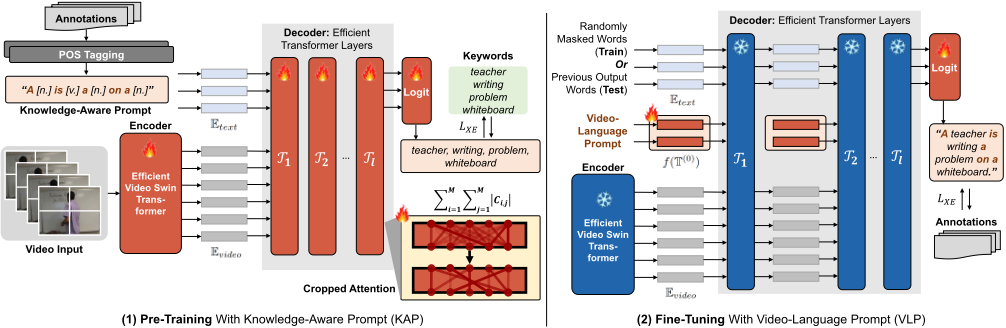
The task of video captioning is to generate a text sequence that summarizes a given video. In this work, we propose a video-language prompt tuning approach for effective caption generation. The overall model architecture of VL-Prompt is shown in Fig. 2, which consists of two key phases, pretraining with Knowledge-Aware Prompt (KAP) and finetuning with Video-Language Prompt (VLP). Intuitively, in the pre-training phase, the video encoder and decoder effectively learns the complex knowledge (the "difficult" part) about the actions and objects from the videos, with the guidance of textual knowledge-aware prompts generated from the annotations. During fine-tuning, the model only needs to tune a few trainable video-language prompts representing the structure of the caption (the "easy" part) while freezing the well-learned encoder and decoder. We adopt an Video Swin Efficient Transformer [Lin et al., 2022] as the video encoder, while the decoder is constructed by a stack of Efficient Transformer Layers [Tay et al., 2020].
3.2 Pre-Training with Knowledge-Aware Prompt
The main responsibilities of the pre-training module is to learn an efficient and effective video encoder for video representation. To this end, we introduce a novel pre-training approach with knowledge-aware prompts.
Textual Knowledge-Aware Prompt. A textual KAP is a discrete prompt which is automatically generated from the annotations of caption. For example, the KAP from original caption of "A teacher is writing a mathematical problem on a whiteboard in a classroom" is "A is writing a mathematical on a in a ". The pipeline consists of the following two steps: 1) Predict Part-Of-Speech (POS) tags on those annotations via POS tagging model (e.g., FLAIR [Akbik et al., 2019]); 2) Select important types of POS tags (e.g., noun or verb) and mask the corresponding words in the original caption; 3) The knowledge-aware prompt X = {x1, x2, ..., xm} (a.k.a., function words) contains remaining words in the caption. The purpose of pre-training is to learn effective video encoder and decoder by recovering the sequence of the marked out keywords Y = {y1, y2, ..., yn} with the guidance of the KAP. Essentially, KAP helps reduce the search space of the target words, which provides additional supervision for video captioning.
Sparse Attention Learning. Dense attention for video features in the Transformer decoder is very computationally intensive. To remove unnecessary attention and refine efficient features in the model, the decoder is supervised by the above keywords to learn the sparse attention patterns [Beltagy et al., 2020; Zaheer et al., 2020; Qin et al., 2023; Wang et al., 2022b], which reduces redundancy among the learned video representation. Following SwinBERT [Lin et al., 2022], the attention mask is defined as a learnable matrix with a size of M ×M, where M is the length of the video embedding from the encoder. Each value Ci,j in this matrix indicates the attention connection between the ith position of the input video embedding and the jth position of the output. This matrix is trained to be more sparse, with the loss designed to reduce the percentage of non-zero elements in the attention connection maps.
Learning Objective. To sum up, the final training objective of the pre-training model is defined as the Cross-Entropy (XE) loss collaborated with the number of non-zero elements in the attention connection maps:
where y and ˆ y denotes the predicted words and the groundtruth respectively, and Y represents the set of notional words (e.g., noun or verb) that removed from the sentence in the KAP. The weight of attention connection count ω will be analyzed in the experiments.
3.3 Fine-Tuning with Video-Language Prompt
With the limited memory of the GPU, it is often impossible to sample a large number of frames from the video when training a large video-language model. To reduce GPU memory usage and increase the model capability for processing more frames, inspired by VPT [Jia et al., 2022], we propose to finetune the pre-trained large-scale model with Video-Language Prompt (VLP), which introduces only a small amount of trainable parameters while keeping the model backbone frozen. We transfer the VPT into a multi-modal prompt tuning framework via designing video-language prompt tokens into the collection of text embeddings and video embeddings. We denote the collection of text embeddings and video embeddings as Etext and Evideo respectively.
Video-Language Prompt. The prompt content is defined as a learnable d-dimensional vector as Tj ∈ Rd for the jth prompt token. Those prompt tokens are fed into a fully connected linear layer f(·) to get video-language prompt embeddings. Following VPT, our tuning process with VLP also has two variants, VLP-Shallow and VLP-Deep.
VLP-Shallow. Prompts are inserted into the first Transformer layer T1 only. Each video-language prompt is a learnable d-dimensional vector. A collection of N prompt tokens is denoted as T(0) = {Tj = (t0, t1, ..., ti, ...., td) | ti ∈ R}Nj=1 , the shallow-prompted decoder with l Transformer layers is defined as:
where E(k) prompt represents the prompt embeddings computed from the kth Transformer layer (1 ≤ k < l), and Logit indicates the Transformer head which convert embeddings into the log-likelihood scores Z for word prediction.
VLP-Deep. Prompts are introduced at every Transformer layer's input space. For kth Transformer Layer Tk, we denote the collection of input learnable prompts as T(k) = {Tj = (t0, t1, ..., ti, ...., td) | pi ∈ R}Nj=1 . As shown in Fig. 2, the deep-prompted decoder with l Transformer layers is formulated as:
Different colors indicate learnable and frozen parameters.
Fine-tuning Objective. During fine-tuning, the sparse attention mask is also frozen. The VLP linear projection and the decoder head are trainable. Following BERT [Devlin et al., 2018], the ground-truth text sentence ˆ Z is randomly masked (e.g., "[MASK] teacher is [MASK] a [MASK] problem on [MASK] whiteboard in [MASK] classroom") and the model prediction Z try to store the masked tokens. Therefore, the fine-tuning objective with VLP becomes:
where z and ˆ z denotes predicted words and the ground-truth respectively. Z denotes all possible words in vocabulary.
3.4 Theoretical Analysis - Prompt Learns Prompt
The core idea of our system is that different words carry different amounts of information. For example, a frequent word (e.g., function words like "on") carries very little information, while a rare word (e.g., notional words like "teacher") is much more informative. In the following analysis, we show that the entropy of the video-language prompt (VLP) and knowledgeaware prompt (KAP) are equivalent, indicating that our model is able to transfer the prompt knowledge from KAP to VLP.
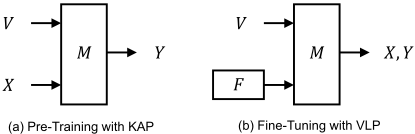
Assuming that the KAP only contains function words with all notional words (nouns and verbs) removed. Mathematically, given an input video V and a knowledge-aware prompt X, our pre-training model M is trained to output a sequence of notional words Y , as shown in Fig. 3. Those function and notional word sequences can be represented by these two random variables. According to the Shannon's theory [Shannon, 1948], the information content or entropy of the pre-trained model can be defined as a conditional entropy:
where X and Y denote the set of function words and notional words respectively. When fine-tuning the model with the video-language prompt network F , which consists of the learnable vectors T and the linear layer f(·), the final sentence output Z can be viewed as a combination of X and Y (i.e., Z is the union distribution of X and Y ). We denote pZ(z) = pX,Y (x, y). Then the joint entropy of the full model is given by:
Then we can measure the expected entropy of the videolanguage prompt F in condition of M as:
where I(M; F) denotes the mutual information between the distribution of the model M and the prompt parameters F. Since M is pre-trained to predict notional words with the guidance of function words and then frozen in the fine-tuning phase, the mutual information I(M; F) is very small. Therefore, we can approximate the expected information of our proposed video-language prompt F to the information of knowledge-aware prompt X, according to the information theory [Thomas and Joy, 2006]:
From the above analysis, we show that the information contents in video-language prompt (VLP) and knowledge-aware prompt (KAP) are equivalent, indicating that VLP learns from KAP, to guide the recovery of the full caption. The full sentence recovery can be viewed as a diffusion process, where function words are diffused among those predicted notional words and then restored.
4 Experiments
4.1 Experimental Setup
Datasets. We conduct experiments on two public video captioning datasets: a) MSR-VTT [Xu et al., 2016] consists of 10K video clips. Each video clip has 20 ground-truth captions. We use the standard split, which has 6.5K training videos, 497 validation videos and 2.9K testing videos. b) MSVD is a collection of 2K video clips downloaded from YouTube. Each video clip has roughly 40 ground-truth captions written by humans. Similar to the prior articles [Chen et al., 2018; Zheng et al., 2020], we use the standard split which contains 1.2K training videos, 100 validation videos, and 670 test videos. We further leverage a larger dataset, VATEX, to study the effect of pre-training. VATEX contains 41.3K videos. Each video clip has 20 ground-truth captions. We use the official training set for training, and evaluate the results using the public test set.
Implementation Details. The number of the Swin Transformer layers in the video encoder is set to 3. The output length of the video feature embedding from the encoder is set to M = 392. The dimension of the video feature embedding from the encoder is 768, while the dimension of the hidden state of the decoder is 512. To ensure the same dimensionality of the video embedding in the encoder and decoder, we transform the video embedding using a linear fully connected network. The number of the transformer layers in the decoder is set to 11. The dimension of the video-language prompt is set to d = 1024. The number of the video-language prompt tokens is set to 100. The max length of the text sequence is set to 50. The max epoch number is set to 10 for both pretraining and fine-tuning. The learning rate is set to 10-4 in pre-training, and 10-5 in fine-tuning.
4.2 Main Results
We compare our VL-Prompt with several state-of-the-art methods on the above commonly used benchmarks. Following previous research [Yan et al., 2022b; Lin et al., 2022], we provide detailed comparisons using a diverse set of performance metrics, including BLEU4 [Papineni et al., 2002], METEOR [Banerjee and Lavie, 2005], ROUGE-L [Lin and Och, 2004] and CIDEr [Vedantam et al., 2015]. Table 1 shows detailed comparisons with eleven LSTM-based and five transformer-based methods for video captioning. In our method, we sample a large number of frames (F = 64) from each video, since our Efficient VL Transformer can avoid overly dense features. It can be seen from the results that: a) Compared to those methods using 2D and 3D CNN encoders, Transformer based method can jointly learn the features of 2D appearance and 3D motion. For example, the popular SAAT [Zheng et al., 2020] uses spatial and temporal feature to represent the static scene and the dynamic motions, but it fails to jointly train the 2D and 3D representation, which can be learned via a visual Transformer. Thus, on MSR-VTT test, our method outperforms SAAT ↑ 4.3 in B@4, ↑ 2.4 in M, ↑ 1.5 in R, and ↑ 4.3 in terms of CIDEr. b) Compared to those methods using Transformer as decoder, prompt tuning methods rely on the well pre-trained large-scale models, which is difficult to be trained. SwinBERT [Lin et al., 2022]
| Encoder | Decoder | PT | MSR-VTT | MSVD | |||||||||
|---|---|---|---|---|---|---|---|---|---|---|---|---|---|
| Method | 2DAppearance | 3DMotion | F | B@4 | M | R | C | B@4 | M | R | C | ||
| SA-LSTM [Xu et al., 2016] | VGG | C3D | × | 16 | 36.3 | 25.5 | 58.3 | 39.9 | 45.3 | 31.9 | 64.2 | 76.2 | |
| RecNet [Wang et al., 2018a] | VGG | C3D | × | - | - | 26.6 | 59.3 | 42.7 | 52.3 | 34.1 | 69.8 | 80.3 | |
| ORG-TRL [Zhang et al., 2020] | IncepResnetV2 | C3D | × | 28 | 43.6 | 29.7 | 62.1 | 50.9 | 54.3 | 36.4 | 73.9 | 95.2 | |
| STGraph [Pan et al., 2020] | ResNet-101 | I3D | × | 10 | 40.5 | 28.3 | 60.9 | 47.1 | 52.2 | 36.9 | 73.9 | 93.0 | |
| SGN [Ryu et al., 2021] | ResNet-101 | 3D-ResNext | × | 30 | 40.8 | 28.3 | 60.8 | 49.5 | 52.8 | 35.5 | 72.9 | 94.3 | |
| RCG [Zhang et al., 2021] | ResNet-152 | I3D | LSTM | × | 28 | 42.8 | 29.3 | 61.7 | 52.9 | - | - | - | - |
| HRL [Wang et al., 2018b] | ResNet-152 | - | × | - | 41.3 | 28.7 | 61.7 | 48.0 | - | - | - | - | |
| PickNet [Chen et al., 2018] | ResNet-152 | - | × | 7 | 38.9 | 27.2 | 59.5 | 42.1 | 46.1 | 33.1 | 69.2 | 76.0 | |
| POSRL [Wang et al., 2019] | IncepResnetV2 | I3D | × | 64 | 41.3 | 28.7 | 62.1 | 53.4 | 53.9 | 34.9 | 72.1 | 91.0 | |
| SAAT [Zheng et al., 2020] | IncepResnetV2 | C3D | × | 28 | 39.9 | 27.7 | 61.2 | 51.0 | 46.5 | 33.5 | 69.4 | 81.0 | |
| HMN [Ye et al., 2022] | IncepResnetV2 | C3D | × | 16 | 43.5 | 29.0 | 62.7 | 51.5 | 59.2 | 37.7 | 75.1 | 104.0 | |
| GL-RG [Yan et al., 2022b] | ResNeXt-101 | 3D-Resnet-18 | × | 30 | 42.9 | 29.9 | 62.2 | 54.3 | 60.5 | 38.9 | 76.4 | 101.0 | |
| O2NA [Liu et al., 2021a] | ResNet-101 | 3D-ResNext | × | 8 | 41.6 | 28.5 | 62.4 | 51.1 | 55.4 | 37.4 | 74.5 | 96.4 | |
| SwinBERT [Lin et al., 2022] | Video Swin Transformer | × | 64 | 41.9 | 29.9 | 62.1 | 53.8 | 58.2 | 41.3 | 77.5 | 120.6 | ||
| VPT [Jia et al., 2022] | ViT | Trans. | ✓ | 32 | 41.2 | 27.9 | 61.5 | 50.3 | 54.6 | 36.0 | 73.1 | 94.7 | |
| Prompting [Ju et al., 2022] | CLIP Image Encoder | ✓ | 16 | 42.0 | 28.8 | 62.3 | 52.2 | 56.4 | 38.6 | 75.4 | 99.8 | ||
| VoP [Huang et al., 2022] | CLIP Image Encoder | ✓ | 12 | 42.1 | 28.9 | 61.9 | 51.7 | 57.9 | 40.2 | 76.3 | 105.9 | ||
| Ours (VL-Prompt) | Efficient VL Transformer | ✓ | 64 | 43.2 | 30.1 | 62.7 | 55.3 | 63.5 | 41.6 | 78.9 | 128.1 | ||
| Method | B@4 | M | R | C | training fps |
|---|---|---|---|---|---|
| VL-Prompt | 63.5 | 41.6 | 78.9 | 128.1 | 7.7 |
| w/o KAP | 53.1 | 34.6 | 72.4 | 102.9 | 8.1 |
| w/o VLP | 59.3 | 37.8 | 76.1 | 115.6 | 8.0 |
introduces a BERT-based training method with sparse attention, which indeed benefits the pre-training of the large-scale video-language models, but fails to explore the inner relationships over the semantic context. Thus, on MSVD test, our method outperforms SwinBERT ↑ 5.3 in B@4, ↑ 0.3 in M, ↑ 1.4 in R, and ↑ 7.5 in terms of CIDEr. c) VL-Prompt outperforms those prompt tuning baselines, indicating the effectiveness of our prompt design and learning. The learned video-language prompts are more explainable [Wang et al., 2023], which effectively decouple the structured knowledge in the captions and restore them efficiently.
4.3 Ablation Study
We conduct a comprehensive ablation study on MSVD and MSR-VTT benchmarks to investigate the capability of the proposed model.
Impact of KAP and VLP. To analyze the impact of KAP and VLP, we conduct ablation experiments on two variants by removing KAP and VLP from the VL-Prompt respectively. As reported in Table 2, we observe significant performance drop after removing either type of prompts, indicating the importance of both KAP and VLP in the model. This demonstrates that our VLP prompts can capture the internal relations, which denote the semantic correlation between tokens within a sentence, by applying reasoning and linking the input keywords (nouns and verbs) together. Nevertheless, our VL-Prompt with both prompts achieves the best performance with slightly lower training fps.
| Masking | B@4 | M | R | C | Attn. | training fps |
|---|---|---|---|---|---|---|
| KAP | 63.5 | 41.6 | 78.9 | 128.1 | 12% | 7.7 |
| Alternate | 56.8 | 36.9 | 74.8 | 104.3 | 59% | 7.5 |
| Random | 57.7 | 37.8 | 75.6 | 106.2 | 31% | 7.5 |
| Noun | 58.7 | 41.0 | 77.8 | 118.2 | 10% | 7.8 |
| Verb | 58.8 | 41.2 | 77.7 | 117.7 | 8% | 7.9 |
| Method | B@4 | M | R | C | fps |
|---|---|---|---|---|---|
| Full Fine-Tuning | 65.2 | 41.3 | 80.6 | 147.0 | 7.6 |
| Linear Probing | 62.3 | 41.1 | 80.1 | 140.3 | 8.0 |
| VLP-Shallow | 65.5 | 42.0 | 80.3 | 150.2 | 8.1 |
| VLP-Deep | 66.4 | 42.7 | 81.3 | 153.8 | 7.9 |
Prompt Design in KAP. We further conduct experiments of different masking strategies in learning context prompt, including alternative masking, random masking, noun masking and verb masking, to understand the effectiveness of different prompt designs. Table 3 shows the ablation results on MSVD. It can be seen that our original KAP (Noun and Verb masking) outperforms all other strategies with big margins, while only masking nouns or verbs achieves a faster speed. This is consistent with our expectation as these nouns and verbs are the most informative words in the caption, representing the objects and actions in the video.
VLP-Shallow vs. VLP-Deep vs. Full. We compare the results of different VLPs with Linear Probing and Full finetuning in Table 4. It is clear that VLP-Deep outperforms all the other parameter-efficient tuning protocols, including VLP-Shallow, Linear Probing, and even outperforms full fine-tuning. VLP-Shallow achieves the fast speed with a comparable performance over all methods. Similar observations have been found in VPT [Jia et al., 2022].
| D L | 10 | 20 | 50 | 100 | 200 |
|---|---|---|---|---|---|
| 256 | 139.9 | 141.6 | 143.1 | 145.4 | 148.5 |
| 512 | 142.7 | 143.5 | 148.0 | 152.9 | 153.7 |
| 1024 | 146.3 | 149.8 | 152.1 | 153.8 | 153.4 |
| 2048 | 147.2 | 150.1 | 152.9 | 153.0 | 153.6 |
| Method | F in Pre-Train | F in Fine-Tune | ||||
|---|---|---|---|---|---|---|
| 4 | 8 | 16 | 32 | 64 | ||
| w/o KAP | 4 | 125.3 | 126.8 | 127.6 | 129.1 | 131.1 |
| 16 | 131.5 | 134.1 | 136.0 | 138.2 | 139.7 | |
| VL-Prompt | 4 | 136.0 | 139.9 | 146.5 | 150.3 | 152.7 |
| 16 | 135.8 | 137.2 | 144.1 | 149.6 | 153.8 | |
Prompt Length & Dimension. To investigate the impact of prompt length and dimension in VLP, we conduct ablation study of different combinations of VLP length and dimension. As shown in Table 5, the best choice for prompt tokens is a length of 100 and a dimension of 1024.
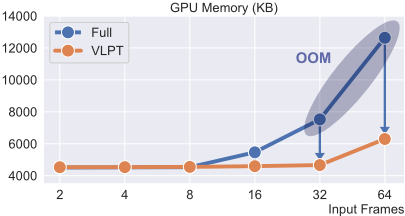
Sampled Frame Number. We uniformly sample F = {2, 4, 8, 16, 32, 64} frames from the given video clip to train and test our method on both MSVD and MSR-VTT datasets. As we increase the number of frames, we observe consistent performance improvements in terms of CIDEr (see Table 6). We also find that without VLP fine-tuning, the network is too large for F = {32, 64} which causes an Out-Of-Memory error, as shown in Fig. 4. In contrast, the network works well on that 11GB GPU during fine-tuning with our VLP, demonstrating the efficiency of our VL-Prompt.
4.4 Effect of Pre-training
To further illustrate the effect of our proposed pre-training method, Table 7 shows the performance of VL-Prompt with additional pre-training data. It can be seen that pre-training on a large dataset achieves better performance in all cases, especially when combining with large VATEX dataset in pretraining. For example, VL-Prompt improves the performance by ↑ 1.2 and ↑ 1.7 in terms of B@4 on MSVD through adding MSR-VTT and VATEX to pre-training, respectively. Moreover, we evaluate the efficiency of our approach by comparing it with the baselines. For example, on the MSVD dataset, our model attains an average fps of 7.7, and outperforms SwinBERT and GL-RG in terms of efficiency (which achieve 7.2 and 6.3 fps respectively). This observation validates the effectiveness of pre-training, which is crucial in the later VLP fine-tuning.
| Fine-Tune | Add. Data | B@4 | M | R | C |
|---|---|---|---|---|---|
| MSR-VTT | MSVD | 43.6↑0.4 | 30.4↑0.3 | 62.9↑0.2 | 55.4↑0.1 |
| VATEX | 44.2↑1.0 | 30.6↑0.5 | 63.4↑0.7 | 55.7↑0.4 | |
| MSVD | MSR-VTT VATEX | 64.7↑1.2 65.2↑1.7 | 42.2↑0.6 | 79.4↑0.5 | 128.4↑0.3 |
| 42.4↑0.8 | 79.8↑0.9 | 128.6↑0.5 |
| ω | 0 | 0.1 | 0.3 | 0.5 | 0.7 |
|---|---|---|---|---|---|
| CIDEr on MSVD | 102.9 | 115.4 | 119.5 | 128.1 | 124.2 |
4.5 Impact of ω
To understand the impact of the hyper-parameter ω, we evaluate the model performance by varying the hyper-parameters ω from {0, 0.1, 0.3, 0.5, 0.7}. The model performances with different hyper-parameter values are reported in Table 8. It can be seen that ω = 0.5 achieves the best performance, indicating that the model needs to identify a good trade-off between efficiency and effectiveness.
5 Conclusion
In this paper, we propose a novel prompt tuning based video captioning approach, VL-Prompt, by designing two different sets of prompts in pre-training and fine-tuning phases respectively. We first pre-train a video-language model to extract key information with the guidance of knowledge-aware prompts. Then, we design a video-language prompt to transfer the knowledge from the knowledge-aware prompts and fine-tune the model to generate full captions. Experimental results show the superior performance of our approach over several state-of-the-art baselines. Theoretical analysis on how the information from knowledge-aware prompts is transferred to the video-language prompts is also conducted. A potential drawback of our method is the low generalization ability that may result from the limited number of parameters and data samples. In future, we plan to investigate VL-Prompt in zero-shot settings. We also plan to apply VL-Prompt in other downstream tasks such as VQA. We hope this work can inspire future studies in video-language prompt tuning.
@inproceedings{ijcai2023p180,
  title     = {Prompt Learns Prompt: Exploring Knowledge-Aware Generative Prompt Collaboration For Video Captioning},
  author    = {Yan, Liqi and Han, Cheng and Xu, Zenglin and Liu, Dongfang and Wang, Qifan},
  booktitle = {Proceedings of the Thirty-Second International Joint Conference on
               Artificial Intelligence, {IJCAI-23}},
  publisher = {International Joint Conferences on Artificial Intelligence Organization},
  editor    = {Edith Elkind},
  pages     = {1622--1630},
  year      = {2023},
  month     = {8},
  note      = {Main Track},
  doi       = {10.24963/ijcai.2023/180},
  url       = {https://doi.org/10.24963/ijcai.2023/180},
}
TY - CPAPER TI - Prompt Learns Prompt: Exploring Knowledge-Aware Generative Prompt Collaboration For Video Captioning AU - Yan, Liqi AU - Han, Cheng AU - Xu, Zenglin AU - Liu, Dongfang AU - Wang, Qifan T2 - Proceedings of the Thirty-Second International Joint Conference on Artificial Intelligence, IJCAI-23 PB - International Joint Conferences on Artificial Intelligence Organization PY - 2023 SP - 1622 EP - 1630 DO - 10.24963/ijcai.2023/180 UR - https://doi.org/10.24963/ijcai.2023/180 ER -Copied
Machine-readable versions of this paper, for tools and AI agents:





