
Targeting Minimal Rare Itemsets from Transaction Databases
Proceedings of the Thirty-Second International Joint Conference on Artificial Intelligence. Main Track. Pages 2114-2121.
https://doi.org/10.24963/ijcai.2023/235
Keywords
- Data Mining: DM: Frequent pattern mining
- Constraint Satisfaction and Optimization: CSO: Satisfiabilty
Abstract
The computation of minimal rare itemsets is a well known task in data mining, with numerous applications, e.g., drugs effects analysis and network security, among others. This paper presents a novel approach to the computation of minimal rare itemsets. First, we introduce a generalization of the traditional minimal rare itemset model called k-minimal rare itemset. A k-minimal rare itemset is defined as an itemset that becomes frequent or rare based on the removal of at least k or at most (k − 1) items from it. We claim that our work is the first to propose this generalization in the field of data mining. We then present a SAT-based framework for efficiently discovering k-minimal rare itemsets from large transaction databases. Afterwards, by partitioning the k-minimal rare itemset mining problem into smaller sub-problems, we aim to make it more manageable and easier to solve. Finally, to evaluate the effectiveness and efficiency of our approach, we conduct extensive experimental analysis using various popular datasets. We compare our method with existing specialized algorithms and CP-based algorithms commonly used for this task.
- [Belaid et al., 2019] Mohamed-Bachir Belaid, Christian Bessiere, and Nadjib Lazaar. Constraint programming for mining borders of frequent itemsets. In IJCAI, pages 1064-1070, 2019. IJCAI
- [Boudane et al., 2016] Abdelhamid Boudane, Saïd Jabbour, Lakhdar Sais, and Yakoub Salhi. A SAT-based approach for mining association rules. In IJCAI, pages 2472-2478, 2016.
- [Boudane et al., 2018] Abdelhamid Boudane, Saïd Jabbour, Lakhdar Sais, and Yakoub Salhi. SAT-based data mining. Int. J. Artif. Intell. Tools, 27(1):1-24, 2018.
- [Darrab et al., 2021] Sadeq Darrab, David Broneske, and Gunter Saake. Modern applications and challenges for rare itemset mining. Int J Mach Learn Comput, 11(3):208-218, 2021.
- [Dlala et al., 2018] Imen Ouled Dlala, Saïd Jabbour, Badran Raddaoui, and Lakhdar Sais. A parallel SAT-based frame- work for closed frequent itemsets mining. In CP, pages 570-587, 2018.
- [Fournier-Viger et al., 2017] Philippe Fournier-Viger, Jerry Chun-Wei Lin, Bay Vo, Tin Truong Chi, Ji Zhang, and Hoai Bac Le. A survey of itemset mining. Wiley Interdisci- plinary Reviews: Data Mining and Knowledge Discovery, 7(4):e1207, 2017.
- [Hidouri et al., 2021a] Amel Hidouri, Saïd Jabbour, Imen Ouled Dlala, and Badran Raddaoui. On minimal and maximal high utility itemsets mining using propositional satisfiability. In IEEE International Conference on Big Data (Big Data), pages 622-628, 2021.
- [Hidouri et al., 2021b] Amel Hidouri, Saïd Jabbour, Badran Raddaoui, and Boutheina Ben Yaghlane. Mining closed high utility itemsets based on propositional satisfiability. Data Knowl. Eng., 136:101927, 2021.
- [Hidouri et al., 2022] Amel Hidouri, Saïd Jabbour, and Bad- ran Raddaoui. On the enumeration of frequent high utility itemsets: A symbolic AI approach. In CP, pages 27:1- 27:17, 2022.
- [Hu and Martin, 2004] Alan J Hu and Andrew K Martin. Formal Methods in Computer-Aided Design: 5th Inter- national Conference, FMCAD 2004, Austin, Texas, USA, November 15-17, 2004, Proceedings. Springer Science & Business Media, 2004.
- [Izza et al., 2020] Yacine Izza, Said Jabbour, Badran Rad- daoui, and Abdelahmid Boudane. On the enumeration of association rules: A decomposition-based approach. In IJ- CAI, pages 1265-1271, 2020. IJCAI
- [Jabbour et al., 2016] Saïd Jabbour, Nizar Mhadhbi, Abde- sattar Mhadhbi, Badran Raddaoui, and Lakhdar Sais. Summarizing big graphs by means of pseudo-boolean con- straints. In IEEE International Conference on Big Data, pages 889-894, 2016.
- [Jabbour et al., 2017] Saïd Jabbour, Nizar Mhadhbi, Badran Raddaoui, and Lakhdar Sais. A SAT-based framework for overlapping community detection in networks. In PAKDD, pages 786-798, 2017.
- [Jabbour et al., 2018] Saïd Jabbour, Fatima Ezzahra Mana, Imen Ouled Dlala, Badran Raddaoui, and Lakhdar Sais. On maximal frequent itemsets mining with constraints. In CP, pages 554-569, 2018.
- [Jabbour et al., 2020] Saïd Jabbour, Nizar Mhadhbi, Badran Raddaoui, and Lakhdar Sais. SAT-based models for over- lapping community detection in networks. Computing, 102(5):1275-1299, 2020.
- [Jabbour et al., 2022] Saïd Jabbour, Nizar Mhadhbi, Badran Raddaoui, and Lakhdar Sais. A declarative framework for maximal k-plex enumeration problems. In AAMAS, pages 660-668, 2022.
- [Mannila and Toivonen, 1997] Heikki Mannila and Hannu Toivonen. Levelwise search and borders of theories in knowledge discovery. Data mining and knowledge dis- covery, 1(3):241-258, 1997.
- [Morgado and Marques-Silva, 2005] António Morgado and João Marques-Silva. Algorithms for propositional model enumeration and counting. Technical report, Instituto de Engenharia de Sistemas e Computadores, Investigac ¸ão e Desenvolvimento em Lisboa, 2005.
- [Szathmary et al., 2007] Laszlo Szathmary, Amedeo Napoli, and Petko Valtchev. Towards rare itemset mining. In IC- TAI, pages 305-312, 2007.
- [Szathmary et al., 2012] Laszlo Szathmary, Petko Valtchev, Amedeo Napoli, and Robert Godin. Efficient vertical min- ing of minimal rare itemsets. In CLA, 2012.
- [Zaki, 1999] Mohammed J Zaki. Parallel and distributed as- sociation mining: A survey. IEEE concurrency, pages 14- 25, 1999.
- [Zhang et al., 1996] Hantao Zhang, Maria Paola Bonacina, and Jieh Hsiang. Psato: a distributed propositional prover and its application to quasigroup problems. Journal of Symbolic Computation, pages 543-560, 1996.
- [Zhang et al., 2012] Shuyuan Zhang, Sharad Malik, and Rick McGeer. Verification of computer switching net- works: An overview. In International Symposium on Au- tomated Technology for Verification and Analysis, pages 1-16, 2012.
References were extracted automatically from the PDF and may contain errors.
Full text extracted automatically from the PDF; figures, tables and equations may differ. The PDF is the version of record.
1 Introduction
Pattern extraction is a core topic in data mining. It aims to automatically infer knowledge from data based on various kinds of interesting measures. This involves the identification of relevant patterns embedded in data. These patterns represent the properties of the data satisfying users' preferences. Frequent Itemset Mining (FIM, for short) is a typical task of data analysis area that aims to find objects that frequently occur together among data. The first original motivation for FIM was found in market basket analysis, which involves exploring transactions in retails to discover frequently co-occurring products.
Earlier work has often focused on mining frequent patterns (see [Fournier-Viger et al., 2017] for a detailed survey). However, in some cases certain items have a much lower chance to frequently appear than others. Hence, patterns appearing rarely, i.e., itemsets having a low frequency in the database, are overlooked since they are considered uninteresting and eliminated using the frequency constraint. In contrast, it has been shown recently that in many real-life applications, targeting infrequent itemsets, called rare itemsets, may be more informative than discovering frequently occurring patterns [Darrab et al., 2021]. For instance, in the medical field, infrequent patterns may be more appealing because their discovery would aid in the avoidance of negative consequences and the formulation of healthcare decisions. During the Covid-19 pandemic, one might be interested for example in analyzing clinical data to discover unusual combinations of disease symptoms and risk factors that have not previously been identified. These patterns could be used as surrogate indicators to identify patients with Covid-19 and predict their clinical outcomes, so that appropriate treatments can be provided. Another example of using rare itemsets is that in the banking field where finding irregular behaviors could be helpful for identifying potentially fraudulent transactions.
The problem of mining rare itemsets from transaction databases is quite challenging since they are practically much more numerous than frequent ones. To overcome this issue, a condensed representation of rare itemsets, coined minimal rare itemsets, has been considered. Minimal rare itemsets are of interest since they represent a border below which all subsets are frequent itemsets [Mannila and Toivonen, 1997]. Some algorithms have been proposed for computing minimal rare itemsets in transaction databases (e.g., [Szathmary et al., 2007; Szathmary et al., 2012; Belaid et al., 2019]).
In this paper, we are primarily interested in generalizing the concept of minimal rare itemset, and then computing these motifs in large transaction databases. In fact, the frequency of some itemsets cannot exceed the minimum frequency threshold due to the presence of some items. As a result, these itemsets are regarded as rare. In this case, it may be more interesting to focus on finding this kind of itemsets while relaxing the fequency constraint over a fixed number of items. This representation will be referred to as k-minimal rare itemsets. In more detail, a k-minimal rare itemset X is an itemset that becomes frequent (resp. rare) when removing at least (resp. most) k (resp. (k-1)) items from it. Clearly, a 1-minimal rare itemset is a minimal rare itemset. Interestingly, such generalization could aid in the discovery of what may be relevant in data in real applications. In fact, k-minimal rare itemsets can be used to identify errors in certain processes. These itemsets, for example, aid in the discovery of the causes of abnormal effects of drugs taken by patients in the medical field. Moreover, such patterns can assist a retailer in identifying irrelevant purchased products, allowing her/him to provide the appropriate product combinations. A retail store manager can use this knowledge to assess the risk of selling a product by removing it from the market.
Our Contributions. In this paper, we first present a generalization of the minimal rare itemset model, which we call k-minimal rare itemset. Note that our framework is general enough to encompass minimal rare itemsets as a specific case. Then, we provide a symbolic Artificial Intelligence (AI) approach to discovering k-minimal rare itemsets from transaction databases. In detail, we present a SAT-based framework for translating the task of finding k-minimal rare itemsets into a propositional satisfiability problem that can be solved using a SAT solver. To tackle the scalability issue, we provide afterwards a splitting-based approach enabling to partition the database into subsets with lower size that can be independently mined without jeopardizing completeness. Finally, we conduct extensive experiments on different popular real-world datasets to evaluate the efficiency of our approach w.r.t. the state-of-the-art methods.
2 General Setting
2.1 Propositional Satisfiability
Let L be a propositional language built up inductively from a countable set P of propositional variables, the Boolean constants ⊤ (true or 1) and ⊥ (false or 0) and the classical logical connectives {¬, ∧, ∨,→,↔} in the usual way. To range over the elements of P, we use the letters x, y, z, and so on. A literal is a propositional variable (x) of P or its negation (¬x). A clause is a (finite) disjunction of literals. Propositional formulas of L are denoted by Φ, Ψ, etc. For any formula Φ from L, P(Φ) denotes the symbols of P occurring in Φ. A formula in conjunctive normal form (or simply CNF) is a finite conjunction of clauses. A Boolean interpretation I of a CNF formula Φ is defined as a function from P(Φ) to {0, 1}. A model of Φ is an interpretation I that satisfies Φ (denoted I |= Φ), that is, if there exists an interpretation I : P(Φ) → {0, 1} that satisfies all clauses in Φ. The formula Φ is satisfiable if it has at least one model. We write M(Φ) as shorthand for the set of models of a formula Φ.
The propositional satisfiability problem (in short, SAT) is the decision problem for propositional logic. Given a CNF formula Φ, SAT determines whether there exists a model of Φ. SAT solvers have been used in a variety of real-world scenarios, e.g., electronic design automation, software and hardware verification [Morgado and Marques-Silva, 2005], etc. Note that the aforementioned applications require the enumeration of all possible models of the corresponding CNF formula. This task, known as model enumeration, is of great importance. For instance, in diagnosis, the user is interested in finding all possible explanations rather than just whether one exists. Model enumeration problems find applications in a variety of tasks, including network verification [Zhang et al., 2012], model checking [Hu and Martin, 2004] as well as several data mining tasks, e.g., [Dlala et al., 2018; Jabbour et al., 2018; Boudane et al., 2016; Izza et al., 2020; Hidouri et al., 2021b; Hidouri et al., 2021a; Hidouri et al., 2022], and graph analysis [Jabbour et al., 2016; Jabbour et al., 2017; Jabbour et al., 2022]. In the last decade, several SAT-based proposals for modeling and solving pattern mining problems have indeed studied. Because they rely on generic and declarative solvers, these approaches are suitable for modeling a variety of mining tasks.
2.2 Overview of the Rare Itemsets
Let Ω be a universe of items (or symbols) that may represent articles in a supermarket, web pages, or a collection of attributes or events. We denote the elements of Ω by the letters a, b, c, etc. An itemset (or simply a motif ) is a subset of items in Ω, that is, X ⊆ Ω. The set of all itemsets over Ω, denoted as 2Ω, are represented by the capital letters X, Y,Z, etc. A transaction database is a finite nonempty set of transactions or records D = {T1, T2, . . . , Tm}. We denote by Da the sub-base containing the set of transactions where a appears. Given a transaction database D and an itemset X, the cover of X in D is a mapping 2X → 2D which maps each itemset X to a set of transactions in D containing X. More formally, Cover(X,D) = {i ∈ [1..m] | Ti ∈ D and X ⊆ Ti}. The cardinality of the cover of the itemset X represents its support (also called frequency). We write Supp(X,D) for the support of X in the dataset D, i.e., Supp(X,D) = |Cover(X,D)|. When there is no confusion, the cover and support will be simply denoted as Cover(X) and Supp(X), respectively. We also write X <freq Y iff Supp(X) ≤ Supp(Y ), for two itemsets X and Y . Next, we introduce some useful notions.
Definition 1 Let D be a transaction database, X an itemset and λ ≥ 1 a minimum support threshold. Then, X is a:
- frequent itemset in D iff Supp(X) ≥ λ.
- rare itemset in D iff Supp(X) < λ.
- minimal rare itemset in D iff (i) X is rare, and (ii) ∀ Y ⊂X, Y is frequent.
Let us write MRIs to be the set of minimal rare itemsets in D. Obviously, every rare itemset is an infrequent itemset in D, and any super-set of a MRI is also a rare itemset.
Definition 2 Given a transaction database D, an itemset X is called a minimal (key) generator in D iff ∀ Y ⊂ X, Supp(X) < Supp(Y ).
Given a database D, it has been shown in [Szathmary et al., 2012] that all minimal rare itemsets are generators in D.
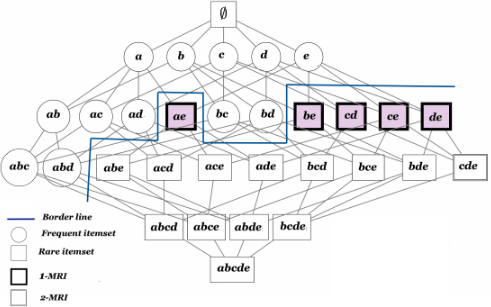
Example 1 Let us consider the transaction database given in Table 1. Note that each transaction contains some products purchased in a grocery store. The minimum support threshold λ is set to 3.
Figure 1 depicts the search space of (in)frequent itemsets (we refer to each product by a letter, e.g., a for apple, b for bread, etc.). The lattice is basically divided into two zones according to λ. The top zone represents frequent itemsets while the bottom one consists of rare itemsets. A line separates these two zones which are complementary subsets of the powerset 2|Ω| . In this paper, we are interested in the second zone, i.e., the set of all rare itemsets in D.
| TID | Items | ||||
|---|---|---|---|---|---|
| 1 | apple | bread | cheese | diapers | |
| 2 | apple | bread | cheese | ||
| 3 | apple | bread | cheese | eggs | |
| 4 | apple | bread | diapers | eggs | |
| 5 | apple | bread | diapers | ||
| 6 | eggs | ||||
As we have seen, a minimal rare itemset is a rare itemset that by removing one item from it becomes frequent. Next, we generalize such condition to consider the deletion of one or more items. Following that, we present our formalization of this generalization as follows.
Definition 3 Let D be a transaction database, λ a minimum support threshold, and k a positive integer. Then, an itemset X is called a k-minimal rare itemset (k-MRI, in short) if (i) ∀ Y ⊂ X s.t. |Y | ≤ k - 1, X \ Y is rare, and (ii) ∀Y ⊂ X s.t. |Y | ≥ k, X \ Y is frequent.
Intuitively, Definition 3 extends the minimal rare itemset model by requiring that the removal of (k-1) items from the itemset does not make it frequent, but the deletion of at least k items does. It is also worthy to say that a k-minimal rare itemset is of size at least k. To our knowledge, this is the first generalization of minimal rare itemsets in data mining. Interestingly, our model encompasses the minimal rare itemsets as a specific case by setting k to 1.
Example 2 Consider the transactions in Table 1 and λ = 3. Then, X = {c, d, e} is a 2-MRI. In fact, {c}, {d}, {e} are frequent while {c, d, e}, {c, d}, {c, e}, {d, e} are not.
Proposition 1 Let D be a transaction database and k > 1. If X is a k-MRI in D, then for all x ∈ X, X \ {x} is a (k - 1)-MRI in D.
Proposition 2 Given a transaction database D and a minimum support threshold λ, if X is a 1-MRI in D with X = Y ⊎ Z, then Z is a 1-MRI in {Ti ∈ D | Y ⊆ Ti}.
3 SAT-based Encoding for k-MRIs Mining
This section presents our SAT-based encoding for the kminimal rare itemset enumeration problem. Given a transaction database D, our key idea is to encode the task of k-MRIs computation into a propositional formula whose models correspond exactly to the set of k-minimal rare itemsets of D. In this view, the problem of mining such motifs is translated to the one of computing all models of a propositional formula.
We start by providing a SAT encoding for the enumeration of 1-MRIs before proposing a generalization for the k-MRIs mining problem. For that purpose, to establish a one-to-one mapping between the models of our SAT-based encoding and the set of 1-MRIs in the database D, each item a ∈ Ω is associated with a propositional variable xa where xa is true iff a belongs to the candidate rare itemset, while each transaction Ti in D is associated with two propositional variables pi and qi where pi (resp. qi) is true iff the transaction Ti contains the candidate rare itemset (resp. the candidate rare itemset except one item).
Now, in order to establish a mapping between the set of 1-MRIs in the database D and the models of the corresponding propositional formula, we introduce the following logical constraints.
Cover constraint. The first constraint allows to capture the cover of the itemset and it can be expressed as follows:
Constraint (1) means that the itemset appears in the transaction Ti if all items that do not occur in that itemset are set to false.
Infrequency constraint. The second constraint ensures that the candidate itemset is not frequent in D.
Given a minimum support threshold λ, Constraints (1) and (2) allow to find the set of all rare itemsets in D.
Now, in order to find a 1-MRI, one needs to identify the set of transactions matching X in D as well as those that match X\{a} for all a ∈ X. This can be expressed by the following constraint.
Generator constraint. This constraint allows to catch the set of transactions in the database D involving the whole itemset except one item.
In other words, enforcing a rare itemset X to be minimal is equivalent to enforcing the itemset X \ {a} (∀a ∈ X) to be frequent. This requirement can be modeled with the next constraint.
Frequency constraint. This constraint requires that each itemset X \ {a} (∀a ∈ X) must be frequent in D.
Example 3 Consider again Table 1 and let λ = 3. Then, the cover, infrequency, generator and frequency constraints can be written as given in Figure 2.
Property 1 Each model of the formula ΦλD = (1) ∧ (2) ∧ (3) ∧ (4) corresponds to a 1-MRI in the database D.
The next result shows that the formula ΦλD entails the following set of clauses.
Proposition 3 For a given transaction database D, we have ΦλD |= Θ:
It is worth noting that Constraint (5) can be useful for unit propagation. In fact, this constraint enforces the rare itemset to be a generator. Indeed, it expresses that there exists a transaction in which X \{a} appears for each a ∈ X. As this property holds for every a ∈ X, then X is a generator.
Interestingly, the previous encoding can be generalized to deal with the problem of mining the set of all k-MRIs from a given transaction database. To do so, let us present the following three logical constraints.
Let us now go over these constraints in greater depth. To compute the set of all k-MRIs in D, we need first to identify the transactions involving the whole itemset (i.e., pi,0), those containing the itemset except one item (i.e., pi,1), until those with k missing items (i.e., pi,k). Constraint (6) enables the identification of such a set of transactions. Next, Constraint (7) requires the deletion of (k - 1) items from the candidate itemset in order for it to be rare. This requires an additional constraint for each subset of items from Ω of size (k - 1). Note that in this case the number of constraints can be exponential w.r.t. k. Lastly, to allow the removal of k items, we need to identify the transactions containing partially the itemset (i.e., the candidate itemset without k items). This condition can be modelled with Constraint (8). Notice that for k = 1, the SAT encoding of 1-MRIs corresponds to ΦλD by substituting pi,0 (resp. pi,1) by pi (resp. qi). Also, it is worthy to note that Constraint (6) is a cardinality constraint of the form ∑ni=1 xi = k. Such constraint can be rewritten as follows:
To close this section, we note that the three constraints (6), (7) and (8) clearly induce a large number of propositional variables that grow rapidly with the values of k.
Proposition 4 Given a transaction database D, a minimum support threshold λ, and a positive integer k > 0, then the propositional formula Φk,λ D = (6) ∧ (7) ∧ (8) encodes the problem of mining k-MRIs in D.
4 Towards aMore Efficient Computation of Rare Itemsets
The practical SAT-based encoding of k-MRIs mining problem, defined in Section 3, is polynomial in k, |Ω|, and |D|. In particular, the number of propositional variables and clauses is bounded by O(|Ω|×|D|2 +|Ω|2 ×|D|) for 1-MRIs. Unfortunately, even if such complexity is polynomially bounded, it becomes challenging and time-consuming for large datasets. This is due especially to the cardinality constraint (4) (for 1MRIs) that involves all the transactions of D. Hence, the size of the whole encoding may be huge. To obviate this scalability issue, we utilize a decomposition scheme for better efficiency by avoiding the generation of large CNF formulas. We provide next an illustration through the 1-MRIs case, which can be generalized to k-MRIs (k > 1).
In more details, the aim is to partition the initial mining problem into less complex and more manageable set of subproblems. The resolution task is then expected to be easier than that for the original problem. In other words, the search space is divided into disjoint parts by the use of the Shannon's principle [Zaki, 1999] (also referred to as guiding path [Zhang et al., 1996]). In fact, the guiding path is a set of formulas added to the original formula in order to split the search space. More formally, let Φ be a propositional formula and {Γ1, . . . , Γn} be a set of sub-formulas over P(Φ) s.t. Γ1 ∨ . . . ∨ Γn ≡ ⊤ and Γi ∧ Γj |= ⊥, ∀ i ̸= j. Then, the satisfiability of the formula Φ is related to the satisfiability of at least Φ ∧ Γ1≤i≤n. Then, we have that M(Φ) = ⊎ni=1 M(Φ ∧ Γi).
In [Jabbour et al., 2020], the authors defined Γi as Γi = Φ ∧ xai ∧ ∧1≤j<i ¬xaj , allowing to enforce the enumeration of only frequent itemsets containing the item ai. This is meant to avoid the encoding of the whole database by considering only the database Dai composed of transactions of D involving ai. Note that all items aj<i are simply removed from Dai . Nevertheless, for the k-MRIs computation problem, in addition to the base Dai , the remaining transactions in D should also be considered. This will naturally increase our previous SAT-encoding size. To overcome this issue, we propose to apply the decomposition principle twice. The main idea is to recursively perform the decomposition over the items of Dai by considering the following set of formulas of the form: Γi,j = xai ∧ xaj ∧ ∧ ¬xal if i < j.
Intuitively, Γ1≤i≤n is extended to Γi,j by performing over Γj at each branch. More precisely, once an item ai is chosen, we iterate through the set of transactions involving ai (i.e., Dai ). The transaction database D can then be partitioned into two subbases Dai ∪Daj and D \ (Dai ∪Daj ). The sub-table
Cover constraint
p1 ↔ (¬xe) p2 ↔ (¬xd ∧ ¬xe) p3 ↔ (¬xb) p4 ↔ (¬xc) p5 ↔ (¬xc ∧ ¬xe) p6 ↔ (¬xa ∧ ¬xb ∧ ¬xc ∧ ¬xd) Infrequency constraint p1 + p2 + p3 + p4 + p5 + p6 < 3Generator constraint
q1 ↔ xe = 1 q2 ↔ xd + xd = 1 q3 ↔ xd = 1 q4 ↔ xc = 1 q5 ↔ xc + xe = 1 q6 ↔ xa + xb + xc + xd = 1Frequency constraint
xa → (p1 + p2 + p3 + p4 + p5 + q6 ≥ 3) xb → (p1 + p2 + p3 + p4 + p5 + q6 ≥ 3) xc → (p1 + p2 + p3 + q4 + q5 + q6 ≥ 3) xd → (p1 + p4 + p5 + q2 + q3 + q6 ≥ 3) xe → (p3 + p4 + p6 + q1 + q2 + q5 ≥ 3)Algorithm 1 SAT-based 1-MRI Computation (SAMRIC)
Input: A transaction database D, a support threshold λ Output: The set of 1-MRIs S 1: S = ∅, Γ = ∅, Γ′ = ∅, ∆= ∅ 2: for a ∈ Ω do 3: if Supp({a}, D) < λ then 4: S ← S ∪ {a} 5: else 6: Γ ← Γ ∪ {a} 7: for b ̸∈ Ωa do 8: if {a} <freq {b} && Supp({b}) ≥ λ then 9: S ← S ∪ {a, b} 10: end if 11: end for 12: Γ′ ← Γ 13: for b ∈ Ωa do 14: if Supp({b}, Db) ≥ λ then 15: if Supp({b}, Da) < λ then 16: S ← S ∪ {a, b} 17: Γ′ ← Γ′ ∪ {b} 18: else 19: ∆ ← ∅ 20: for c ∈ Ωa ∪ Ωb do 21: if Supp({c},Da) < λ || Supp({c},Db) < λ || Supp({c}, Da ∩ Db) = |Da ∩ Db| then 22: ∆ ← ∆ ∪ {c} 23: end if 24: end for 25: Ds ← Simplify(Da ∪ Db, Γ′ , ∆) 26: Ψ = Encode in CNF(Ds) 27: Φ ← Ψ ∧ xa ∧ xb ∧ ∧ c∈Γ′ ¬xc ∧ ∧ c∈∆ ¬xc 28: S = S ∪ Get Patterns(Enumerate models(Φ)) 29: Γ′ ← Γ′ ∪ {b} 30: end if 31: end if 32: end for 33: Γ ← Γ ∪ {a} 34: end if 35: end for 36: return Sto enumerate all models instead of stopping at the first satisfying assignment [Morgado and Marques-Silva, 2005]. Our source code and datasets are available at https://github.com/ amel-hidouri/SAMRIC.git. It should be noted here that for the decomposition, items are sorted in increasing order of frequency. This strategy has been shown to generate small-scale
Dai ∪ Daj contains either the item ai or aj. Then, for each transaction Tl ∈ D \ (Dai ∪ Daj ), both variables pl and ql are set to false which means that such transactions are useless under Γi,j. Thus, the encoding can be performed by considering only transactions of Dai ∪ Daj . Interestingly enough, this allows us to avoid modeling the entire database, having a large number of clauses, and dealing with the associated computational issues.
Algorithm 1 summarizes our SAT-based approach for mining the set of 1-MRIs from transaction databases. It relies basically on a set of simplifications aiming to reduce the size of the generated sub-formulas. Following the decomposition principle discussed above, the algorithm starts by looping over the set of items of D. More precisely, an item a is picked up (line 2). Then, if its support is less than the fixed minimum support λ, then {a} is clearly a 1-MRI (line 4). Otherwise, the sub-database Da is then considered (the set of items of Da are named Ωa). Obviously, each frequent item b not belonging to Ωa forms with a a 1-MRI (line 9). A second loop is performed over the items of Ωa. Then, we can distinguish the following two cases:
- Supp({b},Da) = |Da ∩Db| < λ: in this case {a, b} is clearly the only 1-MRI and it is added to S (line 16).
- |Da ∩Db| ≥ λ: in such a case, some rational simplifications are performed to reduce the size of the encoding. In fact, for each c ∈ Ωa ∪ Ωb no rare itemset of the form {a, b, c, . . .} can exist in the three following cases: (i) Supp({c},Da) < λ, (ii) Supp({c},Db) < λ, and (iii) Supp({c},Da ∩Db) = |Da ∩Db| (lines 20-24). In such cases, the item c can be removed from Da ∪ Db (function Simplify, line 25). After this simplification step, the remaining database is finally encoded (function Encode in CNF, line 26), and a model enumeration procedure over the resulting formula (function Enumerate Models, line 28) is performed to find the set of all models that correspond to the set of 1-MRIs.
5 Empirical Studies
We now present the experiments carried out to assess the performance of our symbolic AI approach to mining k-MRIs from transaction databases.
Algorithm 1 uses the MiniSAT solver, which is a popular SAT solver written in C++. The solver has been modified to disable restarts and perform a simple backtrack each time a model is found. This modification allows the solver sub-problems [Boudane et al., 2018]. Our experiments were performed on a Linux machine 32GB of RAM running at 2.66 GHz. We test our approach for k = {1, 2} while varying the minimum support threshold (λ). The reported runtime is in seconds and the timeout is set to one hour for each test. Let us mention that for our algorithm, the computation time includes both the time needed for generating the CNF formulas and that for computing all models (i.e. the k-MRIs) of such formulas. For our empirical evaluation, experiments were carried out on different commonly used benchmark datasets taken from the well-known repositories FIMI 1 , CP4IM 2 and SPMF 3 . In more details, we use small (i.e., Australian-credit, Chess, Kr-vs-kp, Hypothyroid, Liquor), medium (i.e., Retail, Pumsb, BMS(1), Connect) as well as large (i.e., T10I4D100K, Fruithut, Kosarak, PowerC, Susy) scaled datasets with hundreds, thousands and even millions of transactions, respectively. Characteristics of all these datasets are given in Table 2: the number of transactions (|D|), the number of items (|Ω|), and the density (d).
For k = 1, we compared our algorithm, coined SAMRIC, to two baselines: the constraint programming based algorithm CP4MII 4 proposed recently in [Belaid et al., 2019], and the specialized method Walky-G 5 introduced in [Szathmary et al., 2012], according to the running time for different minimum support threshold values. For the computation of 2-MRIs, since we are the first to define such kind of itemsets, there are no state-of-the-art so far, we only discuss the results of our algorithm. Table 2 summarizes the empirical results of the tested algorithms for k = 1 and k = 2 on each dataset and the considered λ threshold values. Here, TO (resp. OOM) reported when an algorithm is not able to complete the mining process under the fixed time (resp. memory limitations).
Results for 1-MRIs. According to Table 2, the specialized approach Walky-G and SAMRIC have good performance in terms of computing time. They perform well on several datasets e.g., T10I4D100K, Fruithut and Susy. Moreover, experimental results show that SAMRIC surpasses the baseline CP4MII across almost of datasets. Interestingly enough, CP4MII reaches timeout/memory-out 20 times, with 15 times for Walky-G and 2 times for SAMRIC. Table 2 shows also that Walky-G becomes less efficient on dense datasets, e.g., Chess and Hypothyroid. This can be explained by the fact that this algorithm stores a large number of frequent generators. Interestingly, SAMRIC runs faster than Walky-G, which fails to discover the 1-MRIs for the dataset Kr-vs-kp with λ ≤ 250, and for Hypothyroid with λ ≤ 750. For Retail and T10I4D100K datasets, SAMRIC was respectively up to 700 and 66 times faster than CP4MII. It can also be observed that on Liquor, Kosarak and PowerC datasets, CP4MII was unable to mine the target itemsets under the timeout for all the fixed threshold values. However, for the same datasets our SAMRIC algorithm was able to scale for all minimum support threshold values with a maximum running time of 104 seconds. As one can see from Table 2, for the Connect dataset and λ = 7000, Walky-G is the best. However, if λ ≤ 2000, the performance of CP4MII and SAMRIC become better than Walky-G that fails to discover 1-MRIs. Finally, it is worth noticing that our algorithm is able to scale for large datasets, e.g., Susy with 5 million of transactions, while CP4MII fails for all the considered minimum support threshold values. In our experiments, we also include the number of 1-MRIs in Table 2. Generally speaking, the minimum support threshold λ has a strong impact on the performance of the mining process. Thus, the number of patterns gets larger when the value of λ decreases and it can exceed 14 million (e.g., Kr-vs-kp dataset). Clearly, the performance of the three algorithms depends on the overall dataset characteristics. Interestingly, our SAMRIC algorithm scales well for large datasets and lower values of λ.
2 http://dtai.cs.kuleuven.be/CP4IM/datasets/
3 https://www.philippe-fournier-viger.com/spmf/index.php? link=datasets.php
4 https://gite.lirmm.fr/belaid/cp4borders
5 http://coron.loria.fr/
Table 2 reports in addition the size of our SAT encoding according to the number of clauses (#Clauses) 6 and conflicts (#Conf). The results show that the number of conflicts varies depending on the tested dataset and the λ values. Clearly enough, the encoding size is proportional to the size of the dataset, e.g., more than 361 million of clauses for Susy. Notably, despite this barrier, our algorithm remains efficient and able to solve almost datasets under the threshold values.
Results for 2-MRIs. Table 2 contains also the run-time and the number of found 2-MRIs for all datasets. For the decomposition, a variant of Algorithm 1 is performed. Let us first note that the number of 2-MRIs can be very large compared to the number of 1-MRIs, especially for lower λ values, e.g., more than 850 million on Kosarak dataset for λ = 100000. According to our results, as expected, the computation of 2MRIs is time consuming than the one of 1-MRIs. For instance, on Australian-credit dataset, the time needed for discovering the 2-MRIs is about 9 times higher than for 1-MRIs. Surprisingly, this running time is similar to the one of 1-MRIs on some datasets (e.g., Chess and Kosarak). More interestingly, on 68 tests, SAMRIC is able to identify the complete set of 2-MRIs, even for lower threshold values.
6 Conclusions and FutureWork
In this paper, we have presented a SAT-based formalization of the problem of mining k-MRIs, a generalization of minimal rare itemsets. Our approach is based on a set of logical constraints in connection with a decomposition scheme that enables high scalability without forgoing completeness and efficiency. An extensive set of experiments conducted over different datasets showed that our approach scales well and outperforms the CP-based approach CP4MII while competed with the specialized algorithm Walky-G.
In the future, we would like to improve our SAT encoding for k-MRIs mining, especially for k > 2. Furthermore, we plan to investigate more advanced and powerful partitioning techniques to improve the performance of our approach.
6 Note that we didn't count clauses of formulas solved by unit propagation. We refer to that by ⋆ in Table 2.
Acknowledgments
This research has received support from the European Union's Horizon research and innovation programme under the MSCA-SE (Marie Skłodowska-Curie Actions Staff Exchange) grant agreement 101086252; Call: HORIZONMSCA-2021-SE-01; Project title: STARWARS (STormwAteR and WastewAteR networkS heterogeneous data AI-driven management).
@inproceedings{ijcai2023p235,
  title     = {Targeting Minimal Rare Itemsets from Transaction Databases},
  author    = {Hidouri, Amel and Raddaoui, Badran and Jabbour, Said},
  booktitle = {Proceedings of the Thirty-Second International Joint Conference on
               Artificial Intelligence, {IJCAI-23}},
  publisher = {International Joint Conferences on Artificial Intelligence Organization},
  editor    = {Edith Elkind},
  pages     = {2114--2121},
  year      = {2023},
  month     = {8},
  note      = {Main Track},
  doi       = {10.24963/ijcai.2023/235},
  url       = {https://doi.org/10.24963/ijcai.2023/235},
}
TY - CPAPER TI - Targeting Minimal Rare Itemsets from Transaction Databases AU - Hidouri, Amel AU - Raddaoui, Badran AU - Jabbour, Said T2 - Proceedings of the Thirty-Second International Joint Conference on Artificial Intelligence, IJCAI-23 PB - International Joint Conferences on Artificial Intelligence Organization PY - 2023 SP - 2114 EP - 2121 DO - 10.24963/ijcai.2023/235 UR - https://doi.org/10.24963/ijcai.2023/235 ER -Copied
Machine-readable versions of this paper, for tools and AI agents:





