
Capturing the Long-Distance Dependency in the Control Flow Graph via Structural-Guided Attention for Bug Localization
Proceedings of the Thirty-Second International Joint Conference on Artificial Intelligence. Main Track. Pages 2242-2250.
https://doi.org/10.24963/ijcai.2023/249
Keywords
- Data Mining: DM: Mining codebase and software repositories
Abstract
To alleviate the burden of software maintenance, bug localization, which aims to automatically locate the buggy source files based on the bug report, has drawn significant attention in the software mining community. Recent studies indicate that the program structure in source code carries more semantics reflecting the program behavior, which is beneficial for bug localization. Benefiting from the rich structural information in the Control Flow Graph (CFG), CFG-based bug localization methods have achieved the state-of-the-art performance. Existing CFG-based methods extract the semantic feature from the CFG via the graph neural network. However, the step-wise feature propagation in the graph neural network suffers from the problem of information loss when the propagation distance is long, while the long-distance dependency is rather common in the CFG. In this paper, we argue that the long-distance dependency is crucial for feature extraction from the CFG, and propose a novel bug localization model named sgAttention. In sgAttention, a particularly designed structural-guided attention is employed to globally capture the information in the CFG, where features of irrelevant nodes are masked for each node to facilitate better feature extraction from the CFG. Experimental results on four widely-used open-source software projects indicate that sgAttention averagely improves the state-of-the-art bug localization methods by 32.9\% and 29.2\% and the state-of-the-art pre-trained models by 5.8\% and 4.9\% in terms of MAP and MRR, respectively.
- [Chen et al., 2022] An Ran Chen, Tse-Hsun Chen, and Shaowei Wang. Pathidea: Improving information retrieval-based bug localization by re-constructing execu- tion paths using logs. IEEE Transactions on Software En- gineering, 48(8):2905-2919, 2022.
- [Ciborowska and Damevski, 2022] Agnieszka Ciborowska and Kostadin Damevski. Fast changeset-based bug localization with BERT. In 44th IEEE/ACM International Conference on Software Engineering, Pittsburgh, PA, USA, pages 946-957. ACM, 2022.
- [Devlin et al., 2019] Jacob Devlin, Ming-Wei Chang, Ken- ton Lee, and Kristina Toutanova. BERT: pre-training of deep bidirectional transformers for language understand- ing. In Proceedings of the 2019 Conference of the North American Chapter of the Association for Computational Linguistics: Human Language Technologies, Minneapo- lis, MN, USA, pages 4171-4186. Association for Compu- tational Linguistics, 2019.
- [Fejzer et al., 2022] Mikolaj Fejzer, Jakub Narebski, Piotr Przymus, and Krzysztof Stencel. Tracking buggy files: New efficient adaptive bug localization algorithm. IEEE Transactions on Software Engineering, 48(7):2557-2569, 2022.
- [Feng et al., 2020] Zhangyin Feng, Daya Guo, Duyu Tang, Nan Duan, Xiaocheng Feng, Ming Gong, Linjun Shou, Bing Qin, Ting Liu, Daxin Jiang, and Ming Zhou. Code- BERT: A pre-trained model for programming and natural languages. In Findings of the Association for Computa- tional Linguistics: EMNLP, Online Event, pages 1536- 1547. Association for Computational Linguistics, 2020.
- [Fischer et al., 2003] Michael Fischer, Martin Pinzger, and Harald Gall. Populating a release history database from version control and bug tracking systems. In International Conference on Software Maintenance, pages 23-32, 2003.
- [Gay et al., 2009] Gregory Gay, Sonia Haiduc, Andrian Marcus, and Tim Menzies. On the use of relevance feedback in ir-based concept location. In IEEE Interna- tional Conference on Software Maintenance, pages 351- 360, 2009.
- [Guo et al., 2021] Daya Guo, Shuo Ren, Shuai Lu, Zhangyin Feng, Duyu Tang, Shujie Liu, Long Zhou, Nan Duan, Alexey Svyatkovskiy, Shengyu Fu, Michele Tufano, Shao Kun Deng, Colin B. Clement, Dawn Drain, Neel Sundaresan, Jian Yin, Daxin Jiang, and Ming Zhou. GraphCodeBERT: Pre-training code representations with data flow. In 9th International Conference on Learning Representations, Virtual Event. OpenReview.net, 2021.
- [Gupta et al., 2019] Rahul Gupta, Aditya Kanade, and Shirish K. Shevade. Neural attribution for semantic bug- localization in student programs. In Advances in Neu- ral Information Processing Systems 32, Vancouver, BC, Canada, pages 11861-11871, 2019.
- [Hellendoorn et al., 2020] Vincent J. Hellendoorn, Charles Sutton, Rishabh Singh, Petros Maniatis, and David Bieber. Global relational models of source code. In 8th Inter- national Conference on Learning Representations, Addis Ababa, Ethiopia. OpenReview.net, 2020.
- [Huo and Li, 2017] Xuan Huo and Ming Li. Enhancing the unified features to locate buggy files by exploiting the se- quential nature of source code. In Proceedings of the 26th International Joint Conference on Artificial Intelligence, pages 1909-1915, Melbourne, Australia, 2017. IJCAI
- [Huo et al., 2016] Xuan Huo, Ming Li, and Zhi-Hua Zhou. Learning unified features from natural and programming languages for locating buggy source code. In Proceedings of the 25th International Joint Conference on Artificial In- telligence, pages 1606-1612, New York, USA, 2016. IJCAI
- [Huo et al., 2019] Xuan Huo, Ferdian Thung, Ming Li, David Lo, and Shu-Ting Shi. Deep transfer bug local- ization. IEEE Transactions on Software Engineering, 47(7):1368-1380, 2019.
- [Huo et al., 2020] Xuan Huo, Ming Li, and Zhi-Hua Zhou. Control flow graph embedding based on multi-instance decomposition for bug localization. In Proceedings of the 34th AAAI Conference on Artificial Intelligence, vol- ume 34, pages 4223-4230, New York, USA, 2020.
- [Jarman et al., 2022] Darryl Jarman, Jeffrey Berry, Riley Smith, Ferdian Thung, and David Lo. Legion: Massively composing rankers for improved bug localization at adobe. IEEE Transactions on Software Engineering, 48(8):3010- 3024, 2022.
- [Kochhar et al., 2014] Pavneet Singh Kochhar, Yuan Tian, and David Lo. Potential biases in bug localization: Do they matter? In Proceedings of the 29th ACM/IEEE Inter- national Conference on Automated Software Engineering, page 803-814, Vasteras, Sweden, 2014.
- [Lam et al., 2015] An N. Lam, Anh T. Nguyen, Hoan A. Nguyen, and Tien N. Nguyen. Combining deep learning with information retrieval to localize buggy files for bug reports (n). In 30th IEEE/ACM International Conference on Automated Software Engineering, Lincoln, NE, USA, pages 476-481, 2015.
- [Lam et al., 2017] An N. Lam, Anh T. Nguyen, Hoan A. Nguyen, and Tien N. Nguyen. Bug localization with com- bination of deep learning and information retrieval. In Pro- ceedings of the 25th International Conference on Program Comprehension, Buenos Aires, Argentina, pages 218-229. IEEE Computer Society, 2017.
- [Liang et al., 2022] Hongliang Liang, Dengji Hang, and Xi- angyu Li. Modeling function-level interactions for file- level bug localization. Empirical Software Engineering, 27(7):186, 2022.
- [Loshchilov and Hutter, 2019] Ilya Loshchilov and Frank Hutter. Decoupled weight decay regularization. In 7th In- ternational Conference on Learning Representations, New Orleans, LA, USA. OpenReview.net, 2019.
- [Lukins et al., 2008] Stacy K. Lukins, Nicholas A. Kraft, and Letha H. Etzkorn. Source code retrieval for bug lo- calization using latent dirichlet allocation. In Proceedings of the 15th Working Conference on Reverse Engineering, Antwerp, Belgium, pages 155-164. IEEE Computer Soci- ety, 2008.
- [Ma and Li, 2022] Yi-Fan Ma and Ming Li. The flowing na- ture matters: feature learning from the control flow graph of source code for bug localization. Machine Learning, 111(3):853-870, 2022.
- [Peng et al., 2021] Han Peng, Ge Li, Wenhan Wang, Yunfei Zhao, and Zhi Jin. Integrating tree path in transformer for code representation. In Advances in Neural Information Processing Systems 34: Annual Conference on Neural In- formation Processing Systems 2021, virtual, pages 9343- 9354, 2021.
- [Poshyvanyk et al., 2007] Denys Poshyvanyk, Yann-Gael Gueheneuc, Andrian Marcus, Giuliano Antoniol, and Va- clav Rajlich. Feature location using probabilistic ranking of methods based on execution scenarios and information retrieval. IEEE Transactions on Software Engineering, 33(6):420-432, 2007.
- [Rahman and Roy, 2018] Mohammad M. Rahman and Chanchal K. Roy. Improving ir-based bug localization with context-aware query reformulation. In Proceedings of the 26th ACM Joint Meeting on European Software En- gineering Conference and Symposium on the Foundations of Software Engineering, page 621-632, New York, NY, USA, 2018.
- [Saha et al., 2013] Ripon K. Saha, Matthew Lease, Sarfraz Khurshid, and Dewayne E. Perry. Improving bug local- ization using structured information retrieval. In 28th IEEE/ACM International Conference on Automated Soft- ware Engineering, Silicon Valley, CA, USA, pages 345- 355. IEEE, 2013.
- [Vaswani et al., 2017] Ashish Vaswani, Noam Shazeer, Niki Parmar, Jakob Uszkoreit, Llion Jones, Aidan N. Gomez, Łukasz Kaiser, and Illia Polosukhin. Attention is all you need. In Proceedings of the 31st International Con- ference on Neural Information Processing Systems, page 6000-6010, Red Hook, NY, USA, 2017.
- [Wang et al., 2018] Yaojing Wang, Yuan Yao, Hanghang Tong, Xuan Huo, Ming Li, Feng Xu, and Jian Lu. Bug lo- calization via supervised topic modeling. In 18th IEEE In- ternational Conference on Data Mining, Singapore, pages 607-616. IEEE Computer Society, 2018.
- [Wen et al., 2016] Ming Wen, Rongxin Wu, and Shing-Chi Cheung. Locus: locating bugs from software changes. In Proceedings of the 31st IEEE/ACM International Con- ference on Automated Software Engineering, Singapore, pages 262-273. ACM, 2016.
- [Wong et al., 2014] Chu-Pan Wong, Yingfei Xiong, Hongyu Zhang, Dan Hao, Lu Zhang, and Hong Mei. Boosting bug-report-oriented fault localization with segmentation and stack-trace analysis. In 30th IEEE International Con- ference on Software Maintenance and Evolution, Victo- ria, BC, Canada, pages 181-190. IEEE Computer Society, 2014.
- [Yang et al., 2021] Shouliang Yang, Junming Cao, Hushuang Zeng, Beijun Shen, and Hao Zhong. Lo- cating faulty methods with a mixed RNN and attention model. In 29th IEEE/ACM International Conference on Program Comprehension, Madrid, Spain, pages 207-218. IEEE, 2021.
- [Ye et al., 2014] Xin Ye, Razvan Bunescu, and Chang Liu. Learning to rank relevant files for bug reports using do- main knowledge. In Proceedings of the 22nd ACM SIG- SOFT International Symposium on Foundations of Soft- ware Engineering, Hong Kong, China, pages 689-699. ACM, 2014.
- [Ye et al., 2016] Xin Ye, Razvan C. Bunescu, and Chang Liu. Mapping bug reports to relevant files: A ranking model, a fine-grained benchmark, and feature evaluation. IEEE Transactions on Software Engineering, 42(4):379- 402, 2016.
- [Ying et al., 2021] Chengxuan Ying, Tianle Cai, Shengjie Luo, Shuxin Zheng, Guolin Ke, Di He, Yanming Shen, and Tie-Yan Liu. Do transformers really perform badly for graph representation? In Advances in Neural Informa- tion Processing Systems 34, Virtual, pages 28877-28888, 2021.
- [Youm et al., 2017] Klaus Changsun Youm, June Ahn, and Eunseok Lee. Improved bug localization based on code change histories and bug reports. Information and Soft- ware Technology, 82:177 -192, 2017.
- [Zhang et al., 2019] Wen Zhang, Ziqiang Li, Qing Wang, and Juan Li. Finelocator: A novel approach to method- level fine-grained bug localization by query expansion. In- formation Software Technology, 110:121-135, 2019.
- [Zhang et al., 2020] Jing-Lei Zhang, Rui Xie, Wei Ye, Yu- Han Zhang, and Shi-Kun Zhang. Exploiting code knowl- edge graph for bug localization via bi-directional attention. In Proceedings of the 28th International Conference on Program Comprehension, page 219-229, New York, NY, USA, 2020.
- [Zhou et al., 2012] Jian Zhou, Hong-Yu Zhang, and David Lo. Where should the bugs be fixed? more accurate infor- mation retrieval-based bug localization based on bug re- ports. In 34th International Conference on Software Engi- neering, pages 14-24. IEEE Computer Society, 2012.
- [Zhu et al., 2020] Ziye Zhu, Yun Li, Hanghang Tong, and Yu Wang. COOBA: Cross-project bug localization via ad- versarial transfer learning. In Proceedings of the Twenty- Ninth International Joint Conference on Artificial Intelli- gence, pages 3565-3571, 2020. IJCAI
- [Zhu et al., 2022] Ming Zhu, Karthik Suresh, and Chan- dan K. Reddy. Multilingual code snippets training for pro- gram translation. In Proceedings of the Thirty-Sixth AAAI Conference on Artificial Intelligence, Virtual Event, pages 11783-11790. AAAI Press, 2022.
References were extracted automatically from the PDF and may contain errors.
Full text extracted automatically from the PDF; figures, tables and equations may differ. The PDF is the version of record.
1 Introduction
Once a bug occurs in the software system, a bug report describing the abnormal behavior is issued to the software maintenance team for locating the bug, i.e., determining which source files caused the reported bug. However, it is costly for the maintenance team to manually locate the bug, especially when the software system is large. To alleviate the burden of software maintenance, bug localization, which aims to automatically locate the corresponding buggy source files according to the textual description in the bug report, has drawn significant attention in the software mining community [Lukins et al., 2008; Lam et al., 2015; Huo et al., 2016; Zhang et al., 2020; Ma and Li, 2022].
∗Ming Li is the corresponding author.
Traditional methods treat source code as pure text and locate buggy source files by measuring the lexical similarity between the source code and the bug report [Gay et al., 2009; Zhou et al., 2012; Lam et al., 2017]. Recent works indicate that the program structure in source code carries more semantics reflecting the program behavior, which is beneficial for bug localization. For example, NP-CNN [Huo et al., 2016] models the correlations between neighboring statements for improving bug localization. LS-CNN [Huo and Li, 2017] further exploits the inherent sequential nature of source code. KGBugLocator [Zhang et al., 2020] builds a code knowledge graph to model interrelations between classes, parameters, variables, methods, and properties for bug localization. Benefiting from the rich structural information in the Control Flow Graph (CFG), CFG-based bug localization methods have achieved the state-of-the-art performance. CG-CNN [Huo et al., 2020] decomposes the CFG into multiple execution paths according to complex structures like branches and loops for multi-instance learning. To model the correlations between execution paths, cFlow [Ma and Li, 2022] employs the flow-based GRU, a specially designed graph neural network, to extract the semantic feature from the CFG, where statement features are step-wisely propagated from the entry to the exit along all the possible execution paths.
Unfortunately, the step-wise feature propagation in the graph neural network suffers from the problem of information loss when the propagation distance is long. Consequently, when using the graph neural network to extract the feature from the CFG, it is difficult for nodes to capture the key information such as variable types in the distance. However, the long-distance dependency is rather common in the CFG. Figure 1 illustrates an example of the source code and the corresponding CFG, where each statement corresponds to one node in the CFG and edges denote the possible successive execution relationship. It can be observed that the variable declaration information in the red box is crucial for understanding the return value of the function in the green box. However, it takes entire eight steps to propagate the feature of the declaration statement to the return statement if the graph neural network is used. Therefore, using the graph neural network to extract the feature from the CFG may lose the key information in the distance.
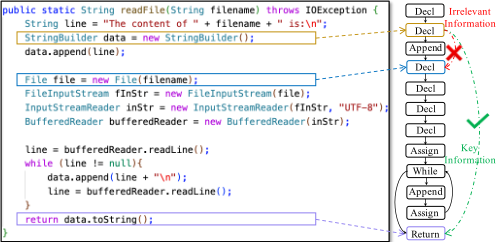
To alleviate the information loss problem and capture the long-distance dependency in the CFG, a straightforward way is to extract the feature of the CFG via the global attention [Vaswani et al., 2017], which allows each node to directly take features from all other nodes in the form of a weighted sum. While benefiting from the convenience of directly taking features from other nodes, employing the global attention to propagate node features in the CFG may be humbled by the irrelevant information in the global. For example, as shown in Figure 1, the two variable declaration statements in the red and blue boxes are irrelevant in semantics. Therefore, the blue node should avoid bringing in the feature of the red node in feature propagation, and vice versa.
One question arises here: how to take advantage of the global attention to capture the long-distance dependency in the CFG, while avoiding bringing in the features of irrelevant nodes? In fact, if the features of irrelevant nodes can be masked, we can still enjoy the convenience brought by the attention mechanism. To this end, we further exploit the structural information in the CFG to determine which nodes are related to it for each node. There are two kinds of dependencies that could be mined from the CFG. One is the execution dependency, which refers to whether one node will be executed or not is determined by another node, and the other is the computation dependency, which refers to the computation of one node depending on the results of other nodes or the declarations of the variables in it. By taking the features of nodes with dependency and masking the features of other irrelevant nodes, the long-distance dependency in the CFG would be carefully modeled.
In this paper, we propose a novel bug localization model named sgAttention (structural-guided Attention), which aims to capture the long-distance dependency in the CFG. In sgAttention, the structural-guided attention is employed to capture the information globally, where the execution and computation dependencies derived from the CFG are used to guide the masking of irrelevant information to facilitate better feature extraction. Experimental results based on four widely-used open-source software projects show that sgAttention outperforms the state-of-the-art bug localization methods and pretrained models, indicating that capturing the long-distance dependency in the CFG via structural-guided attention is beneficial for improving bug localization.
The contributions of this work are summarized as follows:
- We argue that the long-distance dependency is crucial for feature extraction from the CFG. However, when capturing the long-distance dependency in the CFG, the features of irrelevant nodes should not be brought in.
- We propose a novel bug localization model named sgAttention, which employs a particularly designed structural-guided attention to capture the long-distance dependency in the CFG. In sgAttention, features of irrelevant nodes are masked for each node to facilitate better feature extraction from the CFG.
- We evaluate the performance of sgAttention on four widely-used open-source software projects. The results indicate that sgAttention averagely improves the stateof-the-art bug localization methods by 32.9% and 29.2% and the state-of-the-art pre-trained models by 5.8% and 4.9% in terms of MAP and MRR, respectively.
The rest of this paper is organized as follows. In Section 2, the proposed sgAttention model is introduced in detail. Experiments are provided in Section 3 and the related work is discussed in Section 4. Finally, this paper is concluded in Section 5 and the future work is discussed.
2 The ProposedMethod
The bug localization problem is formulated as determining whether a given bug report and source file pair are correlated. Formally, let C = {c1, c2, . . . , cNc } denotes the collection of source code files in a software project, R = {r1, r2, . . . , rNr } denotes the set of bug reports received by the software maintenance team, and yij ∈ Y = {0, 1} indicates whether the source file cj ∈ C is correlated to the bug report ri ∈ R, where Nc,Nr denote the number of source files and bug reports, respectively. The learning task of bug localization aims to learn a prediction function f : R× C ↦→ Y by minimizing the following objective function:
where L(·, ·) is the empirical loss, Ω(f) is the regularization term, and λ is the trade-off hyper-parameter.
2.1 The General Framework
The general framework of sgAttention is shown in Figure 2, which is composed of three encoders and a prediction layer. These three encoders aim to extract the structural feature of code zs , the lexical feature of code zl , and the bug report feature zr , respectively. Then, all the features are concatenated for further fusion and prediction in the prediction layer:
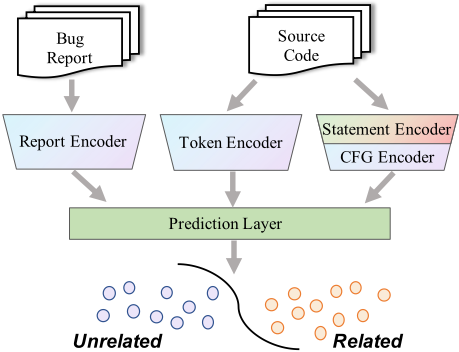
The prediction layer is implemented with a three-layer fully connected network, and batch normalization is applied after the first fully-connected layer to prevent overfitting.
In sgAttention, the cross-entropy loss is used as the empirical loss function:
and L2 norm is employed for regularization.
2.2 The CFGEncoder
The CFG encoder aims to extract the structural feature zsj from the source code cj. Since each node in the CFG corresponds to one statement in the code, we need to extract the semantic features of statements first. Therefore, we additionally insert a statement encoder before the CFG encoder to extract the statement feature xv from the corresponding tokens.
In sgAttention, we employ the encoder of the Transformer [Vaswani et al., 2017] as the basic building block, which is composed of N architecturally identical stacking layers:
where H0 is the embedding of input tokens. For each encoder layer, it applies a multi-head self-attention (MHA) operation followed by a feed-forward network (FFN) over the input:
where FFN is composed of two linear transformations with a ReLU activation in between, and LN represents the layer normalization operation. The MHA is computed via:
where W O ∈ Rdh×dh , W Q i ,W K i ,W V i ∈ Rdh×dk are parameters, h = dh/dk is the number of heads, and dh, dk are the dimension of the representation and a head, respectively.
The statement encoder only contains one encoder layer introduced in E.q. 4. We first tokenize each statement and remove unimportant punctuation such as braces, commas, and quotation marks. Then, each token term is embedded with the token embedding in CodeBERT [Feng et al., 2020], which is a Transformer-architecture model pre-trained on pairs of natural language and programming language tokens. The statement encoder encodes each statement individually, respecting the atomicity of the statement explicitly.
where ˆXt = {[CLS],Xt , [SEP]} is the input sequence, Xt ∈ RLt×dt is the token vector matrix of one statement, and Lt, dt denote the number tokens in the statement and the dimension of the token vector, respectively. The [CLS] is a special symbol added in front of the input sequence, and [SEP] is a special separator token indicating the end of the input sequence. In order to extract the most distinguishing signal, we employ the max-pooling over the output feature sequence to extract the statement feature xv, which is used for the input node feature in the CFG encoder.
The CFG encoder contains 6 stacking encoder layers introduced in E.q. 4, except that the global attention is replaced by the structural-guided attention. The structural feature zsj is extracted by employing the mean-pooling over the node features outputted by the last encoder layer:
where Xv j ∈ RLv×dv is the node feature matrix of the CFG, and Lv, dv denote the number nodes in the CFG and the dimension of the node feature, respectively.
Structural-Guided Attention. As aforementioned, nodes in the CFG should only take the features of nodes with dependency. To this end, instead of using the global attention introduced in E.q. 9, we particularly design a structural-guided attention in the CFG encoder. Specifically, we add a masking matrix M on the attention weight:
The value of the masking matrix M relies on the node dependency in the CFG. Formally, Mij equals 0 if and only if the ith node is depended on the jth node, and -∞ otherwise.
Figure 3 illustrates an example of the structural-guided attention. Each row in the masking matrix denotes the attention masking of other statements to the corresponding statement, where only statements with white boxes placed allow being attended to. There are two kinds of dependencies that could be mined from the CFG. One kind is the execution dependency, which refers to whether one node will be executed or not is determined by another node. Specifically, nodes in the Loop-body are execution-depended on the Loopcondition, and nodes in the If -body or the Switch-body are execution-depended on the If -condition or the corresponding Case-statement, respectively. Thus, nodes in the Loopbody should take the feature of the Loop-condition, and so do nodes in the If -body or the Switch-body. For example, as shown in the bottom left of Figure 3, whether the Append and the Assign statements in the While-statement will be executed or not depends on the While-condition. Thus, the Append and the Assign statements are execution-depended on the While-condition, meaning that they could take the feature of the While-condition in the structural-guided attention. The other kind is the computation dependency, which refers to the computation of one node requiring the results of other nodes or relying on those nodes that declare the variables in it. For example, as shown in the bottommiddle of Figure 3, the declaration of the fInStr variable uses the file variable, meaning that the declaration of fInStr is computation-depended on the declaration of file. Thus, the declaration statement of fInStr could take the feature of the declaration statement of file. Similarly, the declaration of inStr could take the feature of the declaration of fInStr in the structural-guided attention.
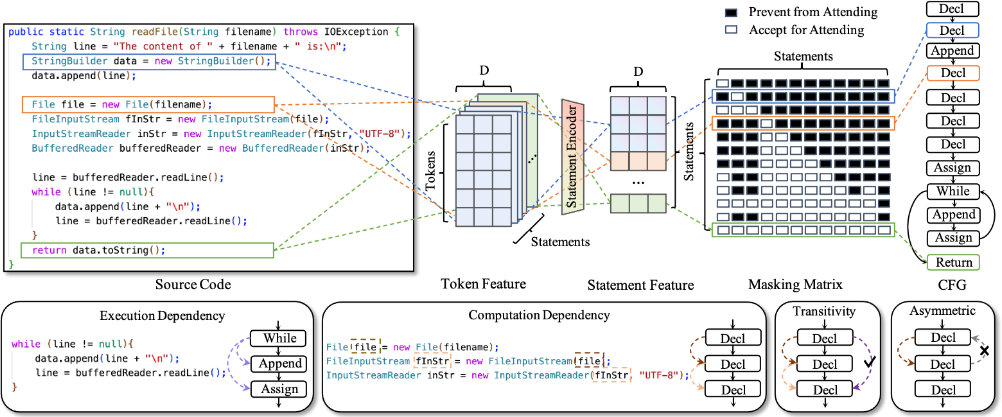
In addition, both the execution dependency and the computation dependency are transitive and asymmetric. As shown in the bottom right of Figure 3, the declaration of inStr is computation-depended on the declaration of fInStr and the declaration of fInStr is computation-depended on the declaration of file. We believe in that knowing the declaration of file ought to be beneficial for better understanding the fInStr variable, which is used in the declaration of inStr. According to the transitivity, the declaration of inStr is depended on the declaration of file. Thus, the declaration of inStr could also take the feature of the declaration of file. On the other hand, the declaration of file does not use the fInStr variable, which should be regarded as irrelevant information for it. Although the declaration of fInStr is computation-depended on the declaration of file, the asymmetry makes sure that the declaration of fInStr is masked for the declaration of file.
By taking the features of nodes with dependency and masking the features of irrelevant nodes, the long-distance dependency in the CFG could be caught without being humbled by the irrelevant information in the global.
It should be noted that adding the [CLS] and the [SEP] symbols in front of and behind the input is a normal operation in the sequential input and has been proven effective [Devlin et al., 2019; Feng et al., 2020]. However, we did not use such normal operation in the CFG encoder since it can hardly define which statement is relevant to the special symbol, resulting in special symbols would be masked by all the nodes. Although Graphormer [Ying et al., 2021] suggests that adding an additional super-node connected to all the nodes and including the feature of the super-node as the graph feature are beneficial for the performance, we empirically found that including the mean of node features performs better in bug localization. See Section 3.4 for more details.
2.3 The Lexical Encoder
The lexical encoder aims to extract the lexical feature zlj from the input source code cj . Here we use the same token embedding as in the statement encoder, while tokens from different statements are concatenated as a sequence Xl j . Then, we finetune the CodeBERT model as the lexical feature encoder with the input sequence ˆXl j = {[CLS],Xl j , [SEP ]}:
We follow the suggestion in [Feng et al., 2020] to include the feature of the [CLS] token outputted by the last encoder layer as the lexical feature zlj of the input source code.
2.4 The Report Encoder
The report encoder takes the raw data of bug report ri as input, and aims to extract the semantic feature zri of it.
We use the normal natural language preprocessing method for bug report preprocessing. Specifically, we first tokenize the bug report and remove the stop words and the punctuation. Then, all the word token terms are embedded into word vectors. We employ a Transformer encoder with 6 encoder layers, which is shown in E.q. 4, as the report encoder. The report encoder takes the ˆXr i = {[CLS],Xr i , [SEP]} as the input sequence, where Xr i ∈ RLr×dr is the token vector matrix of the bug report, and Lr, dr are the length of the bug report and the dimension of the token vector, respectively.
As suggested in [Devlin et al., 2019], the feature of the [CLS] token outputted by the last encoder layer is included as the report feature zri , which is used for further prediction.
3 Experiment
In this section, we evaluate sgAttention against a number of baseline methods based on four widely used datasets. We first introduce the datasets and the baselines in Section 3.1 and 3.2, respectively. Then, experimental results are reported in Section 3.3, followed by the ablation study in Section 3.4.
3.1 Datasets
The four datasets we used are extracted from real-world opensource software projects. As suggested in [Fischer et al., 2003], the ground truth correlations between bug reports and source files are extracted from the bug tracking system (i.e., Bugzilla) and the version control system (i.e., GitHub). The statistics of the four datasets are shown in Table 1.
Eclipse Platform 1 defines a set of frameworks and common services that makes up Eclipse infrastructures. The first dataset Platform is extracted from the "UI" component of it. Plug-in Development Environment 2 is a tool for creating and deploying Eclipse plug-ins. The second dataset PDE is extracted from the "UI" component of it. Java Development Tools 3 is an Eclipse project that provides the tool plug-ins supporting the development of any Java application. The third dataset JDT is extracted from the "UI" component of it. The AspectJ 4 project is an aspect-oriented extension to the Java programming language, which is the last dataset and denoted as AspectJ. All these datasets have been extensively used in previous bug localization studies [Ye et al., 2014; Huo et al., 2016; Ma and Li, 2022].
As suggested in [Kochhar et al., 2014], we have filtered those fully localized bug reports from the dataset, that is, the names of all corresponding buggy source files have been included in the bug report. For such bug reports, they no longer need a machine learning model to automatically locate the buggy source files. It should be noted that this approach makes the performance seem to be worse, but more in line with the real world situation.
1 http://projects.eclipse.org/projects/eclipse.platform
2 http://www.eclipse.org/pde
3 http://www.eclipse.org/jdt
4 http://www.eclipse.org/aspectj
| Project | # source files | # bug reports | # matches | Avg. buggy files per report |
|---|---|---|---|---|
| Platform | 6,125 | 5,016 | 18,055 | 3.60 |
| PDE | 5,330 | 2,612 | 10,721 | 4.10 |
| JDT | 10,845 | 5,060 | 14,408 | 2.85 |
| AspectJ | 6,908 | 368 | 1,522 | 4.14 |
3.2 Baseline Methods
In order to show the effectiveness of sgAttention, we compare it with the following state-of-the-art bug localization methods and pre-trained models:
- CG-CNN [Huo et al., 2020]: A CFG-based bug localization method, which decomposes the CFG into multiple execution paths for multi-instance learning.
- KGBugLocator [Zhang et al., 2020]: A knowledgegraph-based bug localization method, which extracts the code feature based on the code knowledge graph embedding and keywords supervised bi-directional attention.
- CodeBERT [Feng et al., 2020]: A Transformerarchitecture model that pre-trained on natural language and programming language pairs using both masked language modeling and replaced token detection tasks.
- GraphCodeBERT [Guo et al., 2021]: A Transformerarchitecture model that enhances the code representation with the data flow, pre-trained on masked language modeling, edge prediction, and node alignment tasks.
- cFlow [Ma andLi, 2022]: ACFG-based bug localization method, which employs a particularly designed flowbased GRU to step-wisely propagate node features from the entry to the exit along all the execution paths.
- FLIM [Liang et al., 2022]: An information-retrievalbased bug localization method, which locates buggy files based on the cosine similarity between the report feature and the code feature extracted by CodeBERT.
To compare with these baselines, we follow the same experiment settings suggested in their studies. For hyperparameters in sgAttention, each encoder layer contains 12 attention heads, and the dimensions of all the features are set as 768. AdamW [Loshchilov and Hutter, 2019] with a learning rate of 1e-5 and linear schedule with a warm-up ratio 0.1 are employed for optimization in sgAttention. We train our model on NVIDIA Tesla A100 with 128GB RAM, and the source code is publicly available 5 .
3.3 Experimental Results
We use three metrics for evaluation: Mean Average Precision (MAP), Mean Reciprocal Rank (MRR), and Top-10 Rank, all of which have been widely used in previous bug localization studies [Lam et al., 2017; Zhang et al., 2020; Ma and Li, 2022]. For each dataset, we randomly split the dataset into the training, validation, and test sets in a ratio of 8:1:1. We first determine the batch size, the number of training epochs, and the trade-off hyper-parameter λ based on the performance on the validation set. Then, the training and validation sets are mixed up to train the model. This process is repeated for 3 times and the average performance on the test set is reported.
5 https://www.lamda.nju.edu.cn/mayf/
| Method | Platform | PDE | JDT | AspectJ | Avg. |
|---|---|---|---|---|---|
| KGBL | 0.446 | 0.462 | 0.469 | 0.515 | 0.473 |
| CG-CNN | 0.453 | 0.471 | 0.478 | 0.541 | 0.486 |
| CodeBERT | 0.585 | 0.609 | 0.626 | 0.657 | 0.619 |
| GCodeB | 0.596 | 0.626 | 0.633 | 0.659 | 0.629 |
| cFlow | 0.464 | 0.486 | 0.489 | 0.563 | 0.501 |
| FLIM | 0.428 | 0.432 | 0.425 | 0.457 | 0.436 |
| sgAttention | 0.632 | 0.661 | 0.669 | 0.698 | 0.665 |
| Method | Platform | PDE | JDT | AspectJ | Avg. |
|---|---|---|---|---|---|
| KGBL | 0.526 | 0.578 | 0.567 | 0.618 | 0.572 |
| CG-CNN | 0.534 | 0.589 | 0.576 | 0.641 | 0.585 |
| CodeBERT | 0.667 | 0.736 | 0.738 | 0.808 | 0.737 |
| GCodeB | 0.674 | 0.739 | 0.744 | 0.809 | 0.742 |
| cFlow | 0.548 | 0.612 | 0.587 | 0.659 | 0.602 |
| FLIM | 0.519 | 0.534 | 0.512 | 0.558 | 0.531 |
| sgAttention | 0.710 | 0.772 | 0.783 | 0.845 | 0.778 |
The evaluation results in terms of MAP are listed in Table 2. The best performance on each dataset is boldfaced. It can be observed that sgAttention outperforms all the baselines on all the datasets in terms of MAP. It should be noticed that sgAttention achieves the best average MAP performance (0.665), which improves KGBugLocator (0.473) by 40.6%, CG-CNN (0.486) by 36.9%, CodeBERT (0.619) by 7.4%, GraphCodeBERT (0.629) by 5.8%, cFlow (0.501) by 32.9%, and FLIM (0.436) by 52.7%.
The evaluation results in terms of MRR are listed in Table 3, with the best performance on each dataset shown in bold. Similar to the performance in terms of MAP, sgAttention achieves the best MRR performance on all the datasets. In addition, sgAttention achieves the best average MRR performance (0.778), which improves KGBugLocator (0.572) by 35.9%, CG-CNN (0.585) by 32.9%, CodeBERT (0.737) by 5.5%, GraphCodeBERT (0.742) by 4.9%, cFlow (0.602) by 29.2%, and FLIM (0.531) by 46.5%.
Across all the four datasets, sgAttention improves GraphCodeBERT, the second best method, by 5.6% to 6.0% in terms of MAP and by 4.4% to 5.3% in terms of MRR. Besides, sgAttention improves the state-of-the-art bug localization methods by at least 24.0% in terms of MAP and by at least 26.1% in terms of MRR, which should be considered a huge improvement over the state-of-the-art.
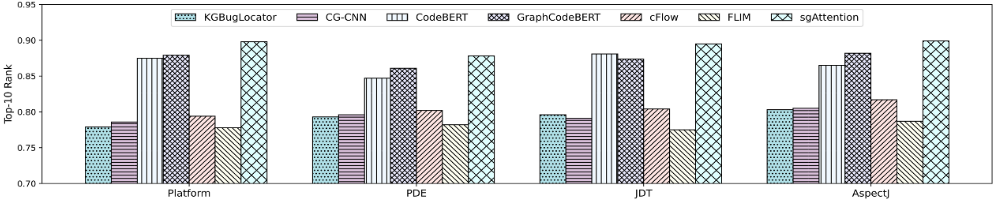
The evaluation results in terms of Top-10 Rank are shown in Figure 4. Not surprisingly, sgAttention once again outperforms all the baselines on all the datasets. Higher Top-10 Rank values indicate that more buggy source files could be correlated by sgAttention when the same number of potential files are examined. Considering that only a limited number of potential files provided by the bug localization model will be checked, sgAttention would be more useful in practice.
| Method | Platform | PDE | JDT | AspectJ | Avg. |
|---|---|---|---|---|---|
| sgAttention - w/o CFG - w/o token - w/o mask | 0.632 | 0.661 | 0.669 | 0.698 | 0.665 |
| 0.585 | 0.609 | 0.626 | 0.657 | 0.619 | |
| 0.567 | 0.570 | 0.576 | 0.632 | 0.586 | |
| 0.600 | 0.634 | 0.641 | 0.677 | 0.638 | |
| - w/o mean | 0.618 | 0.648 | 0.661 | 0.685 | 0.653 |
| Method | Platform | PDE | JDT | AspectJ | Avg. |
|---|---|---|---|---|---|
| sgAttention - w/o CFG - w/o token - w/o mask | 0.710 | 0.772 | 0.783 | 0.845 | 0.778 |
| 0.667 | 0.736 | 0.738 | 0.808 | 0.737 | |
| 0.641 | 0.654 | 0.671 | 0.773 | 0.685 | |
| 0.687 | 0.741 | 0.762 | 0.826 | 0.754 | |
| - w/o mean | 0.691 | 0.754 | 0.768 | 0.830 | 0.761 |
In summary, experimental results on four widely-used open-source software projects indicate that sgAttention outperforms the state-of-the-art bug localization methods and pre-trained models in terms of all the three commonly used metrics, demonstrating that capturing the long-distance dependency in the CFG via the structural-guided attention is beneficial for improving bug localization.
3.4 The Ablation Study
To evaluate the effectiveness of the sgAttention design, we conduct ablation studies on the CFG encoder, the lexical encoder, the attention masking mechanism, and the aggregation method imposed on the CFG encoder, which are denoted as w/o CFG, w/o token, w/o mask, and w/o mean, respectively. The evaluation results in terms of MAP and MRR are shown in Table 4 and Table 5, respectively.
Specifically, sgAttention w/o CFG denotes a model that only uses the lexical encoder and the report encoder, which exactly is the CodeBERT model. Compared with sgAttention, the MAP drops by 6.2% to 8.5% and the MRR drops by 4.6% to 6.4%, indicating that the CFG plays an important role in bug localization. By adding a CFG encoder without the attention masking mechanism, the sgAttention w/o mask model performs better on all the datasets, and even better than GraphCodeBERT, which means that CFG carries more crucial information than the data flow graph for bug localization. However, compared with sgAttention, it still decreases by 3.1% to 5.3% in terms of MAP and by 2.3% to 4.2% in terms of MRR, indicating that only focusing on relevant nodes in the CFG improves the performance of bug localization.
In addition, sgAttention w/o lexical denotes a model that only uses the CFG encoder and the report encoder. It can be observed that compared with sgAttention, the MAP decreases by over 10.4% and the MRR decreases by over 9.3%, indicating that the lexical information is crucial for bug localization.
At last, sgAttention w/o mean denotes a variant of sgAttention that follows the suggestion in Graphormer [Ying et al., 2021] to aggregate node features. Specifically, it adds an additional super-node connected to all nodes in the CFG, and includes the feature of it as the CFG feature. We empirically found that such operations do not perform better than simply including the mean of node features as the CFG feature.
4 RelatedWork
In this section, we introduce a number of works related to bug localization and some transformer-based models designed for software mining tasks.
Bug localization aims to automatically locate buggy source files based on the textual description in the bug report. A large class is the information-retrieval-based bug localization methods, which locate buggy files based on the lexical similarity between the bug report and the source code [Poshyvanyk et al., 2007; Lukins et al., 2008; Saha et al., 2013; Wang et al., 2018]. For example, BugLocator [Zhou et al., 2012] employs the revised Vector Space Model (rVSM) to measure the lexical similarity between the report and the code. DNNLOC [Lam et al., 2017] further combines the rVSMwith the auto-encoder to alleviate the lexical mismatch problem in information retrieval. BLIZZARD [Rahman and Roy, 2018] and FineLocator [Zhang et al., 2019] improve the information retrieval quality with the query reformulation. Fejzer et al. [2022] adaptively reweight 19 similarity scores in [Ye et al., 2016] to improve the retrieval quality, which is further incorporated by FLIM [Liang et al., 2022]. However, many recent studies indicate that mining the program structure from the source code is beneficial for improving bug localization [Huo et al., 2016; Youm et al., 2017; Huo and Li, 2017]. CG-CNN [Huo et al., 2020] decomposes the CFG of source code into multiple execution paths for multi-instance learning. KGBugLocator [Zhang et al., 2020] builds a code knowledge graph to model interrelations between classes, parameters, variables, methods, and properties for bug localization. MRAM [Yang et al., 2021] builds the code revision graph from past code commits and reports for method-level bug localization. cFlow [Ma and Li, 2022] designs a flow-based GRU to extract the feature of the CFG by step-wisely feature propagation.
In addition, many methods deal with the bug localization problem from other perspectives. Locus [Wen et al., 2016] and FBL-BERT [Ciborowska and Damevski, 2022] retrieve buggy source files from the code change logs. BRTracer
[Wong et al., 2014] improves bug localization with segmentation and stack-trace analysis. Pathidea [Chen et al., 2022] improves bug localization by reconstructing the execution path from the bug report. TRANP-CNN [Huo et al., 2019] and COOBA [Zhu et al., 2020] are designed for the crossproject bug localization with the problem of insufficient history data. The usages of bug localization models in the education [Gupta et al., 2019] and the industrial setting [Jarman et al., 2022] are also explored.
Nowadays, with the success of the Transformer on the natural language processing area, a number of Transformer based models have been proposed for software mining tasks. For example, GREAT [Hellendoorn et al., 2020] stacks the Transformer encoder layers and the graph neural network to extract the feature of the abstract syntax tree for the variable misuse task. TPTrans [Peng et al., 2021] integrates the encoding of the absolute and the relative path in the abstract syntax tree into the Transformer for the code summarization task. MuST [Zhu et al., 2022] is a Transformer-architecture program translation model that leverages multilingual code snippets for training. CodeBERT [Feng et al., 2020] is a pretrained model that pre-trained on natural language and programming language pairs using both masked language modeling and replaced token detection tasks, and GraphCodeBERT [Guo et al., 2021] further enhances the code representation with the data flow.
5 Conclusion
In this paper, we propose a novel bug localization model named sgAttention, which employs a particularly designed structural-guided attention to capture the long-distance dependency in the CFG. In sgAttention, each node only takes the features of the execution-depended and the computationdepended nodes, and masks the features of irrelevant nodes to facilitate better feature extraction of the CFG. Experimental results based on four widely-used open-source software projects show that sgAttention averagely improves the stateof-the-art bug localization methods by 32.9% and 29.2% and the state-of-the-art pre-trained models by 5.8% and 4.9% in terms of MAP and MRR, respectively. The empirical evaluation indicates that capturing the long-distance dependency in the CFG via the structural-guided attention is beneficial for improving bug localization.
For future work, it is interesting to extract the features of other code graph representations like the abstract syntax tree or the call graph with the structural-guided attention.
Acknowledgments
This research was supported by NSFC (62076121, 61921006).
@inproceedings{ijcai2023p249,
  title     = {Capturing the Long-Distance Dependency in the Control Flow Graph via Structural-Guided Attention for Bug Localization},
  author    = {Ma, Yi-Fan and Du, Yali and Li, Ming},
  booktitle = {Proceedings of the Thirty-Second International Joint Conference on
               Artificial Intelligence, {IJCAI-23}},
  publisher = {International Joint Conferences on Artificial Intelligence Organization},
  editor    = {Edith Elkind},
  pages     = {2242--2250},
  year      = {2023},
  month     = {8},
  note      = {Main Track},
  doi       = {10.24963/ijcai.2023/249},
  url       = {https://doi.org/10.24963/ijcai.2023/249},
}
TY - CPAPER TI - Capturing the Long-Distance Dependency in the Control Flow Graph via Structural-Guided Attention for Bug Localization AU - Ma, Yi-Fan AU - Du, Yali AU - Li, Ming T2 - Proceedings of the Thirty-Second International Joint Conference on Artificial Intelligence, IJCAI-23 PB - International Joint Conferences on Artificial Intelligence Organization PY - 2023 SP - 2242 EP - 2250 DO - 10.24963/ijcai.2023/249 UR - https://doi.org/10.24963/ijcai.2023/249 ER -Copied
Machine-readable versions of this paper, for tools and AI agents:





