
Discriminative-Invariant Representation Learning for Unbiased Recommendation
Proceedings of the Thirty-Second International Joint Conference on Artificial Intelligence. Main Track. Pages 2270-2278.
https://doi.org/10.24963/ijcai.2023/252
Keywords
- Data Mining: DM: Recommender systems
- AI Ethics, Trust, Fairness: ETF: Bias
Abstract
Selection bias hinders recommendation models from learning unbiased user preference. Recent works empirically reveal that pursuing invariant user and item representation across biased and unbiased data is crucial for counteracting selection bias. However, our theoretical analysis reveals that simply optimizing representation invariance is insufficient for addressing the selection bias — recommendation performance is bounded by both representation invariance and discriminability. Worse still, current invariant representation learning methods in recommendation neglect even hurt the representation discriminability due to data sparsity and label shift. In this light, we propose a new Discriminative-Invariant Representation Learning framework for unbiased recommendation, which incorporates label-conditional clustering and prior-guided contrasting into conventional invariant representation learning to mitigate the impact of data sparsity and label shift, respectively. We conduct extensive experiments on three real-world datasets, validating the rationality and effectiveness of the proposed framework. Code and supplementary materials are available at: https://github.com/HungPaan/DIRL.
- [Acuna et al., 2021] David Acuna, Guojun Zhang, Marc T. Law, and Sanja Fidler. f-domain adversarial learning: The- ory and algorithms. In ICML, pages 66-75, 2021.
- [Ben-David et al., 2010] Shai Ben-David, John Blitzer, Koby Crammer, Alex Kulesza, Fernando Pereira, and Jennifer Wortman Vaughan. A theory of learning from different domains. Mach. Learn., 79:151-175, 2010.
- [Chen et al., 2019] Xinyang Chen, Sinan Wang, Mingsheng Long, and Jianmin Wang. Transferability vs. discrim- inability: Batch spectral penalization for adversarial do- main adaptation. In ICML, pages 1081-1090, 2019.
- [Chen et al., 2021] Jiawei Chen, Hande Dong, Yang Qiu, Xi- angnan He, Xin Xin, Liang Chen, Guli Lin, and Keping Yang. Autodebias: Learning to debias for recommenda- tion. In SIGIR, pages 21-30, 2021.
- [Chen et al., 2023] Jiawei Chen, Hande Dong, Xiang Wang, Fuli Feng, Meng Wang, and Xiangnan He. Bias and debias in recommender system: A survey and future directions. TOIS, 41(3), 2023.
- [Dai et al., 2022] Quanyu Dai, Haoxuan Li, Peng Wu, Zhen- hua Dong, Xiao-Hua Zhou, Rui Zhang, Rui Zhang, and Jie Sun. A generalized doubly robust learning frame- work for debiasing post-click conversion rate prediction. In SIGKDD, pages 252-262, 2022.
- [Deng et al., 2019] Zhijie Deng, Yucen Luo, and Jun Zhu. Cluster alignment with a teacher for unsupervised domain adaptation. In ICCV, pages 9943-9952, 2019.
- [Ganin and Lempitsky, 2015] Yaroslav Ganin and Victor S. Lempitsky. Unsupervised domain adaptation by backprop- agation. In ICML, pages 1180-1189, 2015.
- [Guo et al., 2021] Siyuan Guo, Lixin Zou, Yiding Liu, Wen- wen Ye, Suqi Cheng, Shuaiqiang Wang, Hechang Chen, Dawei Yin, and Yi Chang. Enhanced doubly robust learn- ing for debiasing post-click conversion rate estimation. In SIGIR, pages 275-284, 2021.
- [Huang et al., 2022] Jin Huang, Harrie Oosterhuis, and Maarten de Rijke. It is different when items are older: Debiasing recommendations when selection bias and user preferences are dynamic. In WSDM, pages 381-389, 2022.
- [Imbens and Rubin, 2015] Guido W Imbens and Donald B Rubin. Causal inference in statistics, social, and biomedi- cal sciences. Cambridge University Press, 2015.
- [Jiang and Li, 2016] Nan Jiang and Lihong Li. Doubly ro- bust off-policy value evaluation for reinforcement learn- ing. In ICML, pages 652-661, 2016.
- [Jiang et al., 2022] Junguang Jiang, Yang Shu, Jianmin Wang, and Mingsheng Long. Transferability in deep learn- ing: A survey. CoRR, abs/2201.05867, 2022.
- [Kang et al., 2019] Guoliang Kang, Lu Jiang, Yi Yang, and Alexander G. Hauptmann. Contrastive adaptation net- work for unsupervised domain adaptation. In CVPR, pages 4893-4902, 2019.
- [Koren et al., 2009] Yehuda Koren, Robert M. Bell, and Chris Volinsky. Matrix factorization techniques for rec- ommender systems. Computer, 42:30-37, 2009.
- [Kundu et al., 2022] Jogendra Nath Kundu, Akshay R. Kulkarni, Suvaansh Bhambri, Deepesh Mehta, Shreyas Anand Kulkarni, Varun Jampani, and Venkatesh Babu Radhakrishnan. Balancing discrim- inability and transferability for source-free domain adaptation. In ICML, pages 11710-11728, 2022.
- [Lee et al., 2022] Jae-woong Lee, Seongmin Park, Joonseok Lee, and Jongwuk Lee. Bilateral self-unbiased learning from biased implicit feedback. In SIGIR, pages 29-39, 2022.
- [Lee, 2013] Dong-Hyun Lee. Pseudo-label: The simple and efficient semi-supervised learning method for deep neural networks. In Workshop on challenges in representation learning, ICML, page 896, 2013.
- [Li et al., 2020] Bo Li, Yezhen Wang, Tong Che, Shang- hang Zhang, Sicheng Zhao, Pengfei Xu, Wei Zhou, Yoshua Bengio, and Kurt Keutzer. Rethinking dis- tributional matching based domain adaptation. CoRR, abs/2006.13352, 2020.
- [Li et al., 2022a] Haoxuan Li, Quanyu Dai, Yuru Li, Yan Lyu, Zhenhua Dong, Peng Wu, and Xiao-Hua Zhou. Mul- tiple robust learning for recommendation. arXiv preprint arXiv:2207.10796, 2022.
- [Li et al., 2022b] Haoxuan Li, Chunyuan Zheng, Xiao-Hua Zhou, and Peng Wu. Stabilized doubly robust learning for recommendation on data missing not at random. arXiv preprint arXiv:2205.04701, 2022.
- [Liu et al., 2020] Dugang Liu, Pengxiang Cheng, Zhenhua Dong, Xiuqiang He, Weike Pan, and Zhong Ming. A gen- eral knowledge distillation framework for counterfactual recommendation via uniform data. In SIGIR, pages 831- 840, 2020.
- [Liu et al., 2021a] Dugang Liu, Pengxiang Cheng, Hong Zhu, Zhenhua Dong, Xiuqiang He, Weike Pan, and Zhong Ming. Mitigating confounding bias in recommendation via information bottleneck. In RecSys, pages 351-360, 2021.
- [Liu et al., 2021b] Xiaofeng Liu, Zhenhua Guo, Site Li, Fangxu Xing, Jane You, C.-C. Jay Kuo, Georges El Fakhri, and Jonghye Woo. Adversarial unsupervised domain adap- tation with conditional and label shift: Infer, align and it- erate. In ICCV, pages 10347-10356, 2021.
- [Prabhu et al., 2021] Viraj Prabhu, Shivam Khare, Deeksha Kartik, and Judy Hoffman. SENTRY: selective entropy optimization via committee consistency for unsupervised domain adaptation. In ICCV, pages 8538-8547, 2021.
- [Saito and Nomura, 2022] Yuta Saito and Masahiro Nomura. Towards resolving propensity contradiction in offline rec- ommender learning. In IJCAI, pages 2211-2217, 2022. IJCAI
- [Saito, 2020a] Yuta Saito. Asymmetric tri-training for debi- asing missing-not-at-random explicit feedback. In SIGIR, pages 309-318, 2020.
- [Saito, 2020b] Yuta Saito. Unbiased pairwise learning from biased implicit feedback. In ICTIR, pages 5-12, 2020.
- [Schnabel et al., 2016] Tobias Schnabel, Adith Swami- nathan, Ashudeep Singh, Navin Chandak, and Thorsten Joachims. Recommendations as treatments: Debiasing learning and evaluation. In ICML, pages 1670-1679, 2016.
- [Swaminathan and Joachims, 2015] Adith Swaminathan and Thorsten Joachims. The self-normalized estimator for counterfactual learning. In NeurIPS, pages 3231-3239, 2015.
- [Tzeng et al., 2015] Eric Tzeng, Judy Hoffman, Trevor Dar- rell, and Kate Saenko. Simultaneous deep transfer across domains and tasks. In ICCV, pages 4068-4076, 2015.
- [Tzeng et al., 2017] Eric Tzeng, Judy Hoffman, Kate Saenko, and Trevor Darrell. Adversarial discriminative domain adaptation. In CVPR, pages 2962-2971, 2017.
- [Wang et al., 2019] Xiaojie Wang, Rui Zhang, Yu Sun, and Jianzhong Qi. Doubly robust joint learning for recom- mendation on data missing not at random. In ICML, pages 6638-6647, 2019.
- [Wang et al., 2020] Zifeng Wang, Xi Chen, Rui Wen, Shao- Lun Huang, Ercan E. Kuruoglu, and Yefeng Zheng. In- formation theoretic counterfactual learning from missing- not-at-random feedback. In NeurIPS, 2020.
- [Wang et al., 2022] Zimu Wang, Yue He, Jiashuo Liu, Wen- chao Zou, Philip S. Yu, and Peng Cui. Invariant prefer- ence learning for general debiasing in recommendation. In SIGKDD, pages 1969-1978, 2022.
- [Wu et al., 2019] Yifan Wu, Ezra Winston, Divyansh Kaushik, and Zachary C. Lipton. Domain adaptation with asymmetrically-relaxed distribution alignment. In ICML, pages 6872-6881, 2019.
- [Yan et al., 2017] Hongliang Yan, Yukang Ding, Peihua Li, Qilong Wang, Yong Xu, and Wangmeng Zuo. Mind the class weight bias: Weighted maximum mean discrepancy for unsupervised domain adaptation. In CVPR, pages 945- 954, 2017.
- [Zhang et al., 2019] Yuchen Zhang, Tianle Liu, Mingsheng Long, and Michael I. Jordan. Bridging theory and algo- rithm for domain adaptation. In ICML, pages 7404-7413, 2019.
- [Zhao et al., 2019] Han Zhao, Remi Tachet des Combes, Kun Zhang, and Geoffrey J. Gordon. On learning invari- ant representations for domain adaptation. In ICML, pages 7523-7532, 2019.
References were extracted automatically from the PDF and may contain errors.
Full text extracted automatically from the PDF; figures, tables and equations may differ. The PDF is the version of record.
1 Introduction
Recommender systems (RSs) make personalized recommendation by predicting user preferences for items and have achieved great success in various applications [Chen et al., 2023]. Historical feedback (e.g., like or dislike) is indispensable for learning user preference, which is typically collected from previous recommendation strategies. Consequently, the historical feedback is subject to selection bias [Saito and Nomura, 2022], i.e., unevenly distributed over the entire useritem space. Blindly fitting such biased data will result in biased user preference [Chen et al., 2023] and notorious issues such as unfairness and filter bubble [Huang et al., 2022]. Therefore, it is crucial to counteract selection bias in user preference learning.
∗Corresponding author
The key lies in aligning the distribution of user-item pairs in the biased data to the unbiased data with feedback collected under random exposure. Existing methods achieve the goal by minimizing distribution discrepancy, which is in two main categories at data level and representation level. Bridging the discrepancy at data level is typically achieved by reweighting the user-item pairs according to the exposure probability (a.k.a. propensity score) [Swaminathan and Joachims, 2015; Schnabel et al., 2016; Wang et al., 2019; Guo et al., 2021]. These propensity-based methods typically suffer from unreliable propensity estimation [Saito and Nomura, 2022] and high variance [Li et al., 2022b]. At the representation level, pursuing representations of user-item pairs with invariant distribution across different data is an emerging solution for minimizing distribution discrepancy [Saito and Nomura, 2022; Wang et al., 2022]. These invariant representation-based methods avoid the drawback of propensity scores, achieving promising empirical results [Wang et al., 2022].
Nevertheless, it remains unclear whether representation invariance is sufficient for unbiased recommendation. To bridge this research gap, we analyze the theoretical connection between the representation and recommendation performance based on the theory in unsupervised domain adaptation (UDA) [Ben-David et al., 2010], finding that the recommendation performance is bounded by both the invariance of representation across the biased and unbiased data and the discriminability 1 of representation among useritem pairs with different labels. However, existing invariant representation-based methods typically assume that the representation discriminability is sufficiently high and blindly optimize the invariance [Jiang et al., 2022].
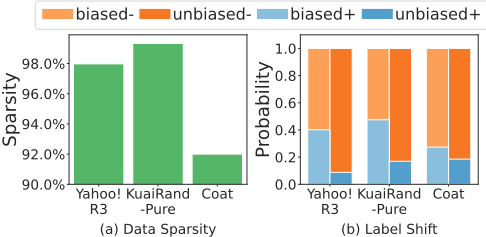
Through empirical analysis, we uncover extreme data sparsity [Koren et al., 2009] and severe label shift [Zhao et al., 2019], as illustrated in Figure 1, leads to impaired representation discriminability and argue that the discriminability should be additionally optimized. The increase of data sparsity will inevitably limit the representation discriminability. This means the underlying assumption of existing invariant representation-based methods might be violated in the presence of extreme data sparsity. Worse still, blindly optimizing the invariance will hurt the discriminability as the presence of label shift. This is because blindly optimizing representation invariance will force the distribution of predictions on the biased and unbiased data to be the same, which is a mistake when the label distribution in fact changes across them. Therefore, optimizing the invariance of representation with consideration of both data sparsity and label shift has the potential of achieving better unbiased recommendation.
In this light, we propose a new Discriminative-Invariant Representation Learning (DIRL) framework for unbiased recommendation. Specifically, we equip the learning objective for pursuing invariant representation with two newly designed losses of label-conditional clustering and priorguided contrasting to optimize both representation invariance and discriminability. Label-conditional clustering concentrates representations with the same labels in close proximity while separating those with different labels farther apart. Prior-guided contrasting restricts the distance between predictions on the biased data and unbiased data according to the prior knowledge of label shift, which avoids the elimination of representation distribution discrepancy originating from label shift. We implement DIRL based on a representative invariant representation learning method named adversarial distribution alignment [Ganin and Lempitsky, 2015; Tzeng et al., 2015] and conduct evaluations on three realworld datasets. Extensive experimental results validate the rationality and effectiveness of the proposed framework.
The main contributions of this paper are as follows:
- We provide theoretical and empirical analyses of the performance bound for unbiased recommendation, highlighting the significance of both representation invariance and discriminability.
- We propose a new Discriminative-Invariant Representation Learning framework to address the selection bias issue in recommendation, which consists of two new losses to mitigate the ruins of data sparsity and label shift on representation discriminability.
- We conduct extensive experiments on three real-world datasets, validating the rationality and effectiveness of the proposed DIRL framework.
1 The ability to separate different labels by a supervised classifier trained over the representations in both biased and unbiased data [Chen et al., 2019].
2 Analysis on Unbiased Recommendation
In this section, we first formulate the task of unbiased recommendation (Section 2.1). We then review recent invariant representation-based methods, uncovering the mystery of their effectiveness and identifying their limitations (Section 2.2). Finally, we empirically demonstrate the importance of boosting representation discriminability in RSs (Section 2.3).
2.1 Task Formulation
We are given an RS with a user set U and an item set I. Let u (or i) denote a user (or an item) in U (or I). Let f := U × I → {0, 1} be the label function, indicating whether a user actually likes an item (y = 1) or not (y = 0). Historical feedback data can be formulated as a set of useritem pairs DB := {(u, i)jB }nj=1 drawn from a biased distribution pB(u, i) (e.g., subject to previous recommendation policy) and their corresponding labels f(DB) = {yjB }nj=1 . The task of unbiased recommendation can be formulated as follow: learning a recommendation model from the available biased data for capturing user preference and accordingly making a high-quality recommendation. Formally, the goal is to learn a function h := U × I → {0, 1} from the biased data that approaches the ideal f over the test distribution:
where pU(u, i) denotes the unbiased distribution under random exposure, which is commonly assumed to be uniform over the entire user-item space, and l(., .) denotes the selected error function between the prediction and the ground truth. Following [Ganin and Lempitsky, 2015; Chen et al., 2019] in UDA, we adopt 0-1 error function for analysis and employ its surrogate error function cross-entropy for training the recommendation model. Since labels of user-item pairs DU := {(u, i)jU }nj=1 drawn from pU(u, i) are not available, the model can be only trained on the biased data with optimizing the following empirical loss:
As the distribution of the training dataset differs from the test, blindly fitting the biased data result in inferior performance and notorious issues like filter bubble [Huang et al., 2022]. Thus, it is essential to develop a debiasing strategy for making great recommendations.
2.2 Analyses over Existing Invariant Representation-based Methods
To better understand the effectiveness and limitation of these methods, we first introduce the theorem in UDA [Ben-David et al., 2010] for analyzing the generalized error bound of unbiased recommendation. In fact, we have:
Theorem 1. (Generalized Error Bound.) Let H be a hypothesis space with VC-dimension d. With the probability of at least 1 - η, ∀h ∈ H,
where H∆H-divergence dH∆H(DB,DU) measures the distribution discrepancy between the biased and unbiased data. The ideal joint error λ∗ := minh∈HεB(h, f) + εU(h, f) is the optimal error that can be achieved by the hypotheses in H on both the biased and unbiased data.
Following existing work [Ganin and Lempitsky, 2015; Zhang et al., 2019], we can apply a representation function g := U × I → Z that maps the user-item space U × I to the representation space Z before passing through hypothesis h2 , which means we can analyze the bound from the data level to the representation level. Accordingly, besides the empirical error and constant, the unbiased recommendation performance is subjected to dH∆H(g(DB), g(DU)) (i.e., representation invariance) and λ∗ (i.e., representation discriminability). Particularly, 1) low representation distribution discrepancy dH∆H(g(DB), g(DU)) means high representation invariance; 2) low ideal joint error λ∗ means high representation discriminability.
Here we revisit CVIB [Wang et al., 2020], DAMF [Saito and Nomura, 2022], and InvPref [Wang et al., 2022], which are types of methods that leverage additional regularizing loss to control the representation distribution discrepancy.
CVIB. The objective can be reorganized as follow:
For brevity, here we omit the irrelevant terms and only preserve the key modules. mB and mU are defined as follows:
The second term is derived from information bottleneck, which reduces the discrepancy between the mean of the model predictions on the biased and unbiased data. Note minimizing distribution discrepancy w.r.t. model's prediction boosts representation invariance indirectly.
DAMF. The objective can be rewritten as:
where dh,H is a kind of metric of the distribution discrepancy. DAMF minimizes it w.r.t. predictions on the biased and unbiased data by adversarial learning.
InvPref. The objective of InvPref can be formulated as:
where d∗ is defined by the environment classifier in the original and measures the representation distribution discrepancy among multi-environments. InvPref constructs heterogeneous environments {D1,D2, · · · } via clustering. Based on the assumption that the distribution of the unbiased data is a combination of distributions of the constructed environments, InvPref would naturally reduce representation distribution discrepancy between the biased and unbiased data.
2 There is a little abuse of the notation h here. The domain of definition is changed.
Based on the above analysis, the merit of existing invariant representation-based methods can be easily understood - they employ various forms of regularizer to boost representation invariance and reduce εU(h, f) to some extent, yielding better performance.
Despite promising, we argue one limitation of existing invariant representation-based methods - the representation discriminability has been overlooked. These methods typically assume that the representation discriminability is sufficiently high, which however is not true in RSs. In fact, RSs usually suffer from extreme data sparsity and severe label shift. The increase in data sparsity will incur inadequate training of the model and inevitably hurts the representation discriminability. Naturally, the presence of extreme data sparsity violates the above assumption. Worse still, purely pursuing the invariance will ruin the discriminability as the presence of label shift. This is because blindly optimizing representation invariance (i.e., force pB(g(u, i)) equals to pU(g(u, i))) will force the distribution of predictions on the biased and unbiased data to be the same (i.e., pB(h(g(u, i))) = pU(h(g(u, i)))), which is a mistake because the label distribution in fact changes across them. Thus, towards better unbiased recommendation, it is essential to consider both representation invariance and discriminability.
2.3 Empirical Analysis
In this section, we conduct the empirical analysis on a realworld dataset Yahoo!R3 to provide evidence of how data sparsity and label shift hurt representation discriminability.
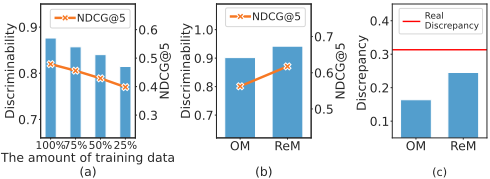
Data sparsity. We respectively use 100%, 75%, 50%, and 25% of the biased data in Yahoo!R3 for training the Matrix Factorization (MF) model. We use 1 - 0.5λ∗ [Chen et al., 2019; Kundu et al., 2022] to measure representation discriminability. The discriminability with varying data ratios of biased data is presented in Figure 2. As can be seen, the discriminability and performance drop heavily with the decrease in the data amount, i.e., the increase of the data sparsity.
Label Shift. We conduct under-sampling on the user-item pairs with positive labels in the original biased data from Yahoo!R3. This process yields resampled biased data that maintains the same label distribution as the unbiased data. We train a model named OM on the original based on adversarial distribution alignment [Ganin and Lempitsky, 2015]. This process is subsequently repeated, wherein the original data is substituted with the resampled one when calculating the representation distribution discrepancy. We denote the model in this setting as ReM. For the two models, we explore the distribution discrepancy between predictions on the original biased data and unbiased data. The results are shown in Figure 2. We make two interesting observations: 1) The discriminability and performance on the ReM are significantly larger than OM, suggesting label shift indeed hurts representation discriminability and recommendation performance; 2) In comparison to the distribution discrepancy between the predictions of ReM on the original biased and unbiased data, the distribution discrepancy between the predictions of OM on the original biased and unbiased data is significantly lower than the real label distribution discrepancy. This confirms that blindly boosting representation invariance will force the distribution of predictions on the biased and unbiased data to be the same.
3 ProposedMethod: DIRL
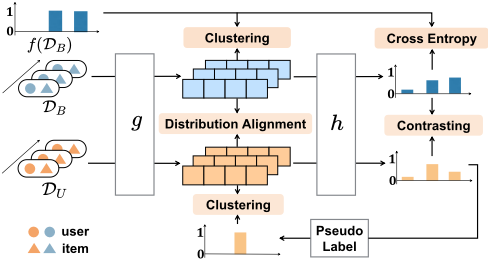
We now present the proposed DIRL framework (cf. Figure 3), which consists of three modules: 1) Adversarial distribution alignment for boosting representation invariance; 2) Labelconditional clustering for mitigating the ruin of data sparsity on representation discriminability; 3) Prior-guided contrasting for mitigating the ruin of label shift on discriminability.
3.1 Adversarial Distribution Alignment
Inspired by the success of adversarial training on UDA task [Jiang et al., 2022], here we leverage adversarial learning in RS for mitigating the distribution discrepancy. That is, the metric of distribution discrepancy dH∆H(DB,DU) can be approximated by training a distribution classifier C.
Formally, the recommendation model and the classifier play a min-max game with optimizing:
where θ and ϕ are the recommendation model's and the distribution classifier's parameters respectively. We use MF as our recommendation model. This means g(u, i) := eu ⊙ ei, where eu and ei are embeddings of the user u and the item i respectively. And h(z) := σ(z⊺1), which is fixed as 1 in H. In practice, the issue of serious gradient vanishing is encountered [Tzeng et al., 2017] and thus a gradient trick [Tzeng et al., 2015] has been utilized, i.e., optimizing the recommendation model with:
3.2 Label-conditional Clustering
Label-conditional clustering has been leveraged for boosting representation discriminability. A clustering loss is introduced, which can encourage representations with the same labels to gather close together and those with different labels to be separated farther apart. Specifically, we optimize the following loss on biased data:
where δ is the indicator function and cyB is the centroid of the representations with the same labels in biased data. cyB is defined as:
We also apply the clustering loss on the unbiased data to further boost representation discriminability. Considering the labels of unbiased data are unavailable, inspired by the selflabeling technique [Lee, 2013], we use pseudo labels from model prediction as substitutes. That is, we simply assign the pseudo-label as 1 if the model prediction is greater than threshold tp = 0.5, or to 0 if it is smaller. The overall cluster loss on both biased and unbiased data is:
Minimizing Eq. (12) concentrates the representation with the same labels and increases the distance among representation centroids of different labels. It naturally mitigates the impact caused by data sparsity that representations with different labels are not separated enough.
Algorithm 1 DIRL
Input: History feedback DB and f(DB); the user set U and the item set I; trade-off parameters β, α1, and α2; learning rate lr; weight decay λ
Parameter: The recommendation model's parameter θ; the distribution classifier's parameter ϕ
Output: Model predictions of users' feedback on items
- 1: Randomly initialize θ and ϕ
- 2: while not convergence do
- 3: Construct unbiased user-item pairs DU by uniformly sampling n users and n items in U and I respectively
- 4: Update ϕ by Adam according to max-step in Eq. 16
- 5: Update θ by Adam according to min-step in Eq. 16
- 6: end while
- 7: return Recommendation model
3.3 Prior-guided Contrasting
To mitigate the impact of label shift on representation discriminability, a straightforward solution is to directly restrict the distribution discrepancy of model predictions. Here we propose prior-guided contrasting that constrains the distance between the predictions on the biased data and unbiased data according to the prior knowledge of label shift. In typical RSs, the biased data contain a much higher proportion of user-item pairs with positive labels than the unbiased data collected using a random exposure policy. Naturally, a constraint is introduced for capturing such useful prior knowledge:
where ¯h(z) := z⊺1, i.e., the predicted logits of the model. Here we directly constrain the average logit of biased data shall be larger than unbiased data.
To better understand the effect, we conduct analyses based on the gradient w.r.t. model parameters θ:
As can be seen, each gradient step has a multiplicative scalar:
This quantity depends on the gap of average logits (i.e., ¯mB - ¯mU). When it is contrary to the prior knowledge of real label distribution discrepancy, ∆¯mB, ¯mU is large, which makes a large update to the representation. When it is consistent with the prior, ∆¯mB, ¯mU will gradually decrease with the increase of the gap, which prevents the gap from being too large. Minimizing Eq. 13 causes invariance boosting focus on eliminating representation distribution discrepancy outside of label shift, which prevents it from forcing the distribution of predictions on the biased and unbiased data to be the same.
3.4 Joint Optimization
DIRL pursues to boost both representation invariance and discriminability and optimizes the following joint objective function:
where β, α1 and α2 are hyper-parameters regulating the effects of the modules. The algorithm is in Algorithm 1.
4 Experiments
In this section, we conduct several experiments to answer the following questions: RQ1 Can DIRL outperform existing recommendation methods for mitigating selection bias? RQ2 To what extent do different modules contribute to the effectiveness of DIRL? RQ3 Does DIRL improve the representation discriminability and reduce the empirical error on the unbiased data as expected? RQ4 How well do the discriminability-boosting modules generalize? Supplementary materials describe the experiment details including evaluation metrics, baselines, and hyperparameter settings.
4.1 Experiment Setup
We use three publicly available datasets: Yahoo!R3 3 , Coat 4 , and KuaiRand-Pure 5 , which contain both biased data for training and unbiased data for testing. Following [Chen et al., 2021], we transform the ratings in Yahoo!R3 and Coat into positive (> 3) and negative (≤ 3) labels. We treat click or not in KuanRand-Pure as positive and negative labels. The statistics of datasets are shown in supplementary materials.
4.2 Performance Comparison (RQ1)
We first compare the ranking performance of DIRL with baselines. Table 1 shows results on Yahoo!R3, KuaiRandPure, and Coat. From the table, we observe that:
- In most cases, DIRL outperforms all baselines, with significant improvements, e.g., the improvement on Yahoo!R3 is up to 9.25% w.r.t. NDCG@5. This result validates the effectiveness of DIRL and the rationality of optimizing both representation invariance and discriminability, which is consistent with our theoretical analysis.
- Propensity-based methods, IPS, DRJL, and MRDR, perform better than the base model MF, showing the effect of data reweighting. Furthermore, MRDR performs better than IPS and DRJL owing to its design for reducing variance in imputation learning. These results are consistent with previous works [Guo et al., 2021].
- In most cases, invariant representation-based methods especially InvPref outperform propensity-based methods, validating the advantages of pursuing invariant representation to minimize the distribution discrepancy for addressing
3 http://webscope.sandbox.yahoo.com/
4 https://www.cs.cornell.edu/˜schnabts/mnar/
5 https://kuairand.com/
| Method | Yahoo!R3 | KuaiRand-Pure | Coat | ||||||
|---|---|---|---|---|---|---|---|---|---|
| NDCG@5 | Precision@5 | Recall@5 | NDCG@5 | Precision@5 | Recall@5 | NDCG@5 | Precision@5 | Recall@5 | |
| MF | 0.4790 | 0.2318 | 0.6244 | 0.3271 | 0.2601 | 0.2704 | 0.5219 | 0.3143 | 0.5725 |
| IPS | 0.5048 | 0.2386 | 0.6446 | 0.3221 | 0.2556 | 0.2727 | 0.5429 | 0.3322 | 0.5979 |
| DRJL | 0.5503 | 0.2577 | 0.7139 | 0.3388 | 0.2687 | 0.2790 | 0.5515 | 0.3425 | 0.6236 |
| MRDR | 0.5686 | 0.2623 | 0.7276 | 0.3410 | 0.2693 | 0.2827 | 0.5593 | 0.3478 | 0.6261 |
| CVIB | 0.5356 | 0.2545 | 0.7048 | 0.3612 | 0.2799 | 0.3099 | 0.5645 | 0.3377 | 0.6141 |
| DAMF | 0.5679 | 0.2600 | 0.7169 | 0.3677 | 0.2860 | 0.3170 | 0.5693 | 0.3372 | 0.6108 |
| InvPref | 0.6229 | 0.2817 | 0.7723 | 0.3678 | 0.2868 | 0.3245 | 0.5926 | 0.3504 | 0.6488 |
| DIRL w/o PL | 0.5627 | 0.2599 | 0.7209 | 0.3508 | 0.2745 | 0.3027 | 0.5841 | 0.3432 | 0.6267 |
| DIRL w/o P | 0.6510 | 0.2873 | 0.7942 | 0.3784 | 0.2928 | 0.3227 | 0.6036 | 0.3497 | 0.6491 |
| DIRL w/o L | 0.6291 | 0.2808 | 0.7706 | 0.3872 | 0.2987 | 0.3308 | 0.5956 | 0.3451 | 0.6369 |
| DIRL | 0.6805 | 0.2965 | 0.8151 | 0.3991 | 0.3063 | 0.3382 | 0.6101 | 0.3522 | 0.6536 |
| Impv (%) | 9.25% | 5.25% | 5.54% | 8.51% | 6.80% | 4.22% | 2.95% | 0.51% | 0.74% |
selection bias in recommendation. Besides, this result indicates the potential of invariant representation learning for unbiased recommendation.
- DAMF performs better than CVIB. We postulate that the metric dh,H utilized by DAMF can better measure the distribution discrepancy in recommendation than the meanbased measurement of CVIB.
4.3 Ablation Study (RQ2)
We then examine the impact of adversarial distribution alignment (A), prior-guided contrasting (P), and label-conditional clustering (L) on the effectiveness of DIRL by further comparing three variations of DIRL: (1) removal of both labelconditional clustering and prior-guided contrasting (DIRL w/o PL), (2) removal of prior-guided contrasting (DIRL w/o P), (3) removal of label-conditional clustering (DIRL w/o L), with DIRL and MF (i.e., removal of adversarial distribution alignment, label-conditional clustering, and priorguided contrasting). The results in Table 1 demonstrate that each module is critical to unbiased recommendations. In particular, (1) even ignoring representation discriminability (i.e., DIRL w/o PL), it can achieve competitive performance, which shows the effectiveness of optimizing representation invariance through adversarial distribution alignment; (2) either label-conditional clustering (i.e., DIRL w/o P) or priorguided contrasting (i.e., DIRL w/o L) improve recommendation performance effectively, showing the importance of optimizing representation discriminability; and (3) the best performance is achieved by using label-conditional clustering and prior-guided contrasting together (i.e., DIRL), which further validates the effectiveness of jointly considering data sparsity and label shift.
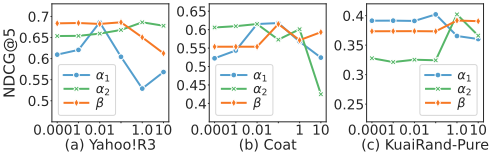
We further evaluate the influence of adversarial distribution alignment, label-conditional clustering, and prior-guided contrasting on model performance by adjusting their coefficients (i.e., β, α1, and α2). Figure 4 presents the results of model performance w.r.t. NDCG@5 as β, α1, and α2 varying in [0.0001, 0.001, 0.01, 0.1, 1.0, 10.0] on three datasets, respectively. Note that the performance w.r.t. Precision@5 and Recall@5 show similar trends (see supplementary materials). From Figure 4, we find that: (1) DIRL can achieve optimal performance by striking a balance between different modules, which confirms the significance of promoting both representation invariance and discriminability; (2) the optimal values of α1 and α2 vary, as their corresponding modules boost representation discriminability by addressing issues arising from different sources (i.e., data sparsity and label shift respectively); (3) unsuitable strength of each module deteriorates model performance.
4.4 In-depth Analysis (RQ3, RQ4)
We investigate sources of DIRL's performance gain by analyzing representation discriminability. And we validate the generalization of our discriminability-boosting modules.
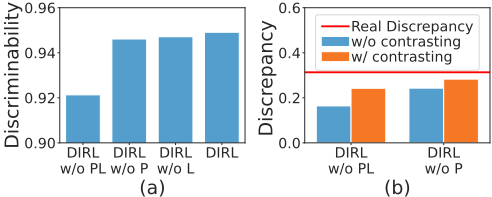
Discriminability. We evaluate the discriminability of DIRL representation. Figure 5 (a) shows that both prior-guided contrasting and label-conditional clustering improve the representation discriminability. This result confirms that improving representation discriminability indeed benefits the recommendation performance. Note Figure 5 (b) shows that both the DIRL w/o PL and DIRL w/o P with prior-guided contrasting have closer prediction distribution discrepancy to real label distribution discrepancy than without it. This means the prior-guided contrasting module improves discriminability in the way expected, i.e., maintaining the true prediction distribution discrepancy between biased and unbiased data.
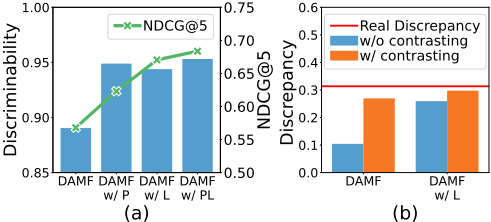
Generalization. To validate that our discriminabilityboosting modules can generalize to other representation invariance-boosting methods, we equip them to DAMF. The results are displayed in Figure 6. Similar observations can be made: (1) When equipped with our discriminability-boosting module, both representation discriminability and recommendation performance (NDCG@5) increase heavily. (2) With prior-guided contrasting, the distribution discrepancy of predictions on the biased and unbiased data is closer to the real label distribution discrepancy.
5 RelatedWork
In this section, we elaborate on the review of existing unbiased recommendation methods and unsupervised domain adaptation relating to our proposal.
Unbiased Recommendation. We focus on methods dealing with selection bias in recommendation. One of the most popular methods is to bridge the gap between biased and unbiased data. Propensity-based methods [Schnabel et al., 2016; Imbens and Rubin, 2015] reweight biased data to align the distribution of unbiased data by the inverse propensity score. Various strategies have been proposed for estimating these propensity scores, such as using statistic metrics of users or items [Saito, 2020a], naive Bayes [Schnabel et al., 2016], or logistic regression [Guo et al., 2021]. [Saito, 2020b; Lee et al., 2022] extend propensity-based methods from explicit feedback data to implicit feedback data. Additionally, methods such as doubly robust [Jiang and Li, 2016; Wang et al., 2019; Chen et al., 2021; Dai et al., 2022] and multiple robust [Li et al., 2022a] incorporate imputation learning to achieve double or multiple robustness for unbiased recommendation. However, propensity scores may be extremely small and these propensity-based methods may have infinite bias, variance, and generalization error bounds [Li et al., 2022b]. An additional line for unbiased recommendation is to bridge the gap at the representation level [Liu et al., 2020; Wang et al., 2020; Liu et al., 2021a; Saito and Nomura, 2022; Wang et al., 2022]. [Wang et al., 2020] leverage information bottleneck and obtain a contrastive loss for balancing the model's average predictions on biased and unbiased data. [Saito and Nomura, 2022] introduce UDA for unbiased recommendation and minimize distribution discrepancy between biased and unbiased data by adversarial distribution alignment. The current leading method is InvPref [Wang et al., 2022], which disentangles variant and invariant representations by clustering and aligning distributions. However, these methods neglect the discriminability of representation.
Unsupervised Domain Adaptation. The task of UDA [Ben-David et al., 2010] is to transfer knowledge from the labeled source domain to the unlabeled target domain. Adversarial distribution alignment is the most popular method in UDA, which focuses on minimizing the distribution discrepancy w.r.t. representation between source and target domains by adversarial learning [Ganin and Lempitsky, 2015; Tzeng et al., 2015; Tzeng et al., 2017; Zhang et al., 2019; Acuna et al., 2021]. However, these methods ignore the representation discriminability, leading to limited generalization performance [Chen et al., 2019]. Some work balances representation invariance and discriminability for better generalization [Chen et al., 2019; Kundu et al., 2022]. Nevertheless, these works are not tailored to recommendation, lacking the consideration of label shift and data sparsity in recommendation. Along this line, a series of methods dealing with the mixed case of covariate distribution shift and label shift [Yan et al., 2017; Deng et al., 2019; Kang et al., 2019; Wu et al., 2019; Li et al., 2020; Prabhu et al., 2021; Liu et al., 2021b]. In an orthogonal direction, we propose a simple and effective module to reduce the impact of label shift on representation discriminability with prior knowledge of label distribution discrepancy. Note that such prior knowledge is unavailable in other scenarios.
6 Conclusion
In this paper, we studied the selection bias in recommender systems from the perspective of invariant representation. According to the analysis of the theory in UDA, we pointed out the importance of optimizing both the invariance and discriminability of representation. Furthermore, we empirically found that the presence of data sparsity and label shift can hurt the discriminability of representation. Accordingly, we proposed a new Discriminative-Invariant Representation Learning framework for unbiased recommendation with additional modules for counteracting the impact of data sparsity and label shift.
One interesting direction for future work is extending our methods to implicit feedback data, which can be collected easier. Besides, it is valuable to explore unbiased methods for sequential recommendation and conversation recommendation to further account for dynamic user preference.
Acknowledgments
This work is supported by the National Key Research and Development Program of China (2022YFB3104701), the National Natural Science Foundation of China (62272437), the Starry Night Science Fund of Zhejiang University Shanghai Institute for Advanced Study (SN-ZJU-SIAS-001), and the CCCD Key Lab of Ministry of Culture and Tourism.
@inproceedings{ijcai2023p252,
  title     = {Discriminative-Invariant Representation Learning for Unbiased Recommendation},
  author    = {Pan, Hang and Chen, Jiawei and Feng, Fuli and Shi, Wentao and Wu, Junkang and He, Xiangnan},
  booktitle = {Proceedings of the Thirty-Second International Joint Conference on
               Artificial Intelligence, {IJCAI-23}},
  publisher = {International Joint Conferences on Artificial Intelligence Organization},
  editor    = {Edith Elkind},
  pages     = {2270--2278},
  year      = {2023},
  month     = {8},
  note      = {Main Track},
  doi       = {10.24963/ijcai.2023/252},
  url       = {https://doi.org/10.24963/ijcai.2023/252},
}
TY - CPAPER TI - Discriminative-Invariant Representation Learning for Unbiased Recommendation AU - Pan, Hang AU - Chen, Jiawei AU - Feng, Fuli AU - Shi, Wentao AU - Wu, Junkang AU - He, Xiangnan T2 - Proceedings of the Thirty-Second International Joint Conference on Artificial Intelligence, IJCAI-23 PB - International Joint Conferences on Artificial Intelligence Organization PY - 2023 SP - 2270 EP - 2278 DO - 10.24963/ijcai.2023/252 UR - https://doi.org/10.24963/ijcai.2023/252 ER -Copied
Machine-readable versions of this paper, for tools and AI agents:





