
LSGNN: Towards General Graph Neural Network in Node Classification by Local Similarity
Proceedings of the Thirty-Second International Joint Conference on Artificial Intelligence. Main Track. Pages 3550-3558.
https://doi.org/10.24963/ijcai.2023/395
Keywords
- Machine Learning: ML: Sequence and graph learning
- Data Mining: DM: Mining graphs
Abstract
Heterophily has been considered as an issue that hurts the performance of Graph Neural Networks (GNNs). To address this issue, some existing work uses a graph-level weighted fusion of the information of multi-hop neighbors to include more nodes with homophily. However, the heterophily might differ among nodes, which requires to consider the local topology. Motivated by it, we propose to use the local similarity (LocalSim) to learn node-level weighted fusion, which can also serve as a plug-and-play module. For better fusion, we propose a novel and efficient Initial Residual Difference Connection (IRDC) to extract more informative multi-hop information. Moreover, we provide theoretical analysis on the effectiveness of LocalSim representing node homophily on synthetic graphs. Extensive evaluations over real benchmark datasets show that our proposed method, namely Local Similarity Graph Neural Network (LSGNN), can offer comparable or superior state-of-the-art performance on both homophilic and heterophilic graphs. Meanwhile, the plug-and-play model can significantly boost the performance of existing GNNs.
- [Abu-El-Haija et al., 2019] Sami Abu-El-Haija, Bryan Per- ozzi, Amol Kapoor, Nazanin Alipourfard, Kristina Ler- man, Hrayr Harutyunyan, Greg Ver Steeg, and Aram Gal- styan. Mixhop: Higher-order graph convolutional archi- tectures via sparsified neighborhood mixing. In Inter- national Conference on Machine Learning, pages 21-29. PMLR, 2019.
- [Battaglia et al., 2018] Peter W Battaglia, Jessica B Ham- rick, Victor Bapst, Alvaro Sanchez-Gonzalez, Vinicius Zambaldi, Mateusz Malinowski, Andrea Tacchetti, David Raposo, Adam Santoro, Ryan Faulkner, et al. Relational inductive biases, deep learning, and graph networks. arXiv preprint arXiv:1806.01261, 2018.
- [Bo et al., 2021] Deyu Bo, Xiao Wang, Chuan Shi, and Huawei Shen. Beyond low-frequency information in graph convolutional networks. arXiv preprint arXiv:2101.00797, 2021.
- [Chanpuriya and Musco, 2022] Sudhanshu Chanpuriya and Cameron N Musco. Simplified graph convolution with heterophily. In Alice H. Oh, Alekh Agarwal, Danielle Bel- grave, and Kyunghyun Cho, editors, Advances in Neural Information Processing Systems, 2022.
- [Chen et al., 2020] Ming Chen, Zhewei Wei, Zengfeng Huang, Bolin Ding, and Yaliang Li. Simple and deep graph convolutional networks. In International Confer- ence on Machine Learning, pages 1725-1735. PMLR, 2020.
- [Chien et al., 2021] Eli Chien, Jianhao Peng, Pan Li, and Ol- gica Milenkovic. Adaptive universal generalized pager- ank graph neural network. In International Conference on Learning Representations, 2021.
- [Defferrard et al., 2016] Michaël Defferrard, Xavier Bres- son, and Pierre Vandergheynst. Convolutional neural net- works on graphs with fast localized spectral filtering. Ad- vances in Neural Information Processing Systems, 29, 2016.
- [Errica et al., 2020] Federico Errica, Marco Podda, Davide Bacciu, and Alessio Micheli. A fair comparison of graph neural networks for graph classification. In Interna- tional Conference on Learning Representations. OpenRe- view.net, 2020.
- [Hamilton et al., 2017] William L. Hamilton, Rex Ying, and Jure Leskovec. Inductive representation learning on large graphs. arXiv, abs/1706.02216, 2017.
- [Hamilton, 2020] William L Hamilton. Graph representation learning. Synthesis Lectures on Artifical Intelligence and Machine Learning, 14(3):1-159, 2020.
- [He et al., 2021] Mingguo He, Zhewei Wei, Hongteng Xu, et al. Bernnet: Learning arbitrary graph spectral filters via bernstein approximation. Advances in Neural Information Processing Systems, 34, 2021.
- [Hu et al., 2020] Weihua Hu, Matthias Fey, Marinka Zitnik, Yuxiao Dong, Hongyu Ren, Bowen Liu, Michele Catasta, and Jure Leskovec. Open graph benchmark: Datasets for machine learning on graphs. Advances in Neural Informa- tion Processing Systems, 33:22118-22133, 2020.
- [Jiang et al., 2013] Yuexin Jiang, Daniel I Bolnick, and Mark Kirkpatrick. Assortative mating in animals. The American Naturalist, 181(6):E125-E138, 2013.
- [Kipf and Welling, 2016] Thomas N. Kipf and Max Welling. Semi-supervised classification with graph convolutional networks. arXiv, abs/1609.02907, 2016.
- [Li et al., 2022] Xiang Li, Renyu Zhu, Yao Cheng, Caihua Shan, Siqiang Luo, Dongsheng Li, and Weining Qian. Finding global homophily in graph neural networks when meeting heterophily. In International Conference on Ma- chine Learning, pages 13242-13256. PMLR, 2022.
- [Lim et al., 2021] Derek Lim, Felix Hohne, Xiuyu Li, Si- jia Linda Huang, Vaishnavi Gupta, Omkar Bhalerao, and Ser Nam Lim. Large scale learning on non-homophilous graphs: New benchmarks and strong simple methods. Advances in Neural Information Processing Systems, 34:20887-20902, 2021.
- [Liu et al., 2020] Meng Liu, Hongyang Gao, and Shuiwang Ji. Towards deeper graph neural networks. In Proceed- ings of the 26th ACM SIGKDD International Conference on Knowledge Discovery & Data Mining, pages 338-348, 2020.
- [Luan et al., 2022] Sitao Luan, Chenqing Hua, Qincheng Lu, Jiaqi Zhu, Mingde Zhao, Shuyuan Zhang, Xiao-Wen Chang, and Doina Precup. Revisiting heterophily for graph neural networks. arXiv preprint arXiv:2210.07606, 2022.
- [McPherson et al., 2001] Miller McPherson, Lynn Smith- Lovin, and James M Cook. Birds of a feather: Ho- mophily in social networks. Annual Review of Sociology, 27(1):415-444, 2001.
- [Namata et al., 2012] Galileo Namata, Ben London, Lise Getoor, Bert Huang, and U Edu. Query-driven active sur- veying for collective classification. In 10th international workshop on mining and learning with graphs, volume 8, page 1, 2012.
- [Pei et al., 2020] Hongbin Pei, Bingzhe Wei, Kevin Chen- Chuan Chang, Yu Lei, and Bo Yang. Geom-gcn: Ge- ometric graph convolutional networks. arXiv preprint arXiv:2002.05287, 2020.
- [Rozemberczki et al., 2021] Benedek Rozemberczki, Carl Allen, and Rik Sarkar. Multi-Scale Attributed Node Em- bedding. Journal of Complex Networks, 9(2), 2021.
- [Scarselli et al., 2009] Franco Scarselli, Marco Gori, Ah Chung Tsoi, Markus Hagenbuchner, and Gabriele Monfardini. The graph neural network model. IEEE Transactions on Neural Networks, 20(1):61-80, 2009.
- [Sen et al., 2008] Prithviraj Sen, Galileo Namata, Mustafa Bilgic, Lise Getoor, Brian Galligher, and Tina Eliassi-Rad. Collective classification in network data. Ai Magazine, 2008.
- [Velickovic et al., 2017] Petar Velickovic, Guillem Cucurull, Arantxa Casanova, Adriana Romero, Pietro Lio, and Yoshua Bengio. Graph attention networks. arXiv, abs/1710.10903, 2017.
- [Wu et al., 2019] Felix Wu, Tianyi Zhang, Amauri Holanda de Souza Jr, Christopher Fifty, Tao Yu, and Kilian Q Weinberger. Simplifying graph convolutional networks. arXiv preprint arXiv:1902.07153, 2019.
- [Zhang and Chen, 2018] Muhan Zhang and Yixin Chen. Link prediction based on graph neural networks. Advances in Neural Information Processing Systems, 31, 2018.
- [Zhu et al., 2020a] Jiong Zhu, Ryan A Rossi, Anup Rao, Tung Mai, Nedim Lipka, Nesreen K Ahmed, and Danai Koutra. Graph neural networks with heterophily. arXiv preprint arXiv:2009.13566, 2020.
- [Zhu et al., 2020b] Jiong Zhu, Yujun Yan, Lingxiao Zhao, Mark Heimann, Leman Akoglu, and Danai Koutra. Be- yond homophily in graph neural networks: Current limita- tions and effective designs. Advances in Neural Informa- tion Processing Systems, 33, 2020.
References were extracted automatically from the PDF and may contain errors.
Full text extracted automatically from the PDF; figures, tables and equations may differ. The PDF is the version of record.
1 Introduction
Graph Neural Network (GNN) has received significant interest in recent years due to its powerful ability in various real-world applications based on graph-structured data, i.e., node classification [Kipf and Welling, 2016], graph classification [Errica et al., 2020], and link prediction [Zhang and Chen, 2018]. Combining convolutional network and graph signal processing, numerous Graph Convolutional Network (GCN) architectures [Scarselli et al., 2009; Defferrard et al., 2016; Hamilton et al., 2017; Velickovic et al., 2017;
∗Correspoding authors: Jing Tang and Chuan Wang.
Kipf and Welling, 2016] have been proposed and show superior performance in the above application domains. Recent work [Battaglia et al., 2018] believes that the success of GCN and its variants is built on the homophily assumption: connected nodes tend to have the same class label [Hamilton, 2020]. This assumption provides proper inductive bias, raising the general message-passing mechanism: aggregating neighbour information to update ego-node feature-a special form of low-pass filter [Bo et al., 2021].
However, the homophily assumption does not always hold [McPherson et al., 2001; Jiang et al., 2013]. In such cases, empirical evidence shows that GCN may even be worse than simple Multi-Layer Perceptrons (MLPs) that use merely node features as input [Chien et al., 2021] (heterophily issue). A potential explanation is that the low-pass filter is believed to hurt the performance of GCN on heterophilic graph. Recently, the heterophily issue has received the community's interest, and various methods [Pei et al., 2020; Chien et al., 2021; He et al., 2021; Li et al., 2022] have been proposed to address the issue. Many existing works [Chien et al., 2021; He et al., 2021; Li et al., 2022] propose to fuse intermediate representations, i.e., outputs of different layers, for heterophilic graphs learning. However, they only consider graph-level heterophily. Moreover, intermediate representations extracted by traditional propagation methods [Kipf and Welling, 2016] may drop some important information, which limits the effectiveness of information fusion among neighbors.
We show that in real-world datasets the heterophily among nodes can be significantly different (Section 3.3), which suggests that only considering graph-level heterophily is insufficient. Although Liu et al. consider node-level heterophily, they simply map each node's representation to its node-level weight, do not take local topology into consideration, yielding suboptimal results. Motivated by the deficiency of existing techniques, we propose to use the local similarity to indicate node homophily to conduct better node-level weighted fusion adaptively. Moreover, we empirically and theoretically show its capabilities on synthetic graphs (Section 4). Furthermore, to obtain more informative intermediate representations for better fusion, we propose a novel Initial Residual Difference Connection (IRDC), which can leverage all the input information. Meanwhile, the IRDC propagation preserves the key property of SGC [Wu et al., 2019] on removing the nonlinear transformations between propagation, which is time- and GPU-consuming in GCNs. This property makes the feature propagation of LSGNN efficient and deep-learning free. Based on the above novel designs, LSGNN offers high performance and high efficiency in evaluations (Section 6).
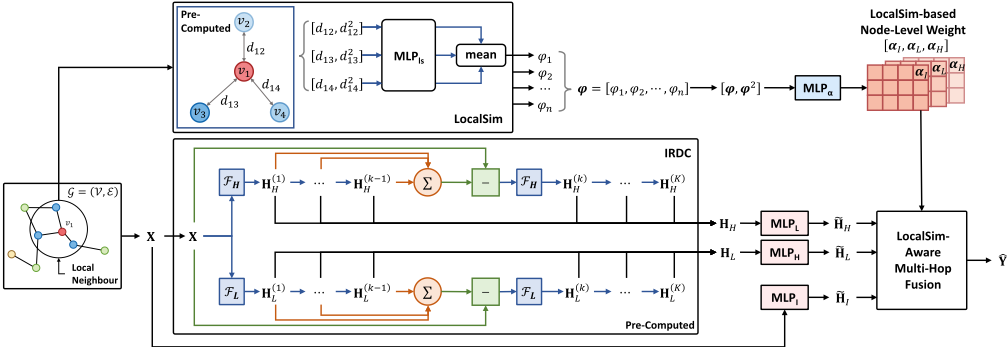
To summarize, we make the following contributions: 1) We study the local node homophily of real-world datasets and suggest using LocalSim as an indicator of node homophily. Moreover, we empirically and theoretically show the effectiveness of using LocalSim to indicate node homophily on synthetic graphs. 2) We propose LSGNN, which contains a LocalSim-aware multi-hop fusion to guide the learning of node-level weight for intermediate representations and an IRDC to extract more informative intermediate representations for better fusion. 3) LocalSim-based node-level weight is a plug-and-play module and can significantly boost the performance of state-of-the-art models, such as H2GCN and GPRGNN. 4) We conduct extensive experiments to demonstrate the superiority of our method, LSGNN, which can offer comparable or superior performance against 13 other methods over homophilic and heterophilic graphs.
2 Preliminaries
2.1 Notations
We denote an undirected graph without self-loops as G = (V, E), where V = {vi}ni=1 is the node set and E ⊆ V × V is the edge set. Let Ni denotes the neighbours of node vi. Denote by A ∈ Rn×n the adjacency matrix, and by D the diagonal matrix standing for the degree matrix such that Dii = ∑nj=1 Aij. Let ˜A and ˜D be the corresponding matrices with self-loops, i.e., ˜A = A+ I and ˜D = D+ I, where I is the identity matrix. Denote by X = {xi}ni=1 ∈ Rn×d the initial node feature matrix, where d is the number of dimensions, and by H(k) = {h(k) i }ni=1 the representation matrix in the k-th layer. We use Y = {yi}ni=1 ∈ Rn×C to denote the ground-truth node label matrix, where C is the number of classes and yi is the one-hot encoding of node vi's label.
2.2 Simple Graph Convolution (SGC)
SGC [Wu et al., 2019] claims that the nonlinearity between propagation in GCN (i.e., the ReLU activation function) is not critical, whereas the majority of benefit arises from the propagation itself. Therefore, SGC removes the nonlinear transformation between propagation so that the class prediction ˆY of a K-layer SGC becomes
where S is a GNN filter, e.g., S = ˜D- 12 ˜A˜D- 12 is used in the vanilla SGC, and W is the learned weight matrix. Removing the nonlinearities, such a simplified linear model yields orders of magnitude speedup over GCN while achieving comparable empirical performance.
2.3 Heterophily Issue
Existing GNN models are usually based on the homophily assumption that connected nodes are more likely to belong to the same class. However, many real-world graphs are heterophilic. For example, the matching couples in dating networks are usually heterosexual. Empirical evidence shows that when the homophily assumption is broken, GCN may be even worse than simple Multi-Layer Perceptrons (MLPs) that use merely node features as input [Chien et al., 2021]. Therefore, it is essential to develop a general GNN model for both homophilic and heterophilic graphs.
Pei et al. [2020] introduce a simple index to measure node homophily/heterophily. That is, the homophilyH(vi) of node vi is the ratio of the number of vi's neighbours who have the same labels as vi to the number of vi's neighbours, i.e.,
and the homophily in a graph is the average of all nodes, i.e.,
Similarly, the heterophily of node vi is measured by 1 - H(vi), and the heterophily in a graph is 1 -H(G).
3 Methodology
3.1 Overview
In this section, we present the Local Similarity Graph Neural Network (LSGNN), consisting of a novel propagation method named Initial Residual Difference Connection (IRDC) for better fusion (Section 3.2), and a LocalSim-aware multi-hop fusion (Section 3.4) and thus cope with both homophilic and heterophilic graphs. We also demonstrate the motivation of using LocalSim as an effective indicator of homophily (Section 3.3). Figure 1 shows the framework of LSGNN.
3.2 Initial Residual Difference Connection (IRDC)
Simply aggregating representation from the previous layer (as applied by most GNNs) might lose important information and consequently incur over-smoothing issues. To obtain more informative intermediate representations, i.e., outputs of different layers, we propose a novel propagation method, namely Initial Residual Difference Connection (IRDC).
General Form. Inspired by SGC, we remove nonlinearity between layers and formulate IRDC as follows:
for k = 2, . . . ,K. S is a GNN filter, and γ ∈ [0, 1] is a hyperparameter. The term ∑k-1 ℓ=1 H(ℓ) in Equation (4) can be seen as the total information extracted by the previous k - 1 layers. In this way, IRDC feeds the information that has never been processed from the original input into the next layer, thus can fully exploit all the information from the initial node features. A normalization operation is conducted following IRDC to handle the potential value scale issue. See Appendix B for comparison between different residual connections.
Parameterization in Practice. Many GCNs use adjacency matrix with self-loops as the low-pass GNN filter to extract similar information from neighbours. However, the self-loops added in GCNs may not always be helpful [Zhu et al., 2020b]. Instead, we use enhanced filters [Bo et al., 2021] of both lowpass and high-pass (FL +FH = I) by adding weighted identity matrix I (i.e., weighted self-loops),
where β ∈ [0, 1] is a hyperparameter. Intuitively, combining low-pass and high-pass filters together can learn better representations for both homophilic and heterophilic graphs. In a K-layer LSGNN, the output H(k) L ,H(k) H ∈ Rn×d of the kth low-pass and high-pass graph filter layer are
where k = 1, 2, . . . , K. Next, H(k) L andH(k) H are transformed into z dimensions by learnable W(k) L ,W(k) H ∈ Rd×z , i.e.,
where σ is the ReLU function. To leverage the the initial node features, we also obtain a transformation ˜HI of X such that
where WI ∈ Rd×z is a learned weight matrix. In what follows, ˜HI, ˜H(k) L , ˜H(k) H ∈ Rn×z (k = 1, 2, . . . ,K) are delivered to the LocalSim-aware multi-hop fusion (Section 3.4) to generate the final node representations.
3.3 LocalSim: An Indicator of Homophily
Based on the hypothesis that nodes with similar features are likely to belong to the same class, we start out by defining a simple version of Local Similarity (LocalSim) ϕi of node vi to indicate its homophily, i.e.,
where sim(·, ·) : (Rd , Rd ) ↦→ R is a similarity measure, e.g.,
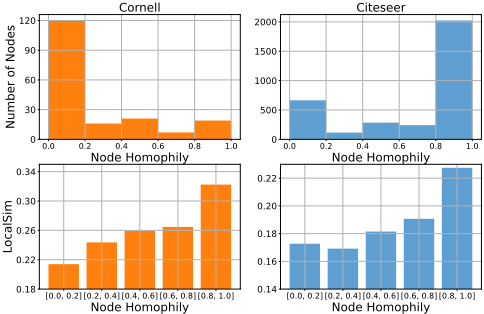
Figure 2 shows the relation between node homophily and LocalSim (using Cosine similarity) on Cornell (left column) and Citeseer (right column) datasets. From the upper figures, we observe that the homophily/heterophily among nodes are different. In particular, Cornell is a heterophilic graph, while Citeseer is a homophilic graph. Moreover, the lower figures show a clear positive correlation between node homophily and LocalSim, which indicates that LocalSim can be used to represent node homophily appropriately.
3.4 LocalSim-Aware Multi-Hop Fusion
In Section 3.3, we show that LocalSim, leveraging the local topology information, can identify the homophily of nodes. We apply LocalSim to learn the adaptive fusion of intermediate representations for each node.
The naive LocalSim in Equation (6) simply averages the similarity between the ego-node and its neighbors. In what follows, we refine the definition of LocalSim by incorporating nonlinearity, i.e., d2ij . Specifically, the refined LocalSimφi of node i is given by
where MLPls →R2 ↦→R is a 2-layer perceptron. It is trivial to see that incorporating d2ij via MLPls can encode the variance of series {dij}vj∈Ni , since Var[dij ] = E[d2ij ] - E2 [dij ] with respect to vj ∈ Ni. As a consequence, φi can better characterize the real "local similarity" than ϕi. To illustrate, we compare φi and ϕi through a simple example. Suppose that node v1 has two neighbours v2 and v3 such that d12 = 0 and d13 = 1, while node v4 has two neighbours v5 and v6 such that d45 = d46 = 0.5. Then, ϕ1 = ϕ4 = 0.5, which cannot characterize the distinct neighbour distributions. On the other hand, by introducing nonlinearity, we can easily distinguish φ1 and φ4. Finally, we have the LocalSim vector for all nodes φ = [φ1, φ2, . . . , φn] ∈ Rn .
LocalSim can guide the intermediate representations fusion, i.e., using φ as local topology information when learning weights for fusion. In addition, we also introduce nonlinearity by using φ and φ2 together to generate weights, i.e.,
where αI,αL,αH ∈ Rn×K are the weights for node representation from each channel and MLPα : R2 ↦→ R3K is a 2-layer perceptron. Then, the node representations for the k-th layer is computed as follows:
where Z(k) ∈ Rn×z and α(k) I ,α(k) L ,α(k) H ∈ Rn for k = 1, 2, . . . ,K, and α(k) I ⊙ ˜HI is the i-th entry of α(k) I times the i-th row of ˜HI for i = 1, 2, . . . , n (so do α(k) L ⊙ ˜H(k) L and α(k) H ⊙ ˜H(k) H ). Then, we obtain the final representation as ˜HI∥Z(1) ∥Z(2) ∥ · · · ∥Z(K) , where ∥ is the concatenation function. Finally, the class probability prediction matrix ˆY ∈ Rn×C is computed by
whereWout ∈ R(K+1)z×C is a learned matrix.
4 Case Study of Toy Example
In this section, we conduct a case study using a simple synthetic graph to demonstrate the superiority of our LocalSimbased node-level weight.
4.1 Empirical Investigation
Inspired by the Featured Stochastic Block Model (FSBM) [Chanpuriya and Musco, 2022], in the following, we introduce FSBM with mixture of heterophily that can generate a simple synthetic graph with different node heterophily.
Definition 1 (FSBM with Mixture of Heterophily). A Stochastic Block Model (SBM) graph G with mixture of heterophily has n nodes partitioned into r communities C1, C2, . . . , Cr and consisting of t subgraphs G1, G2, . . . , Gt where there is no edge between any two subgraphs, with intra-community and inter-community edge probabilities pk and qk in subgraph Gk. Let c1, c2, . . . , cr ∈ {0, 1}n be indicator vectors for membership in each community, i.e., the j-th entry of ci is 1 if the j-th node is in Ci and 0 otherwise. An FSBM is such a graph model G, plus a feature vector x = f + η ∈ Rn , where η ∼ N(0, σ2 I) is zerocentered, isotropic Gaussian noise and f = ∑i µici for some µ1, µ2, . . . , µr ∈ R, which are the expected feature values of each community.
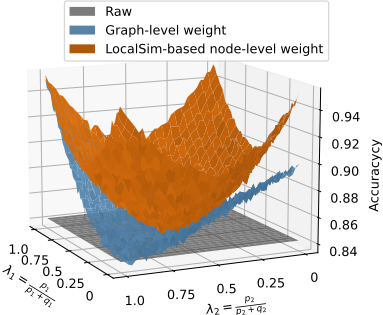
According to Definition 1 and Equation (2), nodes in the same subgraph have identical homophily in expectation, while nodes from different subgraphs have distinct homophily. We consider FSBMs with n = 1000, 2 equallysized communities C1 and C2, 2 equally-sized subgraphs G1 and G2, feature means µ1 = 1, µ2 = -1, and noise variance σ = 1. We generate different graphs by varying λ1 = p1 p1+q1 and λ2 = p2 p2+q2 , where λ1, λ2 ∈ [0, 1] and high λτ means high homophily, with the expected degree of all nodes to 10 (which means 14 (pτ + qτ )n = 10 for τ = 1, 2).
We employ graph-level weight and LocalSim-based nodelevel weight to classify the nodes. For LocalSim-based nodelevel weight, we use the proposed method in Section 3. For graph-level weight, we replace α in Equation (8) with learnable graph-level value. For the similarity measure, we use sim(x, y) = -(x - y)2 , where x and y are scalar values. Finally, considering the simplicity of the synthetic networks, we use the simple LocalSim in Equation (6), and only use adjacency matrix with self-loop ˜A = A+ I and set the layers of IRDC to one.
As shown in Figure 3, our LocalSim-based node-level weight consistently outperforms graph-level weight. In particular, when node homophily is significantly different among subgraphs, the graph-level weight performs poorly, while our approach still performs very well which can recognize the node homophily well and adaptively provide suitable filters.
4.2 Theoretical Analysis
In addition to the empirical investigation, we theoretically confirm the capabilities of LocalSim node-level weight. For simplicity, we assume the number of inter-community and intra-community edges for all the nodes is the same as their expectation and without self-loop. Suppose that the optimal graph-level weight can provide a global filter that achieves the best average accuracy among all subgraphs (not the best in every subgraph), while the optimal node-level weight can provide the optimal filter for each subgraph which can achieve the best accuracy in every subgraph. However, to achieve the optimal node-level weight, we need to estimate the node homophily λ, and LocalSim is used for the aim. Next, we investigate the effectiveness of using LocalSim to indicate λ.
Theorem 1 (Effectiveness of LocalSim Indicating λ). Consider FSBMs with 2 equally-sized communities and 2 equallysized subgraphs, and assume that the number of intercommunity and intra-community edges for all the nodes is the same as their expectation and without self-loop. Consider that LocalSim is defined as ϕ(vi) = - 1 |Ni | ∑vj∈Ni (xi - xj)2 . For any node vi that belongs to Gτ for τ = 1, 2, we have E[ϕ(vi)] = -2σ2 -(1-λτ)(µ1 -µ2)2 , where λτ = pτ pτ+qτ . Moreover, for any two nodes vi ∈ G1 and vj ∈ G2, the expectation of L1-norm distance between ϕ(vi) and ϕ(vj) is no less than to |λ1 - λ2|(µ1 - µ2)2 .
We defer the proof to Appendix A. Theorem 1 states that E[ϕ(vi)] linearly correlates to λτ when vi ∈ Gτ , which suggests that LocalSim can represent the homophily λτ of node vi unbiasedly. We can also get that the expectation of L1norm distance positively correlates to |λ1 - λ2|. This indicates that our estimation is likely to perform better when |λ1 - λ2| goes up. When the gap between λ1 and λ2 shrinks, the two subgraphs become similar to each other, so does the optimal filter for each community. These results confirm the effectiveness of LocalSim indicating node homophily, which yields high performance in our empirical investigation.
5 Additional RelatedWork
In this section, we discuss some related work that attempts to address the heterophily issue. Mixhop [Abu-El-Haija et al., 2019] proposes to extract features frommulti-hop neighborhoods to get more information. CPGNN [Zhu et al., 2020a] modifies feature propagation based on node classes in GCN to accommodate heterophily. Geom-GCN [Pei et al., 2020] proposes to use the graph structure defined by geometric relationship to perform aggregation process to address heterophily. FAGCN [Bo et al., 2021] proposes to use the attention mechanism to learn the edge-level aggregation weights of low-pass and high-pass filters to adaptively address the heterophily issue, while we use LocalSim to parameterize the node-level weight which achieves less computation complexity and better performance. H2GCN [Zhu et al., 2020b] and GPRGNN [Chien et al., 2021] propose fusing intermediate representation at graph-level based on their analysis of graphs. ACM-GCN [Luan et al., 2022] divides feature propagation into three channels: low-pass, high-pass, and identity, and then adaptively mix the three channels during propagation but does not fuse different intermediate representations. Compared with H2GCN, GPRGNN, and ACMGCN, our work only needs propagation once which means the propagation can be pre-computed, while their works are trained via back-propagation through repeated feature propagation which yields huge computation costs. ASGC [Chanpuriya and Musco, 2022] directly uses the least square to filter the features obtained by SGC [Chen et al., 2020] for classification, while our work involves multiple intermediate information, which is fused by node-level weight. These designs yield better performance based on pre-propagated features. Different from all these methods, our work uses LocalSim to parameterize the node-level weight for better adaptive fusion efficiently, and performs IRDC as an efficient propagation method for better informative representation, thus boosting the performance while keeping high efficiency. Moreover, we show that our designed LocalSim-based node-level weight can be used to improve the performance of H2GCN and GPRGNN, which confirms the superiority of our method.
6 Experiment
6.1 Datasets and Setups
We evaluate LSGNN on nine small real-world benchmark datasets including both homophilic and heterophilic graphs. For homophilic graphs, we adopt three widely used citation networks, Cora, Citeseer, and Pubmed [Sen et al., 2008; Namata et al., 2012]. For heterophilic graphs, Chameleon and Squirrel are page-page Wikipedia networks [Rozemberczki et al., 2021], Actor is a actor network [Pei et al., 2020], and Cornell, Texas and Wisconsin are web pages networks [Pei et al., 2020]. Statistics of these datasets can be seen in Appendix D.
For all datasets, we use the feature matrix, class labels, and 10 random splits (48%/32%/20%) provided by Pei et al. [2020]. Meanwhile, we use Optuna to tune the hyperparameter 200 times in experiments. For LSGNN, we set the number of layer K = 5.
There are three types of baseline methods, including nongraph models (MLP), traditional GNNs (GCN, GAT [Velickovic et al., 2017], etc.), and GNNs tolerating heterophily (Geom-GCN, GPRGNN, etc.).
6.2 Evaluations on Real Benchmark Datasets
As shown in Table 1, LSGNN outperforms most of the baseline methods. On homophilic graphs, LSGNN achieves the SOTA performance on the Cora and Pubmed datasets and is lower than the best result by only 1.28% on the Citeseer dataset. On heterophilic graphs except Actor, LSGNN significantly outperforms all the other baseline models by 1.77%-11.00%. Specifically, the accuracy of LSGNN is 7.83% and 2.97% higher than GloGNN, the existing SOTA method on heterophilic graphs, on Chameleon and Cornell, is 11.00% higher than LINKX [Lim et al., 2021] on Squirrel, and is 2.43% and 1.77% higher than ACM-GCN on Texas and Wisconsin. In particular, LSGNN achieves the best average accuracy, higher than the second-best by 3.60%. This demonstrates that LSGNN can achieve comparable or superior SOTA performance on both homophilic and heterophilic graphs.
| Cora | Citeseer | Pubmed | Chameleon | Squirrel | Actor | Cornell | Texas | Wisconsin | Avg | |
|---|---|---|---|---|---|---|---|---|---|---|
| 2MLP | 74.75 | 72.41 | 86.65 | 46.36 | 29.68 | 35.76 | 81.08 | 81.89 | 85.29 | 65.99 |
| 2GCN | 87.28 | 76.68 | 87.38 | 59.82 | 36.89 | 30.26 | 57.03 | 59.46 | 59.80 | 61.62 |
| 2GAT | 82.68 | 75.46 | 84.68 | 54.69 | 30.62 | 26.28 | 58.92 | 58.38 | 55.29 | 58.56 |
| 2MixHop | 87.61 | 76.26 | 85.31 | 60.50 | 43.80 | 32.22 | 73.51 | 77.84 | 75.88 | 68.10 |
| 3GCNII | 88.37 | 77.33 | 90.15 | 63.86 | 38.47 | 37.44 | 77.86 | 77.57 | 80.39 | 70.16 |
| 1Geom-GCN | 85.27 | 77.99 | 90.05 | 60.90 | 38.14 | 31.63 | 60.81 | 67.57 | 64.12 | 64.05 |
| 1H2GCN | 87.81 | 77.07 | 89.59 | 59.39 | 37.90 | 35.86 | 82.16 | 84.86 | 86.67 | 71.26 |
| 1WRGNN | 88.20 | 76.81 | 88.52 | 65.24 | 48.85 | 36.53 | 81.62 | 83.62 | 86.98 | 72.93 |
| 3GPRGNN | 87.95 | 77.13 | 87.54 | 46.58 | 31.61 | 34.63 | 80.27 | 78.38 | 82.94 | 67.45 |
| 3LINKX | 84.64 | 73.19 | 87.86 | 68.42 | 61.81 | 36.10 | 77.84 | 74.60 | 75.49 | 71.11 |
| 3ACM-GCN | 87.91 | 77.32 | 90.00 | 66.93 | 54.40 | 36.28 | 85.14 | 87.84 | 88.43 | 74.92 |
| 3GGCN | 87.95 | 77.14 | 89.15 | 71.14 | 55.17 | 37.54 | 85.68 | 84.86 | 86.86 | 75.05 |
| 1GloGNN | 88.33 | 77.41 | 89.62 | 71.21 | 57.88 | 37.70 | 85.95 | 84.32 | 88.04 | 75.61 |
| LSGNN | 88.49 | 76.71 | 90.23 | 79.04 | 72.81 | 36.18 | 88.92 | 90.27 | 90.20 | 79.21 |
| H(G) | GCN | SGC | GCNII | LINKX | GloGNN | LSGNN | |
|---|---|---|---|---|---|---|---|
| arXiv-year | 0.22 | 46.02 | 32.83 | 47.21 | 56.00 | 54.79 | 56.42 |
| ogbn-arXiv | 0.66 | 71.74 | 69.39 | 72.74 | 54.45∗ | 49.22∗ | 72.64 |
| Avg | NA | 58.88 | 51.11 | 59.98 | 55.23 | 52.01 | 64.53 |
6.3 Evaluations on Large Benchmark Datasets
We also conduct experiments on two large datasets: ogbnarXiv (homophilic) and arXiv-year (heterophilic), both with 170k nodes and 1M edges but different labels, following settings in [Hu et al., 2020] and [Lim et al., 2021], see Appendix D for setting details. Table 2 shows that our method has competitive performance on both homophilic and heterophilic larger graphs.
6.4 Training Cost Comparison
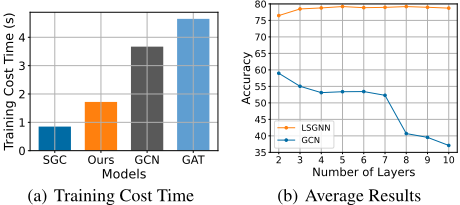
LSGNN only needs to propagate once during training, and the networks for node-level weight are small. Thus the efficiency of LSGNN can be close to SGC's. As shown in Figure 4(a), on the average training time over nine datasets, our proposed method is only slower than SGC, a simple and effective model, and is nearly 2× faster than GCN and GAT. This confirms the high training efficiency of LSGNN. See Appendix C for more setting details and detailed comparisons of training costs on each dataset.
6.5 Alleviate Over-Smoothing Issue
To validate whether LSGNN can alleviate the over-smoothing issue, we compare the performance between vanilla GCN and LSGNN under different layers of propagation (Figure 4(b)), see Appendix E for full results. It can be seen that GCN achieves the best performance at 2 layers, and its performance decreases rapidly as layers increase. In contrast, the results of LSGNN keep stable and high. The reasons are two-fold: (i) our IRDC can extract better informative representations, and (ii) our LocalSim-based fusion can adaptively remain and drop distinguishable and indistinguishable representations, respectively. Through these two designs, LSGNN can perform well as layers increase, which indicates the capability of LSGNN to prevent the over-smoothing issue.
6.6 LocalSim-based Node-level Weight as a Plug-and-Play Module
LocalSim-based node-level weight (Section 3.4) can be regarded as a plug-and-play module, which can be added to existing GNNs that also fuse intermediate representations without involving extra hyperparameters, such as H2GCN, GPRGNN, and DAGNN.
H2GCN and GPRGNN use learned graph-level weight to fuse the intermediate representations, which is only replaced by LocalSim-based node-level weight here. Note that we only add LocalSim-based node-level weight into H2GCN and GPRGNN, but not the enhanced filters or the high-pass filters. As shown in Table 3, the performance of both H2GCN and GPRGNN increases significantly, indicating that taking each node's local topology into consideration when fusing intermediate representations is more reasonable and effective than merely considering graph-level structure.
| Cora | Citeseer | Pubmed | Chameleon | Squirrel | Actor | Cornell | Texas | Wisconsin | Avg | |
|---|---|---|---|---|---|---|---|---|---|---|
| H2GCN | 87.81 | 77.07 | 89.59 | 59.39 | 37.90 | 35.86 | 82.16 | 84.86 | 86.67 | 71.26 |
| w/ LocalSim | 88.42 | 76.77 | 89.91 | 64.91 | 41.73 | 36.29 | 85.68 | 85.68 | 88.82 | 73.13 |
| GPRGNN | 87.95 | 77.13 | 87.54 | 46.58 | 31.61 | 34.63 | 80.27 | 78.38 | 82.94 | 67.45 |
| w/ LocalSim | 88.83 | 76.60 | 90.26 | 65.39 | 51.96 | 35.59 | 85.14 | 87.84 | 87.65 | 74.36 |
| DAGNN | 82.63 | 75.47 | 88.50 | 58.03 | 39.59 | 30.20 | 61.89 | 58.92 | 55.10 | 61.15 |
| w/ LocalSim | 84.12 | 75.29 | 89.97 | 61.10 | 44.91 | 34.13 | 79.73 | 77.03 | 85.29 | 70.17 |
| Components | IRDC | Cora | Citeseer | Chameleon | Dataset | Actor | Cornell | Wisconsin | ||||
|---|---|---|---|---|---|---|---|---|---|---|---|---|
| Rand LocalSim | w-self-loop | Pubmed | Squirrel | Texas | Avg | |||||||
| Baseline | 86.33 | 74.53 | 89.99 | 67.28 | 47.73 | 35.27 | 86.47 | 88.92 | 88.04 | 73.84 | ||
| ✓ | 87.93 | 75.32 | 90.08 | 67.72 | 48.99 | 35.65 | 78.38 | 88.51 | 88.43 | 73.45 | ||
| ✓ | 87.62 | 76.60 | 90.20 | 69.96 | 49.95 | 35.80 | 87.57 | 88.92 | 89.80 | 75.16 | ||
| ✓ | ✓ | 87.65 | 76.89 | 89.98 | 75.95 | 65.50 | 35.80 | 87.84 | 88.11 | 89.80 | 77.50 | |
| LSGNN | ✓ | ✓ ✓ | 88.49 | 76.71 | 90.23 | 79.04 | 72.81 | 36.18 | 88.92 | 90.27 | 90.20 | 79.21 |
DAGNN also fuse intermediate representations by nodelevel weight, which however is simply mapped from each node's representation and is learned without involving any local topology information, leading to a suboptimal result. We use LocalSim-based node-level weight in DAGNN similarly. The drmatic improving in Table 3 suggests that using LocalSim as local topology information can ensure the weight being learned more effectively. Although DAGNN is not designed for heterophilic graphs, it can also perform well on heterophilic graphs after using LocalSim-based node-level weight, and is even superior to H2GCN on Squirrel.
6.7 Ablation Study
In what follows, we investigate the effectiveness of LocalSim-based node-level weight, weighted self-loops, and IRDC. Specifically, in the baseline model, we use graph-level weight learned without any local topology information to fuse the intermediate representations, add self-loops when conducting graph filtering, and apply the propagation method used in GCNs. Then, the above components are added one by one to the baseline model for performance comparison. As shown in Table 4, all the components are effective and can bring great benefits to the model in terms of performance improvement.
Note that learning node-level weight without any local topology information ('Rand') might even bring negative effect on the model (lower than baseline by 0.39% on average).
Once LocalSim is used as local topology information, the model can easily learn an optimal node-level weight (75.16% on average, higher than the baseline by 1.32%), which indicates the superiority of LocalSim-Aware Multi-Hop Fusion.
When replacing the fixed self-loops with weighted selfloops, the performance increases significantly (by 2.34% to 77.50% on average), especially on heterophilic graphs, such as Chameleon and Squirrel. This is because self-loops might not always be helpful on heterophilic graphs.
IRDC also brings a significant improvement (by an increase of 1.71% to 79.21% on average). This suggests that such a propagation method can extract more informative representation for better performance.
7 Conclusion
In this paper, LSGNN is proposed for better performance on both homophilic and heterophilic graphs. Many GNNs use graph-level weight to fuse intermediate representations, which does not fully consider the local structure of different nodes. Some GNNs use node-level weight learned without involving topology information, yielding suboptimal results. Our empirical study and theoretical analysis on synthetic graphs demonstrate the importance of node-level weight considering the local topology information of nodes. The proposed LocalSim-aware multi-hop fusion uses local similarity as guidance to generate a more appropriate node-level weight for intermediate representations fusion, and it can also be used as a plug-and-play module to improve the performance of existing GNNs. For better fusion, IRDC is proposed to extract more informative intermediate representations boosting the performance. Evaluations over real-world benchmark datasets show the superiority of LSGNN in handling both homophilic and heterophilic graphs and the effectiveness of all the proposed components.
Acknowledgements
This work is partially supported by the National Key R&D Program of China under Grant No. 2022YFB2703303, by the National Natural Science Foundation of China (NSFC) under Grant No. U22B2060, Grant No. 61972442, Grant No. 62102413, and Grant No. U2001202, by Guangzhou Municipal Science and Technology Bureau under Grant No. 2023A03J0667, by HKUST(GZ) under a Startup Grant, by the S&T Program of Hebei under Grant No. 20350802D, by the Natural Science Foundation of Hebei Province of China under Grant No. F2020202040, and by the Natural Science Foundation of Tianjin of China under Grant No. 20JCYBJC00650.
Contribution Statement
Yuhan Chen and Yihong Luo are equally contributing to this work, as both of them largely contributed to the proposed method, code implementation, experiments, and the writing of the manuscript. Jing Tang significantly revised and polished the manuscript, improving the overall quality of the writing, and offered guidance and mentorship to Yihong throughout the research process. Liang Yang provided valuable feedback and suggestions for manuscript revision. Siya Qiu carried out a thorough grammar check. Both Chuan Wang and Xiaochun Cao offered guidance and mentorship to Yuhan throughout the research process.
@inproceedings{ijcai2023p395,
  title     = {LSGNN: Towards General Graph Neural Network in Node Classification by Local Similarity},
  author    = {Chen, Yuhan and Luo, Yihong and Tang, Jing and Yang, Liang and Qiu, Siya and Wang, Chuan and Cao, Xiaochun},
  booktitle = {Proceedings of the Thirty-Second International Joint Conference on
               Artificial Intelligence, {IJCAI-23}},
  publisher = {International Joint Conferences on Artificial Intelligence Organization},
  editor    = {Edith Elkind},
  pages     = {3550--3558},
  year      = {2023},
  month     = {8},
  note      = {Main Track},
  doi       = {10.24963/ijcai.2023/395},
  url       = {https://doi.org/10.24963/ijcai.2023/395},
}
TY - CPAPER TI - LSGNN: Towards General Graph Neural Network in Node Classification by Local Similarity AU - Chen, Yuhan AU - Luo, Yihong AU - Tang, Jing AU - Yang, Liang AU - Qiu, Siya AU - Wang, Chuan AU - Cao, Xiaochun T2 - Proceedings of the Thirty-Second International Joint Conference on Artificial Intelligence, IJCAI-23 PB - International Joint Conferences on Artificial Intelligence Organization PY - 2023 SP - 3550 EP - 3558 DO - 10.24963/ijcai.2023/395 UR - https://doi.org/10.24963/ijcai.2023/395 ER -Copied
Machine-readable versions of this paper, for tools and AI agents:





