
Sampling Ex-Post Group-Fair Rankings
Proceedings of the Thirty-Second International Joint Conference on Artificial Intelligence. Main Track. Pages 409-417.
https://doi.org/10.24963/ijcai.2023/46
Keywords
- Search: S: Combinatorial search and optimisation
- AI Ethics, Trust, Fairness: ETF: Fairness and diversity
- AI Ethics, Trust, Fairness: ETF: Bias
Abstract
Randomized rankings have been of recent interest to achieve ex-ante fairer exposure and better robustness than deterministic rankings. We propose a set of natural axioms for randomized group-fair rankings and prove that there exists a unique distribution D that satisfies our axioms and is supported only over ex-post group-fair rankings, i.e., rankings that satisfy given lower and upper bounds on group-wise representation in the top-k ranks. Our problem formulation works even when there is implicit bias, incomplete relevance information, or only ordinal ranking is available instead of relevance scores or utility values.
We propose two algorithms to sample a random group-fair ranking from the distribution D mentioned above. Our first dynamic programming-based algorithm samples ex-post group-fair rankings uniformly at random in time O(k^2 ell), where "ell" is the number of groups. Our second random walk-based algorithm samples ex-post group-fair rankings from a distribution epsilon-close to D in total variation distance and has expected running time O*(k^2 ell^2), when there is a sufficient gap between the given upper and lower bounds on the group-wise representation. The former does exact sampling, but the latter runs significantly faster on real-world data sets for larger values of k. We give empirical evidence that our algorithms compare favorably against recent baselines for fairness and ranking utility on real-world data sets.
- [Baswana et al., 2019] Surender Baswana, Partha Pratim Chakrabarti, Sharat Chandran, Yashodhan Kanoria, and Utkarsh Patange. Centralized admissions for engineering colleges in india. Interfaces, 49(5):338-354, 2019.
- [Beutel et al., 2019] Alex Beutel, Jilin Chen, Tulsee Doshi, Hai Qian, Li Wei, Yi Wu, Lukasz Heldt, Zhe Zhao, Lichan Hong, Ed H. Chi, and Cristos Goodrow. Fairness in rec- ommendation ranking through pairwise comparisons. In Proceedings of the 25th ACM SIGKDD International Con- ference on Knowledge Discovery and Data Mining, KDD '19, page 2212-2220, New York, NY, USA, 2019. Associ- ation for Computing Machinery.
- [Biega et al., 2018] Asia J. Biega, Krishna P. Gummadi, and Gerhard Weikum. Equity of attention: Amortizing indi- vidual fairness in rankings. In The 41st International ACM SIGIR Conference on Research and Development in Infor- mation Retrieval, SIGIR '18, page 405-414, New York, NY, USA, 2018. Association for Computing Machinery.
- [Bobko and Roth, 2004] P. Bobko and P.L. Roth. The four- fifths rule for assessing adverse impact: An arithmetic, in- tuitive, and logical analysis of the rule and implications for future research and practice. Research in Personnel and Human Resources Management, 23, 2004.
- [Castillo, 2019] Carlos Castillo. Fairness and transparency in ranking. SIGIR Forum, 52(2):64-71, jan 2019.
- [Celis et al., 2018a] L. Elisa Celis, Vijay Keswani, Damian Straszak, Amit Deshpande, Tarun Kathuria, and Nisheeth K. Vishnoi. Fair and diverse dpp-based data summarization. In Proceedings of the 35th Inter- national Conference on Machine Learning, ICML 2018, Stockholmsmässan, Stockholm, Sweden, July 10-15, 2018, volume 80 of Proceedings of Machine Learning Research, pages 715-724. PMLR, 2018.
- [Celis et al., 2018b] L. Elisa Celis, Damian Straszak, and Nisheeth K. Vishnoi. Ranking with fairness constraints. In ICALP, 2018.
- [Celis et al., 2019] L. Elisa Celis, Sayash Kapoor, Farnood Salehi, and Nisheeth Vishnoi. Controlling polarization in personalization: An algorithmic framework. In Proceed- ings of the Conference on Fairness, Accountability, and Transparency, FAT* '19, page 160-169. Association for Computing Machinery, 2019.
- [Celis et al., 2020a] L. Elisa Celis, Vijay Keswani, and Nisheeth K. Vishnoi. Data preprocessing to mitigate bias: A maximum entropy based approach. In ICML, 2020.
- [Celis et al., 2020b] L. Elisa Celis, Anay Mehrotra, and Nisheeth K. Vishnoi. Interventions for ranking in the pres- ence of implicit bias. In Proceedings of the 2020 Confer- ence on Fairness, Accountability, and Transparency, page 369-380. Association for Computing Machinery, 2020.
- [Chierichetti et al., 2017] Flavio Chierichetti, Ravi Kumar, Silvio Lattanzi, and Sergei Vassilvitskii. Fair clustering through fairlets. In I. Guyon, U. V. Luxburg, S. Bengio, H. Wallach, R. Fergus, S. Vishwanathan, and R. Garnett, editors, Advances in Neural Information Processing Sys- tems, volume 30.
- Curran Associates, Inc., 2017.
- [Collins, 2007] Brian W. Collins. Tackling unconscious bias in hiring practices: The plight of the rooney rule. New York University Law Review, 82, 2007.
- [Cousins and Vempala, 2018] Benjamin R. Cousins and Santosh S. Vempala. Gaussian cooling and O * (n 3 ) algo- rithms for volume and gaussian volume. SIAM J. Comput., 47:1237-1273, 2018.
- [Diaz et al., 2020] Fernando Diaz, Bhaskar Mitra, Michael D. Ekstrand, Asia J. Biega, and Ben Carterette. Evaluating Stochastic Rankings with Expected Exposure, page 275-284. 2020.
- [Dua and Graff, 2017] Dheeru Dua and Casey Graff. UCI machine learning repository. University of California, Irvine, School of Information and Computer Sciences, 2017.
- [Dyer et al., 1991] Martin Dyer, Alan Frieze, and Ravi Kan- nan. A random polynomial-time algorithm for approxi- mating the volume of convex bodies. J. ACM, 38(1):1-17, jan 1991.
- [Gao and Shah, 2020] Ruoyuan Gao and Chirag Shah. To- ward creating a fairer ranking in search engine results. Information Processing and Management, 57(1):102138, 2020.
- [Geyik et al., 2019] Sahin Cem Geyik, Stuart Ambler, and Krishnaram Kenthapadi. Fairness-aware ranking in search and recommendation systems with application to linkedin talent search. In Proceedings of the 25th ACM SIGKDD International Conference on Knowledge Discovery and Data Mining, KDD '19, page 2221-2231, New York, NY, USA, 2019. Association for Computing Machinery.
- [Gorantla et al., 2021] Sruthi Gorantla, Amit Deshpande, and Anand Louis. On the problem of underranking in group-fair ranking. In Marina Meila and Tong Zhang, editors, Proceedings of the 38th International Conference on Machine Learning, volume 139 of Proceedings of Ma- chine Learning Research, pages 3777-3787. PMLR, 18- 24 Jul 2021.
- [Goto et al., 2016] Masahiro Goto, Atsushi Iwasaki, Yujiro Kawasaki, Ryoji Kurata, Yosuke Yasuda, and Makoto Yokoo. Strategyproof matching with regional minimum and maximum quotas. Artificial Intelligence, 235:40-57, 2016.
- [Hassani, 2021] Bertrand K. Hassani. Societal bias rein- forcement through machine learning: a credit scoring per- spective. AI and Ethics, 1:239-247, 2021.
- [Heuss et al., 2022] Maria Heuss, Fatemeh Sarvi, and Maarten de Rijke. Fairness of exposure in light of in- complete exposure estimation. SIGIR '22, page 759-769, 2022.
- [Kannan and Vempala, 1997] Ravi Kannan and Santosh Vempala. Sampling lattice points. In Proceedings of the Twenty-Ninth Annual ACM Symposium on Theory of Com- puting, STOC '97, page 696-700, New York, NY, USA, 1997. Association for Computing Machinery.
- [Kletti et al., 2022] Till Kletti, Jean-Michel Renders, and Patrick Loiseau. Introducing the expohedron for efficient pareto-optimal fairness-utility amortizations in repeated rankings. WSDM '22. Association for Computing Ma- chinery, 2022.
- [Kook et al., 2022] Yunbum Kook, Yin Tat Lee, Ruoqi Shen, and Santosh S. Vempala. Sampling with riemannian hamiltonian monte carlo in a constrained space. In NeurIPS, 2022.
- [Kuhlman et al., 2019] Caitlin Kuhlman, MaryAnn Van- Valkenburg, and Elke Rundensteiner. Fare: Diagnostics for fair ranking using pairwise error metrics. In The World Wide Web Conference, WWW '19, page 2936-2942, New York, NY, USA, 2019. Association for Computing Ma- chinery.
- [Lovász and Vempala, 2006] László Lovász and Santosh Vempala. Hit-and-run from a corner. SIAM J. Comput., 35(4):985-1005, apr 2006.
- [Memarrast et al., 2021] Omid Memarrast, Ashkan Rezaei, Rizal Fathony, and Brian D. Ziebart. Fairness for robust learning to rank. CoRR, abs/2112.06288, 2021.
- [Narasimhan et al., 2020] Harikrishna Narasimhan, Andy Cotter, Maya Gupta, and Serena Lutong Wang. Pairwise fairness for ranking and regression. In 33rd AAAI Confer- ence on Artificial Intelligence, 2020.
- [Okonofua and Eberhardt, 2015] Jason A. Okonofua and Jennifer L. Eberhardt. Two strikes: Race and the disciplin- ing of young students. Psychological Science, 26(5):617- 624, 2015.
- [Singh and Joachims, 2018] Ashudeep Singh and Thorsten Joachims. Fairness of exposure in rankings. In Pro- ceedings of the 24th ACM SIGKDD International Con- ference on Knowledge Discovery and Data Mining, page 2219-2228, 2018.
- [Singh et al., 2021] Ashudeep Singh, David Kempe, and Thorsten Joachims. Fairness in ranking under uncertainty. In NeurIPS 2021, December 6-14, 2021, pages 11896- 11908, 2021.
- [Stoyanovich et al., 2018] Julia Stoyanovich, Ke Yang, and HV Jagadish. Online set selection with fairness and di- versity constraints. Advances in Database Technology - EDBT, pages 241-252, 2018.
- [Uhlmann and Cohen, 2005] Eric Luis Uhlmann and Geof- frey L. Cohen. Constructed criteria: Redefining merit to justify discrimination. Psychological Science, 16(6):474- 480, 2005.
- [Štefankovič et al., 2012] Daniel Štefankovič, Santosh Vem- pala, and Eric Vigoda. A deterministic polynomial-time approximation scheme for counting knapsack solutions. SIAM Journal on Computing, 41(2):356-366, 2012.
- [Wu et al., 2018] Yongkai Wu, Lu Zhang, and Xintao Wu. On discrimination discovery and removal in ranked data using causal graph. In Proceedings of the 24th ACM SIGKDD International Conference on Knowledge Discov- ery and Data Mining, KDD '18, page 2536-2544, New York, NY, USA, 2018. Association for Computing Ma- chinery.
- [Yang and Stoyanovich, 2017] Ke Yang and Julia Stoy- anovich. Measuring fairness in ranked outputs. In Pro- ceedings of the 29th International Conference on Scien- tific and Statistical Database Management, SSDBM '17, New York, NY, USA, 2017. Association for Computing Machinery.
- [Zehlike et al., 2017] Meike Zehlike, Francesco Bonchi, Carlos Castillo, Sara Hajian, Mohamed Megahed, and Ri- cardo Baeza-Yates. Fa*ir: A fair top-k ranking algorithm. In Proceedings of the 2017 ACM on Conference on In- formation and Knowledge Management, CIKM '17, page 1569-1578, New York, NY, USA, 2017. Association for Computing Machinery.
- [Zehlike et al., 2022a] Meike Zehlike, Tom Sühr, Ricardo Baeza-Yates, Francesco Bonchi, Carlos Castillo, and Sara Hajian. Fair top-k ranking with multiple protected groups. Information Processing and Management, 59(1):102707, 2022.
- [Zehlike et al., 2022b] Meike Zehlike, Ke Yang, and Julia Stoyanovich. Fairness in ranking, part i: Score-based rank- ing. ACM Comput. Surv., apr 2022. Just Accepted.
References were extracted automatically from the PDF and may contain errors.
Full text extracted automatically from the PDF; figures, tables and equations may differ. The PDF is the version of record.
1 Introduction
Ranking individuals using algorithms has become ubiquitous in many applications such as college admissions [Baswana et al., 2019], recruitment [Geyik et al., 2019], among others. In many such scenarios, individuals who belong to certain demographic groups based on race, gender, age, etc., face discrimination due to human and historical biases [Uhlmann and Cohen, 2005; Okonofua and Eberhardt, 2015;
1O∗ suppresses logarithmic and error terms.
Hassani, 2021]. Algorithms learning from biased data exacerbate representational harms for certain groups in the top ranks 2,3 , leading to loss of opportunities. One way to mitigate representational harms is by imposing explicit representationbased fairness constraints that the ranking output by the algorithm must contain a certain minimum and maximum number of candidates from each group [Geyik et al., 2019; Celis et al., 2020b]. Many fair processes such as the Rooney rule [Collins, 2007], the 4/5-th rule [Bobko and Roth, 2004], and fairness metrics such as demographic parity impose representation-based constraints.
A large body of work has proposed deterministic postprocessing of rankings to satisfy representation-based groupfairness constraints [Celis et al., 2018b; Geyik et al., 2019; Wu et al., 2018; Zehlike et al., 2017; Gorantla et al., 2021]. These methods essentially merge the group-wise ranked lists to create a common ranking that satisfies representationbased constraints. However, these methods contain two critical flaws. First, deterministic rankings cannot create opportunities for all the groups at the top, especially when the number of groups is large. Second, observations of merit are often noisy in the real world [Okonofua and Eberhardt, 2015] and could contain implicit bias towards protected groups [Uhlmann and Cohen, 2005]. Hence, inter-group comparisons of merit while merging the group-wise rankings could lead to a loss of opportunities for certain groups. For example, suppose multiple companies intend to hire for a limited number of similar open positions and use the same recruitment system to rank a common candidate pool for job interviews. In a deterministic top-k ranking based on biased merit scores, every company would see the same ranking, where the protected groups could be systematically ranked lower. Hence, equal representation at the top-k may not translate into equal opportunities.
We consider randomized group-fair rankings as a way to create opportunity for every group in the top ranks (or, more generally, any rank). We assume that we are given only the ordinal rankings of items within each group (i.e., intragroup ordering without any scores) and no comparison of items across different groups (i.e., inter-group comparisons). This assumption is strong but circumvents implicit bias and allows us to consider group-fair rankings even under incomplete or biased data about pairwise comparisons. Our randomized ranking algorithms output ex-post group-fair rankings, i.e., every sampled ranking output is group-fair and satisfies representation-based fairness constraints as a stronger ex-post (or actual) guarantee instead of a weaker ex-ante (or expected) guarantee.
2 Jeffrey Dastin, Amazon scraps secret AI recruiting tool that showed bias against women
3 Bogen and Rieke, Help Wanted: An Examination of Hiring Algorithms, Equity, and Bias
The rest of the paper is organized as follows: In Section 2, we survey related work and summarize its limitations for our problem. In Section 3 we describe our axiomatic approach to define a distribution over ex-post group-fair rankings (Axioms 3.1-3.3) and show that there is a unique distribution that satisfies our axioms (Theorem 3.4). The same distribution satisfies sufficient representation of every group in any consecutive ranks in the top-k (Corollary 3.6), a natural characteristic derived from our axioms. In Section 4, we give an efficient dynamic programming-based algorithm (Algorithm 1) and a random walk-based algorithm (Algorithm 2) to sample an ex-post group-fair ranking from the above distribution. We also extend our algorithms to handle representation-based constraints on the top prefixes (Section 4.3). In Section 5, we empirically validate our theoretical and algorithmic guarantees on real-world datasets. Finally, Section 6 contains some limitations of our work and open problems. All the proofs and additional experimental results are included in the appendix.
2 RelatedWork
Representation-based fairness constraints for ranking ℓ groups in top k ranks are typically given by numbers Lj and Uj, for each group j ∈ [ℓ], representing the lower and upper bound on the group representation respectively. They capture several fairness notions; setting Lj = Uj = kℓ , ∀j ∈ [ℓ] ensures equal representation for all groups (see section 5 of [Zehlike et al., 2022b]), whereas Lj = Uj = pj · k, ∀j ∈ [ℓ], ensures proportional representation 4 , where pj is the proportion of the group j in the population [Gorantla et al., 2021; Gao and Shah, 2020; Geyik et al., 2019]. These constraints have also been studied in other problems such as fair subset selection [Stoyanovich et al., 2018], fair matching [Goto et al., 2016], and fair clustering [Chierichetti et al., 2017].
Previous work has tried to formalize the general principles of fair ranking as treating similar items consistently, maintaining a sufficient presence of items from minority groups, and proportional representation from every group [Castillo, 2019]. There has been work on quantifying fairness requirements [Yang and Stoyanovich, 2017; Geyik et al., 2019; Beutel et al., 2019; Narasimhan et al., 2020; Kuhlman et al., 2019], which has predominantly proposed deterministic algorithms for group-fair ranking [Yang and Stoyanovich, 2017; Geyik et al., 2019; Gorantla et al., 2021; Celis et al., 2018b; Zehlike et al., 2022b].
Our recruitment example in the previous section shows the inadequacy of deterministic ranking to improve opportunities. Recent works have also observed this and proposed randomized ranking algorithms to achieve equality or proportionality of expected exposure [Diaz et al., 2020; Singh and Joachims, 2018; Biega et al., 2018; Memarrast et al., 2021; Kletti et al., 2022]. All of them require utilities or scores of the items to be ranked and hence, are susceptible to implicit bias or incomplete information about the true utilities. Moreover, they do not give ex-post guarantees on the representation of each group, which can be a legal or necessary requirement if the exposure cannot be computed efficiently and reliably [Heuss et al., 2022].
4 It may not always be possible to satisfy equal or proportional representation constraints exactly. In that case, the algorithms need to say that the instance is infeasible.
Another recent workaround is to model the uncertainty in merit. Assuming access to the true merit distribution, Singh et al. (2021) give a randomized ranking algorithm for a notion of individual fairness. On the other hand, Celis et al. (2020b) try to model the systematic bias. Under strong distributional assumptions, they show that representation constraints are sufficient to achieve a fair ranking. However, their assumptions may not hold in the real world as unconscious human biases are unlikely to be systematic [Uhlmann and Cohen, 2005; Okonofua and Eberhardt, 2015].
Most aligned to our work is a heuristic randomized ranking algorithm - fair ϵ-greedy - proposed by [Gao and Shah, 2020]. Similar to our setup, they eschew comparing items across different groups. However, their algorithm does not come with any theoretical guarantees, and it does not always sample ex-post group-fair rankings. Moreover, it works only when no upper-bound constraints exist on the group-wise representation. To the best of our knowledge, our work is the first to propose a distribution over ex-post group-fair rankings, using lower and upper bounds on the group-wise representations, and to give provably correct and efficient sampling algorithms for it.
We note here that previous work has also used randomization in ranking, recommendations, and summarization of ranked results to achieve other benefits such as controlling polarization [Celis et al., 2019], mitigating data bias [Celis et al., 2020a], and promoting diversity [Celis et al., 2018a].
3 Group Fairness in Ranking
Given a set N := [n] of items, a top-k ranking is a selection of k < n items followed by the assignment of each rank in [k] to exactly one of the selected items. We use index i to refer to a rank, index j to refer to a group, and a to refer to elements in the set N. Let a, a′ ∈ N be two different items such that the item a is assigned to rank i and item a′ is assigned to rank i′ . Whenever i < i′ we say that item a is ranked lower than item a′ . Going by the convention, we assume that being ranked at lower ranks gives items better visibility [Gorantla et al., 2021]. Throughout the paper, we refer to a top-k ranking by just ranking. The set N can be partitioned into ℓ disjoint groups of items depending on a sensitive attribute. A groupfair ranking is any ranking that satisfies a set of group fairness constraints. Our fairness constraints are representation constraints; lower and upper bounds, Lj,Uj ∈ [k] respectively, on the number of top k ranks assigned to group j, for each group j ∈ [ℓ]. Throughout the paper, we assume that we are given a ranking of the items within the same group for all groups. We call these rankings in-group rankings. We now take an axiomatic approach to characterize a random groupfair ranking.
3.1 RandomGroup-Fair Ranking
The three axioms we state below are natural consistency and fairness requirements for distribution over all the rankings.
Axiom 3.1 (In-group consistency). For any ranking sampled from the distribution, for all items a, a′ belonging to the same group j ∈ [ℓ], item a is ranked lower than item a′ if and only if item a is ranked lower than item a′ in the in-group ranking of group j.
Since the intra-group merit comparisons are reliable, their in-group ranking must remain consistent, which is what the axiom asks for. Many post-processing algorithms for groupfairness ranking satisfy this axiom [Gorantla et al., 2021; Celis et al., 2018b; Zehlike et al., 2022a; Zehlike et al., 2017]. Once we assign the ranks to groups, Axiom 3.1 determines the corresponding items to be placed there consistent with in-group ranking. Hence, for the next axioms, we look at the group assignments instead of rankings. A group assignment assigns each rank in the top k ranking to exactly one of the ℓ groups. Let Yi be a random variable representing the group ith rank is assigned to. Therefore Y = (Y1, Y2, . . . , Yk) is a random vector representing a group assignment. Let y = (y1, y2, . . . , yk) represent an instance of a group assignment. A group-fair assignment is a group assignment that satisfies the representation constraints. Therefore the set of group-fair assignments is {y ∈ [ℓ]k : Lj ⩽ ∑i∈[k] I[yi = j] ⩽ Uj, ∀j ∈ [ℓ]}, where I[·] is an indicator function. The ranking can then be obtained by assigning the items within the same group, according to their in-group ranking, to the ranks assigned to the group. We use Y0 to represent a dummy group assignment of length 0 for notational convenience when no group assignment is made to any group (e.g. in Axiom 3.3).
Let Xj be a random variable representing the number of ranks assigned to group j in a group assignment for all j ∈ [ℓ]. Therefore X = (X1,X2, . . . ,Xℓ) represents a random vector for a group representation. Let x = (x1, x2, . . . , xℓ) represent an instance of a group representation. Then the set of group-fair representations is {x ∈ Zℓ⩾0 : ∑j∈[ℓ] xj = k and Lj ⩽ xj ⩽ Uj , ∀j ∈ [ℓ]}.
Since the inter-group comparisons are unreliable, any feasible group-fair representation is equally likely to be the best. That is, the distribution should be maximally noncommittal distribution over the group-fair representations, which is nothing but a uniform distribution over all feasible group-fair representations. This is captured by our next axiom as follows,
Axiom 3.2 (Representation Fairness). All the non-group-fair representations should be sampled with probability zero, and all the group-fair representations should be sampled uniformly at random.
Remark. Any distribution for top k ranking that satisfies Axiom 3.2 is ex-post group fair since the support of the distribution consists only of rankings that satisfy representation constraints. This is important when the fairness constraints are legal or strict requirements.
Many distributions over rankings could satisfy Axiom 3.1 and Axiom 3.2. Consider a distribution that samples a group representation x uniformly at random. Let x1 ∈ [L1,U1] be the representation corresponding to group 1. Let us assume that this distribution always assigns ranks k - x1 + 1 to k to group 1. Due to in-group consistency, the best x1 items in group 1 get assigned to these ranks. However, always being at the bottom of the ranking is not fair to group 1, since it gets low visibility. Therefore, we introduce a third axiom that asks for fairness in the second step of ranking - assigning the top k ranks to the groups in a rank-aware manner.
Axiom 3.3 (Ranking Fairness). For any two groups j, j ′ ∈ [ℓ], for all i ∈ {0, . . . , k - 2}, conditioned on the top i ranks and a group representation x, the (i + 1)-th and the (i + 2)- th ranks are assigned to j and j ′ interchangeably with equal probability. That is, ∀j, j ′ ∈ [ℓ], ∀i ∈ {0, . . . , k - 2},
Let U represent a uniform distribution. In the result below, we prove that there exists a unique distribution over the rankings that satisfies all three axioms.
Theorem 3.4. Let D be a distribution from which a ranking is sampled as follows,
- Rank the items within the same group in the order consistent with their in-group ranking in the ranks assigned to the groups in the group assignment y.
Then D is the unique distribution that satisfies all three axioms.
We also have the following additional characteristic of the distribution in Theorem 3.4. It guarantees that every rank in a randomly sampled group assignment is assigned to group j with probability at least Lj k and at most Uj k . Hence, every rank gets a sufficient representation of each group. Note that no deterministic group-fair ranking can achieve this.
Let Dδ be a distribution that differs from D as follows: X is sampled from a distribution δ-close to a uniform distribution in Step 1 of D, in the total-variation distance, Y |x is sampled as in Step 2 of D. The items are also assigned as in Step 3 of D. Then it is easy to show that Dδ is δ-close to D in total-variation distance. We then prove the following theorem and its corollary.
Theorem 3.5. For any δ > 0 and group assignment Y sampled from Dδ, for every group j ∈ [ℓ] and for every rank i ∈ [k], Lj k ⩽ PrDδ [Yi = j] ⩽ Uj k .
Corollary 3.6. For any δ > 0, let i, i′ ∈ [k] be such that i ⩽ i′ and let Z j i,i′ be a random variable representing the number of ranks assigned to group j in ranks i to i′ , for a ranking sampled fromDδ. Then, for every group j ∈ [ℓ] and for every rank i ∈ [k], ( i′-i+1 k ) · Lj ⩽ EDδ [Z j i,i′ ] ⩽ ( i′-i+1 k ) · Uj .
Two comments are in order. First, fixing i = 0 in Corollary 3.6 gives us that every prefix of the ranking sampled from Dδ will have sufficient representation from the groups, in expectation. Such fairness requirements are consistent with those studied in the ranking literature [Celis et al., 2018b]. Second, let k′ := i′ - i for some i, i′ ∈ [k] such that i ⩽ i′ . Then Corollary 3.6 also gives us that any consecutive k′ ranks of the ranking sampled from Dδ also satisfy representation constraints. Such fairness requirements are consistent with those studied in [Gorantla et al., 2021].
In the ranking, one might ask for different representation requirements for different prefixes of the ranking. We extend our algorithms to handle prefix fairness constraints in the next section (see Section 4.3).
Time taken to sample fromD (in Theorem 3.4). Given a group representation x, one can find a uniform random y, for a given x, by sampling a random binary string of length at most log k!. Since x is fixed, this gives us a uniform random sample of y conditioned on x. This takes time O(k log k). This sampling takes care of Step 2. Step 3 simply takes O(k) time, given in-group rankings of all the groups. The main challenge is to provide an efficient algorithm to perform Step 1. Therefore, in the next section, we focus on sampling a uniform random group-fair representation in Step 1.
4 Sampling a UniformRandomGroup-Fair Representation
We first note that each group-fair representation corresponds to a unique integral point in the convex polytope K defined below,
Therefore, sampling a uniform random group-fair representation is equivalent to sampling an integral or a lattice point uniformly at random from the convex set K.
4.1 Dynamic Programming for Exact Sampling
In this section, we give a dynamic programming-based algorithm (see Algorithm 1) for uniform random sampling of integer points from the polytope K. Each entry D[k′ , i], ∀k′ = {0, 1, . . . , k} and ∀i ∈ {0, 1, . . . , ℓ} in Algorithm 1 corresponds to the number of integer points in Ki,k′ = {x ∈ Ri | ∑h∈[i] xh = k′ ,Lh ⩽ xh ⩽ Uh, ∀h ∈ [i]}. That is, the DP table keeps track of the number of feasible solutions that sum to k′ with the first i groups. Therefore, D[k, ℓ] contains all feasible integer points of Kℓ,k, which is nothing but K defined in Equation (1). The reader should note that the entry D[0, i] = 1 if assigning 0 to the first i groups is feasible with respect to the fairness constraints and 0 otherwise. However, the entry D[k′ , 0] is always 0 for k′ > 0, since we can
Algorithm 1 Sampling a uniform random group-fair representation Require: Fairness constraints Lj,Uj for all the groups j ∈ [ℓ], a number k ∈ Z⩾0 1: Initialize: Set D[k′ , i] := 0, ∀k′ = {0, 1, . . . , k} and ∀i ∈ {0, 1, . . . , ℓ}, and D[0, 0] := 1 // Counting 2: for k′ = 0 to k do 3: for i = 1 to ℓ do 4: D[k′ , i] = ∑Li⩽xi⩽Ui D[k′ - xi, i - 1] 5: end for 6: end for // Sampling 7: Set k′ := k and i := ℓ 8: while i ̸= 0 do 9: Sample xi from the categorical distribution on Li,Li+1, . . . ,Ui with corresponding probabilities D[k′-Li,i-1] D[k′ ,i] , D[k′-Li+1,i-1] D[k′ ,i] , . . . , D[k′-Ui,i-1] D[k′ ,i] // by convention D[t, i] = 0 for t < 0. 10: Update k′ := k′ -xi and i := i -1 11: end whilenot construct a ranking of non-zero length without assigning the ranks to any of the groups. In Step 1, we initialize all the entries of the DP to 0 except for the entry D[0, 0], which is set to 1. Steps 2 to 6 then count the number of feasible solutions for D[k′ , i] by recursively summing over all feasible values for xi. We note that this DP is similar to the DP, given by ˇStefankoviˇc et al. (2012), for counting 0/1 knapsack solutions where the feasible values of an item are 0 (including it) and 1 (not including it). Now, let us assume that we have sampled the value of xi for all i + 1, i + 2, . . . , ℓ for some 0 < i < ℓ, and let k′ := k-xi+1-xi+2-· · ·-xℓ. Then for any xi ∈ [Li, Ui] the probability that we sample xi is given by the number of feasible solutions after fixing xi, divided by the total number of solutions for xi ∈ [Li,Ui], which is nothing but D[k′-xi,i-1] D[k′ ,i] (see Step 9). Therefore, expanding the probability of sampling a feasible solution (x1, x2, . . . , xℓ) gives us a telescoping product that evaluates to 1/D[k, ℓ]. Hence, we have the following theorem, whose proof appears in Appendix B.
Theorem4.1. Algorithm1 samples a uniform randomgroupfair representation in time O(k2 ℓ).
4.2 Approximate Uniform Sampling
Our second algorithm outputs an integral point from K, defined in Equation (1), from a density that is close to the uniform distribution over the set of integral points in K, with respect to the total variation distance (see Algorithm 2).
There is a long line of work on polynomial-time algorithms to sample a point approximately uniformly from a given convex polytope or a convex body [Dyer et al., 1991; Lov´asz and Vempala, 2006; Cousins and Vempala, 2018]. We use the algorithm by [Cousins and Vempala, 2018] as SAMPLING-ORACLE in Algorithm 2. We get an algorithm Algorithm 2 Sampling an approximately uniform random group-fair representation
Require: Fairness constraints Lj, Uj, ∀j ∈ [ℓ], k ∈ Z+, δ.
with expected running time O∗ (k2 ℓ2 ) to sample a close to uniform random group-fair representation (Theorem 4.2).
Theorem 4.2. Let Lj,Uj ∈ Z⩾0, ∀j ∈ [ℓ] be the fairness constraints and k ∈ Z⩾0 be the size of the ranking. Let ∆ be as defined in Algorithm 2. Then for any nonnegative number δ < e-2 ℓ√ℓ ∆ , Algorithm 2 samples a random point from a density that is within total variation distance δ from the uniform distribution on the integral points in K by making 1/ (e-2 ℓ√ℓ ∆ - δ) calls to the oracle in expectation. When δ is a non-negative constant, such that δ < e-2 and ∆ = Ω (ℓ1.5 ), Algorithm 2 calls the oracle only a constant number of times in expectation, and each oracle call takes time O∗ (k2 ℓ2 ).
Overview of Algorithm 2 and the proof of Theorem 4.2
Let H, P, and ∆ be as defined in Steps 1, 2 and 3 respectively. Clearly, K = H ∩ P. We first find an integral center in x∗ ∈ H ∩ P (Steps 4 to 7) such that there is a ball of radius ∆ in P (see Lemma B.1) and translate the origin to this point x∗ (Step 10). This ensures that there exists a bijection between the set of integral points in the translated polytope K′ and the original polytope K (see proof of Theorem 4.2). We now sample a rational point z uniformly at random from the expanded polytope (1+ √ℓ ∆ ) K′ , using SAMPLING-ORACLE (Step 11). We then round the point z to an integer point on H′ (Step 12). We prove that our deterministic rounding algorithm ensures that the set of points in the expanded polytope that get rounded to an integral point on H′ is contained inside a cube of side length 2 around this point (Lemma B.2) and that this cube is fully contained in this expanded polytope (Lemma B.3). Lemma B.5 gives us that for any two integral points x and x′ , there is a bijection between the set of points that get rounded to these points. Therefore, every integral point is sampled from a distribution close to uniform, given the SAMPLING-ORACLE samples any rational point in the expanded polytope from a distribution δ = 0.1 close to uniform. If the rounded point belongs to K′ , we accept, else we reject and go to Step 11. We then lower bound the probability of acceptance. The algorithm is run until a point is accepted. Hence, the expected running time polynomial is inversely proportional to the probability of acceptance, which is exponential in ℓ in expectation. However, if ∆ = Ω (ℓ1.5 ) and δ < e-2 the probability of acceptance is at least a constant. Note that the value of R2 in Theorem B.1 for the polytope K′ is k2 . Therefore, the algorithm by Cousins and Vempala (2018) gives a rational point from K′ , from a distribution close to uniform, in time O∗ (k2 ℓ2 ). Therefore each oracle call in Theorem 4.2 takes time O∗ (k2 ℓ2 ) when we use Theorem B.1 as the SAMPLING-ORACLE.
Comparison with Kannan and Vempala (1997). Algorithm 2 is inspired by the algorithm by Kannan and Vempala (1997) to sample integral points from a convex polytope from a distribution close to uniform. On a high level, their algorithm on polytope K′ works slightly differently when compared to our algorithm on K′ . They first expand K′ by O (√ℓ log ℓ), sample a rational point from a distribution close to uniform over this expanded polytope (similar to Step 11), and use a probabilistic rounding method to round it to an integral point. Their algorithm requires that a ball of radius Ω (ℓ1.5√log ℓ) lies entirely inside K′ . We expand the polytope K′ by O(√ℓ), sample a rational point from this polytope from a distribution close to uniform, and then deterministically round it to an integral point. Our algorithm only requires that a ball of radius Ω (ℓ1.5 ) lies inside P -x∗ with center on H - x∗ , where P , H and x∗ are as defined in Algorithm 2. As a result, we get an expected polynomial time algorithm for a larger set of fairness constraints. We also note here that the analysis of the success probability of Algorithm 2 is the same as that of the algorithm by Kannan and Vempala (1997).
In Appendix B.1, we give our third exact sampling algorithm, which runs faster than our DP for small values of ℓ.
4.3 Prefix Fairness Constraints
Prefix fairness constraints are represented by the numbers Lij and Uij, for all j ∈ [ℓ] and i ∈ M, where M ⊆ [k], which give lower and upper bounds on the representation of group j in the top i ranks, i.e., the top i prefix of the top k ranking. When M = {k}, this gives us the setup we started with. This model has been first studied by [Celis et al., 2018b; Yang and Stoyanovich, 2017], who give a deterministic algorithm to get a utility-maximizing ranking while satisfying prefix fairness constraints. To overcome the limitations of a deterministic ranking, we propose to use our algorithm 5 as a heuristic to output randomized rankings under prefix fairness constraints. It inductively finds a group-fair assignment in blocks between two ranks (ranks i + 1 to i′ such that i, i′ ∈ M and i′′ ̸∈ M, ∀i′′ ∈ [i + 1, i′ - 1]), as follows:
5 We use Algorithm 2 as it is faster than Algorithm 1 in practice.
- Let us assume we have a random sample of the top i ranking for some i ∈ M. Let wij be the counts of groups j ∈ [ℓ] in this top-i ranking.
- Let i′ ∈ M be the smallest rank larger than i in the set M. Use Algorithm 2 to find an integer solution x(i′ ) j in K = {x ∈ Rℓ | ∑j∈[ℓ] xj = i′ - i + 1, max{0, Li′ j - wij} ⩽ xj ⩽ min{i′ - i +1, Ui′ j -wij}, ∀j ∈ [ℓ]} to get a group-fair representation for ranks i + 1 to i′ .
- Find a uniform randompermutation of x(i′ ) j similar to Step 2 in Theorem 3.4 to get a group-fair assignment for ranks i + 1 to i′ , and go to Step 1 with i = i′ .
We call this algorithm 'Prefix RandomWalk'.
5 Experimental Results
In this section, we run our algorithms on various real-world datasets. We implement Algorithm 2 (called 'Random walk' in plots) using the tool called PolytopeSampler 6 to sample a point from a distribution close to uniform, on the convex rational polytope K. This tool implements a constrained Riemannian Hamiltonian Monte Carlo for sampling from high dimensional distributions on polytopes [Kook et al., 2022].
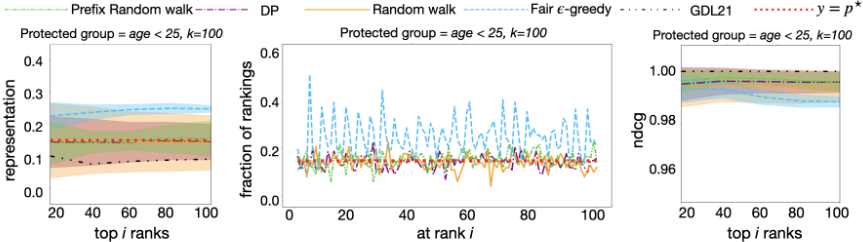
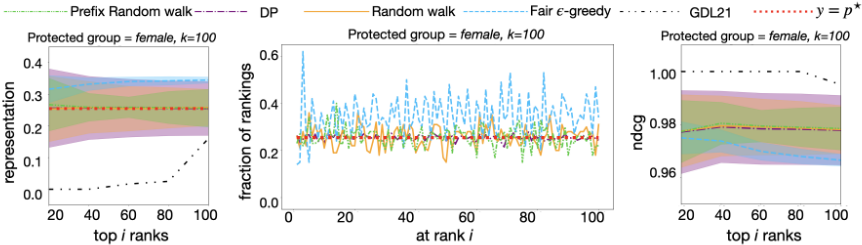
Datasets. We evaluate our results on the German Credit Risk dataset comprising credit risk scoring of 1000 adult German residents [Dua and Graff, 2017], along with their demographic information (e.g., gender, age, etc.). We use the Schufa scores of these individuals to get the in-group rankings; grouping based on age < 25 (see Figure 1) similar to [Zehlike et al., 2017; Gorantla et al., 2021; Castillo, 2019], who observed that Schufa scores are biased against the adults of age < 25. Their representation in the top 100 ranks is 10% even though their true representation in the whole dataset is 15%. We also evaluate our algorithm on the IIT-JEE 2009 dataset, also used in Celis et al. (2020b). The dataset consists of the student test scores of the joint entrance examination (JEE) conducted for undergrad admissions at the Indian Institutes of Technology (IITs). Information about the students includes gender details (25% women and 75% men) 7 . Students' test scores give score-based in-group rankings. We evaluate our algorithm with female as the protected group, as they are consistently underrepresented (0.04% in top 100 [Celis et al., 2020b]), in a score-based ranking on the entire dataset, despite 25% female representation in the dataset.
Baselines. (i) We compare our experimental results with fair ϵ-greedy [Gao and Shah, 2020], which is a greedy algorithm with ϵ as a parameter (explained in detail in Section 5.1). To the best of our knowledge, this algorithm is the closest state-of-the-art baseline to our setting, as it does not rely on comparing the scores of two candidates from different groups. (ii) We also compare our results with a recent deterministic re-ranking algorithm (GDL21) given by Gorantla et al. (2021), which achieves the best balance of both group fairness and underranking of individual items compared to their original ranks in top-k.
6 PolytopeSamplerMatlab (License: GNU GPL v3.0)
7 Only binary gender information was annotated in the dataset.
Plots. We plot our results for the protected groups in each dataset (see Figures 1 and 2). We use the representation constraints Lj = ⌈(p∗j - η)k⌉ and Uj = ⌊(p∗j + η)k⌋ for group j where p∗j is the total fraction of items from group j in the dataset and η = 0.1. For "prefix random walk" we put constraints at every b ranks, i.e., Lij = ⌈(p∗j - ηb max{b,k-i} ) k⌉ and Uij = ⌊(p∗j + ηb max{b,k-i} ) k⌋ with i ∈ {b, 2b, . . .}. We use k = 100 and b = 50 in the experiments. With these, the representation constraints are stronger in the top 50 ranks than in the top 100 ranks. The "representation" (on the y-axis) plot shows the fraction of ranks assigned to the protected group in the top i ranks (on the x-axis). We sample 1000 rankings for randomized algorithms and output the mean and standard deviation. The dashed red line is the true representation of the protected group in the dataset, which we call p∗ , dropping the subscript. The "fraction of rankings" plot for randomized ranking algorithms represents the fraction of 1000 rankings that assign rank i to the protected group. For completeness, we plot the results for the ranking utility metric, normalized discounted cumulative gain, defined as nDCG@i = (∑i′∈[i] (2ˆ si′ -1) log2 (i′+1) ) / (∑i′∈[i] (2si′ -1) log2 (i′+1) ) , where ˆ si′ and si′ are the scores of the items assigned to rank i′ in the group-fair and the score-based ranking, respectively.
5.1 Observations
The rankings sampled by our algorithms have the following property: for any rank i, rank i is assigned to the protected group in a sufficient fraction of rankings (see plots with "fraction of rankings" on the y-axis). This experimentally validates our Theorem 3.5. Moreover, this fraction is stable across the ranks. Whereas fair ϵ-greedy fluctuates a lot, which can be explained as follows. For each rank k′ = 1 to k, with ϵ probability, it assigns a group uniformly at random, and with 1 - ϵ probability, it assigns group G1 := (age⩾ 25) if the number of ranks assigned to G1 is less than ( L1k′ k ) in the top k′ ranks, and to G2 := (age < 25) otherwise. Consider Figure 1 top row where L1 = 80, L2 = 10, and k = 100, and the plot on the right shows the fraction of rankings (y-axis) assigning rank i (x-axis) to G1. Note that if ϵ = 0 (no randomization), this algorithm gives a deterministic ranking where the first four ranks are assigned to G2, and the fifth to G1, and this pattern repeats after every five ranks. Hence, there would be a peak in the plot at ranks k′ = 5, 10, 15, 20, . . .. Now, when ϵ = 0.3, fair-ϵ-greedy introduces randomness in group assignment at each rank and, as a result, smoothens out the peaks as k′ increases, which is exactly what is observed. Therefore, the first four ranks will have very low representation, even in expectation. Similarly, the ranks 6 to 9. Clearly, fair-ϵ-greedy does not satisfy fairness for any k′ < k consecutive ranks. But our algorithm satisfies this property, as is also confirmed by Corollary 3.6.
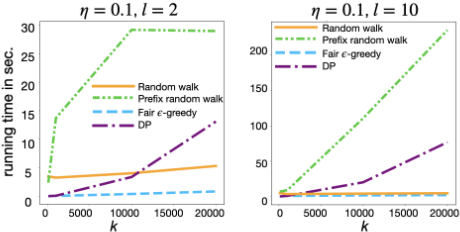
Our algorithms satisfy representation constraints for the protected group in the top k′ ranks in expectation (see plots with "representation" on the y-axis). Fair ϵ-greedy overcompensates for representing the protected group. The deterministic algorithm GDL21 achieves very high nDCG but very low representation for smaller values of k′ , although all run with similar representation constraints. This is because the deterministic algorithm uses comparisons based on the scores, hence putting most of the protected group items in higher ranks (towards k). With a larger value of ϵ, fair ϵ-greedy gets a much higher "representation" of the protected group than necessary (see Figures 7 and 8), whereas, with a smaller value of ϵ, it fluctuates a lot in the "fraction of rankings" (see see Figures 5 and 6). Our "Prefix Random Walk" algorithm is run with stronger fairness requirements than "RandomWalk" and "DP" in the top 50 ranks, which can be observed by its smaller deviation from the line y = p∗ in the left-most plots. The random walk runs very fast, even for a large number of groups (Figure 3). We also run experiments on the JEE 2009 dataset with birth category defining 5 groups (see Appendix C). The experiments were run on a Quad-Core Intel Core i5 processor consisting of 4 cores, with a clock speed of 2.3 GHz and DRAM of 8GB. Implementation of our algorithms and the baselines has been made available for reproducibility 8 .
6 Conclusion
We take an axiomatic approach to define randomized groupfair rankings and show that it leads to a unique distribution over all feasible rankings that satisfy lower and upper bounds on the group-wise representation in the top ranks. We propose practical and efficient algorithms to exactly and approximately sample a random group-fair ranking from this distribution. Our approach requires merging a given set of ranked lists, one for each group, and can help circumvent implicit bias or incomplete comparison data across groups.
8 github.com/sruthigorantla/SamplingExPostGroupFairRankings.
The natural open problem is to extend our method to work even for noisy, uncertain inputs about rankings within each group. Even though our heuristic algorithm does output expost group-fair rankings under prefix constraints, it is important to investigate the possibility of polynomial-time algorithms to sample from the distribution that satisfies natural extensions of our axioms for prefix group-fair rankings.
Ethical Statement
A limitation of our work as a post-processing method is that it cannot fix all sources of bias, e.g., bias in data collection and labeling. Randomized rankings can be risky and opaque in high-risk, one-time ranking applications. Our guarantees for group fairness may not necessarily reflect the right fairness metrics for all downstream applications for reasons including biased, noisy, incomplete data and legal or ethical considerations in quantifying the eventual adverse impact on individuals and groups.
Acknowledgements
SG was supported by a Google PhD Fellowship. The proof of Theorem 4.1 was suggested to us by Santosh Vempala. The authors would like to thank him for allowing us to include it in our paper. AL was supported in part by the SERB Award ECR/2017/003296 and a Pratiksha Trust Young Investigator Award. AL is also grateful to Microsoft Research for supporting this collaboration.
Contribution Statement
AD and AL have made equal contributions to this work.
@inproceedings{ijcai2023p46,
  title     = {Sampling Ex-Post Group-Fair Rankings},
  author    = {Gorantla, Sruthi and Deshpande, Amit and Louis, Anand},
  booktitle = {Proceedings of the Thirty-Second International Joint Conference on
               Artificial Intelligence, {IJCAI-23}},
  publisher = {International Joint Conferences on Artificial Intelligence Organization},
  editor    = {Edith Elkind},
  pages     = {409--417},
  year      = {2023},
  month     = {8},
  note      = {Main Track},
  doi       = {10.24963/ijcai.2023/46},
  url       = {https://doi.org/10.24963/ijcai.2023/46},
}
TY - CPAPER TI - Sampling Ex-Post Group-Fair Rankings AU - Gorantla, Sruthi AU - Deshpande, Amit AU - Louis, Anand T2 - Proceedings of the Thirty-Second International Joint Conference on Artificial Intelligence, IJCAI-23 PB - International Joint Conferences on Artificial Intelligence Organization PY - 2023 SP - 409 EP - 417 DO - 10.24963/ijcai.2023/46 UR - https://doi.org/10.24963/ijcai.2023/46 ER -Copied
Machine-readable versions of this paper, for tools and AI agents:





