
FedBFPT: An Efficient Federated Learning Framework for Bert Further Pre-training
Proceedings of the Thirty-Second International Joint Conference on Artificial Intelligence. Main Track. Pages 4344-4352.
https://doi.org/10.24963/ijcai.2023/483
Keywords
- Machine Learning: ML: Federated learning
- Natural Language Processing: NLP: Applications
Abstract
This study proposes FEDBFPT (Federated BERT Further Pre-Training), a Federated Learning (FL) framework for further pre-training the BERT language model in specialized domains while addressing privacy concerns. FEDBFPT enables multiple clients to collaboratively train the shallower layers of BERT, which are crucial in the pre-training stage, without the need to share private data. To achieve this, FEDBFPT involves building a local model for each client, progressively training the shallower layers of local models while sampling deeper layers, and aggregating trained parameters on a server to create the final global model. This approach utilizes multiple smaller local models to further pre-train a global model targeted at specific tasks via fine-tuning, resulting in a reduction in resource usage while maintaining model accuracy. Theoretical analysis is conducted to support the efficiency of FEDBFPT, and experiments are conducted on corpora across domains such as medicine, biology, and computer science. Results indicate that FEDBFPT achieves performance levels comparable to traditional FL methods while reducing computation and communication costs by 46.70% and 7.04%, respectively, even approaching the performance of centralized training models. The Source code is released at https://github.com/Hanzhouu/FedBFPT.
- [Alistarh et al., 2017] Dan Alistarh, Demjan Grubic, Jerry Li, Ryota Tomioka, and Milan Vojnovic. QSGD: Communication-efficient SGD via gradient quantization and encoding. NeurIPS, 30, 2017.
- [Beltagy et al., 2019] Iz Beltagy, Kyle Lo, and Arman Co- han. Scibert: A pretrained language model for scientific text. In EMNLP-IJCNLP, pages 3615-3620, 2019.
- [Collier and Kim, 2004] Nigel Collier and Jin-Dong Kim. Introduction to the bio-entity recognition task at JNLPBA. In NLPBA/BioNLP, pages 73-78, 2004.
- [Devlin et al., 2019] Jacob Devlin, Ming-Wei Chang, Ken- ton Lee, and Kristina Toutanova. BERT: Pre-training of deep bidirectional transformers for language understand- ing. In NAACL-HLT, pages 4171-4186, 2019.
- [Fu et al., 2020] Fangcheng Fu, Yuzheng Hu, Yihan He, Ji- awei Jiang, Yingxia Shao, Ce Zhang, and Bin Cui. Don't waste your bits! squeeze activations and gradients for deep neural networks via tinyscript. In ICML, pages 3304- 3314, 2020.
- [Hao et al., 2019] Yaru Hao, Li Dong, Furu Wei, and Ke Xu. Visualizing and understanding the effectiveness of bert. In EMNLP-IJCNLP, pages 4143-4152, 2019.
- [Hinton et al., 2015] Geoffrey Hinton, Oriol Vinyals, and Jeff Dean. Distilling the knowledge in a neural network. arXiv preprint arXiv:1503.02531, 2015.
- [Jawahar et al., 2019] Ganesh Jawahar, Benoît Sagot, and Djamé Seddah. What does bert learn about the structure of language? In ACL, 2019.
- [Jiao et al., 2020] Xiaoqi Jiao, Yichun Yin, Lifeng Shang, Xin Jiang, Xiao Chen, Linlin Li, Fang Wang, and Qun Liu. Tinybert: Distilling BERT for natural language un- derstanding. In EMNLP, 2020.
- [Karras et al., 2018] Tero Karras, Timo Aila, Samuli Laine, and Jaakko Lehtinen. Progressive growing of gans for im- proved quality, stability, and variation. In ICLR, 2018.
- [Konečnỳ et al., 2016] Jakub Konečnỳ, H Brendan McMa- han, X Yu Felix, Peter Richtarik, Ananda Theertha Suresh, and Dave Bacon. Federated learning: Strategies for improving communication efficiency. arXiv preprint arXiv:1610.05492, 2016.
- [Lee et al., 2020] Jinhyuk Lee, Wonjin Yoon, Sungdong Kim, Donghyeon Kim, Sunkyu Kim, Chan Ho So, and Jaewoo Kang. BioBERT: A pre-trained biomedical lan- guage representation model for biomedical text mining. Bioinformatics, 36(4):1234-1240, 2020.
- [Li and Wang, 2019] Daliang Li and Junpu Wang. Fedmd: Heterogenous federated learning via model distillation. arXiv preprint arXiv:1910.03581, 2019.
- [Li et al., 2020a] Tian Li, Anit Kumar Sahu, Manzil Zaheer, Maziar Sanjabi, Ameet Talwalkar, and Virginia Smith. Federated optimization in heterogeneous networks. ML- Sys, 2:429-450, 2020.
- [Li et al., 2020b] Zhiyuan Li, Jaideep Vitthal Murkute, Prashnna Kumar Gyawali, and Linwei Wang. Progressive learning and disentanglement of hierarchical representa- tions. In ICLR, 2020.
- [Lin et al., 2018] Yujun Lin, Song Han, Huizi Mao, Yu Wang, and Bill Dally. Deep gradient compression: Re- ducing the communication bandwidth for distributed train- ing. In ICLR, 2018.
- [Lin et al., 2020] Tao Lin, Lingjing Kong, Sebastian U Stich, and Martin Jaggi. Ensemble distillation for robust model fusion in federated learning. NeurIPS, 33:2351-2363, 2020.
- [Liu et al., 2019] Yinhan Liu, Myle Ott, Naman Goyal, Jingfei Du, Mandar Joshi, Danqi Chen, Omer Levy, Mike Lewis, Luke Zettlemoyer, and Veselin Stoyanov. Roberta: A robustly optimized BERT pretraining approach. arXiv preprint arXiv:1907.11692, 2019.
- [Lo et al., 2020] Kyle Lo, Lucy Lu Wang, Mark Neumann, Rodney Kinney, and Daniel Weld. S2ORC: The semantic scholar open research corpus. In ACL, pages 4969-4983, 2020.
- [Luan et al., 2018] Yi Luan, Luheng He, Mari Ostendorf, and Hannaneh Hajishirzi. Multi-task identification of en- tities, relations, and coreference for scientific knowledge graph construction. In EMNLP, pages 3219-3232, 2018.
- [Manginas et al., 2020] Nikolaos Manginas, Ilias Chalkidis, and Prodromos Malakasiotis. Layer-wise guided training for BERT: Learning incrementally refined document rep- resentations. arXiv preprint arXiv:2010.05763, 2020.
- [McMahan et al., 2017] Brendan McMahan, Eider Moore, Daniel Ramage, Seth Hampson, and Blaise Aguera y Ar- cas. Communication-efficient learning of deep networks from decentralized data. In AISTATS, pages 1273-1282, 2017.
- [Paszke et al., 2019] Adam Paszke, Sam Gross, Francisco Massa, Adam Lerer, James Bradbury, Gregory Chanan, Trevor Killeen, Zeming Lin, Natalia Gimelshein, Luca Antiga, et al. Pytorch: An imperative style, high- performance deep learning library. NeurIPS, 32, 2019.
- [Peters et al., 2018] Matthew E. Peters, Mark Neumann, Mohit Iyyer, Matt Gardner, Christopher Clark, Kenton Lee, and Luke Zettlemoyer. Deep contextualized word representations. In ACL, 2018.
- [Radford et al., 2018] Alec Radford, Karthik Narasimhan, Tim Salimans, and Ilya Sutskever. Improving language un- derstanding by generative pre-training. Technical report, OpenAI, 2018.
- [Raghu et al., 2017] Maithra Raghu, Justin Gilmer, Jason Yosinski, and Jascha Sohl-Dickstein. Svcca: Singular vec- tor canonical correlation analysis for deep learning dynam- ics and interpretability. NeurIPS, 30, 2017.
- [Reddi et al., 2020] Sashank Reddi, Zachary Charles, Manzil Zaheer, Zachary Garrett, Keith Rush, Jakub Konečnỳ, Sanjiv Kumar, and H Brendan McMa- han. Adaptive federated optimization. arXiv preprint arXiv:2003.00295, 2020.
- [Sanh et al., 2019] Victor Sanh, Lysandre Debut, Julien Chaumond, and Thomas Wolf. Distilbert, a distilled ver- sion of bert: smaller, faster, cheaper and lighter. arXiv preprint arXiv:1910.01108, 2019.
- [Stich et al., 2018] Sebastian U Stich, Jean-Baptiste Cordon- nier, and Martin Jaggi. Sparsified SGD with memory. NeurIPS, 31, 2018.
- [Vaswani et al., 2017] Ashish Vaswani, Noam Shazeer, Niki Parmar, Jakob Uszkoreit, Llion Jones, Aidan N Gomez, Łukasz Kaiser, and Illia Polosukhin. Attention is all you need. NeurIPS, 30, 2017.
- [Wang et al., 2018] Yifan Wang, Federico Perazzi, Brian McWilliams, Alexander Sorkine-Hornung, Olga Sorkine- Hornung, and Christopher Schroers. A fully progres- sive approach to single-image super-resolution. In CVPR Workshops, pages 864-873, 2018.
- [Wang et al., 2022a] Hui-Po Wang, Sebastian Stich, Yang He, and Mario Fritz. ProgFed: Effective, communication, and computation efficient federated learning by progres- sive training. In ICML, pages 23034-23054, 2022.
- [Wang et al., 2022b] Jue Wang, Ke Chen, Gang Chen, Lidan Shou, and Julian McAuley. SkipBERT: Efficient inference with shallow layer skipping. In ACL, pages 7287-7301, 2022.
- [Wang et al., 2023] Xin'ao Wang, Huan Li, Ke Chen, and Lidan Shou. Code, datasets, and supplementary materials. https://github.com/Hanzhouu/FedBFPT, 2023. Accessed: 2023-05-23. Link
- [Wu et al., 2020] Rongliang Wu, Gongjie Zhang, Shijian Lu, and Tao Chen. Cascade EF-GAN: Progressive facial ex- pression editing with local focuses. In CVPR, pages 5021- 5030, 2020.
References were extracted automatically from the PDF and may contain errors.
Full text extracted automatically from the PDF; figures, tables and equations may differ. The PDF is the version of record.
1 Introduction
Federated Learning (FL) [McMahan et al., 2017] is a technique that enables multiple clients to jointly train a global model without sharing private data. However, training methods in FL suffer from high communication and computational costs, as client devices often possess limited hardware resources and network bandwidth. Consequently, training complex models within the FL framework becomes challenging, especially when dealing with pre-trained language models that have demonstrated significant advancements in natural language processing tasks, such as ELMo [Peters et al., 2018], GPT [Radford et al., 2018], BERT [Devlin et al., 2019], and RoBERTa [Liu et al., 2019]. These models are typically trained on general corpora but can yield better performance on specialized domain tasks after undergoing further pre-training [Beltagy et al., 2019] using specialized datasets. However, collecting such specialized datasets centrally poses privacy concerns, making it infeasible.
∗Ke Chen and Huan Li are the corresponding authors.
Previous research has shown that neural networks tend to stabilize from shallower to deeper layers during training [Raghu et al., 2017]. This has been observed in the popular pre-trained language model BERT, where shallower layers have been shown to capture phrase-level information, which holds greater significance in model pre-training compared to the deeper layers [Jawahar et al., 2019; Hao et al., 2019; Manginas et al., 2020; Wang et al., 2022b]. The observation suggests that it might be feasible to train only a subset of layers on the client side initially and gradually increase the number of trained layers, thereby achieving efficient training of large models in an FL setting.
In this paper, we focus on the cost-effectiveness of BERT's pre-training in FL by asking the following questions: (1) Can we design a computational and communication efficient method to complete the training of large models in resourceconstrained clients? (2) Can such a method achieve the accuracy of traditional FL or even centralized training?
Our answers to both questions are "Yes." Through investigation, we propose FEDBFPT (Federated BERT Further PreTraining), an efficient framework that trains only part of the layers of BERT to reduce the computational and communication costs. FEDBFPT allows for training a large global model using FL by creating small local models for each client to train partial layers of the global model, incurring less computational resources and fewer weights to transmit. Within FEDBFPT, we also propose a method PL-SDL (Progressive Learning with Sampled Deeper Layers), which can train the crucial layers of the global model efficiently on local models with small capacity.
We perform downstream tasks via fine-tuning the resultant global model on specialized domains such as medicine, biology, and computer science, and show that FEDBFPT can achieve similar performance to traditional FL while using 46.70% and 7.04% of the original model's computational and communication costs, respectively, and can even approach the accuracy of centralized trained models.
In summary, our main contributions are as follows.
- We propose FEDBFPT, an efficient FL framework for further pre-training the BERT language model on the client without sharing private corpora (cf. Section 3.2).
- We propose PL-SDL, a method for efficiently training the important layers of the global model on the client side with small-capacity local models (cf. Section 3.3).
- We conduct the analysis on the computational and communication costs (cf. Section 4); We also conduct experiments on specialized domains corpus such as medicine, biology, and computer science, validating the efficiency and effectiveness of FEDBFPT in comparison with many baseline methods (cf. Section 5).
2 RelatedWork
Federated Learning. Federated Learning (FL) [McMahan et al., 2017] is a technique that enables multiple clients to work collaboratively to train a model without sharing their private data. The general FL process typically involves two types of updates, namely local updates and global updates. Particularly, local updates focus on minimizing a local loss function, whereas global updates consider aggregating local weights from clients and synchronizing the model changes across all clients at each communication iteration.
In FL, clients typically have limited resources, including less powerful hardware and limited network bandwidth, which can hinder training large models. To address these challenges, researchers have developed techniques from various perspectives [Wang et al., 2022a], including:
- Message Compression that represents gradients (or parameters) with fewer bits to achieve reduced communication cost. Prominent examples are quantization [Alistarh et al., 2017; Lin et al., 2018; Fu et al., 2020] and sparsification [Stich et al., 2018; Koneˇcn`y et al., 2016].
- Model Pruning that identifies (much smaller) subnetworks within the original model for less computational cost at the inference phase [Li and Wang, 2019; Lin et al., 2020].
- Model Distillation [Hinton et al., 2015] that allows the server to extract knowledge from clients using hold-out datasets [Li and Wang, 2019; Lin et al., 2020].
Message compression helps reduce communication costs, but it does not address the main bottleneck in FL, which is the cost of computerization on the client side. Techniques on model pruning and knowledge distillation can create small, accurate models to speed up inference, but they are ineffective in training large models. Our approach employs the local model to train only the important layers of the global model and use the resultant global model for fine-tuning. By using small models during training, we save computational resources and only transmit the important layer parameters to save on communication costs. This way balances the use of small models for computational efficiency and large models for effectiveness.
Progressive Learning. Progressive Learning, a paradigm initially proposed to stabilize the training process, has been widely used in computer vision tasks such as image synthesis [Karras et al., 2018], image super-resolution [Wang et al.,
| Symbol | Meaning |
|---|---|
| Ck Dk Pk ℓ mG mLk i, I | The k-th client The local dataset at Ck The local parameter pool at Ck The layer index number The number of T-layers in the global model The number of T-layers in the k-th local model The current FL iteration and iteration threshold |
2018], facial attribute editing [Wu et al., 2020], and representation learning [Li et al., 2020b]. The core idea is to start training on easier tasks, such as low-resolution outputs or shallower models, and gradually progress to more difficult but desired tasks, such as high-resolution outputs or deeper models [Wang et al., 2022a]. The cost-saving benefit of progressive learning, i.e., using shallower models during initial training stages, has not been explored in the context of FL.
Further Pre-Training. Pre-trained language models are usually trained on general text corpora, which makes them perform well in general domains tasks but poorly in specialized scientific domains tasks. Some studies, such as SciBERT [Beltagy et al., 2019], BioBERT [Lee et al., 2020], have demonstrated that further pre-training using specialized domain-specific corpus can improve performance in those domains tasks. However, in specialized scientific domains, data is often stored in different professional institutions, leading to privacy concerns during the collection process. Motivated by this, we propose to use FL to protect user privacy, as well as competent techniques to address the issue of limited resources of FL clients and their inability to train large models.
3 FEDBFPT
Below, we go through the concepts, present the overall framework, and detail the internal designs.
3.1 Definitions and Notation
The commonly used notation is listed in Table 1.
In Federated Learning (FL), a centralized server and multiple clients (labeled as Ck, where 1 ≤ k ≤ N) are used. Initially, the server has a global (BERT) model that has already been pre-trained from large-scale general corpora. A BERT model consists of an embedding layer, a sequence of the intermediate transformer layers (T-layers), and an output layer. Typically, the size of the output layer is much smaller than those of the embedding layer and T-layers. Meanwhile, each client Ck has a non-shared, domain-specific corpus (dataset), labeled as Dk, that can be used to further pre-train the global model for increased accuracy at that domain-specific task. To achieve this, each client Ck runs a local (BERT) model and the Masked Language Modelling (MLM) [Devlin et al., 2019] task is performed to update the weights of the local model using the domain-specific corpus. Later, the weights of all local models are uploaded to the server to generate the further pre-trained global model, which needs to be fine-tuned subsequently to accomplish a specific task, e.g., classification [Collier and Kim, 2004] or Named Entity Recognition (NER) [Luan et al., 2018].
In total, three training processes are involved, namely pretraining that generates the pre-trained BERT model from the general corpora, further pre-training that generates a further pre-trained BERT model from the domain-specific corpus, and fine-tuning that generates a fine-tuned model that targets a domain-specific task. In this study, we focus on the further pre-training process and aim to propose an FLbased framework for further pre-training the global model at the server using local datasets distributed at the clients.
Considering practical needs, the framework should have low computational and communication costs for clients, while preserving the performance of the global BERT model after being further pre-trained. To ensure fair and reproducible comparisons with previous work, we define
- computational cost of a client as the training time of the local model in a fixed setting of hyperparameters, training data size, and hardware specification;
- communication cost of a client as the size of the parameters that a client sends to the server;
- final performance of the global model as the effectiveness at the downstream task (e.g., accuracy in classification or F1 in NER) after a fixed round of fine-tuning.
We identify two variables that are related to the above performance indicators, namely the number of layers of the local model and the number of layers to be trained and transmitted at client Ck, denoted as mLk and mTk , respectively. Intuitively, a smaller mLk will reduce Ck's computational cost as well as the final performance of the global model. Likewise, a smaller mTk will reduce Ck's communication cost while reducing the final performance of the global model as well.
Next, we will present our overall FL-based framework (cf. Section 3.2) and the associated techniques (cf. Section 3.3), which can maintain the final performance of the global model with small mLk and mTk .
3.2 Framework Overview
The proposed FEDBFPT framework is illustrated in Figure 1. Specifically, the server runs a global model while each client runs a local model that keeps the same embedding and output layers as the global model but a reduced sequence of T-layers in between. Let mG and mLk be the number of Tlayers in the global model and the k-th local model, respectively. We stipulate that mG > mLk is such that the local model can be deployed and trained at resource-constrained end devices. In the implementation, we set mG = 12 and mL1 = . . . = mLN = 6. Nevertheless, our proposed framework supports using different mLk for the local models at different clients. Moreover, each local model is associated with a parameter pool, which is implemented as a dictionary that organizes model parameters as key-value pairs. It is used to help create the local model and will be updated in each iteration of FL. At the initial stage, each client stores a local dataset that will be used to further pre-train the global model at the server in a collaborative manner.
We proceed to go through the steps of the further pretraining of the global BERT model in Figure 1. The whole
Algorithm 1 FEDBFPT
Input: datasets {D1, . . . ,DN}, global model G with initial model parameters W (0) , epoch threshold I, local MLM training
epoch ek and layer index number ℓ. Output: final model parameters W (I) of G. Initialize: parameter pool Pk of each client Ck; ℓ ← 0. // FL training for I iterations for i = 1 to I do // Parallel executions at clients for each client Ck do if i > 1 then update Pk with W (i-1) fetched from the server end if // Train ℓ-th T-layer and the output layer of the local model and obtain the weights W (i) k ←MLM Train(Dk, Pk, ℓ, ek) upload W (i) k to the server end for // Merge clients' weights at server W (i) ← Merge(W (i) 1 , . . . ,W (i) N ) determine the next layer index number ℓ sent W (i) and ℓ to each client end forprocess is formalized in Algorithm 1.
- S1 Each client Ck fetches the parameters of the global model from the server and persists the fetched parameters in the local parameter pool. Simultaneously, an index number ℓ is received from the server, which indicates the specific ℓ-th T-layer to be trained and updated for the local model at Ck. The determination of the layer index number ℓ is to be detailed in Section 3.3.
- S2 With the other layers including the embedding layer kept frozen, the ℓ-th T-layer and the output layer at each client Ck are trained using the local data Dk. Specifically, the MLM task [Devlin et al., 2019] is performed for a number ek of epochs (cf. MLM Train(Dk, Pk, ℓ, ek) in Algorithm 1). How to train the ℓ-th T-layer in the smallcapacity local model will be presented in Section 3.3.
- S3 Each client Ck uploads the weights of the trained ℓ-th T-layer and the output layer to the server.
- S4 The server merges the weights uploaded by all clients. There are many approaches for merging the weights in FL, such as FedAvg [McMahan et al., 2017], FedProx [Li et al., 2020a], and FedAdam [Reddi et al., 2020]. In our implementation, we choose the typical approach FedAvg, which obtains the merged weights W (i) at the i-th FL training iteration as follows.
where W (i) k is the weights uploaded by client Ck at the i-th iteration.
- S5 The server updates the global model using the merged weights and determines the next index number ℓ.
- S6 Resume to S1 if the current FL training iteration number i does not exceed the user-specified threshold I. Otherwise, we terminate the further pre-training process,
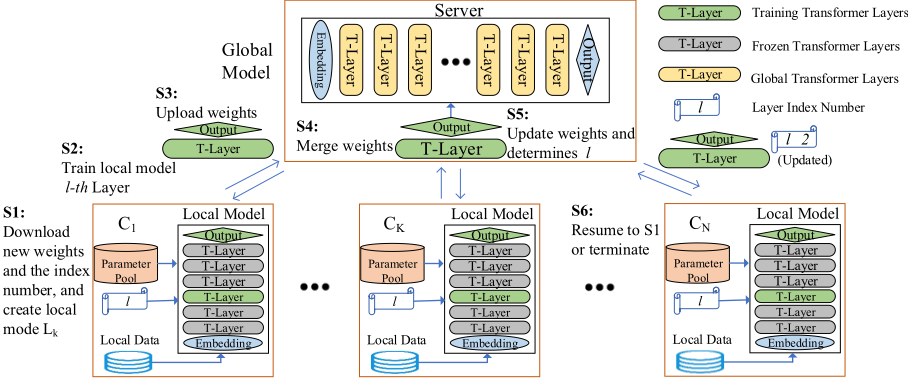
and consequently, the further pre-trained global model is ready to be fine-tuned for downstream tasks.
To minimize computational expenses for clients with limited resources, we opt to train only a single T-layer and output layer while keeping the remaining parts of the model frozen. However, choosing which T-layer to train (i.e., determining ℓ) and how to efficiently train on smaller capacity local models (cf. step S2) are critical procedures. To resolve these, we propose the Progressive Learning with Sampled Deeper Layers (PL-SDL) method in Section 3.3.
3.3 Progressive Learning with Sampled Deeper Layers (PL-SDL)
As introduced in Section 3.2, a local model uses fewer Tlayers than the global model due to the resource constraints of the clients. In this sense, we must train the model parameters more efficiently. This requests us to find and train partial Tlayers that have a higher potential to boost the global model's final performance. Previous studies [Jawahar et al., 2019; Hao et al., 2019; Manginas et al., 2020; Wang et al., 2022b] have pointed out shallower T-layers of the BERT model excel at capturing phrase-level information, which plays a more important role in the pre-training, compared to those deeper T-layers. Inspired by this, we decide to focus on training the shallower T-layers of the local models and only upload the corresponding weights to the server. More specifically, in each FL iteration, we choose only one specific T-layer 1 and synchronize the training results of the clients with the global model. As outlined in the cost analysis to be discussed in Section 4, this approach effectively reduces both computational and communication costs for individual clients.
1 It is feasible to train more than one T-layer at an iteration. However, our preliminary experiments show that this does not bring much performance gain but increase the client's computational and communication cost significantly.
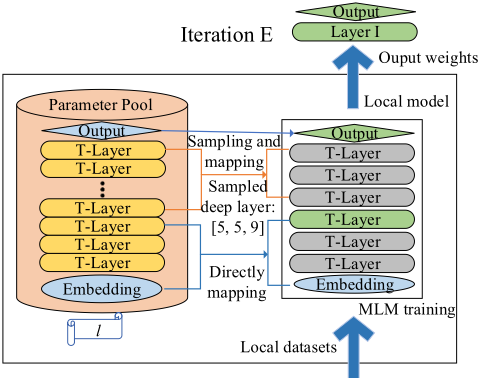
In line with Progressive Learning [Wang et al., 2022a], we train the T-layers one by one, starting from the most shallow T-layer and working our way to the deeper T-layers. This approach raises two technical questions: (1) how to determine the index number of the T-layer to be trained in each iteration and (2) how to handle the rest of the T-layers when pretraining the local model with limited capacity. We discuss the questions below with a running example in Figure 2.
Determination of the Layer Index Number. Our preliminary experiments indicate that shallower T-layers are more cost-effective to train. Therefore, for a given number I of FL iterations to train the model, we propose assigning more iterations to shallower T-layers. Specifically, we assign the first ⌈I/2⌉ FL iterations to train the 0-th T-layer of the local model, the next half of the remaining (I - ⌈I/2⌉) FL iterations to train the 1-th T-layer, and so on. Once the FL iterations assigned to the ℓ-th T-layer are completed, the server increments ℓ by 1, with ℓ always being smaller than mLk , the number of T-layers in client Ck. This mechanism prioritizes training the most important T-layers in the overall FL process.
Handling the Rest T-layers. Before training the ℓ-th Tlayer in the client Ck, the rest (mLk - 1) T-layers must be selected from the local parameter pool. In simpler terms, the 0-th to the (ℓ - 1)-th T-layers are mapped from the corresponding T-layers in the parameter pool. On the other hand, the deeper T-layers, i.e., the (ℓ + 1)-th to the (mLk - 1)-th T-layers, are randomly sampled from the (ℓ + 1)-th to the (mG -1)-th T-layers in the parameter pool; it should be noted that the mapped layer number of a shallower T-layer must be no larger than that of a deeper T-layer. Take the local model training in Figure 2 as an example, suppose ℓ = 2, mLk = 6, and mG = 12; the shallower layers, i.e., the 0-th to 2-nd Tlayers are directly mapped from the local parameter pool; for the sampled deeper layers from the 3-rd to 5-th T-layers, a possible mappling list could be [5, 5, 9], while [5, 9, 5] is not.
4 Cost Analysis
We perform a theoretical analysis of the computational cost and communication cost of FEDBFPT in Section 4.1 and Section 4.2, respectively. To ease the theoretical analysis, the following setups are established:
- To accurately assess the impact of the local model on the global model during FL iterations, we assume that all clients use the same learning rate, batch size, sentence length, and other hyperparameters and train the local models for the same number of epochs ek locally.
- To accurately assess the effect of adjustments to the local model on the costs at the client, we analyze a specific client. As a result, the size of the local dataset Dk and any effects from external factors such as the hardware specification are excluded.
4.1 Computational Cost
Given a BERT model, let V be the vocabulary size, S the sentence length, H the word vector dimension size, C the number of classifications, and m the number of T-layers. A local BERT model differs from a global BERT model only in the number of T-layers m. We use mG and mLk to differentiate the number of T-layers in the global model and the k-th local model. A previous study [Vaswani et al., 2017] breaks down the computation cost of a BERT model into the following several parts:
- Embedding in a time complexity of O((V + S) · H);
- Self-attention in a time complexity of O(m · S2 · H2 );
- Feed Forward in a time complexity of O(m · S2 · H2 );
- Add&Norm in a time complexity of O(m · S · H).
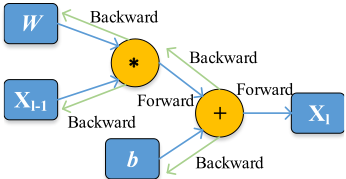
In training a BERT model, two calculation processes are involved, namely the forward propagation to obtain results, and the backward propagation to update model parameters. An example is illustrated in Figure 3.
Based on the above information, we have the overall time complexity of the model as follows. First, the embedding time cost is in the complexity of O((V +S) · H). Then, the forward propagation time cost, including Self-attention, Feed Forward, and Add&Norm, is in O(mf · (S2 ·H2 +S2 ·H2 + S · H)) ≈ O(mf · S2 · H2 ) where mf denotes the number of T-layers participating in forward propagation. Third, the backward propagation time cost, similar to the forward counterpart, is in O(mb·S2 ·H2 ) where mb refers to the number of T-layers participating in backward propagation. Finally, the overall time cost is in O((V +S) · H+mf · S2 · H2 +mb · S2 · H2 ) and we have (V +S) · H ≪ (mf +mb) · S2 · H2 .
In FEDBFPT, we have mf = mb = mG (typically 12) for the global model and mf = mLk (typically 6) and mb = 1 for the local model. Comparing the global model and the local model, it is clear that FEDBFPT saves a lot of computations.
4.2 Communication Cost
Following studies [Vaswani et al., 2017; Devlin et al., 2019], we list the space complexity of the parameter size of different components in a BERT model as follows.
- Embedding: O((V +S) · H);
- T-layers: O(m · (3 · H2 + 4H · (2H + 1));
- Output: O(H · C).
If transmitting the model parameters fully in each iteration, the communication cost will be in the complexity of O((V + S) · H + mb · (3 · H2 + 4H · (2H + 1)) + H · C). Here, we use mb, the number of T-layers in backward propagation, because only these T-layers will be uploaded to the global model in FL. Instead, our proposed FEDBFPT only transmits as few as one T-layer and the output layer to the server for updating. In this sense, a large fraction of parameters to be transmitted are saved for each client given that mb is usually 12 or more for the global model.
5 Experiments
5.1 Setup
We outline the main implementation details of our approach. We use Pytorch 1.11 [Paszke et al., 2019] and an NVIDIA RTX A6000 with 49140 MB Video Memory for training.
The base model is selected as the BERT-base-uncased [Devlin et al., 2019]. Each client performs further pre-training on the base model through the proposed FEDBFPT framework, resulting in a final global model for downstream tasks. To simulate the FL setting, we generate 6 clients and build a local BERT model for each client. The dataset for pretraining is evenly partitioned and then stored in these clients. The uniform and skewed distributions of local datasets are compared in Section 5.4. For comparison use, we also gather the local datasets at the server for centralized further pre-training. The supplementary materials, including the codebase, datasets, and more experiments results are made available online [Wang et al., 2023]. We use the S2ORC dataset [Lo et al., 2020], which contains many generalpurpose corpora for NLP and text mining research over scientific papers, for MLM further pre-training, and then fine-tune the global BERT model on classification (CLS) and Named Entity Recognition (NER) tasks of corresponding scientific domains. In particular, we use the JNLPBA dataset [Collier and Kim, 2004] in the Biology domain for NER and the SciERC [Luan et al., 2018] dataset in the Computer Science domain for NER, and the Rct-20k [Beltagy et al., 2019] 2 dataset in the Medicine domain for CLS for fine-tuning. For MLM training, the corpus in the corresponding domain is selected from S2ORC. For a direct comparison with previous studies, accuracy and F1 are considered as the effectiveness metric for CLS and NER, respectively. Corresponding to the costs defined in Section 3.1, we measure the computational cost as the time to perform one epoch of MLM training on the S2ORC domain subset with batch size 256 and learning rate 5 × 10⁻⁵ , and the communication cost as the storage space occupied by the trained parameters per client.
5.2 Overall Comparisons
We include the following baseline methods for comparing with the proposed FEDBFPT:
- BERT is the original bert-based-uncased pre-trained model without any further pre-training.
- BERT-C is a global model resulting from further pretraining on the gathered dataset on the server side.
- BERT-FL is a model resulting from the FL-based further pre-training where all local models are the same as the global model.
- DistilBERT [Sanh et al., 2019] is a lightweight model using prediction-based distillation on BERT.
- TinyBERT [Jiao et al., 2020] is another lightweight model using layer-wise distillation on BERT. We test both the 6- and 4-layer checkpoints, which are denoted as TinyBERT-6 and TinyBERT-4, respectively.
Table 2 reports the computational and communication cost of a client when using different approaches for BERT further pre-training. In this section, the best and the second best measures in tables are bold and underlined, respectively.
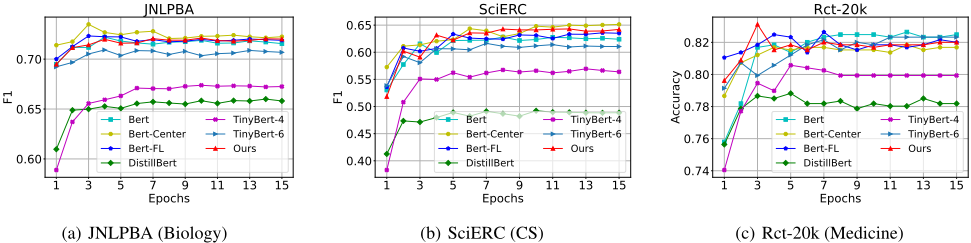
After further pre-training, we fine-tune the resultant models on downstream tasks for specific domains. The F1 or accuracy measures are reported in Table 3, while detailed counterparts with increased training epochs are shown in Figure 4.
2 Rct-20k is very large, and we used 2% of it to fine-tune.
| Models | Computational Cost (unit) | Communication Cost (unit: MB) |
|---|---|---|
| BERT | 1237.37 (-) | N/A |
| BERT-C | 1237.37 (-) | N/A |
| BERT-FL | 1237.37 (-) | 417.83 (-) |
| DistilBERT | 1241.18 (100.31%) | 255.55 (61.16%) |
| TinyBERT-6 | 784.45 (63.40%) | 255.57 (61.17%) |
| TinyBERT-4 | 373.59 (30.19%) | 54.88 (13.13%) |
| FEDBFPT (ours) | 577.85 (46.70%) | 29.42 (7.04%) |
| Models | JNLPBA (F1) | SciERC (F1) | Rct-20k (Accuracy) |
|---|---|---|---|
| BERT | 0.7181 | 0.6223 | 0.8248 |
| BERT-C | 0.7244 | 0.6499 | 0.8121 |
| BERT-FL | 0.7224 | 0.6330 | 0.8185 |
| DistillBERT | 0.6556 | 0.4891 | 0.7787 |
| TinyBERT-6 | 0.7085 | 0.6089 | 0.8073 |
| TinyBERT-4 | 0.6732 | 0.5664 | 0.7994 |
| FEDBFPT (ours) | 0.7198 | 0.6421 | 0.8312 |
According to the experimental results, FEDBFPT achieves comparable effectiveness to BERT-FL 3 while only using 46.70% of the computational cost and 7.04% of the communication cost of BERT-FL, an FL-based approach. Our method outperforms other lightweight BERT models and requires fewer resources. We accomplish this by using a smaller model on clients and updating and uploading only one T-layer and the output layer. Additionally, we utilize the PLSDL method (cf. Section 3.3), which prioritizes training the more important T-layers (i.e., the shallower T-layers) of the global model and helps these shallower T-layers gain more knowledge from the deeper T-layers through sampling and mapping. All these contribute to the decent model performance of FEDBFPT with limited resources.
5.3 Ablation Study
We include the following variants for the ablation study:
- FEDBFPT-ALL that always trains all layers of the local model;
- FEDBFPT\PL that only trains the first T-layer of the local model without Progressive Learning;
- FEDBFPT\M that always uses the first mLk T-layers in the parameter pool to build the local model without a mapping process.
- FEDBFPT\S that conducts a new deeper layer sampling only when ℓ increments. In contrast, FEDBFPT samples deeper layers in every FL iteration.
- FEDBFPT\SP that assigns the i-th iteration to the ℓ-th T-layer (i ≤ mLk ) for training.
Using the SciERC dataset in the computer science domain as our case study, we report the costs and F1 in Table 4.
The results disclose that our proposed framework, which utilizes PL-SDL, can efficiently complete further pre-training with a minimal amount of resources. The PL-SDL method specifically prioritizes training the shallower T-layers of the local model, allowing them to gain more knowledge from deeper T-layers through sampling and mapping. This is particularly important when working with limited resources, as it ensures that the shallower T-layers receive the necessary information to improve their performance. Additionally, we found that sampling and mapping deeper T-layers on each iteration are crucial for achieving good performance.
3 We conducted a t-test via fine-tuning FEDBFPT and BERT-FL for downstream tasks over 10 random seeds. The obtained p-values, i.e., 0.2922 on JNLPBA, 0.4173 on SciERC, and 0.4511 on Rct-20k all pass the t-test, showing that the two methods are comparable.
| Models | Computational Cost (unit: second) | Communication Cost (unit: MB) | F1 |
|---|---|---|---|
| FEDBFPT-ALL | 786.86 (63.59%) | 255.57 (61.17%) | 0.6393 |
| FEDBFPT\PL | 577.85 (46.70%) | 29.42 (7.04%) | 0.6407 |
| FEDBFPT\M | 577.85 (46.70%) | 29.42 (7.04%) | 0.6239 |
| FEDBFPT\S | 577.85 (46.70%) | 29.42 (7.04%) | 0.6038 |
| FEDBFPT\SP | 577.85 (46.70%) | 29.42 (7.04%) | 0.6418 |
| FEDBFPT (ours) | 577.85 (46.70%) | 29.42 (7.04%) | 0.6421 |
| Models | Computational Cost (unit: second) | Communication Cost (unit: MB) | F1 |
|---|---|---|---|
| FEDBFPT-4 | 463.87 (37.49%) | 29.42 (7.04%) | 0.6201 |
| FEDBFPT-8 | 693.62 (56.05%) | 29.42 (7.04%) | 0.6267 |
| FEDBFPT-6 (ours) | 577.85 (46.70%) | 29.42 (7.04%) | 0.6421 |
5.4 Parameter Study
Effect of the Number of Trained T-layers
We test the effect of varying the number of trained T-layers in the local models and report the cost and F1 measures of the SciERC in Table 5. FEDBFPT-4 and FEDBFPT-8 use local models with 4 and 8 T-layers in the clients, respectively.
The results show that the value of 6 we chose effectively balances the trade-off between overhead and performance. Besides, our approach of focusing more on the shallow layers during the further pre-training phase and utilizing medium numbers of T-layers on the local model is effective in allowing the local model to gain more knowledge.
Effect of Skewed Local Datasets
To create a more realistic simulation, we introduce a normal distribution to determine the sizes of datasets assigned to clients. Each client receives a subset of the centralized dataset according to the proportions specified by the normal distribution. The server then merges parameters by assigning weights that are proportional to the sizes of the clients' data. Importantly, the total sum of the partitioned datasets remains unchanged.
| Datasets | JNLPBA (F1) | SciERC (F1) | Rct-20k (Accuracy) |
|---|---|---|---|
| Uniform Datasets | 0.7198 | 0.6421 | 0.8312 |
| Skewed Datasets | 0.7188 | 0.6309 | 0.8232 |
The results of FEDBFPT, shown in Table 6, demonstrate that while the uneven distribution may result in some loss of model performance, our method still performs well. We could further improve performance by using different numbers of trained T-layers for different clients in the future. Nevertheless, our method has lower computational and communication costs compared to other models, regardless of the data distribution, as shown in the aforementioned experiments.
6 Conclusion and FutureWork
In this study, we have built upon previous research to investigate the role of the shallow layer in federated learning (FL) based BERT further pre-training. To combat the limited computational and communication resources on the client side in FL, we proposed a novel framework, referred to as FEDBFPT, which allows for training a single transformer layer of a global BERT model on clients. Moreover, we proposed the Progressive Learning with Sampled Deeper Layers (PL-SDL) method as a means of effectively and efficiently training the local BERT model with a focus on the shallower layers. Through experiments on a variety of corpora across domains, including biology, computer science, and medicine, we have demonstrated that our proposed FEDBFPT in combination with PL-SDL, is capable of achieving accuracy levels comparable to traditional FL methods while significantly reducing computational and communication costs.
In future work, we plan to implement various-sized local models across clients to handle Non-IID (non-independent and identically distributed) data. We also aim to adapt FEDBFPT for downstream tasks by focusing on specific layers that play a crucial role in fine-tuning specific tasks.
Acknowledgements
This work is supported by the National Key R&D Program of China (No.2022YFB3304100) and by the Zhejiang University-China Zheshang Bank Co., Ltd. Joint Research Center.
@inproceedings{ijcai2023p483,
  title     = {FedBFPT: An Efficient Federated Learning Framework for Bert Further Pre-training},
  author    = {Wang, Xin'ao and Li, Huan and Chen, Ke and Shou, Lidan},
  booktitle = {Proceedings of the Thirty-Second International Joint Conference on
               Artificial Intelligence, {IJCAI-23}},
  publisher = {International Joint Conferences on Artificial Intelligence Organization},
  editor    = {Edith Elkind},
  pages     = {4344--4352},
  year      = {2023},
  month     = {8},
  note      = {Main Track},
  doi       = {10.24963/ijcai.2023/483},
  url       = {https://doi.org/10.24963/ijcai.2023/483},
}
TY - CPAPER TI - FedBFPT: An Efficient Federated Learning Framework for Bert Further Pre-training AU - Wang, Xin'ao AU - Li, Huan AU - Chen, Ke AU - Shou, Lidan T2 - Proceedings of the Thirty-Second International Joint Conference on Artificial Intelligence, IJCAI-23 PB - International Joint Conferences on Artificial Intelligence Organization PY - 2023 SP - 4344 EP - 4352 DO - 10.24963/ijcai.2023/483 UR - https://doi.org/10.24963/ijcai.2023/483 ER -Copied
Machine-readable versions of this paper, for tools and AI agents:





