
A Rigorous Risk-aware Linear Approach to Extended Markov Ratio Decision Processes with Embedded Learning
Proceedings of the Thirty-Second International Joint Conference on Artificial Intelligence. Main Track. Pages 5475-5483.
https://doi.org/10.24963/ijcai.2023/608
Keywords
- Planning and Scheduling: PS: Markov decisions processes
- Uncertainty in AI: UAI: Sequential decision making
- Machine Learning: ML: Reinforcement learning
Abstract
We consider the problem of risk-aware Markov Decision Processes (MDPs) for Safe AI. We introduce a theoretical framework, Extended Markov Ratio Decision Processes (EMRDP), that incorporates risk into MDPs and embeds environment learning into this framework. We propose an algorithm to find the optimal policy for EMRDP with theoretical guarantees. Under a certain monotonicity assumption, this algorithm runs in strongly-polynomial time both in the discounted and expected average reward models. We validate our algorithm empirically on a Grid World benchmark, evaluating its solution quality, required number of steps, and numerical stability. We find its solution quality to be stable under data noising, while its required number of steps grows with added noise. We observe its numerical stability compared to global methods.
- [Aggarwal et al., 1977] Vijay Aggarwal, Ramaswamy Chan- drasekaran, and Kunhiraman P.K. Nair. Markov ratio de- cision processes. Journal of Optimization Theory and Ap- plications, 21(1):27-37, 1977.
- [Altman, 1999] Eitan Altman. Constrained Markov Deci- sion Processes, volume 7. CRC Press, 1999.
- [Borgwardt, 2020] Steffen Borgwardt. An LP-based, strongly-polynomial 2-approximation algorithm for sparse wasserstein barycenters. Operational Research, pages 1- 41, 2020.
- [Borkar and Jain, 2014] Vivek Borkar and Rahul Jain. Risk- constrained Markov decision processes. IEEE Transac- tions on Automatic Control, 59(9):2574-2579, 2014.
- [Chow et al., 2015] Yinlam Chow, Aviv Tamar, Shie Man- nor, and Marco Pavone. Risk-Sensitive and Robust Decision-Making: a CVaR Optimization Approach. In C. Cortes, N. Lawrence, D. Lee, M. Sugiyama, and R. Gar- nett, editors, Advances in Neural Information Processing Systems, volume 28.
- Curran Associates, Inc., 2015.
- [de Ghellinck, 1960] Guy de Ghellinck. Les problémes de décisions séquentielles. Cahiers Centre Etudes Rech. Op- erationnelle, 2:161-179, 1960.
- [d'Epenoux, 1963] Franc ¸ois d'Epenoux. A probabilistic pro- duction and inventory problem. Management Science, pages 98-108, 1963.
- [Derman, 1962] Cyrus Derman. On sequential decisions and Markov chains. Management Science, pages 16-24, 1962.
- [Even and Zadorojniy, 2012] Guy Even and Alexander Zadorojniy. Strong polynomiality of the Gass-Saaty shadow-vertex pivoting rule for controlled random walks. Annals of Operations Research, 201(1):159-167, 2012.
- [Feinberg and Huang, 2014] Eugene A. Feinberg and Jeffer- son Huang. The value iteration algorithm is not strongly polynomial for discounted dynamic programming. Oper- ations Research Letters, 42(2):130-131, 2014.
- [Feinberg and Huang, 2018] Eugene A. Feinberg and Jeffer- son Huang. Reduction of total-cost and average-cost MDPs with weakly continuous transition probabilities to discounted MDPs. Operations research letters, 46(2):179- 184, 2018.
- [Friedmann, 2009] Oliver Friedmann. An exponential lower bound for the parity game strategy improvement algorithm as we know it. In 2009 24th Annual IEEE Symposium on Logic In Computer Science, pages 145-156. IEEE, 2009.
- [Gill and Murray, 1973] Philip E. Gill and Walter Murray. A numerically stable form of the simplex algorithm. Linear algebra and its applications, 7(2):99-138, 1973.
- [Hansen et al., 2013] Thomas D. Hansen, Peter B. Miltersen, and Uri Zwick. Strategy iteration is strongly polynomial for 2-player turn-based stochastic games with a constant discount factor. Journal of the ACM (JACM), 60(1):1-16, 2013.
- [Hollanders et al., 2012] Romain Hollanders, Jean-Charles Delvenne, and Raphaël M Jungers. The complexity of pol- icy iteration is exponential for discounted markov decision processes. In 2012 IEEE 51st IEEE Conference on Deci- sion and Control (CDC), pages 5997-6002. IEEE, 2012.
- [Khachiyan, 1979] Leonid G. Khachiyan. A polynomial al- gorithms in linear programming. In Doklady Akademii Nauk, volume 244, pages 1093-1096. Russian Academy of Sciences, 1979.
- [Kostrikov and Nachum, 2020] Ilya Kostrikov and Ofir Nachum. Statistical Bootstrapping for Uncertainty Esti- mation in Off-Policy Evaluation. CoRR, abs/2007.13609, 2020.
- [Meggendorfer, 2022] Tobias Meggendorfer. Risk-Aware Stochastic Shortest Path. In Proceedings of the AAAI Con- ference on Artificial Intelligence, volume 36, pages 9858- 9867, 2022.
- [Megiddo and Chandrasekaran, 1989] Nimrod Megiddo and Ramaswamy Chandrasekaran. On the ε-perturbation method for avoiding degeneracy. Operations Research Letters, 8(6):305-308, 1989.
- [Meyer, 2000] Carl D. Meyer. Matrix analysis and applied linear algebra, volume 71. Siam, 2000.
- [Moritz et al., 2018] Philipp Moritz, Robert Nishihara, Stephanie Wang, Alexey Tumanov, Richard Liaw, Eric Liang, Melih Elibol, Zongheng Yang, William Paul, Michael I. Jordan, and Ion Stoica. Ray: A Distributed Framework for Emerging AI Applications. In 13th USENIX Symposium on Operating Systems Design and Implementation (OSDI 18), pages 561-577, Carlsbad, CA, 2018. USENIX Association.
- [Olver and Végh, 2020] Neil Olver and LászlóA Végh. A simpler and faster strongly polynomial algorithm for gen- eralized flow maximization. Journal of the ACM (JACM), 67(2):1-26, 2020.
- [Puterman, 1994] Martin L. Puterman. Markov Decision Processes: Discrete Stochastic Dynamic Programming.
- [Scherrer, 2016] Bruno Scherrer. Improved and generalized upper bounds on the complexity of policy iteration. Math- ematics of Operations Research, 41(3):758-774, 2016.
- [Schrijver, 1998] Alexander Schrijver. Theory of Linear and Integer Programming. John Wiley & Sons, 1998.
- [Voloshin et al., 2021] Cameron Voloshin, Hoang Minh Le, Nan Jiang, and Yisong Yue. Empirical Study of Off-Policy Policy Evaluation for Reinforcement Learning. In Thirty- fifth Conference on Neural Information Processing Sys- tems Datasets and Benchmarks Track (Round 1), 2021.
- [Walkup and Wets, 1969] David W. Walkup and Roger J.-B. Wets. Lifting projections of convex polyhedra. Pacific Journal of Mathematics, 28(2):465-475, 1969.
- [Ye, 2005] Yinyu Ye. A New Complexity Result on Solving the Markov Decision Problem. Mathematics of Operations Research, 30(3):733-749, 2005.
- [Ye, 2011] Yinyu Ye. The Simplex and Policy-Iteration Methods are Strongly Polynomial for the Markov Deci- sion Problem with a Fixed Discount Rate. Mathematics of Operations Research, 36(4):593-603, 2011.
- [Zadorojniy et al., 2009] Alexander Zadorojniy, Guy Even, and Adam Shwartz. A Strongly Polynomial Algorithm for Controlled Queues. Mathematics of Operations Research, 34(4):992-1007, 2009.
References were extracted automatically from the PDF and may contain errors.
Full text extracted automatically from the PDF; figures, tables and equations may differ. The PDF is the version of record.
1 Introduction
A Markov Decision Process (MDP) is a fundamental model for sequential decision making. MDPs have been studied extensively [Puterman, 1994], including efficient algorithms for finding optimal policies and MDP extensions to allow for more flexible objectives and constraints. One can incorporate risk into the MDP framework to address issues of Safe AI.
[Meggendorfer, 2022] minimizes Conditional Value-atRisk (CVaR), where the algorithm overall runtime is exponential. [Chow et al., 2015] minimize CVaR with approximation, and their finite-time convergence error bound cannot be made zero with that approximation. [Borkar and Jain, 2014] maximizes the expected return such that CVaR is below a threshold. Their algorithm is inapplicable for infinite horizon problems, which we consider in this paper. Moreover, even for finite horizon problems, they require the separability of the cost function as well as some additional function approximations. We observe that these works lack efficient algorithms, in particular, strongly-polynomial ones. 1
Optimal policy algorithms were found in stronglypolynomial time in the size of the MDP in the discounted cost model and, in some cases, in the expected average cost model. Since MDP extensions are of particular interest in real-world applications, a key question is whether strongly-polynomial algorithms exist for those as well.
1 A strongly-polynomial algorithm runs in time polynomial with the problem size, independent of numerical input size.
An important MDP extension is the Markov Ratio Decision Process (MRDP) [Derman, 1962], where one optimizes for the (non-linear) ratio of two linear cost functions, e.g. reward over risk. MRDP can be reduced to a linear programming (LP) problem in the undiscounted [Derman, 1962] and discounted [Aggarwal et al., 1977] cost cases. Since LP can be solved in polynomial time [Khachiyan, 1979], so does MRDP. A strongly-polynomial algorithm for MRDP, however, is an open problem for all cost models; a stronglypolynomial algorithm is not known for general LPs [Schrijver, 1998], and the LP formulation of MRDP differs from that of MDP [de Ghellinck, 1960; d'Epenoux, 1963].
1.1 Contribution
We generalize MRDPs to Extended Markov Ratio Decision Processes (EMRDPs) whose objective r(π)/dω (π) for policy π consists of a linear cost function r(π) in the numerator and an ω-exponentiated linear cost function d(π) in the denominator, where ω ∈ [0, 1]. EMRDPs reduce to MDPs when ω = 0 and to MRDPs when ω = 1. We establish a stronglypolynomial algorithm for optimal policy in these general settings, under a certain monotonicity assumption (that applies, for instance, to applications in financial markets). We provide a data-driven variant of our algorithm that incorporates off-policy evaluation, utilizing available historical data rather than knowledge of an exact environment model. Its solution quality is found to be stable under data noising, while its required number of steps grows with added noise. We analyze its numerical stability compared to global methods.
1.2 RelatedWork
Designing strongly-polynomial time MDP algorithms with respect to its environment parameters (the number n of states, the number k of actions, and the discount factor β) has been a topic of interest for decades. For discounted cost MDPs with a fixed discount factor (a critical assumption), [Ye, 2005] showed that the interior point method is strongly polynomial, and [Ye, 2011] showed that the Simplex algorithm with Dantzig's pivoting rule is strongly polynomial. [Hansen et al., 2013] showed that the strategy iteration algorithm is strongly polynomial for two-player turn-based stochastic games, which includes MDPs, with constant discount factor β, improvingYe's result byO(n) forMDPs. [Scherrer, 2016] improved and generalized an upper bound on the complexity of policy iteration, improving Hansen's bound for MDPs by O(log(n)). For negative results, [Feinberg and Huang, 2014] showed that value iteration is not strongly polynomial for discounted cost MDPs, [Friedmann, 2009] showed that policy iteration is not strongly polynomial for total and expected average reward models, and [Hollanders et al., 2012] showed that policy iteration is not strongly polynomial for discounted cost MDPs when the discount factor is not fixed.
There do exist strongly-polynomial algorithms for subclasses of MDPs. [Zadorojniy et al., 2009] established a strongly-polynomial algorithm for controlled queues in the discounted and expected average cost models (cf. the negative results for general MDPs with expected average cost). Other examples for undiscounted cost MDPs include the reduction from total / average cost models to the discounted cost model, assuming some structure of the MDP [Feinberg and Huang, 2018], and an algorithm by [Ye, 2011] whose transition probability matrix exhibits special characteristics.
Organization. We review MDPs in §2 and introduce EMRDP in §3. We develop an optimal policy algorithm for EMRDP in §4 and show that it becomes strongly polynomial under a monotonicity assumption in §5. We provide a variant of the algorithm that embeds learning in §6 and provide its empirical results on the Grid World benchmark in §7.
2 Background
A Markov Decision Process (MDP) is a tuple 〈S, A, P, r〉 that consists of a finite set of states S, a finite set of actions A, a transition probability matrix P of size n×n k, where n = |S| and k = |A|, and an immediate reward vector r ∈ Rnk . Let St be the random variable representing the state of the process at time t and At be the random variable representing the action at t. The time horizon is infinite. We define P = [P(a1), · · · , P(ak)] to be a concatenation of k square matrices, P(a) for a ∈ A, of size n × n, where the entries of P(a) represent P(a)s′ ,s = P(St+1 = s′ |St = s, At = a), ∀s, s′ ∈ S for an arbitrary t. Let r(s, a) be the immediate reward for taking action a at state s. Throughout this paper, we consider stationary policies π : S → ∆A: for each state s, π(s, a) := π(s)(a) denotes the probability of taking action a at state s.
We consider two reward models: discounted and expected average. We use the occupation measure to represent these reward models in a unified manner. Specifically, for a policy π, let ρπ (s, a) = (1 - β) ∑∞t=0 βt Pπ (St = s, At = a) be the occupation measure for the discounted reward model with a discount factor β ∈ (0, 1), and let ρπ (s, a) = limT→∞ 1 T ∑t<T Pπ (St = s,At = a) for the expected average reward model. Then, the expected reward is given as
where Eπ denotes the expectation with respect to the corresponding occupation measure induced by π.
Constrained MDPs (CMDPs) [Altman, 1999] incorporate constraints. A CMDP is a tuple 〈S,A, P, r, d〉, where d ∈ Rnk is an immediate risk vector; d(s, a) represents the immediate risk for taking action a at state s. Analogously to reward, we consider two risk models (discounted and expected average risk models), with expected risk given by
The objective of the CMDP is to maximize the expected reward under the constraint that the expected risk is at a target value α, which gives rise to the parameterized LP
The matrix Q and vector µ are defined according to the model of choice. For the discounted reward/risk model, Q = ˜Q(β) = [I-β P(a1), · · · , I-β P(ak)], where I is the n × n identity matrix, and µ ∈ Rn is the initial state distribution multiplied by (1 - β). 2 Notice, that the first equality constraint in (1) ensures that ρπ (which induces policy π) is a valid occupation measure. For the average reward/risk model, Q is the (n + 1) × nk matrix defined by appending an additional row of ones to ˜Q(1), and µ = en+1 ∈ Rn+1 is the standard basis vector with a single 1 at the last entry. We refer to the α-parameterized CMDP in (1) as CMDP(α). The variable of LP(α) is ρπ , which yields its corresponding policy π via a standard procedure. We thus write maxπ when the maximization is over ρπ .
3 ExtendedMarkov Ratio Decision Process
We define the Extended Markov Ratio Decision Process (EMRDP) using the same five-tuple 〈S, A, P, r, d〉 as the CMDP. Unlike the CMDP, however, the EMRDP does not include constraints. Its objective is to maximize the ratio of the expected reward to the expected risk to the power of some ω ∈ [0, 1]. The problem of finding the optimal policy for the EMRDP can thus be formulated as:
An EMRDP reduces to a MDP [Puterman, 1994] when ω = 0 and to a MRDP [Derman, 1962; Aggarwal et al., 1977] when ω = 1. It thus interpolates between MDP and MRDP. We will focus on ω ∈ (0, 1] for the rest of this paper, since it is there that the question of strong polynomiality is still unresolved.
4 AGeneral Algorithm for EMRDP
In this section we present a general algorithm for EMRDP. Though we cannot prove that the running time of this algorithm will be polynomial in general, we provide sufficient conditions to make it run in strongly-polynomial time.
4.1 AlgorithmDescription
We solve (1) by finding the set of optimal deterministic policies for all feasible α and then prove it is sufficient to consider just this set of policies to solve (2).
2 Multiplying by (1 - β) guarantees that a feasible ρ is an occupation measure.
Algorithm 1 A General Algorithm for EMRDP Problem (2).
1: Initialize: π ← argminπ {d(π) | Qρπ = µ, ρπ ≥ 0} 2: T ← {(π, r(π), d(π))} 3: while ∃(s, a) s.t. d(πs,a ) > d(π) do 4: πs,a ← argmaxπs,a {∇s,a(π) | d(πs,a ) > d(π)} 5: Add (πs,a , r(πs,a ), d(πs,a )) into T 6: π ← πs,a 7: end while 8: return argmaxπ {r(π)/dω (π) | (π, r(π), d(π)) ∈ T}Consider a deterministic policy π. Let πs,a be the deterministic policy that follows π, except at state s where action a is taken instead of π(s). Denote the change in expected reward over the change in expected risk by
In Line 1 of Algorithm 1, we initialize π with a feasible policy that minimizes d(π) by solving the MDP
The constraints in (4) ensure the feasibility of π. In Line 2, this minimal policy, together with its corresponding reward and risk, is added to a set T. At each while-loop iteration, the algorithm considers policies πs,a with d(πs,a ) > d(π). In Line 4, πs,a is chosen such that ∇s,a(π) is maximal. In Line 5, πs,a (with its corresponding reward and risk) is added to T. In Line 6, the policy π is updated with πs,a for the next iteration of the while loop. In Line 8, the policy that corresponds to the maximal ratio is returned.
4.2 Correctness
We prove that Algorithm 1 finds the optimal policy for problem (2) under the standard assumptions in the literature. Let G(V,E) be the policy graph, where V is the set of deterministic policies and E is the set of the pairs of neighbouring deterministic policies (i.e., policies that disagree in exactly one state). A policy π is strictly 1-randomized if it is deterministic in all but one state s and the set {a : π(s, a) > 0} contains exactly two actions. Let Γα be the set of deterministic and strictly 1-randomized policies for CMDP(α). Let Γ∗α ⊆ Γα be the set of optimal policies in Γα, and let Γ∗ ≡ ∪αΓ∗α.
As in [Zadorojniy et al., 2009], we assume uniqueness, which in practice can be achieved by perturbation [Megiddo and Chandrasekaran, 1989; Zadorojniy et al., 2009]:
Assumption 1 (Uniqueness). For every α, CMDP(α) satisfies the following property: if π∗ is deterministic and optimal for CMDP(α), any other deterministic or strictly 1-randomized policy is not optimal for LP(α), meaning that r(π) < r(π∗ ), ∀π ∈ {π′ | π′ ∈ Γα, π′ ̸= π∗ }.
Another standard assumption is irreducibility (also following [Zadorojniy et al., 2009]). We say that a CMDP is irreducible if every deterministic policy of the CMDP induces an irreducible Markov chain. In practice, this can be achieved by connecting an arbitrary state, normally the initial one, with all others under all actions with "small" transition probabilities by bi-directional arcs.
̄
Assumption 2 (Irreducibility). CMDP(α) is irreducible.
The next Proposition which requires just Assumption 2 shows that considering only deterministic and 1-randomized policies is sufficient for finding the optimal policy.
Proposition 1 (Theorem 5.1 [Zadorojniy et al., 2009]). If LP(α) is feasible, then there exists an optimal policy π∗ of LP(α) that is deterministic or strictly 1-randomized.
The intuition behind following two Propositions is a s following, we start from the vertex corresponding to a deterministic minimal-risk policy. Then, we gradually increase risk level, switching to the strictly 1-randomized policy. By continuing to increase the risk value further, we reach the next reward-optimal deterministic policy. This procedure is repeated until the stopping condition is satisfied.
The following propositions hold under Assumptions 1-2.
Proposition 2 (Lemma 5.4 [Zadorojniy et al., 2009]). The set Γ∗ forms a path in the policy graph G.
Proposition 3 (Theorem 6.1 [Zadorojniy et al., 2009]). Let πi be the (i + 1)-st policy added to T by Algorithm 1 for i = 0, 1, . . .. Then, for any index i, there is an edge in G between πi and πi+1 , and the set of all the policies on those edges, including their endpoints, equals Γ∗ .
Without loss of generality, let π0 and π1 be any two neighbouring deterministic policies on Γ∗ , and πq be a strictly 1-randomized policy on the edge between π0 and π1 (i.e., πq = (1-q) π0 +q π1 , where q ∈ (0, 1)). Then the expected reward and the expected risk have a linear relation:
Proposition 4 (Proposition 5.5 [Zadorojniy et al., 2009]). If d(π0 ) ̸= d(π1 ), then r(πq ) is linear in d(πq ) over the range q ∈ [0, 1].
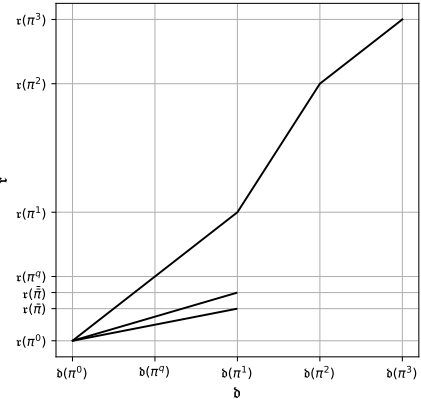
Figure 1 illustrates the relation between r and d. Policies π0 , π1 , π2 and π3 are deterministic and optimal, and policy πq is strictly 1-randomized and optimal. Policies ¯π and ¯¯π are suboptimal and satisfy d(π1 ) = d(¯π) = d(¯¯π) = α for an α ∈ R+. In general, there are multiple policies π with d(π) = α, and these policies can have different values of r(π). However, if we consider just the r(π∗ ) corresponding to the optimal policy π∗ for each α, we get a piecewise linear function from d(π∗ ) to r(π∗ ) due to Proposition 4. Formally, Corollary 1. Let Γdet be the set of deterministic policies returned by Algorithm 1 and Γrnd be the set of strictly 1randomized policies on the edges between the neighboring policies in Γdet . Then Γdet ∪ Γrnd = Γ∗ , and the relation d(π) → r(π) for π ∈ Γ∗ forms a piecewise linear function.
Proof. Proposition 3 implies Γdet ∪Γrnd = Γ∗ . Proposition 2 and Proposition 4 imply that the relation in the corollary is a piecewise linear function.
We further assume that any policy yields positive expected reward and positive expected risk. More formally,
Assumption 3. (Positiveness) For any policy π, we have d(π), r(π) ∈ R+.
The following Lemma holds under Assumption 3:
Lemma 1. The relation d(π) → r(π) dω (π) for π ∈ Γ∗ is a continuous function, and r(π∗ ) dω (π∗ ) ≥ r(π) dω (π) for any π∗ ∈ Γ∗ and any π such that d(π) = d(π∗ ).
Proof. Corollary 1 implies that the relation in the lemma is a continuous function under Assumption 3. Also, for any π∗ ∈ Γ∗ and any π such that d(π) = d(π∗ ), we have r(π∗ ) ≥ r(π) and hence r(π∗ ) dω (π∗ ) ≥ r(π) dω (π) for ω ∈ (0, 1].
Algorithm 1 considers only deterministic optimal policies, ignoring strictly 1-randomized policies that are optimal for some α. We will now show that such strictly 1-randomized policies can indeed by ignored.
Lemma 2. Let 0 < αmin < αmax < ∞ and f(α) = cα+b αω for α ∈ [αmin, αmax], where ω ∈ (0, 1] and c, b are constants such that c α+b > 0 for any α ∈ [αmin, αmax]. Then f(α) is quasiconvex (i.e., its maximum is attained either at α = αmin or α = αmax).
The following theorem shows that we can solve the EMRDP problem with Algorithm 1:
Theorem 1. Under Assumptions (1-3), Algorithm 1 returns the π that maximizes r(π)/dω (π) over all policies π.
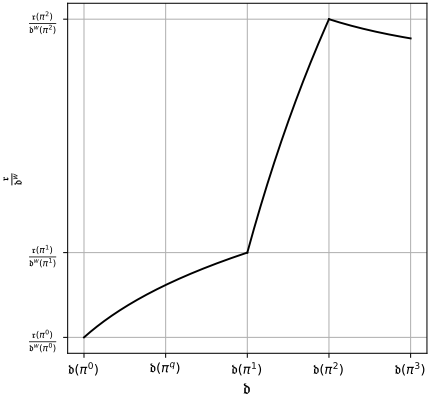
Proof. Let f ∗ : d(π) → r(π) dω (π) for π ∈ Γ∗ be the function as defined in Lemma 1. Then, following Lemmas 1-2, f ∗ is a piecewise quasiconvex function as depicted in Figure 2 (α = d(π)). Hence, f ∗ has no local maximas, corresponding to strictly 1-randomized policies, meaning that Algorithm 1 finds a set of deterministic policies such that one of them must be globally optimal. Thus, by choosing the π with maximal ratio r(π)/dω (π), Algorithm 1 returns the globally optimal policy for the EMRDP problem.
5 A Strongly Polynomial Algorithm
We now show that Algorithm 1 can run in strongly polynomial time with an additional assumption that often holds in applications to financial markets. In financial applications, "larger" actions, such as investing a larger amount, are fundamentally riskier than "smaller" ones. We may thus assume that the risk increases monotonically with the amount of investment, when actions determine the amount of investment.
Assumption 4 (Monotonicity). There is a linear order (a1, . . . , ak) on A such that
5.1 AlgorithmDescription
Algorithm 2 shows the version of our algorithm that runs in strongly-polynomial time when monotonicity holds. Algorithm 2 is identical to Algorithm 1 except in Line 1, where we initialize π with the policy that takes the smallest action a1, defined in Assumption 4, at every state.
5.2 Correctness and Running Time
When Assumption 4 holds, this initial policy minimizes the risk. Algorithm 2 thus finds the deterministic policy π that
Algorithm 2 A Strongly Polynomial Algorithm for EMRDP Problem (2) when Monotonicity Assumption Holds.
- 1: Initialize: π ← (a1, . . . , a1) 2: T ← {(π, r(π), d(π))} 3: while ∃(s, a) s.t. d(πs,a ) > d(π) do 4: πs,a ← argmax πs,a {∇s,a(π) | d(πs,a ) > d(π)} 5: Add (πs,a , r(πs,a ), d(πs,a )) into T 6: π ← πs,a 7: end while 8: return argmax π {r(π)/dω (π) | (π, r(π), d(π)) ∈ T}
minimizes r(π) without solving the MDP in (4), and this solves the issue of strong polynomiality in the case of the expected reward model. In this sense, Algorithm 2 is identical to Algorithm 1 and finds the optimal solution for EMRDP. What remains to show is the running time of Algorithm 2.
Lemma 3. Algorithm 2 runs in O(n4 k2 ) time when Assumption 4 is satisfied.
Proof. By Assumption 4, the while loop of Algorithm 2 is repeated only O(nk) times, since the action must increase in Line 4. In Line 4, there are at most nk candidates of the next policy, and the evaluation of each candidate is dominated by the inversion (i.e., inverse of the basis matrix of size n×n) of the matrix which differs from the current vertex matrix by one column. By the Sherman-Morrison formula [Meyer, 2000], such matrix inversion can be done in O(n2 ) time, which completes the proof of the lemma.
The results in [Even and Zadorojniy, 2012] suggest that Line 1-7 of Algorithm 2 is equivalent to the Simplex algorithm with the Gass-Saaty shadow-vertex pivoting rule, where Line 4 of Algorithm 2 is the pivoting rule of the next vertex. This suggests that the running time of Algorithm 2 is actually O(n3 k2 ) by the following proposition:
Proposition 5 (Proposition 4 from [Even and Zadorojniy, 2012]). The running time of the Simplex algorithm with the Gass-Saaty shadow-vertex pivoting rule is O(n3 k2 ) for finding an optimal policy of a controlled random walk.
Notice that there are minor adjustments with respect to the Simplex algorithm related to the ratio maximization in Line 8 of Algorithm 2.
6 Embedded Learning
We can validate the practical relevance of our algorithmic approach empirically, introducing a variant of Algorithm 1 with embedded learning.
Consider a dataset D derived from some ground-truth environment, whose columns include state and action features as well as reward and risk outcomes; its rows constitute a sequential log of historical instances of state, action, reward, and risk values. When state or action features are continuous, they can be binned (i.e., discretized), while the immediate reward r and risk d associated with each bin can be averaged. Binning can thus gives rise to an empirical CMDP formulation of D with finite state and action spaces and corresponding immediate reward and risk vectors. Transition probability matrices can be estimated from D by counting the number of occurrences of neighboring (binned) rows.
Compared to the discretized ground-truth environment, not all discretized states or actions will necessarily be present in D. Thus, we derive empirical S and A fromD. In addition, the empirical state-action space S ×A may not be present in D in its entirety. We denote its subset (S ×A)D to include all pairs (s, a) ∈ S × A present in the binned D.
Empirical algorithm. Algorithm3 embeds learning within our EMRDP framework. It relies on two essential components to supplement Algorithm 1: (i) a state-dependant ordering of action-associated risk (Line 1) and (ii) a data-driven
Algorithm 3 Empirical Algorithm for EMRDP Problem (2).
1: Initialize: π ← (argmin a (s1, a), . . . , argmin a (sn, a)) 2: T ← {(π, rest (π), dest (π))} 3: while ∃(s, a) ∈ (S ×A)D s.t. dest (πs,a ) > dest (π) do 4: π∗ ← argmax πs,a {∇est s,a (π) | dest (πs,a ) > dest (π)} 5: Add (π∗ , rest (π∗ ), dest (π∗ )) to T 6: π ← π∗ 7: end while 8: return argmax (π,rest (π),dest (π))∈T {rest (π)/ (dest (π))ω }estimate of expected reward and risk (e.g., Line 4). Addressing (i), we define (s, a′ ) < (s, a′′ ) for a fixed s ∈ S and a pair (s, a′ ), (s, a′′ ) ∈ (S × A)D iff d(s, a′ ) < d(s, a′′ ). 3 In Line 1, we initialize with the policy that takes the minimal action at si over all a s.t. (si, a) ∈ (S × A)D. This choice is not guaranteed to be the global minimal-risk policy. However, we will see that it is sufficient in practise. Addressing (ii), we use an offline policy evaluation (OPE) algorithm [Voloshin et al., 2021] that relies on D to output estimates of expected reward rest (π) and risk dest (π) for a policy π supported in (S × A)D. In Lines 3 and 4, we utilize OPE to produce estimates rest (π) and dest (π) and derive ∇est (π) as in (3). In our experiments, we use Q-Evaluation as our OPE [Kostrikov and Nachum, 2020], which is the standard fitted Q-Evaluation without functional approximation.
7 Experiments
We compared Algorithm 3 empirically to the theoretically optimal policy on the benchmark Grid World problem. 4 We examined its performance in terms of solution quality, number of steps, and numerical stability. We found Algorithm 3 solution quality to be stable under data noising, while its required number of steps grows with added noise. We also observed its numerical stability compared to a global optimization method.
7.1 Environment
Solving the benchmark Grid World problem requires finding the optimal policy for traversing an h × w grid from an initial to a terminal cell in a minimal number of moves in the presence of obstacles and action-associated risk. We fixed the initial cell to be the top left cell.
The action space is A = [Up,Down, Left,Right,None] for this problem, where None refers to a 'do nothing' move. Adding the None move allows us to incorporate the notion of infinite horizon. We define transition probability matrices P(a), a ∈ A so that there is a δ = 0.1 probability to end up at a random state under each a ∈ A \ {None} move and a
3 Since we are dealing with data-derived risk, we may assume this ordering is strict.
δN = 0.5 probability under the a = None move. 5 The nonzero probability for randommoves ensures irreducibility.
We fix the immediate cost associated with each cell to be cost = 5.0 and the immediate negative reward to be -cost, except at the terminal cell, where the cost is 0.0, and at obstacle cells, where the cost is M = 2/(1-β), 6 following [Chow et al., 2015]. Thus, maximizing reward aims at finding the policy that establishes the shortest (stochastic) path to the terminal cell, while avoiding obstacles.
To the standard benchmark Grid World problem setup, introduced thus far, we add the novel notion of risk. We define risk as high for walking along the top or bottom boundaries of the grid and medium for walking left into the left boundary or right into the right boundary. Risk is otherwise set to a baseline low value. 7 Our goal is to minimize the ratio r(π)/d(π) (where ω = 1), thereby increasing (negative) reward while decreasing (negative) risk.
We add Gaussian randomization to the immediate reward and risk vectors with ϵ = 0.01 standard deviation. 8 We also sample a pre-fixed number of obstacles. Thus, we effectively generate a Grid World environment at random, with varying immediate reward and risk vectors. Moreover, changing the environment hyper-parameters - β, δ, δN, ϵ, the cost per cell, the low, mid, and high risk values, and the number of obstacles - means that we are, in fact, considering a family of stochastic Grid World environments, rather than a single one (in contrast to [Chow et al., 2015]).
7.2 Theoretically-Optimal Policy
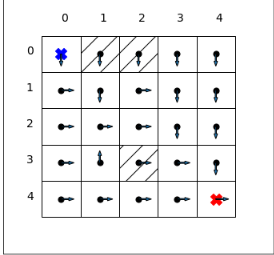
We can compare Algorithm 3 empirically to the theoretical optimum with its full Pareto frontier, calculated using the theory of parametric LPs applied to (1) [Walkup and Wets, 1969]. Figure 3 shows a theoretically optimal policy for a randomly generated Grid World environment. Policy optima are sensitive to Grid World hyper-parameters. A small gap between high and low risk parameter values, for example, will affect risk expression non-trivially: when the expected reward of a policy is high, its occupation measure is high at or near the terminal cell and low on boundary cells further away. Then, their effect on the expected risk is negligible. Minute reward fluctuations may then tilt the scale towards walking along the boundary, effectively ignoring risk. This subtle effect is seen in Figure 3 at the bottom left side of the boundary.
5 A higher δN ensures that datasets generated from randomly chosen policies containing None moves are not sparse.
6 We ran our experiments with discount factor β = 0.95.
7 The risk hyper-parameters of our Grid World environment are RHigh = -1.0, RMid = -5.0, and RLow = -10.0.
8 See the discussion on numerical stability in Section 7.4.
7.3 Solution Quality and Number of Steps
We tested Algorithm 3 on the Grid World problem as follows. First, we calculated the theoretically-optimal policy for a randomly generated h × w Grid World environment. Then, we introduced random noise to the theoretically-optimal policy, at the 10%, 30%, or 100% level. We then generated data from the noised optimal policy, following it for 10 · |S|2 |A| moves. In our Grid World dataset, each row was associated with a single state (grid cell), action (move), immediate reward, and immediate risk. We learned the empirical Grid World environment from the dataset (Section 6) and ran Algorithm 3.
We ran 150 tests overall on a 5 × 5 grid with 3 obstacles, each time, randomly sampling the obstacles and the randomized immediate reward and risk vectors. A 5×5 grid allowed us to witness the non-trivial effects of risk at a relatively low computational cost. The bigger the grid, the lower the likelihood of hitting the boundary, hence, the lower the effect of boundary risk. Thus, with a bigger grid, the problem is likely to degenerate to an MDP. To witness the effect of risk in a bigger grid would have necessitated a more elaborate risk model.
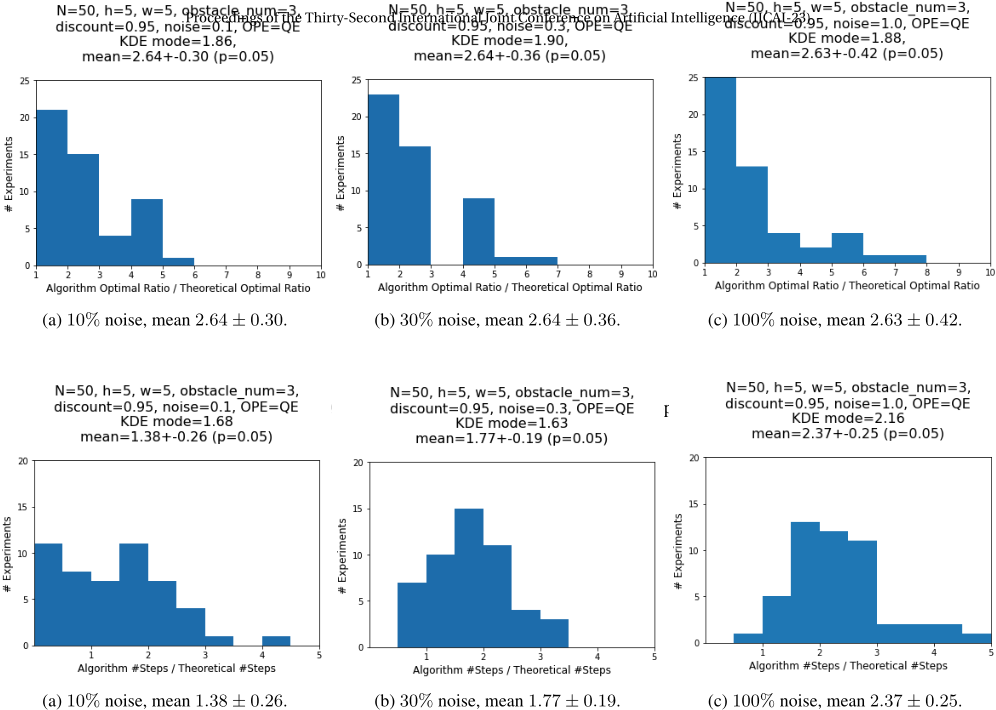
Figures 4a-4b show the distribution of Algorithm 3 optimal ratio over the theoretical optimal ratio across our three noise levels. We provide the mean confidence interval for p = 0.05. As can be seen, Algorithm 3 solution quality is stable w.r.t. data noising. Algorithm 3 optimal ratio, on average, is 2.64±0.30 (10% noise), 2.64±0.36 (30% noise), and 2.63 ± 0.42 (100% noise) times the theoretical optimal ratio.
Figures 5a-5b show the distribution across the same three noise levels of the number of steps required by Algorithm 3 over the number of steps to the optimum along the theoretical Pareto frontier. The number of steps required by Algorithm 3, on average, is 1.38 ± 0.26 (10% noise), 1.77 ± 0.19 (30% noise), and 2.37±0.25 (100% noise) times the number of step to the theoretical optimum. The average number of steps to the optimum along the theoretical Pareto frontier was 14.96± 0.56 (p = 0.05) over our 150 Grid World environments.
We can thus confirm empirically that Algorithm 3 requires more optimization steps as noise grows, though solution quality remains stable. We observe that noise does not weaken learning as a whole. However, the initial, empiricallyminimal policy, from which Algorithm 3 starts, gets further away from the ground-truth risk-minimizing policy as noise grows. As a result, Algorithm 3 requires more steps compared to the number of steps to the theoretical optimum along the theoretical Pareto frontier, which starts at the ground-truth risk-minimizing policy.
7.4 Numerical Stability
Strongly-polynomial algorithms are often considered more numerically stable [Gill and Murray, 1973; Olver and V´egh, 2020; Borgwardt, 2020]. The issue of numerical stability comes up in our Grid World example. Prior to randomizing the immediate risk and reward vectors, its optimization landscape has multiple global optima, since, risk-wise and in the absence of obstacles, moving Right then Down from a (nonboundary) cell is equivalent to moving Down then Right.
When we add randomization to immediate reward and risk, we introduce a unique global optimum with probability 1. Numerically, however, we may still have multiple global optima due to machine precision. Several numerical issues come up in calculating the theoretically-optimal policy. Since we are solving multiple LPs, solutions may not exist or may not give rise to bona fide occupation measures (up to sufficient precision). Our implementation of the theoreticallyoptimal policy algorithm had a fail rate of 4.7% ± 0.4% (p = 0.05), calculated for n = 25 tests, sampling 100 nondegenerate Grid World environments for each.
The issue of numerical stability is inherent to any global search for the optimal policy. A gradient ascent-type algorithm, such as Algorithm 3, that "follows its nose" to some critical point does not encounter such numerical issues.
Parallel computing. From a computational standpoint, estimations of expected reward and risk at the next-best-policy step (Line 4) are mutually independent. We can thus parallelize Algorithm 3 easily. We used the cloud distribution framework Ray to scale up Algorithm 3 [Moritz et al., 2018]. We ran our experiments on an OpenShift cluster with 16 CPUs x 64 RAM x 3 workers.
8 Summary
We introduced a novel parameterized control process, EMRDP, that incorporates both MDP and RMDP. We introduced Algorithm 1 that finds its optimal policy under Assumptions (1)-(3). Its variant, Algorithm 2, does so in stronglypolynomial time under the additional Assumption (4), both for the discounted and expected average reward models. We demonstrated policy optimization with embedded learning in Algorithm 3, using the Grid World problem as a benchmark.
@inproceedings{ijcai2023p608,
  title     = {A Rigorous Risk-aware Linear Approach to Extended Markov Ratio Decision Processes with Embedded Learning},
  author    = {Zadorojniy, Alexander and Osogami, Takayuki and Davidovich, Orit},
  booktitle = {Proceedings of the Thirty-Second International Joint Conference on
               Artificial Intelligence, {IJCAI-23}},
  publisher = {International Joint Conferences on Artificial Intelligence Organization},
  editor    = {Edith Elkind},
  pages     = {5475--5483},
  year      = {2023},
  month     = {8},
  note      = {Main Track},
  doi       = {10.24963/ijcai.2023/608},
  url       = {https://doi.org/10.24963/ijcai.2023/608},
}
TY - CPAPER TI - A Rigorous Risk-aware Linear Approach to Extended Markov Ratio Decision Processes with Embedded Learning AU - Zadorojniy, Alexander AU - Osogami, Takayuki AU - Davidovich, Orit T2 - Proceedings of the Thirty-Second International Joint Conference on Artificial Intelligence, IJCAI-23 PB - International Joint Conferences on Artificial Intelligence Organization PY - 2023 SP - 5475 EP - 5483 DO - 10.24963/ijcai.2023/608 UR - https://doi.org/10.24963/ijcai.2023/608 ER -Copied
Machine-readable versions of this paper, for tools and AI agents:





