
Approximate Inference in Logical Credal Networks
Proceedings of the Thirty-Second International Joint Conference on Artificial Intelligence. Main Track. Pages 5694-5701.
https://doi.org/10.24963/ijcai.2023/632
Keywords
- Knowledge Representation and Reasoning: KRR: Knowledge representation languages
- Uncertainty in AI: UAI: Graphical models
- Uncertainty in AI: UAI: Inference
Abstract
The Logical Credal Network or LCN is a recent probabilistic logic designed for effective aggregation and reasoning over multiple sources of imprecise knowledge. An LCN specifies a set of probability distributions over all interpretations of a set of logical formulas for which marginal and conditional probability bounds on their truth values are known. Inference in LCNs involves the exact solution of a non-convex non-linear program defined over an exponentially large number of non-negative real valued variables and, therefore, is limited to relatively small problems. In this paper, we present ARIEL -- a novel iterative message-passing scheme for approximate inference in LCNs. Inspired by classical belief propagation for graphical models, our method propagates messages that involve solving considerably smaller local non-linear programs. Experiments on several classes of LCNs demonstrate clearly that ARIEL yields high quality solutions compared with exact inference and scales to much larger problems than previously considered.
- [Andersen and Hooker, 1994] Kent Andersen and John Hooker. Bayesian logic. Decision Support Systems, 11(2):191-210, 1994.
- [Antonucci et al., 2010] Alessandro Antonucci, Yi Sun, Cas- sio De Campos, and Marco Zaffalon. Generalized loopy 2U: A new algorithm for approximate inference in credal networks. International Journal of Approximate Reason- ing, 51(5):474-484, 2010.
- [Chandru and Hooker, 1999] Vijay Chandru and John Hooker. Optimization Methods for Logical Inference. John Wiley & Sons, 1999.
- [Constantinou et al., 2020] Anthony Constantinou, Yang Liu, Kiattikun Chobtham, Zhigao Guo, and Neville Kit- son. The bayesys data and bayesian network repository. Technical report, Bayesian Artificial Intelligence research lab, Queen Mary University of London, London, UK, 2020.
- [Cozman, 2000] Fabio Cozman. Generalizing variable- elimination in bayesian networks. In Workshop on Proba- bilistic reasoning in Bayesian networks at SBIA/Iberamia 2000, pages 21-26, 2000.
- [Cussens, 2000] James Cussens. Stochastic logic programs: Sampling, inference and applications. In Uncertainty in Artificial Intelligence (UAI), pages 115-122, 2000.
- [De Raedt et al., 2008] Luc De Raedt, Paolo Frasconi, Kris- tian Kersting, and Stephen Muggleton. Probabilistic In- ductive Logic Programming -Theory and Applications. Springer, 2008.
- [Dürig and Studer, 2005] Michael Dürig and Thomas Studer. Probabilistic abox reasoning: Preliminary results. In De- scription Logics, pages 104-111, 2005.
- [Fagin et al., 1990] Ronald Fagin, Joseph Halpern, and Nim- rod Megiddo. A logic for reasoning about probabilities. Information and Computation, 87(1-2):78-128, 1990.
- [Fagiuoli and Zaffalon, 1998] Enrico Fagiuoli and Marco Zaffalon. 2U: An exact interval propagation algorithm for polytrees with binary variables. Artificial Intelligence, 106(1):77-107, 1998.
- [Fernández de Gortari et al., 2017] Eli Fernández de Gor- tari, César García-Jacas, Karina Martinez-Mayorga, and José Medina-Franco. Database fingerprint (dfp): an ap- proach to represent molecular databases. Journal of Chem- informatics, 9(1):1-9, 2017.
- [Getoor and Taskar, 2007] Lise Getoor and Ben Taskar. In- troduction to Statistical Relational Learning (Adaptive Computation and Machine Learning). MIT Press, 2007.
- [Heinsohn, 1994] Jochen Heinsohn. Probabilistic descrip- tion logics. In Proceedings of the International Conference on Uncertainty in Artificial Intelligence, pages 311-318, 1994.
- [Ide and Cozman, 2008] Jaime Ide and Fabio Cozman. Ap- proximate algorithms for credal networks with binary vari- ables. International Journal of Approximate Reasoning, 48(1):275-296, 2008.
- [Jaeger, 1994] Manfred Jaeger. Probabilistic reasoning in terminological logics. In Principles of Knowledge Repre- sentation and Reasoning, pages 305-316. Elsevier, 1994.
- [Koller and Friedman, 2009] Daphne Koller and Nir Fried- man. Probabilistic Graphical Models: Principles and Techniques. MIT Press, 2009.
- [Li et al., 2020] Shuang Li, Lu Wang, Ruizhi Zhang, Xiaofu Chang, Xuqin Liu, Yao Xie, Yuan Qi, and Le Song. Tem- poral logic point processes. In International Conference on Machine Learning, pages 5990-6000. PMLR, 2020.
- [Marinescu et al., 2018] Radu Marinescu, Junkyu Lee, Rina Dechter, and Alexander Ihler. AND/OR search for marginal MAP. Journal or Artificial Intelligence Research (JAIR), 63(1):875 -921, 2018.
- [Marinescu et al., 2022] Radu Marinescu, Haifeng Qian, Alexander Gray, Debarun Bhattacharjya, Francisco Bara- hona, Tian Gao, Ryan Riegel, and Pravinda Sahu. Logical credal networks. In 36th Conference on Neural Informa- tion Processing Systems (NeurIPS), 2022.
- [Nilsson, 1986] Nils Nilsson. Probabilistic logic. Artificial Intelligence, 28(1):71-87, 1986.
- [Nilsson, 1994] Nils Nilsson. Probabilistic logic revisited. Artificial Intelligence, 59(1-2):39-42, 1994.
- [Pearl, 1988] Judea Pearl. Probabilistic Reasoning in Intel- ligent Systems. Morgan Kaufmann, 1988.
- [Richardson and Domingos, 2006] Matthew Richardson and Pedro Domingos. Markov logic networks. Machine Learn- ing, 62(1-2):107-136, 2006.
- [Riegel et al., 2020] Ryan Riegel, Alexander Gray, Francois Luus, Naweed Khan, Ndivhuwo Makondo, Ismail Yunus Akhalwaya, Haifeng Qian, Ronald Fagin, Francisco Bara- hona, Udit Sharma, et al. Logical neural networks. arXiv preprint arXiv:2006.13155, 2020.
- [Wächter and Biegler, 2006] Andreas Wächter and Lorenz Biegler. On the implementation of an interior-point filter line-search algorithm for large-scale nonlinear program- ming. Mathematical Programming, 106(1):25-57, 2006.
References were extracted automatically from the PDF and may contain errors.
Full text extracted automatically from the PDF; figures, tables and equations may differ. The PDF is the version of record.
1 Introduction
Many real-world applications require efficient handling of uncertainty and compact representations of a wide variety of knowledge. Graphical models such as Bayesian networks [Pearl, 1988] or Markov networks [Koller and Friedman, 2009] provide a powerful framework for reasoning about uncertainty while classical (first-order) logic can naturally be used to represent compactly complex concepts and relationships that comprise expert knowledge. Therefore, probabilistic logic which combines probability and logic in a principled manner has emerged over the years as a unified framework to deal effectively with these complex applications [Nilsson, 1986; Fagin et al., 1990; Heinsohn, 1994; Jaeger, 1994; Andersen and Hooker, 1994; Chandru and Hooker, 1999; D¨urig and Studer, 2005; Richardson and Domingos, 2006; Getoor and Taskar, 2007; De Raedt et al., 2008]. While some of these logics (e.g., [Richardson and Domingos, 2006; Getoor and Taskar, 2007; De Raedt et al., 2008]) associate a single real value to the logical formulas to represent the uncertainty around their truth values, others (e.g., [Nilsson,
1986; Fagin et al., 1990]) relax this requirement and allow specifying lower and upper probability bounds on logical formulas.
In practice, it is often the case that multiple sources of imprecise knowledge need to be combined to solve a problem more effectively. For example, in a realistic credit card fraud detection application, a statistical model capturing the uncertainty around historical transaction data can be combined with probabilistic logic rules expressing imprecise expert knowledge about the domain in order to predict future fraudulent transactions more accurately [Li et al., 2020]. Similarly, in chemo-informatics, a more effective structural analysis of molecular materials can leverage a combination of machine learning models based on molecular fingerprinting data and expert knowledge about certain structural properties of molecules represented by probabilistic logic rules.
Logical Credal Networks or LCNs [Marinescu et al., 2022] are a recent probabilistic logic specifically designed for effective aggregation and reasoning over multiple sources of imprecise knowledge. An LCN specifies a set of probability distributions over the interpretations of a set of logical formulas (propositional or first-order) for which marginal and conditional probability bounds on their truth values are known. Although the model is quite expressive and requires very few restrictions, inference in LCNs is intractable as it involves the exact solution of a non-convex non-linear constraint program defined over an exponentially large number of non-negative real valued variables. This is a serious limitation allowing to solve only relatively small problems with up to 10 atoms.
Contribution. In this paper, we present a novel iterative message-passing algorithm called ARIEL that addresses the limitation of exact inference and thus enables efficient approximate inference in LCNs. Our approach is inspired by the classical belief propagation for graphical models [Pearl, 1988; Koller and Friedman, 2009] and propagates messages in an iterative manner between the nodes of a factor graph associated with the LCN. The key novelty of our scheme is that the messages contain both lower and upper bounds on the marginal probability of the LCN's variables (i.e., atoms) and these bounds are tightened iteratively. Importantly, these messages solve considerably smaller local non-linear constraint programs as compared with those in exact inference. In addition, we show that ARIEL retains an important property of classical belief propagation, namely it yields exact results on singly-connected LCNs. We experiment and evaluate our proposed algorithm on several classes of LCNs including random as well as more realistic problem instances. Our results are quite promising and demonstrate conclusively that ARIEL is able to produce high quality solutions compared with the exact inference approach. Furthermore, we show that ARIEL scales to much larger problems than previously considered while maintaining solution quality. This is important because it allows us to tackle practical problems involving many thousands of variables.
2 Background
We review next basic concepts about Logical Credal Networks and exact inference methods for these models.
2.1 Logical Credal Networks
A Logical Credal Network (LCN) [Marinescu et al., 2022] L is defined by a set of two types of probability sentences:
where q and r can be arbitrary propositional or first-order logic formulas 1 and 0 ≤ lq ≤ uq ≤ 1, 0 ≤ lq|r ≤ uq|r ≤ 1. Each sentence in L is further associated with a Boolean parameter τ indicating dependence between the atoms of q.
An LCN represents the set of probability distributions (i.e., models) over all interpretations that satisfy a set of constraints given explicitly by sentences (1) and (2) together with a set of implied independence constraints between the LCN's atoms. We say that an LCN is consistent if it has at least one model. Otherwise, it is inconsistent.
The primal graph of an LCN L is a directed graph G that contains formula nodes associated with the formulas q and r in L's sentences and atomic nodes associated with the atoms involved in those formulas, respectively. If a formula consists of a single atom then G contains a single atomic node for that formula. For type (1) sentences, there is a directed edge from each of formula q's atomic nodes to q's formula node, while in case of type (2) sentences, G contains directed edges from formula r's atomic nodes to r's formula node, a directed edge from formula node r to formula node q, and directed edges from q's formula node to its corresponding atomic nodes. In addition, for all sentences with τ = True, G contains directed edges from the atomic nodes corresponding to q's atoms to the formula node q.
Given an LCN L and its primal graph G, the parents of an atomic node x, denoted by parents(x), is the set of atomic nodes y such that there exists a directed path (y → z1 → · · · → zk → x) from y to x in G such that all intermediate nodes zi (if any) are formula nodes. Similarly, the descendants of an atomic node x, denoted by descendants(x), is the set of atomic nodes y such that there exists a directed path (x → z1 → · · · → zk → y) from x to y in G such that none of the intermediate nodes xi (if any) is in parents(x).
1 For simplicity, we assume that the first-order logic formulas are universally quantified, do not contain functions and their variables have finite domains of values.
The Markov condition associated with an LCN L allows us to make additional independence assumptions between its atoms. Namely, given a model M of L, every atom x in L is conditional independent of its non-descendant non-parent atoms given its parents in L's primal graph.
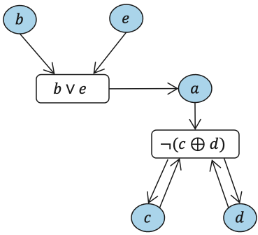
Example 1. Consider the following propositional LCN which was inspired by the Earthquake example from [Pearl, 1988]. The sentences below state that: burglaries (b) are more common than earthquakes (e) (Eq. 3 and 4); the house alarm (a) can be triggered by a burglary or an earthquake (Eq. 5); in case of an alarm, either both Charles (c) and Dan (d) call the emergency services or neither does (Eq. 6); the alarm can also be triggered accidentally (Eq. 7).
Figure 1 depicts the factor graph of the LCN where the round shaded nodes represent atomic nodes and the rectangular hollow nodes correspond to the formula nodes, respectively. In this case, we assume that the τ flag associated with the sentences is True. Therefore, we have that b and e are independent, c is conditionally independent of {b, e} given {a, d} and d is conditionally independent of {b, e} given {a, c}.
2.2 Exact Inference in LCNs
Given an LCN L and a query formula ρ, the marginal inference task computes lower and upper bounds on the posterior marginal probability P(ρ), denoted by P(ρ) and P(ρ), respectively. The task entails solving a non-linear program defined over a set of variables representing the probabilities of L's interpretations and comprising of linear constraints derived from L's sentences, non-linear constraints corresponding to the independence assumptions derived from L's Markov condition and a linear objective function corresponding to the query P (ρ) which is subsequently minimized and maximized to yield the desired bounds.
Let ⃗ p = (p1, . . . , pN) be the vector representing the probabilities of the N = 2n interpretations of an LCN L with n atoms, and let ⃗Aα = (aα1 , . . . , aαN ) be a binary vector, called an indicator vector, such that aαj is 1 if formula α is true in the j-th interpretation and 0 otherwise. Since the probability of a formula α is the sum of the probabilities of the interpretations in which α is true, we can write P (α) as ⃗Aα⊙⃗ p where ⊙ is the dot-product of two vectors. Therefore, we solve:
minimize/maximize ⃗Aρ ⊙ ⃗ p
where xi is an atomic formula, Si = {si1, . . . , sik} and Ti = {ti1, . . . , til} are xi's parents and non-descendants in the primal graph, ⃗Aq and ⃗Aq∧r are the indicator vectors for formulas q and q ∧ r, and ⃗Aα, ⃗Aβ, ⃗Aγ and ⃗Aδ are the indicator vectors corresponding to the formulas α = (xi ∧ si1 ∧ · · · ∧ sik ∧ ti1 ∧ · · · ∧ til), β = (si1 ∧ · · · ∧ sik), γ = (xi∧si1∧· · ·∧sik), and δ = (si1∧· · ·∧sik∧ti1∧· · ·∧til).
Equations (8) and (9) ensure that ⃗ p is a valid probability distribution, while Equations (10) and (11) encode the sentences of type (1) and (2) in L. Equation 12 encodes the conditional independencies implied by the Markov condition, i.e., P(xi|Si, Ti) = P(xi|Si), which must hold for all truth values of its atoms (see also [Marinescu et al., 2022]).
3 Approximate Inference in LCNs
Since exact inference is not tractable for large LCNs, we introduce a new message-passing algorithm to approximate the posterior marginals of the atomic formulas in an LCN. The basic idea is to follow the classical belief propagation scheme on a factor graph associated with the LCN and propagate messages between the variable and factor nodes until convergence [Pearl, 1988; Koller and Friedman, 2009].
3.1 Incompatibility with Belief Propagation
Graphical models such as Bayesian networks [Pearl, 1988] or credal networks [Cozman, 2000] typically require a uniqueassessment assumption, namely a variable must occur in either a marginal distribution (resp. credal set) or a conditional distribution (resp. conditional credal set) but not both, and for each conditional distribution or credal set, all possible interpretations of the parent variables must be specified. LCNs do not require the unique-assessment assumption and, therefore, the sum-product message-passing based approximate inference methods (i.e., belief propagation) which were originally developed for credal networks (i.e., 2U [Fagiuoli and Zaffalon, 1998], L2U [Antonucci et al., 2010] or IPE [Ide and Cozman, 2008]) are not compatible with LCNs. Indeed, consider the following illustrative example:
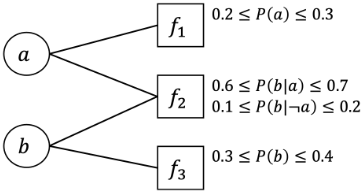
Clearly, this is not a valid credal network because (16) violates the unique-assessment assumption but is legitimate for an LCN. If we query P(b), the correct answer is [0.3, 0.35]. However, 2U or L2U yield an incorrect answer of [0.1, 0.26] even though the underlying graph has a tree-like structure.
3.2 ANovel Message-Passing Scheme
We start with the definition of the factor graph associated with an LCN that underlies our message-passing scheme.
Definition 3.1 (factor graph). Given an LCN L, the factor graph F of L is a bipartite graph with variable nodes and factor nodes, respectively. A variable node corresponds to an atom in L, while a factor node represents one or more sentences in L that involve the same set of atoms. A factor node is connected to a variable node if they share the same atom.
Example 2. Figure 2 shows the factor graph associated with the LCN given by (13)-(16). There are 2 variable nodes (depicted as circles) corresponding to atoms {a, b} and 3 factor nodes (depicted as squares) f1, f2 and f3 corresponding to sentences (13), (14)(15) and (16), respectively.
Given a factor graph F, the high-level flow of our proposed message-passing scheme is similar to that of classical belief propagation, namely to iteratively pass and update messages between the variable and factor nodes of F until convergence. Let v and f denote a variable node and a factor node in F, respectively. We use N(·) to denote the neighbors of a node in F. Two kinds of messages will be propagated along the edges of F, as follows:
The variable-to-factor message. The message sent by a variable node v to a neighboring factor node f is an interval [lv→f , uv→f ], where 0 ≤ lv→f ≤ uv→f ≤ 1. If node v has only one neighbor, then the message [lv→f , uv→f ] is just [0, 1]. Otherwise, the message [lv→f , uv→f ] is defined by:
where [lf ′→v, uf ′→v] is the message sent by a neighboring factor node f ′ ∈ N(v) \ {f}, other than f, to v.
The factor-to-variable message. The message sent by a factor node f to a neighboring variable node v is also an interval [lf→v, uf→v] obtained by minimizing and, respectively, maximizing the objective function P(v) subject to (i) a set of linear constraints encoding f's sentences, (ii) a set of linear constraints ensuring that, for each variable node other than v that is connected to f, its marginal probability is within the bounds given by the corresponding variable-to-factor messages, namely lv′→f ≤ P (v′ ) ≤ uv′→f , ∀v′ ∈ N (f) \ {v}, and (iii) a set of non-linear constraints encoding the assumption that f's atoms (other than v) are independent of each other. The latter independence assumption in the local constraint program is a mechanism to approximate the Markov condition, and the same approach is used in classical belief propagation [Pearl, 1988; Koller and Friedman, 2009].
Specifically, if f involves at most k atoms, namely N(f) = {v1, . . . , vk}, then the message [lf→v, uf→v] is computed by solving the following local constraint program:
minimize/maximize ⃗Av ⊙ ⃗ p
where ⃗ p = (p1, . . . , pK) is the vector representing the probabilities of the K = 2k interpretations, Nf = N(f) \ {v} denotes f's neighbors other than v and [lv′→f , uv′→f ] is the message sent by a neighboring variable node v′ ∈ Nf to f, respectively. Equations (21) and (22) encode sentences of type (1) and (2) in f, Equation (23) ensures that v's marginal probability is within the required bounds, while Equation (24) encodes the independence assumption between f's atoms.
Example 3. Consider the LCN defined by the following sentence 0.3 ≤ P (c ∧ (d ∨ e)) ≤ 0.4. The factor graph has one factor node f corresponding to the sentence and three variable nodes for the atoms {c, d, e}, respectively. The factorto-variable message [lf→d, uf→d] is obtained by minimizing and maximizing the following non-linear program:
Algorithm 1 which we denote hereafter by ARIEL summarizes our message-passing scheme for approximate inference in LCNs. All messages along the edges of the factor graph are first initialized with [0, 1] intervals. Subsequently, the variable-to-factor and factor-to-variable messages are updated in an iterative manner until convergence (i.e., either a fixed number of iterations is exceeded or the average change in messages from one iteration to the next is below a given threshold). Finally, for each variable node v, the lower and upper bounds of the posterior marginal interval are obtained by maximizing and, respectively, minimizing the lower and Algorithm 1 AppRoximate InfErence for LCNs (ARIEL)
Require: LCN L
1: Create factor graph F 2: for all edges (v, f) ∈ F do 3: Set [lv→f , uv→f ] = [lf→v, uf→v] = [0, 1] 4: end for 5: repeat 6: ▷ Update the variable-to-factor messages 7: for all edges (v, f) ∈ F do 8: if |N(v)| = 1 then 9: l = 0, u = 1 10: else 11: l = maxf ′∈N(v)\{f} lf ′→v 12: u = minf ′∈N(v)\{f } uf ′→v 13: end if 14: Update [lv→f , uv→f ] = [l, u] 15: end for 16: ▷ Update the factor-to-variable messages 17: for all edges (v, f) ∈ F do 18: l =minP(v) subject to constraints (19)-(24) 19: u = maxP(v) subject to constraints (19)-(24) 20: Update [lf→v, uf→v] = [l, u] 21: end for 22: until convergence 23: for all variable nodes v do 24: P(v) =maxf∈N(v) lf→v 25: P(v) =minf∈N(v) uf→v 26: end for 27: return [P(v), P(v)] for each atom v ∈ Lupper bounds of the incoming factor-to-variable messages to v (lines 16-18), namely:
Example 4. Continuing our example LCN defined by (13)- (16), the message [lf2→b, uf2→b] is obtained by solving:
minimize/maximize P (b)
The following messages are obtained upon convergence:
Finally, the lower and upper bounds for P (b) are given by:
which match the results of exact inference in this case.
3.3 Properties
We show next that ARIEL computes exact posterior marginal probability intervals for singly-connected LCNs.
Definition 3.2. Let L be an LCN with primal graph G. We call L singly-connected if G does not contain directed cycles.
Theorem 1 (correctness). Given a singly-connected LCN with n atoms denoted by V = {v1, . . . , vn}, ARIEL computes exact posterior marginal lower and upper bounds P(vi) and P(vi), for each atom vi ∈ V .
Note that Theorem 1 holds even if the LCN contains additional marginal probability sentences that break the uniqueassessment assumption. However, in general, LCNs may contain directed cycles and, in this case, there is no guarantee on correctness. This is also true for the classical loopy belief propagation algorithms in probabilistic graphical models [Pearl, 1988; Koller and Friedman, 2009].
Theorem 2 (complexity). Let L be an LCN such that its factor graph has n variable nodes (atoms) and m factor nodes. Assuming a fixed number of iterations i, the complexity of Algorithm 1 is O(i ·n·m·Q), where Q bounds the complexity of solving the local non-linear programs at factor nodes. Each of these non-linear programs involves 2t variables, where t bounds the number of atoms in a factor node.
3.4 Comparison with Other Algorithms
The bound tightening operation at variable nodes is conceptually similar to a recent inference algorithm for Logical Neural Networks [Riegel et al., 2020]. The message computation at factor nodes bears some similarity to the 2U and L2U algorithms for credal networks which make similar independence assumption to approximate the Markov condition [Ide and Cozman, 2008]. ARIEL is also related with the IPE algorithm for credal networks [Ide and Cozman, 2008] which selects the tightest bounds over a number of polytree subgraphs.
3.5 Handling Complex Query Formulas
Let ρ be a non-atomic query formula and let {v1, . . . , vk} be its atoms. In this case, following the message propagation outlined by Algorithm 1, the marginal P(ρ) can be approximated by solving the non-linear constraint program:
minimize/maximize ⃗Aρ ⊙ ⃗ p
where f ′ is an auxiliary factor node corresponding to ρ, N(f ′ ) = {v1, . . . , vk} and ⃗Aρ is ρ's indicator vector.
4 Experiments
We evaluate empirically our ARIEL scheme for approximate inference and compare it with exact inference on several classes of LCNs. The competing algorithms were implemented in Python 3.8 and used the ipopt 3.12 solver [W¨achter and Biegler, 2006] with default settings to handle the non-linear constraint programs. We ran all experiments on a 2.2GHz Intel Core processor with 32GB of RAM.
| size | CPU time (sec) | Errors | ||
|---|---|---|---|---|
| n, e | Exact | ARIEL | MAEl | MAEu |
| polytree | ||||
| 5, 2 | 0.38 | 1.69 | 0.0001±0.00 | 0.0000±0.00 |
| 6, 2 | 0.76 | 1.99 | 0.0000±0.00 | 0.0000±0.00 |
| 7, 2 | 4.94 | 2.45 | 0.0000±0.00 | 0.0000±0.00 |
| 8, 2 | 64.96 | 2.92 | 0.0000±0.00 | 0.0000±0.00 |
| 9, 2 | 837.52 | 3.29 | 0.0000±0.00 | 0.0000±0.00 |
| 10, 2 | 4252.04 | 3.79 | 0.0000±0.00 | 0.0000±0.00 |
| dag | ||||
| 5, 2 | 9.12 | 1.79 | 0.0425±0.06 | 0.0949±0.11 |
| 6, 2 | 5.63 | 2.06 | 0.0332±0.05 | 0.0395±0.04 |
| 7, 2 | 193.07 | 3.13 | 0.0551±0.07 | 0.0555±0.06 |
| 8, 2 | 3625.37 | 3.71 | 0.0339±0.05 | 0.0506±0.08 |
| 9, 2 | 7251.62 | 4.07 | 0.0586±0.08 | 0.0658±0.09 |
| 10, 2 | 17195.05 | 4.33 | 0.1071±0.14 | 0.0640±0.09 |
| random | ||||
| 5, 2 | 9.48 | 1.87 | 0.0431±0.05 | 0.0386±0.05 |
| 6, 2 | 3.98 | 2.29 | 0.0466±0.06 | 0.0372±0.06 |
| 7, 2 | 567.05 | 3.54 | 0.0428±0.07 | 0.0356±0.06 |
| 8, 2 | 3235.67 | 3.98 | 0.0567±0.08 | 0.0348±0.06 |
| 9, 2 | 6263.68 | 5.23 | 0.0647±0.08 | 0.0509±0.07 |
| 10, 2 | 11310.88 | 5.85 | 0.1053±0.12 | 0.0938±0.12 |
Measure of Performance. In all experiments we report the average CPU time in seconds and the mean absolute error (MAE) for the posterior marginal lower and upper bounds obtained for each propositional variable. More specifically, for each problem instance, we define the errors as:
where n is the number of variables, P ∗ (xi) and P ∗ (xi) are the exact posterior marginal lower bounds on P(xi) for each variable xi, while P(xi) and P(xi) are the approximate marginal bounds computed by ARIEL.
4.1 RandomLCNs
For our purpose, we generated several classes of random LCNs with n propositional variables {x1, . . . xn}, called polytree, dag, and random, respectively, having m sentences of the following types:
Specifically, for polytree LCNs, there are m = n sentences of types (a), (b) and (c) generated randomly such that the corresponding primal graph is a polytree (i.e., there are no directed cycles). The dag instances contain m = n randomly generated sentences of types (a), (b) and (c) such that the primal graph is a directed acyclic graph (DAG). For random LCNs we also have m = n sentences of types (a), (b) and (c) generated randomly without the acyclicity requirement. In all cases, we added e additional sentences of type (a).
We note that for type (a) we generate only one sentence P(xi) while for types (b) and (c) we generate sentences for all truth values of xj and xk, namely P(xi|xj), P (xi|¬xj ), P (xi|xj ∧ xk), P (xi|xj ∧ ¬xk), P (xi|¬xj ∧ xk) and P(xi|¬xj ∧ ¬xk), respectively. We selected the probability bounds l and u of the sentences uniformly at random between 0 and 1 such that u - l ≤ 0.6. Furthermore, we ensured that all problem instances generated were consistent.
Table 1 summarizes the results obtained on polytree, dag and random instances of varying sizes with n ∈ {5, 6, . . . , 10} and e = 2. Each data point in the table represents an average over 10 random instances generated for that particular problem size. The second and third columns report the running times of the exact and approximate inference algorithms, while the fourth and fifth columns give the errors MAEl and MAEu on the posterior marginal bounds computed by ARIEL using a maximum of 10 iterations and a 10-6 threshold for convergence (whichever comes first).
When looking at the solution quality, especially on the polytree problems, we can see that the absolute errors are very small (close to zero) thus verifying the correctness of ARIEL on singly-connected LCNs (the discrepancies are caused by the numerical precision for representing real numbers as well as the default tolerances used by the ipopt solver). For dag and random problems, the errors are also small and suggest that the approximate posterior marginals are fairly close to the exact ones. In terms of running time, we can see that, as expected, ARIEL scales much better to larger problems compared with the exact algorithm. For example, on dag and random problems of size 10, the algorithm is already almost 4 orders of magnitude faster while producing relatively good quality solutions.
Furthermore, Table 2 reports results obtained on much larger random LCNs with up to 100,000 propositional variables. We can see that ARIEL was able to solve all these problem instances while the exact algorithm could not go beyond the smallest problem size. Specifically, it exceeded the 30 hour time limit for the n = 100 case and ran out of memory while building the non-linear program for n > 1000, respectively. This demonstrates clearly that ARIEL overcomes the major limitation of exact inference for LCNs and thus allows us to tackle efficiently much larger problems possibly involving many thousands of variables.
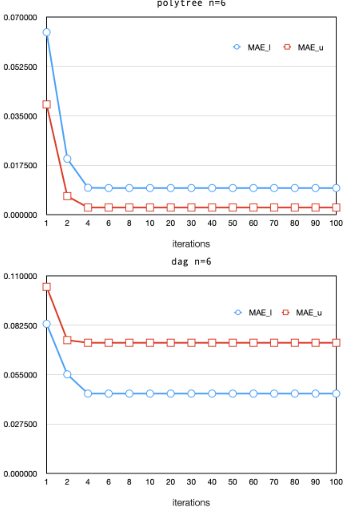
In Figure 3 we plot the mean absolute errors MAEl and MAEu as a function of the number of iterations used by ARIEL for solving the polytree and dag benchmarks of size n = 6, respectively. ARIEL's convergence threshold was set to 0. We can see that the algorithm is able to converge to relatively small errors after less than 10 iterations. A similar pattern was also observed on the other benchmarks.
| size | CPU time (sec) | |
|---|---|---|
| n | Exact | ARIEL |
| 10 | 11422.28 | 5.86 |
| 100 | - | 82.02 |
| 1,000 | na | 820.73 |
| 10,000 | na | 8509.23 |
| 100,000 | na | 89668.61 |
| LCN | CPU time (sec) | Errors | ||
|---|---|---|---|---|
| Exact | ARIEL | MAEl | MAEu | |
| Toy | 0.14 | 0.98 | 0.0000±0.00 | 0.0000±0.00 |
| Earth | 0.32 | 1.31 | 0.0000±0.00 | 0.0000±0.00 |
| Cancer | 0.33 | 1.93 | 0.0014±0.00 | 0.0036±0.01 |
| Asia | 52.23 | 2.69 | 0.0005±0.00 | 0.0162±0.04 |
| Credit | 4334.66 | 2.96 | 0.0336±0.03 | 0.0490±0.09 |
| Engine | 14006.99 | 3.07 | 0.0737±0.08 | 0.0259±0.04 |
| Suicide | 5850.50 | 3.47 | 0.0318±0.07 | 0.0191±0.04 |
| Tank | 11415.05 | 4.16 | 0.0234±0.04 | 0.0355±0.02 |
| Alarm | 10783.91 | 2.77 | 0.0421±0.06 | 0.0578±0.09 |
| Hepatitis | 11178.05 | 5.16 | 0.0177±0.03 | 0.0574±0.06 |
4.2 Real-World LCNs
Table 3 displays the results obtained on LCNs derived from real-world Bayesian networks with binary variables [Constantinou et al., 2020]. More specifically, each of these LCNs contains sentences of the form l ≤ P(xi) ≤ u and l ≤ P(xi|πi) ≤ u, respectively, where xi is a variable and πi = yi1∧· · ·∧yik is the conjunction of the propositional variables corresponding to a particular configuration of the parents {yi1, . . . yik} of xi in the Bayesian network. The bounds l and u were selected such that u - l ≤ 0.4, while the numbers of variables and sentences ranged between 4 and 10, and between 6 and 24, respectively. The complete specification of each of these LCNs is included in the supplementary material. We can see again that ARIEL outperformed dramatically the exact inference method in terms of running time while maintaining a relatively good solution quality. For example, on the Tank and Hepatitis problem instances, ARIEL is almost 4 orders of magnitude faster than its competitor, while the corresponding posterior bounds start to differ at the second decimal point compared with the exact ones.
4.3 Application to Chemistry
We describe next a possible application of LCNs and approximate inference to the chemistry domain. Specifically, we consider a binary molecular classification task using imprecise expert knowledge as well as molecular fingerprinting data [Fern´andez de Gortari et al., 2017]. In this case, the class variable is denoted by y ∈ {0, 1} while the molecule structure is represented by a set of n binary features (or fingerprints) F = {f1, . . . , fn} indicating the presence or absence of certain molecular substructures. The LCN is defined by the following types of sentences: (a) l0 ≤ P(¬y) ≤ u0 and l1 ≤ P(y) ≤ u1 representing the class probability, (b) li0 ≤ P(fi|¬y) ≤ ui0 and li1 ≤ P(fi|y) ≤ ui1 representing the conditional probability of feature fi ∈ F being present given the class, and (c) l ≤ P(y|F(fi1, fi2, . . . , fik)) ≤ u and l ≤ P(¬y|F(fi1, fi2, . . . , fik)) ≤ u, where {fi1, . . . , fik} is a subset of features and F(fi1, . . . , fik) is the conjunction of their respective values, respectively (e.g., F(f1, f2) = f1 ∧ ¬f2). The latter represents imprecise knowledge from one or more domain experts stating that the class can be determined by specific combinations of features.
Given a new molecule for which only a subset of features {f1, . . . , fk} is observed, the task is to compute the posterior marginal probability of its class, namely P(y|f1, . . . , fk) and P(¬y|f1, . . . , fk). For our purpose, we consider a database containing 1298 molecules with n = 985 features. The corresponding LCN has 986 propositional variables, 2 sentences of type (a), 985 sentences of type (b) and 6 sentences of type (c), respectively. The observed features are translated into k additional constraints of the form P(fj) = 1.0 or P(¬fj) = 1.0 ∀j = 1..k, depending on whether fj is absent or present. Table 4 summarizes the results obtained for different sizes of the observed feature subset. Specifically, for each value of k, we generate 10 configurations of k features selected uniformly at random from F and report the average running time. As before, we see that ARIEL was able to solve all problem instances in a little over 5 minutes on average, while the exact method ran out of memory in all test cases.
In summary, we can conclude that the proposed approximate inference algorithm ARIEL is the only inference scheme that can tackle practical larger scale LCNs.
| size | CPU time (sec) | |
|---|---|---|
| k | Exact | ARIEL |
| 10 | na | 324.51 |
| 20 | na | 322.01 |
| 50 | na | 329.58 |
| 100 | na | 339.47 |
| 200 | na | 362.70 |
| 500 | na | 410.43 |
5 RelatedWork
Nilsson's probabilistic logic (NL) [Nilsson, 1986; Nilsson, 1994] is perhaps the first system in which the truth values of logical sentences (or formulas) can range between 0 and 1 and are interpreted as the probability of those sentences being true. The formalism however allows probability bounds but does not permit specifying independence relations between propositions which typically leads to overly large posterior probability intervals. Bayesian logic (BL) [Andersen and Hooker, 1994] combines probabilistic logic and Bayesian networks in order to capture conditional independence relations among propositions. Markov Logic Networks (MLN) [Richardson and Domingos, 2006] apply the ideas of a Markov network to first-order logic where the weights attached to the logic formulas are used to define a joint probability distribution over all possible interpretations and thus enable uncertain inference. Probabilistic Soft Logic (PSL) [Getoor and Taskar, 2007] combines Markov networks with soft or real-valued logic (e.g., Lukasiewicz logic). Probabilistic Logic Programs (PLP) [De Raedt et al., 2008] and Stochastic Logic Programs (SLP) [Cussens, 2000] are logic programs in which some of the facts are annotated with probabilities. We emphasize that MLN, PSL, PLP, SLP do not allow probability bounds on logic formulas, BL constrains the formulas to a specific structure and NL does not consider independence assumptions. In contrast, LCNs overcome these shortcomings.
6 Conclusions
We propose a new iterative message-passing scheme called ARIEL for approximate inference in LCNs. The algorithm works by propagating messages between the nodes of a factor graph representation of the LCN. These messages are lower and upper bounds on marginal probabilities of the variables and their computation involves solving considerably smaller local non-linear programs compared with exact inference. The empirical evaluation on several classes of LCNs including random and more realistic problem instances shows promising results, particularly in scaling to much larger problems while producing good quality solutions.
Potential future directions include extending to temporal models, further algorithmic innovations for learning LCNs from data, and experiments on a wider array of applications. We also plan to investigate extensions to optimization tasks such as MAP and Marginal MAP inference in LCNs using search-based algorithms similar to those developed for graphical models (e.g., [Marinescu et al., 2018]).
@inproceedings{ijcai2023p632,
  title     = {Approximate Inference in Logical Credal Networks},
  author    = {Marinescu, Radu and Qian, Haifeng and Gray, Alexander and Bhattacharjya, Debarun and Barahona, Francisco and Gao, Tian and Riegel, Ryan},
  booktitle = {Proceedings of the Thirty-Second International Joint Conference on
               Artificial Intelligence, {IJCAI-23}},
  publisher = {International Joint Conferences on Artificial Intelligence Organization},
  editor    = {Edith Elkind},
  pages     = {5694--5701},
  year      = {2023},
  month     = {8},
  note      = {Main Track},
  doi       = {10.24963/ijcai.2023/632},
  url       = {https://doi.org/10.24963/ijcai.2023/632},
}
TY - CPAPER TI - Approximate Inference in Logical Credal Networks AU - Marinescu, Radu AU - Qian, Haifeng AU - Gray, Alexander AU - Bhattacharjya, Debarun AU - Barahona, Francisco AU - Gao, Tian AU - Riegel, Ryan T2 - Proceedings of the Thirty-Second International Joint Conference on Artificial Intelligence, IJCAI-23 PB - International Joint Conferences on Artificial Intelligence Organization PY - 2023 SP - 5694 EP - 5701 DO - 10.24963/ijcai.2023/632 UR - https://doi.org/10.24963/ijcai.2023/632 ER -Copied
Machine-readable versions of this paper, for tools and AI agents:





