
Limited Resource Allocation in a Non-Markovian World: The Case of Maternal and Child Healthcare
Proceedings of the Thirty-Second International Joint Conference on Artificial Intelligence. AI for Good. Pages 5950-5958.
https://doi.org/10.24963/ijcai.2023/660
Keywords
- AI for Good: Planning and Scheduling
- AI for Good: Agent-based and Multi-agent Systems
Abstract
The success of many healthcare programs depends on participants' adherence. We consider the problem of scheduling interventions in low resource settings (e.g., placing timely support calls from health workers) to increase adherence and/or engagement. Past works have successfully developed several classes of Restless Multi-armed Bandit (RMAB) based solutions for this problem. Nevertheless, all past RMAB approaches assume that the participants' behaviour follows the Markov property. We demonstrate significant deviations from the Markov assumption on real-world data on a maternal health awareness program from our partner NGO, ARMMAN. Moreover, we extend RMABs to continuous state spaces, a previously understudied area. To tackle the generalised non-Markovian RMAB setting we (i) model each participant's trajectory as a time-series, (ii) leverage the power of time-series forecasting models to learn complex patterns and dynamics to predict future states, and (iii) propose the Time-series Arm Ranking Index (TARI) policy, a novel algorithm that selects the RMAB arms that will benefit the most from an intervention, given our future state predictions. We evaluate our approach on both synthetic data, and a secondary analysis on real data from ARMMAN, and demonstrate significant increase in engagement compared to the SOTA, deployed Whittle index solution. This translates to 16.3 hours of additional content listened, 90.8% more engagement drops prevented, and reaching more than twice as many high dropout-risk beneficiaries.
- [Ariyo et al., 2014] Adebiyi A Ariyo, Adewumi O Adewumi, and Charles K Ayo. Stock price prediction using the arima model. In 2014 UKSim-AMSS 16th international conference on computer modelling and simulation, pages 106-112. IEEE, 2014.
- [ARMMAN, 2023a] ARMMAN. Maternal and newborn health. https://armman.org/maternal-newborn-health/ #1552759270935-9f057600-22c8, 2023. [Online; accessed 8-February-2023]. Link
- [ARMMAN, 2023b] ARMMAN. mmitra. https://armman.org/mmitra/, 2023. [Online; accessed 8- February-2023]. Link
- [Auer et al., 2002] Peter Auer, Nicolo Cesa-Bianchi, and Paul Fis- cher. Finite-time analysis of the multiarmed bandit problem. Ma- chine learning, 47:235-256, 2002.
- [Bai et al., 2018] Shaojie Bai, J Zico Kolter, and Vladlen Koltun. An empirical evaluation of generic convolutional and re- current networks for sequence modeling. arXiv preprint arXiv:1803.01271, 2018.
- [Buchanan, 1991] James M. Buchanan. Opportunity Cost, pages 520-525. Palgrave Macmillan UK, London, 1991.
- [Chevillon, 2007] Guillaume Chevillon. Direct multi-step estima- tion and forecasting. Journal of Economic Surveys, 21(4):746- 785, 2007.
- [Chierichetti et al., 2012] Flavio Chierichetti, Ravi Kumar, Prab- hakar Raghavan, and Tamas Sarlos. Are web users really marko- vian? In Proceedings of the 21st International Conference on World Wide Web, WWW '12, page 609-618, New York, NY, USA, 2012. Association for Computing Machinery.
- [Danassis et al., 2023] Panayiotis Danassis, Shresth Verma, Jack- son Killian, Aparna Taneja, and Milind Tambe. Limited re- source allocation in a non-markovian world: The case of mater- nal and child healthcare. arXiv preprint arXiv:2305.12640, 2023. https://arxiv.org/abs/2305.12640. Link
- [Early et al., 2022] Joseph Early, Tom Bewley, Christine Evers, and Sarvapali Ramchurn. Non-markovian reward modelling from tra- jectory labels via interpretable multiple instance learning. arXiv preprint arXiv:2205.15367, 2022.
- [GatesFoundation, 2020] GatesFoundation. Global progress and projections for maternal mortal- ity: Maternal deaths per 100,000 live births. https://www.gatesfoundation.org/goalkeepers/report/2021- report/progress-indicators/maternal-mortality/, 2020. [Online; accessed 8-February-2023]. Link
- [Ghosh et al., 2023] Abheek Ghosh, Dheeraj Nagaraj, Manish Jain, and Milind Tambe. Indexability is not enough for whittle: Im- proved, near-optimal algorithms for restless bandits. In Proceed- ings of the 22nd International Conference on Autonomous Agents and Multiagent Systems, AAMAS '23. International Foundation for Autonomous Agents and Multiagent Systems, 2023.
- [Glazebrook et al., 2006] Kevin D Glazebrook, Diego Ruiz- Hernandez, and Christopher Kirkbride. Some indexable families of restless bandit problems. Advances in Applied Probability, 38(3):643-672, 2006.
- [Graves and Schmidhuber, 2005] Alex Graves and Jürgen Schmid- huber. Framewise phoneme classification with bidirectional lstm and other neural network architectures. Neural networks, 18(5- 6):602-610, 2005.
- [HelpMum, 2023] HelpMum. Preventing maternal and infant mor- tality in africa. https://helpmum.org/, 2023. [Online; accessed 8-February-2023]. Link
- [Hochreiter and Schmidhuber, 1997] Sepp Hochreiter and Jürgen Schmidhuber. Long short-term memory. Neural computation, 9(8):1735-1780, 1997.
- [Hsu, 2018] Yu-Pin Hsu. Age of information: Whittle index for scheduling stochastic arrivals. In 2018 IEEE International Sym- posium on Information Theory (ISIT), pages 2634-2638. IEEE, 2018.
- [Kadota et al., 2016] Igor Kadota, Elif Uysal-Biyikoglu, Rahul Singh, and Eytan Modiano. Minimizing the age of information in broadcast wireless networks. In 2016 54th Annual Allerton Con- ference on Communication, Control, and Computing (Allerton), pages 844-851. IEEE, 2016.
- [Kaur et al., 2020] Jasvir Kaur, Manmeet Kaur, Venkatesan Chakrapani, Jacqui Webster, Joseph Alvin Santos, and Rajesh Kumar. Effectiveness of information technology-enabled 'smart eating'health promotion intervention: A cluster randomized controlled trial. PLoS One, 15(1):e0225892, 2020.
- [Kazemi et al., 2019] Seyed Mehran Kazemi, Rishab Goel, Sepehr Eghbali, Janahan Ramanan, Jaspreet Sahota, Sanjay Thakur, Stella Wu, Cathal Smyth, Pascal Poupart, and Marcus Brubaker. Time2vec: Learning a vector representation of time. arXiv preprint arXiv:1907.05321, 2019.
- [Lai et al., 2018] Guokun Lai, Wei-Cheng Chang, Yiming Yang, and Hanxiao Liu. Modeling long-and short-term temporal pat- terns with deep neural networks. In The 41st international ACM SIGIR conference on research & development in information re- trieval, pages 95-104, 2018.
- [Liu et al., 2021] Minhao Liu, Ailing Zeng, Zhijian Xu, Qiuxia Lai, and Qiang Xu. Time series is a special sequence: Forecast- ing with sample convolution and interaction. arXiv preprint arXiv:2106.09305, 2021.
- [Mate et al., 2022] Aditya Mate, Lovish Madaan, Aparna Taneja, Neha Madhiwalla, Shresth Verma, Gargi Singh, Aparna Hegde, Pradeep Varakantham, and Milind Tambe. Field study in de- ploying restless multi-armed bandits: Assisting non-profits in im- proving maternal and child health. In Proceedings of the AAAI Conference on Artificial Intelligence, volume 36, pages 12017- 12025, 2022.
- [Matsubara et al., 2014] Yasuko Matsubara, Yasushi Sakurai, Willem G Van Panhuis, and Christos Faloutsos. Funnel: automatic mining of spatially coevolving epidemics. In Pro- ceedings of the 20th ACM SIGKDD international conference on Knowledge discovery and data mining, pages 105-114, 2014.
- [Meiss et al., 2010] Mark R. Meiss, Bruno Gonc ¸alves, José J. Ram- asco, Alessandro Flammini, and Filippo Menczer. Agents, book- marks and clicks: A topical model of web navigation. In Proceed- ings of the 21st ACM Conference on Hypertext and Hypermedia, HT '10, page 229-234, New York, NY, USA, 2010. Association for Computing Machinery.
- [Meshram et al., 2016] Rahul Meshram, Aditya Gopalan, and D Manjunath. Optimal recommendation to users that react: On- line learning for a class of pomdps. In 2016 IEEE 55th Confer- ence on Decision and Control (CDC), pages 7210-7215. IEEE, 2016.
- [Nishtala et al., 2020] Siddharth Nishtala, Harshavardhan Ka- marthi, Divy Thakkar, Dhyanesh Narayanan, Anirudh Grama, Aparna Hegde, Ramesh Padmanabhan, Neha Madhiwalla, Suresh Chaudhary, Balaraman Ravindran, and Milind Tambe. Missed calls, automated calls and health support: Using ai to im- prove maternal health outcomes by increasing program engage- ment. In AI for Social Good Workshop, 2020.
- [Nisthala et al., 2021] Siddhart Nisthala, Lovish Madaan, Aditya Mate, Harshavardhan Kamarthi, Anirudh Grama, Divy Thakkar, Dhyanesh Narayanan, Suresh Chaudhary, Neha Madhiwala, Ramesh Padhmanabhan, Aparna Hegde, Pradeep Varakantham, Balaram Ravindran, and Milind Tambe. Selective intervention planning using restless multi-armed bandits to improve maternal and child health outcomes. In AAMAS workshop on Autonomous Agents for social good, 2021.
- [Papadimitriou and Tsitsiklis, 1994] Christos H Papadimitriou and John N Tsitsiklis. The complexity of optimal queueing network control. In Proceedings of IEEE 9th Annual Conference on Struc- ture in Complexity Theory, pages 318-322. IEEE, 1994.
- [Pfammatter et al., 2016] Angela Pfammatter, Bonnie Spring, Nalini Saligram, Raj Davé, Arun Gowda, Linelle Blais, Monika Arora, Harish Ranjani, Om Ganda, Donald Hedeker, et al. mhealth intervention to improve diabetes risk behaviors in india: a prospective, parallel group cohort study. Journal of medical Internet research, 18(8):e207, 2016.
- [Puterman, 2014] Martin L Puterman. Markov decision processes: discrete stochastic dynamic programming. John Wiley & Sons, 2014.
- [Qian et al., 2016] Yundi Qian, Chao Zhang, Bhaskar Krishna- machari, and Milind Tambe. Restless poachers: Handling exploration-exploitation tradeoffs in security domains. In Pro- ceedings of the 2016 International Conference on Autonomous Agents & Multiagent Systems, AAMAS '16, page 123-131, Richland, SC, 2016. International Foundation for Autonomous Agents and Multiagent Systems.
- [Sinha and Mahajan, 2022] Amit Sinha and Aditya Mahajan. Ro- bustness of whittle index policy to model approximation. Avail- able at SSRN 4064507, 2022.
- [Taieb et al., 2012] Souhaib Ben Taieb, Rob J Hyndman, et al. Re- cursive and direct multi-step forecasting: the best of both worlds, volume 19. Department of Econometrics and Business Statistics, Monash Univ., 2012.
- [TheWorldBank, 2023] TheWorldBank. Fact sheet: An adjustment to global poverty lines. https://www.worldbank.org/en/news/factsheet/2022/05/02/fact- sheet-an-adjustment-to-global-poverty-lines, 2023. [Online; accessed 8-February-2023]. Link
- [UN, 2023] UN. Sustainable development goals. https://sdgs.un.org/goals/goal3, 2023. [Online; accessed 8-February-2023]. Link
- [Vaswani et al., 2017] Ashish Vaswani, Noam Shazeer, Niki Par- mar, Jakob Uszkoreit, Llion Jones, Aidan N Gomez, Łukasz Kaiser, and Illia Polosukhin. Attention is all you need. Advances in neural information processing systems, 30, 2017.
- [Verma et al., 2023] Shresth Verma, Gargi Singh, Aditya Mate, Paritosh Verma, Sruthi Gorantala, Neha Madhiwalla, Aparna Hegde, Divy Thakkar, Manish Jain, Milind Tambe, and Aparna Taneja. Increasing impact of mobile health programs: Saheli for maternal and childcare. In Innovative Applications of Artificial Intelligence (IAAI), 2023.
- [Wang* et al., 2023] Kai Wang*, Shresth Verma*, Aditya Mate, Sanket Shah, Aparna Taneja, Neha Madhiwalla, Aparna Hegde, and Milind Tambe. Scalable decision-focused learning in rest- less multi-armed bandits with application to maternal and child health. In Proceedings of the AAAI Conference on Artificial In- telligence (AAAI), 2023.
- [Weber and Weiss, 1990] Richard R Weber and Gideon Weiss. On an index policy for restless bandits. Journal of Applied Probabil- ity, 27(3):637-648, 1990.
- [Wen et al., 2022] Qingsong Wen, Tian Zhou, Chaoli Zhang, Weiqi Chen, Ziqing Ma, Junchi Yan, and Liang Sun. Transformers in time series: A survey. arXiv preprint arXiv:2202.07125, 2022. IJCAI
- [Whittle, 1988] Peter Whittle. Restless bandits: Activity allocation in a changing world. Journal of Applied Probability, 25(A):287- 298, 1988.
- [Wu et al., 2020] Neo Wu, Bradley Green, Xue Ben, and Shawn O'Banion. Deep transformer models for time series forecasting: The influenza prevalence case. arXiv preprint arXiv:2001.08317, 2020.
- [Wu et al., 2021] Haixu Wu, Jiehui Xu, Jianmin Wang, and Ming- sheng Long. Autoformer: Decomposition transformers with auto-correlation for long-term series forecasting. Advances in Neural Information Processing Systems, 34:22419-22430, 2021.
- [Zeng et al., 2023] Ailing Zeng, Muxi Chen, Lei Zhang, and Qiang Xu. Are transformers effective for time series forecasting? In Proceedings of the AAAI Conference on Artificial Intelligence, 2023.
- [Zhou et al., 2021] Haoyi Zhou, Shanghang Zhang, Jieqi Peng, Shuai Zhang, Jianxin Li, Hui Xiong, and Wancai Zhang. In- former: Beyond efficient transformer for long sequence time- series forecasting. In Proceedings of the AAAI conference on artificial intelligence, volume 35, pages 11106-11115, 2021.
References were extracted automatically from the PDF and may contain errors.
Full text extracted automatically from the PDF; figures, tables and equations may differ. The PDF is the version of record.
1 Introduction
According to the latest estimates from 2020 [GatesFoundation, 2020], the global Maternal Mortality Ratio (MMR) is 152 deaths per 100,000 live births, more than double the UN Sustainable Development Goal (SDG) 3.1's target [UN, 2023]. For context, the MMR in the USA is estimated to be 35, while in Western Europe is 5. Lack of access to preventive care information, especially in the global south, is a major contributing factor for these deaths. For example, India's MMR is estimated to be 130 deaths per 100,000 live births - almost 90% of which are avoidable if women receive the right kind of intervention [ARMMAN, 2023a]. To reduce MMR in India, our partner NGO, ARMMAN (armman.org), employs an automated call-based information program to disseminate critical healthcare information to pregnant women and recent mothers in underserved communities. Such programs have repeatedly demonstrated significant benefits (e.g., see [HelpMum, 2023; ARMMAN, 2023b; Verma et al., 2023; Mate et al., 2022; Kaur et al., 2020; Pfammatter et al., 2016]), as they raise awareness regarding the need for regular care, potential risk factors, and complications. According to ARMMAN, one of the biggest challenges these programs face is that of dwindling adherence, as a large fraction of beneficiaries often drop out. It is thus crucial to provide timely interventions through support calls, or home visits from healthworkers so as to minimize disengagement.
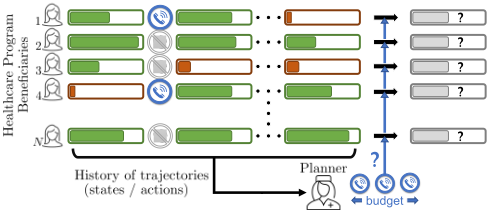
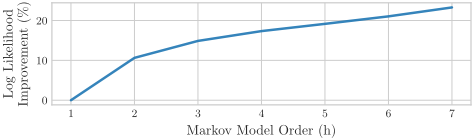
In this paper, we study the problem of scheduling healthcare interventions under limited healthcare worker resources. We model this resource optimization problem as a Restless Multi-armed Bandit (RMAB) problem [Whittle, 1988], in which a planner can act on k out of N arms (beneficiaries) at each timestep (Figure 1). Contrary to stochastic bandits [Auer et al., 2002], in RMABs each arm has a state, the reward depends on said state, and the state changes even when the arm is not pulled. Past works have developed RMAB-based solutions for several classes of sequential scheduling problems with limited resources. Examples include anti-poaching patrols [Qian et al., 2016], machine maintenance [Glazebrook et al., 2006], online advertising [Meshram et al., 2016], and, healthcare [Wang* et al., 2023]. Notably, all past RMAB approaches assume that the arms' behaviour follows the Markov property, where state transitions are history independent [Puterman, 2014]. We challenge this assumption, as human behaviour is likely to contain temporal dependencies, i.e., depend on past states, observations, and actions [Chierichetti et al., 2012; Early et al., 2022; Meiss et al., 2010]. Using real-world data on a maternal health awareness program from our partner NGO, ARMMAN, we demonstrate significant deviations from the Markov assumption. Specifically, the log-likelihood of observing the historical trajectories increases (up to 23%), as we increase the order h of the underlying model (see Section 3).
Even under the Markov assumption, computing an optimal policy for RMABs is PSPACE-hard [Papadimitriou and Tsitsiklis, 1994]. Instead, state-of-the-art (SOTA) approaches commonly adopt the Whittle index policy [Whittle, 1988], an approximate solution that estimates the expected future value (Whittle index) of acting on an arm, and then proceeds to act on the top-k arms with the largest value.
If we want to capture non-Markovian 1 behaviors using SOTA Whittle index based approaches, we would run into computation and data limitations. First, there will be a combinatorial explosion of the state space (an h-order Markov process can be viewed as a first order Markov process on the expanded state space, where each 'super' state consists of h original states, i.e., s′ = ×hi=1 si). Second, since the Whittle index policy requires to know the underlying Markov decision process (MDP) - which grows exponentially in both (i) the order of the process and (ii) the discretization of the state - it would need ever larger datasets to calculate the empirical transition probabilities.
We are the first to cast limited resource optimization problems into the generalised non-Markovian RMAB setting. In order to provide a practical, and scalable solution, we take inspiration from the core idea of the Whittle index - pull arms with the highest expected gains from pulling - but we drop the cumbersome MDPs. Instead, we opt to independently model each participant's trajectory as a time-series, leveraging the power of time-series models to learn complex patterns and dynamics to predict future states. Additionally, we develop the Time-series Arm Ranking Index (TARI) policy, a novel algorithm that selects the arms that will benefit the most from an intervention, given our model's future state predictions.
Finally, as we are no longer limited by the complexity of the Whittle index, in this work, we extend RMABs to continuous state spaces - a previously understudied area - without the need for the discretization of the state, thus bypassing approximation losses (e.g., see [Sinha and Mahajan, 2022]). Combining continuous states and non-Markovian transitions offers additional expressiveness that can more accurately capture behavior transitions and patterns, as we showcase in our results.
1 By non-Markovian we refer to any Markov process of order 2 or higher. For details please see Section 2.
Supplementary Material. Please see [Danassis et al., 2023] for the full version, including the source code.
1.1 Our Contributions
- We demonstrate significant deviations from the Markov assumption in real-world data from a deployed maternal and child health awareness program by ARMMAN.
- We are the first to cast limited resource optimization problems into the generalised non-Markovian, continuous state restless multi-armed bandit setting, enabling us to capture temporal dependencies in human behaviour.
- We model each arm as a time-series, and develop a novel algorithm, the Time-series Arm Ranking Index (TARI) policy, that acts on arms which will benefit the most from an intervention, given our model's future state predictions, resulting in a practical, and scalable solution.
- We perform a secondary analysis on real-data (2252 participants, 23 weeks) from a maternal health awareness program (mHealth), in partnership with an Indian NGO, ARMMAN. Compared to the SOTA, deployed Whittle index policy, TARI results in 16.3 hours of additional content listened, 90.8% more engagement drops prevented, and reaching more than twice as many high dropout-risk beneficiaries.
1.2 Discussion &RelatedWork
Restless multi-armed bandits (RMABs). Prior work in RMAB assumes that arms follow the Markov property. Even in Markovian settings, and when transition dynamics are fully known, RMABs suffer from the curse of dimensionality. Planning an optimal policy is PSPACE-hard [Papadimitriou and Tsitsiklis, 1994]. As such, SOTA approaches usually deploy approximate planning solutions, most notably the Whittle index policy [Whittle, 1988], which solves the Lagrangian relaxation of the problem. The resulting Lagrange multipliers capture the 'resource-efficient value for acting' on an arm (more accurately, the opportunity cost [Buchanan, 1991] for not acting). Then the Whittle index policy proceeds to greedily act on the arms with the largest Lagrange multipliers (see the supplement for a formal definition). The Whittle index approach has been shown to be asymptotically optimal (i.e., when N →∞with fixed kN ) [Weber and Weiss, 1990], and has been shown to perform well empirically in many applications (e.g., [Qian et al., 2016; Hsu, 2018; Mate et al., 2022; Kadota et al., 2016]). Nevertheless, the Whittle index remains a heuristic, and asymptotic optimality does not necessarily translate to practically relevant problem sizes and planning horizons, as was recently demonstrated in [Ghosh et al., 2023]. Critically, the Whittle index is only optimal under several assumptions (see [Ghosh et al., 2023]), which are often hard to validate, and part of active research. Finally, despite being a heuristic, the approach can be prohibitively slow, thus it often requires a problem-specific fast method for computing the index. As such, using the traditional Whittle index on the expanded state space (i.e., s′ = ×hi=1 si) in nonMarkov settings is quite challenging and does not guarantee high-quality results, even if the problem can be approximated sufficiently well with low order Markov processes. In this work, we are the first to generalise RMABs to non-Markovian settings. We maintain the key idea of the Whittle index policy (acting on arms that will benefit the most from an intervention), but we use the power of time-series prediction models to capture complex patterns and dynamics to predict the effect of an intervention.
Time-series Forecasting. Time series forecasting has been an active area of research over the past few years, with applications in diverse areas such as energy consumption, sensor network monitoring, traffic planning, variations in air pollution, weather forecast, disease propagation, and so on (e.g., [Matsubara et al., 2014; Wu et al., 2020; Zhou et al., 2021]). Solutions range from traditional statistical methods (e.g., [Ariyo et al., 2014]), to deep learning-based models (e.g., [Lai et al., 2018; Bai et al., 2018; Liu et al., 2021]), and, more recently, Transformer-based solutions [Wu et al., 2020; Zhou et al., 2021; Wu et al., 2021; Wen et al., 2022] which mostly focus on the more challenging long-term forecasting problem (although their effectiveness has recently come into question [Zeng et al., 2023]). Our contributions are not in developing a SOTA time series prediction model. Instead, we utilise off-the-shelf models in a novel way, to solve nonMarkovian RMAB problems. Importantly, our approach is model agnostic. In fact, we have evaluated a variety of architectures, including LSTM [Hochreiter and Schmidhuber, 1997], BiLSTM [Graves and Schmidhuber, 2005], Transformer models [Vaswani et al., 2017], adding time-based vector representations [Kazemi et al., 2019], attention layers, and more (see the supplement for the details). Future advancements in the area of time series forecasting can easily translate to better performance for the proposed approach.
From the application perspective, [Nishtala et al., 2020] and [Nisthala et al., 2021] aim to predict the dropout risk in a similar maternal health awareness setting. Both works are about classification to high and low risk of dropout, and not time-series regression. The former does not optimize or schedule interventions, while the latter aims to identify a smaller subset of beneficiaries and the use the traditional Whittle index in a classic, binary-state Markov setting.
2 ProblemFormulation: Non-Markovian Restless Multi-armed Bandits (NMRMAB)
We consider scheduling problems in which a planner must act on k out of N independent, continuous state ([0, 1]) arms each round. The planner fully observes the state of each arm, then all arms undergo a history-dependent (i.e., non-Markovian) state transition. The planner's goal is to maximize the number of processes in 'engaging' state over the time horizon H.
Let si,t ∈ S, and ai,t ∈ A denote the state and action taken on arm i, respectively, in timestep t. We assume that states are continuous in [0, 1], and represent the 'level of engagement' of a beneficiary, with higher numbers representing a higher level of engagement. The action set consists of two actions: active (ai,t = 1), and passive (ai,t = 0). A nonMarkovian Restless Multi-armed Bandit (NMRMAB) problem instance is a 4-tuple {N, k, (Xi∈N t )Ht=1 ,R}, where N is the set of independent arms, k is the budget constraint such that ∑i ai,t = k, ∀t, denoting how many arms can be pulled at a given time-step, (Xi∈N t )Ht=1 is an associated transition process for arm i for time horizon H, and R : (Xt)Ht=1 → ℜ is the reward function. In our setting, the reward at timestep t is given by R(×i<t(si, ai), st) = 1st≥s∗, where s∗ is a domain-specific engagement threshold (e.g., ARMMAN considers s∗ = 0.25). The planner's goal is to maximize the total reward, i.e., ∑t∈[1...H] ∑i∈N R(·). Finally, we assume (Xi∈N t )Ht=1 to be a higher order Markov process. For an horder Markov process, the next state depends on the proceeding h states. More formally:
Definition 2.1 (Order h Markov Process). Let x1, . . . , xt be the elements of the process. A Markov process of order h is a process (Xt)∞t=1 , such that ∀t:
3 Non-Markovian Behaviour inMaternal mHealth Data
The proposed modeling raises the question as to whether human activity is indeed non-Markovian in our domain. To answer this question, following related literature [Chierichetti et al., 2012], we compute the log-likelihood of the participants' trajectories for a process of order h, based on the data on a maternal health awareness program from our partner NGO, ARMMAN. Specifically, we start by computing the empirical transition probabilities, assuming the underlying process is of order h. Let h = 1. This is easily achieved by maintaining counters C(st,at)→st+1 . The transition probabilities are simply C(st,at)→st+1 / ∑x C(st,at)→x. For h > 1, an h-order Markov process can be viewed as a first order Markov process on the expanded state space s′ = ×hi=1 si. Thus, we can employ the same approach to calculate empirical probabilities. Given that we are dealing with continuous states, to maintain said counters, we first need to discretize them. We opted for a binary discretization, as in related literature [Verma et al., 2023], into 'engaging' and 'non-engaging' states, using s∗ as a threshold (see also Section 5.3). Then, for each trajectory x in our dataset, we compute l(h) ≜ -logL(h | x) ≜ -logPr(X = x | model of order h). Finally, we average over all trajectories. Due to the increase in the number of counters and data required, we model up to seventh order processes (h = 7). Figure 3 shows the relative improvement - ( l(h)-l(h=1) l(h=1) ) in negative log-likelihood for order h Markov processes (x-axis). There is a clear improvement for higher order models, specifically about 10% for h = 2, and up to 23% for h = 7. This suggests that, under the often-used binary-discretization model, participants' behavior across the duration of the program is indeed not Markovian.
4 Methodology
4.1 RMABs as a Time-series Forecasting Problem
In this work, we are the first to propose a time-series forecasting (TSF) based framework for supervised representation learning of arms' trajectories in non-Markovian RMABs.
Preliminaries: TSF Problem Formulation
Let X = {X1 t , . . . ,X M t }ht=1 denote the historical data of an M-variate series, where h is the look-back window length and Xi t is the value of the ith variate at timestep t. Formally, the TSF task is, given X, to predict the future T values, i.e., ˆ Y = {ˆ Y 1 t , . . . , ˆ Y M t }h+T t=h+1 . There are two methods for predicting ˆ Y when T > 1: Iterated multi-step (IMS) forecasting [Taieb et al., 2012] where the model learns to predict a single-step forward, and then is recursively called to obtain multi-step forecasts. Alternatively, with direct multi-step (DMS) forecasting [Chevillon, 2007], one trains a model that directly optimizes the multi-step forecasting objective, and is only called once. Usually IMS forecasts result in smaller variance than DMS, but the error could accumulate over long prediction horizons [Zeng et al., 2023]. For simplicity, and given the relatively short forecasting horizon in our domain, we opted for the IMS approach (see also Section 4.2).
Labeled Dataset Using a Sliding Window
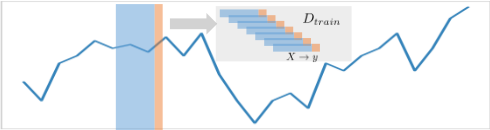
To produce a labeled dataset for both training (Dtrain), and evaluation (Dtest), we used a fixed-length sliding window approach. First, we assume that the planner has access to an offline historical dataset of beneficiaries' trajectories, as is the case for example with our partner NGO, ARMMAN. We then run a sliding window of length h on each trajectory in the dataset to get training samples of history (X), and next state ( ˆ Y), as depicted in Figure 4. For the application at hand, X = {st, at}ht=1 , i.e., pairs of state/actions. This intuitively corresponds to an h-order Markov model approximation. h is a hyper-parameter that depends on the application and needs to be tuned depending on (i) the level of non-Markovian behaviour of beneficiaries, and (ii) the achieved error of the model (larger h does not necessarily translate to lower error). Finally, ˆ Y = {st}t=h+1, i.e., we only predict the next state. Optionally, depending on the domain, we can enhance the input with auxiliary tokens relevant to the task and the arms' behavior (e.g., socio-demographic features).
4.2 Proposed Approach: Time-series Arm Ranking Index (TARI) Policy
The proposed Time-series Arm Ranking Index (TARI) maintains the core idea of the traditional Whittle index: estimate the expected future value of acting on an arm, and then greedily act on arms that will benefit the most from an intervention. However, we adjust the methodology to account for (i) the additional complexity due to the non-Markovian setting, and (ii) the scarcity of resources. Specifically for the latter, a key challenge in real-world applications (and especially ones related to healthcare), is that they are resource constrained. For example, despite the scale of ARMMAN's operation, with millions of active users, due to limited availability of healthworkers beneficiaries typically receive at most one intervention (phone call by a health worker) within a period of 3 months. Taking this into account, TARI estimates the marginal long-term improvement in engagement if you act once on a arm (and never act again), compared to never acting.
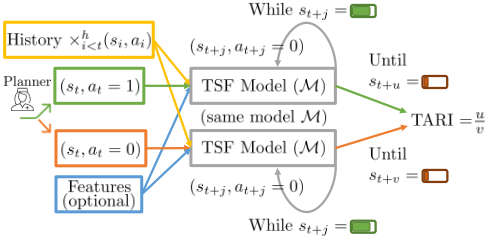
Specifically, we model each arm independently as a time series, and train a model to predict the next state (st+1), given (i) a history of state/actions (×hi<t (si, ai)) of length h, (ii) the current state (st), and (iii) the potential action (at, where at = 1 corresponds to acting, and at = 0 not acting). This is the offline training part. We use this model online, in an iterated multi-step manner (see Section 4.1), to generate a long term forecast (st+1, st+2, . . . , st+H), which then we use to compute the TARI index for planning as follows.
For each arm n independently, we estimate two quantities by recursively using our TSF model: (i) The time un until arm n switches to non-engaging, 2 if we act once at timestep t and never act again (line 4 in Algorithm 1, and green box in Figure 5), and (ii) the time vn until arm n switches to nonengaging, if we never act (line 11 in Algorithm 1, and orange box in Figure 5). Then the TARI index for arm n is simply given by the ratio of the two numbers (Equation 1). This in-
2 Non-engaging means that the continuous state s drops below an application-specific threshold (s∗ ). ARMMAN considers s∗ = 0.25.
Data: Historical dataset of beneficiaries' trajectories Offline: Train TSF model M to predict the next state Online: Decision timestep t: 1 for arm ∈ N do 2 a = 1, u = 1, s = st, history=×hi<t (si, ai) 3 s′ = M(history, s, a) 4 while s′ ≥ s∗ and u ≤H do // While the state is above the engagement threshold. Forecast ahead at most until the time horizon. 5 history.append((s, a)) 6 s = s′ , a = 0, u = u + 1 7 s′ = M(history, s, a) 8 . 9 a = 0, v = 1, s = st, history=×hi<t (si, ai) 10 s′ = M(history, s, a) 11 while s′ ≥ s∗ and v ≤H do 12 history.append((s, a)) 13 s = s′ , a = 0, v = v + 1 14 s′ = M(history, s, a) 15 . 16 TARI(arm) = uvtuitively gives the 'value' of acting. Finally, at each timestep, just like with the traditional Whittle index, we act on the topk arms with the highest TARI value. The proposed approach is depicted in Figure 5 and Algorithm 1.
The TARI policy offers significant advantages. Arms are modeled independently, which allows for scalability. Furthermore, it is computationally efficient to train and compute in non-Markovian continuous state settings, contrary to the traditional Whittle index which requires supporting and computing over MDPs that grow exponentially in both (i) the order of the underlying Markov process, and (ii) the discretization of the state.
5 Simulation Setup
Training data are constructed in the manner described in Section 4.1. We use a 64%, 16%, 20% split for the training, validation, and testing datasets, respectively. All experiments are averaged over 10 independent runs.
5.1 Baselines
We compare the proposed TARI to four baselines: (i) the Whittle index policy [Whittle, 1988], (ii) round-robin selection, which often corresponds to the default policy for many NGOs [Mate et al., 2022] including ARMMAN, (iii) random, where we act on arms selected uniformly at random, and (iv) control, where there are no support calls (no intervention, i.e., ai,t = 0, ∀i ∈ N, ∀t ∈ H).
We chose to compare to the Whittle index, as it is a popular, SOTA approach that has been deployed in the real-world
(e.g., see [Mate et al., 2022; Verma et al., 2023]). Informally, the Whittle index of an arm captures the added value from pulling said arm. Consider a 'passive subsidy' - a hypothetical exogenous compensation m rewarded for not pulling (a = 0) arm i. The Whittle index is defined as the smallest subsidy necessary to make the planner indifferent between pulling and not pulling (assuming indexability [Whittle, 1988]), i.e.,
The Whittle index policy computes the Wi(s) of all arms and pulls the arms with the highest values of the index at each timestep. The augmented (with subsidy m) Bellman equations are solved via value iteration, and binary search is used to find the smallest m that satisfies Equation 2. To use the Whittle index in our setting, we must first discretize the continuous state. Following the convention in previous deployments (e.g., [Mate et al., 2022]), we assume a binary state Markov model ('engaging' = 1, 'non-engaging' = 0, thresholded at s∗ ). For completeness, we also run simulations with a more fine-grained discretization of the state, and also incorporating history by using an expanded state space (i.e., s′ = ×hi=1 si). Of course this significantly increases computational and memory complexity, and data requirements (see Sections 1, 1.2, 3).
5.2 Synthetic Data
We generate trajectories containing an equal number of the following types of 'agents' (arms). (i) Habit former: The value of the continuous sate drops under passive action (a = 0), and increases with a = 1. If the state reaches 1 (formed a habit), it stays there for some duration, independent of the action. (ii) Motivation based: State drops over time. If we act, the state returns to baseline. (iii) Random: Random state independent of the action.
Drop rates, increase rates, habit duration, and state baselines include agent specific noise, drawn uniformly at random (UaR). Trajectories used for testing have higher noise than the ones used for training (see supplement). Historical trajectories are produced by simulating the participants under various simple intervention policies. Specifically, we act i times (drawn UaR in [6, 24]), every j timesteps (also drawn UaR in [1, 14]). Finally, every participant is associated with a noisy 'demographic' feature related to their type. These features are given as an additional input to our model (see Figure 5). Also, they are used by the Whittle index baseline, which learns (offline) empirical transition probabilities for each type of agent, and then uses the features online to map each arm to the corresponding probabilities.
5.3 Real Data onMaternal and Child Healthcare
We use data from a large-scale maternal and child healthcare program operated by our partner NGO, ARMMAN. The program serves pregnant women and early mothers in disadvantaged communities with median daily family income of $3.22 - below the global poverty line [TheWorldBank, 2023] - by disseminating timely health information (via automated voice calls) to reduce maternal, neonatal, and child mortality and morbidity. The main challenge the program faces is drop in engagement over time. Engagement is measured in terms of total number of automated voice messages listened. To mitigate this problem, a planner schedules support calls by limited healthcare workers.
We model this setting as a continuous state, fully observable RMAB problem. The state of each beneficiary represents the listening time. Each automated voice message has a maximum length of 120 seconds, which we normalise to [0, 1]. The planner's task is to recommend a subset of beneficiaries every week to receive support calls from healthcare workers, with the goal to maximize the number of beneficiaries above the engaging threshold s∗ . ARMMAN considers a beneficiary to be engaging if they listen to more than 30 seconds of the automated message (i.e., if s > 0.25 = s∗ ). Transition dynamics are unknown, and we make no Markov assumptions. Finally, the dataset also includes socio-demographic features per beneficiary such as age, gestational age, family income, education, etc., that may be used as auxiliary information.
Training Dataset
We use historical data from a large-scale quality improvement study performed by ARMMAN in 2022, obtained with beneficiary consent. The data follows 12000 participants (11256 with complete state information by the end) over a period of 31 weeks. In the study, a set of beneficiaries received interventions from a variety of policies (see supplement for details). Each beneficiary is represented by a single trajectory of states (engagement behavior) and actions (received, or not a call from a healthworker). Demographic features are used to infer the missing transition dynamics for the Whittle index baseline, as in [Verma et al., 2023].
Notice on Data Usage
Our simulations are a secondary analysis on different evaluation metrics. All data are anonymized, and we have received approval from ARMMAN's ethics board. There is no actual deployment of TARI at ARMMAN.
5.4 Time Series ForecastingModels
We implemented a variety of time series forecasting models, ranging from simple LSTM, and BiLSTM architectures, to adding time-based vector representations and attention layers, to Transformer models. The majority of the models showed high performance. As such, we opted to use an LSTM-based architecture, as simpler models - being less computationally intensive and more sustainable in the long run - would be preferred by NGOs which are operating in a low resource environment. Our chosen model achieved MAE of 0.03 on average for one step prediction on synthetic data (excluding random agents), and 0.20 on real data. We used a history of h = 7 timesteps as input for the synthetic data, and h = 8 timesteps for the real data evaluation. For detailed results, including long horizon forecasts, please see the supplement. It is important to note that (i) as discussed in Section 1.2, our contribution is not in developing or improving SOTA TSF models, and (ii) the proposed TARI depends on relative trends (ratio of two predicted trajectories, see Equation 1), thus if the model consistently over- or under-predicts the two trajectories, the trend (ratio) will be consistent.
Counterfactuals in Non-Markovian Settings
Under no Markovian assumptions, we can not build a beneficiaries' model to compute counterfactual trajectories for the evaluation on real data. To compute such counterfactuals, we employed a separate TSF model trained on the entire dataset (train, validation, and test data). This model is only used when trajectories deviate from the historical data. Given that we only act on a small percentage of the beneficiaries (about 2%), the vast majority of the trajectories follow the historical real data, thus the model will not be used. Note that this second model is only needed for the purposes of the simulation. This is a fully observable RMAB, thus in real life we would actually observe the next state of each participant. We have evaluated an alternative approach to computing counterfactuals in the supplement.
6 Results on Synthetic Data
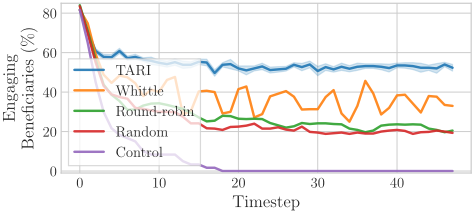
Engagement. We run a long-term simulation of one year (52 timesteps). Starting with the engagement, Figure 6 shows the percentage of engaging beneficiaries during the time horizon. TARI achieves 44.2% higher engagement on average (across timesteps and independent runs), and up to 107.3%, compared to the Whittle index policy (best baseline). Compared to Round-robin and Random it achieves 102.5% and 128.6% higher engagement on average, respectively. Additionally, TARI achieves significantly lower standard deviation (3.1%), compared to over 100% for all other baselines, as TARI never intervenes on Random agents.
Robustness. We evaluated the proposed approach under varying number of arms (N = {30, 90, 120, 600}) and budgets (k = {0.01, 0.1, 0.2} ×N, for n = 90). In both cases, TARI significantly outperformed all the baselines. Specifically, compared to the Whittle index (best baseline), TARI achieved on average 44.2 - 48.2% higher engagement when varying the number of arms, and 37.8 - 88.7% when varying the budget (the smallest budget corresponds to just one intervention, hence the lower improvement). Furthermore, we enhanced the model for the Whittle index baseline to incorporate history (s′ = ×hi=1 si, for up to 4 past states), and a more fine-grained discretization of the state (up to 9 bins) - recall that the Whittle index baseline is not designed for continuous states, and thus requires discretization. In all of the cases, TARI achieved at least 44.2% higher engagement on average (and up to 144.2%). For detailed results, please see the supplement.
7 Results on Real Data onMaternal and Child Healthcare
We run our analysis for more than 5 months (31 weeks of data, minus the 8 weeks we give as input to the TSF model, which corresponds to the observation period of ARMMAN). Due to limited resources, ARMMAN is able to provide support calls to about 2 - 4% of beneficiaries at each week (timestep). In our dataset of 2252 beneficiaries (in the test set), the lower number corresponds to just 46 support calls per week. All policies were evaluated in the entire test set.
Figure 7a depicts the cumulative engagement drops (s < s∗ = 0.25) prevented, compared to control. This figure clearly demonstrates the importance, and difficulty of scheduling effective support calls: the naive round-robin approach (often used by NGOs [Mate et al., 2022]) performs similarly to random, i.e., following such a policy would incur all the cost associated with providing support calls, without any benefit. TARI achieves an 90.8% improvement over Whittle, and 133.9% over round-robin. Ensuring beneficiaries remain consistently engaged is crucial for the success of any healthcare program.
Real-world Significance. To put the real-world significance of TARI's engagement gains into concrete numbers, this corresponds to 3736 and 7851 additional messages listened compared to the Whittle index, and Control, respectively. Or, in other words, 16.3 hours of additional content listened by the beneficiaries compared to the Whittle index, and 62.6 additional hours compared to Control. Adhering to the program improves health literacy, which would ultimately lead to better health outcomes.
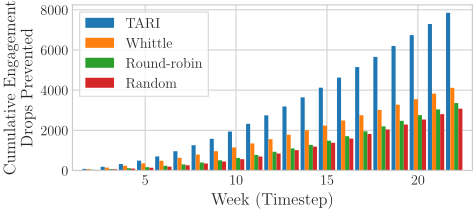
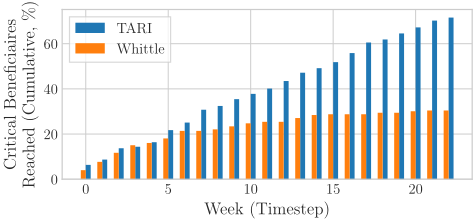
Figure 7: Real data on maternal and child healthcare awareness from ARMMAN. N = 2252 beneficiaries (arms), budget k = 0.02 × N = 45. Results are averaged over 10 independent runs.
Finally, an important open problem for ARMMAN is identifying and proactively reaching beneficiaries with high risk of dropping out from the program ('critical beneficiaries', see supplement). Figure 7b shows the cumulative percentage of critical beneficiaries that TARI, and Whittle chose to intervene. By the end of our observation period, TARI had reached 71.6% of critical beneficiaries, while Whittle only 30.4%, a 135.2% improvement. Please see the supplement for results on engagement, varying budgets, and more.
8 Conclusion
In this work, we study for the first time non-Markovian Restless Multi-armed Bandits (NMRMAB). Using real-world data on a maternal health awareness program from our partner NGO, ARMMAN, we demonstrate significant deviations from the Markov assumption. To solve the challenges that arise, we model arms as time-series, and propose the Timeseries Arm Ranking Index (TARI) policy, a novel algorithm that selects the arms that will benefit the most from an intervention, given our future state predictions. Our evaluation shows a significant increase in engagement compared to the SOTA, deployed Whittle index solution, on real data from ARMMAN with 2252 participants. This translates to 16.3 hours of additional content listened, 90.8%more engagement drops prevented, and reaching more than twice (×2.35) as many high dropout-risk beneficiaries. While we focus on maternal and child healthcare as an indicative application, we expect the proposed approach to perform well on any other RMAB application that involves non-Markovian behaviours.
Acknowledgments
P.D. was funded in part by JPMorgan Chase & Co. Any views or opinions expressed herein are solely those of the authors listed, and may differ from the views and opinions expressed by JPMorgan Chase & Co. or its affiliates. This material is not a product of the Research Department of J.P. Morgan Securities LLC. This material should not be construed as an individual recommendation for any particular client and is not intended as a recommendation of particular securities, financial instruments or strategies for a particular client. This material does not constitute a solicitation or offer in any jurisdiction.
- J.A.K. was supported by an NSF Graduate Research Fellowship under grant DGE1745303
@inproceedings{ijcai2023p660,
  title     = {Limited Resource Allocation in a Non-Markovian World: The Case of Maternal and Child Healthcare},
  author    = {Danassis, Panayiotis and Verma, Shresth and Killian, Jackson A. and Taneja, Aparna and Tambe, Milind},
  booktitle = {Proceedings of the Thirty-Second International Joint Conference on
               Artificial Intelligence, {IJCAI-23}},
  publisher = {International Joint Conferences on Artificial Intelligence Organization},
  editor    = {Edith Elkind},
  pages     = {5950--5958},
  year      = {2023},
  month     = {8},
  note      = {AI for Good},
  doi       = {10.24963/ijcai.2023/660},
  url       = {https://doi.org/10.24963/ijcai.2023/660},
}
TY - CPAPER TI - Limited Resource Allocation in a Non-Markovian World: The Case of Maternal and Child Healthcare AU - Danassis, Panayiotis AU - Verma, Shresth AU - Killian, Jackson A. AU - Taneja, Aparna AU - Tambe, Milind T2 - Proceedings of the Thirty-Second International Joint Conference on Artificial Intelligence, IJCAI-23 PB - International Joint Conferences on Artificial Intelligence Organization PY - 2023 SP - 5950 EP - 5958 DO - 10.24963/ijcai.2023/660 UR - https://doi.org/10.24963/ijcai.2023/660 ER -Copied
Machine-readable versions of this paper, for tools and AI agents:





