
Mimicking the Thinking Process for Emotion Recognition in Conversation with Prompts and Paraphrasing
Proceedings of the Thirty-Second International Joint Conference on Artificial Intelligence. AI for Good. Pages 6299-6307.
https://doi.org/10.24963/ijcai.2023/699
Keywords
- AI for Good: Natural Language Processing
- AI for Good: Humans and AI
Abstract
Emotion recognition in conversation, which aims to predict the emotion for all utterances, has attracted considerable research attention in recent years. It is a challenging task since the recognition of the emotion in one utterance involves many complex factors, such as the conversational context, the speaker's background, and the subtle difference between emotion labels. In this paper, we propose a novel framework which mimics the thinking process when modeling these factors. Specifically, we first comprehend the conversational context with a history-oriented prompt to selectively gather information from predecessors of the target utterance. We then model the speaker's background with an experience-oriented prompt to retrieve the similar utterances from all conversations. We finally differentiate the subtle label semantics with a paraphrasing mechanism to elicit the intrinsic label related knowledge.
We conducted extensive experiments on three benchmarks. The empirical results demonstrate the superiority of our proposed framework over the state-of-the-art baselines.
- [Baccianella et al., 2010] Stefano Baccianella, Andrea Esuli, and Fabrizio Sebastiani. Sentiwordnet 3.0: An enhanced lexical resource for sentiment analysis and opinion min- ing. In LREC, 2010.
- [Bao et al., 2022] Yinan Bao, Qianwen Ma, Lingwei Wei, Wei Zhou, and Songlin Hu. Speaker-guided encoder- decoder framework for emotion recognition in conversa- tion. In IJCAI, pages 4051-4057, 2022.
- [Brown et al., 2020] Tom B. Brown, Benjamin Mann, Nick Ryder, Melanie Subbiah, Jared Kaplan, Prafulla Dhari- wal, Arvind Neelakantan, Pranav Shyam, Girish Sastry, Amanda Askell, Sandhini Agarwal, Ariel Herbert-Voss, Gretchen Krueger, Tom Henighan, Rewon Child, Aditya Ramesh, Daniel M. Ziegler, Jeffrey Wu, Clemens Win- ter, Christopher Hesse, Mark Chen, Eric Sigler, Ma- teusz Litwin, Scott Gray, Benjamin Chess, Jack Clark, Christopher Berner, Sam McCandlish, Alec Radford, Ilya Sutskever, and Dario Amodei. Language models are few- shot learners. In NeurIPS, 2020.
- [Busso et al., 2008] Carlos Busso, Murtaza Bulut, Chi-Chun Lee, Abe Kazemzadeh, Emily Mower, Samuel Kim, Jeannette N. Chang, Sungbok Lee, and Shrikanth S. Narayanan. IEMOCAP: interactive emotional dyadic motion capture database. Lang. Resour. Evaluation, 42(4):335-359, 2008.
- [Ghosal et al., 2019] Deepanway Ghosal, Navonil Ma- jumder, Soujanya Poria, Niyati Chhaya, and Alexander F. Gelbukh. Dialoguegcn: A graph convolutional neural network for emotion recognition in conversation. In EMNLP, pages 154-164, 2019.
- [Ghosal et al., 2020] Deepanway Ghosal, Navonil Ma- jumder, Alexander F. Gelbukh, Rada Mihalcea, and Soujanya Poria. COSMIC: commonsense knowledge for emotion identification in conversations. In Findings of EMNLP, pages 2470-2481, 2020.
- [Hazarika et al., 2018] Devamanyu Hazarika, Soujanya Po- ria, Rada Mihalcea, Erik Cambria, and Roger Zimmer- mann. ICON: interactive conversational memory network for multimodal emotion detection. In EMNLP, pages 2594-2604, 2018.
- [Hu et al., 2021] Dou Hu, Lingwei Wei, and Xiaoyong Huai. Dialoguecrn: Contextual reasoning networks for emo- tion recognition in conversations. In ACL/IJCNLP, pages 7042-7052, 2021.
- [König et al., 2016] Alexandra König, Linda E. Francis, Aarti Malhotra, and Jesse Hoey. Defining affective identi- ties in elderly nursing home residents for the design of an emotionally intelligent cognitive assistant. In EAI, pages 206-210, 2016.
- [Lester et al., 2021] Brian Lester, Rami Al-Rfou, and Noah Constant. The power of scale for parameter-efficient prompt tuning. In EMNLP, pages 3045-3059, 2021.
- [Lewis et al., 2020] Mike Lewis, Yinhan Liu, Naman Goyal, Marjan Ghazvininejad, Abdelrahman Mohamed, Omer Levy, Veselin Stoyanov, and Luke Zettlemoyer. BART: denoising sequence-to-sequence pre-training for natural language generation, translation, and comprehension. In ACL, pages 7871-7880, 2020.
- [Li and Liang, 2021] Xiang Lisa Li and Percy Liang. Prefix- tuning: Optimizing continuous prompts for generation. In ACL/IJCNLP, pages 4582-4597, 2021.
- [Li et al., 2017] Yanran Li, Hui Su, Xiaoyu Shen, Wenjie Li, Ziqiang Cao, and Shuzi Niu. DailyDialog: A manually la- belled multi-turn dialogue dataset. In IJCNLP, pages 986- 995, 2017.
- [Li et al., 2021] Jiangnan Li, Zheng Lin, Peng Fu, and Weip- ing Wang. Past, present, and future: Conversational emo- tion recognition through structural modeling of psycholog- ical knowledge. In Findings of EMNLP, pages 1204-1214, 2021.
- [Li et al., 2022] Shimin Li, Hang Yan, and Xipeng Qiu. Con- trast and generation make BART a good dialogue emotion recognizer. In AAAI, pages 11002-11010, 2022.
- [Liu et al., 2021] Xiao Liu, Yanan Zheng, Zhengxiao Du, Ming Ding, Yujie Qian, Zhilin Yang, and Jie Tang. GPT understands, too. CoRR, abs/2103.10385, 2021.
- [Liu et al., 2023] Pengfei Liu, Weizhe Yuan, Jinlan Fu, Zhengbao Jiang, Hiroaki Hayashi, and Graham Neubig. Pre-train, prompt, and predict: A systematic survey of prompting methods in natural language processing. ACM Comput. Surv., 55(9):195:1-195:35, 2023.
- [Majumder et al., 2019] Navonil Majumder, Soujanya Poria, Devamanyu Hazarika, Rada Mihalcea, Alexander F. Gel- bukh, and Erik Cambria. Dialoguernn: An attentive RNN for emotion detection in conversations. In AAAI, pages 6818-6825, 2019.
- [Majumder et al., 2020] Navonil Majumder, Pengfei Hong, Shanshan Peng, Jiankun Lu, Deepanway Ghosal, Alexan- der F. Gelbukh, Rada Mihalcea, and Soujanya Poria. MIME: mimicking emotions for empathetic response gen- eration. In EMNLP, pages 8968-8979, 2020.
- [Mueller et al., 2022] Aaron Mueller, Jason Krone, Salva- tore Romeo, Saab Mansour, Elman Mansimov, Yi Zhang, and Dan Roth. Label semantic aware pre-training for few- shot text classification. In ACL, pages 8318-8334, 2022.
- [Poria et al., 2019a] Soujanya Poria, Devamanyu Hazarika, Navonil Majumder, Gautam Naik, Erik Cambria, and Rada Mihalcea. MELD: A multimodal multi-party dataset for emotion recognition in conversations. In ACL, pages 527- 536, 2019.
- [Poria et al., 2019b] Soujanya Poria, Navonil Majumder, Rada Mihalcea, and Eduard H. Hovy. Emotion recogni- tion in conversation: Research challenges, datasets, and recent advances. IEEE Access, 7:100943-100953, 2019.
- [Pujol et al., 2019] Francisco A. Pujol, Higinio Mora, and Ana Martínez. Emotion recognition to improve e- healthcare systems in smart cities. In Anna Visvizi and Miltiadis D. Lytras, editors, RIIFORUM, pages 245-254, 2019.
- [Robertson and Zaragoza, 2009] Stephen E. Robertson and Hugo Zaragoza. The probabilistic relevance framework: BM25 and beyond. Found. Trends Inf. Retr., 3(4):333-389, 2009.
- [Sap et al., 2019] Maarten Sap, Ronan Le Bras, Emily All- away, Chandra Bhagavatula, Nicholas Lourie, Hannah Rashkin, Brendan Roof, Noah A. Smith, and Yejin Choi. ATOMIC: an atlas of machine commonsense for if-then reasoning. In AAAI, pages 3027-3035, 2019.
- [Shen et al., 2021a] Weizhou Shen, Junqing Chen, Xiaojun Quan, and Zhixian Xie. Dialogxl: All-in-one xlnet for multi-party conversation emotion recognition. In AAAI, pages 13789-13797, 2021.
- [Shen et al., 2021b] Weizhou Shen, Siyue Wu, Yunyi Yang, and Xiaojun Quan. Directed acyclic graph network for conversational emotion recognition. In ACL/IJCNLP, pages 1551-1560, 2021.
- [Song et al., 2022] Xiaohui Song, Longtao Huang, Hui Xue, and Songlin Hu. Supervised prototypical contrastive learn- ing for emotion recognition in conversation. In EMNLP, pages 5197-5206, 2022.
- [Yang et al., 2019] Zhilin Yang, Zihang Dai, Yiming Yang, Jaime G. Carbonell, Ruslan Salakhutdinov, and Quoc V. Le. Xlnet: Generalized autoregressive pretraining for language understanding. In NeurIPS, pages 5754-5764, 2019.
- [Yang et al., 2022] Lin Yang, Yi Shen, Yue Mao, and Longjun Cai. Hybrid curriculum learning for emotion recognition in conversation. In AAAI, pages 11595-11603, 2022.
- [Yi et al., 2022] Jingjie Yi, Deqing Yang, Siyu Yuan, Kaiyan Cao, Zhiyao Zhang, and Yanghua Xiao. Contextual in- formation and commonsense based prompt for emotion recognition in conversation. In ECML PKDD, pages 707- 723, 2022.
- [Zhang et al., 2020] Tianyi Zhang, Varsha Kishore, Felix Wu, Kilian Q. Weinberger, and Yoav Artzi. Bertscore: Evaluating text generation with BERT. In ICLR, 2020.
- [Zhang et al., 2021] Wenxuan Zhang, Yang Deng, Xin Li, Yifei Yuan, Lidong Bing, and Wai Lam. Aspect sentiment quad prediction as paraphrase generation. In EMNLP, pages 9209-9219, 2021.
- [Zhao et al., 2022] Weixiang Zhao, Yanyan Zhao, and Xin Lu. Cauain: Causal aware interaction network for emotion recognition in conversations. In IJCAI, pages 4524-4530, 2022. IJCAI
- [Zhu et al., 2021] Lixing Zhu, Gabriele Pergola, Lin Gui, Deyu Zhou, and Yulan He. Topic-driven and knowledge- aware transformer for dialogue emotion detection. In ACL/IJCNLP, pages 1571-1582, 2021.
References were extracted automatically from the PDF and may contain errors.
Full text extracted automatically from the PDF; figures, tables and equations may differ. The PDF is the version of record.
1 Introduction
Emotion Recognition in Conversation (ERC) is a crucial task for recognizing mental health problems. As reported by the WHO, 1 in every 8 people in the world lives with a mental health problem such as emotional regulation 1 . With the goal of recognizing human emotions, ERC can help discover the negative emotions of speakers and identify potential individuals who may be experiencing mental health issues. The ERC task is also a fundamental step towards human-like artificial intelligence (AI) [Poria et al., 2019b], and has played an important role in many areas that are beneficial to humans such as legal trials [Poria et al., 2019b], empathetic dialog systems [Majumder et al., 2020], health care systems [Pujol et al., 2019], and intelligent assistants [K¨onig et al., 2016].
* Corresponding authors.
1 https://www.who.int/news-room/fact-sheets/detail/mentaldisorders.
Different from conventional emotion recognition tasks, the emotion of a target utterance in ERC is not self-contained, which indicates that we cannot predict the emotion merely by understanding the utterance itself. Instead, some supplementary information, such as the conversational context, and the speaker's background, is required to accurately identify the emotion conveyed by the utterance. Moreover, the difference between emotion labels like 'sadness' and 'frustrated' is often subtle and needs to be carefully distinguished.
Current research direction is mainly towards the modeling of the conversational context without taking the speaker's background into account. Various sequence-based models [Hazarika et al., 2018; Majumder et al., 2019; Hu et al., 2021] and graph-based models [Ghosal et al., 2019; Shen et al., 2021a; Bao et al., 2022; Li et al., 2022; Shen et al., 2021b] built upon pre-trained language models (PLMs) are developed to model contextual interactions between utterances. There is also a growing trend in employing external commonsense knowledge [Sap et al., 2019] to enrich utterance representations [Ghosal et al., 2020; Zhu et al., 2021] or facilitate emotion transition over the conversation graphs [Li et al., 2021; Zhao et al., 2022]. Simply fusing features through network structure falls short of exploiting the knowledge capacity [Liu et al., 2023; Brown et al., 2020; Liu et al., 2021] of the PLMs, and thus a more recent method CISPER [Yi et al., 2022] leverages the prompt-learning paradigm for this purpose. However, CISPER uses the same prompt for all utterances in a dialogue without considering their relations to the target utterance and its speaker.
In this paper, we propose a novel conversational emotion recognition framework which mimics the thinking process of a human being. To understand the emotion conveyed by the target utterance, human beings typically go through the following questions step by step.
- What does the speaker say? People need first to locate and then read the target utterance to understand the utterance itself.
- What is the influence of the conversational context on the speaker? The conversational context may exert a strong influence on the speaker, so it is necessary to obtain relevant information from the dialogue history.
- What is the speaker's background? People need to learn the speaker's background since the speaker often draws
experience in similar situations to express an attitude to a particular utterance.
- How does the speaker feel? People need to differentiate the semantics of the emotion labels for a precise emotion understanding.
To realize the above thinking process, we present a multiprompt and label paraphrasing (MPLP) model for emotion recognition in conversation. Our model consists of two stages. At the first stage, the model is trained to understand 1) What does the speaker say?. An utterance along with its surrounding context are fed into a PLM for the utterance encoding. In the second stage, the model is further trained to better identify the emotions with a thorough comprehension of 2) 3) 4). While 2) is the focus of all previous methods yet the existing prompt based approach does not handle it well, 3) and 4) are largely neglected by current studies. Our effort is devoted to addressing these issues.
To be specific, to perceive 2) What is the influence of the conversational context on the speaker?, we encode the speaker-related information and the history-influenced emotion into a history-oriented prompt to comprehend the conversational context. To model 3) What is the speaker's background?, we retrieve similar utterances seen in the training set and convert these utterances into an experience-oriented prompt to capture the speaker's task-specific experience. To have a deep understanding of 4) How does the speaker feel?, we design an auxiliary generation task with the help of label paraphrasing from SentiWordNet [Baccianella et al., 2010] to distinguish the subtle semantics of different emotion labels.
In summary, the contributions of this work are threefold. Firstly, we point out the problem of inadequate coverage of the human thinking process in existing methods. Secondly, we propose a multi-prompt and label paraphrasing model to mimic this process in a comprehensive way. Lastly, We demonstrate the effectiveness and the working mechanism of our proposed model via extensive experiments on three commonly-used datasets 2 .
2 RelatedWork
2.1 Emotion Recognition in Conversation
Most existing approaches design sequence-based or graphbased models to tackle the problem of context modeling. ICON [Hazarika et al., 2018] uses GRUs to model the selfand inter-speaker emotional effects. DialogueRNN [Majumder et al., 2019] keeps track of the individual party states by several GRU models. DialogueCRN [Hu et al., 2021] uses LSTMmodules to retrieve and integrate contextual emotional clues iteratively. DialogueGCN [Ghosal et al., 2019] models speakers' dependency by applying graph neural networks to a neighbor graph. DAG-ERC [Shen et al., 2021b] and SGED [Bao et al., 2022] treat the conversation as an acyclic directed graph. External knowledge is also widely used in ERC tasks. COSMIC [Ghosal et al., 2020] introduces commonsense knowledge during the sequence modeling procedure. TODKAT [Zhu et al., 2021] combines topic information to reduce the noise of commonsense. SKAIG [Li et al., 2021] and CauAIN [Zhao et al., 2022] classify commonsense elements into different types to enhance emotion transition between utterances. CISPER [Yi et al., 2022] encodes the conversation context and commonsense into prompts. In addition to the model designing, some work [Yang et al., 2022; Song et al., 2022; Li et al., 2022] adopts contrastive or curriculum learning strategies to get better results.
2 Our code and data are available at https://github.com/ NLPWM-WHU/MPLP.
Overall, existing methods suffer from the issue of inadequate coverage of the human thinking process, and we realize this by mimicking the complete process with prompts and paraphrasing.
2.2 Prompt and Paraphrasing
Prompt-based learning is an emerging paradigm in natural language processing. To bridge the gap between the pretraining and fine-tuning, prompt-based methods modify the inputs by appending additional token sequences, which are helpful to elicit knowledge from PLMs [Brown et al., 2020; Lester et al., 2021]. Early models like GPT-3 [Brown et al., 2020] use handcrafted task instructions and demonstrations to construct hard prompts. Recently, there has been a growing trend to explore the potential of continuous prompts [Li and Liang, 2021; Lester et al., 2021]. Paraphrasing is another new learning paradigm to transfer knowledge of a PTM by paraphrasing the key elements and generating a target sentence for the input sentence [Mueller et al., 2022; Zhang et al., 2021].
We introduce a history-oriented prompt, an experienceoriented prompt, and a label paraphrasing into our model, which can better leverage the power of PLMs for the downstream ERC task.
3 Methodology
3.1 ProblemDefinition
In ERC, a conversation is defined as a list of utterances u1, u2, ..., uN, where N is the number of utterances. Each utterance ui consists of ni tokens, namely ui = wi1,wi2, ...,wini . A discrete value yi ∈ Y is used to denote the emotion label of ui, where Y is the set of emotion labels. Each utterance ui is associated with a speaker s(ui). The objective of this task is to output the emotion label yt for a given query/target utterance ut based on its historical context u1, u2, ..., ut-1 and the corresponding speaker information.
3.2 Overview
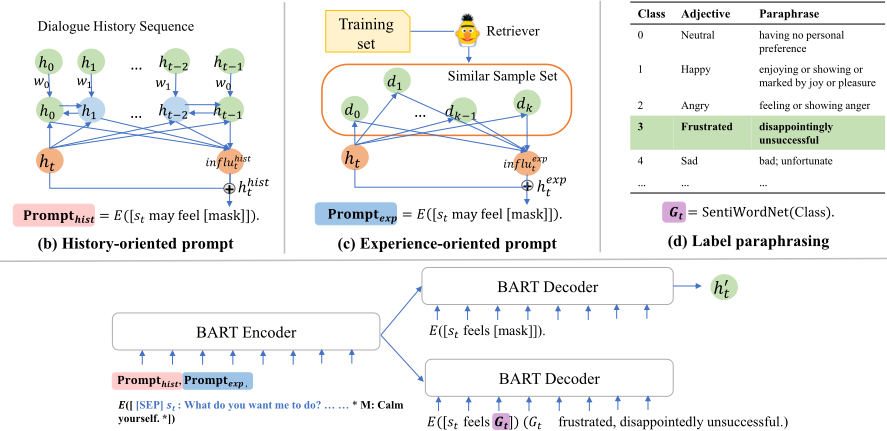
In this section, we present our multi-prompt and label paraphrasing (MPLP) model to mimic the thinking process. The overview of our model is shown in Fig. 1. Our model consists of two stages. The first stage is for utterance understanding, i.e., "1) What does the speaker say?". To this end, a PLM is fine-tuned to produce initial representations for utterances. The resulting model is saved as the base model (denoted as MPLPb). The second stage is for the modeling of next three questions including "2) What is the influence of the conversational context?", "3) What is the speaker's background?", and "4) How does the speaker feel?". Accordingly, we construct a history-oriented prompt and an experience-oriented
(a) An overview of our model at the second stage
Figure 1: An overview of our model. The first stage for utterance understanding is conventional and thus omitted, and we only present the structure used at the second stage (a). The utterance representations from the first stage are used to construct the history-oriented prompt (b) and the experience-oriented prompt (c). The label paraphrases from the SentiWordNet are used for the auxiliary generation task (d).
prompt based on the initial utterance representations from the first stage. Meanwhile, we perform an auxiliary task of label paraphrasing to leverage label semantics and fully elicit the lexical knowledge from the PLM.
3.3 Utterance Understanding
We adopt the generative PLM BART [Lewis et al., 2020] for utterance understanding. We package the most recent m utterances and their corresponding speaker names along with the target sentence into a token sequence Ct, and feed it to the BART encoder. To distinguish the target utterance (st, ut) from its context, a special token ∗ is added at the beginning and the end of the input utterance in the encoder. An emotional prompt Pt is sent to the decoder to get the representation of target utterance. E denotes the embedding layer:
The representation of the [mask] token in Ht, denoted as ht, which reflects the underlying emotion understood by the model, will be used for training the model at the first stage with a cross entropy loss. After the first stage, we can obtain a preliminary understanding of the target utterance.
3.4 History-oriented Prompt Construction
Many studies [Hazarika et al., 2018; Majumder et al., 2019; Shen et al., 2021b] have demonstrated the importance of historical information for the ERC task. However, the currently available prompt-based method CISPER [Yi et al., 2022] simply constructs a shared prompt for all utterances in a dialogue.
This hinders the model's ability to understand contextual information that is relevant to the target utterance. To address this issue, we propose a speaker-focused and history-oriented prompt generation method.
We generate a representation hi for each historical utterance ui using the fine-tuned BART obtained by the first stage. To concentrate on the utterances that are highly relevant to the target utterance, we calculate the representation similarity as the importance measure:
Following [Shen et al., 2021b], a relation-aware feature transformation is applied to each historical utterance:
where Whist i ∈ {W0,W1} is determined by whether a historical utterance ui is of the same speaker with the target utterance ut. This helps to distinguish the emotional effect of the current speaker and those of other speakers.
To make the emotional representation more contextualized, a Bi-LSTMmodule is applied to the historical sequence:
Finally, we aggregate the historical emotional information to obtain the influence influhist t of the conversational context on the current speaker. influhist t is further added to the original utterance representation to capture the emotional impact of the dialogue history:
Further, to allow the PLM to better utilize the target utterance-related history information, we construct a historyoriented prompt by replacing the embedding at the [mask] position in the original E([st may feel [mask]]) prompt with hhist t , and denote the resulting prompt as Prompthist :
Prompthist is appended to the input of the encoder at the second stage. During the training procedure, the historyoriented prompt is updated by dynamically selecting historical relevant information to continuously enhance the model.
3.5 Experience-oriented Prompt Construction
The speaker's background is also crucial to determine his/her attitude in the conversation. In particular, in multi-party conversations where the conversational context is less coherent, a speaker depends more on his/her experience in similar situations to facilitate conversation. In this section, we propose an experience-oriented prompt to encode the speaker's taskspecific background.
We consider the training set, which has been seen by the model at the first stage as the speaker's task-specific background, and retrieve similar samples in it to build the experience-oriented prompt. To find similar samples, we use a text retriever such as BERTScore [Zhang et al., 2020] and BM25 [Robertson and Zaragoza, 2009] to calculate the similarity between the target utterance ut and an utterance ud in the training set. The utterances with the top-k similarity are chosen as the similar sample set D.
By now, we have calculated the text similarity for the utterances themselves. However, as pointed out by previous work [Li et al., 2022], even emotions of the same expression can vary dramatically in different context. To model the similar situation more precisely, we calculate the contextinfluenced text similarity between the similar samples and the target utterance, which is implemented by element-wise product of the utterance representations followed by a linear transformation. Since at the first stage, the local context is partially incorporated into the utterance encoding procedure, we consider their similarity as an indicator of the context-influenced text similarity between utterances:
After the above two steps, we can use the training samples which are similar to the current utterance and have similar context as our prior experience to get a deep understanding of the speaker's background. Similar to the previous section, we use hexp t to construct the experience-oriented prompt:
Promptexp is also appended to the input of the encoder at the second stage to provide the speaker's background knowledge.
3.6 Label Paraphrasing
The rich semantics of labels are indispensable for distinguishing the subtle difference between labels. They are also beneficial to capture the text-label correlation. In view of this, we perform an auxiliary label paraphrasing task to assist the main emotion recognition task. We use the label names and their paraphrases in SentiWordNet 3.0 3 to conduct the label paraphrasing task. To be specific, for a given label, such as sadness, we map it to the corresponding adjective and generates the sense gloss Gt, which is the gloss of the most frequent sense 4 . Finally, the input of the encoder at the second stage is denoted as C ′ t :
There are two generative targets Pt and Gt on the decoder side. These two targets are fed into the decoder for two passes to get H′t and H′gt , which are used for emotion classification and label paraphrase generation, respectively:
H′gt = BART-Decoder(E([st feels Gt]), BART-Encoder(I ′
t ))
(15)
3.7 Training and Prediction
For the model training at the second stage, we take the representation of [mask] in H′t as the final representation h′t , and apply a feed-forward neural network to get the predicted emotion logits pt and the predicted label ˆ yt:
To fine-tune the model, the cross-entropy loss is used as the objective function:
where M is the number of conversations in the training set, Nj is the number of utterances in the j-th dialogue, and θ is the collection of trainable parameters in our model.
The auxiliary loss for generating label paraphrases is calculated and added via weighted sum:
where gr denotes the r-th token in the label gloss Gj,i, and α is a balancing weight for the loss of the label paraphrasing task.
3 Note that our model does not need paraphrase for inference.
4 We filter the paraphrases with both PosScore and NegScore equal to 0. Compared to the class category id and the adjective, the gloss contains more emotion-related words that are valuable for a deep label understanding.
4 Experimental Settings
4.1 Datasets andMetrics
We conduct experiments on three widely used ERC datasets, including MELD [Poria et al., 2019a], IEMOCAP [Busso et al., 2008], and DailyDialog [Li et al., 2017].
MELD is collected from the TV show Friends. It consists of multi-party conversations and there are 7 emotion labels including neutral, happiness, surprise, sadness, anger, disgust, and fear.
IEMOCAP is a multimodal dyadic conversation dataset where each conversation is performed by two actors. There are 6 types of emotion, namely, neutral, happiness, sadness, anger, frustrated, and excited.
DailyDialog is a large collection of daily dialogues. In each conversation, there are two speakers. Each utterance is classified as neutral, happiness, sadness, anger, surprise, disgust, and fear. Over 83% of utterances in DailyDialog are classified as neutral.
Only the textual modal information is used in our experiments. We adopt the micro-averaged F1 excluding the majority neutral class for DailyDialog and the weighted-average F1 for other two datasets as metrics [Shen et al., 2021b].
4.2 Baselines
We adopt 10 state-of-the-art baselines and divide them into two types: with or without external commonsense knowledge during inference. Our model belongs to the latter type.
DialogueRNN [Majumder et al., 2019] uses three GRUs to keep track of the speaker states, proceeding contexts, and proceeding emotion.
DialogueGCN [Ghosal et al., 2019] utilizes a graph-based structure to model self- and inter-speaker dependency of the interlocutors within a conversation.
DialogXL [Shen et al., 2021a] modifies the XLNet [Yang et al., 2019] with dialog-aware self-attention to capture useful intra- and inter-speaker dependencies.
DAG-ERC [Shen et al., 2021b] exploits a directed acyclic graph to model the information flow from both long-distance and nearby context in a conversation.
CoG-BART [Li et al., 2022] employs the BART-Large model, and augments it with supervised contrastive learning and response generation to facilitate dialogue understanding.
COSMIC [Ghosal et al., 2020] is the first model that incorporates different elements of commonsense and leverages them to update conversation states.
TODKAT [Zhu et al., 2021] combines topic information to help the model choose commonsense that is more relevant to the topic of current conversation.
SKAIG [Li et al., 2021] builds a locally connected graph and classifies commonsense elements into present, past, and future types to enhance emotion transitions in the graph.
CauAIN [Zhao et al., 2022] treats commonsense as the cause of emotion and adopts the attention mechanism to connect utterances.
CISPER [Yi et al., 2022] is the first to leverage prompt learning for ERC. The context and commonsense of the entire conversation are encoded into shared prompts for utterances in a dialogue.
| Model | MELD | IEMOCAP | DailyDialog | |
|---|---|---|---|---|
| without commonsense | DialogueRNN DialogueGCN | 63.61 63.02 62.41 | 64.76 64.91 65.94 67.10 | 57.32 57.52 54.93 58.25 |
| DialogXL | ||||
| DAG-ERC* | 63.37 | |||
| CoG-BART | 64.81 | 66.18 | 56.29 | |
| COSMIC | 65.21 | 65.28 | 58.48 | |
| TODKAT with | 65.47 | 61.33 | 58.47 | |
| SKAIG commonsense | 65.18 | 66.96 | 59.75 | |
| CauAIN* | 65.15 | 64.29 | 57.08 | |
| CISPER* | 64.99 | 55.20 | 56.80 | |
| Ours | MPLPb | 65.46 | 64.85 | 57.06 |
| MPLP | 66.51 | 66.65 | 59.92 |
4.3 Implementation
The training process is divided into two stages. At the first stage, we fine-tune the BART-Larget model for a batch size of 8 utterances. Following [Li et al., 2022], the AdamW optimizer is adopted with a learning rate of 2e-5 with a linear scheduled warm-up strategy. Our model is trained 4, 10, and 4 epochs for MELD, IEMOCAP, and DailyDialog, and the maximum input text length is set to 128, 160, and 128, respectively. After that, we start the prompting and paraphrasing for an additional 1 epoch at the second stage. The size of retrieved similar samples and the paraphrasing loss ratio is set via grid search. We use BERTScore as the text retriever for MELD and IEMOCAP, and BM25 for DailyDialog. The results on the test set come from the best checkpoint in the validation set. All experiments are performed on a single GeForce RTX 3090 GPU and are averaged over 3 runs.
5 Results and Analysis
5.1 Main Comparison Results
Themain comparison results are shown inTable 1. In general, our MPLP model achieves the best performance on MELD and DailyDialog datasets, and its performance on IEMOCAP is also very competitive.
MELD The models based on commonsense knowledge perform better on this dataset. This suggests that commonsense knowledge can provide additional information and facilitate the understanding of the utterances. Moreover, our base model MPLPb, which does not utilize commonsense knowledge, can achieve almost the same result as the best baseline TODKAT, indicating the strong utterance understanding capability of the PLM itself. Finally, with our proposed prompts and label paraphrasing, our complete model outperforms TODKAT by an absolute 1.04 F1 increase. This clearly demonstrates that our human-mimicking process can get a more comprehensive understanding of dialogue utterances.
IEMOCAP On this dataset, the graph-based models such as DAG-ERC and SKAIG can produce good results. The main reason is that the conversations in IEMOCAP is extremely long [Shen et al., 2021b], requiring complex stacked graph structures to model the dependencies of distant dialogues. Note that the performance of CISPER, which is also based on prompt, is extremely poor on this dataset. In contrast, our model closely follows behind DAG-ERC and SKAIG and is better than all other methods, indicating that our proposed prompt and paraphrasing learning mechanism can compensate for the issue of complicated dialogue structure modeling.
| MELD | IEMOCAP | DailyDialog | |
|---|---|---|---|
| Full Model | 66.51 | 66.65 | 59.92 |
| w/o Hist Prompt | 65.76(↓0.75) | 65.28(↓1.37) | 58.60(↓1.32) |
| w/o Exp Prompt | 65.77(↓0.74) | 65.39(↓1.26) | 59.38(↓0.54) |
| w/o Label Para. | 66.00(↓0.51) | 65.81(↓0.84) | 59.52(↓0.40) |
DailyDialog It is hard to recognize emotion from daily dialogues, and thus all methods produce worse results on this dataset than those on other two datasets. Nevertheless, our model outperforms the models without commonsense by at least an absolute 1.67 F1 increase. It also surpasses the models with commonsense and future information, showing the enormous understanding capacity of our proposed humanmimicking framework.
5.2 Ablation Analysis
To verify the effectiveness of each component in our model, we conduct a series of ablation study, by removing the history-oriented prompt (denoted as w/o Hist Prompt), the experience-oriented prompt (denoted as w/o Exp Prompt), and the label paraphrasing task (denoted as w/o Label Para) from the complete MPLP. The results are shown in Table 2. As we can observe, the performance drops on all datasets when each of the components is removed from the model. This proves the effectiveness of our proposed framework.
The history-oriented prompt yields the greatest impacts on three datasets. This is consistent with the findings in previous studies. Notably, the experience-oriented prompt makes almost the same contribution as the conversational context on MELD and IEMOCAP. This demonstrates that the modeling of speaker's background, which is first attempt made by us for the ERC task, is indeed essential for the understanding of the target utterance in most cases. The influence of experienceoriented prompt is not that significant on DailyDialog. The reason might be that daily conversations are often diversified, and it is hard to trace the speaker's background from the training set.
| Model | MELD | IEMOCAP | DialyDialog |
|---|---|---|---|
| MPLP | 66.51 | 66.65 | 59.92 |
| rep. Add | 65.67(↓0.84) | 64.99(↓1.66) | 58.12(↓1.80) |
| rep. Concatenate | 65.00(↓1.51) | 65.55(↓1.10) | 57.11(↓2.81) |
Label paraphrasing shows the greatest impact on IEMOCAP. This might be due to that the emotion labels in this dataset are much ambiguous. For example, it is hard to distinguish sadness, anger, and frustrated since these types of emotion are often mixed together, and thus label paraphrasing helps a lot in disambiguation.
5.3 Parameter Study
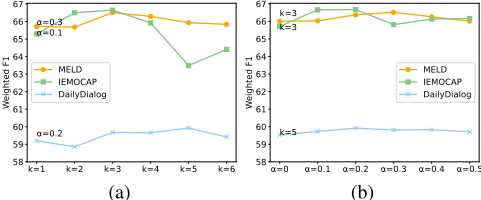
There are two parameters in our framework: the number of similar samples k and the ratio of paraphrase generation loss α. In this section, we investigate the impact of these two parameters. The results are drawn in Fig. 2. We find that the trends on different datasets are similar with the change of parameters. They first rise to a peak and then fall gradually. A small k does not provide enough experience. When k is too large, the model is prone to introduce too much noise since more dissimilar sentences are added. The model with a small α can hardly learn label-semantics related information. If α is too large, the model may excessively emphasize the label semantics and ignores other factors.
5.4 Using Prompts vs. Using Features
We investigate the way in using the historical and background information, e.g., is prompt based learning a better way or can we simply use the same information as features?
To this end, we directly fuse the history or experience influenced representations to the utterance embeddings instead of using them as prompts. To be specific, we add (denoted as rep. Add) or concatenate (denoted as rep. Concatenate) these representations to the decoder output for final classification. In the first case, the classification head of the first stage is reused. In the second case, we retrain a new classification head with more epochs for a fair comparison since the feature dimensionality increases. The results are shown in Table 3.
As can be seen, though the same representations from conversational context and the speaker's background are fused into the final embeddings, both the performance of rep. Add and that of rep. Concatenate are consistently worse than our MPLP across all datasets. This indicates that the prompt based learning is a better way to inject relevant knowledge since the prompts are more understandable to a PLM than symbolic features.
5.5 Paraphrase Design
In this section, we examine the impact of paraphrase design on the model performance. We employ three experimental setups. The default one is our proposed MPLP model in this paper, which uses the gloss of the target label in SentiWordNet as the generative target. The second one uses a special token for a label (denoted as rep. Special Token). The third one adopts the corresponding adjective of the emotion label (denoted as rep. Label Adjective) as the target. The results are shown in Table 5.
| Conversational Context | Similar Sample Set | DAG-ERCCISPER | Ours | |
|---|---|---|---|---|
| ...... Chandler: I mean, that guy with the toe thing? (anger) Chandler: Who's he sleeping with? (neutral) Chandler: Oh, c'mon Dora, don't be mad... (neutral) ...... | (1) Rachel: Mom, c'mon, stop worrying. (fear) (2) Rachel: Hey, c'mon, cut it out. (joy) (3) Rachel: Oh, c'mon. She's a person, you can do it! (joy) | sadness % | anger % | neutral ! |
| Monica: I can't find garbage bags! (anger) Rachel: Oh, I think I saw some in here. (neutral) Monica: What is it?! (surprise) ...... | (1) Chandler: I can't figure this out! (anger) (2) Rachel: I can't watch! (fear) (3) Monica: I can't do it! (sadness) | fear % | sadness | %anger ! |
| ...... Phoebe: Ohh, let me see it! Let me see your hand! (surprise)(2) Monica: Why do you want to see my hand? (neutral) Phoebe: I wanna see what's in your hand. I wanna see the trash. (disgust) . . . ... | (1) Charlie: I was (surprise) Chandler: I like her. (neutral) (3) Woman: I love your car. (joy) | neutral % | neutral % | disgust ! |
| Model | MELD | IEMOCAP | DailyDialog |
|---|---|---|---|
| MPLP | 66.51 | 66.65 | 59.92 |
| rep. Special Token | 65.72(↓0.79) | 65.01(↓1.64) | 59.75(↓0.17) |
| rep. Label Adjective | 66.21(↓0.30) | 65.72(↓0.93) | 60.10(↑0.18) |
We find that the performance of rep. Special Token variant declines dramatically on all datasets. This is because the randomly initialized special tokens contain no semantics and cannot provide a proper guidance for the model. Compared to the special token, the performance of rep. Label Adjective variant is better, demonstrating the effectiveness of label understanding. The performance can be further improved by exploiting label glosses from SentiWordNet on MELD and IEMOCAP. However, the label's adjective works slightly better than the label paraphrasing on DailyDialog. This might be due to the diversity of the utterances in this dataset, where the the most frequent paraphrase of the emotion label cannot well satisfy such requirement and the corresponding adjective provides a more precise meaning for the label. Overall, label paraphrasing is helpful in most cases, yet its design can be further optimized, which we leave for the future work.
5.6 Case Study
To have a close look at the impact of the proposed prompts and label paraphrasing mechanism in our framework, We conduct a case study and show the results in Table 4.
The first case shows the effectiveness of history-oriented prompt. DAG-ERC misclassifies the utterance as sadness, showing that it fails to capture the context. CISPER incorporates the context but it pays more attention on the utterance with anger emotion. In contrast, our model can select relevant information and make the correct prediction of neutral. To further confirm the effect of the history-oriented prompt, we replace our prompt with feature concatenation (Sec. 5.4), and find this variant also produces an anger label.
The second case demonstrates the effectiveness of experience-oriented prompt. As the first utterance in the dialogue, the target utterance does not have any history information. As a result, both DAG-ERC and CISPER are unable to accurately recognize its emotion. In contrast, our model can make a correct prediction based on its prior experience. As can be seen, there is a utterance in the similar sample set which conveys the same emotion of angry as that for the target utterance.
The third case emphasizes the importance of label paraphrasing, where no historical utterance or similar sample is related to the emotion of disgust. DAG-ERC and CISPER directly classify the utterance as neutral. In contrast, the word "trash", which is associated with the label's semantics of "disgust", helps our model to make a correct prediction.
In summary, the history-oriented prompt, the experienceoriented prompt, and the label paraphrasing improve our model's capability to recognize emotion in conversations.
6 Conclusion
We propose a novel framework for the ERC task which mimics the thinking process of a human being. We realize this process with a history-oriented prompt, an experienceoriented prompt, and the label paraphrasing mechanism, which can improve the understanding of the conversational context, the speaker's background, and the label semantics, respectively. We conduct experiments on three datasets, the results show that our method achieves competitive performance with the state-of-the-art baselines, proving the necessity of the modeling of human-thinking process, especially the understanding of the speaker's background, which has not been touched by existing studies. The ablation study and indepth analysis further confirm the importance and effectiveness of using prompts and paraphrasing in our framework.
Ethical Statement
Emotion Recognition in Conversation has been a popular research topic in the academic community for a long time. The data and code used in our experiments are all open-source resources for research purposes.
Acknowledgements
This work was supported by the grant from the National Natural Science Foundation of China (NSFC) project (No. 62276193). It was also supported by the Joint Laboratory on Credit Science and Technology of CSCI-Wuhan University.
@inproceedings{ijcai2023p699,
  title     = {Mimicking the Thinking Process for Emotion Recognition in Conversation with Prompts and Paraphrasing},
  author    = {Zhang, Ting and Chen, Zhuang and Zhong, Ming and Qian, Tieyun},
  booktitle = {Proceedings of the Thirty-Second International Joint Conference on
               Artificial Intelligence, {IJCAI-23}},
  publisher = {International Joint Conferences on Artificial Intelligence Organization},
  editor    = {Edith Elkind},
  pages     = {6299--6307},
  year      = {2023},
  month     = {8},
  note      = {AI for Good},
  doi       = {10.24963/ijcai.2023/699},
  url       = {https://doi.org/10.24963/ijcai.2023/699},
}
TY - CPAPER TI - Mimicking the Thinking Process for Emotion Recognition in Conversation with Prompts and Paraphrasing AU - Zhang, Ting AU - Chen, Zhuang AU - Zhong, Ming AU - Qian, Tieyun T2 - Proceedings of the Thirty-Second International Joint Conference on Artificial Intelligence, IJCAI-23 PB - International Joint Conferences on Artificial Intelligence Organization PY - 2023 SP - 6299 EP - 6307 DO - 10.24963/ijcai.2023/699 UR - https://doi.org/10.24963/ijcai.2023/699 ER -Copied
Machine-readable versions of this paper, for tools and AI agents:





