
Plansformer Tool: Demonstrating Generation of Symbolic Plans Using Transformers
Proceedings of the Thirty-Second International Joint Conference on Artificial Intelligence. Demo Track. Pages 7158-7162.
https://doi.org/10.24963/ijcai.2023/839
Keywords
- Planning and Scheduling: PS: Learning in planning and scheduling
- Natural Language Processing: NLP: Language generation
Abstract
Plansformer is a novel tool that utilizes a fine-tuned language model based on transformer architecture to generate symbolic plans. Transformers are a type of neural network architecture that have been shown to be highly effective in a range of natural language processing tasks. Unlike traditional planning systems that use heuristic-based search strategies, Plansformer is fine-tuned on specific classical planning domains to generate high-quality plans that are both fluent and feasible. Plansformer takes the domain and problem files as input (in PDDL) and outputs a sequence of actions that can be executed to solve the problem. We demonstrate the effectiveness of Plansformer on a variety of benchmark problems and provide both qualitative and quantitative results obtained during our evaluation, including its limitations. Plansformer has the potential to significantly improve the efficiency and effectiveness of planning in various domains, from logistics and scheduling to natural language processing and human-computer interaction. In addition, we provide public access to Plansformer via a website as well as an API endpoint; this enables other researchers to utilize our tool for planning and execution. The demo video is available at https://youtu.be/_1rlctCGsrk
- [Aeronautiques et al., 1998] Constructions Aeronautiques, Adele Howe, Craig Knoblock, ISI Drew McDermott, Ash- win Ram, Manuela Veloso, Daniel Weld, David Wilkins SRI, Anthony Barrett, Dave Christianson, et al. Pddl-the planning domain definition language. Technical Report, Tech. Rep., 1998.
- [Brown et al., 2020] Tom Brown, Benjamin Mann, Nick Ry- der, Melanie Subbiah, Jared D Kaplan, Prafulla Dhari- wal, Arvind Neelakantan, Pranav Shyam, Girish Sastry, Amanda Askell, et al. Language models are few-shot learners. Advances in neural information processing sys- tems, 33:1877-1901, 2020.
- [Chen et al., 2021] Mark Chen, Jerry Tworek, Heewoo Jun, Qiming Yuan, Henrique Ponde de Oliveira Pinto, Jared Kaplan, Harri Edwards, Yuri Burda, Nicholas Joseph, Greg Brockman, et al. Evaluating large language models trained on code. arXiv preprint arXiv:2107.03374, 2021.
- [Chowdhery et al., 2022] Aakanksha Chowdhery, Sharan Narang, Jacob Devlin, Maarten Bosma, Gaurav Mishra, Adam Roberts, Paul Barham, Hyung Won Chung, Charles Sutton, Sebastian Gehrmann, et al. Palm: Scal- ing language modeling with pathways. arXiv preprint arXiv:2204.02311, 2022.
- [Cobbe et al., 2021] Karl Cobbe, Vineet Kosaraju, Moham- mad Bavarian, Jacob Hilton, Reiichiro Nakano, Christo- pher Hesse, and John Schulman. Training verifiers to solve math word problems. arXiv preprint arXiv:2110.14168, 2021.
- [Devlin et al., 2018] Jacob Devlin, Ming-Wei Chang, Ken- ton Lee, and Kristina Toutanova. Bert: Pre-training of deep bidirectional transformers for language understand- ing. arXiv preprint arXiv:1810.04805, 2018.
- [Gerety and Cull, 1986] C Gerety and P Cull. Time com- plexity of the towers of hanoi problem. SIGACT News, 18(1):80-87, mar 1986.
- [Ghallab et al., 2004a] Malik Ghallab, Dana Nau, and Paolo Traverso. Automated Planning: theory and practice. El- sevier, 2004.
- [Ghallab et al., 2004b] Malik Ghallab, Dana Nau, and Paolo Traverso. Automated Planning: Theory and Practice. The Morgan Kaufmann Series in Artificial Intelligence. Mor- gan Kaufmann, Amsterdam, 2004.
- [Ghallab et al., 2014] Malik Ghallab, Dana Nau, and Paolo Traverso. The actors view of automated planning and act- ing: A position paper. Artificial Intelligence, 208:1-17, 2014.
- [Gupta and Nau, 1991] Naresh Gupta and Dana S. Nau. Complexity results for blocks-world planning. In In Pro- ceedings of AAAI-91, pages 629-633, 1991.
- [Helmert and Domshlak, 2011] Malte Helmert and Carmel Domshlak. Lm-cut: Optimal planning with the landmark- cut heuristic. Seventh international planning competition (IPC 2011), deterministic part, pages 103-105, 2011.
- [Helmert, 2006] Malte Helmert. The fast downward plan- ning system. Journal of Artificial Intelligence Research, 26:191-246, 2006.
- [Hendrycks et al., 2021a] Dan Hendrycks, Steven Basart, Saurav Kadavath, Mantas Mazeika, Akul Arora, Ethan Guo, Collin Burns, Samir Puranik, Horace He, Dawn Song, et al. Measuring coding challenge competence with apps. arXiv preprint arXiv:2105.09938, 2021.
- [Hendrycks et al., 2021b] Dan Hendrycks, Collin Burns, Saurav Kadavath, Akul Arora, Steven Basart, Eric Tang, Dawn Song, and Jacob Steinhardt. Measuring mathemati- cal problem solving with the math dataset. arXiv preprint arXiv:2103.03874, 2021.
- [Howey et al., 2004] Richard Howey, Derek Long, and Maria Fox. Val: Automatic plan validation, continuous effects and mixed initiative planning using pddl. In 16th IEEE International Conference on Tools with Artificial In- telligence, pages 294-301. IEEE, 2004.
- [ICAPS, 2022] ICAPS. International planning competi- tions at international conference on automated plan- ning and scheduling (icaps). In https://www.icaps- conference.org/competitions/, 2022. Link
- [Jiménez et al., 2012] Sergio Jiménez, Tomás De La Rosa, Susana Fernández, Fernando Fernández, and Daniel Bor- rajo. A review of machine learning for automated plan- ning. The Knowledge Engineering Review, 27(4):433- 467, 2012.
- [Lamanna et al., 2023] Leonardo Lamanna, Luciano Ser- afini, Mohamadreza Faridghasemnia, Alessandro Saffiotti, Alessandro Saetti, Alfonso Gerevini, and Paolo Traverso. Planning for learning object properties. arXiv preprint arXiv:2301.06054, 2023.
- [Li, 2022] Hang Li. Language models: Past, present, and future. Commun. ACM, 65(7):56-63, jun 2022.
- [Lin, 2004] Chin-Yew Lin. Rouge: A package for automatic evaluation of summaries. In Text summarization branches out, pages 74-81, 2004.
- [Long and Fox, 2003] Derek Long and Maria Fox. The 3rd international planning competition: Results and analysis. Journal of Artificial Intelligence Research, 20:1-59, 2003.
- [Muise, 2015] Christian Muise. Planning domains. http:// planning.domains/, 2015. Accessed: 2023-02-20. Link
- [Pallagani et al., 2022] Vishal Pallagani, Bharath Mup- pasani, Keerthiram Murugesan, Francesca Rossi, Lior Horesh, Biplav Srivastava, Francesco Fabiano, and An- drea Loreggia. Plansformer: Generating symbolic plans using transformers. arXiv preprint arXiv:2212.08681, 2022.
- [Pallagani, 2023a] Vishal Pallagani. Plansformer api. http: //129.252.131.13/plansformer/, 2023. Accessed: 2023-02- 20. Link
- [Pallagani, 2023b] Vishal Pallagani. Plansformer website. https://uo-sc-plansformer.vercel.app/, 2023. Accessed: 2023-02-20. Link
- [Papineni et al., 2002] Kishore Papineni, Salim Roukos, Todd Ward, and Wei-Jing Zhu. Bleu: a method for au- tomatic evaluation of machine translation. In Proceedings of the 40th annual meeting of the Association for Compu- tational Linguistics, pages 311-318, 2002.
- [Roberts et al., 2014] Mark Roberts, Adele Howe, and In- drajit Ray. Evaluating diversity in classical planning. In Proceedings of the International Conference on Auto- mated Planning and Scheduling, volume 24, pages 253- 261, 2014.
- [Scao et al., 2022] Teven Le Scao, Angela Fan, Christo- pher Akiki, Ellie Pavlick, Suzana Ilić, Daniel Hesslow, Roman Castagné, Alexandra Sasha Luccioni, Franc ¸ois Yvon, Matthias Gallé, et al. Bloom: A 176b-parameter open-access multilingual language model. arXiv preprint arXiv:2211.05100, 2022.
- [Seipp et al., 2016] Jendrik Seipp, Florian Pommerening, Gabriele Röger, and Malte Helmert. Correlation complex- ity of classical planning domains. 2016. IJCAI
- [Silver et al., 2022] Tom Silver, Varun Hariprasad, Reece S Shuttleworth, Nishanth Kumar, Tomás Lozano-Pérez, and Leslie Pack Kaelbling. Pddl planning with pretrained large language models. In NeurIPS 2022 Foundation Models for Decision Making Workshop, Oct 2022.
- [Valmeekam et al., 2022] Karthik Valmeekam, Alberto Olmo, Sarath Sreedharan, and Subbarao Kambhampati. Large language models still can't plan (a benchmark for llms on planning and reasoning about change). arXiv preprint arXiv:2206.10498, 2022.
- [Vaswani et al., 2017] Ashish Vaswani, Noam Shazeer, Niki Parmar, Jakob Uszkoreit, Llion Jones, Aidan N Gomez, Łukasz Kaiser, and Illia Polosukhin. Attention is all you need. Advances in neural information processing systems, 30, 2017.
- [Veloso et al., 1995] Manuela Veloso, Jaime Carbonell, Ali- cia Perez, Daniel Borrajo, Eugene Fink, and Jim Blythe. Integrating planning and learning: The prodigy architec- ture. Journal of Experimental & Theoretical Artificial In- telligence, 7(1):81-120, 1995.
- [Wang et al., 2021] Yue Wang, Weishi Wang, Shafiq Joty, and Steven CH Hoi. Codet5: Identifier-aware unified pre- trained encoder-decoder models for code understanding and generation. In Proceedings of the 2021 Conference on Empirical Methods in Natural Language Processing, pages 8696-8708, 2021.
- [Younes et al., 2005] Håkan LS Younes, Michael L Littman, David Weissman, and John Asmuth. The first probabilistic track of the international planning competition. Journal of Artificial Intelligence Research, 24:851-887, 2005.
- [Zimmerman and Kambhampati, 2003] Terry Zimmerman and Subbarao Kambhampati. Learning-assisted automated planning: Looking back, taking stock, going forward. AI Magazine, 24(2):73-73, 2003.
References were extracted automatically from the PDF and may contain errors.
Full text extracted automatically from the PDF; figures, tables and equations may differ. The PDF is the version of record.
1 Introduction
Large Language Models (LLMs) have revolutionized the field of Natural Language Processing (NLP), outperforming humans in various natural language tasks [Vaswani et al., 2017; Devlin et al., 2018; Brown et al., 2020; Scao et al., 2022; Chowdhery et al., 2022; Li, 2022]. However, their use in domains involving symbols, such as mathematics [Hendrycks et al., 2021b; Cobbe et al., 2021], coding [Hendrycks et al., 2021a; Chen et al., 2021], and automated planning [Lamanna et al., 2023; Jim´enez et al., 2012], has been limited due to their inability to reason with symbolic data. In this paper, we To accomplish this, we create a training and test set for four classical planning domains and use CodeT5 (base) [Wang et al., 2021], a pre-trained code generation model, as the LLM. We then present Plansformer, which is obtained by fine-tuning CodeT5 on planning problems, making it capable of generating symbolic plans of high quality. Our experimental results indicate that the syntactic and symbolic knowledge learned from different programming languages in the CodeT5 model can be useful for the PDDL-based automated planning task, achieving promising results in generating valid and optimal plans.
Plansformer is not intended to replace traditional automated planners, which are capable of generating valid or optimal plans, but rather complement them. A Plansformer can play to its benefit as a fast solver and has relaxation in terms of correctness, while the traditional planner can be used as a sound and complete solver, which is deliberative and always generates a correct output. This work also explores LLMs' capabilities in dealing with symbolic language, revealing a promising direction to harness LLMs for symbolic tasks such as planning. This is a significant contribution as prior work [Valmeekam et al., 2022; Silver et al., 2022] has shown that even state-of-the-art LLMs, such as GPT-3 [Brown et al., 2020], cannot reason with symbolic data.
2 Background andMethodology
Automated planning is a field of AI concerned with generating plans to achieve goals [Ghallab et al., 2004a; Ghallab et al., 2004b]. Traditional approaches use search algorithms but have scalability and uncertainty limitations [Ghallab et al., 2014]. Learning-based approaches, leveraging machine learning, can overcome these limitations, learn from data, generalize to new domains, and improve performance [Veloso et al., 1995; Zimmerman and Kambhampati, 2003]. We present a comparison of traditional and learning-based planning approaches in Table 2.
Plansformer, a learning-based planner is generated and tested in two phases: modeling and evaluation. Fine-tuning the CodeT5 to address planning syntax and semantics for the first phase, and evaluating the competency of Plansformer as a language model and planner for the second phase. The sequence of actions generated by Plansformer are validates using both language based (e.g. ROUGE, BLEU) and planning based metrics (e.g. validity, optimality).
| Models | Valid Plans (%) | Invalid Failed (%) | Plans Incomplete/Wrong (%) | Optimal Plans (%) | Avg. Time (sec) | |
|---|---|---|---|---|---|---|
| FastDownward Truth) | (Ground | 100% | - | - | 100% | 10.28s |
| GPT-2 | 0% | 0% | 100% | 0% | 0.05s | |
| T5-base | 0.25% | 17.3% | 82.7% | 0.25% | 0.47s | |
| Codex | 0.15% | 99.85% | 0% | 0.15% | 1s | |
| CodeT5-base | 0.6% | 0% | 99.4% | 0.6% | 0.68s | |
| Plansformer | 83.64% | 16.18% | 0.19% | 73.27% | 0.06s | |
| Plansformer-bw | 90.04% | 9.94% | 0.02% | 88.44% | 0.05s | |
| Plansformer-hn | 84.97% | 14.72% | 0.31% | 82.58% | 0.05s | |
| Plansformer-gr | 82.97% | 16.61% | 0.42% | 69.47% | 0.06s | |
| Plansformer-dl | 76.56% | 23.44% | 0% | 52.61% | 0.09s |
| Criteria | Traditional Planners | Learning-based Planning |
|---|---|---|
| Representation | Symbolic representation, logical reasoning | Neural network-based, data-driven |
| Scalability | Limited scalability, exponential growth of state space | Scalable to large state spaces, can learn from large data sets |
| Accuracy | Can guarantee correctness, optimal solutions | Prone to errors, suboptimal solutions |
| Generalization | Limited ability to generalize to unseen do- mains | Can generalize to unseen domains with sufficient training data |
| Interpretability | Human-understandable, explainable | Lack of interpretability, black-box models |
| Efficiency | Inefficient for large state spaces, computa- tionally expensive | Can be more efficient than traditional planners, especially for large state spaces |
2.1 Modeling Phase
In the modeling phase, we fine-tune CodeT5 by creating a planning-based dataset. We focus on four classical planning benchmark domains from International Planning Competitions [ICAPS, 2022; Younes et al., 2005; Long and Fox, 2003]: Blocksworld [Gupta and Nau, 1991], Towers of Hanoi [Gerety and Cull, 1986], Grippers [Seipp et al., 2016], and Driverlog [Roberts et al., 2014], each with multiple problem instances. We generate optimal plans [Helmert and Domshlak, 2011] for each problem instance using the FastDownward planner [Helmert, 2006]. The generated dataset for each domain contains 18,000 plans with different problem configurations, and we use 5-fold cross-validation for training. We use a Byte-level BPE tokenizer with a vocabulary size of 32,005 and add PDDL-specific tokens ([GOAL], [INIT], [ACTION], [PRE], [EFFECT]) to simplify the input to Plansformer, which represents the goal state, initial state, possible actions with their associated preconditions and effects caused by the actions in the environment. CodeT5 is well-suited for planning tasks as it can generate goal-directed, structured code with semantic meaning. We fine-tune it with 80% of the 18,000 generated samples for each of the four domains in the planning dataset.
2.2 Evaluation Phase
In the evaluation phase of Plansformer, the model is tested for both plan validation and language model competency. For plan validation, the sequence of actions generated by Plansformer must guide an agent from the initial state to the goal state for a given problem instance, and we evaluate for optimality and validity using a plan validation tool called VAL [Howey et al., 2004]. For language model competency, we use metrics such as BLEU [Papineni et al., 2002] and ROUGE-L [Lin, 2004] to measure precision and recall, respectively. Although these metrics have no direct intuition in automated planning, we use them to evaluate the task of plan generation from the perspective of LLMs. The results of these evaluations provide conclusive evidence on how well Plansformer generates plans and its performance as a language model.
3 SystemDemonstration
The website [Pallagani, 2023b] provides an easy-to-use interface to exploit all the functionalities of Plansformer. It also provides all the information to guide the user through the different features made available, for instance how to use and leverage the various features and tools for editing and generating plans. On the landing page, the tool is introduced to the user, along with instructions on how to use it. By clicking on the editor button (in the menu bar), the user is directed to the tool usage page. The website provides an intuitive PDDL [Aeronautiques et al., 1998] editor, where the user can add or edit code files as per their requirements. Figure 1 provides an example of the editor page with the Blocksworld domain in PDDL.
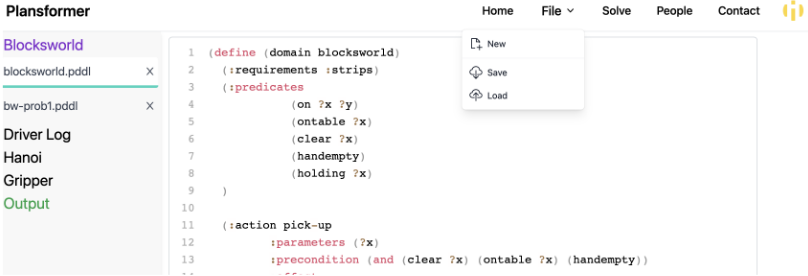
For the user's convenience, the website offers a reference to some problem instances from the four domains under study. Furthermore, the user can create new files on the website or upload files from their local system. To facilitate the user's experience, the website also offers the functionality of saving files from the Plansformer tool to their local file storage.
The solve functionality is the next step in the user journey. To initiate the plan generation process, the user needs to choose a domain and its corresponding problem file. The website provides an optional plan validity checker, which enables the user to know the validity and optimality characteristics of the generated plan. Once the solution is obtained, the output is displayed, and the user is shown the generated plan, a summary of the selected domain and problem, along with the validation results if requested. Researchers can also leverage the API to use Plansformer for their work [Pallagani, 2023a], in order to use the API endpoint domain and problem files must be specified as input, as reported in Listing 1
c u r l -X POST \ -H ' Content -Type : mu l t i p a r t / form-data '\ -F ' domain=@/ pa th / t o / domain . pddl ' \ -F ' problem=@/ pa th / t o / problem . pddl ' \ h t t p : / / 1 2 9 . 2 5 2 . 1 3 1 . 1 3 / p l ans f o rme r /Sometimes users may experience some delays in the computation of a solution. The website is implemented for demonstration purposes and it is based on a basic server. This is the reason for the increased latency of plan generation in the demo website which can leverage only on CPUs for the computation of a solution. The website is inspired by the well-known online planning tool [Muise, 2015], which should help users in getting familiar with our solution.
4 SystemEvaluation
Plansformer is evaluated on multiple planning domains of varying complexities using both quantitative and qualitative measures. For model evaluation, Plansformer is compared with other language models using the model evaluation metrics (ROUGE and BLEU) and the results as seen in Table 3, show that Plansformer outperforms all other models, including Codex [Chen et al., 2021]. However, for plan validation, FastDownward, a traditional classical planning system is also added to the test-bed. Plans generated by Plansformer are evaluated for validity and optimality, and the results as seen in Table 1, show that Plansformer performs best in simple planning domains (such as blocksworld) but generates fewer optimal plans in complex domains (such as driverlog). The paper reports that the average time taken by Plansformer to solve the test-bed of problems is approximately 200 times faster than the FastDownward planner 1 . The study by [Pallagani et al., 2022] provides a comprehensive account of the experimental methodology and outcomes achieved through the application of Plansformer, offering an in-depth analysis of the results obtained.
| Models | ROUGE-Lrecall | ROUGE-Lprecision | ROUGE-Lfmeasure | BLEU |
|---|---|---|---|---|
| GPT-2 | 0.04 | 0.14 | 0.06 | 0.07 |
| T5-base | 0.16 | 0.70 | 0.26 | 0.02 |
| Codex | 0.72 | 0.52 | 0.60 | 0.36 |
| CodeT5-base | 0.41 | 0.28 | 0.33 | 0.02 |
| Plansformer | 0.93 | 0.93 | 0.93 | 0.89 |
| Plansformer-bw | 0.97 | 0.99 | 0.98 | 0.90 |
| Plansformer-hn | 0.99 | 0.96 | 0.97 | 0.95 |
| Plansformer-gr | 0.94 | 0.94 | 0.94 | 0.92 |
| Plansformer-dl | 0.82 | 0.83 | 0.82 | 0.79 |
5 Conclusion
In this demonstration, we have showcased a novel tool that leverages an LLM for generating and validating plans for classical problems in four selected domains. As a next step, we are actively expanding the tool's applicability to various other planning domains, aiming to enhance its generalizability and versatility. In future iterations, we plan to extend the tool's capabilities to address more complex planning scenarios, including epistemic and hierarchical planning. Additionally, we aim to enable the tool to automatically repair invalid plans, and to enhance its visual output to facilitate easier plan interpretation and analysis.
1 when used with GPU capabilities
@inproceedings{ijcai2023p839,
  title     = {Plansformer Tool: Demonstrating Generation of Symbolic Plans Using Transformers},
  author    = {Pallagani, Vishal and Muppasani, Bharath and Srivastava, Biplav and Rossi, Francesca and Horesh, Lior and Murugesan, Keerthiram and Loreggia, Andrea and Fabiano, Francesco and Joseph, Rony and Kethepalli, Yathin},
  booktitle = {Proceedings of the Thirty-Second International Joint Conference on
               Artificial Intelligence, {IJCAI-23}},
  publisher = {International Joint Conferences on Artificial Intelligence Organization},
  editor    = {Edith Elkind},
  pages     = {7158--7162},
  year      = {2023},
  month     = {8},
  note      = {Demo Track},
  doi       = {10.24963/ijcai.2023/839},
  url       = {https://doi.org/10.24963/ijcai.2023/839},
}
TY - CPAPER TI - Plansformer Tool: Demonstrating Generation of Symbolic Plans Using Transformers AU - Pallagani, Vishal AU - Muppasani, Bharath AU - Srivastava, Biplav AU - Rossi, Francesca AU - Horesh, Lior AU - Murugesan, Keerthiram AU - Loreggia, Andrea AU - Fabiano, Francesco AU - Joseph, Rony AU - Kethepalli, Yathin T2 - Proceedings of the Thirty-Second International Joint Conference on Artificial Intelligence, IJCAI-23 PB - International Joint Conferences on Artificial Intelligence Organization PY - 2023 SP - 7158 EP - 7162 DO - 10.24963/ijcai.2023/839 UR - https://doi.org/10.24963/ijcai.2023/839 ER -Copied
Machine-readable versions of this paper, for tools and AI agents:





